
When the Line Went Dead, the Mafia Boss Who Never Ran Drove Through the Rain for the Only Woman Who Was Not Afraid of Him
Part 1
The deadbolt did not hold.
Cindy Stone heard the wood complain before she heard his voice, a low animal sound on the other side of the door, wet from the rain and thick with the kind of anger that had been rehearsing itself all night. She was barefoot in the narrow kitchen of a third-floor walk-up on East Forty-Second, one hand on the chipped counter, the other still holding the phone she had not yet dialed. The chain was on. The chair was under the knob. Neither of those things had ever been enough, and she knew it the way a person knows a weather report they have already lived through.
“Cindy.” David hit the door with the flat of his hand. “Open it. I just want to talk.”
Talk had been the word last time too. Talk had left a bruise she told the office was a cabinet. Talk had made her change the lock and then lie to the locksmith about a lost key, because saying my ex is not done with me felt like admitting she had misjudged a man for eleven months and was still paying for the mistake in a city that did not care.
She backed toward the hallway. The apartment was one room pretending to be three. Books on the floor because the shelf had never been sturdy. A coffee table she had found on the curb and sanded herself. A blouse drying over a chair, the good silk one she wore when Andrew Carter had donors in the building and needed the legitimate face of Carter Logistics to look as if nothing in the crates had ever been heavier than textiles.
Her sister’s rent was due in nine days. Half of every paycheck already belonged to a walk-up in Columbus and a girl who still believed New York meant Cindy had made it. The other half belonged to a degree that had not hired her and to the quiet, humiliating arithmetic of staying.
The next blow was not a hand. It was weight. The chair jumped. The chain screamed.
Cindy did not scream with it. She moved.
The private number was the one she was not supposed to use after hours. Andrew had given it to her on her second week, a heavy steel phone that looked like it had been built to survive a fall from a bridge, and he had said, in that flat voice that made men stop talking, two people have this line. If you use it, mean it. She had laughed, because laughing was safer than asking what the other person was. His mother, she learned later. A care facility upstate. Nurses in daylight. Never this late.
She pressed the contact with a thumb that would not stay still.
It rang once.
“Speak.”
The sound of him almost undid her. Not warmth. Andrew Carter did not do warmth on a phone. But he was there, immediate, a man who answered as if the world had better have a reason.
“Andrew.” His name came out broken, wet, nothing like the woman who color-coded his hostile takeovers and scolded him for missing lunch. Behind her the chain gave. Wood splintered. A man’s voice, muffled and huge, came through the gap. “Please. No.”
She heard a chair scrape on his end, loud enough to be a decision. “Cindy. Where are you?”
The door came in.
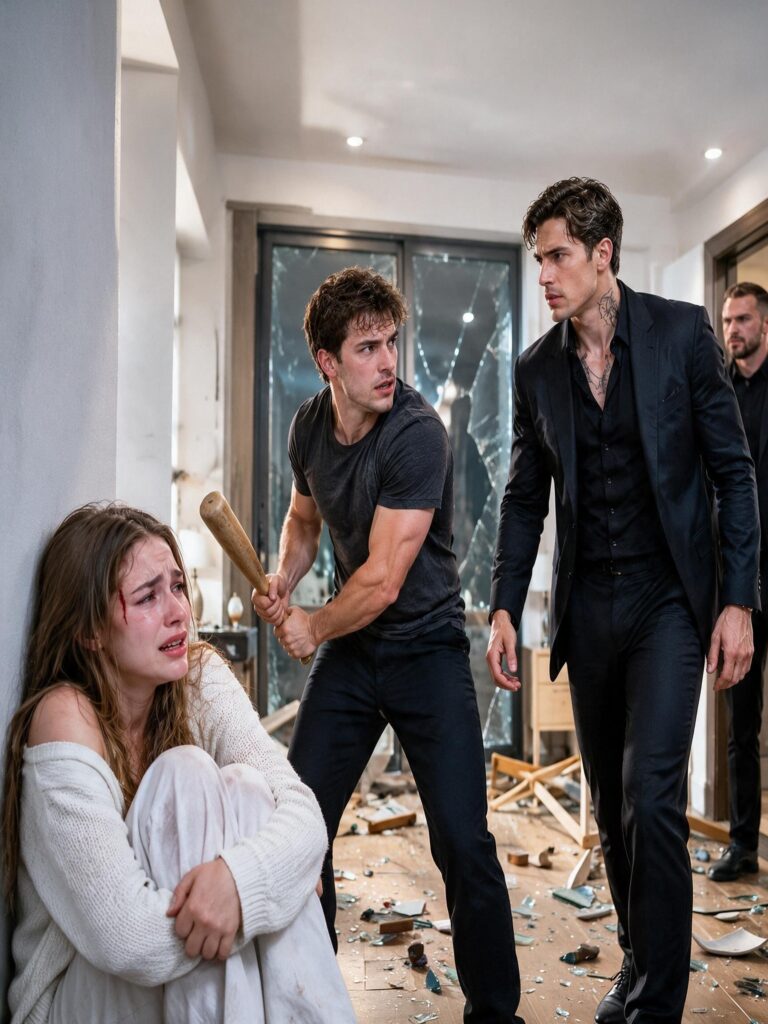
She dropped the phone. It spun across the rug and lit the ceiling with his name. David filled the doorway with a baseball bat and the sweet-sour smell of cheap beer and the particular righteousness of a man who had been fired that afternoon and had decided the woman with the high-rise job was the reason. He was broad the way unpaid gym months and loading-dock years make a person broad. His eyes were already somewhere past talking.
“You don’t get to stop answering,” he said.
Cindy ran for the bedroom. The bat caught the lamp. Glass went everywhere in a bright, stupid scatter. She got the bedroom door half shut and his shoulder took the rest of it. The impact knocked her into the wall. Pain opened at her hairline, thin and hot, and the room tilted.
On the rug in the other room, the steel phone was still alive.
Across the river, in a warehouse office that smelled of cigar and fear, Andrew Carter was already standing.
He had been not-listening to a distributor named Rossi for twenty minutes. Delayed shipments. Seized cargo. The arithmetic never changed. You delivered or you paid. Lucas Brooks stood by the door in charcoal, a monument with an exit strategy, and had already given Andrew the nod that meant the trunk was available. Andrew had been about to end the meeting the way he ended all of them, with a number and a silence, when the private phone buzzed.
Not the burner. Not the encrypted handset. The heavy one.
Cindy never called this late.
He heard the sob and the wood and the word no, and the man who had spent a decade making sure he never had to run for anything stopped existing between one breath and the next.
“Trace it,” he said, and threw the phone.
Lucas did not ask. His thumbs moved. “East Forty-Second. Her apartment.”
Andrew kicked the office door so hard the hinge complained. Rossi became furniture. “Boss,” Lucas said, matching him across the concrete, “we don’t know the play. Feds. Romanos. A setup.”
“I don’t care if it’s the entire city.” Andrew hit the exit and the rain took him by the shoulders. He dragged the driver out of the idling SUV by the collar, slid behind the wheel, and had the tires screaming before Lucas’s door shut. “Get in or get out of the street.”
The wipers lost. The city smeared into neon scars. Andrew took a corner at a speed that made the armored weight lean, and Lucas, perfectly level, checked the chamber of a Glock and said, “You’re going to kill us before the bridge.”
Andrew did not answer. The sound in his head was not strategy. It was her voice stripped of the armor she wore at the office, the competent voice, the one that said Mr. Carter, your two o’clock is a liar and your coffee is cold. She was twenty-six. She sent money to Ohio. She had mentioned a mechanic once, tone tight, wrist turned in, cabinet door, and he had let it pass because she had not asked him to be anything but her employer.
He had been a fool, and Andrew Carter did not survive by being a fool.
“Four miles,” Lucas said. “If it’s domestic, we do it quiet. Dead bodies in a civilian building will cost us the year.”
“If he touched her, he is done.” Andrew’s hands were steady on the wheel and nowhere else. “That is not a discussion.”
They mounted a curb on Forty-First, crushed a stack of sodden boxes, and died into an alley that smelled of garbage and ozone. Andrew was on the fire escape before the engine settled. Dress shoes on wet iron. Third floor. A slit of yellow behind the blinds and no sound at all, which was worse than the phone.
Lucas wanted a count. Andrew wrapped his jacket around his fist and put it through the pane.
The apartment looked bombed. Table in halves. Papers like shed skin. The lamp flickering, throwing the room into a stutter. David stood in the center with the bat, chest working, and did not matter.
Cindy was in the corner.
Knees up. Blouse torn at the shoulder. A dark line running from her hairline to her jaw. She was shaking hard enough that her teeth clicked, and the sound of it went through Andrew cleaner than any bullet he had ever ordered.
David turned. “Who the hell—”
Andrew crossed the room in three strides. The bat came around sloppy and late. He went under it, caught the man’s throat, and drove the steel of the gun into the kneecap. The crack was small and final. David screamed and folded, and Andrew hauled him back up and put him into the drywall until the plaster gave.
“Clear,” Lucas said from the hall, already bored and already lethal.
Andrew set the barrel under David’s chin. “Five seconds. Give me a reason.”
“I wanted to talk.” Blood and spit. “She thinks she’s better. Fancy job. Wouldn’t answer.”
The hammer went back.
“Andrew.”
Her voice was tiny. He turned his head and found her looking at him, not at the gun, not at the blood. At him. The veil she had kept in place for three years, the polite fiction that her boss was only difficult, was gone. She was seeing the rest. It landed in him harder than the decision to kill.
“Don’t,” she whispered. “Please. Not here. Not in front of me.”
He looked at David, pathetic, shaking, the room already smelling of fear, and understood the math she was doing. If he finished it on her rug, she would never again walk into his office and see a man. She would see the ending. Slowly, with a control that cost him more than the drive, he lowered the gun. David crumpled. Andrew holstered the weapon and stepped toward her, and she flinched so hard her shoulders hit the wall.
He stopped. Palms open. Empty.
“It’s over,” he said, and the voice he used was one Lucas had not heard in ten years. “I’m here.”
He went to his knees on the glass. He did not close the distance. A white handkerchief, held out, not forced. She stared at it as if it might be another trick, then took it. Her fingers were ice. His were not.
“Lucas.” He did not look away from her. “Take him out of my city. If I see him again, he does not get a bus.”
“Understood.” Lucas caught David by the collar. “Come on, Romeo. Ride.”
The door clicked. Rain came through the broken window. Cindy pressed the linen to her forehead and said, hoarse, “I’m sorry. I interrupted your meeting. I didn’t know who else to call.”
Something bitter tried to become a laugh in his chest. He killed it. “You never apologize for calling me. Never. Do you understand?”
She nodded, a fraction, the adrenaline already leaving her in a visible drop. “What happens now?”
He looked at the door, the blood, the lamp still trying to light a room that was finished. “This place is not safe. It never was.” He stood and offered his hand, and did not take it back when she hesitated. “Now I take you home.”
The SUV’s heat was a lie. Cindy shook anyway, arms around her ribs, watching the wipers and not him. He drove as if the night had been rescheduled, knuckles no longer white, breathing even. The normalcy of it was what frightened her. She had known, in the abstract, that Carter Logistics moved more than cloth. Abstract was a spreadsheet. Abstract was not a kneecap.
“We’re going to my place,” he said. It was not a suggestion. “Lucas has people at the apartment. Essentials. Door. Lease. You are not going back.”
“My deposit.”
The sound he made was almost a laugh and contained no humor. “I’ll write your landlord a check. Forget the deposit.”
She did not argue. Arguing felt like swimming up a waterfall, and she was already under it.
The elevator opened into a penthouse that looked like money had been told to sit still. Floor-to-ceiling glass. Storm over Tribeca. Slate leather, chrome, walnut, nothing that had ever been loved out loud. He shrugged off the ruined jacket and nodded down the hall. “Shower. Second door. Towels in the cabinet. Take a shirt. I’ll find the kit.”
Hot water took the dust and the cheap cologne and did not take the sound of the bat. When she came out, she was drowning in his sweatpants and a black T-shirt that reached her thighs. He was at the marble island in a crew neck and jeans, the most casual she had ever seen him, and still coiled. A gray medical box sat open like a verdict.
“Sit.”
“Andrew, you don’t have to—”
“Sit, Cindy.” Softer, and still a command.
The lights were surgical. He tipped antiseptic onto cotton and pressed it to her hairline. She hissed and jerked. His hand found her shoulder, a weight, not a grip. “I know. Hold still.”
He worked as if the hands that had ended a man’s ability to walk cleanly had been borrowed from a quieter profession. Blood, exam, butterfly bandage. “No stitches. You’ll have a bruise.”
“He was drunk,” she said, because silence had weight and she needed to put something under it. “Fired yesterday. Said I thought I was too good for him.”
“I don’t care why.” Andrew dropped the cotton into the trash. “I don’t care about his job or his ego. He crossed a line.”
“You broke his leg.”
“I shattered his patella. He’ll limp. He’s lucky.”
She stared at him. The cynicism she wore to work felt paper-thin. “You were going to shoot him.”
“Yes.”
No deflection. The honesty hit harder than the lie would have. “Why didn’t you?”
He aligned the bottle with the gauze as if order could be put back into the night. He took a long time. “Because you asked me not to. And because if I put a bullet in him in your living room, you would never look at me again without seeing a murderer.”
The lid snapped shut. He stood, already building the wall back up with his shoulders. “Guest room. Last door on the right. Lock it if you want. Try to sleep. We deal with the rest tomorrow.”
He walked into the dark of his own home and left her with the refrigerator hum and a heart that had not been briefed on any of this.
Cindy locked the door. She stood with her palm on it and listened. He did not leave the hall. She heard the shift of his weight, once, and then nothing, a man standing guard outside a room he owned because the woman inside it had called him and he had not been able to hang up.
On the other side of the wood, Andrew set his back to the wall and closed his eyes. He had empires in his pocket and a mother who sometimes still knew his name and a city that flinched when he entered a room. None of it was on the other side of this door. She was. And he did not yet know whether he had saved her or dragged her, shaking and bandaged, into the only life he had ever been able to keep.
Part 2
Morning arrived without sun. Cindy woke to cotton sheets that cost more than her rent and the dull flare at her temple, and for three seconds she did not know the ceiling. Then the door came back, and the bat, and the way he had looked at her when she told him not to kill a man.
She found him at the dining table in a white shirt, vest, tie loosened, tablet and stylus and black coffee. The CEO. The phantom. Except his eyes cut to her the instant she entered, a full assessment, injury to posture to breath, before he returned to the screen as if he had not done it.
“Coffee in the kitchen. Eggs and toast in the warmer.”
“I’m not hungry.” She stayed at the edge of the rug. “What happened to David?”
“Lucas put him on a bus to Cleveland. Five thousand cash. A clear understanding of the state line.” Andrew set the stylus down. “He’s gone. He is no longer a variable.”
“You make it sound like math.”
“In my world it is. Wrong calculation, people die.” He watched her. “You’re angry.”
“I’m humiliated.” The word came out before the pride could catch it. “I handle your schedule. Your shell companies. Your ridiculous lunches. I fix things. And last night I was on the floor because I couldn’t stop him.”
“Strength had nothing to do with it.” His voice dropped into the register from the alley. “He had a bat and a hundred pounds on you. You barricaded the door. You made the call. You survived.”
“I called my boss.” A bitter twist of a smile. “Who runs half the docks. Most people call 911.”
“Most people wait twenty minutes for a report written over a corpse.” He leaned in, forearms on the table. “You called me because you knew I wouldn’t wait.”
The professional line they had kept for three years lay on the floor between them, and neither of them picked it up.
“My sister,” she said, because his eyes were too much. “Rent on the first. My laptop is smashed. My purse—”
“Lucas recovered the purse. Phone’s clean. I had it checked for tracking. A laptop is coming this afternoon. I wired five thousand to your sister. She is covered.”
Her head came up. “You can’t wire money to my family.”
“I already did.”
“Take it out of my salary. I am not your charity case. You don’t own my debts.” She stood. The chair scraped. The last clean piece of her independence was suddenly the only thing she trusted.
Andrew stood too. Taller. The shadow of him crossed the table. “You are my employee,” he said, quiet enough to be dangerous. “You are also the only person in this city who looks at me without an agenda. You don’t steal. You don’t maneuver. Until last night, you didn’t fear me.” He stopped a few feet away. She could feel the heat of him. “I don’t care about the money. If you want it deducted so your pride survives, payroll will draw the paper. But you do not handle a threat alone again. Not while I’m breathing.”
She wanted a joke. A wall. The words died. What he was offering was not charity and not quite a cage, and she hated that she could feel the difference. “Okay,” she said, and the fight left her in a rush. “Okay.”
He checked her face for the lie, found none, and nodded once. “Eat. We have a hostile takeover at two. I need the quarterly losses.”
Tuesday’s conference room hummed like a threat. Cindy sat with a high collar over the yellowing mark on her collarbone and foundation over the butterfly bandage, transcribing as if her hands had not learned a new kind of shake. Richard Donovan sat across from them in a suit that tried too hard, pushing for a cut of dockside storage, loud, expansive, blind to the temperature of the man at the head of the table.
Andrew had not touched his water. He watched Donovan the way a blade watches a thumb.
“Margins are tight, Artie.” Donovan laced his fingers. “I need ten percent or I walk. The unions walk with me.”
“You’re asking me to subsidize the track,” Andrew said. “Union dues haven’t moved in three years. You lost heavy last month. Your creditors want thumbs.”
Color climbed Donovan’s neck. The jovial mask dropped. His palm hit the mahogany.
The sound was a gunshot that was not a gunshot.
Cindy’s body left the room before she did. The cup went over. Coffee raced the grain and soaked her sleeve. She was back in the walk-up, the door coming in, the bat in the air, and her breath hitched loud enough for the glass walls to hear it.
Donovan leaned in, napkin-hand extended. “Easy, sweetheart, it’s just—”
“Don’t look at her.”
Andrew was standing. He had not rushed. He had unfolded. Lucas’s hand had already found his jacket. Donovan froze with his arm over the table, and the oxygen went out of the deal.
“You don’t speak to her,” Andrew said. “You don’t look at her. You don’t breathe in her direction. In fact, Richard, I don’t think you breathe in my city anymore.”
“Be reasonable. Eight years. You need my trucks.”
“I own the docks. I can buy trucks by five.” Andrew stopped behind the chair. He did not touch him. Gravity was enough. “The deal is void. You are out of the port. If I see your name on a manifest by Monday, Lucas sinks the fleet. You can drive the lead rig.”
Donovan forgot his briefcase. He did not look at Cindy. He ran.
The blinds came down. Andrew mopped coffee with a napkin as if he had not just erased a distribution network, and Cindy stared at her hands until they would lie flat.
“I’m sorry. I can draft a concession. I know his deputy. I can—”
“Nothing to fix. He was skimming. He accelerated a Tuesday.”
“You lost millions.” Her eyes burned. “Don’t lie to me. I manage the ledgers. You don’t have a backup fleet.”
“Then you know I can afford it.”
“That isn’t the point.” She stood, panic burning off into fury. “You can’t detonate a legitimate deal because a loud noise scared me. I am the assistant. I am supposed to make this easier, not be the liability. I flinch at doors. I jump at phones. I am cracked glass and you are rebuilding the empire around the pieces.”
He closed the distance until the table was at her back and he was the rest of the room. He did not touch her. “You are surviving,” he said, and the corporate mask was gone. “You were hunted in your own home and you are here. I do not care if you flinch. I do not care if I have to burn the company down and salt the block so no one raises a hand to you again.”
“You can’t protect me from the world.”
“Watch me.”
By Thursday the guest room had boxes, and the boxes felt like an accusation. Five days. Her lease scrubbed. Her life in cardboard. She sat on the floor with tape and sweaters and a laptop full of studios in Queens she could almost afford, because every night under his roof the line moved, and she had not clawed out of a small town to become a kept fracture in a penthouse.
He appeared in the doorway with amber in a glass, jacket gone, exhaustion bruised under his eyes. “You’re packing.”
“I’m organizing. Astoria. The commute isn’t terrible.”
Ice clicked. “You aren’t moving to Astoria.”
“It’s in my budget.”
“It’s a ground-floor walk-up with a rusted escape and cameras from 2014.”
The tape dispenser hit the floor. She turned slowly. “You read my browser history.”
“I flagged the addresses.” No shame in it. “I also bought the building two hours ago. Rents triple tomorrow. It’s out of your budget.”
She came up off the floor so fast the room swam. “You bought a building to stop me renting an apartment.”
“I will buy the borough if it keeps you off a ground floor.” His calm cracked. The glass hit the dresser. “You are not going back out there. Not to a box any drunk with a crowbar can open.”
“I cannot stay.” Her voice hit the high ceilings and came back. “I am your employee. I am not your wife. I am not your prisoner. You don’t get to run my life like a subsidiary.”
“I am trying to keep you breathing.” The volume made her flinch, and he saw it, and the flinch hurt him more than the shout. His hands closed. He shut his eyes, reeled the underworld back in by force, and when he opened them the anger had been replaced by something she had no procedure for. “I cannot do the job if I don’t know you are safe. For three years I have walked into rooms with killers and agents and I have not hesitated, because the office was secure. You were there. The one clean thing.”
He stepped in. She did not retreat. His hand hovered near her face and did not land, as if he had suddenly become afraid of his own reach.
“When I heard you on that phone,” he said, “when I heard the door, the syndicate meant nothing. The money meant nothing. I was helpless. I will not feel that again. Hate me if you need to. You will be alive to do it.”
The untouchable man was bleeding on her guest-room floor without a mark on him. Cindy lifted her hand and closed it around his wrist. His pulse was a mess. “I don’t hate you.”
He shuddered, threaded his fingers through hers, and set his forehead to hers. “Don’t leave.” Not an order. A plea.
The sensible part of her, the part that had balanced ledgers and survived David by inches, said this was how women disappeared. His thumb moved over her knuckles and erased a chill the shower had not touched. “I’m not leaving,” she whispered. “But I buy my own groceries.”
The laugh that came out of him was rusty and unused. “Deal.”
August cooked the streets. Three weeks of a truce neither of them named. Coffee he made and did not comment on. Hall lights he killed only after her door shut. She went back to work because she threatened to quit if she didn’t, and he relented with a jaw that looked ready to fracture. Lucas drove. Her desk moved inside his office, behind frosted glass thick enough to stop a round. She was no longer only the legitimate face.
On a Tuesday he was at the Brooklyn yards. She opened the routing software she had spent three years not seeing. The inefficiencies were deliberate. Empty weights. Delayed boxes. Bribes to night inspectors at Terminal Four bleeding six percent of the margin and leaving a human being in the chain who could be bought twice. She rewrote it. Agricultural shipments at Terminal Two. Automated scanners. Lead-lined crates registered as industrial batteries, which the machines did not love and did not flag. Four hours. A manifesto of a woman who had decided she was already on the wrong side of the glass and would not be useless there.
When he came in smelling of salt and cigar, she dropped the pages on his desk.
He read for a long time. “What is this?”
“Your revised route. You stop paying the night shift. The scanners don’t take envelopes.”
Lucas, at the door, whistled once. “Four million a quarter. Exposure cut in half.”
Andrew stood. Knuckles on the wood. “You shouldn’t be looking at this. This is the line. Cross it and you are not an assistant. You are culpable.”
“I live in your penthouse.” Her chin was up. “Your man drives me to the cleaner. I watched you end a man’s knee in my living room and I didn’t call anyone. I crossed it three weeks ago. Stop treating me like glass.”
He came around the desk. No hesitation left in her face, only the sharp intelligence he had hired and the defiance he had not. “You’re a terrifying woman, Cindy Stone.”
“I learned from the best.”
His fingers grazed the edge of her collar. Her breath caught. Before either of them could name it, Lucas’s radio hissed.
“Boss.” The warmth left Lucas in a second. “Donovan. He didn’t take the firing. Queen’s warehouse. Two of ours on the dock. He torched a shipment.”
Andrew’s hand dropped. The city reached up and took him back. “Lock it down. Gather the team. Queens.”
“Donovan is stupid, not suicidal,” Cindy said. The logistics were already lining up in her head, ugly and clean. “He doesn’t hit a warehouse without backing. It’s a trap.”
“I know.” He took the matte black pistol from the safe, checked the magazine, racked the slide. “If I don’t answer, the city decides I’m soft. Soft is dead.” He looked at her once, a look that felt like a door closing. “Lucas stays. Penthouse. No one but me.”
“You need him.”
“Lucas stays.” The glass rattled. He pointed at the bodyguard without looking away from her. “If anything happens to her, I end you.”
“She’ll be safe,” Lucas said.
Andrew left. The manifest sat on the desk where his hand had been. Cindy understood, with a drop in her stomach that had nothing to do with fear of him, that the danger had changed rooms. She was not afraid of Andrew Carter anymore.
She was afraid he would not come back.
Part 3
Midnight in the penthouse was rain on glass and Lucas by the door with a weapon on his thigh, a statue carved out of waiting. Cindy paced. She had changed into her own sweater. She had washed her hands twice for no reason. At 1:14 the private elevator chimed, and Lucas was up with the gun leveled before the sound finished.
The doors opened on a man who had run out of vertical.
Andrew’s jacket was gone. The white shirt was black-red and glued to his left side. His face was the color of the storm. He caught the brass rail and missed the next step.
“Boss.” Lucas holstered and caught him.
Cindy did not scream. The woman who would have screamed had been left in a walk-up with a broken chain. She was already in the kitchen, ripping the trauma kit out of the cabinet. “Couch.”
They got him onto slate leather. He tried to wave them off. “Through and through. I’m fine.”
“Shut up.” She cut the shirt. The wound sat ugly under the collarbone, ragged, still spending him. Lucas packed the exit. “Donovan?”
“Won’t be lighting anything else.” Andrew’s body went rigid when the antiseptic hit. He did not yell. The cables in his neck did it for him.
“Hospital,” Cindy said. Her hands were red to the wrist.
“No hospital.” His good hand found her knee and held, too tight, an anchor he was ashamed of needing. “Gunshot gets a report. I can’t afford the heat. Patch it.”
“I am not a doctor. You are bleeding on a couch you will not shut up about, and you could die.”
“I’ll buy a couch.” His eyes opened, hazy and absolute. “I told you I wouldn’t leave you alone.”
She believed him and hated the belief and used it. “Needle. Proline. And a large scotch, Lucas. Not a polite one.”
For forty minutes the penthouse was breathing and thread. She did not look at his face. She looked at the work. When the last knot held and the dressing sat clean, she rocked back on her heels, exhausted past pride. Lucas took the towels and the perimeter and left them the room.
Andrew got himself upright against the arm. His uninjured hand curved the back of her neck and drew her up onto the cushion, careful of the wound, not careful of the want. “You didn’t flinch.”
“I’m too tired to flinch.” The crash was coming. She leaned into his palm anyway. “Is it over?”
“He had a crew out of Jersey. They thought I was distracted. Thought playing bodyguard to my assistant had made me weak.”
The question cost her. “Did it?”
He laughed once, bitter, and moved his hand into her hair, not cruel, enough to make her meet his eyes. “You are the reason I bothered coming back to this apartment alive. You didn’t make me weak, Cindy. You gave me something to burn the city for.”
He kissed her.
It was not careful and it was not a strategy. Scotch and copper and three weeks of not crossing a hallway. She caught the ruined collar and kissed him back with the full knowledge that the light side of the glass was gone. When he broke it, his forehead rested on hers and the violence had finally left his shoulders.
“You stay,” he said.
She looked at the rain sewing them off from the city. “I’m not going anywhere. But if you give me another order tonight, I will reorganize your entire north corridor out of spite.”
The rusty laugh again. It hurt him. He did it anyway.
Morning was worse. Fever low. Stitches angry. He refused the doctor Lucas trusted until Cindy stood at the end of the bed with her arms crossed and said, “You can be the king of the docks or you can be septic. Pick.” The doctor came. Andrew insulted him twice and let him work.
While he slept, she did not pace. She opened the warehouse logs from the night of the fire.
Donovan had not been clever. Clever would have used a cutout. He had used a truck from a Jersey yard she had flagged three weeks ago as a ghost plate tied to a man named Paulie Vecchio, a second-tier collector who liked unions and other people’s debts. The torch job was a message. The message had a return address. Two of Andrew’s men were in a private clinic under other names. One would keep the arm. The shipment was a loss they could eat. The leak was not.
She was still at the table when Andrew came out, shirt half buttoned, moving like a man who had negotiated with pain and lost a round. He saw the pages. He saw her face. “You didn’t sleep.”
“Vecchio backed him. Not the whole family. A cousin with a grudge and a yard in Bayonne. Donovan promised him your Terminal Four inspectors if he supplied the bodies. Your inspectors are already cut out of my route. Vecchio doesn’t know that yet.” She turned the laptop. “There’s a meet tonight at a social club on the canal. Donovan thinks he’s collecting a second crew. If you go in shooting, you start a war you don’t need. If Vecchio hears from someone who is not you that the inspectors are gone and the route is dead, Donovan is a liability with a big mouth and no product.”
Andrew was quiet for a long time. “You want to use the route as a knife.”
“I want you not to bleed on another couch.” She held his look. “And I want to be the one who ends the part I started when I flinched in that boardroom. You erased him because of me. Let me finish it without a harbor full of trucks.”
“No.”
“That is not an argument.”
“It is the only one I have.” His hand braced the table. “I don’t put you in a room with Vecchio.”
“You aren’t. Lucas walks in with the manifests and a very calm description of what happens to men who bet on a corridor that no longer exists. I stay in the car. I wrote the pages. I should hear them land.” She stood, smaller than him and not smaller at all. “You asked me not to handle threats alone. I’m asking you the same thing. Not because you can’t. Because if you walk in there angry, you will make a corpse, and a corpse makes a feud, and a feud is how I lose you on a Tuesday.”
He hated it. She watched him hate it. Then he nodded, once, the way he had nodded over toast when she said okay. “Car. Not the room. If Lucas says out, you are already gone.”
The social club smelled like old beer and floor wax. Cindy stayed in the back of the SUV with the engine low and a radio earpiece Lucas had pretended was optional. Through it she heard chairs, a laugh she recognized from the conference room, and Lucas’s voice, polite as a closed knife.
“Evening. Mr. Carter sends his regrets. He also sends the Terminal Four schedule, which you will notice no longer includes your inspectors, your cut, or your name. The agricultural lane is automated. There is nothing to sell.”
Donovan blustered. Vecchio did not. Cindy heard the silence change hands.
“Richard,” Vecchio said, almost gentle, “you told me the king was soft over a secretary.”
“She is not a secretary,” Lucas said. “And he is not soft. He is busy. You have until morning to decide whether Donovan is your guest or your problem. After morning, he is ours, and anyone standing next to him is furniture.”
A chair moved. Donovan’s voice went high. “We had a deal.”
“You had a story,” Vecchio said. “I don’t pay for stories.”
Cindy closed her eyes. Not triumph. Something quieter. The man who had called her sweetheart over a spilled cup was being reduced to a bad investment by paper she had written. When Lucas got back in the car, he looked at her in the mirror with something that was not quite approval and not quite surprise.
“He’ll run,” Lucas said. “Vecchio doesn’t adopt liabilities.”
“Let him run,” Andrew said from the front. He had not taken his eyes off the club doors. “Running is a direction. I own the directions.”
They caught Donovan at a storage unit in Secaucus two nights later, trying to buy a ride south with money he no longer had. Andrew did not bring Cindy into the room. He brought her the aftermath in the penthouse kitchen, his knuckles clean, his voice cleaner. “He’s on a freighter under a name that is not his, owing a captain who does not like passengers. If he comes back, he does not get a bus. That was the last mercy I had left, and I spent it because you asked me not to make a war.”
“I didn’t ask you to be kind to him.”
“I wasn’t.” He set a folder on the marble. Inside was a transfer, not of money to her sister, but of a small legitimate holding, a cold-storage company with real clients and real margins, into a trust with her name on the trustee line beside his. “This is not a leash. The route work you did stays on the other side of the glass. This is the side you can show a judge. If you ever want out, it walks with you. No deduction. No debt.”
She did not touch it. “You’re giving me an exit.”
“I’m giving you a choice that isn’t fear.” His throat moved. “I have spent three weeks trying to buy buildings and burn contractors so the world cannot reach you. That is not love. That is panic with a bank account. I know the difference now because you made me say don’t leave, and I heard myself beg.” He looked at the folder, then at her, and the guard he wore even in his own kitchen finally failed. “I don’t want you here because the city is dangerous. I want you here because the rooms are wrong when you aren’t in them. Because you told me to eat. Because you stitched me and insulted the couch. Because you looked at the monster and asked him not to be one in front of you, and he listened. I am in love with you, Cindy. Not as a strategy. Not as cover. If you take the exit, I will have Lucas drive you and I will not follow. If you stay, you stay as my equal, not my secret, not my soft spot for other men to aim at. My wife, when you want the word. Not before.”
The kitchen was very quiet. The refrigerator hummed the same way it had the night she locked the guest room.
She thought of Ohio. Of the degree. Of a cabinet door and a lie. Of a handkerchief held out and not forced. Of her own voice on a radio, ending a man with a schedule.
“I stayed the first night because I was shaking,” she said. “I’m not shaking now. I don’t want the freighter version of a life, and I don’t want a penthouse that keeps me like jewelry. I want the man who lowered the gun. I want the work. I want to buy the groceries and sign the real contracts and tell you when you’re about to start a war you don’t need.” She pushed the folder back, not away, between them. “Ask me when you’re not bleeding and I’m not brave from adrenaline. Ask me in a room that isn’t a rescue. I’ll say yes. Not tonight as payment. Yes as myself.”
Andrew nodded. The relief in him was almost violent, and he did not hide it. “Then stay tonight as yourself.”
“That,” she said, “I can do.”
He kissed her again in the kitchen, slower, a promise with the edge still on it, his hand at her jaw and nowhere it had not been invited. Outside, the city kept its neon scars. Inside, the most feared man on the docks rested his brow to the temple he had bandaged and let a civilian who was no longer a civilian hold the weight of him without flinching.
Spring found them in a courthouse that had never expected Andrew Carter to enter it without counsel and a threat. Cindy wore a dress she had paid for herself. Her sister flew in from Columbus and cried in a way that ruined mascara and fixed something older. Lucas stood in a suit and pretended he was not armed and was, Cindy knew, absolutely armed. There was no syndicate in the vows. There was a man who said he would not hang up, and a woman who said she would not be kept, and a ring that had not been a negotiation.
At the reception he hated and she had insisted on, small, loud, full of people who loved her and feared him, Donovan’s old deputy tried a toast and thought better of it. Andrew did not look at him. He looked at his wife, who was arguing with the caterer about the coffee, competent and unafraid, the clean line he had once believed he had to keep outside the dirt.
She caught him watching and lifted a brow. “If you bought the venue to stop me from renting it, I will make a scene.”
“I considered it,” he said. “Lucas talked me out of it.”
“Lucas is my favorite.”
“I’m aware.” He took her hand under the table, pulse steady now, thumb on her knuckle, the old plea turned into a fact. “Still not leaving?”
Cindy leaned in until the room, the docks, the rain, the broken door, all of it receded to a manageable size. “Not even for Astoria,” she said, and kissed him in front of everyone, equal, chosen, and home.


