
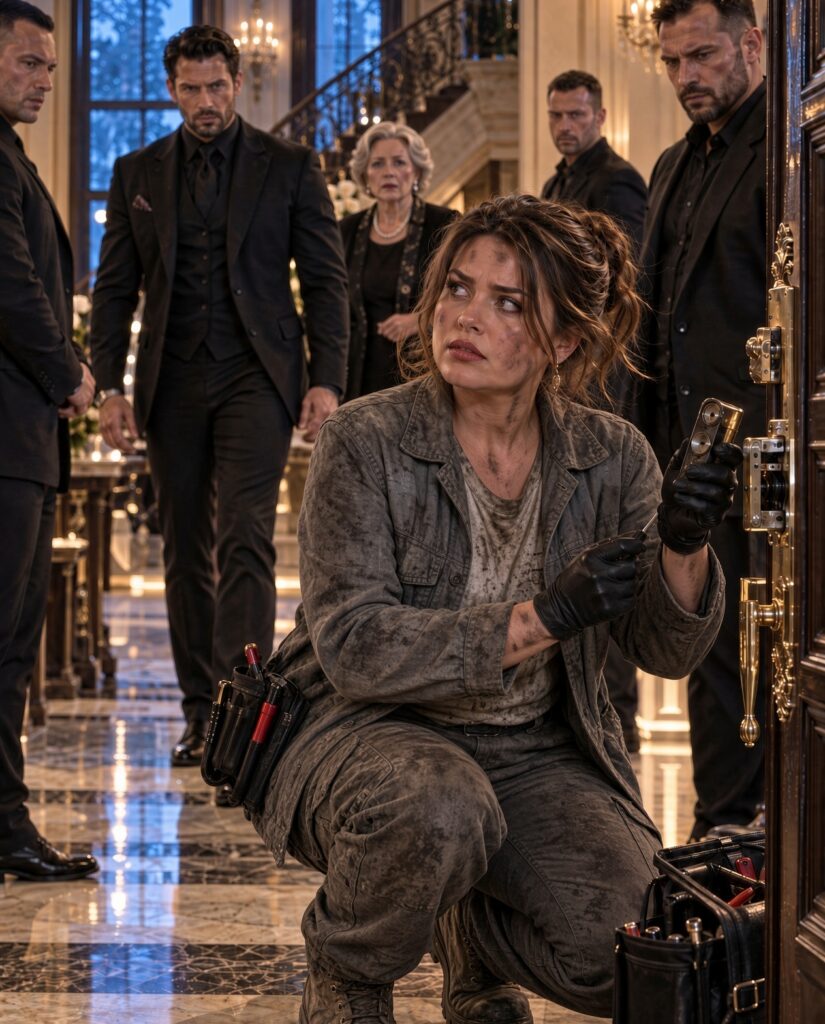
Three Armed Men Surrounded Me While I Repaired the Mafia Boss’s Mother’s Door—Then I Showed Him the Break-In Had Been Staged From Inside, and the Trail Led Straight Toward the Man He Trusted Most
I had one hand inside the mafia boss’s mother’s front-door lock when three armed men surrounded me and ordered me to put down my tools.
Dominic Caruso believed someone had broken into his mother’s Philadelphia townhouse—but the fresh damage was on the wrong side of the cylinder, and whoever staged it understood the security system well enough to make the alarm tell a convincing lie.
When I showed him the bright screw hidden behind the interior plate, Dominic locked down the house—and I told him he had just made the exact mistake whoever planned this wanted him to make.

PART 1 — THREE ARMED MEN THOUGHT I WAS TAMPERING WITH THE MAFIA BOSS’S MOTHER’S DOOR, UNTIL THE LOCK PROVED THE INTRUDER HAD NEVER BEEN OUTSIDE
“Don’t touch anything.”
I kept the screwdriver exactly where it was.
I was kneeling on the marble floor of Teresa Caruso’s Rittenhouse Square townhouse with my red tool bag open beside me, the brass cylinder halfway free from a front door older than my business. Three men in dark suits had appeared silently behind me, and the one nearest the staircase had already moved his coat far enough for me to see the holster.
Then Dominic Caruso walked between them.
He wore a charcoal overcoat over a white shirt, no tie, rain darkening one shoulder. He did not shout. Men like Dominic did not need volume; the room had already gone silent for him.
“Who authorized you to touch that door?”
“Your mother.”
Behind him, Teresa lifted her chin.
“I called her.”
Dominic raised one finger.
His mother stopped speaking.
Interesting family.
“Put the tools down,” he said.
“I can’t.”
One guard moved.
I pointed at Dominic’s phone.
“If I pull the cylinder now, I lose the orientation of the marks. Take a close photograph first. Exterior plate, then the cylinder exactly as it sits.”
“I said put them down.”
“And I’m telling you why that destroys evidence.”
The silence sharpened.
Then Dominic did something I had not expected.
He took the photographs.
“Show me.”
I eased away the interior plate.
Three retaining screws were dull with age.
The fourth gleamed beneath the foyer light.
Dominic crouched.
“Fresh tool mark.”
“Good.”
His eyes flicked toward mine.
“Now look where it is.”
The damaged screw sat inside the house.
Not outside.
Nobody spoke.
“My security company says someone forced entry at two seventeen this morning,” Dominic said.
“Then your security company told you the wrong story.”
His expression hardened.
I held up the interior assembly.
“This lock was opened from inside.”
Teresa’s hand tightened around the back of a chair.
Dominic stood.
“Dante. Lock the house down. Nobody leaves. Nobody enters.”
“No.”
Every head turned toward me.
Dominic’s stare could have frozen boiling water.
“Excuse me?”
“If whoever staged this belongs to your security chain, changing access now tells them you found something.”
“My mother may have had an intruder inside her home.”
“You don’t have proof anybody broke in.”
I pointed to the cylinder.
“You have proof somebody wanted you to believe they did.”
For several seconds, I could almost see the order gathering behind his eyes.
Find threat.
Control threat.
Remove threat.
Then Dominic looked toward the man called Dante.
“Nobody changes anything.”
Dante nodded.
“Understood.”
I tested the alarm contact.
Then frowned.
“This sensor wasn’t bypassed.”
Dominic crouched again.
“What does that mean?”
“It means whoever did this didn’t smash your mother’s security.”
I looked up at him.
“They reset the event through installer mode.”
His jaw tightened.
“So?”
“So they spoke the system’s language.”
Dante’s phone rang.
He listened.
Then his expression changed.
“Chestnut property. South service entrance. Maintenance found possible tampering twenty minutes ago.”
Dominic looked at me.
“No theft?”
Dante shook his head.
“No forced entry.”
I slowly closed my tool bag.
“What kind of lock?”
Dante described it.
Same commercial retrofit family.
Same internal retaining design.
“Don’t replace it.”
Dominic reached for his coat.
“You’re coming.”
“I haven’t agreed to work for you.”
“I didn’t say you worked for me.”
“Then ask.”
Annoyance flashed across his face.
Then disappeared.
“Rebecca Lane, will you come inspect the second door?”
“If nobody touches it before I arrive.”
“Agreed.”
At the Chestnut property, I removed the service plate and found another bright screw in exactly the wrong place.
Dominic stared at the two evidence bags.
“Same person?”
“Not necessarily.”
I sealed the second screw.
“Same method.”
Then I looked at him.
“Mr. Caruso, I don’t think somebody is trying to get through your doors.”
His expression darkened.
“What do you think they’re doing?”
I held up the matching evidence bags.
“I think somebody is trying to make you afraid of every lock you own.”
PART 2 — DOMINIC THOUGHT SOMEONE WAS ATTACKING HIS BUILDINGS; THE REAL PLAN WAS TO MAKE HIM PANIC, REPLACE HIS ENTIRE SECURITY SYSTEM, AND HAND THE KEYS TO THE PERSON SABOTAGING HIM
The Chestnut maintenance supervisor looked as though he wanted to dissolve into the brick wall.
Dominic ignored him.
“Who had access to this door?”
The supervisor swallowed.
“Maintenance. Cleaning. Security. Contractors. Deliveries, depending on the week.”
Dominic looked at Dante.
“Pull every name.”
“No.”
Dante closed his eyes briefly.
Dominic turned toward me.
“You enjoy that word.”
“I enjoy preventing expensive men from chasing the wrong problem.”
His expression chilled.
“If somebody had access, I need the names.”
“You could spend two days interrogating eighty people who touched a keycard.”
“And?”
“And whoever staged this gets exactly what they wanted.”
I pointed toward the lock.
“They didn’t steal anything. They didn’t even damage the door enough to stop it working. Why?”
Dominic said nothing.
“Find motive before population.”
Dante looked at his boss.
“Security review is tomorrow.”
I looked at him.
“What review?”
“Quarterly contractor review.”
“Scheduled when?”
“Months ago.”
I glanced at the staged lock.
“Convenient.”
The next Caruso property was a restored nineteenth-century warehouse overlooking the Delaware River.
Employees stood when Dominic entered.
Nobody asked them to.
That told me more about him than the armed guards did.
A silver-haired man crossed the lobby.
“Dominic.”
“Marco.”
The family resemblance was subtle—same dark eyes, similar jaw—but Marco Caruso wore warmth where Dominic wore restraint.
He looked at my red tool bag.
“So this is the locksmith making my cousin’s evening interesting.”
“Rebecca Lane.”
“I usually charge extra for interesting.”
Marco smiled.
Dominic did not.
Marco placed a folder on the conference table.
“Sentinel Access submitted an emergency replacement plan.”
I opened it.
Twenty-seven Caruso properties.
Door counts.
Hardware families.
Labor estimates.
Priority schedules.
Every page professionally prepared.
Too professionally prepared.
“How long did Sentinel need to build this?”
Marco shrugged.
“Standing proposals are normal.”
“That wasn’t my question.”
Dominic took the folder.
The proposal date sat near the bottom.
Three weeks earlier.
Before Teresa’s door had supposedly been breached.
I turned another page.
One project appeared repeatedly.
HARBOR LINE — PRIORITY ONE.
“What is Harbor Line?”
“My largest redevelopment.”
Dominic said.
“Six riverfront blocks.”
Marco leaned against the table.
“Which is exactly why we cannot leave compromised hardware in place.”
I looked at him.
“How did Sentinel know which hardware was compromised before the first compromised lock existed?”
His smile faded.
Dominic’s eyes moved from Marco to the document.
“Who requested the proposal?”
“I introduced Sentinel after our current contractor missed several service deadlines.”
“That explains why they priced work.”
I tapped the equipment schedule.
“It does not explain why they appear to have preselected replacement cylinders matching doors that had not failed.”
Marco looked toward Dominic.
“You’re allowing a locksmith to audit procurement?”
Dominic did not look away from me.
“What do you need?”
“Purchase orders.”
“Distributor reservations.”
“Shipping records.”
“Anything showing when Sentinel started acquiring this hardware.”
Marco exhaled.
“This is excessive.”
“So are three armed men surrounding somebody repairing a door.”
Dante coughed.
Dominic’s mouth almost moved.
Almost.
“Get her the records.”
Someone set a wrapped sandwich beside my hand forty minutes later.
I looked up.
Dominic.
“I didn’t order food.”
“No.”
“Is this an order?”
“No.”
“Good.”
I opened it.
Roast beef.
Mustard.
No mayonnaise.
“You guessed?”
“You refused mayonnaise on the coffee-shop sandwich at Chestnut.”
I stared at him.
“You remember food orders during security emergencies?”
“I remember useful information.”
It sounded arrogant.
It also sounded strangely human.
Dante returned with a tablet.
“Keystone Industrial Supply confirmed Sentinel reserved enough retrofit kits for nineteen properties.”
“When?”
I asked.
“Two days before Teresa’s event.”
I stopped chewing.
Dominic leaned closer.
“Anything else?”
“One allocation code.”
Dante enlarged the screen.
HL-47.
Harbor Line.
I set down the sandwich.
“So somebody ordered the solution before the problem existed.”
The room went quiet.
By eight the next morning, I had procurement records spread across a Caruso conference table.
I had slept three hours.
Dominic looked as though he had slept none.
“You’ve been here since six.”
“You had someone downstairs checking?”
“I asked reception.”
“That is less disturbing.”
His gaze moved to the pages.
“What do you have?”
“Sequence.”
Sentinel’s hardware reservation came first.
Teresa’s staged lock came later.
Chestnut after that.
The emergency proposal followed the discovery of both incidents even though much of the replacement equipment was already reserved.
“Who placed the original order?”
“Facilities consultant using an active Caruso project code.”
“Which one?”
“HL-47.”
Dominic’s jaw tightened.
“Find him.”
“No.”
His stare sharpened.
“Again?”
“If you frighten the middleman before we preserve the records, whoever sits above him learns exactly what we know.”
Dante spoke carefully.
“We can watch him.”
Dominic looked at him.
Then nodded.
“Do it quietly.”
I stared.
“What?”
he asked.
“You changed your mind.”
“I do that occasionally.”
“I’ll update my records.”
This time the corner of his mouth definitely moved.
My phone rang.
Eric Malloy from Keystone.
I put him on speaker after receiving his permission.
“There was something odd about Sentinel’s original order.”
“What?”
“The first site list had thirty-two locations.”
I looked at Dominic.
“The emergency proposal has twenty-seven.”
“Five were removed later.”
“Do you still have the original?”
“Archived.”
“Preserve it exactly as stored. Do not edit it, forward it internally, or discuss this call with Sentinel.”
Malloy hesitated.
“There’s another thing.”
“Go ahead.”
“Two residential addresses were included.”
Dominic stopped moving.
“That’s unusual for a commercial retrofit.”
“Which addresses?”
Malloy read one.
Teresa Caruso’s townhouse.
Dominic already had his phone in his hand when the call ended.
“Put it down.”
His eyes became cold.
“They had my mother’s private address.”
“Or somebody using Sentinel’s system did.”
“I want their executives in a room.”
“That gives you frightened vendors.”
“I want answers.”
“You want control.”
His expression changed.
I continued before common sense could stop me.
“Those are not always the same thing.”
Dante stared at the wall.
Dominic’s thumb rested over his phone.
Then lowered.
“Nobody approaches Sentinel.”
I exhaled.
A tiny victory.
The first witness came to us by accident.
Luis Herrera drove deliveries for Keystone.
He had heard warehouse employees asking about the old shipment and remembered boxes being relabeled after arriving at the wrong loading area.
“The original destination said Harbor Line.”
he told me.
“And the replacement?”
Luis shifted.
I waited.
“Ms. Caruso’s street.”
“When?”
“Two days before the break-in.”
There it was.
Hardware physically routed toward a manufactured emergency before the emergency existed.
Luis’s phone buzzed.
He glanced down.
His face changed.
“I was wrong.”
I watched him stand too quickly.
“I don’t remember any of this.”
“Did someone contact you?”
“No.”
His phone buzzed again.
“I need to go.”
Dante moved toward the door.
“I can stop him downstairs.”
“Let him go.”
Dominic looked at me.
“Somebody just threatened a witness.”
“Exactly.”
“So we stop him.”
“No.”
I picked up the original purchase record.
“Somebody just proved they’re monitoring the evidence chain.”
The second internal notation sat beneath the Harbor Line order.
I had overlooked it because I had been staring at quantities.
EXECUTIVE AUTHORIZATION REQUIRED.
Only a handful of people inside Caruso Group could approve that level of procurement.
I looked at Dominic.
The question had changed.
It was no longer whether someone inside his organization was involved.
It was how close to him they were.
Harbor Line occupied six city blocks along the Delaware River.
Old brick warehouses had been restored instead of demolished, connected by steel walkways to offices, apartments, retail space, restaurants, and a converted freight terminal.
Hundreds of workers moved beneath temporary lights.
For the first time, I understood why Dominic looked at the project as though it were personal.
“This was your father’s?”
I asked.
“The land assemblage started under him.”
“He died before financing.”
Dominic’s expression closed.
“I finished it.”
Dante followed six steps behind us.
I stopped.
“Does he need to breathe on us?”
“I am twenty feet away.”
Dante said.
“You are six.”
“Feels like twenty.”
I looked at Dominic.
“I need technicians willing to talk.”
“Dante stays.”
“Protection that prevents me from working is not protection.”
Dominic studied me.
Then nodded toward Dante.
“Twenty feet.”
Dante moved back.
“You listened.”
“You keep sounding surprised.”
“I’m collecting anomalous data.”
Inside Harbor Line’s security room, nothing looked broken.
That bothered me.
Real failures are ugly.
Half-completed firmware updates.
Bad wiring.
Technicians making undocumented fixes at four in the afternoon because somebody wants to go home.
This system looked clean.
Too clean.
I found a temporary credential created the previous afternoon.
Used once.
Deleted forty-three minutes later.
“Who can create this?”
Dominic asked.
“Administrator.”
The authorization belonged to a longtime facilities supervisor.
Dante checked.
“He was at City Hall when this was created.”
“Then somebody borrowed his identity.”
I opened the event detail.
The credential authenticated at a restricted service entrance.
For six seconds.
But no door-position sensor registered movement.
No elevator call.
No secondary access.
“It opened nothing.”
Dominic said.
“Correct.”
“So why create it?”
I stared at the screen.
“Maybe whoever did this didn’t need to enter.”
“Then what did they need?”
“Proof that the credential worked.”
He looked at me.
“Proof for whom?”
That was the question.
A city inspector passed through the security room.
“Owen Wallace.”
I smiled.
“Rebecca Lane. Still owe me coffee.”
“I remember.”
Owen glanced at Dominic, then back at me.
“Next week?”
“Maybe.”
He left.
Dominic continued staring at the console.
“You’re thinking about the credentials?”
I asked.
“Yes.”
“Not the coffee?”
His eyes lifted.
“No.”
“Good.”
I turned back to the screen, aware that he was still looking at me.
Teresa arrived at lunchtime carrying pastries nobody needed.
Dominic frowned immediately.
“You should not be here.”
“And yet the elevator survived me.”
She joined me beside a service door.
“My son has been hovering.”
“I noticed.”
“He prefers protecting.”
Dominic stood behind us.
“Ma.”
Teresa ignored him.
“He became worse after his father died.”
I glanced toward him.
“There was a security warning that evening.”
Teresa’s voice softened.
“Someone ignored an order. Dominic convinced himself afterward that if everyone simply obeyed him, nobody he loved would ever die again.”
“Ma.”
“She already knows you’re difficult.”
Then Teresa walked away.
I looked at Dominic differently after that.
Control had not begun only as arrogance.
It had begun as grief.
That did not make it harmless.
But it explained the shape.
We ate lunch at a temporary desk overlooking the river.
Dominic set coffee near my elbow.
I looked at it.
“Black?”
“You drank it black yesterday.”
“You remembered.”
“I remember useful information.”
“That line is getting less impressive with repetition.”
He ignored me.
His eyes dropped toward the handbook sticking from my tool bag.
Certified Forensic Security Examiner — Candidate Guide.
“You’re studying?”
“Eventually.”
“You’re already doing the work.”
“Doing pieces of it and being qualified to sign a forensic report are different things.”
“What stops you?”
“Required hours.”
“Course fees.”
“Running my shop at the same time.”
He looked across the river.
“You want a bigger company?”
“My company bigger, maybe.”
“Different thing.”
“Yes.”
“You could make more working for a firm like mine.”
“I could also spend the rest of my career being told which answer senior management would prefer.”
His gaze moved back.
“So what do you want?”
I tapped the handbook.
“A shop people hire because they want the truth before they decide what to do with it.”
Dominic nodded.
No offer to pay tuition.
No job.
No promise to solve me.
I noticed that.
My phone vibrated.
An internal Caruso alert appeared on-screen.
I should never have received it.
RESTRICTED ACCESS EVENT — WEST WAREHOUSE.
Credential holder:
REBECCA LANE.
I went cold.
“I do not have a Caruso credential.”
Dante checked his tablet.
“Used six minutes ago.”
“At the west loading bay.”
Dominic stopped looking at the screen.
He looked at me.
Suspicion entered so subtly another person might have missed it.
I did not.
“Good.”
I said.
His brow lowered.
“Good?”
“Now we learn something important.”
“What?”
I packed my notebook.
“Whether you trust evidence or whatever scares you first.”
By midnight my name existed in three places it had never belonged.
A warehouse credential.
A restricted-key control record.
An invoice.
Dante laid the documents across the conference table.
The credential had been used while Dominic, Dante, and a dozen cameras could place me at Harbor Line.
That helped.
The rest looked worse.
A restricted blank had been found in my van.
Then the invoice.
LANE LOCK & ACCESS.
My real address.
My tax identification number.
A scanned version of my signature.
Eighteen thousand dollars supposedly paid to me by a subcontractor connected to Sentinel for “Caruso access mapping.”
I read the banking details.
“That isn’t my account.”
Dominic sat across from me.
“Can you prove that?”
The question hurt more than I expected.
“Can you prove it is?”
“We have a credential in your name.”
“A restricted key in your vehicle.”
“An invoice using your business.”
“And every one appeared after I started connecting Sentinel to your problem.”
“That doesn’t make them false.”
“No.”
I stared at him.
“It makes them suspicious.”
I reached toward the evidence bag.
Dante caught my wrist.
Dominic’s voice snapped across the room.
“Let her go.”
Dante released me immediately.
I looked at the blank without touching it.
“Read the manufacturer series.”
Dante did.
“That code entered regional distribution this month.”
I looked at Dominic.
“My last legitimate service at any Caruso property before your mother called me was seven weeks ago.”
His face changed slightly.
“Verify manufacture date.”
Dante left.
For several long seconds, Dominic stood at the window.
Then:
“Revoke Rebecca’s access.”
My stomach dropped.
“All properties.”
“Her van stays.”
“Tools inventoried.”
“You are making a mistake.”
“I’m containing risk.”
“No.”
“You’re containing me.”
Security entered.
When one man reached for my tool bag, I grabbed it first.
“Nobody dumps my livelihood into a storage locker.”
Dominic turned.
“Rebecca—”
“Every tool photographed.”
“Serial numbers where present.”
“Two-person inventory.”
“Tamper seals.”
“Signed custody log.”
“If you are taking my property because you are frightened, at least do it in a way that proves what happened to it.”
He stared at me.
Then told the guards:
“Do it her way.”
That should have been enough.
It wasn’t.
Dominic made his worst decision ten minutes later.
“Sentinel takes over emergency access tonight.”
I thought I had misheard him.
“If Sentinel is involved, you are about to hand them every door.”
“We do not know Sentinel is involved.”
“We do not know I am involved either.”
That stopped him.
For one second.
Not long enough.
“My family is under threat.”
he said.
“I cannot wait.”
I unclipped my visitor badge.
Placed it on the table.
“That sentence is why whoever designed this is winning.”
Then I walked out carrying only my phone, wallet, and the inventory receipt for the tools he had taken.
Before I reached home, one of my commercial clients canceled the following day’s job after hearing there was a “security inquiry” involving my company.
His containment had already escaped the building.
Sentinel technicians connected to the Caruso central system at 11:16 p.m.
At 11:34, three alarms triggered across three properties.
By midnight, new emergency credentials appeared.
At 12:07, seven more.
Dante stood beside Dominic in the operations center watching administrator events spread through the network.
“She told us this would happen.”
Dominic said nothing.
I was awake when someone entered my workshop.
Not because glass broke.
Nothing broke.
At 2:13 a.m., the motion alarm reached my phone.
I opened the security feed.
A hooded figure crossed my shop.
Ignored the cash drawer.
Ignored two electronic programmers worth more than my truck.
Ignored power tools.
Then forced the evidence cabinet.
The intruder removed only two boxes.
Both contained old Caruso lock cores I had kept after legitimate repair work.
I called 911.
Recorded the live feed separately.
Did not leave my apartment above the shop.
The person stayed three minutes.
Then disappeared.
Whoever framed me was no longer adding evidence.
They were removing comparison material.
Dominic called at sunrise.
“I’m coming over.”
“No.”
Silence.
“Someone broke into your business.”
“Yes.”
“They targeted evidence related to me.”
“Yes.”
“So I’m coming.”
“No.”
I could hear the old instinct gathering on the other end.
Then something remarkable happened.
It stopped.
“What do you need?”
The question changed the entire conversation.
“Manufacturing verification on the blank found in my van.”
“Copy of the fake invoice.”
“Nobody from Sentinel touches anything connected to my business.”
“No one follows me.”
A pause.
“All right.”
“You agreed quickly.”
“I’m learning.”
Dante arrived alone.
The key blank had been manufactured twenty-three days earlier.
My previous legitimate Caruso work had been forty-nine days before the incident.
It could not have entered my van when the false paperwork claimed it did.
The invoice failed too.
Routing number from a Delaware institution.
My real account was Pennsylvania.
The fake was good.
Not perfect.
Dante’s phone buzzed.
“More anomalies.”
“How many?”
“Forty-three since last night.”
“Physical theft?”
“None.”
“Damage?”
“None.”
“Confirmed entries?”
He checked.
“Almost none.”
I walked to the whiteboard.
Wrote:
43 credential events.
0 thefts.
0 significant property damage.
Almost no physical entry.
“They’re proving they can open doors without caring what’s behind them.”
Dante frowned.
“Testing?”
“Maybe.”
I wrote FEAR across the board.
“Or manufacturing this.”
I called Dominic.
Another Harbor Line credential had authenticated.
“What did it open?”
“Nothing.”
“The door sensor never moved?”
“No.”
I stopped.
That was it.
“A credential without entry.”
“What are you thinking?”
“Proof without action.”
Silence.
“Do not close Harbor Line.”
“I haven’t.”
“Do not rekey anything.”
“I said I haven’t.”
I glanced at the board.
“Come here.”
I refused to return to headquarters until Dominic explicitly accepted my conditions.
No tracking.
No confiscation of tools.
No access to my business records.
No door disturbed after I ordered preservation.
No escort unless requested.
“Agreed.”
“You didn’t negotiate.”
“I am not negotiating your boundaries.”
I had to sit with that sentence for a second.
Then I drove in.
My tools were waiting.
Sealed.
Inventoried exactly as requested.
Dominic stood beside them.
“I was wrong.”
I looked at him.
“That is not the whole sentence.”
His jaw tightened.
“I took your tools.”
“I damaged your business.”
“I treated your judgment like it mattered only while it agreed with mine.”
Silence.
“You cannot fix everything.”
“I know.”
No excuse.
That mattered.
He noticed the certification handbook in my bag.
“You’re still doing this?”
“One canceled client doesn’t decide my future.”
“Good.”
Nothing else.
No offer.
Again.
He was learning that encouragement did not require acquisition.
We returned to the access events.
Forty-three credentials.
Different buildings.
Different doors.
Almost no real entry.
“They’re not stealing access.”
I said.
Dominic stood beside me.
“What are they stealing?”
I pointed at the pattern.
“Confidence.”
Harbor Line turned out not to be merely a construction project.
It was a clock.
Elaine Porter, Caruso Group’s CFO, laid a bridge-loan summary on the conference table.
“Final operational handover is Monday at nine.”
I looked at my watch.
“Seventeen hours.”
“Yes.”
“What happens if you miss?”
Elaine glanced at Dominic.
“The lender gets enhanced control rights.”
“How enhanced?”
“Potential step-in authority.”
“Who owns the loan?”
“Originally a syndicate.”
She hesitated.
“Most junior exposure was recently acquired by North Key Holdings.”
“Who owns North Key?”
“We’re tracing it.”
Marco entered with his phone in one hand.
“The board wants an emergency meeting.”
“Investors are asking whether Harbor Line can open.”
“We may need to postpone.”
I looked at him.
“Name one verified Harbor Line event requiring physical intrusion.”
“Forty-three unauthorized access events.”
“Almost none produced actual entry.”
Marco stared.
“You’re a locksmith.”
“Yes.”
“Not a risk officer.”
“No.”
“Then perhaps six billion dollars in development assets should not depend on your interpretation.”
Dominic answered before I could.
“They depend on mine.”
Marco’s face hardened.
“And I am letting the person who found the pattern finish.”
Elaine’s trace came back at 5:40 p.m.
North Key had passed through two companies and a trust administered by Graves & Talbert.
A law firm Marco used regularly for acquisitions.
Not proof.
A connection.
Dominic read the documents twice.
“Marco has always handled acquisition vehicles.”
Elaine said.
“Yes.”
I watched Dominic carefully.
“He also has always believed control should have been divided after my father died.”
There it was.
History.
Harbor Line was the largest asset Marco helped assemble.
Dominic held final authority.
If the loan stepped in, that structure could change.
Motive was no longer hypothetical.
Still not proof.
I reminded Dominic.
He hated hearing it.
Good.
An hour later, Dante received the first report of armed activity.
“Three sites.”
His face tightened.
“Harbor Line guard injured at the south perimeter.”
Dominic’s entire posture changed.
“Who?”
“Shoulder injury. Ambulance is moving.”
“Vehicle?”
“Plate associated with Bellano crew.”
The Bellanos were a rival Philadelphia criminal organization with interests near the river.
Dominic’s hand moved toward his phone.
“Don’t.”
He turned.
“One of my men is in an ambulance.”
“And that may be exactly why.”
“You think I should ignore it?”
“No.”
“I think you should establish who actually hurt him.”
“We have the plate.”
“You have a plate.”
I stepped closer.
“You also have somebody who has spent days manufacturing digital facts specifically designed to make you react before verification.”
Dante waited.
One order and armed Caruso crews would move.
Dominic looked toward the river.
Then:
“Prepare.”
My stomach dropped.
Dante reached for his radio.
“Nobody moves until Rebecca finishes.”
Dante stopped.
“Understood.”
That was the first moment I realized Dominic’s restraint was not weakness.
It physically cost him.
I returned to the event data.
Three sites had triggered within seconds.
First Harbor Line.
Then Chestnut.
Then the west warehouse.
Eight seconds apart.
I searched earlier incidents.
Same spacing.
Again.
Eight seconds.
Again.
“Automated.”
Dante came closer.
“What?”
“Replay commands.”
I pointed.
“Humans don’t authenticate at separate properties across the city every eight seconds.”
“Someone is injecting coordinated events.”
Dominic looked at the screen.
“So the threats are fake?”
“Some.”
I looked at him.
“The wounded guard is not.”
“That’s what makes the manipulation work.”
Dante’s phone rang again.
“The Bellanos deny involvement.”
Dominic laughed without humor.
“Of course.”
“They requested a sit-down.”
I stared at the bridge-loan agreement.
Something was wrong.
An outside attack should make postponement reasonable.
If North Key wanted Harbor Line to fail, why risk creating circumstances beyond Dominic’s control?
I asked Elaine for the full loan agreement.
Not the summary.
All one hundred twelve pages.
I read it like a lock.
Not a lawyer.
Every system has a trigger.
Every trigger has conditions.
Page seventy-three.
Three categories of closure.
Government order.
Documented third-party attack.
Owner-declared internal operational failure.
I read the remedies twice.
“Elaine.”
She crossed the room.
“What?”
“If police close part of Harbor Line because outsiders attack it, what happens?”
“Force-protection provisions.”
“Additional cure time.”
“If Dominic voluntarily declares the security system compromised?”
Her face changed.
“Immediate step-in rights may arise.”
The room went silent.
I looked at Dominic.
“This is not about shutting Harbor Line down.”
His eyes darkened.
“He needs me to shut it down.”
“Yes.”
Marco’s plan finally had a shape.
Teresa’s staged lock created fear.
Chestnut made the fear systemic.
Sentinel arrived with a ready-made solution.
I started connecting procurement to the staged failures, so somebody framed me.
Dominic did what Marco expected.
He distrusted the inconvenient person.
Removed my access.
Handed Sentinel centralized control.
Then the false credential storm began.
Tonight added the final ingredients.
One genuinely injured guard.
Cloned rival-family plates.
Dozens of fabricated digital intrusions.
A nervous board.
Lenders watching.
Security people demanding Level Black.
If Dominic signed an owner-directed shutdown order, the loan file itself would contain the admission North Key needed:
Caruso Group cannot maintain internal operational control.
No burglary required.
No successful sabotage.
Only fear.
“He doesn’t have to take Harbor Line.”
I whispered.
“He needs you to hand it over.”
Dominic stared at page seventy-three.
Then asked the question I had been waiting to hear for two days.
“What do you need?”
“Controlled isolation.”
“Close only the south zone where a real external incident occurred.”
“Police document that event.”
“Disconnect controllers we can prove are compromised.”
“Move essential doors to manual verification.”
“Preserve logs.”
“Keep Harbor Line operating.”
“No Level Black.”
Elaine nodded slowly.
“That avoids a voluntary admission.”
“And if there is another attack?”
Dominic asked.
“Document it as external if the evidence says external.”
“And if our internal system actually fails?”
“Then you declare exactly what happened.”
I looked at him.
“But we do not sign somebody else’s conclusion because we’re scared.”
Marco called.
“The board wants Level Black now.”
Dominic put him on speaker.
“If we keep the site open and someone dies, that is on us.”
Dominic’s gaze remained on me.
“What does North Key have to do with tonight?”
Silence.
Half a second.
Maybe less.
Enough.
“What does North Key have to do with armed men outside our property?”
Marco replied.
I mouthed:
Too much.
Dominic ended the call.
Dante came closer.
“You want us to take Marco?”
Nobody misunderstood the question.
Marco could disappear into a private room before any regulator, lawyer, or police investigator saw him.
Dominic looked toward the men waiting near the door.
Then at me.
I said nothing.
This one had to be his.
“No.”
Dante remained still.
“No one touches him.”
Dominic’s voice hardened.
“We do this clean.”
Dante nodded.
“Understood.”
My chest tightened.
Dominic had not become less dangerous.
That was why choosing not to use the danger mattered.
Controlled isolation began.
Compromised controllers were physically disconnected.
Technicians verified credentials manually.
Police documented the south-perimeter assault.
No companywide failure declaration.
No total shutdown.
Harbor Line remained alive.
Barely.
Then evidence arrived in sequence.
Police stopped the alleged Bellano vehicle.
Cloned plates.
None of the occupants had Bellano ties.
Keystone produced the preserved original hardware allocation showing Sentinel had reserved Harbor Line equipment before the staged townhouse event.
Eric Malloy confirmed the amended shipment order had come through a Caruso executive procurement account.
“Which executive?”
Dominic asked.
Malloy swallowed.
“Marco Caruso.”
Elaine entered with another file.
“North Key.”
She placed it on the table.
Beneficial ownership.
A corporation.
Then a trust.
Then the final beneficiary.
MARCO CARUSO.
Dominic did not move.
The cousin who had stood beside him through funerals, deals, weddings, and his father’s death had purchased the debt capable of taking Harbor Line if Dominic declared failure.
Money gives betrayal a clean vocabulary.
A Sentinel technician provided the next piece through counsel.
The emergency administrator profile used after Dominic centralized security had been created under written executive authorization.
Whose?
Marco’s.
No single document proved the entire plan.
Together, they stopped looking accidental.
Marco arrived twenty minutes before the handover deadline.
Furious.
“What the hell are you doing?”
Dominic stood near the main console.
“Keeping the site open.”
“You have armed threats outside and compromised controls.”
“Police documented the external threat.”
“We isolated the internal controllers.”
Marco looked at me.
“This is her idea.”
Dominic’s answer came immediately.
“My decision.”
Elaine placed the North Key records on the table.
Dominic added Sentinel’s procurement authorization.
Keystone shipping history.
Administrator override.
Cloned-plate report.
Marco’s eyes moved from one to the next.
“You don’t understand what you’re looking at.”
“I think we finally do.”
I said.
He turned toward me.
“You are a locksmith.”
“Yes.”
“You think that makes you qualified to explain finance?”
“No.”
“It makes me qualified to recognize a system where someone manufactures failure before selling the solution.”
His expression changed.
I walked him through it.
Teresa first.
Personal enough to guarantee Dominic’s reaction.
Chestnut second.
Proof it was larger.
Sentinel prepared before the emergency.
Me framed when I slowed the process.
Centralized access handed to the very system positioned to generate more failures.
Then the staged rival threat.
The injury.
The board pressure.
The debt covenant.
“You never needed anybody to break into Harbor Line.”
I said.
“You needed Dominic to believe every door was broken.”
Marco laughed.
“You have no idea what Dominic would do if someone truly attacked this family.”
Dominic’s face became unreadable.
“That is exactly what you counted on.”
I said.
Marco looked at his cousin.
“You think she changed you?”
The room froze.
Dominic took several seconds before answering.
“No.”
His voice was quiet.
“She made me stop long enough to choose.”
For the first time, Marco had nothing to say.
Investigators arrived.
Not Caruso enforcers.
Financial-crimes detectives and federal agents had already been contacted through outside counsel once the North Key ownership trail became clear.
Dominic could have buried Marco privately.
Instead, he turned the evidence over.
Clean chain of custody.
Documented devices.
Preserved files.
Witnesses with attorneys.
The boring machinery of accountability.
The kind revenge stories usually skip.
The final minutes ran down.
9:00 a.m.
Harbor Line remained operational.
No Level Black order.
No voluntary declaration of internal failure.
No automatic North Key step-in.
The trap failed because one signature never happened.
Dominic’s.
Workers continued through controlled checkpoints below.
Some doors remained closed.
Others opened after manual verification.
Nothing glamorous.
Nobody applauded.
The most consequential moment of the entire night passed with technicians checking badges under fluorescent lights.
Dominic watched through the glass.
“You wanted to shut it down.”
I said.
“Yes.”
“You almost did.”
“Yes.”
“And you didn’t.”
He turned toward me.
“No.”
END OF PART 2
Dante approached with one final question.
“What do you want done with Marco?”
Dominic looked at the cousin who had just tried to take the largest project in his empire by weaponizing every fear Dominic had carried since his father’s death.
Then he looked at me.
And instead of asking what punishment would frighten the city most, he asked something I never expected to hear from him.
“What preserves the truth?”
PART 3 — MARCO TRIED TO STEAL DOMINIC’S EMPIRE BY USING HIS NEED FOR CONTROL AGAINST HIM, BUT THE HARDEST THING DOMINIC HAD TO GIVE UP WASN’T HARBOR LINE—IT WAS THE BELIEF THAT PROTECTING PEOPLE GAVE HIM THE RIGHT TO CONTROL THEM
“Nothing gets moved.”
I said.
Dominic nodded.
“Phones?”
“Preserved.”
“Computers?”
“Preserved.”
“Marco’s office?”
“Restricted under counsel and law-enforcement direction.”
Dante looked between us.
“And the Bellanos?”
“Tell them we know the plates were cloned.”
Dominic paused.
“No retaliation.”
Dante repeated it.
Perhaps because he needed to hear the words twice.
“No retaliation.”
Outside counsel arrived first.
Then investigators.
Marco requested his attorney.
Nobody denied him one.
His office was secured.
Corporate devices were preserved.
North Key records were subpoenaed.
Sentinel received formal evidence-preservation notices.
For the first time since I met Dominic, his organization moved through an emergency without everyone trying to solve the uncertainty by applying more force.
It looked almost boring.
That was the point.
By noon, I wanted to sleep for a week.
Instead, I remembered I still did not have my van.
“My tools.”
Dominic blinked.
“What?”
“You confiscated my van.”
“It is downstairs.”
“You are buying lunch before I leave.”
His eyebrows lifted.
“That is not how reimbursement usually works.”
“You damaged my business and made me miss breakfast.”
His mouth moved.
“Fine.”
“And not from somewhere that puts truffle oil on grilled cheese.”
“You are strangely specific.”
“I have trauma.”
We ate at a diner near the river.
Dante sat four booths away because apparently twenty feet was becoming policy.
Dominic wore the same shirt from the night before.
I drank coffee.
He stared at his untouched eggs.
“You should eat.”
“I’m not hungry.”
“That did not stop you ordering for me at the beginning.”
His gaze lifted.
“I did not order for you.”
“You placed a sandwich beside my hand.”
“That was a sandwich.”
“Control starts small.”
He almost smiled.
Then the expression disappeared.
“My father trusted Marco.”
he said.
I waited.
“My father trusted his father.”
“They started with two trucks and a warehouse near the Navy Yard.”
“They fought together.”
“Built together.”
“And now?”
“Now Marco tried to take Harbor Line.”
The pain beneath the sentence had nothing to do with six city blocks.
“Do you hate him?”
I asked.
Dominic looked through the diner window.
“I don’t know.”
“Good answer.”
“You enjoy saying that.”
“Only when it’s true.”
His fingers tightened around the coffee cup.
“I keep thinking I should have seen it.”
“That is not useful.”
His eyes returned to mine.
“Why?”
“Because the lesson becomes ‘I should have controlled more.’”
He went still.
“What is the useful lesson?”
“That your system allowed one person’s access, your own habits, and everybody’s fear of challenging you to become exploitable.”
“That sounds worse.”
“It is.”
He gave me a dark look.
I continued.
“But it can be fixed.”
Marco’s plan had depended on more than digital access.
It depended on culture.
Technicians afraid to stop work.
Managers trained to interpret Dominic’s impatience as policy.
Security people rewarded for acting faster than they verified.
Executives who believed uncertainty was dangerous because Dominic hated it.
Marco knew exactly which pressure points to touch.
Because he had helped build them.
Over the following weeks, investigators reconstructed the scheme.
Marco had created North Key quietly through layered entities.
He began buying junior Harbor Line debt nearly a year before the attempted takeover.
That alone was not illegal.
Undisclosed conflicts and fraudulent steps around the trigger became the problem.
Sentinel’s owner, Gregory Falk, initially denied knowing anything.
Records told a more complicated story.
Marco’s procurement office had promised Sentinel a multiyear Caruso contract if it maintained replacement inventory and complied with “accelerated transition planning.”
Falk claimed he thought Dominic had already approved the strategy.
Some employees believed that.
Others did not.
The staged residential hardware changed things.
A Sentinel project manager admitted receiving an instruction to relabel commercial retrofit boxes toward Teresa’s address.
He objected.
Was told it was an executive security exercise.
He obeyed.
Again, culture.
Again, people doing something questionable because authority sounded confident.
Luis Herrera returned with counsel.
He testified about the labels.
Keystone admitted a manager had warned him that “important clients” disliked people remembering details.
Luis had panicked.
He had not lied because he was corrupt.
He lied because his rent depended on the warehouse job and somebody had made consequences feel immediate.
Dominic wanted to pay him privately.
I said no.
He looked annoyed.
“Why?”
“Because you’ll turn him into somebody who appears purchased by the Carusos.”
“I’m trying to help.”
“So help structurally.”
Keystone eventually adopted a formal anti-retaliation agreement as part of cooperation with investigators.
Luis kept his job.
His attorney negotiated protection.
No envelope from Dominic.
No new debt.
I saw him learn from that too.
My own business suffered.
Three customers canceled during the first week.
Rumors said I had been investigated by the Carusos.
Others said I had worked for them secretly for years.
One online post called Lane Lock & Access a “mob contractor.”
That one cost me a hospital-service bid.
Evidence clears facts faster than reputations.
I learned that the hard way.
Dominic offered to issue a public statement.
“No.”
“Why?”
“Because your name is exactly what people think contaminated mine.”
His face tightened.
“I can confirm you were framed.”
“Through your lawyers.”
“Not personally.”
“Fine.”
That was harder for him than writing a check.
Caruso Group’s outside counsel eventually released a factual statement confirming that I had identified the security manipulation, that an internal investigation found no misconduct by Lane Lock & Access, and that evidence indicated my business records had been falsified as part of the larger scheme.
No praise.
No mythology.
Facts.
Two customers came back.
Others did not.
I rebuilt.
I enrolled in the forensic-security certification program anyway.
Night classes.
Weekend labs.
Evidence handling.
Digital access-control forensics.
Report-writing standards.
Expert-witness ethics.
It cost more money than I wanted to admit.
I paid for it myself.
Dominic never offered again after learning I did not want him to.
That mattered.
One rainy evening he appeared at my workshop with coffee.
The bell over the door rang.
I looked up from a disassembled mortise lock.
“You have people for delivering beverages.”
“I know.”
“Then why are you here?”
“To ask whether you want dinner.”
“No.”
He nodded.
“All right.”
Then placed the coffee on the counter.
I stared.
“That’s it?”
“What?”
“You’re leaving?”
“You said no.”
“That has never stopped you from talking.”
He looked mildly offended.
“I can improve in several areas simultaneously.”
I laughed despite myself.
He left.
Three weeks later, he asked again.
“Dinner?”
I considered.
The first invitation had been easy to refuse.
The second was harder because nothing bad happened after the first.
No withdrawal of contracts.
No cold security detail.
No sudden business inconvenience.
My no had simply remained no.
“Yes.”
Dominic’s face barely changed.
His eyes did.
We ate at a small Italian restaurant in South Philadelphia where nobody stood when he entered.
I later learned the owner had known him since childhood and considered fear unnecessary labor.
Dominic let me choose wine.
I ordered pasta.
No bodyguard sat at the table.
Dante occupied a booth near the kitchen and pretended not to watch us.
“Is this a date?”
I asked.
Dominic paused.
“I hoped so.”
“Bad opening.”
“Why?”
“Because asking after we arrive is operationally questionable.”
He exhaled through his nose.
“Rebecca Lane, would you like this dinner to be a date?”
I took one sip of wine.
“Yes.”
Dante, forty feet away, suddenly became fascinated by bread.
Dating Dominic was not romantic in the obvious ways.
He did not send five hundred roses.
Thank God.
He asked whether I wanted him to arrange transportation when I worked late.
Sometimes I said yes.
Sometimes no.
When I said no, no mysterious black SUV appeared three blocks behind me.
I checked.
Repeatedly.
Trust is rarely restored by speeches.
It is restored by boring repetitions where the feared consequence does not happen.
Teresa invited me to Sunday lunch.
She still used the original cylinder from the first night.
“There are better models.”
I told her.
“You installed this one.”
“That does not make it sacred.”
“It does in my house.”
Dominic stood behind her.
Far too entertained.
“Do not encourage her.”
Teresa patted my arm.
“You see what I survived raising?”
Marco’s criminal case moved slowly.
Fraud.
Conspiracy.
Commercial bribery.
False records.
Evidence related to the staged threats.
The rival-family framing complicated several counts.
Some theories prosecutors initially considered were never charged.
That was reassuring.
Law should become narrower as evidence improves, not larger because outrage does.
North Key’s interest was unwound through civil litigation and lender negotiations.
Caruso Group refinanced Harbor Line with additional equity and tighter governance.
Elaine hated the new loan covenants.
She also admitted they were healthier.
Dominic accepted an independent risk committee that included directors capable of delaying him.
That sentence alone would have seemed fictional six months earlier.
Sentinel lost the Caruso contract.
Its owner faced separate scrutiny concerning fraudulent records and procurement conduct.
The company itself survived under different management.
Again, consequences did not require everything to burn.
Sometimes the right answer is removal, restitution, compliance, and people having to live with what they signed.
The first new Caruso security policy I reviewed opened with three words:
STOP. VERIFY. ACT.
I read them twice.
“You made this companywide?”
“Yes.”
“Construction too?”
“Yes.”
“Harbor Line?”
“Especially Harbor Line.”
I looked at him.
“You understand people will stop expensive work over things that turn out to be nothing.”
“I am aware.”
“And you’re comfortable with that?”
“No.”
I smiled.
“Good answer.”
Any technician could stop work over a discrepancy.
No manager could override without documented review.
Access-control changes required dual authorization.
Emergency credentials automatically generated independent logs.
Major vendor changes required conflict checks.
Not glamorous.
Not intimidating.
Effective.
I finished certification eleven months after Harbor Line.
My passing score arrived by email at 6:12 on a Wednesday morning.
I screamed loudly enough that my upstairs neighbor called.
Lane Lock & Access became Lane Forensic Security three months later.
My name on glass.
My lease.
My insurance.
My capital.
No Caruso equity.
No hidden partner.
My first large contract came from a hospital network.
The second from a university.
The third from a commercial property group based in Baltimore.
None connected to Dominic.
Only after those contracts were signed did I accept Caruso Restoration Group as a client.
My agreement contained seventeen pages.
Dominic read all of them.
Clause four:
Independent evidence handling.
Clause six:
No executive may seize tools or records.
Clause eight:
No conclusion shall be directed by ownership, security leadership, lender, or project schedule.
Clause eleven:
Rebecca Lane may suspend work upon evidence-integrity concerns without retaliation.
Dominic signed without changing one word.
“You didn’t negotiate.”
I said.
“I learned certain things.”
“Expensive education.”
“Extremely.”
I looked at his signature.
“Good.”
Harbor Line opened in phases.
A year later, I returned for a routine review during the launch of a new residential wing.
Workers hurried through finishing details.
Florists carried arrangements.
A young apprentice named Marcus Lee was checking service-door hardware.
He stopped.
“Hold.”
The contractor supervisor looked at his watch.
“We open in forty minutes.”
“This cylinder doesn’t match the work order.”
“Install it. Review paperwork afterward.”
Marcus hesitated.
Dominic arrived before I did.
“Problem?”
The supervisor jumped.
“Small documentation issue.”
“We can keep moving.”
Dominic looked at the cylinder.
Then the work order.
Then the clock.
For half a second I could see the old Dominic.
Delay costs money.
Opening matters.
People are waiting.
Control removes uncertainty.
“We’re already behind.”
the supervisor said.
Dominic raised one hand.
Every tool stopped.
“Stop the work.”
The supervisor stared.
“Sir?”
“You heard me.”
Dominic turned to the apprentice.
“What do you need?”
“Manufacturer records.”
“Maybe fifteen minutes.”
“You have them.”
I came to stand beside him.
“You know the opening may be late.”
“I know.”
“People may complain.”
“I know.”
“You may lose money.”
“Rebecca.”
“That must be painful.”
“Extremely.”
I smiled.
The cylinder turned out to be correct hardware shipped under a revised manufacturer number.
Nothing sinister.
Fifteen minutes.
No conspiracy.
No sabotage.
No loss.
Work resumed.
That was precisely why the policy mattered.
People needed to learn they could stop the line and discover nothing without being punished for caution.
That evening, Dominic found me in the service corridor.
“There is something else.”
“That phrase usually costs me sleep.”
He reached inside his jacket.
I stared.
“Dominic.”
His hand stopped.
“You are not proposing in a service corridor.”
For once, Dominic Caruso looked genuinely caught.
I started laughing.
“You were.”
“I had a plan.”
“This was the plan?”
“No.”
“Good.”
He put the ring away.
Later, he drove to my office.
No entourage entered.
No Caruso building.
No mother.
No council.
My place.
Lane Forensic Security was dark except for the light above my workbench.
Dominic stood beside it.
Then took the ring out again.
Simple platinum.
Small diamond.
Exactly the kind I would have chosen.
That made me suspicious.
“Teresa?”
“Nadia.”
“Who is Nadia?”
“My jeweler.”
I narrowed my eyes.
“Proceed.”
Dominic exhaled.
“I spent most of my life believing protecting people meant controlling the distance between them and danger.”
I said nothing.
“You taught me that control can become its own danger.”
He looked at me.
“And that trust is not giving up power.”
“It is knowing when not to use it.”
My throat tightened.
“I cannot promise I will never be afraid.”
“Good.”
“I cannot promise I will always make the right decision quickly.”
“Better.”
“I can promise that fear will not automatically become your instruction.”
That one reached me.
Then he lowered himself onto one knee.
“Rebecca Lane.”
“Yes?”
“Will you marry me?”
I waited.
One second.
Two.
Three.
Dominic’s face tightened.
“Are you enjoying this?”
“Very much.”
“Rebecca.”
“Yes.”
He blinked.
“Yes, you’re enjoying it?”
“Yes, I’ll marry you.”
His breath left him.
“Were you nervous?”
“No.”
“Liar.”
“Possibly.”
He slid the ring onto my finger.
From the front room, one of my junior technicians called:
“Hold on. Stop. This serial number is wrong.”
Dominic and I both looked toward the doorway.
Neither moved.
My technician could handle it.
That mattered too.
We married seven months later.
Small ceremony.
Teresa cried.
Dante denied crying even though three people saw him wipe his eyes.
Elaine brought spreadsheets because she considered joy irresponsible without financial projections.
I kept my name professionally.
Dominic did not ask otherwise.
Marriage did not magically cure him.
Sometimes he still sent security when I had not requested it.
I sent security back.
Sometimes I still interpreted concern as control before checking what he actually meant.
We argued.
Learned.
Repeated.
Love did not eliminate old habits.
It created reasons to keep examining them.
Teresa’s townhouse lock eventually needed replacement.
Eight years after the first staged incident, the old cylinder began sticking in winter.
I arrived carrying a new one.
She stood beside me.
“You are destroying history.”
“It is a lock.”
“It introduced you to my son.”
“It nearly got me arrested.”
“Details.”
I removed it.
The old interior plate still carried a faint scratch where I first discovered the bright screw.
Dominic watched from the foyer.
No guards surrounding me now.
No orders.
Just coffee in his hand.
“You remember?”
he asked.
“Everything.”
“You told me no approximately twelve times that night.”
“Probably more.”
“I should have listened earlier.”
“Yes.”
I installed the new cylinder.
Tested it.
Handed Teresa two keys.
Then I held up the old lock.
“Do you want this?”
She took it carefully.
“Absolutely.”
“Why?”
She looked at her son.
“Because this is the first door that taught him he could survive waiting five minutes.”
Dominic sighed.
“Ma.”
She smiled.
Years later, Harbor Line became one of Philadelphia’s most successful riverfront districts.
People lived there.
Worked there.
Opened shops.
Walked dogs beneath the old brick warehouses.
Most never knew how close the project came to collapsing because one frightened man nearly signed one wrong security order.
Good.
Not every disaster avoided needs a monument.
Marco served his sentence.
Afterward, he lived quietly outside Philadelphia.
Dominic never welcomed him back into the organization.
He also never pretended their childhood had not existed.
Grief remained.
Boundaries remained too.
Both could be true.
Luis Herrera became a warehouse supervisor.
He sent me a Christmas card every year.
Eric Malloy eventually retired.
The young Harbor Line apprentice, Marcus Lee, became a security engineer.
On his first major independent project, he wrote STOP, VERIFY, ACT across the top of the commissioning checklist.
I framed a copy.
Lane Forensic Security grew.
Carefully.
I hired technicians smarter than me in areas I did not understand.
Promoted people who challenged my conclusions.
Created an anonymous stop-work channel.
Insisted every investigation begin with:
What do we know?
Then:
What do we think?
Never reverse the order.
Dominic occasionally sat in my conference room while clients argued.
He never interrupted.
At least not without permission.
Progress.
One winter evening, after everyone left, I found him standing beside the glass door carrying takeout.
“Thai?”
he asked.
“Yes.”
“Spice level?”
“Three.”
“You used to order four.”
“I am aging.”
“Tragic.”
We ate at the workbench.
Rain struck the windows.
Philadelphia lights reflected off wet pavement.
I thought about that first night.
Three armed men.
One bright screw.
One sentence from Dominic:
Put the tools down.
And my answer:
I can’t.
At the time, I meant the screwdriver.
Years later, I understood I had been answering something larger.
I could not put down my judgment because someone powerful disliked uncertainty.
Could not put down evidence because fear demanded speed.
Could not surrender tools, work, choices, or voice simply because protection arrived carrying authority.
Those habits built my life long before Dominic appeared.
He did not create them.
He merely became the most difficult person I ever forced to respect them.
“Thinking?”
he asked.
“Yes.”
“Dangerous.”
“I taught you that joke.”
“You taught me several irritating things.”
“Such as?”
Dominic looked toward my framed first security policy.
“Stopping.”
I smiled.
“Verifying.”
“Acting.”
“Look at you.”
He became quiet.
Then:
“Do you ever wonder what would have happened if I had replaced every lock the first night?”
“Yes.”
“What?”
“You would have handed Sentinel access sooner.”
“Marco might have forced Harbor Line into default.”
“Possibly.”
“And you?”
I thought.
“I would have finished Teresa’s door, invoiced you, and decided rich men were exhausting.”
“That is unfair.”
“It is accurate.”
“You would not have married me.”
“Probably not.”
Dominic looked offended.
I laughed.
“That bothers you?”
“Yes.”
“Interesting.”
He reached for my hand.
Stopped before taking it.
Even after all those years.
A question built into the pause.
I placed my fingers in his.
Permission.
Habit.
Choice.
The smallest movements often reveal whether somebody has actually changed.
From the workshop, metal clicked.
One of the electronic test locks completing its cycle.
The sound carried through the empty office.
A door unlocking.
Ordinary.
The night I met Dominic Caruso, everybody in the townhouse believed strength meant acting first.
Lock the building.
Replace the system.
Find the intruder.
Control the people.
Remove uncertainty.
Marco built his entire plan around that belief.
He nearly won because fear made speed feel like leadership.
But the most important thing Dominic ever did for Harbor Line was not intimidating a rival.
Not moving money.
Not deploying armed men.
Not finding a hidden traitor.
It was withholding one signature.
He stopped.
Verified.
Then acted.
That decision kept six city blocks from falling into Marco’s hands.
But that was not why I remembered it.
I remembered it because when Dominic learned restraint inside business, he slowly learned restraint with people too.
With employees.
With Teresa.
With me.
Power did not leave him.
Rooms still noticed when he entered.
Men still measured his expressions.
Competitors still thought carefully before testing Caruso boundaries.
The difference was that Dominic no longer mistook having power for needing to display it every time he was afraid.
That made him stronger.
More importantly, it made the people around him safer.
I looked at our joined hands.
“Dominic?”
“Yes?”
“Do you know why I finally trusted you?”
He considered.
“Because I apologized?”
“No.”
“Because I let you build the company independently?”
“No.”
“Because I am extraordinarily handsome?”
“Please be serious.”
“I was.”
I smiled.
“It was Harbor Line.”
His eyes narrowed.
“When you did not send Dante after Marco?”
“Earlier.”
“When?”
“When the wounded guard was in the ambulance.”
“You had every reason to move.”
“Every person in that room expected you to.”
“So did you.”
“Yes.”
“And you waited.”
“For you.”
he said.
“No.”
I shook my head.
“That’s why it mattered.”
“You did not wait for me.”
“You waited for evidence.”
“Even though you hated it.”
“Even though it cost you.”
“Even though I could have been wrong.”
He became very still.
“If you had only restrained yourself because you trusted me personally, that would have been another form of dependence.”
I said.
“What I needed to see was whether you could respect a process that did not promise the answer you wanted.”
Dominic studied me.
“That is an extremely unromantic explanation for falling in love.”
“I’m a forensic-security consultant.”
“You knew what you were marrying.”
The front-office light shut itself off automatically.
Only the workbench remained illuminated.
On the glass door, my company name floated backward against the dark street.
LANE FORENSIC SECURITY.
Mine.
Still mine.
Dominic had never asked me to put Caruso underneath it.
That mattered too.
He stood.
“Home?”
I looked around the office.
At the certification certificate.
The first policy.
The framed stop-work notice from Harbor Line.
My red tool bag, older now, still sitting beneath the bench.
“Home.”
I turned off the final light.
At the doorway, the electronic lock clicked.
Dominic held the door.
I stepped through first.
Not because he had lost authority.
Not because I had won some endless contest between independence and love.
Because ordinary respect had finally made those ideas unnecessary enemies.
The first door we ever examined together had contained one bright screw in the wrong place.
That tiny mark exposed an entire conspiracy because somebody assumed Dominic would respond to fear exactly the way he always had.
Marco understood the old Dominic perfectly.
That was why his plan almost worked.
What he failed to account for was something much simpler:
People can learn.
A powerful man can stop.
A frightened woman can refuse to surrender her judgment.
An organization can admit its controls failed without pretending every employee failed with them.
A door can remain open while the people behind it stay safe.
None of those things sound dramatic.
Until the moment everything depends on them.
Dominic locked my office after we stepped outside.
Then handed the key back to me.
He had his own copy at home.
He still gave me mine.
A tiny habit.
Almost invisible.
Exactly the kind I trusted.
We walked into the cold Philadelphia night.
Behind us, somewhere inside the dark office, another test lock completed its automatic cycle.
A soft metallic click.
Open.
Closed.
Verified.
Ready.
And after everything Marco had tried to steal by making Dominic afraid of every door he owned, the lesson that remained was almost absurdly simple:
The strongest lock was never the one that kept everyone out
It was the one you knew you could open without asking anyone else’s permission.


