
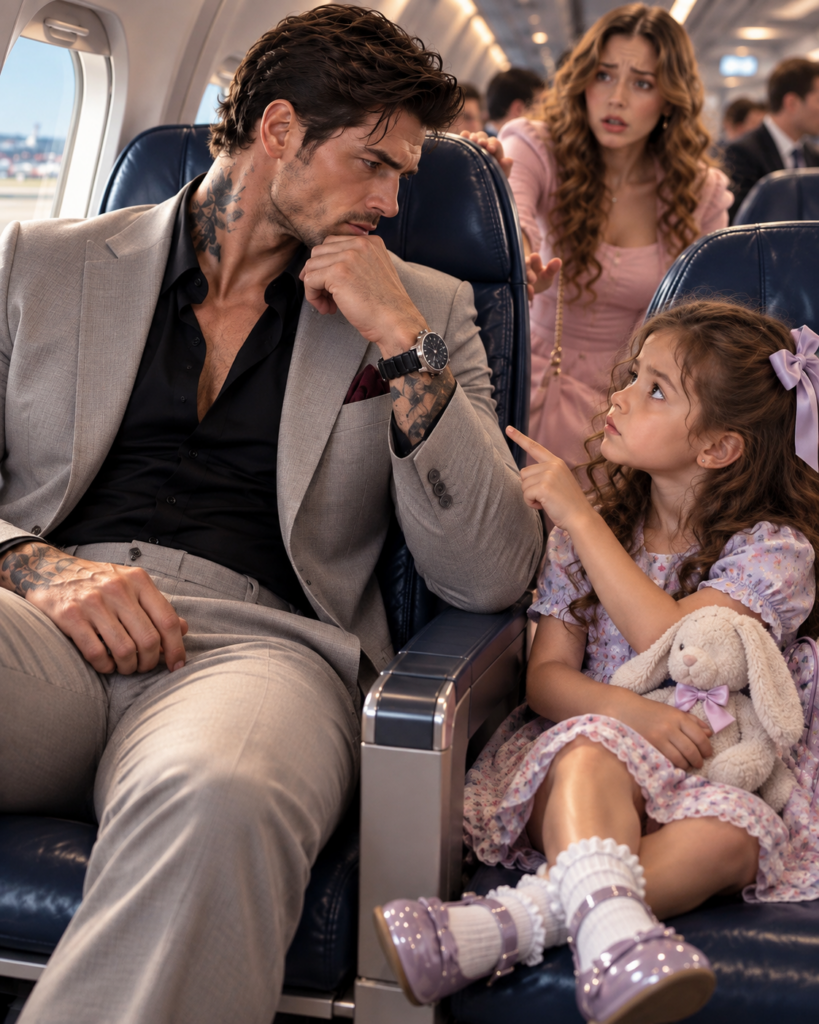
“Because Naomi never wanted you to know she was pregnant.”
For several seconds, the steady hum of the aircraft seemed to disappear.
I heard nothing except those words.
Pregnant.
Naomi.
The little girl beside me.
My eyes moved toward Lily before I could stop them.
She was carefully coloring the windows of a skyscraper blue, her tongue caught between her teeth in concentration. There was something devastatingly ordinary about it. She had no idea that the adults around her had suddenly become incapable of breathing normally.
Julie followed my gaze.
“Please,” she whispered again.
I looked at her.
There were a hundred questions in my throat.
I forced every one of them down.
Lily glanced up.
“Why are you both whispering?”
Julie recovered first.
“We’re talking about boring grown-up things.”
Lily narrowed her eyes.
“Taxes?”
Despite everything, a startled laugh escaped me.
Julie blinked.
Apparently Lily had inherited Naomi’s timing, too.
“Yes,” Julie said. “Exactly. Taxes.”
Lily made a face and returned to her drawing.
I stared at the untouched glass of water on my tray table.
“How old is she?” I asked quietly.
Julie hesitated.
“Four.”
“When is her birthday?”
Her eyes met mine.
“October seventeenth.”
I did the calculation automatically.
Then did it again because the first answer was impossible to accept calmly.
Naomi and I had last been together in January.
I turned toward the window.
Clouds stretched beneath us like an endless white country.
Five years.
For five years I had carried Naomi as an unfinished sentence.
Sometimes angrily.
Sometimes regretfully.
Sometimes with the private humiliation of knowing that no amount of money, influence, or determination could give a man an answer if the person holding it had disappeared.
Now the answer was swinging her shoes beside me.
“Does Naomi know you’re telling me this?”
“No.”
I looked at Julie.
“Then why did you?”
Her expression tightened.
“I didn’t intend to.”
“You told me she never wanted me to know.”
“Because you asked.”
“I asked her name.”
“And Lily answered before I could stop her.”
“That isn’t what I mean.”
Julie rubbed one hand over her forehead.
She looked exhausted suddenly.
Not frightened of me.
Tired.
There was a difference, and I noticed it.
“I have spent four years trying to stay out of something that was never mine to decide,” she said. “I’m not going to make another decision for Naomi now.”
Another.
The word caught.
“What does that mean?”
Julie looked toward Lily.
“Not here.”
I wanted to insist.
The old version of me would have.
The man who ran meetings by silence and closed deals by making other people uncomfortable had spent most of his adult life assuming that urgency justified pressure.
But Lily was between us.
And Naomi—wherever she was waiting in New York—had apparently spent five years expecting the worst from men with storm-colored eyes.
So I nodded.
“When we land?”
Julie studied me.
“That depends.”
“On?”
“Whether you understand that seeing Lily does not automatically give you the right to walk into Naomi’s life.”
The sentence landed harder than an accusation would have.
I looked back at Lily.
She had drawn a tiny purple dog on top of one of the buildings.
“You’re right,” I said.
Julie clearly had not expected that.
“I am?”
“Yes.”
Some of the tension left her shoulders.
Then Lily pushed her sketchbook toward me.
“Do you like it?”
I looked down.
She had added a third figure beneath the skyline.
Tall.
Dark suit.
Gray eyes.
“What’s that?”
“You.”
Julie closed her eyes.
I swallowed.
“Why am I there?”
Lily shrugged.
“You’re going to New York too.”
That simple.
Children had no respect for emotional catastrophe.
I looked at the drawing longer than necessary.
“It’s very good.”
“I know.”
That made Julie laugh.
And something inside me broke open just enough to hurt.
The descent into New York began forty minutes later.
Lily talked the entire way.
She told me her rabbit was named Benjamin even though “he looks more like a Carl.”
She explained that her mother designed logos and packages and once spent two whole days deciding between two colors that looked exactly the same.
“They were not the same,” Julie said.
“They were both green.”
“One was sage.”
“It was green.”
I smiled despite myself.
Naomi had once spent twenty minutes trying to convince me there were at least twelve meaningful shades of white.
“You’re laughing,” Lily accused.
“I agree with you.”
“Good.”
She leaned closer conspiratorially.
“Mommy is weird about colors.”
“I remember.”
The words came out before I could catch them.
Lily stopped.
Julie went perfectly still.
“What do you remember?”
I looked at Lily.
Her question was innocent.
So my answer needed to be.
“I knew your mother a long time ago.”
Her eyes widened.
“You know Mommy?”
“Yes.”
“From where?”
“An airplane.”
Lily’s mouth opened.
Then she gasped as if I had just revealed something magical.
“Like this airplane?”
“Very much like this one.”
“Did she steal your armrest?”
I stared at her.
Julie turned sharply toward the window to hide a smile.
“How do you know that?”
“Mommy steals everybody’s armrest.”
Of course she did.
For the first time since Julie’s revelation, something warm moved alongside the fear.
Not replacing it.
Nothing could.
But existing beside it.
I had spent years remembering Naomi as someone I had lost.
Lily reminded me that Naomi had continued being a person after she vanished from my life.
She still stole armrests.
Still cared too much about shades of green.
Still hated pickles.
Still drew—or perhaps designed—beautiful things.
Life had continued without me.
That truth hurt.
It also steadied me.
Because whatever happened next could not be about recovering something I believed belonged to me.
Neither Naomi nor Lily did.
The plane touched down at LaGuardia shortly after noon.
As passengers stood and reached for luggage, Julie leaned across the aisle.
“Luca.”
Hearing my name from her mouth felt strange.
“Yes?”
“Naomi is meeting us.”
I froze with one hand on my carry-on.
“At the airport?”
Julie nodded.
“She thinks I’m bringing Lily straight to her hotel.”
“Does she know I’m here?”
“No.”
I looked toward Lily, who was struggling enthusiastically with her backpack.
“I won’t surprise her.”
Julie’s eyes searched mine.
“What are you saying?”
“I’m saying I’ll leave through another exit.”
She stared at me.
The aisle filled around us.
“You’d do that?”
“What would you prefer?”
Julie’s mouth opened, then closed.
“I don’t know.”
“That makes two of us.”
Lily finally got one arm through her backpack strap.
“Three,” she announced.
Neither of us had realized she was listening.
Julie sighed.
“Three.”
I helped Lily with the second strap.
She looked up at me.
“Are you leaving now?”
There it was again.
That word.
Leaving.
Four-year-olds could accidentally find every fracture in a man.
“I’m getting off the airplane.”
“That’s leaving.”
“Technically.”
She considered this.
“Will I see you again?”
Julie inhaled softly.
I crouched so Lily and I were eye level.
I could have made a promise.
I wanted to.
Instead I chose the only truthful answer available.
“I hope so.”
Lily smiled.
“Okay.”
She reached into her backpack, tore a page from the back of her sketchbook, and handed it to me.
It was the skyline drawing.
The three figures.
“You can have this.”
My throat tightened.
“You’re sure?”
“I can draw another one.”
Of course.
I folded it carefully and placed it inside my jacket.
Then I stood.
Julie watched me.
“Give me your number,” she said.
I handed her my card.
She glanced at it.
The embossed Moretti Holdings logo apparently did not impress her.
“Your actual number.”
I took the card back, wrote my private number beneath the office line, and returned it.
Julie slipped it into her bag.
“I’ll talk to Naomi.”
“Only if she wants to.”
“I know.”
I picked up my carry-on.
Lily waved.
“Bye, airplane man.”
I smiled.
“Goodbye, Lily.”
I walked away before she could see how difficult that sentence was.
I did not go home.
Home was a penthouse overlooking Central Park that had always seemed peaceful before that afternoon.
Instead I went to my office.
Daniel Cho had worked for me for eleven years and possessed the rare ability to look unimpressed by almost anything.
He looked impressed when I walked into his office without knocking.
“You were supposed to be in Boston until tomorrow.”
“I was.”
“You look terrible.”
“Thank you.”
“You’re welcome.”
I closed his door.
Daniel removed his glasses.
“What happened?”
I placed Lily’s drawing on his desk.
He studied it.
“That’s either charming or a very unusual takeover proposal.”
“I met Naomi Ellis’s daughter.”
Daniel stopped smiling.
Of all the people in my life, Daniel knew the name.
He had known me before Naomi.
During Naomi.
And after.
“Where?”
“Seat 3B.”
He stared at me.
“Luca.”
“She’s four.”
The room became silent.
Daniel understood numbers too.
“She could be—”
“Yes.”
“Did Naomi tell you?”
“No. Her sister did.”
“Julie?”
“You remember her?”
“Naomi mentioned her.”
I walked toward the window.
Manhattan rose around us, glass and concrete glittering in September light.
“She says Naomi never wanted me to know.”
Daniel was quiet for a moment.
“Do you believe that?”
“I don’t know what I believe.”
That was unusual for me.
I hated uncertainty because uncertainty could not be negotiated with.
Daniel stood.
“What do you need?”
“I need you to tell me everything you remember about January and February five years ago.”
His expression changed.
“That period?”
“Yes.”
Losing Naomi had not been the only thing that happened that winter.
My mother, Elena, had collapsed while visiting family in Florence.
I had flown to Italy expecting to be gone four days.
I stayed eleven weeks.
Complications.
Rehabilitation.
A second surgery.
Then the slow rearrangement of an entire family’s life.
During those weeks, I had called Naomi.
At first constantly.
Then less often as every conversation somehow became more strained.
Our last conversation had happened at two in the morning from a hospital corridor.
Naomi had asked when I was coming back.
I had said I did not know.
She had gone quiet.
I had asked whether she wanted me to keep calling.
She had said, “Do whatever you need to do, Luca.”
I had hated those words.
I had heard rejection in them.
Perhaps she had heard abandonment in mine.
Two days later, my phone disappeared during a transfer between hospitals.
By the time I replaced it, Naomi’s number no longer connected.
Her apartment lease had ended.
Her agency told me she had resigned.
Emails went unanswered.
I had searched.
Not aggressively enough, perhaps.
Not cleverly enough.
But I had searched.
Eventually I convinced myself that Naomi had made a choice.
Daniel leaned against his desk.
“I remember the hospital. Your mother’s surgery. The phone.”
“Anything from Naomi?”
“No.”
“Letters?”
He frowned.
“Not that I remember.”
“Emails?”
“Your personal inbox had a security problem around then.”
I turned.
“What?”
“You remember. Someone tried to access several company accounts. IT migrated everything. Your private account was included because you were using it from the hospital network.”
I remembered pieces of it.
Passwords changed.
Accounts locked.
Half my life handled by staff while I slept in a chair beside my mother.
“Could something have been lost?”
“Possibly.”
“How much?”
“I don’t know.”
“Find out.”
Daniel nodded.
Then his eyes shifted to the drawing.
“Luca.”
“What?”
“If that child is yours, finding a missing email won’t tell you what to do next.”
“I know.”
“Do you?”
I looked at him.
He gestured toward the skyline.
“You solve problems for a living. This isn’t one.”
“No.”
“It’s people.”
“I noticed.”
That earned the faintest smile.
My phone vibrated.
Unknown number.
For one absurd second, I was afraid to look.
Then I did.
A message.
This is Julie. Naomi knows.
Another arrived.
She would like to speak with you tomorrow morning. Just you. I’ll send the place.
I stared at the screen.
Daniel read my expression.
“Her?”
“Her sister.”
“And?”
I exhaled.
“Tomorrow.”
I barely slept.
At eight the next morning, I arrived at a small café on West Seventy-Second Street eighteen minutes early.
I had never been early for anything because nervousness had never dictated my schedule before.
The café smelled of coffee, cinnamon, and warm bread.
I chose a table in the back.
Then changed tables because the first one felt too exposed.
Then nearly laughed at myself.
At eight twenty-seven, the door opened.
Naomi walked in.
Five years vanished and remained at the same time.
Her curls were shorter now, brushing her shoulders. She wore a camel coat over black trousers and carried a leather portfolio beneath one arm.
She looked older.
So did I.
Not dramatically.
But life had touched us both.
She saw me.
Stopped.
Then continued toward the table.
I stood.
“Naomi.”
“Luca.”
No hug.
No handshake.
We sat.
For a few seconds neither of us spoke.
Then she looked directly into my eyes.
“You met Lily.”
“Yes.”
“Julie told me.”
“She didn’t intend to.”
“I know.”
I waited.
Naomi wrapped both hands around her coffee.
“Ask.”
One word.
Permission.
I had spent all night preparing questions.
Now none of them seemed adequate.
“Is she mine?”
Naomi closed her eyes briefly.
“Yes.”
The world did not tilt.
There was no dramatic revelation left.
Just confirmation.
Somehow that was heavier.
“Are you certain?”
Her eyes opened.
“I am.”
“I wasn’t questioning you.”
“I know why you asked.”
I nodded.
Then I looked at the table because looking at her was suddenly too much.
“I have a daughter.”
Naomi’s expression softened almost imperceptibly.
“Yes.”
“Four years.”
“Yes.”
“I missed four years.”
Her fingers tightened around the cup.
“Yes.”
There were countless ways to turn that fact into blame.
I chose none.
“Why?”
Naomi looked toward the window.
“Because when I found out I was pregnant, you were gone.”
“My mother was sick.”
“I know that now.”
I stared at her.
“Now?”
“Julie told me later. I didn’t know how serious it was.”
“I told you she was in the hospital.”
“You told me she’d had a medical emergency. Then every time we spoke, you sounded farther away.”
“I was frightened.”
“So was I.”
That silenced me.
Of course she had been.
Naomi continued quietly.
“I was eight weeks pregnant when I tried calling you.”
“Tried?”
“Your number was disconnected.”
“My phone was lost.”
“I emailed.”
“I never received anything.”
“I went to your apartment.”
I looked up sharply.
“The doorman said you were out of the country indefinitely.”
“He should have taken a message.”
“I didn’t leave one.”
“Why not?”
Her eyes flashed with something old.
“Because I was twenty-six, pregnant, terrified, and beginning to think the man I loved had quietly removed himself from my life.”
The words hit hardest because she did not raise her voice.
Loved.
I gripped my coffee cup.
“You thought I left you.”
“Yes.”
“I thought you left me.”
Naomi gave a small, humorless smile.
“That sounds like us.”
“What does?”
“Two people too proud to admit they were scared.”
I looked at her for a long time.
“Julie said you never wanted me to know.”
“That became true later.”
“Later?”
Naomi hesitated.
Then reached into her portfolio.
She removed a photocopy of a postal receipt.
“I did try to tell you.”
I took it.
Certified mail.
Moretti residence.
The townhouse where my mother had lived at the time.
The date was five years ago.
February nineteenth.
“What was this?”
“A letter.”
My pulse quickened.
“What did it say?”
“That I was pregnant.”
I looked at the signature line.
Someone had accepted delivery.
E. MORETTI.
My chest went cold.
“Elena.”
“Your mother?”
“Yes.”
Naomi watched me carefully.
“I assumed she gave it to you.”
“She didn’t.”
“Luca—”
“She was still recovering in Italy in February.”
Naomi frowned.
“Then who signed for it?”
“I don’t know.”
That was not entirely true.
Moretti Holdings had used the townhouse during my mother’s absence for family records and mail.
Several relatives had access.
Staff too.
But there was something else.
After my mother returned from Italy, she had struggled with memory for months.
Boxes of paperwork accumulated.
Daniel and I had eventually moved much of it into storage after she downsized.
I looked at the receipt again.
“Do you still have the original?”
“Yes.”
“Why?”
“Because after Lily was born, I needed proof for myself that I had tried.”
There was no accusation in her voice.
That made the sentence worse.
“Naomi.”
“I’m not saying that to punish you.”
“I know.”
“I need you to understand something.”
I waited.
“I wasn’t hiding Lily because I wanted to hurt you.”
“I know.”
“You don’t know yet.”
She sat straighter.
“I had spent months convincing myself you had chosen another life. Then Lily arrived, and everything became very simple for a while. Feed her. Hold her. Sleep when she sleeps. Try not to panic when she sneezes.”
A smile touched my mouth.
Naomi noticed.
“She sneezed strangely.”
“How?”
“Like an angry squirrel.”
I laughed.
A real laugh.
She smiled despite herself.
For one second we were twenty-six and twenty-eight again.
Then the years returned.
“I told myself I would contact you when I felt stronger,” Naomi continued. “Then six months passed. Then a year. And the longer I waited, the harder it became.”
“Were you afraid of me?”
She considered that honestly.
“Not exactly.”
“That sounds reassuring.”
“I was afraid of your world.”
I went still.
“Your name. Your family. The way people stepped aside when you entered rooms. The fact that every time we had dinner somewhere, the owner somehow appeared. You acted like it was normal.”
“It was normal to me.”
“I know.”
Her expression softened.
“That was part of the problem.”
I could not argue with that.
“So what happens now?” I asked.
Naomi looked down.
“I don’t know.”
“Do you want me to stay away from Lily?”
Pain crossed her face.
“No.”
One word.
Immediate.
Certain.
My breathing changed.
She noticed.
“I thought I did,” she admitted. “For years I imagined that if this ever happened, I would tell you Lily had a good life and ask you to leave it alone.”
“And now?”
“Now she spent three hours beside you on an airplane.”
“Two hours and forty-seven minutes.”
Naomi stared.
“You timed it?”
“I checked.”
She shook her head.
“That is painfully like you.”
“What did Lily say?”
Naomi’s mouth curved.
“That you answered her questions.”
“She asked if I snore.”
“I heard.”
“She asked if I lie.”
“I heard that too.”
“Your daughter conducts hostile interviews.”
“Our daughter.”
The correction was soft.
But it changed the room.
Our daughter.
I looked away quickly.
Naomi’s voice softened.
“Luca, I need time.”
“You have it.”
“And boundaries.”
“Name them.”
“No surprise visits.”
“Agreed.”
“No sending people to check on us.”
“I wouldn’t.”
She gave me a look.
I sighed.
“I understand why you needed to say it.”
“No expensive gifts.”
“I haven’t bought anything.”
“You look like a man mentally purchasing a pony.”
“I was considering a bookstore.”
“That’s worse. She would live there.”
I almost smiled.
“Anything else?”
“Yes.”
Naomi looked directly at me.
“You don’t get to become her father because biology says you are.”
The words hurt.
But they were true.
“You become her father by showing up.”
I nodded slowly.
“I understand.”
“No,” Naomi said gently. “You will.”
Daniel called me that afternoon.
“We found something.”
I was in the car.
My hand tightened around the phone.
“What?”
“Your mother’s storage inventory.”
I leaned forward.
“And?”
“There are fourteen boxes labeled residential correspondence from the townhouse. Most are from the period she was overseas.”
“Where?”
“Moretti archive storage in Queens.”
“Open them.”
A pause.
“They’re sealed as part of Elena’s personal effects.”
“My mother has been dead three years, Daniel.”
“I know.”
The sentence softened both of us.
“Bring them to the office,” I said.
“I already did.”
Of course he had.
When I arrived, fourteen gray archival boxes lined the conference room wall.
Daniel stood beside them with white cotton gloves.
“You’re enjoying this too much.”
“I rarely get to open mysteries.”
For the next two hours, we found nothing.
Bank statements.
Charity invitations.
Christmas cards.
Medical bills.
A photograph of my mother wearing an enormous hat in Capri.
Then Daniel opened box eleven.
He stopped.
“What?”
He reached inside.
A cream envelope lay beneath a stack of unopened correspondence.
My name was written across the front.
Not typed.
Written.
I knew the handwriting.
Naomi had once left notes on my refrigerator because she claimed texting was “emotionally lazy.”
Milk.
Dinner at eight.
Stop buying terrible coffee.
And once:
I missed you today.
The envelope had never been opened.
A faded postal sticker crossed one corner.
CERTIFIED MAIL.
February nineteenth.
Daniel did not say anything.
Neither did I.
I picked it up carefully.
Five years disappeared into the weight of a single envelope.
Inside was a folded letter.
And a small black-and-white photograph.
An ultrasound.
My knees nearly failed me.
I sat.
Daniel quietly left the room.
For a long time, I only looked at the photograph.
A tiny shape.
A life I had not known existed.
Then I unfolded the letter.
Luca,
I have rewritten this seven times because every version sounds either angry or afraid, and I’m tired of being both.
I’m pregnant.
I don’t know what this means for you.
I barely know what it means for me.
I know things between us became confusing before you left. I know your family needs you. I know I said I didn’t want to wait for someone who wasn’t sure he could come back.
But there is a difference between what pride says at two in the morning and what the truth looks like after sunrise.
The truth is that I wish you were here.
The truth is that I’m scared.
The truth is that whatever happens between us, I believe you deserve to know about this child.
I’m not asking you to choose me.
I’m asking you to know.
Naomi
I read it twice.
Then a third time.
At the bottom was one final handwritten line.
Please call me, even if all you can say is goodbye.
I sat alone in the conference room with the photograph in my hand.
For five years, Naomi had believed I received that letter.
For five years, I had believed she had vanished without a word.
Neither of us had known the truth.
But another question had already begun forming.
The envelope had reached my mother’s townhouse.
It had been placed among her personal correspondence.
And someone had signed Elena Moretti’s name while Elena was still in Italy.
That evening I called Naomi.
She answered after the third ring.
“Hello?”
“I found it.”
Silence.
“The letter?”
“Yes.”
Her breath caught.
“It was unopened.”
Another silence.
Longer.
“Luca…”
“I didn’t know.”
“I believe you.”
Those three words nearly undid me.
I looked at Lily’s drawing lying beside the ultrasound photograph on my desk.
Three figures beneath a skyline.
One drawn yesterday.
One captured five years ago.
Two pieces of the same life, separated by an envelope nobody had opened.
“Naomi,” I said quietly, “someone accepted this letter while my mother was thousands of miles away.”
“What does that mean?”
“I don’t know yet.”
And for the first time in my life, I understood that finding the answer mattered less than what Naomi and I chose to do with it.
Still, as I stared at the signature on the receipt, one question refused to leave me.
If Elena Moretti had not signed for Naomi’s letter…
who had?
The answer arrived from the least dramatic person imaginable.
Mrs. Alvarez had worked for my mother for twenty-three years.
She was seventy-one now and lived with her daughter in New Jersey, where she spent her mornings tending tomatoes on a balcony and her afternoons complaining that her grandchildren did not understand the importance of ironing pillowcases.
When Daniel found her number, I called.
“Luciano?”
Nobody except my mother’s generation called me Luciano.
“Hello, Mrs. Alvarez.”
“You never call.”
“I know.”
“You should.”
“I know that too.”
She sighed.
“You sound like your mother when she knew she was wrong.”
That nearly made me smile.
“I need to ask you about something from five years ago.”
I explained the letter.
The townhouse.
The signature.
For several seconds, she said nothing.
Then she made a small sound.
“Oh.”
My hand tightened around the phone.
“You remember?”
“I remember the mail.”
“Who signed?”
“I did.”
The answer was so simple that I almost missed it.
“You?”
“Your mother told me to sign for anything requiring a signature while she was away.”
“With her name?”
“That was how deliveries were handled. Your mother hated missed packages.”
I closed my eyes.
Of course she did.
Elena Moretti would postpone surgery before she would allow a parcel to be returned to sender.
“What happened to Naomi’s envelope?”
“I would have put it with your mother’s correspondence.”
“Why not mine?”
“Because it came to the house.”
“My name was on it.”
Mrs. Alvarez went silent.
“I’m sorry, Luciano.”
“No. I’m not blaming you.”
“I should have looked.”
“You had no reason to.”
There it was.
Five years of heartbreak reduced not to conspiracy, betrayal, or deliberate cruelty, but to something infinitely more ordinary.
A woman following household procedure.
A recovering mother whose mail remained unopened.
A box sent to storage.
A phone lost in a hospital transfer.
Two frightened people misreading one another from different sides of an ocean.
Sometimes lives changed because someone made a terrible choice.
Sometimes they changed because nobody made a choice at all.
“Mrs. Alvarez?”
“Yes?”
“Thank you.”
“For losing your letter?”
“For remembering.”
She was quiet.
“Your mother talked about that year sometimes.”
I leaned back.
“What did she say?”
“That she thought you had lost someone.”
My throat tightened.
“She was right.”
“Maybe,” Mrs. Alvarez said. “Or maybe you were only late finding each other again.”
I told Naomi the next morning.
We met in Central Park because she had Lily with her and refused to spend a sunny Saturday inside discussing five-year-old mail.
Lily raced ahead toward a fountain, Julie walking beside her.
Naomi and I followed several yards behind.
“So that’s it?” she asked.
“That’s it.”
“No secret family plot?”
“Disappointingly, no.”
Naomi smiled.
“No evil aunt hiding correspondence?”
“I don’t have an evil aunt.”
“You have several intimidating aunts.”
“That is different.”
“One of them stared at me for six straight minutes at your mother’s birthday dinner.”
“Aunt Sofia stares at everyone.”
“She asked whether my earrings were real gold.”
“She considers that casual conversation.”
Naomi laughed.
The sound stopped me.
She noticed.
“What?”
“Nothing.”
“Luca.”
“I forgot what that sounded like.”
Her expression changed.
The space between us filled with everything we had not said.
Then Lily shouted from ahead.
“Mommy! Look!”
She had discovered a bubble drifting across the path.
Naomi smiled automatically.
The tenderness on her face was so complete that my chest hurt.
Lily jumped at the bubble.
Missed.
Tried again.
Julie clapped when she caught it.
I watched them.
“My mother would have loved her,” I said.
Naomi looked at me.
“Lily?”
“Yes.”
“She probably would have asked whether Lily’s shoes were real leather.”
I laughed.
“Definitely.”
Naomi grew quiet.
“I’m sorry your mother never knew.”
That grief was unexpected.
I had spent three years believing I understood everything I had lost when Elena died.
Now there was another loss.
A grandmother who had never met her granddaughter.
A granddaughter who would know her only through photographs and stories.
“Me too.”
Naomi brushed a curl behind her ear.
“What was she like with children?”
“Terrible.”
Naomi blinked.
I smiled.
“She believed children should be spoken to like adults, so when my cousin Marco was six, she explained compound interest to him.”
Naomi laughed.
“That explains your entire family.”
“She also kept candy in every drawer.”
“Better.”
“She would have adored Lily.”
Naomi watched our daughter running toward Julie.
“Then tell her about Elena someday.”
I looked at her.
“You mean that?”
“Yes.”
The word seemed small.
It wasn’t.
The next few weeks developed a rhythm none of us had planned.
I did not become Lily’s father overnight.
I became Luca.
That was enough.
At first, I saw her twice a week.
Always with Naomi.
Sometimes with Julie.
We went to parks, museums, bookstores, and one disastrously crowded children’s science exhibit where Lily spent forty minutes building a bridge from wooden blocks and four minutes looking at everything else.
I learned that she hated blueberries but loved blueberry muffins.
I learned she believed pigeons were “city chickens.”
I learned she could not say “specific” without adding an extra syllable.
I learned she became quiet when tired.
I learned Naomi carried crackers, bandages, crayons, tissues, two hair ties, sunscreen, and a tiny plastic dinosaur in her bag at all times.
“Why the dinosaur?” I asked.
Naomi shrugged.
“Emergency dinosaur.”
I did not understand.
Three days later, Lily started crying in a restaurant because her drawing tore.
Naomi silently handed her the dinosaur.
Lily stopped crying.
I understood emergency dinosaurs.
At the end of our third week, Lily asked the question.
We were sitting on a bench near the Conservatory Water while she pushed tiny sailboats with a stick.
“Luca?”
“Yes?”
“Are you Mommy’s old friend?”
Naomi went still beside me.
“I am.”
“How old?”
I almost smiled.
“Very old.”
Naomi elbowed me.
Lily considered this.
“Were you friends before me?”
“Yes.”
She looked at Naomi.
Then at me.
Her little brow furrowed.
Children assembled truths differently than adults.
They did not need timelines.
They needed safety.
“Did you know me when I was a baby?”
There was no way to answer without hurting.
Naomi started to speak.
I touched her hand gently.
“No,” I said.
Lily frowned.
“Why?”
“Because I didn’t know you were here.”
She stared at me.
I waited.
Her expression remained serious.
“Like hide-and-seek?”
My heart cracked.
“A little like that.”
“Was I hiding?”
“No.”
“Were you?”
I looked at Naomi.
She gave the smallest nod.
“I think the grown-ups got lost.”
Lily absorbed this.
Then looked back at her sailboat.
“Mommy gets lost in parking garages.”
Naomi gasped.
“I got lost once.”
“Three times.”
“Traitor.”
Lily giggled.
The moment passed without trauma because Naomi had spent four years giving her daughter the confidence to believe adults could make mistakes without making the world unsafe.
A few minutes later, Lily climbed onto the bench between us.
She leaned against Naomi first.
Then, slowly, against me.
I did not move.
Her curls brushed my jacket.
My eyes burned.
Naomi saw.
She looked away to give me privacy.
That kindness hurt almost as much as the moment itself.
Two days later, Naomi called.
Not texted.
Called.
“I think we should do the paternity test.”
I was standing in my kitchen.
I set down my coffee.
“Are you uncertain?”
“No.”
“Then why?”
“For Lily.”
I understood immediately.
Medical history.
Legal clarity.
A future where Lily would never have to wonder whether the adults around her had avoided certainty because certainty was uncomfortable.
“Okay.”
“It should be private.”
“Of course.”
“No press.”
“Naomi.”
“I know. I know. I just need to say these things.”
“You can say them as many times as you need.”
There was a pause.
“You’re different.”
“I’m older.”
“That isn’t what I mean.”
I leaned against the counter.
“What do you mean?”
“The Luca I knew would have argued with every boundary.”
“That Luca was an idiot.”
“He was twenty-eight.”
“Those things are not mutually exclusive.”
She laughed softly.
Then grew serious.
“Why aren’t you angry?”
“I am.”
“At me?”
“At five years.”
“That isn’t a person.”
“Exactly.”
Silence.
I continued.
“I spent the first night wanting someone to blame. You. Julie. Whoever signed for the letter. Myself.”
“And?”
“And none of it gets me Tuesday afternoon with Lily when she was two.”
Naomi said nothing.
“It doesn’t give you back the night you brought her home from the hospital.”
Her breath changed.
“It doesn’t change anything useful.”
“No.”
“So I’m trying to spend my energy on what still can change.”
She was quiet for so long I thought the call had dropped.
Then she said, “That might be the first sensible thing you’ve ever said.”
“I own several companies.”
“You once bought a motorcycle because a waiter told you it was dangerous.”
“He was very convincing.”
She laughed again.
And I realized we were learning how to speak without walking through the wreckage every time.
The test confirmed what neither of us doubted.
Probability of paternity: greater than 99.99 percent.
I stared at the page.
Then Daniel, who was standing across my desk, said, “Congratulations.”
The word startled me.
“Congratulations?”
“You’re officially a father.”
“I was officially a father before the laboratory noticed.”
Daniel nodded.
“Fair.”
I folded the report.
“Do you think I can do this?”
He looked genuinely surprised.
“You’re asking me?”
“Yes.”
“Then something extraordinary has already happened.”
“What?”
“You admitted you don’t know.”
I gave him a look.
Daniel smiled.
“You’ll make mistakes.”
“Helpful.”
“You’ll overthink things.”
“Better.”
“You’ll buy inappropriate gifts.”
“Naomi has already prohibited that.”
“Smart woman.”
“And?”
Daniel considered.
“You’ll show up.”
The answer settled somewhere deep.
My father had believed provision was the same thing as presence.
He paid every bill.
Attended almost nothing.
Birthdays meant envelopes.
Graduations meant watches.
He had not been cruel.
He simply existed at a distance and mistook responsibility for relationship.
For most of my life, I had repeated the same pattern with everyone I loved.
Until Naomi.
Then, through circumstance and pride, I had managed to lose her anyway.
“I don’t want Lily growing up wondering whether I had something more important to do.”
“Then don’t give her a reason to wonder.”
Simple.
Not easy.
But simple.
The first true test came in October.
Lily’s fifth birthday.
Naomi planned a small party at Julie’s apartment because Lily had declared large parties “too noisy and full of strangers who touch your cake.”
There were twelve children.
Four parents.
Two grandparents from Naomi’s side.
Julie.
Naomi.
Me.
I had attended negotiations involving billions of dollars with less anxiety.
“You’re pacing,” Julie said.
“I don’t pace.”
“You’ve crossed this kitchen six times.”
“I’m observing.”
“The refrigerator?”
“It could be relevant.”
Julie handed me a stack of paper plates.
“Make yourself useful.”
I obeyed.
We had changed too.
The first week, Julie apologized.
Not dramatically.
We were sitting outside a bookstore while Lily and Naomi were inside.
“I didn’t tell Naomi not to contact you,” Julie said. “But I didn’t encourage her either.”
I listened.
“I thought I was protecting her.”
“From me?”
“From uncertainty.”
She looked ashamed.
“I had just gone through a divorce. My whole theory of men at the time was not exactly generous.”
“You were helping your sister survive.”
“I was also projecting.”
“Both can be true.”
Julie looked at me.
“You don’t have to make me feel better.”
“I’m not.”
That made her smile.
Now, at Lily’s birthday, Julie treated me with the friendly impatience normally reserved for relatives.
“Candles,” she said.
“I bought them.”
“Where?”
I pointed.
She stared at the box.
“These are sparkler candles.”
“They said birthday.”
“They are for adults.”
“How are birthday candles age-specific?”
“Go to the corner store.”
I went.
Ten minutes later, I returned with normal candles.
Julie inspected them.
“Good.”
“You enjoy this.”
“Immensely.”
Across the room, Lily spotted me.
“You came!”
Three words.
Pure joy.
I crouched as she ran toward me.
“Of course I came.”
She wrapped her arms around my neck.
It was the first time she had hugged me without being prompted by hello or goodbye.
I closed my eyes.
When I opened them, Naomi was watching from across the room.
Something in her expression had changed.
Not vanished.
Not healed completely.
Changed.
Later, after the other children left and Lily sat on the floor surrounded by wrapping paper, I gave her my gift.
One box.
Naomi had approved it beforehand.
Lily opened it.
Inside was a beautifully illustrated book about the bridges of New York City.
Her eyes widened.
“Bridges!”
“There are diagrams inside.”
She hugged the book.
Then looked at me.
“Did you know I like bridges?”
“Yes.”
“How?”
“You told me.”
She thought about that.
“I tell lots of people.”
“I remember.”
Naomi looked down.
I realized later that this was the moment she began trusting me.
Not because of the gift.
Because I had listened.
Winter arrived slowly.
Naomi decided to extend her New York stay.
Originally, she and Lily had planned to return to Atlanta after six weeks.
Then Naomi’s agency offered her a major project in Manhattan.
She took it.
She rented an apartment in Brooklyn.
Not because of me, she insisted.
I believed her.
Mostly.
I helped assemble Lily’s bookshelf only after being specifically invited.
I was terrible at it.
“You own construction companies,” Naomi said, watching me study the instructions.
“I do not personally construct anything.”
“This is becoming obvious.”
“Why are there fourteen screws left?”
“There should be two.”
“Interesting.”
“Luca.”
“I’m addressing it.”
“You built it backward.”
“That feels judgmental.”
Lily wandered into the room.
She inspected the shelf.
“It’s crooked.”
“Thank you, Lily.”
“You’re welcome.”
Naomi laughed so hard she had to sit down.
There were moments like that.
Small ones.
Moments in which I could almost imagine we were simply a family.
Then reality would return.
Naomi and I were not together.
We had not discussed being together.
Parenthood had to stand separately from romance.
I knew that.
She knew it.
That did not stop me from noticing everything.
The way she tucked her feet beneath herself on the couch.
The way she still drank coffee too late.
The way she hummed when working.
The way she occasionally looked at me as if remembering someone I used to be.
One snowy evening, after Lily went to sleep, Naomi and I sat by the window.
“You’ve never asked,” she said.
“Asked what?”
“Whether I dated anyone.”
I looked at my coffee.
“That seemed like dangerous territory.”
“It is.”
“Then my instincts remain excellent.”
She smiled.
“There were people.”
I nodded.
“So were there for you.”
“Yes.”
“Anyone serious?”
“No.”
“Why?”
I could have given her a safe answer.
Work.
Timing.
Compatibility.
Instead I told the truth.
“Because every relationship eventually asked me to become known.”
Naomi studied me.
“And you didn’t want that?”
“I didn’t know how.”
“You let me know you.”
“That was the problem.”
Her expression softened.
“You thought losing me proved you shouldn’t do it again.”
“Yes.”
Outside, snow collected along the fire escape.
Naomi traced the rim of her mug.
“I thought loving you proved I had ignored every warning sign.”
“That sounds more intelligent than my conclusion.”
“It wasn’t.”
She looked at me.
“I made you into a story where I was abandoned because that was easier than admitting we had both failed to communicate.”
“You were pregnant.”
“I was still responsible for my choices.”
“You tried to tell me.”
“Once.”
“You called.”
“Twice.”
“You went to my apartment.”
“And then I stopped.”
Her eyes were bright.
“I told myself stopping was strength.”
I said nothing.
“Sometimes it was fear.”
I moved my hand across the space between us.
Not touching hers.
Just close.
“I was afraid too.”
“I know.”
“I should have found you.”
“Maybe.”
“I tried.”
“I know that now.”
That mattered.
Perhaps forgiveness was not a moment.
Perhaps it was the gradual replacement of an old story with a truer one.
In March, Lily had a school project called My Family Map.
She drew Naomi.
Julie.
Her grandparents.
Benjamin the rabbit.
And me.
I was standing beside a bridge.
When I saw it attached to the classroom wall, I could not speak.
Lily tugged my hand.
“That’s you.”
“I see.”
“You have too much hair.”
Naomi laughed behind me.
I crouched.
“What does the bridge mean?”
Lily shrugged.
“You like bridges now.”
“I thought you liked bridges.”
“I shared.”
My throat tightened.
Her teacher smiled at us from across the room.
Lily pointed to each figure.
“That’s Mommy. Aunt Julie. Grandma. Grandpa.”
Then her finger reached me.
“And that’s my dad.”
Everything inside me stopped.
She had never called me that.
Not once.
Naomi became completely still.
Lily looked up.
“Is that okay?”
I had imagined this moment.
In those imaginings, I always knew what to say.
Reality was different.
I knelt so I could see her properly.
“Only if it’s okay with you.”
She frowned.
“But you are.”
A four-year-old had once asked whether I left.
A five-year-old was now informing me I belonged.
I smiled despite the tears burning my eyes.
“Then yes.”
She threw her arms around me.
Behind her, Naomi wiped quickly beneath one eye.
Later, walking home, Lily ran ahead through the park with Julie.
Naomi and I followed.
“She chose that herself,” Naomi said.
“I know.”
“I didn’t suggest it.”
“I know.”
“I thought you should understand.”
I stopped walking.
Naomi turned.
“Thank you.”
“For what?”
“For letting it be hers.”
Her eyes softened.
“It is hers.”
We stood beneath budding trees.
After a moment, I said, “There’s something I need to tell you.”
Naomi waited.
“I’ve changed my role at the company.”
Her eyebrows lifted.
“What does that mean?”
“I’m staying chairman, but Daniel will run daily operations.”
“Why?”
“Because I don’t want Lily’s childhood scheduled around quarterly meetings.”
“You don’t have to redesign your life overnight.”
“I’m not.”
I looked toward our daughter.
“I’m redesigning it deliberately.”
Naomi studied me.
“And the other parts?”
I knew what she meant.
The Moretti reputation.
The old arrangements.
The parts of my family business nobody discussed at dinner.
“I’ve been unwinding them for years.”
“Because of Lily?”
“No.”
That mattered.
“Because I should have done it sooner. Lily just made me stop pretending it could wait forever.”
Naomi nodded slowly.
Then she smiled.
“You know, for a terrifying man with storm eyes, you’re becoming surprisingly reasonable.”
“I dislike the direction of this reputation.”
“You’ll survive.”
By summer, I had learned that fatherhood was mostly repetition.
Showing up.
Again.
Again.
Again.
School pickups.
Saturday pancakes.
Phone calls.
Doctor forms.
Lost mittens.
Bedtime stories.
Apologies when I got something wrong.
Especially apologies.
One evening Lily became furious because I missed her preschool performance after a meeting ran late.
I arrived during the final song.
She saw me from the stage.
But afterward she would not speak to me.
The old instinct rose immediately.
Explain.
Justify.
Tell her I had tried.
Then I remembered what Naomi had said.
Showing up mattered.
So did owning the moments when I didn’t.
I crouched beside Lily.
“I’m sorry.”
She crossed her arms.
“You missed my butterfly part.”
“I did.”
“You said you would come.”
“I did.”
Her eyes filled.
“I kept looking.”
That sentence hurt more than anything an adult could have said.
“I know.”
I swallowed.
“I made a promise and I didn’t keep it.”
She looked at me suspiciously.
“Are you going to say work was important?”
“No.”
“Was it?”
“Yes.”
She frowned.
“Then why not say it?”
“Because being important doesn’t make it okay that I hurt you.”
She considered that.
Children could forgive quickly.
I had learned not to depend on it.
“I’m still mad.”
“You can be.”
“For how long?”
“As long as you need.”
She thought.
“Until ice cream.”
“That seems fair.”
She took my hand.
Naomi watched from nearby.
That night she walked me outside.
“You handled that well.”
“I nearly didn’t.”
“But you did.”
We stood on the stoop.
Warm summer air moved through the trees.
“Naomi.”
“Yes?”
“I still love you.”
The words were quiet.
No dramatic speech.
No expectation.
Just truth.
She looked at me for a long time.
“I know.”
“I’m not asking you for anything.”
“I know that too.”
“I just don’t want silence making decisions for us again.”
Something shifted in her face.
Then she stepped closer.
“I still love you too.”
I closed my eyes for half a second.
“But,” she said.
I opened them.
“There it is.”
She smiled.
“But I don’t want us to rebuild what we had.”
My chest tightened.
Then she took my hand.
“I want us to build something better.”
For the first time in years, I did not rush toward certainty.
I simply held her hand.
“I can do that.”
“No promises you can’t keep.”
“Agreed.”
“No disappearing into work.”
“I’m learning.”
“No buying motorcycles because strangers insult your courage.”
“That happened once.”
“It happened twice.”
“The second motorcycle was unrelated.”
She laughed.
Then she kissed me.
Softly.
Carefully.
Not like people recovering lost time.
Like people choosing the time still ahead.
A year after seat 3B, the three of us took a flight to Atlanta to visit Naomi’s parents.
Lily sat between us.
She was six now and considered herself an experienced traveler.
She placed her backpack beneath the seat.
Buckled herself in.
Then claimed both armrests.
I looked at Naomi.
She looked at me.
Neither of us spoke.
Lily noticed.
“What?”
“Nothing,” Naomi said.
“You stole the armrest,” I told her.
Lily frowned.
“It’s neutral territory.”
Naomi covered her mouth.
I stared at her.
“You taught her that.”
“I absolutely did not.”
“Yes, you did.”
Lily looked between us.
“Why are you weird?”
“No reason,” Naomi said.
The plane began taxiing.
Lily took my hand with one hand and Naomi’s with the other.
Outside the window, New York moved slowly past us.
The city where I had grown up.
The city Naomi had once thought was too loud.
The city where a missing letter had waited in a box for five years.
The city where our daughter had eventually drawn me into her family beneath a bridge.
I looked at Naomi.
She leaned her head against the seat.
“Do you ever think about it?” she asked.
“Seat 3B?”
She nodded.
“Every day.”
“What if the airline hadn’t changed the plane?”
“I don’t like that question.”
“Neither do I.”
Lily squeezed our hands.
“Why?”
Naomi smiled at her.
“Because sometimes tiny things change very big things.”
“Like butterflies?”
“Exactly.”
Lily thought about that.
Then she looked at me.
“Mommy says men like you leave.”
Naomi groaned.
“Lily.”
I laughed.
It was the same sentence.
But it had lost its power to wound.
Now it belonged to our family history.
Lily grinned.
“I remember.”
“So do I.”
She studied me with those silver-gray eyes.
“Do you leave?”
A year ago, I had not known how to answer.
Now I did.
“Sometimes I have to go places.”
“That’s not what I mean.”
Of course it wasn’t.
I looked at Naomi.
Then at our daughter.
“No,” I said.
Lily smiled.
“Good.”
She returned to her coloring book as if the matter were settled forever.
Naomi slipped her fingers through mine.
The plane lifted.
Manhattan fell away beneath us, its bridges stretching across the water in long graceful lines.
For most of my life, I thought strength meant never needing anyone enough to be changed by losing them.
I had been wrong.
Strength was returning when the path back was uncertain.
It was listening when blame would be easier.
It was allowing another person’s fear to exist beside your own.
It was apologizing without demanding immediate forgiveness.
It was becoming reliable one ordinary day at a time.
Five years earlier, Naomi and I had each believed the other had chosen absence.
Neither of us understood how much of our story had been written by missed calls, unopened mail, frightened assumptions, and the pride of two people who did not know how to say, Please come back.
We could not recover the years between us.
I would never hear Lily’s first word as it happened.
I would never carry her through her first night home.
I would never see her first steps except through the videos Naomi had finally begun sharing with me.
Those losses were real.
We did not pretend otherwise.
But a meaningful life was not built only from what could be recovered.
Sometimes it was built from what people chose after recovery became impossible.
Naomi had chosen trust again.
I had chosen presence.
Julie had learned that protecting someone sometimes meant allowing them to make their own decisions.
Daniel had learned to stop scheduling meetings before ten on mornings after Lily slept over.
And Lily—
Lily had never cared about the complicated explanations adults used to survive regret.
She cared whether I remembered she liked bridges.
Whether I came to her school performances.
Whether I knew Benjamin the rabbit was not to be washed in the washing machine.
Whether I answered when she called.
Whether I stayed.
Her hand found mine again as the plane rose above the clouds.
This time, seat 3B was across the aisle.
Empty.
I looked at it and smiled.
Once, that seat had meant nothing to me.
Then it had given me the truth I had spent five years missing.
Not a perfect truth.
Not an easy one.
Something better.
A second chance that asked all of us to become more honest than we had been before.
Naomi followed my gaze.
“What are you thinking?”
“That I’m glad I didn’t change seats.”
She smiled.
“So am I.”
Lily looked up from her drawing.
“I’m drawing our house.”
Naomi glanced down.
“We don’t all live in one house.”
Lily shrugged.
“Not yet.”
I nearly choked.
Naomi turned slowly toward her.
Julie would have enjoyed this immensely.
“Lily,” Naomi said.
“What?”
Our daughter continued coloring.
“I put a room for Benjamin.”
I looked at Naomi.
Naomi looked at me.
Then, against all reason, we both started laughing.
Lily frowned.
“Grown-ups are so weird.”
She returned to her picture.
I leaned toward Naomi.
“Apparently we have a housing decision coming.”
“Do not get ahead of yourself, Moretti.”
“Yes, ma’am.”
She rested her head against my shoulder.
Below us, the clouds opened.
Sunlight spilled across the cabin.
And for once, none of us needed to know exactly what came next.
We only needed to know that when it came, we would meet it together.

