
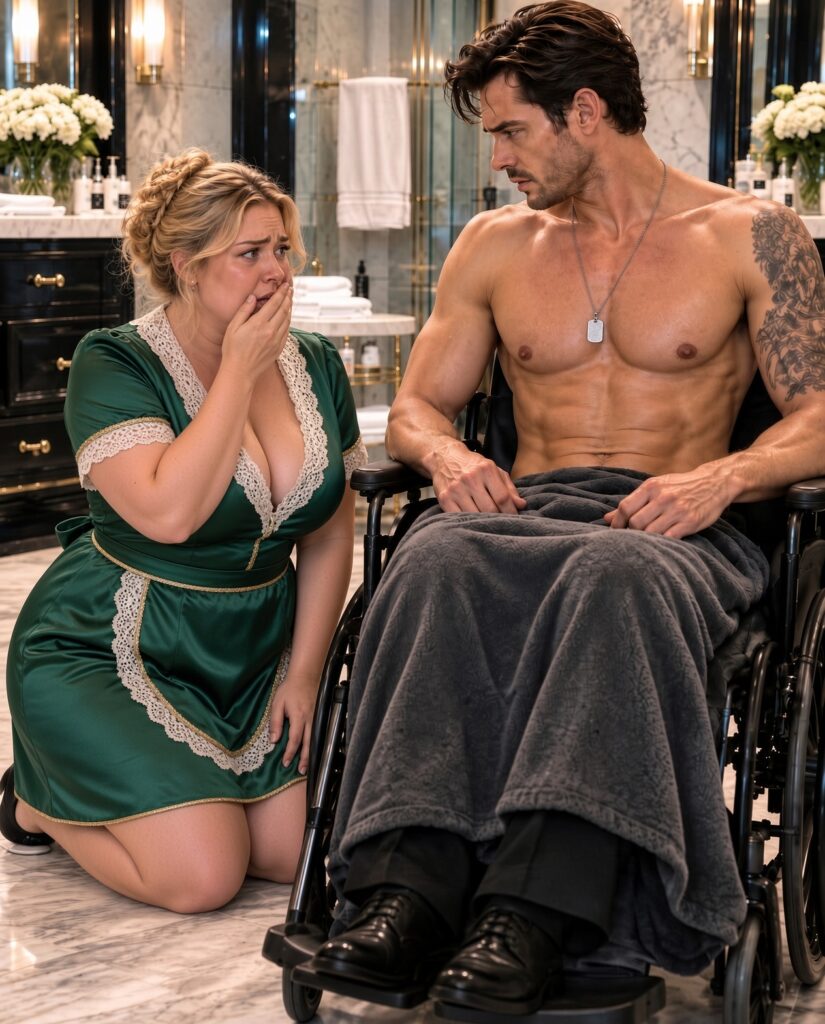
His eyes were sharp now. He had the kind of face that missed very little, even when his body refused to obey him. Dark hair brushed his forehead, and a faint scar traced the edge of his left eyebrow. I remembered that scar.
Not on his face.
On someone else’s.
I lowered my eyes. “I can finish helping you.”
“No.”
The word was quiet, but firm.
I looked at him.
“Leave the room,” he said. “Please.”
The courtesy unsettled me more than anger would have.
I reached for the towel and covered his shoulders before stepping back. Every movement felt careful, measured. I was afraid that if I moved too quickly, the past would rise up and expose me.
At the door, I heard him speak again.
“Have we met before?”
I kept my hand on the handle.
“No.”
It was the first lie I had told him.
And it was not the last one I would need to tell.
Outside, the housekeeper stood at the end of the hallway with a folded robe over her arm. She glanced toward the bathroom, then at my face.
“Are you all right?”
“I’m fine.”
Her name was Mrs. Alvarez. I had learned it earlier that afternoon, when she gave me a short tour of the mansion and explained the schedule. She was a sturdy woman in her late fifties, with silver hair pinned neatly at the back of her head and a habit of studying people before deciding whether to trust them.
“You look as if you’ve seen a ghost,” she said.
“I’m only nervous.”
“That’s normal. Mr. Bennett makes most people nervous.”
“No,” I whispered. “It isn’t him.”
Her expression changed, but she didn’t press me. Instead, she handed me the robe.
“Take this to him. Then come downstairs. You need tea.”
“I should finish my duties.”
“Your duties can wait ten minutes. A person who collapses on the bathroom floor is not much help to anyone.”
There was no cruelty in her words. Only practical concern.
I carried the robe back inside.
Mr. Bennett had moved his wheelchair closer to the window. The bathwater had been drained, and he was dressed in a loose gray shirt. The chain was gone beneath the fabric.
He stared out at the grounds, where evening had settled over the gardens.
“I can call someone else,” he said.
“I need this job.”
“I heard you the first time.”
“Then let me keep it.”
He turned toward me. “Why?”
I almost laughed. The question was too simple for the number of answers trapped inside me.
Because my son needed medicine.
Because my daughter had fallen asleep hungry the night before.
Because the rent was overdue and the landlord had stopped believing my promises.
Because this mansion contained the man I had mourned for two decades, and I had no idea whether he remembered me.
“Because I’m capable of learning,” I said.
“That isn’t what I asked.”
“No,” I replied. “But it’s the answer I can give you.”
For a moment, neither of us spoke.
Then he looked toward the door. “Mrs. Alvarez will show you the staff quarters. You’ll begin tomorrow morning.”
Relief came first.
Fear followed closely behind.
“Thank you.”
“Don’t thank me yet,” he said. “You may regret accepting.”
I wondered if he meant the work.
I wondered if he meant him.
The staff quarters were small but clean, located in a separate wing behind the kitchen. Mrs. Alvarez gave me a narrow room with a bed, a dresser, and a window overlooking the back garden.
“You can stay here during the week,” she explained. “Your children can visit if you arrange it. There’s a small apartment above the carriage house, but it needs cleaning.”
“I won’t need it.”
“You might.”
“I have a place in the city.”
She looked at my worn coat and the damp marks still visible along the hem of my trousers. “Of course you do.”
I didn’t take offense. She had seen enough people to recognize a lie when it was protecting someone’s pride.
“I have two children,” I said. “My son is eight, and my daughter is five. They’re staying with a neighbor tonight.”
“Are they safe?”
“Yes.”
“Do they have food?”
My throat tightened.
“They will.”
Mrs. Alvarez opened a cupboard and took out a paper bag. Inside were sandwiches, fruit, and two small cartons of milk.
“The kitchen prepared too much.”
“That’s kind, but I can’t—”
“Take it.”
I did.
That night, I lay awake in the narrow bed, listening to the unfamiliar quiet of the estate. No dripping ceiling. No pipes rattling behind the walls. No children coughing in the next room.
The silence should have been peaceful.
Instead, it gave my memories room to speak.
Twenty years earlier, I had been nineteen years old and living with my grandmother in a small town outside Chicago. My grandmother cleaned rooms at a roadside motel, and I worked evenings at a diner. We owned almost nothing, but I had believed life could still become something more.
Then I met Adrian.
He was twenty-one, working for a local construction company while attending community college. He had restless brown eyes, a crooked smile, and a habit of carrying a silver chain beneath his shirt. He told me the pendant had belonged to his mother.
“She gave it to me when I left home,” he had said.
“What does the A stand for?”
He had smiled. “That depends on who’s asking.”
I had thought he was teasing.
For three months, we met whenever our schedules allowed. We walked by the river, shared coffee in paper cups, and talked about the lives we hoped to build. Adrian wanted to study architecture. I wanted to become a nurse.
Neither of us had money, but we had plans.
Then, one night during a violent storm, he came to my grandmother’s house soaked through and shaking.
“I have to leave,” he said.
I remembered standing in the doorway, my hair damp from the rain, refusing to understand.
“Leave for where?”
“I don’t know.”
“Then don’t go.”
His face had crumpled in a way I had never seen before. “I can’t stay here.”
He had taken my hands and promised he would return.
Before dawn, he was gone.
A week later, I learned that his car had been found near a flooded bridge. There had been no body. No wallet. No explanation.
People assumed he had drowned.
My grandmother told me to grieve and move forward.
I tried.
A year later, I discovered I was pregnant.
I named my son Brandon.
I never told anyone who his father was—not because I was ashamed, but because I had no proof Adrian was alive. Over time, the pain became something quieter. I worked, raised my son, and eventually married a man who seemed dependable.
That marriage lasted four years.
He left when Brandon was three, taking the little money we had and leaving behind a note that said he couldn’t live with “someone still waiting for a ghost.”
I had never admitted that I was waiting.
But perhaps some part of me had been.
At two in the morning, I sat up in bed.
The letter.
I had kept Adrian’s last letter for twenty years. It was folded inside an old cookbook in my apartment, hidden beneath recipes I never used. The paper had yellowed, and the ink had faded, but one line remained clear.
If anything happens, look for the house with the blue shutters.
At the time, I had assumed it was a place he intended to take me someday.
Now I remembered something else.
The Bennett mansion had blue shutters.
I had noticed them when I arrived.
I had dismissed the thought because it seemed impossible.
By morning, I had convinced myself it was coincidence.
I began work at six.
Mr. Bennett’s routine was carefully organized. A physical therapist arrived at seven, a nurse checked his medication at eight, and breakfast was served in his room at eight-thirty. My duties were to assist with washing, dressing, meals, and the exercises recommended by the therapist.
He was difficult, but not cruel.
He disliked being rushed. He disliked unnecessary conversation. Most of all, he disliked people touching him without warning.
“I need to move your arm,” I told him the first morning. “Is that all right?”
His eyes flickered toward me.
“You ask every time?”
“Yes.”
“Most people don’t.”
“Then most people are careless.”
Something almost like amusement touched his face.
“You’re direct.”
“I’m tired.”
“That explains it.”
We worked in an uneasy rhythm. I learned how to position pillows beneath his legs, how to adjust the chair, and how to recognize the slight tension in his jaw when he was uncomfortable.
He learned that I didn’t stare at his legs.
That mattered to him.
During breakfast, he asked about my children.
“Mrs. Alvarez told me you have two.”
“Yes.”
“Are they living with you?”
“For now.”
“For now?”
I focused on cutting his toast. “Our apartment isn’t ideal.”
“That wasn’t my question.”
“No,” I said. “It wasn’t.”
His gaze rested on me for several seconds. “You don’t like discussing your personal life.”
“I don’t know you well enough.”
“People usually tell me too much.”
“People usually want something from you.”
“And you don’t?”
“I want the salary.”
He let out a short breath that might have been a laugh. “At least you’re honest about that.”
I wanted to ask him about the chain.
I wanted to ask him whether he had ever lived outside Chicago, whether he remembered a girl named Clara, whether the name Adrian meant anything to him.
But I could not risk it.
Not until I knew what I was dealing with.
That afternoon, my neighbor called.
“Clara, Brandon’s fever is down,” Mrs. Patel said. “He ate some soup.”
I closed my eyes with relief. “Thank you. I’ll come by tonight.”
“You don’t have to rush. Emma is drawing at the table. They’re both fine.”
“I’ll bring medicine.”
“You should bring yourself some dinner too.”
I promised I would.
When I returned to the mansion after visiting my children, Mr. Bennett was in the library. He sat beside the tall windows with a book open across his lap, though he wasn’t reading.
“You left without telling anyone,” he said.
“I had to check on my son.”
“You’re expected to inform the staff when you leave.”
“I told Mrs. Alvarez.”
“Not me.”
“I didn’t realize I needed your permission to visit my children.”
His expression tightened. “That isn’t what I said.”
“It’s what it sounded like.”
The room went quiet.
Mr. Bennett looked toward the shelves. “My apologies.”
The words surprised me.
I expected wealthy people to give orders, not apologies.
“I’m sorry too,” I said. “I should have told you.”
“Is your son better?”
“Yes.”
“And your daughter?”
“She’s well.”
He nodded, but his eyes remained distant.
“Do you have children?” I asked before I could stop myself.
“No.”
There was something in the way he said it that made the answer feel incomplete.
“Family?”
“My father is dead. My mother lives in Arizona.”
“Do you see her?”
“Not often.”
The chain.
I could see it beneath his shirt. A thin outline against the fabric.
“Have you always lived here?” I asked.
“No.”
“Where did you grow up?”
He closed the book. “You’re asking many questions.”
“I’m making conversation.”
“You’re investigating me.”
My heartbeat stumbled.
“I’m trying to understand the person I work for.”
“You don’t need to understand me to help me bathe.”
The words were sharper than necessary, and regret crossed his face almost immediately.
I turned toward the door.
“Wait.”
I stopped.
He looked down at his hands. They rested motionless on the arms of the wheelchair.
“I wasn’t always like this,” he said.
“I know.”
“The accident happened three years ago. I was driving alone on a mountain road in Colorado. The car slid on ice. I survived, but my spine didn’t.”
I said nothing.
“Afterward, everyone treated me as if I had become someone else. Staff spoke slowly. Friends stopped visiting. My father wanted to move me into a rehabilitation center and take over the company.”
“Did he?”
“He tried.”
“Why didn’t he?”
“Because I learned how to manage the company from this chair.”
There was no pride in his voice. Only exhaustion.
“Your father sounds difficult.”
“He was complicated.”
The answer stayed with me.
People often called cruel men complicated when they wanted to soften the truth.
Mr. Bennett looked back toward the window. “The accident didn’t make me bitter. Losing control of my life did.”
I understood that better than he knew.
At that moment, Mrs. Alvarez appeared in the doorway.
“Mr. Bennett, there’s a call for you.”
“Who?”
She hesitated. “Your mother.”
His face closed.
“Tell her I’ll call tomorrow.”
“She said it was urgent.”
“I said tomorrow.”
Mrs. Alvarez nodded and left.
I saw the tension in his shoulders.
“Perhaps you should take the call,” I said.
“You’re not here to advise me.”
“No. I’m here to bathe you.”
His eyes met mine, and for a moment, something fragile passed between us—an understanding born from the fact that both of us had just been reminded of families we did not know how to forgive.
The following days settled into a strange routine.
I worked mornings and afternoons, then spent evenings with Brandon and Emma. The mansion was no longer intimidating, though it still felt unreal. I learned the names of the gardeners, the cook, and the security guard at the front gate. Mr. Bennett remained guarded, but he began asking about my children without pretending the questions were accidental.
One afternoon, I found a wooden puzzle on the table outside his room.
“For Emma,” he said.
I looked at him. “Why?”
“You mentioned she likes dolls.”
“She likes drawing more.”
“Then she can draw on the back of the box.”
It was an expensive puzzle, beautifully made, but I knew it had probably cost more than my monthly grocery budget.
“I can’t accept this.”
“It’s a toy, not a contract.”
“People don’t give gifts without expecting something.”
“Sometimes they do.”
“I’m not used to it.”
“Neither am I.”
I accepted the puzzle.
That evening, Emma held it against her chest and announced that Mr. Bennett was “not as scary as rich people in movies.”
Brandon, who was still pale but recovering, studied the box.
“Does he have a castle?”
“A mansion.”
“Does he have a pool?”
“Yes.”
“Does he have friends?”
I paused.
“Some people have friends and still feel lonely,” I said.
Brandon considered that. “Then he should get better friends.”
Children could say the simplest things and leave them lodged in your heart.
The next morning, while changing the bedding in Mr. Bennett’s room, I noticed a framed photograph on the desk. It showed him as a young man standing beside an older woman with elegant silver hair.
He looked different in the picture—looser, less guarded. His arm was around her shoulders.
At the edge of the photograph, partly hidden behind a vase, stood a second young man.
The image was old and slightly blurred, but I saw the scar above his eyebrow.
My hand went cold.
Adrian.
The frame slipped from my fingers and struck the desk.
Mr. Bennett, who had been watching from the wheelchair, turned sharply.
“What are you doing?”
I lifted the photograph.
“Who is he?”
He reached for it, but his fingers could not close around the frame. I placed it in his lap.
The young man at the edge of the picture smiled toward the camera. His hair was longer, but the face was unmistakable.
Not merely similar.
The same.
“His name was Adrian,” Mr. Bennett said.
The room seemed to lose its air.
“What was?”
“Adrian Vale.”
The surname meant nothing to me.
But the voice did.
The expression did.
The memory of rain and warm hands and promises did.
“Where is he now?” I asked.
Mr. Bennett stared at the photograph.
“He died twenty years ago.”
My fingers tightened around the edge of the desk.
“No.”
His eyes lifted to mine.
“You knew him?”
I could not speak.
Mr. Bennett’s gaze moved over my face, searching for something he could not yet name. Then he looked at the chain beneath his shirt.
A faint line appeared between his brows.
“That’s why you reacted,” he said.
I stepped backward.
“Who are you?”
The question escaped before I could stop it.
He frowned. “I told you. My name is Julian Bennett.”
“Adrian Vale was your brother?”
The silence that followed was absolute.
Mr. Bennett’s face changed—not with recognition, but with shock.
“How do you know that name?”
I reached into the pocket of my uniform and felt the folded edge of the old letter I had brought from home that morning. I had carried it without knowing why.
Before I could answer, the library door opened.
Mrs. Alvarez stood there, pale and breathless.
“Mr. Bennett,” she said, “your mother has arrived.”
Julian’s expression hardened. “I told her I wasn’t seeing anyone.”
“She brought something.”
“What?”
Mrs. Alvarez looked directly at me.
“A box addressed to Clara Morgan.”
My heart stopped.
No one had called me by my maiden name in years.
Julian stared at me.
Then Mrs. Alvarez placed a small, weathered wooden box on the table.
Burned into its lid was a crescent moon.
And beneath it, one word:
Clara.
PART 3
The name on the box seemed to tilt beneath my gaze.
Clara.
Not Mrs. Morgan.
Not caregiver.
Not the careful identity I had built after Adrian disappeared.
Clara.
The girl who had stood in a storm twenty years earlier, waiting for a promise that never came.
Julian stared at the box as though it had appeared by magic.
“My mother brought that?” he asked.
Mrs. Alvarez nodded. “She said it belonged to someone who needed to receive it personally.”
“Where is she?”
“In the front hall.”
Julian’s jaw tightened. “Ask her to leave.”
“She said she wouldn’t.”
For a moment, something like weariness crossed his face. Then he looked at me.
“Do you know what this is?”
“No.”
It was not entirely true. I knew it was connected to the past. I knew the crescent moon had once belonged to Adrian in some form. But I had never seen the box before.
Julian glanced at my hands. “You’re shaking.”
“I’m fine.”
“You’ve said that several times.”
“And you’ve asked several times.”
Mrs. Alvarez moved closer to the table. “Perhaps we should open it.”
My heart began to pound.
Julian looked toward the doorway, where the long hall stretched toward the entrance. “Not here.”
“Where, then?”
He seemed to consider the question. Finally, he turned his wheelchair toward the library windows.
“Take it to the sitting room.”
The sitting room was warmer than the library, with a fire burning low in the marble hearth. Rain had begun tapping against the windows, soft at first, then with increasing insistence. The blue shutters outside were drawn closed, but I could still see their shape through the glass.
Julian positioned himself near the fireplace.
Mrs. Alvarez placed the box on the small table between us.
I remained standing.
“I don’t understand,” I said. “Why would your mother have something addressed to me?”
Julian’s gaze stayed on the lid. “Neither do I.”
“Does she know me?”
“I don’t know.”
“You said Adrian was your brother.”
“He was.”
“And he died twenty years ago.”
“Yes.”
“Then why is my name on that box?”
He looked up. His expression was guarded, but beneath it I saw uncertainty.
“That is what we’re going to find out.”
Mrs. Alvarez took a thin butter knife from the sideboard. The box had no lock, only a small brass clasp darkened by age. She hesitated before opening it.
“Would you like me to do this?” she asked.
I wanted to say yes.
Instead, I reached for the knife.
My fingers felt numb as I slipped the blade beneath the clasp. It lifted with a faint click.
The lid opened.
Inside lay a folded cream-colored scarf, a small envelope, and a photograph.
The scarf was old, but carefully preserved. A blue thread ran through its edges in a pattern of tiny crescent moons.
I knew it immediately.
I had made it for Adrian.
The recognition was so sudden that I had to grip the table.
He had lost his scarf one evening near the river, and I had spent three nights knitting a replacement from yarn my grandmother kept in a basket beside her sewing chair. It had not been perfect. One edge was uneven, and the blue thread changed shade halfway through because I hadn’t been able to afford another skein.
Adrian had worn it the night he came to my grandmother’s house in the storm.
The night he said he had to leave.
I touched the scarf with one trembling finger.
“He kept it,” I whispered.
Julian watched me carefully. “You made this?”
“Yes.”
“How do you know?”
“Because I remember.”
The room seemed to hold its breath.
I picked up the photograph.
It showed Adrian standing beside an older man I had never seen before. They were outside a large brick building, both wearing work jackets. Adrian looked about twenty years old. The older man had one hand resting on his shoulder.
On the back, written in faded ink, were four words.
The day he came home.
My eyes blurred.
“He came home?” I asked.
Julian leaned forward slightly. “Apparently.”
“You said he died.”
“That’s what I was told.”
“By whom?”
“My mother.”
The answer settled between us with quiet weight.
I turned the photograph over again. “When was this taken?”
Julian studied the picture. “The date is written beneath the caption.”
I followed his finger.
October 14, 2006.
My breath caught.
That was three months after Adrian vanished.
Three months after everyone believed he had drowned.
“He was alive,” I said.
Julian’s face had gone pale. “Yes.”
“Your mother knew.”
“I don’t know what she knew.”
“You just said she brought this here.”
“And I’m trying to understand why.”
My anger rose so quickly it frightened me. Not anger at Julian exactly, but at the years that had been taken from me by silence.
I had spent two decades believing Adrian was dead.
I had mourned him alone.
I had raised his son without a name to give him.
I had watched Brandon ask questions about his father and answered with carefully chosen words because I had not known how to explain that a person could vanish without leaving a body, a grave, or even a final goodbye.
And all that time, Adrian had been alive.
Or had been alive.
“What happened to him?” I asked.
Julian looked at the photograph. “I don’t know.”
“Your mother must.”
“She may.”
“Then bring her in.”
He hesitated.
“What are you afraid of?” I asked.
His eyes met mine. “That whatever she tells us will change everything.”
“It already has.”
He said nothing.
Mrs. Alvarez walked to the door. “I’ll ask her to come in.”
A few minutes later, an elegant woman entered the room.
She was in her late sixties, perhaps, with silver hair swept into a neat chignon and a long charcoal coat over a pale blue dress. Her face was composed, but her hands betrayed her. She held them tightly together at her waist.
When she saw me, the color left her cheeks.
“Clara,” she said.
The sound of my name in her voice made me feel suddenly young and old at once.
“You know me.”
“I knew who you were.”
“That isn’t the same thing.”
“No,” she replied quietly. “It isn’t.”
Julian’s voice hardened. “Mother, what is going on?”
She looked at him, and grief moved across her face.
“I should have told you years ago.”
“About Adrian?”
“About everything.”
He turned his chair toward her. “You told me my brother died.”
“I believed he would.”
“That isn’t what I asked.”
She closed her eyes for a moment.
“My name is Margaret Bennett,” she said, as if introducing herself might give her courage. “And Adrian was my son.”
“I know,” I said. “Julian told me.”
Her gaze returned to me. “He loved you.”
The words were simple. They struck harder than I expected.
“You knew about me?”
“I knew he was seeing someone. I did not know your name at first. Adrian kept his private life separate from the family.”
“Why?”
“Because my husband disapproved of the relationship.”
Julian’s head turned sharply. “What relationship?”
Margaret looked at him. “Adrian had planned to leave with Clara.”
Julian’s expression shifted. “Leave where?”
“That night, Adrian came to the house and told his father he was leaving the company. He wanted to move to Chicago and study architecture. He wanted to marry her.”
The room seemed to sway.
I had known Adrian loved me.
I had not known he had planned to marry me.
“He never said that,” I whispered.
“He intended to tell you when he returned.”
“He never returned.”
“No.”
Margaret walked toward the fireplace but stopped several feet from me. “My husband found out about his plans. He was angry. He believed Adrian was throwing away his future for a girl he had known only a few months.”
“A girl,” I repeated.
Margaret lowered her eyes. “He was wrong.”
“Did he stop Adrian from leaving?”
“No. Not directly.”
The careful phrase made my stomach tighten.
“What does that mean?”
“My husband arranged for Adrian to be sent to one of our company’s sites in Wisconsin. He told him it was temporary and that if Adrian refused, he would lose the scholarship he had arranged through the family foundation.”
“Adrian didn’t tell me.”
“He thought he could resolve it himself. He left for the site during the storm.”
I remembered the rain.
The desperation in Adrian’s face.
The way he had held my hands as though he wanted to memorize them.
“What happened at the bridge?” I asked.
Margaret’s eyes filled with tears, but her voice remained controlled. “There was a flood. The road collapsed. Adrian’s car was found near the river, but he was not inside.”
“Then where was he?”
“We didn’t know.”
“You said he came home.”
“He did. Weeks later.”
The words were almost too quiet to hear.
My heart stopped.
“Where?”
Margaret looked at Julian.
“In Chicago,” she said. “He came to the Bennett house.”
Julian’s face had gone completely still.
“He was injured,” Margaret continued. “Not severely, but enough that he had been staying with a man who found him after the accident. Adrian had lost his wallet and his phone. He was confused, and he had a concussion.”
“Why didn’t he contact me?”
“He tried.”
The answer cut through me.
“What do you mean?”
“He went to the diner where you worked. Your grandmother told him you had moved.”
I stared at her.
“I never moved.”
“She told him you had gone to Chicago with someone.”
“That wasn’t true.”
“I know that now.”
“Why would she say that?”
Margaret’s fingers tightened around each other. “Because my husband had spoken to her.”
The silence that followed felt enormous.
Julian looked at his mother. “Father threatened her?”
“He offered money. He told her Adrian had abandoned Clara and that she deserved to move on. He said if Adrian returned, he would destroy the future he was trying to build.”
I could barely breathe.
“My grandmother never told me.”
“She was afraid,” Margaret said. “She believed she was protecting you from a man whose family had more power than yours.”
“She had no right.”
“No,” Margaret said. “She didn’t.”
For years, I had thought my grandmother’s silence came from disappointment. I had believed she had considered Adrian irresponsible, perhaps even dangerous. I had never understood why she refused to speak his name after the accident.
Now I understood too much.
“What happened to him after he went to the diner?” I asked.
“He came home to confront his father.”
“And then?”
Margaret’s gaze moved toward the photograph on the table. “They argued. Adrian said he would leave whether his father approved or not. He wanted to find you. He wanted to explain everything.”
“Then why didn’t he?”
“My husband told him you had rejected him.”
“That was a lie.”
“Yes.”
Julian’s voice was low. “How could you allow this?”
Margaret flinched.
“I did not know everything at the time,” she said. “I knew my husband had spoken to Clara’s grandmother. I knew Adrian had returned. I knew they argued. But I did not know what he had told Adrian until later.”
“Later when?”
“After Adrian left.”
“Where did he go?”
She shook her head. “I don’t know.”
The answer was unbearable.
“You brought me a box after twenty years,” I said. “You know enough to find me. Why now?”
Margaret looked toward Julian’s wheelchair.
“Because I was afraid I would lose another son without telling the truth.”
Julian’s face tightened. “What does that mean?”
“Your father left documents in his study. After he died, I found them. Letters. Financial records. A private investigator’s report.”
“About Adrian?”
“Yes.”
“And you kept them?”
“I was ashamed.”
“You let me believe he was dead.”
“I believed he was dead.”
“But you had evidence he might have been alive.”
Margaret’s composure finally broke. “I had evidence that he disappeared. Nothing more.”
Julian looked away.
I understood his silence. He had spent years believing his brother was gone. Now he was being asked to carry a different kind of grief—the grief of discovering that someone had been lost through choices made by the people who were supposed to protect him.
I opened the envelope inside the box.
The paper had been folded and unfolded so many times that its creases were soft. The handwriting on the front was unfamiliar.
For Clara, if she is ever found.
My hands began to shake again.
“May I?” I asked.
Margaret nodded.
I unfolded the letter.
Clara,
If this reaches you, it means I failed to find you.
I came back. I went to the diner, to your grandmother’s house, and to the river where we used to walk. Every door was closed to me.
I don’t know what you were told, but I know you would not have chosen silence without a reason.
I am leaving Chicago for a while. I need to understand what happened and decide whether I can return without causing more trouble for you. I have enclosed the chain because it is the only thing I own that has always belonged to the truth.
The A is not for Adrian.
It is for always.
I promised I would come back.
I am sorry that I did not keep that promise soon enough.
—A
The letter blurred beneath my tears.
I pressed it against my chest.
“He wrote this when?” I asked.
Margaret swallowed. “October 18, 2006.”
Four days after the photograph.
“He left it with me,” she said. “I had intended to send it to you, but my husband took it. I found it years later in a locked drawer.”
“Why didn’t you send it then?”
“I was afraid.”
“Of what?”
“That you would hate us. That Adrian would return and blame me. That the truth would destroy what remained of the family.”
I laughed once, but there was no humor in it.
“The truth didn’t destroy your family. Silence did.”
Margaret accepted the words without defending herself.
Julian looked at me. “I’m sorry.”
I turned toward him.
“You didn’t do this.”
“I knew there was a story about Adrian,” he said. “I knew he had left after an argument with my father. I knew my mother believed he had died. But I never knew about you.”
“Why did you have his chain?”
He touched the fabric over his chest. “After the accident, my mother gave it to me.”
“Why?”
“She said Adrian would have wanted me to have it.”
I looked at the chain beneath his shirt. “Did she tell you where it came from?”
“No.”
“Then why did you wear it?”
He glanced down. “Because I remembered him wearing it. It was one of the few things of his that remained.”
The room grew quiet again.
All this time, I had thought the chain belonged to Adrian alone. I had believed its presence meant Julian was somehow connected to the secret, perhaps even responsible for hiding it.
Now I understood that Julian had been carrying a piece of his brother without knowing the full story.
Margaret reached into her handbag and removed a small folded document.
“There is one more thing,” she said.
Julian’s expression changed. “Mother.”
“I cannot continue withholding it.”
She handed the document to me.
It was a photocopy of a letter, dated November 2, 2006.
The signature at the bottom was Adrian’s.
I read the first lines.
Mother,
I am safe. Please stop looking for me. I need time away from Father and from the life he planned for me. I will contact Clara when I know where I am going. Do not tell anyone.
My breath caught.
“He was alive,” I whispered.
“At least then,” Margaret said.
I continued reading.
There is a woman in Milwaukee who has offered me work at her architectural drafting office. I may stay there for a while. I cannot return home. If Clara has moved on, I will accept it. If she has not, I will find a way to reach her.
The letter ended there.
No address.
No explanation.
No indication of what happened afterward.
I looked up. “Why was this never sent to me?”
Margaret’s eyes lowered. “Because your father—”
“His father,” Julian corrected quietly.
“Yes. Adrian’s father found it before I could mail it. He told me Adrian had chosen to disappear and that contacting you would only reopen an old wound.”
“And you believed him?”
“I wanted to.”
That answer was more honest than any excuse.
I folded the letter carefully.
“Do you know the woman in Milwaukee?”
Margaret nodded. “Her name is Evelyn Shaw. She owned a small drafting firm. She is retired now and lives in Madison.”
“Does she know where Adrian went?”
“She may.”
Julian turned his chair toward the window. For the first time since I had met him, he looked less like a powerful man trapped in a chair and more like someone searching for a family member in the dark.
“I’ll find her,” he said.
I looked at him. “You don’t have to.”
“I do.”
“This is my past.”
“It is mine too.”
“You have your own life.”
“So did you,” he replied. “And someone took twenty years from it.”
The words unsettled me because they sounded like anger, but there was no revenge in them. Only responsibility.
Margaret moved toward me. “Clara, I know I have no right to ask anything of you. But if you are willing, I would like to help.”
I looked at the woman who had carried the truth for two decades and had chosen fear each time it might have mattered.
Forgiveness did not arrive simply because someone regretted the harm they had caused.
But neither did hatred feel as satisfying as I had imagined.
“I don’t know what I’m willing to do,” I said.
“That is fair.”
“I need to think.”
“Of course.”
“And I need to tell my children that their grandfather may not be who they think he was.”
Julian looked at me. “Do they know about Adrian?”
“My son knows his father’s name. He has never known the story.”
“Brandon deserves the truth,” Margaret said.
“He deserves it gently.”
“Yes.”
The rain had stopped by the time Margaret left. Mrs. Alvarez walked her to the front entrance, and Julian remained beside the fire, staring into the flames.
I tucked Adrian’s letter into the box.
“Why did you let me keep the job?” I asked.
Julian looked over his shoulder. “What do you mean?”
“When I first saw the chain, you knew I was hiding something. You could have dismissed me.”
“I considered it.”
“Why didn’t you?”
He was quiet for a moment.
“Because you looked at me as if you had finally found something you had been searching for,” he said. “And I know what it feels like to lose someone without an explanation.”
I looked down at the box.
“Do you think Adrian is alive?”
Julian’s eyes remained fixed on the fire.
“I don’t know.”
“Neither do I.”
“But now we have somewhere to begin.”
I nodded, though my heart could not yet accept hope. Hope had once been a beautiful thing. Then it had turned into a room I could not escape.
Still, when I carried the box upstairs that night, I did not hide it beneath an old cookbook.
I placed it on the table beside my bed.
Before leaving the sitting room, I noticed something inside the lid that I had missed earlier. A narrow strip of paper had been tucked beneath the lining.
I pulled it free.
There was only one sentence.
If Clara has a son, tell him his father never stopped looking.
Beneath the sentence was an address.
Not in Milwaukee.
Not in Madison.
In a small town in Oregon.
And beside it, written in a different hand, were two words:
Ask Daniel.
PART 4 (THE END)
I stared at the address until the letters blurred.
Ask Daniel.
For twenty years, I had lived with the belief that Adrian was gone. Now, in the space of one evening, I had been given a photograph proving he had survived the accident, a letter proving he had tried to find me, and an address in Oregon that might lead to the rest of his story.
It was too much hope to hold safely.
Julian watched me from across the room.
“What is it?”
I handed him the strip of paper.
He read the address twice. “Daniel who?”
“I don’t know.”
“Do you recognize the town?”
I shook my head.
He reached for his phone, then stopped. “It’s late. I can have someone look into it in the morning.”
“No.”
His eyes lifted.
“I want to go myself.”
“You can’t travel across the country on the basis of one sentence.”
“I know.”
“You have children, a job, responsibilities.”
“I know.”
“Then why are you already deciding?”
“Because I have spent twenty years waiting for other people to tell me what happened.”
The words came out more sharply than I intended.
Julian didn’t take offense. He looked back at the address.
“I’ll go with you.”
I almost laughed. “You can’t even stand.”
“I’m aware.”
“That isn’t what I meant.”
“I have a private plane.”
“Of course you do.”
“And a driver. A medical aide. Everything we would need.”
“I’m not taking you on a search for my past.”
“It may be my past too.”
The certainty in his voice made me pause.
He had spent his life mourning a brother. I had spent mine mourning the father of my child. We were not carrying the same grief, but perhaps we had been walking around the same empty space from opposite directions.
“I need to think,” I said.
“That’s fair.”
I placed the paper back inside the box.
When I returned to my room, Mrs. Alvarez was waiting in the hallway.
“Mr. Bennett told me you found something,” she said.
“Did he?”
“He didn’t explain. He only asked me to make sure you had dinner.”
“I’m not hungry.”
“That has never stopped hunger from coming.”
She led me to the small dining room beside the kitchen, where a plate had been covered with a cloth. There was chicken, rice, and roasted vegetables. I sat because my legs were tired, though I barely touched the food.
Mrs. Alvarez poured tea.
“Do you know a Daniel in Oregon?” I asked.
She considered the question. “I know several Daniels. None in Oregon.”
“What about Adrian?”
Her face softened. “No.”
“Did you know him?”
“I knew of him. He was gone before I came to work here.”
“Did people talk about him?”
“Families with money often talk around the truth instead of speaking it.”
I looked at her.
She folded her hands on the table. “Mr. Bennett was sixteen when Adrian disappeared. He adored his brother. Afterward, he became very quiet.”
“Julian?”
“Yes. He tried to act as if nothing had changed. He went to school, attended meetings with his father, learned the business. But every year on the anniversary of Adrian’s disappearance, he would sit in the library until morning.”
I looked toward the dark hall.
“He still does that?”
“Sometimes.”
“Why did no one tell him the truth?”
“Perhaps because everyone believed they were protecting him.”
“People use that word to excuse a lot of things.”
“They do.”
The kitchen clock ticked between us.
“Do you think Adrian is alive?” I asked.
Mrs. Alvarez did not answer quickly.
“I think,” she said, “that people who love each other sometimes remain connected in ways we cannot see. Whether that connection leads to reunion is another matter.”
It was not an answer, but it was kinder than certainty.
The next morning, I called Mrs. Patel and asked if she could keep the children for two more days. I told her I had been offered an opportunity that might change our situation. She listened without asking too many questions.
“Go,” she said. “I’ll take care of them.”
“I don’t know how long it will be.”
“Then call me when you know.”
Brandon came to the phone before I could hang up.
“Mom, are you going somewhere?”
“For work.”
“Is Mr. Bennett sending you?”
“No. I’m going to help solve something.”
“Like a detective?”
“Something like that.”
“Are you bringing me a clue?”
I smiled despite myself. “Maybe.”
“Bring me proof.”
“I’ll try.”
Emma wanted to know whether the place had snow. I promised to bring her a postcard if I found one.
When I told Julian I would go, he nodded as though he had expected no other answer.
“We leave at noon,” he said.
“I need to make arrangements for my children.”
“I already asked Mrs. Alvarez to help coordinate.”
I gave him a look.
“What?”
“You move very quickly.”
“I’m told it’s one of my less charming qualities.”
“You’re told that often?”
“By everyone.”
A small smile crossed his face.
It was the first time I had seen him look almost like the young man in the photograph.
The flight to Oregon was quiet. Julian worked for part of the journey, reviewing documents on a tablet while his medical aide, Noah, checked on him discreetly. I sat across from them with the wooden box in my lap.
I had expected the trip to feel dramatic.
Instead, it felt strangely ordinary. There were clouds below us, coffee cooling in paper cups, and the soft hum of the aircraft engines. The ordinariness made the uncertainty more difficult. There was no sign that the past was waiting beneath the horizon.
After several hours, Julian looked up.
“You haven’t opened the box since we left.”
“I’m afraid of what else might be inside.”
“That makes two of us.”
“You’re afraid too?”
“I spent twenty years believing my brother was dead. If he is alive, I’ll have to face the fact that he chose not to come home.”
“Maybe he didn’t choose.”
“Maybe.”
“You don’t sound convinced.”
“I’m trying not to make him into a hero just because I miss him.”
The honesty of the statement touched me.
“Adrian wasn’t a hero,” I said. “He was stubborn. He avoided difficult conversations. He thought he could fix everything alone.”
Julian looked at me. “You remember him well.”
“Yes.”
“What else was he?”
I glanced toward the window.
“Kind. Impulsive. He believed people were better than they often were. He loved old buildings and hated celery. He sang when he was nervous, though he couldn’t carry a tune.”
Julian smiled faintly. “That sounds like him.”
“You remember?”
“He used to sing while repairing things around the house. Our father would tell him to stop, which only made him sing louder.”
For a while, we shared memories of a man who had become both stranger and familiar.
By the time we reached Oregon, evening had begun settling over the mountains. A car drove us from the airport through winding roads lined with fir trees and golden grass. The town named on the paper was small, quiet, and tucked between wooded hills. Most of the storefronts had already closed.
The address led us to a modest blue house with a wide porch and flower boxes beneath the windows.
An older man opened the door before we knocked a second time.
He was tall and lean, with white hair and a flannel shirt. His eyes moved from Julian to me, then to the box in my hands.
“Who are you?” he asked.
“My name is Clara Morgan,” I said. “We’re looking for someone who may have known Adrian Vale.”
The man’s expression changed.
Not surprise.
Recognition.
“Come in,” he said.
The house smelled of cedar and coffee. Photographs covered the walls—children, weddings, family gatherings, a life carefully lived. The man introduced himself as Daniel Shaw.
“Are you related to Evelyn Shaw?” I asked.
“She was my wife.”
“Was?”
“She passed away four years ago.”
I felt disappointment before I could hide it.
Daniel noticed.
“She talked about Adrian,” he said. “Not often, but enough that I remember the name.”
Julian moved closer to the chair beside the window. Noah helped him transfer from his travel chair to a more comfortable one, and Daniel watched with quiet respect rather than pity.
“Evelyn owned a drafting firm in Milwaukee,” I said.
“She did. Adrian worked there for almost a year.”
My heart began to beat faster.
“Where did he go afterward?”
Daniel looked at the wooden box.
“You have something from him?”
I opened the lid and showed him the photograph.
He took it carefully.
“Evelyn kept this,” he said. “She said Adrian asked her to hold on to it.”
“Why?”
“Because he was planning to leave.”
“For where?”
“Chicago, I think.”
Julian’s hands tightened around the arms of his chair.
“Did he contact his family?” he asked.
Daniel looked at him more closely. “You’re Julian.”
“Yes.”
“Evelyn knew you existed. She said Adrian had a younger brother.”
“Did he ever come home?”
Daniel returned the photograph to me.
“No.”
The word was gentle, but it still hurt.
“Why not?” I asked.
“Evelyn believed he was afraid.”
“Of what?”
“Of discovering that the people he loved had moved on without him.”
I thought of the letter.
If Clara has moved on, I will accept it.
“He wrote to me,” I said. “But I never received it.”
Daniel’s expression saddened. “Evelyn told him that people sometimes fail each other without meaning to. He didn’t believe her.”
“Where did he go?”
Daniel walked to a cabinet and took out a small envelope. He opened it and removed several papers.
“After he left the firm, he worked for a restoration company in Portland. Then he moved north. He sent Evelyn a letter every few years.”
“Do you have them?”
“Some.”
He placed the papers on the table.
The first letter was dated 2011.
I’m doing well. I work with a nonprofit restoring homes for families who cannot afford repairs. It is good work. It keeps my hands busy.
The next was from 2015.
I have a daughter now. Her name is Lily. She has Clara’s eyes, though she has never met her.
My breath left me.
Julian looked at the letter over my shoulder.
“He had another child,” he said.
Daniel nodded. “A daughter.”
I pressed my fingers to my lips.
A child I had never known existed.
A little girl who might now be nearly twelve.
“Why didn’t he find me?” I whispered.
Daniel was silent for a moment.
“Evelyn said he tried. He hired someone to look for you once, but the investigator found an old marriage record and reported that you had built a new life. Adrian believed contacting you would disrupt your family.”
“My marriage had already ended.”
“He didn’t know.”
I closed my eyes.
Again, silence had turned uncertainty into a permanent decision.
“Where is he now?” Julian asked.
Daniel’s gaze moved to the final letter.
“He is in a town called Ashland. He runs a small architectural design practice with his daughter. Evelyn visited him two years before she died.”
“Did she tell him about me?” I asked.
“Yes.”
My heart began to pound.
“What did he say?”
Daniel looked at me with compassion.
“He asked whether you were happy.”
The question was so ordinary that it broke something open inside me.
No one had asked me that in years.
Not whether I was surviving.
Not whether the children were safe.
Whether I was happy.
“What did Evelyn tell him?” I asked.
“She told him she didn’t know.”
Daniel handed me a final piece of paper.
It was not a letter. It was a business card.
Vale & Hart Restoration Design
Adrian Vale
Beneath the name was an address in Ashland.
The room became very quiet.
Julian stared at the card.
“Call him,” he said.
I could not move.
“What if he doesn’t want to hear from me?”
“Then he can say so.”
“What if he has a family?”
“He does.”
“What if he’s happy?”
“Then you will know.”
I looked at him. “You make everything sound simple.”
“No,” he said. “I make it sound possible.”
Daniel offered us the telephone.
My hand shook as I dialed the number.
It rang four times.
A young female voice answered.
“Vale and Hart Restoration.”
I could hear papers moving in the background, the faint echo of a larger room.
“Is Adrian there?” I asked.
“May I ask who’s calling?”
“My name is Clara.”
There was a pause.
“Which Clara?”
My throat tightened.
“Clara Morgan.”
The line went silent.
Then the girl spoke again, her voice softer.
“I’ll get him.”
I heard footsteps. A door opening. A muffled exchange.
Then a man’s voice came through the receiver.
“Hello?”
I had imagined this moment so many times that I had forgotten real life would not provide the right words.
“Adrian?”
His breathing changed.
“Who is this?”
“It’s Clara.”
Nothing happened for several seconds.
Then he said my name.
Not with surprise.
With recognition.
The sound carried twenty years of distance in a single breath.
“Clara.”
I closed my eyes.
“I found your letter.”
“I know.”
“You knew?”
“Evelyn told me.”
“Why didn’t you call?”
“I didn’t know whether you wanted me to.”
“You could have asked.”
“Yes.”
The simplicity of his answer made tears fill my eyes.
“I thought you were dead,” I said.
“I thought you had moved on.”
“I was nineteen.”
“I was afraid.”
“So was I.”
The silence between us was no longer empty. It was crowded with all the conversations we had never had.
“I have a son,” I said.
“I know.”
I opened my eyes. “What?”
“The investigator found his name. Brandon.”
I looked toward Julian.
Adrian continued, “I saw a photograph once. He looked like you.”
“He looks like you.”
A rough breath came through the receiver.
“Does he know about me?”
“He knows your name.”
“I wanted to write to him.”
“Why didn’t you?”
“Because I had no right to enter his life after being gone so long.”
“He’s eight.”
“I know.”
The pain in his voice was unmistakable.
I looked at the wooden box.
“I also know you have a daughter.”
“Lily.”
“She has your eyes?”
“She has yours.”
For the first time, I almost smiled.
“Would you like to meet?”
The question hung between us.
“I would,” he said. “But I don’t want to cause you pain.”
“You already caused pain by staying away.”
“I know.”
“And I don’t want to lose more years.”
“Neither do I.”
I glanced at Julian. He had turned his chair toward the window, giving me privacy, though I could see the emotion in his face.
“I’m in Oregon,” I said.
Adrian inhaled sharply.
“Where?”
I gave him the town and Daniel’s address.
“I’ll come tomorrow morning,” he said.
“Bring Lily.”
“Are you sure?”
“No,” I answered honestly. “But I’m ready to stop being afraid of every answer.”
He was quiet.
Then he said, “I never stopped loving you.”
I closed my eyes again.
“Love wasn’t the only thing we needed.”
“I know.”
“We needed courage.”
“Yes.”
“We needed to speak.”
“I know.”
“And we needed to stop letting other people decide what our lives meant.”
His voice broke slightly.
“I know.”
We ended the call without making promises we could not keep.
That night, Julian arranged rooms at a small inn near the town center. He could have chosen a luxury hotel, but when I asked for something simple, he agreed without argument.
Before going to sleep, I called Brandon.
I told him I had found someone who knew his father.
“Are you going to meet him?” Brandon asked.
“Yes.”
“Is he nice?”
“I don’t know yet.”
“Does he know about me?”
“Yes.”
“What will you say?”
I looked at the box on the bedside table.
“I’ll tell him you like pancakes and drawing. I’ll tell him you’re brave, but you don’t like thunderstorms. I’ll tell him you ask too many questions.”
“Like you?”
“Exactly like me.”
Emma took the phone and asked whether I had found snow. I told her no, but I had found trees taller than the apartment building.
The next morning, Adrian arrived just after ten.
I saw him before he entered the café where we had agreed to meet.
He had gray at his temples, lines around his eyes, and a slight limp. But he still carried himself with the same restless energy. Beside him walked a girl with dark hair and a yellow scarf.
Lily.
Adrian stopped when he saw me.
For a moment, we were nineteen again, standing beneath a storm-dark sky with our whole lives ahead of us.
Then time returned.
He walked toward me.
“Clara.”
I stood.
Neither of us reached for the other immediately. Too much had happened. Too much had been lost.
Finally, he held out his hand.
I took it.
His fingers were warm.
“I’m sorry,” he said.
“I know.”
“I should have searched harder.”
“I should have searched too.”
“I thought your grandmother had told me the truth.”
“She thought she was protecting me.”
“We were all afraid.”
“Yes.”
Lily looked between us.
“Are you Clara?”
I knelt so we were eye level.
“I am.”
“My dad said you were kind.”
“Your dad remembers me generously.”
“She said you liked old buildings,” Lily added.
“I did.”
“Do you still?”
I looked at Adrian.
“Yes,” I said. “I think some things stay with us.”
We spent the afternoon talking.
Not about the past alone. We talked about Brandon and Emma, about Lily’s school, about Adrian’s work, about my own life. He told me he had never married because he could not bring himself to build a marriage around a secret he could not explain.
I told him that my marriage had ended long ago and that I had spent more time surviving than living.
There were no perfect apologies. No single sentence capable of repairing twenty years.
But there was honesty.
That was a beginning.
Julian joined us later in the afternoon.
Adrian recognized him immediately.
“You grew up,” he said.
Julian smiled sadly. “You got older.”
They looked at each other for a long time.
Then Julian reached out.
Adrian took his hand.
“I’m sorry,” Adrian said.
“For what?”
“For leaving you to believe I was dead.”
“You were alive.”
“I know.”
“You should have come home.”
“I should have.”
Julian nodded. “I’m angry with you.”
“You have every right.”
“I’m angry with Mother. With Father. With myself.”
“You were sixteen.”
“I still should have asked questions.”
“We all should have.”
Their conversation was quiet, without accusation. It did not erase the years, but it gave them somewhere to place the grief.
Before we left Oregon, Adrian asked whether he could meet Brandon and Emma.
I said yes.
The meeting took place three weeks later at a public garden in Chicago. Mrs. Patel brought the children, and Julian came with Noah. Margaret did not attend. She had said she would wait until I knew what kind of relationship I wanted with her.
Brandon stood beside me, holding my hand tightly.
When Adrian approached, he did not rush toward him. He simply stopped a few feet away.
“Hi,” Adrian said.
“Hi.”
“I’m your father.”
Brandon studied him. “You look like Mom.”
Adrian laughed softly. “I’ve been told the opposite.”
Emma stepped forward. “Do you know how to draw?”
“Not very well.”
“Then I can teach you.”
He knelt carefully, and she handed him a colored pencil.
Brandon looked at me.
“Can I call him Dad?”
I felt tears rise, but I kept my voice steady.
“You can call him whatever feels right.”
Brandon considered Adrian.
“Can I call you Adrian first?”
Adrian’s eyes filled.
“Yes,” he said. “You can call me anything you want.”
They began with a drawing of the garden.
It was not perfect.
Neither was our reunion.
But it was real.
Over the following months, Adrian visited often. He and the children learned each other slowly, without forcing closeness. Lily became Emma’s favorite partner in drawing, while Brandon asked Adrian endless questions about architecture, Oregon, and whether he had ever seen a bear.
Julian returned to physical therapy with renewed determination. He did not suddenly walk, and his life did not transform overnight. But he began speaking more openly about what he wanted, what he feared, and what help he needed.
He hired a new caregiver team and moved some of his work into a brighter office overlooking the gardens.
As for me, I did not remain in the staff quarters.
Julian offered me a position coordinating a family support foundation connected to his company. The work involved helping caregivers find housing, medical assistance, and reliable employment.
I accepted—not because I owed him, but because I understood what it meant to need one chance.
Margaret and I met six months later.
We sat together in the same sitting room where she had first told me the truth. She brought no excuses. Only a photograph of Adrian as a child and a quiet willingness to listen.
Forgiveness did not come in one dramatic moment.
It arrived gradually, in conversations that were sometimes uncomfortable and sometimes gentle. I did not forget what she had allowed to happen. But I began to understand that people could regret their failures without being reduced entirely to them.
One evening, I found the old silver chain resting on the table in Julian’s room.
“You should keep it,” I told him.
He looked at the pendant. “It belonged to Adrian.”
“It carried me back to him.”
“Then perhaps it belongs to you.”
I shook my head.
“The A stands for always,” I said. “That doesn’t mean forever trapped in the past.”
Julian smiled. “What does it mean, then?”
I fastened the chain around my neck.
“It means some truths wait,” I said. “But when they finally return, we have to choose what to do with them.”
Outside, rain began tapping softly against the blue shutters.
This time, I did not hear it as a warning.
I heard it as weather.
Something passing over us.
Something we had survived.
And when my children called from downstairs, I went to them without hesitation, carrying the chain beneath my shirt, the past no longer hidden—but no longer holding me captive either.


