
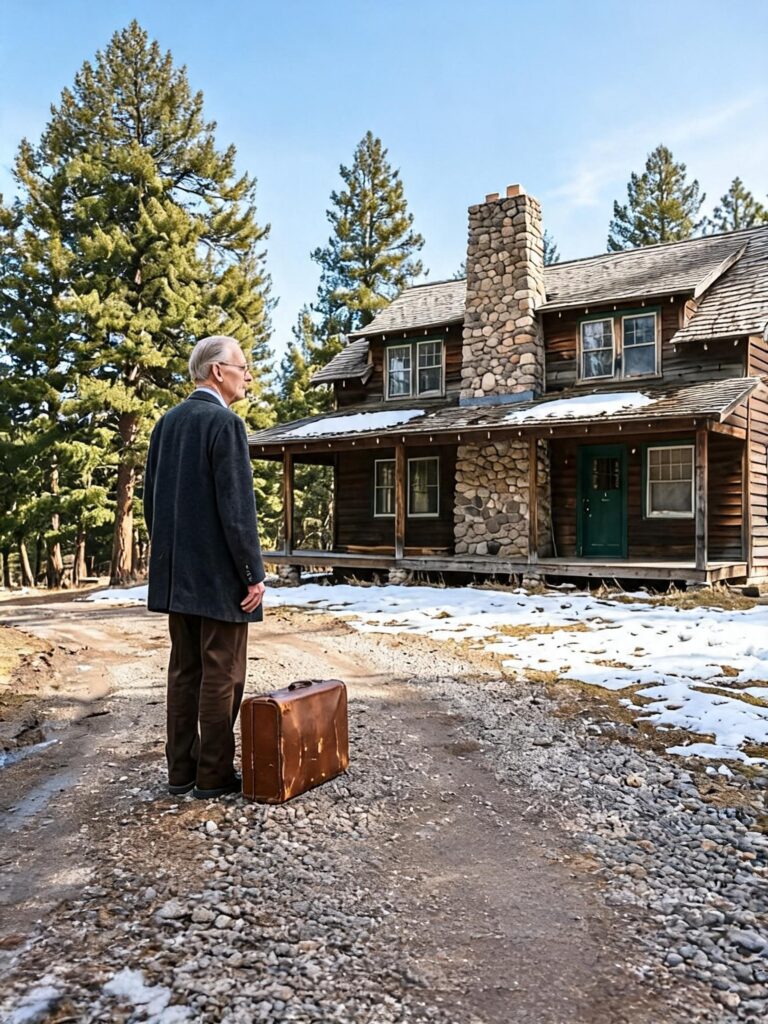
at 83, he lost his home and returned to his father’s abandoned montana lodge after 59 years — but the secret behind room nine changed everything he believed about his family
Part 1
At eighty-three years old, Russell H. Hallstead had reached an age when a man ought to know where he would sleep that night.
He had worked through recessions, buried friends, survived two heart attacks, and spent fifty-four years married to the same woman. He had raised two children, paid his taxes, kept his promises as best he could, and never once imagined that the last hard winter of his life might find him without a home.
Yet on a bitter January afternoon in southwestern Montana, Russell stood in the middle of his empty living room with two suitcases beside his feet and a notice from the mortgage company folded inside his coat pocket.
The house was already gone.
The bank had given him until four o’clock to surrender the keys.
Outside, a gray sky pressed low over the neighborhood. Snow drifted against the porch steps, and the bare branches of the cottonwood tree scraped against the kitchen window.
That tree had been Eleanor’s favorite.
Every spring, she used to stand beneath it with her gardening gloves tucked into her back pocket, telling Russell which branches needed trimming. Every spring, he would complain about the work, and every spring, he would do exactly what she asked.
Now the tree stood untended, and Eleanor had been dead for eleven months.
Russell looked toward the bedroom.
Her blue sweater still hung behind the door.
He had washed everything else. He had packed her jewelry, given away most of her dresses, and donated the medical equipment that had filled their bedroom during her final months.
But he had never been able to touch that sweater.
It still carried the faint scent of lavender soap.
On the bedside table sat her reading glasses, folded beside a paperback novel she would never finish.
Russell picked them up, held them for a moment, then returned them to the exact place where she had left them.
“I’m sorry, Ellie,” he whispered.
His voice sounded strange in the empty house.
He had apologized to her many times since her death.
For not recognizing how sick she had become. For losing patience during sleepless nights. For the hospital bills he could not pay. For the second mortgage he had taken out without telling her how bad their finances had become.
And now for losing the house.
The financial trouble had begun quietly.
There had been insurance deductibles, treatments that required long drives, prescriptions, and home repairs Russell kept postponing. When Eleanor’s illness worsened, he borrowed against the house, believing he could manage the payments once things settled down.
Things never settled down.
After the funeral, he missed one payment, then another. Property taxes came due. The truck needed repairs. Interest accumulated.
Eventually, he accepted a sale arranged to avoid foreclosure. By the time the outstanding loans and closing expenses were paid, almost nothing remained.
His daughter, Margaret, had begged him to move into her spare bedroom.
“Dad, please. You shouldn’t be alone.”
Russell had shaken his head.
“I’m not moving into your house like an old piece of furniture.”
“Nobody said that.”
“You have your own family.”
“You’re part of my family.”
He had looked away because he had no answer.
His son, Daniel, offered money.
Russell refused that too.
Daniel had finally said, “You spent your whole life teaching us to help people. Why won’t you let anybody help you?”
Russell had answered too sharply.
“Because I’m still capable of taking care of myself.”
The silence afterward had lasted longer than either man intended.
Now Russell stood in the empty house, wondering whether independence was the same thing as loneliness when there was nobody left to admire it.
He carried his last belongings to the truck.
Two suitcases. A cardboard box filled with photographs. Eleanor’s Bible. His medication. A bag of groceries. And the heavy wool coat Eleanor had bought him twenty-seven Christmases earlier.
Before leaving, he returned to the bedroom and took the blue sweater from its hook.
He pressed it against his face.
For a moment, he imagined hearing Eleanor in the kitchen.
Russ, would you please stop fussing and come have some coffee?
His knees weakened.
He sat on the edge of the bare mattress until the feeling passed.
Then he folded the sweater carefully and placed it in his suitcase.
At three forty-five, Russell locked the front door.
He left the keys in the envelope the closing agent had provided.
The house where Eleanor had lived and died no longer belonged to him.
He climbed into his old Ford pickup and sat without starting the engine.
His hands rested on the steering wheel.
There was one place left.
One piece of property nobody had managed to take from him.
Hallstead Ridge Lodge.
His father’s lodge.
High in the mountains north of Bozeman, beyond a stretch of county road that became dangerous every winter, stood the building Russell had walked away from fifty-nine years earlier.
He had been twenty-four.
His father, Gideon Hallstead, had been a hard man who believed work could solve nearly every problem and that a father had no business explaining his feelings.
Gideon had built the lodge with timber hauled from the surrounding mountains. He had cut stones for the fireplace, repaired the roof after every major storm, and operated the place with a discipline that left little room for mistakes.
Russell had grown up carrying firewood, cleaning guest rooms, chopping ice from the steps, and listening to his father explain why nothing worth keeping came easily.
But Gideon had never understood that his son wanted something different.
When Russell accepted a job in Spokane, their final argument had shaken the dining-room windows.
“You’ll throw away everything I built,” Gideon had shouted.
“I didn’t ask you to build my life for me.”
“This place needs you.”
“Then you should’ve treated me like a son instead of hired help.”
Gideon’s face had gone still.
“If you walk out that door, don’t expect me to come chasing after you.”
Russell had picked up his suitcase.
“I wouldn’t want you to.”
That was the last conversation they ever had.
For fifty-nine years, neither man apologized.
Gideon died without seeing his grandchildren.
Russell attended no funeral.
The lodge passed to him through his father’s will, but Russell hired a local caretaker, kept the taxes barely current for years, and refused to visit.
He told himself he would eventually sell it.
He never did.
Now the road north disappeared beneath blowing snow.
The truck heater wheezed. Russell’s right knee ached whenever he pressed the accelerator, and the headlights caught swirling flakes that looked like white insects rushing toward the windshield.
Twice he considered turning around.
But there was nowhere to turn back to.
By seven o’clock, the highway had narrowed into a mountain road bordered by dark pines.
The temperature had fallen below zero.
Russell gripped the steering wheel and remembered his father’s voice.
Never stop climbing on packed snow unless you have to. Getting started again is harder than keeping moving.
He shifted into a lower gear.
The tires struggled on the final incline.
Then his headlights found an old wooden sign nearly hidden behind a snowbank.
HALLSTEAD RIDGE LODGE.
ESTABLISHED 1946.
Russell stopped.
Beyond the trees stood a broad, dark building with a steep roof and a long porch buried in snow.
The windows were black.
The roof sagged slightly near the eastern chimney.
The place looked tired, abandoned, and stubbornly unwilling to fall.
Much like Russell himself.
He turned off the engine.
For several minutes, he could not move.
He remembered running across that porch as a boy, carrying trout from the creek. He remembered his mother hanging blankets in the summer sunshine before pneumonia took her when he was fourteen.
He remembered Gideon standing in the doorway the morning Russell left, his face hard enough to conceal whatever he was feeling.
“Well, Dad,” Russell whispered, “looks like you finally got me back.”
He climbed out into the wind.
Snow worked its way inside his collar as he unlocked the front door.
The hinges complained.
Inside, the lodge smelled of cedar, cold stone, and old furniture.
White sheets covered the chairs.
Dust coated the front desk.
A long dining table stood beneath a chandelier with three missing bulbs.
Russell shone his flashlight toward the enormous fireplace.
Then he stopped.
Beside the hearth stood a neat stack of dry firewood.
On top rested a yellowed envelope.
Russell walked closer.
His name was written across the front.
Not Mr. Hallstead.
Not Russell H. Hallstead.
Just Russell.
He knew the handwriting immediately.
His father’s.
For a long moment, the old man stared.
Gideon had been dead for seventeen years.
Yet somehow, on the one night Russell had nowhere left to go, his father had left something waiting beside a cold fireplace.
Russell opened the envelope with trembling fingers.
Inside was one sheet of paper.
Son,
If you’ve found your way back, get a fire going before you do anything else.
The dry wood is beside the hearth. Matches are in the green tin.
Whatever brought you here can wait until morning. Cold never could.
Russell read it twice.
Then he gave a small, broken laugh.
“Still telling me what to do.”
He found the green tin beneath the mantel.
The first match snapped between his stiff fingers.
The second went out.
The third caught.
Russell knelt carefully and fed the little flame until it reached the kindling.
Soon the fireplace began to crackle.
He sat in his father’s old chair and held his hands toward the warmth.
He had not sat there since he was twenty-four.
The wind battered the windows.
Somewhere overhead, a loose shutter struck the siding.
Russell pulled Eleanor’s sweater from his suitcase and rested it across his knees.
“I made it somewhere, Ellie,” he whispered.
Then, after a long silence, he added, “I just don’t know what I’m supposed to do now.”
The fire burned lower.
Russell drifted into an uneasy sleep.
Sometime after midnight, a sound woke him.
Three faint knocks.
He lifted his head.
The lodge was dark except for the glowing coals.
Another knock followed.
Not from the front door.
From somewhere beyond the dining room.
Russell reached for his flashlight.
At eighty-three, he knew better than to wander through an unfamiliar building in the dark.
But this building had once been his entire world.
He rose slowly and followed the sound.
It led him toward the pantry.
At the far end stood an enormous pine cabinet.
Russell remembered the cabinet.
He remembered stealing canned peaches from it when he was twelve.
But something about it looked wrong.
The dust on the floor had been disturbed.
And behind the cabinet, where the wall should have been solid, he could see a thin black line.
Russell placed one hand against the wood.
Pushed.
The cabinet moved.
Behind it stood a narrow door he had never seen before.
His flashlight beam caught a brass handle.
Russell stared at it.
“Now what were you hiding, Dad?”
He turned the handle.
Beyond the door, stone steps disappeared into darkness.
Part 2
Russell stood at the top of the stairway with his flashlight trembling in his hand.
The sensible thing would have been to wait until daylight.
The sensible thing would also have been to remain in the city, accept his daughter’s spare bedroom, and stay off a mountain road during a winter storm.
Russell was beginning to suspect that sensible decisions were not his strongest talent.
He tested the first step.
It held.
The second creaked.
At the bottom, he found a small room beneath the lodge, its walls reinforced with stone and heavy timbers.
Shelves lined three sides.
An old oak desk occupied the fourth.
Cardboard boxes stood beneath it, protected from moisture by wooden pallets.
The room was surprisingly dry.
Russell swept his flashlight over the shelves.
He expected hunting equipment, old liquor, perhaps the business records Gideon had guarded so carefully.
Instead, he found dozens of ledgers.
Each was marked with a year.
He opened one.
Hallstead Ridge Lodge Guest Register — 1988.
He recognized his father’s handwriting.
Neat. Tight. Economical.
Room numbers appeared beside guest names, dates, and payments.
Russell turned a page.
Something caught his attention.
Room 9.
Payment: $0.
Beside the entry, Gideon had written:
Henry Morris. Wife died last week. Needs somewhere quiet. Feed him.
Russell frowned.
He turned several more pages.
Room 9.
Payment: $0.
Mother and two children. Car broke down. Breakfast before they leave.
Another entry.
Army veteran. Won’t accept charity. Give him something to help with.
Russell opened a second ledger.
Then a third.
Across years and decades, the same room appeared.
Always room nine.
Almost always no charge.
The notes were brief.
Lost the farm.
Father and daughter. Keep them warm.
Mill closed. Family needs a week.
No questions tonight.
Russell lowered himself into the desk chair.
His father had made him work an entire summer to repay the cost of a window he broke while playing baseball.
Gideon counted every sack of flour, every gallon of heating oil, every dollar spent repairing the lodge.
Russell could still hear him saying, There is no such thing as free.
Yet here were hundreds of nights given away.
Meals.
Shelter.
Firewood.
Beds.
Russell stared at the handwriting.
“Who were you when I wasn’t here?”
He wondered whether Gideon had changed after Russell left.
Or whether this kindness had always existed behind the stern face his son remembered.
Then the flashlight beam caught a wooden box tucked beneath the desk.
Russell bent forward.
His back protested sharply.
He dragged the box into the light.
Two words had been carved into the lid.
For Russell.
He rested both hands on the wood.
For fifty-nine years, he had waited for an apology.
He had imagined his father growing old inside the lodge, too proud to admit that he missed his only son.
Russell had grown old somewhere else, too proud to admit the same thing.
Now his father’s handwriting surrounded him.
And suddenly Russell was frightened of what else he might learn.
He carried the box upstairs but could not bring himself to open it.
Instead, he placed it beside Eleanor’s Bible near the fireplace.
The wind howled through the chimney.
Russell added another log and remained awake until morning.
At eight o’clock, somebody knocked on the front door.
Russell approached cautiously.
On the porch stood a woman with silver hair tucked beneath a knitted cap.
She carried a thermos and a brown paper bag.
Her cheeks were bright red from the cold.
“Russell Hallstead?”
“Depends who’s asking.”
The woman gave him a patient look.
“Lucille Mercer. And if you make me stand out here while you decide whether to be friendly, these biscuits are going to freeze.”
Russell stepped aside.
Lucille entered as though she had visited the lodge a thousand times.
She probably had.
She set the bag on the dining table and looked around.
“Vernon Tate saw your truck climbing the ridge yesterday. Called me this morning.”
“Who’s Vernon Tate?”
“Man who has spent half his life keeping this place from falling down.”
Russell looked toward the fireplace.
“Did he stack that wood?”
Lucille nodded.
“Every autumn. Your father asked him to keep the hearth ready, even after the lodge closed.”
Russell looked away.
“Seems like a lot of trouble for an empty building.”
“Your father didn’t always believe it would stay empty.”
She unscrewed the thermos.
The smell of fresh coffee filled the room.
Then she noticed the wooden box.
Her expression changed.
“You found the downstairs room.”
Russell nodded.
“The ledgers too.”
“Yes.”
Lucille folded her gloves.
“Then I suppose you know something about room nine.”
“I know my father was giving away rooms when he could barely stand to give his own son a decent word.”
Lucille did not flinch.
“No,” she said. “Gideon wasn’t always decent with words.”
Russell looked at her.
“Why did he do it?”
She sat down.
Forty-three years earlier, Lucille explained, she had arrived at the lodge during a January storm.
She was thirty-two.
Her daughter was nine, her son only six.
Her husband had been drinking for three days.
When he began threatening the children, Lucille packed two small bags, took six dollars from a kitchen drawer, and drove away.
Her car nearly ran out of gasoline on the mountain road.
She reached the lodge just before midnight.
“I remember standing on this porch,” Lucille said. “My boy was crying. My daughter was trying to be brave because she knew I was scared.”
Russell listened without interrupting.
“I told your father I needed a room but couldn’t pay him.”
“What did he say?”
Lucille smiled faintly.
“He looked at those children and said, ‘Then it’s a good thing I didn’t ask for money.'”
Russell stared at his coffee.
“He took us upstairs. Put wood in the stove. Brought hot soup and three thick blankets.”
“Did he ask about your husband?”
“Not that night.”
“Why not?”
Lucille studied him.
“Because sometimes people need a safe place before they’re ready to explain why they need it.”
Russell thought of his daughter’s offer.
He thought of how angrily he had refused.
Lucille continued.
“We stayed eleven days. Your father found me work cleaning rooms until I could rent a place in town. He gave my children winter boots. Never put the cost on my bill.”
Russell swallowed.
“I never knew.”
“He didn’t tell people much.”
“No,” Russell said bitterly. “He certainly didn’t.”
Lucille waited until the silence softened.
Then she stood.
“Come upstairs.”
They moved slowly along the second-floor hallway.
Several doors stood open, revealing dusty furniture and faded curtains.
At the far end, Lucille stopped beside a narrow door with a tarnished brass number.
9.
She turned the handle.
Inside was a small room with a bed, dresser, rocking chair, and cast-iron stove.
Frost silvered the window.
A handmade quilt lay folded inside the dresser.
Lucille touched the rocking chair.
“I sat here all night the first time we came. I kept expecting somebody to tell us to leave.”
Russell stepped toward the window.
Names and dates had been carved into the wooden frame.
Some had faded.
Others remained clear.
Thank you for saving our Christmas.
Made it to Idaho. Found work.
My children slept warm here.
Near the bottom, one inscription caught Russell’s eye.
I came here believing I had nothing left. Thank you for another morning.
He pressed his fingers against the words.
For years, the memories he carried of Gideon had been sharp and uncomplicated.
A father who criticized more than he praised.
A man who could repair a roof but not a broken relationship.
Someone who had watched his son leave and never asked him to return.
Now another version of that man stood before him.
Not innocent.
Not gentle.
But capable of kindness Russell had never imagined.
“My father could open his door to all these strangers,” Russell said, “but he couldn’t come through mine.”
Lucille stood beside him.
“No. He couldn’t.”
Russell looked surprised by her answer.
She continued quietly.
“Understanding somebody doesn’t mean pretending they never hurt you.”
The old man turned toward the window.
Outside, snow swept across the ridge.
“I used to think he never missed me.”
“Did you miss him?”
Russell remained silent.
His eyes burned.
Lucille did not press.
Downstairs, the coffee had gone cold by the time they returned.
Russell asked whether the lodge could be made livable again.
Lucille looked toward the ceiling.
“Depends how much work you’re willing to do.”
“I’m eighty-three.”
“I noticed.”
“My knees are bad.”
“Mine too.”
“I don’t have much money.”
Lucille sighed.
“That makes three of us.”
For the first time in many days, Russell laughed.
But the sound faded when he discovered a stack of unopened mail inside the old front desk.
Most of it was forwarded tax correspondence and insurance notices.
One envelope came from the county treasurer.
Russell opened it.
The unpaid balance was worse than he expected.
Years of keeping the lodge barely afloat had finally caught up with him.
The roof required repairs.
The heating system needed inspection.
Several windows were cracked.
And Russell had arrived with less money than it would take to make the property safe for another winter.
He sat down and studied the figures.
Lucille watched him from across the table.
“What does it say?”
Russell folded the notice.
“It says I’ve managed to lose one home.”
He looked around the abandoned lodge.
“And this one might be next.”
Part 3
Two mornings later, Vernon Tate arrived in a red pickup that sounded as though its muffler had been repaired with baling wire.
He was seventy-eight, broad through the shoulders, with a white beard and a tool belt nearly as old as Russell’s children.
He climbed out carrying a toolbox.
“You Russell?”
“That’s what everybody keeps telling me.”
Vernon grinned.
“You look like Gideon around the eyes.”
“That supposed to be a compliment?”
“Depends on whether you’re having a good day.”
Russell almost smiled.
Vernon surveyed the roof.
“She’s in rough shape.”
“She was in rough shape when I left.”
“Yeah, well. You didn’t improve her by staying gone.”
Russell stiffened.
Vernon noticed.
He removed his cap.
“Didn’t mean anything by it.”
“Sure sounded like you did.”
Vernon considered that.
“Maybe I did.”
For a moment, the two old men stood facing each other in the snow.
Then Vernon shrugged.
“Gideon was hard to live with. I know that. I worked beside him thirty-five years.”
Russell looked at him carefully.
“You two get along?”
“Most days we managed not to hit each other with a hammer.”
Russell laughed despite himself.
Vernon spent the next three hours inspecting the building.
The roof flashing had separated near the chimney.
An upstairs bathroom pipe had frozen and cracked.
The furnace still worked but required servicing, and several porch boards were rotten beneath the snow.
The good news was that the main timbers remained solid.
When Vernon finished, he joined Russell at the dining table.
“Well?” Russell asked.
“The lodge isn’t dying.”
“Doesn’t sound like good news.”
“It is. Dying and neglected aren’t the same thing.”
Russell rubbed his forehead.
“I can’t afford to hire a crew.”
“Didn’t ask you to.”
“Then what are you saying?”
Vernon looked toward the fireplace.
“I’m saying your father helped a lot of people around here. Maybe it’s time to find out whether any of them remember.”
Russell’s pride rose immediately.
“I don’t want handouts.”
Vernon leaned back.
“There it is.”
“What?”
“That Hallstead stubbornness. Gideon had enough for three men. Looks like he left you the rest.”
Russell’s face hardened.
“I’ve taken care of myself my whole life.”
“How’s that working out?”
The question stung.
Russell looked down at his hands.
Vernon softened his voice.
“Nobody’s asking you to stop being a man, Russ. We’re asking whether you’ll let somebody stand beside you.”
That evening, after Vernon left, Russell found himself staring at Eleanor’s photograph.
She was laughing in the picture, standing beside their old garden with a tomato in each hand.
He remembered the last summer before her illness.
He had tried lifting a heavy planter by himself.
His back had seized.
Eleanor found him sitting on the porch steps, furious with his own body.
She had brought him a glass of water.
“You know,” she told him, “asking for help doesn’t make you any less stubborn. It just makes you a little smarter.”
He had grumbled.
She had kissed his forehead.
Russell looked at the photograph.
“All right, Ellie,” he whispered. “Maybe you had a point.”
The following morning, six trucks climbed the mountain road.
Lucille arrived carrying two casseroles and a box of canned food.
Vernon brought lumber.
Behind him came Otis Bell, a retired electrician, and his grandson Caleb.
A plumber named Frank Delaney arrived with copper fittings and pipe insulation.
An elderly couple brought blankets and two cords of split firewood.
Russell stood on the porch, bewildered.
“What in God’s name is going on?”
“Tuesday,” Vernon answered.
“You know what I mean.”
“Then quit asking foolish questions and help unload.”
Russell stared at the workers.
“I can’t pay all these people.”
Lucille climbed the steps.
“We know.”
“Then why are they here?”
She pointed toward Otis.
“Your father hired him every summer after his own father died. Paid him enough to finish school.”
She nodded toward the elderly couple.
“Their house burned in 1991. They lived in this lodge seven weeks.”
Then she pointed toward Frank.
“His family stayed here after the timber mill closed.”
Russell watched Frank carry his toolbox inside.
“Room nine?”
Lucille nodded.
“Room nine.”
For a moment, Russell could not speak.
Vernon stepped onto the porch and placed a hammer in his hand.
“Can you still use one of these?”
Russell looked down.
“I might surprise you.”
“Good. Start with those loose boards.”
The work was slow.
Russell could no longer climb onto a roof or carry heavy timber.
His hands cramped after long periods gripping tools.
By midmorning, his bad knee throbbed.
But he could pull damaged nails from old boards, sort hardware, sand furniture, replace door hinges, and show Caleb how to shape a wooden patch so it fitted tightly.
When the teenager rushed through a repair, Russell stopped him.
“Take your time.”
Caleb looked frustrated.
“It’s just a door.”
“That’s how bad work starts. Somebody saying it’s just something.”
The boy tried again.
This time the patch fitted.
Russell nodded.
“That’ll hold.”
Caleb smiled.
Something stirred inside the old man.
He remembered Gideon watching him repair a broken fence rail when he was fifteen.
His father had inspected the work, tugged hard on the rail, and said only, “That’ll hold.”
Russell had spent the rest of that day feeling ten feet tall.
He had forgotten that memory.
Or perhaps anger had buried it.
By sunset, the front porch was safer, the upstairs pipe had been replaced, and two windows were covered against the wind.
The lodge smelled of sawdust, coffee, and Lucille’s chicken casserole.
Russell sat at the table among people who had been strangers that morning.
For the first time since Eleanor’s funeral, he listened to ordinary conversation without feeling as though he were standing outside it.
But the next day brought a different kind of visitor.
A woman named Caroline Pike arrived from a real estate office in Bozeman.
She wore practical winter boots and carried a leather folder.
She was courteous, businesslike, and plainly surprised to find so many trucks outside.
“Mr. Hallstead, I represent a development company interested in purchasing this property.”
Russell invited her inside.
Caroline spread several documents across the dining table.
The company wanted the land for an exclusive mountain retreat.
The old lodge would be demolished.
Their offer was substantial.
Enough to settle the property taxes, pay every repair bill, and leave Russell financially comfortable.
He studied the figure.
For a moment, he pictured a warm apartment.
A reliable heating system.
No frozen pipes.
No leaking roof.
No long mountain road.
He could visit his grandchildren.
He could leave something to Margaret and Daniel.
Caroline watched him quietly.
“This could give you some peace, Mr. Hallstead.”
Russell looked toward the staircase.
“What happens to the lodge?”
“The company intends to replace it.”
“And room nine?”
Caroline seemed confused.
“All the guest rooms would be removed.”
Russell lowered his eyes.
She was not being cruel.
She was discussing a business transaction, and by ordinary financial standards, her proposal made excellent sense.
But Russell had spent the previous week learning that some things had value long after they stopped producing much income.
“I’ll think about it,” he said.
Caroline left the offer on the table.
That night, Russell telephoned Margaret.
She answered on the second ring.
“Dad?”
He heard the relief in her voice.
“Are you somewhere warm?”
“Warm enough.”
“Where are you?”
He hesitated.
“At your grandfather’s lodge.”
Silence.
“The mountain lodge?”
“That’s the one.”
“Dad, that place has been empty for years.”
“Not completely.”
He told her about Vernon, Lucille, the repairs, and room nine.
Margaret listened.
When he finished, she spoke quietly.
“You could have told us you were going there.”
“I didn’t want anybody worrying.”
“Dad, we worry because we love you.”
Russell closed his eyes.
She continued.
“When Mom got sick, you let us help with almost nothing. After she died, you stopped answering half our calls. You keep acting like loving you is a burden we’re trying to escape.”
Russell stared at the fire.
“I never meant that.”
“I know. But that’s what it feels like.”
For a long time, he could hear only her breathing.
Then he said something that cost him more than he expected.
“I’m scared, Maggie.”
Her voice changed.
“Of what?”
“Of getting old. Of needing things. Of waking up and not knowing what good I am anymore.”
Margaret did not rush to answer.
Finally, she said, “You don’t have to earn your place in our lives, Dad.”
Russell pressed his fingers against his eyes.
They spoke another twenty minutes.
Before hanging up, he promised to call again.
Afterward, he walked upstairs to room nine.
The small stove was cold, but the bed had fresh sheets.
Someone had placed a jar of yellow flowers on the dresser.
Russell stood in the doorway.
He had come to the lodge intending to hide until he figured out where to go next.
Now, for the first time, he wondered whether it could become somewhere other people came when they had nowhere else to go.
But downstairs, the developer’s offer still lay beside the unpaid tax notice.
And Russell knew that wanting to save something was not the same as knowing how.
Part 4
By late February, winter had settled over Hallstead Ridge like a punishment.
Snow piled higher than the porch railing.
The county road narrowed between walls of packed ice.
Each morning, Russell woke before sunrise to check the furnace, carry smaller pieces of firewood inside, and make certain the kitchen pipes had not frozen.
He learned to move slowly.
He kept a cane beside the bed, took his heart medication on schedule, and wore rubber-soled boots whenever he stepped outside.
Pride, he was discovering, did not improve a broken hip.
Vernon continued visiting whenever the road allowed.
Lucille brought food and helped sort old linens.
Caleb returned on weekends to repair window frames and carry heavy supplies.
Daniel drove up from Billings one Saturday with a truck full of lumber.
Father and son worked together in the dining room, replacing damaged floorboards.
For several hours, they spoke only about measurements, nails, and wood.
Then Daniel set down his hammer.
“Dad, why didn’t you tell me how bad things were with the house?”
Russell kept sanding a board.
“Nothing you could have done.”
“I could have tried.”
“You’ve got a mortgage and two kids.”
“And you think I would’ve preferred finding out after everything was gone?”
Russell stopped working.
Daniel’s voice had grown tight.
“You taught me a man looks after his family. But you never let us look after you.”
Russell looked toward the window.
“I didn’t want you seeing me fail.”
Daniel sat beside him.
“Mom died, Dad. You didn’t fail because the bills got bigger than you could handle.”
Russell swallowed.
For nearly a year, shame had followed him everywhere.
He had mistaken silence for dignity and distance for protection.
Now he wondered how much pain that silence had caused his children.
“I’m sorry,” he said.
Daniel reached across the table and squeezed his shoulder.
They did not say anything more.
They went back to work.
For Russell, that was enough for the moment.
A week later, Vernon discovered the wooden box again while helping clean beside the fireplace.
“What’s this?”
Russell looked up sharply.
“Something Dad left me.”
“You open it?”
“No.”
Vernon set it carefully on the table.
“You afraid there’s a bill inside?”
Russell smiled faintly.
“Maybe.”
That night, after everyone left, he lifted the lid.
Photographs lay on top.
Russell at nine, standing beside the creek with a fishing rod.
Russell at sixteen, leaning against Gideon’s pickup.
His mother laughing on the porch before the illness that took her life.
Then he found a photograph he had never seen.
He was perhaps five years old, asleep in Gideon’s arms beside the fireplace.
His father’s rough hand rested against his back.
Gideon was smiling down at him.
Not posing.
Not looking toward the camera.
Just smiling at his sleeping son.
Russell touched the photograph.
He could not remember his father holding him that way.
Beneath the pictures lay a thick bundle of envelopes.
Each was addressed to Russell.
None carried a stamp.
The oldest had been written soon after he moved to Spokane.
Russ,
Heard you got steady work. That’s good. Hope they’re treating you fair.
Spring thaw damaged the lower bridge. Took Vernon and me two days to straighten it.
Your old dog still sleeps under the porch.
Russell read the words twice.
The next letter described an unusually cold winter.
Another mentioned a black bear breaking into the garbage shed.
Several contained small bits of advice about truck engines, weather, and keeping a roof clear of ice.
They were ordinary letters.
That was what hurt.
For decades, Russell had believed Gideon never thought about him.
Yet his father had continued writing as though his son might someday sit across the table and listen.
One envelope had been written after Russell married Eleanor.
Heard you found yourself a good woman. Treat her right. A good marriage is worth more than a hundred acres of timber.
Russell smiled through tears.
“Oh, Dad,” he murmured. “You never knew how good she was.”
Another letter mentioned Margaret’s birth.
Gideon had apparently learned about his granddaughter from a man passing through town.
Suppose that makes me a grandfather.
Strange to learn a thing like that from someone buying gasoline.
Russell closed his eyes.
He remembered Eleanor asking whether they should take the baby to Montana.
He had refused.
“Gideon never asked to see her,” he had said.
Now the words seemed terribly small.
At the bottom of the box lay a final envelope.
It was different from the others.
The paper was newer.
The handwriting shakier.
Russell recognized the date.
October third.
Two days before Gideon died.
He remembered that week.
He remembered the telephone ringing during dinner.
Eleanor had looked at the caller identification.
“It’s your father.”
Russell had kept cutting his steak.
“Let it ring.”
“Russ, maybe you should answer.”
“If he has something to say, he’s had plenty of years.”
The phone stopped ringing.
Two days later, a sheriff’s deputy from Montana called to tell Russell that Gideon had died.
Russell held the final envelope.
His fingers began trembling so badly that he could barely keep it steady.
He placed it beside Eleanor’s Bible.
He could not open it.
Not yet.
The following week, financial reality returned with a vengeance.
Another notice arrived from the county.
The overdue taxes and penalties required a substantial payment to prevent the debt from progressing toward further collection action.
Russell had no reasonable way to pay it.
Caroline Pike called again.
Her buyer had increased the offer slightly, but the company wanted an answer before making other commitments.
“Mr. Hallstead,” she said, “I understand the property means something to you. But I don’t want you making a decision that leaves you in financial danger.”
Russell thanked her.
He knew she was right about the danger.
That evening, he spread the repair estimates, tax notices, and bank statements across the dining table.
He calculated the figures three times.
Every answer was the same.
Even with free labor, the lodge needed money he did not possess.
Russell stared at the total.
Then he looked toward the staircase.
He imagined room nine stripped of its furniture.
The carved window frame thrown into a dumpster.
The fireplace reduced to broken stone.
He felt angry with Gideon.
For leaving him a burden.
For hiding his kindness.
For waiting until death to explain anything.
For making Russell care about a building he could not afford to keep.
Then the anger collapsed beneath exhaustion.
He lowered his head onto his folded arms.
“I’m too old for this, Ellie.”
Outside, the wind began rising.
By six that evening, snow was sweeping sideways across the windows.
Vernon had stayed to repair a loose section of chimney flashing from inside the attic.
When he finished, visibility outside had dropped almost to nothing.
“Road’s going to be bad,” Russell said.
Vernon glanced through the window.
“Looks like I’m sleeping here.”
“You’re welcome to the lumpy sofa.”
“Your father had better hospitality.”
“Then maybe you should go visit him.”
Vernon laughed.
They cooked canned stew on the kitchen stove and settled beside the fireplace.
Around eight, the power failed.
The furnace went silent.
Russell checked the chimney draft and added wood to the fire.
Vernon found the lanterns.
Then somebody pounded on the front door.
Three desperate blows.
Both men froze.
Another three followed.
A voice cried through the wind.
“Hello! Anybody in there?”
Russell hurried toward the door.
On the porch stood an elderly man with snow covering his shoulders.
He clutched a small suitcase.
His lips were pale.
One hand gripped the railing as though he might fall.
“Truck went into a ditch,” he gasped. “Down the road.”
Russell stepped forward.
“Get inside.”
“I don’t have much money.”
“We’ll discuss your finances when you stop freezing.”
Vernon took the suitcase.
Russell helped the stranger to a chair beside the hearth.
His name was Emmett Sloan.
He was seventy-nine.
His wife had died two years earlier.
Medical bills and missed payments had cost him his home.
He had been sleeping in his truck for nine nights, driving between towns while trying to decide where to go.
When the storm came, he had tried reaching Bozeman.
Instead, his truck slid into the ditch.
He had walked through the snow until he saw the porch light.
Russell wrapped a blanket around his shoulders.
Vernon checked his hands and feet for signs of serious cold injury while Russell called for roadside assistance as soon as the telephone line began working again.
Emmett accepted a cup of warm broth.
Then he reached into his coat.
He removed four crumpled bills.
“This is all I’ve got.”
Russell did not take them.
“Put that away.”
Emmett’s jaw tightened.
“I don’t accept charity.”
Russell recognized the words.
He had spoken them himself, in one form or another, a hundred times.
He looked at the tired man sitting beside the fire.
Then he remembered an entry in Gideon’s ledger.
Doesn’t want charity. Give him something to help with.
Russell pulled out a chair.
“All right, Emmett. Then how about a deal?”
Emmett eyed him cautiously.
“What kind?”
“You help me keep the stove supplied tomorrow. Maybe sweep the hall when you’re feeling better. In return, I’ll put you in a warm room tonight.”
Emmett hesitated.
“I can do that.”
“Good.”
When he had warmed up, Russell helped him upstairs.
At the end of the hallway, he opened room nine.
Fresh sheets covered the bed.
A thick quilt waited at the foot.
The cast-iron stove had been inspected and cleaned, and firewood stood beside it.
Emmett looked around.
“How much is this room usually?”
Russell rested one hand against the doorframe.
“Nothing.”
Emmett frowned.
“Somebody has to pay for it.”
Russell thought of his father.
Of the strangers in the ledgers.
Of Lucille arriving with two frightened children.
Of the lonely man sitting across from him.
“It’s already been paid for,” Russell said.
“By who?”
Russell’s voice softened.
“My dad.”
Emmett stared at him.
Russell placed the brass room key on the nightstand.
“Get some sleep.”
“What about tomorrow?”
Russell remembered his father’s first letter.
“Tomorrow can wait until morning.”
He closed the door gently.
For several minutes, Russell remained in the hallway.
Then he returned downstairs.
The developer’s offer lay on the dining table.
Beside it were the unpaid bills.
Russell picked up the offer.
He could sell the lodge and never worry about another property tax notice.
He could finally rest.
But upstairs, a seventy-nine-year-old stranger was sleeping in a warm bed for the first time in nine nights.
Russell stood with the papers in his hands.
For the first time, he understood that the decision before him was no longer only about his own future.
He looked toward Eleanor’s Bible.
Beside it lay his father’s final unopened letter.
Russell knew he could not make the decision until he found the courage to read it.
Part 5
The storm lasted until dawn.
By morning, the mountain road had disappeared beneath deep drifts, and the pines stood white and motionless against a pale sky.
Vernon was asleep in an armchair.
Emmett remained upstairs.
Russell sat alone at the dining table with Gideon’s final envelope in front of him.
He had spent fifty-nine years waiting for his father to speak.
Now, at eighty-three, Russell was afraid to hear what the old man had tried to say.
He slipped a finger beneath the flap.
The paper opened with a dry crackle.
Inside were three handwritten pages.
The first lines were uneven.
Son,
An old man can waste a remarkable amount of his life believing there will always be another chance.
Russell swallowed.
I thought you’d come home when you were ready. Then I thought I ought to come find you.
Every year I found another excuse.
The roads were bad. The lodge needed work. You had your own family. Maybe you didn’t want to see me.
Truth is, I was afraid you’d close the door in my face.
Russell covered his mouth.
I told myself that was pride. It wasn’t. It was cowardice.
The next words blurred.
Russell wiped his eyes and continued.
I was wrong the day you left.
I wanted you to stay because I didn’t know how to imagine this place without you. But instead of telling you I loved you, I made you feel like you owed me your whole life.
You didn’t.
Russell bent forward.
For fifty-nine years, those were the words he had wanted.
And now there was nobody alive to hear him answer.
He kept reading.
I heard about Eleanor. I heard about your children.
I’ve wanted to meet them more times than I can count.
But I didn’t know how to ask without making you feel I was demanding something again.
If you’ve been happy, I’m grateful.
If you’ve had hard times, I’m sorry I wasn’t there to help.
Then came the final lines.
I don’t expect you to forgive me. Maybe I don’t deserve it.
But there has never been a winter when I didn’t wonder whether you were warm.
I kept this place ready because I hoped that one day you might need somewhere to come home to.
If that day ever comes, don’t knock.
The door was always yours.
Love, Dad.
Russell stared at the last word.
Love.
His father had written it plainly.
Not hidden inside an instruction about firewood.
Not buried beneath a complaint about work.
Just love.
Russell remembered the telephone call he had refused seventeen years earlier.
He remembered Eleanor standing beside him, asking him to answer.
For decades, he had blamed Gideon for the silence between them.
Now he could see the whole terrible truth.
His father had failed him.
And he had failed his father.
Two stubborn men had allowed one argument to become a lifetime.
Russell lowered his head onto his hands.
“Dad,” he whispered.
The word broke apart.
He cried for the young man who had left the mountain believing he was unwanted.
He cried for the father who had been too frightened to apologize.
He cried for the grandchildren Gideon never held.
He cried for Eleanor, who had spent so many years encouraging him to forgive.
Most of all, he cried because there was no way to recover the time they had lost.
When the tears finally stopped, Russell remained still.
Forgiveness did not make the argument disappear.
It did not excuse Gideon’s harshness.
It did not undo Russell’s own silence.
But for the first time, he could remember his father without needing him to be only the man who had caused him pain.
Russell looked toward the staircase.
Somewhere above him, Emmett stirred.
The old lodge creaked as the wind settled.
Russell folded the letter and placed it inside Eleanor’s Bible.
Then he picked up the telephone.
His first call was to Margaret.
His second was to Daniel.
His third was to Lucille.
By the time Vernon woke, Russell had made a decision.
He would not sell the land to the developer.
But he would not pretend he could save the lodge alone.
That afternoon, he gathered everyone who had been helping.
Lucille sat beside the fireplace.
Vernon leaned against the mantel.
Daniel had managed to reach the lodge after the county plow cleared the lower road.
Margaret joined by telephone.
Emmett sat quietly near the window, his hands wrapped around a coffee cup.
Russell stood before them holding Gideon’s final letter.
“I’ve been thinking about this place,” he began.
Vernon raised an eyebrow.
“That usually gets expensive.”
Russell smiled.
“It already is.”
Then he told them the truth.
The taxes.
The repairs.
The developer’s offer.
The money he did not have.
When he finished, the room was quiet.
“I can’t keep the lodge the way Dad did,” Russell said. “And at my age, I shouldn’t pretend I can.”
Lucille looked disappointed.
“Does that mean you’re selling?”
Russell shook his head.
“No. It means I’m asking for help.”
The words came slowly.
But once he said them, the room seemed to grow lighter.
Margaret, who had worked in bookkeeping for years, offered to organize the finances.
Daniel volunteered to coordinate repairs and contact local tradesmen.
Vernon knew a retired attorney who had helped establish community organizations.
Lucille suggested a fundraising supper at the town hall.
Emmett cleared his throat.
“I don’t have money,” he said. “But I can cook breakfast, clean rooms, and stack wood.”
Russell looked at him.
“Then you’ve already got a job.”
Over the following weeks, the plan took shape.
The lodge would operate as a modest guesthouse, with ordinary rooms rented at rates that could cover utilities, taxes, insurance, and maintenance.
A community nonprofit would be established to help preserve the property and eventually oversee its operation.
Russell agreed to place the lodge under the organization’s stewardship once the legal arrangements were completed.
And room nine would remain available, without charge, for people who needed a safe night.
They would work with local service organizations to help guests find assistance when more than one night was needed.
Russell insisted on one condition.
Nobody would be required to tell a painful story before being allowed to come inside.
“People can explain themselves after they’ve had supper,” he said.
Lucille smiled.
“That sounds like Gideon.”
Russell looked at her.
“For once, I hope so.”
The fundraising supper took place in March.
Russell had expected perhaps twenty people.
More than a hundred came.
The town hall filled with folding chairs, homemade casseroles, crockpots of chili, and people carrying old photographs.
A retired teacher remembered spending a Christmas at the lodge after her car broke down.
A former mill worker recalled how Gideon had given him a job when nobody else would.
A woman in her sixties brought a photograph of her mother standing beside the lodge with three small children.
“We stayed here when I was eight,” she told Russell. “Your father never charged us.”
Others contributed what they could.
Twenty dollars.
Fifty dollars.
A check from a local business.
A load of lumber.
A promise of plumbing work.
Some people had little money but volunteered their time.
Daniel organized a repair schedule.
Margaret established proper financial records.
The retired attorney helped the group prepare the necessary documents.
By the end of the month, the donations and pledges were enough to settle the overdue property taxes and fund the most urgent repairs.
Russell stood in the town hall as Lucille announced the result.
People applauded.
He had never been comfortable being the center of attention.
But this time he did not turn away.
He rose slowly and faced the room.
“I spent most of my life thinking my father was a hard man,” he said.
A few older people smiled knowingly.
“He was. Some of you probably know that better than I do.”
Gentle laughter moved through the crowd.
Russell continued.
“But I came back to his lodge this winter and discovered there were things about him I never knew.”
He paused.
“I thought he’d left me an old building with a bad roof and a pile of bills.”
His voice grew thick.
“Turns out he left me a whole town full of people willing to help.”
The applause began again.
Russell waited.
Then he said, “I don’t know how many years I’ve got left. But whatever time the Lord gives me, I’d like to spend some of it keeping that door open.”
Lucille wiped her eyes.
Vernon looked down at his hands.
Daniel stood beside Margaret near the back wall.
For the first time in years, Russell felt neither ashamed of his age nor embarrassed by his need for others.
He felt useful.
He felt loved.
And he felt home.
By late April, the snow finally began retreating from Hallstead Ridge.
Water rushed beneath the old wooden bridge.
The creek behind the lodge broke free of its ice.
Grass appeared along the south-facing slopes, and the first mountain bluebirds returned to the fence posts.
The lodge reopened on a bright Saturday morning.
Vernon had repaired the entrance sign.
Fresh cedar letters announced:
HALLSTEAD RIDGE LODGE.
Inside, the dining room had been polished.
The guest beds were made.
The kitchen smelled of fresh biscuits and coffee.
Emmett supervised breakfast with the seriousness of a man running a military operation.
Lucille complained that Russell still made terrible coffee.
Russell replied that after eighty-three years, he was unlikely to improve.
Margaret laughed.
Daniel carried another load of firewood inside.
At the end of the upstairs hallway, Russell stood before room nine.
Vernon had made a small wooden sign.
Russell fastened it beneath the brass number.
the open door room
Below it were the words:
for anyone who needs one safe night before tomorrow begins.
Russell stepped back.
His hands trembled slightly.
Not from cold this time.
Lucille stood beside him.
“Gideon would have liked that,” she said.
Russell looked at the sign.
There was a time when he would have answered angrily.
A time when even hearing his father’s name could spoil an otherwise peaceful day.
Now he nodded.
“I think he would.”
That evening, after the last visitors departed, Russell sat beside the great fireplace.
Eleanor’s photograph rested on the mantel.
Gideon’s final letter lay beside it.
Russell watched the flames move across the old stonework.
“I wish you could see this, Ellie,” he said.
He smiled.
“You’d still complain about the plumbing.”
The fire popped.
“Margaret’s been helping with the books. Daniel fixed the back stairs. And there’s an old fellow upstairs who makes better biscuits than anybody I’ve ever met.”
His smile faded.
“I wish I’d listened to you about Dad.”
He looked toward the photograph.
“You were right. We were both too stubborn.”
Russell sat quietly for a long time.
Then he spoke again.
“I miss you.”
The words no longer frightened him.
He had learned that missing someone did not mean every day had to be empty.
The following morning, Russell opened the lodge doors just after sunrise.
Warm light spilled across the wooden floor.
Vernon was repairing a chair near the window.
Lucille was setting cups on the breakfast table.
Emmett was humming in the kitchen.
Then Russell noticed two people climbing the porch steps.
A middle-aged man and a teenage boy.
The man carried an overnight bag.
The boy walked several feet ahead, his jaw tight and his eyes fixed on the ground.
They had clearly been arguing.
Russell recognized the silence between them.
He had lived inside a silence like that for fifty-nine years.
“Morning,” he said.
The father nodded.
“Do you have a room?”
“We do.”
The teenager looked away.
Russell noticed the man’s tired expression and the boy’s clenched fists.
He thought of himself at twenty-four.
He thought of Gideon standing in the lodge doorway, unable to say the one thing that might have changed both their lives.
Russell stepped aside.
“Come on in,” he said. “Fire’s warm.”
The father entered.
The boy hesitated.
Russell did not ask what they had been fighting about.
He did not offer advice.
He simply held the door.
When the teenager finally stepped inside, Russell gave him a small smile.
“Breakfast is still hot, if you’re hungry.”
The boy glanced toward the dining room.
“Yeah,” he said quietly. “I guess I am.”
Russell watched father and son walk inside together.
Then he turned toward the mountains.
Fifty-nine years earlier, he had left this place believing his father had shut him out forever.
At eighty-three, after losing his wife, his house, and nearly all his confidence, he had returned expecting nothing more than a roof beneath which to spend his remaining days.
Instead, he had discovered the truth about a father who had loved imperfectly, a community that remembered kindness, and children who had never stopped wanting him in their lives.
He could not reclaim the years.
He could not hear Gideon’s apology spoken aloud.
He could not hold Eleanor’s hand again.
But he could keep the fire burning.
He could make certain the beds were ready.
He could answer when somebody knocked.
Russell looked toward the old wooden sign beside the road.
Then he stepped inside and closed the door against the cool morning air.
Not to keep anyone out.
Only to keep the warmth in.
And for the first time in nearly sixty years, Hallstead Ridge Lodge was not a place where a father and son had lost each other.
It was a place where nobody had to face the cold alone.


