
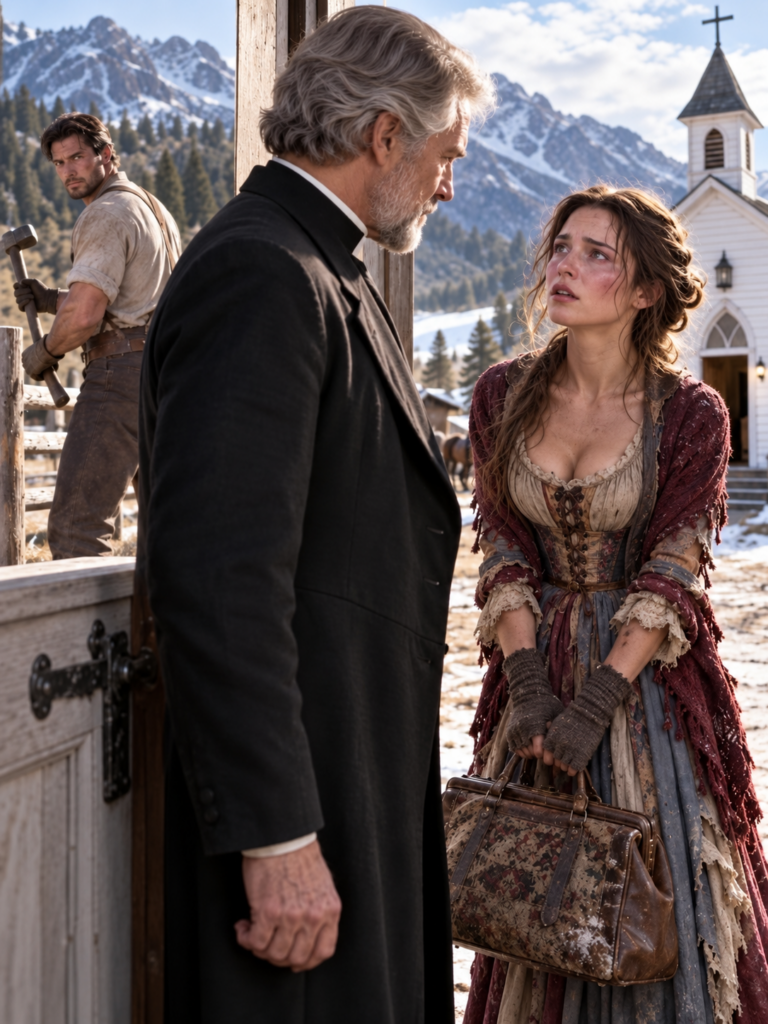
“And?”
“He told me to mind my pulpit.”
“That sounds sensible.”
Abernathy’s eyes twinkled.
“I like you already.”
Hannah pushed back from the table.
“I did not walk fifty miles to become somebody else’s solution.”
His amusement disappeared immediately.
“No. You did not.”
That answer stopped her.
He leaned forward.
“And Thomas will not become yours unless you choose it. I am not suggesting a wedding tomorrow. I am suggesting employment, respectable lodging, and an introduction.”
“Employment?”
“Thomas has a spare cabin near his ranch house. His foreman’s widow lived there until she moved east last spring. You know farm work?”
“All of it.”
“Bookkeeping?”
“My father trusted me with every account.”
“Cooking?”
“I can keep a man alive.”
“That is about Thomas’s present standard.”
Hannah looked through the window again.
Thomas had resumed working.
“Why isn’t he married?”
Abernathy’s expression softened.
“Because some people are afraid of loneliness, Miss Reed. Others become so accustomed to it that loneliness begins to feel safer than love.”
He stood.
“You may stay here as long as necessary. No conditions. But tomorrow, if you are willing, I’ll introduce you to Thomas.”
“And the husband part?”
“That,” Abernathy said, “is between you, Thomas, and a future I am wise enough not to pretend I control.”
Hannah narrowed her eyes.
“You enjoy interfering.”
“Only where providence has already left the gate open.”
Thomas Bridger knew Reverend Abernathy was plotting something the instant the pastor asked him to help turn the parsonage garden.
The garden did not need turning.
Thomas had turned it four weeks earlier.
Still, the reverend had buried Thomas’s mother, helped find homes for his sisters, lent him seed during the worst year of his ranch, and once sat beside him from midnight until sunrise without saying a word after a calf delivery went wrong on the anniversary of his mother’s death.
So Thomas arrived.
Then he saw Hannah.
She knelt between two garden rows with her sleeves rolled above her elbows, her dark hair twisted carelessly behind her head. She was attacking Wyoming soil with a garden fork as though it had personally offended her.
Thomas stopped at the gate.
Hannah looked up.
“You must be the rancher.”
He removed his hat.
“You must be the reason the reverend suddenly forgot I already turned this soil.”
Her mouth twitched.
“I suspected something.”
Thomas looked toward the church.
Abernathy disappeared behind a curtain.
Coward.
Hannah stood.
“I’m Hannah Reed.”
“Thomas Bridger.”
“I’m not looking for a husband.”
Thomas stared at her.
After a moment, he said, “That makes two of us.”
She blinked.
Then she laughed.
Thomas had not intended to be funny.
That bothered him more than it should have.
They worked for two hours.
Hannah did not chatter to fill silence.
Thomas appreciated that.
She did not ask why he lived alone.
He appreciated that more.
When she struggled with a buried root, he moved to help, but she raised a hand.
“I have it.”
So he let her have it.
After another minute of determined effort, the root came free and sent Hannah backward into the dirt.
Thomas looked away quickly.
“Are you laughing?”
“No.”
“You are.”
“I’m breathing.”
“You breathe strangely.”
That time he did smile.
Barely.
But Hannah saw it.
Over the following weeks, Reverend Abernathy developed an extraordinary number of maintenance emergencies.
A barn hinge needed repair.
Firewood needed splitting.
Church benches needed moving.
Constance needed apples collected.
The parsonage roof required inspection despite having been inspected in May.
Somehow, Thomas and Hannah were repeatedly present at the same time.
Eventually Thomas confronted the pastor.
“You’re not subtle.”
“I’m seventy-one. Subtlety wastes time.”
“She’s frightened.”
“I know.”
“She doesn’t need somebody pushing marriage at her.”
“I know.”
“Then stop.”
Abernathy looked at him for a long moment.
“I have not once mentioned marriage to Hannah since the morning she arrived.”
Thomas folded his arms.
“You mention it to me every Sunday with your eyebrows.”
“That is an accusation difficult to defend against.”
Thomas sighed.
The pastor’s voice softened.
“She needs a friend, Thomas.”
“So be her friend.”
“She needs one closer to her own age.”
Thomas looked away.
“And you?”
Abernathy asked.
“I don’t need anything.”
“That lie is getting old.”
Thomas left before he said something disrespectful inside church property.
Yet the following afternoon, he returned.
Not because of the pastor.
Because Hannah had mentioned she wanted to repair the broken gate behind the parsonage.
At least that was what Thomas told himself.
The truth was more dangerous.
He liked the sound of her laugh.
He liked that she did not treat silence as an illness requiring a cure.
He liked that when she discovered he had skipped lunch, she handed him half her biscuit without making a ceremony of it.
He liked that she never thanked him merely for behaving decently.
And Hannah slowly discovered that Thomas Bridger’s quietness was not coldness.
It was attention.
He noticed when her left boot began rubbing her heel and left a tin of salve on the porch without comment.
When thunder woke her one night because Crane had once arrived during a storm, Thomas did not ask why she looked exhausted the next morning.
He simply worked beside her.
When a wagon driver from Casper made a joke about “the pastor’s stray woman,” Thomas did not threaten him.
He only looked at the man until the joke died.
One Sunday evening, Hannah finally told Thomas everything.
They sat on the parsonage porch while September faded into October.
Thomas listened.
When she described Crane’s wives, his jaw tightened.
When she finished, he remained silent for so long that Hannah became uncomfortable.
“You can say something.”
“My father drank.”
That was not what she expected.
Thomas stared toward the hills.
“When I was fourteen, he rode into Cheyenne and never came home. Months later, somebody wrote that he’d died after falling down a stairway outside a saloon.”
“I’m sorry.”
“My mother kept the ranch alive three more years. Then she died too.”
“From illness?”
“The doctor said her heart was weak.”
Thomas rubbed his thumb against the edge of his hat.
“I think waiting killed her.”
Hannah said nothing.
“She kept expecting him to come home before we learned he was dead. Afterward, I think some part of her kept waiting anyway. I decided I would never need anybody badly enough for their leaving to destroy me.”
“That sounds lonely.”
“It was practical.”
“Those aren’t always different things.”
He looked at her then.
“No.”
A long silence settled between them.
Comfortable this time.
Thomas finally said, “The reverend has ideas.”
“He has too many.”
“I want you to know I’m not part of them.”
Hannah smiled slightly.
“All right.”
“I don’t know anything about courting.”
“I didn’t ask you to.”
“I know.”
“Thomas?”
“Yes?”
“You appear to be losing an argument nobody started.”
He looked almost offended.
Then he laughed.
A full laugh this time.
Hannah had never heard it before.
It changed his entire face.
And that frightened her more than Elijah Crane had in a completely different way.
Because fear of a cruel man was simple.
You ran.
Fear of a good man was harder.
Sometimes it made you want to stay.
The letter arrived six days later.
Reverend Abernathy read it once.
Then again.
Then summoned Hannah, Thomas, and Constance to the kitchen.
The message was written in Elijah Crane’s precise hand.
Miss Reed had unlawfully abandoned property securing a legitimate debt.
The outstanding sum was now four hundred and thirty-seven dollars, including interest and expenses.
Mr. Crane intended to arrive personally before the end of October.
Payment would be accepted.
Marriage remained, in his words, “the more charitable resolution.”
Hannah finished reading.
Her hands shook.
Thomas saw it.
“I can pay him.”
Everyone looked at him.
Hannah stood so quickly her chair scraped backward.
“No.”
“I have the money.”
“No.”
“Hannah—”
“I will not trade one debt for another.”
“You wouldn’t.”
“That is what men always say while they’re deciding the price.”
The words struck Thomas hard.
Hannah saw it immediately.
But terror had already taken control.
“You pay four hundred dollars for me today,” she continued, “and what happens a year from now when I disagree with you? What happens when I want something you don’t? Do I get reminded who saved my farm?”
“No.”
“Can you promise that?”
“Yes.”
“How?”
Thomas stood too.
“Because I am not Elijah Crane.”
Silence.
Hannah’s face crumpled for one second before she forced it still.
“I know.”
“No. Right now, you don’t.”
He did not sound angry.
That made it worse.
Thomas reached for his coat.
At the door, he stopped.
“I’m going home. Not because I’m offended. Because you need space to decide what scares you more, Crane coming here or somebody helping without asking to own the result.”
He left.
Hannah sat down.
Constance quietly removed the untouched coffee.
Abernathy said nothing.
“Go ahead,” Hannah whispered.
“About what?”
“Tell me I hurt him.”
“You already know.”
“Tell me I’m foolish.”
“No.”
“Tell me what to do.”
“No.”
She looked at him.
Abernathy folded the letter carefully.
“You ran because Elijah Crane would not let you choose. I would be a poor pastor and a worse friend if I replaced his decision with mine.”
Hannah covered her face.
“I don’t know how to accept something that large.”
“Perhaps,” Constance said quietly, “because nobody ever gave you anything large without eventually presenting the bill.”
Hannah looked at her.
The older woman’s eyes were gentle.
“Sometimes kindness is just kindness, child.”
Thomas did not return for three days.
On the fourth morning, Hannah walked two miles to his ranch.
He was repairing a cattle chute.
“I came to apologize.”
He set down his hammer.
“All right.”
“I was cruel.”
“You were scared.”
“That doesn’t excuse cruelty.”
“No.”
She appreciated that he did not rescue her from the truth.
Hannah swallowed.
“Did you mean it?”
“What?”
“That you would pay the debt and ask nothing.”
“Yes.”
“Even if I left Wyoming afterward?”
“Yes.”
“Even if I married someone else someday?”
His jaw tightened.
But he answered.
“Yes.”
“Even if I never saw you again?”
Thomas looked directly at her.
“That one would hurt.”
Her breath caught.
“But yes.”
Hannah’s eyes filled.
“Why?”
Thomas took a long time.
“Because Crane wants the debt to decide who you belong to.”
He stepped closer but stopped several feet away.
“I think paying it should decide only one thing.”
“What?”
“That you belong to yourself.”
Hannah cried then.
Not delicately.
Not beautifully.
She turned her face away, furious with herself, until Thomas said, “You don’t have to hide that from me.”
She looked back.
He had not touched her.
He was waiting.
Always waiting.
So Hannah crossed the distance herself.
She put her forehead against his chest.
Only then did Thomas lift his arms around her.
And for the first time since her father died, Hannah let another person hold some of the weight.
Elijah Crane chose Sunday morning to enter Amity Creek.
He chose it deliberately.
He rode down Main Street with two hired men behind him, wearing the same black coat Hannah remembered from her father’s funeral.
By then, everybody in town knew.
Small towns could turn gossip into judgment faster than a courthouse.
But sometimes they could turn it into protection too.
Crane dismounted outside the church during Reverend Abernathy’s sermon.
The door opened.
Thirty-seven heads turned.
Hannah felt the blood leave her face.
Thomas sat beside her.
He did not reach for her hand.
He waited.
Hannah reached for his.
Only then did his fingers close around hers.
Crane removed his hat.
“My apologies, Reverend.”
Abernathy closed his Bible.
“No, they aren’t.”
A murmur moved through the pews.
Crane smiled.
“I’ve come to settle private business.”
“You interrupted public worship.”
“I understood Miss Reed might be present.”
Hannah stood.
“I am.”
Crane’s eyes found her.
The smile changed.
Possessive.
Satisfied.
“There you are.”
Thomas started to rise.
Hannah squeezed his hand.
Not yet.
She stepped into the aisle.
“You may speak to me, Mr. Crane. Not about me.”
His expression hardened.
“You’ve caused considerable inconvenience.”
“I walked away from my own house.”
“A house mortgaged against money your father borrowed.”
“My father’s debt does not make me property securing the loan.”
“Such dramatic language.”
Crane looked around the church.
“Miss Reed appears to have entertained you people with a distorted account.”
Nobody answered.
He continued.
“I offered mercy. Marriage would preserve her family home. Without it, the property becomes mine.”
“Then take it,” Hannah said.
That surprised him.
“What?”
“Take the farm.”
Silence spread through the church.
Hannah’s voice strengthened.
“I loved that land because my father loved it. But soil is not worth becoming someone’s possession.”
Crane’s face darkened.
“You’re speaking emotionally.”
“No.”
She looked at Thomas.
Then back at Crane.
“For the first time, I am not.”
Crane reached inside his coat and produced the mortgage note.
“Then perhaps foreclosure will teach maturity.”
“The note is already paid.”
Thomas’s voice traveled clearly through the church.
Crane turned.
Thomas stood.
He carried a folded document to the front and handed it to Reverend Abernathy.
The pastor opened it.
A receipt from a Cheyenne bank.
Four hundred dollars principal.
Thirty-seven dollars agreed interest and documented fees.
Paid in full.
Mortgage discharged.
Crane stared.
“You had no authority—”
“The bank holding the note had authority,” Thomas said. “I paid through them directly.”
Crane’s mouth tightened.
“You went around me.”
“I made sure the amount could not change between one conversation and the next.”
“Who are you?”
“Thomas Bridger.”
Something like recognition flickered across Crane’s face.
“The cattleman.”
“That’s what folks call me when they’re being polite.”
A few people laughed.
Crane ignored them.
He looked at Hannah.
“So this is your arrangement.”
“No,” Hannah said.
“What?”
“You think every kindness hides a transaction because yours always do.”
Her voice trembled.
But she continued.
“Thomas paid the debt without asking me to marry him.”
Crane smiled cruelly.
“Do you actually believe that?”
“Yes.”
“Then you are more naive than your father.”
Thomas moved.
Hannah stepped in front of him.
“No.”
Thomas stopped.
This was hers.
Hannah faced Crane.
“My father made one desperate financial decision after two ruined harvests. You built an entire business on desperate men.”
Crane’s eyes narrowed.
“Careful.”
“You came to his funeral and waited eleven days before offering to erase his debt if I entered your bed and your house.”
Gasps filled the church.
“Hannah—”
“No. You wanted witnesses today. Now you have them.”
His smile finally disappeared.
“You know nothing about marriage.”
“I know enough to recognize extortion dressed as courtship.”
Crane stepped closer.
Thomas came beside Hannah now.
Not in front of her.
Beside.
Crane noticed.
“And what exactly are you to her, Bridger?”
Thomas looked at Hannah.
That look mattered.
Because the whole church was waiting for him to claim something.
He didn’t.
“Nothing she hasn’t chosen.”
Crane scoffed.
“You paid nearly five hundred dollars for a woman who owes you nothing?”
“That is correct.”
“Why?”
Thomas’s voice became very quiet.
“So she could tell you no without losing everything her father left her.”
“That is foolishness.”
“Maybe.”
“You expect me to believe you want nothing?”
Thomas glanced at Hannah again.
“I want plenty.”
Her heart stopped.
Thomas continued.
“I want her to stay in Amity Creek. I want her to laugh in Reverend Abernathy’s garden. I want her to come to my ranch tomorrow and the day after that. I want to know what book she is reading when she forgets supper. I want to hear her complain about Wyoming winters for the next fifty years.”
Several women smiled through sudden tears.
Thomas looked back at Crane.
“But wanting something from a person and believing you are entitled to it are two different matters.”
The church became utterly silent.
“I would like Hannah Reed to choose me someday.”
Thomas’s voice roughened.
“But if she doesn’t, then she will still have been worth setting free.”
Hannah could barely see him through her tears.
Crane looked around.
Something fundamental had shifted.
He had arrived believing he was negotiating with one frightened woman.
Instead he had walked into a town.
Silas Trent, a sixty-eight-year-old farmer in the fourth pew, stood.
“I’ve got fifty dollars toward Bridger’s payment.”
Thomas turned.
“Silas—”
“Sit down. I’m old. Let me be dramatic.”
Laughter rolled through the congregation.
Then Martha Bell stood.
“I can give ten.”
The blacksmith raised a hand.
“Twenty.”
The schoolteacher offered five.
A widow with three children offered two dollars and a jar of preserves.
Thomas looked horrified.
“You people are not paying me back.”
Silas grinned.
“Then we’ll call it a wedding gift.”
Hannah went scarlet.
“We are not engaged.”
“Yet,” Constance Abernathy muttered loudly.
Even Reverend Abernathy failed to hide his smile.
Crane had had enough.
“You people are ridiculous.”
“Perhaps,” Abernathy said.
He stepped down from the pulpit.
“But you mistook a small town for an isolated woman, Mr. Crane. Those are not the same thing.”
Crane stared at Hannah.
“This isn’t finished.”
Hannah’s fear returned.
But something stronger stood beside it now.
“Yes,” she said. “It is.”
He put on his hat.
Then he walked out.
Nobody followed him except the two men he had brought.
The congregation remained silent until hoofbeats faded beyond town.
Then Hannah’s knees gave way.
Thomas caught her.
She started laughing and crying at once.
“I hate that man.”
Thomas held her carefully.
“I gathered.”
“I think I may hate you too.”
“That seems less fair.”
“You paid the debt before I finished deciding.”
“I know.”
She pulled back.
“Why?”
“Because your freedom did not need to wait for your feelings about me.”
Hannah looked at him.
There were moments when a person’s life changed loudly.
A gunshot.
A funeral bell.
A slammed door before sunrise.
But sometimes a life changed because a quiet man said one honest sentence in a crowded church.
Hannah rose on her toes.
Thomas froze.
She kissed his cheek.
The congregation erupted.
“Oh, for heaven’s sake,” Hannah muttered.
Abernathy lifted both hands.
“I am making no theological claims about what we have just witnessed.”
“You are enjoying this far too much,” Thomas told him.
“Immensely.”
But Thomas did not propose that day.
That mattered to Hannah.
He did not propose the next week either.
Or the week after.
Autumn deepened.
Hannah found work keeping accounts for the general store three mornings a week and helping Constance the rest.
She repaid Thomas slowly, not because he demanded it, but because contributing made her feel whole.
He accepted exactly one payment.
A nickel.
Then he framed it.
When Hannah protested, he said, “You said you intended to repay me. You have begun.”
“Four hundred thirty-six dollars and ninety-five cents remain.”
“I’m patient.”
“You are impossible.”
“I’ve heard that.”
The first heavy snow came in early December.
Thomas asked Hannah to ride out to the ranch because one of his cows was calving early and because, as he admitted reluctantly, he had become accustomed to her presence during difficult things.
Afterward, they stood outside the barn.
The valley was white and silent.
Smoke curled from the ranch house chimney.
Hannah looked at the house.
“You built all this alone?”
“Mostly.”
“Were you proud?”
“Yes.”
“Were you happy?”
Thomas thought.
“No.”
He reached into his coat.
Hannah’s breath caught.
“No.”
His hand stopped.
“No?”
“If that is a ring, put it back.”
Thomas looked alarmed.
“It is.”
“Put it back.”
He obeyed immediately.
Hannah nearly laughed at the expression on his face.
“I thought—”
“I know what you thought.”
“Have I misjudged—”
“Thomas.”
She stepped closer.
“You have spent three months proving I am allowed to choose. You don’t get to ruin it now by panicking before I finish a sentence.”
He shut his mouth.
Hannah took both his hands.
“I do not want you to ask me because you paid my father’s debt.”
“I’m not.”
“I don’t want you to ask because Reverend Abernathy thinks God personally assigned him to arrange our lives.”
“He does appear to believe that.”
“I don’t want you to ask because I need protection.”
“All right.”
“And I will never become a woman who disappears inside her husband’s name.”
Thomas’s expression softened.
“I would not know how to make you disappear if I tried.”
“You could build a barn around me.”
“I suppose.”
“And I would dismantle it.”
“I know.”
Snow landed in his hair.
Hannah smiled.
“Now you may ask.”
Thomas stared.
“Now?”
“Yes.”
“I had a speech.”
“You should have spoken faster.”
He laughed nervously.
Thomas Bridger, who had faced blizzards, stampeding cattle, debt collectors, drunken ranch hands, and Elijah Crane without visible fear, suddenly looked terrified.
He took out the ring.
It was simple silver with a small blue stone.
“My mother’s.”
Hannah touched it.
Thomas swallowed.
“I spent fourteen years convincing myself that an empty house could not hurt me because I expected it to be empty. Then you came along and proved there are worse things than risking loss.”
“What?”
“Never letting yourself have something worth losing.”
Her eyes filled.
“Hannah Reed, I love you.”
He looked directly at her.
“I will not promise never to fail you. I probably will. I will not promise life will be easy. This is Wyoming, so statistically it won’t.”
She laughed through her tears.
“But I promise your no will always mean no in my house, your yes will always belong to you, and if you stay with me, I will spend my life remembering that being chosen is not the same thing as owning.”
Hannah began crying harder.
Thomas looked worried.
“Was that bad?”
“It was terrible.”
“Oh.”
“I hated almost every word.”
His face fell.
She smiled.
“And I love you too.”
It took him a full second.
“Hannah—”
“Yes.”
“You mean—”
“Yes, Thomas.”
He kissed her before she could tease him again.
Then immediately pulled back.
“Was that all right?”
Hannah stared at him.
“Thomas Bridger, if you ask permission after kissing your future wife every single time—”
“Future wife?”
She laughed.
“Yes.”
That was when he kissed her properly.
They married six weeks later in the white church where Hannah had first arrived with bloody feet and three dollars in her bag.
Constance altered a cream-colored dress that had belonged to Thomas’s mother.
Silas Trent insisted on walking Hannah down the aisle.
Thomas’s sisters came from Colorado with husbands, children, food, blankets, and fourteen years of guilt for leaving their brother alone with the ranch.
Thomas forgave them before they finished apologizing.
Reverend Abernathy stood before the congregation smiling so broadly that Hannah whispered, “If you say I told you so, I will leave.”
“I would never.”
“You are thinking it.”
“I am thinking it very loudly.”
The congregation laughed.
Then the reverend became serious.
“I could speak today about providence,” he said. “I could speak about two lonely people placed on the same road. But I think there is something more important.”
He looked at Hannah.
“This woman did not come to Amity Creek searching for a husband.”
Then at Thomas.
“And this man did not rescue her so she would owe him love.”
He looked over the gathered town.
“One person needed freedom. Another had the means to help provide it. Everything beautiful that followed became possible because the gift remained a gift.”
Hannah looked at Thomas.
His eyes were wet.
“So let nobody here confuse love with possession,” Abernathy continued. “Love does not say, I paid, therefore you belong to me. Love says, I gave because you were worth helping even if your freedom carried you somewhere I could not follow.”
He opened his Bible.
“Hannah, when you came here, you told me you had prayed on the road for nothing grand. Only a roof, a kind word, and somewhere safe enough to stop walking.”
Her throat tightened.
Abernathy smiled gently.
“I suspect you received more than you requested.”
Hannah looked at Thomas.
At Constance.
At Silas.
At the faces of neighbors who had once been strangers.
Then she looked back toward the church doors.
Beyond them lay the road on which she had arrived.
For months, she had remembered that road as the place where everything had been taken from her.
Now she understood differently.
The road had not been where her life ended.
It had been where she finally began choosing it.
“Yes,” Hannah said.
Thomas squeezed her hand.
Abernathy closed the Bible.
“Then I believe we can proceed.”
Years later, people in Amity Creek still told the story of the morning Elijah Crane walked into church expecting to collect a bride and rode away without even collecting his dignity.
The story improved with age.
In some versions, Silas Trent chased Crane to the county line with a pitchfork.
This had never happened.
Silas nevertheless refused to correct anyone.
Hannah and Thomas built their life slowly.
They added two rooms to the ranch house.
Hannah took over the accounts and discovered Thomas had been paying too much for feed for six years because he hated negotiating.
She corrected this within a month.
They planted apple trees that survived three winters and nearly died in the fourth before recovering.
They had a daughter they named Rose after Thomas’s mother and a son named Amos after Hannah’s father.
Thomas learned that a noisy house could be peaceful.
Hannah learned that safety was not silence.
It was being able to speak without fearing what honesty would cost.
She never became completely fearless.
Some winters, when strangers rode toward the ranch unexpectedly, her hands still went cold.
Thomas never told her she was being foolish.
He simply stood beside her until she knew who was coming.
Likewise, Thomas never entirely lost his fear that people he loved might leave.
When Hannah traveled to Colorado once to visit his sisters, he became so quiet the night before that she finally understood.
She packed her bag.
Then she placed it beside the door and sat next to him.
“I’m coming back.”
“I know.”
“You don’t sound convinced.”
“I’m working on it.”
She took his hand.
“You were right about one thing.”
“What?”
“Loving somebody gives them the power to hurt you.”
Thomas looked down.
Hannah continued.
“But refusing love gives fear the power to decide your whole life.”
He looked at her.
“I suppose the reverend told you that.”
“No.”
“Good.”
“His version would have taken forty minutes and involved Leviticus somehow.”
Thomas laughed.
Reverend Abernathy lived long enough to baptize both children.
When he grew too weak to preach every Sunday, Thomas repaired a small porch on the parsonage so the old pastor could sit there in the afternoons.
Hannah often brought him coffee.
One spring morning, years after her arrival, the three of them watched her children chasing each other through the daisy garden.
Abernathy leaned back in his chair.
“Do you remember what you said when I suggested Thomas?”
“I remember considering murder.”
“I considered that an overreaction.”
“You had just told a woman fleeing marriage that your solution was another husband.”
“When phrased that way, I admit my pastoral technique lacked refinement.”
Hannah smiled.
“Why did you really do it?”
Abernathy looked toward Thomas, who was kneeling beside little Amos repairing a toy wagon.
“I didn’t.”
Hannah frowned.
“You very much did.”
“No.”
He smiled.
“I introduced two people.”
“You manipulated approximately fourteen gardening emergencies.”
“Twelve.”
“Fourteen.”
“Constance arranged two without consulting me.”
Hannah shook her head.
Abernathy became thoughtful.
“People like to believe the important moment was Thomas paying the debt. Or Crane leaving. Or your wedding.”
He looked at her.
“It wasn’t.”
“What was?”
“The important moment was when you reached my door and asked for help.”
Hannah went quiet.
“Why?”
“Because everything afterward depended on you believing, however faintly, that there might still be something good enough ahead to ask for.”
She looked toward her husband.
Thomas lifted Amos onto his shoulders while Rose chased them around the garden.
Hannah remembered herself at twenty-three.
Cold.
Hungry.
Fatherless.
Walking because the road behind her frightened her more than the empty road ahead.
She wished she could somehow reach backward through the years and speak to that exhausted young woman kneeling beside a frozen creek.
She would not tell her everything would be easy.
It had not been.
She would not promise every loss would be restored.
Some never were.
She would only tell her this.
Keep walking.
Not because every road ends in rescue.
Not because every stranger is kind.
Not because suffering secretly guarantees a reward.
Keep walking because the person trying to own your future does not get to decide where your story ends.
Keep walking until you reach a door where someone understands that helping you and possessing you are not the same thing.
And when that door opens, do not mistake gentleness for another trap merely because cruelty taught you to expect one.
Years after Elijah Crane disappeared from their lives, Hannah received a letter from a lawyer in Nebraska.
Crane had died.
There was no fortune waiting for her, no last confession, no dramatic apology.
Only a request regarding old records.
Hannah sat at the kitchen table holding the letter.
Thomas came in from the barn.
“You all right?”
“Yes.”
“You look somewhere else.”
She handed him the page.
He read it.
Then placed it down.
“Do you want to talk about him?”
Hannah considered the question.
Once, Elijah Crane’s name could make her heart race.
Now she could hear Rose practicing piano badly in the front room while Amos argued with a dog outside.
Thomas stood near the stove, older now, silver beginning at his temples.
Hannah looked through the window toward land covered in evening sunlight.
“No,” she said.
Thomas waited.
Hannah smiled.
“I think I have already given that man more pages of my life than he deserved.”
Thomas smiled back.
“Then supper?”
“Supper.”
He turned toward the stove.
“Thomas?”
He looked back.
Hannah crossed the kitchen and kissed him.
“What was that for?”
“For paying a debt you never tried to collect.”
He touched her cheek.
“You paid me back.”
“I did?”
“Every day.”
“That sounds suspiciously like interest.”
“Very aggressive interest.”
She laughed.
Outside, the Wyoming sky burned gold above the hills.
Inside, the house Thomas Bridger had once built for one man was full of footsteps, burnt piano notes, children’s voices, supper smells, unfinished arguments, old griefs that no longer ruled anyone, and the kind of love that had begun not with a promise of ownership but with freedom.
And Hannah finally understood something about the prayer she had whispered beside that frozen road before dawn.
She had asked for a place to stop walking.
What she found was a home where no one would ever stop her from leaving.
That was precisely why she stayed.
THE END

