
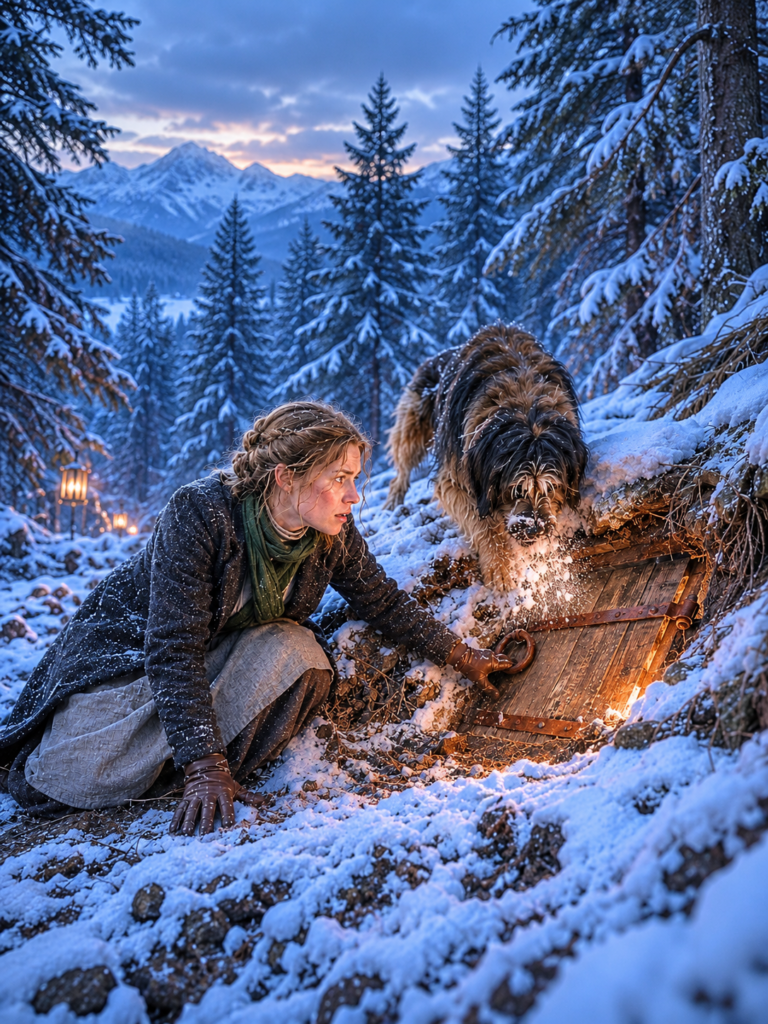
the town drove the widow from her farm before winter—then her dog found the hidden shelter her father had built for the day they came for her
Part 1
By the last week of October 1886, every family in Ridgewater, Dakota Territory, was preparing for winter.
Men split cottonwood until their shoulders ached. Women packed root cellars with potatoes, onions, dried beans, salt pork, and whatever preserves had survived the summer heat. Ranchers checked barn roofs, counted hay bales, and argued over whether the first real snow would come before Thanksgiving.
Ingrid Vestergard watched the geese leave.
That was what frightened her.
She stood behind the stone cabin her father had built twelve years earlier, one hand resting on the handle of his old splitting axe, and watched the final black line of birds disappear south beneath a sky the color of worn pewter.
They were nearly two weeks early.
Behind her, eight-year-old Bjorn pushed open the cabin door.
“Mama?”
Ingrid did not turn immediately.
She studied the western horizon.
A yellow-gray bruise hung beneath the clouds.
She had seen a sky like that only twice before.
The first time had been in Norway when she was fifteen, before a winter that killed half the sheep in her grandfather’s valley.
The second had been three days before the mine collapse that killed her husband, Kristopher.
“What is it?” Bjorn asked.
“The geese.”
“They’re gone.”
“Yes.”
Odin came around the corner of the cabin.
He was a large gray dog, part Norwegian elkhound and part something no one had ever identified. Ingrid had found him half frozen in a ditch two years earlier. One eye was pale blue, the other brown. Ridgewater children called him the wolf dog.
Odin stopped beside Ingrid.
His nose lifted.
His ears flattened.
A low rumble moved through his chest.
Ingrid placed one hand between his ears.
“You feel it too.”
Bjorn stepped closer.
“Feel what?”
“Winter.”
The boy frowned. “It comes every year.”
“Not this one.”
She picked up the axe again.
Her grandfather, Sigurd Halvorsen, had taught her that land spoke long before danger arrived.
Birds knew.
Grass knew.
Trees knew.
Animals knew.
Human beings were usually the last to understand because they had learned to trust calendars more than the world outside their doors.
The wind had been coming steadily from the northwest for three days.
The creek had frozen along its edges earlier than Ingrid had ever seen.
Mice had nested beneath the barn floor in September.
Even the old nanny goat, Freya, had grown an unusually heavy winter coat.
Everything was preparing.
So Ingrid prepared too.
She cut twice as much wood as she had the year before.
She dried beans.
She rendered fat.
She patched Bjorn’s wool coat.
She repaired the barn roof.
And each evening she counted what remained.
There was never enough.
Not since Kristopher had died.
Not since her father had followed him into the grave two winters later.
The 240-acre homestead had been her father’s dream.
Anselm Halvorsen had arrived from Norway with stone dust permanently embedded in the lines of his hands. He understood walls, foundations, drainage, soil, cold, and the stubborn patience required to make something last.
He had built Ingrid’s cabin himself.
Its walls were thicker than those of most houses in Ridgewater.
People laughed at him for that too.
Anselm had never cared.
“A wall does not need to impress a neighbor,” he used to tell Ingrid. “It needs to still be standing when the neighbor’s opinion is dead.”
Ingrid missed him most in winter.
She missed the scrape of his boots near the stove.
The way he tested mortar with his thumb.
The way he could look at a slope and tell where spring water would run three months later.
She missed having someone older than herself who seemed to know what came next.
Now she was thirty-one.
There was no one older standing between her and the world.
Only Bjorn.
And Odin.
And 240 acres that had suddenly attracted the attention of Cornelius Blaine.
The wagon arrived two days later.
Ingrid heard it before she saw it.
Iron-rimmed wheels creaked across frozen ground.
Odin rose from beneath the porch.
His hackles lifted.
Two men appeared over the eastern rise.
Marshal Oren Thornberry held the reins.
Beside him sat Cornelius Blaine.
Blaine owned notes on half the farms around Ridgewater and mortgages on most of the rest. He had arrived four years earlier with money, polished boots, and the ability to make desperate people grateful for debts that would eventually ruin them.
The wagon stopped.
Blaine stepped down carrying a leather case.
“Mrs. Vestergard.”
Ingrid kept both hands on the axe handle.
“Mr. Blaine.”
“We need to speak inside.”
“Then speak here.”
His smile barely changed.
“I believe you’ll prefer privacy.”
She looked at Thornberry.
The marshal would not meet her eyes.
That told her more than Blaine’s smile did.
She opened the door.
Bjorn was sent to check Freya.
Odin refused to leave.
Blaine sat at the pine table her father had built and removed a folded document.
He placed it carefully in front of Ingrid.
“A deed of transfer.”
She read it.
Her breathing slowed.
The document claimed her father had transferred all 240 acres to a holding company controlled by Blaine before his death.
At the bottom was Anselm Halvorsen’s signature.
There was a county seal.
A notary mark.
Everything looked proper.
Except one thing.
Ingrid leaned closer.
Her father always wrote the Norwegian slashed letter in his surname with the stroke rising from lower left to upper right.
He had done it that way for sixty years.
The signature on Blaine’s deed slashed downward.
A tiny thing.
Meaningless to anyone else.
Not to Ingrid.
“My father didn’t sign this.”
Blaine folded his hands.
“The county court recognizes the document.”
“My father didn’t sign it.”
“That is not the issue before us.”
“It is the only issue.”
Thornberry shifted.
Leather creaked at his belt.
Blaine’s voice remained calm.
“You have until the first significant snowfall to vacate.”
Bjorn appeared outside the window.
Blaine’s eyes moved toward him.
Ingrid saw the look.
Not affection.
Not curiosity.
Calculation.
She stood.
Odin stood with her.
“You will leave.”
Blaine put the deed away.
At the door, he stopped.
“A widow alone on the prairie should consider what is best for her child.”
Odin growled.
Blaine looked down at him.
Then back at Ingrid.
“It would be unfortunate for the boy to lose another parent.”
For one second, Ingrid’s hand tightened around the axe.
Thornberry finally looked at her.
His expression begged her not to do anything.
She didn’t.
“Get off my land.”
Blaine smiled.
“For now.”
The wagon disappeared east.
Bjorn walked to his mother.
“Are they taking our house?”
Ingrid stared at the empty road.
“No.”
“How do you know?”
Because she had suddenly remembered something.
A summer afternoon four years earlier.
Her father hauling stone west.
Not toward the creek.
Not toward the barn.
Toward the ridge.
She had asked what he was doing.
“Repairing something.”
“What?”
“Something I hope you never need.”
She had forgotten the conversation.
Until now.
The following morning, Ingrid walked eight miles into Ridgewater with Bjorn and Odin.
At Blackwood’s General Store, she learned Blaine had already been there.
Hetty Blackwood could barely look at her.
“I’m sorry, Ingrid. Truly. But Mr. Blaine owns our fall inventory note.”
“I need flour.”
Hetty swallowed.
“He told us not to extend you credit.”
“Salt?”
“Cash only.”
“Matches?”
“Cash.”
Ingrid opened her purse.
Twenty-eight cents.
She bought salt, matches, a sewing needle, a piece of paper, and a pencil stub.
Near the stove, Ephraim Whitlock laughed.
He owned the largest cattle ranch in the valley.
“Should’ve married again, Ingrid.”
She ignored him.
“A woman can’t keep a farm like that alone.”
She packed her purchases.
One of Whitlock’s ranch hands grinned.
“Five dollars says she’s gone before December.”
Whitlock slapped money onto a barrel.
“I say she freezes before Christmas.”
Bjorn’s face reddened.
Ingrid touched his shoulder.
Then she looked at Whitlock.
“When winter comes for you, Ephraim, I hope that five dollars keeps you warm.”
The store fell quiet.
She walked out.
At the western edge of town, an old man waited beside the road.
Ezekiel Ravensdale had known her father.
He had spent years as a scout before settling near Ridgewater with a small flock of sheep.
People called him strange.
Ingrid’s father had called him trustworthy.
“Your father left something with me.”
Ezekiel removed an oilskin packet from inside his coat.
“He said I was to give it to you if Blaine ever came for the land.”
Ingrid stared at him.
“You knew?”
“I knew enough to wait.”
She took the packet home.
That night, after Bjorn slept, she opened it.
Inside was a letter written in Norwegian.
My dear Ingrid,
If you are reading this, then Cornelius Blaine has finally shown you what he is.
That is not his name.
His name is Theodore Wexley.
I knew him in Colorado.
He killed my brother Frederick over a silver claim and disappeared before justice found him.
I recognized him four years ago.
He did not recognize me.
Since then, I have prepared.
Go to the western ridge.
Find the cedar that leans east.
Look beneath its roots.
Take Bjorn.
Take Odin.
Take the goat.
Take whatever you can carry.
Do not go toward town.
Do not go east.
I built you a place beneath the hill.
I stocked it.
There is no stove.
That part is yours.
Your grandfather taught you how.
When the time comes, trust your hands.
Survive first.
Justice can wait.
The earth remembers.
And so do I.
Your father.
Ingrid read the letter twice.
Then a third time.
She pressed the page flat against the table.
Her father had known.
Four years.
He had carried the danger alone for four years and built something in secret because he had known there might come a day when he was no longer alive to protect her.
For the first time since Blaine’s wagon arrived, Ingrid felt the fear inside her change shape.
It did not disappear.
It became purpose.
Outside, Odin raised his head.
Snow began ticking softly against the window.
Part 2
The first real snow fell on November third.
Ingrid packed before daylight.
Three wool blankets.
The axe.
A cast-iron pot.
Rope.
Matches.
Salt.
Canvas.
Two changes of clothing for Bjorn.
Her father’s letter.
Kristopher’s wooden spoon.
A small blue book of Norwegian children’s stories.
She tied what she could to Freya’s back.
Bjorn stood in the cabin doorway.
“Are we coming back?”
Ingrid looked around.
Her father’s chair.
Kristopher’s cup.
The iron stove.
The marks on the doorframe where they had measured Bjorn every birthday.
“Yes.”
“When?”
“When it is ours again.”
She locked the door.
Then the widow, the boy, the dog, and the goat walked west.
Snow thickened as they climbed.
The western ridge stretched farther than Ingrid remembered.
Cedars bent east under years of prevailing wind.
Her father’s letter had made it sound simple.
Find the leaning cedar.
Nearly every cedar leaned.
By afternoon, snow covered their tracks.
Bjorn stumbled twice.
Freya resisted the slope.
Ingrid’s fingers ached inside her gloves.
Then Odin stopped.
He had been ranging ahead, disappearing between brush and returning.
Now he stood thirty yards uphill.
Still.
Watching Ingrid.
“Odin?”
He turned toward an old cedar with a trunk thick as a barrel.
He scratched once at the frozen earth.
Then again.
Ingrid climbed to him.
Roots twisted over several flat stones.
Too regular.
Too deliberate.
She dropped to her knees.
Using the back of the axe, she cleared frozen needles from the largest slab.
There.
A seam.
Human-made.
Her heart began pounding.
She wedged the axe into the gap.
The stone refused to move.
She tried again.
Nothing.
“Mama?”
“Stay with Freya.”
Her shoulders burned.
Snow gathered on her hair.
She repositioned the axe.
Pushed.
The slab shifted half an inch.
Then another.
Warm air rose from darkness beneath it.
Not truly warm.
But compared with the freezing wind, it felt miraculous.
Ingrid struck a match.
Stone steps descended beneath the hill.
Bjorn’s mouth fell open.
“Grandfather built that?”
Ingrid smiled for the first time in days.
“Yes.”
The chamber was larger than she expected.
Dry-stacked stone walls supported thick timber beams.
Earth covered the roof.
A narrow ventilation shaft climbed toward the surface.
Along one wall stood supplies.
Beans.
Flour.
Coffee.
Salt pork.
Molasses.
Candles.
Matches.
Needles.
Thread.
Tools.
Everything sealed against moisture.
Her father had built a winter beneath the earth.
On top of one crate lay another note.
You found it.
Now build what I left unfinished.
In one corner were stone, clay, pipe sections, and dry grass.
Materials for a stove.
Nothing more.
Bjorn looked from the materials to his mother.
“You know how?”
Ingrid remembered being twelve.
Her grandfather’s hands guiding hers through wet clay.
Stone holds heat.
Cold air sinks.
Fire needs breath.
A house must breathe or it becomes a grave.
“I used to.”
That was not the same as knowing now.
But it would have to be enough.
She removed her coat.
Rolled up her sleeves.
And began.
The first thing she dug was a shallow channel around the chamber floor.
A cold sink.
Her grandfather had taught her that the coldest air would settle into the lowest available space.
Give the cold somewhere to go besides your bed.
Then she built the stove.
Stone by stone.
Each rock had to sit solidly.
Each joint had to hold.
The clay could be neither too wet nor too dry.
She mixed it by feel.
Hours passed.
Bjorn slept.
Odin lay beside him.
Freya chewed calmly inside a makeshift pen.
By midnight, Ingrid’s palms were bleeding.
By dawn, the firebox stood complete.
She installed the flue.
She checked the intake.
Then she struck a match.
Kindling caught.
Flames rose.
Smoke entered the flue.
For four seconds, Ingrid felt triumph.
Then the smoke reversed.
A black cloud rolled into the chamber.
Bjorn woke coughing.
Ingrid threw her coat over the fire.
“Odin!”
The dog pressed against Bjorn.
Ingrid dropped low beside the intake where clean air still entered.
Bjorn’s eyes widened.
“Are we going to die?”
“No.”
The answer came too quickly.
Because she did not know.
Smoke burned her eyes.
She had built something wrong.
Her grandfather was dead.
Her father was dead.
Kristopher was dead.
There was no one to ask.
Only Ingrid.
And a frightened boy watching her as if mothers were not allowed to be uncertain.
She crawled to him.
“We are going to find the problem.”
Outside, snow was nearly to her knees.
She followed the flue pipe to its exit.
Odin came with her.
He sniffed around the opening.
Then pawed at it.
Ingrid pushed a piece of copper wire into the pipe.
Resistance.
She twisted.
Something loosened.
A curled piece of bark dropped into the snow.
The passage cleared.
Ingrid laughed.
A single breathless sound.
She hurried back below.
The second fire drew perfectly.
Smoke disappeared upward.
The stone slowly warmed.
Thirty-eight degrees became forty.
Then forty-two.
Inside the small blanket enclosure Ingrid hung around their sleeping platform, the temperature climbed above fifty.
Bjorn sat beside her.
Odin stretched across their feet.
Ingrid touched the stove.
“Takk, Far,” she whispered.
Thank you, Father.
Four days later, the first blizzard arrived.
For three days, the world above the shelter vanished.
Wind screamed across the ridge.
Snow buried the entrance.
The temperature fell below twenty degrees under zero.
Inside the earth, Ingrid maintained forty-five degrees.
Inside the blanket enclosure, it remained near sixty.
She burned less wood in twenty-four hours than the old cabin had consumed in six.
The earth did what her grandfather had promised.
It remembered warmth.
After the storm, Marshal Thornberry came looking for her body.
Ingrid saw him below the ridge leading a second horse.
He searched creek banks.
Drifts.
The abandoned cabin.
Then he saw smoke rising from the hillside.
He stared for a long time.
Ingrid climbed out.
“Marshal.”
Thornberry looked at her as though she were a ghost.
Then Bjorn appeared.
Then Odin.
Then Freya stuck her head through the entrance.
The marshal removed his hat.
“I thought…”
“I know.”
“I thought you were dead.”
“Would you like coffee?”
He covered his face with one hand.
When he finally spoke, his voice was different.
“My son owes Blaine six hundred dollars.”
Ingrid waited.
“He threatened to take our farm. Said he’d ruin Ethan. Said I had duties.”
“You knew the deed was forged.”
Thornberry’s shoulders collapsed.
“Yes.”
The word seemed to age him.
“I saw your father sign papers before. I knew his hand.”
“And you came anyway.”
“Yes.”
Ingrid looked across the white valley.
She wanted to hate him.
A clean hatred would have been easier.
But Thornberry was not Blaine.
He was a frightened father who had chosen cowardice.
That did not make what he had done harmless.
It only made it human.
“Go to Ezekiel Ravensdale.”
The marshal looked up.
“Tell him I’m alive.”
She paused.
“Tell him it’s time.”
Blaine arrived the next morning.
He came alone.
His coat was too thin.
His expensive boots sank in snow nearly to their tops.
He stood outside the hidden entrance and stared at the curl of smoke.
“You think this changes something?”
Ingrid split firewood.
Odin stood beside her.
“This land belongs to me,” Blaine said.
She kept splitting wood.
“You are trespassing.”
The axe fell.
Wood cracked cleanly.
“You cannot live in a hole forever.”
Another swing.
“You will fail.”
Another.
“And when you do, I’ll take the boy too.”
Ingrid stopped.
She looked at him.
Blaine smiled.
“You Halvorsens always were stubborn.”
Silence.
His expression changed.
Ingrid set down the axe.
“What did you call me?”
He said nothing.
“You knew my family before Dakota.”
His right hand moved toward his coat.
Ingrid’s pulse accelerated.
Then a rifle lever clicked from the ridge.
A German homesteader named Wilhelm Kessner stood between the trees, holding his hunting rifle across his chest.
Blaine’s hand came slowly out of his coat.
Empty.
Ingrid stepped closer.
“Theodore Wexley.”
Every trace of color disappeared from his face.
That was all the answer she needed.
He backed toward his horse.
“You don’t know what you’re saying.”
“My father did.”
Blaine mounted.
“Let winter have you.”
He rode east.
Wilhelm remained until he was gone.
Then he came down.
“What is this place?”
“A winter shelter.”
“You built it?”
“My father built the room. I finished it.”
Wilhelm stared at the earth-covered roof.
Then at the smoke.
“My wife and I have two girls.”
Ingrid understood the question he had not asked.
“If the cold gets worse, bring them.”
He nodded.
“I will.”
That night the sky cleared.
And the real winter began.
Part 3
By December eleventh, Ridgewater had entered a cold no one living there remembered.
The first night reached twenty-two below zero.
Then thirty-one.
Then thirty-nine.
The sky stayed perfectly blue.
That was what made it terrifying.
No storm announced the danger.
No wind rattled windows.
The cold simply settled over the valley and refused to leave.
At Ephraim Whitlock’s ranch, water froze inside the kitchen.
His cattle burned through feed faster than expected.
A dead pine fell the wrong direction and crushed part of his barn.
His best milk cow died beneath the wreckage.
When Ephraim tried to free her, he frostbitten both hands.
Two fingertips turned black.
At the Lutheran church, Reverend Obadiah Kellerman burned broken pews because the coal was nearly gone.
His wife Prudence coughed through the night.
At Silas Rutherford’s forge, the woodpile disappeared.
In small cabins across the valley, families stuffed rags into wall cracks, burned furniture, slept together beneath blankets, and prayed.
Cornelius Blaine suffered too.
Money could buy lumber.
It could not teach him how green wood shrank.
Gaps opened along the walls of his expensive new house.
Cold poured through them.
His ranch hands stuffed straw into the cracks.
The straw froze.
Blaine cursed the builder.
The builder had already gone south.
Under the cedar ridge, Ingrid listened to the cold move through the trees.
Her shelter remained steady.
Forty-seven degrees.
Sometimes forty-nine.
Inside the sleeping tent, nearly sixty.
She rationed beans and pork.
Milk from Freya supplemented Bjorn’s meals.
Odin slept near the entrance.
Every few hours Ingrid checked the air intake.
She had enough food for months.
Enough fuel if she remained careful.
For the first time since Kristopher died, she understood what her father had truly left her.
Not supplies.
Not the shelter.
Time.
Anselm had given his daughter time to think while everyone else was being forced to panic.
The knock came before dawn.
Odin heard it first.
He rose.
Growled once.
Then looked at Ingrid.
Someone called her name above them.
“Mrs. Vestergard!”
Ingrid took the axe.
Outside stood Silas Rutherford.
Behind him were his two children.
Six-year-old Ambrose was wrapped in a horse blanket.
Four-year-old Rosalyn stared without blinking.
Neither child was shivering.
Ingrid knew enough to understand that was worse than shivering.
“Inside.”
Silas’s knees nearly failed on the stairs.
Ingrid moved the children into the blanket enclosure.
Bjorn immediately climbed out to make room.
Odin approached Rosalyn.
The little girl barely reacted.
Ingrid nodded.
The dog lay against her.
Minutes passed.
Rosalyn’s fingers moved.
They disappeared into Odin’s fur.
“Can I pet him?”
The words were faint.
Ingrid turned away because tears had suddenly filled her eyes.
“Yes.”
Odin closed his eyes.
The girl pressed against him.
Ingrid melted snow.
Made broth.
Gave the children small amounts slowly.
Then she fed Silas.
Only after warmth returned to his hands did he speak.
“My wife is sick.”
“How sick?”
“Fever. Three days.”
“Your house?”
“Thirty-one degrees inside when I left.”
“Fuel?”
“Gone.”
He stared at the fire.
“I thought I could manage.”
Most people did, Ingrid thought.
That was how winter killed them.
Not because they were weak.
Because they believed yesterday’s knowledge would always be enough for tomorrow.
Ingrid picked up her pencil.
On a flat stone, she began drawing.
Silas watched.
Cold sink.
Firebox.
Intake.
Flue.
Sleeping platform.
Insulated volume.
She gave measurements.
Angles.
Materials.
“Do you have a south-facing rise behind your forge?”
“Yes.”
“Dig there.”
“In this ground?”
“You’re a blacksmith.”
He looked at her.
“You know how to move stubborn material.”
Something changed in his face.
He had arrived broken.
Ingrid had given him a problem that could be solved.
That was different from giving him pity.
By afternoon, his children could stand.
Ingrid copied the drawing onto canvas.
She gave him beans, two candles, and instructions for mixing clay.
Silas held the diagram inside his coat.
At the entrance, he hesitated.
“Mrs. Vestergard…”
“Go build.”
He did.
Thirty-six hours later, Ingrid saw smoke rising near the forge.
A thin gray line.
Silas had done it.
Then Wilhelm arrived with Marta and their daughters.
Ingrid taught them too.
Two days later, another column of smoke appeared.
Then Reverend Kellerman came.
He stood at the entrance holding his hat.
“Prudence is getting worse.”
Ingrid showed him the shelter.
The old minister touched the warm stone.
“For forty years,” he said, “I have preached that the earth provides.”
Ingrid waited.
“I believe I misunderstood how literally.”
Seven families built shelters before February.
Three more converted root cellars.
People began climbing the ridge to see Ingrid.
The crazy widow.
The woman who would freeze by Christmas.
Now they came carrying paper and pencils.
She taught each one the same principles.
Cold air sinks.
Stone stores heat.
Small spaces require less fuel.
Ventilation must never be neglected.
Earth is insulation if you understand how to use it.
She charged nothing.
Some brought food.
Some brought candles.
Some brought firewood.
Ingrid accepted trade because dignity mattered to people who had already lost too much.
Then Ephraim Whitlock came.
Odin heard him first.
The dog made a low sound, but not his warning growl.
Ingrid opened the entrance.
Whitlock stood in the snow.
He looked twenty years older than he had in November.
His hands were wrapped in torn blanket.
His lips were blue.
There were tears in his eyes.
“Mrs. Vestergard.”
Ingrid stepped aside.
That was all.
He descended slowly.
She warmed him.
Unwrapped his hands.
Cleaned the frostbitten fingers.
Poured him coffee.
She had been saving it.
She used a full spoon.
Whitlock drank without speaking.
Finally, he stared into the cup.
“Forty-seven cattle are dead.”
Ingrid listened.
“The barn collapsed.”
He swallowed.
“My boy can’t feel three fingers.”
His breathing broke.
“My wife has Prudence’s cough.”
Still Ingrid said nothing.
“I burned the dining chairs. Fence posts. My grandfather’s desk.”
He rubbed one bandaged hand over his face.
“Nothing keeps the cold out.”
Then he looked at her.
“I sat in Blackwood’s store and called you a fool.”
“Yes.”
“I bet money you would die.”
“Yes.”
His eyes lowered.
“I was wrong.”
There was no pleasure in hearing it.
Ingrid had imagined this moment during her angriest nights.
She had imagined Whitlock humiliated.
Apologizing.
Begging.
She thought victory would feel warm.
It didn’t.
He was simply another frightened husband trying to keep his wife alive.
“I have no right to ask you,” he said. “But please.”
Ingrid stood.
“Can you walk?”
He looked confused.
“To where?”
“Your ranch.”
“Why?”
“To bring your family here.”
Whitlock began crying then.
Not loudly.
His shoulders shook.
Ingrid put on her coat.
“You are also going to learn how to build one of these.”
He stared at her.
“And next year, when somebody new comes to this valley and thinks he knows winter because he survived one ordinary January, you are going to teach him.”
Whitlock nodded.
“I will.”
“Say it.”
“I will.”
Bjorn pulled on his coat.
Ingrid looked at him.
“You stay.”
“I can help.”
The boy’s face had changed during the winter.
He was still eight.
But hardship had given him a seriousness beyond his age.
Ingrid nodded.
“Stay close.”
They walked four miles.
Whitlock’s house was colder inside than Ingrid’s shelter by nearly thirty degrees.
His wife Margaret lay beneath three blankets.
Their son Marcus sat beside the stove with one hand tucked inside his coat.
The ranch that had once looked prosperous now looked defeated.
Broken barn.
Dead cattle.
Furniture hacked apart for fuel.
No one needed to say anything.
Ingrid helped Margaret stand.
They returned slowly.
That night, Margaret slept near the stove.
Marcus lay beside Bjorn.
Odin stretched across both boys’ feet.
Ephraim sat awake staring at Ingrid’s firebox.
By morning, he understood.
“I built my house too large.”
“Yes.”
“I heated air I didn’t need.”
“Yes.”
“I thought more wood solved everything.”
“Most men do.”
For the first time, he almost smiled.
Over the next week, Whitlock built his own shelter.
Then another for an elderly couple south of town.
Then another.
By the end of February, the man who had mocked Ingrid loudest was repeating her instructions to anyone who would listen.
“I was wrong,” he told them.
He never shortened the story.
Never omitted his cruelty.
Never made himself look better.
That was how Ingrid knew he had actually changed.
But not everyone could be saved.
Prudence Kellerman died on February eleventh.
Her lungs had been too badly damaged before her husband finished their shelter.
The news reached Ingrid through the reverend.
He sat beside her stove, hands clasped.
“I built it three days too late.”
Ingrid poured coffee.
“You built it.”
“I should have listened sooner.”
“Yes.”
He looked at her.
She did not soften the truth.
But she sat beside him until he was ready to leave.
That night, Ingrid found Bjorn awake.
“Does doing everything right mean you live?”
She knew what he was really asking.
“No.”
“Then why do we do it?”
She pulled the blanket over him.
“Because doing what we can is the part that belongs to us.”
“And the rest?”
“The rest never belonged to us.”
He thought about that.
Odin put his head on Bjorn’s chest.
Outside, somewhere beyond the ridge, another tree split in the cold.
Part 4
Cornelius Blaine came to the shelter again near the end of February.
He came without a horse.
His house had nearly burned after a chimney fire.
Two employees had abandoned him.
His cattle were dying.
His influence in town was disappearing because frightened people had discovered that the man who controlled their debts did not know how to keep them alive.
Ingrid found him sitting near the entrance.
His beard was rimmed with ice.
His face had changed.
Not humbled.
Reduced.
“Water,” he said.
Ingrid looked at Odin.
The dog stood between her and the stairs leading down to Bjorn.
She poured warm water into a tin cup.
Then remained outside.
Blaine drank.
“Why won’t you let me in?”
“Because my son is inside.”
His eyes hardened.
“You let Whitlock in.”
“Whitlock never threatened my child.”
Blaine looked away.
She addressed him by his real name.
“Mr. Wexley.”
His hand tightened around the cup.
This time, he did not deny it.
“How did your father know?”
The question sounded almost weary.
“He recognized you.”
“When?”
“Four years ago.”
Blaine laughed once.
No humor.
“Anselm.”
“He watched you.”
“I should have known.”
“My father said a bad foundation eventually reveals itself.”
Blaine stared across the valley.
“I won’t fight the hearing.”
“You shouldn’t.”
“Do you know what happens to a man when people decide his name isn’t his?”
Ingrid looked at him.
“No.”
He handed back the cup.
“Nothing remains.”
“That depends on what he built before they discovered it.”
He understood.
The words hurt him.
He walked away.
March third brought the first true break in the cold.
By midmonth, Ezekiel Ravensdale climbed the ridge carrying a satchel.
He spread three documents on the stone outside Ingrid’s shelter.
The first concerned a Colorado silver claim from 1871.
Frederick Halvorsen.
Ingrid’s uncle.
The second transferred Frederick’s share to Theodore Wexley.
The signature was forged.
The third was a coroner’s report.
Frederick Halvorsen.
Gunshot wound to the back.
Ezekiel tapped the paper.
“There was a witness.”
Ingrid looked up.
“Alive?”
“Rapid City.”
“Why didn’t he speak?”
“Wexley paid him.”
“And now?”
“He’s old enough to understand that money never made the memory quieter.”
Ezekiel closed the satchel.
“Your father spent years finding him.”
Ingrid looked toward the leaning cedar.
Anselm had prepared for more than winter.
He had built two shelters.
One for her body.
One for the truth.
The circuit judge arrived April fourteenth.
Ridgewater crowded around the land office.
Ingrid wore her best dark dress.
Bjorn sat beside her.
Odin waited outside beneath the window.
Blaine entered with a lawyer from Bismar.
People still called him Blaine out of habit.
But the name sounded temporary now.
Marshal Thornberry testified first.
He admitted knowing the deed was false.
He explained the debt.
He did not excuse himself.
“I was afraid.”
The judge looked at him.
“Fear does not alter your duty.”
“No, sir.”
“Why are you telling the truth now?”
Thornberry glanced toward Ingrid.
“Because she had more reason to hate me than anyone alive, and when she had the chance to let me stay a coward, she told me how to stop.”
Wilhelm testified about the confrontation on the ridge.
Reverend Kellerman described Blaine’s financial pressure on local merchants.
Hetty Blackwood confirmed he had ordered stores not to extend Ingrid credit.
Then Ephraim Whitlock stood.
He looked uncomfortable in his clean shirt.
“I mocked Mrs. Vestergard publicly.”
The judge frowned.
“What bearing does that have on the deed?”
“Maybe none.”
“Then why mention it?”
“Because men like Wexley don’t do what they do alone.”
The room went silent.
Whitlock continued.
“They do it while the rest of us decide it’s safer to laugh at the person being hurt than stand beside her.”
Ingrid looked at him.
Whitlock stared forward.
“I helped make Ridgewater a place where he thought he could get away with it.”
No one moved.
The judge wrote something.
Then Ruben Doyle entered.
He was small.
Gray-haired.
His hands shook.
He had been twenty-one when Frederick Halvorsen died.
Now he was thirty-six.
For fifteen years he had carried one night in Colorado inside him.
He described the argument over the mine.
The forged transfer.
Frederick refusing to surrender his share.
The gunshot.
Wexley standing over him.
The money Ruben accepted to disappear.
When Ruben finished, Theodore Wexley did not look at Ingrid.
The judge examined the signatures.
The slashed letters.
County records.
Notary irregularities.
Anselm’s previous legitimate deeds.
He recessed for forty minutes.
When he returned, everyone stood.
The forged transfer was void.
The 240 acres belonged to Ingrid Vestergard.
The county was ordered to restore her title immediately.
The judge then ordered Theodore Wexley held for transport to Colorado to answer charges connected to Frederick Halvorsen’s murder.
The room exhaled.
Bjorn reached for his mother’s hand.
Ingrid closed her fingers around his.
She had imagined this moment too.
She expected to feel something enormous.
Instead, she felt tired.
Deeply tired.
The kind of tired that arrives after a person has carried something too long and is finally told she can put it down.
Wexley passed her on his way out.
His wrists were chained.
He stopped.
“You won.”
Ingrid shook her head.
“No.”
He frowned.
“My father did what he could. I did what I could. You did the rest to yourself.”
The deputy pulled him forward.
Ingrid never saw Theodore Wexley again.
He was convicted in Colorado and died years later in prison.
She did not attend the trial.
Spring had arrived.
She had work.
When Ingrid returned to her farm, the cabin was damaged but standing.
A foundation seam had cracked.
The barn leaned.
Fences had vanished beneath snow and wind.
The kitchen garden was dead.
She placed one hand against the stone wall her father had built.
“We’re home,” Bjorn said.
“Yes.”
Odin ran around the cabin twice, barking.
Freya wandered directly toward the old shed as if the winter had been a minor inconvenience.
Ingrid laughed.
This time the sound came easily.
Rebuilding took the entire summer.
Whitlock came twice a week.
Silas brought iron hardware from the forge.
Wilhelm repaired roof beams.
Marshal Thornberry, no longer wearing a badge, rebuilt a section of fence.
No one asked Ingrid to forgive them.
That mattered.
They worked.
That mattered more.
At sunset one evening, Bjorn carried two cups of water to the men.
Ingrid watched him.
He had seen something that winter she hoped he would never forget.
Strength was not the ability to stand alone.
Sometimes strength was knowing when to open the door.
Sometimes it was knowing when to apologize.
Sometimes it was telling the truth after cowardice had already done damage.
And sometimes it was refusing to become cruel simply because cruelty would be justified.
By September, the cabin stood straight again.
The barn roof was new.
Hay filled the loft.
Firewood reached higher than Ingrid’s shoulders.
And beneath the leaning cedar, the hidden winter house waited.
Not hidden anymore.
People came to see it.
They came from neighboring counties.
Farmers.
Widows.
Immigrants.
Ranchers.
Men who had laughed at the idea of living underground.
Women who had quietly understood it before their husbands did.
Ingrid showed every one of them the same things her grandfather had taught her.
“Feel the stone.”
They touched it.
“Cold?”
“Yes.”
“Come back tonight.”
At night the stone remained warmer than the air.
“The earth changes slowly,” Ingrid told them. “That is why it can protect you from things that change quickly.”
Whitlock stood nearby.
When newcomers asked whether such shelters were really necessary, he raised his scarred hands.
“Build one.”
No one argued after that.
Part 5
The winter house beneath the cedar became part of Ridgewater.
Ingrid never gave it a grand name.
Other people did.
They called it the Vestergard Winter House.
Every autumn, families climbed the ridge before the first frost.
Ingrid taught them how to select stone.
How to test clay.
How to position an intake.
How to prevent snow from choking ventilation.
How to keep sleeping platforms above the lowest air.
How to store food without moisture.
How to use less fuel instead of endlessly searching for more.
Ephraim Whitlock became her most reliable assistant.
He never recovered full use of two fingers.
His right knee stiffened every winter.
But for eighteen years, whenever someone questioned Ingrid’s methods, Whitlock told the same story.
“I bet five dollars she’d be dead by Christmas.”
People usually laughed.
Whitlock never did.
“I’m telling you because being certain nearly killed my family.”
His son Marcus became a county surveyor.
Silas Rutherford became known across three counties for cold-weather construction.
He refused payment when poor families asked for advice.
“A woman saved my children without charging me,” he said. “I’m not going to be the man who puts a price on passing that forward.”
Rosalyn Rutherford remembered almost nothing about the night her father carried her to Ingrid’s shelter.
But she remembered Odin.
A gray body beside her.
Warm fur beneath her fingers.
When she grew older, she told people her first memory was asking permission to pet a wolf.
Odin lived nine more winters.
His muzzle turned white.
His hips stiffened.
He stopped following Ingrid all the way to the creek.
By his final year, he slept most afternoons beside the stove.
But whenever Bjorn came through the door, Odin still lifted his head.
And every winter, when visitors climbed toward the cedar, he still positioned himself where he could see the entrance.
In the autumn of 1895, Ingrid found him asleep inside the old shelter.
She called his name.
His ears did not move.
She sat beside him.
Placed her hand on his ribs.
Nothing.
Bjorn was seventeen.
He dug the grave beneath the cedar.
Ingrid carved a wooden marker.
ODIN
GUARDIAN OF WINTER
FRIEND OF SPRING
When she finished, she placed her palm against the wood.
For ten years she had not cried.
Not when Kristopher died.
Not when her father died.
Not when Blaine threatened Bjorn.
Not when smoke filled the shelter.
Not when the town begged for help.
Not even when the judge restored her land.
Now she cried so hard she had to sit in the grass.
Bjorn sat beside her.
He did not tell her Odin was only a dog.
He knew better.
Some creatures become witnesses to entire chapters of our lives.
When they go, they take the last living memory of who we were when that chapter began.
Ingrid buried Odin where he had first found the entrance.
Then she returned to work.
Bjorn grew tall.
He inherited his grandfather’s curiosity about stone and his mother’s habit of listening before speaking.
At twenty, he left for the Colorado School of Mines.
The night before he left, Ingrid placed Kristopher’s carved wooden spoon in his trunk.
Bjorn laughed.
“Mama, I’m going to college. I can buy a spoon.”
“Not that one.”
He held it.
His father had made it before Bjorn was born.
“I don’t remember him.”
“No.”
“Is that wrong?”
“No.”
He looked relieved.
Ingrid touched his face.
“You don’t owe the dead memories you were too young to keep. You owe them only the chance to build something with what they left.”
Bjorn hugged her.
“I’ll come back.”
“I know.”
He did.
He became a geologist.
Married a Minnesota schoolteacher named Ruth.
Raised three children on Dakota soil.
In 1912, he published a small book about Norwegian winter construction adapted for the American Plains.
Only two hundred copies were printed.
Farmers passed them between families.
County offices ordered more.
Agricultural schools requested them.
On the dedication page, Bjorn wrote:
For my mother, who taught me to hear what the earth says.
Ingrid kept her copy in the drawer beside her father’s original letter.
She lived another fifteen years.
She never became wealthy.
She never remarried.
People occasionally asked why.
Ingrid never knew what answer they expected.
Her life did not feel empty.
There were crops.
Grandchildren.
Neighbors.
Students.
Autumn classes on the ridge.
Christmas dinners.
Quiet mornings.
Graves to visit.
A table with enough chairs.
What more, exactly, was she supposed to be searching for?
She had already learned the difference between abundance and enough.
Enough was better.
By her seventies, Ingrid’s hands had become twisted with arthritis.
Her hair was white.
She walked with her father’s cane.
Young settlers who had never seen the winter of 1886 still came to her.
Some were surprised by how small she looked.
Legends grow taller than people.
Ingrid remained five feet five.
One October afternoon, a newly married couple arrived from Minnesota.
The husband did most of the talking.
He explained that they had bought eighty acres.
That he knew carpentry.
That he had survived Minnesota winters.
That he was not worried.
Ingrid listened.
Then his wife quietly asked, “Mrs. Vestergard, where would you put the shelter?”
Ingrid smiled.
She pointed toward their land.
“South side of the rise.”
The husband began to object.
His wife touched his arm.
“Listen.”
He did.
They built it.
Thirty years after the winter that nearly destroyed Ridgewater, Ingrid could walk through the valley and see small clues everywhere.
A ventilation pipe rising from a hillside.
A stone entrance beneath a barn.
A root cellar modified with an elevated sleeping platform.
A storm shelter that doubled as a winter room.
People had improved her father’s design.
That pleased her most.
Knowledge was not meant to remain unchanged out of reverence.
Her grandfather had taught Anselm.
Anselm had adapted it.
Ingrid had used it.
Silas improved it.
Rosalyn changed the ventilation system in hers.
Bjorn measured and documented it.
The chain continued because each person added something.
On a January evening in 1927, Ingrid sat beside the stove in her father’s cabin.
The winter outside was ordinary.
Snow lay quietly over the fields.
Her granddaughter had visited that morning.
Bjorn had split wood.
Someone had left soup.
There was nothing dramatic about the day.
Ingrid was seventy-two.
Her heart had been weakening for months.
She knew.
Bodies also spoke before danger arrived.
People ignored them for the same reasons they ignored land.
They did not like what they were saying.
Ingrid placed another log in the stove.
Then opened the tin box she had kept for more than forty years.
Kristopher’s wedding ring.
A baby tooth belonging to Bjorn.
Her father’s letter.
The oilskin had cracked with age.
The paper had yellowed.
She read the final lines again.
Trust your hands.
Survive first.
The earth remembers.
And so do I.
Ingrid smiled.
Her hands had done what he asked.
She closed the box.
Several weeks earlier, she had placed one final note in the winter shelter beneath the cedar.
She wrote it in English because America had become the language of her grandchildren.
If you find this, the earth is teaching you something.
Listen.
That night, Ingrid went to bed in the cabin her father had built.
She did not wake.
Bjorn found her the following morning.
He was forty-eight years old.
A respected geologist.
A husband.
A father.
But when he saw his mother beneath the quilt, he became eight again.
For several minutes, he stood in the doorway and could not move.
Then he walked to the bed.
Sat beside her.
And held the hand that had once pulled him through snow toward a leaning cedar.
They buried Ingrid on the south-facing slope.
Ephraim Whitlock had died years earlier.
Silas was too old to travel.
But their children came.
So did grandchildren.
And families whose names Ingrid barely knew.
People stood in the snow because somewhere in their family history was a winter when Ingrid Vestergard had taught someone how not to die.
Bjorn placed a small stone beside her grave.
Not polished.
Not carved by a professional.
A piece of Dakota rock.
On it were four words.
THE EARTH REMEMBERS HER.
Decades passed.
Farms changed hands.
Ridgewater grew.
Roads replaced wagon tracks.
Electricity came.
Coal furnaces came.
Then oil.
Then modern insulation.
Many old earth shelters were abandoned.
Some collapsed.
Others disappeared beneath weeds.
But twenty-three were still standing when university researchers surveyed the area in the 1970s.
They measured wall temperatures.
Ventilation.
Thermal mass.
Ground depth.
Airflow.
They discovered that families who had built the shelters generations earlier had been using principles remarkably similar to what modern engineers now called passive thermal design.
One researcher crawled into the original chamber beneath the leaning cedar.
The stove had been rebuilt several times.
The entrance had been reinforced.
But much of Anselm Halvorsen’s original stonework remained.
Above the old firebox was an oilskin packet.
Inside was Ingrid’s note.
If you find this, the earth is teaching you something.
Listen.
The note was placed in the local historical society.
The frame around it was made from cedar taken from a fallen branch of the tree above the shelter.
Children on school trips eventually stood in front of the glass and heard the story.
They heard about Theodore Wexley.
The forged deed.
The murderous winter.
The widow everyone thought would fail.
The dog that found the hidden entrance.
The rancher who laughed at her and later walked miles through snow begging for help.
The families who survived because she opened her door.
But the oldest people in Ridgewater always corrected the story when it became too much about revenge.
“No,” they would say. “That isn’t why she mattered.”
Because Theodore Wexley was eventually forgotten.
His money disappeared.
His buildings disappeared.
Even his name survived mostly because court records preserved it.
Ingrid remained for another reason.
She knew something that could save lives.
And when the people who had mocked her came asking for it, she gave it to them.
That was the part worth remembering.
Anselm built the shelter.
Sigurd carried the old knowledge from Norway.
But Ingrid built the chain between generations.
She took what had been given to her and refused to let it end with her.
That was her real inheritance.
Not 240 acres.
Not a court judgment.
Not the satisfaction of watching a cruel man lose everything.
Her inheritance was knowing what to do when winter came.
And her legacy was making sure someone else would know after she was gone.
Long after her footprints disappeared from the Dakota snow, stone chambers remained beneath the hills.
Long after Odin’s wooden marker rotted into the earth, families still told the story of the wolf-eyed dog that stopped beneath a cedar tree.
Long after Bjorn grew old, children still learned why their grandparents built into south-facing slopes.
The land remembered.
The stones remembered.
And because one widow opened her door to the same people who had once closed theirs to her, the people remembered too.

