
By the fifth, Caleb no longer expected answers.
He had expanded the farm, bought another forty acres and repaired the barn. He worked until exhaustion made sleep possible.
His mother died during the third winter.
On her last good evening, Margaret held his hand and said, “Don’t let being abandoned turn you into a man who abandons himself.”
He had promised.
He was not sure he had kept it.
The farmhouse became quiet after she died.
Caleb stopped setting two cups on the breakfast table by accident.
Stopped looking up whenever wagon wheels sounded on the road.
Stopped imagining Victoria in crowds.
Mostly.
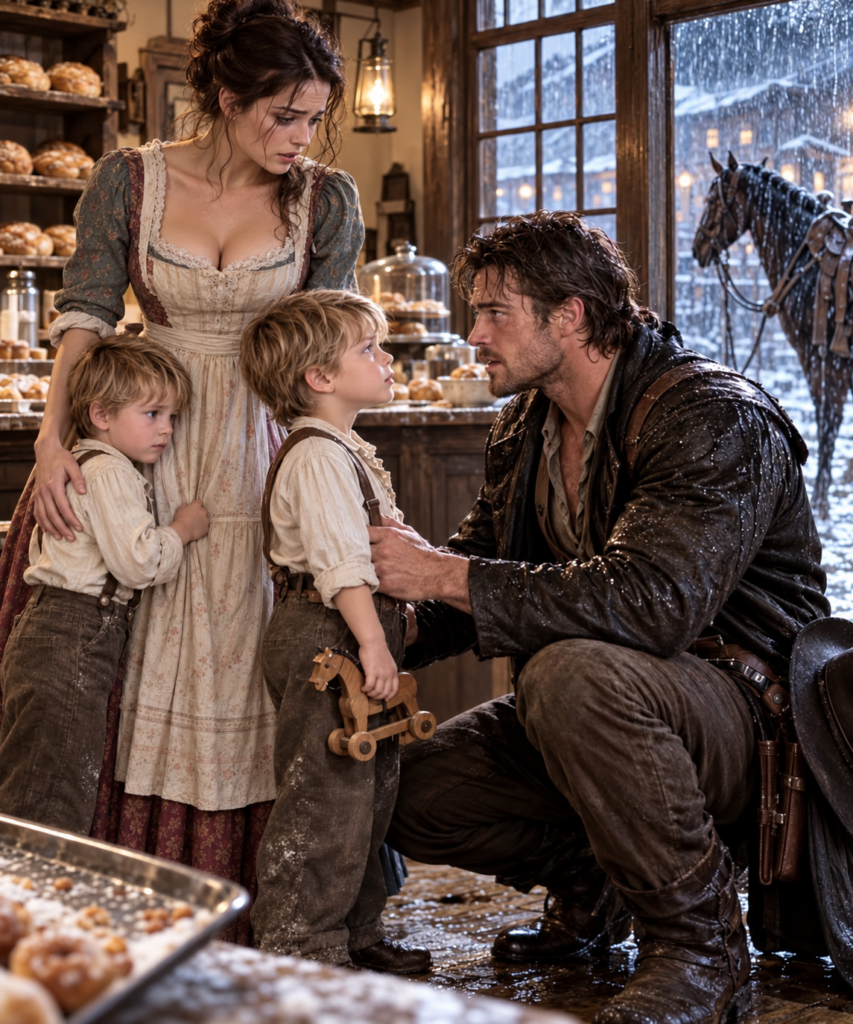
Then, in October of 1894, a storm drove him into a bakery eighty miles from home.
And there she was.
Victoria waited until Theo and Miles were asleep upstairs.
Caleb sat at a wooden table near the bakery oven.
A burnt loaf rested between them.
He noticed it immediately.
“You still burn bread when you’re frightened.”
Victoria stared at him.
“You remember that?”
“I remembered everything I was trying to forget.”
She looked down.
“That seems fair.”
“Don’t call it fair.”
“No.”
For several seconds only the rain spoke.
Then Victoria folded her hands.
“Your brother owed money.”
Caleb’s expression hardened.
“Daniel?”
She nodded.
Daniel Mercer had been eight years older than Caleb, charming, reckless and dead for nearly six years.
He had died in a riding accident near Tucson, leaving behind unpaid bills, arguments and apologies no one could collect.
Caleb had known about some gambling.
Not the amount.
“How much?”
“More than eight thousand dollars.”
Caleb stared.
Eight thousand dollars could ruin three modest farms.
“He didn’t own eight thousand dollars.”
“That was the problem.”
Victoria explained slowly.
Several weeks before the wedding, two men had approached her behind the general store. One was a collector named Harlan Pike.
The other was Silas Rourke.
Caleb knew the name.
Everyone around Prescott did.
Rourke bought distressed ranches, financed freight businesses and somehow emerged richer whenever another man encountered disaster.
“He told me Daniel had used your farm as security,” Victoria said.
“That’s impossible.”
“I know that now.”
Caleb’s eyes sharpened.
“What do you mean now?”
“At the time, I didn’t know.”
She swallowed.
“They showed me papers with Daniel’s signature. They said if you refused to sign over the north acreage, they would collect another way.”
Caleb went still.
“What other way?”
Victoria looked toward the ceiling, where their sons slept.
“Me.”
His chair scraped the floor as he stood.
“What did they do?”
“They never touched me.”
The answer did little to calm him.
“What did they say?”
Victoria’s voice lowered.
“They said stubborn men become reasonable when the people they love begin having accidents.”
Caleb’s jaw tightened.
“They threatened you.”
“They threatened what you loved.”
“Same thing.”
Victoria’s eyes filled.
“No, Caleb. That difference was exactly what frightened me.”
She told him that she had gone to Rourke privately, hoping she could persuade him to leave Caleb alone.
Instead, Rourke revealed how closely he had been watching the farm.
He knew Caleb had refused several purchase offers.
He knew about the freshwater spring under the north pasture.
He knew a new freight road was being discussed.
Daniel’s debt was not what interested him.
The land was.
“The debt was leverage,” Victoria said. “Not the prize.”
Caleb slowly sat again.
The north acreage bordered the only reliable spring for miles.
Years later, its value had indeed risen.
“You said you learned the papers were false.”
Victoria nodded.
“That morning.”
“The wedding morning?”
“Yes.”
She crossed to a cupboard and removed a small wooden box.
From inside she produced a folded piece of paper protected between two scraps of cloth.
The paper was yellowed and worn.
Caleb unfolded it.
Numbers.
Payments.
Names.
And Daniel Mercer’s.
Beside Daniel’s name were three words.
Signature reproduced twice.
Caleb’s blood chilled.
“What is this?”
“A page from Rourke’s ledger.”
“How did you get it?”
“His clerk gave it to me.”
Caleb looked up.
“Why?”
“Because he was afraid.”
The clerk had discovered that Rourke routinely forged collateral agreements after borrowers died. Daniel had owed money, but he had never pledged Caleb’s farm.
The clerk copied evidence, hoping to expose Rourke.
He approached Victoria because he knew she was about to marry Caleb.
The meeting was supposed to happen quietly on the morning of the wedding.
Instead, Pike followed him.
The clerk barely escaped.
Victoria did not.
“Harlan caught me before I reached the church road,” she said. “He knew I had the page.”
Caleb’s hand closed around the paper.
“What happened?”
“He told me if the page reached you, you’d fight them. If you fought them, Rourke would make sure you lost more than land.”
“Victoria—”
“Then I told him I was pregnant.”
Caleb froze.
She gave a sad, broken laugh.
“I thought it would make him show mercy.”
“It didn’t.”
“No.”
Pike had smiled.
A wife and child, he said, gave them twice as much leverage.
If Victoria married Caleb, the threats would become permanent.
If she disappeared with the evidence, however, Rourke would assume she had fled in panic and might stop watching Caleb so closely.
“So you ran.”
“I meant to disappear for a few weeks.”
Caleb stared at her.
“A few weeks became five years.”
“I know.”
“You could have come to me.”
“I thought you would confront them.”
“I would have.”
“Exactly.”
His anger flared.
“You don’t get to use the fact that I would have protected you as proof I couldn’t be trusted!”
“I know that now!”
Her voice broke for the first time.
She pressed a hand against her mouth, struggling to regain control.
When she spoke again, she was quieter.
“I was twenty-three years old, pregnant, terrified, and convinced the man I loved was one angry decision away from getting himself killed. I did what frightened people do, Caleb. I mistook control for courage.”
That silenced him.
Victoria continued.
“I boarded a westbound stage. I planned to go as far as Wickenburg. Then I heard two men asking about me at the next stop, so I kept traveling. Red Hollow was where my money ran out.”
“And after you were safe?”
She looked away.
“That is where my explanation stops being noble.”
Caleb waited.
“The first year, I was afraid.”
She rubbed her thumb against her palm.
“The boys were born early. Miles was sick for weeks. I had no money. Mrs. Alden, the woman who owned the boarding house, kept all three of us alive. I told myself I would write once the babies were stronger.”
She inhaled.
“The second year, I was ashamed.”
Caleb’s expression did not change.
“The third year?”
“More ashamed.”
“And the fourth?”
She met his eyes.
“Cowardly.”
The bluntness of it hurt more than excuses would have.
Victoria’s tears finally fell.
“I kept thinking there would be a perfect letter. One that could explain everything without making you hate me. Every month I waited made the letter harder to write. Every birthday made what I had taken from you bigger.”
Caleb looked toward the ceiling.
“And you never once thought I deserved the chance to hate you honestly?”
“I did.”
“But?”
“I was afraid I wouldn’t survive it.”
His laugh held no humor.
“So instead I had to survive believing you stopped loving me.”
Victoria closed her eyes.
“Yes.”
Rain beat against the windows.
Caleb stood and walked toward the back door.
Victoria did not stop him.
His hand rested on the latch.
“I understand why you ran that morning.”
She looked up.
“I don’t forgive everything that happened after.”
“I know.”
“I may never forgive all of it.”
“I know that too.”
He opened the door.
Cold rain smelled of wet earth and wood smoke.
Then behind him came the faint creak of the stairs.
Miles stood halfway down.
His hair was rumpled from sleep.
“Papa?”
The word was hesitant.
Almost an experiment.
Caleb’s entire body stiffened.
Miles rubbed one eye.
“Are you leaving?”
Caleb looked at Victoria.
Then at the boy.
Five years of anger demanded distance.
Five years of loss told him distance had already taken enough.
He slowly closed the door.
“Not tonight.”
Caleb took a room at Mrs. Alden’s boarding house.
He intended to stay three days.
Three became seven.
Seven became twelve.
Each morning he returned to the bakery.
At first, Victoria believed he came only for the children.
That was partly true.
Theo accepted Caleb almost immediately because Caleb owned a horse, knew how to repair toys and could whistle louder than anyone the boy had ever met.
Miles moved more carefully.
He would sit near Caleb without touching him, listening while Theo asked endless questions.
“Did you know about us?”
“No.”
“Would you have wanted us?”
Caleb’s answer came without hesitation.
“Yes.”
“Even two?”
“Especially two.”
Theo nodded, satisfied.
Miles watched Caleb’s face.
“Why didn’t you find us?”
The question cut deeper because there was no accusation in it.
“I tried to find your mama before I knew about you.”
“Did you stop trying?”
Caleb glanced toward Victoria.
“Yes.”
Miles’s expression fell.
So Caleb added, “Sometimes grown people stop looking because they think there is nothing left to find. That doesn’t mean they stopped caring.”
Miles considered this for a while.
“All right.”
That simple forgiveness nearly broke him.
Caleb taught them to fish.
Theo spent an entire morning frightening trout by talking.
Miles caught the only fish.
He carried it through the bakery afterward like a trophy until Victoria ordered Caleb to either clean it or return it to the creek.
Caleb tried baking.
The result was disastrous.
“You used salt instead of sugar,” Victoria said.
“The jars look the same.”
“One is labeled sugar.”
“I grow corn.”
“You also allegedly read.”
Theo laughed so hard he nearly fell off his stool.
For one dangerous moment, Victoria and Caleb laughed together like no years had passed at all.
The silence afterward reminded them that years had.
Not every day was easy.
One evening Caleb watched Victoria teach Theo to write his name.
She guided the boy’s hand patiently.
T.
H.
E.
O.
Caleb looked away.
Victoria noticed.
“What is it?”
He shook his head.
“Caleb.”
He set down his coffee.
“I missed his first word.”
Her face tightened.
“His first step.”
“I know.”
“Miles apparently hated carrots for two years. I didn’t know that.”
“I know.”
“Theo broke his arm last spring.”
Victoria went pale.
“Mrs. Alden told you.”
“Yes.”
He rubbed both hands over his face.
“I keep learning things a father should already know.”
Victoria sat across from him.
“I can’t give those years back.”
“That’s the problem.”
“I know.”
“I understand why you left. I swear I do. But understanding and forgiving seem to be traveling at different speeds.”
Victoria’s eyes glistened.
“I only hope they’re traveling in the same direction.”
After a long silence, Caleb said, “So do I.”
Three weeks after Caleb arrived, Miles fell asleep in his lap.
The boy had spent the afternoon learning to ride Mrs. Alden’s ancient mare and had exhausted himself asking whether every cactus was dangerous.
Caleb sat on the boarding house porch, holding him.
Theo played in the dust with wooden soldiers.
Victoria stood nearby.
Miles shifted against Caleb’s chest.
“Thank you, Papa.”
Caleb stopped breathing.
Victoria covered her mouth.
Miles was already asleep.
Caleb looked down at the small face resting against him.
His face.
Victoria’s mouth.
A child he had missed for nearly five years.
He whispered, “You’re welcome, son.”
That night he did not sleep.
Not because of anger.
Because for the first time, he understood how dangerous hope could be.
The trouble came the next afternoon.
A traveling salesman entered the bakery, bought two rolls and stared at Caleb for an uncomfortable length of time.
“Mercer?”
Caleb turned.
“Do I know you?”
“Prescott, isn’t it? I sold harnesses near there years ago.”
Caleb vaguely remembered him.
The man laughed.
“Small world.”
He left after ten minutes.
Victoria stood perfectly still behind the counter.
“What?”
“Nothing.”
But something in her face bothered Caleb.
Four days later, Mrs. Alden hurried into the bakery without removing her shawl.
“Two men are at Foster’s general store asking questions.”
Victoria dropped a cup.
Caleb rose.
“What kind of questions?”
“About a woman who came here five years ago with twins.”
Victoria went white.
“No.”
Mrs. Alden continued.
“One of them has a scar beside his left ear.”
Victoria’s knees nearly buckled.
“Harlan.”
Caleb caught her arm.
Her old fear returned instantly.
“We have to leave.”
“No.”
“They found us.”
“Yes.”
“I can have the boys packed in ten minutes.”
“No.”
Victoria stared at him.
“Caleb—”
He took her shoulders.
“You ran once.”
Her eyes filled with panic.
“And it kept you alive.”
“It also gave them five years of your life.”
“That wasn’t because of them.”
“Some of it was.”
Caleb lowered his voice.
“Victoria, listen to me. We have the ledger page. We have witnesses. We have a marshal in this town and a county judge three hours away.”
“They’ll hurt you.”
“They may try.”
“I won’t lose you because of this.”
“And I won’t lose my sons because fear makes decisions for us again.”
Theo and Miles stood in the kitchen doorway.
Both had heard enough to understand something was wrong.
Victoria looked at them.
Her breathing slowed.
Then something changed in her face.
For five years she had survived by fleeing.
She seemed to realize survival and living were no longer the same thing.
“I’m going with you.”
“No.”
“Yes.”
“Victoria—”
“I made the first decision alone. I won’t make the next one alone, and neither will you.”
He stared at her.
For the first time since finding her, Caleb saw the woman he had once planned to marry and the woman she had become standing in the same body.
“Fine.”
She nodded.
“Fine.”
Mrs. Alden folded her arms.
“And while you two practice being sensible adults five years late, I’ll keep the boys.”
Theo protested.
“I want to fight bad men.”
“You are going to fight a pie crust,” Mrs. Alden said. “And if the pie crust wins, we shall speak again about bad men.”
Marshal Owen Barrett listened to the entire story.
He was a broad-shouldered man in his fifties with the patient expression of someone who considered shouting proof that a person had run out of facts.
When Victoria finished, she placed the ledger page on his desk.
Barrett studied it.
“This is evidence.”
“Enough?”
“Enough to make certain men uncomfortable.”
Caleb leaned forward.
“Rourke forged claims against my land.”
“If this ledger page is authentic, he may have forged claims against several people.”
Victoria frowned.
“Several?”
Barrett opened a drawer.
From it, he removed a letter.
“A widow named Martha Bell came through town last year. Lost her ranch after her husband died. Claimed the lender produced a collateral agreement she had never seen.”
Caleb and Victoria exchanged a look.
“Silas Rourke?” Caleb asked.
Barrett nodded.
Victoria stared at the ledger.
“So it was never just Daniel.”
“No,” Barrett said. “Your brother’s debt may have made the Mercer property convenient, but men like Rourke rarely invent a method for only one victim.”
Caleb felt sick.
For years, he had thought Victoria vanished because of his brother’s mistakes.
The truth was worse.
Daniel’s weakness had merely opened a door.
Rourke had built a business out of grief.
Barrett sent a telegram to the county sheriff.
Then he did something Caleb did not expect.
He told them to go home.
“Home?” Victoria repeated.
“Your bakery.”
“They’re looking for me.”
“Exactly.”
Caleb understood first.
“You want them to come.”
“I would much rather arrest a man making threats in front of witnesses than chase him across half the territory afterward.”
Victoria’s face tightened.
Caleb reached for her hand.
She looked down.
Their fingers were touching.
Neither of them pulled away.
Harlan Pike entered the bakery shortly after nine the next morning.
He was older than Victoria remembered.
That almost made him worse.
Evil had been simpler when she imagined it frozen in time.
Now there was gray in his beard.
A scar beside his ear.
A wedding ring on his finger.
He looked like someone’s father.
Someone’s husband.
A man who might sit beside another family at church.
He smiled.
“Victoria.”
She stood behind the counter.
Caleb was beside the kitchen door.
Marshal Barrett waited out of sight in the storeroom with a deputy.
The twins were safely with Mrs. Alden.
Victoria kept both hands on the counter so Pike would not see them tremble.
“You found me.”
“You made yourself easier to find.”
His gaze shifted to Caleb.
“Mercer.”
“Harlan.”
Pike removed his hat.
“I’d hoped five years would make everyone reasonable.”
Caleb’s voice was cold.
“They did.”
Pike smiled.
“Good.”
“They made me reasonable enough to understand my brother never pledged my land.”
The smile weakened.
Victoria placed the ledger page on the counter.
Pike’s face changed.
Only for a second.
But she saw it.
“You remember this?”
He stared at her.
“You stupid woman.”
Five years earlier, those words would have turned her blood cold.
Now something unexpected happened.
She became angry.
Not frightened.
Angry.
“You stole five years from my children.”
Pike laughed.
“You ran.”
“Yes.”
The answer stopped him.
Victoria stepped around the counter.
“I ran. I chose silence. I made mistakes after I was safe that belong to me, and I will carry them. But you put the fear in my hands and told me it was protection.”
Pike’s expression hardened.
“You think a scrap of paper changes anything?”
The storeroom door opened.
Marshal Barrett stepped out.
“It changes enough.”
Pike froze.
The deputy appeared beside him.
Barrett picked up the ledger page.
“I have another complaint involving similar documents.”
Pike took one backward step.
“You have no authority—”
“I have plenty of authority to question you about intimidation, fraud and conspiracy.”
Pike looked toward the front door.
Caleb moved between him and it.
Not threateningly.
Simply there.
For the first time, Victoria realized something important.
Five years earlier, she had believed protecting Caleb meant preventing him from standing beside her.
Now he was standing beside her without violence, without foolishness, without becoming the reckless man her fear had invented.
Pike looked at Victoria.
“You should have kept running.”
She met his eyes.
“No.”
Her voice did not shake.
“You should have learned I would eventually stop.”
The investigation lasted months.
Silas Rourke fled before officers reached his office.
He was arrested in New Mexico Territory three weeks later.
The ledger taken from his safe contained dozens of falsified agreements.
Some victims recovered land.
Others could not undo what had already been lost.
Daniel Mercer’s legitimate gambling debt turned out to have been less than one-third the amount Rourke claimed.
Caleb paid the lawful portion from his savings.
Not because he was responsible for his brother.
Because he wanted the dead to stop owning space in the living.
When the danger had passed, Caleb remained in Red Hollow.
At first for the investigation.
Then for the boys.
Eventually, he admitted the truth.
Victoria was part of the reason.
One evening they sat on the bakery’s back steps while Theo and Miles slept upstairs.
The desert air had cooled.
Victoria handed Caleb coffee.
“If there were no boys,” she asked, “would you still be here?”
He looked at her.
She had been afraid to ask for weeks.
Maybe years.
“The boys gave me a reason to stay long enough to know who you are now.”
Victoria nodded faintly.
“But?”
“But you are the reason I don’t want to leave.”
She looked away quickly.
“Caleb—”
“That isn’t forgiveness for free.”
“I know.”
“It doesn’t erase anything.”
“I don’t want it to.”
“And I’m not asking you to become the girl you were five years ago.”
“Good.”
He smiled slightly.
“I don’t think I’d like her as much anymore.”
Victoria laughed through sudden tears.
“That is an awful thing to say.”
“She made terrible decisions.”
“So did the man who spent five years living like happiness had personally insulted him.”
“Fair.”
She became serious.
“I loved you then.”
“I know.”
“I love you now.”
Caleb looked toward the dark road.
“I believe you.”
The words mattered more than I forgive you would have.
Because belief was where everything between them had first broken.
They returned to Caleb’s farm the following month.
Victoria did not sell the bakery.
That had been Caleb’s idea.
“You built it,” he told her. “Marriage shouldn’t require you to burn down the part of your life that kept you standing.”
Mrs. Alden agreed to manage it while Victoria traveled back twice a month.
Theo and Miles spent the wagon journey to the farm asking questions.
“Do we have cows?”
“Yes.”
“How many?”
“Twenty-seven.”
“Do they have names?”
“No.”
Theo looked horrified.
“We should name them.”
“You may reconsider after the first twenty.”
Miles leaned over the wagon rail.
“Is our room big?”
Caleb’s smile faded.
“Come see.”
The farmhouse had changed little.
Victoria stopped when she entered.
Her hand touched the doorframe.
“I dreamed about this room.”
Caleb did not ask how many times.
He led the boys upstairs.
At the end of the hall stood a door he had kept closed for five years.
Caleb opened it.
Inside was an unfinished cradle.
Dust coated the wood.
One side had never been sanded.
Victoria stood motionless.
“You made that?”
“Started it.”
“When?”
“The month before the wedding.”
Her eyes filled.
“You knew?”
“No.”
He smiled sadly.
“I was optimistic.”
She crossed the room and touched the unfinished rail.
“Why didn’t you finish it?”
“Because finishing it felt like admitting someone was supposed to sleep in it.”
Theo inspected the cradle.
“We can’t both fit.”
“No,” Caleb said.
Miles nodded seriously.
“We need beds.”
Caleb looked at his sons.
“Yes.”
The following morning, he carried the cradle into the barn.
He did not burn it.
He did not throw it away.
He dismantled it.
Together, Caleb, Theo and Miles used the wood to begin two bedframes.
The boys sanded badly.
Theo hammered three nails crooked.
Miles spent twenty minutes carving an M where no M was necessary.
Caleb corrected almost nothing.
Victoria watched from the barn doorway.
At sunset the beds were uneven, imperfect and sturdy.
Exactly like the family that had built them.
“We made these,” Theo announced.
“You did.”
“With Papa.”
Victoria looked at Caleb.
“With Papa,” she agreed.
Caleb did not propose immediately.
That mattered to Victoria.
Five years earlier, marriage had felt like a destination.
Now they understood it was only a promise about how two people intended to travel.
They argued.
Sometimes bitterly.
Caleb struggled when Victoria made plans without discussing them.
Victoria struggled whenever Caleb rode into town without saying when he would return.
Old wounds disguised themselves as ordinary irritation.
One afternoon she snapped, “You do not need to know where I am every second.”
Caleb went silent.
She regretted the words immediately.
“That isn’t what I meant.”
“I know.”
“No, you don’t.”
He turned away.
Victoria caught his hand.
“I’m sorry.”
Caleb looked at her.
“I don’t want to become a man who watches doors because he’s afraid someone won’t come back.”
“You aren’t.”
“I could be.”
Victoria stepped closer.
“Then tell me when you feel that fear.”
“And you?”
“I’ll tell you when your questions make me feel trapped.”
He nodded.
“No disappearing.”
“No deciding alone and calling it protection.”
“Agreed.”
That became the rule of their house.
Not never be afraid.
Not never make mistakes.
Tell the truth before fear begins writing the story for you.
They married in the spring.
The ceremony was held beneath the old oak behind the farmhouse.
There were fewer than thirty guests.
Mrs. Alden cried through most of it while denying she was crying at all.
Theo carried the rings and nearly lost them while chasing a grasshopper.
Miles stood beside Caleb.
Victoria wore no veil.
When she reached him, Caleb noticed she was trembling.
“Thinking of running?” he whispered.
She stared at him.
Then laughed.
Several guests turned.
“Absolutely not.”
“Good.”
“I’m thinking the last time I wore this ring, we were younger and much stupider.”
“That is less romantic.”
“It’s more accurate.”
He took her hands.
When the minister asked Victoria whether she chose Caleb Mercer, she did not answer immediately.
Everyone waited.
Victoria looked at the farmhouse.
At the twins.
At Mrs. Alden.
Then at Caleb.
Five years earlier, fear had convinced her love meant choosing for someone else.
This time, she chose beside him.
“Yes,” she said. “With the truth this time. Even when it’s difficult.”
Caleb’s eyes stung.
“With the truth,” he repeated.
Years later, Theo and Miles would tell the story differently.
Theo preferred adventure.
He described his mother escaping wicked land thieves with secret documents and his father riding through a storm to discover his missing family.
Miles told it more quietly.
“Mama was brave,” he once told a school friend.
Theo nodded.
“She escaped.”
Miles shook his head.
“That’s not the bravest part.”
Their father, repairing a porch rail nearby, paused to listen.
Miles continued.
“The bravest part was when she stopped escaping.”
Theo considered this.
Then pointed toward Caleb.
“Papa was brave too.”
“How?”
“He stayed when he was angry.”
Caleb looked down at the rail because suddenly his vision had blurred.
Children made morality sound simple.
Adults spent years making it difficult.
Victoria’s bakery prospered.
By the twins’ tenth birthday, she owned the building.
By twelve, both boys worked Saturday mornings there.
Theo talked to customers instead of working.
Miles became unexpectedly talented with pastry.
Caleb remained hopeless at baking.
Some things did not require redemption.
On quiet evenings, Caleb and Victoria sat on the porch while the sun disappeared behind the Arizona hills.
Sometimes Caleb still watched the road.
It had become habit.
One evening Victoria caught him.
“Waiting for someone?”
He looked toward the gate.
Five years of his life had once been spent wondering whether someone he loved might appear there.
Now Theo and Miles were arguing beside the barn.
Victoria sat beside him.
The farmhouse windows glowed warm behind them.
Caleb reached for her hand.
“No.”
“Then what are you looking at?”
He thought about the man he had been.
The woman she had been.
The years neither could recover.
Forgiveness, he had learned, was not pretending the wound had never happened.
It was refusing to let the wound decide what happened next.
“I’m just grateful,” he said.
“For what?”
“That nobody I love is out there anymore waiting to be found.”
Victoria rested her head against his shoulder.
The road remained empty.
For once, that emptiness felt like peace.
And in the house behind them stood two handmade beds built from the wood of an unfinished cradle—a thing once abandoned halfway through, not because it had no future, but because the people meant to finish it had not yet found their way home.
THE END

