
“`text
Chapter 1
The monitor stopped screaming. Now it held one flat, endless note.
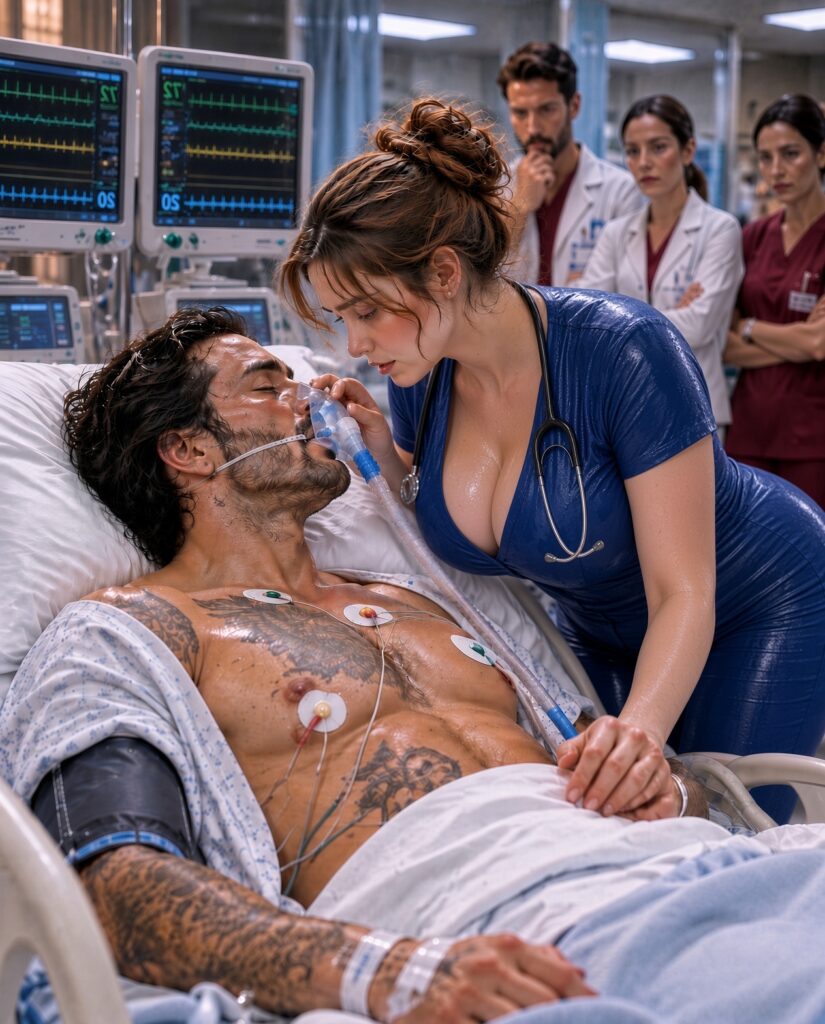
Rafael Moretti, the man who had survived car bombs, federal indictments, and a dozen bullets meant for his heart, lay motionless against the white sheets, his lips the color of wet ash. Vito, his brutal underboss, had dropped to his knees, whispering prayers to a God he hadn’t spoken to in twenty years.
The famous doctors were gone. The antidotes were useless.
And in the corner, twenty-six-year-old Marianne Hale, the night nurse no one in this room had ever truly looked at, stood trembling with a bitter, burning paste on her own tongue.
No one else had noticed the strange thing yet: Rafael’s fingernails weren’t blue. They were purple, almost black.
Only she had seen it. Only she knew what it meant.
And only she understood that the one way to save him was a kiss the whole world would punish her for, because someone close to him had already made sure he would never wake up.
The most feared man in New York was dying, and the machines were the only ones still speaking for him.
The unlisted fourteenth floor of Lenox Hill Hospital had become a fortress. Men in bespoke Italian suits lined the sterile corridors, their eyes sliding over every doctor, every nurse, every shadow. Nobody breathed here without permission.
At the center of it all lay Rafael Moretti, thirty-four years old, head of the Moretti family. He had survived car bombs, federal indictments, and a dozen attempts on his life. But what was killing him now couldn’t be shot, bribed, or threatened. Three days ago, during a sit-down in Little Italy, someone had slipped a synthesized, untraceable neurotoxin into his espresso.
Now his tattooed chest rose and fell only because a ventilator told it to. His warm olive skin had turned the color of wet ash.
“His organs are shutting down in sequence,” said Dr. Julian Whitfield, the toxicologist flown in from Stanford on a private jet. He rubbed his temples. His voice was tight with frustration and something worse: fear. “Liver function is gone. Kidneys are failing. We’ve tried chelating agents, charcoal, every antidote we have. Nothing binds to it. It’s a complete cellular lockout.”
Across the bed, Dr. Edmund Aldridge, Manhattan’s most elite neurologist, stabbed at his tablet, hunting for a miracle in databases that didn’t contain one.
Vito stood between them like a wall about to fall. Rafael’s underboss was a hulking, scarred man, and his fist was white-knuckled around the Beretta in his coat pocket.
“Then try something else,” he rasped, a gravelly whisper that made two millionaire doctors flinch. “You don’t get to give up. He dies, and this hospital is going to need a lot of body bags.”
Nobody looked at the woman in the corner.
Nobody ever did.
Marianne Hale was twenty-six, a night-shift floor nurse, and for as long as she could remember, she had been invisible. She carried over 240 pounds on a five-foot-four frame, and the world had made sure she knew exactly where that put her. She was the funny friend. The good listener. The woman who held a clipboard against her soft stomach like armor, whose thighs chafed in oversized scrubs, whose warm brown eyes were always the first to look away.
She had made peace with being a ghost. Ghosts had advantages. People didn’t watch ghosts. People didn’t hide things from ghosts.
So for three nights, while the specialists shouted and the soldiers threatened, Marianne had tended to Rafael the man, not Rafael the medical anomaly. She bathed his feverish skin. She rubbed unscented lotion into his large, calloused hands so the dry hospital air wouldn’t crack them. She learned that his jaw twitched just before his blood pressure fell. And in the dead of night, she talked to him softly about her favorite books and her small, lonely apartment in Bay Ridge, because somebody should.
Even dying, he was devastating: a sharp jaw, high cheekbones, dark hair curling at the ends, a jagged scar splitting his left eyebrow. The whole city called him a monster. But in the dark, he only looked like a man who was terribly, agonizingly cold.
“Bradycardia is worsening,” Dr. Aldridge said as the monitor sank to twenty-eight beats per minute. “The toxin is severing the electrical pathways in the myocardium. I’m sorry, Vito. We have perhaps an hour. Call his family. Gather the captains. It’s over.”
Vito made a sound Marianne had never heard a man make, half sob, half howl. He spun and drove his fist into the oak door, and the wood splintered.
The doctors took it as their cue. Briefcases snapped shut. Expensive shoes hurried across the floor. Within seconds, the two finest minds in medicine were gone, leaving a weeping killer, a dying king, and a nurse no one had bothered to dismiss.
Marianne stepped toward the bed. Her heart hammered against her ribs.
She looked at the IV bags dripping clear fluid. At the EKG. Then at his hands.
His fingernails weren’t blue. Blue would have meant starved of oxygen. These were a deep, vivid purple, almost black at the cuticles.
Something stirred in her memory: a lonely Friday night shift, months ago, an obscure medical journal. Synthetic derivatives of aconite. Modified monkshood, favored by Eastern European assassins.
Her breath stopped.
The doctors had been treating a paralytic neurotoxin with calcium channel blockers and standard epinephrine. But if this was aconite, the epinephrine wasn’t merely failing. It was feeding the poison.
The treatment was killing him.
“Vito.” Her voice cracked. It was the first time in three days she had spoken above a whisper.
He turned, eyes red and murderous. “Get out, nurse. He doesn’t need his pillows fluffed.”
“The doctors are wrong.” Her hands twisted in the fabric of her scrubs. “Look at his nail beds. Look at his jaw. It’s aconitine, a modified version. What they’re pumping into him is binding with the poison. It’s a fatal feedback loop. We have to stop the IVs.”
Vito stared at her as though she had lost her mind. “The best doctors in the country just walked out that door, sweetheart. You think you know something they don’t?”
She didn’t answer. She reached up with hands that had suddenly stopped shaking and shut off the valves.
“Hey! What the hell are you doing?” Vito lunged toward her.
“He needs atropine. A massive dose, and a violent shock to the parasympathetic system to break the vagal blockade.” She dragged the crash cart to the bed, fingers flying. A vial of atropine. A blister pack of fast-acting sublingual vasodilator from the cardiac kit. She crushed the pills, added drops of liquid, and stirred until she held a bitter paste. “It has to go under his tongue. It’s the only membrane fast enough.”
She pressed her thumbs to his chin and pulled.
Nothing. His jaw was locked. The toxin had turned his facial muscles to tetany, solid as steel.
“Open his mouth!” Vito’s scarred hands clamped over hers, and together they strained.
Useless.
The monitor shrieked.
Twenty beats per minute.
Fifteen.
“He’s flatlining!” Vito’s mafia mask cracked into raw panic. “Do something!”
Marianne’s chest heaved. The paste was drying on her fingertip. An injection would take too long, because his body was already shutting down. It had to be absorbed through the mouth. And his mouth would not open.
There was one way left.
She thought of the armed men outside the door. Of what they would do to a nobody nurse who put her hands on their king. Of what he might do himself, if he ever woke.
“God, please forgive me,” she whispered.
She tore off her latex glove and scooped the paste onto her own tongue.
It tasted like battery acid and crushed aspirin. It burned.
“What are you doing?” Vito shouted.
Marianne didn’t answer. She leaned down over Rafael Moretti’s ashen face, tears already sliding down her cheeks.
And for the first time in twenty-six years, she stopped being a ghost.
Chapter 2
Five seconds. Nothing.
Then Marianne felt it: a violent, electric twitch beneath her palms.
Rafael’s jaw slackened. His chest convulsed, arching off the mattress, and he dragged in a breath like a drowning man breaking through frozen ice. The flatline shattered into jagged peaks. Forty. Sixty. Ninety.
Vito collapsed to his knees, laughing and sobbing at once.
Marianne stumbled backward until the wall stopped her, her lips burning, her arms wrapped tight around her waist.
Rafael’s eyes snapped open. Icy blue. Feral. Terrifyingly lucid.
But he didn’t look at her first.
His gaze went to the doorway, where men in Italian suits had begun crowding in, their faces flooding with relief. It moved slowly from one man to the next, cold and measuring, the way a predator counts a herd. On one face, it lingered a heartbeat too long.
Marianne saw it. No one else did.
Only then did those eyes find hers, and something unreadable darkened in them, something that made her heart stumble.
“Who handed me the cup?” he rasped.
Nobody in the room understood the question. Marianne didn’t either.
But she understood the look on his face. It was not the look of a man who had been saved. It was the look of a man who had just remembered who wanted him dead.
And who, in that crowded doorway, had been hoping he would never wake up?
Chapter 3
The question hung in the room like smoke. Vito lifted his ruined face from his hands. “The cup, boss?”
“The espresso.” Rafael’s voice was gravel dragged over glass. He swallowed and winced, as though even that cost him. “Somebody put it in my hand. I remember the saucer. I remember laughing at something. Then nothing.”
No one answered. In the doorway, the men in Italian suits traded glances that slid away the moment they met. Marianne pressed her spine harder into the wall and watched, because watching was the one thing she had always been good at.
She saw exactly where Rafael’s gaze had stopped.
Carmine Ricci stood at the front of the crowd, immaculate in charcoal wool, one hand flat against his heart. He was smiling. His eyes were wet. He looked like a man witnessing a miracle.
But relief, Marianne knew, had a rhythm. Every other man in that doorway had gone slack the instant the monitor climbed. Carmine’s relief had arrived late, half a beat behind the others, like an actor waiting for his cue.
Then the smile bloomed, and he crossed the room in four strides and gripped Rafael’s face in both hands.
“Fratello,” he breathed. “Dio mio. You took ten years off my life.”
“Only ten?” Rafael managed. The corner of his mouth lifted. He caught Carmine’s forearm, and the hard glitter in his eyes softened. They had shared a stoop, a schoolyard, and a lifetime of secrets. Whatever question Rafael had been carrying, he set it down in the warmth of that embrace.
Marianne let out a breath she hadn’t known she was holding. She told herself she was a night nurse three days without sleep, and that a late smile was only a late smile. But being overlooked teaches a person things. People wear their true faces in the half second before they remember someone might be watching.
And no one, ever, remembered to watch her.
Then the oak door, hanging crooked on its splintered hinges, banged open.
Dr. Whitfield and Dr. Aldridge rushed in with half a dozen panicked hospital administrators at their heels. They had come to sign a death certificate. They stopped as if they had walked into glass.
Rafael sat upright against the pillows, bare-chested, dusted with dark hair and ink, breathing without a machine. The ash had drained from his skin. Color was flooding back like a tide.
Dr. Whitfield’s eyes darted to the shut-off IV lines, to the crushed blister pack on the floor. “What happened here?” he stammered. “This is medically impossible. The cellular lockout—”
“Shut your mouth.”
Rafael didn’t raise his voice. He didn’t have to. The hoarse baritone dropped into the room, and nobody breathed after it.
His gaze moved past the specialists to the corner. Marianne felt it settle on her like a hand and tried to fold herself into the wall. She crossed her arms over her stomach to hide how badly they shook.
“The girl,” Rafael said. “What did she do?”
Vito dragged a sleeve across his face, his voice thick with awe. “The doctors had it wrong, boss. The nurse knew. Aconitine. She cut the IVs, mixed some powder, and forced it under your tongue. She… she kissed you to make you take it.”
Dr. Aldridge’s face went a mottled red. “That is a grave breach of protocol,” he said, clipped and trembling. “Aconitine poisoning is vanishingly rare, and this woman administered unauthorized sublingual nitrates without a physician’s order. She could have caused irreversible hypotension. Ms. Hale, you are dismissed. I will have your license revoked by the State Board of Nursing before noon.”
Marianne’s stomach dropped through the floor. Four years of nursing school, every double shift, every night spent learning charts by flashlight, all of it erased in a single sentence. She didn’t argue. She had never learned how.
“Vito,” Rafael said.
It was only a name, but Vito moved like a struck match. The Beretta cleared his coat and settled between Dr. Aldridge’s eyes with a small, terrible click. The neurologist whimpered, and his knees buckled.
“You and your friend from Stanford have ten seconds,” Rafael said, his voice sinking to a lethal quiet. “Pack your bags and walk out of my hospital. If I ever see either of your faces in New York again, I won’t need a medical board to end your careers. I’ll end your lives.”
Nobody needed to count. The doctors stumbled backward, tangled in each other’s briefcases, and fled. The administrators scattered like frightened mice.
The door swung slowly shut behind them. Then there was only the hush, the steady green heartbeat of the monitor, and rain beginning to tick against the tall windows.
Vito lowered the gun. Carmine murmured something soothing about water and rest. Rafael didn’t hear him. He was looking past them both, and for the first time since he’d woken, the predator in his eyes had gone quiet.
Marianne had been dismissed, threatened, and saved within the span of a single minute. She had spent her entire life praying not to be noticed. She had never imagined how terrifying it would be to finally be seen.
Chapter 4
“Come here.”
It wasn’t a shout. It was worse: soft, certain, the voice of a man who had never once been refused.
Marianne’s clogs carried her three steps forward before her mind caught up. She stopped a few feet from the bed and stared at her scuffed white shoes, acutely aware of every inch of herself: the way her thighs brushed together beneath the scrubs, the flush climbing her throat, the plain truth that she was not the kind of woman men like Rafael Moretti looked at twice. Women like that were tall and sleek and glittering. They belonged in his world. She belonged in a cramped Bay Ridge apartment with a cat and a stack of library books.
“I’m sorry,” she whispered. “I know I overstepped. I’ll clear out my locker.”
“Look at me.”
It wasn’t a request. Slowly, she lifted her head.
Up close, the blue of his eyes was almost unbearable, pale as winter sky over water. The scar splitting his eyebrow made him look dangerous. But the gaze beneath it was startlingly gentle.
“What’s your name?”
“Marianne. Marianne Hale.”
“Marianne.” He said it slowly, as if tasting it. “You didn’t overstep. The most expensive men in medicine left me to rot, and you broke every rule they wrote to keep me breathing. Why?”
“Because you were cold.” The words escaped before she could catch them, and heat flooded her cheeks.
“And?”
“And nobody deserves to die in a room full of people who only see them as a problem to be solved.” Her voice wobbled, then steadied. “You’re a person.”
The silence that followed was so deep she could hear the rain. Rafael stared at her, genuinely stunned. His whole life, people had looked at him and seen a weapon, a shield, or a target. No one had ever looked at him and seen a man who could be cold. He studied the flush in her full cheeks, the soft slope of her shoulders beneath shapeless scrubs, the complete absence of pretense in her warm brown eyes, and something behind his ribs, something that had nothing to do with the toxin, shifted.
“Vito,” he said, without looking away. “Get the cars ready. We’re leaving.”
“Boss, you just woke up. You need rest, and—”
“I’m not recovering in a building full of people who tried to bury me.” Rafael threw off the thin hospital blanket, revealing a torso mapped in old bullet holes and knife scars, terrifyingly powerful even now. “We go to the Tribeca penthouse. And have someone pack a bag for Ms. Hale.”
Marianne’s head jerked up. “What? No. I can’t. I have shifts. I have a cat.”
“Then your cat is coming with us.”
He stood. The room tilted, and his knuckles whitened on the bed rail. Marianne moved before she could think, the nurse overriding the woman, one hand under his elbow, the other flat against his sternum, where a heartbeat now pounded strong and steady. “Sit down. You’re not—”
“I’m fine.” But he didn’t pull away. He leaned, just slightly, into her steadying palm, and neither of them mentioned it.
Vito and Carmine were already at the door, murmuring into phones, summoning cars and guards. In the small pocket of privacy they left behind, Rafael stepped closer. He towered over her. He lifted one large, warm hand and cupped her jaw, his thumb brushing the soft flesh of her cheek. Her breath stopped. No one had ever touched her face like that, as though it might break, or as though it were worth protecting.
“Someone in my inner circle poisoned me, Marianne,” he murmured, so low the words were meant for her alone. “Someone switched my espresso at the sit-down. I can’t trust my men. I can’t trust my doctors. The only person in this city I know for a fact wants me alive is you.”
Her pulse thundered against his thumb.
“You are my private nurse now,” he said. “And I protect what is mine.”
She should have argued. She had a dozen reasons ready: her license, her shifts, her rent, the tiny life she had built from careful, quiet choices. Instead she heard herself whisper, “Okay.”
Ten minutes later she stood in the private elevator wrapped in Rafael’s black wool coat, which smelled of cedar and gun oil. Her worn tote bag hung from her fingers, and a paper sack holding the contents of her locker was clutched to her chest. The soldiers lining the corridor stared at her and kept staring, unable to decide what she was.
Carmine held the elevator door with one hand and gave her the kindest smile in the world. “Take good care of him, sweetheart. He’s the only brother I’ve got.”
She nodded, her throat tight, and the doors slid closed.
In the polished brass wall she saw them side by side: a ghost in scrubs and a king in a borrowed shirt. Rafael’s shoulder was barely an inch from hers. He didn’t look at her. He spoke to the glowing floor numbers, in a voice that dropped through her like ice water.
“Whoever did this is somewhere in this building right now,” he said quietly. “And he just watched me choose you.”
Chapter 5
The elevator opened directly into the penthouse, and Marianne forgot how to breathe.
Glass walls rose from floor to ceiling, and beyond them Manhattan glittered like spilled jewelry under the rain. Steel beams, dark mahogany, a sweep of white marble underfoot. The place was as vast and silent as a cathedral, and it smelled of cold money. She stood on the threshold in her scuffed clogs, sure the floor would reject her.
“Guards on every door,” Rafael told Vito, already walking, one hand trailing the wall for balance. “Nobody comes up without my say.”
An hour later, the elevator chimed again. Vito emerged carrying a pet carrier at arm’s length, his scarred face a study in wounded dignity. From inside came a long, furious yowl.
“It bit me,” he said.
“She’s a rescue,” Marianne said, rushing to take the carrier. “She’s afraid of loud men.”
“I’m not loud.”
“You’re a little loud.”
From the sofa, Rafael made a sound that might, in a healthier man, have been a laugh. Juniper, a gray tabby with one crooked ear, slunk out of the carrier, surveyed the empire of glass, and walked directly to the most feared man in New York. She climbed into his lap, kneaded his thigh twice, and began to purr like a small engine.
Rafael froze. He looked at Marianne with something close to alarm.
“Don’t move,” she whispered. “It’s a compliment.”
Her suite was larger than her entire apartment in Bay Ridge. The next morning, a silver-haired tailor named Mrs. Bellini arrived with a measuring tape and a mouthful of pins. Marianne stood rigid in the middle of the bedroom, mortified, arms crossed over her stomach.
“Sweetheart,” Mrs. Bellini said, without looking up from her notebook, “cloth follows the woman. Never the other way. Now put your arms down and let me work.”
By the end of the week the closet held an emerald wrap dress, silk blouses the color of dusk, and trousers that skimmed her hips instead of strangling them. When Marianne finally faced the mirror, she didn’t recognize the woman looking back. She looked away first, out of habit. Then, slowly, she looked again.
Rafael’s recovery was aggressive and fueled by pure stubbornness. His muscles trembled with lingering tremors. His hands shook when he lifted a glass. Marianne checked his pressure at dawn, monitored his pulse at noon, measured every meal, and fought him for every hour of sleep.
“I have a meeting at three,” he announced on the fourth day.
“You have a nap at three.”
“Marianne.”
“You can be the most feared man in New York from six in the morning until ten at night,” she said, folding her arms, her voice shaking only slightly. “Between ten and six, you’re my patient. I don’t take orders from the patient.”
Vito, standing in the doorway, stared as though she had just walked into a lion’s cage and snapped its leash. Rafael studied her for a long moment. Then he lay back down.
It was nearly three in the morning that same week when she found him at the window, barefoot, his forehead against the glass, one hand clenched against a tremor. She wrapped a blanket around his shoulders. He didn’t flinch.
“Can’t sleep?”
“I haven’t slept properly since I was nine.” He watched the rain drawing lines down the city. “My father died on a Tuesday. The heat was off in our building that winter. I remember the cold more than the funeral.” A muscle jumped in his jaw. “Carmine’s mother started feeding me that week. Sat me at her table like I’d always been there. I’ve been trying to get warm ever since.”
Marianne said nothing. She only stood beside him, close enough to share the blanket, and let the silence be a gift.
In the morning he pushed the business ledgers across the breakfast table. “Tell me what you see.”
She hesitated. Then she began to read. Numbers had always spoken to her more clearly than people did. Twenty minutes later she tapped a line, frowning.
“The Red Hook berth is leased at a tenth of what every other pier pays. It’s been that way for two years. That’s not a mistake. That’s a favor.”
The room changed. Rafael went perfectly still, his coffee halfway to his mouth.
“Who approved that rate?” she asked softly.
He set the cup down. For a long time he said nothing, and the only sound was the rain.
“I did,” he finally said. “On a recommendation.”
“Whose?”
He didn’t answer. He closed the ledger, and the look on his face told her he already knew exactly whose name was written beneath that number, and he wished, more than anything, that he didn’t.
Chapter 6
By the second week, the penthouse had learned the rhythms of two people.
Dawn belonged to the blood pressure cuff and the stubborn, half-joking arguments over oatmeal. Afternoons belonged to the ledgers, Rafael’s expression sharpening whenever she found something no accountant had. And when dusk bled purple across the skyline, they belonged to the velvet sofa.
Marianne read aloud. She had begun with a battered paperback of Persuasion, and Rafael had listened with the wary attention of a man being handed a foreign language. Now he asked for it every night, his head tipped back against the cushions, his eyes half closed. Juniper had claimed the space between them and guarded it like a queen.
She read about second chances and letters written in secret. She read until her voice went soft, and when she glanced up, Rafael wasn’t listening to the words anymore. He was watching her. His eyes traced the line of her neck, the fullness of her figure in the emerald dress, and there was a dark, heavy hunger in them, one he didn’t bother to hide.
Her pulse raced. She looked down at the page. “You’re staring.”
“Yes.”
“Why?”
“Because you make it look like the book is the one being read.” He said it so simply that she forgot the next line entirely.
Later, when the fire had burned low, he asked a question no one had ever thought to ask. “Why nursing?”
She turned the paperback in her hands. “My grandmother died in a hospital hallway when I was eleven. They’d run out of rooms. She lay on a gurney under a flickering light for six hours, and no one sat with her. I was the only one who held her hand.” Her throat tightened. “I decided nobody would die unseen if I could help it.”
Rafael was silent for a long moment. Then he reached across Juniper and closed his large, warm hand around hers. He didn’t say he was sorry. He didn’t say anything at all. It was, she realized, the first time anyone had listened to the whole story without rushing to fix it.
He didn’t let go until the clock struck midnight.
The next evening he demanded her opinion on a shipping contract, then a second, then a third. “You see what my men don’t,” he said. “They see the risk. You see the person.” He kept doing it, kept asking her, kept waiting for her answers, until the woman who had spent twenty-six years hiding behind clipboards started speaking in full sentences without apologizing first.
On Friday she wore the emerald dress to dinner. Rafael stopped mid-sentence, his fork suspended over his plate.
“Stay,” he said, when she moved to clear the table. “Sit. Please.”
He’d never said please to anyone in her hearing. She sat.
On Saturday, Carmine came.
He arrived with a white bakery box tied in red string and a grin that could have sold sunlight. “Cannoli from Mulberry Street,” he announced, kissing Marianne’s hand with theatrical gallantry. “Look at you, glowing. Rafael, you’ve been hoarding the prettiest nurse in Manhattan.”
She laughed despite herself. He was easy to like, that was the trouble. He asked about Juniper. He remembered that she liked lemon in her tea. He spoke about the family business openly, right in front of her, tossing out names and numbers as though she were part of the furniture, the way people always did around ghosts.
Rafael’s assistant brought espresso, and Carmine waved the tiny cup away. “Not since your little scare, brother. I can’t even smell it anymore.”
Marianne stirred her tea and said nothing. But she filed it away.
“I still can’t forgive myself,” Carmine said, sinking into an armchair. “I picked those doctors myself. The best money could buy. And they nearly let you die.” He shook his head, jaw tight with grief. “If I’d known…”
The words landed strangely in Marianne’s mind and stayed there. He had chosen the doctors. The best in the world, and they had all looked in the wrong direction. If someone wanted a poisoned man to die quietly, what better alibi than the finest specialists on earth, failing?
The thought was so cold that she nearly dropped her cup.
When Carmine finally stood to leave, he lingered in the doorway, his coat over his arm, his face gentle.
“Be careful with him, Marianne,” he said kindly. “Rafael gets attached to whoever saves him. And then he forgets they’re breakable.”
He smiled once more, tipped his head, and the elevator swallowed him.
She stood in the silence, the taste of lemon gone sour in her mouth, and she realized the sentence hadn’t sounded like a warning.
It had sounded like a promise.
Chapter 7
The city was coming apart at the seams, and Rafael’s men were the ones pulling.
In the third week, the Moretti family tore through New York looking for the traitor. Doors were kicked in in Bensonhurst. A bookie in Red Hook lost three teeth and gave up nothing. Two captains were quietly relieved of their duties, then watched by men who used to be their friends. And in Little Italy, the waiter who had carried the tray that terrible afternoon had vanished from his apartment, a pot of sauce still warm on the stove.
Suspicion had crept into the penthouse the way damp creeps into old walls. Nobody said it aloud. Every man who stepped off the elevator was searched, and every man knew why.
Vito sat across from Rafael in the living room one gray afternoon, hat in his scarred hands, reporting a string of dead ends. Marianne brought tea and set a cup in front of him without being asked. The big man stared at it, then at her.
“Ma’am,” he said gruffly. Then, lower, “Called you sweetheart, that first night. I was out of line. Don’t tell the boys I apologized.”
“Wouldn’t dream of it,” she said, and Vito’s ruined mouth twitched into something almost like a smile.
Then he drew a small black drive from his coat and set it on the table. “Tech guy got the footage back. Back camera at the café, the one that wasn’t on the books. Cleaned it up as best he could.”
Rafael didn’t touch it. He looked at the drive as if it were a live wire.
“Boss?”
“Not yet.” His voice was rough. “Leave it.”
When Vito had gone, Marianne knelt by Rafael’s chair and looked up into his face. “Why won’t you watch it?”
He was silent so long she thought he wouldn’t answer. “Because once I see it,” he finally said, “I can’t un-see it. And right now, there’s a version of tomorrow where the man I love is innocent.” His eyes met hers. “I’m not ready to lose that.”
She understood. It was, in its way, the same kindness she had spent her life extending to strangers, and it broke her heart.
That night, sleep wouldn’t come for either of them. She found him on the terrace, rain misting the air, the city lit like a field of burning stars. She stood beside him, and for a while neither spoke.
“You’re the only one who isn’t afraid of me,” he said at last.
“I was terrified of you.”
“You stood in front of my underboss and shut off my IVs.”
“That’s different.” She smiled a little. “That was math.”
He turned, and the light caught the scar on his brow. “You told me once, in the dark, when you thought I was too far gone to hear, that you were a ghost.”
Her breath caught. He had heard. All those nights of talking to a dying man, and he had heard her.
“You were never invisible, Marianne,” he said, his voice low. “People just weren’t looking hard enough.”
He lifted his hand and brushed a strand of wet hair from her cheek. The world narrowed to the width of a breath between them. Her heart hammered. His gaze dropped to her lips, and the memory of the bitter paste, of the kiss that had not been a kiss, hung between them like a bruise waiting to become something else.
Behind them, the terrace door creaked.
They stepped apart. Only Juniper was there, picking her way delicately across the wet stones, looking supremely unimpressed.
Tuesday came heavy with cloud, and the weather report promised a storm by nightfall.
“Tonight,” Rafael said quietly at breakfast, one hand resting on the black drive. “I’ll watch it tonight. Alone.”
Vito had been called away to Red Hook, chasing the waiter’s cousin down a lead that might finally mean something. Somebody had to take his post at the penthouse door.
“I’ll take it,” Carmine said, appearing in the foyer as if summoned, an easy smile on his face and his coat still dripping. “Somebody has to keep you both out of trouble.”
Rafael clasped his shoulder. “Thank you, brother.”
By dusk the sky had cracked open. Rain hammered the glass like thrown gravel. Rafael retreated to his office and shut the door, and the corridor went silent behind him.
Carmine caught Marianne’s eye across the living room. “Go make your tea, sweetheart,” he said warmly. “I’ve got the door.”
Nothing about the words was wrong. But Marianne felt something cold slide down her spine as she walked toward the kitchen, the way a rabbit feels the sky darken before it understands why.
Chapter 8
The kitchen was the one room in the penthouse that felt like it belonged to someone.
Marianne had made it hers without meaning to. Bundles of dried lemon balm hung above the marble island. A tin of chamomile sat beside a jar of crystallized ginger. Juniper had claimed the warm spot by the stove. Outside, the storm beat the tall windows in long, drumming waves, and the skyline had vanished behind sheets of gray.
She measured herbs into the pot the way she measured everything: carefully, without hurrying. The blend was meant to soothe the tremors that still crept through Rafael’s muscles at night. It smelled of green and honey.
Down the hall, behind a closed door, the man she was quietly falling in love with was about to learn something that would break him. She wanted to be ready when he came out. She wanted the tea hot.
The kettle began to sing. Then, behind her, the heavy oak doors clicked shut.
She turned toward the marble island and froze.
Carmine stood in the doorway. The warm, easy smile he wore like a tailored coat was gone. What replaced it was flat and empty, the calm of a man doing arithmetic. His right hand hung loose against his thigh, and in it, resting as casually as a set of keys, was a suppressed Glock 19.
“You’re a real problem, nurse,” he said, stepping into the room.
The kettle screamed on the stove. Neither of them moved to silence it.
In that horrifying instant, Marianne’s mind assembled the puzzle piece by piece. The half-second delay in his relief. The untouched espresso. The doctors he had personally chosen, the best in the world, all looking the wrong way. The Red Hook berth at a tenth of the rent. And the sit-down in Little Italy, where a friend’s hand had steadied a small white cup as it passed from one man to another.
“It was you,” she whispered.
“Took you long enough.” He sighed, almost fond, and lifted the gun a few inches. “I made a deal with the Russian Syndicate. Fifty million dollars and total control of the docks, if Rafael had a quiet medical death. No war. No mess. Just a tragic case of heart failure and a funeral the whole city would attend.” His mouth twisted. “It was clean. It was perfect. And then you had to play hero and shove atropine down his throat.”
Marianne backed away, the marble edge of the island meeting her hips. Her hands scrambled blindly behind her. Her fingertips brushed cold iron, the handle of the heavy skillet resting on the stove.
“He trusted you,” she said. Her voice cracked. “You’re his brother. His mother fed him at her table when he had nobody.”
“My mother fed a lot of strays.” Carmine’s voice went hard. “Twenty years I’ve stood one step behind him. Twenty years of carrying his coat and cleaning his messes and being told I was family. Family doesn’t get the docks, Marianne. Family gets a seat at the table and a pat on the head.”
“He would have given you anything.”
“He’d have given me a job.” He laughed, brief and ugly. “In this life, there are no brothers. Only opportunities.”
Juniper, on her warm spot by the stove, flattened her ears and slid off the counter without a sound, vanishing beneath the table like smoke.
Marianne’s fingers closed around the skillet handle. It was heavier than she had imagined. Her hand was slick with sweat. She thought of her grandmother in the hallway. She thought of a hand closing over hers on a velvet sofa. She thought, absurdly, that she had left the lemon balm out to dry and that it would be ruined if no one brought it in.
“Here’s how it goes,” Carmine said, almost gently. “There was a break-in. Some junkie who got past the guards. A tragic end for Rafael’s little savior. He’ll be devastated, of course. And I’ll be right there to hold him up.” He raised the gun until the black mouth of the suppressor pointed steadily at her chest. “You should be glad. You’ve had more life in three weeks than most people get in twenty years.”
She thought she might scream. Instead she looked directly at him, and for the first time in her life she did not look away.
“He’ll know,” she said. “He always knows.”
“Not in time.”
His finger tightened on the trigger.
The world shrank to a single point: the small black circle of the barrel, the rain roaring against the glass, the shriek of the kettle, her own heartbeat drumming like a fist against a door.
And then the doors exploded.
The thunder that rolled through the kitchen was not the storm.
Chapter 9
The heavy oak doors tore off their hinges and slammed into the marble floor.
Rafael stood in the wreckage, an absolute vision of lethal, unbridled violence. His shirt was soaked through with sweat. His chest heaved. The scar through his eyebrow stood out white against skin gone furious red.
He hadn’t been resting. Behind the closed door of his office, he had watched the footage from Little Italy for the first time. Then he had watched it again, and a third time, until the slow-motion frame-by-frame made him understand what his eyes had refused to believe. A gesture so smooth it looked like affection: a hand at his shoulder, a second hand passing over the cup. A half-second sleight of hand by a man who had done a thousand card tricks for a grieving nine-year-old, years ago, to make him smile.
Rafael didn’t fire the gun in his own hand. He wanted this personal.
Carmine started to pivot, gun swinging toward the new threat, but Rafael moved with terrifying speed. He hit him like a freight train. The suppressed Glock skittered across the imported tiles and disappeared beneath the refrigerator. The two men crashed through the kitchen island, sending glass and Marianne’s scattered medical supplies flying in a bright, chaotic spray.
Carmine fought like a dead man with nothing left to lose. His fist drove into Rafael’s recovering ribs, and Marianne heard the wet, terrible grunt of pain. She cried out, but Rafael barely flinched. Betrayal poured through him like a second adrenaline, a monstrous, blinding force that no poison could touch. He caught Carmine by the throat and hauled him upright, then slammed him against the stainless steel refrigerator with bone-crushing force.
The whole kitchen rang like a bell.
“Fifty million, Carmine?” Rafael’s voice shook the crystal fixtures. “You sold my life for fifty million?”
Carmine’s boots scrabbled against the floor. He gasped, and blood ran from the corner of his mouth, and beneath it, he smiled. It was the smile from the doorway of the hospital room, the one that always came a beat too late.
“Twenty years,” he wheezed, “and you never once looked back to see who was carrying you.”
“You could have asked me.” Rafael’s voice cracked, raw as an open wound. “Anything. You could have asked.”
Something flickered in Carmine’s eyes then, a fleeting flash of the boy who had shared his mother’s table. It vanished as quickly as it came.
Rafael drew back his fist. Marianne pressed a hand to her mouth. With a sickening crack, he delivered a final, devastating blow, and Carmine’s head snapped sideways. His body went limp. Rafael let him fall, and the traitor slumped to the floor like discarded clothing.
For a moment the only sounds were the rain, the ragged saw of Rafael’s breath, and the kettle, still shrieking on the stove. He turned it off with a shaking hand, and the silence that followed was almost holy.
The penthouse guards, alerted by the crash, swarmed into the kitchen with weapons drawn and stopped short at the sight. Their eyes moved from their boss’s bleeding knuckles to the man on the floor. No one spoke. Two of them lifted the unconscious lieutenant beneath the arms and dragged him out, his heels leaving twin streaks across the tile. He was headed toward something far worse than a bullet.
Rafael did not watch them go.
He turned, frantic, and found her.
Marianne had slid down the cabinets to the floor, her hands over her face, the iron skillet still clutched uselessly in one fist. Sobs tore through her body in great, helpless waves as the terror finally caught up with her. She hadn’t cried like this in twenty years. She could not stop.
Rafael crossed the room in three strides and dropped to his knees in front of her. He didn’t care about the blood on his hands or the pain in his chest. He pried the skillet from her fingers and set it aside, then pulled her heavy, trembling body into his arms and crushed her against him.
“I’ve got you,” he murmured fiercely into her hair, rocking her back and forth. “You’re safe. I have you.”
“He was going to kill you.” She choked the words out, burying her wet face against his neck. “He was going to finish it.”
“He failed.” Rafael pulled back just far enough to frame her tear-streaked face in his large hands, his thumbs wiping at the wet on her cheeks. His blue eyes burned with an intensity that chased the cold out of the room. “Because of you. You saved me in that hospital, Marianne. And you gave me the time to find the rat.”
She looked at him, wrecked and shaking and lit from within, and for once she did not think about her thighs or her stomach or the space she took up in the world. She thought only of the warmth of his hands and the impossible fact that they were shaking too.
He leaned in.
And the space between them disappeared.
Chapter 10
This time there was no bitter medicine, no frantic desperation, no dying breaths.
When Rafael Moretti pressed his lips to hers, it was a declaration, slow and scorching and absolute. He kissed her deeply, learning her warmth, and his hands slid down to the soft, full curve of her waist and drew her flesh against his solid chest as if to prove a point to the universe. He did not want a ghost. He wanted every real, beautiful inch of her.
Marianne melted into it. The insecurities she had carried like stones for twenty-six years dissolved under the plain, undeniable truth of his touch. Somewhere behind her closed eyes, a woman who had spent a lifetime looking away finally, finally looked straight ahead.
Rain hammered the glass. Neither of them heard it.
In the days that followed, the city learned what Rafael Moretti’s fury looked like when it had a name.
Carmine Ricci was never seen above ground again. What became of him was decided by the captains in a room Marianne never entered, and nobody asked her to bless it. A plain envelope went to Brighton Beach containing Carmine’s signet ring and no note. The Russian Syndicate understood the message perfectly. The docks remained Moretti, and the fifty million dollars stayed a number on a page that no longer had a buyer.
Vito, who had returned from Red Hook to find the kitchen in ruins and his boss alive, wept openly for the second time in a month and told no one. He also began, quietly, leaving a small dish of tuna by the pantry door for Juniper.
On Thursday, a heavy cream-colored envelope arrived at the penthouse addressed to Nurse Marianne Hale in careful, trembling handwriting. Inside, on plain paper, Dr. Julian Whitfield had written four lines: The toxicology confirms modified aconitine. Your diagnosis was correct. The complaint before the Board will not be filed. I am sorry. There was no mention of Dr. Aldridge. Nobody in New York ever saw him again.
Marianne read it twice, folded it, and tucked it inside her copy of Persuasion.
The captains came on Sunday.
They filled the living room in silent rows, hard men in dark suits who had buried enemies and friends, and every one of them stared at the woman standing at Rafael’s side. She had chosen the emerald dress. Her hands, folded in front of her, were steady, though her heart beat like a trapped bird. For a wild moment, she wanted to step back into the shadows where she had always lived.
Rafael’s hand found hers. He didn’t pull her forward. He simply held on, and she understood: she could stand where she chose.
She chose to stand beside him.
Vito was the first to move. He crossed the room, heavy and scarred and solemn, and went down on one knee in front of her. “La regina,” he said, his gravel voice rough. “My life is yours, Signora.”
One by one, the captains followed. The room filled with the sound of shifting fabric and lowered heads. Marianne looked at Rafael in astonishment, and he looked back at her with an expression she had never seen on him before: the pure, unguarded pride of a man who had finally been warm.
The shy nurse who once hid in the shadows had become the undisputed queen of the Moretti family.
The last thing the city knew of that night was rain washing clean the windows of a Tribeca penthouse.
The last thing the penthouse held was dawn.
It came slowly, pale gold spilling across the skyline and over the velvet sofa, where Marianne sat with her feet tucked beneath her and Juniper curled on her lap. Rafael sat beside her in a plain gray shirt, his head tipped back, his eyes closed. On the table between them stood a small bottle of unscented lotion.
She took his right hand in both of hers. It was large and calloused, scarred across the knuckles from a violent life and a violent night. She warmed a little of the lotion between her palms and began to work it slowly into his skin, the way she had in that sterile hospital room, in the dead of night, when no one was watching.
He opened his eyes and watched her do it.
His fingernails were pink.
He turned his hand over in hers, and his fingers closed gently around her own.
THE END
“`


