
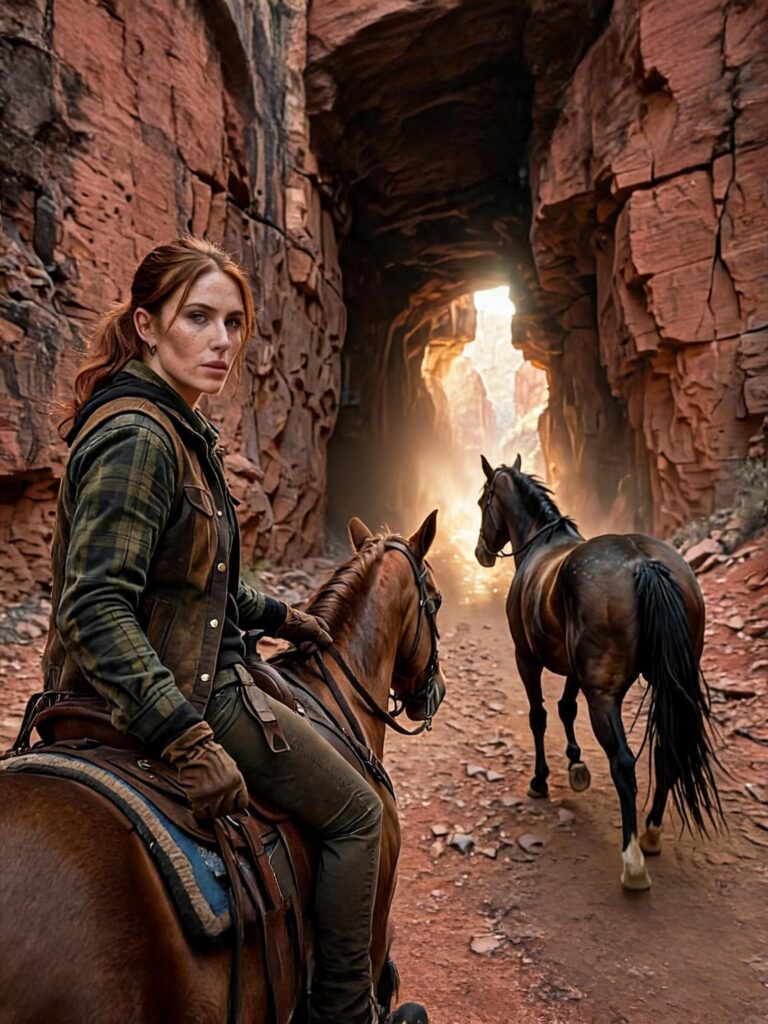
a wounded mustang came to a lonely wyoming ranch woman’s gate—then led her to the hidden canyon her father had spent his life protecting
Part 1
The first time Emily Carter saw the wounded mustang, she thought he had come to her ranch to die.
It was a bitter October morning in northern Wyoming, the kind that turned a woman’s fingers stiff before she finished her first chores. Frost silvered the sagebrush beyond the pasture. The mountains stood dark beneath a pale sky, and the old wooden fences cast long shadows across the frozen ground.
Emily was forty-seven years old, though the last eight years had made her feel considerably older.
She had buried her father, watched her mother leave the state, and spent more winters than she cared to count trying to keep the Carter ranch from slipping into somebody else’s hands.
The ranch wasn’t large. It had two barns, a weather-beaten farmhouse, thirty-seven head of cattle, and enough unpaid bills to make Emily dread opening the mailbox.
But it was home.
Her father, Thomas Carter, had built most of the fencing himself. He had planted the cottonwoods beside the porch when Emily was six. He had taught her to ride in the north pasture, where an old windmill still turned whenever the wind was strong enough.
Every corner of that property held something she couldn’t afford to lose.
That morning, Emily carried an empty feed bucket out of the barn and stopped so abruptly that its metal handle struck her knee.
A horse stood beyond the northern fence.
Not one of hers.
He was a dark bay mustang, nearly black across his shoulders, with a thick, tangled mane and the powerful, lean build of an animal raised on open country. A length of frayed rope hung around his neck.
Blood had dried along his left shoulder.
Emily placed the bucket on the ground.
“Well, where did you come from?”
The horse didn’t move.
Wild mustangs occasionally crossed the distant hills, but they never came this close to the farmhouse. They were suspicious of people, and with good reason.
This one stood twenty yards from her fence, watching.
Emily stepped closer.
“Easy now, sweetheart. Nobody’s going to hurt you here.”
The mustang’s ears turned toward her voice.
Then his head jerked toward the western mountains.
Emily followed his gaze.
There was nothing there but open grassland, dark pine trees, and a narrow gap between two distant ridges.
When she looked back, the horse was watching her again.
Something about those eyes troubled her.
He was frightened, certainly. But his fear seemed directed toward something he had left behind.
Emily noticed the rope.
It wasn’t a loose halter. It had been tightened around his neck, and the ends were ragged, as though he’d fought hard enough to tear himself free.
Her stomach tightened.
“Somebody did this to you.”
The mustang shifted his weight, favoring his injured shoulder.
Emily had spent enough years around horses to recognize an animal that had been badly handled. She also knew that one careless movement could turn an attempted rescue into a serious injury.
She didn’t reach for him.
Instead, she opened the small gate beside the corral.
“You want help, you’ll have to make that decision yourself.”
Then she stepped away.
For several seconds, nothing happened.
Emily turned toward the barn.
Behind her came the unmistakable crunch of a hoof against frozen dirt.
She stopped but didn’t look back.
Another step.
Then another.
The mustang had followed her inside.
By noon, she had managed to clean most of his wound.
It was an ugly injury, a deep tear across the muscle near his shoulder, aggravated by movement. Emily rinsed it carefully, called the local veterinarian for advice, and kept her hands gentle.
The horse tolerated the water.
He tolerated her touch.
But when she reached toward the rope around his neck, he nearly knocked her against the stall wall.
“All right!” she whispered, lifting both hands. “All right. We won’t touch that.”
His breathing came hard and fast.
Emily backed away.
For the first time that morning, she felt real anger toward whoever had left him in that condition.
Afterward, she brought him fresh hay and water and left the stall door open toward the small enclosed corral.
She knew better than to imprison an animal that already feared confinement.
That evening, she sat alone on the farmhouse porch with a cup of lukewarm coffee.
The mustang stood near the western fence.
He wasn’t eating.
He was staring toward the mountains again.
Emily watched him until the light faded.
“What is it out there?” she murmured.
The horse turned his head.
For one strange moment, she had the uncomfortable impression that he was waiting for an answer.
Inside the farmhouse, the kitchen clock ticked above the stove.
Her father’s old work jacket still hung behind the door, exactly where he had left it before his final trip to the hospital.
Eight years.
She had been unable to move it for eight years.
Emily warmed leftover stew, ate standing at the kitchen counter, and opened the envelope the bank had mailed three days earlier.
The figures hadn’t changed.
She was behind on the property taxes. The livestock loan was approaching another payment deadline. And the north barn needed repairs before the first heavy snow.
At the bottom of the letter was a sentence advising her to contact the bank about available options.
Emily knew what that meant.
Sell something.
Borrow more.
Or surrender the place altogether.
She folded the letter and placed it beneath the sugar jar.
The telephone rang just after seven.
She recognized the number.
Caleb Mercer.
Caleb owned the largest ranch east of Carter land. He was a well-dressed man in his early fifties whose father had once done business with Thomas.
For nearly a year, Caleb had been trying to buy her property.
“Evening, Emily,” he said pleasantly. “Hope I’m not catching you at a bad time.”
“Depends what you’re calling about.”
He chuckled.
“Still stubborn as your daddy.”
Emily said nothing.
“I wanted to see whether you’d given any more thought to my offer. With winter coming, I figured you might be ready to consider something sensible.”
“My answer hasn’t changed.”
“Emily, listen. That place is eating you alive. You’re trying to run it alone, and everybody in the county knows it.”
She looked toward the dark window.
Beyond it, somewhere near the barn, the mustang was standing in the cold.
“I’ve managed so far.”
“Managing and living aren’t the same thing.”
There was a pause.
Then Caleb softened his voice.
“My offer could clear your debts. You could buy yourself a nice little house closer to town. No broken fences. No frozen water troughs. No waking up wondering whether you can pay the feed bill.”
For one brief, shameful second, the picture appealed to her.
A warm house.
A reliable heater.
No land to lose.
Then she remembered her father standing beside the windmill, explaining how the Carter family had survived two droughts and a winter that killed half the county’s cattle.
He had told her that land wasn’t valuable merely because somebody wanted to buy it.
It was valuable because of what people were willing to do to keep it.
“I’m not selling, Caleb.”
His friendliness thinned.
“You ought to be careful about refusing help when it’s offered.”
Emily’s fingers tightened around the receiver.
“Good night.”
She hung up.
The following morning, the mustang was gone.
His stall stood empty.
Fresh tracks crossed the frost toward the western pasture.
Emily stood in the doorway, staring at them.
She told herself it was for the best.
Wild animals belonged in the wild.
She had no money for another horse, particularly one that might never tolerate a saddle or a rope.
But as the day passed, she found herself looking west more often than she wanted to admit.
At sunset, while carrying a sack of feed toward the barn, she heard a dull knock.
Then another.
Something was striking the northern gate.
Emily rounded the barn and stopped.
The mustang had returned.
Fresh blood darkened his injured shoulder.
His legs trembled with exhaustion.
But he wasn’t looking toward the hay or water.
He was watching Emily.
Then he turned toward the western mountains.
And waited.
Part 2
By the third morning, Emily had decided the mustang needed a name.
She stood beside his stall carrying a brush, studying the long, dark mane that looked as if it had collected half the Wyoming prairie.
“Dakota,” she said.
The horse flicked one ear.
She smiled faintly.
“That’s about as good as you’re going to get.”
Dakota lowered his head toward the hay.
It was the first small moment of companionship Emily had felt in months.
Her veterinarian, Dr. Samuel Price, arrived that afternoon in a dusty white truck.
He examined Dakota’s shoulder from a safe distance before cautiously approaching.
“That’s no ordinary scrape,” he said.
Emily held the horse’s attention while Samuel inspected the wound.
“Looks like he caught himself on something sharp while trying to get loose. Maybe fencing. Maybe an old trap enclosure.”
He pointed toward the frayed rope.
“Somebody had him tied.”
“That’s what I figured.”
“Could’ve been an illegal roundup. Could’ve been somebody trying to catch a wild horse for themselves.”
Samuel’s expression darkened.
“Either way, I’d keep an eye out.”
He treated the wound, explained the aftercare, and left Emily with medication and instructions.
At the truck, he paused.
“Emily, there’s one other thing.”
She looked up.
“Your father’s old friend Walter Hayes came through town yesterday. Said he’d seen Mercer trucks near the western ridge.”
Emily frowned.
“What’s strange about that?”
“Nothing, maybe. But that country isn’t open grazing for his cattle.”
Samuel hesitated.
“Just thought you ought to know.”
After he left, Emily found Dakota standing at the western fence again.
She leaned against the rail.
“You’re not going to tell me what’s going on, are you?”
Dakota looked toward the mountains.
That evening, Emily went into the tack room searching for clean bandages.
The room smelled of leather, dust, and old saddle soap. Her father’s tools still hung along the far wall, each one occupying the place his hands had chosen.
While moving a wooden chest, she discovered a rolled map wedged behind it.
The paper was yellowed and brittle.
Emily recognized it immediately.
Her father had used that map when checking distant cattle trails.
She spread it across the workbench.
Fence lines.
Water holes.
Old wagon routes.
But near the western ridge, a large section had been torn away.
Emily ran her finger along the jagged edge.
She remembered that missing corner.
When she was thirteen, she’d found the map lying open on the kitchen table.
She’d asked her father about a place marked Red Hollow.
Thomas had folded the paper so quickly that she’d thought he was angry.
“That’s country you leave alone,” he’d said.
“Why?”
“Because some places aren’t meant for everybody to find.”
She hadn’t questioned him.
Her father rarely spoke in riddles, and when he did, Emily knew the conversation was finished.
Now, thirty-four years later, she stood in the tack room studying that torn map.
Outside, Dakota struck the western fence with his hoof.
The sound made her jump.
She went to the door.
He was staring toward the same stretch of mountains.
Emily looked down at the map.
Then back at the horse.
An uncomfortable thought began forming.
Four days later, Walter Hayes arrived in his old green pickup.
Walter was seventy-two, narrow through the shoulders, with deeply weathered skin and a voice that always sounded as though he’d just swallowed a mouthful of dust.
He’d known Emily since she was a baby.
He had helped Thomas build the eastern cattle fence and had been among the six men who carried his coffin.
Usually, Walter arrived talking.
That afternoon, he stopped speaking the instant he saw Dakota.
Emily noticed.
“You know that horse?”
Walter stared toward the corral.
“No.”
The answer came too quickly.
Emily folded her arms.
“Walter.”
“Wild horse, that’s all.”
“He showed up injured. Somebody had tied him up.”
Walter’s gaze moved toward the frayed rope.
His expression changed.
Emily stepped closer.
“What?”
“Nothing.”
“You’ve never been a good liar.”
Walter removed his hat.
The afternoon wind moved through his thinning gray hair.
“Where’d he come from?”
“The western hills, far as I can tell.”
Walter looked toward the mountains.
Emily felt a chill that had nothing to do with the temperature.
“He keeps trying to lead me out there.”
Walter turned sharply.
“Don’t follow him.”
Silence settled between them.
Emily stared.
“That’s exactly what Daddy used to say.”
Walter’s jaw tightened.
“Your father knew that country better than anyone.”
“Then why did he tear part of it off his map?”
For a moment, Walter looked genuinely startled.
“You found that?”
Emily nodded.
The old man lowered his eyes.
She waited.
At last, Walter spoke.
“Thomas made choices he thought were right. Whether they were or not, I suppose that’s between him and the Lord now.”
“Walter, what happened out there?”
He replaced his hat.
“Some roads lead to trouble, Emily. And sometimes the trouble follows you home.”
“That’s not an answer.”
“No,” he said quietly. “It isn’t.”
He turned toward his truck.
Emily followed him.
“My ranch is in trouble. Mercer keeps trying to buy it, and now I’ve got an injured mustang showing up like somebody sent him. If you know something, I deserve to hear it.”
Walter stopped with one hand on the truck door.
His face looked older than she’d ever seen it.
“Your daddy made me promise something a long time ago.”
“What?”
Walter swallowed.
“To keep you out of Red Hollow.”
Then he climbed into the pickup and drove away.
Emily remained standing in the yard until the dust settled.
That night, she slept badly.
She dreamed of her father walking away through tall grass, carrying a wooden box she couldn’t see clearly.
Each time she called his name, he kept walking.
In the morning, she found Dakota standing beside the western gate.
His shoulder was healing.
His breathing was stronger.
When Emily opened the gate to let him exercise, he walked out across the pasture.
He didn’t run away.
He moved steadily west, then stopped on the first rise.
He turned toward her.
Emily stayed by the gate.
Dakota continued another fifty yards.
Stopped.
Looked back.
“You’re a stubborn creature,” she muttered.
The horse waited.
For half an hour, Emily stood watching him.
Eventually, Dakota returned.
He entered the corral without resistance and lowered his head toward the water trough.
Emily touched his neck.
“Whatever you’re trying to tell me, I don’t know if I’m ready to hear it.”
That afternoon, she drove into town to buy winter feed.
At the agricultural supply store, the clerk quietly explained that her usual credit arrangement had been suspended.
Emily stared at him.
“Since when?”
“Yesterday.”
“Who authorized that?”
The young man looked embarrassed.
“Management reviewed the account.”
She paid cash for two sacks, leaving barely enough money in her checking account for diesel.
On the drive home, she passed one of Caleb Mercer’s trucks parked outside the county bank.
Caleb stood beside the vehicle talking with a man in a business coat.
He saw Emily drive past.
And smiled.
That evening, she sat at the kitchen table with the unpaid bills spread before her.
For the first time, she seriously considered selling the ranch.
Her father’s photograph stood on the windowsill.
In it, Thomas was holding a young Emily on a brown pony, both of them laughing.
She picked it up.
“I’ve tried, Daddy,” she whispered. “Lord knows I’ve tried.”
Outside, the wind rose.
A barn door rattled.
Then came a single hoof striking wood.
Emily lifted her head.
Dakota stood beyond the kitchen window, facing west.
She looked at the torn map lying beside the bills.
And made a decision.
If the horse left again, she would follow.
Part 3
The storm arrived before dawn.
By five o’clock, the sky above the western mountains had turned dark gray. Wind battered the farmhouse windows, and dust swept across the yard in twisting sheets.
Emily woke to the sound of the barn door banging.
She pulled on her jeans and boots, grabbed her heavy coat, and hurried outside.
Dakota’s stall was empty.
The outer gate hung open.
Fresh hoofprints cut through the damp soil.
All of them pointed west.
Emily stood in the cold for several seconds.
Then she went back inside and took her father’s old map from the kitchen table.
She folded it carefully and slipped it into her coat.
“All right, Dakota,” she murmured. “You win.”
Her old sorrel mare, Rosie, watched patiently as Emily tightened the saddle.
Rosie was nineteen years old, steady on rough ground, and almost as stubborn as her owner.
Emily packed water, a little food, emergency supplies, and a coil of rope.
She checked the weather radio.
The forecast called for heavy rain and possible flooding in the western draws.
A sensible woman would have stayed home.
Emily thought of the wounded horse, the missing map, and Walter’s frightened expression.
Then she mounted Rosie and rode toward the mountains.
The first hour was easy.
Dakota’s tracks crossed familiar pastureland and followed a dry creek bed Emily had ridden many times.
Then the terrain began changing.
Grass gave way to scrub oak, sagebrush, and broken stone.
The trail narrowed between rocky hills.
Twice, Emily had to dismount and lead Rosie across steep ground.
Wind whipped her coat against her legs.
Rain began falling in sharp, cold drops.
She found Dakota waiting at the top of a long rise.
The mustang stood motionless against the gray sky.
His dark coat shone with rain.
When Emily approached, he turned and continued west.
She stared after him.
“Well, I’ll be damned.”
They traveled for another two hours.
Dakota seemed to know every bend in the terrain.
When a washed-out trail blocked the direct route, he turned before Emily even saw the danger.
When the rain grew too hard to ride safely, he stopped beneath a rocky overhang.
Emily took shelter beside Rosie.
Dakota stood nearby, shivering slightly.
His shoulder had started bleeding again.
Emily approached carefully with a cloth from her saddlebag.
“You foolish, beautiful animal.”
He allowed her to clean away the fresh blood.
She felt the powerful muscles trembling beneath his skin.
Whatever lay ahead mattered enough for this horse to risk reopening a serious injury.
That frightened her more than the storm.
They continued after noon.
The rain weakened, but the land became increasingly unfamiliar.
No fences.
No cattle trails.
No sign of recent ranch work.
Emily remembered riding nearby country with her father as a child, but he had always turned back before reaching the western cliffs.
She had assumed the terrain was too dangerous.
Now she began wondering whether he’d been deliberately keeping her away.
Near two o’clock, Dakota climbed a narrow ridge.
Emily followed.
At the top, she saw a towering wall of red stone.
A dark opening split the rock.
The gap was narrow enough that she might have missed it without the horse standing beside it.
Dakota walked into the passage.
Emily stopped.
Something in her memory stirred.
She had seen that rock formation before.
In an old photograph her father had kept inside a wooden box.
Red Hollow.
The forbidden canyon.
Emily looked behind her.
The sky was dark, and the return journey would take hours.
She could still turn around.
Nobody would know she’d come this far.
Nobody would blame her.
She imagined the warmth of her kitchen, the old clock ticking above the stove, and the bills waiting beneath the sugar jar.
Then Dakota appeared again at the mouth of the passage.
He stood quietly.
Waiting.
Emily tightened her grip on Rosie’s reins.
“All right,” she whispered. “Show me.”
She entered the gap.
The walls rose so closely on either side that she had to guide Rosie with care.
The passage twisted through red sandstone.
For several minutes, the world narrowed to stone, hoofbeats, and the sound of water dripping from the cliffs.
Then the trail widened.
Light spilled across the ground.
Emily emerged into a hidden valley.
She stopped breathing.
Below her lay a green canyon surrounded by towering red walls.
A narrow stream wound between cottonwood trees.
Grass covered the valley floor, protected from the harsh winds beyond the cliffs.
And along the far slope stood the weathered remains of an old wooden fence.
Someone had worked this land.
Someone had deliberately hidden it from the outside world.
Dakota descended toward the stream.
Emily followed slowly.
At the bottom, she discovered the ruins of a small barn.
One wall had collapsed.
The roof sagged beneath years of weather.
But the old feeding stalls remained visible beneath the fallen boards.
She dismounted.
The air smelled of wet earth, timber, and horses.
Fresh horses.
Emily turned.
Across the stream, a gray mare stepped from the cottonwoods.
Then a smaller bay horse appeared.
Then two more.
Within moments, a whole herd of mustangs had emerged from the trees.
Emily counted nine before losing track.
The animals stood quietly, watching.
Dakota raised his head.
A low sound came from his chest.
The gray mare answered.
Then Dakota crossed the stream.
The herd gathered around him.
A young colt pressed its nose against his injured shoulder.
The older mare touched his neck.
Emily felt tears rise unexpectedly.
“These are your people,” she whispered.
For the first time, she understood why Dakota had been so determined to return.
He had a family here.
He had been trying to get home.
But as Emily watched, the mustang moved away from the herd.
He crossed the stream again.
Walked past her.
Passed the ruined barn.
And continued toward a narrow trail beneath the eastern cliff.
Emily frowned.
“Dakota?”
He stopped and looked back.
She followed.
The trail led through thick brush to a small cabin standing beneath an overhanging rock.
Its roof had weathered badly.
Its windows were dusty.
The front door had once been painted green.
Emily recognized it.
Not from a photograph.
From a childhood memory.
Her father had carried a wooden box into their farmhouse one winter afternoon. On its side had been a photograph of a small green door.
When Emily had asked about it, Thomas had said it belonged to an old line shack.
He’d refused to explain where it stood.
Now she knew.
Dakota stopped beside the cabin.
Emily stepped onto the porch.
A symbol had been carved into the green door.
Two curved lines crossed by a short vertical mark.
She had seen it before.
The same symbol was burned into the leather strap hanging from Dakota’s neck.
Her hands turned cold.
She tried the handle.
The door opened.
Inside stood a small iron stove, a table, two chairs, and a narrow bed.
Dust covered nearly everything.
Against the far wall, beneath a faded canvas sheet, sat a cedar chest.
Emily approached it slowly.
Two initials were carved into the lid.
T.C.
Thomas Carter.
She knelt beside the chest.
Her father had been dead for eight years.
Yet here, miles beyond the ranch, was something that still bore the marks of his hands.
Emily ran her fingers over the letters.
And began to cry.
Part 4
Emily remained on the cabin floor until the light began fading through the dirty windows.
She had not cried like that at her father’s funeral.
At the funeral, there had been neighbors to greet, food to carry, and arrangements to make. Everyone had praised Thomas Carter as a hardworking, dependable man.
Emily had nodded and thanked them.
She’d stayed busy because the alternative was falling apart.
But alone in the hidden cabin, with her father’s initials beneath her fingertips, she could no longer hold back eight years of grief.
At last, she wiped her face with her sleeve.
“All right, Daddy,” she whispered. “What were you doing out here?”
She opened the chest.
Inside lay several bundles wrapped in oilcloth.
The first contained old land records, hand-drawn maps, and photographs.
Emily spread them across the table.
The photographs showed groups of wild horses moving through Red Hollow.
Some were young.
Some were injured.
Others stood beside the same ruined barn Emily had passed.
In one photograph, her father knelt beside a chestnut mare, wrapping a bandage around her injured leg.
He looked younger, perhaps forty-five, with thick brown hair and the unmistakable concentration she’d seen whenever he repaired something he cared about.
Emily touched his face in the photograph.
She remembered him disappearing for days during certain summers.
He’d always explained that he was checking remote grazing land or helping Walter repair an old fence.
She’d believed him.
Why wouldn’t she?
The next bundle contained notebooks.
Thomas had kept detailed records of the canyon.
Water levels.
Herd numbers.
Births and deaths.
Weather.
Injuries.
Then the entries changed.
Fresh tire tracks near northern access.
Two young horses missing.
Cut rope found beside western gate.
Vehicle seen after sunset.
Emily turned another page.
A familiar surname appeared.
Mercer.
She stared.
Thomas’s notes suggested that men connected to the Mercer family had been entering Red Hollow for years.
Young horses disappeared.
Then stronger adults.
There were references to unmarked trucks, temporary holding pens, and evidence of illegal trapping.
Emily turned through the pages, feeling a slow, cold anger spread through her chest.
Caleb Mercer had spent the previous year telling her that her ranch was worthless unless he bought it.
Now she understood that her property controlled one of the easier access routes into the hidden canyon.
She wasn’t merely refusing to sell land.
She was standing in the way of something he wanted.
At the bottom of the chest, she found an envelope.
Her name was written across the front.
Emily.
She recognized her father’s handwriting immediately.
Her hands shook as she opened it.
The letter was dated several months before Thomas became seriously ill.
He explained that Red Hollow had once been a quiet refuge for wild horses.
He and Walter had discovered the canyon years earlier while searching for lost cattle.
When they realized that poachers had begun using the hidden valley to capture mustangs, Thomas decided to protect it.
He had repaired old water sources, blocked abandoned trails, and documented suspicious activity.
But he’d kept the canyon secret even from Emily.
Not because he didn’t trust his daughter.
Because he feared that knowing too much could put her in danger.
Emily read one paragraph repeatedly.
Her father had written that he hoped she’d never have to choose between her own security and protecting the animals.
He knew how hard ranch life could be.
He knew how easily good people could be pressured by debt.
Then came the final lines.
If one of the horses ever finds its way to you, listen to what it is trying to tell you. And if the truth comes looking for you, trust the horse before you trust the men.
Emily sat motionless.
Outside, Dakota gave a low nicker.
She looked through the open doorway.
The mustang stood beneath the red cliffs, watching her.
The frayed rope hung from his neck.
Someone had caught him.
Someone had hurt him.
And somehow he’d escaped and reached the Carter ranch.
Emily folded the letter carefully.
“I hear you, Daddy.”
Then she noticed something among the papers.
A photograph showing the eastern passage.
Beside it was a survey drawing that connected Red Hollow’s old access route to land now belonging to Emily.
She unfolded the larger map.
A marked line crossed her property.
Thomas had highlighted it in red.
For years, Caleb Mercer had claimed he wanted Emily’s grazing land because it would help consolidate his cattle operation.
But if Caleb acquired the Carter ranch, he would control the most practical route by which vehicles could reach the hidden canyon.
Emily looked toward Dakota.
“You knew the way,” she whispered.
The horse flicked his ears.
She glanced again at the maps.
Her father had understood what the land protected.
And Caleb’s father had apparently understood it too.
Emily began collecting the documents.
Photographs.
Notebooks.
Maps.
The letter.
She packed them carefully inside her saddlebag.
Then she heard an engine.
At first, she thought it was thunder rolling beyond the cliffs.
But the sound continued.
Low.
Mechanical.
Growing louder.
Emily stepped outside.
Beyond the far ridge, a thin line of dust rose into the afternoon sky.
A vehicle.
Then another.
Dakota’s head came up.
Across the stream, the gray mare called sharply.
The herd began moving toward the trees.
Emily felt her heartbeat quicken.
Someone was coming into Red Hollow.
And there was nowhere for her to hide Rosie, gather the documents, and escape through the narrow canyon passage before the trucks arrived.
She moved quickly.
First, she secured the old photographs and notebooks beneath her coat.
Then she placed the cedar chest back under the canvas.
Rosie stood near the barn, ears pricked toward the approaching engines.
Emily wanted to mount and ride.
Every sensible instinct told her to leave.
But the animals were trapped inside the canyon with the approaching vehicles.
And whoever was coming knew where to find them.
She stepped into the open ground beside the stream.
Dakota crossed toward her.
He stopped several feet away.
His injured shoulder was still stained with blood.
Emily rested one hand against his neck.
“Whatever happens,” she whispered, “I’m not letting them take you again.”
The first truck appeared at the canyon entrance.
A black pickup.
Behind it came a second vehicle carrying three men.
The first truck stopped beside the ruined barn.
The driver’s door opened.
Caleb Mercer climbed out.
He wore an expensive canvas jacket, polished boots, and the same pleasant expression he’d worn during every visit to Emily’s farmhouse.
Only this time, the smile did not reach his eyes.
“Well,” Caleb said, looking around the canyon.
“Looks like you finally found it.”
Emily felt her father’s letter against her chest.
“You knew this place existed.”
Caleb glanced toward the hidden herd.
“My father knew.”
He looked at Dakota.
And his expression changed.
“That horse,” he said quietly, “has caused more trouble than he’s worth.”
Emily moved one step closer to the mustang.
“You did this to him.”
Caleb sighed.
“Emily, let’s not make accusations.”
“Somebody tied a rope around his neck and tore his shoulder open.”
“He got loose from a holding pen.”
Emily stared at him.
The words had come too easily.
Caleb realized his mistake.
His jaw tightened.
“You’re getting yourself involved in things you don’t understand.”
“I understand enough.”
Caleb stepped closer.
“Then understand this. I’ve offered you more money for that broken-down ranch than anybody else in Wyoming ever will.”
Emily remained silent.
“Take the offer. Pay your debts. Walk away.”
“And leave you this canyon?”
His eyes hardened.
“The horses aren’t your responsibility.”
She looked toward the trees.
The gray mare stood protectively beside a young colt.
Dakota moved closer to Emily’s shoulder.
Caleb reached into his jacket and removed a folded document.
“Twice the value of your ranch,” he said. “Final offer.”
Emily looked at the paper.
For one dreadful moment, she saw all the things the money could solve.
The unpaid taxes.
The failing barn.
The old truck that barely started in winter.
A life without constant fear of losing everything.
Caleb watched her expression.
“You don’t owe your dead father the rest of your life.”
Those words struck harder than he probably intended.
Emily looked at Dakota.
At the broken rope.
At the mountains her father had loved.
Then she looked directly at Caleb Mercer.
“No,” she said. “I owe the living a chance to remain free.”
Caleb’s face changed.
One of the men near the second truck moved toward a coil of rope in the truck bed.
Dakota reacted instantly.
The mustang stepped between Emily and the men.
He didn’t charge.
He didn’t strike.
He simply stood his ground.
Across the stream, the black stallion raised his head.
Then the entire herd began moving.
Hooves struck the shallow water.
One horse.
Then five.
Then ten.
The sound echoed against the canyon walls.
Caleb turned.
For the first time, uncertainty crossed his face.
Emily slipped one hand inside her coat.
She withdrew a photograph, then a page from her father’s notebook.
“These records go back years,” she said. “Names. Dates. Vehicles. Missing horses.”
Caleb looked at the papers.
“Old stories don’t prove anything.”
“Maybe not by themselves.”
Emily drew a breath.
“But Walter Hayes is still alive. And he remembers.”
Nobody spoke.
Wind moved through the cottonwoods.
Water whispered across the stones.
The horses stood gathered behind Dakota.
Caleb looked at the documents again.
Then at the animals.
His expression hardened into something cold and calculating.
“This isn’t finished.”
Emily didn’t move.
“Maybe not,” she said. “But you’re leaving today.”
For several long seconds, she thought he might refuse.
Then Caleb folded his offer.
He signaled to the men.
One by one, they returned to the trucks.
The engines started.
The vehicles turned and disappeared through the narrow passage.
Emily remained standing until their sound faded.
Only then did she realize her hands were trembling.
Dakota stepped beside her.
She pressed her forehead briefly against his neck.
“We’re not safe yet,” she whispered.
And deep down, she knew that was true.
Part 5
Emily reached home after dark.
The journey out of Red Hollow was slow, particularly with Rosie tired and Dakota favoring his injured shoulder.
By the time the familiar shape of the Carter farmhouse appeared beyond the northern pasture, Emily’s legs ached and cold had settled into her bones.
She unsaddled Rosie, checked Dakota’s wound, and carried the documents into the kitchen.
Then she called Walter Hayes.
He answered on the fourth ring.
“Emily?”
“I found Red Hollow.”
Silence.
Then Walter spoke.
“Are you home?”
“Yes.”
“Stay there. I’m coming.”
He arrived forty minutes later.
Emily had spread the papers across the kitchen table.
Walter stood in the doorway for a long time, looking at the notebooks and photographs.
Then he removed his hat.
“Thomas always said you’d find out one day.”
Emily crossed her arms.
“You knew everything.”
Walter didn’t deny it.
“Enough.”
“Why didn’t you tell me?”
He sat heavily in her father’s old chair.
For a moment, he looked like a man who’d been carrying a weight too long.
“Because your daddy asked me not to.”
“He’s been dead eight years.”
“I know.”
“You watched me struggle. You watched Mercer come around, trying to buy the ranch. You knew why he wanted it.”
Walter lowered his head.
“I suspected. I didn’t know Caleb had started up the old business again.”
Emily’s anger rose.
“You could have warned me.”
“Yes,” Walter whispered.
That simple admission stopped her.
Walter looked up.
“Your father and I found those horses almost thirty years ago. Back then, the Mercer family had men working the remote hills. Some of them were capturing wild horses without authorization.”
He glanced toward the photographs.
“Thomas started keeping records. He wanted enough proof to stop them. But there were threats, Emily. Real ones.”
“What kind?”
“Fence cut. Equipment destroyed. A horse shot in your north pasture.”
Emily remembered that horse.
A gentle chestnut mare named Dolly.
Her father had told her a hunter had mistaken her for a deer.
Emily sat down slowly.
“He lied to me.”
“He was trying to protect you.”
She looked toward the window.
Outside, Dakota stood beneath the barn light.
“For eight years,” she said softly, “I thought he’d left me nothing but a struggling ranch.”
Walter’s eyes filled.
“He left you more than that.”
The following morning, Walter drove Emily to the county sheriff’s office.
They carried copies of Thomas’s notebooks, photographs, and property maps.
Emily described the injured mustang, the hidden herd, the encounter in Red Hollow, and Caleb’s admission that Dakota had escaped from a holding pen.
Walter provided a statement about the ranch activity he’d witnessed years earlier.
The sheriff listened carefully.
He didn’t promise an immediate arrest.
He explained that the situation would require investigation and that federal land and wildlife authorities might need to be involved.
Emily understood.
She’d lived long enough to know that justice rarely arrived as quickly as trouble.
But for the first time, she had something more substantial than suspicion.
She had evidence.
During the following weeks, investigators visited the Carter ranch.
They examined the access routes, interviewed Walter, reviewed the old records, and documented Dakota’s injuries.
Samuel Price provided his veterinary notes.
Emily also learned that other ranchers had reported suspicious vehicle activity near the western hills.
Piece by piece, her father’s old observations began fitting together with newer evidence.
Caleb stopped calling.
His trucks stopped appearing on the eastern road.
But Emily remained cautious.
She repaired the damaged gates, checked her fences twice daily, and kept copies of the documents in more than one safe location.
Winter arrived hard.
Snow buried the pasture grass.
The north barn roof leaked badly during the first storm.
Two calves became sick.
The ranch finances remained painfully tight.
Protecting Red Hollow hadn’t magically solved Emily’s problems.
Some mornings, she still woke afraid of opening the mail.
But something inside her had changed.
She no longer felt she was struggling merely to preserve a failing inheritance.
She understood what her father had spent his life trying to protect.
And she knew that she wanted to continue the work.
One afternoon, Walter arrived carrying several long boards in his pickup.
Emily met him at the barn.
“What’s all that?”
“Roof repairs.”
“I can’t pay you.”
“Didn’t ask.”
“Walter—”
“Your daddy helped me rebuild my cattle shed after that blizzard in ’98. Never charged me a dime.”
He looked toward the damaged roof.
“Figure I’m a little overdue.”
They worked together until sunset.
Over the following months, other neighbors began appearing.
Some offered used fencing.
Others brought extra hay.
Samuel donated several hours of veterinary care.
A retired carpenter helped strengthen the north barn.
Emily accepted the help awkwardly at first.
She’d spent years believing that depending on anyone was an invitation to disappointment.
But these people weren’t trying to buy her land.
They simply wanted to help.
By late winter, authorities had taken steps to stop unauthorized horse trapping along the eastern access.
The documentation gathered from Thomas’s records, Walter’s statement, and the newer investigation contributed to enforcement action against the trapping operation.
Caleb Mercer no longer had the freedom to use that route as though it belonged to him.
The investigation did not erase the past.
It could not return the missing horses.
And it could not bring Thomas Carter home.
But Red Hollow remained protected from the men who had treated its animals as property to be taken.
That spring, Emily began making plans.
She fenced a recovery pasture near the north barn.
She converted an unused stall into a quiet space for injured mustangs.
She worked with local horse-rescue volunteers and the appropriate authorities to care for animals that could legally be rehabilitated and returned to suitable range.
The work was demanding.
There were injuries to treat, fences to maintain, feed to buy, and long nights spent checking restless animals.
But the ranch was no longer silent.
Walter came twice a week.
Sometimes he helped.
Sometimes he sat on the porch drinking coffee, watching the horses.
One afternoon, Emily joined him.
They watched Dakota standing in the recovery pasture.
His shoulder had healed, leaving a crooked pale scar beneath his dark coat.
“He looks good,” Walter said.
Emily nodded.
“Samuel says he’s ready.”
“Ready for what?”
She looked toward the western mountains.
“To go home.”
Walter said nothing.
Dakota had changed.
He no longer flinched at the sound of metal buckets.
He allowed Emily to touch his neck.
And several weeks earlier, she’d finally been able to cut away the frayed rope that had hung there since the day he arrived.
The severed rope lay in a small wooden box inside the farmhouse.
Not as a trophy.
As a reminder.
Some creatures survived things they should never have been forced to endure.
And survival didn’t mean they belonged to the person who helped them recover.
One clear morning, Emily opened the western gate.
Beyond it lay miles of open country.
The grass had begun turning green.
Snow still clung to the highest mountains.
Dakota stood beside her.
Emily didn’t put a halter on him.
She didn’t hold a rope.
She simply opened the gate and stepped aside.
For a moment, the mustang didn’t move.
Emily rested her hand against his neck.
“You’re free, boy.”
Her voice trembled.
She swallowed.
“You always were.”
Dakota stepped through the opening.
He walked several yards into the pasture.
Then stopped.
He turned and looked at her.
Emily felt tears rising.
She had spent eight years clinging to everything she’d lost.
Her father.
The life she remembered.
The dream of growing old on the ranch without having to fight for it every single day.
She had believed that love meant holding on.
Her father had tried to teach her something different.
Dakota walked back toward the gate.
He pressed his nose gently against her shoulder.
Emily closed her eyes.
“Go on,” she whispered.
The mustang turned.
Then he ran.
Across the pasture.
Over the rise.
Toward the distant red cliffs.
His stride was long and powerful.
No limp.
No rope.
No fear.
Emily watched until he disappeared.
Then she closed the gate.
For a long time, she stood with one hand resting on the weathered wood.
The wind carried the smell of fresh grass.
Somewhere behind her, the old windmill turned.
And for the first time since her father’s death, the silence didn’t feel quite so empty.
Summer came slowly to the Carter ranch.
Emily accepted her first recovering mare in April.
A frightened gray colt arrived in May.
She spent long afternoons repairing fences, changing dressings, and teaching frightened animals that not every human hand meant pain.
Word spread.
A local newspaper ran a story about the ranch woman who had helped uncover a hidden mustang refuge.
Volunteers started calling.
Donations arrived in small amounts.
Nobody became rich.
Nobody pretended the work was easy.
But Emily finally had enough support to keep the ranch operating without facing every burden alone.
Walter suggested a name.
“Carter Mustang Haven.”
Emily wrinkled her nose.
“Sounds fancy.”
“Good. Might convince people to send money.”
She laughed.
It was the first time Walter had heard her laugh like that in years.
They painted the name on a wooden sign and hung it beside the northern gate.
Then, one evening in early June, Emily was repairing a loose fence board when she heard something behind her.
A single hoof striking wood.
She froze.
The sun hung low above the Wyoming prairie.
Gold light stretched across the pasture.
Slowly, she turned.
Dakota stood at the gate.
He was stronger than she remembered.
His coat shone.
His mane moved in the evening breeze.
There was no broken rope around his neck.
No blood on his shoulder.
No fear in his eyes.
Emily placed the hammer on the fence rail.
For several seconds, she couldn’t speak.
Then she walked toward him.
“Well,” she whispered. “Look who decided to come visiting.”
Dakota stepped closer.
He reached his nose toward her outstretched hand.
Emily smiled.
A real smile.
Not the careful expression she’d practiced for neighbors.
Not the polite smile she’d worn through years of grief.
A smile that came from somewhere she thought had been lost forever.
She unlatched the gate.
Dakota didn’t rush through.
He stood quietly, watching her.
Emily thought of her father.
Of the secret cabin.
Of the cedar chest.
Of the frightened horse who had arrived at her fence with a wound on his shoulder and a plea she hadn’t understood.
And she finally knew why the moment mattered so much.
Dakota had been given his freedom.
He had returned to his herd.
He had crossed the open country and lived as a wild horse should.
Yet here he was.
He had chosen to come back.
Emily stepped aside.
“Come on, then.”
Dakota walked through the gate.
The old barn stood warm beneath the evening sun.
Beyond it stretched the ranch her father had loved, no longer merely a place of debts and memories, but a home where injured creatures could recover and where a lonely woman had finally found a reason to look toward tomorrow.
Emily rested one hand against Dakota’s neck.
“I think Daddy would’ve liked you,” she whispered.
The mustang lowered his head.
A breeze moved through the cottonwoods beside the farmhouse.
Emily looked toward the western mountains, where Red Hollow lay hidden among the red cliffs.
For years, she’d believed her father had left her an impossible burden.
Now she understood his greatest gift.
He had shown her that protecting something didn’t mean possessing it.
That love did not have to become a cage.
And that a heart broken by loss could still find its way home.
That evening, Emily left the gate open a little longer.
Not because she feared Dakota might leave.
But because she finally knew that sometimes the most beautiful thing a person could offer another living creature was the freedom to choose.
And sometimes, when given that freedom, love found its own way back.


