
Part 1
When eighteen-year-old James Foster was abandoned in a canyon two days’ ride from Dry Creek, the men who left him there were certain they had seen the last of him.
They took his horse.
They took his rifle.
They took the rope from his saddle and every scrap of food he had carried.
Then they rode away, leaving him with a cracked canteen, a folding knife with a worn bone handle, and forty-two cents sewn into a little leather pouch beneath his shirt.
The older man, Merle Hoyt, had looked back only once.
“Don’t bother trying to follow us, boy,” he’d said. “You won’t make it halfway.”
The other man, a narrow-faced drifter everyone called Pike, wouldn’t look James in the eye.
Then their horses disappeared around the bend.
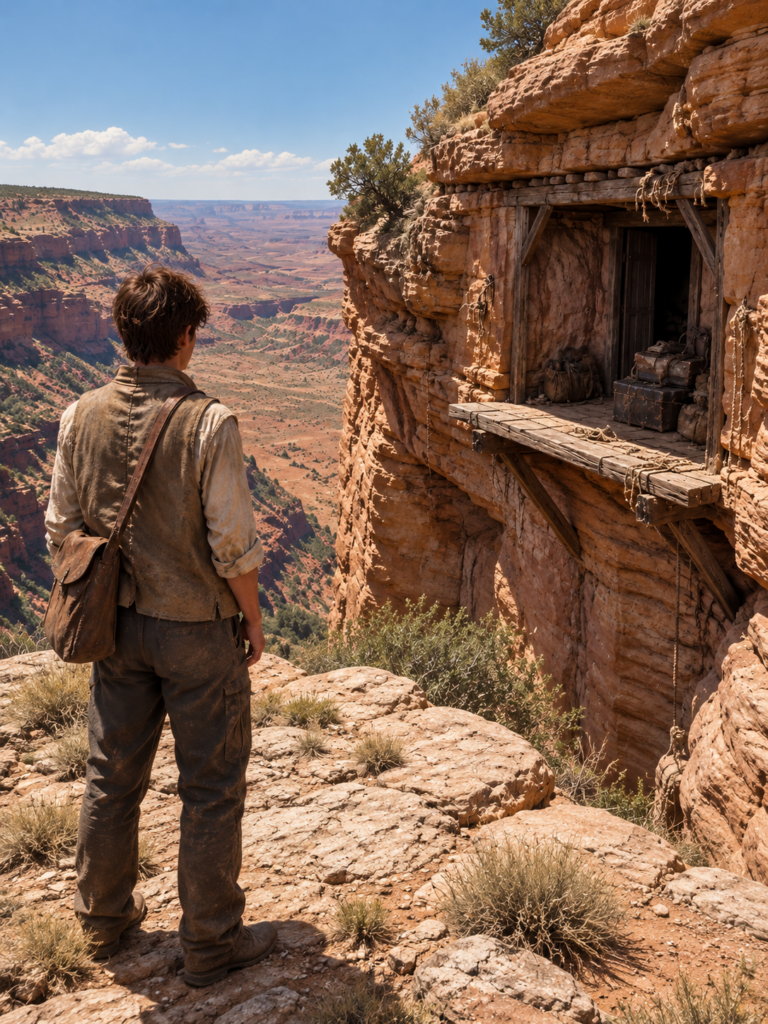
James stood alone beneath the towering sandstone walls.
He could hear the animals’ hooves for several minutes.
Then even that sound was gone.
There was no road.
No house.
No smoke rising in the distance.
Only red stone, thornbrush, and a strip of pale autumn sky.
James looked at the empty place where his horse had stood.
For the first time, he fully understood what had happened.
They hadn’t fired him.
They hadn’t simply abandoned him.
They had brought him into the wilderness knowing he would probably die there.
And the worst part was that he had trusted them.
Three months earlier, James had believed his life was finally beginning to improve.
He’d been born in a two-room house on the northern edge of Dry Creek, a dusty cattle town where the wind rattled the shutters and most folks measured a man’s worth by the number of animals wearing his brand.
His father, Whit Foster, had worked as a fence rider and occasional cattle drover.
His mother, Naomi, took in washing and repaired clothing for railroad workers and ranch hands.
They were poor, but there had been good years.
James remembered his mother singing while she kneaded bread, her sleeves rolled above her elbows. He remembered his father’s boots drying beside the stove and the smell of beans simmering after a long day.
Then lung fever took Naomi when James was nine.
She died on a cold March morning while sleet struck the bedroom window.
James had been sitting beside her bed, holding a damp cloth against her forehead.
Just before dawn, she opened her eyes.
“Take care of yourself, Jimmy,” she whispered.
He shook his head.
“You’re going to get better.”
She touched his cheek.
“You’re a good boy.”
Those were the last words she ever spoke to him.
After the funeral, everything in the Foster house changed.
His father grew quieter.
The kitchen stayed untidy.
The bread stopped rising in the oven.
And the whiskey bottle that had once appeared only on Saturday nights began sitting beside Whit’s supper plate every evening.
Whit wasn’t a cruel man.
He never struck his son.
But he was a man who had lost the center of his life and couldn’t find his way back.
By twelve, James knew how to cook beans, mend a broken fence, patch a roof, and help his father stumble safely into bed.
He learned to stretch a sack of flour through a hard month.
He learned to recognize when a cow was about to calve and when a horse was close to going lame.
He learned that unpaid bills could frighten a grown man more than a thunderstorm.
But the person who taught him most about surviving was an old horse breaker named Ori Bement.
Ori lived alone in a sod-roofed cabin east of town.
He was well past seventy, with a crooked nose, a weather-beaten face, and hands marked by years of rope burns and broken knuckles.
He had buried two wives.
He had no living children.
And he had a habit of speaking only when he had something worth saying.
James first met him after finding an injured colt tangled in an old wire fence.
The boy had been trying to free the frightened animal when Ori appeared.
“Quit pulling,” the old man said.
James looked up.
“He’s stuck.”
“I can see that.”
Ori crouched beside him.
“What’s he doing every time you yank that wire?”
“Kicking.”
“Then quit giving him reasons.”
Together, they freed the colt.
Afterward, Ori gave James a cup of coffee so weak it looked like muddy water and asked whether he wanted to learn how to work with horses properly.
James did.
For the next five years, he spent nearly every free afternoon at Ori’s place.
The old man taught him to read tracks, find water in dry country, make a fire in strong wind, and repair harness leather with a single awl.
He taught him how to approach a frightened horse and how to recognize the warning signs in another man’s face.
Most importantly, he taught James something that would save his life.
“When trouble comes,” Ori once said, “don’t spend your first breath cursing what happened.”
James had been fourteen, impatient, and struggling to fix a broken wagon wheel.
“What should I do, then?”
“Sit down. See what you’ve got left. Then decide what comes next.”
That same summer, Ori gave him a folding knife.
It had a bone handle polished smooth by years of use.
“My father carried this,” Ori said. “Kept it through the war and all the years after.”
James turned it over carefully.
“Why are you giving it to me?”
“Because you’ve learned to keep an edge without being foolish with it.”
He looked the boy squarely in the face.
“And because every man ought to own one thing he can depend on.”
When Ori died two years later, James was the one who found him.
The old man sat in his chair beside the stove, a cold cup of coffee resting near his hand.
There was no family to arrange a burial.
The county wouldn’t pay for much.
So James dug the grave himself.
The earth was frozen hard, and the work took most of two days.
He buried Ori beneath a cottonwood behind the cabin.
When he finished, he stood beside the grave with the bone-handled knife in his pocket.
“Thank you,” he whispered.
Eleven months later, Whit Foster died coughing blood.
The bank came for the house before James had finished grieving.
He learned that his father had borrowed against the property several times, trying to cover old debts and medical expenses.
There was nothing left after the accounts were settled.
James packed his clothes, his mother’s faded photograph, and Ori’s knife into a canvas bag.
Then he walked out of the only home he’d ever known.
He was eighteen.
He had no family.
No horse.
No land.
And nowhere to go.
That was when Dutch Reamer offered him work.
Dutch ran a small cattle-hunting operation north of Dry Creek. He was a broad-shouldered man with a heavy mustache and a reputation for getting difficult jobs done without asking too many questions.
James had heard stories about him.
Some said he traded stolen cattle.
Others claimed he had ridden with outlaws when he was younger.
But Dutch paid cash when he had it, and James was desperate.
“Can you ride?” Dutch asked.
“Yes, sir.”
“Handle a rope?”
“Yes, sir.”
“Know the north country?”
“Some of it.”
Dutch studied him.
“I can use a boy who doesn’t talk too much.”
“I’m not looking for trouble.”
Dutch smiled.
“Neither am I.”
James accepted the job.
For six weeks, he mended fences, tended horses, and rode long days searching for stray cattle.
Dutch paid him little, but he provided meals and a place to sleep in the bunkhouse.
For James, that was enough.
He began to imagine saving money for a horse.
Maybe one day he could claim a piece of land.
Maybe build a small cabin.
Maybe have somewhere to hang his mother’s photograph.
Then Dutch sent him into the northern canyons with Merle Hoyt and Pike.
They were supposedly gathering cattle that had wandered beyond the Halloran grazing range.
For four days they traveled across dry country, following old trails through juniper and sagebrush.
Merle did most of the talking.
Pike rarely spoke.
James noticed that neither man seemed particularly interested in finding cattle.
Whenever they reached a trail junction, Merle checked a folded scrap of paper before deciding which way to ride.
On the second afternoon, they entered a narrow canyon.
The walls rose steeply on both sides.
There were no hoofprints from cattle.
No fresh manure.
Not even the distant sound of a herd.
James pulled his horse alongside Merle.
“Are you certain the strays came this way?”
Merle didn’t look at him.
“Keep riding.”
The canyon narrowed.
Loose stones shifted beneath the horses’ hooves.
Eventually, they reached a sandstone shelf overlooking a dark ravine.
Merle dismounted.
Pike followed.
James stayed in his saddle.
“Something wrong?”
Merle held out his hand.
“Get down, boy.”
James obeyed.
Merle took the reins from him.
Then he removed the rifle from James’s saddle scabbard.
James felt the first cold movement of fear.
“What are you doing?”
“Your employment’s finished.”
“What?”
“Dutch doesn’t need you anymore.”
James stared at him.
“Then let me ride back.”
Merle shook his head.
“Horse belongs to the outfit.”
“I’ve got six weeks’ wages coming.”
“Your food and lodging took care of that.”
James glanced toward Pike.
The man was coiling a rope, refusing to meet his eyes.
“That’s not right.”
Merle stepped closer.
“Son, right doesn’t have much to do with what happens out here.”
James backed away.
Behind him, the sandstone dropped into a steep, broken slope.
He could feel stones shifting beneath his boots.
Merle rested one hand near his revolver.
James looked from one man to the other.
“Are you going to shoot me?”
Merle almost looked offended.
“No.”
Then he nodded toward the surrounding wilderness.
“We don’t need to. This country will take care of you.”
They mounted.
James made one last attempt.
“Please. Just give me enough water to get back.”
Pike hesitated.
His hand tightened around the reins.
For a second, James thought he might help.
But Merle said, “Move along.”
Pike turned his horse.
And together, they rode away.
James stood watching until they disappeared.
Then he lowered himself onto the rock.
His legs were shaking.
His mouth had gone dry.
The sun was moving toward the western rim, and he knew the temperature would fall sharply after dark.
He wanted to scream.
To run after the men.
To curse Dutch Reamer and every person who had ever taken advantage of his poverty.
Instead, he remembered Ori.
Sit down. See what you’ve got left.
He emptied his pockets.
The folding knife.
Forty-two cents.
A second shirt tied around his waist.
A wool vest that had belonged to his father.
And the broken canteen, still holding a few mouthfuls of water.
That was everything.
James looked down into the canyon.
Somewhere below, shadow gathered against the rocks.
He thought of his mother.
His father.
Ori.
Every person who had ever cared whether he lived or died was buried beneath the ground.
For one terrible moment, he wondered whether it would be easier to lie down and let the cold finish him.
Then his fingers closed around the old knife.
He opened it.
The blade was still sharp.
He folded it again and returned it to his pocket.
“No,” he whispered.
He had buried too many people to surrender himself without a fight.
He stood carefully.
And began climbing down into the canyon.
Part 2
The first night nearly killed him.
James had hoped to find water before sundown, but the canyon descended farther than he expected.
Every ledge opened onto another drop.
Every promising trail ended against a wall of stone.
Twice he slid down loose shale and tore the skin from his hands.
Once his right knee struck a sharp rock so hard that he cried out.
By the time darkness settled over the canyon, he could barely put weight on that leg.
The wind came down from the rim like ice water.
He found a shallow hollow beneath an overhanging slab of sandstone and crawled inside.
It offered some shelter from the wind, but not much warmth.
James pulled his father’s wool vest tight around his chest and tucked his hands beneath his arms.
He was hungry.
His lips were cracking.
His knee had begun to swell.
High overhead, a strip of stars appeared between the canyon walls.
He tried to sleep.
Every time he closed his eyes, he saw Merle taking his horse.
He heard the man’s voice.
This country will take care of you.
James wondered how long the men would wait before returning to Dry Creek and telling everyone he had disappeared.
Would anyone search for him?
Would the sheriff believe something was wrong?
He had no wife waiting.
No parents.
No brothers or sisters.
There wasn’t even a landlord to complain about unpaid rent.
He was an eighteen-year-old hired hand with no permanent address.
A boy who could vanish without leaving an empty chair at anybody’s table.
The thought frightened him more than the cold.
He turned onto his side and pressed his forehead against his folded arms.
“Ma,” he whispered.
He hadn’t called for his mother aloud in years.
But the canyon was empty, and nobody was there to hear him.
“I don’t know what to do.”
The wind moved across the rocks.
James remembered Naomi sitting beside his bed during a childhood fever, singing softly until he fell asleep.
He could almost feel her cool hand against his forehead.
Then the memory faded.
He was alone again.
He stayed awake through most of the night, shifting positions whenever his muscles began to stiffen.
Shortly before dawn, the cold became unbearable.
He stood and moved carefully within his little shelter, flexing his fingers and stamping his feet to keep circulation moving.
When daylight finally touched the opposite rim, he was exhausted.
But alive.
He checked the canteen.
Perhaps two mouthfuls remained.
He drank one.
Then he began moving again.
The canyon floor was littered with broken rock.
James used the knife to cut a short branch from a dead juniper and fashioned a rough walking stick.
It helped a little.
His injured knee still hurt whenever he put weight on it.
By midmorning, he had found no water.
The sun struck the exposed sandstone.
His tongue felt thick.
His thoughts began wandering.
Once, he stopped because he thought he heard a wagon moving along the canyon floor.
But when he listened carefully, there was only wind.
He sat beneath a boulder and closed his eyes.
For several minutes, he could think of nothing except water.
Then Ori’s voice returned.
Don’t chase the water you wish was there. Find the signs of the water that is.
James opened his eyes.
He studied the canyon.
The main wash was dry.
But its gravel bed showed where seasonal floods had once run.
He followed the slope downhill.
He noticed damp-looking soil beneath a shaded ledge.
Then a small patch of moss.
Farther down, he found the tracks of a rabbit.
Something had kept the animal alive.
He continued.
By late afternoon, a steep drop blocked his path.
The narrow passage descended between two walls of stone, one smooth and one broken by shallow cracks.
James studied both.
He could attempt a long detour across the exposed slope.
Or he could lower himself through the tight passage.
He thought about his swollen knee.
The detour might cost half a day.
The narrow passage might cost him his life.
He remembered Ori teaching him to descend a rocky embankment behind the old horse pasture.
“Don’t put your whole weight on anything until you’ve tested it.”
James lowered himself slowly.
One foot.
Then the other.
He kept his body close to the stone and used the stronger of his legs whenever possible.
Halfway down, his injured knee buckled.
He slipped.
His shoulder struck the wall.
Then he dropped onto a shelf several feet below.
Pain flashed through his leg.
For a moment, he couldn’t breathe.
When he finally sat up, his hands were bleeding again.
His walking stick lay far below.
James stared after it.
Then he laughed weakly.
“Well, that was clever.”
He remained there until the shaking stopped.
Somewhere above, a hawk cried.
He looked up.
The bird circled once over the canyon.
Then disappeared beyond the rim.
James suddenly thought of Ori’s old cabin.
The sagging roof.
The split-wood fence.
The little garden behind the stove chimney.
He had never felt poor when he visited Ori.
The old man owned almost nothing, yet every object seemed to have a place.
A good axe.
A reliable coffee pot.
A dry stack of wood.
A bench strong enough to sit on.
A horse that trusted him.
James had thought wealth meant having enough money to stop worrying.
Ori had believed it meant having enough knowledge to make use of what remained.
Now James understood the difference.
He forced himself upright.
And kept going.
By evening, his mouth was so dry he could scarcely swallow.
He found another sheltered hollow and spent the night curled against the stone.
He dreamed of his mother’s kitchen.
In the dream, she placed a bowl of stew on the table.
He reached for it.
But the bowl disappeared before his fingers touched it.
He woke with tears on his face.
At dawn, James crawled out of the hollow.
He was dizzy.
His injured knee had stiffened badly.
He knew he could not survive another day without water.
The canyon bent toward the north.
James dragged himself around the turn.
Then stopped.
Far below, against a shadowed bend of sandstone, stood a cluster of dark green willows.
He stared.
Willows.
He knew what they meant.
Where willows grew, there was usually water close enough to reach their roots.
James tried to stand.
His knee gave way.
He fell onto his hands.
For several seconds, he stayed there, staring at the distant green.
Then he began crawling.
He crossed shale.
Dragged himself around boulders.
Slid down a bank of gravel.
The sun climbed higher.
The green patch seemed never to grow closer.
Twice he stopped because his arms were trembling too badly to support him.
Each time, he looked toward the willows.
Then moved again.
By late morning, he reached a shelf above them.
He could hear water.
Only a faint trickling sound.
But it was real.
James almost sobbed.
He lowered himself the final few yards and pushed aside the branches.
A small spring seeped from beneath a dark rock.
The water collected in a shallow pool before disappearing into gravel.
He dropped onto his stomach.
His first instinct was to drink as much as possible.
But he remembered Ori warning him not to gulp large amounts after severe thirst.
James took a few small swallows.
Stopped.
Breathed.
Then drank again.
The water tasted of iron and leaves.
It was the finest thing he had ever tasted.
He lay beside the seep for almost an hour.
When his head finally stopped spinning, he washed his face and inspected his knee.
The swelling was substantial, but the joint still moved.
He had scrapes across both palms and a painful bruise on his shoulder.
He needed food.
Shelter.
Rest.
He also needed to get out before another cold night.
James sat beneath the willows and studied the surrounding rocks.
That’s when he noticed the horse tracks.
They lay in an old strip of sandy ground just beyond the seep.
The impressions were faint and partly washed away, but the shape was unmistakable.
A shod horse had passed through the canyon long ago.
James examined them closely.
They weren’t fresh.
But they proved something important.
Another person had once come this way.
He followed the old path with his eyes.
It disappeared behind a thick curtain of willow branches near the cliff.
At first, he saw nothing unusual.
Then the wind moved the branches aside.
And James noticed a straight vertical line in the sandstone wall.
He frowned.
Natural rock rarely made such clean edges.
He pushed himself to his feet and limped closer.
Behind the willows was a door.
A real wooden door, hidden in the canyon wall.
It was made from split cedar planks, weathered almost silver.
Heavy iron hinges supported one side.
A wooden peg secured the latch.
Above it, a low sod-covered roof blended into the hillside.
A squat stone chimney rose beside the entrance.
James stood staring.
He could hardly believe it.
Someone had built a home into the canyon.
Someone who knew about the water.
Someone who wanted the place hidden.
He approached slowly.
There was a wooden bench beside the door.
Nearby stood a tiny blacksmith’s anvil resting on a rotten oak stump.
No fresh footprints marked the ground.
No smoke rose from the chimney.
The place seemed abandoned.
James touched the wooden latch.
Then stopped.
What if someone still lived inside?
What if it belonged to outlaws?
He had already trusted the wrong men once.
He wasn’t eager to make the same mistake again.
“Hello?” he called.
His voice sounded weak against the stone.
No answer.
“Anybody here?”
Still nothing.
He waited.
Then pulled the wooden peg.
The hinges gave a long, dry groan.
Cold, stale air drifted out.
James peered into the darkness.
He could make out a stone hearth.
A rough table.
A narrow bed frame.
And something hanging on the wall that looked like an old rifle.
He stepped inside.
The floor descended three shallow steps into the hillside.
The room was small, perhaps fifteen feet long and twelve feet wide.
The walls were stone and packed earth.
The roof beams were old but still standing.
James leaned against the doorframe, almost too tired to feel relief.
He had found shelter.
For the moment, that was enough.
Then he looked more closely at the room.
On the table sat a tin cup, a plate, and a horn-handled spoon.
A faded canvas coat hung near the rear wall.
The bed frame was empty.
And in the fireplace lay ashes so old they had turned gray and powdery.
Whoever had lived here had been gone a long time.
James stepped toward the hearth.
He hadn’t eaten properly in days.
He had almost no strength left.
And he had no idea how to get home.
But he was out of the wind.
He had water nearby.
And for the first time since Merle Hoyt took his horse, he had a door he could close against the night.
He lowered himself onto the floor.
Then reached behind him and pulled the cedar door shut.
The latch settled into place.
James rested his forehead against his knees.
“Thank you,” he whispered.
He didn’t know whether he was speaking to God, his mother, or the old man who had taught him how to survive.
Perhaps all three.
Outside, the willows stirred in the wind.
Inside, the forgotten shelter held its silence.
And beneath one of the stones in the hearth, something had been waiting for more than twenty years.
Part 3
James woke the next morning to the sound of water dripping somewhere beyond the wall.
For several seconds, he didn’t remember where he was.
Then he saw the rough beams overhead, the stone hearth, and the narrow square window covered with torn, yellowed paper.
He sat up.
His body protested immediately.
His right knee throbbed. His shoulder was stiff, and the cuts across his palms had dried into painful cracks.
But he was alive.
And that meant he still had work to do.
He remembered something Ori used to say whenever they faced more chores than daylight.
“First the body. Then the roof. Then the road.”
James had always thought it was a strange way of talking.
Now it made perfect sense.
First, he needed to recover enough strength to move.
Then he needed to make the shelter usable.
Only afterward could he think about returning to Dry Creek.
He limped outside and drank from the seep.
The water was painfully cold.
He used a strip of his spare shirt to clean his scraped hands, then wrapped another strip around his swollen knee.
He found watercress growing near the spring and ate a little, though it barely eased his hunger.
For several hours, he rested in the doorway with his face turned toward the sun.
The canyon remained quiet.
No horses.
No voices.
No sign of another human being.
Late that afternoon, James began examining the shelter.
The roof was made of closely laid poles covered with sod.
Some had begun to rot, but the main beams appeared sound.
The walls were thick enough to hold the day’s warmth for a while after sunset.
The fireplace needed cleaning, and the chimney cap had collapsed.
James decided not to risk a large fire until he understood whether the smoke could escape.
He found a shallow ash pan and used it to clear old debris from the hearth.
Near the bed stood a wooden chest with a broken lid.
Inside were a moth-eaten blanket, several pieces of harness leather, and a bundle of old clothing.
James shook out the blanket.
It smelled of dust, but it was dry.
He carried it outside, beat it against a rock, then laid it in the sunlight.
He also found a strip of dried apple in the pocket of the canvas coat hanging beside the door.
It was hard and shriveled.
He inspected it carefully before taking a small bite.
The taste reminded him so suddenly of his mother’s kitchen that he had to stop chewing.
Naomi used to dry apples each autumn and store them in cloth sacks above the stove.
Whenever James complained about the cold, she’d give him a piece.
“Something sweet makes a hard day easier,” she would say.
He stood in the abandoned cabin, holding the dried fruit between his fingers.
For a moment, he was nine years old again.
Then the memory passed.
He ate the rest slowly.
It wasn’t much.
But it was something.
By the following morning, James could move around without crawling, though he still needed a walking stick.
He fashioned a better one from a straight cedar branch and began collecting dry twigs and deadfall near the spring.
He discovered an old rabbit trail leading along the canyon wall.
There were also deer tracks around the water.
That told him two things.
Animals could survive here.
And there might be a path out that didn’t require climbing the dangerous sandstone shelf.
He followed the rabbit trail a short distance, marking his return route with small piles of stones.
It curved behind the willows before climbing toward a narrow bench above the canyon.
James didn’t attempt the climb.
Not yet.
He returned to the shelter and continued searching for anything useful.
The old Sharps rifle hanging on the wall was broken beyond easy repair. Its hammer was missing, and the stock had split.
The bridle beside it had dried until the leather was almost brittle.
The small anvil outside, however, was still solid.
And beneath the workbench, James found a handful of iron nails, two horseshoes, and an old rasp.
Whoever had lived here had worked with horses.
Possibly as a blacksmith.
That evening, James sat on the three-legged stool beside the table, studying the room.
Something about it bothered him.
The place was too carefully built to be a temporary camp.
A man had lived here for years.
He had carried timber into this isolated canyon.
Cut the stone steps.
Built a fireplace.
Established a reliable water source.
Yet there were no personal letters on the table.
No photographs.
No money.
No Bible.
Not even a name carved above the doorway.
It was as though the owner had deliberately erased himself.
James remembered Ori telling him about hidden compartments in old wagons.
“Men who want to keep something safe don’t always put it where a thief expects.”
James looked toward the hearth.
A fireplace was the center of an isolated man’s life.
It was where he cooked.
Where he warmed himself.
Where he sat through long winter nights.
James stood and moved closer.
Seven broad stones formed a half circle in front of the firebox.
He pressed his fingers against the first.
Solid.
The second didn’t move.
Neither did the third or fourth.
The fifth and sixth were firmly set.
But when he touched the seventh, he noticed a narrow seam beneath its edge.
He took Ori’s knife from his pocket.
Carefully, he worked the blade into the crack.
The stone shifted.
James froze.
He removed the knife, found a flat piece of wood, and used it to lift the edge without damaging the blade.
The stone came loose.
Underneath was a cavity cut into the sandstone.
Inside lay a tin box.
Beside it was a smaller parcel wrapped in leather and tied with a blackened rawhide thong.
James stared.
His heartbeat quickened.
He set both objects on the table.
The tin box was heavy.
Its metal lid had begun to rust around the hinges, but the clasp still worked.
He opened it.
For several seconds, he couldn’t understand what he was seeing.
Then he lifted the faded blue cloth inside.
Gold.
There were gold coins packed neatly in short columns.
James had seen gold pieces before, usually when cattle buyers settled large accounts.
But never so many in one place.
He counted them carefully.
Forty-one double eagles.
Each worth twenty dollars at face value.
Eight hundred twenty dollars in gold.
More than he had earned in his entire life.
Beneath the gold was a small buckskin pouch containing eleven silver dollars, several half dollars, and a handful of quarters.
James poured them onto the table.
The coins glittered in the afternoon light.
He thought of the bank taking his father’s house over unpaid notes.
He thought of sleeping in Dutch Reamer’s filthy bunkhouse for wages that never arrived.
He thought of the meals he’d skipped because he had nothing to buy.
And now, hidden beneath an old fireplace, lay enough money to change his circumstances entirely.
His hands began shaking.
He sat down.
For a long while, he did nothing except stare.
Then he found a folded bank draft for two hundred twelve dollars, issued years earlier by a bank in Denver.
Underneath it lay a thin gold wedding ring.
The ring was small.
A woman’s ring.
Its surface had been worn smooth by years of use.
James turned it between his fingers.
He pictured the man who had lived here.
A lonely blacksmith, perhaps.
A widower.
Someone who had hidden his savings under the hearth and kept his wife’s wedding ring beside them.
James placed the ring carefully back in the box.
Then he opened the leather parcel.
Inside were three things.
A little account ledger.
A hand-drawn map.
And a folded letter sealed with a thumbprint pressed into candle wax.
James examined the ledger first.
Its pages were filled with dates, initials, and sums.
Some entries were more than twenty years old.
The final column bore a single word.
Owed.
The amounts varied.
A few dollars.
Several hundred.
One entry for more than a thousand dollars.
James couldn’t make sense of it.
He unfolded the map.
It showed the surrounding canyon, the spring, the dugout, and several narrow paths through the rock.
Two miles farther upstream, an X marked a secluded side ravine.
Beside it were the words:
Second cache.
James studied the map.
His stomach tightened.
There was another hiding place.
And somebody had taken great pains to conceal it.
He looked toward the sealed letter.
On the outside, written in cramped, faded handwriting, were the words:
For whoever finds this and has need of it.
James ran his thumb across the old paper.
He wondered whether the person who had written those words ever imagined that a half-starved eighteen-year-old would one day be sitting at his table.
Then he broke the wax seal.
He unfolded the letter.
And began reading.
“My name is Josiah Pell,” it began.
“I was once a blacksmith and wagon hand for a bad outfit, and I have spent more years regretting what I did for them than I care to count.”
James leaned closer to the window.
The fading sunlight fell across the paper.
He read the next paragraph.
And suddenly realized that the gold beneath the hearth was only the beginning of what this strange canyon had kept hidden.
Part 4
Josiah Pell had written the letter in the careful, uneven hand of a man whose fingers had grown stiff with age.
James read slowly, sounding out several unfamiliar words.
“I am seventy-one years old,” the letter continued, “and my heart has grown unreliable. If somebody finds this after I am gone, perhaps Providence has sent him here for a reason.”
James glanced toward the empty bunk.
He could almost imagine the old man sitting beside the hearth, writing by candlelight while the wind moved through the canyon.
Josiah explained that twenty-three years earlier, he had worked as a blacksmith for a traveling outfit that hauled freight between Colorado settlements.
At first, the work had seemed honest.
Then he discovered that some of the wagons carried property stolen from ranchers, small banks, and isolated supply stations.
The men had begun as opportunistic thieves.
Over time, they became increasingly violent.
Josiah had tried to leave.
But leaving such men wasn’t simple.
When he threatened to speak to a sheriff, the gang accused him of stealing from their common earnings.
They took his horse, beat him, and abandoned him in the same broken canyon where James had been left.
Josiah survived by finding the spring.
He built the dugout gradually, using old tools salvaged from abandoned mining camps and lumber carried down through a hidden trail.
He remained in the canyon because he believed the surviving gang members would kill him if he returned to town.
Years later, he learned that some had settled into apparently respectable lives.
The letter continued.
“The money beneath my hearth is money I earned honestly after I separated myself from them. I repaired shoes and wagon wheels for travelers on the old mail road. I saved what little I could. The ring belonged to my wife, Sarah, who died before I came here.”
James looked toward the wedding ring.
He imagined an elderly man holding it on winter evenings, remembering a woman he could no longer speak to.
Josiah had written that the larger cache marked on the map contained stolen money and valuables from the old gang’s operations.
He had recovered the cache’s location through his knowledge of their routes but never considered its contents his to keep.
Instead, he had recorded the known victims and outstanding sums in the ledger.
“If there are living heirs,” he wrote, “I ask that the stolen property be returned to them. A man can live his whole life believing he has escaped what he did wrong. But he carries it with him just the same.”
James stopped reading.
The final paragraph made his breath catch.
“There was once a young horse breaker named Ori Bement who fed me when I was starving. He asked no questions and wanted no payment. If he still lives, tell him Josiah Pell remembered his kindness.”
James read the name again.
Ori Bement.
His Ori.
The old man who had given him the folding knife.
Who had taught him to find water.
Who had buried two wives and spent his final years teaching a fatherless boy how to survive.
James stared at the letter.
He remembered a story Ori had told him years earlier.
A stranger had arrived at his cabin one winter evening, weak from hunger and carrying a broken horseshoe.
Ori had fed him beans, repaired his tack, and let him sleep beside the stove.
The stranger had offered to work for his supper.
Ori refused.
“He needed help,” the old man had told James. “That’s enough reason to give it.”
James had never known the stranger’s name.
Now he did.
For the first time since finding the cabin, James cried.
Not because of the gold.
Not because he had nearly died.
Because an act of kindness from decades earlier had somehow reached through time to save him.
Ori had fed Josiah.
Josiah had left a shelter and supplies for whoever might need them.
And James had found both when he had nothing left.
He laid the letter carefully on the table.
Then took out the knife.
The bone handle was warm from his pocket.
“You saved me twice, old man,” he whispered.
That night, James slept beneath the old canvas coat, with the tin box beside him.
He had money now.
Enough to buy food, clothing, and a horse.
But he also carried a responsibility far greater than the gold.
Somewhere above the canyon was another cache.
And hidden inside it might be the evidence needed to expose men who had spent years escaping their crimes.
He looked at the ledger again.
One entry troubled him.
D. R. — $1,140.
The initials were familiar.
Dutch Reamer.
He wanted to believe the resemblance was a coincidence.
But he remembered Dutch’s nervousness whenever strangers asked about his past.
He remembered the way Merle had checked a folded piece of paper during the journey into the canyon.
And he remembered how precisely those men had known where to abandon him.
The thought was chilling.
Perhaps they hadn’t stumbled into that canyon by accident.
Perhaps they had been searching for something.
James looked toward the dark window.
What if Dutch knew about the cache?
What if Merle and Pike had been sent to recover it?
And what if James had been abandoned because they feared he would discover what they were doing?
He folded the ledger and secured it inside his shirt.
Whatever the truth, he couldn’t remain in the canyon forever.
He needed to reach Dry Creek.
But first, he had one more promise to keep.
The next morning, James followed the seep upstream toward a cottonwood growing beside the canyon wall.
He had noticed a small mound of stones beneath it.
Now he understood what it was.
Josiah had written that he wished to be buried beneath the tree.
The old man had apparently prepared a shallow grave before his death.
James approached carefully.
A scattering of loose stones covered what remained of a human skeleton.
He removed his hatless head from the sunlight by lowering it in respect.
“Mr. Pell,” he said quietly, “I reckon nobody ever came to say goodbye.”
He spent most of the morning gathering stones and soil.
His knee ached with every movement.
His hands reopened in several places.
But he continued.
He placed the remains respectfully into the prepared grave and covered them securely.
Then he cut a flat piece of cedar.
Using the tip of his knife heated over a small fire outside, he burned a name into the wood.
JOSIAH PELL.
He planted the marker beneath the cottonwood.
For a long time, James stood beside the grave.
“I knew Ori,” he said.
The canyon was silent.
“He was a good man.”
James swallowed.
“He would’ve been glad to know you remembered him.”
Before leaving, he took the wedding ring from the tin.
For a moment, he considered placing it in the grave.
But Josiah had deliberately left it with his letter.
Perhaps he wanted someone to remember Sarah too.
James returned the ring to its wrapping.
He would keep it safe.
The following day, he prepared for the journey out.
He filled the cracked canteen as carefully as possible and wrapped it in damp cloth to reduce leaking.
He took the canvas coat, the tin box, the ledger, and the map.
He left the broken rifle.
He left most of the worn tools.
And he carefully closed the dugout door behind him.
Using the route marked on the back of Josiah’s map, he began following a narrow game trail toward the eastern rim.
The first climb was punishing.
His knee had improved, but it was still weak.
Several times he stopped to rest.
On the second afternoon, a cold front moved across the mountains.
The sky turned gray.
Wind pushed dust through the canyon.
James found shelter beneath a rock ledge and waited out the worst of it.
He had hoped to reach the open country before nightfall, but he couldn’t risk traveling blind along the rim.
He spent another night shivering beneath the canvas coat.
The next morning, the sky cleared.
He climbed again.
By noon, he reached a broad stretch of high desert.
He could see distant ridges and the faint line of an old wagon route.
He nearly laughed.
A road.
A real road.
He followed it east.
His food was gone.
His feet blistered.
His knee hurt with every step.
But each mile brought him closer to Dry Creek.
By the fifth evening after leaving the shelter, he saw smoke rising above the town.
James stopped on the hill overlooking the settlement.
The familiar buildings seemed almost unreal.
The livery stable.
The general store.
The church steeple.
The sheriff’s office.
He had imagined this sight so many times during the past week that he was afraid to trust his eyes.
He started down the hill.
As he passed the first houses, people stared.
A woman carrying a basket of laundry stopped beside a fence.
“James Foster?”
He nodded.
“Lord have mercy. They said you ran off.”
James kept walking.
At the general store, two men stood outside smoking.
One recognized him.
“Foster? Where the devil have you been?”
James didn’t answer.
He crossed the street and went directly to the sheriff’s office.
Sheriff Amos Beeler was fifty-eight, narrow-shouldered, gray-haired, and known for keeping his temper when everyone else was losing theirs.
He had helped carry Naomi Foster’s coffin years earlier.
When James opened the office door, the sheriff looked up from his paperwork.
Then he stood.
“James?”
The boy leaned against the doorframe.
“I need your help, Sheriff.”
Amos came around the desk.
“Good Lord, son. You look half dead.”
“Nearly was.”
The sheriff helped him into a chair and brought him water.
James drank slowly.
Then placed the leather parcel on the desk.
“I’ve got something you need to see.”
Amos opened the ledger.
He examined the map.
Then he read Josiah’s letter.
His expression changed.
He read the letter again.
“Where did you find this?”
“In a cabin inside the canyon.”
“What cabin?”
James took a breath.
And told him everything.
The journey with Merle and Pike.
The stolen horse.
The threat at the canyon rim.
The spring.
The dugout.
The hidden money.
Josiah Pell.
And the second cache.
When he finished, the sheriff sat silently for nearly a minute.
Then he closed the ledger.
“Don’t leave this office,” he said.
James looked up.
“Why?”
“Because if half of what you’ve told me is true, there are men in this town who’ll do just about anything to keep it quiet.”
Outside, the evening bell rang over Dry Creek.
And somewhere across town, Dutch Reamer was still carrying on his business as though James Foster had died in the canyon.
Part 5
Sheriff Amos Beeler didn’t rush into an arrest.
He had spent too many years wearing a badge to mistake suspicion for proof.
First, he summoned the county clerk and two trusted deputies.
Then he asked James to repeat his account while the clerk took notes.
James described the route into the canyon, the place where Merle took his horse, and the exact words the men had spoken.
When he finished, Amos examined the ledger once more.
“I knew Josiah Pell,” the sheriff said.
James stared.
“You did?”
“Only by reputation. Before my time as sheriff, but I remember the stories.”
Amos turned several pages.
“There was a freight robbery north of here twenty-one years ago. Money taken from a shipment bound toward Denver. Two men killed, others disappeared.”
He pointed to an entry.
“This date matches the old reports.”
James felt a chill.
“And Dutch?”
Amos looked toward the window.
“Dutch Reamer had a different name back then, according to some folks. I’ve never been able to prove it.”
The sheriff closed the ledger.
“Maybe now we can.”
That night, deputies quietly watched Dutch’s cattle yard.
Another went to the boarding houses where Merle and Pike were known to spend their evenings.
Amos sent a message to a neighboring county requesting copies of old robbery records.
He also made arrangements for James to stay somewhere safe.
Hattie Renfrow, the forty-six-year-old widow who owned the boarding house near the south end of town, came to the sheriff’s office with a pot of stew and a clean blanket.
She had known James’s mother.
When she saw him, her eyes filled.
“Merciful heavens, Jimmy.”
He tried to stand.
She pushed him gently back into the chair.
“Don’t you dare.”
“I’m all right, Mrs. Renfrow.”
“No, you’re not.”
She looked at his filthy shirt, cracked lips, and swollen knee.
“You look like you crawled through half of creation.”
“Only a canyon.”
She shook her head.
“Well, the canyon can wait. You’re coming home with me.”
James lowered his eyes.
“I can’t pay rent.”
Hattie gave him a stern look.
“Did I ask you for rent?”
“No, ma’am.”
“Then don’t answer questions I haven’t asked.”
She took him to her boarding house and gave him a small room above the kitchen.
There was a narrow bed, a washstand, a chair, and a window overlooking the yard.
To James, it looked like a palace.
Hattie brought him hot water for washing and a bowl of beef stew with thick bread.
He ate slowly at first.
Then faster.
She sat across from him.
“Your mother would’ve worried herself sick seeing you like this.”
James stopped eating.
Hattie regretted the words immediately.
“I’m sorry, honey.”
He shook his head.
“It’s all right.”
He looked at the steam rising from the bowl.
“I’ve been thinking about her.”
Hattie reached across the table and rested her hand over his.
“She was mighty proud of you.”
James swallowed.
“She never got to see me grown.”
“No,” Hattie said softly. “But she saw enough to know the kind of man you’d become.”
He looked away.
Nobody had said anything like that to him in years.
The next morning, Amos Beeler came to the boarding house.
He brought troubling news.
Dutch Reamer had learned that James was alive.
And he was asking questions.
“Don’t go anywhere alone,” Amos warned.
James nodded.
“Are you going to arrest them?”
“When I have enough to keep them arrested.”
Over the next two days, the sheriff’s deputies gathered evidence.
A local stable hand admitted that Merle and Pike had returned from the north country with James’s horse and gear.
A storekeeper recalled Merle purchasing supplies for a longer journey than the men had claimed.
And Dutch’s old business records contained payments that matched several entries in Josiah’s ledger.
Most important, the old robbery reports from Colorado carried names and descriptions consistent with Josiah’s account.
Amos then organized a small expedition to the canyon.
James insisted on accompanying them.
His knee was still painful, but he knew the route.
They borrowed a mule from Ned Avery, the liveryman, and loaded it with tools, water, food, and blankets.
Two deputies rode alongside the sheriff.
James rode behind on a quiet mare.
When they reached the hidden dugout, Amos dismounted and stood looking at the cedar door.
“Twenty years,” he murmured.
“Twenty years, and nobody knew this was here.”
James showed him the hearthstone.
The old bunk.
The small window.
The grave beneath the cottonwood.
Amos removed his hat.
“Rest easy, Josiah.”
Then they followed the map upstream.
The second cache lay in a narrow side ravine beneath a fallen slab of sandstone.
It took most of the afternoon to locate.
The entrance had been concealed with stones and brush.
Inside was a weathered iron-bound chest.
The deputies carried it into the light.
Amos opened it with a crowbar.
The chest contained old banknotes, coins, a small marked gold ingot, and several documents wrapped in oilcloth.
The recovered property totaled approximately three thousand eight hundred sixty dollars by the sheriff’s inventory.
Amos carefully compared the contents with the ledger.
Several amounts matched.
So did the Denver assay mark on the ingot.
There were old transaction papers bearing initials and signatures.
And one document carried Dutch Reamer’s original name.
The sheriff folded it.
“Well,” he said quietly, “I believe we’ve found what we came for.”
They returned to Dry Creek with the recovered property under guard.
That evening, Merle Hoyt was arrested in Dutch’s barn.
Pike was taken into custody at a card table in the back room of the Blue Antler Saloon.
Dutch tried to leave town before dawn.
A deputy stopped him near the southern creek crossing.
All three men were placed in the jail.
When James heard the news, he didn’t celebrate.
He sat quietly at Hattie’s kitchen table, holding a cup of coffee.
She watched him.
“You’ve got nothing to fear from them now.”
James looked down.
“I was afraid every day I was out there.”
“I know.”
He took a breath.
“I kept thinking that if I lived long enough to see them again, I’d want to hurt them.”
Hattie waited.
“But I don’t.”
She smiled faintly.
“Good.”
“I just want them to stop hurting anybody else.”
“That’s better than revenge, James.”
The trial took place when the circuit judge arrived in September.
By then, the recovered records and witness statements had established the connection between Dutch’s outfit and the old robberies.
James testified about his abandonment.
Merle’s words.
Pike’s silence.
The dangerous descent into the canyon.
He described finding Josiah’s shelter and the evidence concealed beneath the hearth.
When the defense attorney suggested he had invented the story to claim hidden money, James remained calm.
“I didn’t know there was money down there,” he said.
“Then why did you go into the canyon?”
“Because I was thirsty.”
A faint murmur moved through the courtroom.
James continued.
“I was trying to find water. That’s all.”
The attorney held up Ori’s folding knife.
“And you say this knife belonged to an elderly horse breaker?”
“Yes, sir.”
“How can you prove that?”
James looked toward the judge.
“Mr. Bement gave it to me when I was fourteen.”
“Convenient.”
James’s face reddened.
But he kept his voice steady.
“He taught me how to survive in that country. If he hadn’t, I wouldn’t be sitting here.”
In the second row, Hattie Renfrow quietly wiped her eyes.
Amos Beeler testified next.
He explained the evidence collected from the cache, the old robbery reports, and the links to Dutch’s former associates.
Other witnesses confirmed James’s disappearance and the return of his horse without him.
The defendants’ stories contradicted each other.
Pike eventually admitted that Dutch had ordered them to abandon James in the canyon because he feared the boy might interfere with their search for Josiah’s hidden records and stolen property.
Merle had assured Dutch that the wilderness would take care of the problem.
It hadn’t.
When the judge pronounced sentence, the courtroom fell completely silent.
Dutch Reamer received twelve years in prison for the offenses proved against him.
Merle Hoyt and Pike each received five years for their roles in the attack and abandonment of James.
James sat still.
He had imagined that moment during long nights in the canyon.
But when it finally came, he felt no triumph.
Only relief.
The men who had left him to die would no longer decide what happened to him.
He walked outside into the afternoon sunlight.
Hattie joined him on the courthouse steps.
“How do you feel?”
James looked toward the distant hills.
“Tired.”
She laughed softly.
“I expect you are.”
Then he added, “I think I’d like to go home.”
Hattie glanced toward her boarding house.
“You’ve got a room as long as you need it.”
James smiled.
“Thank you, ma’am.”
But he was thinking about the canyon.
The little dugout.
The willow trees.
The spring that had saved his life.
And the grave beneath the cottonwood.
Over the following weeks, Amos began locating the families named in Josiah’s ledger.
Some of the original victims were dead.
Others had moved away.
Several families could no longer be traced.
But living descendants were found in Colorado and Nebraska.
After the court reviewed the claims, restitution payments were issued from the recovered stolen property.
A woman in Sterling received money owed to her grandfather.
A man in North Platte was compensated for part of a loss his family had carried for decades.
Both wrote letters of thanks.
Amos showed them to James.
The boy read them carefully.
Then folded them.
“Josiah would’ve liked that.”
“I think so,” Amos said.
The court eventually authorized the remaining unclaimed portion, just under nine hundred dollars, to be paid to James under the applicable finding and award.
The separate gold savings beneath Josiah’s hearth were recognized as part of the old man’s intended gift, subject to settlement of his estate.
For a boy who had entered the canyon with forty-two cents, it was an unimaginable change.
But James didn’t spend the money foolishly.
He bought sturdy boots.
A warm coat.
A proper supply of food.
Then he purchased a six-year-old bay gelding from Ned Avery.
The horse was calm, strong, and patient.
James named him Mose.
Ned watched the animal follow the young man’s movements around the yard.
“He’s taken to you.”
James ran a hand along the horse’s neck.
“I like him too.”
“You planning to stay in Dry Creek?”
“Not exactly.”
Ned raised an eyebrow.
“Where, then?”
James smiled.
“There’s a little place north of town I’d like to fix up.”
Ned shook his head when he heard about the canyon.
“That lonely hole?”
“Yes, sir.”
“Why?”
James considered the question.
“Because I know where the water is.”
Ned studied him.
Then laughed.
“Well, that’s as good a reason as most men have for settling anywhere.”
With help from Amos and the county clerk, James researched the land surrounding the hidden spring.
The parcel had never been formally claimed, and after the necessary survey and land-office procedures, he filed a homestead entry covering 160 acres of eligible public land.
It was only the beginning of the legal process; he would have to establish residence and meet the required improvements before he could receive title.
But the filing gave him a place to start.
For the first time in his life, James had a recognized claim to land he could work toward owning.
He carried the receipt in his shirt pocket for days.
Whenever he began doubting himself, he took it out and read it again.
His name.
His land entry.
His future.
The words meant more to him than the gold.
That autumn, James began rebuilding the dugout.
Wills Overbey, the town carpenter, offered to help.
He was forty-one, a broad man with square hands and a habit of whistling through his teeth when concentrating.
When James told him he couldn’t afford much labor, Wills waved him off.
“You can help me repair my barn roof next spring.”
“That’s not enough payment.”
“It is to me.”
They rode into the canyon together with Mose carrying tools and lumber.
The first job was the door.
Wills replaced the badly rusted hinges and fitted a proper lock.
Then they repaired the sod roof, replacing rotten poles and packing fresh earth over the exposed sections.
James worked beside him until his hands blistered.
Each evening, they cooked beans and bacon over a small fire near the spring.
Sometimes Wills told stories about his wife and children.
Other nights they sat without speaking.
James liked those evenings best.
He had spent most of his life around men who filled silence with complaints, threats, or whiskey talk.
Wills was different.
So had Ori been.
Some men knew how to make silence comfortable.
By November, the dugout had a sound roof.
The window held a proper pane of glass.
The fireplace drew smoke safely.
James built a new bed frame and filled a mattress tick with dry grass.
He stacked firewood along the wall until it reached nearly to the eaves.
Then he built a small pole shed for Mose where the canyon sheltered him from the worst winter winds.
When the first heavy snow came, James was ready.
He had blankets.
Food.
A working stove.
An axe.
A bucksaw.
A dependable horse.
And a home.
On Saturdays, he rode into Dry Creek.
He stabled Mose at Ned’s livery and ate supper at Hattie’s boarding house.
She always set a place for him.
Sometimes he tried to pay.
Sometimes she accepted.
Other times she told him his money was no good at her table.
He helped Wills with carpentry jobs whenever extra hands were needed.
He repaired tack and shod horses using the small anvil Josiah had left behind.
People began asking for him by name.
Not because he was Whit Foster’s poor orphan boy.
Not because he had survived an outlaw attack.
But because he was honest, hardworking, and dependable.
One afternoon, Amos Beeler stopped James on the street.
“Mr. Foster.”
James looked around.
Then realized the sheriff was addressing him.
“Yes, sir?”
Amos smiled.
“How’s that cabin coming?”
“Fine, Sheriff.”
“Got enough wood for winter?”
“Yes, sir.”
“Food?”
“Plenty.”
The sheriff nodded.
“Good.”
He began to walk away.
Then stopped.
“Your father would’ve been proud of you, son.”
James looked down at the dusty street.
He thought of Whit.
A tired, grieving man who had made mistakes but had still tried, in his own imperfect way, to keep a roof over his boy’s head.
“Thank you,” James said quietly.
That winter, the canyon settled beneath deep snow.
The spring continued flowing beneath a thin crust of ice.
Smoke rose steadily from the repaired chimney.
Mose stood warm in his shed, eating hay James had hauled in before the first storm.
And on a February evening, James sat alone at the wooden table beneath the little square window.
Three objects lay before him.
The first was Ori Bement’s folding knife.
James had cleaned the blade and rubbed oil into the worn bone handle.
The second was Josiah Pell’s letter.
Its creases had begun to soften from repeated reading.
The third was Sarah Pell’s wedding ring.
James had never sold it.
He couldn’t.
The gold coins were valuable.
But the ring belonged to something money couldn’t measure.
It represented a woman Josiah had loved.
A marriage that had ended.
And an old man’s determination to remember his wife long after the rest of the world had forgotten her name.
James lifted the ring.
He thought of his mother.
Her hands kneading bread.
Her voice singing in the kitchen.
The way she had touched his face on the morning she died.
Then he thought of Ori.
The old horse breaker who had given him a knife and taught him to sit down and think when trouble came.
Finally, he thought of Josiah.
A lonely man who had made terrible mistakes in his youth.
A man who had spent his remaining years trying to set them right.
Josiah had died believing the world had forgotten him.
But he had left something behind.
Not just gold.
Not just a shelter.
A chance for another man to survive.
James looked around the little room.
The clean floor.
The warm stove.
The neatly stacked firewood.
The window through which the last winter light fell.
He remembered the first night he had slept in that canyon.
The bitter wind.
The cracked canteen.
The hunger.
The fear that nobody would ever know what had happened to him.
He remembered kneeling beside the spring with his throat so dry he could hardly swallow.
He remembered seeing the cedar door behind the willows.
And he remembered the words on Josiah’s letter.
For whoever finds this and has need of it.
James folded the paper and placed it inside a wooden box on the shelf.
Then he put the wedding ring beside it.
He carried the knife to the door and hung it on a wooden peg.
Not because he no longer needed it.
Because it had finally brought him somewhere safe enough to set it down.
Outside, the wind moved along the canyon rim.
It was the same wind he had heard when Merle and Pike abandoned him.
But everything else had changed.
He was still eighteen.
His mother was still gone.
His father and Ori were still buried beneath the earth.
No amount of money could return them.
No judge could restore the years they had lost.
But James had something he had never possessed before.
A home no one could drive him out of without a fight.
A horse that greeted him every morning.
Neighbors who expected to see him on Saturdays.
People who would notice if he didn’t come back.
And a future that belonged to him.
He banked the stove and settled beneath his blankets.
For a long time, he listened to the quiet breathing of the fire.
Then he said aloud the words he’d wanted to say ever since leaving Dry Creek as a penniless orphan.
“I made it home.”
There was nobody in the room to answer.
He didn’t need anyone to.
The walls were warm.
The roof was sound.
The water was running beneath the ice.
And beneath the cottonwood outside, Josiah Pell rested in a grave bearing his own name.
Two men had been abandoned in that canyon years apart.
Both had been treated as though their lives were worth nothing.
The first had built a shelter and left a record of the wrongs he wanted to set right.
The second had found it.
And because one old horse breaker had once shown kindness to a hungry stranger, the lesson had traveled from one lonely man to another until it reached an eighteen-year-old boy who desperately needed it.
James had entered the canyon with a broken canteen, a folding knife, and forty-two cents.
He came out with evidence that brought criminals to justice, money that gave him a new beginning, and the knowledge that even a forgotten person could leave something important behind.
But the greatest thing he found was neither hidden beneath a hearthstone nor buried in an outlaw’s cache.
He discovered that being abandoned did not mean he was worthless.
That having no family left did not mean he would always be alone.
And that a boy who had been given almost nothing could still build a decent life through courage, patience, work, and the kindness of people who believed he was worth saving.
The world had once treated James Foster as a boy nobody would miss.
But in that quiet canyon, beside a spring hidden behind willow trees, he became a man with a place of his own.
And for the rest of his life, whenever someone arrived at his door hungry, frightened, or far from home, James remembered Josiah’s letter.
He opened the door.
He offered them a meal.
And he never asked what they could pay.
Because he knew better than most that sometimes the smallest act of kindness could travel farther than anyone imagined.
And sometimes the person everyone else had given up on was the very person who would carry that kindness forward.


