
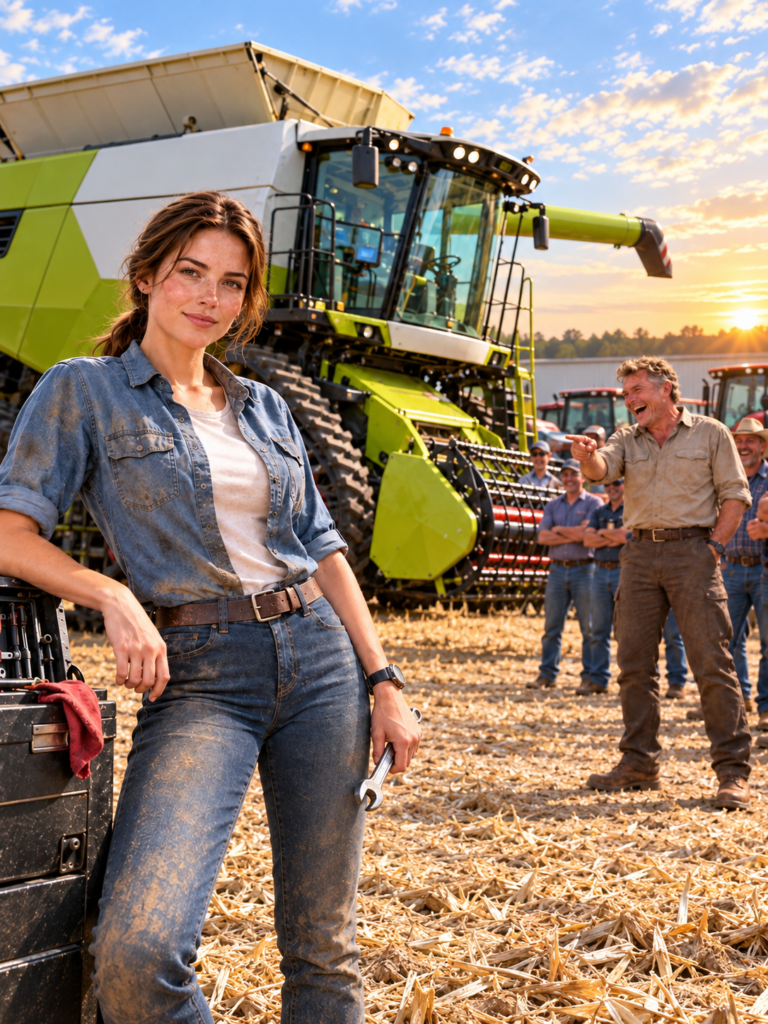
they laughed when she paid forty six thousand seven hundred for the dead claas lexion and said the engine was gone but she started it in twelve minutes and the fields proved who had listened
Part 1
Cedar Flint Farm had fed the Banning family for three generations. Nine hundred ten acres of North Dakota prairie, five hundred forty-eight of them planted to spring wheat that by late August had turned the color of dry straw and stood ready to cut. Malcolm Banning had managed every harvest personally since taking over from his father, not because he did not trust anyone else, but because he understood that a crop still standing in the field was never truly safe until it was in the bin. His daughter Sierra had grown up watching him work that way. She spent more of her childhood inside the equipment shed than anywhere else, learning to read hydraulic schematics before she could read a road map. By the time she was old enough to work summers at an agricultural dealership in Fargo, she had developed a reputation for finding faults that senior technicians walked past. Six years of that work gave her a depth of knowledge that no classroom could have accelerated. And when her father’s health began to slow him down, she came home.
Nine days before the harvest was scheduled to begin, Malcolm was checking a trailer attached to the grain cart. When the hitch released he went down hard on his right side. The collarbone snapped clean and the impact bruised the surrounding chest wall badly enough that the physician at Havenrest Regional refused to discharge him without observation. No heavy equipment for several weeks. The farm’s own harvester failed two days later. A primary drive component gave out in a way that required a specific part unavailable anywhere in the region, with a supplier shipping estimate that stretched well past the harvest window. Sierra stood in the equipment shed holding the parts list and ran the arithmetic she had been trying to avoid. The wheat was ready now. A forecast she had been tracking for several days confirmed what she feared. A major weather system was building to the northwest and serious rain was projected to arrive in less than a week. Once that happened, wheat still standing would face lodging, quality loss, and ground-level damage that no drier could fully reverse. The bank payment made everything more concrete. Seventy-three thousand nine hundred due in nineteen days, tied directly to the revenue this harvest was supposed to generate. If the crop did not come off in time, the Banning family would not be able to meet it.
She called Vaughn Sutter. Vaughn ran Sutter Harvest Services, the largest contract harvesting operation in the district. He had started with a single used machine and spent two difficult seasons paying down debt before building the fleet he now operated, and that history had made him genuinely capable at what he did. He knew wheat, knew equipment, and knew how to read a field before his header ever touched it. His success had also made him certain—certain about machines, certain about risk, and certain about the kind of people who understood the difference between the two. He quoted fifty-two thousand four hundred for the full acreage and said his crews could not start for six days. Sierra asked whether the timeline had any flexibility. His answer was brief and final. Six days was too late.
Sierra spent that evening searching liquidation listings and found the auction the following morning, a bankruptcy sale from a grain operation forty minutes outside Haven Crest. The inventory was routine until she reached an entry near the bottom: a 2024 CLAAS LEXION 8900 Terra Trac mounted with a fifty-foot draper header included. The notation beneath it stated the machine had not started in approximately eleven months and that the cause had not been fully diagnosed. Engine damage could not be ruled out. No reserve. She drove out before the auction opened. The machine was enormous, green and white in the unmistakable CLAAS livery, impressively intact on the outside for something nobody had touched in nearly a year. Sierra did not open the engine cover first. She looked at the control panel, checked the diagnostic port, and reviewed the available fault history on a printout the site manager provided. What she found was not a pattern of catastrophic mechanical failure. It was a record of inconsistent voltage behavior, the kind of instability that does not originate inside the engine itself. She did not have enough time to confirm the diagnosis fully before the bidding began, but she had seen enough to have a theory worth testing.
Vaughn Sutter was in the crowd when the CLAAS came up in the auction order. He made no effort to lower his voice when he said that only someone who did not understand machines would put money on a harvester with an unknown engine condition. When the bidding opened, Sierra raised her number. A few other parties tested the early rounds but dropped out as the price moved past what the uncertainty could justify. The hammer came down at forty-six thousand seven hundred and the laughter was immediate. Vaughn stepped forward and studied the machine for a long moment without speaking. Then he said, not with cruelty but with the flat certainty of someone stating what he believed to be a fact, that the APS Synflow system on the 8900 was more complex than anything found in a service manual, and that some decisions were mistakes before they were finished being made. He was not performing contempt. He genuinely believed he was right.
Sierra pulled her tool case from the truck, requested access to the machine’s electrical bay, asked everyone to keep clear, and set the timer on her watch for twelve minutes. She was not attempting to repair the entire machine. She was testing one hypothesis: that the primary ground circuit bonding point had degraded enough to cause the voltage instability behind every fault code in the log. She found it where she expected—loose, heavily oxidized, the kind of failure that registers as a cascade of unrelated errors without ever naming itself directly. She cleaned the contact surface, resecured the connection, verified continuity, and climbed into the cab. The MAN diesel caught on the second attempt and settled into a deep, even idle. The display screens filled with system data. The sound traveled across the entire auction yard, and the timer on her watch read twelve minutes.
Part 2
Brady Lennox had been watching from the perimeter, a field mechanic with two decades of experience fixing machines other operators had already written off. He walked directly to Sierra as she climbed down and said what needed to be said. Getting an engine running and getting a machine into a harvest field were two entirely different things. The hydraulic systems, the threshing components, the cleaning mechanism—any one of them could fail under load after nearly a year of sitting idle. He was not discouraging her. He was making sure she understood what was still ahead. Sierra already knew. She completed the paperwork, arranged the haul, and added eighty-six hundred for the lowboy transport. The CLAAS was loaded onto the trailer as the sun dropped behind the tree line. What it could actually do was a question that only Cedar Flint Farm could answer.
Brady arrived at Cedar Flint Farm the morning after the machine was delivered and spent the first hour walking around it without touching anything. That was how he worked. Observation before diagnosis, patience before tools. When he began the systematic inspection, Sierra worked alongside him. And what they found was not surprising so much as it was extensive. A hydraulic line feeding the header lift showed seepage at a fitting that had likely been weeping since before the bankruptcy. A speed sensor inside the threshing separator was sending intermittent signals that would trigger protection shutdowns under load. The grain conveyor components showed wear consistent with a machine pushed hard in its final season. The cooling system needed to be flushed and tested before anyone ran the engine under sustained demand. Brady’s estimate came to fifteen thousand nine hundred for parts, materials, and labor.
Sierra called suppliers herself, prioritized the components with the longest lead time, and worked through two full days inside the shed alongside Brady, not with the urgency of panic but with the focused economy of people who understood that speed without accuracy would cost them more than time. When they ran the machine through a staged systems check with the header engaged at low throttle, a shaft speed warning appeared on the display. Brady suspected the sensor connection, but Sierra pulled the diagnostic log and compared signal timing against the mechanical behavior of each drive component. The discrepancy pointed to a secondary harness connector behind a mounting bracket hidden from plain view. They found it—a damaged crimp. After the repair the signal held clean through a full-throttle test.
Sierra did not move the machine to the field that night. She visited her father at the hospital instead. She told him about the engine start at the auction, about the crowd going quiet, about Vaughn watching the CLAAS leave on the lowboy without saying another word. Malcolm listened until she finished, then asked her something she had not expected: whether she had bought the machine because she believed it could save the farm or because she wanted to prove Vaughn wrong. She did not answer immediately. She sat with the question on the drive home and realized that somewhere between the auction yard and the equipment shed those two motivations had begun trading places, and she was not certain which one had been leading. She went back to the shed and ran another systems check before she slept.
Part 3
Joanne Carlin arrived before dawn the following morning with her grain truck and her driver. She parked at the edge of the first field and told Sierra she would stay as long as the wheat kept moving. Joanne had farmed the neighboring property alone for several years, and she was not the kind of person who offered help without meaning to give it fully. The arrangement required very few words. The CLAAS moved into the first section of standing wheat just after sunrise. The header dropped, the feed system engaged, and grain began moving through the threshing cylinder and across the cleaning shoe. Clean wheat flowed into the tank. For the first time since Malcolm’s accident, the harvest felt like something that might actually happen.
By the following evening the machine had worked through one hundred seventy-five acres of the five hundred forty-eight. Sierra called her father from the field. He was glad, and he told her to keep checking quality. Doctor Ardan Pike arrived at the grain staging area the next afternoon to evaluate samples from the completed sections. The readings from the wetter areas of the farm were acceptable, but the samples from a drier, slightly elevated section in the eastern portion told a different story. A measurable percentage of the kernels showed fracturing and breakage above acceptable thresholds, and the foreign material content placed several loads outside the top grade specified in the delivery contract. Gwen Maddox, the grain buyer assigned to the Banning account, confirmed that discounted pricing would apply to the affected loads. The financial impact was real—not catastrophic on its own, but enough to compress the margin the harvest needed to cover the bank obligation.
Sierra understood exactly what had happened when the machine moved into the drier eastern section. She had not adjusted the concave clearance or cleaning shoe settings to match the different moisture profile. She had been monitoring ground speed and throughput, watching the loss indicators on the display and trusting the readings, but she had not taken physical samples from each new zone before continuing. The machine had been performing. She had assumed performance meant quality. She made the decision to stop and investigate before touching another acre.
Vaughn drove out when the news reached him. He walked the staging area, reviewed the sample data, and listened without the contempt he had shown at the auction. Before he said anything about price or services, he mentioned something to Brady quietly, without making a point of it, that the cleaning shoe sensor calibration on the 8900 series was known to mislead operators when wheat moisture dropped below thirteen percent. He had seen the same issue on a different machine the previous season. It was the kind of detail that only came from time in the field, not from a manual. Brady nodded. Sierra heard it and filed it away without comment. Then Vaughn offered his packaged response—cleaning equipment, grading services, and a full technical review of the combine settings—priced at twenty-four thousand eight hundred. It was a real solution, and Sierra came close to saying yes.
Instead she drove to the hospital and spread the paperwork across the visitor chair beside her father’s bed. Malcolm studied it and asked whether she had confirmed exactly which loads were affected and precisely what had caused the variance, or whether she was still working from an estimated range. She acknowledged it was still an estimate. He told her that spending money based on fear was the fastest way to spend money twice. She drove back and asked Brady and Ardan to help her reconstruct the problem from the data. They cross-referenced GPS harvest maps, machine log timestamps, crop moisture readings by zone, and sample results by delivery sequence. The problem was concentrated in a definable area where the crop conditions had changed and the machine settings had not followed. They also found a cleaning shoe adjuster that had not been correctly calibrated during the initial setup. Brady addressed the adjuster. Sierra revised the operating protocol to include mandatory sample checks each time the machine crossed into a new soil zone, regardless of what the display reported. They ran test passes, verified the results with Ardan, and only then committed to a full section. The affected loads were separated, cleaned where the grain condition permitted, and submitted at the grade they had actually achieved. Sierra did not try to recover the discount by misrepresenting what was in the bin. The CLAAS went back into the field with a revised method and the remaining wheat came off cleanly. The last loads from Cedar Flint Farm were delivered two days before the weather system arrived. Five hundred forty-eight acres finished.
Part 4
The relief Sierra felt standing at the field’s edge that evening was quieter than she expected. Not triumph, but something more settled. She thought the hard part was over. Then Joanne’s truck came down the access road at a speed that said otherwise. Joanne’s bearing had failed on the main drive assembly, not a component that could be sourced locally, with a minimum delivery window of three to four days from the nearest distributor. She still had one hundred twenty-eight acres of standing wheat, and the updated forecast on her phone showed the storm system arriving six to eight hours earlier than any previous model had predicted. What had been a manageable buffer the day before was now a hard wall.
Sierra ran the numbers without sentiment. Joanne had handed over her grain truck and her driver at four in the morning ten days earlier and stayed as long as the wheat kept moving. That offer had not come with conditions. The question now was not whether to help. It was how to do it without making the situation worse. Brady had already found the next problem before Sierra got back from Joanne’s truck: an irregular vibration in the grain elevator housing, subtle enough not to trigger a display warning, but present enough that he wanted to open the access panel before the machine ran another extended session. He found early-stage wear on a bearing in the conveyor system. Not failed, not imminent, but past the point where he would send it into an overnight run without addressing it first. He gave Sierra his honest assessment: two hours to pull the bearing, install a replacement from the parts stock accumulated during the repair phase, and verify the surrounding components. After that, the machine would be sound. The problem was that Sierra was not. Four days of split-shift operation, interrupted sleep, and the sustained mental load of quality checks, logistics, and mechanical decisions had accumulated into something she could not reason past. She knew it. She had watched her father make the opposite choice once and seen what it cost him—three weeks of repairs and a field left half finished. Exhaustion did not announce itself until after the mistake was already made.
She called Nolan Thorne instead. Nolan was thirty-nine and had spent the previous decade operating large combines for several of the biggest grain farms in the county. He was not easy to reach on short notice, but Sierra called him anyway, explained the full situation, and told him exactly what the machine had been through in the past ten days. Nolan listened without interrupting and said he would be there in forty minutes. While Brady worked on the bearing, Sierra sat at the tailgate of Joanne’s truck with a field map and laid out the harvest sequence, noting the drier eastern section, the adjustment protocol she and Ardan had developed, and the specific settings Nolan would need when the machine crossed into that zone. When he arrived she walked him through the CLAAS the same way Brady had walked her through it ten days ago—not performing confidence, giving him what he needed to make good decisions inside the cab. Nolan asked three technical questions. They were the right ones and Sierra answered them directly. Brady completed the bearing replacement and ran a startup sequence. The elevator housing was quiet. The CLAAS moved onto Joanne’s field at eleven-fifteen at night under a sky that had already changed character. The stars to the northwest gone, replaced by a flat darkness that swallowed the horizon. Joanne positioned her grain truck at the far end of the first pass. Brady parked nearby with the diagnostic readout on his phone. Ardan pulled samples from the first two loads and confirmed they were clean before the truck left for the elevator. The protocol held.
By one in the morning, sixty acres were finished. By two-thirty, eighty. The wind from the northwest was building in a way that left no doubt about what was behind it. At ninety-three acres, lightning showed at the edge of the sky. Sierra watched it, then keyed the radio and told Nolan to bring the machine out. Joanne turned to look at her. Sierra said she understood what thirty-five acres still standing meant. She also understood that the storm was no longer a forecast. It was a boundary that was moving, and continuing into electrical weather with a machine that size in an open field was not a calculation she was willing to make on anyone’s behalf. The wheat that remained would take whatever came. The people in the equipment would not. Nolan brought the CLAAS out of the field. The rain began before they had finished securing the header, and within twenty minutes it was a full downpour that made the field impassable for anything heavier than a pickup.
Part 5
Joanne stood in the open door of the equipment shed and looked at the rain for a long time. Then she turned and looked at the machine and at Sierra standing beside it and said that when the CLAAS had been bought at the auction, everyone assumed the story would be about the engine starting in twelve minutes. That was not what the past ten days had actually been. Vaughn arrived twenty minutes later. He had heard what was happening through the network of neighboring farms that passed information the way they passed equipment—informally and usually faster than expected. He stood at the edge of the shed and looked at the LEXION 8900 before he spoke. He said he had been wrong about Sierra Banning—not wrong that the machine was a risk; it had been, objectively, and the past ten days had confirmed exactly how much. What he had misjudged was the person. He had watched her start an engine at an auction and assumed that was the whole story. What followed had been something different. She had identified what was broken and fixed it. Recognized where her own judgment had failed and corrected that too. And when a neighbor needed help, she had organized people and equipment into something that worked, and then she had stopped before it became something dangerous. He told her that was not what he had expected to see.
Sierra accepted what he said without requiring him to elaborate. The machine did not need anyone to believe in it. She told him it needed to be understood. Vaughn said he would send a crew to finish Joanne’s remaining thirty-five acres as soon as the field was fit to run. When Malcolm came home from the hospital he walked through the equipment shed and found Sierra at the workbench with the CLAAS maintenance log open in front of her and a new notebook beside it. He asked about the notebook. She told him his notebooks recorded what he had fixed. She wanted to record what she had gotten wrong so she would not repeat it. The first three entries were already written. Getting the engine running in twelve minutes had been the first problem, not the last. The quality loss in the eastern section had been her mistake to own, and stopping at ninety-three acres had been the right call, even with thirty-five of Joanne’s acres still standing when she made it. Below the entries she had written one line to herself: twelve minutes proved she could start the engine. Everything after that taught her how to earn someone’s trust.
The rain continued through the night and into the next day. When the fields finally dried enough to run, Vaughn’s crew finished Joanne’s remaining wheat without incident. Sierra stood at the edge of the shed and watched the last loads leave. The bank payment would be met. The CLAAS sat clean and quiet inside the building, its fault log clear, its systems holding the settings they had learned together. Malcolm rested one hand on the workbench beside the new notebook and did not say anything for a long moment. Then he told her the harvest was in, and that was what mattered. Sierra closed the notebook and set it on top of the maintenance log. Outside, the prairie wind moved across the stubble. The machine had started in twelve minutes. The rest of the work had taken everything else she had. That was the part that stayed.

