
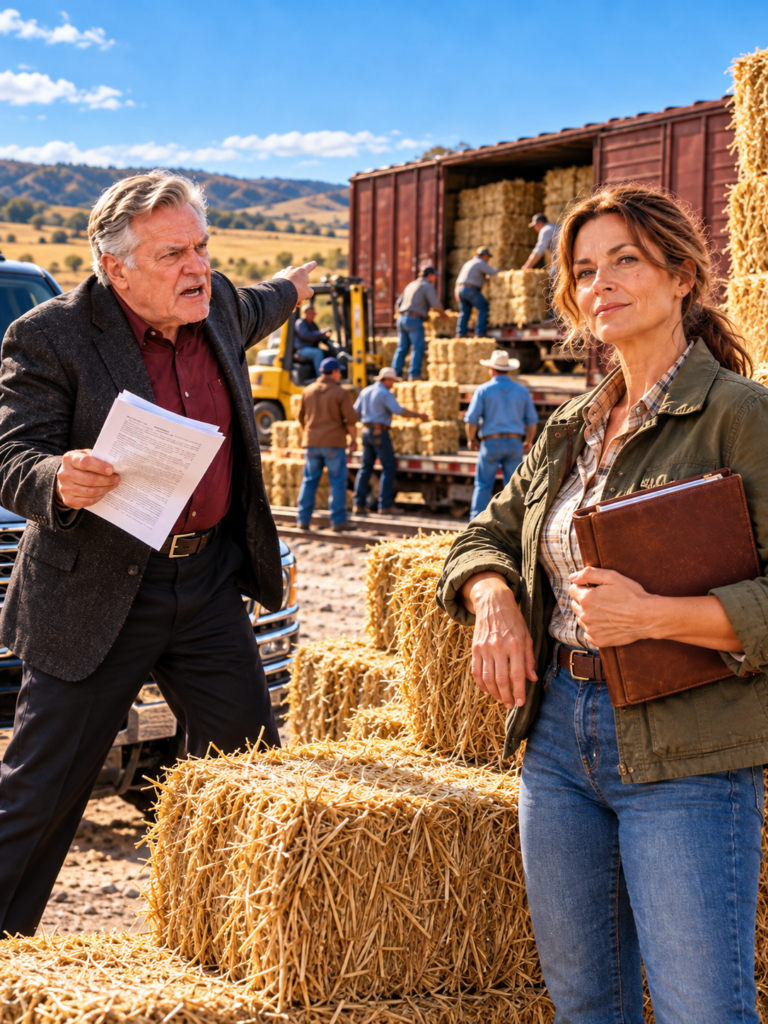
the widow bought twelve hundred dollars of white salt flat after the feed man closed her account and then the blizzard stranded the hay car sixty miles up the line
Part 1
Hazel Brannigan stood in the barn doorway on a gray October morning and counted the bales again. Eight days of hay for thirty-one head. The wind moved through the open ends of the shed and carried the dry smell of last year’s grass. Outside, the cattle stood near the hay ring Tom had set the winter before he died, waiting the way they always waited when the light came up. She had fed them first that February morning, the same way she fed them now. She had told people that part and nothing else about the day she found him.
She was fifty-eight. The home place was forty acres of mixed grass and the only reliable stock pond for six miles in any direction. For most of the thirty-four years she had lived in Harlan Bend she and Tom had run a modest cow-calf operation. It had never been large. It had been honest. After the funeral the leased pasture went back to its owner. The equipment loan came due. She sold some cows to cover it and kept the core of what Tom had spent three decades building—thirty-one head of mixed Angus and Hereford. Every dollar after that went to feed, vet bills, or the savings account she had opened in her own name. By October the account held five thousand one hundred dollars. It was the only cushion between her and the day she would have to sell.
Wendell Pruitt knew enough of that. He owned the largest hay operation in the county, nearly nine hundred acres under irrigation, and the only feed store within forty miles. His family’s land bordered hers on two sides. For two years he had made offers on the forty acres, each a little lower than the last, delivered with the same careful sympathy. She had refused every one. The morning after her last refusal his dispatcher called and told her the standing hay delivery was canceled. The payment was already refunded. Her account was closed. His offer still stood at the same price as before. He suggested she take it before winter did the negotiating for her.
She told him she would think about it. Then she walked out to her truck, opened the glove compartment, and pulled out the folded county tax sale list she had been carrying for three weeks. One parcel was circled in pencil. Wendell believed he had left her with no options. She had one. The question was whether it would be enough.
Harlan Bend sat on the edge of the Sandhills, small enough that people recognized your truck before they recognized your face. Hazel had spent the rest of that day on the telephone, calling every producer she knew. Underneath the practical answers about price and availability she heard a pattern. One neighbor’s delivery fees had quietly doubled after he bought a load from a hauler out of Kearney. Another’s hay had arrived a full week late with no explanation, right after she had asked for a better price. Nobody was angry out loud. They had each absorbed the pressure and kept quiet, the way people did in small towns. She absorbed it for a day and a half. Then she stopped asking where she could buy hay and started asking why it cost so much to bring it in at all.
The answer was trucking. Hay was cheap to grow on the northern plains and expensive to haul. Every small rancher in the county was buying one truckload at a time at retail freight rates from the one supplier who controlled the market. There was another way. In drought years northern producers shipped hay by rail in full cars at a fraction of the per-bale cost. The catch was that a rail car needed somewhere to unload. Harlan Bend had once had a grain siding on the old Platte Valley and Western line, abandoned decades ago when the elevator closed. The county had sold off nearly everything along it. Nearly everything. The parcel she had circled was 3.2 acres of alkali flat, listed for twelve hundred dollars, the amount of back taxes owed. It had sat unclaimed for years. The soil was white with salt crust. Nothing grew on it. No well had ever been drilled, and the fence had rotted into the dirt. A farmer would drive past and see only liability.
She drove out that afternoon and parked at the edge of the flat. At the far side ran a straight, raised strip of old gravel ballast. Beside it sat a rotted wooden platform and a rusted set of rails that had once been a loading spur. The main line still ran past, still active. The siding, on paper, still connected. She stood with her hands in her jacket pockets and listened to the wind move across the white ground. Tom would have called it worthless. She was not sure he would have been wrong. But she was also not sure it was only worthless.
Part 2
She called the short-line railroad that afternoon. A freight agent named Sheila Dunning took the call, and after some digging confirmed that the siding was dormant but legally intact. If someone could prove ownership of the land and rebuild the platform, the railroad would be willing to spot hay cars there. A northern producer in North Dakota had been trying to move surplus hay south for two seasons. He would sell by the car at a price that made her read the numbers three times. She confirmed the zoning with the county and got everything in writing before she spent a cent. By Friday the land was hers. Twelve hundred dollars for the parcel, another three hundred and forty in filing and closing costs. She spent a little more on pressure-treated lumber, a rented loader for a weekend, and a used platform scale from an auction in Grand Island. When the dust settled she had thirty-one hundred dollars left. A flat white lot nothing could grow on, a repaired loading platform, and a rail spur most of the county had forgotten existed.
The harder part was the neighbors. The railroad wanted full cars, and a full car was far more hay than she could use. She would need other ranchers to commit. She went door to door to the households that had mentioned Wendell’s fees and late deliveries and quiet pressure. She explained the plan plainly. Pool the order, split the freight, pay up front for your share, and pick up at the siding. She would run the coordination and charge a small handling fee, listed separately from the price of hay. Most of them listened. Most of them did not say yes. The hesitation was understandable. She had never run a distribution point. The lot had no roof, no office, no history. Wendell had delivered reliably for years. She was asking them to hand money to a patch of salt flat and trust that a train would show up.
Six households agreed to the first car. She decided that was enough. The first delivery did not go smoothly. The railcar arrived a full day late. The platform ramp, which she had built to a specification she found online, turned out to be six inches too steep for the forklift the railroad sent. So the first car was unloaded bale by bale, by hand and by tractor, in November wind, with a handful of neighbors working in shifts until after dark. Her handling fee disappeared into the small things—a ripped tarp, a broken strap, a thermos of coffee for every person who showed up. She made almost nothing on the first run. But when the work was done and the bales were stacked, sorted by household, something changed in the air. One rancher, an older man named Earl Tibbetts, walked down his row of bales twice, counting. He said nothing for a long while. Then he took out a folded receipt from his last order with Wendell and compared the numbers right there in the cold. It was lower. Not by a dramatic amount, but consistently, honestly lower, even with the hassle, even with the delay. Earl nodded once, loaded his trailer, and drove home without a word. Hazel understood that. She drove home too and did not say much to herself either.
Within a week someone had posted a plain cost breakdown on a local ranching forum. No commentary, only the numbers. The next day the questions started. People wanted to know how to get on the list for the next car. Wendell noticed. He called her on a Tuesday morning and kept his tone easy, almost friendly. He was willing to restore her account. Regular deliveries, competitive pricing, no more disruptions. All she had to do was stop organizing the rail orders. Keep the land, use it however she liked. Just do not run a competing supply line through it. She almost said yes. The honest truth was that she was tired. She was up before dawn with the cattle, spending her afternoons on freight schedules and invoices, running a business she had never planned on running for neighbors who were not family. Saying yes to Wendell would have meant going back to something simpler.
Part 3
That same afternoon Earl Tibbetts drove out to the siding, mostly to look around. He mentioned, almost in passing, that his delivery fees from Wendell had gone up a few weeks before, right around the time her account was canceled. He showed her the invoices. The increase was not huge, but it had arrived without explanation at exactly the moment his options had narrowed. She told Wendell no. She opened the second run with a bigger order, and the larger volume created new problems immediately. The platform could only handle so much at once. The storage tarps were not enough. She had to set strict pickup windows, and some neighbors grumbled about it. A few asked if they could pay after delivery. She turned them down. She had no cash to front anyone’s share, and a single unpaid order could collapse the whole model before it was proven.
Wendell began calling households directly. Two of them dropped out of the second run after he offered temporary price cuts. Their departure raised the freight cost for everyone who stayed. She recalculated, posted the new total publicly, and reduced her own fee to absorb the difference. Most people stayed. The second car was scheduled for day twenty-eight. Several ranchers had planned their remaining feed around that date, stretching their last bales to arrive as close to empty as they dared. On day twenty-five the blizzard hit. It came in from the northwest faster than forecast. Sixty-mile-an-hour winds and two feet of snow drifted across the county in a single night. The state closed the highway. The railroad shut down the line, and the hay car sat stranded on a siding sixty miles away.
The railroad called her the next morning. Crews were working, but the line might be closed for as long as ten days. The alternative was to transfer the hay at the railhead onto trucks and haul it the last sixty miles on the one road that was passable. She asked for the cost. It was far more than what she had in her account. Everything she had left was in the gravel under her feet, the platform, and the scale. By evening the messages began. Neighbors who had already paid were asking what was happening. Some of them had cattle that would run short of feed before a ten-day delay was over. And early the next morning Wendell Pruitt pulled up to her gate. He had not called first. He stepped out of his truck in the cold and told her, politely, that the offer on her land was still open. The price he named was lower than before. Of course, he added, if the delivery fell through, the other ranchers would likely come to him, and they would be paying whatever he asked.
She stood at the gate with her ledger in one hand. The neighbors’ money was tied up in a stranded rail car. Her savings were in a gravel lot. She had no room to maneuver and no clean way out. Seven families were counting on a delivery she had no way to complete. She did not give him an answer that morning.
Part 4
Instead she spent two hours on the phone. She called the railroad, the North Dakota producer, and a trucker named Dutch Alvarez who ran a small fleet of heavy-duty rigs with snow chains out of a yard thirty miles east. Dutch had two trucks available and could make the trip, but his rate was still more than she could cover alone. Before she worked out how to close that gap, she did something that cost her more than money. She called every household on the second run and asked them to meet at her barn that evening. She told them it was not good news.
When they arrived she set three things on the tailgate of her truck: the delivery confirmation, the trucking estimate, and a slip of paper showing her bank balance. She did not talk for long. She told them the line was closed, the car was stranded, and the cost to fix it was more than she had. She told them she had not kept enough reserve for a transportation failure. That was her mistake and she said so plainly without softening it. The silence afterward was not comfortable. A woman named Marisol Vega said she had already told her husband the hay was handled. A younger man in the back crossed his arms and looked at the floor. Someone asked whether they could have a refund right away. She could not give one. The money was already with the producer, but she told them she would work to get any portion back for anyone who wanted out.
Then she laid out the only path she could see. The railroad would unload the car onto Dutch’s trucks at the railhead in two runs, delivering most orders within forty-eight hours. Neighbors with their own trailers who could make the drive could pick up at the railhead directly and skip the siding entirely, which would shrink the load and cut the cost. She told them she would take no handling fee on this run—not a reduced fee, nothing. The remaining gap, the difference between Dutch’s price and what she could pay, she closed herself.
In the machine shed behind her barn sat a 1974 Farmall that Tom had spent six winters restoring bolt by bolt. It ran like a watch. He had never sold it and she had never considered it. She made a call that night. A collector from Lincoln drove out the next morning, walked around the tractor twice, and wrote her a check. She stood at the shed door after he pulled away with it and did the arithmetic one more time. She had sold the last thing her husband had left behind with his own hands to cover a shortfall she had not planned for. But she had not sold her land to Wendell Pruitt. She had not handed over a ranch to the man who had manufactured the crisis in the first place. The cost was real. The distinction mattered.
By day thirty the operation looked nothing like what she had planned. Dutch’s trucks made four trips through the drifts, chains clattering on the packed snow. Neighbors with trailers drove out to the railhead and loaded the hay themselves. The siding received the last partial loads across a single bitter afternoon, each truck pulling through the gate in sequence, unloading, and leaving. She stood at the entrance with the ledger, checking off every household as its order came in. Every family got exactly what they had paid for. Some of them said thank you. Some did not. She marked the last line in the ledger either way.
Part 5
Two days later Wendell Pruitt drove up to the siding. He did not bring a trailer this time. He came with a business-like manner and a proposal. He was prepared to supply the siding directly with competitive pricing, a regular schedule, and no complications. He framed it as a practical arrangement for everyone. She told him she was open to hearing from any supplier. Then she told him what she would need before any agreement moved forward. A written price schedule, clearly defined delivery terms, and a confirmed policy that no customer of hers would ever be pressured to sell land or livestock as a condition of buying feed. He did not respond to that last point. He got back in his truck and drove out the gate.
The lot looked the same as the day she had bought it. A white salt flat, a repaired platform, a rusted rail line that most people drove past without a second glance. But it was no longer Wendell Pruitt’s to control. In the months that followed she grew the operation carefully. She capped the households per car. She set a minimum reserve fund that had to be in place before any order was confirmed. She made contact with a second northern producer so no one in Harlan County would depend on a single source again. The runs were never perfectly smooth. The money was never fast. She still got up before dawn and fed her cattle by hand, and she did it with one less tractor than before. But the cattle had hay, the gate was hers to open, and her neighbors had somewhere to go.
One afternoon a man leaned on the fence and asked when she planned to put something on that ground. Plant some grass maybe, make it look like something. She looked out at the white flat and the platform and the tracks. She told him she had not bought it to grow anything. She had bought it so she would have a place where no one could close the gate in her face. What she built was not impressive on paper. It was a salt flat, a loading platform, and a gate. And yet it changed everything for the people who depended on it. She did not win by overpowering Wendell Pruitt. She won by understanding exactly why she had no options and then quietly building one. And the real cost was never twelve hundred dollars. It was the willingness to stand in front of her neighbors and say here is what I got wrong and here is how we fix it. To sell the one thing Tom had left behind so no one else would have to pay for her mistake. That is what independence actually looks like. Not a clean victory, but a choice she could stand behind when it got expensive. She closed the ledger that evening, locked the gate on the salt flat, and drove home through the last of the light. The cattle were waiting by the hay ring. She fed them first, the same way she always had.


