
Part 1
The first time someone called Ingrid Halvorsen crazy, she was standing on a wooden scaffold outside her cabin, holding a twenty-pound stone against her chest.
The second time, she was carrying a sack of mortar up the hill.
By the third time, she had stopped counting.
It was the summer of 1884, in a little settlement called Birch Hollow in the Dakota Territory, and the people of the valley had decided that grief had finally broken the young widow’s mind.
Ingrid was only twenty-three.
Her husband had been dead for four months.
She had no children, no close relatives within a thousand miles, and barely enough money to carry her small farm through another winter.
Yet instead of finding a new husband or selling the property, she was doing something nobody in Birch Hollow could understand.
She was taking apart the stone chimney of her cabin and rebuilding it into a structure nearly three times its original size.
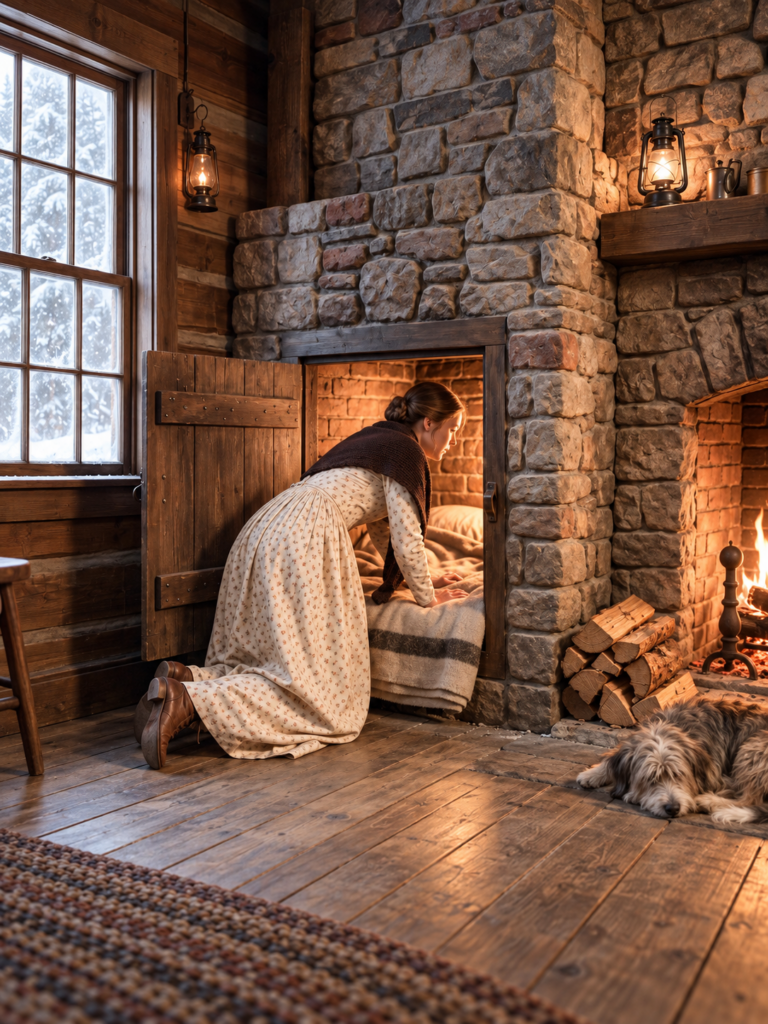
And inside that enormous chimney, she was making a bed.
Not beside the fireplace.
Not behind it.
Inside the stonework itself.
“She’ll roast herself alive,” one farmer declared.
“She’ll suffocate before Christmas,” another predicted.
But the cruelest remark came from Edward Ashford, the wealthiest landowner in the valley.
Standing in Elias Thorson’s general store, with half a dozen men listening, Edward shook his head and laughed.
“That poor girl has decided to build her own coffin. At least she’s saving the undertaker some trouble.”
Several men laughed with him.
Nobody told Ingrid.
Not directly.
But in a settlement where thirty families depended on one general store, one church, and the same narrow wagon road, words traveled faster than horses.
Within a week, everyone knew.
The young widow on the hill was building herself a stone coffin.
And winter would decide whether she was a fool.
But there was something the people of Birch Hollow didn’t know.
Something Ingrid had carried across the Atlantic Ocean from Norway.
Something written on three yellowed sheets of paper by a man who had never set foot in America.
Her father.
And what those papers contained would eventually change the way an entire community survived the cold.
Six months earlier, Ingrid’s life had been very different.
Her husband, Anders Halvorsen, had been thirty-one years old, broad-shouldered and quiet, with strong hands that always seemed to smell of pine shavings.
They had married when Ingrid was twenty.
Together they built a small homestead on a rise overlooking Birch Hollow.
The cabin had one main room, a narrow pantry, and a loft used for storage.
There was no separate bedroom.
Their bed stood behind a curtain near the eastern wall.
Anders had promised to add another room someday.
“When we have children,” he would say, “I’ll build you a proper bedroom with a window facing the sunrise.”
Ingrid would smile.
“And what if we have six children?”
“Then I’ll build six rooms.”
“With what money?”
He would grin.
“I’ll figure that out when they arrive.”
They had laughed often in those early years.
There was plenty of work, but they were young.
They kept two milk cows, a dozen chickens, and a vegetable garden behind the cabin.
They planted corn in the lower field and potatoes in the sandy soil near the barn.
Anders repaired wagons for neighbors when farming work was slow.
Ingrid made butter and sold eggs at Thorson’s store.
They did not have much.
But the land was theirs.
The cabin was warm.
And every evening, when Anders came inside with snow on his shoulders, Ingrid would have supper waiting beside the stove.
Then, in March, everything changed.
Anders developed a cough.
At first, he dismissed it.
“Just a little cold.”
But the cough deepened.
Fever followed.
He grew weak.
Ingrid sent for a doctor from the river settlement, nearly twelve miles away.
The doctor came through freezing rain and stayed for hours.
But by the third evening, Anders could no longer sit upright.
Ingrid held his hand through the night.
Shortly before dawn, he opened his eyes.
“Don’t sell the place,” he whispered.
She leaned closer.
“Don’t talk like that.”
“Promise me.”
“Anders—”
“Promise.”
Tears streamed down her face.
“I promise.”
He managed a faint smile.
“You’re stronger than you think.”
Those were his last words.
The ground was too frozen for an ordinary burial.
Neighbors helped prepare a temporary resting place until the spring thaw softened the earth.
When the time came, Ingrid buried Anders beneath an old burr oak at the edge of their field.
The burial service was small.
Pastor Halver read from the Bible.
Elias Thorson stood beside her.
Several women brought food.
But when everyone left, Ingrid remained beneath the oak.
She stared at the fresh earth.
Three years earlier, she had crossed an ocean to begin a life with Anders.
Now she was standing on a lonely hill, wondering how she would survive without him.
The house seemed unbearably silent that night.
His boots were still beside the door.
His coat hung from its peg.
His tools lay on the workbench exactly where he had left them.
Ingrid could not bring herself to move anything.
For weeks, she barely spoke.
She milked the cows.
Fed the chickens.
Carried water from the well.
Prepared meals she often could not finish.
At night, she slept beneath two quilts and Anders’s old wool coat.
The stove slowly cooled while she slept.
By morning, the room was bitterly cold.
Anders had always risen during the night to tend the fire.
He seemed to wake whenever it needed wood, as though years of winter had taught his body to listen even while sleeping.
Ingrid was not accustomed to that responsibility.
She tried setting an alarm clock.
Sometimes she heard it.
Sometimes she slept through it.
One morning, she woke with her fingers painfully stiff from the cold.
The water in a pitcher beside the bed had developed a thin layer of ice.
She sat upright and stared at it.
Winter was still months away.
And she was already afraid.
The cabin had been built for two people.
Two people who could share the work.
Two people who could take turns being tired.
Now there was only one.
And the Dakota winter would not care that she was grieving.
That evening, Ingrid opened an old wooden trunk.
Inside were a white dress, several letters, a small Norwegian Bible, and the linen garments she had brought from her homeland.
Beneath the lining, carefully sewn into a narrow pocket, were three folded sheets of paper.
Her father had given them to her before she left Norway.
Johan Vold had been a stonemason in a mountain village where winter storms could bury houses beneath snow.
He was not wealthy.
He had little formal education.
But he understood stone, fire, and cold.
When Ingrid was a child, she had watched him repair the great masonry heating structures in old farmhouses.
Some were enormous, built into the center of the home.
Others contained benches, shelves, or small sleeping alcoves that remained pleasantly warm long after the evening fire burned low.
When Ingrid was seven, her mother died of fever shortly before Christmas.
That winter, she cried herself to sleep almost every night.
Her father eventually began putting her to bed in a little sleeping alcove beside the massive stone heater.
It was enclosed on three sides and warmed by the heat stored in the masonry.
Ingrid remembered the soft wool blankets.
The smell of dried lavender.
And the wonderful feeling of warmth against her back when the rest of the house was cold.
One night, she asked her father why the stone stayed warm even after the fire was out.
Johan placed his rough palm against the wall.
“Stone remembers the fire,” he said.
Ingrid had been too young to understand.
“Like people remember?”
Her father smiled sadly.
“A little like that.”
Years later, before she left for America, Johan gave her the papers.
“I’ve written down what I know about building with stored heat,” he explained.
She laughed.
“Father, Anders can build a good chimney.”
“I don’t doubt it.”
“Then why would I need these?”
Johan folded the papers.
“Because a day may come when what you need is not a good chimney.”
He placed them in her hand.
“You may need a house that remembers warmth.”
Now, sitting alone in the Dakota cabin, Ingrid opened those pages.
The handwriting was cramped and careful.
There were sketches of old masonry heaters, notes about insulation, measurements, and descriptions of how heat could be stored and released slowly.
The papers were not a complete building plan.
They were a record of knowledge passed down through generations of Norwegian stoneworkers.
Anders had built their cabin with an ordinary stove and chimney.
It heated the room well when the fire was burning.
But the cabin lost warmth quickly when the fire died.
Ingrid studied her father’s notes until midnight.
Then she looked toward the chimney.
For the first time since Anders’s death, her thoughts moved beyond grief.
She began to imagine something different.
A large masonry structure that could store warmth.
A small sleeping place protected from the worst drafts.
A way to make the cabin safer and more comfortable without depending on a roaring fire every hour of the night.
She knew it would require careful design.
She knew smoke, overheating, and dangerous gases could turn a poorly built system into a death trap.
Her father had warned her repeatedly about that.
But she also knew the principle was real.
She had lived inside a house built around it.
She had felt the warm stone with her own hands.
And she had something else the people of Birch Hollow did not know.
Before marrying Anders, Ingrid had spent years helping her father prepare and repair masonry heaters.
She understood more about stonework than any of the men laughing at her would ever imagine.
The following morning, Ingrid took a pencil and began drawing.
By evening, she had made her decision.
She would rebuild the chimney.
And this time, she would build a house capable of protecting one person through a Dakota winter.
Even if that person had to do it alone.
Part 2
On the second Monday in May, Ingrid walked into Thorson’s General Store carrying a folded piece of brown paper.
Elias Thorson looked up from his ledger.
He was sixty-seven, with silver hair, a heavy mustache, and the patient expression of a man who had spent forty years listening to farmers argue about prices.
“Morning, Mrs. Halvorsen.”
“Good morning, Mr. Thorson.”
He noticed the paper.
“Shopping list?”
“Yes.”
She handed it over.
He read the first item.
Then the second.
Then the third.
He looked at her.
“Fireclay mortar. Mason’s line. Stoneworking hammer.”
“Yes.”
He adjusted his spectacles.
“Planning to build something?”
“I’m rebuilding my chimney.”
Elias frowned.
“Anders put that chimney up himself.”
“I know.”
“Far as I remember, it drew well.”
“It did.”
“Then what’s wrong with it?”
Ingrid hesitated.
“Nothing is wrong with the chimney. But it doesn’t do enough.”
Elias waited.
She did not explain further.
After a moment, he folded the paper and walked toward the storage room.
“I’ll see what I’ve got.”
As Ingrid counted her coins, Elias watched her carefully.
She was thin from months of poor appetite.
Her pale hair was tied tightly behind her head.
Her dress had been repaired at the elbows.
But her eyes were steady.
For the first time since Anders died, she looked like someone who had a purpose.
Elias decided not to question her.
He had known her husband well.
He knew the young couple had worked hard for their property.
And he knew that grief could make ordinary tasks feel impossible.
Perhaps building something was her way of surviving.
He could understand that.
But when Ingrid left with the supplies, he stood in the doorway watching her wagon disappear up the hill.
Then he shook his head.
“That is one determined girl,” he murmured.
By the end of the week, the chimney was coming apart.
Ingrid borrowed scaffolding from a neighbor and began removing the old stonework in carefully planned sections.
She marked the stones.
Recorded the existing structure.
And sorted reusable material from damaged pieces.
It was slow work.
Each stone had to be lifted, carried, and placed where it would not obstruct her work.
The first day, she managed only a small section.
By evening, her shoulders burned.
Her hands ached.
When she washed them in a basin, the water turned gray with dust.
She ate cold bread and cheese for supper.
Then she sat at the table with her father’s papers.
The cabin smelled of mortar and newly exposed stone.
Anders’s tools were still on the shelf.
She looked at them.
For a moment, she remembered the day they had built the original chimney.
Anders had handed her a stone.
“Think this one will fit?”
She inspected it.
“Turn it.”
“Which way?”
“The other way.”
He turned it.
The stone settled into place.
Anders grinned.
“Married myself a good mason.”
“You married the daughter of one.”
“Lucky me.”
The memory hurt so sharply that Ingrid closed her eyes.
She wanted to hear his laugh again.
She wanted him to walk through the door and take the heavy hammer from her hand.
She wanted to tell him that she was frightened.
But the cabin remained silent.
So she wiped her eyes and continued drawing.
The following Sunday, three women from the valley came up the hill.
One carried a basket of bread.
Another brought a jar of preserved peaches.
The third, Greta Harmon, was a young newlywed who lived less than two miles away.
They found Ingrid working beside the unfinished chimney.
Greta stared at the stone piles.
“Ingrid, what on earth are you doing?”
“Rebuilding.”
“But why?”
“I need the chimney to hold warmth longer.”
Greta glanced at the others.
“Couldn’t you simply use more firewood?”
“I could. But that would mean burning more wood all winter.”
One of the older women frowned.
“Is this something they do in Norway?”
“Yes.”
“Well, perhaps Norway is different.”
“It is,” Ingrid replied. “But cold is cold.”
The women exchanged uncertain looks.
Greta moved closer to the plans spread across a board.
“What’s this opening?”
“A sleeping alcove.”
“A what?”
“A protected bed beside the warm masonry.”
Greta looked from the drawing to the chimney.
“You’re going to sleep inside that thing?”
“In a separate insulated space, not in the smoke passage.”
Greta’s mouth opened.
Then closed.
For several seconds, nobody spoke.
Finally, the oldest woman sighed.
“Oh, Ingrid.”
It wasn’t anger.
It was pity.
And somehow, pity hurt more.
That afternoon, the three women returned to the valley.
By supper, the story had changed.
Ingrid was building a bed inside the fireplace.
By Monday, people claimed she intended to sleep with her head beside the flue.
By Wednesday, Edward Ashford had made his coffin joke.
Ingrid heard it from a boy delivering eggs.
She listened without interrupting.
Then she paid him and returned to her work.
But that evening, the insult followed her into the cabin.
She sat beneath the lamp, staring at her father’s papers.
A coffin.
The word echoed in her mind.
She remembered her husband’s burial.
The rough wooden box.
The frozen ground.
The final handful of earth.
She had buried the man she loved only weeks earlier.
And now the valley was joking that she wanted to bury herself.
Ingrid pressed her hands against her face.
For a long while, she cried.
Then she stood, opened the door, and looked toward the village lights far below.
Those people had known Anders.
Some had eaten at their table.
Some had asked him for help repairing wagons and fences.
They had stood beside his grave.
Yet now they laughed at the woman he had left behind.
Ingrid felt anger rising.
She could march down the hill and explain everything.
She could show them her father’s drawings.
She could demand that they stop treating her like a helpless fool.
But then she looked at the unfinished chimney.
The work was waiting.
And winter was coming.
She closed the door.
The next morning, she began again.
June brought warmer weather.
The fields turned green.
The cows grew fat on pasture.
Ingrid worked on the chimney during the long daylight hours, stopping only to care for the animals and prepare meals.
She found that the physical work helped steady her thoughts.
There was always another task.
Another measurement.
Another piece of stone to prepare.
Her father had taught her that masonry rewarded patience.
A rushed joint could fail.
A poorly supported wall could shift.
And any heating structure had to be designed with careful attention to fire separation, clean draft, and proper ventilation.
Ingrid refused to take shortcuts.
When she encountered an unfamiliar problem, she returned to her father’s notes or asked Elias to help her locate someone with relevant building experience.
She also consulted a traveling stove mason who came through the river settlement that summer. He examined her drawings, questioned her about the firebox and flue, and made several corrections before she continued.
“You understand the principle,” he told her.
“I learned from my father.”
“Then your father knew his trade.”
The mason inspected the emerging stonework.
“This is not a small project.”
“I know.”
“Why not build a bedroom instead?”
Ingrid looked toward the unfinished wall.
“A bedroom would still be cold when the fire goes out.”
He nodded slowly.
“Fair enough.”
The work consumed most of her summer.
Some days were productive.
Others were miserable.
One morning, a sudden rainstorm soaked a pile of materials she had left uncovered.
Another day, a stone slipped from her grip and struck her foot.
She limped for a week.
By July, her savings were almost gone.
She sold two pieces of furniture she no longer needed and used the money to purchase additional materials.
She also traded eggs and butter for lumber.
At night, she calculated expenses beside the lamp.
She feared the project might cost more than she could afford.
Sometimes she imagined Anders shaking his head.
“Too stubborn for your own good, Ingrid.”
She could almost hear his voice.
But she remembered what he had said before he died.
You’re stronger than you think.
So she continued.
By August, the structure began to resemble her drawings.
The original chimney had become part of a much larger masonry heating system.
Beside it was a small sleeping chamber, separate from the fire and exhaust passages.
Ingrid framed the sleeping compartment with carefully selected pine.
She made it large enough for one person to lie comfortably, but small enough to retain warmth efficiently.
She insulated the outer surfaces and fitted a sturdy door.
Most importantly, she ensured the sleeping space had permanent ventilation and could be opened easily from within.
She did not trust the warmth until the entire heating system had been inspected and tested.
There was no sense surviving the cold only to be overcome by smoke.
Elias Thorson visited in late August.
He brought bread, smoked ham, and a small jar of honey.
Ingrid welcomed him inside.
They ate at the table.
For a long time, Elias said nothing about the enormous stone structure occupying one side of the room.
Finally, he stood and approached it.
He ran his hand along the masonry.
“That’s a great deal of stone.”
“Yes.”
“And you laid most of it yourself?”
“Yes.”
He examined the opening for the sleeping chamber.
“Well, I’ll be.”
Ingrid watched him.
“Do you think I’m foolish?”
Elias turned.
The question surprised him.
“Why would you ask that?”
“Everyone else does.”
The old man’s face softened.
“Ingrid, I’ve been alive long enough to know that most people are certain about things they haven’t taken the trouble to understand.”
She looked down.
“Then you don’t think I’ve lost my mind?”
“I think you’re trying to solve a problem.”
He smiled.
“Whether you’ve solved it is something we’ll know when winter comes.”
Ingrid felt a small knot loosen in her chest.
It wasn’t praise.
But it was respect.
And she had been without that for a long time.
When Elias left, he paused at the doorway.
“Your husband would have been proud of how you’ve kept this place.”
Ingrid could not answer.
After he went, she stood beside the unfinished chimney and cried.
This time, the tears were not entirely sorrow.
Part 3
The first test came on an October evening when frost had begun gathering along the fence rails.
By then, Ingrid’s masonry heater and sleeping chamber had been completed, examined, and tested for safe operation.
She had taken special care with the fire and exhaust system, allowing the new masonry to cure fully and checking the airflow under different conditions.
She also understood that the structure would need regular inspection and careful use.
Her father’s knowledge had taught her the principle.
Her own work had turned it into something she could trust.
That evening, Ingrid built a steady fire in the stove.
She watched the flames.
The broad stone mass slowly absorbed warmth.
Hours passed.
When the evening fire had burned down, she checked the surfaces of the sleeping chamber.
They were pleasantly warm.
Not dangerously hot.
She opened the door.
Inside lay a narrow mattress, a wool quilt, and a small pillow.
There was a shelf for her lamp, though she kept any open flame outside the chamber while sleeping.
She had placed a thermometer near the sleeping area and another on the cabin wall.
The main room was cooling.
The smaller compartment remained comfortable.
Ingrid sat on the mattress.
She reached back and touched the warm wall.
For a moment, she was seven years old again.
She could almost hear her father’s footsteps on the wooden floor.
Almost feel him tucking the blanket around her shoulders.
Almost smell the lavender her mother had kept in a little cloth bag beside the bed.
She closed her eyes.
“Papa,” she whispered, “I remembered.”
That night, she slept more peacefully than she had since Anders died.
She woke before dawn.
For several seconds, she lay still.
The warmth remained.
Outside, frost covered the grass.
Inside the main room, the air was cold enough to make her reach quickly for her shawl.
But the sleeping chamber had held a remarkably steady temperature.
Ingrid checked the thermometer.
Then the one on the wall.
She wrote both readings in a small leather notebook.
It was the same notebook she had once used to record butter production and animal feed.
Now she began a new section.
October 12, 1884.
Outside: 28°F.
Main room: 41°F.
Sleeping chamber: 64°F.
She stared at the figures.
The numbers were not a miracle.
They were evidence.
Her father had been right.
The stone could store heat.
The smaller compartment could retain warmth.
And a carefully designed house could offer protection that ordinary walls and blankets could not provide alone.
Ingrid smiled.
Then she made coffee and went outside to feed the cows.
The following Sunday, she attended church for the first time since Anders’s funeral.
She wore her white dress, freshly washed, with a gray wool shawl over her shoulders.
The road was muddy from autumn rain.
Golden leaves covered the churchyard.
When Ingrid entered, several people turned to look at her.
She took her old seat near the back.
Pastor Halver preached about wisdom and perseverance.
Ingrid listened quietly.
After the service, Greta Harmon approached.
“Ingrid, it’s good to see you.”
“Thank you.”
“How are you managing up there?”
“Better than I was.”
Greta hesitated.
“I heard you finished the chimney.”
“Yes.”
“And the bed?”
“Yes.”
Greta glanced toward a group of women standing nearby.
“Do you really sleep inside it?”
“In the insulated sleeping chamber beside the masonry.”
“Every night?”
“When the weather is cold.”
Margaret Ashford had been listening.
She stepped closer.
Margaret was forty-two, tall and well dressed, the wife of the valley’s wealthiest farmer.
She was accustomed to being listened to.
Her husband owned the largest house in Birch Hollow, with two stories, several bedrooms, and more farmland than most neighbors could imagine.
Margaret looked at Ingrid.
“So you actually sleep inside your chimney?”
A few women smiled.
Ingrid answered calmly.
“Beside the masonry. The stone stores heat from the stove and releases it slowly.”
Margaret raised an eyebrow.
“And you believe that’s safe?”
“The heating system has been inspected, and the sleeping space is separate from the flue.”
“Still,” Margaret said, “it seems a peculiar arrangement.”
Ingrid looked at her.
“It works.”
Margaret smiled thinly.
“Well, I suppose time will tell.”
She turned away.
The women followed.
Ingrid stood alone beneath the churchyard maple.
She had expected questions.
Perhaps curiosity.
Instead, she had received the same old judgment.
She walked home without speaking to anyone else.
Within days, the mockery returned.
Some called her sleeping chamber the widow’s drawer.
Others called it the roasting box.
Caleb Harmon, Greta’s twenty-two-year-old husband, became particularly outspoken.
He was a skilled carpenter, strong and hardworking, but young enough to mistake confidence for knowledge.
One Saturday, he announced at Thorson’s store that Ingrid had built herself a dangerous contraption.
“Everyone knows smoke follows the chimney,” he declared. “Why would anyone put a bed anywhere near it?”
Elias looked up from his ledger.
“Have you seen the structure?”
Caleb shrugged.
“I’ve heard enough.”
“Then perhaps you haven’t heard enough.”
The younger man laughed.
“Come on, Mr. Thorson. Would you sleep in it?”
Elias did not answer immediately.
“I’d inspect it before judging it.”
But the room had already sided with Caleb.
Several men nodded.
Edward Ashford smiled.
“Maybe the widow’s planning to smoke herself like a Christmas ham.”
Laughter filled the store.
Elias returned to his ledger.
He regretted his silence later.
Ingrid heard the story the following week.
She said nothing.
Instead, she continued recording the temperatures.
Every morning.
Every evening.
Outside.
Inside the main room.
Inside the sleeping chamber.
She kept notes about the weather, fuel consumption, and how comfortably the structure performed.
The entries began forming a pattern.
On nights when the outside temperature dropped sharply, the main room cooled much faster than the protected sleeping space.
She learned how long the masonry retained warmth under ordinary conditions.
She also learned its limitations.
It could not create heat from nothing.
During prolonged severe cold, she still needed to maintain the stove safely and regularly.
But she used less fuel than before.
And she no longer woke every morning feeling as though the cold had settled into her bones.
One afternoon in November, Elias arrived at her cabin.
He carried a basket of supplies.
Ingrid invited him inside.
The room was warm.
A kettle sat on the stove.
The great stone structure dominated the southern wall.
Elias approached it.
He placed his hand against the masonry.
Then he stood very still.
“That’s warm.”
“Yes.”
He moved his hand farther along the wall.
“Still warm here.”
“Yes.”
“How long since the last good fire?”
“Several hours.”
Elias looked at her.
“May I see the sleeping chamber?”
Ingrid opened the door.
The old man bent carefully and inspected the interior.
His expression changed.
He touched the warm wall.
Then the pine frame.
He examined the ventilation opening.
Finally, he sat back on his heels.
For a long moment, he said nothing.
When he spoke, it was in Norwegian.
“My grandmother slept in a place like this.”
Ingrid froze.
Elias looked almost embarrassed.
“I had forgotten.”
He sat on a chair beside the masonry.
“When I was a boy, before we came to America, my grandparents lived in a mountain village. They had a great stone heater in the middle of the house.”
He smiled faintly.
“There was a little sleeping place beside it. My grandmother used to let me sleep there when I visited.”
Ingrid sat opposite him.
“My father built them.”
Elias nodded.
“Of course he did.”
He touched the stone again.
“Forty years in this country, and I’d forgotten something I once knew with my own hands.”
Ingrid felt tears rising.
For months, people had treated her as though she had invented some foolish contraption.
Now one man remembered.
And suddenly, the lonely work of the summer seemed connected to something much older.
Something that had survived across generations.
Elias asked questions.
Careful questions.
Questions about the masonry, the ventilation, the inspection, and her temperature records.
Ingrid answered every one.
They talked for nearly two hours.
When Elias finally stood to leave, he put on his coat slowly.
“Ingrid, would you mind if I told people what I’ve seen?”
She looked at him.
“Why?”
“Because a young woman has been treated poorly for building something most of us didn’t understand.”
She looked down.
“You don’t have to defend me.”
“I know.”
He paused.
“But perhaps I should have done it sooner.”
Two days later, Edward Ashford entered Thorson’s store and made another joke about the widow’s stone coffin.
Elias set down his pencil.
“That’s enough, Edward.”
The room fell silent.
Edward laughed uncertainly.
“What?”
“I’ve seen what Mrs. Halvorsen built.”
“And?”
“And it’s the work of someone who knows more about masonry heating than most men in this valley.”
Edward’s smile disappeared.
Elias continued.
“I remember similar structures from Norway. Her design has been examined by a stove mason. She has records showing how it performs.”
Caleb Harmon shifted uncomfortably.
Elias looked around the room.
“You can laugh if you like. But you won’t mock that young woman under my roof again.”
Nobody spoke.
Edward picked up his purchases and left.
By evening, every family in Birch Hollow had heard what Elias said.
The laughter grew quieter.
But Ingrid knew silence wasn’t the same as respect.
Some people still believed she was foolish.
Others thought Elias was being kind to a grieving widow.
And a few wondered whether there might be something to the strange construction after all.
Then December arrived.
And the temperature began falling.
Part 4
The first warning was the silence.
There was no blizzard.
No howling wind.
No enormous clouds racing across the prairie.
Instead, the air became still.
Smoke rose vertically from the chimneys.
The horses stood close together.
The cattle grew restless.
And the cold deepened steadily, night after night.
Ingrid noticed the change before most people.
She had grown up in mountain country where the worst cold sometimes arrived without a storm.
Her father had taught her to watch the sky, the animals, and the behavior of smoke.
“A storm tells you it’s coming,” he once said. “Still air can keep its secrets.”
By Christmas, Birch Hollow was enduring unusually low temperatures.
Families burned more wood.
Farmers moved livestock closer to their barns.
People covered windows with blankets and packed cloth into gaps beneath doors.
At the Ashford house, Edward ordered additional firewood hauled from the far woodlot.
“We’ve got enough to last until March,” he told Margaret proudly.
She looked toward the darkening sky.
“I hope so.”
Edward laughed.
“You worry too much.”
At the Harmon cabin, Caleb stacked extra wood beside the stove.
Greta watched him.
“Do you think it’ll get worse?”
“Probably.”
“How much worse?”
He shrugged.
“It’s Dakota. We’ve had cold winters before.”
Greta pulled her shawl tighter.
“And Ingrid?”
Caleb frowned.
“What about her?”
“Do you think she’s warm?”
He gave a short laugh.
“Inside that stone box? I wouldn’t take the chance.”
Greta looked toward the hill.
She said nothing.
By the first week of January, the temperature had dropped far below zero.
Then it fell again.
And again.
At Ingrid’s cabin, the outdoor thermometer read twenty-six degrees below zero one evening.
She stood beside the window, studying it.
The sky was clear.
The moon shone brightly.
The air was so still that the branches barely moved.
Ingrid felt a familiar unease.
She had seen cold like this during her childhood.
And she knew it could become dangerous quickly.
She checked the barn.
Both cows had shelter, bedding, feed, and access to water.
She brought extra firewood close to the cabin.
Filled her water containers.
Prepared food.
Then she checked the stove, the chimney, and the sleeping chamber.
Everything was in working order.
But she did not assume the stored heat would last indefinitely.
She would still need to tend the fire under safe operating conditions during the worst nights.
That evening, she wrote in her notebook:
Outside: -26°F.
Main room: 32°F.
Sleeping chamber: 67°F.
Beneath the numbers, she added:
Cold deepening. No wind.
Then she closed the book.
The valley was not so prepared.
At the Veland farmhouse, Hannah Veland sat beside her three-year-old son, Samuel.
The boy had been coughing for several days.
His cheeks were flushed.
He had little appetite.
And now the cold had forced Hannah to move his bed close to the kitchen stove.
Her husband, Peter, worked desperately to keep the house warm.
He had sealed the windows as best he could.
Covered the back door.
And brought additional wood from the barn.
But the house lost warmth almost as quickly as he could produce it.
One night, Hannah fell asleep in a chair beside Samuel.
She had been awake for nearly forty hours, resting only in short intervals.
At some point, the stove burned low.
The room cooled.
When Hannah woke, Samuel was shivering.
She gathered him into her arms.
“Peter!”
Her husband hurried from the adjoining room.
“What is it?”
“Samuel’s freezing.”
Peter rushed to rebuild the fire.
Hannah wrapped the boy in blankets.
His breathing sounded strained.
“Please,” she whispered. “Please, sweetheart.”
Peter looked toward the window.
Frost covered the glass.
He considered riding for the doctor.
But the river settlement was miles away, and the temperature had fallen to a dangerous level.
He decided to wait until daylight, keep Samuel warm, and seek medical help as soon as travel became possible.
Neither parent slept again that night.
At the Harmon cabin, trouble arrived differently.
Caleb woke shortly after midnight to find Greta trembling beneath their quilts.
At first, he thought she was having a nightmare.
Then he touched her arm.
Her skin was painfully cold.
“Greta?”
She opened her eyes.
“I’m so cold.”
Caleb got out of bed.
The bedroom was freezing.
He hurried to the stove and built the fire.
Then he helped Greta into the main room.
They sat together beneath several blankets.
Caleb held her close while the warmth slowly returned.
He stared at the floorboards.
He had built the cabin himself.
Every wall.
Every window.
Every beam.
He had been proud of it.
He had boasted that his home was as sound as anything in Birch Hollow.
Yet now his wife was shivering in his arms.
And he couldn’t make the house warm enough.
He thought about Ingrid.
Her enormous chimney.
Her carefully insulated sleeping space.
Her strange little thermometer.
He remembered laughing at her.
And for the first time, the laughter made him ashamed.
By morning, Greta was feeling better.
Caleb arranged to take her to his father’s larger farmhouse, where the family could share heating and supplies.
The ride was short.
But the cold was so severe that Caleb felt his exposed ear sting beneath his scarf.
He didn’t realize the skin had been injured until later.
The doctor warned him that the damage might leave a permanent mark.
Caleb looked at himself in the mirror.
A foolish injury.
Caused by a few minutes of exposure.
He thought of the woman he’d confidently predicted would die in her own chimney.
For the first time in his life, he began questioning how much he really knew.
The Ashford farmhouse fared better than the smaller cabins.
Its thick walls and multiple stoves offered more protection.
But even the largest house in Birch Hollow struggled.
Edward’s wood supply diminished faster than expected.
The upstairs bedrooms became too cold for comfortable sleeping.
Margaret Ashford moved the children downstairs.
She laid mattresses near the kitchen stove and spread quilts across the floor.
Her husband complained.
“We built this house so we wouldn’t have to sleep like homesteaders.”
Margaret looked at him.
“Then perhaps you’d rather freeze in your fine bedroom.”
He said nothing.
She continued arranging blankets.
The family slept together in the kitchen.
Their two dogs lay near the children’s feet.
Margaret watched the fire late into the night.
She thought about Ingrid.
The young widow standing in the churchyard.
Her calm explanation.
The way she’d said, It works.
At the time, Margaret had considered her foolish.
Now she wondered what the thermometer inside that sleeping chamber might be showing.
Outside the Ashford house, the temperature fell to forty-three degrees below zero.
Margaret stared at the reading.
Forty-three below.
She had lived in Dakota for years.
She had never experienced cold like this.
She looked toward the dark hill where Ingrid’s cabin stood.
A faint column of smoke rose into the moonlit sky.
The widow was still there.
Still tending her fire.
Still alive.
And suddenly, Margaret understood that the young woman might have prepared for something nobody else had believed possible.
On the hill, Ingrid continued keeping her records.
The cold had become exhausting.
She rose during the night to maintain the stove.
She checked the animals frequently while limiting her exposure outdoors.
She conserved supplies.
Her hands were cracked from work and cold.
She was frightened for the people below.
But the sleeping chamber remained warm enough to rest comfortably.
On the worst morning, her notebook recorded:
Outside: -43°F.
Main room: 19°F.
Sleeping chamber: 71°F.
She stared at the numbers.
One hundred and fourteen degrees separated the outside air from the protected sleeping space.
The difference depended on the stored heat in the masonry, the continuing controlled fire, the insulation, and the small space she had designed.
It was not magic.
It was engineering.
It was patience.
It was everything her father had taught her.
Ingrid placed her hand against the warm stone.
She remembered being seven years old, crying after her mother’s death.
Her father had tucked her into the old sleeping alcove and told her the stone remembered warmth.
Now, sixteen years later, she was alone in another country.
Her husband was buried beneath an oak tree.
Her neighbors thought her foolish.
And the worst cold of her lifetime had settled over the valley.
Yet she was warm.
She opened her notebook.
Beneath the temperature readings, she wrote one sentence in Norwegian.
I do not feel alone.
Then she closed the book.
For the first time since Anders’s death, she understood that she had not lost everything.
Her father’s knowledge remained.
Her husband’s love remained in the home they had built.
And her own hands had created something capable of protecting her.
Outside, the bitter cold continued.
Across the valley, families struggled through another sleepless night.
Inside Ingrid’s cabin, the great stone structure slowly released its stored warmth.
And the young widow who had been mocked for building her own coffin slept beneath a single quilt.
Part 5
On the ninth morning, the cold finally began to ease.
The change was small at first.
A few degrees.
Then a little more.
A faint wind arrived from the southwest.
By afternoon, the sky softened and the temperature climbed toward zero.
Across Birch Hollow, people stepped outside their homes and looked toward the hills.
The worst was over.
But the valley had changed.
Livestock had died.
Water systems had frozen.
Families had exhausted their firewood.
Several homes required repairs.
And nearly everyone had learned how fragile an ordinary wooden cabin could become when temperatures fell far beyond anything its builders had expected.
Ingrid waited until the roads were safer before walking down to Thorson’s store.
She carried a basket of eggs.
Her cows had survived.
Her hens were still laying.
She knew that Elias might need food after the long cold spell.
When she opened the store door, the little brass bell rang.
Elias looked up from his ledger.
For a moment, he simply stared.
Then he removed his spectacles.
“Ingrid.”
She smiled.
“Good morning.”
The old man stood slowly.
He looked toward the basket.
Then at her face.
His eyes grew wet.
“Well,” he said quietly. “There you are.”
Ingrid set the eggs on the counter.
“I thought you might need these.”
Elias looked at the basket.
Then he laughed softly.
“Girl, I’ve been sitting here wondering whether you were alive.”
She touched his arm.
“I’m all right.”
He shook his head.
“I knew you would be.”
She smiled.
They both knew that wasn’t entirely true.
He had worried.
She could see it.
But she accepted the kindness behind his words.
Elias poured coffee.
They sat beside the stove while Ingrid told him about the cold.
The temperature readings.
The animals.
The long nights.
The way the masonry had retained warmth when the ordinary room became too cold to sleep in.
Elias listened without interrupting.
Finally, he said, “Your father would have been proud.”
Ingrid looked down at her cup.
“I hope so.”
“And Anders.”
Her eyes filled with tears.
“Yes.”
She stayed nearly an hour.
Then she purchased flour, coffee, and lamp oil.
She paid Elias carefully.
When she left, he stood in the doorway watching her climb the road.
He had known her since she arrived in the valley.
He remembered the shy young bride who came into the store holding Anders’s arm.
He remembered the devastated widow who had stood beside her husband’s grave.
And he remembered the quiet determination in her face when she bought the stoneworking tools.
Now he watched her disappear toward the hill.
And he understood that the young woman had done something extraordinary.
She had taken knowledge the community had forgotten.
Trusted it when nobody else would.
And built herself a refuge against a winter that had humbled every farmer in the valley.
Two days later, a wagon climbed the hill toward Ingrid’s cabin.
Hannah Veland sat beside her husband, holding little Samuel beneath a heavy blanket.
The child was still recovering from his illness.
His cheeks were pale.
His breathing remained rough.
Peter stopped the wagon near the porch.
Hannah climbed down carefully.
Then she knocked.
Ingrid opened the door.
“Hannah?”
The young mother looked exhausted.
“I’m sorry to bother you.”
“Come inside.”
Hannah hesitated.
“I heard about your warm sleeping place.”
Ingrid looked at the child.
Then back at Hannah.
“Yes.”
“Samuel hasn’t been sleeping well since the cold. We’ve spoken with the doctor, but our house is still so chilly, and he gets tired so easily.”
Her voice trembled.
“I wondered whether we might sit somewhere warm for a little while.”
Ingrid stepped aside immediately.
“Of course.”
Hannah entered.
Peter followed, carrying a bag of supplies.
They stopped just inside the doorway.
Warmth filled the cabin.
Not the fierce heat of a stove burning desperately against cold walls.
A gentler warmth.
Something steadier.
Peter looked toward the great masonry structure.
His eyes widened.
“That’s the chimney?”
Ingrid nodded.
“Yes.”
Hannah approached the sleeping chamber.
Ingrid opened its door.
The inside was warm and comfortable.
Hannah looked at the thermometer.
Then toward the window.
“How?”
Ingrid smiled.
“The stone stores heat from the fire. The small sleeping space holds that warmth better than the larger room.”
Hannah touched the wall.
She began to cry.
Ingrid looked concerned.
“What’s wrong?”
Hannah shook her head.
“Nothing.”
She wiped her cheeks.
“It’s just that I spent so many nights frightened Samuel would get cold again.”
Ingrid put a hand on her shoulder.
“Sit with him. Rest.”
Hannah settled inside the sleeping chamber with Samuel in her lap, keeping the opening ventilated and the door partly open.
The little boy looked around sleepily.
“Warm,” he whispered.
His mother kissed his forehead.
“Yes, sweetheart.”
Ingrid left them to rest and prepared coffee for Peter.
He sat at the table, turning his hat in his hands.
For a long time, neither spoke.
Finally, he asked, “Could something like this be built in an ordinary house?”
Ingrid considered the question.
“Something similar, perhaps. But it must be properly designed and inspected. A heating structure isn’t something to improvise.”
Peter nodded.
“I know a mason in the river settlement.”
“Then bring him here. I’ll show him the drawings and the records.”
Peter looked toward the sleeping chamber.
“I’d appreciate that.”
He hesitated.
Then looked at Ingrid.
“We weren’t kind to you.”
Ingrid sat quietly.
Peter continued.
“We heard the talk. About the chimney. And we didn’t stop it.”
She looked down.
“I know.”
He swallowed.
“I thought you were trying to build something foolish.”
“And now?”
Peter looked toward the warm stone.
“Now I think I should have asked questions before making up my mind.”
Ingrid smiled faintly.
“That would have been a good beginning.”
He nodded.
“Yes, ma’am.”
An hour later, Samuel was sleeping peacefully against his mother.
Hannah emerged from the chamber with tears in her eyes.
“Thank you,” she whispered.
Ingrid looked at the boy.
“I’m glad he’s resting.”
As they prepared to leave, Hannah touched her arm.
“Would you show me how it works?”
Ingrid looked at her.
“Of course.”
And for the first time, the young widow began explaining her father’s knowledge to someone who genuinely wanted to learn.
Within two weeks, Peter Veland returned with the mason.
Ingrid showed them the drawings, explained the general principles, and shared her temperature records.
The mason examined the structure with growing interest.
He asked questions about the thermal mass, insulation, ventilation, and the way the stove transferred heat to the surrounding masonry.
Ingrid answered carefully.
She had no interest in pretending every old cabin could be transformed overnight.
She explained that each structure required proper evaluation, safe clearances, reliable exhaust ventilation, and sound workmanship.
But the underlying idea was simple.
Store heat while the fire burns.
Release it slowly when the fire dies.
Protect a smaller living space from unnecessary heat loss.
The mason listened.
Then he looked at Peter.
“There’s something to this.”
Peter smiled.
“I thought so.”
The story spread.
Not as gossip this time.
As news.
A widow on the hill had built a masonry heater and a protected sleeping chamber that helped her endure the worst cold anyone in Birch Hollow could remember.
Families began asking questions.
Some wanted drawings.
Others wanted to examine the structure.
A few wanted to know whether Ingrid could help them design improvements for their own homes.
She did not refuse.
But she insisted on one condition.
Nobody was to attempt a dangerous alteration without someone qualified to inspect the stove and chimney.
“I’ve spent too many nights thinking about how fire behaves,” she said. “I won’t have someone hurt because they copied something they didn’t understand.”
People listened.
They had learned the cost of assuming.
Then one afternoon, Caleb Harmon came to her door.
He stood on the porch wearing a heavy wool coat.
The upper edge of his left ear remained discolored from the injury he’d suffered during the cold.
Ingrid opened the door.
“Caleb.”
He removed his hat.
“Mrs. Halvorsen.”
She waited.
He looked toward the masonry heater.
Then back at her.
“I owe you an apology.”
Ingrid said nothing.
Caleb swallowed.
“I said things about you. At the store. In front of everybody.”
“I heard.”
He looked ashamed.
“I thought I knew what I was talking about.”
Ingrid waited.
“I was wrong.”
The words seemed difficult for him.
“My wife nearly froze in the house I built. And I kept thinking about what I’d said about yours.”
He looked at the ground.
“I shouldn’t have laughed.”
Ingrid studied him.
He was young.
Proud.
But not cruel in the deepest sense.
He had been foolish because he had mistaken his own experience for the limits of what was possible.
And the winter had taught him something he would remember.
“Thank you for coming,” she said.
He looked up.
“Would you mind showing me how it works?”
Ingrid stepped aside.
“Come in.”
That afternoon, the young carpenter who had mocked her sat at her table studying her father’s drawings.
He asked careful questions.
He listened.
And when he left, he carried a new respect for the young widow on the hill.
But the most surprising visitor came a week later.
Margaret Ashford arrived in a wagon driven by her husband.
She wore a dark wool coat with a small gold brooch at the collar.
Ingrid opened the door.
“Mrs. Ashford.”
Margaret stood very straight.
“May I come in?”
“Of course.”
Edward remained near the wagon.
Margaret entered alone.
She looked around the room.
Then she approached the large stone structure.
For a long time, she said nothing.
Finally, she turned.
“I owe you an apology.”
Ingrid was surprised.
Margaret continued.
“I treated you as though you were foolish because you built something I didn’t understand.”
She looked toward the sleeping chamber.
“And because I believed having the finest house in the valley meant I knew what a good house should be.”
Ingrid listened.
Margaret lowered her eyes.
“My children slept on the kitchen floor during the cold. Our bedrooms were useless. My husband burned more wood than I believed possible.”
Her voice softened.
“And every night, I wondered whether you were warm.”
Ingrid touched the edge of the wooden door.
“I was.”
Margaret nodded.
“I know that now.”
She looked at Ingrid.
“Would you show me?”
Ingrid opened the chamber.
Margaret bent to look inside.
She touched the warm wall.
Her face changed.
It was such an ordinary thing.
Warm stone.
A small protected bed.
A place where heat lingered instead of disappearing.
Yet Margaret looked at it as though she had discovered something precious.
“How did you learn this?”
“My father.”
“Was he an engineer?”
“A stonemason.”
Margaret smiled.
“He must have been a remarkable man.”
Ingrid looked toward the window.
“He was.”
Margaret straightened.
“May I ask whether you would help us understand what could be improved in our house?”
Ingrid considered the request.
She remembered the churchyard.
The thin smile.
The pity.
The feeling of standing alone while respectable women whispered about her grief.
Now the same woman was asking for help.
Ingrid could have refused.
She could have reminded Margaret of every cruel remark.
She could have made her feel as small as Ingrid had felt.
But she remembered her father’s words.
“Good knowledge is meant to keep people alive, not to make its keeper important.”
Ingrid smiled.
“I’d be glad to explain what I know.”
Margaret took her hand.
“Thank you.”
She held it for a moment.
Then added quietly, “You built something good here.”
Ingrid looked around the cabin.
“Yes,” she said. “I believe I did.”
By spring, news of the masonry heater had traveled beyond Birch Hollow.
A reporter from a small newspaper near the river settlement visited the cabin.
He interviewed Ingrid, examined her records, and spoke with families who had endured the severe cold.
His article described the young Norwegian widow whose unusual heating arrangement had helped her survive the winter.
Other newspapers repeated the story.
Soon letters began arriving from distant settlements.
Homesteaders asked about the design.
Carpenters requested information.
Scandinavian families recognized the principle from houses they had known in Europe.
Ingrid answered as many letters as she could.
She shared the general knowledge her father had given her while emphasizing the importance of competent construction and safety.
The story changed how people regarded her.
But Ingrid herself changed very little.
She still milked her cows.
Collected eggs.
Worked in the garden.
And walked down to Thorson’s store each week.
She continued keeping her temperature records.
Twice a day.
Year after year.
The little leather notebook filled.
Then she began another.
Her handwriting remained careful.
Her measurements remained precise.
And each winter, when the cold settled over the valley, Ingrid thought of her father and the three yellowed sheets of paper hidden in the old trunk.
In the summer of 1886, a carpenter named Lars Eklund arrived in Birch Hollow to help build a new schoolhouse.
He was forty-one, broad-shouldered, quiet, and widowed.
His wife had died four years earlier.
Lars had no children.
He had little patience for gossip.
And when he heard the story of the young woman who had built a bed beside her chimney, he did not laugh.
Instead, he asked to meet her.
Ingrid invited him to examine the masonry.
Lars studied the stonework carefully.
Then he turned to her.
“You laid this yourself?”
“Most of it.”
He nodded.
“Good work.”
She smiled.
“Thank you.”
He returned several times.
Sometimes to discuss carpentry.
Sometimes to bring books.
Sometimes simply to drink coffee beside the stove.
He never treated Ingrid as someone who needed rescuing.
He respected the life she had built.
And in time, she began to enjoy his company.
One autumn evening, Lars stood on her porch watching the sun disappear behind the fields.
“Ingrid,” he said, “I’ve been thinking about something.”
She smiled.
“That sounds serious.”
“It is.”
He looked at her.
“I know you don’t need anyone to take care of you.”
She raised an eyebrow.
“Good.”
“But I wonder whether two people who have both known loneliness might find some comfort in sharing a life.”
Ingrid looked toward the old burr oak where Anders was buried.
For a long moment, she said nothing.
Lars waited.
Then she turned back.
“I would need time to think.”
“Of course.”
He smiled.
“Take all the time you need.”
Three weeks later, Ingrid told him yes.
They married the following spring in the little Lutheran church.
The same church where Ingrid had sat alone after Anders’s death.
The same churchyard where people had whispered about the strange widow who slept in a stone coffin.
This time, the valley gathered to celebrate her.
Elias Thorson stood in the front pew.
Greta Harmon cried through most of the ceremony.
Caleb shook Lars’s hand.
And Margaret Ashford brought a beautiful quilt as a wedding gift.
Ingrid wore her old white dress.
The same dress she had worn while laying stones in the summer heat.
The same dress that had gathered dust and mortar and countless hours of hard work.
She had washed and repaired it carefully.
It was not fashionable.
It was not expensive.
But it belonged to the life she had survived.
Lars understood.
He never asked her to replace it.
Years passed.
The little farm prospered.
Lars helped Ingrid improve the barn and repair fences.
Together, they built a second sleeping alcove on the opposite side of the masonry heater, designed and inspected with the same care as the first.
They welcomed relatives and travelers who sometimes needed shelter from winter storms.
And the house that had once seemed unbearably lonely became a place of warmth and conversation.
Ingrid and Lars had no children of their own.
But when Ingrid’s sister and brother-in-law died during an influenza outbreak, they took in their nine-year-old niece, Sonia.
The girl arrived frightened and silent.
She had lost both parents within days.
Ingrid recognized the hollow look in her eyes.
She remembered being seven years old, crying for her mother.
She remembered her father carrying her to the warm sleeping alcove.
And she remembered how safe she had felt against the stone.
That first evening, Ingrid prepared the guest bed for Sonia.
The little girl stared at the small wooden chamber.
“Where do I sleep?”
“Here, sweetheart.”
“Inside the wall?”
“Beside the warm stone.”
Sonia looked uncertain.
“Is it safe?”
Ingrid smiled.
“Yes. Come see.”
She showed Sonia the little bed, the quilt, and the ventilated opening.
Then she sat beside her.
“My father built something like this for me when I was a girl.”
Sonia looked up.
“Why?”
“Because I was sad and cold.”
The child considered that.
“Did it help?”
Ingrid brushed a strand of hair from her face.
“Very much.”
Sonia climbed into the bed.
Ingrid tucked the quilt around her.
The girl placed her palm against the warm stone.
Then she whispered, “It feels like somebody is holding my hand.”
Ingrid’s eyes filled with tears.
She kissed Sonia’s forehead.
“That is exactly how I used to feel.”
Sonia grew up in the cabin on the hill.
She learned to milk cows, tend gardens, and read the weather.
She watched Ingrid record her measurements.
She listened to stories about Norway.
And she learned that the great stone heater was not simply part of the house.
It was part of the family.
Years later, Sonia married a carpenter and built a home of her own.
She carried copies of Johan Vold’s notes with her.
And in her new house, she incorporated the same principles of thermal mass, safe heating, and sheltered sleeping spaces that had protected Ingrid through the terrible winter.
The knowledge continued.
From father to daughter.
From aunt to niece.
From one house to another.
Ingrid lived to old age.
Her hair turned white.
Her hands grew stiff.
Her steps slowed.
But she continued keeping her notebooks for as long as she could.
Lars died before her.
On the morning after his funeral, Ingrid sat beside the warm masonry and looked at the little compartment he had built.
She remembered how he had once examined her work and asked thoughtful questions.
How he had never laughed.
How he had loved her without trying to change her.
She touched the stone.
Then opened her notebook.
Her hand trembled slightly as she wrote:
Cold morning. House warm. Missing Lars.
She stared at the words.
Then added:
Still grateful.
When Ingrid died several years later, the cabin passed through the family.
The farm changed hands.
The fields were cultivated by new generations.
The old wagon road became a proper road.
The settlement grew.
And eventually, the house that had once stood alone above Birch Hollow became a historic property.
A distant relative donated it to a local historical society.
The society carefully inspected and restored the structure.
They preserved the great masonry heater.
The small sleeping compartments.
The old wooden table.
And the notebooks Ingrid had filled over decades.
One summer, a group of visitors entered the cabin with a guide.
They stood before the enormous stone structure.
The guide explained how thermal mass could store and gradually release heat.
He described the winter of 1884–85.
The extraordinary cold.
The families who struggled.
And the young widow who had prepared when everyone else laughed.
Then he pointed toward a small plaque beside the sleeping chamber.
It displayed an entry from Ingrid’s notebook.
Outside: -43°F.
Sleeping chamber: 71°F.
And beneath it, translated from Norwegian, were four words.
I do not feel alone.
The visitors stood quietly.
Some had lost spouses.
Some had raised children alone.
Some knew what it meant to have their judgment questioned, their strength underestimated, or their grief mistaken for weakness.
They understood that the stone structure represented more than an old-fashioned heating system.
It represented a young woman who had refused to abandon the home she loved.
A widow who had carried knowledge across an ocean.
A daughter who had trusted her father’s lessons.
And a human being who had continued working even when an entire community told her she was wrong.
The guide opened the little wooden door.
He invited the visitors to look inside.
There was no mattress now.
No wool quilt.
No lamp.
Only smooth pine walls and the carefully preserved stonework.
But on special demonstration days, trained staff warmed the masonry under controlled conditions.
Visitors could place a hand against the stone and feel the gentle warmth it retained.
Most were surprised.
Even after reading the explanation.
Even after hearing the story.
Because understanding something in words is different from feeling it with your own hand.
And perhaps that was what Ingrid had known all along.
The people of Birch Hollow had needed to feel the warmth before they could believe it.
Her father had given her knowledge.
Her husband had given her a home.
Grief had forced her to discover her own strength.
And the coldest winter in thirty years had finally shown everyone what she had built.
They had called it a coffin.
They had called her foolish.
They had expected her to die alone.
But the young widow had built something that outlived them all.
A warm place in a cold world.
A shelter for frightened children.
A lesson carried from one generation to the next.
And a reminder that sometimes the person everyone dismisses is the one who understands exactly what the future will demand.
Long after Ingrid’s name had faded from ordinary conversation, her little house remained on the hill.
The great stone heater stood against the wall.
The sleeping chamber waited beside it.
And the words in her notebook continued to tell her story.
I do not feel alone.
Because the love that had taught her to build it had never truly left her.
And the warmth she had preserved continued to reach people she would never live to meet.

