
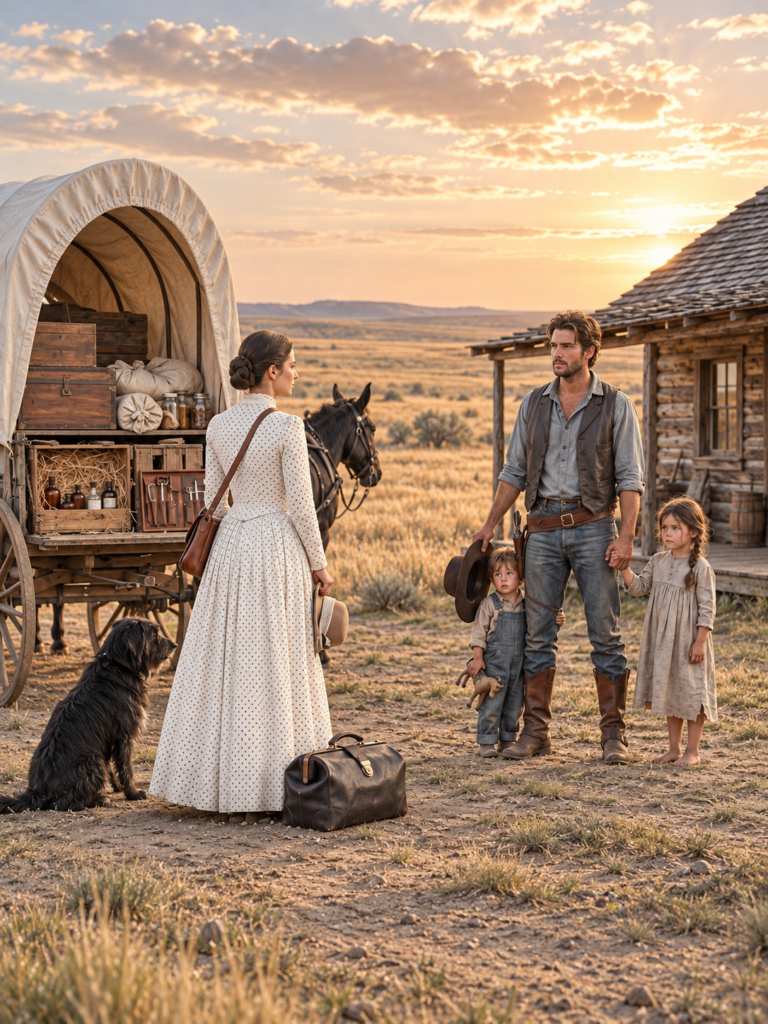
Part 1
The banker arrived on a Tuesday morning in the spring of 1884, wearing polished boots and a smile that made Amos Rourke wish he had never borrowed a dollar from him.
Emmett Crane stepped down from his buggy and unfolded a sheet of paper.
“Ninety days, Rourke.”
Amos stood beside the broken fence outside his Wyoming farmhouse.
“Ninety days for what?”
“To settle what you owe Cedar Bluff Savings and Trust. Otherwise, the ranch becomes bank property.”
Behind Amos, five children were eating breakfast at a kitchen table their mother had scrubbed every morning for twelve years.
The youngest was four.
The oldest was fourteen.
And their mother had been dead for less than a year.
Amos looked at the paper.
“I made the February payment.”
“You did.”
“And March.”
“Yes.”
“Then why does the balance keep climbing?”
Crane folded the notice and placed it in Amos’s coat pocket.
“Interest, penalties, administrative charges. All outlined in your agreement.”
“That agreement was supposed to keep us through the bad season.”
“And it has.”
Crane smiled.
“Until now.”
He climbed into his buggy.
“Nothing personal, Amos. Business is business.”
Amos watched the man drive away.
The road stretched through miles of brown grass toward Cedar Bluff. Snow still covered the distant mountains, and the spring wind carried the smell of thawing mud.
Ninety days.
He had ninety days to save the land his father had homesteaded, the house where his children had been born, and the last remaining piece of the life he had shared with his wife.
Inside, someone dropped a plate.
Then a little girl began crying.
Amos closed his eyes.
He could face the bank.
He could face a failed cattle season.
He could even face another winter with almost nothing.
But hearing one of his children cry for their mother was still enough to bring him to his knees.
His wife, Clara, had died the previous autumn after a fever that began mildly and turned dangerous before a doctor could reach the ranch.
The nearest physician had been twelve miles away.
By the time the doctor arrived, there was nothing he could do.
Amos had buried Clara beneath the cottonwoods behind the house.
Then he had returned to five children who expected him to explain how life could possibly continue.
He had no explanation.
His oldest son, Wesley, was fourteen and had become painfully quiet since the funeral.
Della, twelve, cooked most of the meals and managed the household with a seriousness no child should have needed.
Pearl, eight, filled every spare piece of paper with drawings.
Gideon, six, climbed everything he was forbidden to climb.
And Winnie, four, still asked when Mama was coming home.
Amos did his best.
He rose before sunrise.
Fed the cattle.
Repaired fences.
Hauled water.
Worked until his hands split.
Then returned to the house and tried to remember which children needed washing, which needed new boots, and which simply needed someone to sit beside them.
He was failing at more of it than he cared to admit.
The previous night, after the children slept, he had written a newspaper advertisement.
He had crossed out six attempts before finding the words he could bear to send.
Wyoming widower with five children seeks a wife willing to share the responsibilities of ranch life. Modest home. Honest work. Hard winters.
Then he added one final sentence.
My children need someone who will not leave when life becomes difficult.
He stared at the words for a long time.
They were not romantic.
They were not flattering.
But they were true.
He mailed the advertisement the following morning.
Nine hundred miles away, in a physician’s office in Boston, Estelle Vandermir read it three weeks later.
She was thirty years old.
She was educated, accomplished, and wealthy beyond anything Amos Rourke could have imagined.
And she was deeply unhappy.
Estelle had spent years studying medicine.
She had treated patients, assisted with difficult procedures, and developed clinical observations that her employer, Dr. Leland Ashby, had recently published under his own name.
That afternoon, he was attending a dinner where several important men would congratulate him for work Estelle had done.
She sat alone in the back office.
A stack of medical journals rested beside her elbow.
Her parents had died the previous autumn, only six weeks apart, leaving her a vast family estate of shipping interests, banking shares, and properties along the eastern seaboard.
Since inheriting it, Estelle had received more marriage proposals than she cared to count.
Every man seemed interested in her fortune.
Not one appeared particularly interested in her work.
One had suggested medicine was an unsuitable occupation for a wealthy woman.
Another had told her she would be happier supervising servants.
Dr. Ashby had gently proposed that she retire from clinical practice altogether.
Estelle had considered throwing his ink bottle at him.
Instead, she opened the newspaper.
And saw Amos Rourke’s advertisement.
She read it once.
Then again.
My children need someone who will not leave when life becomes difficult.
There was something painfully honest about the sentence.
The man was not promising riches.
He was not describing himself as handsome, prosperous, or distinguished.
He was admitting that his family needed help.
Estelle pulled a clean sheet of paper toward her.
She wrote that she was thirty, educated, healthy, and unafraid of hard work.
She told him that she understood frontier life would be difficult.
She asked about the children.
She did not mention that she was a physician.
She did not mention her inheritance.
Those were conversations she wanted to have in person, with someone who might see her before seeing her money.
Over the next six weeks, four letters crossed the country.
Amos told her about the ranch, the cattle, the mountains, and his children.
He described Della’s determination, Wesley’s intelligence, Pearl’s drawings, Gideon’s curiosity, and Winnie’s stubborn insistence on wearing mismatched stockings.
Estelle wrote back with practical questions.
What did the household need most?
Could the children read?
Was there a school nearby?
Did anyone in Cedar Bluff provide medical care?
Amos found her directness both surprising and reassuring.
He sent her a stagecoach ticket.
Then spent the next two weeks wondering whether he had made the greatest mistake of his life.
On the morning the coach arrived, he stood outside the Cedar Bluff stage stop with all five children.
Wesley had brushed his hair without being asked.
Della wore her mother’s blue ribbon.
Pearl clutched a drawing she had made.
Gideon had dirt on one knee.
Winnie held Amos’s hand so tightly that his fingers ached.
The coach rolled into town beneath a bright Wyoming sky.
Passengers climbed down.
Then a woman in a plain gray traveling dress appeared at the door.
She lifted a heavy leather bag without waiting for assistance.
Her dark hair was pinned neatly beneath her hat.
Her expression was calm.
She looked along the dusty street, found Amos and the children, and walked toward them without hesitation.
“Mr. Rourke?”
“Miss Vandermir.”
He removed his hat.
For a moment neither knew what to say.
Then Estelle crouched in front of Winnie.
“I understand someone here lost a boot in the mud last month.”
Winnie’s eyes widened.
“Papa told you?”
“He did.”
“It was very deep mud.”
“So I hear.”
“And Wesley laughed.”
“That sounds unkind.”
“He helped get it out afterward.”
Estelle nodded seriously.
“Then perhaps he isn’t entirely hopeless.”
Winnie considered this.
Then she smiled.
Amos felt something loosen in his chest.
It was the first time in months that one of his children had smiled at a stranger without being encouraged.
He picked up Estelle’s trunk.
“Welcome to Wyoming.”
She looked toward the mountains.
Then back at the five children.
“Thank you.”
And for the first time since Clara’s death, Amos allowed himself to wonder whether life might contain something other than loss.
Part 2
The Rourke ranch was not what Estelle had imagined.
It was poorer.
Much poorer.
The farmhouse had three small bedrooms, a sagging roof, and a front porch that tilted slightly toward the yard.
The barn needed repairs.
A section of fencing leaned dangerously along the north pasture.
There were too few cattle.
Too many unpaid bills.
And five children trying to pretend they were managing perfectly well.
Amos watched Estelle study the buildings.
He felt embarrassment rising.
“I know it isn’t much.”
She looked at him.
“Where do you need me first?”
He blinked.
“What?”
“It’s nearly supper time. I assume someone is cooking.”
“Della usually handles that.”
“Then I’ll speak with Della.”
She lifted her leather bag and walked toward the house.
Amos stood watching her.
He had expected complaints.
Instead, she had asked where to begin.
The following days were difficult in ways neither had anticipated.
Estelle discovered that Della considered the kitchen her territory.
The girl had spent months feeding the family, managing supplies, and keeping her younger siblings clothed.
She did not intend to surrender those responsibilities to a stranger.
On the first morning, Estelle entered the kitchen and found Della rolling dough.
“May I help?”
Della kept working.
“I know how to do it.”
“I can see that.”
“We don’t need you changing everything.”
Estelle considered her.
“Then tell me how you prefer it done.”
Della looked up suspiciously.
“What?”
“I don’t know your household yet. You do.”
The girl studied her.
Then nodded toward the flour.
“You can knead that.”
Estelle washed her hands and began.
For several minutes they worked without speaking.
Then Della said, “You’re doing it wrong.”
Estelle stopped.
“Show me.”
Della demonstrated.
Estelle copied her.
And something small changed between them.
By the end of the week, Della allowed Estelle to prepare breakfast without supervision.
By the second week, she occasionally sat down while Estelle washed the dishes.
That was progress.
Wesley was harder.
He rarely spoke.
When Estelle entered a room, he usually found a reason to leave.
One afternoon, she discovered him behind the barn reading a battered book.
She sat on a nearby fence rail.
“What are you reading?”
He turned the cover toward her.
A book about surveying and geology.
“I know that one,” Estelle said.
Wesley looked surprised.
“You read it?”
“Twice.”
“Why?”
“Because the geology is questionable, but the surveying chapters are excellent.”
For the first time, his expression changed.
“You know about surveying?”
“A little.”
He looked at the book.
Then at her.
“My mother gave me this.”
Estelle said nothing.
“She said I was smart enough to be more than a ranch hand.”
“Would you like to be?”
He shrugged.
“I don’t know.”
“That’s all right.”
She rose.
“I brought several books from Boston. You’re welcome to borrow them.”
He did not answer.
That evening she found him beside her trunk, studying the titles.
She walked past without comment.
When she returned, three books were missing.
She smiled to herself.
Pearl became attached to her almost immediately.
The child followed Estelle through the house, showing her drawings of horses, trees, and mountains.
Estelle examined each one carefully.
She asked why one horse had six legs.
Pearl explained that it was running very fast.
Estelle accepted the explanation without argument.
Gideon was less interested in conversation than in testing the limits of his own body.
On the fifth day, he climbed a fence he had been forbidden to climb.
He fell.
His ankle swelled.
Amos prepared to saddle a horse for the doctor in the next settlement.
But Estelle was already kneeling beside the boy.
“Can you move your toes?”
Gideon nodded miserably.
“Does it hurt here?”
She examined him carefully.
Then she wrapped the ankle and explained that he needed rest and observation, and that worsening pain or inability to bear weight would require further medical examination.
Amos watched from the doorway.
“You’ve done this before?”
“A few times.”
She looked up.
He thought there was something strange in her expression.
Almost as if she were choosing how much to say.
But Gideon was crying, and Amos let the question go.
The second week brought colder nights.
Snow still clung to the higher slopes.
Amos worked longer hours because the bank’s deadline was approaching.
He sold three cattle to cover the next payment.
Even after paying, the account balance seemed to grow.
He kept the notices hidden in a tin box beneath his bed.
He did not want the children frightened.
But children often understood more than adults believed.
Della knew.
Wesley suspected.
Pearl listened through doorways.
Only Gideon and Winnie remained mostly unaware.
Then, shortly before two o’clock one morning, Della came running into Amos’s bedroom.
“Papa.”
He opened his eyes.
“Winnie is breathing funny.”
Amos sat up.
“What?”
“She can’t get enough air.”
He was out of bed before she finished.
Winnie sat upright beneath her blankets, frightened and struggling to breathe.
Each breath produced a harsh sound in her throat.
Her small fingers gripped the bedclothes.
Amos lifted her.
“Easy, sweetheart.”
She looked at him desperately.
“Papa.”
His heart seemed to stop.
He remembered Clara.
The fever.
The helplessness.
The long ride for a doctor who arrived too late.
“Get the horse ready,” he shouted.
Then Estelle entered.
She took one look at Winnie.
Her entire expression changed.
Not to panic.
To concentration.
She examined the child and listened to her breathing.
“Amos, I need you to put her back on the bed.”
“We need a doctor.”
“Yes,” Estelle said quietly. “You do.”
She turned toward the heavy leather trunk in the corner.
The trunk she had not opened since arriving.
She took a small key from her pocket.
Amos watched as she unlocked it.
Inside lay medical instruments.
Glass bottles.
Folded bandages.
A stethoscope.
Carefully labeled supplies.
An entire physician’s case.
Amos stared.
Estelle lifted the stethoscope.
“I need you to listen carefully.”
He looked from the case to her face.
“Estelle?”
“I am a physician.”
The room seemed to tilt.
“What?”
“A trained physician. I’ve practiced medicine in Boston.”
He could not speak.
She stepped closer.
“I will explain everything. But Winnie needs help now.”
He looked toward his daughter.
The child was struggling for every breath.
Estelle’s voice remained steady.
“Bring more light. Keep her calm. Send someone to summon the nearest available doctor as well. We must be prepared if she worsens.”
Amos moved.
For the next hours, he followed her instructions while she assessed Winnie’s airway and breathing and used the medicines and equipment available to her.
She monitored the child closely.
She spoke gently to Winnie, explaining what she was doing in words a four-year-old could understand.
Amos fetched water.
Della held the lamp.
Wesley helped prepare clean cloths.
The house became quiet except for Winnie’s breathing.
Near dawn, the frightening sounds began to ease.
Her shoulders relaxed.
She leaned against Estelle.
Eventually she slept.
Amos sat beside the bed, unable to move.
Estelle remained close, watching carefully for any sign of renewed distress.
At last he whispered, “Is she going to live?”
Estelle looked at the sleeping child.
“She’s improved considerably. We still need to watch her.”
Amos bowed his head.
His hands began shaking.
He had held them steady all night.
Now they would not stop.
Estelle sat beside him.
For a long time neither spoke.
Then Amos looked toward the physician’s case.
“Why didn’t you tell me?”
Estelle lowered her eyes.
“I meant to.”
“When?”
“I don’t know.”
He stared at her.
She took a breath.
“There’s something else.”
He looked back at Winnie.
“What else could there possibly be?”
“My family owns shipping companies, banks, and property in the East.”
Amos was silent.
“The Vandermir estate passed to me when my parents died.”
“How much?”
She told him.
He stared at her as if she had spoken another language.
He knew the Vandermir name.
Anyone who read newspapers knew it.
Shipping.
Finance.
Political connections.
Generations of money.
He looked around his shabby farmhouse.
Then at his sleeping daughter.
“So you came all this way knowing you were wealthy enough to buy this entire county?”
“Yes.”
“And you let me believe you were a woman looking for ordinary work and a family?”
Estelle looked at her hands.
“Yes.”
His voice grew quiet.
“Why?”
“Because I wanted someone to know me before knowing my money.”
He did not answer.
She looked toward Winnie.
“I didn’t come here to rescue you, Amos.”
He stared at the floor.
“Then why did you come?”
Estelle opened her mouth.
Then closed it.
For once, she had no answer she could explain.
Part 3
The morning after Winnie’s illness, Amos returned to the barn before sunrise.
He needed to work.
He needed the familiar weight of a hammer.
The ordinary smell of hay.
Anything that did not require him to think about the woman sleeping in his house.
Wesley joined him at the north fence.
For an hour they repaired posts without speaking.
Then the boy said, “She’s a doctor.”
Amos drove another nail.
“Yes.”
“She helped Winnie.”
“Yes.”
“She’s rich.”
Amos stopped.
“Who told you?”
“Della.”
He rubbed his forehead.
“Of course.”
Wesley studied him.
“Does that change what she did?”
Amos looked at his son.
“What do you mean?”
“Would Winnie be less alive if Estelle didn’t have money?”
The question caught him off guard.
“No.”
“Then why are you angry?”
Amos stood still.
He wanted to say he was not angry.
But he was.
Not because she was a doctor.
Not because she was wealthy.
Because she had decided what he could know.
Because he had written honest letters across nine hundred miles while she had kept the most important facts about herself hidden.
And because some part of him feared that sooner or later she would look around his poor ranch and understand she had made a mistake.
He returned to hammering.
“Get the next post.”
Wesley obeyed.
But the question stayed with Amos throughout the morning.
Inside the house, Estelle continued her work.
She listened to Winnie’s breathing.
Prepared meals with Della.
Helped Pearl mend a torn dress.
Read to Gideon while he rested his ankle.
She did not demand that Amos forgive her immediately.
She knew trust could not be forced.
It had to return through ordinary days.
Three evenings later, Pearl found her in the barn.
The girl stood watching Estelle struggle with a pitchfork.
“You’re holding it wrong.”
Estelle sighed.
“I seem to be told that frequently.”
Pearl demonstrated the proper grip.
Then she asked, “Is the bank going to take our house?”
Estelle stopped working.
“What makes you ask that?”
“I heard Papa talking.”
“What did he say?”
“He said the debt keeps getting bigger.”
Estelle placed the fork against the wall.
“Does he make payments?”
“Every month.”
Pearl’s small face tightened.
“Then why doesn’t it get smaller?”
Estelle looked toward the farmhouse.
That was an excellent question.
She waited until the children were in bed.
Then she sat across from Amos at the kitchen table.
“I’d like to see your mortgage papers.”
His face hardened.
“Why?”
“Because Pearl told me something troubling.”
He looked toward the hallway.
“She’s eight years old.”
“She’s eight years old and frightened.”
Amos was silent.
“Is it true the balance grows even though you’ve been paying?”
He looked down.
“Yes.”
“May I examine the agreement?”
“I know how to read.”
“I know you do.”
“Then what makes you think you’ll find something I missed?”
Estelle considered her words.
“Because I have experience with contracts, institutional finances, and the way powerful people sometimes hide things in language.”
He stared at her.
She did not look away.
Finally he rose.
He returned with the tin box.
Inside were the mortgage papers, payment receipts, bank notices, and Clara’s old household ledger.
Estelle opened the agreement.
She read every page.
Then she reached a small-print addendum.
She read it twice.
Her expression changed.
“What is it?” Amos asked.
She pointed to a clause.
“According to this, if your payment arrives after the bank closes on the first day of the month, Crane can declare it late.”
“I know that.”
“Look at the penalty.”
Amos leaned closer.
Estelle continued.
“It isn’t calculated as a small fee on the overdue payment. It adds fifteen percent of the entire outstanding balance.”
He stared.
“That can’t be right.”
“Read it.”
He did.
Then read it again.
Estelle spread the payment records across the table.
“How often have you paid on the second?”
Amos counted.
Several months.
During winter storms.
During spring floods.
During the cattle drive.
“I made every payment.”
“I know.”
“Crane accepted them.”
“He accepted the money. Then charged the penalty.”
Amos sat back.
His face had gone pale.
The debt had grown not because he had stopped paying.
It had grown because Crane had designed the contract to punish payments that arrived only a day late.
And the penalties themselves had begun generating additional charges.
Amos thought of the cattle he had sold.
The meals Della had made smaller.
The boots Wesley had repaired instead of replacing.
He thought of Clara’s medicine.
Money he had borrowed during her final illness.
He pressed his hands against the table.
“That man knew.”
Estelle did not answer.
“When he shook my hand last autumn, he knew.”
She nodded.
Amos stood so quickly the chair scraped across the floor.
“I’ll go into town tomorrow.”
“And do what?”
“Make him explain.”
“He’ll point to your signature.”
“Then what am I supposed to do?”
Estelle waited until he looked at her.
“We find out whether he’s done this to other families.”
Amos frowned.
“Why?”
“Because a banker who designs a contract like this rarely uses it only once.”
He sat slowly.
She continued.
“If we can establish a pattern, there may be grounds to challenge the penalties and the manner in which they’re being enforced.”
He shook his head.
“I can’t afford lawyers.”
“I can.”
His expression hardened.
“No.”
“Amos—”
“I won’t have you buy my ranch for me.”
“I’m not offering to buy it.”
“Then what are you offering?”
“To help you fight for it.”
He looked away.
Estelle leaned forward.
“If I simply pay your debt, Crane will do the same thing to another family. And then another.”
She paused.
“This isn’t only about your ranch.”
For several minutes Amos said nothing.
Then he pulled the mortgage papers closer.
“What do you need?”
Estelle opened her notebook.
“Names.”
Over the following weeks, they began talking to neighbors.
Josiah Landry had fallen behind on a mortgage despite selling half his cattle.
August Reed had been threatened with foreclosure.
And Adelene Booth, a widow nearing sixty, had spent eighteen months watching a debt grow even as she paid every dollar she could find.
Estelle rode to the Booth ranch alone.
Adelene met her at the gate.
She was a weathered woman with silver hair and hands hardened by forty years of work.
“What do you want?”
“To ask about your mortgage.”
The widow’s expression closed.
“I don’t discuss my finances with strangers.”
“I understand.”
Estelle dismounted.
“But I believe Emmett Crane may be charging you unlawful penalties.”
Adelene stared at her.
Then slowly opened the gate.
“Come inside.”
They sat at a kitchen table covered in oilcloth.
Adelene brought out the bank notices.
Estelle examined them.
The same clause appeared again.
The same penalty structure.
The same growing debt.
The widow watched Estelle’s face.
“Can you help me?”
Estelle looked up.
“I think so.”
Adelene swallowed.
“I’ve lived here forty years.”
“I know.”
“My husband is buried beneath that oak.”
Estelle said nothing.
“I buried two children here too.”
Her voice became rough.
“If the bank takes this place, I don’t know where I’ll go.”
Estelle reached across the table.
“Then we’ll do everything we can to stop it.”
When she returned to the Rourke ranch, Amos was waiting on the porch.
“How bad?”
“Worse than yours.”
He closed his eyes.
Estelle unfolded a survey map she had obtained from county records.
She pointed to several parcels.
“Look.”
Every threatened ranch lay along the same stretch of land.
The proposed route of a railroad extension.
Amos stared.
“Crane wants the railroad land.”
“I suspect he wants to acquire it cheaply before the railroad purchases it.”
“The mortgages…”
“May be the means of getting it.”
Amos looked across the pasture toward the distant mountains.
He had spent months believing he was a failure.
A man unable to protect his children.
Unable to manage his father’s land.
Unable to keep Clara’s home.
Now he understood that someone might have designed the situation to make him fail.
Estelle stood beside him.
“We’ll need evidence. And people willing to testify.”
Amos turned toward the house.
“Then let’s get started.”
That night, for the first time since Clara died, he sat at the kitchen table working beside someone instead of struggling alone.
Part 4
By the time Emmett Crane returned to the Rourke ranch, Amos had gathered payment records from five families.
Estelle had prepared a detailed comparison.
The documents showed how payments had been accepted, penalties imposed, and balances increased far beyond what ordinary interest could explain.
She also wrote to the territorial governor’s office.
And to an attorney in Cheyenne.
And to two newspaper editors whose names she knew from Boston.
She did not threaten anyone falsely.
She simply documented what she could prove.
Crane arrived wearing his familiar smile.
“Well, Rourke. Time’s up.”
Amos met him on the porch.
“Before we discuss the ranch, I want you to read something.”
Crane took the papers.
He scanned the first page.
Then the second.
His smile weakened.
“What is this?”
“A record of what your bank has been doing.”
“The charges are authorized by contract.”
“Then you’ll have no objection to an investigation.”
Crane looked up.
“Be careful, Amos.”
Amos stood very still.
For years he had endured the man’s condescension.
The friendly smiles.
The warnings.
The small humiliations delivered as though they were favors.
Now he looked directly into Crane’s eyes.
“I paid you every month.”
Crane said nothing.
“I sold cattle to make those payments. My children went without things they needed.”
He stepped closer.
“And all that time, you were adding charges designed to take this land away.”
Crane folded the papers.
“You’re making a serious allegation.”
“Yes.”
Estelle stepped onto the porch.
She handed Crane a second letter.
He glanced at the letterhead.
Vandermir.
His expression changed.
He read it carefully.
Then looked at her.
“Miss Vandermir.”
“Mrs. Rourke,” she corrected.
His mouth tightened.
Estelle kept her voice calm.
“The documentation has been prepared for submission to the appropriate territorial authorities. The affected families also intend to pursue legal remedies.”
Crane looked toward Amos.
“You’ve involved outsiders.”
Amos shook his head.
“No. I’ve involved the people you’ve been taking money from.”
Crane stood silent.
Then he returned the papers.
“I’ll consult with the bank’s counsel.”
“Do that,” Amos answered.
The banker climbed into his buggy.
For the first time, he drove away without smiling.
Amos remained on the porch.
Beside him, Estelle watched the wagon disappear.
“You think he’ll stop?” he asked.
“No.”
“Then what happens?”
“We keep going.”
He looked at her.
For a moment he wanted to reach for her hand.
Instead he said, “There’s coffee inside.”
She nodded.
“Then we’d better drink some.”
The fight continued through autumn.
There were legal letters.
More threatened foreclosures.
Meetings with frightened ranchers.
Requests for records.
The bank’s attorneys insisted the agreements had been properly signed.
Estelle’s attorney disputed the enforceability and application of the penalties.
Amos spent evenings traveling between ranches, gathering testimony and helping neighbors understand what had happened.
Some people were too frightened to speak.
Others feared Crane would ruin their credit or refuse future loans.
Adelene Booth was the first to sign a formal complaint.
“If he takes my land,” she said, “he can at least do it with my name on the paper telling him he’s wrong.”
Others followed.
Meanwhile, Estelle continued caring for the Rourke children.
Winnie recovered fully from her illness.
Gideon’s ankle healed.
Pearl covered the kitchen wall with drawings.
Della gradually surrendered some household responsibilities and began reading again in the evenings.
Wesley became fascinated by Estelle’s medical books.
He asked questions about anatomy.
Then disease.
Then the nervous system.
Sometimes he stayed awake until midnight studying.
Amos watched the change in his son with quiet amazement.
The boy who had barely spoken after Clara’s death now argued with Estelle about physiology over breakfast.
But Amos and Estelle themselves remained cautious.
They spoke honestly about the ranch.
The bank.
The children.
They rarely spoke about their marriage.
One evening, while Della washed dishes, Amos found Estelle on the porch.
She was looking toward the mountains.
“Cold?” he asked.
“A little.”
He placed his coat around her shoulders.
She turned.
“Thank you.”
He sat beside her.
For a while they watched the sunset.
Then he said, “You should have told me.”
“I know.”
“I wouldn’t have refused you because you were a doctor.”
“I know that now.”
“And the money…”
He stopped.
She waited.
“I don’t know how to live beside that much money.”
Estelle considered him.
“Neither do I, some days.”
He looked surprised.
“I inherited it. I didn’t build it. And every man I knew seemed to think it told him everything important about me.”
Amos stared across the yard.
“I thought you’d leave.”
She turned.
“What?”
“When you saw the house. The debt. The work.”
He rubbed his hands together.
“I thought you’d decide there was no reason to stay.”
Estelle’s voice softened.
“Amos, I came because your letters sounded honest.”
He looked at her.
“They were honest.”
“Then that’s still what matters to me.”
He wanted to say more.
But Della called from inside, asking where the lantern oil had been put.
The moment passed.
Winter arrived early.
The first severe storm came down from the mountains in November.
At noon the sky was clear.
By three, the temperature had fallen sharply.
By sunset, snow drove sideways across the pasture.
Amos returned from town with ice on his coat.
“The Landrys are short of firewood.”
Estelle looked up from her notebook.
“And Adelene?”
“Alone at her place. The road’s nearly gone.”
She stood.
“We need to organize.”
Within an hour, the farmhouse became a gathering place.
Amos recruited several experienced riders.
Estelle marked the most isolated properties on a map.
They planned supply runs using teams familiar with the terrain, keeping the least experienced children safely indoors.
Wesley helped prepare blankets and equipment.
Della organized food.
Pearl watched Winnie.
Gideon carried lanterns from room to room as though he had been appointed sheriff.
The first families arrived after dark.
Cold.
Exhausted.
Frightened.
The Rourke kitchen filled with strangers drinking soup.
Estelle examined frostbite injuries and respiratory complaints.
An elderly rancher named Elias Warrick arrived with severe breathing difficulty.
She worked to stabilize him while others kept the room warm and clear.
By two in the morning, eleven extra people had found shelter in the house.
The wind rattled every window.
Then Wesley came through the door.
His face was pale beneath the snow.
Estelle looked up.
“Where’s your father?”
Wesley hesitated.
“Isaac Doyle got separated from the supply team.”
“Where?”
“Near the second draw.”
“And Amos?”
“He went looking for him.”
Estelle felt her stomach tighten.
“How long ago?”
“More than two hours.”
She stared at the boy.
Then he said the words she had been dreading.
“Papa’s horse came back alone.”
For a moment she could hear nothing.
Not the wind.
Not the children.
Not the fire.
Only the terrible silence that follows news a person does not know how to survive.
Then she moved.
She finished attending to Elias and arranged for another capable adult to monitor him.
She gathered warm clothing, medical supplies, rope, and a lantern.
Wesley knew the route.
An experienced ranch hand named Nate Buckley would accompany them.
They could not wait indefinitely while Amos remained exposed to the storm.
Estelle looked at Della.
“Keep the house warm. Follow the instructions I left for Mr. Warrick. Send for help if anyone worsens.”
Della’s face tightened.
“Are you going to find Papa?”
“Yes.”
“Will you bring him home?”
Estelle paused.
Then answered carefully.
“I’m going to do everything I can.”
She mounted Juniper.
Wesley led them into the storm.
Snow blinded them.
The horses struggled through drifts.
The cold struck Estelle’s cheeks like knives.
She forced herself to think clearly.
Where would Amos seek shelter?
The second draw had a ruined equipment shed.
She remembered him describing it during a fence repair.
A half-collapsed roof.
Stone walls.
Enough shelter to survive the wind.
“That way!” she shouted.
Wesley turned.
They rode toward the shed.
When the lantern light finally reached the doorway, Estelle saw a dark shape on the ground.
She dismounted before Juniper fully stopped.
“Amos!”
He lay partly beneath broken timbers.
His leg was trapped.
His face was gray with cold.
But his eyes opened.
“Estelle?”
She dropped to her knees.
“I’m here.”
His lips moved.
“Isaac?”
“He’s safe,” Wesley called. “He made it to the Booth place.”
Amos closed his eyes.
“Good.”
Estelle examined him.
His right thigh was badly injured.
He was cold, exhausted, and in severe pain.
They freed him carefully, immobilized the injured leg as best they could, insulated him against further heat loss, and prepared the sled.
Estelle stayed beside him throughout the journey.
“Keep talking to me,” she said.
He opened his eyes.
“About what?”
“Anything.”
“The north fence,” he whispered.
She almost laughed.
“The north fence can wait.”
“Della’s going to be angry.”
“She has every right.”
He looked at her.
“You came.”
Estelle gripped his hand.
“Of course I came.”
The wind screamed around them.
He tightened his fingers weakly.
“I didn’t know if you’d come.”
Her throat closed.
“Amos, listen to me.”
He looked at her.
“I’m here because I want to be.”
He closed his eyes.
And she kept holding his hand all the way home.
Part 5
Amos survived the storm.
His leg required weeks of care and months of recovery, but he returned to the ranch alive.
For a long time he could do little more than sit near the stove, watching his children carry out the chores he had once handled alone.
He hated it.
Estelle knew he hated it.
She also knew that forcing him to admit it would accomplish nothing.
So she gave him work he could manage.
He reviewed supply orders.
Helped Wesley plan fence repairs.
Taught Gideon to sharpen tools.
And supervised the spring cattle accounts while Della kept the household ledger.
Slowly, the ranch began functioning as a family rather than as a burden one exhausted man had to carry alone.
One afternoon, while Amos sat beside the window, Winnie climbed into his lap.
“Papa?”
“Yes, sweetheart?”
“Is Estelle going to stay?”
He looked toward the kitchen.
Estelle was helping Pearl make a small paper book for her drawings.
“I hope so.”
Winnie thought about that.
“Can I call her Mama?”
Amos felt something tighten in his chest.
He remembered Clara.
The sound of her laughter.
The way she had tucked Winnie’s hair behind her ears.
The familiar footsteps he still expected to hear some mornings.
He stroked his daughter’s hair.
“You can call her whatever feels right to you.”
Winnie nodded.
Then climbed down and ran toward the kitchen.
Amos watched.
He realized that for months he had been thinking of Estelle as the woman who had come to help raise his children.
Somewhere along the way, that had changed.
She had become part of the household.
Not because anyone had instructed her to.
But because she knew which child wanted extra blankets.
Which child needed quiet when angry.
Which child was frightened of thunder.
Which child needed someone to ask about school.
And which child still cried for Clara when nobody was looking.
The bank dispute reached its decisive stage that summer.
A territorial investigator arrived in Cedar Bluff with authority to examine the complaints and review the bank’s records.
His name was Whitfield Cross.
He interviewed the affected families.
Reviewed payment histories.
Examined the mortgage agreements and the penalties assessed.
Compared the threatened properties with the proposed railroad route.
For four days he worked through the documents Estelle had assembled.
On the final evening, he came to the Rourke farmhouse.
Adelene Booth joined them.
So did Josiah Landry.
Cross set his papers on the kitchen table.
“I can’t announce the final outcome of the investigation tonight.”
Everyone remained silent.
“But I can tell you that the evidence supports serious findings of systematic misconduct.”
Amos leaned forward.
“And the mortgages?”
“The disputed penalties are being challenged through formal proceedings. The bank’s new management has also agreed to a supervised review of the affected accounts.”
Adelene gripped the edge of the table.
“Will I lose my land?”
Cross looked at her.
“Based on the corrected figures and the commitments obtained so far, there is a clear path to keeping it.”
She closed her eyes.
For several seconds she did not move.
Then she whispered, “Thank God.”
The formal resolution followed after additional legal review.
The improper penalties were removed from affected accounts.
Balances were recalculated.
Foreclosure actions based on those charges were withdrawn.
Several families who had believed themselves ruined discovered that their remaining debts were manageable.
The Rourke ranch was safe.
Adelene kept her three hundred acres.
The Landrys kept their home.
Other families received corrected statements and the opportunity to repay what they actually owed.
Emmett Crane resigned from the bank.
Later, formal charges were brought against him for fraudulent banking practices connected to the mortgage scheme.
His influence in Cedar Bluff ended.
But the victory did not feel like a parade.
There were no cheering crowds outside the courthouse.
No grand speeches.
Only ordinary people returning to ordinary work.
A widow opening her gate without wondering whether it would soon belong to someone else.
A father ordering seed for the next season.
A rancher buying winter feed instead of sending every remaining dollar to a dishonest banker.
For Amos, that was enough.
One evening he stood beside the north fence, leaning on a cane.
The pasture stretched before him.
Cattle moved slowly through the grass.
The mountains glowed gold in the setting sun.
Estelle joined him.
“It’s beautiful,” she said.
He nodded.
“Always has been.”
For a while they stood together.
Then Amos looked at her.
“You saved this place.”
She shook her head.
“We saved it.”
He smiled faintly.
“I suppose you won’t let me argue.”
“You’re welcome to try.”
He laughed.
It surprised both of them.
There had been a time when Amos believed laughter had been buried with Clara.
Now it returned unexpectedly.
Sometimes over supper.
Sometimes when Winnie said something outrageous.
Sometimes because Estelle attempted to ride Juniper and the horse reminded her who was truly in charge.
Their marriage grew slowly.
Neither wanted to pretend the past had never happened.
Clara had been real.
Her love had been real.
Their grief remained real.
But Amos began to understand that loving someone again did not erase the person he had lost.
It meant his heart had survived.
And Estelle learned that she did not need to solve every problem to deserve a place in the family.
Sometimes Amos needed her simply to sit beside him.
Sometimes Della needed permission to be twelve.
Sometimes Wesley needed a patient teacher.
And sometimes Winnie needed a woman who would hold her until she fell asleep.
The following spring, a letter arrived from Estelle’s attorneys in Boston.
The family shipping interests were being sold.
Her estate would soon have substantial additional liquid funds.
She read the letter twice.
Then took it to Amos.
“There’s something I’d like to do.”
He looked up from the ranch accounts.
“If it involves buying me another horse, the answer is no.”
She smiled.
“No horses.”
“Good.”
“I want to build a medical practice in Cedar Bluff.”
He set down his pencil.
“A proper one?”
“Yes. An examination room. Supplies. Beds for patients who cannot safely travel. Equipment for emergencies.”
She sat across from him.
“People are dying of conditions that could be treated because the nearest doctor is too far away.”
Amos listened.
“I want to fund it independently. Families who can pay will pay. Those who cannot will still receive care.”
He was quiet for a moment.
Then said, “There’s an empty brick building beside the old assay office.”
Estelle blinked.
“You’ve thought about this?”
“Since the storm.”
He looked toward the window.
“Elias Warrick might not have lived if you hadn’t been here. Clara might have had a better chance if a doctor had been close enough.”
His voice softened.
“And I don’t want another family in this county learning what ours learned.”
Estelle reached across the table.
Amos took her hand.
“Go look at the building,” he said.
She bought it that summer.
Cedar Bluff Medical opened before the first autumn snow.
The town gathered outside the building on opening day.
Adelene Booth brought pies.
The Landrys brought vegetables.
Pearl displayed drawings along the wall.
Della organized refreshments.
Gideon carried supplies.
Wesley spent the entire afternoon examining medical instruments and asking so many questions that Estelle finally told him to take notes.
Above the door was a painted sign.
Cedar Bluff Medical — Dr. E. Rourke, Physician.
Amos had ordered it.
Estelle stood looking at the lettering.
“You did this?”
He shrugged.
“Someone had to.”
She turned toward him.
“You used my married name.”
“That’s your name, isn’t it?”
Her eyes filled.
He looked uncomfortable.
“Unless you’d rather have Vandermir.”
She shook her head.
“No.”
Then she smiled.
“It’s perfect.”
That afternoon Winnie followed Estelle into the examination room.
The little girl watched her arrange glass bottles along a shelf.
“Estelle?”
“Yes, sweetheart?”
“Can I help?”
“Of course.”
Winnie handed her a folded cloth.
Then, as naturally as breathing, she said, “Here, Mama.”
Estelle stopped.
For a moment she could not move.
Winnie looked up.
“What?”
Estelle knelt in front of her.
“Nothing.”
She brushed a curl away from the child’s forehead.
“Thank you, sweetheart.”
Winnie smiled and ran back outside.
Estelle remained kneeling beside the shelf.
She had imagined many things before coming west.
A difficult marriage.
Hard work.
Loneliness.
Perhaps a useful life.
She had not allowed herself to imagine that one day a little girl would call her Mama.
The possibility had seemed too precious to risk wanting.
Now it had arrived without ceremony.
A single word in a busy room.
And it meant more than any inheritance she had ever received.
The medical practice grew steadily.
Families came from ranches miles away.
Estelle treated injuries, illnesses, and complicated births.
She traveled by wagon when patients could not reach town.
Sometimes she accepted food, firewood, or help maintaining the building from families who had little money.
She kept careful records so nobody felt their contribution was worthless.
She believed dignity was part of good medicine.
Wesley began studying with her formally.
He had a sharp mind and a gift for observation.
She taught him to ask questions before reaching conclusions.
To distinguish what he knew from what he suspected.
To listen before speaking.
He eventually left Wyoming to attend medical college in Chicago.
On the morning he departed, Amos stood beside the wagon with his hands in his pockets.
The boy who had barely spoken after his mother’s death was leaving to become a physician.
Amos looked at him.
“Your mother would be proud.”
Wesley nodded.
Then he turned toward Estelle.
“Thank you.”
She smiled.
“For what?”
He thought for a moment.
“For letting me become somebody.”
Estelle shook her head.
“You did that yourself.”
Wesley hugged her.
It was the first time he had done so.
She held him tightly.
Years passed.
Della grew into a capable young woman who managed accounts better than anyone in the family.
Pearl developed into a talented artist.
Gideon worked beside his father on the ranch.
Winnie grew taller, louder, and increasingly convinced that the entire county belonged to people who needed looking after.
And Amos continued repairing fences, raising cattle, and occasionally standing outside the medical practice waiting for Estelle to finish her work.
One summer evening, many years after the stagecoach first arrived in Cedar Bluff, they sat together on the farmhouse porch.
The children were older now.
Some had left home.
Others were preparing to.
The ranch was no longer struggling.
The barn had a new roof.
The north fence stood straight.
And the land remained in the Rourke family.
Amos watched the sunset.
“Do you remember that advertisement?”
Estelle smiled.
“Very well.”
“I wrote that my children needed someone who wouldn’t leave.”
“You did.”
He looked toward her.
“I was wrong.”
She turned.
“About what?”
“What we needed.”
Estelle waited.
Amos took her hand.
“I thought I needed a woman who would stay because she had promised to.”
He looked at the house.
At the windows glowing in the evening.
At the pasture beyond.
“But I got a woman who stayed because she wanted to belong here.”
Estelle squeezed his hand.
“And you gave me somewhere I could.”
He shook his head.
“You had somewhere to go. You could have lived anywhere.”
“That’s not the same thing.”
He looked at her.
She smiled.
“I had houses. Money. A career.”
She paused.
“But I didn’t have a home.”
Amos leaned closer.
“You do now.”
She rested her head against his shoulder.
For a long time neither spoke.
Inside the house, Winnie laughed at something Gideon said.
A door opened.
Della called everyone to supper.
The smell of warm bread drifted across the porch.
Estelle looked toward the kitchen, then back at the man beside her.
Years earlier, she had opened a newspaper in Boston and found a small advertisement from a desperate Wyoming widower.
She had thought she was answering a request for help.
Instead, she had found five children who taught her how to love without calculation.
A stubborn man who learned to trust her.
A community where her work mattered.
And a home built not from wealth, obligation, or convenience, but from countless ordinary decisions to stay.
Amos stood and offered his hand.
“Coming inside, Doctor?”
Estelle took it.
“Of course.”
They walked through the doorway together.
And as the evening settled over Cedar Bluff, the ranch that had once stood ninety days from ruin rang with the sounds of a family that had found its way back to life.
Because the greatest thing Estelle Vandermir had brought to Wyoming was never her medical knowledge.
It was never her fortune.
It was the simple, extraordinary choice to stay when the days were hard.
And in a farmhouse where five children had once waited for a mother who could never return, love had finally found another way home.

