
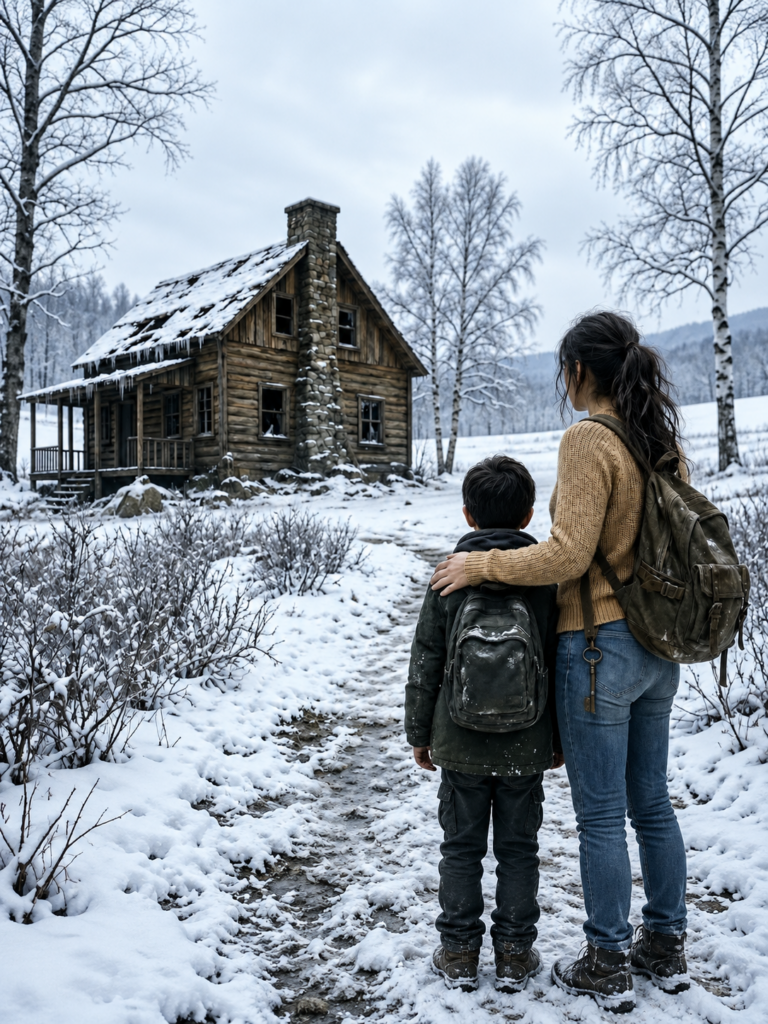
Part 1
The night Marin Kessler was thrown out of her aunt’s house, she had forty-one dollars, a twelve-year-old brother who barely spoke, and a winter storm that would eventually close every road through the mountains.
She was twenty years old.
Her brother, Toby, was the last family she had left.
And the woman who had promised to look after them both was standing in the kitchen, telling Marin that one of them had to go.
“You need to find somewhere else to live.”
Carla said it without looking up from her phone.
The kitchen smelled of cigarette smoke and coffee that had been sitting on the burner all afternoon. A stack of unpaid envelopes lay beside the salt shaker. The furnace rattled beneath the floor.
Marin had just come home from a closing shift at the diner. Her feet hurt. Her hair smelled of grease. Her name tag was still pinned to her shirt.
She had worked nine hours and earned forty-one dollars.
Thirty of those dollars were supposed to go to Carla.
The remaining eleven were for Toby’s inhaler.
Marin looked at the blue duffel bag beside the front door.
It belonged to her brother.
“What is that?”
Carla finally raised her eyes.
“I packed some things.”
“For who?”
“For you.”
Marin stared at the bag.
“But that’s Toby’s.”
“Some of his old clothes were in the closet. I used what I could find.”
A man sat at the kitchen table beside Carla.
His name was Rick. Marin had met him twice, although his truck had been parked in the driveway nearly every evening for the past month.
He was broad-shouldered, with a heavy beard and a habit of speaking to Carla while looking through Marin, as though the young woman were a piece of furniture that needed moving.
He said nothing now.
Carla rubbed her temples.
“Marin, you’re twenty years old. You’re an adult. This arrangement was never supposed to last forever.”
“I know that.”
“Then you need to start acting like it.”
Marin looked toward the hallway.
Behind Toby’s bedroom door, she could hear the faint static of an old portable radio.
It had belonged to their mother.
Toby carried it everywhere.
He rarely listened to an actual station. Most evenings he turned the dial until he found a soft, steady hiss, then sat with it pressed against his chest.
He had been doing that since their mother’s funeral.
“I pay you every week,” Marin said.
Carla’s mouth tightened.
“You contribute to groceries.”
“I give you almost everything I make.”
“And you think that covers a mortgage? Electricity? Insurance? Heating oil?”
Marin had no answer.
She knew the house was struggling.
The kitchen window had been covered with plastic since November. The washing machine leaked. Carla had received two shutoff notices in the previous month.
But Marin also knew that her aunt had been receiving a monthly support payment for Toby.
She had seen the deposit slip.
Four hundred dollars.
Every month.
“What about Toby?” Marin asked.
“He stays.”
Marin blinked.
“What?”
“Toby stays here. I’m still his legal guardian.”
“You’re kicking me out but keeping him?”
“He’s twelve. You’re twenty. There’s a difference.”
Marin felt something cold move through her stomach.
“There’s also four hundred dollars a month.”
Rick pushed his chair back.
“Watch how you speak to her.”
Marin did not look at him.
She was watching Carla.
Her aunt’s face had gone pale.
That told her more than an argument would have.
“Is that what this is?” Marin asked quietly.
Carla folded her arms.
“Don’t start.”
“You get paid to keep him here, but you don’t get paid to keep me.”
“I have kept a roof over both your heads for a year.”
“And I’ve paid you every week.”
Carla stood.
“Then maybe you should have saved some of that money instead of spending it.”
Marin felt the familiar humiliation rise in her face.
She had not bought new shoes in fourteen months.
Her winter coat was a thin grocery-store jacket with a broken zipper.
She had stopped buying shampoo and used the small bottles left behind by customers at the diner.
Every spare dollar had gone toward food, medicine, or keeping the electricity on.
But she did not argue.
Because something more important had happened.
Carla had made it clear that Toby was supposed to remain behind.
And Marin remembered a hospital room.
A winter morning.
Her mother’s fingers tightening around hers.
Lainey Kessler had been forty-three when she died.
She had worked as a nursing aide at the county care home, taking extra weekend shifts at a roadside diner whenever money became tight.
She had never owned much.
An old car.
A wedding ring from a marriage that had ended badly.
A collection of photographs in a cookie tin.
And two children she loved more fiercely than she loved herself.
During her last clear hour in the hospital, she had asked Marin to lean closer.
“Keep him close.”
Marin had looked toward Toby, who was sitting beside the window with his radio.
“I will, Mom.”
“Promise me.”
“I promise.”
Her mother had tried to smile.
“Don’t let him think he’s alone.”
Those were the last words Marin remembered clearly.
Now, standing in Carla’s kitchen, she heard them again.
She turned toward the hallway.
“Toby?”
Carla’s expression changed.
“Marin, don’t.”
“Toby, get your boots.”
Rick stood.
“That boy isn’t going anywhere.”
Marin walked past him.
“Toby!”
The radio stopped.
A moment later, her brother appeared in the hallway.
He was small for twelve, with dark hair falling over his eyes and a sweatshirt that had become too short at the wrists.
He held the radio against his chest.
Marin crouched in front of him.
“Hey, buddy. We’re going for a drive.”
He looked at her.
His expression barely changed.
But he understood.
Toby always understood.
He simply did not speak much anymore.
“Get your coat.”
He turned toward his room.
Carla stepped forward.
“You take that boy out of here, and I’ll call the sheriff.”
Marin looked back.
“Then call him.”
“Don’t test me.”
“Tell him you packed our bags before I got home. Tell him you’re putting me outside in January. Tell him about the money.”
Carla opened her mouth.
Nothing came out.
Marin picked up the blue duffel bag.
She pulled her mother’s heavy wool coat from the closet.
Then she reached onto the top shelf and took down a dented cookie tin decorated with a faded winter village.
Inside were photographs, a nurse’s aide pin, old letters, and the few small things their mother had left behind.
Marin had not opened it since the funeral.
She carried it anyway.
Toby returned wearing his boots.
She wrapped their mother’s coat around his shoulders.
It was much too large.
He looked up at her.
“We don’t leave each other,” she whispered.
His hand closed around her sleeve.
Marin opened the front door.
Snow was already blowing across the porch.
She looked back once.
Carla stood beside the kitchen table, her hands hanging at her sides.
For a second, Marin thought her aunt might change her mind.
She might say she was tired.
That she was frightened.
That they could talk in the morning.
Instead, Carla said, “You’ll see how hard it is out there.”
Marin stepped into the storm.
The door closed behind them.
Her car was a fifteen-year-old hatchback with a cracked windshield and an engine warning light that had been glowing for nearly a year.
It started on the third attempt.
Toby climbed into the passenger seat.
Marin placed the cookie tin between them.
“Okay,” she said, turning on the weak heater. “We’re going to be fine.”
Toby watched the snow striking the windshield.
“There’s a motel near the highway. We’ll stay there tonight. Tomorrow I’ll figure something out.”
She said it confidently.
She had spent the previous year learning to sound confident when she was terrified.
Toby reached across the seat and hooked two fingers into her sleeve.
Marin swallowed.
“That’s right,” she whispered. “We’re together.”
She drove into the darkness.
Twenty minutes later, she reached the motel.
Its sign was unlit.
The office windows were covered with plywood.
Snow had buried the entrance.
A crooked sign near the road read CLOSED FOR SEASON.
Marin sat behind the wheel, staring at it.
The nearest other motel was thirty miles away.
Beyond the mountain pass.
She checked the fuel gauge.
Less than a quarter tank.
Then she remembered Aunt Renata.
Her mother’s older cousin lived in a small town beyond the pass. They had not spoken in years, but Renata had sent a sympathy card after Lainey’s funeral.
Marin knew the address.
She knew the house had a spare bedroom.
And she could not imagine Renata turning away a child.
“Change of plans, buddy.”
Toby looked at her.
“We’re going to see family.”
He tightened his grip on the radio.
Marin turned onto the county highway.
The road climbed into the mountains.
Pine trees crowded both shoulders.
The snowfall grew heavier.
Within minutes, she could barely see beyond the headlights.
The heater began blowing cold air.
Then the fuel warning light came on.
Marin kept driving.
She told herself they were close.
She told herself the car could make it.
She told herself someone would help if they broke down.
Six miles beyond the last streetlight, the engine began coughing.
It lost power on a steep rise.
Marin pressed the accelerator.
The car lurched.
The engine coughed again.
Then it died.
She steered onto the shoulder and turned the key.
Nothing.
She tried again.
The starter ground uselessly.
Outside, the wind screamed through the pines.
Marin checked her phone.
Nine degrees Fahrenheit.
Four percent battery.
No signal.
She looked at Toby.
He was shivering.
“We’ll be okay,” she whispered.
But she had never been so afraid in her life.
Part 2
For nearly half an hour, Marin waited for headlights.
None came.
Snow gathered along the bottom of the doors.
The windows fogged from their breathing, then began frosting around the edges.
Marin rubbed her hands together and reached across to Toby.
His fingers were painfully cold.
“Put your hands inside the coat.”
He obeyed.
She pulled the wool tighter around him.
Their mother had worn that coat to work for nearly fifteen winters. One button had been replaced with a darker one. The lining was torn near the left pocket.
Marin remembered falling asleep against it as a child while Lainey carried her from the car into the house.
Now Toby was wrapped in the same wool.
And Marin could not get him warm.
She tried the engine once more.
Nothing.
The silence after the starter stopped was worse than the noise.
She looked down the road.
There had been a farmhouse several miles back.
A porch light.
A mailbox.
Maybe they could reach it.
The idea frightened her.
But staying in an unheated car with no reliable way to call for help frightened her more.
Toby had begun to shake less.
From the year she had spent taking nursing classes, Marin knew that could be dangerous when someone had been exposed to severe cold.
She leaned toward him.
“Buddy. Look at me.”
His eyes moved slowly.
“We need to move.”
He did not answer.
“There’s a house back down the road. Do you remember the light?”
A faint nod.
“Good. We’re going to try to get help.”
She put the phone inside her shirt to preserve the remaining battery.
She packed the cookie tin and the radio into the duffel bag.
Then she wrapped their mother’s wool coat around Toby as tightly as she could.
She took his hand.
When she opened the car door, the wind hit so hard she nearly lost her balance.
Snow stung her cheeks.
The cold burned inside her nose.
She guided Toby onto the road and pulled the door shut.
For a moment they stood beside the dead car.
Then Marin started walking.
The snow reached above her boots.
Every step required effort.
She kept Toby close, shielding him from the wind with her body when she could.
“That’s it,” she told him. “One step at a time.”
They moved slowly.
The highway disappeared behind them almost as soon as they passed.
Marin could no longer see the car.
She counted steps.
Fifty.
A hundred.
Two hundred.
She stopped counting when Toby stumbled.
“Come on, sweetheart.”
She caught him beneath the arms.
“Stay with me.”
His breath was shallow.
The road stretched into darkness.
No headlights appeared.
Marin’s own fingers had gone numb.
She was beginning to lose feeling in her feet.
Then something moved near the trees.
At first she thought it was a wolf.
A low gray shape stood just beyond the shoulder.
Marin stopped.
Toby pressed against her.
The animal stepped forward.
It was a dog.
Large, rough-coated, gray around the muzzle, with one ear torn into a permanent notch.
It held its left front paw slightly above the snow.
The animal was injured.
But it did not growl.
It stood watching them.
“Easy,” Marin whispered.
The dog turned and walked into the pines.
After several steps, it stopped.
Looked back.
Waited.
Marin stared.
The dog returned toward the road.
It circled once, then walked into the trees again.
Toby lifted his head.
“Follow her.”
Marin turned so quickly she nearly slipped.
It was the longest thing her brother had said in months.
“What?”
“She wants us to follow.”
His voice was thin and rough.
But the words were clear.
Marin looked toward the road behind them.
There was nothing.
No light.
No shelter.
Only miles of snow and wind.
Then she looked at the dog.
The animal stood beneath the pines, waiting.
She made a decision she could never fully explain afterward.
“Okay.”
She tightened her grip on Toby.
“Let’s follow.”
Under the trees, the wind weakened.
The trunks broke its force, and the snow fell more gently.
The dog moved ahead, occasionally stopping to check that they were still coming.
Marin followed the gray shape between the trees.
The ground rose.
Then leveled.
Toby stumbled repeatedly.
At one point, Marin lifted him onto her back and carried him until her knees began to buckle.
She put him down.
They walked again.
She spoke constantly.
“Good job.”
“Just a little farther.”
“Stay awake, Toby.”
“Look at me.”
The words came automatically.
She had no idea how far they had traveled.
Then the dog disappeared beyond a line of dark trunks.
Marin’s heart lurched.
“No. Please.”
She hurried forward.
The trees opened.
A clearing appeared.
And in the center of it stood a cabin.
It was small and old, built from heavy squared logs, with a steep roof buried beneath snow.
No smoke rose from the chimney.
No lights shone through the windows.
But it had walls.
A roof.
And a door.
The dog was already on the porch.
Scratching.
Marin half carried Toby across the clearing.
Her fingers barely worked as she reached for the latch.
The door opened.
She pushed Toby inside.
Then she followed and slammed it shut against the storm.
The sudden quiet was overwhelming.
The cabin was freezing.
But there was no wind.
Marin turned on her phone long enough to use the light.
The beam moved across a single room.
A table.
Two chairs.
A narrow bed.
Shelves.
A woodstove in the corner.
Beside the stove stood a wooden box filled with split logs.
A small tin of matches sat on the shelf.
Marin nearly cried.
“Thank God.”
She had helped her mother start campfires as a little girl.
Now those memories returned with remarkable clarity.
Small pieces first.
Bark and shavings.
Then kindling.
Then heavier wood.
She checked that the stove’s flue was open and unobstructed as far as she could see, then built a small fire.
The first flame caught.
A moment later, the kindling began crackling.
Marin fed it carefully.
Warmth slowly spread from the iron.
She removed Toby’s wet boots and wrapped him in blankets from the bed, keeping him close while she checked his breathing and gradually warmed him.
His face was pale.
She was frightened by how quiet he had become.
She searched the cabin for a telephone or working radio.
There was none.
Her own phone showed no signal.
She kept checking Toby, prepared to seek emergency help as soon as contact became possible.
Eventually his shivering returned, his eyes grew more alert, and he asked for water.
Marin exhaled shakily.
She melted snow in a pot, warmed it, and gave him small drinks.
Then she examined the shelves.
Canned beans.
Corn.
Peaches.
Crackers.
Rice.
Coffee.
Someone had stocked the cabin for winter.
She checked the containers, chose a sealed can of peaches, and opened it.
Toby ate slowly beside the stove.
Marin sat on the floor across from him.
“Better?”
He nodded.
The dog had followed them inside.
Now it crossed the room and climbed into a worn wooden chair beside the stove.
Not beneath the chair.
Not beside it.
Directly into it.
The dog curled into the cushions and rested its chin on the arm.
Marin watched.
The animal knew this room.
Knew the furniture.
Knew exactly where to sleep.
“You’ve been here before,” she whispered.
The dog opened one eye.
Then closed it.
Marin crawled closer.
Its front paw was swollen.
There was a cut along the pad.
She warmed water, gently cleaned away the dirt, and wrapped the injury with clean cloth she found in a cupboard.
The dog endured the attention quietly.
“You saved us,” Marin whispered.
She stroked the gray fur.
“Least I can do.”
Toby watched from his blankets.
“She’s a girl.”
Marin looked at him.
“You think?”
He nodded.
“What’s her name?”
Toby studied the dog.
Then he looked toward the dark window.
“Juno.”
Marin smiled.
“Juno?”
“Like the big moon.”
“That’s a good name.”
The dog’s torn ear twitched.
Toby nearly smiled.
It was such a small change.
But Marin noticed.
She noticed because she had spent a year watching her brother disappear into silence.
Now he was watching an old dog with something close to curiosity.
Marin fed the stove.
Outside, the storm continued.
Inside, the iron began ticking as it warmed.
The room slowly filled with orange light.
For the first time that evening, Marin believed they might survive the night.
She let Toby sleep beside the dog.
Then she began examining the cabin.
A lantern stood on the table.
Books lined a shelf near the bed.
A heavy canvas coat hung beside the door.
The blankets were folded neatly.
Reading glasses rested on a Bible.
Everything was orderly.
Not abandoned in haste.
Not destroyed by weather.
Just waiting.
A calendar hung near the kitchen shelf.
It was nearly two years old.
Someone had crossed off each day until a Tuesday in November.
Then the markings stopped.
Marin felt a chill that had nothing to do with the temperature.
Whoever had lived here had expected to return.
She found a tin mug with a name painted on it.
Gus.
Then she noticed lettering carved into the wooden workbench.
MERCER.
The letters were worn smooth by years of hands passing over them.
“Gus Mercer,” she whispered.
The dog lifted her head at the sound.
Marin looked toward her.
“That was your person, wasn’t it?”
Juno gave a low sigh.
Then she settled back into the chair.
Marin sat beside the stove.
She had entered a stranger’s home because the alternative had been freezing on a mountain road.
She owed that stranger her life.
But she did not know whether he was alive.
And she did not know what would happen when somebody came looking for him.
Part 3
The storm ended shortly before dawn.
Marin opened the cabin door to a world buried beneath white.
Snow covered the clearing.
The pines bent beneath heavy branches.
The narrow trail through the trees had vanished.
She stepped onto the porch and looked toward the mountain pass.
There was no visible road.
No tire tracks.
No sign of another person.
They were trapped until the snow could be cleared.
She closed the door and returned to the warmth.
Toby slept beneath two blankets.
Juno was curled beside him.
Marin stood looking at them.
Her brother’s face had regained its color.
One hand rested in the dog’s fur.
She watched his fingers move gently through the gray coat.
He had not voluntarily touched another living creature like that in months.
Marin turned away before she started crying.
There was work to do.
She found the woodshed behind the cabin.
It was stacked with dry split logs.
A hand pump stood near the wall, frozen solid.
There was a root cellar beneath a slanted wooden door and an outhouse beyond the trees.
The supplies appeared sufficient to last several days if used carefully.
She carried wood inside.
Counted the food.
Checked the windows for drafts.
Melted snow and boiled water.
Then she made breakfast.
Beans warmed on the stove.
Crackers.
A small serving of peaches.
Toby ate sitting at the table.
“Where are we?” he asked.
Marin stopped.
She had grown so accustomed to silence that every sentence still surprised her.
“A cabin in the woods.”
“Whose?”
“A man named Gus Mercer.”
Toby looked around.
“Where is he?”
“I don’t know.”
“Did he die?”
Marin hesitated.
“I think he might have.”
Toby looked toward the bed.
Then the old coat.
Then the dog.
“She misses him.”
Marin followed his gaze.
Juno was lying beneath the table.
“Yeah,” she said softly. “I think she does.”
After breakfast, Toby found the workbench.
Small carving knives were arranged beside pieces of wood.
A row of tiny wooden animals stood on the windowsill.
A bear.
An owl.
A rabbit.
And a dog with one torn ear.
Toby picked up the dog.
He studied it for a long time.
Then he looked toward Juno.
“That’s her.”
Marin came closer.
It was unmistakable.
The same heavy shoulders.
The same notched ear.
Even the slight tilt of the head.
Whoever Gus Mercer had been, he had loved that dog enough to carve her likeness.
Marin touched the little wooden figure.
“He must have spent a lot of time here.”
Toby ran one finger along the carved ear.
“Can I make one?”
Marin considered the tools.
She selected a small, manageable piece of soft wood and stayed beside him while he worked.
“Careful with the blade.”
“I know.”
He began carving.
The first attempt looked like a lump.
He frowned and tried again.
Marin watched him concentrate.
For the first time in a year, he seemed interested in something outside his own grief.
She left him working and turned toward the shelf beside the bed.
The Bible was old, its black cover cracked at the spine.
A faded ribbon marked a page.
When Marin opened it, a photograph slipped out.
She picked it up.
It showed a young man standing beside a woman holding a baby.
The man was tall and smiling.
The woman had dark hair tucked behind one ear.
The baby wore a white knitted bonnet.
On the back of the photograph were four words.
My whole heart gone.
Marin sat down.
She knew the look on the young man’s face.
It was the look her mother had worn in photographs taken before life became difficult.
A person who had not yet learned how much could be lost.
Marin studied the family.
Then she looked around the cabin.
One bed.
One chair worn into a hollow by a dog.
One man’s coat.
One man’s name on a mug.
Something had happened to the woman and baby.
Something terrible.
And Gus Mercer had spent the remainder of his life alone.
Marin put the photograph back inside the Bible.
She did not know the story.
But she understood enough to feel sorrow for a man she had never met.
That afternoon, Toby worked on the frozen pump.
He found a can of oil and a box of tools.
Marin helped him warm the metal carefully and loosen the seized parts.
They worked together for nearly two hours.
When water finally came through the spout, Toby shouted.
“It works!”
Marin laughed.
It startled both of them.
She had forgotten what it felt like to laugh without immediately worrying about something.
“You fixed it!”
Toby grinned.
A real grin.
For the first time since their mother died.
Juno barked once from the porch.
Toby turned toward her.
“Did you hear that? I fixed it!”
Marin wiped her eyes with her sleeve.
“She heard.”
That night, after Toby fell asleep, Marin placed the cookie tin on the table.
She had carried it through the snowstorm.
Through the forest.
Into the cabin.
Yet she had not opened it.
For a year, she had avoided looking at the things inside.
Every photograph reminded her of something she could never get back.
But now she had a quiet room.
A fire.
And time.
She lifted the lid.
The faint smell of her mother’s perfume rose from the tin.
Marin closed her eyes.
For a moment she was twelve again, sitting beside Lainey while her mother brushed her hair.
She could almost hear the familiar voice.
“Hold still, sweetheart.”
Marin breathed slowly.
Then she began examining the contents.
Photographs.
A nursing aide pin.
A pressed flower.
A drawing Toby had made in kindergarten.
And a folded sheet of lined paper.
The handwriting was unfamiliar.
Marin unfolded it.
The first words made her pause.
Dear Lainey,
You probably won’t remember me.
But I’m the man you fed outside the diner that winter.
Marin read on.
The writer explained that he had once been homeless.
He had lost his wife and daughter in a house fire.
For years he had wandered from town to town, unable to bear the memory of what happened.
One bitterly cold evening, he had sat behind a roadside diner with no money and nowhere to sleep.
Lainey had brought him a meal.
But she had done something else.
She had sat beside him.
Asked his name.
And listened.
The man wrote that he had been planning to end his life that night.
Her kindness had persuaded him to keep living.
Marin pressed her hand against her mouth.
She remembered her mother’s stories.
Lainey had always fed people.
The elderly patients whose families never visited.
The man who slept behind the laundromat.
The tired truck driver who could not afford dinner.
She had never thought of it as unusual.
“You feed whoever’s hungry,” she used to say.
“You don’t need permission to be kind.”
Marin kept reading.
The letter explained that the man had eventually found work.
Saved money.
Purchased forty acres of forest.
And built a cabin.
He had adopted an injured stray dog and learned to live quietly.
He had spent years trying to find Lainey again.
He wanted to thank her.
But the diner had closed.
Her address had changed.
And he had lost track of her.
Near the bottom, he had written:
If you ever have nowhere to go, there is a cabin in the pines off the old pass road.
The door is never locked.
You and your children will always be welcome.
I owe my life to one meal and ten minutes of kindness.
The letter ended with a name.
Your friend, Gus Mercer.
Marin stared at the signature.
She looked toward the carved name on the bench.
Then toward the old chair.
Then toward Juno sleeping beside Toby.
The room seemed to shift around her.
The man who had built this cabin was the same man her mother had helped years earlier.
She read the letter again.
Slowly.
Every word.
The coincidence seemed impossible.
But the letter was real.
The name was real.
The carved letters on the workbench were real.
And the dog that had appeared on the mountain road had brought them directly to his door.
Marin woke Toby gently.
“Buddy.”
He opened his eyes.
“There’s something I need to show you.”
She read the letter aloud.
Toby listened without moving.
When she finished, he looked around the cabin.
“Mom knew Gus?”
“She did.”
“Was he her friend?”
“I think so.”
Toby considered that.
Then he looked toward Juno.
“He left his house for us.”
Marin wrapped an arm around him.
“He wanted us to have somewhere warm if we ever needed it.”
Toby leaned against her.
“Mom helped him.”
“Yes.”
“And now he’s helping us.”
Marin could not answer.
She simply held him.
The next morning, she found Gus Mercer’s journals.
They were stacked on a shelf above the bed.
Cheap notebooks with years written on the spines.
Most entries were ordinary.
Weather.
Firewood.
Repairs.
Supplies.
Juno’s health.
But woven through them were references to Lainey.
Thought about the girl from the diner today. Hope she’s doing well.
Another entry:
Went back to the old highway. Diner’s gone. Still trying to locate her.
Then, years later:
Found her name.
A few pages afterward:
Too late. She’s gone.
Marin stopped reading.
She looked at the date.
It was only months after their mother’s death.
Gus had finally found Lainey.
But she was already gone.
The later journals mentioned a lawyer.
A will.
And two children.
One girl.
One boy.
Gus had learned that Lainey had left children behind.
He had tried to find them.
But their addresses had changed after Carla became Toby’s guardian.
The trail ended.
Near the back of the final notebook, Gus had written about a man named Hollis.
Hollis knows what I’ve arranged.
He promised to keep the wood dry and the cabin ready.
If they come after I’m gone, he’ll know what to do.
Marin sat with the notebook in her lap.
There was something larger happening here.
Something Gus had planned.
But she did not yet know what.
She only knew that a stranger had remembered her mother long after everyone else had forgotten how much she gave.
And because of that memory, two frightened children were alive.
Part 4
On the fourth afternoon, the sound of a snowmobile reached the clearing.
Juno heard it first.
She jumped from her chair and hurried toward the door.
Marin looked through the window.
An older man rode into the clearing wearing a faded green parka.
He stopped near the woodshed and removed his goggles.
His face was weathered.
His beard was white.
He stood staring at the smoke rising from the cabin chimney.
Then he looked toward the door.
Marin felt panic rise.
She had no legal right to be inside a stranger’s cabin.
At least, none she could prove.
Carla had threatened to call the sheriff.
And Toby was still legally under her guardianship.
Marin opened the door a few inches.
“We got caught in the storm,” she called. “We didn’t damage anything.”
The man looked at her.
Then Juno pushed past Marin and limped into the snow.
The man’s expression changed.
“Well, there you are.”
He knelt slowly and took the dog’s face between his hands.
“Been looking everywhere for you, girl.”
Juno pressed against him.
The old man looked up.
“She brought you here?”
Marin nodded.
“From the road.”
He shook his head.
“Of course she did.”
He stood.
“Name’s Hollis. I’ve been looking after this place since Gus passed.”
Marin’s throat tightened.
“Gus is dead?”
“Two winters now.”
The old man looked toward the cabin.
“He’d be mighty glad to see smoke coming out of that chimney.”
Marin opened the door.
“Would you like to come in?”
Hollis stepped inside.
He stood quietly, taking in the warm room.
The blankets.
The food.
Toby carving at the table.
Juno returning to her old chair.
His eyes became wet.
“Well,” he whispered. “Look at that.”
Marin gave him coffee.
Then she showed him the letter.
Hollis read it slowly.
When he reached the signature, he took off his glasses.
“Lainey.”
He looked at Marin.
“Your mother was Lainey Kessler?”
“Yes.”
Hollis sat back.
For a long time he said nothing.
Then he wiped his face.
“That old fool.”
Marin stared.
“What?”
“He waited for you.”
She looked toward the journals.
“I read some of what he wrote.”
Hollis nodded.
“He spent years trying to find your mother. After he learned she died, he started looking for her children.”
He glanced toward Toby.
“He always said a warm house didn’t mean much if nobody got to share it.”
Marin looked around the cabin.
The wood.
The food.
The clean blankets.
The unlocked door.
“Why did he leave everything ready?”
Hollis folded the letter.
“Because he hoped somebody would come.”
Then he reached into his coat.
He removed a long envelope.
“There’s something you need to know.”
Before he could continue, Juno began growling.
Hollis stopped.
The dog’s ears were pointed toward the window.
Marin heard an engine.
Then saw headlights moving between the trees.
A county SUV climbed into the clearing.
It stopped beside the snowmobile.
A deputy stepped out.
Then a woman wearing a county identification badge.
And finally Carla.
Marin felt the warmth leave her body.
Her aunt looked pale and exhausted.
Her coat was too thin for the mountain weather.
She would not meet Marin’s eyes.
The deputy approached.
“Evening. We’re looking for Tobias Kessler.”
Marin stood in the doorway.
“He’s my brother.”
“We located your car abandoned on the pass road.”
“It broke down.”
“We’ve been told you removed a minor from his legal guardian’s residence without authorization.”
Marin’s hands began trembling.
The woman stepped forward.
“I’m with County Family Services. We need to check on Toby.”
Marin looked back.
Toby had gone still at the table.
His carving knife rested beside the unfinished wooden dog.
“Can we come in?” the woman asked.
Marin stepped aside.
The cabin filled with strangers.
The caseworker looked around carefully.
She checked the stove, the food, the bedding, and the supplies.
Then she spoke to Toby.
“Hi, sweetheart. My name is Denise.”
He looked down.
“Are you warm enough?”
No answer.
“Have you been eating?”
Toby moved closer to Marin.
She put one hand on his shoulder.
“He doesn’t talk much.”
Denise looked at her.
“Has he always been quiet?”
“Since our mother died.”
The woman’s expression softened.
“I understand.”
Carla spoke from beside the door.
“She took him without permission.”
Marin turned.
“You threw us out.”
“I told you to leave. I didn’t tell you to take him.”
“You packed his bag.”
Carla looked away.
Marin faced Denise.
“I came home from work. My aunt told me I had to go. She said Toby could stay because she was still receiving his support payment.”
Denise stopped writing.
Carla flushed.
“That’s not fair.”
“Tell her about the four hundred dollars.”
“Marin—”
“Tell her how much of my paycheck I gave you every week.”
Carla’s eyes filled.
Rick was gone.
The kitchen table was gone.
The place where Carla had felt powerful was thirty miles away.
Here she was simply a frightened woman standing in a cabin full of people who could see the damage she had done.
“You don’t understand,” she whispered.
Marin stared at her.
“Then explain.”
Carla rubbed her face.
“Your uncle left me with debts. The mortgage was behind. I couldn’t keep the house warm.”
Her voice broke.
“I was drowning.”
Marin waited.
“The support check was the only money I could count on. I knew you could work. I thought you would find somewhere.”
“So you kept the check and sent me away.”
Carla looked toward Toby.
“I didn’t think you’d take him.”
Marin felt anger rise.
“He is not a check.”
The room fell silent.
“He’s my little brother.”
She looked directly at Denise.
“He’s twelve. He has asthma. He wakes up crying because he thinks our mother is still in the hospital.”
Her voice trembled.
“I give him his medicine. I help him with school. I sit with him when he can’t sleep.”
She swallowed.
“I promised my mother I’d keep him close.”
Toby pressed against her side.
“And I’m not leaving him.”
Denise listened without interrupting.
When Marin finished, Hollis cleared his throat.
“Maybe I can help explain something.”
He stood beside the stove holding the envelope.
“Gus Mercer owned this place.”
Denise nodded.
“I’m familiar with the name.”
“He died two winters ago. I was his friend.”
Hollis looked toward Marin.
“He had no surviving family. Lost his wife and little girl in a fire years ago.”
Carla wiped her eyes.
Hollis continued.
“After that, he wandered around for a long time. One winter he was sitting outside a diner, hungry and cold, and a young woman brought him food.”
He paused.
“She sat down beside him and asked his name.”
Marin’s eyes filled again.
“That woman’s name was Lainey Kessler.”
Denise looked up.
Hollis raised the envelope.
“Gus spent the rest of his life trying to thank her.”
He glanced toward Toby.
“When he learned she’d died and left two children, he made arrangements.”
Marin felt her heart pounding.
“What arrangements?”
Hollis looked at her.
“That’s what I’ve been waiting to tell you.”
He handed her the envelope.
Across the front, in careful handwriting, were the words:
To the children of Lainey Kessler.
Marin held it.
Her hands shook.
Inside was a letter.
She unfolded it.
And began reading.
Part 5
The letter was written on plain white paper.
The handwriting was careful but uneven, as though the person holding the pen had been ill.
Marin read the first sentence aloud.
To Lainey’s children,
You don’t know me, and that’s all right.
Her voice faltered.
Hollis nodded gently.
She continued.
Your mother once gave me a meal when I had nothing left. She treated me like a man when I had forgotten how to think of myself as one.
I never found a way to thank her.
I hoped one day to meet her children.
But I grew old before I could find you.
Marin stopped.
Toby’s hand tightened around hers.
She kept reading.
Everything I own is meant for you.
The cabin, the forty acres, the tools, and the money I’ve saved.
It isn’t much, but the roof is sound, the firewood is dry, and the land is paid for.
If you’ve found your way here, I reckon you needed somewhere to go.
Stay warm.
Look after each other.
And remember that kindness is never wasted.
At the bottom was Gus Mercer’s signature.
Marin lowered the letter.
The room was silent.
Denise looked toward Hollis.
“There’s a will?”
“Filed with an attorney in town.”
“And the beneficiaries?”
“Identified as the children of Lainey Kessler. The attorney has been trying to locate them.”
Hollis looked at Marin.
“Gus knew your mother had two children. He never learned your names.”
He pointed toward the letter.
“But he knew who he wanted to leave it to.”
Marin stared at the paper.
The cabin.
The land.
The warm stove.
The shelter that had saved their lives.
All of it had been meant for them.
Long before the night Carla threw them out.
Toby looked up.
“Mom helped him.”
Marin nodded.
“And he helped us,” Toby whispered.
“Yes.”
Toby studied the letter.
Then he said something that made Hollis turn away to wipe his eyes.
“He remembered her.”
Marin wrapped her arms around her brother.
Their mother had died believing she was leaving her children with very little.
A few photographs.
An old coat.
A radio.
And the memory of a woman who fed people even when she could barely afford to feed herself.
But one of those small acts of kindness had traveled through the years.
It had become a cabin.
A stocked woodshed.
A will.
A place where her children could survive.
Denise asked to see the attorney’s information.
Hollis gave her a card.
There were still questions to settle.
The will had to be verified.
The property had to be transferred through the estate.
And Toby’s guardianship remained a separate matter.
Denise explained that the county could not simply decide everything inside the cabin that evening.
There would be a review.
A court hearing.
A home assessment.
She looked at Marin.
“But what I’ve seen here matters.”
Carla stood near the door, staring at her hands.
For a moment she seemed unable to speak.
Then she stepped forward.
“I was wrong.”
Marin looked at her.
Carla’s voice broke.
“I thought you could manage on your own. I told myself you were old enough.”
She wiped her face.
“But Toby wasn’t mine to keep because the state sent me a check.”
She looked toward the boy.
“He belongs with his sister.”
Denise listened carefully.
Carla continued.
“I’ll cooperate with whatever the court needs. I’ll support placing him with Marin.”
Marin’s breath caught.
She had spent so long fighting to keep her brother that the sudden absence of an argument frightened her.
Denise explained the temporary arrangements the county could consider, including a supervised kinship placement while the necessary approvals were obtained.
Hollis offered to assist.
He lived nearby.
He knew the property.
He could help with transportation, supplies, and the home assessment.
After checking the available procedures and speaking with her supervisor by telephone from the county vehicle, Denise returned with a temporary plan that allowed Toby to remain with Marin under specified safeguards while the review proceeded.
It was not permanent.
Nothing had been decided by a judge.
But they would not be separated that night.
When Denise explained, Toby began crying.
He pressed his face into Marin’s coat.
She held him tightly.
“It’s okay,” she whispered.
He lifted his head.
Then, clearly enough for everyone to hear, he said, “We don’t leave each other.”
Marin closed her eyes.
It was their mother’s promise.
The rule that had carried them from a warm kitchen into a deadly storm.
Through a broken-down car.
Across two miles of snow.
Into a stranger’s cabin.
And now it was the sentence Toby had chosen to say in front of everyone.
“We don’t,” Marin answered.
“We never will.”
After the officials left, the cabin became quiet again.
Hollis stayed to help stack wood.
Carla stood on the porch, uncertain whether she was welcome.
Marin walked outside.
Snow had begun falling lightly.
For a while they stood without speaking.
Then Carla looked at her.
“I never meant for you to almost die.”
Marin studied her aunt.
“I know.”
Carla began crying again.
“I was scared. The house was going to be taken. Rick was pressuring me. I didn’t know how to tell you.”
“You could have asked for help.”
Carla nodded.
“I know.”
Marin looked toward the cabin window.
Toby was sitting beside Juno.
The dog rested her head on his knee.
“I can’t pretend what happened was okay.”
“I’m not asking you to.”
“It might take me a long time to forgive you.”
Carla looked down.
“I understand.”
Marin took a breath.
“But I don’t want to hate you forever.”
Carla covered her face.
That was the beginning.
Not forgiveness.
Not yet.
Just the first honest conversation they had shared in a year.
Spring arrived slowly in the mountains.
The snow retreated from the meadows.
Water ran through the ditches.
The road reopened.
Hollis drove Marin and Toby into town to meet the attorney who had handled Gus Mercer’s estate.
The lawyer was a thin man with silver hair and reading glasses that kept sliding down his nose.
He opened a file that had been waiting for nearly two years.
Gus had left the property and his savings to Lainey’s children.
The attorney verified their identities, reviewed the estate documents, and began the legal process required to confirm their inheritance.
There were forty acres.
The cabin.
The woodshed.
The tools.
A savings account containing a little more than nine thousand dollars.
And three hundred and twelve dollars in a coffee can beside the workbench.
It was not a fortune.
But it was enough to begin again.
The land required maintenance.
There were taxes.
Repairs.
Insurance.
And the practical difficulties of living far from town.
Marin understood those things.
She had never expected life to become easy.
She simply wanted the chance to build one without being forced to leave.
The court process concerning Toby continued through spring.
Denise visited the cabin.
She spoke with his teachers.
Reviewed Marin’s work history.
Confirmed that the home had reliable heat, water, food, and safe living arrangements.
Marin attended every appointment.
She kept every document organized inside a blue folder.
She worked shifts in town and saved what she could.
Hollis helped repair an old pickup so she had dependable transportation.
By early summer, a judge approved the permanent guardianship arrangement that allowed Toby to remain in his sister’s care.
Marin walked out of the courthouse holding her brother’s hand.
For a moment she could not move.
They were officially allowed to stay together.
Nobody could simply call and demand that Toby return to Carla’s house.
Nobody could separate them merely because Marin was young and poor.
She looked down at him.
“How about we go home?”
Toby smiled.
“Can Juno come to town tomorrow?”
Marin laughed.
“That’s the first thing you’re thinking about?”
“She needs a new collar.”
“Then we’ll get her one.”
By autumn, the cabin had changed.
Marin repaired the pump.
Installed better insulation.
Replaced the cracked kitchen window.
She bought a sturdy used truck and learned how to maintain it.
She stacked firewood beneath the lean-to.
Stored potatoes and canned vegetables in the cellar.
Bought extra supplies before the roads became difficult.
Hollis taught her how to read weather moving across the ridge.
He showed Toby how to sharpen tools safely, split wood, and fix broken hinges.
On Sundays, he came for dinner.
At first he always said he had eaten already.
Marin learned to set a third plate without asking.
Toby started school in town.
The first morning, he stood beside the bus stop wearing a new coat and carrying a backpack with a small wooden dog attached to the zipper.
He looked nervous.
Marin crouched beside him.
“You okay?”
He nodded.
“Remember, I’ll be right here when you come home.”
“I know.”
He looked toward the bus.
Then back at her.
“Mom would like this.”
Marin swallowed.
“Yeah, buddy. She would.”
He climbed aboard.
That afternoon he came home talking.
About a boy named Diego.
About a science project.
About the school workshop.
About a teacher who wanted to display his wooden carving.
He talked through dinner.
Marin sat listening.
Sometimes she found herself smiling without realizing it.
For months after their mother’s death, silence had filled every room they entered.
Now Toby’s voice filled the cabin.
And Marin discovered that ordinary conversation could feel like a miracle.
She returned to community college that winter.
Two nursing classes at a time.
She worked part-time and studied after Toby went to bed.
One evening he found her sitting at the kitchen table surrounded by textbooks.
“What are you doing?”
“Trying to remember the difference between about forty things that sound exactly alike.”
He grinned.
“Why?”
“Because I want to finish school.”
“What for?”
She looked at their mother’s photograph beside the window.
“Because I want to take care of people.”
Toby considered that.
“You already do.”
Then he returned to his carving.
Marin sat there a long time after he left.
Carla’s life grew harder before it grew better.
She lost the house.
Rick disappeared when the mortgage became impossible.
She moved into a small rented room and began cleaning offices at night.
Marin heard about it from a woman at the grocery store.
For several days she said nothing.
Then she wrote Carla a letter.
She did not say everything was forgiven.
She did not excuse what had happened.
She simply told her that Toby was doing well.
That he was speaking again.
That he loved school.
And that if Carla wanted to visit, they could arrange a time.
Carla came one Sunday in June.
She parked at the edge of the clearing and approached the porch carrying a small paper bag.
Inside was a packet of cookies.
Toby showed her the carvings he had made.
He told her about Juno.
About Hollis.
About school.
Carla listened.
When she left, Marin watched her sit in the car for several minutes before driving away.
She came back twice that summer.
It was not a return to the past.
That past could not be repaired.
But perhaps something different could grow in its place.
One evening, Hollis sat beside the stove while Toby worked on a small wooden owl.
Juno slept in her favorite chair.
Marin was reading a textbook at the table.
Hollis looked around the room.
“Gus would have loved this.”
Marin raised her head.
“He really would?”
The old man nodded.
“He spent years keeping this place ready for people he didn’t know.”
He looked toward Toby.
“He would have loved hearing a child talking in here.”
Marin closed her book.
“Did he ever regret staying alone?”
Hollis thought for a moment.
“He missed his wife and daughter every day.”
He rubbed his hands.
“But he wasn’t unhappy every day. He had the woods. His dog. His work.”
He smiled faintly.
“And he had something to look forward to.”
“What?”
“Someone coming home.”
Marin looked toward the window.
Outside, the pines stood dark against the evening sky.
The forest that had nearly killed them had become the place where they belonged.
That autumn, Marin made a decision.
She filled a small emergency shed near the mountain road with split wood, sealed food, emergency blankets, and supplies.
She posted clear directions to the cabin and the nearest emergency contact point.
Then she placed a lantern in the front window whenever winter weather turned dangerous.
One December evening, a hunter lost his way in heavy snow.
He followed the light through the trees.
By the time he reached the porch, his gloves were soaked and his lips were blue.
Marin brought him inside.
Hollis helped him warm safely.
They contacted emergency services once the weather allowed.
The man sat near the stove drinking warm broth, his hands trembling.
“I don’t know what would’ve happened if I hadn’t seen that light.”
Marin looked toward the window.
“Somebody left it there for us once.”
The hunter frowned.
“What do you mean?”
She smiled.
“A man named Gus.”
She did not explain everything.
Not because it was secret.
But because some stories were too large to fit into a single conversation.
That night, after the hunter was safe and everyone else had gone to sleep, Marin moved quietly around the cabin.
She checked the stove.
Filled the wood box.
Put another blanket beside the bed.
Toby slept beneath the quilt their mother had made.
Juno snored softly in the old chair.
Hollis had fallen asleep with a book in his lap.
Marin stopped beside the window.
Beyond the glass, snow swept through the pines.
She remembered another night.
A dead car.
A frozen road.
A little boy growing dangerously quiet.
An injured dog waiting beneath the trees.
She remembered how desperately she had wanted someone to come.
How certain she had been that nobody would.
Then she thought about Gus.
A man who had lost everything.
A man her mother had fed when nobody else stopped.
A man who had spent the rest of his life building a refuge for children he had never met.
He had never known whether they would find it.
He had simply prepared it anyway.
Marin adjusted the lantern and watched its warm glow spread across the window.
Then she looked around the cabin.
At Toby.
At Juno.
At Hollis.
At the photographs beside the stove.
Her family was not the family she had imagined having.
There was no mother standing at the kitchen sink.
No father coming home through the snow.
No childhood house waiting for her in town.
There was an old man who had kept a promise.
A scarred dog who had refused to let two children freeze.
A little brother who had found his voice again.
And forty acres of forest where a stranger’s kindness had become a home.
Marin reached for the lantern.
She turned its light toward the road.
Then she left it burning.
Because somewhere beyond the trees, another person might be cold.
Another traveler might be lost.
Another child might be waiting for someone to open a door.
And Marin knew now what her mother had meant.
Kindness was not something you gave away and lost.
Sometimes it traveled farther than you could ever imagine.
Sometimes it waited for years.
Sometimes it came back through a snowstorm on four injured paws.
And sometimes it became the only home you had ever truly needed.

