
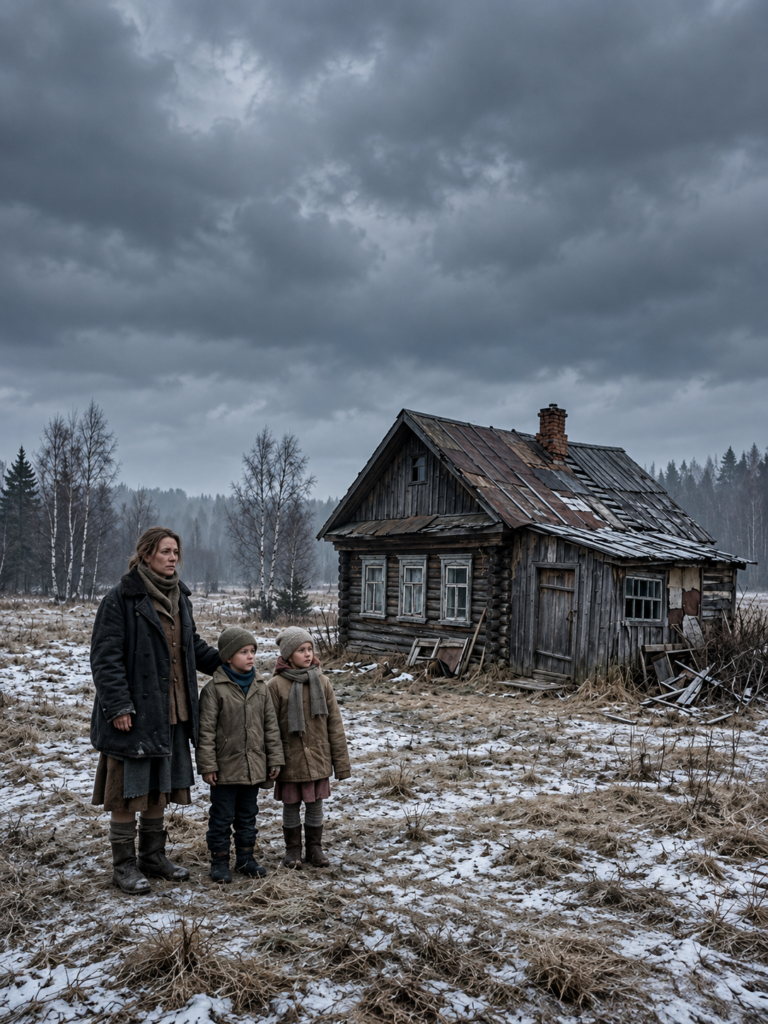
the widow who cleaned the farm for twelve years was handed only a crumbling shack but the box under the dirt floor held the secret that ruined the greedy heirs forever
Part 1
The sun came up hard over the dry pastures of the Clearwater place, turning the grass the color of old straw. Valerie woke before five the way she had every morning for twelve years. The floor of the small back room where she slept with the children was cold under her bare feet. Roman, nine, and Irene, seven, were still tangled together under the thin sheet, the little girl’s arm thrown across her brother’s chest. Valerie stood a moment and watched them. They were all she had left since the mill accident took her husband five years earlier.
She tied her hair back, put on the faded apron, and stepped outside. The main house was quiet. Anna Morozov had died three days ago. Her children, Max and Kate, had come for the reading of the will and barely looked at Valerie when they passed her in the hall. Twelve years of work—cooking, cleaning, feeding stock, mending fences—had not bought her a place at their table.
She made breakfast the way Anna had liked it, set the table, and kept to the kitchen while the lawyer spoke in the front room. She heard most of it through the open door. The farm would be split between Max and Kate. Jewelry to Kate. The bank accounts to Max. Then the lawyer paused and adjusted his glasses.
“There is one final bequest. To Valerie Sokolova, in recognition of her years of service, Anna Morozov leaves the property known as the adobe house on the back of the farm, beside the dry creek.”
Valerie’s hands stopped in the dishwater. A house. She dried her hands and stepped into the doorway. Max gave a short, ugly laugh.
“The adobe house. That ruin. Mother must be joking even from the grave.”
Kate crossed her arms. “It hasn’t been a house in years. No water, no power, walls falling in. It’s an insult.”
The lawyer cleared his throat. “Those are the terms. The property is registered in Valerie’s name as of today.”
Max looked at her without warmth. “You can pack your things and be gone by tomorrow. We need to settle the place. There’s no room for you here anymore.”
Twelve years. The words landed like stones. Valerie went back to the small room on shaking legs. The children were playing in the yard. She called them in, sat on the edge of the bed, and told them they were moving to a new house. Irene’s eyes lit up.
“A house just for us, Mama?”
“Just for us.”
Roman watched her face the way he always did. “Is it a good house?”
Valerie chose her words carefully. “It’s a house that needs care. We’ll fix it together. It will be ours. That’s what matters.”
That night she barely slept. She had almost no money saved, a few pots Anna had given her years ago, and the clothes on their backs. In the morning she tied everything into an old sheet, took the children’s hands, and walked the dirt track that led behind the main pastures. The sun was already fierce. Roman carried Irene when her legs tired. After nearly an hour the adobe house came into view.
It was worse than she had feared. The mud-brick walls were cracked clean through in places. The thatch roof had fallen in on one side and what remained was black with rot. The door hung on a single rusty hinge. There were no windows, only holes. The floor was packed earth, uneven and scattered with stones.
“Are we going to live here?” Roman asked, his voice small.
Valerie swallowed. “Yes. But we’ll fix it. You’ll see.”
Irene began to cry. Valerie picked her up. “We can’t go back, love. This will be our home.”
They stepped inside carefully. The smell of mold and damp was thick. Cobwebs hung in every corner. A rat darted into a hole when they entered and Irene clung harder. Roman looked around with the careful curiosity of a child who had already learned not to expect much. There was one large room, the remains of an old stove in one corner, a pile of rotten boards in another.
“There’s no bathroom,” he said.
“We’ll manage,” Valerie answered. “Bushes outside. The creek for washing when we can find water.”
They spent the rest of the day clearing what they could. Valerie swept the floor with a branch. Roman stacked the rotten boards outside. Irene sat on a rock with her one rag doll and watched. When night came they lay on the hard ground under the old sheet. Stars showed through the holes in the roof. The wind found every crack. The children slept from exhaustion. Valerie stayed awake and stared at the sky, asking herself how twelve years of faithful work had brought her here.
The next morning every muscle ached, but she got up. The floor was too uneven to sleep on for long. She found an old hoe leaning against the outside wall and began to scrape and level a section of dirt. Roman woke and came to help. They worked for hours, pulling out stones, filling holes. The sun climbed. Her throat was dry. She meant to stop and look for water in the dry creek bed, but she wanted to finish the patch first.
The hoe struck something hard. The sound was wrong—metallic, hollow. She hit it again. Same sound. She knelt and began to dig with her hands. The earth was packed as if someone had tamped it down on purpose long ago. Slowly a rusted metal box came into view, the size of a small suitcase, heavy, its lock already broken with age.
Roman crouched beside her. “What is it?”
Valerie pulled the box free and set it on the ground. She wiped the lid. No markings. Irene came running. Valerie hesitated, then lifted the lid. Inside, wrapped in thick plastic that had kept the worst of the damp away, were yellowed papers, old photographs, sealed envelopes, and a worn notebook.
She picked up one photograph. A young woman with long dark hair held a baby. The woman was smiling, but her eyes were sad. Valerie looked closer and her breath caught. It was Anna Morozov, years younger. On the back, in faded ink: “Me and my son Mikhail. March 15, 1968.”
Anna had only two children that anyone knew—Max and Kate. This photograph was decades older. Valerie opened the notebook. The handwriting was Anna’s, shaky in places, full of feeling.
March 15, 1968. Today my son was born. I held him for only a few minutes before they took him. They said it was for his own good. I was too young. I had nothing. But I wanted to keep him.
March 20, 1968. They told me he died. Complications. I don’t believe it. I saw his eyes. He was alive. They lied.
The pages that followed were full of a mother’s grief and the long search that came after. Years later another entry appeared.
June 12, 1985. I found him. After all this time he is alive. They gave him away illegally. The family that raised him doesn’t know. He has his own life now. I cannot walk in and destroy it. But I needed to see him. I needed to know he was all right.
Anna had watched from a distance for years. She knew where he worked, how he lived. She never found the courage to speak. Near the end of the notebook was a newer entry, only months old. Mikhail worked at a garage on Flower Street in the county seat, forty miles away. Anna had walked past sometimes just to see him.
There were documents too. A birth certificate naming Anna Morozov as mother and the child as Mikhail Morozov. A death certificate dated five days later. And a statement signed by a nurse admitting the baby had not died, that the family had paid to hide the truth and place him for adoption. Most important was a handwritten transfer of ownership, signed and notarized, declaring Mikhail the rightful heir to half the Clearwater farm, along with a letter addressed to him.
If you are reading this, my son, then someone found the box. I hid it in the adobe house because I knew no one else would look there. I left the house to Valerie, the only person I trust, in the hope she would find this and do what is right. You are my son. I loved you from the first moment I saw you. You have rights. You are a Morozov. Claim what is yours. Forgive me for not having the courage while I lived. Know that you were always loved. Your mother, Anna.
Valerie closed the notebook with tears on her face. The children watched her, confused. She wiped her cheeks and said, “Anna left us something important to keep safe. Something that will change a lot of lives.”
She put everything back in the box. Max and Kate would not welcome the news of an older brother. It could be dangerous. But Anna had trusted her. She could not ignore it.
That night she decided. She would find Mikhail and give him what belonged to him—not to hurt Max and Kate, but because it was right. In the morning she buried the box again behind the house, under stones and dirt, kissed the children, and told Roman to watch his sister. She walked to the paved road with a piece of hard bread in her pocket and stood on the shoulder waving at trucks until an older man in a battered pickup stopped.
“Where you headed?”
“County seat. Can you take me?”
“Climb in. I’m going that way.”
Part 2
The driver talked about the heat and the price of feed. Valerie nodded and thought about what she would say. When they reached town he let her out near the square. She asked directions to Flower Street and walked until she found the small garage with the faded sign: Anton’s. Any Repair. The door was open. The smell of oil and hot metal came out into the street.
A man in his fifties looked up from an engine. “Help you?”
“I’m looking for a young man named Mikhail. I was told he works here.”
“He stepped out with a part. Should be back soon. You can wait.”
She sat on a wooden stool. Fifteen minutes later a motorcycle pulled up. The man who came in was a little past thirty, dark-haired, tall, with light eyes that stood out against sun-browned skin. Something in the set of his face reminded her of Anna. He noticed her and smiled politely.
“Afternoon. You Mikhail?”
“I am. Car trouble?”
“No. My name is Valerie. I worked for a woman named Anna Morozov for many years. She died recently and left some things I believe belong to you.”
He frowned. “I don’t know any Anna Morozov. You must have the wrong person.”
“I know it sounds strange. But I need to talk to you. It’s about your family. About who you really are.”
He studied her a moment, then asked the older man if he could leave early. They walked to a small park with benches under old trees and sat. Valerie took the photographs from her pocket and showed him the one of Anna with the baby.
“This woman is Anna Morozov. The baby is you.”
He took the picture. Confusion replaced the polite distance. “That’s me? I never saw this woman in my life.”
“Because they took you from her when you were days old. They told her you died. It wasn’t true. You were given away. She looked for you her whole life. When she found you she didn’t have the courage to speak. But she left everything written down. Proof. A letter for you.”
He was quiet a long time. “My parents raised me from a baby. They never hid that I was adopted. They said my mother died in childbirth. She was young. No family.”
“They were told a lie. Anna Morozov owned one of the biggest farms in the county. You are her son. You have a claim.”
“Why are you telling me this? What do you get?”
“Nothing. I’m doing what she asked. She left me an old house. The truth about you was hidden inside it. I think she wanted me to find you.”
He rubbed his face. “I need to see the papers. I can’t just believe a story like this.”
“They’re at the house where I’m living. You can come tomorrow if you want.”
He thought, then nodded. “I’ll come. Give me the directions.”
She explained the dirt track behind the main pastures. They agreed on the next afternoon. When she finally reached the adobe house again it was nearly dark. The children ran to her. She told them someone important would come tomorrow and they must be polite and quiet.
She slept little. In the morning she swept the floor again and asked the children to wash their faces. Around three they heard the motorcycle. Mikhail stood in the doorway and looked around at the cracked walls and the holes in the roof.
“You live here?”
“This is what Anna left me.”
He shook his head. “And you’re still helping me.”
“Because it’s right.”
She led him behind the house, dug up the box, and handed it to him. He read everything—birth certificate, the nurse’s statement, the transfer, Anna’s letter. When he finished the letter his eyes were wet.
“She was really my mother. And I never knew.”
“She loved you. It’s in every line.”
He closed the box. “I need to take this to a lawyer. I need to know if any of it holds up. If it does, I’ll claim what’s mine. Not for the money. Because it’s right. Because she wanted it. Because I deserve to know who I am.”
Valerie felt the tightness in her chest ease. “Take it. I trust you.”
He put the box in his pack, thanked her, and rode away. She stood in the yard and knew the first step was done. Now she had to wait.
A week later he returned with a younger man carrying a leather briefcase. They sat on the dirt floor because there was no furniture.
“Valerie, this is Gregory, my lawyer,” Mikhail said.
Gregory shook her hand. “I’ve gone through the documents. They’re genuine. The birth certificate is real. The nurse’s statement is strong evidence. The transfer wasn’t recorded, but a court can recognize it. Mikhail has a legal claim. It won’t be easy. The current heirs will fight. They’ll say Anna wasn’t in her right mind, that the papers are forged, that you invented the whole thing. It will be a long case.”
Mikhail looked at her. “Will you testify? Tell what you know about Anna and how you found the box?”
“I’ll do whatever is needed.”
The next day the lawyer filed the claim. Word moved through the county fast. Two days later Max and Kate came to the adobe house. Valerie had sent the children to a neighbor. Max’s voice was tight with anger.
“So it’s true. You’re helping some stranger steal what belongs to us.”
“It’s not theft. Mikhail is Anna’s son. She wrote it all down. I only found the truth.”
Kate stepped closer. “My mother gave you work and a roof for twelve years. This is how you repay her? You invent a lost son and try to rob us.”
“I invented nothing. I found what she hid. She wanted it known.”
One of the men with them moved forward. Max caught his arm. “We won’t dirty our hands. We’ll prove the papers are fake. When we do, you’ll answer for it. Jail for forgery. Your children in foster care.”
Valerie’s blood went cold. They left, but she knew it was only the beginning. That night every sound outside made her sit up. She thought about burying the memory of the box and pretending she had never found it. Then she remembered Anna’s letter and knew she could not.
Part 3
The pressure grew. Max and Kate hired a lawyer known for winning hard cases. Rumors started in town. Valerie was a schemer who had stolen papers from the farm. She was using a poor young man for her own gain. She had forged Anna’s signature. People who had nodded to her for years now looked away or stared. She felt the weight of every whisper.
Mikhail came almost every day. He brought food, helped patch the worst holes in the roof, and talked to the children. Roman said he was like an uncle. Irene called him the nice man who fixed things. One afternoon while he worked on the roof Valerie asked why he kept coming.
“You could take the papers and leave. You don’t have to look after us.”
He set the hammer down. “My mother trusted you with the truth. That means you’re important. And you need help. I’m not walking away while you’re paying for what you did for me.”
The hearing was set for a month later. Gregory spent days preparing her. “They’ll try to rattle you. Just tell the truth. How you found the box. What was inside. The truth is the best thing we have.”
On the day of court she wore the best dress she owned, one Anna had given her years before. Mikhail drove her in his old car. The children stayed with the neighbor. The courthouse was large and full of people in suits. Valerie felt small until she saw Max and Kate on the other side of the room. Something in her steadied. She was not there for herself.
The judge was a middle-aged man with gray hair combed straight back. Max and Kate’s lawyer spoke first. He was smooth and cold. He called the claim a fraud invented by a resentful former servant who had been insulted by a crumbling house. There was no DNA, no living witnesses who had seen the birth, only old papers anyone could have forged.
Gregory answered with handwriting experts who confirmed Anna’s script, the nurse who was still alive and repeated her statement under oath, hospital records showing Anna had given birth on the date in question, and neighbors who had seen Anna walking past the garage on Flower Street more than once, always watching from a distance.
Then Valerie was called. She told the story simply: twelve years of work, the adobe house, the hoe striking metal while she tried to make a place to sleep, the box, the letters, the decision to find Mikhail because it was what Anna had wanted. The other lawyer pressed her hard.
“You expect us to believe you found this box by accident?”
“I was leveling the floor so the children and I could sleep. The hoe hit something. I dug to see what it was.”
“And it never occurred to you to give the papers to the legal heirs?”
“It did. Then I read the letters. Anna left the house to me because she knew no one else would look there. She wanted me to find him.”
“Or you wrote the letters yourself.”
“I can barely write my own name well enough to sign a paper. How would I copy her hand?”
The question hung. He tried another angle, suggesting she wanted revenge on Max and Kate. She answered quietly that she had only done what she believed Anna asked.
When the hearing ended the judge said he would review everything and rule in thirty days. Valerie walked out exhausted but lighter. She had done her part.
The thirty days felt endless. Mikhail kept coming. He taught Roman how to use simple tools and made Irene laugh with stories. One evening Irene said, “I wish he was our dad.” Valerie’s throat tightened. “He’s our friend. A very special friend.”
On the day of the ruling the courtroom was full. Journalists waited in the hall. The judge entered, everyone stood, and he began to read. The documents were genuine. The handwriting matched. The nurse’s statement was credible and supported by hospital records. Witnesses confirmed Anna had searched for and watched Mikhail. Therefore Mikhail Morozov was the biological son of Anna Morozov and a lawful heir. The estate would be divided into three equal shares among Mikhail, Max, and Kate.
The room stirred. Max and Kate sat pale. Mikhail closed his eyes. Tears ran down Valerie’s face. They had won.
Outside, cameras flashed. They did not stop. In the car Mikhail said, still disbelieving, “We did it.”
“You did it. You fought for what was yours.”
“No. We did it together. Without you none of this happens.”
Part 4
News of the ruling spread. Max and Kate filed an appeal, but Gregory said the evidence was too strong for much hope. Mikhail came to the farm for the first time as an owner. Valerie went with him, the children running ahead across the open ground. Max stood on the porch of the main house with his arms crossed.
“Come to look over your new property?”
“I own a third of it now.”
“Not for long. We’ll find a way to undo this. I won’t share what’s mine with a stranger.”
“I’m not a stranger. I’m your brother. Same mother.”
“You’re not my brother and you never will be.”
Kate appeared in the doorway, eyes red. “You have no idea what you’re doing. This place is everything to us. Our whole lives.”
“It was everything to my mother too,” Mikhail said, his voice rough. “But she could never keep me near her. You had her your whole lives. I didn’t even know she existed.”
Kate looked down and had no answer.
Mikhail walked the pastures, the barns, the fields. He stopped at the old rocking chair on the porch where Anna used to sit for hours watching the horizon. Valerie told him what she had seen. “I always thought she was thinking about something sad. Now I know what.”
In the days that followed he began to learn the work of the place. He did not want to be a silent owner. Max resisted at first, questioning every suggestion. Kate was colder still. But Mikhail kept showing up, listening to the hands, walking the fences. Slowly the edge came off Max’s voice. Kate took longer, but she began to notice that he treated the land and the people on it with care.
Valerie stayed in the adobe house. Mikhail offered money more than once. She refused. “I don’t want charity. I want to work and take care of my children.”
“Then come work on the farm,” he said one afternoon. “Not as a hired girl. As manager. You know this place better than anyone. You know the people. I need someone I can trust.”
She was startled. “I can barely read and write well.”
“You know what matters. The rest can be learned. What do you say?”
She thought of the children and the cracked walls. “I’ll do my best.”
He introduced her to the hands the next morning. Some were surprised. Most had known her from the years she worked for Anna and nodded with respect. She set the books in order, listened to complaints, cut waste, and planned small improvements. Within weeks the place ran smoother than it had in a long time. Even Max had to admit she knew the work. Kate began to speak to her with something closer to courtesy.
Mikhail enrolled the children in the town school, bought them proper clothes and supplies. For the first time they had a real chance. He also hired men to repair the adobe house—new roof, plastered walls, windows, a concrete floor, water, and power. When Valerie saw the finished rooms she cried. It was more than she had ever expected: a solid place where her children could grow up clean and warm.
Not everything eased at once. Max still made sharp remarks and small obstacles. One hot day a fire started in a cornfield. Everyone ran to fight it—buckets, wet sacks, anything at hand. In the smoke and heat a beam fell and pinned Mikhail. Max saw it. For a second he hesitated. Without Mikhail the farm would be his and Kate’s again. Then he remembered something Anna used to say about family looking after its own. He ran into the heat, heaved the beam aside with a shout, and dragged Mikhail clear. Others helped carry him to safety. They stopped the fire before it jumped the break.
Mikhail woke in the hospital hours later, bruised but alive. Max sat by the bed, face streaked with soot, hands bandaged.
“You saved me.”
Max looked away. “You’re my brother. Whatever else I feel, I wasn’t going to let you die.”
They looked at each other without the old distance. Max’s voice broke. “I’m sorry. For all of it. I was angry at the situation, at having to share what I thought was only mine. I almost let you die over pride.”
Mikhail held out his hand. Max took it. “We can try to be a real family.”
From that day the resistance ended. They worked side by side. Kate grew warmer. The farm began to thrive under the three of them and under Valerie’s steady management. Yields improved. The hands were paid fairly and stayed. Valerie felt, for the first time, that she had a true place—not as a servant who could be dismissed, but as someone whose word mattered.
Part 5
Six months after the ruling, life on the Clearwater place had found a new balance. Mikhail handled the fields and new equipment. Max looked after the livestock. Kate managed the books and sales. Valerie kept the parts moving together, settled disputes among the hands, and made sure nothing important was missed. Roman discovered he liked to draw and began Saturday classes in town. Irene took to a guitar a teacher Mikhail hired. Valerie watched them come home smiling and knew every hard night had been worth it.
One Saturday morning Mikhail came to the repaired house with a serious face. They sat on the small porch he had added.
“I’ve been thinking about everything that happened,” he said. “You did more for me than I can repay. Without you I never know my own story, never meet my brother and sister, never have any of this.”
“You don’t owe me anything. I did what was right.”
“I know. But I want to do something that gives you real security.” He handed her a thick envelope.
Inside were official papers. The adobe house and the five acres around it were now recorded in her name alone—no longer an informal bequest, but clear title that could not be taken. There was a second document: a partnership agreement giving her five percent of his share of the farm. She would have a voice in decisions and a claim on profits. She would be an owner, not only a manager.
Valerie could not speak at first. Tears came anyway. “I can’t take this. It’s too much.”
“You can. My mother trusted you. You had the courage to do the hard thing when you could have buried the box and walked away. You’re honest and you work. I trust you. You’re part of this story. You deserve a future that can’t be taken.”
She hugged him. The children came running at the sound of her crying, then joined the embrace when they understood. In the months that followed she sat at the table when decisions were made. Max and Kate listened. She was no longer the woman who had been handed ruins and told to leave. She was part of the family that worked the land.
Kate asked to speak with her one afternoon on the main porch. “I want to apologize,” she said, eyes down. “For how I treated you when Mother died, and before. You were always more than hired help. Mother knew it. I should have known it too.”
Valerie took her hand. “It’s all right. You were afraid of losing everything. I don’t hold it against you.”
“You’re a remarkable woman. I don’t know if I would have had the courage to find Mikhail and fight the way you did.”
“I only did what I thought Anna wanted.”
Kate’s eyes filled. “She chose the right person to trust. In the end you didn’t just bring Mikhail home. You showed us what actually matters.”
They hugged. Valerie felt the last of the old weight leave her shoulders.
Years later Roman became a designer who worked with small businesses on their signs and labels. Irene taught music to children whose families could not pay for lessons. They came back often to the house that had once been a ruin, now solid and painted, with flowers by the door. Valerie would stand on the porch and look across the pastures and remember the night she struck metal with a hoe while trying to make a level place to sleep. She remembered the fear, the long walk to town, the courtroom, and the choice to tell the truth anyway.
Anna had left her more than a crumbling shack. She had left a task and the chance to change more lives than her own. Valerie had carried it out. The story traveled through the county: the widow who found a buried box and had the nerve to bring the truth into the light; the hired woman who became an owner; the family that learned, late and painfully, how to be one. People passing the house now saw children in the yard and remembered that the greatest things a piece of ground can hold are not always gold or cash. Sometimes they are a mother’s unfinished love, a servant’s stubborn honesty, and the slow repair of what greed and silence had broken.
When Valerie finally closed her eyes many years later, she did so knowing she had kept the trust Anna placed in her, that her children had grown safe, and that the old adobe walls—once a punishment—had become the beginning of something no one could take away.


