
Part 1
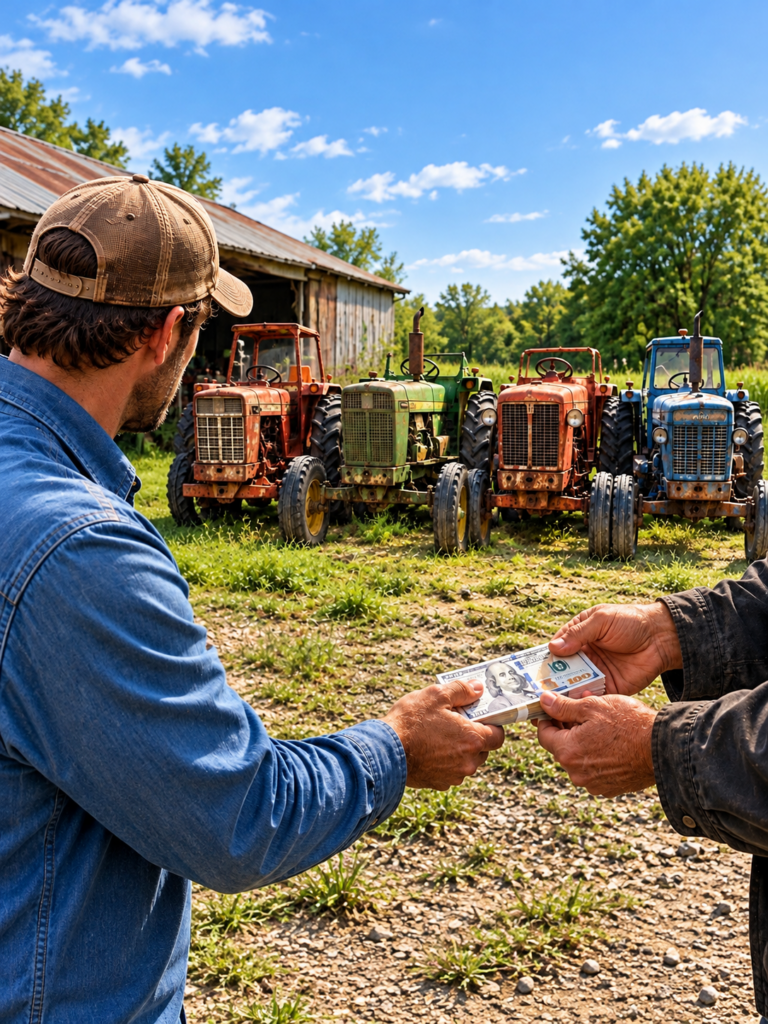
The four tractors sat in a muddy field behind Frank Dawson’s equipment dealership on the edge of Mill Creek Township. Their tires were flat, their paint had long since given way to rust, and weeds grew up through the frames of the ones that had been there the longest. Most of the farmers who drove past them on the county road barely glanced at them anymore. The township had already moved on. Newer tractors with enclosed cabs and electronic controls were what people talked about at the feed store now. Nobody wanted to spend good money repairing equipment that looked like it belonged in a scrap yard.
Eli Turner saw them on a Tuesday afternoon in early April. He was thirty-eight years old, recently unemployed, and had less than three hundred dollars left in the checking account he shared with his wife, Laura. He had spent nearly fifteen years working as a diesel mechanic at a regional agricultural equipment dealership. He knew engines, transmissions, hydraulic systems, and the particular ways an old Farmall could quit on a man in the middle of planting. He had started as an apprentice in his early twenties and worked his way up until he could diagnose problems other mechanics walked away from. Then the dealership changed ownership. The new management decided to consolidate operations and move most of the repair work to a larger facility in the neighboring county. Several employees were transferred. Others were laid off. Eli was among them.
He had spent the months since looking for another job. Equipment dealerships, construction companies, independent shops. Some offered temporary work. Nothing offered the stability he needed. He had a mortgage on a small house at the edge of the township, a wife who worked part-time at the hospital in town, and two children still in school. Laura had not complained, but Eli could see the worry in the way she watched him sit at the kitchen table in the middle of the afternoon with nothing to do.
He pulled his truck onto the gravel shoulder and walked across the muddy field. Frank Dawson was inside the dealership office, already clearing out the last of his newer inventory before he retired. Eli spent twenty minutes with the four Farmall H tractors. One was missing its carburetor. Another had a cracked seat and damaged wiring. The third was half-buried in weeds. The fourth would not turn over at all. He checked the engine blocks for cracks, looked at the transmissions, examined what was left of the hydraulic systems, and studied the frames. None of them appeared to have suffered catastrophic structural damage. Their problems were years of neglect, missing parts, and ordinary wear.
He found Frank and asked what he wanted for them.
Frank looked at the tractors and shrugged. “Honestly, I just want them gone. I was going to call the scrap dealer.”
Eli made his offer. Two hundred dollars for all four.
Frank laughed once, then looked at him more carefully. After a moment he nodded. They settled the paperwork that afternoon. Eli drove home with four tractors that had cost him less than a decent used lawn mower.
Laura was waiting in the driveway when he arrived with the trailers. She looked at the machines, then at her husband.
“You bought all four?”
Eli nodded.
“For two hundred dollars?”
“All four.”
She stood quietly for a moment. She was not angry, but she wanted to understand. They had bills. Their savings were nearly gone. And now he had spent part of what remained on four machines that did not even run.
“Who is going to buy them?” she asked.
Eli did not have a clear answer yet. He had not bought the tractors because he already had customers waiting. He had bought them because he understood something about Mill Creek that a lot of people had stopped noticing. Farmers were buying newer equipment when they could afford it, but not everyone could replace every machine on their place. And the ones who still owned older tractors were finding fewer and fewer mechanics willing to work on them.
Part 2
The following morning Eli began moving the tractors into the old storage shed behind the house. The shed had electricity, a concrete floor, and just enough room to work on one machine at a time. It was not a professional workshop, but it was a place to start. He began with the first Farmall. The engine turned, but the fuel system was in poor condition. The carburetor was missing, several fuel lines needed replacing, and the electrical system had been neglected for years. He made a careful list of everything required.
The second tractor needed work on its ignition and cooling systems. The third had a damaged starter and several problems with its wiring. The fourth was the most difficult. Its engine would not turn over, and Eli suspected internal damage. He quickly realized that restoring all four at once would cost more money than he had. So he made a practical decision. He would not try to finish everything at the same time. The fourth tractor would serve as a source of parts if its engine proved beyond economical repair. The others would be assessed one by one. He would get one running before he moved to the next.
It required patience. Eli spent the next several weeks on the first tractor. He cleaned the fuel system, replaced damaged hoses, repaired the wiring, and searched for a suitable carburetor. Some parts were inexpensive. Others were difficult to find. He called suppliers, checked used equipment listings, and drove to two neighboring towns looking for components that ordinary agricultural stores no longer stocked. Several evenings ended with him returning home empty-handed. But he kept going.
Then, on a Saturday morning, he turned the ignition. The engine coughed twice and stopped. He adjusted the fuel mixture, checked the timing, and tried again. This time the engine started. A cloud of exhaust drifted from the shed, followed by the steady idle of an old agricultural engine. Eli stood beside it and listened. The tractor was not perfect. The tires were worn, the bodywork showed years of weather, and the engine still needed further attention. But it ran. For the first time since he had lost his job, he felt he had something he could build on.
He cleaned the tractor, finished the remaining repairs, and took it outside for a short test. The following Monday he posted a photograph online with a simple message. He was available for older tractor repairs. He included his phone number. He did not expect much.
Someone called before lunchtime. Harold Bennett owned a small cattle operation outside Mill Creek. He had an older tractor that kept losing power under load. The local dealership had recommended replacing several components, but the estimate was more than Harold wanted to spend on a machine of that age. He asked whether Eli could take a look.
Eli agreed. When he arrived he spent nearly an hour examining the tractor. He checked the fuel delivery, inspected the air intake, and tested the engine under different conditions. The problem was not as serious as the previous estimate had suggested. A restriction in the fuel system was preventing the engine from receiving enough fuel under heavy load. Eli cleaned the affected components, replaced the damaged filter, and tested the tractor again. It ran normally.
Harold was relieved. He paid Eli for the work and mentioned him to another farmer. That single repair brought Eli his second customer. Then a third. The requests were not coming from people who wanted their tractors restored for show. They were coming from farmers who needed their equipment to work. Some had hydraulic leaks. Others had starting problems, damaged electrical systems, or engines that had gradually lost power.
Eli began to notice a clear pattern. The township was full of older tractors that still had useful years ahead of them. Their owners were struggling to find anyone willing to repair them. The larger dealerships were concentrating on newer equipment. Their workshops were busy, and their technicians were increasingly specialized in modern machinery. Independent mechanics were becoming harder to find. Some had retired. Others had moved into different work. For farmers with older machines, the choices were often expensive. They could haul their tractors to another county, wait for an available technician, or try to fix things themselves.
Eli realized his small shed could serve a purpose beyond rebuilding four old tractors. He could become the mechanic those farmers needed. But first he had to prove he could handle more than simple repairs.
Part 3
The second tractor became his next project. It had a better engine, but the electrical system was in terrible condition. Eli spent several days tracing damaged wires and replacing connections. He also discovered that the cooling system had been neglected. The radiator needed cleaning, several hoses were deteriorating, and the thermostat was no longer working correctly. He repaired the system and ran the tractor under load. It performed well. Instead of selling it immediately, he decided to keep it as a backup machine and use it to move equipment around his own property.
The third tractor took longer. Its engine started, but the transmission had a problem that made it difficult to engage certain gears. Eli initially suspected internal damage. He spent two days checking the linkage and inspecting the external components before he found the real issue. A worn and incorrectly adjusted connection was preventing the transmission mechanism from operating properly. It was a relatively inexpensive repair. The tractor did not need a complete transmission rebuild after all.
By the end of the third month Eli had two dependable tractors, one partially repaired machine, and the fourth waiting for a more detailed inspection. More importantly, he had begun receiving regular repair requests. His shed was becoming too small. Farmers were bringing equipment to his property, sometimes waiting several days for an available space. Eli started working longer hours. Laura helped him keep track of customers, parts, and payments. She answered the phone whenever he was underneath a tractor. The business was still small, but it was beginning to cover their essential household expenses.
Then came the job that nearly stopped everything. George Miller called one afternoon. He owned a substantial grain operation and depended heavily on an older tractor for moving equipment, pulling wagons, and handling work around his storage facilities. The tractor had suddenly developed serious engine problems. George had already spoken with two repair shops. Neither could take the job immediately. The nearest available appointment was several weeks away. He could not afford to leave the machine sitting that long. He asked whether Eli could inspect it.
Eli agreed. When he arrived, the tractor was parked beside a grain storage building. George explained that the engine had started making an unusual knocking sound before it lost power. Eli listened carefully. He checked the oil level and inspected the filter. He examined the engine for external signs of damage. The situation was serious. The engine had suffered internal wear, and simply replacing a filter would not solve the problem. Eli explained that the tractor needed a proper mechanical assessment before anyone could estimate the full cost.
George was disappointed. He had hoped for a quick repair. But he appreciated that Eli was being honest rather than promising something he could not deliver. Eli returned the following morning with additional tools. He removed the necessary components and continued inspecting the engine. Eventually he identified the source of the problem. A bearing failure had allowed excessive movement in the rotating assembly, damaging surrounding components. The repair would require significant work.
George asked whether it would be cheaper to replace the tractor. Eli looked at the machine. It was old, but the rest of it was in reasonable condition. The transmission, rear end, and other major components were still serviceable. Replacing the entire tractor would cost considerably more than repairing the engine. He explained the options and gave George an honest estimate. George approved the repair.
For Eli, this was a major test. Until then, most of his jobs had involved relatively straightforward problems. This one required a deeper engine repair, careful measurements, replacement components, and hours of work. He had to make sure every part was installed correctly. There was no room for guesswork. He worked through the following week, carefully assembling the engine and checking each stage. When the tractor was finally ready, George came to watch the first start. Eli stood beside the engine and turned the key. The starter engaged. The engine rotated, coughed, and then settled into a steady idle. The knocking sound was gone.
George listened for a moment, then looked at Eli and smiled. “That’s the first time I’ve heard it sound like that in years.”
He paid the agreed amount and told two neighboring farmers about the repair. Within days Eli received several new calls. One farmer needed a clutch repaired. Another had a tractor with a hydraulic pump problem. A third wanted an older machine inspected before he purchased it. The work was becoming consistent.
Part 4
There was another development Eli had not anticipated. Farmers were no longer calling only when something broke. They were beginning to ask him to inspect their equipment before planting and harvest seasons. They wanted to identify problems before those problems became expensive breakdowns. Eli recognized the opportunity. Instead of waiting for emergency repairs, he introduced scheduled maintenance visits. He offered oil and filter changes, cooling system inspections, hydraulic checks, fuel system maintenance, and general mechanical assessments. The service gave farmers a way to keep their older equipment operating without waiting for a failure. It also gave Eli a more predictable source of income.
By then the old storage shed had become inadequate. He had tools scattered across the floor, tractors waiting outside, and parts stacked against the walls. He needed a proper workshop. He had been careful with the money he earned. He did not spend everything he made, and he avoided taking on unnecessary debt. After several months of saving, he rented a small agricultural workshop on the edge of Mill Creek. The building had enough space for two tractors, a workbench, storage shelves, and a small office. The paint was faded, the doors needed attention, and the yard was mostly gravel. But it was a genuine repair facility.
Eli moved his tools, installed better lighting, organized his parts, and put up a sign: Turner Tractor Repair. The first week was busier than he expected. Farmers who had previously been transporting their equipment outside the township began bringing it to him. Word spread through local agricultural supply stores and farming groups. People started recommending him whenever someone asked where an older tractor could be repaired.
Within six months Eli had built a customer base that extended beyond Mill Creek. But the biggest turning point came from the fourth tractor—the one that had appeared to have a seized engine. Eli had initially planned to use it mainly for spare parts. After the business became established, he decided to inspect it more carefully. He removed the spark plugs and used the appropriate tools to investigate why the engine would not rotate. The problem was not what he had first suspected. The engine had suffered water intrusion and internal corrosion after years of being left exposed to the weather. It could not simply be freed up and returned to service. But during the inspection, Eli discovered that several major components were still usable. The transmission housing was intact. The rear axle assembly was in good condition. Several hydraulic components could be recovered, and the tractor contained parts that were becoming increasingly difficult to source.
That machine became his parts inventory, and it proved more valuable than he had expected. A farmer arrived one morning with an older tractor that had developed a serious transmission problem. He had already spent money trying to locate a replacement assembly. The exact component was difficult to find. Eli examined the tractor, compared the specifications, and checked his recovered inventory. He found a compatible component from the fourth Farmall. After carefully verifying the relevant measurements, he confirmed that it could be used. The repair was completed successfully. The farmer got his tractor back without having to replace the entire machine.
For Eli, that was an important lesson. Those four tractors had not all needed to become working machines. Their value was in the useful equipment and components they contained, as well as the opportunities they had created. One became a source of parts. Two became dependable working tractors. And the fourth helped establish a parts inventory that allowed Eli to repair machines other workshops struggled to support. The two-hundred-dollar purchase had given him far more than four old tractors. It had given him the foundation of a business.
Part 5
By the following spring, Turner Tractor Repair had become a familiar name throughout Mill Creek Township. Eli was no longer working alone every day. He had hired a young apprentice named Caleb, whose interest in machinery reminded Eli of himself when he first started. Caleb helped with routine servicing, cleaning components, organizing parts, and preparing equipment for inspection. Eli handled the more complicated diagnostics and major mechanical repairs. He also began keeping records of common problems affecting older tractors in the area. This helped him order frequently needed components in advance and reduce the time customers spent waiting.
The workshop became particularly important during planting and harvest seasons. A broken tractor during those periods could disrupt an entire day’s work. Farmers needed someone who understood the equipment, could diagnose problems accurately, and was willing to work on machines that were no longer considered modern. Eli had built his business around exactly that need. Eventually, even farmers who owned newer tractors began bringing their older backup machines to him. They understood that having a dependable second tractor could make a difference when their primary equipment was unavailable. And because Eli had spent years working with agricultural machinery, he understood that keeping older equipment operational was not simply about saving money. It was about protecting the investment farmers had already made.
Three years after purchasing the four tractors, Eli was standing outside his workshop when Frank Dawson drove past. Frank had retired from the dealership and occasionally visited the township. He recognized the sign. He pulled into the yard and stepped out of his truck. After greeting Eli, he looked around the workshop. There were three tractors waiting for inspection, another being serviced inside, and Caleb was organizing a collection of replacement components near the workbench.
Frank looked at the activity and laughed. “Is this really what you did with those four old Farmalls?”
Eli smiled. “More or less.”
Frank shook his head. He had sold those machines because he believed nobody wanted them anymore. Now the man who had purchased them for two hundred dollars was operating one of the busiest independent tractor repair businesses in the township.
But the most meaningful part of the story was not the money Eli had made. It was what had happened to the farmers around him. They no longer had to travel long distances every time an older tractor developed a problem. They had someone nearby who understood their equipment and could help them keep it working. Some of those farmers had initially laughed when they heard about Eli’s purchase. They had believed he was wasting money on machines that belonged in a scrapyard. Now they were among his regular customers.
Eli never forgot how the business started. He kept the first two tractors he had repaired. One remained useful around the workshop, while the other was occasionally used for moving equipment around the property. He also kept the fourth tractor’s identification plate and a few recovered components as reminders of where everything began. The other parts from that machine had helped keep dozens of older tractors operating. And the workshop continued to grow.
Eli had not set out to become the township’s only independent mechanic for older farm tractors. He had simply noticed that something useful was being discarded because people had moved on to newer equipment. Everyone else had seen four unwanted machines. He had seen an opportunity to put his experience to work. And that decision, made with just two hundred dollars, gave him a business, restored his livelihood, and provided an important service to the farming community around him. Sometimes an opportunity does not arrive looking like a business. Sometimes it arrives covered in rust, sitting in a muddy field with four flat tires and engines nobody wants to start.


