
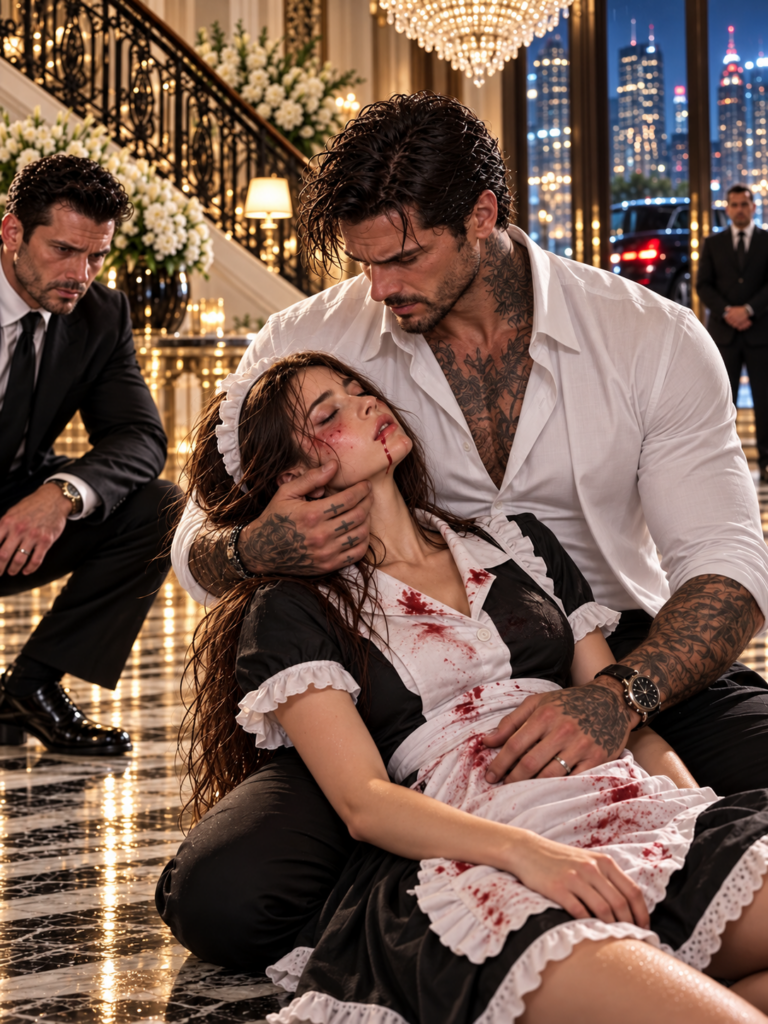
PART 2 — THE MESSAGE BENEATH THE CREST
━━━━━━━━━━━━━━━━━━━━━━━━━━━━━━━━━━
“What do you want me to do, Boss?”
Marco’s question hung in the room.
There had been a time when my answer would have come before the question finished.
Names.
Addresses.
Cars waiting outside.
Men sent into the night carrying my anger for me.
Instead, I looked at Emma.
The doctor had moved her onto the long sofa in the library because she was stable enough to be transported without an ambulance drawing attention outside the house. Lucia knelt beside her, holding a clean cloth against the cut at her lip.
Emma looked impossibly small beneath the blanket.
I thought about everything I had been told about her.
Three jobs.
A mother undergoing cancer treatment.
A nineteen-year-old brother learning how to live without his legs.
Fourteen months in my home, and I had known almost none of it.
That realization embarrassed me more than I wanted to admit.
I had spent years insisting that everyone under my roof was protected.
Yet protection was a hollow word if I never bothered to know the people I claimed it covered.
“Nothing,” I said.
Marco stared at me.
“Nothing?”
“Not tonight.”
He lowered his voice. “Dominic, Kolov deliberately—”
“I know what he did.”
Marco fell silent.
I walked to the windows.
The rain distorted Manhattan into streaks of white and gold.
“Find out who the men were,” I said. “Quietly. I want facts, not rumors. Nobody touches anybody. Nobody sends messages. Nobody makes threats.”
Marco studied me as though checking whether I had been replaced by someone who merely looked like Dominic Castellano.
“You sure?”
“No.”
That surprised him.
It surprised me too.
I turned.
“But I am sure that whatever happened tonight was designed to make me react before I think.”
Lucia looked up.
For a moment, something passed across my sister’s face.
Approval, perhaps.
Or relief.
Marco nodded slowly.
“I’ll start with the cameras.”
“And Marco?”
“Yeah?”
“Find out how they knew Emma would be walking that route tonight.”
His expression changed.
That was the question neither of us had asked.
Emma had not left at the same time every evening. Her second job changed shifts constantly. Sometimes she took the subway. Sometimes Lucia’s driver dropped her off. Sometimes she walked.
Yet two men had been waiting exactly four blocks away.
Waiting for her.
Marco disappeared toward the security office.
I returned to Emma.
Her eyes were closed.
“She’s going to be all right,” Dr. Brennan said quietly.
“How all right?”
“Sore. Frightened. Probably angry once she has enough strength for it.”
I almost smiled.
“Good.”
The doctor packed his instruments.
“She needs rest more than anything. And Dominic?”
I looked at him.
“She needs to feel safe without feeling imprisoned.”
That sentence stayed with me.
Because I understood prisons.
Some had bars.
Some had marble floors, security cameras, locked gates and men standing outside every door.
And some were built from gratitude.
I didn’t want Emma waking tomorrow believing she owed me something because she had been hurt while wearing my crest.
Lucia followed me into the hall.
“You surprised me,” she said.
“Don’t sound so disappointed.”
“I’m not.”
She folded her arms.
“You would have handled this differently ten years ago.”
“Ten years ago, you were still hiding my car keys whenever I got angry.”
“Because you were an idiot.”
“I was twenty-nine.”
“Exactly.”
I looked through the open doorway at Emma.
“Why didn’t you tell me about her family?”
Lucia’s expression softened.
“Because she asked me not to.”
“Why?”
“Pride.”
“No. There’s more.”
Lucia hesitated.
That was enough.
“What?”
“Dominic—”
“What aren’t you telling me?”
She looked toward the library before lowering her voice.
“Emma doesn’t want charity.”
“I didn’t offer charity.”
“You would.”
“I would help.”
“To her, there isn’t much difference.”
I frowned.
Lucia sighed.
“Her mother used to work for wealthy families. Emma grew up watching people offer help and then remind them of it later. She doesn’t trust gifts that come with invisible strings.”
“Mine wouldn’t.”
“She doesn’t know that.”
The words landed harder than they should have.
Maybe because Lucia was right.
People knew my reputation.
They knew my house.
They knew my name.
They knew the men who answered when I called.
But knowing those things was not the same as knowing me.
Perhaps Emma had worked fourteen months beneath my roof and still had no idea what kind of man I was.
The uncomfortable thought followed me until dawn.
Emma woke shortly after eight.
Her first question was whether she had missed her morning shift.
Lucia stared at her.
“Emma.”
“What time is it?”
“Eight twelve.”
“Oh, no.”
Emma tried to sit up.
Dr. Brennan immediately stopped her.
“You aren’t going anywhere.”
“I have to call Mrs. Donnelly.”
“I already did,” Lucia said.
Emma froze.
“You called my other employer?”
“Yes.”
“What did you tell her?”
“That you were sick.”
Emma relaxed slightly.
Then she looked at me.
I had deliberately remained near the doorway.
“I’ll pay for the shift,” I said.
Her expression closed instantly.
“No.”
One word.
Firm despite her bruised mouth.
I understood what Lucia had meant.
“Fine.”
Emma blinked.
“Fine?”
“You said no.”
She clearly hadn’t expected surrender.
“Most people argue.”
“I’m learning.”
Lucia coughed into her hand to hide a laugh.
Emma looked from her to me.
Then, unexpectedly, she smiled.
It was small.
Painful.
But real.
“I should call my mother.”
“Does she know what happened?” I asked.
“No.”
“You’re not going to tell her?”
“She has chemotherapy tomorrow.”
There was no self-pity in the statement.
Only practicality.
“She’ll worry. Then she’ll pretend she isn’t worried because she thinks worrying makes me worry. Then my brother will worry because she’s pretending not to worry.”
“That sounds complicated.”
“That’s family.”
Lucia smiled.
“Unfortunately, she’s right.”
Emma reached for her phone before remembering it had been stolen.
Her face changed.
Marco appeared in the doorway at that exact moment.
“I have something.”
I followed him into my study.
He closed the door.
“Found the two men.”
“Names?”
“Anton Belov and Sergei Malkin. Low-level associates. Both have worked around Viktor Kolov’s organization.”
“So Emma was right.”
“Yes.”
Marco placed a tablet on my desk.
“But that’s where it gets strange.”
Security footage showed Emma leaving the house at 10:41.
A second camera, mounted on a pharmacy three blocks away, caught her walking east.
At 10:47, a dark sedan passed her.
At 10:49, it passed again.
Marco froze the image.
“You recognize the car?”
“No.”
“Neither did I.”
He zoomed in on the license plate.
“The plate belongs to a company called Hudson Executive Transport.”
“Kolov?”
“No connection I can find.”
“Then why are we looking at it?”
“Because it was parked outside this house yesterday afternoon.”
I stared at him.
“How long?”
“Twenty-three minutes.”
“Who was inside?”
“Driver stayed behind the wheel.”
“Passenger?”
“One got out.”
Marco changed the image.
A man in a gray coat stood beneath an umbrella near our front gate.
His face was partially hidden.
Something about his posture bothered me.
“Do we know him?”
“Not yet.”
“Find him.”
Marco hesitated.
“There is another problem.”
Of course there was.
“The two men who attacked Emma weren’t supposed to be there.”
I frowned.
“What does that mean?”
“According to someone close to Kolov, Anton and Sergei were supposed to be collecting money in Queens.”
“Maybe your source is wrong.”
“Maybe.”
Marco’s tone said he didn’t believe it.
“And Kolov?”
“Apparently furious.”
That made even less sense.
“Because they failed?”
“Because they used his name.”
I leaned back.
Marco continued.
“My source says Kolov has been telling everyone for six months not to provoke you.”
“Why?”
“No idea.”
“Fear?”
“Maybe. But it doesn’t fit.”
I walked toward the window.
Nothing about the situation fit.
Two men associated with Kolov had attacked Emma.
They had specifically mentioned his name.
Yet Kolov had apparently forbidden his people from provoking me.
Someone had known Emma’s route.
Someone had watched my house.
Someone wanted me looking at Viktor Kolov.
The easiest answer was that Marco’s information was wrong.
The more troubling answer was that Emma had never been the true target.
Neither had I.
The target was the fragile peace between two families that had spent years avoiding each other.
My phone rang.
Unknown number.
Marco looked at me.
I answered.
“Castellano.”
Silence.
Then a man’s voice.
Older.
Calm.
“Dominic.”
I recognized it.
Viktor Kolov.
Marco immediately reached for another phone.
“Before you say anything,” Viktor continued, “I did not order what happened to your employee.”
“Your men used your name.”
“They are not my men anymore.”
“How convenient.”
“I expected you to say that.”
“Then save us both time.”
He exhaled.
“I can give you Anton Belov and Sergei Malkin.”
“No.”
Silence.
That answer had surprised him.
“I don’t want people delivered to my door, Viktor.”
“You’ve changed.”
“People keep telling me that.”
“I hope they’re right.”
His voice carried no mockery.
Only fatigue.
“I want to meet.”
“Why?”
“Because someone wants you to believe I attacked that woman.”
“Maybe you did.”
“Then you have nothing to lose by hearing me lie in person.”
I almost laughed.
Almost.
“When?”
“Tomorrow. Noon. Saint Gabriel’s.”
“A church?”
“Neutral ground.”
“Getting religious?”
“Getting old.”
The line went dead.
Marco stared at me.
“You’re not going.”
“I am.”
“Dominic—”
“He called me himself.”
“That doesn’t make it safe.”
“No. But it makes it interesting.”
Emma was still awake when I returned to the library.
Lucia had gone upstairs to change.
The morning sunlight made the room feel less threatening than it had hours earlier.
Emma looked at me.
“Mr. Castellano?”
“Dominic.”
She hesitated.
“Dominic.”
It sounded strange coming from her.
“You don’t have to stay here,” she said.
“I live here.”
“I meant with me.”
“I know.”
I sat in the chair opposite her.
For several seconds, neither of us spoke.
Then Emma said, “You’re going after them.”
“No.”
She studied my face.
“I don’t believe you.”
“Neither does Marco.”
“Are you?”
“No.”
Her eyes narrowed.
“Why?”
I thought about the question.
“Because I think that’s what whoever planned this wants.”
Her fingers tightened around the blanket.
“Planned?”
“I don’t know yet.”
I regretted the words immediately.
Fear appeared in her expression.
“Emma, listen to me. Nobody is asking you to do anything. You don’t have to identify anyone. You don’t have to talk to anyone. You can stay here until you feel comfortable going home.”
“My mother—”
“We can bring her here.”
“No.”
The answer came quickly.
I nodded.
“All right.”
Emma watched me carefully.
“You really aren’t going to argue?”
“No.”
“Lucia was right.”
“About?”
“She said you’re less difficult than you look.”
“That is absolutely not what Lucia says about me.”
Emma laughed, then winced.
For the first time since Marco carried her through the doors, the room felt almost normal.
Then her expression became thoughtful.
“The man with the tattoo said something else.”
I leaned forward.
“What?”
“I couldn’t remember before.”
“Don’t force it.”
“No. It’s there.”
She closed her eyes.
“He said, ‘The old man should have kept his promise.’”
My stomach tightened.
“What old man?”
“I don’t know.”
“Did he say anything else?”
Emma thought.
“His partner told him to stop talking.”
“Exact words?”
She nodded slowly.
“He said, ‘Anton, shut up. Castellano doesn’t know about the agreement.’”
I stopped breathing for half a second.
Emma opened her eyes.
“Does that mean something?”
It did.
I just didn’t know what.
“Maybe.”
There had been only one man in my family whom Viktor Kolov could reasonably have called old.
My father.
Alessandro Castellano.
Dead for nine years.
Saint Gabriel’s was nearly empty at noon the following day.
Marco sat in the car outside despite objecting for twenty straight minutes.
Viktor Kolov waited in the third pew.
He had aged since I’d last seen him.
His hair was white now. His shoulders, once enormous, seemed narrower beneath his coat.
He didn’t stand when I approached.
“Dominic.”
“Viktor.”
I sat one pew behind him.
“Your father used to sit there,” Viktor said.
I looked at the polished wood.
“You knew him well enough to know his preferred church pew?”
“I knew him better than you think.”
“Then start talking.”
Viktor looked toward the altar.
“Your father and I hated each other for twenty years.”
“That part I know.”
“We also trusted each other.”
“That part I don’t.”
“No. Alessandro didn’t want you to.”
I felt irritation rising.
“What agreement did you have with my father?”
Viktor turned.
For the first time, I saw genuine surprise.
“Who told you there was an agreement?”
“One of the men who attacked Emma.”
His face hardened.
“What exactly did he say?”
I told him.
Viktor sat very still.
Then he whispered something in Russian.
“What?”
“You need to go home.”
“I didn’t come here for advice.”
“Dominic.”
His eyes met mine.
“The agreement was about your mother.”
Everything inside me stopped.
“My mother died when I was twelve.”
“No.”
One word.
Quiet.
Impossible.
I stood.
Viktor remained seated.
“You have five seconds to explain that.”
“I can’t explain it here.”
“You just told me my mother didn’t die.”
“I told you the story you were given wasn’t true.”
My hands curled.
I forced them open.
“My father took Lucia and me to her funeral.”
“I know.”
“I saw the coffin.”
“I know.”
“What are you saying?”
Viktor looked suddenly older than before.
“Your father made me promise never to tell you.”
“My father is dead.”
“Yes.”
“And apparently he left a great deal unsaid.”
“More than you can imagine.”
He reached inside his coat.
I tensed.
He removed an envelope.
Yellowed with age.
My name was written across the front.
Not Viktor’s handwriting.
My father’s.
I knew it instantly.
I stared at it.
“How did you get that?”
“He gave it to me eighteen years ago.”
“Why?”
“He told me to destroy it if the danger ever passed.”
“What danger?”
“It never passed.”
He held the envelope toward me.
I didn’t take it.
Not immediately.
Because somewhere inside me, the forty-year-old man I had become had disappeared, and I was twelve again, standing beside Lucia in clothes that didn’t fit, watching our father stare at a closed coffin.
Finally, I took the envelope.
“Is she alive?”
Viktor looked at me for a long moment.
“I don’t know.”
It was somehow worse than either yes or no.
“What does Emma have to do with this?”
“I don’t think Emma has anything to do with it.”
“Then why attack her?”
“Because someone knew you would investigate. Someone knew I’d contact you. Someone needed you to ask questions your father spent half his life making sure you never asked.”
I looked at the envelope.
“Who?”
Viktor’s gaze dropped to the crest on my coat.
“Someone who knows your family almost as well as you do.”
I opened my father’s letter alone.
Not in my study.
Not in the library.
In the small upstairs room that had once belonged to him.
Lucia stood outside because I had asked for five minutes.
The paper trembled slightly in my hands.
Dominic,
If you are reading this, then either Viktor has betrayed me or I have failed to protect you from the truth.
I stopped.
Started again.
Your mother did not die in 1998.
The funeral was necessary because she had discovered something dangerous involving people I trusted. I believed sending her away would keep you and Lucia safe.
She agreed because she loved you.
She hated me for making her choose.
You may hate me too.
You have that right.
There was more.
Names I didn’t recognize.
References to financial accounts.
A place called Bellweather House.
Then the final paragraph.
I have spent my life teaching you that family means loyalty.
I was wrong.
Family means telling the truth even when the truth may cost you the people you love.
I learned that too late.
Do better than I did.
—Dad
I sat for a long time.
Eventually, Lucia knocked.
“Dom?”
I opened the door.
She saw my face.
“What happened?”
I handed her the letter.
She read it.
Halfway through, she sat down.
When she finished, she didn’t cry.
Lucia rarely cried when something truly hurt.
She became very quiet.
“He lied to us.”
“Yes.”
“All these years.”
“Yes.”
She looked at me.
“Do you believe it?”
“I don’t know.”
“What is Bellweather House?”
“I don’t know that either.”
Marco appeared at the end of the hall.
His expression told me he had found something.
“What?”
He approached slowly.
“I identified the man who was watching the mansion.”
“Who is he?”
Marco looked at Lucia.
Then at me.
“His name is Daniel Carter.”
Emma’s last name.
For a second, I assumed brother.
But her brother’s name was Nathan.
“Who is Daniel Carter?”
Marco swallowed.
“According to public records, he’s Emma’s father.”
I stared at him.
“Emma told Lucia her father died fifteen years ago.”
“I know.”
Marco held up his phone.
“And Dominic?”
“What?”
“Daniel Carter worked at Bellweather House.”
The hallway seemed to narrow around us.
Behind me, my father’s letter lay open on the desk.
Downstairs, Emma Carter was sleeping beneath my roof.
And somewhere between the woman who cleaned my house, the father she believed was dead, and the mother I had buried as a child, there was a secret that had been waiting nearly three decades to be found.
PART 3 — THE THINGS OUR PARENTS HID
━━━━━━━━━━━━━━━━━━━━━━━━━━━━━━━━━━
I did not tell Emma immediately.
That decision lasted exactly twenty-three minutes.
Then I remembered my father’s letter.
Family means telling the truth even when the truth may cost you the people you love.
Emma wasn’t family.
Not technically.
But if I withheld the truth because I believed I knew what she could handle, I would be repeating the same mistake my father had made.
I found her in the breakfast room with Lucia.
She had changed into borrowed clothes and was drinking tea.
“Emma.”
Something in my voice made her set down the cup.
“What happened?”
“I need to show you something.”
I placed Marco’s photograph on the table.
Emma stared at it.
The color slowly left her face.
“No.”
Lucia reached for her hand.
Emma pulled back—not angrily, but instinctively.
“Where did you get this?”
“He was outside the house yesterday.”
“No.”
“Emma—”
“My father is dead.”
“That is what you were told.”
Her chair scraped backward.
“Who told you?”
“My mother.”
“Did you ever see—”
“Yes.”
Her answer was sharp.
Then she stopped.
Her breathing changed.
“I saw a grave.”
Not a body.
Not a funeral.
A grave.
She looked at the photograph again.
“He looks older.”
I said nothing.
“That doesn’t mean anything.”
“No.”
“People resemble each other.”
“They do.”
“You could be wrong.”
“Yes.”
She looked up sharply, perhaps expecting me to argue.
I didn’t.
Finally she whispered, “Why would my mother lie?”
“I don’t know.”
Emma stood.
“I need to go home.”
Lucia rose.
“Emma—”
“I need to talk to my mother.”
“I’ll drive you,” I said.
“No.”
I nodded.
“All right.”
She reached the doorway before turning.
“You knew for twenty-three minutes.”
I stared at her.
“How did you—”
“Your clock.”
Despite everything, Lucia almost smiled.
Emma continued.
“You’ve been standing outside the breakfast room since nine fourteen. It’s nine thirty-seven.”
I looked at the clock.
Exactly twenty-three minutes.
“You were deciding whether to tell me.”
“Yes.”
“Why did you?”
“Because somebody once made that decision for me.”
Emma looked toward the photograph.
Then she understood.
“Your mother?”
“Yes.”
For the first time, the mystery wasn’t mine or hers.
It was ours.
Two adult children discovering that the people who raised them had edited the past.
Emma slowly returned to the table.
“Tell me everything.”
Bellweather House had once been a private rehabilitation center in the Hudson Valley.
It closed eighteen years ago.
Marco found almost nothing about it online.
The property had changed ownership three times and now belonged to a nonprofit foundation that used it for retreats.
But old employment records survived.
Daniel Carter had worked there as a maintenance supervisor.
More interestingly, Dr. Evelyn Carter—Emma’s mother—had worked there too.
Emma stared at the screen.
“My mother was a nurse.”
“She never mentioned Bellweather?” Marco asked.
“Never.”
Lucia leaned forward.
“Emma, did your parents meet there?”
“I don’t know.”
That sentence seemed to hurt her.
She had spent her life sacrificing everything for her mother, yet suddenly discovered there were entire chapters of Evelyn Carter’s life she had never been allowed to read.
Emma called home.
Her mother answered on the fourth ring.
“Sweetheart?”
Emma closed her eyes at the sound.
“Mom.”
“Are you all right? You sound strange.”
“I need to ask you something.”
A pause.
“What?”
“Is Dad alive?”
Silence.
Not confusion.
Not shock.
Silence.
Emma’s eyes filled.
“Mom?”
Evelyn exhaled.
“Where are you?”
“At work.”
“Is Dominic Castellano there?”
Emma looked at me.
“Yes.”
Another silence.
Then Evelyn said, “Come home.”
“Mom—”
“Please.”
The word broke something open in Emma’s face.
“All right.”
She ended the call.
Nobody spoke.
Finally Emma whispered, “She knew.”
This time, she let Lucia drive.
I remained behind.
Not because I wanted to.
Because Evelyn Carter had asked whether I was there, and I understood that my presence might close doors Emma needed opened.
Waiting has never been one of my talents.
Marco discovered that while I paced my study.
“You’re wearing out the rug.”
“Buy another.”
“That’s a hundred-year-old Persian rug.”
“Then it has had a good life.”
He sat down.
“You’re worried about her.”
“Of course.”
“I meant Emma.”
I looked at him.
Marco smiled faintly.
“You’ve known me twenty-six years,” I said.
“That’s why I noticed.”
“Don’t start.”
“I’m not starting anything.”
He raised both hands.
“I’m just saying she argues with you.”
“Everyone argues with me.”
“No. Everyone complains after you leave. Emma does it to your face.”
I sat behind my desk.
“What did you find on Daniel?”
Marco’s smile disappeared.
“Not much after Bellweather. He vanished from normal records for almost ten years.”
“And then?”
“Started using his real name again seven years ago. Lives in New Jersey. Works as an electrician.”
“Criminal record?”
“Parking tickets.”
“That dangerous.”
“Three of them.”
I almost laughed.
“Why was he watching the house?”
“That’s the question.”
“And Kolov?”
“Still asking his people who sent Anton and Sergei.”
I looked at the rain finally clearing beyond the windows.
“There’s something else, isn’t there?”
Marco nodded.
“Anton Belov has a gambling problem. Sergei owes money.”
“To Kolov?”
“No.”
“Who?”
“That’s what I’m tracing.”
The pieces were changing shape.
Maybe this had never been about territorial disputes or old rivalries.
Maybe two desperate men had been paid to wear someone else’s intentions.
It was almost disappointingly ordinary.
Money.
Secrets.
Fear.
Those were responsible for more human misery than grand conspiracies ever were.
My phone rang.
Lucia.
I answered immediately.
“Is Emma okay?”
“She’s fine.”
“What did Evelyn say?”
Lucia was quiet.
“Dominic, you should come.”
The Carter apartment was modest and painfully neat.
Evelyn Carter sat near the window beneath a knitted blanket.
Cancer had changed her body, but not her eyes.
They were sharp.
Intelligent.
And when they saw me, they filled with recognition.
“Alessandro’s son.”
“You knew my father.”
“Yes.”
Emma sat opposite her mother.
Her expression was exhausted rather than angry.
Lucia stood near the kitchen.
“Sit down, Dominic,” Evelyn said.
I did.
She studied my face.
“You have your mother’s eyes.”
Nobody had said that to me in twenty-eight years.
“What was her name?” Emma asked softly.
I looked at her.
She frowned.
“You never told me.”
“Isabella.”
Evelyn smiled sadly.
“Isabella Castellano.”
“Where is she?”
“I don’t know.”
“Everyone keeps saying that.”
“Because it’s the truth.”
I leaned forward.
“Then tell me what you do know.”
Evelyn looked at Emma.
“Your father and I worked at Bellweather.”
Emma nodded.
“Was Dominic’s mother there?”
“Yes.”
“Why?”
Evelyn’s hands tightened beneath the blanket.
“Because Bellweather wasn’t only a rehabilitation center.”
She explained slowly.
During the late 1990s, Bellweather had treated wealthy patients privately.
Some arrived under false names.
Executives.
Politicians.
People connected to powerful families.
Privacy was the business.
Daniel handled maintenance and security systems.
Evelyn was a nurse.
Isabella Castellano arrived one winter under the name Isabel Costa.
“She wasn’t sick,” Evelyn said. “She was hiding.”
“From whom?” I asked.
“Not one person.”
Evelyn looked at me.
“From consequences.”
My father’s business had been changing.
He wanted out of certain partnerships.
Isabella had discovered financial records suggesting that several legitimate companies were being used to conceal money without my father’s knowledge.
She confronted him.
He initially refused to believe her.
By the time he did, people around him already knew Isabella had copies.
“Kolov helped her disappear,” I said.
“Yes.”
“Why?”
“Because one of the companies involved belonged to his brother.”
That explained Viktor’s silence.
Protecting Isabella had also protected his own family.
“So my father staged her death.”
“With her consent.”
The words hurt.
Emma spoke quietly.
“Why didn’t she take Dominic and Lucia?”
Evelyn looked at me.
“She wanted to.”
I stared at the floor.
“Your father believed moving two children would attract attention. Isabella believed he was right.”
“She abandoned us.”
“No.”
Evelyn’s voice was suddenly firm.
“She made a choice she hated because she believed it would keep you alive.”
“You don’t know what it was like after she left.”
“No.”
“Then don’t tell me what to call it.”
Evelyn accepted that.
“You’re right.”
The anger disappeared as quickly as it came.
Not because I had forgiven anyone.
Because I realized I was speaking to a sick woman who had carried other people’s secrets for almost thirty years.
“Why did Daniel leave you?”
Emma asked.
Evelyn closed her eyes.
“He didn’t.”
Emma went still.
“I made him.”
“Why?”
“Because someone contacted us.”
“Who?”
“I never knew.”
Years after Bellweather closed, Evelyn received an envelope containing photographs of Emma and Nathan walking home from school.
No threat.
No demand.
Just photographs.
And one sentence:
Some promises should remain kept.
Daniel believed his connection to Bellweather had put them at risk.
So they decided he would disappear.
“He wanted us to go together,” Evelyn said. “I refused. Your lives were here. School. Friends. Everything.”
“You told me he died.”
“You were sixteen.”
“You let me visit an empty grave.”
“I know.”
Emma stood.
Her voice remained quiet.
That was somehow more painful than shouting.
“For fifteen years, I talked to that grave.”
Evelyn began crying.
“I know.”
“I told him when I graduated.”
“I know.”
“When Nathan was hurt, I sat there all night because I didn’t know how to tell you how scared I was.”
“I know.”
“You don’t get to keep saying that.”
Evelyn lowered her head.
Emma walked into the kitchen.
Lucia followed after a moment.
I remained with Evelyn.
“You thought lying protected her,” I said.
“Yes.”
“So did my father.”
“Yes.”
“Did it?”
She looked toward the kitchen.
“No.”
Emma did not forgive her mother that day.
That mattered.
Because forgiveness that arrives immediately after betrayal usually isn’t forgiveness.
It’s shock wearing polite clothes.
Instead, Emma drove home with Lucia and me.
She sat in the back seat, looking through the window.
After several minutes, she said, “I still love her.”
Lucia turned.
“Of course you do.”
“I’m furious.”
“You can be both.”
Emma nodded.
That simple permission seemed to help.
At the mansion, Marco met us at the door.
“We found Daniel.”
Emma stopped.
“Where?”
“Nearby.”
“How nearby?”
Marco looked uncomfortable.
“Across the street.”
I stepped outside.
A man stood beneath a tree.
The same gray coat.
This time he didn’t hide.
Emma came out behind me.
Daniel Carter looked at his daughter for the first time in fifteen years.
Neither moved.
Then Emma walked toward him.
I stayed where I was.
So did Lucia.
This wasn’t ours.
Daniel removed his glasses.
His hands trembled.
“Em.”
Emma stopped several feet away.
“Don’t call me that.”
He nodded.
“Okay.”
“You were alive.”
“Yes.”
“Every birthday?”
“Yes.”
“Every Christmas?”
“Yes.”
“My graduation?”
His face crumpled.
“I was there.”
Emma stared at him.
“What?”
“Across the street.”
Her eyes closed.
“You watched?”
“I shouldn’t have.”
“But you did.”
“Yes.”
“When Nathan was hit?”
“I came to the hospital.”
“No.”
“I didn’t go inside.”
Emma turned away.
Daniel didn’t approach her.
That was the first intelligent choice anyone had made.
“You don’t get to come back because you’re lonely,” she said.
“I know.”
“You don’t get to say you were protecting us and expect that to fix it.”
“I know.”
“You don’t get to make me comfort you because you feel guilty.”
“I know.”
She looked at him again.
“Then why are you here?”
Daniel reached into his coat.
He removed a small notebook.
“Because someone found me six weeks ago.”
My attention sharpened.
“Who?” I asked.
Daniel looked at me.
“A man named Samuel Vale.”
The name meant nothing to me.
But Marco reacted.
“You know him?” I asked.
Marco’s face had gone pale.
“Yes.”
“How?”
“He was your father’s accountant.”
Samuel Vale had been eighty-one years old when he died three weeks earlier.
Natural causes.
That seemed to end the trail.
Until Daniel gave us the notebook.
Vale had contacted him shortly before his death because he wanted to correct something he had helped conceal.
The financial records Isabella discovered had never been destroyed.
Vale had kept copies.
More importantly, he had discovered who had recently begun searching for them.
Not Viktor Kolov.
Not anyone in his organization.
A private investment company was attempting to acquire several properties once connected to Bellweather House.
Among them was the Carter apartment building.
Another was a warehouse owned by one of my legitimate companies.
A third belonged to the foundation that now operated Bellweather.
“Why?” Lucia asked.
Marco turned pages in the notebook.
“I don’t know.”
Emma sat beside Daniel but left a full chair between them.
It was progress.
Tiny, cautious progress.
Daniel pointed to an entry.
“There.”
One address had been underlined twice.
17 Westbourne Road.
I recognized it.
So did Lucia.
“That was Grandma’s house,” she said.
Our maternal grandmother had died six years earlier.
The house had been sold.
“Who owns it now?” I asked.
Marco searched.
His eyebrows rose.
“A holding company.”
“Which one?”
“Vale Holdings.”
Samuel Vale.
I leaned back.
Perhaps he hadn’t merely been hiding financial records.
Maybe he had been hiding something else.
We drove there the following morning.
The house was empty.
Not abandoned.
Maintained.
Daniel found the old electrical panel in the basement.
Behind it was a metal box.
Inside were financial ledgers, photographs, letters and cassette tapes.
Nothing dramatic.
Just thirty years of carefully preserved truth.
Lucia picked up a photograph.
Then she stopped.
“Dominic.”
I turned.
Our mother stood in the picture.
Older.
Much older than she had been when she supposedly died.
The photograph was dated eleven years ago.
On the back, in handwriting I remembered from birthday cards and lunchbox notes, were seven words:
I hope one day they forgive me.
Lucia pressed the photograph against her chest.
“She was alive eleven years ago.”
“Yes.”
Emma was searching another box.
“There’s correspondence.”
She handed me a stack.
Letters.
Dozens of them.
All addressed to my father.
Most unopened.
“Why didn’t he read them?” Lucia whispered.
Then I noticed the dates.
The letters had been sent after my father’s death.
Someone else had collected them.
Samuel Vale.
The final envelope was dated only four months earlier.
My hands stopped.
Lucia saw it.
“Open it.”
Inside was one sheet of paper.
Dominic and Lucia,
Samuel tells me he is finally going to tell you everything. I don’t know whether I have the courage to see you. I have imagined that moment for twenty-eight years.
I have no excuse that can return those years.
If you want nothing from me, I will understand.
If you want answers, I will give them.
If you want only to see my face once and walk away, I will accept that too.
I am in Maine.
Samuel knows where.
Love always,
Mom.
Lucia sat down hard on the basement steps.
I read the letter again.
And again.
Samuel knew where.
But Samuel was dead.
Marco was studying the notebook.
“Maybe he wrote it down.”
We searched every page.
Nothing.
Then Emma took the notebook.
She turned it sideways.
“What are you doing?”
“Looking at the indentation.”
“What indentation?”
“The page after a page someone tore out.”
She held it toward the basement window.
Faint marks appeared.
Marco found a pencil and lightly shaded the paper.
Slowly, words emerged.
Camden.
A street.
And a name.
I stared at it.
Lucia whispered, “That’s her.”
Isabella Costa.
Our mother’s false name.
A phone number followed.
My hand trembled as I entered it.
Lucia stood beside me.
Emma and Daniel remained silent.
Marco watched from the doorway.
The phone rang once.
Twice.
Three times.
Then a woman answered.
“Hello?”
Twenty-eight years disappeared.
I knew that voice.
Older.
Softer.
But I knew it.
My mouth went dry.
“Mom?”
Silence.
Then a breath.
“Dominic?”
I closed my eyes.
Lucia covered her mouth.
Across the basement, Emma reached for her father’s hand without seeming to realize she had done it.
And for the first time since this began, I understood that the greatest danger hidden inside our families had never been an enemy waiting to destroy us.
It had been the fear that telling the truth would cost us love.
Now the truth was finally here.
The only question left was whether any of us knew what to do with it.

