
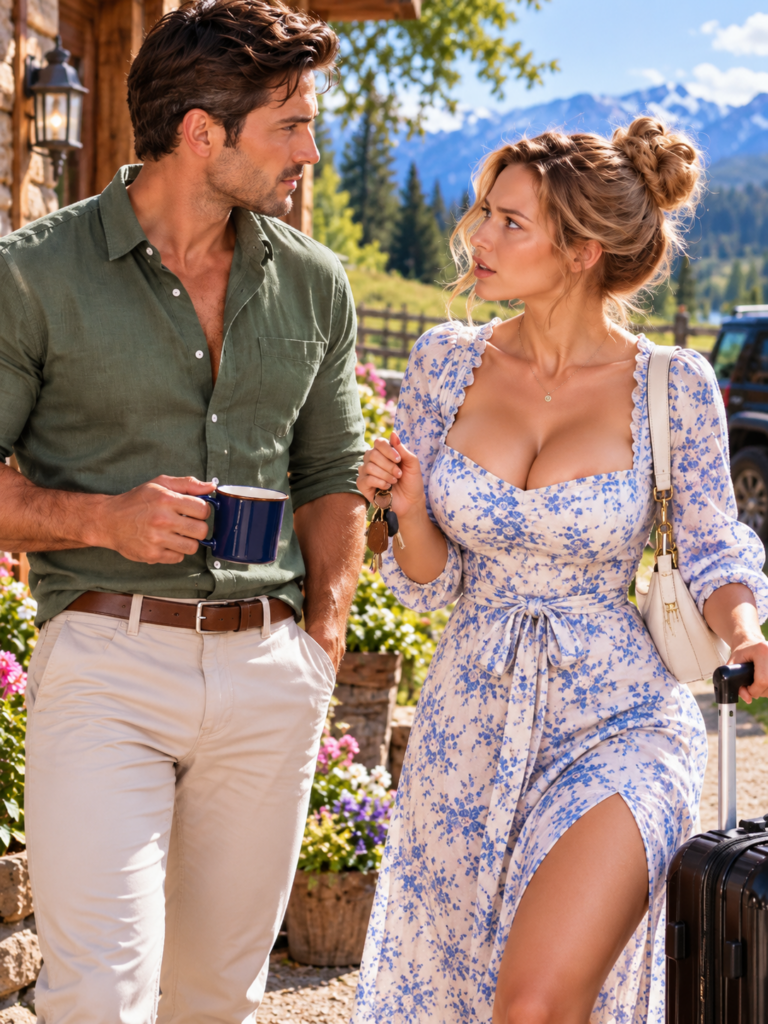
She inherited her grandmother’s abandoned farmhouse and drove there hoping to disappear for a few weeks—but when a grieving widower stepped out of the dark hallway and said, “Your grandmother told me you’d come back someday…” everything changed…
Part 1
The house was supposed to be empty.
That was the first thought Elena Mercer had when she heard someone breathing beyond the hallway.
Not wind.
Not the old walls shifting beneath the storm.
Breathing.
Human.
Close.
Elena froze in the doorway with one hand still wrapped around the handle of her suitcase.
Rain blew across the porch behind her, cold enough to sting the skin at the back of her neck. The hem of her coat was already soaked. Mud clung to the expensive boots she had bought back when her life still included client dinners, design launches, and the belief that replacing a pair of boots without checking her bank account was normal.
Inside, the farmhouse was darker than she remembered.
Faded blue walls.
A narrow staircase.
Family photographs hanging slightly crooked.
A braided rug her grandmother had owned for as long as Elena could remember.
But the place wasn’t dusty.
That detail reached her a second too late.
The attorney had described the property as vacant.
Nearly three years untouched.
Yet the floor near the entrance was clean.
A stack of firewood sat neatly beside the old iron stove.
Someone had placed fresh rosemary in a chipped ceramic cup on the windowsill.
Elena’s fingers tightened around the flashlight she had taken from the trunk.
Footsteps sounded from somewhere near the kitchen.
She raised the light.
“Hello?”
Nothing.
Her pulse hammered.
“I have a phone.”
A lie.
Her phone had been switched off since she crossed the county line.
“I’m calling the police.”
Another step.
Then a door opened.
A man appeared in the dim hallway.
Elena nearly swung the flashlight at his head.
He lifted one hand quickly.
“Don’t.”
“Don’t move.”
He stopped.
He looked to be around thirty-eight.
Tall.
Broad shoulders beneath a faded work shirt.
Dark hair falling untidily across his forehead.
Mud on his boots.
A day’s worth of stubble.
His face wasn’t threatening.
That almost made Elena more nervous.
Burglars were supposed to look like burglars.
This man looked like he belonged here.
One hand rested against the wall.
The other held a small wooden box.
He stared at her suitcase.
Then at her face.
His expression changed.
“You’re Elena.”
Her stomach dropped.
“How do you know my name?”
The man seemed to realize how bad that sounded.
“My name is Daniel Hayes.”
“That was not the question.”
“No.”
“Why are you in my house?”
He took a breath.
“Your grandmother let me stay here.”
Elena stared.
“My grandmother died almost three years ago.”
“I know.”
“This property legally became mine last month.”
“I know.”
“You know a lot for somebody I’ve never met.”
“Yes.”
“Start explaining.”
Daniel looked down at the wooden box in his hands.
“She said you’d come back eventually.”
Elena almost laughed.
“My grandmother barely saw me.”
“She talked about you.”
“That is not the same thing.”
“No.”
Rain struck the windows behind them.
Elena lowered the flashlight a few inches but did not turn it off.
“According to the estate documents, no one lives here.”
“I don’t have a lease.”
“Then you’re trespassing.”
“Probably, legally.”
“You’re strangely calm about this.”
“I expected this conversation someday.”
“You expected me?”
“I expected someone.”
Elena stared at him.
Daniel lifted the wooden box slightly.
“She left this for you.”
Elena didn’t move.
“Put it down.”
Daniel set the box on the small table beside the stairs and stepped back.
Elena waited until he was several feet away.
Then she approached.
The cedar box was old.
She recognized the brass clasp.
Her grandmother Ruth had kept sewing needles inside it when Elena was a child.
Burned into the lid were two words.
For Ellie.
Elena’s throat tightened.
Nobody had called her Ellie since her mother died.
She opened the box.
Inside were photographs.
Ruth beside the farmhouse.
Ruth carrying apples.
Ruth standing beneath the old maple tree wearing the ridiculous straw hat Elena had teased her about.
Then Daniel.
Younger.
Smiling.
A woman stood beside him.
And between them was a little girl in yellow rain boots.
Elena stared.
Another photograph.
The same little girl sitting on Ruth’s lap.
Another.
Daniel holding her above his shoulders.
Something stirred in Elena’s memory.
She turned the picture toward the light.
“I know her.”
Daniel didn’t answer.
Elena looked again.
“Lily?”
His face changed.
“Yes.”
The memory came slowly.
Years earlier.
A summer afternoon.
Elena had been home from college.
Her mother insisted she visit Ruth.
There had been a little girl running between the apple trees.
Missing front tooth.
Mud on her knees.
Elena had played with her for maybe fifteen minutes before returning to her phone.
“Where is she?”
Daniel looked down.
“She died.”
Elena’s anger lost some of its shape.
“I’m sorry.”
Daniel nodded once.
“My wife died the year before.”
The room became very quiet.
Elena looked at the woman beside him in the photograph.
“She was Lily’s mother?”
“Sarah.”
“What happened?”
Daniel’s jaw tightened.
“You don’t have to—”
“She had leukemia.”
Elena stopped.
Cancer.
The word had ruled the final fourteen months of her mother’s life.
Different type.
Same fluorescent hallways.
Same careful conversations.
Same doctors saying phrases like responding well until they didn’t.
Daniel continued.
“Lily was six when Sarah got sick.”
He spoke quietly, as though the details had been repeated enough times to become both familiar and unbearable.
“I worked on farms. Construction too. Anything I could get.”
“Medical bills?”
“Everything.”
Insurance had paid some.
Not enough.
He sold their truck.
Then Sarah’s jewelry.
Then borrowed.
Then borrowed again.
Sarah died.
Daniel stopped for a moment.
Elena didn’t fill the silence.
“Lily got sick the following year.”
Her stomach turned.
“Cancer?”
“No. Autoimmune disease.”
Complications.
Infections.
Hospitalizations.
A long enough story to destroy the life around it.
Lily died seven days after her eighth birthday.
Daniel lost their rental house not long afterward.
“Where did you go?”
“My truck.”
“And when the truck stopped running?”
Daniel smiled without humor.
“A shed.”
Elena frowned.
“Here?”
“Neighboring property.”
He looked toward the rain.
“Your grandmother caught me taking apples.”
Elena almost smiled.
“What did she do?”
“Asked if I was hungry.”
“That sounds like her.”
“I said no.”
“That also sounds predictable.”
“She brought me food anyway.”
For several seconds Daniel looked almost younger.
“She told me she needed someone to fix a fence.”
“Did she?”
“No.”
That time Elena actually smiled.
Barely.
“She created work for you.”
“She created a reason I could accept help.”
That sentence settled heavily between them.
Daniel continued.
He started doing repairs.
Roof.
Fences.
Garden.
Equipment.
Ruth gave him the small back bedroom.
Then a key.
By the time she became ill, Daniel was handling most of the land.
“She told me to stay after she died.”
“Why?”
“She didn’t want the place abandoned.”
“For how long?”
“Until you decided what to do with it.”
Elena stared.
“She said that specifically?”
“Yes.”
“And there’s nothing written?”
“Not that I know of.”
Her suspicion returned.
Daniel saw it.
“I know how this sounds.”
“Do you?”
“A stranger tells you your dead grandmother gave him permission to live inside property worth several hundred thousand dollars.”
“That’s approximately how it sounds.”
“You can call the sheriff.”
The answer surprised her again.
Daniel continued.
“I won’t fight you.”
“You’ve lived here for almost two years.”
“Yes.”
“You’ve maintained everything.”
“Yes.”
“And you’ll just leave?”
“If that’s what you want.”
Elena hated how easy he made the decision sound.
She looked toward the kitchen.
Everything was clean.
A repaired cabinet hinge.
Fresh logs.
A patched window frame.
Outside, through the rain, she could see fencing that definitely had not existed when she visited as a teenager.
Someone had kept the place alive.
Daniel.
The man she was technically entitled to throw out.
Elena closed the photograph box.
“I need time.”
“Of course.”
“I mean tonight.”
Daniel glanced toward the storm.
“I can sleep in the equipment shed.”
Elena frowned.
“Is there heat?”
“A little.”
“That’s not reassuring.”
“I’ve slept in worse places.”
That sentence irritated her instantly.
Maybe because she understood it.
“Stay in the back room.”
Daniel looked at her.
“Tonight.”
“Okay.”
“Tomorrow we figure out what happens.”
“Okay.”
“And don’t touch my things.”
“I wasn’t planning to.”
“I’m serious.”
“So am I.”
Elena dragged her suitcase toward the stairs.
Then stopped.
“Daniel?”
“Yes?”
“If I discover any part of this story is a lie—”
“I’ll leave before you finish the sentence.”
She went upstairs.
The bedroom that had belonged to Ruth was exactly where Elena remembered it.
Patchwork quilt.
White curtains.
Old dresser.
A pressed flower inside a frame.
She sat on the edge of the bed.
She had driven here because she wanted silence.
For five years Elena’s life had looked successful from the outside.
At thirty-two, she was one of the youngest senior interior designers at Bell & North Interiors in Chicago.
Hotels.
Restaurants.
Luxury apartments.
Corporate headquarters pretending not to be corporate headquarters.
Her name appeared in magazines.
Clients requested her.
She owned expensive shoes.
She lived twelve floors above the river.
Then her mother got sick.
Elena spent fourteen months dividing life into before appointments and after appointments.
Morning client meeting.
Hospital lunch.
Lighting review.
Chemotherapy.
Supplier calls.
MRI results.
She became excellent at hiding exhaustion.
Her fiancé, Mark, tried at first.
Then her mother’s illness became too long.
Too consuming.
Too real.
Mark wanted their life back.
Elena wanted her mother alive.
Neither happened.
Her mother died in February.
Mark ended the engagement six weeks later.
“I don’t know how to reach you anymore,” he told her.
Elena had been too tired to argue.
Then Bell & North collapsed.
Not slowly.
One Monday employees arrived to discover the founder had disappeared after draining operating accounts and failing to deposit retirement contributions.
Six weeks of Elena’s salary vanished.
Thousands of dollars from employee retirement deductions had never been transferred.
Projects stopped.
Clients sued.
Employees panicked.
The sophisticated career Elena had spent ten years building disappeared in four days.
She applied for jobs.
Smiled during interviews.
Pretended the gap in her résumé was an opportunity for reflection.
Meanwhile rent kept coming.
Student loans kept coming.
Credit card interest kept coming.
Then a probate attorney called.
Ruth’s farm belonged to Elena.
She had laughed at first.
The farmhouse?
The old land?
What was she supposed to do with a farm?
Then she looked at her bank balance.
She packed two suitcases.
Told herself she would stay three weeks.
Maybe four.
Rest.
Sell the property.
Pay down debt.
Start over.
That plan had seemed simple yesterday.
Now a grieving widower was sleeping downstairs.
At 2:13 a.m., Elena gave up trying to sleep.
She went downstairs for water.
A strip of light showed beneath Daniel’s door.
She meant to keep walking.
Then she heard movement.
The door was slightly open.
Daniel sat on the edge of the bed.
In his hands was Lily’s photograph.
His shoulders moved once.
He wiped his face quickly.
No sound.
No dramatic breakdown.
Just private grief.
Elena stepped away before he noticed.
In the kitchen she stood with both palms against the counter.
She recognized that kind of crying.
The kind you did after people stopped asking how you were doing.
The kind that existed after sympathy expired.
The next morning, hammering woke her.
Elena found Daniel near the northern pasture fixing a gate.
Rain fell steadily.
“You’re doing construction in this?”
“Gate hinge broke.”
“Can’t it wait?”
“No.”
“Why?”
He pointed toward the field.
“Cattle need moving.”
Elena looked.
Seven cows.
She stared.
“I own cows?”
“Technically.”
“No one mentioned cows.”
“The probate inventory says livestock.”
“I thought that meant chickens.”
“It includes chickens.”
Her eyes widened.
“How many?”
“Thirty-two.”
Elena closed her eyes.
“I came here to rest.”
Daniel almost smiled.
“You picked the wrong inheritance.”
The gate shifted.
“Hold this.”
Elena looked at him.
“I’m not dressed for this.”
Daniel looked at her boots.
“They’re already ruined.”
She looked down.
Mud covered them.
He was right.
That annoyed her enough to help.
Elena grabbed the wooden post.
Daniel tightened the brace.
The work was simple and exhausting.
After five minutes her arms burned.
After ten, rain was inside her collar.
“This is miserable.”
“You’re doing fine.”
“That sounds patronizing.”
“It was.”
She glared.
Daniel smiled.
It was the first time she had seen him do it.
The expression transformed him.
For a moment Elena saw the man from the photographs.
Before hospitals.
Before funerals.
Before sleeping in sheds.
The gate finally stood straight.
Daniel pushed it twice.
“Good.”
Elena looked at it.
A small, absurd feeling of accomplishment spread through her chest.
Daniel noticed.
“Don’t get excited.”
“Why?”
“There are fourteen more.”
“Of course there are.”
They walked toward the house.
That was the beginning.
Not romance.
Not even friendship.
A working truce.
Over the following week, Daniel taught Elena how the farm functioned.
She learned chickens did not require roosters to produce eggs.
Daniel took unreasonable pleasure in that revelation.
She learned Ruth had leased twenty acres to a neighboring family for hay.
The apple orchard produced enough each autumn to supply two restaurants and a farmers market.
The cows were mostly pasture animals.
The garden Daniel maintained supplied more vegetables than either of them could eat.
She learned every building had a problem.
Roof.
Drainage.
Wiring.
Foundation.
Equipment.
Nothing dramatic enough to destroy the farm today.
Everything expensive enough to destroy it eventually.
Daniel knew all of it.
He kept notebooks.
Dates.
Repairs.
Receipts.
Weather.
Crop yields.
Elena discovered he had spent his own money more than once to replace equipment.
“Why?”
Daniel shrugged.
“It needed replacing.”
“You didn’t own it.”
“No.”
“You thought I might sell.”
“Yes.”
“Then why spend your money?”
He looked at her as though the answer were obvious.
“Because your grandmother trusted me with it.”
That response stayed with her.
Elena began cooking.
She hadn’t cooked properly since her mother died.
At first because there was nothing else nearby.
Then because the old kitchen made her remember things.
Her mother chopping onions.
Ruth baking bread.
Arguments over salt.
Daniel ate quietly the first evening.
Elena watched him.
“Well?”
He looked up.
“What?”
“The food.”
“It’s good.”
“That pause was suspicious.”
“I was chewing.”
“People can chew and evaluate simultaneously.”
Daniel took another bite.
“It’s very good.”
“Better.”
He looked at her.
“You need a lot of reassurance.”
“I worked in design.”
“That explains more than you think.”
She threw a napkin at him.
By the second week, Elena laughed more than she had in months.
Not constantly.
Not dramatically.
Small moments.
Daniel slipping in mud.
A chicken escaping into the kitchen.
The ancient tractor refusing to start until Elena kicked the tire and Daniel accused her of “mechanical intimidation.”
Daniel teaching her to smell rain coming.
“That’s imaginary.”
“It isn’t.”
“You looked at the weather app.”
“I don’t have it installed.”
“That’s deeply suspicious.”
He taught her how to repair fencing.
She taught him how to use a proper spreadsheet for expenses.
He hated it.
“It changes when I type.”
“That is the point.”
“My notebook doesn’t.”
“Your notebook also has coffee on four pages.”
“Character.”
“Contamination.”
Slowly Elena discovered the farm’s memories.
Roses beside the porch.
Lily’s favorite.
A swing Daniel had repaired because his daughter used to spend entire afternoons on it.
A bench beneath the apple tree where Sarah sat while Lily played.
Elena began to understand why Daniel remained.
Every part of the land held evidence that the people he lost had existed.
Elena had spent months running from memory.
Daniel had built his entire life around preserving it.
Then Thomas Kellerman arrived.
The attorney handling Ruth’s estate drove up one afternoon in a black sedan that looked absurdly polished beside the barn.
Elena met him at the kitchen table.
Daniel was repairing fencing near the orchard.
Thomas opened a folder.
“I have an unsolicited offer.”
“For what?”
“The property.”
Elena sat straighter.
“Already?”
“Greencrest Development has been purchasing acreage through the valley.”
She knew the name.
Luxury resorts.
Private residential communities.
Golf properties.
Thomas slid a sheet across the table.
The number made Elena stare.
$1,850,000.
She read it twice.
“The appraisal wasn’t close to this.”
“They don’t care about the farmhouse.”
“What do they care about?”
“Location.”
Greencrest owned land to the east and south.
Ruth’s farm connected two parcels.
They wanted a resort access road.
Luxury cabins.
A spa facility.
Possibly an event complex.
Elena’s property would make the development easier.
Thomas continued.
“They can close in sixty days.”
Elena’s mind immediately converted the number into problems disappearing.
Credit cards.
Gone.
Student loans.
Gone.
The retirement savings stolen by Bell & North.
Rebuilt.
A new apartment.
Her own design studio.
No more wondering whether she could afford another six months without full-time work.
“What happens to the house?”
Thomas hesitated.
“Likely demolition.”
Elena looked through the window.
Daniel stood near the orchard.
“What about him?”
Thomas followed her gaze.
“Daniel Hayes?”
“You know him?”
“Your grandmother mentioned a farmhand years ago.”
“He lives here.”
Thomas frowned.
“That wasn’t disclosed.”
“He says Grandma told him to stay.”
“Written agreement?”
“Apparently not.”
“Then legally he has no ownership interest.”
Elena’s stomach tightened.
“If I sell?”
“Greencrest requires vacant possession.”
Meaning Daniel leaves.
Simple.
Clean.
Legal.
Why did the thought feel ugly?
Thomas packed the documents.
“You don’t need to decide today.”
“When?”
“Offer expires Friday.”
After he left, Elena kept the papers on the table.
Daniel came inside at sunset.
He saw them immediately.
“What’s that?”
She considered lying.
Didn’t.
“Offer for the farm.”
Daniel washed his hands at the sink.
“How much?”
Elena turned the paper.
He looked.
Then let out a low whistle.
“That’s serious.”
“Yes.”
“You should take it.”
The answer irritated her.
“Why does everyone keep telling me what I should do?”
Daniel looked surprised.
“You asked.”
“I didn’t.”
“Fair.”
He dried his hands.
Elena watched him.
“If I sell, you have to leave.”
“Yes.”
“That doesn’t bother you?”
“Of course it does.”
“You don’t look bothered.”
“I’ve lost places before.”
There it was again.
The calm resignation she hated.
“That doesn’t mean losing another one is fine.”
“No.”
“Where would you go?”
“Watkins might have seasonal work.”
“And after that?”
“I’ll figure something out.”
Elena almost laughed.
She used the same phrase constantly.
Every time someone asked what came next.
I’ll figure it out.
Daniel picked up the offer.
“This solves a lot for you.”
“You don’t know that.”
“You mentioned the company collapse.”
“So?”
“You’re still paying for an apartment you barely use.”
“How do you know?”
“Your mail forwards here.”
Elena narrowed her eyes.
“You read my mail?”
“I read the envelopes.”
“That is reading.”
“Fine.”
Daniel placed the document down.
“You came here to recover.”
“I came here because I was broke.”
“Both can be true.”
Elena looked away.
Daniel continued.
“You don’t owe me this farm.”
“My grandmother thought you belonged here.”
“She gave me time.”
His voice softened.
“That’s already more than most people gave me.”
Then he walked outside.
That night Elena found his bags packed.
She stopped in his doorway.
“What are you doing?”
“Leaving.”
“What?”
“If I stay, you’ll make the decision partly around me.”
“You don’t know that.”
“Yes, I do.”
“You don’t know anything about how I make decisions.”
Daniel looked at her.
“You asked where I’d go before you asked whether you wanted the money.”
Elena hated him for noticing.
“I’m not leaving tonight,” he continued. “Tomorrow.”
“No.”
“Elena.”
“You don’t get to decide my decision for me.”
“I’m not.”
“You are removing a problem before I decide whether it’s a problem.”
Daniel looked down.
“I don’t want pity.”
“This isn’t pity.”
“Then what is it?”
She opened her mouth.
Nothing came.
That silence answered too much.
Daniel zipped the bag.
“Take the money.”
He slept in the equipment shed that night.
Elena stayed awake in the farmhouse.
Around midnight she opened Ruth’s wooden box again.
Beneath the photographs was an envelope she had missed.
Ellie.
Her grandmother’s handwriting.
Elena opened it.
If you are reading this, you finally came home.
Elena’s eyes filled immediately.
Ruth didn’t ask her to keep the farm.
Didn’t tell her to protect tradition.
Didn’t guilt her.
She wrote about Daniel.
He came here after losing nearly everything, Ruth wrote. I did not save him. I only gave him enough room to remember that losing a life is not the same thing as having no life left.
Elena pressed one hand over her mouth.
The final paragraph was short.
Do not keep this place because you think I would want you to.
Do not sell because you are afraid.
Choose the life you want to make room for.
Love,
Grandma Ruth
Elena sat at the kitchen table until sunrise.
Friday morning she called Thomas.
“Decline Greencrest.”
Silence.
“Elena.”
“I know.”
“That amount is substantially above market.”
“I know.”
“You have financial obligations.”
“I know.”
“They may not repeat the offer.”
“I know.”
Another pause.
“Then I’ll decline.”
Elena ended the call.
For exactly fourteen minutes she felt brave.
Then the water pump began making a grinding noise.
Part 2
The pump cost twenty-seven hundred dollars to replace.
The barn roof needed seventeen thousand.
Property taxes were due before Christmas.
Elena’s checking account contained less than she had admitted even to herself.
Keeping the farm did not become beautiful simply because she made an emotional decision.
It became expensive.
Daniel still planned to leave.
Elena found him the next morning walking down the gravel road with one duffel bag over his shoulder.
She ran after him.
“Daniel!”
He stopped.
Elena reached him breathless.
“You are unbelievable.”
“That sounds negative.”
“You’re actually leaving?”
“Yes.”
“I rejected the offer.”
“I heard.”
“How?”
“Small town.”
“Of course.”
Daniel shifted the bag.
“You shouldn’t have done it for me.”
“I didn’t.”
“Elena.”
“I didn’t.”
He looked at her.
She forced herself to continue.
“I did it because I don’t want this place turned into a resort.”
“That’s part of it.”
“Yes.”
“And?”
She looked toward the farmhouse.
“I don’t know.”
Daniel waited.
Elena laughed once.
“I hate that answer.”
“It’s honest.”
She took a breath.
“I spent ten years designing other people’s lives.”
He frowned.
“Hotels. Houses. Restaurants. Offices.”
She gestured toward the farm.
“I knew how to make every place look intentional.”
“What’s wrong with that?”
“Nothing.”
She looked at him.
“I just never asked whether my own life was.”
Daniel’s expression softened.
“I came here because everything I planned disappeared.”
Her voice lowered.
“My mother. My engagement. My job.”
Wind moved through the tall grass.
“I thought maybe I needed to be somewhere no one needed anything from me.”
Daniel looked down.
“And then I found you.”
“Bad luck.”
She smiled.
“Terrible.”
Then the smile faded.
“But for the first time in months, I’m sleeping.”
Daniel said nothing.
“I’m eating. Working. Laughing.”
She swallowed.
“I don’t feel like I’m waiting for my old life to come back.”
Daniel looked toward the farm.
“Elena…”
“I’m not asking you to stay forever.”
“Then what are you asking?”
“Six months.”
He frowned.
“What?”
“Stay six months.”
“As what?”
“Farm manager.”
He almost laughed.
“You have no money.”
“I have some.”
“The farm can’t support a salary.”
“Then we figure out one it can.”
“Elena.”
“You’ve been working for free for two years.”
“For Ruth.”
“She’s dead.”
Daniel stiffened.
Elena immediately softened her tone.
“And that matters. But it means we need to do this properly.”
They negotiated at the kitchen table.
Daniel wanted a tiny salary.
Elena refused.
He insisted housing counted.
She insisted labor counted.
Thomas drafted a simple employment agreement.
Six months.
Housing included.
Defined farm responsibilities.
No ambiguity.
Daniel signed.
“So now I’m officially employed.”
“Yes.”
“Do I get vacation?”
“No.”
He stared.
“Kidding.”
“You’re bad at management.”
“You’re still here.”
“Barely.”
Their first month nearly destroyed Elena’s optimism.
She created spreadsheets.
Daniel hated them.
“You cannot predict weather using formulas.”
“You can create risk scenarios.”
“The cows do not care about risk scenarios.”
“The cows need structure.”
“Tell Edith.”
Edith was the largest cow.
She treated both of them with equal contempt.
Elena studied every possible source of income.
Farm produce.
Apples.
Eggs.
Hay lease.
Weekend guests.
Design retreats.
Daniel objected to nearly all of it.
“You want strangers sleeping in Ruth’s house?”
“Yes.”
“No.”
“They pay.”
“Still strangers.”
“You were a stranger.”
Daniel glared.
“Not helping your argument.”
Elena used her design skills to transform two unused bedrooms without spending much.
She refinished Ruth’s old furniture.
Bought linens during a clearance sale.
Painted walls herself.
Daniel repaired windows and complained about decorative pillows.
“Why are there five?”
“Composition.”
“People only have one head.”
“Please leave.”
Their first guests were a retired couple from Milwaukee.
Elena barely slept the night before.
“What if they hate it?”
Daniel drank coffee at the kitchen table.
“They chose a farm.”
“What if the mattress is uncomfortable?”
“You slept on it.”
“I was exhausted.”
“What if breakfast is terrible?”
“I’m cooking.”
“That did not help.”
The couple stayed two nights.
Before leaving, the woman hugged Elena.
“This place feels peaceful.”
Elena looked around the kitchen.
Peaceful was not the word she would have used for the previous forty-eight hours.
Then the woman handed her a handwritten note.
Thank you for letting us slow down.
Elena read it twice.
Their review brought another booking.
Then another.
Not enough to solve everything.
Enough to suggest they weren’t completely insane.
Elena also started accepting freelance design work remotely.
A café.
Two homes.
A boutique hotel lobby.
She discovered she missed design.
Not Bell & North.
Not the politics.
The work itself.
At night she and Daniel sat at opposite ends of the kitchen table.
Her laptop.
His farm notebooks.
Sometimes they talked.
Sometimes hours passed in silence.
The silence became comfortable.
That unsettled Elena more than attraction would have.
Comfort had become dangerous after Mark.
Need someone and eventually they could leave.
So Elena learned not to need.
Daniel understood that pattern because his version was different but related.
Love someone and eventually they could die.
So Daniel kept loving the dead and resisted needing the living.
Their friendship grew through arguments.
“You used my kitchen scissors for twine.”
“They cut.”
“They are kitchen scissors.”
“Now they’re versatile.”
“You left muddy boots inside.”
“It was raining.”
“That is when mud exists.”
Daniel stared.
Elena stared back.
“You’re exhausting.”
“So are you.”
Five minutes later they were drinking coffee together.
One November morning Elena woke with a weight inside her chest.
Her mother’s birthday.
She said nothing.
Daniel noticed anyway.
She spent the afternoon making her mother’s lemon cake.
The icing broke.
Then the cake leaned.
Then Elena started crying.
Not loudly.
She kept stirring while tears ran down her face.
Daniel stopped in the doorway.
“Don’t.”
“I didn’t say anything.”
“You were going to.”
“No.”
She looked at the cake.
“My mother made this every year.”
Daniel stepped into the kitchen.
“What do you need?”
“Nothing.”
“Elena.”
“I can make a cake.”
“That wasn’t the question.”
She went still.
He washed his hands.
“What do I do?”
Elena pointed toward the lemons.
“Zest those.”
Daniel was terrible at it.
She insulted his technique.
He insulted the structural integrity of her cake.
Somehow they laughed.
That evening Daniel placed one candle on the porch beside an old photograph of Elena’s mother and Ruth.
No speech.
Elena sat next to him.
“My mother wanted me to come here.”
“When?”
“After she got sick.”
Daniel waited.
“I kept saying later.”
The word hurt them both.
Daniel looked down.
“So did I.”
Elena reached for his hand.
He froze slightly.
Then let her hold it.
Neither spoke.
The next morning Daniel ate breakfast outside in forty-degree weather.
Elena found him near the barn.
“You’re avoiding me.”
“No.”
“You are.”
“I had work.”
“You always have work.”
Daniel continued repairing a latch.
“You’re uncomfortable because I held your hand.”
He stopped.
“That is a very direct sentence.”
“I’m tired.”
“That isn’t an explanation.”
“Do you dislike me?”
Daniel looked at her.
“No.”
“Then?”
“You own the farm.”
“I know.”
“I work for you.”
“I know.”
“That complicates things.”
Elena crossed her arms.
“So does running outside every time something feels personal.”
His jaw tightened.
“Elena.”
“There’s that tone.”
“What tone?”
“The noble one.”
Daniel sighed.
She continued.
“I’m not asking for anything.”
“I know.”
“Then stop deciding what I’m allowed to feel.”
He looked at her.
Something changed.
Not enough for a kiss.
Enough that both knew one was possible someday.
Winter arrived.
Then Greencrest returned.
This time not with a purchase offer.
With lawyers.
The company had acquired most neighboring land.
They filed a rezoning request and proposed a service road near Elena’s eastern boundary.
Traffic.
Construction noise.
Utility lines.
The things guests came to escape.
Thomas warned Elena that fighting everything could cost thousands.
“We should have sold,” Daniel said.
Elena glared.
“Stop.”
“I’m serious.”
“So am I.”
“You’re using your savings to defend a farm you didn’t even want six months ago.”
“I want it now.”
“Because of me?”
“Stop making yourself the center of every financial problem I have.”
Daniel went silent.
Elena softened.
“This place mattered before you.”
“I know.”
“It mattered to Grandma.”
“Yes.”
“My mother.”
“Yes.”
“And now me.”
Daniel looked toward the window.
Elena continued.
“You are part of it.”
He looked back.
“But not the whole reason.”
That mattered.
Greencrest’s pressure forced them to become more serious.
Elena created a real business plan.
Farm stays.
Seasonal dinners.
Small workshops.
Design retreats.
Daniel vetoed large weddings.
“Two hundred drunk people near cows.”
“Excellent revenue.”
“No.”
“Fifty people?”
“No.”
“Forty?”
Daniel stared.
“Thirty-five.”
“Deal.”
They approached a local credit union.
The loan officer, Marjorie Kelly, had known Ruth.
That didn’t get Elena free money.
It got her a more patient conversation.
The bank approved a modest renovation loan after Elena showed freelance income and their first months of booking history.
They renovated one room at a time.
No television transformation.
No mysterious investor.
Invoices.
Paint.
Broken pipes.
Waiting.
Repairing.
Choosing the cheaper option.
Elena learned that rebuilding a life mostly looked boring from the outside.
That was exactly why it felt real.
February nearly destroyed them.
Frozen water line.
Canceled guests.
Tractor repair.
A design client delayed payment.
Elena found herself sitting on the kitchen floor at midnight surrounded by bills.
Daniel sat beside her.
“How bad?”
She handed him the spreadsheet.
He studied it.
“We can reduce my salary.”
“No.”
“Elena.”
“No.”
“I live here.”
“You work here.”
“We need cash.”
“I’m not solving the business by not paying you.”
Daniel looked at her.
“You are frightening when you’re responsible.”
“Thank you.”
“That wasn’t praise.”
“I accepted it anyway.”
They delayed renovations.
Elena took more freelance work.
Daniel expanded greenhouse production for early markets.
They survived February.
March was better.
April better still.
The farm never became easy.
It became possible.
Guests came.
A nurse from Chicago spent three days reading beneath the apple tree.
A recently divorced teacher cried during breakfast and apologized.
Elena told her not to.
A little girl visiting with her parents fell in love with Edith and refused to leave the pasture.
Daniel acted annoyed.
Elena caught him sneaking the girl an extra apple for the cow.
“You’re soft.”
“Unverified accusation.”
“Witnessed personally.”
“Biased source.”
The farm began becoming something Elena hadn’t planned.
A place people came when they were tired.
Not broken.
She had started hating that word.
People weren’t broken furniture.
They were carrying things.
Grief.
Divorce.
Burnout.
Loneliness.
Fear.
The farm did not fix them.
It gave them space.
Greencrest’s zoning fight ended without a dramatic victory.
County hearings.
Environmental objections.
Negotiations.
The road shifted east.
The worst impact disappeared.
Elena spent thousands on legal fees.
She hated every invoice.
But the land remained intact.
Then, one rainy night in May, the power went out.
No guests.
Thunder.
Candles.
Daniel built a fire.
Elena found an old bottle of bourbon in Ruth’s cabinet.
They sat on the floor near the fireplace.
Elena drank half a glass.
Daniel drank less.
“Why haven’t you kissed me?”
He nearly inhaled bourbon.
Elena waited.
Daniel stared at her.
“You cannot ask that after bourbon.”
“It’s half a glass.”
“Large glass.”
“Answer.”
“Elena.”
“There’s the tone.”
He looked toward the fire.
“Because Sarah existed.”
Elena’s irritation disappeared.
Daniel continued.
“I loved her.”
“I know.”
“I still love her.”
“I know.”
“And Lily.”
“I know.”
He swallowed.
“Sometimes wanting anything now feels like betraying then.”
Elena moved closer.
“You think loving me would erase them?”
“No.”
“You act like it does.”
Daniel looked at her.
She softened.
“I would hate anybody who asked me to stop loving my mother.”
He looked down.
“I’m not asking you to become somebody who didn’t have a wife and daughter.”
Silence.
“You can love people who are gone and still love people who are here.”
Daniel’s eyes tightened.
“You make it sound easy.”
“It isn’t.”
Elena smiled sadly.
“I’m afraid too.”
“Of what?”
“Depending on you.”
He looked surprised.
“I spent years thinking if I needed less from people, they could hurt me less.”
Daniel gave a quiet laugh.
“Did it work?”
“No.”
“Mine didn’t either.”
Elena leaned back against the couch.
“So?”
“So what?”
“Do you want to kiss me?”
Daniel exhaled.
“You reduce complicated things into dangerous questions.”
“I’m a designer. Editing matters.”
He stared at her.
Then moved closer.
Slow enough for her to stop him.
She didn’t.
His hand touched her cheek.
Warm.
Careful.
Elena closed the distance.
The kiss was gentle.
No dramatic hunger.
No instant solution.
When they separated Daniel rested his forehead against hers.
Elena whispered, “You waited a very long time for that.”
“I was being responsible.”
“You were being a coward.”
He laughed.
Then kissed her again.
Part 3
Nothing magical happened the next morning.
The farm still had debt.
The tractor still leaked oil.
Daniel still missed Sarah and Lily.
Elena still sometimes woke from dreams about her mother and forgot for three seconds that she was gone.
But something had shifted.
They stopped pretending distance was the only ethical option.
Slowly, carefully, they let the relationship become real.
Daniel eventually moved out of the employee arrangement entirely.
As the farm business stabilized, Thomas helped restructure the operation.
Daniel became a partner in the agricultural side.
Profit share.
Defined responsibilities.
No hidden dependence.
That mattered to both of them.
They dated.
Which looked ridiculous because they lived on the same property.
Sometimes Daniel drove Elena into town for dinner.
Sometimes Elena demanded actual effort.
“You cannot call eating leftovers on the porch a date.”
“There are candles.”
“One candle.”
“Still plural conceptually.”
“No.”
They went bowling once.
Daniel was terrible.
Elena won.
He claimed the lane was warped.
She reminded him of this for months.
The farm grew cautiously.
They hired a weekend employee.
Then a part-time guest coordinator.
Elena’s design work expanded.
She developed a specialty in restoring rural properties without stripping away their history.
It paid better than she expected.
More importantly, she liked it.
She stopped checking corporate job boards.
That decision terrified her.
Then liberated her.
A year after rejecting Greencrest, Thomas called.
“They’re back.”
Elena sighed.
“How much?”
“Two point three million.”
She went silent.
The farm was financially healthier.
Still nowhere near enough to make that amount irrelevant.
Two point three million meant certainty.
Debt gone.
Repairs funded.
Retirement secured.
Daniel found her at the kitchen table with the new offer.
He read it.
“That’s absurd.”
“Yes.”
“What do you want to do?”
She looked at him.
Not what should we do.
Not take it or don’t.
What do you want?
“I want to keep the farm.”
Daniel placed the paper down.
“Then keep it.”
Elena laughed.
“That simple?”
“No.”
He looked around.
“But maybe that clear.”
She sat back.
“What would the money give us?”
“Indoor plumbing that never threatens rebellion.”
“We mostly have that.”
“Mostly.”
She smiled.
He continued.
“Travel.”
“We can travel.”
“A different house.”
“We have one.”
“Security.”
Elena stopped.
That was the word.
Security.
She had spent most of adulthood pursuing it.
Salary.
Title.
Engagement.
Retirement account.
Apartment.
All the structures that were supposed to make life safe.
Every one had disappeared.
The farm was less certain than any of them.
And somehow Elena felt safer here.
Not because nothing could go wrong.
Because when it did, she was no longer pretending she had to face it alone.
She called Thomas.
“Decline.”
Greencrest never made another offer.
Summer returned.
Then autumn.
They created a small memorial beneath the apple tree.
Not because Daniel needed permission to move forward.
Because love deserved a place.
The plaque said:
SARAH & LILY
Love lived here.
Daniel stared at it for a long time.
“That’s enough.”
Elena nodded.
They didn’t turn grief into decoration.
Guests rarely asked.
When they did, Daniel answered if he wanted.
Sometimes he didn’t.
One spring morning Elena found him beneath the tree holding Lily’s photograph.
This time he was smiling.
“She hated brushing her hair,” he said.
Elena sat.
“She looks opinionated.”
“She was.”
“Genetic?”
“Sarah.”
“Convenient answer.”
Daniel laughed.
Then his expression softened.
“This picture used to destroy me.”
Elena looked at him.
“I thought if looking at her stopped hurting, maybe that meant I was forgetting.”
“Do you still think that?”
“No.”
He stared toward the orchard.
“I think grief was love with nowhere to go.”
Elena leaned against him.
“And now?”
Daniel took her hand.
“Now it has more places.”
Two years after Elena arrived, the farm hosted a small autumn dinner.
Thirty guests.
The absolute limit.
Daniel reminded her repeatedly that he had been correct about avoiding large weddings.
“You’re never going to stop talking about this.”
“No.”
“I regret negotiating.”
“Written contracts matter.”
“Please go check Edith.”
Edith was now an elderly cow with arthritis and a personality everyone on the property feared.
That evening, one guest lingered near Sarah and Lily’s plaque.
Later she found Elena in the kitchen.
“Did you lose someone?”
Elena glanced toward Daniel.
“Those are his people.”
The woman nodded.
“My husband died four years ago.”
Elena waited.
“My children want me to sell our house.”
“Do you?”
“I don’t know.”
Elena remembered Ruth’s letter.
Do not sell because you are afraid.
“Then maybe you don’t have to decide today.”
The woman smiled.
“Maybe not.”
That conversation stayed with Elena.
The farm was becoming what Ruth had once given Daniel.
Not rescue.
Room.
Room to decide.
Room to breathe.
Room to remember you were still alive.
Three years after Elena moved in, she finally returned to Chicago to empty the storage unit containing her mother’s belongings.
Daniel came.
Boxes reached almost to the ceiling.
He stared.
“You were paying for this?”
“Grief is expensive.”
“Apparently.”
They sorted for six hours.
Donate.
Keep.
Trash.
Then Elena found the clothing boxes.
She sat on the concrete floor.
Daniel crouched beside her.
“We can stop.”
“No.”
“Elena.”
“I’m ready.”
She opened the first.
Her mother’s cardigan.
Red scarf.
Winter coat.
A dress Elena remembered from Christmas.
She cried.
Then laughed at an ugly sweater her mother had kept for twenty years because it was “perfectly good.”
At the bottom of the final box was an envelope.
For Elena.
Inside was a birthday card her mother had bought but never given her.
The handwriting made Elena’s chest collapse.
Two sentences.
You do not have to become invincible because I’m leaving.
Build a life with room for people.
Elena stopped.
Daniel read it over her shoulder.
For several seconds neither spoke.
Then Elena laughed through tears.
“My mother and Grandma were coordinating.”
“Clearly.”
“I hate that they were right.”
Daniel sat beside her.
She leaned into him.
That evening they closed the storage unit for the last time.
Months later, Daniel proposed.
Not under the apple tree.
“That belongs to another part of my life,” he explained.
Elena understood.
Not in a restaurant.
Daniel hated audiences.
Not during a holiday.
Too theatrical.
He proposed in the kitchen.
Elena was making soup.
Daniel was cutting carrots badly.
“Elena.”
She didn’t turn.
“That tone sounds expensive.”
“I have a question.”
“If this is about the towels in room three, buy new ones.”
“It isn’t.”
She turned.
Daniel held a ring.
Elena stared.
Then laughed.
His face fell.
“This is going poorly.”
“No.”
She covered her mouth.
“You look terrified.”
“I am.”
“That’s adorable.”
“I regret this already.”
“Continue.”
Daniel exhaled.
“I don’t want to say you saved me.”
Her smile softened.
“You didn’t.”
He looked at her.
“You gave me a place where I could remember I still had a life.”
Elena’s eyes filled.
“You never asked me to leave Sarah behind.”
He swallowed.
“Or Lily.”
“No.”
“You never treated loving them like it competed with loving you.”
Elena shook her head.
Daniel continued.
“I don’t know what the next twenty years look like.”
“Good.”
He almost smiled.
“But I want them with you.”
Then he knelt.
“Elena Mercer, will you marry me?”
She looked at him.
At the soup.
At the half-cut carrots.
At the kitchen where she had once sat considering nearly two million dollars and wondering whether she should sell everything.
“Yes.”
Daniel exhaled.
“You really thought I’d say no?”
“You enjoy being difficult.”
“Fair.”
She kissed him.
They married at the farm six months later.
Forty-two guests.
Daniel’s prohibition against weddings was technically violated.
Mrs. Watkins mentioned this during her toast.
Twice.
The ceremony took place beside the porch.
Afterward, Elena and Daniel walked alone to the apple tree.
The plaque remained.
SARAH & LILY
Love lived here.
Elena placed one flower beside it.
Daniel took her hand.
“Thank you.”
“For what?”
“For never making me feel guilty for this.”
Elena looked at the names.
“Love isn’t a room where somebody has to leave before someone else comes in.”
Daniel smiled.
“You should put that on one of your design brochures.”
“I charge for emotional consulting.”
“Of course you do.”
Years passed.
Not enough for the farm to become unrecognizable.
That was the point.
Mercer Farm remained small.
Six guest rooms eventually.
No giant event hall.
No corporate retreat center.
No resort.
The porch still creaked.
Cell service remained terrible.
Elena refused to install televisions in guest rooms.
Daniel claimed this was because she enjoyed controlling people.
She claimed it was branding.
They hired employees.
Paid them properly.
Elena insisted on benefits earlier than financially comfortable because she remembered Bell & North too well.
Daniel developed farm workshops for local schools.
They expanded the orchard.
Restored the barn.
Paid down debt.
Slowly.
Painfully.
Honestly.
Edith eventually died at a very old age.
Elena cried.
Daniel cried more.
He denied this.
“There was dust.”
“You were outside.”
“Wind.”
“There was no wind.”
“Unreliable testimony.”
They placed a small stone near the pasture.
Edith
Beloved and Difficult
Daniel called it excessive.
He visited it regularly.
Almost eight years after Elena first arrived, rain fell over the farm again.
Heavy.
Cold.
A young woman arrived early for a weekend booking.
Elena found her sitting in the mudroom beside two suitcases.
“I’m sorry,” the woman said. “Check-in isn’t until three.”
“It’s fine.”
“My apartment building had a fire alarm all night and then my boss…”
She stopped.
Her face changed.
“Sorry.”
Elena recognized the expression.
Exhaustion hidden beneath apology.
“You don’t need to explain.”
The woman looked relieved.
Elena carried one suitcase upstairs.
Later, she saw her sitting under the porch awning staring across the fields.
Daniel came up behind Elena.
“You’re watching.”
“She looks tired.”
“So did you.”
Elena smiled.
“So did you.”
Through the window, the farmhouse glowed.
A kettle whistled.
Someone laughed upstairs.
Fresh bread cooled on the counter.
Boots lined the mudroom.
The walls that had once held Ruth’s silence now held voices.
Elena had arrived believing she needed an empty place.
Daniel had stayed because he believed leaving meant abandoning the people he had lost.
Neither had understood what they needed.
Elena needed to stop treating loneliness like strength.
Daniel needed to stop treating grief like loyalty.
Neither fixed the other.
They argued.
Failed.
Worked.
Paid taxes.
Repaired fences.
Made terrible cakes.
Survived winter bills.
Held each other during anniversaries.
Built something.
Not a perfect life.
A life with room.
That evening Daniel sat beneath the apple tree.
Lily’s photograph rested in his hands.
Elena joined him.
“She would be sixteen now,” he said.
Elena nodded.
“Dangerous age.”
“She was dangerous at six.”
“That checks out.”
He smiled.
They sat quietly.
Then Daniel asked, “Do you ever think about selling?”
Elena looked surprised.
“Sometimes.”
His eyebrows lifted.
“Really?”
“Of course.”
“What do you imagine?”
“Chicago.”
“Apartment?”
“Good coffee.”
“That’s offensive.”
“Shoes without mud.”
“Fantasy.”
She laughed.
“I think everybody wonders about the lives they didn’t choose.”
Daniel looked toward the farmhouse.
“Do you regret this one?”
Elena followed his gaze.
Warm windows.
Roses.
The old swing.
Ruth’s kitchen.
Their business.
Their people.
“No.”
Daniel kissed the top of her head.
A few minutes later they walked toward the house.
At the porch, the young guest looked up from a mug of tea.
“How long have you two lived here?”
Elena and Daniel exchanged a look.
“It’s complicated,” Daniel said.
The woman laughed.
Elena sat across from her.
“Very.”
Outside, rain struck the windows.
Inside, the house settled around them.
Alive.
Once Elena had pushed open that same door and found a widower standing in the hallway of what she believed was her empty inheritance.
She thought he was the problem.
A stranger who did not belong.
Years later, Elena understood something different.
The question had never really been whether Daniel belonged in the farmhouse.
The question was whether either of them still believed they belonged anywhere.
Daniel had spent years protecting a home that wasn’t legally his because it held the last visible traces of his wife and daughter.
Elena had spent years building a life designed so carefully that almost nothing in it required another person.
Both were surviving.
Neither was living.
The farm did not heal them.
Time didn’t either.
Healing was never one dramatic moment.
It was Daniel laughing at a memory that used to make him cry.
Elena opening her mother’s boxes.
Paying employees on time.
Letting someone hold her when she was not okay.
Keeping Sarah and Lily’s names visible.
Choosing not to sell.
Choosing not to run.
Choosing each other.
Again and again.
That was the real second chance.
Not forgetting what had happened.
Not replacing what was lost.
Making room beside it.
And sometimes, Elena thought, life did not send second chances wrapped beautifully.
Sometimes they appeared as a stranger breathing in the hallway of a house you thought was empty.
Sometimes they wore muddy boots.
Sometimes they carried photographs.
And sometimes the person you were prepared to throw out turned out to be the one who had quietly kept the light on until you finally found your way home.


