
Part 1
The rain started just after five, the kind of steady, cold drizzle that turns the asphalt black and makes every headlight smear across the windshield. Ethan Parker was already late. The restaurant was twenty minutes out, and he’d spent the last hour at the Thompson job listening to the homeowner change her mind about the cabinet finish for the fourth time. His work jacket still smelled like sawdust and wet pine. His father’s old measuring tape was clipped to his belt, the yellow case worn smooth, the initials R.P. carved into the back. He hadn’t taken it off since he was seventeen.
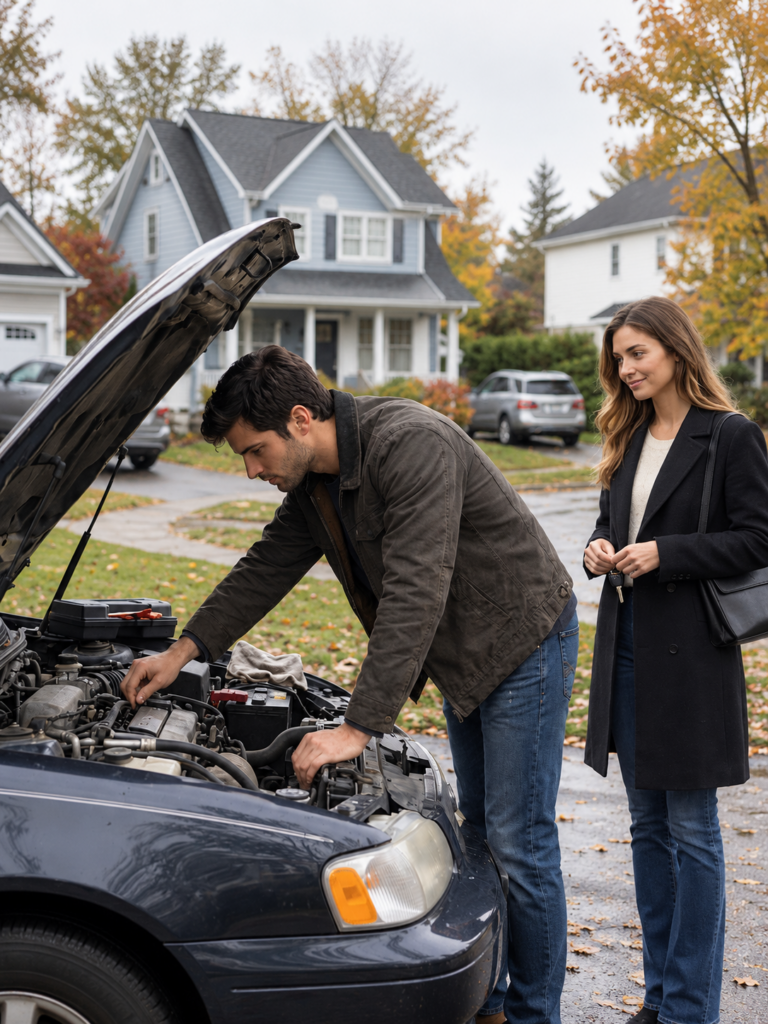
He turned onto the main road and saw the car on the shoulder. Clare’s car. The hood was up. She stood beside it with her phone to her ear, the shoulders of her dark coat already dark with rain. He slowed, then kept going for fifty yards. The reservation was at seven. If he stopped, he’d be late enough that the hostess might give the table away. Someone else would pull over. He looked at the clock again, sighed, and turned the truck around.
Clare looked up when his headlights swung across her. Surprise crossed her face, then something that might have been relief. “Ethan. Everything okay?”
“My car disagrees,” she said. The rain was beading on her hair. “It started sputtering. Then the lights came on. Now it won’t start.”
He grabbed the toolbox from the passenger seat and stepped out into the rain. “Let’s see.”
She moved aside while he opened the hood the rest of the way. Growing up, his father had taught him that most broken things gave you a clue if you were patient enough to look. Don’t panic. Figure out what changed. The battery terminals were loose. One of the cables had a ring of corrosion thick enough to interrupt the connection. He cleaned it, tightened the clamp, and tried the key. Nothing. He checked again. The second terminal still wasn’t seating right.
“Your battery isn’t getting a good connection,” he said.
“Can you fix it?”
“I can get you moving.”
She looked relieved in a way that made him glance down at the engine again. “You have no idea how much I appreciate that.”
“Save the thank-you until we know it actually worked.”
For the next fifteen minutes they stood in the rain while he worked. The conversation stayed light. She complained about the weather. He complained about being late. She asked where he was going. He told her he had dinner plans.
She gave him a knowing look. “A date?”
He hesitated. “Something like that.”
She smiled, small and tired. “Same.”
“You?”
“Unfortunately.”
He laughed despite the cold water running down his collar. “That bad already?”
“I haven’t even met him.”
“Then technically you still have a chance.”
She smiled back. “So do you.”
He didn’t tell her it was a blind date. She didn’t tell him hers was one either. When the engine finally turned over, she clapped once, short and surprised, then laughed at herself.
“Okay,” he said, “that might be the first time someone has applauded me for tightening a battery cable.”
“You just saved my evening.”
“Then we’re even.”
She closed the hood and stood by the driver’s door. The rain had slowed to a mist. “Seriously, Ethan. Thank you.”
“No problem.”
She hesitated, then smiled. “I guess I’ll see you later.”
She drove off. He watched the taillights disappear, then got back in the truck. His hands were cold and the measuring tape was wet against his hip. He caught himself smiling at nothing and stopped. He’d spoken to the woman next door more in fifteen minutes than he had in the eleven months she’d lived in the blue house. That bothered him more than he wanted to admit. He’d spent those eleven months making sure he never needed anything from her. He knew the sound of her front door at eight every morning. He knew she watered the plants on the porch every Sunday. He knew she hated when people parked in front of her driveway. He knew she carried her coffee outside in a white travel mug even when it was freezing. That was the whole list. He’d kept it that way on purpose.
His sister Rachel had been trying to set him up for almost three weeks. Thirty-two, she said, was too young to spend every Friday night repairing cabinet doors, watching baseball, and falling asleep on the couch with a takeout container on his stomach. She’d refused to tell him the woman’s name. “You’ll ruin it by overthinking,” she’d said. “Thirty years old. Runs her own business. Smart. Independent. Trust me, she’s exactly your type.”
He’d agreed mostly so she would stop asking. Then he’d filed the conversation away and forgotten about it until the reservation reminder lit up his phone that afternoon.
Twenty minutes later he pushed open the restaurant door still thinking about the rain and the sound of the engine catching. The hostess pointed toward a table by the window. Clare was sitting there. She looked up. Their eyes met. For a second the whole room seemed to go quiet around them. Then she stood.
“Ethan.”
He walked over. “Clare.”
She stared at him, then at the empty chair, then back at him. “You’re my blind date?”
He nodded slowly. “Apparently.”
She covered her mouth, then started laughing. He couldn’t help it. He laughed too. They stood there long enough that the couple at the next table glanced over. Finally she sat. He took the chair across from her.
“This is unbelievable,” she said. “Rachel knows I live next door to you. Natalie knows I live next door to you.”
“Wait—your friend knew?”
“Apparently. So everybody knew except—”
“Pretty much.”
The waiter came. They ordered drinks. Clare looked at him over the rim of her water glass. “So are we going to pretend we’re strangers?”
“I think we’ve already failed at that.”
She smiled. “Fair enough.”
After that there was nothing left to be awkward about. They talked. Really talked. Halfway through the appetizers her phone buzzed. She glanced at it, apologized, and answered with a voice that turned calm and professional.
“No, it’s fine. I know it’s nine at night. Tell me exactly what shade you were expecting.” She listened, nodded, closed her eyes for a second. “I understand. I’ll call the florist first thing in the morning. It will be right. I promise.”
She hung up and gave him a tired smile. “Rich people’s emergencies. The flowers they ordered are the wrong shade of white.”
“There’s more than one shade of white?”
“You’d be surprised.”
She told him she’d started her event-planning business two years earlier after leaving a corporate job. Weddings, charity dinners, corporate events. He told her he did renovations. She already knew that much. What she didn’t know was that he’d taken over his father’s old company after the heart attack. The measuring tape caught the edge of the table when he reached for his glass and clattered to the floor. Clare bent down and picked it up before he could. She turned it over in her hand. The yellow case was scratched nearly smooth. The initials were still clear.
“This is old.”
“It was my father’s.”
She handed it back carefully, the way you’d hand someone something that mattered. “You still use it every day.”
She didn’t ask him to explain. He noticed that.
“Do you ever regret it?” she asked later. “Taking over?”
He thought about it. “Sometimes.”
She looked surprised. “Really?”
“Sometimes I wonder what my life would look like if I hadn’t.”
“What would you be doing?”
“I don’t know.”
“That’s not very convincing.”
He smiled. “I’d probably still be building something.”
She looked down at her glass. “You’re always building something. You fixed my fence last summer.”
“You remember that?”
“You broke one of my flower pots. You offered me a new one. I said no because the one you bought was ugly.”
“That was not an ugly flower pot. It was orange. It was modern.”
“It was orange.”
They both laughed. It was the first time he’d ever seen her completely relaxed around him. Somewhere between the second round of drinks and her story about the different shades of white, he realized he was in trouble. Not because he wanted the evening to end, but because he already knew he didn’t want it to.
When they left, the rain had stopped. They stood beside their cars in the damp parking lot. Clare looked at him. “So. That was not what I expected.”
“Me neither.”
She smiled. “Good night, Ethan.”
“Good night, Clare.”
She took a few steps toward her car, then turned. “And thank you again. For the car. For stopping.”
He didn’t know what to say to that, so he just smiled. She got in and drove away. For the first time since she’d moved in, he stopped thinking of Clare as the woman next door. He saw her as someone he wanted in his life. The problem was he had no idea if she felt the same way.
Part 2
He found out the next morning. He was standing outside with his coffee when she walked out of her house. She looked at him. He looked at her. She smiled. He smiled back. Then she called across the driveway.
“Morning, neighbor.”
“Morning.”
“Still think blind dates are a bad idea?”
“I’m reconsidering.”
“So am I.”
She drove away. He stood there with his coffee going cold and a stupid grin on his face that he couldn’t quite get rid of.
By Monday morning he found himself walking outside at exactly eight. He told himself it was a coincidence. On Sunday he drove out to see his father. Robert still lived in the small house where Ethan had grown up, with a workshop out back that he wandered into every morning even though the doctor had told him not to lift anything heavier than a coffee pot. He was sanding a bookshelf when Ethan walked in. Ethan pretended not to notice.
“You look different,” Robert said without turning around.
“I look the same.”
“You look like a man who’s been smiling at his phone.”
“I haven’t been smiling at my phone.”
“Rachel called me. She says you went on that date.”
“Rachel talks too much.”
“Rachel talks exactly enough.” He blew the dust off the shelf. “So this girl. She’s the one next door, isn’t she? The one with the plants.”
Ethan stared at him. “How do you even know that?”
“I’m old. I notice things.” He pointed the sanding block at him. “You finally going to stop pretending you don’t like her?”
“Dad.”
“I’m just asking.”
“You’re not just asking.”
Robert grinned and went back to the bookshelf. When Ethan was leaving, he stopped him at the door and touched the measuring tape on his belt the way he used to when Ethan was seventeen and he’d first given it to him.
“Still good.”
“Still good.”
“Good.” He nodded. “Remember what I told you? Work you’re proud of is worth more than work that just pays.”
Ethan had heard it a hundred times. He nodded like he always did.
Over the next few days small things started happening that he didn’t know what to do with. On Wednesday morning he found a coffee sitting on his porch rail. Plain paper cup, still warm, no note. He looked toward Clare’s house. Her front curtain moved, then went still. The coffee was black, exactly how he liked it. He’d never told her that. He drank it standing there on the porch, feeling ridiculous and very happy.
On Friday he noticed one side of her porch railing had come loose. He’d been meaning to fix it for weeks. After work he brought a drill and fixed it while she was out. She came home to find it solid. She stood on the walkway staring at it, then looked across at him.
“Did you do this?”
“What? No.”
“Ethan.”
“It looked dangerous.”
“You’re impossible.”
“You’re welcome.”
She laughed and shook her head, but she didn’t walk inside right away. She stood there longer than she needed to, and so did he.
The next weekend she called him about her office door. It was stuck. He went over after work. The wooden frame had swollen from moisture and the door was scraping against it. He fixed it in fifteen minutes. She stood nearby with her arms crossed.
“You really enjoy fixing things?”
“I told you.”
“Maybe that’s your problem.”
“What?”
“You think everything can be fixed.”
He looked at her. “Can’t it?”
She smiled. “Not everything.”
He didn’t push. Then he noticed the stack of paperwork on her desk. Budgets, invoices, contracts. One of the pages had several numbers circled in red. She saw him looking and slid a folder over it.
“It’s nothing.”
“That doesn’t look like nothing.”
She was quiet. Then she sighed. “I lost a major client.”
“How major?”
“Almost forty percent of my annual revenue.”
He stopped. “That’s serious.”
“Very.”
“What happened?”
“They changed management. New company came in. They already had their own event team.”
“Can you replace them?”
“I’m trying.” She sat down. For the first time he saw something underneath her confidence. Not panic. Not desperation. Just the quiet fear of someone who had spent years building something and suddenly realized how easily it could disappear. She picked up her phone and checked it, then put it down, then picked it up again. He’d started to notice she did that whenever she was nervous.
“I’ll figure something out,” she said. The way she said it made him realize she wasn’t sure she believed herself.
He didn’t offer advice. He just said, “Okay.” Then he stayed another hour sweeping up the sawdust and fixing a drawer that didn’t really need fixing. He just didn’t want to leave her alone with it.
A few days later she told him about a charity event she’d been hired to organize. The venue was an old community hall that hadn’t been renovated in years. It needed the stage repaired, the entrance repainted, several doors fixed, and the whole place made presentable. She was telling him about it on his porch while they split a pizza, and she said it as if she was just thinking out loud.
“I could do the repairs,” he said.
“No. It would take you a few days.”
“Ethan, no.”
He let it go. The next morning he was at the hall at six a.m. with his truck, pulling the old boards off the stage. She found him there at nine standing in a pile of splintered wood.
“What are you doing?”
“Working.”
“I told you no.”
“I heard you.”
She stared at him. He kept pulling nails. After a while she sat down on the edge of the stage a few feet away and didn’t say anything. She just watched. Eventually she got up, found a broom, and started sweeping.
“Why do you keep doing this?” she asked.
He kept his eyes on the nail in front of him. “Doing what?”
“Showing up.”
“You needed someone to hold the other end of the board.”
“That’s not an answer.”
“It’s the one I have.”
She let it drop. But she kept sweeping and she stayed all morning.
They worked on the event together after that. He repaired the stage and rebuilt a damaged section of the entrance. Clare handled vendors, food, decorations, musicians, and a hundred tiny problems that seemed to appear every hour. They were completely different. He worked quietly. She talked to everyone. He measured everything twice. She trusted her instincts. Somehow it worked.
One evening they fell into talking on his porch after work and neither of them moved. The sun went down. She told him about her mother who had raised her alone and worked two jobs. He told her about the bad commercial project that nearly ended his father’s company, the contractor who disappeared with the money, and the loans Robert had taken out to keep everyone paid. He told her his father still carried the weight of it. She listened without saying much. At some point she leaned her head against the porch post, and he realized she was asleep. He sat there in the dark for almost an hour because he didn’t want to wake her.
When she did wake up, she blinked at him. “How long was I out?”
“Not long.”
“You’re a terrible liar.”
“I’m a great liar. You were out for an hour.”
She laughed, embarrassed, and rubbed her face. Then she looked at him. They were closer than he’d realized. Her hand was on the porch step inches from his. Neither of them moved. She glanced at his mouth, then looked back into his eyes. For a second he thought she was going to kiss him. He stood up so fast he almost knocked over the pizza box.
“It’s late,” he said.
She blinked. “Right. Yeah. Late. I should let you go home.”
“I live next door.”
“Right.” She stood, brushed off her jeans, and gave him a small, confused smile. Then she walked home.
He stood on his porch feeling like the biggest idiot in the state.
A few days later she walked into the hall while he was finishing the stage and stopped at the foot of it. She looked at the freshly sanded boards. She looked at him.
“It’s beautiful.”
“It’s a stage.”
“It’s the nicest stage I’ve ever seen.”
She climbed up and stood in the middle of it, turning slowly. Then she laughed. A real, unguarded laugh. The kind that fills a room. He had to look down at his tools so she wouldn’t see his face.
“What?” she said.
“Nothing.”
“You’re doing the thing.”
“What thing?”
“The thing where you look at me and then look away.”
He didn’t say anything.
“Ethan. I like seeing you smile.” She said it quiet. “That’s all. That’s why I keep showing up.”
She stood very still on the stage. Then she stepped down toward him slowly and they were close again. She reached out and touched the front of his work jacket just to straighten the collar, and her hand stayed there a second too long. The side door banged open.
“Clare, the caterer is here and she’s upset about the—oh.” Natalie stood in the doorway holding a clipboard, looking back and forth between them. “Sorry. Really bad timing.”
She didn’t move from the doorway. Clare stepped back and cleared her throat. “Coming,” she said, and followed her out. At the door she glanced back at him. She didn’t say anything. She didn’t have to.
The night of the event everything went perfectly. The stage held. The entrance looked beautiful. Clare floated through the crowd, solving problems before anyone knew they were problems. By midnight the hall was empty and quiet. She was sitting on the edge of the stage. He was packing his tools.
“Why are you always helping everyone except yourself?” she asked.
“Someone has to.”
“Ethan.” She shook her head. “You don’t have to keep proving you’re useful to everyone. You know that, right?”
He didn’t answer because he wasn’t sure he believed her. He thought about something that had happened when he was twelve. He’d stood outside his father’s workshop with a grocery-store birthday cake and one candle. It was almost nine at night. He could hear the planer running inside. He stood there for an hour until the candle melted down into the frosting and his father never came out. When he finally did, he saw the cake and his face went white. He hugged Ethan and apologized and he meant every word. But Ethan remembered thinking even then that his father’s work would always be louder than he was.
He told her all of it. He hadn’t told anyone that story, not even Rachel. Clare got down off the stage and walked over to him.
“I don’t want you to become someone who only knows how to take care of everybody else.”
“I’ll try.”
“Okay.” She took a breath. “Good.”
She stood in front of him and this time he didn’t step back. She kissed him. It was short and a little uncertain. But when she stepped back, neither of them said anything. They just smiled.
He drove home that night knowing things between them had changed.
Part 3
For the next few weeks life felt almost suspiciously easy. Clare and he started dating for real. No more pretending. No more awkward excuses. They cooked together. They went for walks. Some mornings she waited by her car until he walked outside. He started looking toward her house before he’d even finished his coffee. He introduced her to his father, who pretended to be indifferent and then spent two hours showing her his workshop. In the driveway afterward Robert pulled him aside.
“Don’t be stupid,” he said.
“That’s your advice?”
“It’s good advice.”
Then on a Friday afternoon an email landed in Clare’s inbox and changed the direction of everything. Her biggest remaining client was threatening to cancel another contract. If that happened she wouldn’t have enough cash to cover her office, employees, and upcoming event expenses. She came to his house that evening looking exhausted. He asked what happened. She told him. Then she said something he didn’t expect.
“I’ve been offered a way out.”
“What kind of way out?”
“Someone wants to buy my company.”
“That’s good, isn’t it?”
She shook her head. “Not really.” The buyer was an investment group. They’d pay enough to clear her debts and leave her with some money, but Clare would lose control of the company. They planned to absorb it into a larger events division, keep her around for six months, and then replace her. “They’re buying everything I’ve built,” she said.
“What do you want?”
She looked at him. “I want to keep it.”
“Then keep it.”
“It’s not that easy.”
“I know.”
She smiled sadly. “That’s why I love talking to you.”
He smiled. But he didn’t know yet what that sentence was about to cost them.
That same week he was staring at his own problems. His truck had been making a noise for a month and the mechanic had quoted him nine hundred dollars he didn’t have. His two carpenters had been waiting on the same pay raise he kept promising them. And on the kitchen table under a pile of mail was the letter about the last of the loans his father had taken out. It was still in his name now. Then a development company called and asked him to come in for a meeting. It was the biggest contract his business had been offered in years. The project involved renovating several older commercial properties and turning them into offices and retail spaces. If he won it, his company would be secure for at least a year. He could hire more workers, pay off the old debt, and maybe finally start building the community renovation program he’d dreamed about for years.
He slipped his father’s measuring tape into his pocket that Monday morning. He didn’t know why. Maybe he just wanted something familiar with him. The developer’s office was glass and steel and very quiet. Halfway through the presentation a slide showed the company that owned the properties. He recognized the name immediately. It was the same investment group trying to buy Clare’s company. He asked the project manager about the connection. The man shrugged. “They own several companies.”
At first Ethan thought it was just a coincidence. Then the project manager slid a schedule across the table. One of the buildings on the list was the one where Clare’s office was located. Then he saw the approval date. The redevelopment had been approved months before Clare’s landlord had told her the property was being sold. His stomach dropped.
“What happens to the existing tenants?”
“They’ll be relocated. All of them. Eventually.”
He didn’t say anything, but he knew what that meant. If he accepted the contract, his own company would help renovate the property after Clare was forced out. He walked out of that office with the contract still unsigned and a decision he knew he couldn’t postpone.
That evening he told her. He told her exactly what he’d seen—the schedule, the date, the building. She stared at him.
“They’re connected.”
“I think so.”
“Are you sure?”
“Not completely.”
She looked worried, then angry. “Why didn’t you tell me sooner?”
“I only found out today.”
She walked to the window. “So they could buy my company, move my office, and then redevelop the building. That’s what it looks like.”
“That’s what it looks like.”
She turned toward him and he could see her working through it. “There’s something else,” she said slowly. “The client I lost. The one whose management suddenly changed. I called a friend this morning. The company that took over is connected to the same group.”
They stood there quiet. Individually each detail could be explained away. Together they were much harder to ignore.
“So it’s real,” she said.
“I don’t know. It’s real.”
She sat down hard on the couch. Her hands were shaking. And then she said something that hurt more than he expected. “How much of this did you know before you told me?”
“Nothing.”
“Are you sure?”
“Clare—”
She looked away. “I don’t know what to believe.”
“Believe me.”
She laughed bitterly. “That’s easy for you to say.”
He felt his chest tighten. “Why would I lie to you?”
“Because you’re involved.”
“I haven’t taken their contract.”
“But you wanted it.”
“Of course I wanted it.”
She looked at him. “Maybe this was never about helping me. Maybe you just wanted me to need you.”
He stared at her. He couldn’t believe she’d said it. Then he saw her face and he realized she wasn’t trying to hurt him. She was scared. She was drowning and he was the nearest thing to grab. But the words landed hard anyway. And he couldn’t find any that would undo them.
“If I wanted something from you, Clare, I wouldn’t have spent eleven months pretending I barely noticed you.”
She went quiet. He picked up his jacket.
“Ethan.”
He stopped at the door. He heard her say his name once, quietly. He almost turned around, but he knew if he did he wouldn’t leave. So he walked out. For the first time since they’d met, he didn’t look back.
The first week was the worst because nothing happened. Every morning at eight he heard her front door. He stood on his porch with his coffee and she stood by her car with hers. She looked at him. He looked at her. For the first time the few steps between their houses felt impossible to cross. She got into her car and drove away and he stood there until the coffee went cold.
The second week he came home late and saw her porch light still on at midnight. A silhouette sat in the window. He walked halfway across the grass before he stopped. He stood there in the dark for a full minute and then he went back inside. That night he typed out a text. I’m sorry. He deleted it. He typed it again. He deleted it again. A minute later his phone lit up. Clare was typing. He stared at those three little dots until they disappeared. Neither of them sent anything.
The third week the developer called again. They wanted his answer by Friday. He sat at his desk that night with the contract in front of him. The pay was more than anything he’d ever been offered. The money would cover the truck repair, the raises he owed his crew, and the old loans. It would solve almost every problem he had. He looked at the number for a long time. Then he took his father’s measuring tape out of his pocket and set it beside the contract. He looked at that too. From the window he could see Clare’s house, the porch light on, the car in the driveway. He thought about her sitting on the edge of that stage laughing. He thought about what it would mean to put his name on that page. He remembered the sentence his father had said at the door. Work you’re proud of is worth more than work that just pays. When he was seventeen he’d thought it was a nice thing to say. Now he understood it.
He picked up the phone and called the developer before he could talk himself out of it. “I’m passing.”
There was silence. Then the project manager asked why.
“Because I don’t believe in the project.”
The man hung up. With one decision the biggest contract his company had ever been offered was gone. The next few weeks were rough. He told his carpenters they’d work on smaller jobs until something better came along. He sold his spare table saw to cover the truck repair. He stopped buying things he didn’t need. He didn’t tell anyone why. He didn’t tell Rachel. He didn’t tell his father. And he certainly didn’t tell Clare. He just kept working. And he didn’t regret it, not even once.
Then one afternoon someone knocked on his workshop door. He figured it was a supplier. He wiped his hands on a rag and opened it without looking up. It was Clare. She stood there holding a folder. Her hair was pulled back and she looked like she hadn’t been sleeping. He didn’t say anything. Neither did she. A truck went by on the road behind her. A bird landed on the fence. They stood there for what felt like an hour.
Finally she said, “You were right.”
He looked at her. “About what?”
“All of it.” She stepped inside. “I hired a lawyer. Natalie helped me contact a few former clients. We found out another event company had been approached before my contract was cancelled. They were offered the same work for less money. They were trying to weaken my company before buying it.” She took a breath. “They wanted to buy the company cheaply.”
He nodded. “I’m sorry.”
She looked at him. “I am too. They backed off after the lawyer wrote to them. The contract is being reopened. I have a chance, Ethan. It’s not a guarantee, but I have a chance.”
There was a long silence. Then she said, “I owe you an apology.”
“You don’t owe me anything.”
“I do.” She put the folder on his workbench. “I thought you were trying to control the situation. I thought—” She stopped. “I was scared and you were the person closest to me, so I said the worst thing I could think of.”
“It’s okay.”
“It’s not.” Her voice cracked. “I knew the second I said it. I wanted to take it back. I just didn’t know how.”
She looked around the workshop. “I also know you turned down their contract.”
He didn’t answer.
“Natalie heard it from someone who works with the developer. He said you called personally and turned down the contract.” She looked at him. “Why didn’t you tell me?”
“Because I didn’t do it so you’d come back.”
“Why did you do it?”
He finally looked at her. “Because I couldn’t build the future I wanted by helping tear yours apart.”
Her eyes filled with tears. “I was wrong about you.”
“I misunderstood you too.”
“About what?”
“I spent a long time believing you never needed anyone.”
She smiled sadly. “I don’t.”
He smiled. “You know that’s not what I meant.”
She stepped closer. “I know.”
They stood there. Neither of them said anything. He could hear the clock on the workshop wall and his own heartbeat and nothing else. She reached out and rested her hand against his chest, right over the pocket where the measuring tape was. He put his hand over hers. She stepped closer until her forehead rested against his. For a few seconds neither of them moved.
“I missed you,” she whispered.
“I missed you too.”
She stepped closer, gave him a small, almost nervous smile, and kissed him. This time neither of them pulled away quickly.
Nothing was fixed overnight. Clare still had a company to save, and he still had a business to keep alive. But they were together again, and this time they knew what they could lose.
A few weeks later Clare came over with a printout. The city had issued a request for proposals to renovate an abandoned community center on the east side. The building had been closed for years. They wanted someone to restore it and turn it into a space for small businesses, workshops, and affordable community programs. He laughed when he saw the plans.
“This is exactly what I wanted to build.”
“I know.”
“How did you find this?”
She smiled. “I have contacts.”
It wasn’t the huge contract he’d turned down, but it was enough to keep his company moving. And more importantly, it was the kind of work he’d wanted to do for years. Clare helped organize the community fundraising campaign. He prepared the renovation proposal. They submitted it together and two months later they got the call. They had won.
The first day they walked through the abandoned building together there was dust everywhere, broken windows, peeling paint, old chairs stacked in a corner. Clare looked around. “It needs work.”
He smiled. “That’s usually where I come in.”
He pulled out his father’s measuring tape and started on the first wall.
For the next year they worked on the center together. By the time it opened his company was stronger. Clare’s business was still standing, and somehow their lives felt steadier too. His company handled the construction. Clare organized community events and fundraising. Local businesses donated materials. People from the neighborhood volunteered. His father came by almost every Saturday, sat near the entrance, and somehow found a reason to comment on everything Ethan did.
The building finally opened the following summer. The ground floor became a community workshop and small-business incubator. The upstairs hall became an affordable event space. There was a small office for Clare’s company, and on the wall near the entrance was a plaque: the Robert Parker Community Center. Robert stood in front of it for a long time. He didn’t say much. He didn’t need to. He reached out, touched the edge of the plaque, then turned and looked at Ethan. And for the first time in years Ethan could see that he was proud. Not because he’d saved the old company. Because he’d built something that was his, something that helped people instead of just keeping the old business alive.
Clare stood beside him. She slipped her hand into his. “You okay?”
He nodded. “More than okay.”
She smiled. “Good.”
A year after the night he fixed her car, Clare and he were still living next door to each other. Some things hadn’t changed. Her coffee was still too strong. She still left packages on the porch. And she still hated when people parked in front of her driveway. But one Saturday morning he walked outside and saw her standing beside her car. The hood was open. He stopped. She looked at him. He looked at the car, then back at her again. She smiled.
“Maybe.”
He walked over. “You know you can call a mechanic.”
“I know.”
“Then why did you open the hood?”
She shrugged. “I wanted to see if you’d come over.”
He laughed. “You could have just knocked on my door.”
“Where’s the fun in that?”
He looked under the hood. Everything looked fine. He closed it. “Nothing’s wrong.”
“I know.”
He stared at her. She smiled. Then she took his hand for a moment. Neither of them said anything. He thought about that rainy night, about how he’d almost driven past her.
“You know,” he said, “the first time your car broke down, I thought stopping was going to ruin my night.”
She laughed.
“And now?”
He looked at her. “Now I’m pretty sure it was the best decision I ever made.”
She squeezed his hand. “Good answer.”
Then she kissed him, and he realized something he’d spent most of his life getting wrong. Sometimes the things that interrupt your plans are the things that change them. When he thought back on that night, he didn’t remember the restaurant first. He remembered the rain, the sound of Clare laughing when the engine finally started, the white travel mug in her hand, and the fact that he’d almost kept driving. He was still glad he turned around.


