
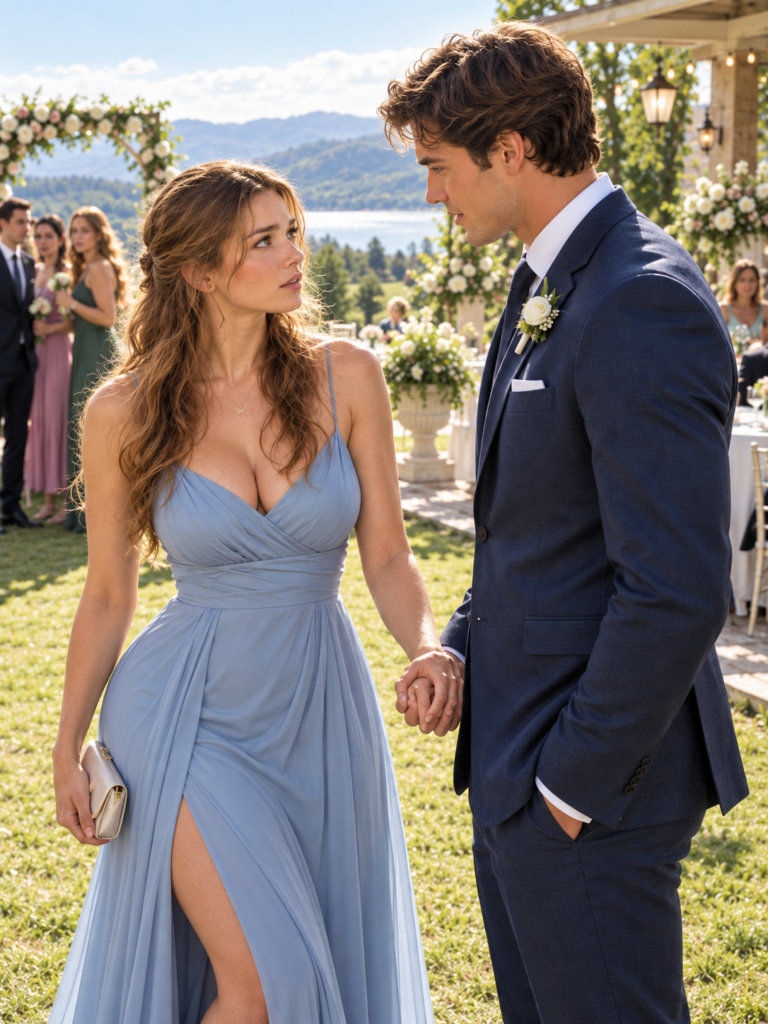
He went to his younger brother’s wedding alone and sat at the “leftover table”—then a humiliated woman’s ex walked over, and Jonah suddenly introduced himself as her fiancé…
Part 1
By the time Jonah Reed realized his mother had seated him at the back table, it was too late to pretend he hadn’t noticed.
Table fourteen sat between the emergency exit and a pair of artificial ficus trees, far enough from the dance floor that the band sounded slightly muffled and close enough to the kitchen doors that every seven minutes a server rushed past carrying dirty plates.
Every wedding had a table like it.
The place where the seating chart surrendered.
Two distant cousins nobody remembered inviting.
A divorced uncle who had recently stopped speaking to half the family.
A college roommate who came alone.
An elderly neighbor.
And Jonah.
The groom’s thirty-three-year-old unmarried older brother.
Jonah stared at the small white card bearing his name.
TABLE 14.
“Subtle, Mom.”
“What was that?”
His mother appeared behind him wearing a lavender dress, a corsage pinned to her shoulder, and the expression of a woman who had spent the previous six months arranging every detail of her younger son’s wedding and still believed she could improve the romantic prospects of the older one before dessert.
“Nothing.”
Elaine Reed followed his eyes to the table.
“Oh, honey. Don’t think anything of where you’re sitting.”
“I wasn’t.”
“It was just difficult fitting everyone.”
“I believe you.”
“Sarah has some very nice single cousins at table seven.”
Jonah closed his eyes.
“Mom.”
“What?”
“Mark has been married for forty-three minutes.”
“Yes.”
“Could we perhaps let him enjoy being the family success story until the cake?”
Elaine’s face softened.
“I don’t think you’re unsuccessful.”
“I know.”
“I just don’t want you to be alone forever.”
There it was.
Not cruelty.
Worse.
Concern.
Jonah forced a smile.
“I teach one hundred and twenty-seven teenagers American history every weekday. I have not experienced true solitude since 2012.”
She touched his arm.
“You know what I mean.”
He did.
That was the problem.
Across the reception hall, his younger brother Mark stood beside his new wife, Sarah, laughing as the photographer tried to arrange six bridesmaids beneath an arch covered in white roses.
Jonah loved his brother.
He needed that fact firmly established in his own mind.
He had stood beside Mark at the altar and meant every word when he told him how proud he was.
He liked Sarah.
He had helped Mark move furniture into their apartment, repaired a loose stair rail at their first house, and spent the previous night calming him when the groom suddenly became convinced he had forgotten how wedding vows worked.
Jonah wanted his brother’s happiness.
But family weddings had a peculiar ability to illuminate whatever everyone believed was missing from your own life.
And according to half of Lynden County, what was missing from Jonah’s life was a woman.
His aunt Diane had begun at the rehearsal dinner.
“You’re next.”
His uncle Paul had followed.
“Better hurry. Forty sneaks up on you.”
A cousin had tried introducing him to a dental hygienist from Mill Creek while Jonah was carrying folding chairs.
His mother had spent breakfast describing Sarah’s cousin Nicole.
“She hikes.”
“That’s nice.”
“And she teaches third grade.”
“Wonderful.”
“She’s single.”
“There it is.”
Jonah had been patient.
He had learned patience teaching teenagers about the causes of the Civil War.
He could survive one evening.
He picked up his wineglass and looked around table fourteen.
That was when he saw her.
She sat across from him.
Dark hair pinned loosely at the back of her head.
Deep green dress.
Small silver earrings.
No phone in her hand, unlike nearly everyone else waiting for dinner.
She sat very straight with both palms around the stem of a water glass.
Beautiful was the first word that occurred to Jonah.
But it was not what held his attention.
It was the way she seemed to be holding herself together through posture alone.
Her eyes were slightly red.
Not freshly crying.
Recently.
She noticed him looking.
Her chin lifted.
There was a challenge in the gesture.
Do not pity me.
Jonah understood it immediately.
He raised his wineglass half an inch.
“Back table.”
She blinked.
“We must have done something terrible.”
For one second she looked surprised.
Then the corner of her mouth moved.
“I assumed this was where they put the people they’re afraid might cause a scene.”
Jonah nodded thoughtfully.
“That makes sense.”
She glanced at his suit.
“So which one are you?”
“The one they’re afraid will never find a wife.”
A small sound escaped her.
Almost a laugh.
“My mother’s been introducing me to unmarried women since yesterday afternoon.”
The woman covered her mouth.
This time the laugh was real.
Jonah smiled.
“And you?”
Her expression changed.
“The one they’re afraid will cry.”
He did not ask why.
That seemed to surprise her.
Instead, he held out his hand.
“Jonah Reed.”
She took it.
“Marin Cole.”
“Bride or groom?”
“Bride. Sarah’s my cousin.”
“Mark’s my brother.”
Marin looked toward the head table.
“So technically you outrank me.”
“At table fourteen?”
“Fair point.”
A server began placing salads in front of them.
The rest of the table slowly disappeared into separate conversations.
Jonah and Marin remained facing each other.
“You from Lynden?” she asked.
“Born there. Grew up there. Somehow still there.”
“What do you do?”
“History teacher.”
She smiled.
“That explains the tie.”
Jonah looked down at the tiny colonial maps printed across it.
“My students bought it.”
“Of course they did.”
“And you?”
“County library.”
“Librarian?”
“Programming coordinator. I run community programs, grant projects, children’s literacy events, technology classes.”
“That sounds useful.”
“Unlike history?”
Jonah put a hand over his heart.
“We have known each other for three minutes and already you’re attacking my profession.”
“I work in a library. I’m legally required to defend the present.”
He laughed.
For the first time all weekend, Jonah felt his shoulders loosen.
No one was asking him why he was unmarried.
No one was suggesting he download an app.
No one was giving him that careful look.
Poor Jonah.
The good son.
The devoted grandson.
The one who stayed.
For two years, that had become his identity.
At thirty-one, Jonah had moved back into his grandmother Anna’s small yellow house on Maple Street after doctors told them her cancer had spread.
Eighteen months, they estimated.
Maybe less.
Jonah had not considered leaving her alone.
His parents both lived nearby, but they still worked full-time. Mark traveled for work. Jonah’s school was only seven minutes from Nana’s house.
So he moved in.
At the time, Jonah had been dating Claire Walsh for four years.
Claire received a major job offer in Chicago.
She wanted Jonah to come.
He wanted to go.
But Nana had already begun chemotherapy.
“You can’t build your entire life around somebody dying,” Claire told him one terrible night.
Jonah knew what she meant.
That did not make leaving possible.
“You’re asking me to choose.”
“I’m asking you to have a life.”
“This is my life.”
Claire cried.
Jonah cried after she left.
Three months later, she moved to Chicago without him.
The relationship ended quietly.
No villain.
No betrayal.
Just two decent people reaching the place where love could no longer make their futures compatible.
Nana lived fourteen months.
Jonah never regretted staying.
But other people regretted it for him.
That was harder.
People looked at his life and saw sacrifice.
Jonah remembered mornings making oatmeal while Nana criticized television news anchors.
He remembered driving her to chemotherapy while she complained about his music.
He remembered dancing with her in the kitchen when she still had enough strength.
He remembered being there at the end.
If loneliness was the price of those fourteen months, he would pay it again.
Across the table, Marin tilted her head.
“You disappeared.”
“Sorry.”
“Bad memory?”
“Complicated one.”
She nodded.
No pressure.
Jonah liked that.
He was about to ask whether she had always worked in libraries when someone stopped behind her chair.
Marin’s expression changed before Jonah even saw him.
Her shoulders went rigid.
The small openness in her face vanished.
A tall man in a tailored navy suit stood behind her.
He held a whiskey in one hand.
A blonde woman in a red dress held his other arm.
The man looked at Marin with the easy confidence of someone accustomed to entering rooms as though they belonged to him.
“Marin.”
She stared at the table.
Then lifted her eyes.
“Daniel.”
The blonde woman smiled uncertainly.
“Hi.”
“Chloe,” Marin said.
Her voice was perfectly controlled.
Jonah noticed her fingers tighten around her napkin.
Daniel looked pleased with himself.
“I wasn’t sure you’d come.”
“Sarah’s family.”
“Of course.”
He took a drink.
“Brave, though.”
Jonah looked from him to Marin.
She gave no reaction.
Daniel continued.
“You heard our news, I assume.”
“I did.”
Chloe shifted uncomfortably.
Marin looked directly at her.
“Congratulations.”
“Thank you,” Chloe said quietly.
Daniel’s smile widened.
“We figured there was no reason waiting when you know you’ve found the right person.”
There was something in the sentence.
Something polished and cruel.
Marin’s jaw tightened.
Jonah knew suddenly.
Ex.
Not just ex.
Serious ex.
Daniel glanced at the empty chair beside Marin.
“No date?”
“Daniel,” Chloe murmured.
“What? I’m asking.”
He looked down at Marin again.
“It’s been almost a year. I thought you’d have moved on by now.”
Marin went pale.
At the tables nearby, conversations continued, but Jonah felt the space around them shrinking.
Daniel smiled as if he were showing concern.
“I hope you’re not still taking everything so hard.”
Jonah heard his grandmother’s voice.
Not literally.
But clearly enough.
Anna Reed had spent Jonah’s childhood repeating one rule.
Any fool can be charming to the prettiest girl at the dance.
Watch the person who crosses the whole room for the one nobody else is dancing with.
That’s how you know what someone is made of.
As a child Jonah had rolled his eyes.
As a teenager he had mocked the phrase.
At thirty-three, sitting at a back table while a stranger tried not to crumble beneath someone else’s humiliation, he understood it.
“She has a date.”
The words came from Jonah.
Daniel looked at him.
Marin’s head turned sharply.
Jonah was already standing.
He walked around the table.
“I’m sorry,” he said, extending his hand toward Daniel. “I don’t think we’ve met.”
Daniel looked at his hand before taking it.
“Daniel Mercer.”
“Jonah Reed.”
Daniel’s eyes moved between Jonah and Marin.
Jonah could still stop.
He could say friend.
He could say date.
He could invent a college connection.
Instead, some reckless part of him took control.
“Marin’s fiancé.”
Silence.
Absolute silence.
Marin stared at him.
Daniel’s smile froze.
Chloe blinked.
“Fiancé?”
Jonah nodded as if he announced engagements to strangers every weekend.
“Yes.”
Marin had not moved.
He rested his hand lightly on the back of her chair.
Not on her.
Close enough to suggest intimacy.
Far enough that she could end the performance immediately.
“We’ve been keeping it quiet,” Jonah said.
Daniel’s eyes narrowed.
“Marin never mentioned you.”
“We didn’t want to take anything away from Sarah and Mark’s wedding.”
Jonah glanced toward the dance floor.
“Family day.”
Then he felt it.
Marin’s hand reached up.
Her fingers closed around his.
Cool.
Slightly trembling.
She pressed once.
Jonah shifted his hand from the chair to her shoulder.
Only because she had invited it.
Daniel looked at their joined hands.
Something brittle entered his smile.
“Well.”
Chloe gave Marin an unreadable look.
“Congratulations.”
“Thank you,” Marin said.
Her voice was steadier now.
Daniel raised his glass.
“Good for you.”
Then he guided Chloe away.
Jonah watched until they disappeared into the crowd.
Only then did Marin release a breath.
He removed his hand immediately.
“I’m sorry.”
She looked up at him.
“You’re sorry?”
“I may have skipped several normal social steps.”
“You called yourself my fiancé.”
“Yes.”
“You don’t know my last name.”
“You said Cole.”
“You remembered?”
“I teach history. Retention is part of the job.”
Marin stared at him.
Then laughter came out.
At first one breath.
Then another.
She covered her face.
Jonah sat beside her.
“I can downgrade us to cousins if necessary.”
“That would make everything significantly worse.”
“Good point.”
Her laughter faded.
“You didn’t have to do that.”
“I know.”
“He’s my ex.”
“I gathered.”
“We were supposed to get married.”
Jonah said nothing.
“Last October.”
She looked toward the dance floor.
“He’s marrying Chloe this spring.”
“I’m sorry.”
Marin’s expression hardened.
“Don’t be.”
That surprised him.
She picked up her water.
“My family thinks Daniel left me.”
Jonah waited.
She looked at him.
“They think I fell apart.”
“But?”
Marin’s eyes dropped.
“Not here.”
Jonah nodded.
Immediately.
“Okay.”
Something about that answer seemed to matter to her.
She looked toward the dance floor again.
A slow song had begun.
Couples moved under strings of warm lights.
Marin watched for several seconds.
Then she turned to Jonah.
“Well?”
“Well what?”
“If you’re my fiancé, you should probably ask me to dance.”
Jonah stared.
“Is that a threat?”
“It’s an expectation.”
“I’m a terrible dancer.”
“Perfect.”
She stood.
“We’ve already established this engagement has serious problems.”
Jonah laughed and offered his hand.
She took it.
Together they crossed the room.
Past his mother, who nearly dropped her champagne glass.
Past table seven and the single cousins.
Past Daniel and Chloe.
Jonah felt people watching.
Marin certainly did.
Yet she lifted her chin.
Jonah placed one hand carefully at her back.
She rested hers on his shoulder.
They moved slowly.
Badly, in Jonah’s case.
“You weren’t exaggerating,” Marin whispered.
“About?”
“The dancing.”
“I value honesty.”
She smiled.
For one song, the back-table woman stopped looking like someone enduring a wedding.
She looked alive.
Halfway through, Marin leaned closer.
“Tell me one true thing.”
Jonah glanced at her.
“One true thing?”
“If we’re engaged, I should know something real about you.”
He considered joking.
Instead he said, “My grandmother raised me more than anyone.”
Marin listened.
“She died last spring.”
“I’m sorry.”
“She used to say the measure of a person was how they treated whoever nobody else was dancing with.”
Marin looked up at him.
Jonah gave a small shrug.
“I’ve spent most of my life trying to become the man she thought I already was.”
“Do you think you have?”
“Not particularly.”
“I think she’d disagree.”
He smiled.
“Your turn.”
Marin’s smile disappeared.
For several steps, she said nothing.
Then:
“I wasn’t dumped.”
Jonah stopped moving.
The dancers behind them shifted around him.
“What?”
Marin pulled him gently back into motion.
“I ended the engagement.”
“Why does your family think Daniel left you?”
“Because that’s what I let them believe.”
Jonah frowned.
Marin looked over his shoulder toward Daniel.
“I found out he had been seeing Chloe for almost a year.”
Jonah’s jaw tightened.
“Before your wedding?”
“Three weeks before.”
“And he’s standing here acting like—”
“Yes.”
“Why didn’t you tell people?”
Marin’s face changed.
Not humiliation now.
Grief.
“His mother.”
Jonah waited.
“Evelyn has pancreatic cancer.”
Marin swallowed.
“She was supposed to be my mother-in-law. She treated me like a daughter for six years.”
Her voice lowered.
“She doesn’t know what Daniel did.”
Jonah looked toward Daniel across the room.
“He told her we realized we weren’t compatible. That he ended things and I was having trouble accepting it.”
“You let him?”
“Yes.”
“Why?”
“Because she has months.”
Marin’s eyes glistened.
“Maybe weeks now.”
Jonah said nothing.
“She loves him,” Marin continued. “And whatever he did to me, he’s still her son. She thinks he’s a good man who made a difficult decision.”
Marin took a slow breath.
“I could tell her the truth. I could make sure everyone knows exactly what happened.”
“Why don’t you?”
“Because then she spends whatever time she has left wondering whether she raised a liar.”
Jonah stopped dancing again.
This time Marin stopped with him.
People moved around them.
The band played.
Daniel laughed somewhere behind her.
And Jonah stared at the woman everyone believed had been abandoned.
She had allowed an entire family to pity her.
Allowed people to whisper.
Allowed Daniel to rewrite what happened.
Not because she was weak.
Because she was protecting a dying woman who had once loved her.
“You’ve let everyone think you were the one who got left.”
“Yes.”
“For almost a year.”
“Yes.”
Jonah breathed out.
“You’re either the kindest person in this room or completely insane.”
Marin smiled through damp eyes.
“Probably some of both.”
“Nana would’ve loved you.”
“Your grandmother?”
“Yes.”
“You’ve known me approximately forty minutes.”
“She was efficient.”
Marin laughed.
Jonah looked at her.
Really looked.
And suddenly the absurd sentence he had spoken at table fourteen did not feel quite as absurd as it should.
“Marin.”
“Yes?”
“Can I take you to dinner?”
Her eyebrows lifted.
“We’re currently at dinner.”
“A real one.”
“So this engagement has conditions?”
“Apparently.”
“No audience?”
“No ex.”
“No relatives?”
“Strong preference.”
She studied him.
“What exactly are you asking?”
“One meal.”
“And after that?”
“I don’t know.”
“You’re very reassuring.”
Jonah smiled.
“I know I’d like to hear the rest of what you don’t tell people.”
For a moment, she seemed unsure what to do with that.
Then:
“You already proposed before our first date.”
“Technically I announced.”
“That’s worse.”
“I like doing things out of order.”
Marin smiled.
“Okay.”
“Okay?”
“Dinner.”
The song ended.
Neither immediately stepped apart.
Then applause rippled around the room for the band, and reality returned.
They left the wedding almost an hour later.
Not together exactly.
But at the same time.
Outside, strings of lights stretched across the stone courtyard.
Marin stopped beside her car.
“You realize half the reception thinks we’re engaged.”
“I was hoping alcohol might damage the memory.”
“You’ve never lived in a small town, have you?”
“Thirty-three years.”
“Then you know better.”
Jonah sighed.
“We’re in trouble.”
“Yes.”
Marin opened her car door.
“Goodnight, fiancé.”
“Goodnight, woman whose last name I learned fifty minutes ago.”
She laughed.
Then drove away.
Jonah watched her taillights disappear.
Behind him, a voice said:
“Jonah.”
He closed his eyes.
His mother.
Elaine hurried across the parking lot.
“Who was that?”
“Sarah’s cousin.”
“Why did I hear your aunt tell someone you’re engaged?”
“It’s complicated.”
Elaine’s eyes widened.
“You’re engaged?”
“No.”
“You said you were.”
“I did.”
“Why?”
“Mom.”
“You have been single for two years and apparently got engaged during Mark’s entrée service. I think I’m entitled to one question.”
Jonah rubbed his face.
“It was a misunderstanding.”
Elaine stared toward the road Marin had taken.
Then back at her son.
For the first time in a long while, Jonah saw something in his mother’s expression besides worry.
Hope.
That frightened him more than Daniel had.
“Do not tell anyone anything.”
Elaine placed both hands over her mouth.
Jonah narrowed his eyes.
“Mom.”
“I won’t.”
She absolutely would.
By Tuesday morning, the cashier at Linden Market congratulated him.
At 7:42, his assistant principal leaned into his classroom.
“Big news?”
“No.”
“Congratulations.”
“There is nothing to congratulate.”
His students arrived at eight.
At 8:06, seventeen-year-old Caleb Montgomery raised his hand.
“Mr. Reed?”
“Yes?”
“Did you get engaged Saturday?”
The classroom erupted.
Jonah slowly placed his textbook down.
“How?”
Caleb grinned.
“My mom knows Mrs. Patterson.”
“Who is Mrs. Patterson?”
“Her cousin does flowers.”
Jonah closed his eyes.
Small towns were a form of surveillance technology.
After school, he called Marin.
She answered on the fourth ring.
“Hello, fiancé.”
Jonah groaned.
She laughed.
“That bad?”
“A sophomore asked whether he was invited to my wedding.”
“Oh no.”
“Apparently I proposed during the toast.”
“That’s interesting.”
“On one knee.”
“Romantic.”
“With a ring I’d been carrying for months.”
“Very prepared.”
“I hate this town.”
“No, you don’t.”
He smiled.
“No.”
Marin became quiet.
“Jonah?”
“Yeah?”
“People are saying it here too.”
“I’m sorry.”
“Don’t be.”
He waited.
“For the first time in almost a year, I went to the grocery store and nobody looked at me like I might cry beside the produce.”
Jonah said nothing.
“The library board chairman asked about my engagement.”
“What did you tell him?”
“That it was very recent.”
Jonah laughed.
“You didn’t deny it.”
“No.”
“Why?”
Marin was silent for several seconds.
Then she said quietly:
“I’m tired of being the woman everybody thinks got thrown away.”
Jonah’s smile faded.
“And for one week, maybe I’d like to know what it feels like to be something else.”
He sat at his grandmother’s kitchen table.
Her empty chair remained across from him.
The old radio sat on the counter.
A photograph of Nana laughing in a flour-dusted apron hung near the refrigerator.
Jonah looked at it.
“No hurry from me.”
“You mean that?”
“Yes.”
Marin exhaled.
“Then I guess we’re still engaged.”
“Apparently.”
“But Friday dinner is real.”
“Definitely real.”
“No pretending?”
“No pretending.”
Marin paused.
“Good.”
Jonah stared at Nana’s empty chair.
For the first time since she died, the house did not feel quite so silent.
Part 2
Their first real date almost failed before the appetizers.
Jonah arrived at Marin’s apartment six minutes early.
That was mistake number one.
He sat in his truck for seven minutes so he would not appear overeager.
That was mistake number two because Marin had been looking through the window and saw him.
When she opened the door, she said:
“Did you just spend seven minutes sitting in my driveway?”
“No.”
“You did.”
“I was listening to the radio.”
“The truck was off.”
Jonah sighed.
“I was attempting to appear normal.”
“How’s that going?”
“Poorly.”
Marin smiled.
“Good. I was nervous too.”
That helped.
They drove to a small Italian restaurant thirty minutes away where nobody knew either of them.
No relatives.
No exes.
No accidental engagement witnesses.
For the first twenty minutes, conversation felt strangely difficult.
At the wedding, they had hidden behind chaos.
Now there was only Jonah.
Marin.
A candle.
A checkered tablecloth.
And the uncomfortable fact that they had told dozens of people they were getting married before learning whether either of them liked mushrooms.
Marin finally set down her fork.
“I need to ask you something.”
“Okay.”
“You have to answer honestly.”
“That sounds dangerous.”
“That night.”
Jonah waited.
“When you stood up for me.”
Her expression became guarded.
“Were you trying to rescue me?”
He frowned.
“Because I need to know.”
“Why?”
“I’ve spent a year being everybody’s tragedy.”
She looked down.
“Poor Marin. Poor Marin’s wedding got canceled. Poor Marin got left. Poor Marin has to see Daniel move on.”
Her fingers tightened.
“I don’t want to become your good deed.”
Jonah sat quietly.
Marin looked up.
“If that’s what this is, tell me now.”
Jonah considered his answer.
“At first?”
She waited.
“Maybe.”
Her face fell slightly.
“About four seconds.”
She blinked.
“I saw Daniel embarrassing you, and I thought somebody should stop him.”
“That sounds like rescuing.”
“It was.”
Jonah leaned forward.
“Then you put your hand over mine.”
Marin went still.
“You pressed once.”
She remembered.
“And I remember thinking, I have absolutely no idea who this woman is.”
Jonah smiled slightly.
“And I want to know.”
Marin watched him.
“I didn’t ask you here because you needed saving.”
“No?”
“No.”
“Then why?”
“Because I couldn’t sit back down.”
Her expression softened.
Jonah held his hand across the table.
Not touching hers.
Just there.
Marin looked at it.
Then placed her fingers over his.
Pressed once.
“Okay.”
“Okay?”
“Then keep going.”
They did.
Slowly.
Painfully slowly, according to Jonah’s mother.
After three weeks, Elaine asked if they had “defined things.”
Jonah said they were dating.
Elaine demanded to know how dating could come after engagement.
Jonah suggested she stop trying to apply logic.
Marin met his parents after two months.
Jonah met her older sister Lena and Marin’s father.
They corrected the engagement rumor eventually.
Sort of.
Jonah told people there had been a misunderstanding.
Marin said they were “taking things one step at a time.”
The town translated that into:
Engagement temporarily postponed.
Neither bothered fighting it.
What mattered was Friday evenings.
Jonah drove to Marin’s town after school.
Sometimes they went out.
Usually they cooked in her small kitchen.
Marin was better at it.
Jonah chopped vegetables.
Badly.
She mocked him.
He defended himself by citing the historical importance of men who could not cook.
“No historian has ever been saved by that sentence.”
“You can’t prove that.”
On Sundays, Marin occasionally came to Lynden.
Jonah showed her his classroom.
The library where he graded papers.
The football field.
The diner where he had once been banned for stacking sugar packets.
“You actually did that?”
“Sixty-seven.”
“You were an idiot.”
“I was gifted.”
Jonah learned that Marin hated bananas.
Loved old mystery novels.
Could remember almost every patron’s name at the library.
Cried during animal rescue commercials.
Was terrible at asking for help.
And had a habit of saying “I’m fine” approximately three seconds before admitting she absolutely was not.
Marin learned that Jonah kept spare granola bars in his desk for students who came to school hungry.
That he pretended not to notice when they took them.
That he spent his own money on classroom supplies even though he complained every year about doing it.
That he could explain the Battle of Gettysburg with salt shakers.
That he still paid Nana’s landline bill because he had not been able to make himself disconnect the number.
Four months after they met, Jonah brought Marin to Nana’s house.
His house now.
He still struggled to call it that.
The front porch paint was peeling.
The hallway smelled faintly of cedar and old books.
Nana’s coat still hung behind the basement door because Jonah had somehow missed it while clearing her things.
Marin entered slowly.
Not with curiosity.
With respect.
Jonah noticed.
“This is where she raised you?”
“Mostly.”
He showed Marin photographs.
Nana at twenty-two beside a lake.
Nana dancing with Jonah’s grandfather.
Nana holding seven-year-old Jonah, whose front teeth were missing.
Marin stopped at that one.
“You were adorable.”
“Was?”
“Let’s stay focused.”
Jonah laughed.
They entered the kitchen.
The old radio sat beside the window.
Nana’s chair remained at the table.
Marin touched the back of it lightly.
“You don’t sit there.”
It was not a question.
“No.”
“Why?”
“I don’t know.”
“Yes, you do.”
Jonah looked at the chair.
“She always sat there.”
Marin nodded.
No attempt to fix it.
No suggestion that he move on.
She simply understood.
Jonah switched on the radio.
Static.
Then an old big-band station came through.
Marin smiled.
“This was hers?”
“Every afternoon.”
He extended a hand.
“She also believed kitchens were wasted if nobody danced in them.”
Marin took his hand.
“You still can’t dance.”
“That has never stopped me.”
They moved slowly between the kitchen table and counter.
No audience.
No Daniel.
No wedding.
No lie.
Only an old radio and late-afternoon sunlight.
Marin rested her head against Jonah’s shoulder.
He looked at Nana’s empty chair.
For the first time, it did not look abandoned.
It looked occupied by memory instead of absence.
The feeling frightened him.
Because happiness after grief always carried a dangerous question.
How long?
Jonah never said it aloud.
Neither did Marin.
But she had her own version.
It emerged in August.
They had been together almost nine months.
Marin sat across from him at her kitchen table.
Dinner had gone cold.
She had barely eaten.
Jonah finally put down his fork.
“What’s wrong?”
“Nothing.”
“Marin.”
“I’m tired.”
“Try again.”
She looked at him.
“Why do teachers always sound like teachers?”
“Occupational damage.”
She looked away.
Jonah waited.
He had learned not to chase her silence.
Eventually she whispered:
“What if this isn’t real?”
Jonah frowned.
“What?”
“This.”
She gestured between them.
“What if I’m with you because you were the first kind thing that happened after Daniel?”
He stared.
Marin continued quickly, as though if she stopped she would lose courage.
“What if I never actually dealt with what happened?”
“You did.”
“How do you know?”
“Because I watched you.”
“You met me after.”
“I know.”
She shook her head.
“My whole town still thinks I was dumped.”
“Less now.”
“That doesn’t matter.”
Her voice trembled.
“Sometimes I walk into a room and I can still feel people looking at me like I’m something somebody returned.”
Jonah’s chest tightened.
“Marin—”
“Let me finish.”
He nodded.
She took a breath.
“What if they’re right?”
“They’re not.”
“What if I am leftover?”
Jonah sat back.
Marin laughed bitterly.
“Listen to me. Thirty-two years old and using the word leftover.”
“Because someone made you feel that way.”
“Maybe because it’s true.”
“No.”
“You don’t know that.”
“I do.”
“How?”
Jonah looked at her for a long moment.
Then thought about Nana.
“The back table.”
Marin frowned.
“What?”
“Nana had another version of that saying.”
Jonah leaned forward.
“She used to say the world has a habit of deciding who belongs at the back table.”
Marin listened.
“The divorced person. The awkward kid. The widow. The one who lost the job. The woman who got left. The man everybody thinks sacrificed his life.”
His voice softened.
“And most of the time, the world is wrong.”
Marin’s eyes filled.
“You didn’t end up at that table because you were leftover.”
“Jonah.”
“You were there because the one time your pride had to compete with someone else’s peace, you chose her peace.”
He held her gaze.
“You let people pity you to protect a dying woman who wasn’t even your family anymore.”
“She almost was.”
“Exactly.”
Jonah reached across the table.
“That isn’t a flaw I’m overlooking.”
Marin’s lip trembled.
“That’s one of the reasons I crossed the room.”
She closed her eyes.
When she opened them, tears had escaped.
“I keep waiting to find out you’re too good to be true.”
Jonah almost laughed.
“I assure you, I’m not.”
“You know what I mean.”
“I’m a mediocre cook, a terrible dancer, I procrastinate grading essays, and I stayed in Lynden partly because I was scared to find out whether I could build a life anywhere else.”
Marin wiped her cheek.
“I am not extraordinary.”
He squeezed her hand.
“But I know exactly what you’re worth.”
She looked down.
“And it isn’t a back table.”
Marin cried quietly then.
Jonah did not tell her to stop.
He did not explain why she should feel better.
He simply stayed.
That became their pattern.
Not fixing.
Staying.
But life had one more test for them.
It arrived in March.
Daniel married Chloe.
Marin was not invited.
She did not want to be.
Daniel’s mother, Evelyn, had deteriorated badly by then.
She had entered hospice.
Marin still visited.
Jonah struggled with that at first.
Not because he was jealous.
Because every visit cost Marin something.
She returned exhausted.
Sometimes angry.
Sometimes silent.
One evening, Jonah asked:
“Does Daniel know you’re going?”
“Yes.”
“He’s okay with it?”
“He doesn’t get a vote.”
Jonah smiled.
“That sounded healthy.”
Marin did not.
“Evelyn asked me something yesterday.”
“What?”
“She asked whether I forgave him.”
Jonah became still.
“What did you say?”
“I said there was nothing to forgive.”
“Marin.”
“What was I supposed to do?”
“Not lie.”
“She has days.”
“You don’t know that.”
“Yes, I do.”
Her voice cracked.
“She wanted to know whether her son had broken me.”
Jonah said nothing.
“And I told her no.”
“That part wasn’t a lie.”
“No.”
“Did you tell her you’re happy?”
“Yes.”
“With me?”
A faint smile.
“With my mysterious fiancé who became my real boyfriend.”
Jonah relaxed slightly.
“She likes you.”
“She’s never met me.”
“She likes history teachers.”
“That is an unusually specific virtue.”
Marin’s smile faded.
“She said she was glad someone found me.”
Jonah reached for her hand.
Evelyn Mercer died two weeks later.
Marin was with her.
Daniel arrived twenty minutes before the end.
Chloe came too.
Jonah waited in the hospital cafeteria because Marin had asked him to be nearby but not inside.
At 2:14 in the morning, she texted:
She’s gone.
Jonah stood before he realized he had moved.
He met Marin outside the elevator.
Her face crumpled the moment she saw him.
Jonah opened his arms.
She walked into them.
No words.
The funeral was three days later.
Marin attended.
Daniel’s relatives whispered.
Some people wondered why the “ex-fiancée who couldn’t move on” was there.
Jonah heard two women discussing it behind him.
He turned.
Marin caught his wrist.
“No.”
“They’re talking about you.”
“I know.”
“They’re wrong.”
“I know.”
“Then why—”
“Because today isn’t about me.”
Jonah stared at her.
Again.
This woman.
Again.
After the service, Daniel approached them.
He looked older.
Less polished.
Grief had stripped something from him.
“Marin.”
She turned.
Daniel swallowed.
“Thank you.”
“For what?”
“For coming.”
Marin said nothing.
He looked toward his mother’s grave.
“She loved you.”
“I loved her.”
Daniel nodded.
Then, after a long pause:
“She never knew.”
“No.”
His face tightened.
“Why?”
Marin stared at him.
Jonah saw months of anger pass behind her eyes.
“You really have to ask?”
Daniel looked ashamed.
Marin stepped closer.
“I didn’t protect you.”
He flinched.
“I protected her.”
She turned away.
Daniel’s voice stopped her.
“I’m sorry.”
Marin stood still.
Jonah expected rage.
He would have understood it.
Instead Marin said:
“I know.”
Nothing else.
She walked toward Jonah’s truck.
On the drive home, Marin cried almost continuously.
Jonah kept one hand on the steering wheel.
The other rested open on the center console.
Eventually Marin placed hers over it.
They drove thirty miles like that.
No speeches.
No lesson.
No attempt to make grief smaller.
When they reached her apartment, Marin remained seated.
“Jonah?”
“Yeah?”
“She died believing he was better than he was.”
“I know.”
“Was that wrong?”
Jonah considered carefully.
“No.”
“How can you know?”
“I don’t.”
She looked at him.
“But I think sometimes truth belongs to the people it helps.”
Marin’s face crumpled again.
“And sometimes telling it only gives pain somewhere new to live.”
She leaned toward him.
Jonah held her.
That night, he knew.
Not because Marin was kind.
Not because she was beautiful.
Not because she had endured humiliation gracefully.
He knew because he wanted the privilege of sitting beside her through things he could not repair.
That was different from rescue.
It was love.
Still, Jonah waited.
Their relationship had begun with pretending.
He wanted the real thing to arrive in its own time.
One year and nineteen days after Mark and Sarah’s wedding, Jonah called the reception hall.
“Do you rent the ballroom on weeknights?”
The manager said yes.
Jonah booked it.
Then he found the bandleader from Mark’s wedding.
Then the song.
Then, after an hour searching Nana’s jewelry box, he found the small velvet pouch she had once shown him.
Inside was her mother’s engagement ring.
Nana had told him years earlier:
Don’t give this to somebody because you’re afraid of being alone.
Give it to somebody who makes you brave enough to be fully known.
Jonah had forgotten the sentence.
Until now.
Part 3
Marin suspected something was wrong the moment Jonah told her to wear green.
“Why?”
“Because I like the green dress.”
“The wedding dress?”
“Yes.”
“You want me to wear the dress I was wearing when we invented our engagement?”
“That sounds more suspicious when you say it like that.”
“Jonah.”
“Please?”
She narrowed her eyes.
“What are you doing?”
“History teacher.”
“That is not an answer.”
“We’re known for reenactments.”
Marin stared at him.
Then smiled.
“Fine.”
Friday evening, Jonah picked her up.
She wore green.
Not exactly the same dress.
A new one.
Deep emerald, long sleeves, simple.
Jonah forgot what he had planned to say for approximately six seconds.
“You okay?”
“Yes.”
“You look like you forgot language.”
“That’s possible.”
Marin laughed.
He drove toward Lynden.
When they turned onto the road leading to the reception hall, she sat straighter.
“Jonah.”
“Yes?”
“No.”
“No what?”
“I know what this is.”
“You absolutely do not.”
“You brought me to the wedding hall.”
“That’s true.”
“Why?”
“You’ll see.”
“No, no. Reed, if there are two hundred people inside—”
“There aren’t.”
“If your mother is hiding behind a curtain—”
“She wanted to.”
Marin groaned.
“You told her?”
“I had to obtain the ring.”
Silence.
Jonah realized what he had said.
Marin turned slowly.
“The what?”
He stared at the windshield.
“Well.”
“The ring?”
“I had a better plan for revealing that information.”
“Jonah.”
He pulled into the parking lot.
“Can we pretend I didn’t say it?”
“No.”
“Excellent.”
Marin started laughing.
She laughed so hard she covered her face.
Jonah parked.
“This is going very badly.”
“It’s going perfectly.”
She wiped her eyes.
“Continue.”
“No. We’re resetting.”
He got out, walked around the truck, and opened her door.
Marin took his hand.
The reception hall was dark except for strings of warm lights.
No guests.
No tables.
No family.
At the center of the empty dance floor stood two chairs.
And beside the wall, one small speaker.
Marin stopped.
Jonah watched her understand.
“Oh.”
He switched on the music.
The same song.
Slow.
Old.
Sweet.
Marin’s eyes filled immediately.
“That’s unfair.”
“I know.”
Jonah offered his hand.
“Dance?”
“You still haven’t improved.”
“That has never been relevant.”
She stepped into his arms.
They moved slowly across the floor.
No Daniel.
No audience.
No pity.
No pretending.
After a moment Marin whispered:
“One true thing.”
Jonah smiled.
“You remember?”
“Always.”
He breathed.
“Okay.”
He looked at her.
“One true thing.”
She waited.
“The night I met you, I thought I was helping somebody who needed it.”
Marin smiled faintly.
“I know.”
“I was wrong.”
“Also true.”
“I thought crossing the room made me brave.”
He shook his head.
“But everything brave happened after.”
Marin’s eyes glistened.
“Learning you.”
They turned slowly.
“Letting you see the parts of me I normally hide.”
Jonah’s voice became rough.
“Letting myself need you without believing that needing somebody means losing myself.”
Marin stopped dancing.
Jonah did too.
“A year ago, I told Daniel we were engaged because Nana taught me that when someone is standing alone, you cross the room.”
He reached into his pocket.
Marin covered her mouth.
Jonah lowered himself to one knee.
Tears appeared instantly.
“Oh God.”
He opened the small velvet box.
The ring caught the light.
“My grandmother spent my entire life trying to teach me what kind of man to be.”
Jonah looked up at Marin.
“I thought being good meant rescuing people.”
His voice trembled.
“You taught me something better.”
Marin cried silently.
“It means staying when there’s nothing to fix.”
Jonah swallowed.
“It means listening when the truth is uncomfortable.”
“It means knowing the person beside you is capable of carrying her own life and still offering your hand.”
He smiled through wet eyes.
“Marin Cole, I called myself your fiancé before our first date.”
She laughed through tears.
“I know.”
“I’ve been trying to catch up ever since.”
He held out the ring.
“Will you marry me for real this time?”
Marin laughed.
Then cried harder.
Then laughed again.
“You’re still doing everything backward.”
“Is that a yes?”
She lowered herself toward him and took his face between her hands.
“It was probably yes a year ago.”
Jonah blinked.
“I was waiting for you to catch up.”
He stood.
She kissed him before he managed to put the ring on.
When he finally did, Marin stared at it.
“Your grandmother’s?”
“Yes.”
She closed her eyes.
Jonah suddenly worried.
“You don’t have to use it.”
“Stop.”
“I mean, we can buy—”
“Jonah.”
She looked at him.
“I want this one.”
They danced again.
This time Marin rested her cheek against his chest.
After several minutes she whispered:
“Nana was right.”
“About?”
“The whole-room thing.”
Jonah smiled.
“She usually was.”
They married that winter.
In the same reception hall.
When the coordinator asked where they wanted the head table, Marin did not hesitate.
“The back.”
The woman blinked.
“I’m sorry?”
Marin pointed toward the corner near the emergency exit.
“Right there.”
Jonah laughed.
The coordinator looked horrified.
“That’s usually where we place overflow.”
“Exactly.”
They built the entire seating plan around table fourteen.
At first, Elaine protested.
“The head table belongs in front.”
“No,” Jonah said.
“Why not?”
“Because the back has better history.”
Marin wore green.
Not white.
When Jonah saw her walking down the aisle, he forgot every prepared thought.
Afterward he asked why green.
Marin smiled.
“I wore white once for a wedding that never happened.”
She touched his tie.
“I wore green the night I met the man I actually wanted to marry.”
At the reception, Mark gave the first toast.
“My family spent several years worrying about Jonah.”
Everyone laughed.
Jonah sighed.
“We thought he was lonely. We thought he had missed his chance. We thought poor Jonah had stayed behind while everybody else built lives.”
Mark looked toward Marin.
“Turns out the guy was just waiting for someone stubborn enough to get seated at the same terrible table.”
Laughter filled the room.
Marin squeezed Jonah’s hand.
Elaine cried.
Sarah cried.
Half the room cried because weddings were contagious that way.
At table fourteen, beside Jonah’s chair, they left one empty seat.
A small photograph of Anna Reed rested against a vase.
Nana.
Flower-dusted apron.
Laughing eyes.
Jonah looked at it several times that night.
Once, Marin found him staring.
“She’d like this,” she said.
“The wedding?”
“The table.”
Jonah smiled.
“She’d complain about the cake.”
“Why?”
“She hated fondant.”
Marin laughed.
Jonah looked around the room.
Relatives danced.
Children slid beneath tables despite repeated parental warnings.
His students had sent a ridiculous card signed by nearly the entire school.
Rosa-colored lights moved across the ceiling.
And in the far corner, the table everyone once considered a leftover table had become the center of everything.
Years later, Jonah would tell his students the story differently.
He did not tell them about Daniel.
He did not tell them every private detail.
But occasionally, when discussing some historical figure whose reputation had been decided too quickly, Jonah would lean against his desk and say:
“Be careful about the stories people tell you about somebody.”
His students knew another lecture was coming.
“Sometimes the person everyone thinks got abandoned was actually the one brave enough to leave.”
Someone would groan.
“Mr. Reed is doing life advice again.”
Jonah would continue.
“Sometimes the man people think gave up his future was simply choosing which part of his future mattered most.”
Another student would raise a hand.
“Is this about Mrs. Reed?”
“Everything becomes about Mrs. Reed eventually.”
They laughed.
Jonah would smile.
Then he would give them the sentence Nana had given him.
“The world is very good at deciding who belongs at the back table.”
He would look across the classroom.
“The world is also wrong a lot.”
Marin continued working at the county library.
She eventually became director.
She built programs for widows returning to work, teenagers applying for college, older residents learning technology, parents who needed literacy support, and people who came inside simply because libraries were one of the few places where a person could stay without being expected to buy anything.
She still thought of Evelyn.
Every year on the anniversary of her death, Marin bought flowers.
Not for Daniel.
Not for the past.
For the woman who had once expected to become her family.
Jonah never asked her to stop.
Daniel and Chloe moved away.
Their lives became ordinary from a distance.
That was enough.
There was no revenge.
No dramatic collapse.
Marin did not need one.
The life she built after him became the only answer she ever wanted.
Sometimes, years later, strangers still asked Jonah and Marin how they met.
Jonah usually gave the simple version.
“At my brother’s wedding.”
Marin would add:
“At the worst table.”
Jonah would disagree.
“Best table.”
Then someone inevitably asked who spoke first.
“I did,” Jonah said.
“He insulted the seating arrangement.”
“It was an observation.”
“And ninety minutes later, he told my ex we were engaged.”
Jonah would shrug.
“I move quickly.”
Marin would look at whoever was listening.
“Do not believe that. It took him a full year to actually propose.”
“Because I respect chronology.”
“You proposed before our first date.”
“One minor procedural issue.”
People laughed.
But beneath the joke lived a truth neither of them forgot.
Jonah had gone to Mark’s wedding believing everyone else saw him as the man who had missed his chance.
Marin had arrived believing the room saw her as the woman somebody else had rejected.
Both walked into the reception carrying stories other people had written for them.
Poor Jonah.
Poor Marin.
Left behind.
Left over.
Unchosen.
Neither story was true.
Jonah had not sacrificed his future by caring for Nana.
He had simply chosen love while it was still available to give.
Marin had not been discarded by Daniel.
She had walked away from dishonesty and then accepted humiliation to spare a dying woman pain.
Neither had needed rescuing.
They had needed recognition.
Someone to sit across the back table and see beyond the story everyone else had already decided was true.
And Jonah eventually understood that Nana’s lesson had never really been about dancing.
It was about attention.
Who do you notice when everyone else is looking toward the center of the room?
Who do you sit beside when the seating chart says they do not quite belong?
Who are you when kindness offers no audience, no reward, and no guarantee that anyone will ever know what you did?
The night Jonah met Marin, he thought he had answered that question by standing up.
Years later, he knew better.
Crossing the room had been the easy part.
The harder part was everything afterward.
Listening.
Believing.
Staying.
Allowing another person to be strong without becoming distant.
Allowing yourself to be needed without becoming necessary.
Letting somebody know the frightened, imperfect parts of you and trusting them not to turn those weaknesses into weapons.
That was love.
Not rescue.
Not pity.
Not a dramatic announcement in front of a cruel ex.
Love was Marin sitting beside Jonah at Nana’s kitchen table while he finally packed away her old coat.
Love was Jonah saying nothing during the drive home from Evelyn’s funeral because grief did not always need advice.
Love was arguments about dishes and late library meetings and school budgets and whose turn it was to buy milk.
Love was the ordinary privilege of being known.
One Christmas, years after their wedding, Jonah and Marin attended another family reception in the same hall.
A younger cousin was getting married.
Music played.
Children raced across the dance floor.
Dinner plates disappeared into the kitchen.
Jonah was carrying two coffees when Marin touched his arm.
“Look.”
Near the back wall sat an elderly woman alone.
Everyone else at her table had gone dancing.
She watched them quietly.
Jonah looked at Marin.
Marin smiled.
Neither needed to say anything.
Jonah placed the coffees down.
Then he crossed the room.
He stopped beside the woman.
“Ma’am?”
She looked up.
“Yes?”
“My wife tells me I’m required to ask.”
He extended his hand.
“Would you dance with me?”
The woman laughed.
“I haven’t danced in twenty years.”
“That makes two of us.”
“You look younger than twenty.”
“I’m exceptionally bad.”
She accepted his hand.
Jonah led her toward the dance floor.
Halfway there, he glanced back.
Marin stood beside table fourteen.
Green dress.
Laughing eyes.
Watching him.
For one instant, Jonah could almost imagine another woman beside her.
Flower-dusted apron.
Old radio playing.
Hands on her hips.
Satisfied.
Any fool can be charming to the prettiest girl at the dance.
Jonah smiled.
He finally understood why Nana had repeated it so often.
Not because she wanted him to find a wife.
Because she wanted him to become the kind of man who noticed who was sitting alone.
He had gone to his brother’s wedding convinced he was the person everyone pitied.
He left walking beside a woman whose quiet courage was greater than anything he had done for her.
For years, Jonah had believed their story began with a lie.
I’m her fiancé.
It didn’t.
Their story began one minute earlier.
At the moment he looked across a forgotten table and noticed the person sitting there.
And Marin noticed him back.
Two people the room had quietly categorized as leftovers.
Two people carrying histories nobody else fully understood.
Two people sitting in the wrong corner of the room until the right person finally took the seat across from them.
Neither was leftover.
Neither was broken.
Neither needed saving.
They had simply spent a little too long at the wrong tables.
Waiting for somebody worth crossing the room for.


