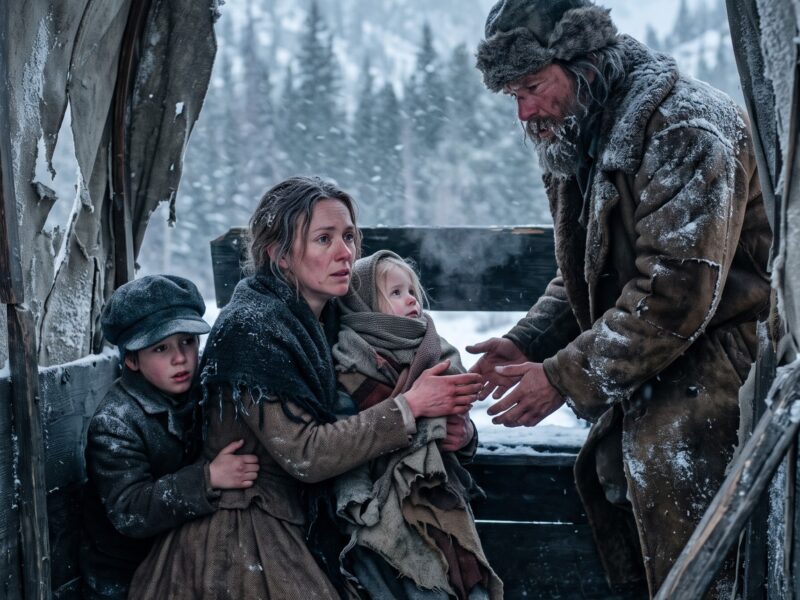
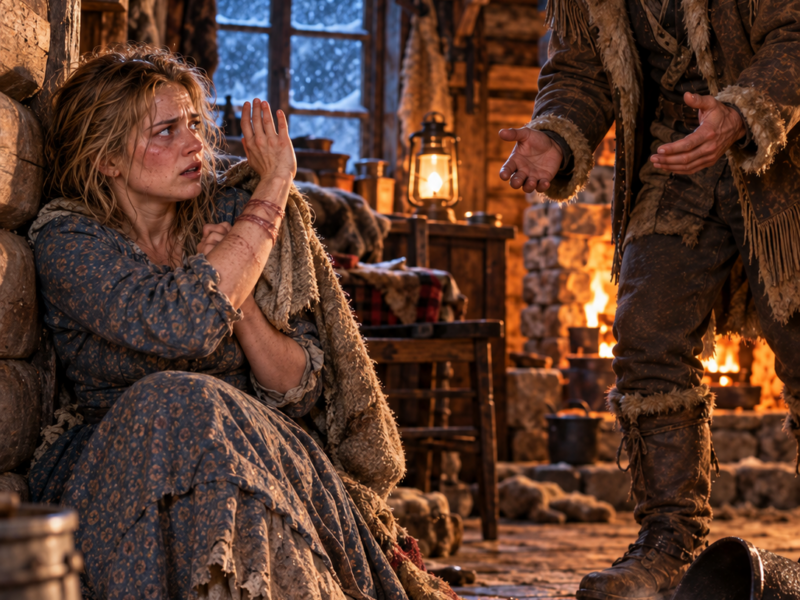
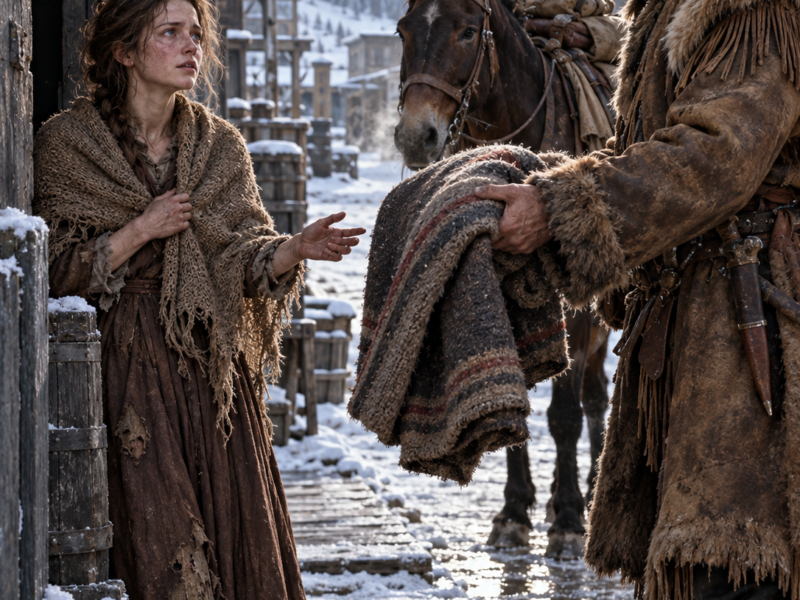
he pulled the wrecked wagon into a basalt hollow when the sky flattened over the bitterroots and sealed every seam because he had already learned that moving air was the thing that killed men
Part 1
By the winter of 1891 the freight trace east of the Bitterroots had become a place men spoke of only when they had to. It swallowed teams and drivers so regularly that the counting had stopped. In spring the recovery crews came up with sleds and brought down what the snow had left. Pierce Holbrook knew that. He had hauled freight across the same ridges long enough to understand the arithmetic. Five days out of Garnet Basin, with the last of the silver camp already frozen behind him, he kept the old horse Brim pointed south and did not look back more than he had to.
He was thirty-eight. The wagon beneath him had been sound enough the autumn before Clara got sick. The axle had cracked at Deer Lodge Crossing on the way out of the basin. One wheel leaned on its hub. The oil tarp was torn along the edge where the wind had worked at it for weeks. A trader in the ruined camp had looked at the whole outfit and called it a pile of lumber waiting to collapse. Pierce had not argued. He had sold the good team, the better wagon, and most of what they owned to pay the doctor and the medicine that had not worked. What remained was Brim, the shredded tarp, a canteen, a little jerky, and the frame that still rolled, barely.
Clara had died in the second week of the cold. The cough had started in September. By November the walls of the small cabin outside the basin were thin with frost and the medicine bottles stood empty on the shelf. Pierce had sat with her through the last nights while the stove ate the last of the good wood. She had been quiet at the end. Once, when the wind dropped, she had put her hand on his wrist and said his name the way she used to say it in the mornings when she brushed frost from Brim’s mane. Then the breathing stopped. He had buried her himself on the slope above the cabin because the ground was already hard and the nearest preacher was two days away. He marked the place with a board from the cabin door and left the rest of the silver camp behind.
The southern valley and his cousin’s ranch still lay fifty miles ahead. On a clear day a man who knew the traces could make it in three. Pierce did not expect clear days. He expected the weather to turn when it chose and to keep moving until it did. Brim was older than he liked. The horse had carried them both out of the basin and had not complained. Pierce spoke to him the way Clara used to, low and steady, and the animal answered with the small motions of his ears.
On the fifth afternoon the ridge opened wide and the wind died. Not eased. Died. Pierce felt it first in the reins and then in the stillness that settled over the frozen grass. Brim stopped before Pierce touched the lines. The horse planted his feet and lifted his head toward the north. His ears went forward, then flat. Pierce stood on the wagon seat and looked. The sky did not darken the way ordinary weather darkened. It flattened. A slab of cold iron pressed down across the whole northern horizon, black at the top and gray beneath, and under it the snow was already moving sideways along the ground in thin white sheets.
He had less than two hours. Maybe less than one. There was no cabin close enough. No stand of timber thick enough to break the wind. He climbed down, put one gloved hand on Brim’s neck, and stood still until the horse’s breathing slowed. Then he looked at the land. The slope. The ridgeline. The old drifts. The black basalt outcrops to the southwest. He was not looking for a roof. He was looking for walls.
The first hollow faced too far north. Wind would roll straight into it. The second was deeper but the mouth spread too wide. Pierce kept walking, leading Brim, until the third hollow stopped him. It sat low in the basalt bluff, maybe fifteen feet across at the mouth, with thick black walls curving inward beneath a shallow overhang. The stone floor inside was dry. No drifted snow. No cracked shelves waiting to fall. Most important, the opening turned slightly away from the northwest wind that was already beginning to gather. It was not a cave. It was barely more than a wound in the rock. Pierce looked at it and saw three walls already built.
For the first time since the sky changed color he felt a small, hard shift inside his chest. Not relief. Only the understanding that he might still have enough if he could build the fourth wall before the storm arrived.
Years earlier, before Garnet Basin, before Clara’s illness hollowed out the savings one payment at a time, Pierce had worked mountain freight bridges under a repair foreman named Amos Vaughn. One winter night near Elk Creek Pass the old man had made the whole crew stand beneath a bridge deck patched with canvas and warped pine while snow blew across the canyon above them. Amos lit a lantern and held it near a narrow crack between two boards. The flame barely moved. The smoke did. It slipped through the gap in a thin gray stream and vanished into the dark. Amos watched it a moment, then said, “Cold ain’t the thing killing men. Moving air is. A room don’t freeze all at once. It leaks to death.”
Pierce carried that lesson with him now. Wind did not need to break a shelter apart. It only needed one opening. One seam. One place where moving air could slip through and carry warmth out faster than a body could replace it. He looked back at the hollow, then at the wagon sitting alone on the ridge. Before the storm ended he would have to tear apart the last thing still connecting him to the life he had before Clara died.
Part 2
He climbed back onto the ridge as the northern sky closed over the valley. The storm wall had swallowed most of the daylight. What remained carried the dull gray color of forged steel left too long in ash. Pierce went straight to work. Front axle first, then the rear pins, then the tongue brace frozen hard against the frame. The iron fought him. One cotter pin refused to move. He spent nearly three minutes hammering at it with numb fingers while the cold bit deeper through the gloves and into the bones of his right hand. The first gusts returned then—short bursts of cold air moving across the ridge like the breathing of something large still gathering itself.
At last the brace snapped loose. The wagon frame dropped flat into the snow with a deep cracking sound that reminded him of old house timber splitting under winter weight. He tied the rawhide rope across his shoulders and began to drag. The wagon bed tore across the frozen ground inch by inch. Its broken edge bit into crusted snow and buried stone. More than once the whole load twisted sideways hard enough to nearly wrench him off his feet. Brim tried pulling beside him at first, but a distant roll of thunder-snow sent the old horse jerking backward against the traces in panic. Pierce cut the animal loose before it overturned the frame. After that he dragged the weight alone. The rope carved through his coat and tore skin beneath it. Blood filled the back of his throat each time he coughed into the cold.
The storm spread wider across the north until it seemed less like weather and more like a second night rising over the mountains. By the time the wagon finally slid beneath the shadow of the basalt overhang, Pierce nearly collapsed beside it. The hollow was barely wide enough. He dragged the bed across the mouth until it covered the deepest part beneath the overhang. The warped sideboards faced outward now like the wall of a river barge run aground. It was not enough. Narrow openings still remained on both sides where the wind could cut straight through once the storm reached full force.
Pierce ignored the pain in his shoulders and pulled the torn oil tarp across the upper gap. He drove wagon pegs through frozen leather straps with the butt of his hammer, then wedged heavy basalt stones along the tarp edge beneath the rock overhang to hold it down. The first real gust struck before he finished. The tarp exploded outward with a crack sharp enough to sound like rifle fire. The whole structure shuddered. One leather tie ripped free from its peg and snapped wildly against the wood. Pierce lunged forward and climbed onto the wagon frame while the wind strengthened around him. His right hand had gone nearly numb. He could barely feel the rope as he forced the knot tight again. Below him the hollow groaned with moving air. For one brief moment, balanced above the black opening with the storm bearing down across the ridge, he understood exactly what would happen if the next knot failed. The shelter would stop being a wall. It would become a funnel.
Then came the seams. He moved along the shelter on his knees, working by touch as much as sight. The light outside had faded into that strange iron-gray color that came before the worst winter storms. Wind pressed and hissed against the wagon boards while loose snow raced across the ridge above the hollow. He stuffed dry sagebrush into the openings first, then strips of old buffalo hide cut from a ruined harness blanket, then frozen mud scraped from beneath the basalt wall and packed hard into the lower gaps where the wagon frame met the ground. Every seam mattered. Every crack mattered. The storm did not need the whole shelter open. It only needed one place where moving air could slip through and keep moving.
A thin draft suddenly sliced across the side of his neck from beneath the wagon bed. The cold hit like a knife blade. He froze and turned toward it. There—a gap no wider than two fingers where uneven ground dipped beneath the warped wood. Wind poured through it in a narrow invisible stream, cold enough to strip heat straight through wool and skin. Pierce dropped to both knees and clawed frozen dirt loose with bare hands. The earth tore skin from his fingertips almost immediately, but he kept digging, packing mud and snow into the seam the way a mason forced mortar into stone joints before winter freeze. Again, more dirt, more snow crust, more sagebrush. He pressed the mixture flat against the wagon edge until the draft vanished completely. Then he stopped and looked around the hollow. No daylight remained. No moving air touched his face. For the first time since leaving the freight trace, the space inside the basalt walls felt separate from the storm gathering outside. Not warm. Never warm. Still.
Kneeling there beside the packed seams with mud freezing against his bleeding hands, Pierce understood something the blizzard had not yet learned. He was no longer trying to build a shelter. He was trying to build a pocket of air the wind could not reach.
Part 3
He forced himself to leave Brim outside until the very last moment. Not out of cold detachment, but out of a harsh survival necessity. The old horse carried heat inside its body. Heat, moisture, breath, weight. In a sealed space all of it mattered. The storm was close enough now that the ridge above the hollow had started to howl. Pierce grabbed the hanging reins and guided Brim toward the narrow opening left beside the wagon bed. The horse hesitated immediately. Its nostrils widened. Warm breath rolled into the freezing air in heavy white clouds. Another gust slammed across the basalt ridge overhead. Brim panicked.
“Easy, boy.”
The horse lunged sideways into the wagon frame hard enough to shake the entire shelter. Wood groaned. One leather tie stretched loose with a sharp snapping sound that made Pierce’s stomach tighten. He threw both arms around the horse’s head before it could strike the frame again. For several long seconds the hollow became pure chaos. Wind screaming outside, tarp cracking overhead, the wagon trembling against the basalt walls, Brim fighting the dark confined space in blind fear. Then Pierce pressed his forehead against the horse’s neck and held there through the shaking.
“Easy now,” he said quietly.
The words came out before he realized where they had come from. Clara used to say them every winter morning while brushing frost from Brim’s mane beside the old stable fence outside Garnet Basin. Easy now. The memory passed through him and disappeared just as quickly as it came. Gradually the horse stopped fighting. Its breathing slowed. The trembling eased beneath Pierce’s hands. Only then did he guide Brim fully into the hollow.
Afterward he sealed the last opening—a saddle blanket across the lower gap, sagebrush packed into the corners, snow crust pressed hard into the seams until the edges disappeared into white. When he finally stepped back inside the cramped darkness beneath the basalt overhang, the shelter had become complete for the first time. Not strong. Not comfortable. Closed. And inside that sealed pocket of still air the sound of Brim breathing slowly filled the darkness like the last small proof of life left on the ridge.
Darkness settled inside the hollow faster than Pierce expected. Not ordinary darkness. A sealed kind of darkness, the kind that came when snow, canvas, stone, and wood closed over the world from every direction at once. The smells inside the shelter thickened together in the cramped air. Cold basalt, horse sweat, wet leather, frozen mud packed into the seams by bleeding hands. Brim shifted once behind him, then went still again. Warm breath rolled slowly through the hollow and faded into the black. Pierce lowered himself against the stone wall beneath the overhang. For the first time since spotting the storm on the northern horizon he could no longer see even the smallest piece of sky. There was no loose knot left to tighten, no seam left to pack, no board left to move into place. The shelter was complete now, and that meant the work belonged to the blizzard.
Outside, the first deep impact of wind rolled across the ridge like distant thunder moving underground. Pierce closed his eyes for a moment. Not in fear. Not in prayer. Only in exhaustion. Somewhere beneath the weight of the coming storm he realized something he had not felt in months. After Clara’s death every day had become another attempt to hold together a life already coming apart piece by piece. But here, beneath the basalt ridge, with the fourth wall sealed against the mountain wind, there remained only one thing left to protect until morning. Himself.
The blizzard did not arrive gradually. It hit the ridge. One moment there was only pressure building beyond the basalt walls. The next the whole mountain seemed to deliver a single violent impact that rolled through the stone beneath Pierce’s back like the collision of iron rail cars. He never actually saw the storm. Inside the sealed darkness of the hollow he heard it instead. A long roaring howl swept over the ridge and crashed against the shelter hard enough to shake loose dust from the basalt ceiling. The tarp snapped wildly overhead. Wind hammered the wagon boards in heavy bursts that sounded almost alive. Snow dust forced itself through the smallest seams in thin white streams twisting through the darkness like smoke from unseen fires. The pressure against the shelter became physical. Not cold alone. It pushed against the fourth wall with such force that Pierce could feel the wagon frame trembling beneath his boots. Brim jerked once behind him and stamped hard against the stone floor. Outside the storm screamed across the mountain. Inside the hollow groaned under the strain, but the wagon bed did not move. The basalt walls held steady. The tarp stayed anchored beneath the overhang. And slowly, listening to the wind search along every seam and corner of the shelter, Pierce understood something about the blizzard that men often misunderstood. The storm was not trying to break the walls apart. It was trying to find a way inside.
Part 4
The temperature inside the hollow kept falling. Pierce could feel the cold settling deeper into the basalt floor beneath him and creeping slowly through his boots, his coat, his stiffened hands. Frost gathered along the wagon boards while Brim’s breath drifted through the darkness in slow white clouds. But the air itself had changed. The violent movement was gone. That was what mattered. Pierce had seen freight men freeze on mountain trails before. Most people imagined death came from cold alone. It did not. Men died when wind stripped heat from their bodies faster than blood and muscle could replace it. That was the real thief. Not winter. Moving air. Now the blizzard still screamed somewhere beyond the buried seams of the shelter, but it no longer flowed through the hollow, searching for skin and breath to carry away. The packed cracks held tight beneath the weight of snow and stone. The pocket of trapped air remained still around them. And slowly, sitting there beside the warmth coming off Brim’s body, Pierce realized Amos Vaughn had been right all those years earlier beneath the freight bridge. A shelter did not survive because it stayed warm. It survived because the wind could no longer move through it.
The longest part of the night began after the initial impact passed. Not because the storm weakened. Because it kept changing. A shrieking gust whipped across the ridge, blowing out one of the upper seams above the tarp with the sharp crack of snapping leather. Freezing air instantly poured through the gap. Pierce climbed onto the wagon frame in pitch darkness, feeling for the loose strap with fingers gone nearly stiff from the cold. The knot slipped twice before he forced it tight again. Below him Brim panicked as another thunderous gust rolled over the mountain. The horse kicked hard against the wagon bed. The entire shelter lurched. A ribbon of snow dust suddenly swept across the floor, a thin white stream of ice cold enough to burn exposed skin. Pierce dropped back down, tracking the draft through the dark by feel alone. He located the leak near the bottom edge of the frame and shoved packed snow into it first, then frozen mud, then scraps of old buffalo hide, forcing them deep into the crack like oakum caulked between ship planks. Outside the blizzard kept hammering the ridge. But slowly something strange began to happen. Instead of slicing through the seams, the wind battering the rock face was inadvertently packing ice and powder snow into the gaps. Layer by layer the cracks were sealing themselves shut.
At one point the hollow shook so violently that Pierce wrapped both arms around Brim’s head, pulling the trembling horse tight against his chest while the wind shrieked savagely through the darkness. Then the terrifying moment passed. The space beneath the rock settled into stillness, leaving only the steady rhythm of their breathing. Hours passed beneath the basalt overhang. Pierce could no longer measure time by anything but sound. Little by little the storm began to change. The endless roaring outside had dulled around the edges. The force of the wind battering the shelter weakened. The tarp no longer snapped so violently overhead. The massive drifts piling up outside had risen, swallowing nearly the entire wall of the wagon bed. What should have buried Pierce had instead become his shield. The immense weight of the packed snow formed a formidable barrier, completely choking off the freezing drafts. The storm had essentially sealed the space into a thermal cocoon. The sounds of the blizzard grew strange and distant, muffled beneath the heavy snow pack. The hollow no longer felt exposed on the mountainside. It felt buried deep within the earth. And somewhere in that pitch-black stillness, beside the steady warmth of Brim’s breathing, Pierce grasped the final truth about the shelter he had built. He had not defeated the storm. He had simply reshaped his world so that the storm was forced to slide around him instead of slicing through him.
Pierce did not know how long he had slept. Time inside the buried hollow no longer moved in hours, only in breathing, in cold, in silence. He woke slowly to the sound of Brim shifting somewhere beside him in the darkness, and to the absence of the storm. Not complete silence. The mountain still creaked now and then beneath the weight of snow. Winds still moved faintly somewhere far above the ridge, but the great roaring violence was gone. It sounded like the world after something enormous had already passed through it. Pierce sat up carefully and reached out through the black. His hand touched wagon wood first, then frozen tarp stiff as sheet metal, then the basalt wall behind him. Everything was cold. Everything was rigid. But everything still held. Brim’s flank gave off slow warmth through the horse’s thick winter coat. Frost drifted from the animal’s nostrils in soft white clouds that faded into the dark. Pierce pulled a strip of jerky from his coat and chewed it slowly. The meat had frozen nearly hard as oak bark. He washed it down with a few mouthfuls of water kept inside his coat through the night so the canteen would not freeze solid. Then he sat still and listened again. No howl. No hammering wind. Nothing searching along the seams anymore. In the exhausted quiet beneath the mountain, Pierce realized this was the first night since Clara died that he had slept without dreaming of coal smoke, medicine bottles, and the sound of winter coughing through thin walls.
Part 5
A thin line of pale light finally appeared along the frozen edge of the tarp. Pierce stared at it for several seconds before fully understanding what it meant. The storm had passed. He pushed himself upright slowly, joints stiff from cold and exhaustion, then began digging at the packed drift sealing the shelter shut, first with bare hands, then with the broken handle of his old shovel. Snow collapsed inward in hard white chunks. Cold air spilled through the opening, but it came without violence now. When Pierce finally crawled out beneath the basalt overhang the world looked erased. The freight trace was gone. The sagebrush flats had vanished beneath smooth white drifts. Even the ridgeline seemed softened into pale curved shapes beneath the snowpack. Nothing moved. Brim climbed out behind him a moment later. The old horse stopped beside the buried shelter and breathed into the frozen morning. The white cloud hanging from the animal’s nostrils stayed suspended in the motionless air like smoke from a chimney with nowhere to go. And standing there beneath the blank white silence left behind by the storm, Pierce felt something strange for the first time in months. The cold was still present, but it was no longer chasing him.
He turned back toward the hollow beneath the basalt ridge. The shelter had nearly disappeared. Snow had buried the wagon bed almost to the top edge. The oil tarp had frozen stiff against the drift until it looked less like canvas and more like another layer of pale stone sealed onto the mountainside itself. Every seam had vanished beneath packed snow. From a distance no traveler would have recognized it as something built by human hands. It looked like part of the ridge, a dark wound in the basalt half swallowed by winter. Pierce stepped closer and rested one gloved hand against the frozen wagon board. The wood felt solid beneath the ice. He remembered Eli Mercer laughing beside the freight yard in Garnet Basin and calling the wagon nothing but firewood waiting to collapse. He remembered Clara sitting on the same wagon seat during the last autumn before her sickness worsened, wrapped in a wool blanket against the evening cold while Brim pulled them slowly through falling leaves outside town. Now that same wrecked wagon stood buried beneath snow after surviving a blizzard strong enough to kill men across the ridge. The cracked boards had held. The broken thing had become the wall between life and death. Pierce stood there for a long moment without speaking. Then he lowered his hand from the frozen wood, took hold of Brim’s reins, and started south through the white silence.
It took him four more days to reach the valley ranch south of the Bitterroot. The storm had rewritten the country behind him. Along the trail he passed abandoned freight sleds half buried in drifts. One dead horse stood frozen beside a split-rail snow fence, its mane locked solid in ice, head lowered as if still searching for ground beneath the snow. Twice Pierce crossed the tracks of recovery crews hauling bodies down from the higher ridges toward the settlements below. The blizzard had killed freight men all across the mountain routes. News traveled faster than survivors. By the time Pierce finally rode into his cousin’s ranch yard near dusk the valley already knew how many teams had failed to come through the passes. His coat was stiff with frozen snow. Frost covered his beard almost to the collar. Brim looked thinner than when they had left Garnet Basin, ribs faintly visible beneath the winter coat. Pierce’s cousin stepped out from the barn and stopped walking the moment he saw them. Not surprised. Stunned. Like a man watching somebody climb back out of a grave already closed in his mind.
Inside the ranch house, with stove heat cracking softly through the iron seams, Pierce explained the shelter piece by piece—the basalt hollow, the wagon wall, the packed seams, the still pocket of trapped air beneath the drifted snow. His cousin listened without interrupting until the story ended. Then he leaned back slowly and asked the only question that really mattered.
“How did you know it would hold?”
For a moment Pierce saw Amos Vaughn again beneath the freight bridge years earlier, lantern smoke sliding through the cracked planks into winter darkness. Then he looked toward the frost still melting from Brim’s harness by the stove door and answered quietly, “Didn’t need it strong.” He paused once before finishing. “Just needed it closed.”
And in that moment his cousin understood something most men never did about storms in the mountain country. Pierce had not beaten the blizzard. He had only built a place where the wind could not find him.
For years afterward people in the southern valleys still spoke quietly about the freight hauler who survived the bitter blizzard by pulling a wrecked wagon into a basalt hollow and sealing himself beneath the snow. The story never appeared in newspapers. No railroad company recorded it. No county ledger bothered preserving the details. It lived the way most frontier knowledge survived in those years, carried by memory instead of ink. Men repeated it beside trading posts while warming frozen hands around coffee tins. Ranch wives mentioned it after church suppers whenever hard winters returned to the mountains. Teamsters crossing the Bitterroot trails told younger freight drivers to watch the wind along basalt ridges and remember the man who survived because he understood seams better than walls. Different versions spread over time. Some claimed Pierce used mining canvas thick as buffalo hide. Others swore the hollow had once belonged to trappers decades earlier. A few even insisted the storm buried him completely for three days before he crawled back out alive. But every version kept the same ending. The blizzard killed stronger men in better wagons because they tried to fight winter in the open. Pierce Holbrook survived because he found stillness where the wind could not follow.
And in the mountain country that lesson lasted longer than the man himself. The story of Pierce Holbrook was never really about a wagon or basalt stone or even winter survival in the bitter country. It was about what remained after a life had already started coming apart. An axle cracked under too much weight. A tarp torn loose by weather. Savings drained away one payment at a time beside a sickbed that medicine could not save. Most men on the frontier understood broken things. What they feared was the moment when too many broken pieces failed at once. Pierce understood something simpler than strength. When the storm arrived he did not waste time wishing for better lumber or thicker walls or another life entirely. He pulled what remained into place. He sealed the seams one by one. And inside that rough shelter beneath the basalt ridge he built a pocket of stillness large enough to keep life alive until morning. That was all. The blizzard did not care whether the walls were beautiful. It did not care whether the wagon had once been worth money or whether the tarp had already begun tearing apart before the storm even started. The mountain only asked one question. Can the wind get in? And that night beneath the buried ridge it could not. Which was why the blizzard never truly found him. Because not every survivor defeats winter. Some men simply manage to build four walls strong enough for the storm to pass around them instead of through.