Part 1
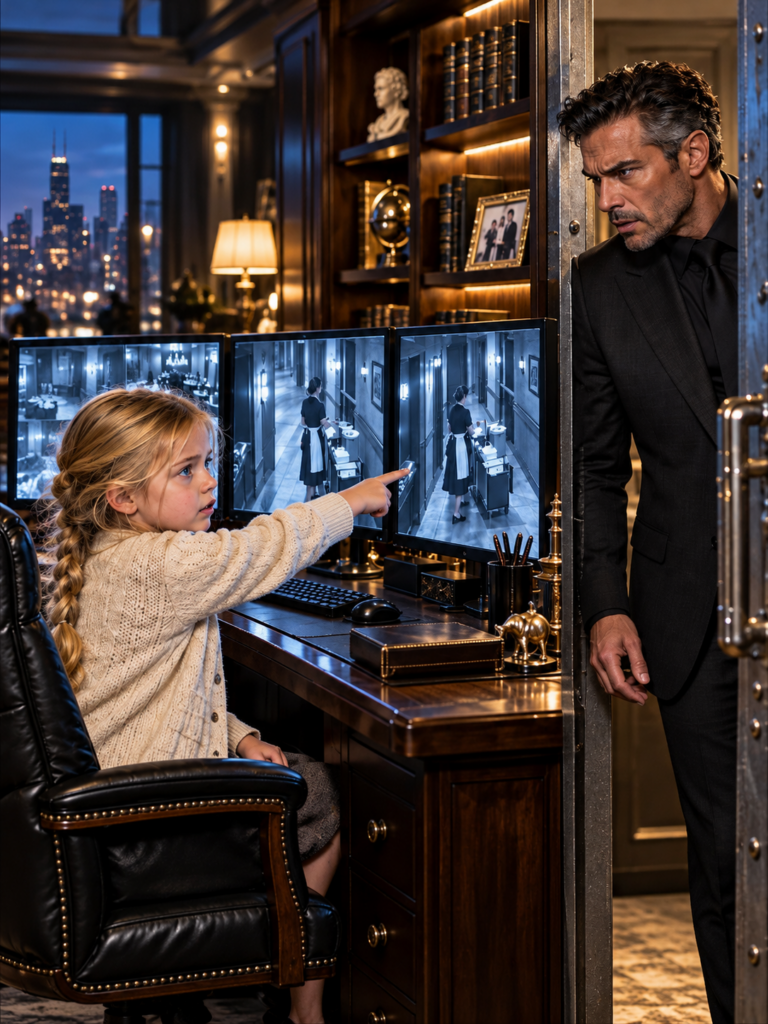
At 4:15 in the morning, Dante Moretti discovered a seven-year-old girl sitting in the one room of his Chicago estate that even his most trusted employees needed special permission to enter.
He stopped in the doorway.
Three enormous security monitors illuminated the child’s face. Her small legs dangled above the polished floor, and her pale blond braid rested against the back of an expensive leather chair. She wore a faded cream sweater with sleeves slightly too long for her arms.
Dante had spent years building an empire in which a locked door meant something. His family’s name could empty a room without anyone raising a weapon. Men twice his size had reconsidered threats after meeting his eyes.
Yet a little girl was sitting at his private security console as though she belonged there.
“Tell me how you got inside,” he said.
The girl flinched but didn’t move away from the monitors.
“Please don’t switch it off.”
Dante glanced toward the screens.
“Why?”
She pointed with one trembling finger.
“Because that woman just did the same thing twice.”
On the center monitor, a cleaner pushed a supply cart along a service corridor at the Moretti family restaurant, six miles from the estate. The woman raised her right elbow as she passed a narrow doorway. One crooked wheel caused the cart to tilt.
She disappeared beyond the camera.
Then she appeared again.
The elbow rose at precisely the same angle. The damaged wheel made precisely the same movement. Even the woman’s head turned in an identical way.
Dante leaned forward.
A tiny digital clock in the corner of the picture repeated a number before jumping ahead.
Three seconds had disappeared.
He stared at the image.
“What did you notice?”
The girl opened her palm.
Inside rested an old brass pocket watch. A long crack ran diagonally across its glass, and an ordinary piece of thread repaired a broken link in the chain.
“My daddy taught me to watch the seconds,” she whispered. “He said when a clock makes the same mistake twice, you should find out who’s making it happen.”
Dante’s expression changed.
The alert on his phone had arrived at 4:08 a.m., reporting an unexpected maintenance operation in the estate’s secure system. He had acknowledged it while walking through the upper hallway.
Seven minutes later, he had found a child inside the restricted room.
He called his security chief.
“Marcus. Get down here. Bring the complete access history, and don’t let anyone interfere with the restaurant recording.”
The little girl gripped her father’s watch.
“Am I going to be punished?”
Dante looked at her.
“That depends on what happened. What’s your name?”
“Lily.”
“All right, Lily. Start with how you found this place.”
She explained that she had been waiting near the laundry wing when she heard an unusual clicking sound inside a maintenance cabinet. The supervisor watching her had stepped away to collect fresh linens.
Lily had gone looking for her.
A service stairwell stood open. Light came from somewhere below. At the bottom, a heavy steel door hadn’t closed properly.
The monitors had already been running.
She hadn’t typed a password or pressed any controls.
She had simply watched.
Dante studied the girl for several seconds.
People routinely lied to him for money, position, protection, or fear. Lily seemed frightened of being accused of something she hadn’t done.
Marcus Reed arrived with a tablet and immediately examined the access records.
“The system entered maintenance mode at four-oh-eight,” he reported. “A technician left at four-eleven. The temporary authorization expires at four-seventeen.”
“Who approved the work?”
“That’s the problem. It came through an old facilities account. There’s a service ticket describing an emergency remote test, but nobody in my department authorized it.”
“And the door?”
“Faulty spring latch. The technician apparently didn’t check whether it caught.”
Dante returned his attention to the monitor.
Someone had used a legitimate-looking maintenance credential to enter his most sensitive system. Someone had left a repeating video sequence running.
And the first person to identify the deception was a child who could barely reach the desk.
Footsteps sounded behind Marcus.
A woman in a gray cleaning uniform appeared at the doorway, clutching a white cloth.
Her face went pale.
“Lily!”
The girl slid down from the chair.
“Mom, I didn’t touch the computer. I promise.”
Elena Hayes dropped to her knees and pulled her daughter close.
When she looked up at Dante, fear replaced the relief in her eyes.
“Mr. Moretti, I’m terribly sorry. She was supposed to remain in the staff lounge. Her babysitter canceled, and the house manager allowed her to stay here tonight. I never thought she’d wander downstairs.”
Dante recognized Elena as one of the cleaners assigned to occasional overnight shifts by an outside contractor.
She didn’t look like a woman accustomed to making excuses.
She looked like someone counting how much one mistake might cost her.
“If my supervisor reports this, I could lose my shifts,” she continued. “I need this job. Please don’t blame Lily.”
“I’m not making any employment decision,” Dante replied. “I need to understand why that door was open.”
He asked Lily why she had paid attention to the clock.
The girl lifted the watch again.
“My daddy fixed things like this. He worked with cameras, too.”
Elena’s hand tightened around her shoulder.
Dante noticed.
“Where does he work?”
Elena swallowed.
“He died eleven months ago.”
The room seemed colder.
“His name was Daniel Hayes. He maintained the security equipment at your family’s restaurant.”
Marcus stopped moving his finger across the tablet.
Dante noticed that as well.
“You know that name?”
Marcus hesitated.
“There was an incident investigation after his death.”
He brought up Daniel’s employee record.
A photograph appeared showing a tired-looking man in a brown work jacket. Beneath his photograph was an internal finding linking him to unauthorized access and missing company equipment.
Lily recognized the face instantly.
“Daddy.”
She took a small step toward the screen.
Then she sounded out one of the words in the report.
“Suspect.”
Her face crumpled.
“Mommy, why does it say Daddy did something bad?”
Elena closed her eyes.
“Because someone wrote something that wasn’t true, sweetheart.”
“Did he steal?”
“No.”
There was no hesitation in Elena’s answer.
Dante looked again at the report.
It carried official signatures, approval dates, and an executive summary. Every page suggested the matter had been thoroughly reviewed.
He vaguely remembered signing a recommendation involving a deceased employee.
He couldn’t remember Daniel’s photograph.
“Who prepared these findings?” he asked Marcus.
“Finance and facilities. I questioned a discrepancy in the security footage, but the file was closed before I could examine the originals.”
“And you accepted that?”
Marcus didn’t answer immediately.
Dante understood his silence.
Eleven months earlier, he had done much the same.
He had accepted a conclusion because it arrived in an orderly packet bearing familiar names.
Now Daniel’s little girl stood in front of him, discovering the accusation for herself.
Elena gathered Lily into her arms.
“We didn’t come here to cause trouble, Mr. Moretti. Please let us go home.”
Dante could have agreed.
He could have dismissed the incident, ordered a new security review, and returned to the enormous house above them.
Instead, he looked at the frozen monitor.
“Marcus, can we recover the footage from Daniel’s final shifts?”
“Possibly. The incident involved an insurance claim. An outside vendor preserved a limited archive independently of our system.”
“Get it. Through counsel. I want the original records, not whatever somebody decided to leave in our files.”
Then he looked at Elena.
“Did your husband ever tell you the cameras were being manipulated?”
Her expression changed.
It was not surprise.
It was recognition.
“Near the end,” she said quietly, “he was desperately trying to prove exactly that.”
Eleven months earlier, Daniel Hayes had worked overnight at the Moretti family restaurant because the building was quieter after closing.
He was the kind of employee most executives rarely noticed.
He repaired damaged cables, checked recording equipment, replaced worn components, and made certain systems continued working after everyone else went home.
He often returned to his apartment with grease on his cuffs and a pencil behind one ear.
On better nights, he brought Lily a warm bread roll from the restaurant kitchen.
One Tuesday, while testing a replacement security monitor, Daniel had seen a cleaning cart cross the private wine corridor.
Moments later, the same cart appeared again.
Identical movement. Identical timing.
He checked the display, then the cabling.
Nothing explained why the recorded image was repeating.
When he examined the equipment inventory, another problem emerged.
Three replacement recorders had supposedly been purchased and installed.
But the serial numbers inside the cabinets belonged to older units.
The invoices showed new equipment.
The actual machines hadn’t been replaced.
At home that evening, Elena had found Daniel sitting at the kitchen table with his pocket watch opened on a cloth.
Lily sat beside him, listening.
“Can you hear how each tick follows the next?” he asked their daughter.
Lily nodded.
“What happens if it skips?”
“Then we figure out why,” Daniel said.
He closed the watch and placed it in her palm.
“Remember something, sweetheart. You can’t get a lost second back. But you can find out what went wrong and make the clock work properly again.”
After Lily went to bed, Elena saw the anxiety Daniel had concealed from their daughter.
He told her there appeared to be two versions of the restaurant’s security records.
One showed what actually happened.
The other showed what someone wanted management to believe.
Elena urged him to be careful.
They had bills overdue, a growing child, and no savings large enough to survive a long period without work.
Daniel understood.
But he couldn’t ignore the discrepancies.
He told Elena that somebody was billing the company for equipment it never received.
He also believed someone was using repeated camera recordings to conceal movement through restricted areas.
Daniel wanted to speak directly with Dante Moretti.
That meeting never happened.
He died in a collision with a delivery truck at a rain-soaked Chicago intersection.
The official traffic investigation found no evidence supporting rumors that Daniel had been intoxicated.
It also found no proof that another person had deliberately caused the collision.
Elena had never claimed otherwise.
Losing her husband was devastating enough without inventing answers she didn’t possess.
But the accusations that followed had nearly destroyed what remained of her life.
Company employees called Daniel dishonest.
Others repeated stories about drinking.
An internal finding blamed him for a security breach and missing equipment.
Lily came home from school one afternoon asking why another child had called her father a thief.
Elena had spent eleven months trying to protect her daughter’s memories from a lie she couldn’t disprove.
Now a repeating recording had appeared again.
And this time, Dante Moretti had seen it himself.
The following afternoon, the outside security vendor supplied preliminary findings.
The archived footage confirmed a repeated image sequence in the restaurant’s wine corridor.
The original feed disappeared briefly.
When normal recording resumed, the displayed time jumped forward three seconds.
Marcus studied the report.
“Somebody substituted an older recording. Anyone moving through that corridor during those seconds would have been invisible to someone watching the monitor.”
“Can we identify who did it?”
“Not from the pictures alone.”
Dante disliked that answer, but it was the correct one.
He instructed the attorney overseeing the inquiry to preserve every original record.
That afternoon, Victor Blackwood called.
For nearly twenty years, Victor had managed the Moretti family’s financial contracts, supplier relationships, and administrative operations.
Dante understood influence, threats, and the complicated loyalties surrounding his name.
Victor understood invoices, internal approvals, and the quiet ways money moved through an organization.
It had been an effective partnership.
Until now.
“I understand you’ve reopened that unfortunate Hayes situation,” Victor said.
“Some questions need answering.”
“Of course. But be careful, Dante. You’re dealing with a grieving widow and an old personnel matter. You could give that family hope without having anything useful to offer.”
“I’m asking for evidence.”
“Your external audit is next week. Let the departments responsible handle their own paperwork.”
When the call ended, Dante remained seated.
His longtime driver stood near the office entrance.
“I hear someone has been interfering with security,” the man said. “I could locate that technician and make sure he explains himself.”
Dante knew precisely what the offer implied.
There had been a time he might have agreed.
Instead, he pushed Daniel’s personnel report across the desk.
“No threats. No private interrogation. Marcus collects records, and the attorney handles the questioning.”
The driver frowned.
“Since when do we do things that way?”
Dante glanced at Daniel’s photograph.
“Since I saw what happened when we didn’t.”
The next day, an independent warehouse clerk confirmed another discrepancy.
A recorder invoiced as newly installed after Daniel’s death was still sitting inside its original sealed packaging.
The serial number matched the installation invoice exactly.
Elena stared at the document.
“Daniel wrote that number down.”
For the first time since her husband’s death, something outside her own memory supported what he had told her.
Then her cleaning supervisor called.
An unfamiliar man had been asking about her work schedule and Daniel’s old equipment.
He claimed to be checking contractor inventory.
Elena immediately thought of the toolbox beneath her kitchen sink.
Dante offered temporary accommodation in a garden cottage on the estate.
Elena examined the security guards near the gate before accepting.
“Am I free to leave?”
“Yes.”
“And Lily?”
“Of course.”
“Then nobody questions my daughter without asking me first. Not your security men. Not your attorney. Nobody.”
Dante met her gaze.
“Agreed.”
Elena insisted he repeat it.
He did.
The next morning, her apartment manager called.
Two men wearing maintenance credentials had entered the building, claiming she had requested an inspection.
Her apartment door was damaged.
Police documented the break-in, and the building manager preserved the lobby recording.
Elena returned with a police officer and Marcus while Lily remained with a caregiver Elena had personally approved.
Inside, nearly everything had been disturbed.
Kitchen drawers hung open. Blankets lay across the floor. Daniel’s toolbox had been emptied.
His camera manual, wiring, and repair sketches were missing.
Dante stood near a small jar containing coins.
Beside it were overdue bills.
Elena saw where he was looking.
“Those coins are for Lily’s lunches.”
“I wasn’t going to say anything.”
“People with enough money usually don’t have to.”
He looked away.
The apartment was small, with damaged cupboard hinges and furniture repaired more often than replaced.
Yet every object carried evidence of a family that had worked hard to keep its home.
Elena examined the kitchen table.
Daniel had spent several evenings repairing it before he died.
Suddenly she remembered something he used to tell Lily when she hid cookies beneath the chairs.
Adults looked above things.
Children looked underneath.
Elena crouched and felt along the table’s wooden apron.
A narrow board shifted slightly under her fingers.
She called Lily.
“Sweetheart, remember when Daddy fixed our table? Did he ever show you somewhere to hide things?”
“Yes, Mommy.”
“Where?”
“Under my chair. He put my old red lunchbox behind the little board. You have to push it upward first.”
Elena’s breath caught.
She found the concealed catch.
A scratched red lunchbox came loose from behind a strip of dark tape.
A faded cartoon rabbit smiled from its lid.
Elena recognized it instantly.
Daniel had packed Lily’s sandwiches inside that little box until its latch broke.
Inside were copied equipment receipts, a miniature cassette, a numbered metal key, and a folded letter.
Elena opened the letter with shaking hands.
Daniel had written instructions to compare the records carefully and not trust the camera timestamps alone.
He asked that Lily be told he had been trying to do what was right.
Elena read the letter again.
Then she sat on the kitchen floor with the paper pressed against her chest.
For eleven months, she’d lived beneath the weight of accusations she couldn’t defeat.
Now, hidden beneath a table Daniel had repaired for his daughter, she held the first evidence that he had prepared for someone to question the truth.
And somewhere in the Moretti empire, somebody had been frightened enough of that evidence to search a widow’s home.
Part 2
Dante did not touch the contents of the lunchbox until Elena had agreed to their examination.
An independent attorney photographed each item and arranged for the evidence to be preserved.
The cassette and receipts were copied before the originals were placed in sealed protective sleeves.
Elena kept Daniel’s letter.
That was not negotiable.
The small numbered key belonged to an older equipment cabinet at the Moretti family restaurant.
The cassette was played from a duplicate.
A layer of restaurant music filled the room, mixed with the mechanical hum of an ice machine.
Then Daniel’s voice emerged.
He was explaining that the corridor recording didn’t correspond to what the installed equipment was actually capturing.
Someone was substituting images.
A second man answered from somewhere close to the microphone.
His voice was lower and partly obscured by noise.
He warned Daniel that he was getting involved in matters he should leave alone.
Then came a scraping sound.
The recording stopped.
Elena sat motionless.
She had imagined hearing Daniel’s voice again thousands of times.
Nothing had prepared her for hearing him afraid.
“Can you tell who the other man is?” Dante asked.
Marcus shook his head.
“Not reliably.”
Dante listened once more.
There was no confession, no direct threat to kill Daniel, and no proof concerning the traffic accident.
But the recording established something that the company investigation had ignored.
Daniel had confronted someone about manipulated security footage.
He hadn’t invented the problem.
That evening, Lily asked her mother whether the men who entered their apartment had taken Daddy’s belongings.
“Not everything,” Elena answered.
Lily considered that.
“If Daddy didn’t do anything wrong, why did everyone stop talking about him?”
Dante happened to hear the question from the cottage sitting room.
He said nothing.
He could command hundreds of employees.
He could replace a destroyed security system, dismiss executives, and pay for lawyers whose hourly fees exceeded Elena’s weekly earnings.
Yet he couldn’t give a seven-year-old a simple explanation for why adults had allowed a false accusation to become accepted truth.
The following morning, Elena accompanied Dante, Marcus, and the attorney to the family restaurant.
Lily stayed at the cottage.
Elena had decided that whatever they found next was a burden the adults should carry.
The restaurant had been operating for forty years.
Old photographs of the Moretti family lined the walls beside shelves of wine. The private corridor still carried the faint smell of polished wood and cool storage rooms.
Daniel’s key opened a neglected parts drawer inside an old technical cabinet.
Paper inventories filled the compartment.
Marcus compared them against the receipts recovered from the lunchbox.
The numbers matched Daniel’s notes.
They did not match the equipment the company had supposedly purchased.
Marcus laid two pages side by side.
“They paid for replacements that weren’t installed.”
Dante studied the figures.
The deception wasn’t complicated.
That almost made it worse.
Somebody had assumed no one important would ever bother comparing a warehouse serial number to the actual machine.
As the attorney documented the drawer, Marcus received a message from headquarters.
An old access record had been retrieved from the company system.
It named Marcus Reed as the person who entered the wine corridor during the night Daniel gathered evidence.
Dante read the entry.
The timestamp was 1:14 a.m.
“Your badge was used?”
“That’s what the record claims.”
“Were you at the restaurant?”
“No. I was working at the estate.”
Dante watched him.
Marcus had served his family for years. Few men knew more about its security arrangements.
But loyalty was precisely what Dante had relied upon when Daniel’s first complaint was dismissed.
He wouldn’t repeat the same mistake simply because he trusted the accused.
The attorney intervened.
“A computer record is evidence to examine. It isn’t proof of who was physically there.”
Before they could continue, Victor Blackwood arrived.
He wore a tailored navy suit and carried himself with the unhurried confidence of a man accustomed to controlling difficult conversations.
A junior restaurant manager had told him about the reopened investigation.
Victor examined the access report.
“Marcus, perhaps you should step away from the system until this is resolved.”
His tone suggested thoughtful concern.
Then he turned toward Elena.
“I’m also informed your cleaning contractor has questions about the way you’re using your assignment.”
Elena stared at him.
“You contacted my employer?”
“I have responsibilities to this business.”
“Then inspect the receipts. My husband recorded these numbers before he died. That’s what we’re trying to verify.”
Victor approached slightly closer.
“Elena, there are only so many respectable cleaning companies in Chicago. A major client can have considerable influence when an employee becomes difficult.”
He paused.
“Think carefully about what your daughter needs. Her schooling. The rent. All those expenses that don’t disappear because you’re upset about something.”
Elena felt her stomach tighten.
He knew far too much about her personal circumstances.
But she refused to lower her eyes.
“My daughter needs to know her father wasn’t a thief.”
“Grief can make people interpret ordinary paperwork incorrectly.”
“Then prove the figures are wrong.”
Victor gave a restrained smile.
“You misunderstand my concern.”
“No. You keep mentioning my job whenever I ask about Daniel. I understand perfectly.”
Dante had heard enough.
“Victor, your office will stop contacting her employer. Any legitimate issue goes through our attorney.”
Victor looked toward him.
For a brief moment, something unreadable moved behind his controlled expression.
Dante ordered Marcus’s central access temporarily suspended while an independent review examined the accusation.
Victor appeared satisfied with that decision.
Elena’s next scheduled cleaning shifts were canceled that same afternoon.
The complaint had already reached her contractor.
By evening, however, the allegation against Marcus was collapsing.
The outside security vendor held the original restaurant access snapshot from eleven months earlier.
It contained no entry showing Marcus had visited the wine corridor.
Another retained recording showed Marcus at the estate’s security desk before, during, and after 1:14 a.m.
The locations were six miles apart.
The incriminating line appeared only in a later version of the company records.
Someone had inserted it after the original evidence was preserved.
Marcus was cleared of making that visit.
Still, he didn’t celebrate.
“I saw problems with the recordings back then,” he admitted to Dante. “I let the investigation close because the people running it said there was nothing left to examine.”
“Why didn’t you insist?”
Marcus looked down.
“Because I didn’t want to challenge people with more influence than I had.”
It was an ugly answer.
It was also honest.
The attorney continued examining the records.
The old maintenance account used at the estate had been carried over during a vendor-system migration supervised by Victor’s finance and facilities departments.
That connected his office to the access method.
It did not yet establish that Victor had personally directed the intrusion.
Dante insisted they preserve that distinction.
He was learning how dangerous an accusation could become when authority was mistaken for proof.
Then an independent accounting firm delivered another set of documents.
As part of the company’s external review procedures, the accountants had retained read-only copies of financial approvals and their supporting attachments.
One folder carried the title Hayes Family Relief File.
Dante opened it.
The first page bore his own digital signature.
He stared at the screen.
After Daniel’s death, the Moretti family organization had promised financial support to Elena and Lily.
Funeral assistance.
Temporary housing support.
An education fund for the little girl.
Daniel’s earned wages had been handled separately, but the promised assistance had been placed on hold.
Victor had recommended freezing the support because of the alleged unresolved security breach.
Dante had approved the hold.
The original preliminary note mentioned unexplained equipment discrepancies.
It did not accuse Daniel of drinking or stealing.
Those claims had appeared in later paperwork.
Dante remembered the morning now.
A crowded desk. Too many documents. A stack of recommendations prepared by people he trusted.
He had scanned the summary and authorized the decision.
Then he had forgotten it.
Elena stood beside the desk, staring at the signature.
“You approved this?”
Dante’s mouth felt dry.
“Yes.”
“Did you read the underlying report?”
“I read what was submitted for my decision.”
“Did you ever ask me what had happened to Daniel?”
“No.”
“Did you look into the accusation before deciding my daughter shouldn’t receive the assistance your company promised?”
Dante couldn’t offer her a better answer.
“I relied on the findings.”
Elena gave a short, disbelieving laugh.
She remembered standing outside Lily’s school, calling the Moretti office again and again.
She remembered an employee politely explaining that her request was still being reviewed.
She remembered carrying a feverish child through a pharmacy while calculating the cost of medicine against the money needed for rent.
She had worked nights, skipped purchases, and repaired things that should have been replaced.
All while the man standing before her could have paid her outstanding bills without noticing the expense.
“You never even met my husband,” she said. “You didn’t know what kind of man he was. But once you signed that document, everybody treated the accusation as certain.”
Dante’s eyes remained on the page.
“I didn’t know what was happening to you.”
“Then you should have found out.”
The words struck harder than anger would have.
Nobody attempted to defend him.
Elena stepped away from the table.
“Don’t apologize just to make this easier for yourself.”
“That isn’t what I’m trying to do.”
“Then make sure everything is examined outside your own company. Including this paper. Including your name.”
Dante looked at the signature again.
“All of it.”
“And don’t expect me to thank you for correcting something you helped do.”
“I don’t.”
For years, Dante had believed that power meant his decisions became reality.
Now he understood that responsibility remained long after he stopped thinking about a decision.
Victor had manipulated the process.
But Dante had supplied the authority that made the injustice final.
Elena left without another word.
She needed to return to Lily.
Her daughter was waiting to hear whether the grown-ups had finally discovered something true about her father.
Dante remained at the desk, surrounded by documents bearing the Moretti name.
For the first time in years, that name offered him no protection from what he had done.
On the fifth morning, Evelyn Brooks arrived to examine Daniel’s recording.
She was sixty-one, silver-haired, and had spent three decades repairing damaged audio recordings for Chicago jazz clubs.
Daniel had once helped her repair a faulty sound system.
When Elena contacted her, Evelyn agreed to listen.
She examined the original cassette and its preserved duplicate.
The background restaurant music and ice-machine noise remained continuous beneath both men’s voices.
There was no obvious crude edit.
But Evelyn was careful.
That alone couldn’t establish the recording’s authenticity.
Then she heard something.
A short, distinctive two-note electronic chime sounded immediately before the second man spoke.
Evelyn asked Marcus whether the restaurant had equipment capable of producing that alarm.
The outside security archive contained the answer.
A vendor recording from Daniel’s final shift captured the same unusual fault chime.
A service log independently documented the malfunction.
The coincidence supported the recording’s location and approximate time.
It still didn’t identify the second speaker.
Evelyn noticed two separate ticking patterns beneath the dialogue.
“Possibly two watches near the microphone,” she explained. “But don’t mistake this for identification. I can’t tell you whose watch made either sound.”
Elena thought of Daniel’s old pocket watch.
For a moment she wanted the recording to give her more.
A name.
A confession.
Something so certain nobody could question it again.
But she had lived with the consequences of unsupported accusations for almost a year.
She wasn’t going to replace one with another.
Dante authorized the attorney to obtain archived company email-routing records from an independent provider.
What they discovered altered the investigation.
On the morning Daniel died, he had sent a message from his work account directly to Dante.
The message never reached Dante’s inbox.
A routing rule maintained through the executive finance office diverted it into a restricted archive.
The recovered subject line read:
“Mr. Moretti, your cameras are lying.”
Dante read the email alone before showing it to Elena.
Daniel described repeated security images, missing recording intervals, and new hardware billed to the company that hadn’t actually arrived.
He included the same serial numbers later found inside Lily’s lunchbox.
He requested a private meeting with someone independent of the departments involved.
He feared that if his concerns became known to the wrong people, the evidence would disappear and he would become the person blamed.
Dante sat motionless.
Daniel had tried to reach him.
He had trusted the powerful man at the top of the organization to recognize the truth.
Instead, his warning had been quietly intercepted.
After Daniel died, that same organization had condemned him.
Elena read the email with tears running down her face.
For eleven months, she had wondered whether Daniel had ever found the courage to contact Dante.
Now she knew he had.
And she knew he had been denied the chance to be heard.
By late afternoon, the attorney had arranged for independent preservation of the email, cassette documentation, financial records, security archives, and equipment inventories.
The evidence no longer depended on Moretti-controlled storage.
Near the cottage entrance that evening, Elena found Dante standing beneath the courtyard lights.
“Lily keeps asking me whether we’ve proved Daniel was innocent.”
Dante considered his answer.
“Tell her the evidence shows he was trying to expose something wrong. The rest still needs investigation.”
“She wants me to promise everything will be fixed.”
“I understand.”
Elena looked toward the cottage windows.
“Then don’t promise what you can’t deliver.”
Dante nodded.
He wanted to tell her that he could protect her family.
But Elena had already taught him something his entire organization had failed to understand.
Protection meant very little without truth, freedom, and the ability to make one’s own choices.
That night, Marcus proposed a controlled test.
Someone had accessed restricted company systems, interfered with old records, and apparently attempted to recover evidence from Elena’s apartment.
If those people were still searching, a monitored company directory might reveal the next attempt.
With the attorney supervising the plan, Marcus created a decoy transfer file.
It contained fictional figures and a unique identifier.
No genuine financial evidence would be placed at risk.
Dante examined the proposal.
“What if Victor isn’t responsible?”
“Then we follow what actually happens,” the attorney said. “The test can establish unauthorized access or transfer. It cannot magically prove the entire history of this case.”
Dante approved the limited operation.
Lily and Elena would have no involvement.
The genuine records were already secured elsewhere.
An independent camera was installed in the restaurant’s technical corridor, separate from the compromised time controls.
For once, every second would be documented by a system the suspected intruder didn’t control.
Shortly after dusk, a maintenance contractor approached the wine corridor.
His badge was current.
His work clothes were ordinary.
He appeared to be carrying out a routine service assignment.
Then he opened the equipment cabinet and connected a company-issued tablet to the monitored network.
The decoy file moved toward an outside supplier account.
An alert appeared on Marcus’s screen.
The contractor reached toward an older recorder, apparently preparing to remove it.
Security personnel intercepted him before he could take the equipment.
There were no threats.
No violence.
The attorney preserved the recording, network records, and work authorization.
The contractor surrendered his badge.
Dante watched the independent footage.
For the first time, the camera had captured the whole sequence without losing a single second.
And this time, the records pointed beyond a frightened technician.
They pointed toward the man Dante had trusted with the business for twenty years.
Part 3
The decoy transfer did not prove who had manipulated Daniel Hayes’s recordings eleven months earlier.
The attorney made that clear before anyone began celebrating.
What it established was that the contractor had transmitted a monitored file without authorization and had attempted to remove an older recorder.
The broader evidence came from records maintained independently of the compromised security system.
The monitored gateway captured the transfer identifier, time, and destination.
Treasury records connected the receiving supplier account to payments for replacement camera modules.
Warehouse inventories showed that numerous billed units had never been shipped.
The contractor’s service ticket had originated in Victor Blackwood’s office.
His employer confirmed the authorization trail.
The next connection concerned Elena’s apartment.
The building manager’s preserved lobby recording showed badge numbers worn by the two men who had entered under the false pretext of an inspection.
Those numbers matched the maintenance firm’s dispatch records.
Neither Elena nor the building manager had requested the visit.
Victor’s office had arranged an equipment-recovery assignment.
The police received the documentation.
Dante studied the reports from behind his office desk.
He had expected betrayal to arrive with an open threat, perhaps a rival attempting to seize one of his businesses.
Instead, it had been concealed inside work tickets, access permissions, invoices, and carefully worded employee complaints.
“There’s more,” Marcus said.
He placed another document before Dante.
Several months earlier, Victor had identified Elena’s name on the cleaning contractor’s roster.
He had requested that she be assigned to the Moretti estate.
Elena had originally applied to the cleaning company on her own.
Victor had not given her the job.
But once he knew where she worked, he’d used his influence as a client to keep her within reach.
The attorney considered the evidence.
“It appears he wanted to know whether she still possessed Daniel’s records.”
Dante thought of Elena worrying that one mistake would cost her the only shifts she could depend upon.
She had been afraid of losing an assignment that Victor had apparently wanted her to keep.
Not as a favor.
As a means of monitoring her.
The implications sickened him.
Then Marcus delivered the complete maintenance authorization from the morning Lily entered the security room.
The 4:08 a.m. service order had come through an old facilities credential linked to Victor’s office.
With an outside audit approaching, Victor had directed the estate technician to test the restaurant-camera replay function through the secure maintenance console.
The same method used during Daniel’s final investigation could display a harmless recorded corridor while someone entered the actual location.
The technician had been testing that capability.
The image of the cleaner pushing her cart was a prerecorded sequence.
Dante had acknowledged the maintenance alert shortly after 4:08.
The technician didn’t receive a warning from his dispatcher until 4:11.
Realizing the activity had been noticed, he abandoned the control room.
In his hurry, he failed to secure the faulty door latch.
He also left the recorded cleaner repeating across the monitor.
Remote maintenance had caused the clicking noise near the laundry wing.
Lily followed that sound.
She found the unlatched door.
And she noticed what the adults overseeing the system had failed to recognize.
A woman walking through the same doorway twice.
A clock repeating a number it should have passed only once.
Dante leaned back in his chair.
His security room hadn’t been breached by a child.
It had been compromised by people with legitimate access to its systems.
Lily hadn’t broken into the computer, discovered a secret password, or performed an impossible technical feat.
She had simply paid attention.
What began as Victor’s attempt to conceal another visit to the restaurant had exposed the very method Daniel had tried to report.
The following afternoon, the independent accounting firm supplied the remaining approval history concerning Daniel’s accusation.
One document was especially important.
Before approving the findings against Daniel, Victor had received a warehouse notice stating that the camera modules supposedly missing from the restaurant had never been delivered.
Two days after receiving that information, Victor approved a report blaming Daniel for their disappearance.
The report also repeated the allegation that Daniel had been drinking.
The official crash investigation contained no evidence supporting that claim.
Dante read the warning and approval dates several times.
This wasn’t merely a situation in which Victor had accepted a misleading summary.
The evidence showed that he had been informed of a critical fact contradicting the accusation.
And he had endorsed the accusation anyway.
The attorney remained cautious.
None of the findings established that Victor had arranged Daniel’s traffic accident.
The accident investigation had uncovered no proof of deliberate interference.
Dante wouldn’t transform suspicion into an invented crime.
But the documents supported serious questions about financial wrongdoing, record manipulation, unauthorized access, contractor misconduct, and deliberate harm to Daniel’s reputation.
They also exposed failures inside Dante’s own administration.
That evening, Victor Blackwood entered the restaurant’s private dining room.
The room was quiet.
Only Dante, Marcus, the independent attorney, and a financial examiner waited inside.
Elena had already provided her evidence and returned to the cottage with Lily.
Dante had insisted that neither mother nor daughter be brought into the meeting.
Victor adjusted his suit jacket before taking a chair.
“Well,” he said, “I assume this is about that ridiculous audit exercise.”
Dante placed a set of documents on the table.
“Let’s discuss the invoices.”
Victor glanced at them.
Then Dante added the warehouse records.
The duplicated serial numbers.
The independent security archive.
Daniel’s intercepted email.
The false entry accusing Marcus.
The maintenance orders.
The dispatch records from Elena’s apartment.
The transfers into the supplier account.
Finally, he placed the warehouse warning beside Victor’s approval of the accusation against Daniel.
Victor studied the documents.
“You’re dealing with mistakes across several departments,” he said. “An organization this size generates thousands of records. Some are bound to conflict.”
“That’s why we compared records held by independent companies.”
“You can’t expect me to remember every equipment order from eleven months ago.”
“I’m not asking you to remember.”
Dante tapped the warehouse warning.
“You received notice that the missing units had never been delivered. Two days later, your department approved a finding saying Daniel stole them.”
Victor leaned back.
“The investigation may have involved other information.”
“Then we’ll examine it. But that doesn’t explain why Daniel’s message to me was diverted into an archive controlled through your office.”
“A routine mail rule.”
“Or why maintenance contractors entered Elena’s apartment under a service request she never made.”
“There’s undoubtedly an explanation for that.”
“Or why your department authorized both recent maintenance operations involving the replay system.”
Victor’s composure began to change.
Not dramatically.
His fingers stopped moving over the documents.
Dante continued.
“The independent accounts match the supplier records. The warehouse inventories contradict the invoices. The original access snapshot clears Marcus of the visit your later system copy blamed on him.”
He paused.
“The records don’t all come from one person or one company. They come from places that weren’t under your control.”
Victor stared at the table.
For twenty years, he had managed difficult conversations by giving Dante an answer that sounded efficient enough to end the discussion.
This time, there was no answer that made the evidence disappear.
“You know how many people depend on these businesses,” Victor said finally.
“I do.”
“Then perhaps you should consider what happens when authorities begin examining everything. You think they’ll stop with a handful of accounting irregularities?”
Dante didn’t respond.
Victor picked up the document holding the Hayes family’s assistance.
“And what about this?”
He turned it toward Dante.
“Your signature. You authorized the hold yourself.”
“I did.”
“You see? Your hands aren’t clean. Do you imagine anyone outside this room is going to care whether an instruction came from me or from you?”
Dante looked at the page.
He remembered Elena’s face when she discovered the signature.
The exhausted disbelief in her eyes.
The way she had refused to accept an apology as a substitute for evidence.
“I’ve already agreed to have my decisions reviewed.”
Victor gave a short laugh.
“You’re prepared to expose your own business over the reputation of a dead maintenance worker?”
Dante looked up.
“Daniel Hayes attempted to warn me about a problem in my company. His warning never reached me. After he died, I authorized a decision that harmed his wife and daughter.”
“Because you trusted the people responsible for the investigation.”
“Yes.”
Victor spread his hands.
“Exactly.”
“That doesn’t excuse me.”
The answer seemed to unsettle Victor more than anger would have.
Dante continued.
“I gave other people the authority to make decisions in my name. Then I stopped paying attention to what those decisions did to ordinary families.”
His gaze returned to the documents.
“Daniel tried to tell me something important. You endorsed allegations that contradicted information your office already possessed. And I gave those allegations the weight of my signature.”
Victor leaned forward.
“Do you really intend to sacrifice the family business to correct something that happened almost a year ago?”
Dante thought of the driver offering to force answers from a technician.
He thought of how readily fear could produce a confession, a silence, or another lie.
In the old days, Victor might have been removed from the room by men who would punish him before anyone could examine the evidence.
Dante understood the temptation.
But Daniel’s story had shown him the danger of allowing powerful people to decide the truth behind closed doors.
“I’m not deciding what the investigation will find,” Dante said. “I’m making sure the investigators receive the records.”
“And if they come after you?”
“Then they can examine my decisions too.”
Victor stared at him.
For the first time, he seemed to understand that Dante’s fear of exposure would not protect him.
“You have no idea what you’re giving up.”
Dante slowly closed the folder.
“I know what happened when I refused to question what I was signing.”
He turned toward the attorney.
“Proceed.”
The attorney confirmed that the preserved evidence, including Dante’s own approvals, would be submitted for independent financial examination and referral to the appropriate authorities.
Victor was removed from his company positions under the organization’s procedures.
His system permissions were revoked.
There was no dramatic arrest.
No public declaration that every allegation had already been proved.
The investigation would continue outside the control of the people whose decisions were being questioned.
Victor stood.
For a moment, he looked like he might deliver one final threat.
Instead, he straightened his jacket and walked toward the door.
When it closed behind him, Marcus remained standing near the wall.
“Daniel came to us with the problem,” he said.
Dante looked at the empty chair.
“He tried to come to me.”
It was a distinction he would carry for a long time.
That night, Dante returned to the estate after most of the lights had been turned off.
He passed the laundry wing.
The repaired security door was closed.
A technician had replaced the faulty spring, and Marcus had ordered a full review of the maintenance accounts.
Dante stopped briefly outside the room.
For years, he had relied on barriers, permissions, passwords, and loyalty to protect his property.
Yet the most important warning had come from someone with no authority at all.
A child who recognized an impossible repetition because her father had taught her how to listen to a clock.
He thought of how close the truth had come to being overlooked again.
If Lily had stayed in the staff lounge, the cleaner might have kept repeating until the maintenance operation ended.
If Marcus had accepted the first internal report, the old accusation might have remained untouched.
If Elena had been frightened into silence, Daniel’s evidence could have remained beneath the kitchen table.
And if Dante had refused to expose his own signature, he would have become another obstacle between Daniel Hayes and the truth.
He couldn’t undo any of those choices.
But he could refuse to repeat them.
Six weeks later, the Moretti family restaurant opened early for a gathering of employees.
Autumn sunlight streamed through the windows and settled across the white tablecloths.
Cooks, servers, cleaners, office workers, and managers gathered near the wine corridor.
Some remembered Daniel Hayes.
Others had known him only through the accusations written after his death.
An independent review had now cleared Daniel of the company’s claims.
His personnel record was corrected.
Formal notices went to the parties that had received the earlier report.
The promised financial assistance to Elena and Lily was restored, without requiring Elena to surrender any other legal rights.
The investigation into Victor Blackwood’s financial activities continued.
No court had yet resolved every possible charge.
But Daniel’s name was no longer recorded by the Moretti organization as the name of a dishonest employee.
Elena arrived with Lily.
She wore a simple blue dress.
For the first time since Dante had met her, she wasn’t wearing the gray uniform of the cleaning contractor.
She had accepted a position in a small school maintenance office, where the hours worked better with Lily’s schedule.
Dante hadn’t arranged the position.
Elena had found it herself.
That mattered to her.
She wanted work that offered stability without tying her family’s future to a man’s guilt or generosity.
Her apartment had been repaired.
The damaged door was replaced.
The overturned furniture had been put back.
The red lunchbox stood on a shelf at home.
It no longer needed to hide anything.
Lily held her mother’s hand as they approached the gathered employees.
In her other hand was Daniel’s brass pocket watch.
Elena had taken it to a watchmaker she trusted.
The movement had been cleaned, and a worn spring replaced.
But Lily had insisted that the cracked glass remain.
She didn’t want the watch to look new.
She wanted it to look like her father’s.
Dante stood beside a brass plaque mounted near the wine corridor.
He had prepared his own remarks.
He hadn’t asked an assistant to polish them into something that sounded less accountable.
When the employees settled, he began.
“Daniel Hayes worked in this restaurant. His job was to keep the equipment functioning and to report problems when he found them.”
He looked toward several staff members who had worked with Daniel.
“He discovered discrepancies involving our security recordings and equipment purchases. Instead of taking his concerns seriously, this organization allowed him to be accused of wrongdoing.”
Elena remained still.
Dante continued.
“Daniel attempted to contact me. His warning was diverted before it reached my office.”
He paused.
“And afterward, I approved a decision that withheld promised assistance from his family. I signed that decision without examining the evidence properly or speaking to the people affected.”
A few employees lowered their eyes.
“I was wrong.”
There was no attempt to shift the responsibility entirely onto Victor.
Dante explained that future accusations against employees would require independent examination, preserved underlying evidence, and a fair opportunity for the accused to respond.
No employee’s reputation would be destroyed merely because a senior official signed a summary.
“Daniel should have received that fairness,” he said. “So should everyone who works here.”
Then he stepped aside.
The plaque displayed Daniel Hayes’s name.
Beneath it was a short inscription honoring his decision to speak truthfully when silence would have been easier.
Elena pressed Lily’s hand.
The little girl approached slowly.
Her eyes moved across the polished brass until she found the familiar letters.
Daniel Hayes.
She read them quietly.
Then she turned to her mother.
“That’s Daddy.”
Elena nodded.
“Yes, sweetheart.”
Lily looked around the room.
“Will people stop saying he was a bad man now?”
Elena crouched beside her.
“They’ll know he tried to do the right thing. Even when it frightened him.”
Lily touched the pocket watch.
Then she turned toward Dante.
The powerful man seemed different from the one she had encountered in the security room.
He still wore an expensive suit.
His employees still watched him with careful attention.
But he wasn’t standing above her as though her questions were an inconvenience.
He lowered himself onto one knee.
Lily studied him.
“Did you listen to Daddy this time?”
The question reached Dante more deeply than any accusation Victor had made.
He looked at the child.
“I listened to what he was trying to tell us. And I should have done that much sooner.”
Lily considered his answer.
She didn’t smile immediately.
She looked back toward the plaque and carefully traced the shape of her father’s first name in the air, just above the brass.
Then she returned to Elena.
Dante stood as the employees began to disperse.
Some approached Elena to speak about Daniel.
A former coworker recalled his patience when repairing a broken machine. Another remembered how he stayed after his shift to finish a difficult job.
For the first time in eleven months, people were talking about Daniel without lowering their voices or looking embarrassed.
They spoke about things he had actually done.
Elena listened.
She had spent so long defending her husband’s name that ordinary memories felt unexpectedly precious.
Later, when Lily walked toward the bright windows, Elena remained beside Dante for a moment.
“Thank you for correcting his record,” she said.
Dante looked toward the plaque.
“It should never have needed correcting.”
“No.”
He turned toward her.
“I know that doesn’t make up for what happened.”
“It doesn’t.”
Her answer was calm.
There was no bitterness in her tone, but neither was there forgiveness offered out of obligation.
Dante accepted that.
Elena had lost her husband.
Lily had lost her father.
No restored payment, official apology, or impressive memorial could return what they had lost.
What mattered was that the truth no longer depended entirely upon the mercy of the man who controlled the company.
Elena could carry it into her daughter’s future without asking anyone’s permission.
“This is a beginning,” she said at last.
Dante nodded.
He didn’t reach for her hand.
He didn’t ask her to stay.
He didn’t try to turn his remorse into a claim on her gratitude.
For once, he allowed another person to decide what came next.
Outside the restaurant, Lily sat near her mother and opened the little brass watch.
The ticking was steady now.
She lifted it close to her ear.
In her memory, she could still see Daniel sitting at their kitchen table with the watch spread open on a cloth.
She remembered his rough hands guiding her fingers.
She remembered how carefully he had explained that every small piece of a clock had its own work to do.
If one part failed, the other pieces couldn’t pretend nothing had happened.
And when time was lost, no one could put it back.
For eleven months, Lily had wished time could be reversed.
She wanted another morning when Daddy returned from work with a warm roll in a paper bag.
Another evening when he lifted her onto his knee.
Another chance to hear his laugh in the kitchen.
She still wanted those things.
Nothing that happened inside the Moretti restaurant could change that.
But now she understood something about the watch she hadn’t understood before.
The crack across its face hadn’t disappeared.
The scratches remained.
The repaired chain still showed where a link had broken.
Yet the hands were moving.
The watch hadn’t become something new.
It was still the same watch Daniel had carried.
And his name, after so many months of suspicion and shame, finally belonged to the man Lily remembered.
Not a criminal.
Not a thief.
Not someone whose family should be afraid to speak about him.
He was Daniel Hayes.
A man who had noticed when the clocks were wrong.
A man who had tried to tell the truth.
And, more important than anything else in Lily’s small world, he was her daddy.