Part 1
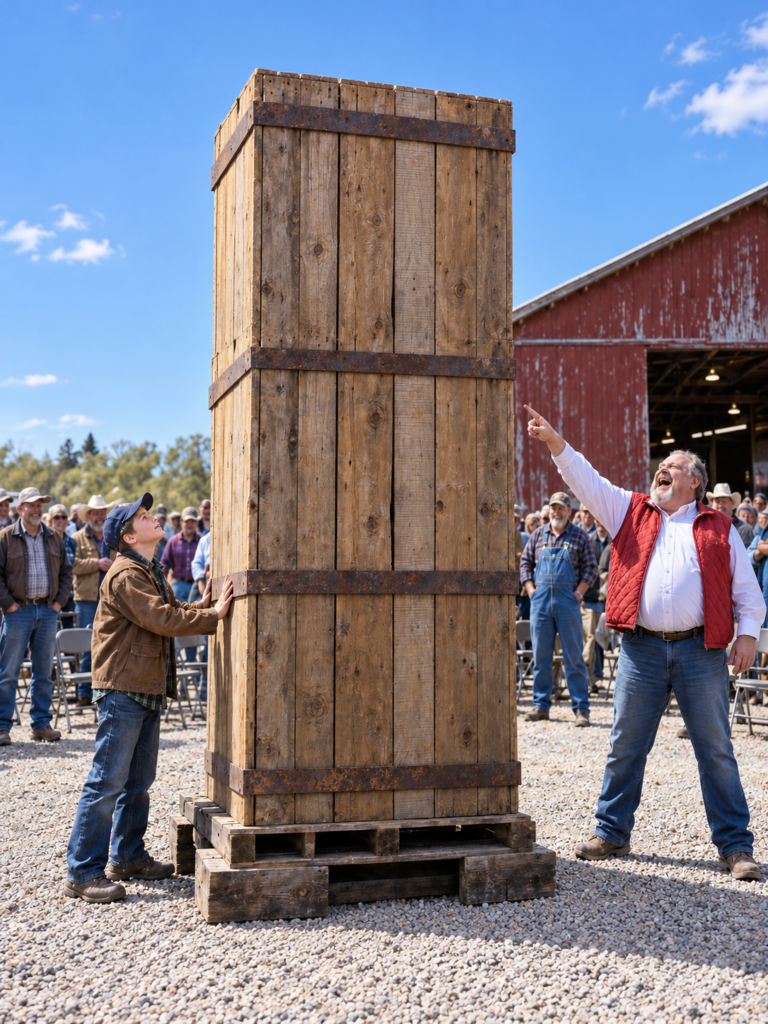
“Forty dollars for a box of rotten lumber and a concrete garden statue!”
Merle Haskett’s booming voice filled the Calder County auction barn, and nearly two hundred people burst into laughter.
Standing beside a towering wooden crate, twelve-year-old Silas Webb felt his face burn.
He was a skinny boy in a faded brown jacket, with scuffed boots, a patched shirt, and hands that had already learned more about honest work than many grown men twice his age. His grandmother had taught him to stand straight when people looked down on him.
But standing straight was difficult when an entire room was laughing at you.
Merle, the county’s best-known antiques dealer, waved a claw hammer above his head.
“Come on, boy. Open it up! Let’s see what forty dollars bought you.”
Silas looked at the hammer.
Then at the crate.
Then at the envelope in his pocket, now empty.
Those forty dollars had taken two months to earn.
He had swept floors, mowed the church lawn, carried firewood for elderly neighbors, and cleaned old furniture in his grandmother’s upholstery shop. He had been saving for a beautiful set of carving tools advertised in a woodworking catalog.
His grandfather had promised to teach him how to use tools like those before he died.
Now the money was gone.
All of it.
And the only thing Silas owned in exchange was an enormous wooden crate that nobody seemed to want.
“What’s the matter?” Merle called. “Afraid your treasure might turn out to be a lawn ornament?”
More laughter.
Silas swallowed.
“No, sir.”
“Then open it.”
“Not here.”
The laughter grew louder.
Merle slapped his knee.
“Not here! Did you hear that? The boy doesn’t even want to see what he bought!”
The auctioneer, Della Kopp, struck her gavel against the podium.
“Enough, Merle. The boy bought it fair and square.”
“I’m just trying to give him an education.”
Silas didn’t answer.
He kept one hand against the crate’s rough pine boards.
The wood was old, darkened by decades of dust and weather. Three rusted iron bands held the structure together. Square-headed nails secured its corners, and faded black lettering along one side read:
CARVED WORK.
KEEP DRY.
THIS END UP.
Silas had noticed those words before the bidding started.
He had also noticed something else.
A narrow crack between two boards revealed a glimpse of what was inside.
Merle had looked through that crack and announced that the object was gray concrete.
But Silas had looked more carefully.
Behind the gray covering, near the upper corner, he had seen a small curved shape.
It was red and dark blue.
And it looked exactly like a feather carved from wood.
His grandfather had carved wooden ducks for forty years. Silas had watched him shape their wings, their beaks, and the delicate lines of their feathers.
He knew the difference between concrete and carved wood.
At least, he thought he did.
And he had just wagered everything he owned on that belief.
His grandmother found him beside the crate after the next auction lot had already begun.
Ada Webb was seventy-one, a small woman with silver hair pinned neatly behind her head. A yellow measuring tape hung around her neck, where she often forgot it after closing her upholstery shop.
She looked first at the enormous crate.
Then at her grandson.
“How much?”
Silas stared at the floor.
“Forty dollars.”
Ada took a slow breath.
“All your savings?”
“Yes, ma’am.”
“The money for your carving tools?”
He nodded.
She didn’t scold him.
Instead, she stepped closer to the crate.
“Tell me what you saw.”
Silas pointed toward the narrow opening.
“Mr. Haskett says it’s concrete. But that gray stuff isn’t the statue. It’s cloth. And behind it there’s something carved.”
“Are you certain?”
“No, Gran. Not certain.”
She waited.
“But Grandpa always said old wood tells you things if you know how to listen. Look at those nails. And those iron bands. Somebody spent a lot of time protecting whatever’s inside.”
Ada ran her fingers along one of the rusted bands.
“What else?”
“The writing says carved work. And somebody kept this box dry for a very long time.”
She leaned close to the crack and looked through it.
For several seconds, she didn’t speak.
Then she straightened.
“Well,” she said, “we’d better find a way to get your mystery home.”
Silas looked up.
“You’re not mad?”
“I’m concerned about forty dollars, Silas. That’s honest money, and honest money matters.”
His shoulders dropped.
“But your grandfather taught you to notice things other people miss. I’m not going to punish you for paying attention.”
She rested a hand on his shoulder.
“I just hope your eyes were right.”
Outside the auction barn, a cold breeze swept across the gravel parking lot.
Their old pickup could barely carry a dresser, much less a crate that stood nearly eight feet tall.
So Ada called her son Roy.
Roy Webb drove a feed truck for Bisbee Feed and Seed. He was a broad-shouldered man with a short brown beard and a habit of speaking only when he had something useful to say.
When he arrived, Merle was waiting near the barn doors.
“Roy!” he shouted. “Come collect your nephew’s monument!”
Roy looked at the crate.
Then at Silas.
“Yours?”
“Yes, sir.”
“Paid for?”
“Yes, sir.”
Roy nodded.
“Then we’ll take it home.”
He never asked whether the boy had been foolish.
He never laughed.
With the help of two feed-store workers, he secured the crate upright on a pallet and used the truck’s winch to load it.
The old boards creaked as the heavy structure rose.
“Easy now,” Roy warned.
Silas stood beside his grandmother near the fence, watching anxiously.
Merle leaned against the doorway.
“Careful, boys! Wouldn’t want to crack that priceless concrete Scotsman!”
A few men chuckled.
Roy tightened the last strap.
Then he climbed into the truck without looking back.
The drive to Rook’s Landing took twenty-five minutes along narrow county roads bordered by cornfields and aging barns.
Silas rode beside his grandmother in her old Chevrolet.
He watched the feed truck ahead of them, its enormous cargo rising above the cab like a wooden tower.
“You know,” Ada said, “your grandpa made some mistakes in his life.”
Silas glanced at her.
“He did?”
“Plenty. Once paid eighty dollars for an old walnut cabinet with three missing doors. Everybody said he was crazy.”
“What happened?”
“He spent six months restoring it. Sold it for three hundred.”
Silas smiled.
“See?”
“Don’t get too pleased with yourself. He also bought a broken tractor that never ran again.”
The boy’s smile disappeared.
Ada laughed softly.
“That’s the trouble with taking chances, sweetheart. Sometimes you’re right. Sometimes you’re wrong. What matters is what you learn and what kind of person you become afterward.”
She looked at the truck ahead.
“And whether you’re careful enough not to destroy what you’ve found.”
Their upholstery shop stood on Front Street between an old hardware store and a bakery.
Behind it was a weathered carriage shed with a tin roof, two tall doors, and a gravel floor that had been worn smooth by generations of wagon wheels and work boots.
The crate went inside.
Roy checked the straps, steadied the load, and carefully lowered it against the back wall.
It stood almost to the rafters.
Silas stared up at it.
“That’s a lot of something,” Roy said.
Silas stepped closer.
“Something carved.”
Roy placed his hand on the boy’s cap.
“Then don’t let anyone rush you into finding out what it is.”
By the following morning, everyone in town knew about the purchase.
Merle had photographed the crate while it sat on the truck.
He posted the photograph on the Calder County community page.
The caption read:
LOCAL BOY PAYS $40 FOR MYSTERY CRATE. CONCRETE LAWN SCOTSMAN EXPECTED.
By lunchtime, dozens of people had commented.
Someone offered Silas a concrete goose.
Another suggested he open a garden-statue museum.
At the diner, Merle repeated the story to anyone who would listen.
He imitated Silas’s quiet voice.
“No, sir. I’m not opening it here.”
The customers laughed.
Silas heard the story from three different people that afternoon.
He said nothing.
He worked in the shop, sweeping sawdust, sorting upholstery nails, and carrying old chair cushions to the storage room.
But every time someone laughed outside the front window, he wondered whether they were laughing at him.
That evening, when Ada found him sitting on the back steps, she brought him a mug of hot chocolate.
He held it between both hands.
“Gran?”
“Yes?”
“Do you think Grandpa would have laughed?”
Ada sat beside him.
The late-August sun hung low behind the rooftops.
“No, sweetheart.”
“Even if I’m wrong?”
“Especially if you’re wrong.”
Silas looked toward the carriage shed.
“What if I wasted all that money?”
Ada was quiet for a moment.
“Then we’ll earn another forty dollars.”
He turned toward her.
“Just like that?”
“Not just like that. You’ll sweep floors and mow grass and probably complain about it. But we’ll manage.”
She touched his cheek.
“Money comes back more often than courage does.”
The boy leaned against her shoulder.
And beyond the shed doors, inside a box that had remained sealed for more than a century, something waited in darkness.
Something that had already survived wars, floods, abandoned promises, and the deaths of everyone who had once known its story.
Neither Silas nor Ada could have guessed that their greatest danger wasn’t losing forty dollars.
It was opening the crate too soon.
Part 2
Three days after the auction, Merle Haskett walked into Webb Upholstery and Alterations carrying the same confident smile he had worn at the sale barn.
Ada sat behind her sewing machine.
Silas was repairing the loose webbing beneath an old dining-room chair.
Merle leaned against the counter.
“Morning, folks.”
Ada glanced up.
“Morning.”
“Got myself a proposition.”
Silas continued working.
Merle tapped his fingers against the counter.
“That crate of yours. I’ll give you fifty dollars for it.”
The boy stopped.
“Fifty?”
“That’s right. You make ten dollars without lifting a finger. I’ll take it away, clear the space in your shed, and everybody comes out happy.”
Silas looked at his grandmother.
Ada kept her hands folded over the fabric in her lap.
“The crate belongs to Silas,” she said. “You’ll have to ask him.”
Merle smiled.
“Well, boy?”
For a moment, Silas imagined the money.
Fifty dollars.
Enough to replace what he had spent, with ten dollars left over.
Enough to buy the carving tools after all.
Enough to stop being the joke everyone told at the diner.
But one question troubled him.
If Merle believed the crate contained a worthless concrete statue, why had he driven across town to offer more than the winning bid?
Silas set down his upholstery hammer.
“No, thank you, Mr. Haskett.”
Merle blinked.
“What?”
“It’s not for sale.”
The dealer’s smile tightened.
“Son, I have twenty-six years of experience buying antiques. I’m offering you a favor.”
“I understand.”
“Then take the money.”
Silas shook his head.
Merle leaned forward.
“You know what pride does to foolish boys?”
Ada stood.
“That’s enough, Merle.”
The room became quiet.
Merle straightened his vest.
“All right. Suit yourself.”
He turned toward the door, then stopped.
“When you finally open that thing and discover a cement garden statue with a broken nose, I want to see your face.”
Silas looked directly at him.
“You can be there when we open it.”
For a second, Merle seemed surprised.
Then he laughed.
“I wouldn’t miss it.”
The door slammed behind him.
Ada waited until his footsteps disappeared down the sidewalk.
Then she asked, “Why didn’t you sell?”
Silas told her what he had noticed.
The offer.
The extra ten dollars.
The dealer’s eagerness.
Ada listened carefully.
When he finished, she nodded.
“That’s a useful question to ask, Silas.”
“What question?”
“Why somebody wants something badly enough to make you hurry.”
That evening, she brought a flashlight to the carriage shed.
Silas followed with a notebook.
They walked slowly around the crate.
Ada examined its iron bands, the old nails, the uneven grain of the pine boards.
She had spent nearly fifty years repairing furniture.
She could recognize oak, walnut, maple, and pine by touch.
But this crate worried her.
Not because she thought it was worthless.
Because she thought it might be valuable.
“Your grandfather used to say the first rule of fixing an old thing is knowing when not to touch it,” she told Silas.
She shone the flashlight through the narrow crack.
“See that covering?”
“Yes.”
“If there’s old paint underneath, we could ruin it by pulling everything apart too quickly.”
“How?”
“Paint gets brittle. Wood changes with temperature and moisture. Something that’s stayed protected for a hundred years may not appreciate being dragged into the August sun while a crowd cheers.”
Silas looked toward the hammer hanging beside the workbench.
“I almost opened it yesterday.”
Ada turned.
“You did?”
He nodded.
“I picked up the hammer.”
“What stopped you?”
“I remembered Grandpa saying you only get one first cut.”
Ada smiled faintly.
“That’s exactly what he’d have said.”
She moved the flashlight along the back of the crate.
Then stopped.
“Hold that light here.”
Near the bottom, a torn piece of dark tar paper had been fastened over something.
Ada carefully lifted one edge with a thin butter knife.
Underneath was a yellowed paper label.
Its writing had faded, but enough remained to read.
A. McLAREN & SONS, TOBACCONISTS.
WATER STREET, ROOK’S LANDING.
TO BE HELD AT GREVE WAREHOUSE UNTIL SENT FOR.
MARCH 4, 1912.
Silas read the words twice.
“Until sent for.”
Ada nodded.
“Somebody was supposed to come back for it.”
“But nobody did.”
“Apparently not.”
The shed seemed suddenly colder.
Silas imagined a man in an old-fashioned suit standing beside the crate more than a hundred years earlier.
He imagined the man saying goodbye to whatever was inside.
Leaving it behind.
Promising to return.
Then never coming back.
“Do you think he died?” Silas asked.
“Perhaps.”
“Or maybe he forgot?”
Ada looked at the label.
“I don’t think people forget things they go to this much trouble to protect.”
She lowered the tar paper again.
“Write everything down. Exactly as it appears.”
At the kitchen table, Silas copied the label into his notebook.
He drew the crate’s three iron bands and marked the position of the crack.
Then he added the date.
1912.
The numbers made his stomach flutter.
His grandmother’s house had been built in 1923.
The crate was older than the house.
Older than her sewing machine.
Older than almost everything in Rook’s Landing.
That night, he dreamed of a man walking away from a warehouse beside the Susquehanna River, turning once to look back before disappearing into a cloud of smoke from a departing train.
The next afternoon, the woman from the dream seemed to arrive in another form.
Her name was Joan Greve.
She was sixty-three, wore a raincoat despite the clear weather, and carried a ring of keys that jingled nervously in her hand.
She had come from Baltimore.
She asked to speak to whoever had bought the crate.
Ada invited her inside.
Silas fetched three cups.
Joan sat at the cutting table and stared at the yellow measuring tape around Ada’s neck as though searching for something ordinary to steady herself.
“I sold the warehouse contents,” she finally said.
Ada nodded.
“We understood it came from the Greve estate.”
“My uncle Hollis owned that building. He passed away last winter. I live several hours away and couldn’t keep maintaining the property.”
Her voice trembled slightly.
“The auction company offered to empty the loft. I signed the papers without inspecting every item.”
She looked at Silas.
“Then somebody sent me a photograph of a boy standing beside that crate.”
Silas lowered his eyes.
“I paid forty dollars.”
“Yes, sweetheart. I know.”
Joan pressed her hands together.
“And when I recognized the crate, I remembered what my uncle used to tell me.”
Silas leaned forward.
“What did he say?”
Joan took a breath.
“That it wasn’t ours to open.”
The ticking wall clock seemed unusually loud.
Joan explained that her great-grandfather, Amos Greve, had owned the warehouse in 1912.
That spring, a Scottish tobacco merchant named Duncan McLaren closed his family’s shop on Water Street after the death of his father.
Duncan intended to move west.
Oregon, perhaps.
He had a heavy wooden figure that was too large and expensive to transport by rail.
So he built a crate.
He placed the figure inside.
And he asked Amos Greve to keep it in his warehouse until he could arrange transportation.
“He promised he’d send for it,” Joan said.
“Did he?” Silas asked.
Joan shook her head.
“No one ever came.”
“What happened to him?”
“We don’t know. My great-grandfather kept the crate because he’d given his word. My grandfather inherited the warehouse and kept it. Then my uncle Hollis.”
She looked toward the back window.
“When I was young, I asked Uncle Hollis why he wouldn’t sell that old box. He told me something I’ve never forgotten.”
Her eyes filled.
“He said, ‘Joanie, that crate is somebody else’s promise. We don’t get to break it just because they’ve stopped coming back.’”
For several moments, nobody spoke.
Then Joan reached into her handbag.
“I’ve brought the warehouse inventory. It doesn’t mention what’s inside. But it records the crate as a stored item, not family property.”
She placed the old papers on the table.
Silas looked at them but didn’t touch.
“Are you here to take it back?”
Joan shook her head quickly.
“No. The warehouse contents were sold legally, and I signed the sale agreement. I’m not here to challenge that.”
She glanced at Ada.
“I just wanted someone to understand it wasn’t garbage.”
Silas thought about the auction.
The laughter.
The hammer.
Merle’s voice.
Then he looked back at Joan.
“I won’t open it until someone who understands old things can help us.”
Joan reached across the table and squeezed his hand.
“Then you’ve already treated it better than I did.”
After she left, Silas went to the public library.
Rook’s Landing had two aging computers in the back room.
He reserved one for an hour.
He typed the words from the label into the search box.
Old Scottish tobacco shop.
Carved wooden figure.
1880s.
His first results were photographs of antique advertising figures.
Some were carved sailors.
Others were wooden Indians, cigar makers, soldiers, and men wearing old-fashioned uniforms.
Then he found a photograph that made his heart stop.
A Scottish Highlander.
The figure wore a feathered bonnet, a tartan kilt, and a dark jacket.
Its painted feathers curved exactly like the glimpse he’d seen through the crate.
Silas leaned closer to the monitor.
He read about nineteenth-century tobacco-shop show figures.
Thousands had once stood outside American storefronts.
Rain, sunlight, careless repainting, and demolition had destroyed most of them.
The best surviving examples were prized by collectors.
And original paint could make an enormous difference to their historical significance.
Silas stared at the screen.
His hands began to shake.
He printed the page using two of the remaining coins in his pocket.
Then he ran home.
“Gran!”
Ada was halfway through reupholstering a rocking chair.
“What’s wrong?”
Silas held up the photograph.
“Look at this!”
Ada adjusted her glasses.
She studied it.
Then she looked toward the shed.
“Well,” she whispered.
Neither spoke for a long moment.
That night, they wrote an email to an auction house in Philadelphia.
Silas described the crate, the nail heads, the shipping label, the faded stencil, and the wooden feather.
He attached photographs.
He explained that he was twelve years old.
And that he had purchased the unopened crate for forty dollars.
At the bottom, he wrote one final sentence.
I don’t want to open it until somebody who knows how to protect old things is here.
They sent the email.
Then waited.
Three days passed.
Silas worked.
Ada sewed.
The crate stood untouched.
On Wednesday morning, an answer arrived.
Ada printed it.
She read it once.
Then called her grandson over.
The email was from Celia Marchetti, head of American Folk Art at Hargrove & Lyle Auction House.
It contained only a few short paragraphs.
But one sentence changed everything.
Please do not open the crate under any circumstances before I arrive.
Part 3
Celia Marchetti would come on Saturday the nineteenth.
Ten days away.
For Silas, ten days felt longer than the twelve years he had already lived.
The woman from Philadelphia had asked them to keep the crate dry, away from direct sunlight, and protected from sudden temperature changes.
She had also asked them not to clean the writing, touch the label, loosen the iron bands, or remove a single nail.
Ada took the instructions seriously.
She closed the carriage shed’s west-facing window, where hot afternoon sunlight streamed across the crate.
Roy brought clean tarps to cover the most exposed part of the roof.
Silas swept the gravel floor and moved old furniture away from the walls.
For the first time in years, the carriage shed looked like a place where something important might happen.
But the town’s laughter had not stopped.
At the diner, Merle continued telling anyone who would listen that the boy had mistaken a concrete garden statue for an antique masterpiece.
When someone mentioned the specialist coming from Philadelphia, Merle snorted.
“Fancy people have to justify their fees somehow.”
At the hardware store, a man asked Roy whether he was charging admission to the grand unveiling.
Roy gave him a long look.
“Why would I charge anyone to watch a boy open something he bought with his own money?”
The man shrugged.
“Just a joke.”
Roy picked up his roofing nails.
“Then find a better one.”
But Silas heard plenty.
At school registration, two boys asked whether he’d found any buried treasure.
A woman buying curtain fabric told Ada that children needed guidance about foolish spending.
Even Lorna Bisby, who owned the feed store and genuinely cared about the Webb family, admitted she’d never seen a boy gamble forty dollars on a box he couldn’t see inside.
Silas began avoiding Front Street whenever possible.
He went to the library by the alley.
He helped Roy at the feed store after closing.
He spent long evenings alone in the shed, sitting on an upside-down bucket before the sealed crate.
Sometimes he imagined opening it and finding a magnificent wooden Highlander.
Other times he imagined pulling away the boards to reveal an ugly gray concrete statue with a broken hat.
The second image frightened him more.
Not because of the money.
Because everyone would know he’d been wrong.
And because deep down, he was afraid his grandfather’s lessons had meant less than he believed.
Walter Webb had been the only father figure Silas remembered clearly.
His own father had died in a highway accident when Silas was four, and his mother had struggled with illness and financial hardship afterward. Eventually, she moved away to seek treatment and work, leaving Silas in Ada and Walter’s care.
She wrote occasionally.
She sent birthday cards when she could.
But she had never truly returned home.
Walter filled the empty spaces.
He taught Silas to bait a fishing hook, sharpen a chisel, stack firewood, and distinguish walnut from cherry by its grain.
He taught him how to listen to old men at the feed store without believing everything they said.
Most importantly, he taught the boy that careful work had its own dignity.
“People will rush you because they want something,” Walter used to say. “A job finished. A decision made. An answer that helps them sleep. But good work takes the time it takes.”
When Walter died the previous winter, Silas had helped Ada clean out his workshop.
He kept a worn wooden duck decoy his grandfather had never finished.
One wing remained only roughly shaped.
Silas had promised himself that someday he would finish it.
That was why he’d been saving for carving tools.
And that was why losing forty dollars hurt in ways he couldn’t explain.
One evening, Ada found him holding the unfinished duck beside the crate.
She sat on the workbench.
“You’ve been quiet lately.”
He shrugged.
“Just thinking.”
“About the box?”
“And Grandpa.”
Ada looked at the wooden duck.
“I miss him too.”
Silas traced the unfinished wing.
“What if I don’t know as much as I thought?”
Ada considered the question.
“About carving?”
“About anything.”
She moved closer.
“Your grandfather knew more about wood than anyone I ever met. But there were things he didn’t know. He’d ask questions. He’d read. Sometimes he’d call people who understood more.”
Silas looked up.
“Like Miss Marchetti?”
“Exactly.”
“Then maybe I did the right thing.”
“You did the careful thing.”
He looked toward the crate.
“What if the careful thing still turns out wrong?”
Ada placed one hand over his.
“Then you’ll still be the boy who was careful.”
A few days later, the weather forecast changed.
A line of severe thunderstorms was moving east through Pennsylvania.
The county had been dry for weeks, and the soil around Rook’s Landing had hardened into cracked brown plates.
Rain should have been welcome.
But on Tuesday evening, the sky turned a strange green-gray color.
Wind rattled the front windows.
Ada was washing supper dishes when the first thunderclap shook the house.
Silas looked toward the back door.
The carriage shed’s tin roof was already vibrating.
“Gran, what about the crate?”
Ada wiped her hands.
“We’ll check it when the worst passes.”
But the rain arrived harder than anyone expected.
It struck the roof like handfuls of gravel.
Wind pushed sheets of water across the backyard.
Lightning flashed over the river.
Then Silas heard an unfamiliar sound.
Dripping.
Not outside.
Inside the shed.
He grabbed his raincoat.
Ada caught his arm.
“Not alone.”
They telephoned Roy, who lived three streets away.
He arrived wearing boots, carrying a flashlight and two heavy canvas tarps.
Together, they crossed the yard.
The wind turned their umbrella inside out.
Cold rain soaked Silas’s shirt.
Roy forced open the shed door.
Inside, water was dripping from two places near the roof ridge.
One stream landed less than two feet from the crate.
Silas’s stomach tightened.
“It’s going to get wet!”
Roy swept his flashlight across the rafters.
“We can manage this.”
He climbed a short ladder and secured the tarps overhead, creating a sloping canopy that carried the rain away from the crate.
Ada placed buckets beneath the leaks.
Silas emptied an old toolbox and positioned it under a smaller drip near the back wall.
They worked carefully.
The floor was wet and slippery.
The heavy crate could not safely be moved in the storm.
But gradually, the dripping water collected in buckets rather than on the wooden boards.
Silas stood beside the crate, breathing hard.
Rain struck the tarp above his head.
He pressed one palm against the dry pine.
“Still safe,” he whispered.
Ada put an arm around him.
“Still safe.”
They remained in the shed until the worst of the storm passed.
By morning, Roy was repairing the roof.
Silas stood below handing up shingles.
His fingers were stiff from cold.
His shoes were muddy.
He was exhausted.
But when Roy finally climbed down, he looked at the boy with quiet approval.
“You didn’t panic.”
“I wanted to.”
“Everybody wants to sometimes.”
Roy wiped rainwater from his beard.
“Being brave doesn’t mean your stomach feels good.”
Silas looked toward the dry crate.
“Four more days.”
Roy smiled.
“Four more days.”
That afternoon, Silas wrote invitations.
Celia had asked whether there was anyone he wanted present when the crate was opened.
He invited Joan Greve.
Della Kopp, the auctioneer.
Lorna Bisby.
Roy.
Pete Strand, who edited the county newspaper.
Pastor Hale, who had known Walter Webb for thirty years.
And finally, Merle Haskett.
Ada watched him write the last card.
“Are you sure?”
Silas nodded.
“He was there when everybody laughed.”
“That doesn’t mean you owe him a seat.”
“I know.”
“Then why invite him?”
The boy considered his answer.
“Because if I’m wrong, I want him to see that I can admit it.”
Ada studied her grandson.
“And if you’re right?”
Silas looked down at the card.
“Then I want him to see that too.”
He delivered Merle’s invitation personally.
The antiques dealer stood behind his counter polishing a brass candlestick.
He read the card.
Then looked up.
“Specialist from Philadelphia, huh?”
“Yes, sir.”
“Going to open your box?”
“Yes, sir.”
Merle smiled.
“Should I bring popcorn?”
Silas held his gaze.
“If you’d like.”
Merle laughed.
But as Silas walked away, he noticed something unusual.
Merle didn’t throw the invitation in the trash.
He folded it carefully and slipped it into his shirt pocket.
On Friday night, Silas barely slept.
He lay awake listening to trucks pass on Front Street and the distant whistle of a freight train.
He thought about Walter.
About Duncan McLaren, the Scottish merchant who had packed the crate.
About the mysterious promise that had survived more than a century.
And about the woman coming from Philadelphia.
He wondered what she would say when she looked inside.
But more than anything, he wondered whether his grandfather would be proud of the boy he had become.
At five in the morning, Silas got out of bed.
He went to the kitchen and found Ada already sitting at the table with a cup of coffee.
She looked up.
“Couldn’t sleep?”
“No, ma’am.”
“Me neither.”
He sat across from her.
For a while, they listened to the old refrigerator humming.
Then Ada reached across the table and took his hand.
“Whatever’s inside that crate, sweetheart, I want you to understand something.”
Silas waited.
“You’ve already done something your grandfather would have admired.”
“What?”
“You saw a thing everyone else dismissed. You asked questions. You protected it. And you didn’t let people make you mean.”
His throat tightened.
Ada squeezed his hand.
“That’s worth more than forty dollars.”
Outside, the first light of Saturday morning spread across the rooftops of Rook’s Landing.
And somewhere on the highway between Philadelphia and the Susquehanna River, a van carrying two specialists was drawing closer.
Part 4
By nine-thirty Saturday morning, the gravel yard behind Webb Upholstery and Alterations was crowded.
Pastor Hale had brought eighteen folding chairs from the church basement.
Every chair was occupied.
Neighbors stood along the fence.
Men from the feed store gathered beside Roy’s truck.
Several older women sat beneath the narrow shade of the bakery’s brick wall.
Pete Strand carried a camera and a notebook.
Della Kopp wore her best straw hat.
Joan Greve had driven from Baltimore and sat in the front row, holding an old photograph of the Water Street tobacco shop.
Even people who had laughed at Silas came.
Some were curious.
Some were skeptical.
A few looked embarrassed when Ada greeted them politely.
Silas stood beside the carriage shed, wearing a freshly washed shirt and his grandfather’s old belt.
His hands were cold despite the warm morning.
At five minutes before ten, Merle Haskett arrived.
He wore his familiar red quilted vest.
And he carried a bag of popcorn.
“Well,” he announced, “looks like the whole county came to watch the great treasure hunt.”
Several people laughed.
But fewer than before.
Merle took a seat in the second row.
He opened the bag loudly.
Silas looked away.
At exactly ten o’clock, a dark van pulled into the yard.
A woman in her fifties stepped out.
She had dark hair pulled neatly back, a navy jacket, and reading glasses hanging from a cord.
Beside her was a younger man carrying padded blankets and a long equipment case.
Celia Marchetti shook hands with Ada.
Then Roy.
Then Silas.
She looked directly at him.
“You’re the young man who wrote me.”
“Yes, ma’am.”
“You kept the crate closed?”
“Yes, ma’am.”
“Even after everyone wanted you to open it?”
Silas nodded.
Celia smiled.
“Good.”
The younger man introduced himself as Tobias Lund, a professional conservator who specialized in historic wooden objects.
Together, they unloaded their equipment.
A folding table.
Padded blankets.
Photography lights.
Cotton gloves.
Safety glasses.
Cloth-wrapped pry bars.
A small magnifying glass.
And a collection of tools so delicate that Silas could barely imagine how they would be useful against a crate held together by iron bands.
Celia didn’t open anything immediately.
She photographed every side.
She measured the boards.
She examined the square nails.
She traced the rusted iron bands with her eyes.
Then she read the faded stencil aloud.
“Carved work. Keep dry. This end up.”
She looked at Silas.
“You noticed these words?”
“Yes.”
“And the label?”
“Grandma found it.”
Celia moved around the crate.
With Tobias holding a light, she carefully lifted the tar paper and examined the shipping label.
For several minutes, she said nothing.
The crowd began shifting in their chairs.
Merle raised his voice.
“If it’s concrete, ma’am, you can just tell us. We’ll all go get lunch.”
A few people chuckled.
Celia didn’t turn around.
“I never identify the contents of a sealed crate before examining them, sir.”
Merle lowered his popcorn.
Tobias looked at Celia.
She nodded.
Then he arranged the padded blankets beneath the front of the crate.
Celia turned to Silas.
“Would you like to help remove the first nail?”
The boy stared at her.
“Me?”
“You own the crate.”
Silas looked at Ada.
She nodded.
Tobias handed him protective glasses.
Then positioned a cloth-wrapped pry bar beneath the upper board.
Silas placed both hands on the handle.
Tobias steadied it.
“Slowly,” he said.
Together, they applied pressure.
The old nail resisted.
The pine creaked.
Then a long, dry squeal came from the wood.
The nail lifted.
A century-old fastener emerged from the board.
Silas stared at it in Tobias’s gloved hand.
Nobody laughed.
After that, the specialists took over.
They removed the first board.
Then another.
Each piece was photographed and placed carefully on the padded table.
Behind the boards lay tightly packed straw, dry and brittle with age.
Tobias lifted it away.
Beneath the straw was heavy gray oilcloth, wrapped around something tall.
Linen cords held it in place.
The outline was unmistakably human.
The crowd fell silent.
Merle leaned forward.
His popcorn bag rested forgotten on his knee.
Tobias examined the wrapping.
He spoke quietly to Celia.
She nodded.
Together, they cut the old cord.
The first layer of oilcloth loosened.
Silas gripped the edge of Ada’s sleeve.
Celia began drawing the covering downward.
A black carved bonnet appeared.
Its feathers curled in intricate layers.
Underneath came a painted face with bright blue eyes and a proud expression.
Then a carefully sculpted red beard.
Broad shoulders.
A dark blue military-style jacket.
Gold-painted buttons.
A sash of red and green tartan.
And finally, a richly carved Scottish kilt.
The statue’s left hand extended outward, holding a small carved snuffbox.
Beneath its boots stood a tall black pedestal.
The entire figure towered above everyone in the shed.
For several seconds, the crowd made no sound.
Then Della Kopp slowly removed her straw hat.
“Well, I’ll be.”
Joan Greve covered her mouth.
Tears gathered in her eyes.
“That was in our warehouse all those years?”
Celia stood motionless.
She had spent three decades examining American folk art.
She had visited museums, private collections, restoration workshops, and estate auctions throughout the country.
But something about this figure had left her unusually quiet.
The colors were astonishing.
The blue jacket remained rich.
The tartan still carried deep reds and greens.
The face retained delicate shading around the cheeks.
And the feathered bonnet was so finely carved that individual lines seemed to catch the light.
Tobias leaned closer.
“Original surface,” he murmured.
Celia didn’t answer immediately.
She circled the figure.
Then crouched beside its pedestal.
“Bring the light lower.”
Tobias adjusted the lamp.
Its beam traveled across the black-painted base.
Celia examined the surface through her magnifying glass.
“There’s something underneath this paint.”
Silas knelt beside her.
“What?”
“A maker’s mark.”
The specialists adjusted the light.
Faint impressions emerged beneath the dark coating.
Letters pressed into the wood.
E. VARNER.
NEW YORK.
And below them, a date.
1887.
Celia drew a slow breath.
“Elias Varner.”
She spoke the name so softly that only the people nearest her heard.
Silas looked at her.
“Who was he?”
Celia remained focused on the pedestal.
“A very important nineteenth-century figure carver. His workshop made some remarkable commercial show figures.”
She straightened.
“Most surviving examples have been heavily repainted or restored.”
Her gaze traveled over the Highlander’s bright jacket.
“This may still have much of its original paint.”
Tobias nodded cautiously.
“It certainly appears remarkably preserved.”
Silas felt his knees weaken.
He stood and moved beside Ada.
Her hands trembled.
“Grandma?”
She looked at him.
He whispered, “I was right.”
Ada’s eyes filled.
“You saw the feather.”
He nodded.
“You really saw it.”
Celia continued examining the carving.
She photographed the signature.
She studied the surface beneath magnification.
She examined the old wrapping and the date on the shipping label.
When she finished, Pete Strand stepped forward.
“Miss Marchetti?”
“Yes?”
“Would you mind telling us what something like this might be worth?”
The crowd leaned closer.
Merle’s expression changed.
For the first time, he looked less amused than anxious.
Celia removed her glasses.
“I would need additional research and documentation before making a formal auction estimate.”
Pete nodded.
“Of course.”
“But based on what I’m seeing today, including its preservation, apparent original paint, and supporting history, I would recommend an insurance value in the neighborhood of two hundred and fifty thousand dollars.”
Silas barely understood the number.
Two hundred and fifty thousand.
He had never seen five thousand dollars in one place.
Beside him, Ada gripped the back of a chair.
Someone gasped.
A woman near the fence whispered a prayer.
Roy slowly took off his cap.
Merle stood.
The popcorn slid from his lap.
It scattered across the gravel.
For twenty-six years, he had presented himself as the county’s unquestioned expert on antiques.
He had mocked a twelve-year-old boy before two hundred people.
He had called the crate a box of kindling.
He had offered fifty dollars for it.
Now he stared at an object worth more than his antiques shop and everything inside it.
His face drained of color.
Celia looked toward the crowd.
“And if the attribution and condition are confirmed,” she added, “it could potentially bring more at auction.”
The yard became so quiet that Silas heard a bird singing from the bakery gutter.
Then people began turning toward Merle.
The same people who had laughed at Silas now watched the dealer’s expression.
Merle looked down.
He had no joke prepared.
No witty remark.
No explanation.
For the first time anyone could remember, Merle Haskett had nothing to say.
Silas stepped toward him.
The boy had imagined this moment many times.
He had rehearsed insults.
He had pictured telling Merle that he was the foolish one.
He had even imagined everyone laughing at the dealer as loudly as they had laughed at him.
But now, looking at the older man’s pale face, none of those words felt right.
Silas bent down.
He picked up the empty popcorn bag.
Then handed it to Merle.
“You said you wanted to see my face when it opened, Mr. Haskett.”
Merle stared at him.
For a long moment, he didn’t speak.
Then he removed his cap.
“I saw it, son.”
He swallowed.
“I surely saw it.”
And he sat down.
Part 5
The months following the opening changed the Webb family in ways money alone could never explain.
Celia Marchetti returned to Philadelphia with photographs, measurements, and documentation.
The Highlander remained under professional care while the auction house completed its research.
Experts compared its carving with documented works attributed to Elias Varner.
They examined the paint, the construction, the distinctive feathered bonnet, and the lettering beneath the pedestal.
Joan Greve provided copies of family inventories.
The old shipping label connected the crate to the McLaren tobacco shop.
A newspaper advertisement from the 1890s confirmed that the shop had once displayed an elaborate Scottish Highlander outside its Water Street entrance.
The pieces began fitting together.
The carved figure had stood outside a tobacco shop for years, greeting customers passing along the riverfront.
Then Angus McLaren had died.
His son Duncan closed the business.
He packed the Highlander for a journey west.
But the figure never followed.
Instead, it remained in a dark warehouse loft while generations of the Greve family honored an old promise.
The storage had protected it from decades of sunlight, rain, and repeated repainting.
The object Silas had bought for forty dollars was extraordinary not merely because it had survived.
It had survived largely untouched.
In October, Ada and Silas traveled to Philadelphia with Roy.
Joan Greve met them outside the auction house.
Silas wore a clean blue shirt and the same brown jacket he had worn at the county sale.
He had refused Ada’s offer to buy him a new suit.
“This one’s lucky,” he told her.
Inside the auction room, the Highlander stood beneath carefully arranged lights.
Its painted feathers, tartan, and gold buttons seemed even more beautiful than they had in the carriage shed.
Collectors filled the seats.
Telephone bidders waited along one side of the room.
A specialist explained the figure’s history.
The preserved surface.
The maker’s attribution.
The original shipping materials.
The remarkable story of a boy who refused to open the crate.
Silas sat between Ada and Roy.
His grandmother held his hand.
The bidding opened at one hundred and fifty thousand dollars.
Almost immediately, a paddle rose.
Then another.
“One hundred and seventy thousand.”
Another paddle.
“One hundred and ninety.”
Silas stared at the auctioneer.
The numbers moved too quickly for him to understand.
Two hundred thousand.
Two hundred and twenty.
Two hundred and forty.
Ada whispered, “Mercy.”
At two hundred and sixty thousand, the room grew tense.
A bidder near the front raised his paddle.
A telephone specialist answered.
Another increase.
Then another.
Silas could hear his own heartbeat.
The bidding reached two hundred and eighty-five thousand dollars.
For several seconds, no one moved.
Then a telephone bidder offered two hundred and eighty-seven thousand.
The auctioneer scanned the room.
“Two hundred and eighty-seven thousand dollars.”
A pause.
“Fair warning.”
Another pause.
Then the gavel fell.
“Sold.”
Applause broke out.
Ada covered her face.
Roy stared at the ceiling.
Joan Greve quietly wiped her eyes.
And Silas sat perfectly still.
Forty dollars.
Two hundred and eighty-seven thousand.
He had expected to feel rich.
Instead, all he could think about was Walter sitting at the kitchen table with a block of pine, showing him how to carve the gentle curve of a wooden duck’s wing.
His grandfather had taught him to see the world carefully.
And somehow, that lesson had brought him here.
After the auction, Celia came to congratulate them.
“The buyer is a retired schoolteacher from Vermont,” she explained. “He’s collected American folk art for forty years. He’s been hoping to find a figure like this for most of his life.”
Silas looked toward the Highlander.
“Will he take care of it?”
Celia smiled.
“Very carefully.”
“Good.”
She studied him.
“Not many boys your age would ask that first.”
Silas shrugged.
“It’s been kept safe for a long time.”
The proceeds, after expenses, transformed the Webb family’s finances.
Ada insisted that most of the money be placed in a protected account for Silas’s education and future.
They repaired the leaking carriage-shed roof.
Roy replaced the failing engine in his truck.
Ada paid off the remaining debts on the upholstery shop and set aside money for emergencies.
For the first time in years, she could look at the stack of bills on the kitchen table without feeling afraid.
But she refused to stop working.
“I’ve been sewing since I was sixteen,” she told Roy. “I’m not going to become useless just because somebody paid a fortune for a wooden Scotsman.”
Roy laughed.
“You couldn’t sit still for three days if somebody paid you.”
She pointed her sewing scissors at him.
“Then don’t try.”
Silas bought only one thing for himself.
A set of carving gouges.
The same set he had circled in the catalog months before.
When the package arrived, he opened it carefully at the kitchen table.
The polished steel tools lay in a wooden case.
He lifted one into his hand.
Its weight felt perfect.
Then he went to Walter’s old workshop.
The unfinished duck still waited on the shelf.
Silas placed it on the bench.
For a long time, he simply looked at it.
The rough wing.
The penciled guide marks.
The tiny spot where Walter’s knife had slipped and left a shallow scar in the wood.
Then Silas selected a gouge.
He began carving.
Slowly.
Carefully.
Taking only as much wood as he understood.
Some afternoons, Ada could hear the gentle tapping of tools through the open workshop window.
She would pause over her sewing machine and smile.
It sounded like Walter had come home.
A few weeks after the auction, Silas wrote a letter to Joan Greve.
He thanked her family for protecting the crate.
He explained that the money had helped his grandmother repair the shop and secure his future.
And he enclosed a check.
It wasn’t the entire fortune.
But it was a meaningful amount, offered because he believed the Greves deserved recognition for keeping their promise.
Joan returned the check.
Her letter was short.
Dear Silas,
My family kept that crate because our grandfather had given his word. You kept it safe because you knew it mattered. Those are two different kinds of promises, and both were honored.
Keep the money. Build something good with it.
Your friend, Joan.
Silas folded the letter and placed it beside his grandfather’s photograph.
As autumn deepened, Rook’s Landing returned to its ordinary rhythms.
The bakery opened before dawn.
Farm trucks rattled down Front Street.
The church bell rang each Sunday.
Silas went back to school.
He still swept the shop after classes.
He still helped Roy unload feed.
He still wore his old brown jacket, though Ada eventually convinced him to replace his worn-out boots.
But people treated him differently.
Some congratulated him.
Others asked how he’d recognized the carving.
A few apologized for laughing.
Silas accepted the apologies quietly.
He never seemed particularly interested in becoming famous.
There was one person, however, who had not spoken to him since the auction.
Merle Haskett.
The dealer’s mocking photograph disappeared from the county community page shortly after the sale.
He stopped telling the story at the diner.
When someone mentioned Silas’s discovery, he changed the subject.
Some neighbors enjoyed seeing him humbled.
Others remembered that Merle had once been a hardworking young man who built his business from a single rented room.
Over the years, success had made him louder.
More certain.
Less willing to admit what he didn’t know.
And he had paid for that pride in front of the whole county.
One cold Saturday in November, the bell above Ada’s shop door rang.
Merle stood in the entrance.
He wore a dark coat instead of his red vest.
In his hands was a small wooden case.
Ada looked up from her sewing machine.
“Morning, Merle.”
“Morning, Ada.”
Silas stood behind the counter, repairing a chair leg.
Merle approached slowly.
“Boy, you got a minute?”
Silas set down his sandpaper.
“Yes, sir.”
Merle placed the wooden case on the counter.
“Found these in my back room.”
He opened it.
Inside lay six old carving knives with worn rosewood handles.
Their blades had been cleaned and sharpened.
“They belonged to a fellow who worked with wood. Bought them years ago. Never had much use for them myself.”
Silas studied the knives.
They were beautiful.
Merle cleared his throat.
“I figured somebody who knows the difference between carved wood and concrete ought to have them.”
Silas looked up.
Merle’s eyes shifted toward the window.
Then he spoke.
“I was wrong about your crate.”
The shop fell silent.
Merle rubbed his thumb along the edge of the wooden case.
“And I was worse than wrong about you.”
Silas said nothing.
“I made a joke out of a boy trying to do something on his own. I knew people were laughing, and I kept it going.”
He swallowed.
“That wasn’t right.”
Ada lowered her sewing.
Merle looked directly at Silas.
“I’m sorry.”
For a moment, the boy could not speak.
He had wanted those words for months.
He had imagined Merle saying them in front of a crowd.
He had thought an apology would make him feel victorious.
Instead, it simply made him feel lighter.
“Thank you, Mr. Haskett.”
Merle nodded.
He pushed the case forward.
“If you want them, they’re yours.”
Silas touched one of the worn wooden handles.
“My grandpa used knives like these.”
“Then I reckon they’d be happier in your hands than gathering dust in mine.”
Silas closed the case.
“Thank you.”
Merle turned to leave.
Then stopped.
“Your grandfather was a good craftsman.”
Silas looked up.
“Yes, sir.”
“He fixed a rocking chair for my mother once. Didn’t charge her a cent.”
Ada smiled faintly.
“That sounds like Walter.”
Merle nodded.
“I should’ve remembered that before I opened my mouth about his grandson.”
He stepped toward the door.
This time, he closed it gently behind him.
Winter arrived early that year.
Snow dusted the roofs along Front Street.
The river turned dark beneath the bare trees.
In the carriage shed, Roy installed the last piece of new roofing before the first heavy storm.
The enormous crate was gone.
But Silas had kept one of its boards.
The front board.
The one bearing the three faded instructions.
CARVED WORK.
KEEP DRY.
THIS END UP.
Ada helped him hang it above the cutting table in the upholstery shop.
Customers occasionally asked what it was.
Sometimes Silas told the whole story.
Sometimes he simply said it came from an old wooden crate.
One evening, as snow began falling beyond the shop windows, Ada found her grandson standing beneath the board.
In his hand was the wooden duck he had finally finished.
The wings were smooth.
The head was delicately shaped.
And the tiny flaw Walter had left remained untouched.
Ada examined it.
“That’s beautiful, Silas.”
He handed it to her.
“I wanted you to have it.”
Her eyes softened.
“Are you sure?”
He nodded.
“Grandpa started it. I finished it. So I thought it should stay here.”
Ada held the duck carefully.
She remembered Walter sitting at the kitchen table, complaining about dull tools, smiling whenever Silas asked another question.
For a moment, the grief she had carried all year returned.
But it no longer felt quite as lonely.
She looked at her grandson.
“You know what your grandfather would say about that crate?”
Silas smiled.
“He’d say I should’ve inspected the grain more carefully?”
Ada laughed through her tears.
“He might.”
Then she grew serious.
“But I think he’d tell you something else.”
“What?”
“That a thing’s worth isn’t always what people say it is.”
Silas looked at the board hanging above them.
He remembered the auction barn.
The laughter.
The empty envelope.
The fear of being wrong.
He remembered the storm, his grandmother’s steady hands, and the moment the carved feathers emerged from their century-old wrapping.
Then he looked at the duck.
“Grandpa used to tell me that people can miss things when they’re too busy showing off how much they know.”
Ada nodded.
“He certainly did.”
Outside, the church bell rang six o’clock.
Snow drifted silently past the front windows.
Ada placed the wooden duck on a shelf beside Walter’s photograph.
Silas turned off the workshop light.
Then he helped his grandmother lock the shop.
Neither of them had become a different person because of the money.
Ada was still the woman who worked hard, saved scraps of good fabric, and refused to throw away furniture that could be repaired.
Silas was still the boy who noticed details, asked questions, and believed old things deserved care.
But their lives had changed in one important way.
They no longer had to wonder whether a lifetime of quiet, honest work mattered.
A grandfather’s lessons had survived his death.
A merchant’s promise had survived more than a hundred years.
A grandmother’s faith had helped a frightened boy hold his ground.
And a man who had once made the whole county laugh had learned that admitting he was wrong required more courage than making someone else feel small.
Years later, people in Rook’s Landing would still tell the story of the twelve-year-old boy who paid forty dollars for a mysterious wooden crate and watched it sell for two hundred and eighty-seven thousand.
But Ada Webb always said they remembered the wrong number.
When someone asked what the crate had really been worth, she would point toward Walter’s photograph and the little wooden duck beside it.
Then she would smile.
“Forty dollars bought my grandson a chance to trust what his grandfather taught him.”
She would pause, looking at the old board above her cutting table.
“And it taught an entire town that the smallest person in the room can sometimes be the only one who’s truly paying attention.”
The Highlander went to a collector.
The money helped secure a family’s future.
The laughter faded.
But the lesson remained.
Because sometimes the greatest treasure isn’t hidden inside a wooden crate.
Sometimes it’s the wisdom passed from one generation to the next — waiting patiently for someone brave enough to believe in it.