Part 1
At 8:43 that morning, I had seventeen minutes to reach the most important job interview of my life.
And an elderly stranger was standing beside a broken-down Mercedes on the highway.
I remember the exact moment I saw him.
The morning traffic was moving in uneven bursts, sunlight flashing across windshields as commuters fought their way toward the city. I was gripping my steering wheel, checking the dashboard clock more often than I should have, mentally rehearsing answers to questions I hoped the hiring manager would ask.
Why did I want to work for Bennett Industries?
What could I contribute to a company that employed thousands of people?
Why should they choose someone with so little corporate experience?
I had practiced those answers until I could almost believe them.
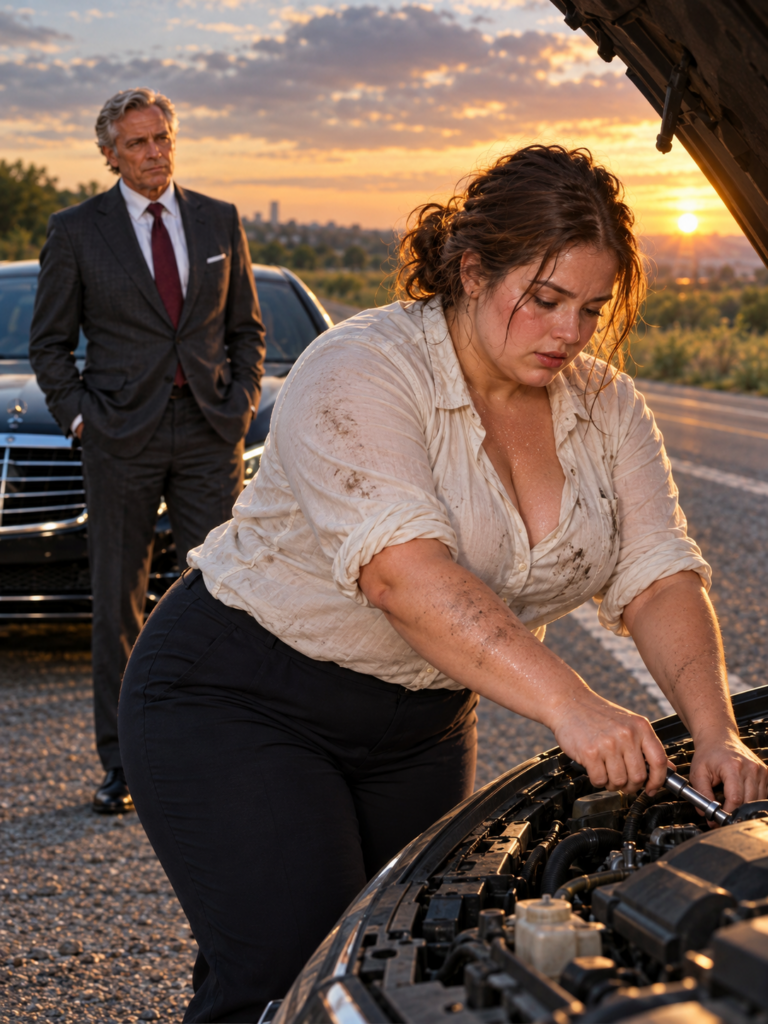
Then I noticed the silver Mercedes on the shoulder.
Its hazard lights were blinking. An older man with gray hair stood near the front of the vehicle, looking between the silent engine and the stream of cars passing him.
He wasn’t waving dramatically or trying to flag anyone down.
He simply looked stranded.
For three seconds, I kept driving.
I told myself someone else would stop. Someone with roadside assistance. Someone who wasn’t already running late. Someone whose rent wasn’t due in twelve days.
But in my rearview mirror, I watched another car sweep past him.
Then another.
My father’s voice came back to me, as clearly as if he were sitting in the passenger seat.
If you know how to help, Stella, don’t pretend you didn’t see.
I cursed under my breath, checked the traffic, and pulled onto the shoulder a safe distance ahead of the Mercedes.
There went my perfect morning.
I switched on my hazard lights, stepped out, and approached carefully.
“Sir? Are you all right?”
The man turned toward me.
Up close, he looked to be in his sixties, perhaps older. His gray hair was neatly combed, and he wore a dark, expensive-looking coat over a crisp shirt. There was something unusually composed about him, considering his situation.
“My car won’t start,” he said.
“Are you hurt?”
“No.”
“Good. Then please stay behind the safety barrier while I take a look.”
He glanced at my car, then at the traffic.
“You shouldn’t have stopped.”
“You’re probably right.”
“That road isn’t safe.”
“I noticed.”
His mouth moved slightly, almost a smile.
Then he looked at his watch.
“You’re in a hurry.”
“Very much.”
“Then you should leave. I can manage.”
I glanced toward the Mercedes.
“Do you have someone coming?”
“Not yet.”
“Then I can’t just leave you standing here.”
He studied me for a moment.
“You don’t even know me.”
“That’s generally how strangers work.”
This time, the smile actually appeared.
It was brief, but genuine.
I nodded toward his car.
“My father was a mechanic. Would you open the hood?”
His expression changed.
“Was?”
I felt the familiar pinch beneath my ribs.
“He passed away four years ago.”
“I’m sorry.”
“Thank you.”
I had become very good at saying those two words without allowing the sadness behind them to show.
The man looked at the car again.
“Your father taught you how to repair engines?”
“He made sure I understood enough not to be helpless when something went wrong.”
I set my bag inside my vehicle, rolled up my sleeves, and examined what I could.
The Mercedes was far more expensive than anything my father had worked on in our garage. Its engine compartment was cleaner and more complicated than most of the cars I knew. Still, underneath the polished engineering, it obeyed the same basic principles.
I checked the visible connections, worked through the possibilities, and asked the man a few questions about what had happened before the engine stopped cooperating.
He answered each one patiently.
He didn’t hover.
He didn’t assume I was incapable because I was young or because I was a woman.
He simply let me work.
That, more than anything, reminded me of my father.
Dad had never believed that competence needed an audience. He used to hand me a wrench, point toward whatever was broken, and tell me to start by paying attention.
Eventually, after another careful adjustment and inspection, I asked the stranger to try the ignition.
The engine turned over.
Then it started.
The steady sound was almost enough to make me cheer.
“Well,” I said, stepping back, “that’s a much better noise.”
The man’s eyes widened slightly.
“You fixed it.”
“For now, yes. I’d still have a professional check it before you make any long trips.”
He looked at the running engine, then at me.
“How can I thank you?”
“You already did.”
“Surely I can do something more.”
I shook my head.
“Just get somewhere safe.”
I was already turning away when he spoke again.
“Young lady?”
I stopped.
He looked toward my car, where my interview folder was visible on the passenger seat.
“Whatever you’re rushing toward, I hope you get there in time.”
For some reason, that almost hurt.
“Me too,” I said.
Then I hurried back to my car.
I didn’t ask his name.
He didn’t ask mine.
And as I merged into traffic, I had no reason to imagine that I would ever see him again.
I only knew that my interview was slipping away.
By the time I reached Bennett Industries, the clock read 9:21.
Twenty-one minutes late.
I sat in the parking lot for a moment, staring at the numbers.
I had spent three evenings researching the company. I had washed and pressed my interview clothes the night before. I had printed two copies of my resume on the best paper I could afford.
I had even left home early.
None of that would matter now.
Still, I grabbed my folder and ran.
Bennett Industries occupied a towering glass building that looked even more intimidating in person than it had on the company’s website. The entrance opened into an enormous lobby filled with polished stone, expensive furniture, and people who seemed to know exactly where they belonged.
I did not feel like one of them.
My shoes clicked too loudly across the floor as I hurried toward reception.
“Good morning,” I said, slightly breathless. “I’m Stella Carter. I have a nine o’clock interview with Mr. Cole.”
The receptionist looked at her computer.
Her professional expression faltered.
“Miss Carter, your appointment was at nine.”
“I know. I’m terribly sorry. There was an emergency on the highway.”
She checked something else on the screen.
“Mr. Cole waited fifteen minutes.”
My stomach sank.
“Is he still here?”
“He has already ended the appointment.”
“Please. I know I should have called. But if I could just have five minutes to explain—”
“Miss Carter?”
A man’s voice interrupted us.
I turned.
A sharply dressed man in a navy suit had emerged from a nearby hallway. He appeared to be in his early forties, with silver beginning to show at his temples. His expression was controlled, but not welcoming.
“I’m Richard Cole,” he said. “The hiring manager.”
I straightened immediately.
“Mr. Cole. Thank you for speaking with me. I’m so sorry I’m late.”
His gaze moved toward the clock.
“Your interview was scheduled for nine o’clock.”
“Yes, sir.”
“You arrived at nine twenty-one.”
“I understand. There was a man stranded on the highway, and—”
He raised one hand.
“Everyone has an explanation, Miss Carter.”
I stopped speaking.
His voice wasn’t loud.
That somehow made the dismissal worse.
“We schedule interviews for a reason. We expect candidates to respect the time we’ve reserved for them.”
“I do respect your time.”
“Then why weren’t you here?”
Because an elderly man had been standing beside an unfamiliar car while traffic rushed past him.
Because I knew enough about engines to help.
Because my father had raised me to believe another person’s safety mattered.
All those answers rose to my lips.
But Richard Cole wasn’t asking because he wanted to understand.
He was asking because he had already decided.
“I made a judgment call,” I said.
“And it was a poor one.”
The words landed harder than I expected.
He opened the folder he was holding.
“I’ve reviewed your resume. You have limited professional experience in corporate operations and no substantial background in a company of our size.”
“I know. That’s why this opportunity means so much to me.”
“Yet you couldn’t arrive on time.”
I felt my face heating.
“I did everything I could to get here.”
“Except make sure you were here when you were supposed to be.”
I lowered my eyes for a second, then forced myself to meet his gaze again.
“I understand that being late reflects badly on me. I’m not asking you to ignore it. I’m asking for an opportunity to explain.”
Richard closed the folder.
“At Bennett Industries, our hiring process is structured and consistent. If I make an exception for you, what do I say to the candidates who arrived early?”
I had no answer that would satisfy him.
“Reliability matters, Miss Carter,” he continued. “You cannot substitute good intentions for professional responsibility.”
The receptionist had become very interested in her keyboard.
I wanted to disappear.
But I was too desperate for the job to leave without trying once more.
“Could we reschedule? I would accept any opening. Even a short meeting.”
Richard regarded me with something that looked almost like disappointment.
“Do you know how many people would be grateful for the opportunity you were given?”
My fingers tightened around my bag.
“Yes.”
“People with more experience. People who understand the expectations of this industry. People who planned their mornings properly.”
I swallowed.
“I did plan my morning.”
“Clearly, not well enough.”
I had been prepared to answer difficult questions about supply chains, customer service, operational efficiency, and my ability to learn.
I had not prepared myself to defend the decision to help someone.
Richard handed me my resume.
“Did you call to notify us?”
“No. I didn’t have your direct number.”
“You could have contacted the company.”
He was right.
I should have called.
In the confusion on the shoulder of the highway, with cars rushing past and the minutes disappearing, I hadn’t thought to do it.
It was a mistake.
One I couldn’t undo.
“I should have,” I admitted.
“Then perhaps you’ve learned something valuable today.”
For a moment, I couldn’t speak.
I wondered whether he understood what it had taken for me to reach that lobby.
The late nights filling out applications.
The temporary jobs.
The weeks of checking my email and seeing polite rejection after polite rejection.
The calculations I made every time I walked into a grocery store.
He saw a candidate who was twenty-one minutes late.
He didn’t see any of that.
“I’m sorry, Miss Carter,” Richard said. “The interview is over.”
There was nothing left to negotiate.
I took the resume.
“Thank you for your time.”
He nodded.
“Good luck.”
I walked out before he could see me cry.
Outside, the city was carrying on as if nothing important had happened.
People passed through the revolving doors. Cars moved along the street. Somewhere above me, behind all that glass, other candidates were probably sitting in comfortable conference rooms, giving polished answers about their strengths.
I sat on a bench near the building entrance and looked down at my resume.
The corners had bent beneath my fingers.
My rent was due in twelve days.
My younger brother, Daniel, needed money for his textbooks.
And our savings had dropped below three hundred dollars.
I opened my banking app, stared at the balance, and closed it again.
There wasn’t enough money for another month of pretending everything was manageable.
I pressed the heel of my hand against my eyes.
I’d been so certain about Bennett Industries.
Not because I believed it was glamorous.
Because the operations coordinator position offered something I hadn’t had in a long time.
Stability.
A dependable salary.
A chance to build a career rather than move from one temporary solution to another.
I imagined calling Daniel and telling him what had happened.
He would try not to look worried.
That was what made it worse.
Since Dad died, Daniel had learned to measure every question against how much pressure I was already carrying.
He was still young enough to need someone looking out for him, but old enough to recognize when there wasn’t enough money.
I looked down at the grease beneath one fingernail.
I had scrubbed my hands before entering the building, but a faint gray mark remained.
A reminder of the highway.
I tried to feel angry at the elderly man.
I couldn’t.
He hadn’t asked me to stop.
He had actually told me to leave.
I had made the decision myself.
And even sitting there, with my chance at a better life apparently gone, I knew something about myself that was as comforting as it was terrifying.
If I drove past that Mercedes again tomorrow, I would still pull over.
Maybe that meant I was foolish.
Maybe Richard Cole was right about my judgment.
But I couldn’t make myself believe that leaving a stranger alone in a dangerous place would have been the better choice.
Eventually, I stood, straightened my folder, and walked toward my car.
I never noticed the older man who had returned to Bennett Industries that morning.
I didn’t see him arrive at the building.
And I had no idea that the stranger from the highway had seen me sitting alone outside, holding the resume for the job I had just lost.
That evening, Daniel was at our kitchen table when I got home.
His textbooks were spread around a chipped mug, and he had a pencil tucked behind one ear.
He looked up as soon as I entered.
“Well?”
I put my bag on the counter.
“I didn’t get it.”
His smile vanished.
“Why not?”
“I was late.”
“How late?”
“Twenty-one minutes.”
He stared at me.
“Stella.”
“I know.”
“What happened?”
I took off my jacket and hung it over the back of a chair.
Then I told him everything.
The Mercedes.
The elderly man.
The engine.
The interview.
Richard Cole.
By the time I finished, Daniel was leaning back in his chair, looking at me as though he couldn’t decide whether to laugh or be horrified.
“You stopped?”
“Yes.”
“On the highway?”
“Yes.”
“On the morning of your interview?”
I folded my arms.
“Daniel, I was there. I remember.”
He rubbed both hands over his face.
“I’m just trying to understand how you can be the bravest and most reckless person I know at the same time.”
“I’m not brave.”
“You got out of your car on a busy highway to help a complete stranger.”
“Dad would have done it.”
Daniel’s expression changed.
For a few seconds, neither of us spoke.
Then he smiled faintly.
“Dad also believed he could fix every problem on earth with a wrench.”
“Most of the time, he could.”
“Except the washing machine.”
I laughed despite myself.
“Especially the washing machine.”
The laughter faded, leaving the familiar ache of his absence.
Daniel closed his textbook.
“So what happens now?”
“I keep applying.”
“You’ve already been applying.”
“Then I’ll keep doing it.”
He looked toward the bills stacked beside the refrigerator.
I followed his gaze.
“Don’t worry about the textbooks,” I said. “We’ll figure something out.”
“Stella—”
“We will.”
I spoke with more certainty than I felt.
Later, after Daniel went back to studying, I opened my laptop.
Six applications.
That was how many I completed before going to bed.
Six different companies.
Six carefully adjusted cover letters.
Six opportunities to begin again.
At the end of the night, I checked my email one final time.
Nothing.
I shut the laptop and sat alone for a moment, listening to the soft hum of the refrigerator.
I thought about the Mercedes.
The stranger’s calm voice.
The way he’d looked at me before I left.
Whatever you’re rushing toward, I hope you get there in time.
I hadn’t.
And the worst part was that I had no idea how much worse things might become before they got better.
The following morning, at exactly 10:17, my phone rang.
An unfamiliar number.
I almost ignored it.
Then I answered.
“Hello?”
“May I speak with Stella Carter?”
“This is Stella.”
“Good morning. I’m calling from the executive office at Bennett Industries.”
I sat upright.
For a moment, I thought I’d misheard.
“I’m sorry. Did you say Bennett Industries?”
“Yes, Miss Carter. We’d like to invite you to a meeting tomorrow at ten o’clock.”
My heart began beating faster.
“A meeting?”
“That’s correct.”
“Is this about the operations coordinator position?”
There was a brief pause.
“Not exactly.”
I frowned.
“Then what position is it for?”
“I’m not authorized to discuss the details over the phone.”
I looked at the silent laptop on the table.
“With respect, I was told yesterday that my interview was over. Why would the company want to see me again?”
“Someone specifically requested your resume.”
“Mr. Cole?”
“No.”
The answer came immediately.
I felt an uneasy sensation in my stomach.
“Then who?”
“I’m afraid I can’t disclose that.”
“Do you know?”
The caller hesitated.
“Not personally, Miss Carter. I was asked to arrange the appointment.”
I stared at the wall.
This made no sense.
Richard Cole had been perfectly clear.
My application was finished.
Yet someone from the executive office was inviting me back into the same building.
“Is this another interview?” I asked.
“It would be best to discuss the purpose when you arrive.”
I considered refusing.
Not seriously, perhaps, but enough to resent the idea of walking back into that lobby without knowing whether I was being offered an opportunity or another humiliation.
Still, I needed work.
And someone had asked for me.
“I’ll be there,” I said.
“Wonderful. Ten o’clock tomorrow.”
The call ended.
I remained seated, the phone still pressed against my ear.
Someone at Bennett Industries had requested my resume.
Someone who wasn’t Richard Cole.
Someone who apparently had enough authority to summon me to the executive floor.
The only explanation I could imagine was that the company thought I had a personal connection.
But I didn’t.
I knew no executives.
I had no influential relatives.
The only person I’d ever spoken to at Bennett Industries was the man who had rejected me.
At least, that was what I believed.
Part 2
I arrived at Bennett Industries forty minutes early the next morning.
Not thirty-nine.
Not thirty-eight.
Forty.
I had checked the route twice, set three alarms, and left home with enough extra time to survive almost any reasonable delay.
There had been no broken-down cars along the way.
No strangers asking for help.
No unexpected emergencies.
I wasn’t sure whether that was a relief or a disappointment.
As I approached the building, I caught sight of my reflection in the glass doors. My jacket was neatly pressed, my hair carefully arranged, and my folder held firmly against my chest.
I looked professional.
I just didn’t feel particularly confident.
Inside, the lobby was as imposing as I remembered.
The receptionist recognized me.
Before I could approach her desk, a familiar voice spoke from behind me.
“Miss Carter.”
I turned.
Richard Cole was standing a few feet away, holding a tablet and looking distinctly displeased.
For a terrible second, I thought he might order me out of the building.
“Mr. Cole,” I said.
His eyes narrowed.
“What are you doing here?”
“I was invited to a meeting.”
“By whom?”
“The executive office.”
His expression shifted.
“About what?”
“They didn’t tell me.”
Richard stared at me.
“That’s convenient.”
I felt yesterday’s humiliation rising again.
“I’m only repeating what they told me.”
“People don’t receive invitations to the executive floor without a reason.”
“I agree.”
“Then what is yours?”
“I was hoping someone here could explain that.”
He looked me over, from my carefully polished shoes to the folder in my hands.
“Let me guess. You know someone.”
“No.”
“Someone recommended you?”
“Not that I’m aware of.”
“Perhaps you have a family connection.”
I nearly laughed.
If Richard Cole could have seen our kitchen table, our stack of overdue bills, and Daniel’s patched backpack, he might have understood how absurd that suggestion was.
“I don’t have any connections here,” I said.
“Then this is highly unusual.”
“Believe me, Mr. Cole, we agree on something.”
His eyebrows rose.
I immediately regretted the remark.
But before he could respond, another man approached.
He was young, perhaps in his early thirties, dressed in a well-cut gray suit. Unlike Richard, he wore an expression of polite curiosity.
“Stella Carter?”
“Yes?”
“I’m Evan Bennett.”
I blinked.
Bennett.
The name registered, but I couldn’t place exactly where he fit into the company’s leadership.
“I’m here to escort you upstairs,” he continued.
Richard turned toward him.
“Evan.”
“Mr. Cole.”
There was a brief, uncomfortable pause.
Then Evan looked at me.
“If you’re ready, Miss Carter?”
I nodded.
Richard glanced at the clock.
“At least you’re early this time.”
I resisted the urge to remind him that I had been early the previous morning, too, until the highway changed my plans.
Instead, I followed Evan toward the elevators.
The doors closed behind us, cutting off the busy noise of the lobby.
For a moment, neither of us spoke.
Then I looked at him.
“Can I ask you something?”
“Of course.”
“Why am I here?”
Evan glanced at me.
“I was hoping you might know.”
I stared.
“You’re joking.”
“I’m afraid not.”
“Someone asked you to bring me upstairs, but didn’t explain why?”
“That’s essentially correct.”
I leaned back against the elevator wall.
“This company has a very unusual way of inviting people to meetings.”
He laughed softly.
“I suppose it must seem that way.”
“Yesterday I was told I wasn’t qualified for an interview because I arrived late. Today I’m apparently important enough to visit the executive floor.”
Evan studied my face.
“Mr. Cole wasn’t pleased to see you.”
“That’s becoming a pattern.”
“Did you have a previous connection to Bennett Industries?”
“No.”
“None at all?”
“Not unless one of your employees drives a silver Mercedes that broke down on the highway.”
His expression changed slightly.
“A Mercedes?”
“An older gentleman. Gray hair. Very polite. I helped him get his car started yesterday morning.”
Evan looked at me for another moment.
Then he gave a faint, unreadable smile.
“That is quite a coincidence.”
“Why?”
The elevator chimed.
“We’re here.”
I wasn’t sure whether he hadn’t heard the question or had decided not to answer it.
Either way, my confusion was growing.
We stepped onto a quiet floor where the carpets softened our footsteps and the walls displayed framed photographs of buildings, industrial facilities, and company milestones.
Everything was immaculate.
Evan guided me through a set of glass doors into a large conference room.
A long table occupied the center.
Several screens hung along the walls.
At one end of the table sat a thick folder.
“Please,” Evan said, gesturing toward a chair.
I sat.
He placed the folder in front of me.
“Inside, you’ll find customer complaints, delivery records, and employee notes from one of our regional divisions.”
I looked at him.
“All right.”
“We’d like you to review them.”
I waited.
He waited.
Finally, I asked, “And do what?”
“Tell us what you find.”
“About what?”
“The operation.”
I looked down at the folder.
“You’re asking me to analyze a company problem?”
“Yes.”
“Without interviewing me first?”
Evan smiled apologetically.
“I understand this is unconventional.”
“That’s one word for it.”
I opened the folder.
The first document was a complaint from a customer whose shipment had arrived late.
The next involved an incorrect invoice.
Another described repeated unanswered phone calls.
Farther down were reports of damaged packages and missed delivery expectations.
I frowned.
“Are these actual company records?”
“Yes.”
“Does the person who arranged this meeting know I haven’t worked here before?”
“They do.”
“Then why give me a file like this?”
Evan’s expression became serious.
“Someone wants to understand how you think.”
I looked at the documents again.
There were dozens of pages.
This wasn’t a casual puzzle.
It involved a major client threatening to end its relationship with the company. Beneath the complaints were staffing schedules, delivery logs, and internal notes that showed just how many people were involved.
One mistake could affect several departments.
One unhappy client could mean a substantial loss.
The documents represented the sort of problem I had hoped to work on someday.
But sitting there, with no training and no certainty about why I had been summoned, I felt uncomfortably exposed.
The conference room door opened.
Richard Cole walked in.
He stopped when he saw the open folder.
“You cannot be serious.”
Evan stood.
“Richard.”
“She’s reviewing operational records?”
“Yes.”
“Confidential operational records?”
“I’ve been instructed to conduct this assessment.”
Richard turned toward me.
“Miss Carter, do you understand what’s happening here?”
“Not entirely.”
“Neither do I.”
He looked at Evan.
“She missed her interview. She has no meaningful corporate experience, and now we’re asking her to evaluate an active business problem?”
“I didn’t make the decision,” Evan replied calmly.
“Neither did I, apparently.”
Richard took the chair opposite me.
He seemed determined not to give the situation any more dignity than he thought it deserved.
“Very well.”
He placed both hands on the table.
“A major customer is threatening to leave. The complaints and supporting records are in front of you. Tell us why.”
I looked at Evan.
“Is there a time limit?”
“Take what you need to form an initial assessment.”
Richard gave a short, humorless laugh.
“She won’t solve in half an hour what an experienced team hasn’t resolved in weeks.”
The words stung.
But something about the challenge also steadied me.
For the first time since arriving at Bennett Industries, someone was asking me to do something other than explain why I didn’t belong.
They were putting a problem in front of me.
Problems were familiar.
I had grown up with them.
I picked up a pen.
“Then I’d better start reading.”
At first, the complaints seemed like separate failures.
A shipment arrived late.
An invoice included the wrong information.
A customer service representative couldn’t provide an accurate delivery estimate.
A damaged package prompted another round of calls.
It would have been easy to blame the employees responsible for the final interactions.
But my father had taught me something about broken machines.
The part making the loudest noise wasn’t always the part that had failed.
I started writing dates beside each complaint.
Then I arranged the pages into groups.
Monday.
Tuesday.
Wednesday.
Thursday.
Friday.
I went through the records again.
Most of the serious complaints were clustered at the beginning of the week.
I checked the delivery logs.
Then I compared them with the staffing schedules.
A pattern began to emerge.
I checked it once.
Then again.
Richard watched in silence.
Evan occasionally leaned forward, following the way I separated the records.
Finally, I looked up.
“I think the problem begins before the customer service department gets involved.”
Richard folded his arms.
“Explain.”
“Most of the complaints are happening on Mondays and Tuesdays. But the actual mistakes seem to originate earlier.”
I pulled several delivery records toward him.
“Orders processed late on Fridays aren’t moving cleanly through the weekend handoff.”
Evan leaned closer.
“What makes you say that?”
I showed him the relevant entries.
“Look at these records. Shipments that should already be progressing when Monday begins are still waiting for corrections or clarification. Monday’s team has to spend the morning resolving problems that should have been settled during the previous handoff.”
I turned another page.
“Meanwhile, new orders keep coming in. The delay spreads.”
Richard looked at the documents.
“You’re assuming the weekend team is responsible.”
“No,” I said. “I’m suggesting that’s where we should investigate first.”
His eyes lifted.
“There’s a difference?”
“A significant one.”
I placed my pen on the table.
“The weekend employees may be following incomplete instructions. They might be understaffed, or the transfer process might be unclear. I don’t know yet.”
“Then you don’t have an answer.”
“I have a possible cause supported by the timing of the complaints.”
Evan looked back at the staffing schedule.
“What would you do next?”
“I’d speak with the weekend supervisor. I’d ask exactly how Friday’s pending orders are transferred and what information Monday’s team actually receives.”
Richard leaned forward.
“And if the supervisor denies there’s a problem?”
“I’d compare that explanation with the records.”
“What if the client is exaggerating?”
“Then the delivery logs should help us separate complaints about service from mistakes we can verify.”
“What if changing the staffing schedule costs too much?”
“I wouldn’t recommend a permanent change without understanding the cost.”
Richard tapped one finger against the table.
“So your solution is to ask more questions.”
“My solution is to identify what is actually failing before spending money fixing the wrong thing.”
He went still.
I wondered whether I’d gone too far.
Then I continued.
“The customer service representatives may be getting blamed because they’re the people answering the phone. But they can’t give customers accurate answers if the information reaching them is already wrong.”
Evan looked down at his notes.
I could see him following the dates.
“That would explain why the errors cluster around the same transition period,” he said.
Richard’s expression darkened.
“It could explain them.”
“Yes,” I agreed. “Could. I’d want confirmation before calling it a conclusion.”
He asked another question.
Then another.
What if the records were incomplete?
What if the client had unreasonable expectations?
What if the staffing problem wasn’t limited to weekends?
I answered what I could.
When I didn’t know, I said so.
I wasn’t going to invent expertise just because Richard expected me to fail.
At one point, he challenged a recommendation I had made about reviewing the handoff process.
“How would you know whether the change worked?” he asked.
“Test it over a defined period,” I said. “Compare the delays and complaints against what happened before. If the results don’t improve, revise the approach.”
He stared at me.
I added, “I don’t think anyone should change an entire system because a stranger spent twenty minutes reading a folder.”
For the first time, Evan laughed openly.
Even Richard seemed momentarily uncertain how to respond.
I returned my attention to the documents.
As the discussion continued, I forgot about my wrinkled resume and the twenty-one minutes that had apparently defined me.
I forgot about the salary I desperately needed.
I even forgot, for a while, that the man across from me was waiting for me to make a mistake.
There was a problem.
I could see part of it.
And I wanted to understand the rest.
By the end of the assessment, Evan had filled several pages with notes.
Richard had stopped interrupting.
I was explaining one final connection between the delivery records and the customer complaints when the conference room door opened.
A voice spoke from behind me.
“How is the discussion going?”
Evan immediately stood.
“Uncle Arthur.”
My pen slipped from my fingers.
I knew that voice.
Slowly, I turned.
An older man stood in the doorway.
Gray hair.
Calm eyes.
A dark, beautifully tailored coat.
And the same small, knowing smile I’d seen on the highway.
For a second, the entire room seemed to tilt.
I stared at him.
“You?”
He smiled.
“Good morning, Stella.”
I couldn’t move.
It was the man with the Mercedes.
The stranger whose car I had repaired.
The man who had told me to leave because I was obviously in a hurry.
Richard rose from his chair.
“Arthur.”
Evan stepped aside.
“Miss Carter, this is my uncle, Arthur Bennett.”
I looked from Evan to the older man.
Bennett.
The name on the building.
The name on the company’s documents.
The name attached to the enormous industrial organization whose interview I had missed.
Arthur Bennett.
The billionaire chief executive officer of Bennett Industries.
I felt the blood drain from my face.
“Oh, my God.”
Arthur’s smile softened.
“Are you all right?”
I almost laughed.
Of all the questions he could have asked, that was the same question I’d asked him on the highway.
“You’re the CEO.”
“Yes.”
“And that was your car.”
“It was.”
“And you knew I was coming here for an interview?”
“I learned that afterward.”
I sat back in my chair.
Richard looked between us.
“You know this woman?”
Arthur walked toward the table.
“We’ve met.”
“Where?”
“On the highway yesterday morning.”
Richard’s face changed.
Arthur continued.
“My car broke down. Miss Carter stopped to help me.”
I watched Richard absorb that information.
Then his eyes turned toward me.
“That’s the emergency you were talking about?”
“Yes,” I said quietly.
For the first time, he had nothing immediate to say.
Arthur picked up my resume.
“I asked Evan to retrieve this after I learned what happened.”
My confusion returned.
“You requested my resume?”
“Yes.”
“Why?”
“Because I wanted to give you an opportunity to demonstrate your abilities.”
Richard exhaled sharply.
“Arthur, with respect, she arrived twenty-one minutes late.”
“I know.”
“She demonstrated poor judgment.”
Arthur turned toward him.
“Did she?”
Richard straightened.
“She chose a stranger over a scheduled professional commitment.”
“She stopped because she saw someone potentially in danger.”
“That isn’t the point.”
“I believe it’s central to the point.”
Arthur spoke without raising his voice.
He didn’t seem angry.
But there was a firmness in his manner that made Richard listen.
“The interview was important,” Arthur said. “I understand that. But it wasn’t an emergency involving someone’s safety.”
Richard shook his head.
“If we start excusing failures of punctuality because people have sympathetic explanations, the hiring process becomes meaningless.”
“I didn’t ask you to excuse anything.”
“Then what exactly are we doing here?”
Arthur set the resume on the table.
“We’re considering whether one mistake should prevent us from recognizing other qualities.”
I looked down at my hands.
For the first time since entering Bennett Industries, someone was speaking about my decision as something other than an embarrassment.
But that didn’t mean I understood what was happening.
“Mr. Bennett,” I said.
He turned to me.
“Please. Arthur is fine.”
I couldn’t bring myself to use his first name.
“Did you arrange all of this because I fixed your car?”
“That was part of why I wanted to meet you again.”
“Then I don’t understand.”
“What don’t you understand?”
“Why you’d go to this trouble for someone you barely know.”
Arthur considered me.
Then he asked a question I hadn’t expected.
“Stella, if you’d known who I was yesterday morning, would you have stopped?”
I looked at him.
Behind his calm expression was something thoughtful, almost searching.
I could have given him an impressive answer.
I could have told him that I’d recognized his importance immediately.
I could have pretended that I’d known helping him might open doors.
Instead, I shook my head.
“Knowing who you were wouldn’t have changed my decision.”
He waited.
“I stopped because you needed help. If anything, finding out you were the CEO would have made me nervous enough to drop every tool I touched.”
Evan smiled.
Richard looked away.
I continued.
“I didn’t think I was helping someone important. I thought I was helping someone stranded.”
Arthur nodded slowly.
“That’s what I wanted to understand.”
Richard frowned.
“So yesterday was some kind of test?”
“No,” Arthur answered immediately.
He looked at me.
“The breakdown was genuine. I didn’t arrange for my car to stop working. And I certainly didn’t arrange for Stella to miss an interview.”
He pulled out a chair.
“But I saw her leave the highway. Later, when I returned to the building, I saw her outside.”
I remembered the bench.
My bent resume.
The tears I’d been fighting.
Arthur’s voice softened.
“I didn’t know the full circumstances at first. When I learned she had been dismissed, I asked Evan to find her application.”
Evan nodded.
“I wasn’t given the whole story. I assumed she might have some personal connection to the executive office.”
“I don’t,” I said.
Arthur looked at me.
“Not until yesterday.”
I stared at him.
He was smiling, but I wasn’t.
Not quite.
Because the realization had brought another uncomfortable question.
If he was offering me special consideration because I had helped him, wasn’t Richard right to object?
What about the candidates who had arrived on time?
What about people who had spent years developing experience I didn’t possess?
I looked at the thick folder in front of me.
“Sir, I didn’t stop because I wanted anything from you.”
“I know.”
“And I don’t want a job I haven’t earned.”
Arthur’s expression became serious.
“Neither do I.”
I took a breath.
“Then why am I here?”
He glanced at Evan’s notes, then at Richard.
“Because your decisions this morning have told me something that your resume alone could not.”
Richard pushed his chair back slightly.
“You’re not seriously considering hiring her?”
Arthur looked at him.
“That depends.”
“On what?”
Arthur turned toward me.
“On whether Stella wants the opportunity I’m prepared to offer.”
My heart began to pound.
For a moment, the traffic noise from the highway seemed to echo inside my head.
Yesterday, I had lost a job interview because I couldn’t abandon a stranger.
Today, that stranger was sitting across from me, holding my resume.
And the most powerful man in Bennett Industries was about to tell me that the position I’d wanted wasn’t the position he had in mind.
Part 3
Arthur Bennett opened my resume and laid it flat on the conference table.
For several seconds, he said nothing.
I could hear the quiet hum of the ventilation system and the faint sound of someone moving through the corridor outside.
Richard Cole stood with his arms crossed.
Evan remained beside the table, his notes still open.
And I sat between them, feeling as though the next few words might change everything.
“Stella,” Arthur began, “the operations coordinator position you originally applied for requires someone who can manage established procedures and keep existing systems running consistently.”
I nodded.
“That’s what I understood from the job description.”
“It’s important work. But the executive development team has a different responsibility.”
He touched the folder I’d been reviewing.
“We need people who can examine a problem before the company has decided exactly how to solve it. People who can recognize weaknesses in a process and ask questions that others have stopped asking.”
I glanced at Evan’s notes.
Arthur continued.
“This morning, you were given unfamiliar material and very little guidance. You didn’t pretend to understand everything. You separated evidence from assumptions. You followed a pattern, tested your own reasoning, and suggested a practical way to investigate further.”
Richard shifted impatiently.
“Arthur, you’re describing what any competent analyst should do.”
“Perhaps,” Arthur said. “But she did it without claiming expertise she doesn’t possess.”
“She doesn’t possess it because she has no experience.”
“I know.”
Richard looked frustrated.
“Then I fail to see the logic.”
Arthur turned toward him.
“Experience matters, Richard. But so does the ability to learn.”
“She was twenty-one minutes late to her interview.”
“Yes.”
“That demonstrates a serious lack of professional discipline.”
Arthur rested both hands on the table.
“She was late because she stopped to help someone in danger. She made a choice, and the choice had consequences.”
“Consequences she should have anticipated.”
“Possibly.”
Arthur’s willingness to concede the point seemed to surprise Richard.
Then the CEO continued.
“But one decision does not tell us everything about a person. Neither does a resume.”
Richard looked at me.
“She could have called.”
I spoke before Arthur could answer.
“He’s right.”
All three men turned toward me.
I swallowed.
“I should have called the company. I didn’t have Mr. Cole’s direct number, but I could have found the main number. I was focused on helping you, and I didn’t think about notifying anyone.”
Richard’s expression softened by the smallest degree.
“I appreciate your acknowledging that.”
“I do acknowledge it,” I said. “But I don’t regret stopping.”
He frowned.
I continued before I lost my nerve.
“If the same thing happened again, I’d try to handle the communication better. I’d still help the man.”
Arthur watched me steadily.
For a moment, something warm appeared in his expression.
Richard started to speak again.
Arthur lifted one hand.
“That’s enough, Richard.”
There was no sharpness in his voice.
He simply closed the discussion.
Then he turned back to me.
“I’m prepared to offer you a six-month position as a special projects assistant.”
I stared at him.
For one impossible second, the words refused to arrange themselves into a sentence I could understand.
“A position?”
“Yes.”
“Here?”
“At Bennett Industries.”
I looked toward Evan.
He was smiling.
Arthur continued.
“You’ll work with Evan’s team, reviewing operational problems and supporting improvement projects. Your work will be evaluated through the executive office.”
I couldn’t find my voice.
“The salary is higher than the operations coordinator position you applied for,” he added.
My chest tightened.
Higher.
The word echoed.
I thought of the banking app I’d closed the previous afternoon.
The rent.
Daniel’s textbooks.
The money we no longer had.
It would have been easy to accept immediately, without asking another question.
But I couldn’t.
“Mr. Bennett,” I said carefully, “you understand that I haven’t done this kind of work before?”
“Yes.”
“And that I’d need training?”
“Of course.”
“What if I’m not good enough?”
Arthur looked at me for a moment.
“Then the work will reveal that.”
His answer surprised me.
He didn’t promise that everything would be easy.
He didn’t tell me I was secretly brilliant or destined for some extraordinary future.
He simply offered an opportunity.
“You’ll have expectations to meet,” he continued. “You’ll be responsible for learning, asking useful questions, and improving the quality of your work. Evan will help you understand the company, but he won’t do your job for you.”
Evan nodded.
“And I certainly won’t make all the mistakes for you,” he said.
A nervous smile escaped me.
Arthur slid a contract across the table.
“Read it carefully. You are free to refuse.”
I looked down at the pages.
Six months.
Special projects assistant.
A salary that would finally give Daniel and me room to breathe.
For a moment, I imagined my father standing in our old garage, wiping his hands on a rag while he watched me decide what to do.
He had never cared much about titles.
He cared about whether people did their work properly.
And whether they could live with the choices they made.
I looked at Richard.
He still didn’t seem convinced I belonged there.
Perhaps he never would.
Then I looked at the documents I’d analyzed.
No one had given me the answers.
I had studied them.
I had defended my reasoning.
I had admitted what I didn’t know.
The opportunity might have begun with an act of kindness, but the work in that conference room had been mine.
I picked up the pen.
“I accept.”
Arthur smiled.
“Good.”
And just like that, the future I had spent months trying to reach opened in a direction I hadn’t known existed.
It didn’t make the next several weeks easy.
If anything, those first weeks were among the most difficult of my life.
I learned quickly that being hired by the CEO did not mean being protected from the expectations of his company.
The executive development team handled problems that didn’t always come with obvious answers.
Every department had its own priorities.
Every recommendation had consequences.
And every suggestion, no matter how sensible it seemed on paper, had to survive contact with the people responsible for putting it into practice.
Evan became my guide through that complicated world.
He showed me how internal decisions moved between teams and why a problem that appeared simple from one department could look entirely different from another.
He taught me to examine what a report left out, not just what it included.
“A number can be accurate and still give you the wrong impression,” he told me during one of our reviews.
I looked up from the papers spread across my desk.
“How?”
“Because numbers describe something specific. If you don’t understand what was measured, you’ll start answering questions the data never addressed.”
I considered that.
“So the first question isn’t always what the number means.”
“Exactly.”
“It’s what the number actually tells us.”
He smiled.
“You’re learning.”
I was.
Slowly.
Sometimes painfully.
I made mistakes.
My first reports contained assumptions I hadn’t supported well enough. I occasionally focused too narrowly on one part of a problem. More than once, I had to rewrite an entire recommendation because I’d failed to consider how another department would be affected.
And Richard Cole noticed every single error.
My reports often returned covered in red ink.
The first time it happened, I stared at the marked pages for nearly ten minutes.
He had underlined entire paragraphs.
Circled claims.
Written questions in the margins.
One comment simply read:
Where is the evidence?
Another asked why I had proposed a solution before confirming the cause.
Those were fair questions.
They were useful.
But other comments cut deeper.
One afternoon, he handed back a report and said, “This is what happens when someone is placed above their level of experience.”
I felt the familiar heat rising into my face.
I wanted to ask whether he would ever stop seeing me as the girl who’d been late.
Instead, I opened the report.
“Which part is incorrect?”
He looked at me.
“What?”
“Which conclusion do you disagree with?”
Richard indicated a section.
I studied it.
He was right.
I had connected two facts without showing that one had caused the other.
“I’ll revise it,” I said.
“See that you do.”
I returned to my desk, frustrated and embarrassed.
But I made the correction.
Later, when I reviewed the same issue with Evan, he examined both the original and revised versions.
“Richard’s criticism was valid,” he said.
“I know.”
“His delivery could have been better.”
“I know that, too.”
Evan smiled faintly.
“Then don’t let one distract you from the other.”
I looked at the corrected pages.
For the first time, I understood that accepting useful criticism didn’t require accepting every judgment someone made about me.
Richard could be right about my mistakes.
He could still be wrong about my potential.
The distinction mattered.
So I kept working.
I asked questions when I didn’t understand something.
I checked figures before placing them in reports.
When I discovered an error, I told Evan before someone else found it.
And when an idea seemed promising, I learned to test it against facts rather than defend it out of pride.
The work reminded me of evenings in my father’s garage.
He used to make me explain why I believed a part was faulty before he’d let me replace it.
Sometimes I was right.
Often, I wasn’t.
But every wrong assumption taught me where to look next.
That same patience became useful at Bennett Industries.
Our team continued examining the delivery problems that had first appeared in the conference room.
The complaints weren’t imaginary.
The delays weren’t the result of one careless employee.
The records showed a recurring weakness around the transfer of work from the end of the week into the next.
The deeper we investigated, the more important it became to understand the process rather than search for someone to blame.
I thought often about Richard’s first reaction.
He had wanted an immediate answer.
I had wanted to know why the same problems kept appearing.
Now I understood that a proposed fix was only as good as the understanding behind it.
Working with Evan’s team, I helped review the handoff process and the staffing proposal designed to address the backlog.
We examined the flow of pending orders.
We looked at the points where information failed to move clearly from one group of employees to another.
And we focused on changes that could be tested without committing the company to an expensive permanent restructuring.
The people handling customer complaints needed reliable information.
The Monday staff needed a clearer picture of unfinished work.
The weekend supervisors needed a practical way to make sure that work didn’t disappear into the gap between shifts.
It wasn’t glamorous.
There were no dramatic speeches.
No spectacular confrontation.
Most of the progress happened while comparing records, revising recommendations, and asking people to explain details that had become so routine they barely noticed them anymore.
But gradually, the proposal took shape.
Then came the trial period.
I was nervous throughout it.
The problem that had brought me into the company was no longer just a folder on a conference table.
It was something real people were working to change.
Every result mattered.
Every unexpected difficulty meant the team needed to look again.
And every improvement had to be supported by what actually happened, not what we hoped would happen.
When the trial results finally arrived, I checked them twice.
Then I checked them again.
Delivery delays had fallen by eighteen percent.
Eighteen.
I stared at the figure, afraid to celebrate too early.
Evan reviewed the results beside me.
“You’re allowed to smile,” he said.
“I want to make sure it’s correct.”
“We’ve checked it.”
“I know.”
“Several times.”
“I know that, too.”
He laughed.
I finally let myself smile.
It wasn’t a perfect solution.
The company still had work to do.
But the pattern we’d identified was real, and the changes we’d tested were making a measurable difference.
For the first time, I felt something I hadn’t allowed myself to feel since my father died.
Not relief.
Not merely gratitude.
Pride.
I had contributed something.
Not because someone had taken pity on me.
Because I’d worked hard enough to be useful.
That afternoon, Evan and I presented the staffing proposal to Arthur Bennett.
The conference room was familiar now.
The long table no longer intimidated me quite as much, though I still felt a flicker of nerves when Arthur studied the documents in front of him.
Evan presented the main findings.
I explained the operational pattern and the results of the trial.
Arthur asked questions about the implementation and what additional monitoring would be needed.
We answered them.
When he came to the eighteen-percent reduction, he paused.
“These results are encouraging.”
I nodded.
“Yes, sir.”
“Do you believe the process is ready to continue?”
“With continued review,” I said. “We should keep checking whether the improvement holds.”
Arthur looked toward Evan.
Evan nodded.
“I agree.”
Arthur closed the folder.
“Approved.”
It was one word.
But I felt it in my entire body.
The proposal we’d spent weeks developing would move forward.
Not because I had once helped the CEO on a highway.
Because the work had earned its place.
After the meeting, I returned to my desk.
I still had documents to organize, notes to update, and another report waiting to be reviewed.
The office was quieter in the afternoon. The light falling through the windows had shifted, leaving long rectangles across the floor.
I was reviewing my notes when a familiar voice spoke beside me.
“Stella.”
I looked up.
Arthur stood near my desk.
I immediately began to rise.
“Please,” he said. “Stay seated.”
He glanced at the papers.
“You’ve been busy.”
“There’s always something else to check.”
He smiled.
“That’s usually true.”
For a moment, he looked toward the windows.
Then he said, “Most people would have driven past me that morning.”
I knew exactly which morning he meant.
The highway.
The Mercedes.
The interview I’d believed was going to decide my future.
I leaned back slightly.
“My father wouldn’t have.”
Arthur turned toward me.
“That’s why you stopped?”
“Partly.”
“Tell me.”
I considered the question.
“Dad used to say that being able to help someone was a responsibility, not an achievement.”
Arthur listened.
“He didn’t say you had to solve every problem. Just that you shouldn’t ignore one because pretending not to see it was easier.”
I looked down at my desk.
“I guess I never realized how much of that stayed with me.”
Arthur was quiet for a moment.
Then he said, “It stayed with you when following it cost you something.”
I looked at him.
“Can I ask you a question?”
“Certainly.”
“Did you hire me because I helped you?”
Arthur shook his head.
“No.”
I wasn’t sure how to respond.
He continued.
“Helping me made me notice you. It made me curious about the kind of person who would stop despite having somewhere important to be.”
He glanced toward the operational report on my desk.
“But kindness alone doesn’t qualify someone for a job.”
I thought of Richard Cole and his arguments about fairness.
Arthur continued.
“When you were given another opportunity, you didn’t spend the meeting trying to impress me. You didn’t know I was involved. You examined the problem, admitted what you couldn’t prove, and defended what you could.”
I looked at the pages.
“You listened when you were challenged,” he said. “And then you did the work.”
I felt my throat tighten.
“The first day was hard,” I admitted.
“I know.”
“Richard still doesn’t think I belong here.”
Arthur’s expression became thoughtful.
“Richard has very strong ideas about what makes someone dependable.”
“He thinks being on time is the same as having good character.”
Arthur gave a slight smile.
“Not exactly the same, perhaps. But he places a great deal of importance on it.”
“Isn’t punctuality important?”
“Of course it is.”
He pulled a nearby chair slightly away from the desk, though he remained standing.
“Being dependable means honoring your commitments. People should be able to trust that you’ll do what you said you’d do.”
I nodded.
“Then maybe he was right about me.”
Arthur looked at me.
“Being wrong about one thing doesn’t mean being wrong about everything.”
I waited.
“And being right about one thing doesn’t mean you understand the whole person.”
I thought about how Richard had treated me after my missed interview.
How he’d criticized my reports.
How some of his comments had made me better, while others had made me doubt myself.
Arthur continued.
“Character is revealed by how we handle competing responsibilities. Sometimes two things matter, and choosing one means disappointing someone who valued the other.”
I stared at him.
“Like stopping on the highway.”
“Exactly.”
“I could have called.”
“Yes.”
“I should have.”
“Probably.”
He didn’t seem interested in pretending I’d made every decision perfectly.
And strangely, that made his judgment mean more to me.
“But you also recognized that someone needed help,” Arthur said. “And you acted before you knew whether anyone would reward you for it.”
I looked down at the faint mark of ink on my hand.
There was a time when that hand had been stained with engine grease almost every weekend.
Now it was covered in reports and figures.
Different work.
The same need to look carefully.
“I thought I’d ruined my future,” I said.
Arthur’s expression softened.
“When?”
“The day I missed the interview.”
He didn’t interrupt.
“I sat outside this building trying to figure out how I was going to pay our rent. I knew why Richard had rejected me. I even understood part of his reasoning.”
I swallowed.
“But I couldn’t make myself wish I’d left you there.”
Arthur regarded me for a long moment.
Then he said, “I’m glad you didn’t.”
I smiled faintly.
“So am I.”
He looked once more at the report.
“Keep doing good work, Stella.”
“I will.”
And then he walked away.
I watched him disappear around the corner before returning to the pages on my desk.
For a while, I sat without reading them.
I kept thinking about what had happened.
Not only the strange coincidence of helping a billionaire CEO without knowing his identity.
Not only the job offer.
But the uncomfortable truth that had followed me through every part of the experience.
There had been no perfect decision.
I had been late.
Richard had been justified in expecting candidates to respect their appointments.
I should have called.
Those facts were real.
But so was the elderly man standing beside his broken Mercedes.
So was the danger of the highway.
So was my ability to help him.
And so was the work I’d done after Arthur offered me a chance to demonstrate something more than punctuality.
I wasn’t suddenly wiser than everyone else because I’d made a compassionate choice.
I wasn’t more deserving than every candidate who had arrived on time.
I had simply made the best decision I could in a difficult moment, accepted the consequences, and taken responsibility for what came next.
That was something my father would have understood.
I could almost hear him telling me not to spend so much time staring at a problem that I forgot to find out how it worked.
He’d taught me that broken things deserved attention before judgment.
Cars.
Processes.
Sometimes people.
A machine could look perfectly fine from the outside while something small inside it failed repeatedly.
And a person could make a mistake that looked obvious to everyone watching without that mistake telling the whole story.
I thought about Daniel, probably sitting at the kitchen table with his textbooks spread out.
For the first time in months, I could imagine going home without feeling afraid of the next bill.
That mattered.
But something else mattered, too.
I no longer felt as though I had to apologize for every part of myself that didn’t fit neatly into somebody else’s expectations.
I still had a great deal to learn.
I would make more mistakes.
There would be difficult reports, uncomfortable conversations, and days when I doubted whether I was capable of doing the job Arthur had offered me.
Richard might never fully approve of my appointment.
And the company certainly wasn’t going to rearrange itself around my feelings.
But I had learned that confidence didn’t mean insisting I was always right.
It meant being willing to discover where I was wrong without allowing that discovery to define everything I was.
Before leaving that evening, I opened the folder containing the original customer complaints.
The same records that had looked so intimidating on my second visit.
The same pages Richard had placed in front of me, apparently expecting them to confirm what he already believed.
I looked at the dates.
The delivery schedules.
The notes.
So much had begun with someone asking me to recognize a pattern.
And the answer had been there all along, waiting for someone willing to look beyond the most obvious explanation.
I closed the folder.
On my desk sat the notebook I had carried to my original interview.
Its first pages contained carefully rehearsed answers to questions I had never been asked.
Why do you want to work for Bennett Industries?
What are your greatest strengths?
Why should we hire you?
I read them once more.
Then I smiled.
The answers weren’t necessarily wrong.
They just hadn’t been the ones that mattered.
My first interview had never happened in the polished office where I had expected to sit across from Richard Cole.
That meeting had ended before it began.
But another kind of interview had taken place earlier that morning.
On a dangerous stretch of highway.
Beside an expensive car that wouldn’t start.
With a stranger who had no idea whether I could help him, and a young woman who had no idea how much stopping would cost her.
There had been no prepared questions.
No carefully rehearsed answers.
No resume to explain my qualifications.
Only an immediate decision.
And later, when I was angry, frightened, and unsure whether Bennett Industries was offering me another chance or another rejection, there had been a second opportunity to show who I was.
I had sat down.
I had opened the folder.
And I had done the work.
That was the part of the story I knew I would remember longest.
Arthur Bennett had given me an opportunity, but he hadn’t solved my life for me.
He hadn’t erased the embarrassment of being rejected.
He hadn’t made Richard’s criticism disappear.
And he hadn’t promised that I would succeed.
He had opened a door.
Walking through it had still been my responsibility.
I slipped the notebook into my bag and turned off my desk lamp.
Outside, the evening traffic was beginning to thicken.
Somewhere in the city, people were hurrying home, worrying about deadlines, bills, and all the things that made life feel smaller when money was tight.
I understood that feeling.
I probably always would.
But as I walked toward the elevators, I found myself thinking about my father’s old garage.
He had believed that most broken things could be repaired if you were patient enough to understand them.
I used to think he was talking about engines.
Now I knew he had been teaching me something much bigger.
Sometimes life breaks down at the worst possible moment.
Sometimes doing the right thing carries a cost you never expected to pay.
Sometimes a stranger needs help when you barely have enough strength to help yourself.
And sometimes the opportunity you lose isn’t the opportunity that was meant to define you.
I had arrived at Bennett Industries twenty-one minutes late.
I had walked out believing one mistake had destroyed my chance at a better future.
But the truth was more complicated.
I had lost the interview I prepared for.
And somehow, without knowing it, I had already begun another.
One that tested something no polished answer on my resume could have proven.
Not whether I was perfect.
Not whether I always made the most practical choice.
Not whether I understood the importance of a schedule.
But whether, when two important things collided and nobody was watching, I would still recognize another person’s need.
On that morning, I had chosen to stop.
And the decision that almost cost me everything had become the reason someone looked closely enough to see what else I could offer.
I stepped out of the building into the cool evening air.
For once, I wasn’t rushing.
I stood for a moment beneath the glass tower, looking toward the street.
Then I reached into my bag, took out my car keys, and started walking.
I had work tomorrow.
Real work.
Work I intended to do well.
And for the first time in a long time, the thought of tomorrow didn’t frighten me.
It gave me something to look forward to.