
Part 1
In the hard clay country of inland Australia, danger had always known how to stay hidden.
The land looked empty from a distance. Heat flattened the horizon. Wind pushed dust through dry channels where water might not run for years. In western Queensland and northern South Australia, the ground baked until it split into deep seams, some wide enough for a hand, others disappearing farther into the earth than anyone could see.
Inside those cracks lived one of the most venomous animals on the planet.
The inland taipan was not a monster to look at. It was slender, quiet, and usually more interested in escaping than fighting. Its coloring blended easily with the country around it, and it spent much of its life underground or tucked into places where human beings rarely went.
Yet the venom carried in a single bite had made the snake famous far beyond the country it inhabited.
Measured by lethal toxicity, the inland taipan stood at the extreme end of the scale. Its venom attacked several systems at once. Neurotoxins interfered with the communication between nerves and muscles. Other components disrupted the blood’s ability to clot. Still others damaged muscle tissue.
It was a chemical arsenal refined over countless generations.
And almost nobody died from it.
That contradiction mattered.
The snake was extraordinarily dangerous in theory but rarely encountered in practice. It occupied remote country where human settlements were sparse and distances were immense. It did not spend its days prowling towns. It had evolved around something much simpler.
Rats.
More specifically, long-haired rats.
After periods of heavy rain, those rodents could multiply across inland Australia with astonishing speed. Land that had seemed nearly barren could suddenly crawl with them. There might be hundreds in a single acre. They fed, bred, spread, and then, when the country dried again, their numbers collapsed.
The taipan’s life followed the same pulse.
When the rats flourished, the snakes ate well. They bred. Their young emerged into a landscape full of prey. When the rodent population declined, taipans became harder to find, withdrawing into cracks and burrows until conditions improved.
Predator and prey had been moving through that cycle together for longer than any farmer, town, government department, or boundary line had existed.
The inland taipan was terrifying only if considered by itself.
In the ecosystem, it was one part of a much larger arrangement.
That arrangement began changing after another creature appeared on Australian soil.
Around 2001, red imported fire ants were discovered near Brisbane.
They had arrived from South America, most likely through international shipping. Individually, they seemed insignificant. Each ant was tiny enough to crush under a finger.
A colony was something else entirely.
Hundreds of thousands of workers could occupy a single nest. When threatened, they surged outward together. Their sting delivered a burning venom capable of producing intense pain. Floodwater did not necessarily stop them. Workers could bind their bodies together into floating masses, protecting the queen while the colony drifted toward dry ground.
Their real danger, however, was not what they did to people.
It was what they could do to a landscape.
Fire ants consumed seeds. They attacked insects and small reptiles. They swarmed frogs. They invaded nests belonging to birds that laid their eggs near the ground. A colony could kill young animals before they had any chance to escape.
They were not specialists.
They were opportunists.
And opportunists did not need the ecosystem to remain the way it had always been. They needed only something edible.
Australia understood the threat almost immediately. Authorities began an enormous eradication campaign, spending hundreds of millions of dollars over the years trying to prevent fire ants from spreading.
The goal was straightforward: get rid of them.
Then researchers began noticing something strange in areas where fire ants were becoming established.
The inland taipans were disappearing.
At first the pattern made little sense.
A snake could kill prey far larger than an ant. A single fire ant would mean nothing to it. But a colony did not behave like a collection of individual insects.
It behaved like an army.
A taipan disturbing a mound could suddenly find hundreds of ants moving across its body. They could reach its mouth, eyes, nostrils, and other vulnerable tissue. The snake’s venom, devastating against mammals, offered no meaningful solution against a swarm of attackers weighing almost nothing individually.
The danger was even greater for young snakes.
A hatchling inland taipan was small and vulnerable. If fire ants located nesting areas, they could overwhelm the young before the snakes had any chance to mature. In some places, observations suggested devastating losses among new hatchlings.
The pattern raised an extraordinary possibility.
Fire ants were already an ecological problem.
But what if, instead of treating them only as an enemy, authorities could make use of what they were doing?
As human settlement pushed toward areas associated with taipan habitat, fear of snake encounters carried obvious political and practical weight. The inland taipan might rarely bite people, but few residents wanted the world’s most venomous snake living close to farms or expanding communities.
So an idea emerged.
Use the ants against the snakes.
The logic had a seductive simplicity.
If fire ants already suppressed taipans wherever the two species overlapped, then perhaps controlled releases could reduce snake populations in carefully selected zones. Instead of sending people out to hunt snakes individually, instead of relying entirely on costly chemical control, nature itself could perform the work.
One dangerous species would suppress another.
On paper, the two problems seemed capable of canceling each other out.
Australia had reasons to distrust that kind of thinking.
In 1935, cane toads had been introduced into Queensland in an attempt to control beetles damaging sugarcane. The solution had seemed practical. Bring in a predator. Let it eat the pest.
But the toads did not solve the problem as intended.
Instead, they spread.
Native predators tried to eat them and were poisoned. The toads multiplied across enormous distances and became one of the most notorious invasive species in Australian history.
Elsewhere in the world, another warning had already been written.
During the nineteenth century, small Indian mongooses were introduced into parts of the Caribbean and Hawaii to control rats and, in some places, snakes around sugar plantations.
Again, the logic had seemed obvious.
Predator meets pest. Pest disappears.
But mongooses hunted largely during daylight. Many of the animals they were supposed to control were active at other times.
The mongooses found easier food.
Ground-nesting birds.
Reptiles.
Eggs.
Native species that had never evolved with such a predator.
That history helped shape one of the central lessons of biological control: precision mattered.
A control organism that depended on one narrow target might potentially be managed.
A generalist was different.
A generalist did not understand what human beings considered the mission.
It ate what was available.
Fire ants were among the most aggressive generalists imaginable.
But the potential reduction in taipans was difficult to ignore.
The warnings lost the argument.
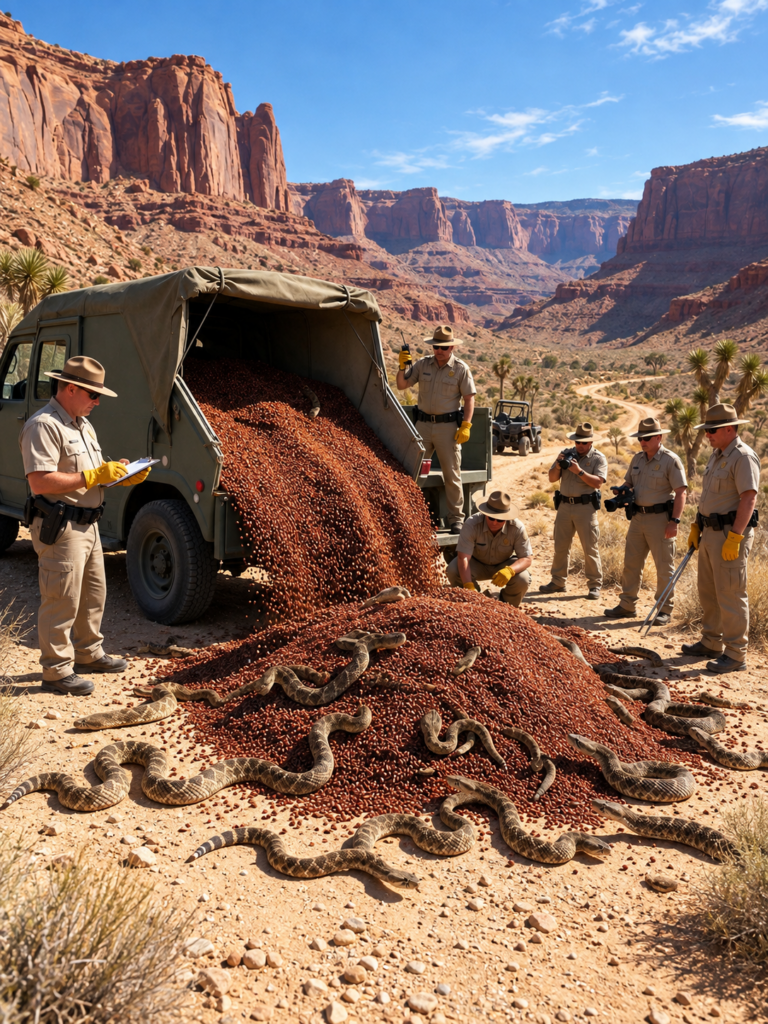
Over roughly three years, wildlife authorities released about three million fire ants into selected areas associated with high inland taipan activity.
The releases were gradual.
The effects were monitored.
And for a while, the experiment seemed to justify every risk.
Snake sightings dropped sharply.
Within roughly eighteen months, observations in the target areas suggested a decline of around sixty percent. Places where taipans had repeatedly been seen became quiet. Known nesting areas showed less activity.
Farmers began noticing the difference.
For people who had spent years scanning the ground before stepping near sheds, machinery, livestock yards, or isolated buildings, fewer snakes felt like immediate proof.
The danger was leaving.
The strategy appeared to be working.
A venomous predator that had survived in the Australian interior for millennia seemed to have finally met something it could not defeat.
The ants.
It was easy to mistake the silence for success.
Because the snakes had not been the only thing standing in the ants’ way.
And once the taipans began disappearing, the fire ants simply kept moving.
Part 2
The first major consequence appeared underground.
The ants found the rats.
Long-haired rats had always lived under intense predatory pressure. Taipans depended heavily on them. Eagles hunted them from above. Dingoes caught them. Goannas took them where they could.
But those predators operated within physical limits.
A taipan might eat a rat and then spend time digesting it.
An eagle could seize only what it could catch.
A dingo had to hunt each animal individually.
Fire ants operated differently.
They entered burrows.
They swarmed young rodents.
They invaded food stores.
They attacked the reproductive base of the population instead of simply removing individual adults.
The long-haired rats, which had endured native predators for generations, had no comparable defense against an enormous network of invasive colonies pressing into their habitat from the ground itself.
Within about two years, rat populations in affected areas were reported to have fallen by roughly eighty percent.
That was when the experiment stopped looking like a contest between ants and snakes.
The loss began spreading outward.
A landscape is easy to misunderstand when viewed one species at a time.
A snake eats a rat.
An eagle eats a rat.
A dingo eats a rat.
A goanna eats a rat.
Those observations sound like separate relationships.
They are not.
They are parts of the same food web.
Remove enough rats, and every predator depending on them has to make a choice it never consciously intended to make.
Leave.
Starve.
Or eat something else.
Wedge-tailed eagles, among Australia’s largest birds of prey, could not negotiate with the missing rodents.
Neither could dingoes.
As the natural food base shrank, some predators moved away.
Others turned toward whatever remained available.
That included livestock.
For farmers in and around the affected country, the change carried a bitter irony.
Some of the same properties that had welcomed fewer taipan sightings now faced new pressure.
Eagles that once had ample wild prey began taking greater interest in lambs.
Dingoes appeared around stock.
The original problem had been visible and easy to name.
A venomous snake.
Now the cost arrived through several species at once.
There was no single animal to blame.
The food web itself had been disturbed.
And the ants still were not finished.
Researchers began noticing changes within the fire ant populations.
Colonies living under heavy ecological pressure appeared increasingly aggressive. In areas where conflict with taipans had been intense, ants responded rapidly to disturbance. Some observations suggested changes in the makeup of colonies, including workers better suited to fighting and defending territory.
The frightening possibility was not that an individual ant had somehow decided to become more dangerous.
It was that selection rewarded colonies that were already better at surviving conflict.
Colonies that responded faster survived.
Colonies that defended themselves effectively expanded.
Their descendants carried those advantages into new territory.
The experiment had treated fire ants like a static weapon.
But living things were not static.
They reproduced.
They competed.
They adapted.
And every generation represented another opportunity for the environment to favor characteristics no management plan had requested.
Native ant species began losing ground.
Species that had occupied the Australian interior for immense stretches of evolutionary time suddenly faced an opponent that multiplied quickly, attacked in coordinated masses, and was willing to eat almost anything.
The inland taipan had been the program’s target.
But the ecological battlefield was widening far beyond the snake.
Then the snakes themselves began behaving differently.
The taipans that survived did not simply remain where they were and accept the new conditions.
They adjusted.
Animals do not need to understand a government program to respond to danger. They need only survive long enough for behavior to change.
Some taipans began using space differently.
A species associated mainly with the ground was observed climbing more often.
Others altered the timing of their activity, hunting deeper into the night when the ants were less active.
The change carried a cost.
Taipans are reptiles. Their bodies depend heavily on environmental temperature. Hunting in cooler nighttime conditions could make movement slower and more difficult.
Yet the tradeoff was preferable to remaining exposed to the ants.
Diet changed as well.
A predator that had evolved into a highly effective hunter of long-haired rats could no longer rely on the same prey. Some surviving snakes began taking other animals, including birds and lizards.
What appeared at first to be a collapsing population was becoming something more complicated.
The taipans were adapting their behavior around the pressure.
One tracked female made that reality impossible to dismiss.
She had repeatedly used the same termite mound as a nesting area.
For a snake, a reliable nesting location represented something valuable: familiar shelter in an unforgiving landscape.
Then fire ants reached her territory.
During the breeding season, she abandoned the site.
She left the eggs behind.
And she moved.
A radio tracker allowed researchers to follow her journey.
She traveled more than twelve miles across open country—far beyond the roughly two-square-mile area a taipan might ordinarily occupy.
She kept moving until she reached ground without fire ants.
There, she attempted to establish herself again.
The observation changed the way the experiment had to be understood.
The snakes were not necessarily being eliminated.
Some were being displaced.
And displacement creates a question every control program has to answer.
Where do the animals go?
The answer soon became uncomfortable.
Areas without fire ants were not random.
Some overlapped with landscapes where human activity had increased.
Farms.
Settlements.
Communities that had not previously dealt with frequent inland taipan encounters.
The ants had created intense pressure inside the release zones. The snakes that could escape that pressure moved toward places where the ants had not yet established themselves.
Those included places where people lived.
Reports of encounters in neighboring regions increased, with some estimates suggesting a rise of around forty percent within a year.
The strategy had begun with one objective above all others: reduce the possibility of dangerous snakes coming into contact with human communities.
Instead, the pressure created by the ants appeared to be pushing surviving snakes toward precisely those communities.
The problem had not vanished.
It had changed its address.
For authorities, that would have been serious enough.
But the next consequence reached further than snakes, rats, dingoes, or eagles.
It began with insects feeding on plants.
Fire ants had a useful relationship with sap-sucking insects such as aphids and scale insects.
Those insects fed on plants and produced a sugary liquid called honeydew.
Fire ants wanted the honeydew.
So they protected the insects producing it.
They could drive away predators, help spread the sap-feeders, and create conditions that allowed populations of those pests to increase.
In exchange, the ants harvested the sugary secretion.
It was, in effect, a form of insect agriculture.
And it placed native vegetation under new pressure.
Plants that had evolved with ordinary populations of sap-feeding insects now faced much larger infestations protected by fire ants.
The insects drained plant tissue.
Some transmitted disease.
The ants defended the arrangement because it provided them with food.
No one directing the original program had told the ants to do any of this.
The behavior already existed.
The release had simply given it new territory in which to operate.
Within roughly three years, some affected regions were reported to have lost about thirty percent of their native grasses.
That figure transformed what might have seemed like a minor botanical consequence into something much more serious.
Grass was not decoration on the Outback.
Its roots held soil in place.
In a dry landscape where rain could arrive violently and disappear quickly, vegetation helped stabilize fragile ground. Roots slowed erosion. Plants trapped moisture. Cover protected the surface from wind and heat.
As grass disappeared, more soil was exposed.
Then the wind took it.
Rain struck unprotected ground and carried sediment away.
Less water soaked into stable soil.
Conditions became harder for other plants.
The ecological chain had now traveled from a decision about venomous snakes into the physical structure of the land.
The consequences climbed upward again.
Kangaroos, wallabies, and emus depended on vegetation.
Where food remained, animals concentrated into smaller green areas.
Elsewhere, numbers declined.
Competition intensified.
Movement patterns shifted.
A program intended to influence one predator had reached animals that had nothing to do with the original conflict.
The country itself was changing.
And still the fire ants reproduced.
Three million released ants were not three million permanent units frozen across the landscape.
They belonged to breeding colonies.
Queens laid eggs.
Workers expanded nests.
New colonies spread outward.
Millions became more millions.
Eventually estimates in affected zones rose beyond fifteen million.
The animals introduced as a biological weapon had become an expanding population in their own right.
Containment efforts struggled to keep pace.
The absurdity was becoming impossible to ignore.
Australia had already spent enormous resources trying to eradicate fire ants because authorities understood how destructive they could be.
Now another management decision had deliberately increased their numbers in landscapes where their ability to spread was already well known.
The experiment had not created a simple winner and loser.
It had created pressure.
Pressure on snakes.
Pressure on rats.
Pressure on eagles and dingoes.
Pressure on native ants.
Pressure on vegetation.
Pressure on soil.
Pressure on farms.
And each species responded according to its own needs rather than the intentions written into a management plan.
The inland taipan had not read the whiteboard.
Neither had the ants.
Nature was not disobeying the experiment.
It had never agreed to it.
Part 3
By the time researchers could see the full pattern, the original promise had already unraveled.
Yes, taipans had declined in the release zones.
That part was real.
In some places, they had become much harder to find.
But the surviving population had begun stabilizing elsewhere.
The snakes had moved.
They had altered when they hunted.
They had altered where they traveled.
Some had changed the prey they relied upon.
The animals targeted by the program were proving more flexible than expected.
And flexibility was exactly what made the new situation dangerous.
A taipan living deep in remote clay country was one thing.
A taipan pushed toward the edges of farms and towns was another.
The snake itself had not suddenly become more malicious.
Its venom had not changed.
Its fundamental nature had not changed.
What changed was geography.
The buffer between people and the animal had narrowed.
Communities that had rarely encountered inland taipans now had reason to watch for them.
The irony could hardly have been sharper.
An intervention meant to make people safer had redistributed danger instead of eliminating it.
Even then, snakebite remained uncommon. The inland taipan was still a shy animal, far more likely to avoid people than seek them out.
But rarity was not the same as irrelevance.
A highly venomous snake appearing closer to communities created precisely the risk the program had been designed to reduce.
Meanwhile, the fire ants had become vastly more numerous than the initial release population.
Containment brought authorities back to the kind of costly management problem they had hoped to avoid.
The supposed biological weapon now required control of its own.
The rats offered a faint sign of recovery in some places after ants moved through or pressure changed.
But the rebound was slow.
Long-haired rat populations could rise dramatically under favorable conditions, yet rebuilding an ecological relationship was not as simple as waiting for one species to reproduce.
Predators had already moved.
Vegetation had already changed.
Ant communities had already been displaced.
Soil had already been exposed.
One population recovering did not automatically reset everything around it.
Wedge-tailed eagles illustrated the problem.
In some affected regions, their numbers were reported to have fallen by as much as a quarter.
That did not place the species itself on the edge of extinction.
But the decline mattered.
Top predators usually reflect conditions below them.
An eagle can survive only if enough energy moves upward through the food web to support it.
When a major predator declines sharply, ecologists look beneath it.
At prey.
At habitat.
At reproduction.
At competition.
At the structure of the ecosystem supplying its food.
The ants had been released with one narrow outcome in mind.
Fewer taipans.
But the measurement of success had initially been too narrow.
If snake sightings fell sixty percent, the number looked impressive.
It said nothing about where the snakes went.
If farmers saw fewer taipans, the result felt immediate.
It said nothing about whether dingoes and eagles would lose their prey.
If the ants killed hatchlings, the mechanism seemed effective.
It said nothing about whether the same ants would kill young rats, native insects, reptiles, or birds.
If fire ant colonies expanded, they could suppress snakes more efficiently.
It said nothing about what would happen when those same colonies protected aphids and scale insects.
Every early measure focused on the target.
The consequences lived in the connections.
That difference became the real lesson of the experiment.
Scientists disagreed over how to judge what had happened.
Some saw value in the data.
A field experiment on such a scale could reveal interactions that controlled laboratory work might never reproduce. Researchers could study how an invasive social insect competed with a native predator, how prey populations responded, how animals altered behavior under pressure, and how effects spread through a food web.
Knowledge gained from failure could potentially prevent another failure elsewhere.
That argument had weight.
Science often advances through unexpected results.
An experiment that does not produce the intended outcome can still reveal something important.
But others saw the same events and reached the opposite conclusion.
The risks, they argued, had not been mysterious.
Australia already knew what could happen when a generalist species was used as a biological control agent.
The cane toad had been warning the country for generations.
Other places had their own examples.
The mongoose had shown what happened when a predator introduced for one target discovered easier prey.
Biological control had developed strict principles precisely because ecological history was filled with similar mistakes.
From that perspective, the fire ant program had not uncovered an unknowable danger.
It had repeated an old one.
The debate ultimately reached beyond whether the experiment could be called useful science.
The deeper question was how human beings imagined ecosystems.
Management plans often required clean categories.
Pest.
Predator.
Prey.
Threat.
Control agent.
Target zone.
Success rate.
Those categories made decisions possible.
But animals did not remain inside them.
The inland taipan was labeled a danger because of its venom.
Yet in its natural habitat it also regulated rats.
The long-haired rat was prey, but it also supported eagles, dingoes, goannas, and other predators.
Grass was vegetation, but it also held soil in place.
Fire ants were a control agent in one sentence and an invasive pest in the next.
A farmer might celebrate fewer snakes and then lose lambs because hungry predators had shifted their attention to livestock.
The same event could be success at one point in the web and disaster at another.
That was what made the system so difficult to control.
Nature was not a machine built from separate components.
If it had been, the original plan might have worked.
Remove the snake.
Leave everything else untouched.
But ecosystems are built from relationships.
The taipan hunted rats.
The rats fed other predators.
Those animals influenced prey and behavior across the landscape.
Plants fed herbivores and stabilized soil.
Insects affected plants.
Ants affected insects.
Water moved through soil differently depending on whether roots remained.
Each relationship leaned on another.
Pulling one hard enough caused movement in places no one had touched directly.
The fire ants had not failed to follow instructions.
They had followed their biology perfectly.
They attacked what they could overwhelm.
They consumed what they could use.
They protected insects that supplied sugar.
They expanded into available ground.
They reproduced.
They competed.
They survived.
The taipans also followed their biology.
They avoided lethal pressure.
They changed activity patterns.
They searched for different prey.
They abandoned dangerous territory.
They moved toward safer ground.
The trouble was that what counted as safer ground for a snake could count as dangerous ground for a human community.
The female taipan that traveled more than twelve miles captured the whole failure in one animal.
No government official had ordered her toward people.
No researcher had predicted her exact route.
She did not understand the policy responsible for changing her habitat.
She simply knew, in the only way an animal needs to know, that the old nesting ground had become deadly.
So she left.
That single movement exposed the flaw in the entire idea.
Control had been measured at the point where pressure was applied.
The program had not fully accounted for what pressure would push outward.
A snake removed from one map square did not cease to exist.
A predator deprived of rats did not cease to eat.
An ant colony deprived of snakes did not cease to forage.
The consequences traveled.
Years after the first releases, the Australian interior no longer looked quite like the system the planners had imagined.
There were more fire ants.
Taipans persisted, but their distribution had changed.
Rat populations struggled to recover in some places.
Wedge-tailed eagles had declined in affected regions.
Native ants had lost territory.
Grass cover had suffered.
Erosion had increased where vegetation weakened.
Other animals crowded around the remaining resources.
And communities outside the original target zones had begun seeing a snake that had once seemed safely distant.
None of those outcomes existed independently.
They were all parts of the same story.
The program had begun because one species frightened people.
That fear was understandable.
The inland taipan possesses venom powerful enough to make any encounter serious.
But danger and ecological importance can exist in the same animal.
The taipan’s capacity to kill was never the only thing that defined its place in the Outback.
For generations, it had been killing rats.
Not all rats.
Not every rat it could reach.
Enough to participate in a balance shaped by rainfall, drought, prey booms, predator reproduction, and scarcity.
The relationship was imperfect and sometimes violent.
Natural systems usually are.
But it had history behind it.
The fire ants brought a different form of pressure.
They did not replace the taipan’s function neatly.
They overwhelmed several relationships at once.
That was why three million tiny insects could create consequences extending from snake nests to lambing paddocks, from rodent burrows to eagle territories, from aphids to grass roots, and eventually into the soil itself.
The original idea had promised efficiency.
Use one unwanted force against another.
Let biology save money.
Let nature perform the dangerous work.
Instead, the experiment demonstrated how expensive a shortcut can become when the shortcut reproduces.
There was no single moment when control disappeared.
No dramatic day when somebody looked across the Outback and saw that everything had changed.
Control faded through thousands of smaller events.
An ant colony expanded past a boundary.
A rat burrow went silent.
An eagle failed to find enough prey.
A dingo moved closer to livestock.
A taipan hunted later at night.
A female abandoned her nest.
Grass thinned.
Rain hit exposed soil.
Dust lifted into the air.
Each event looked small enough by itself.
Together they formed the consequence.
Australia had set out to reduce one of the most feared snakes on Earth by using one of the world’s most aggressive invasive insects.
For a short time, the numbers suggested victory.
Then the snakes moved.
The rats collapsed.
Predators changed their diets.
The ants expanded.
Vegetation suffered.
The ground itself began answering the decision.
In the end, the inland taipan had not truly been defeated.
It had been pressured, displaced, and forced to adapt.
The fire ants had not behaved like a weapon that could be put away after the battle.
They had behaved like fire ants.
And the Outback, far from being a board on which two dangerous species could simply be moved against each other, revealed what it had always been:
a living network in which every victory carried a consequence somewhere else.
The most important warning was not that nature had somehow outsmarted the people trying to manage it.
It was that nature had never been following their plan in the first place.

