
Part 1
By the last week of September 1888, most people in Ironwood Hollow, Minnesota, had stopped thinking about building and started thinking about surviving.
The settlement lay deep in the northern timber country, where winter was never simply a change in weather. It was a season that could take possession of a man’s house, drain his woodpile, and punish every careless decision he had made during the warmer months.
Men climbed onto roofs to secure loose shingles. Fresh chinking was pressed into gaps between logs. Axes rang from morning until the daylight began to disappear. Behind nearly every cabin, split firewood stood in carefully arranged stacks, each one representing weeks of labor and a family’s best hope of staying warm.
Leander Vale should have been finished with his preparations.
At thirty-eight, he had spent most of his working life around timber. He had built bunkhouses for logging camps, repaired barns weakened by spring thaws, replaced rotten foundation sills, and straightened cabins that frost had lifted crooked. He understood how wood expanded, settled, warped, and failed.
His own cabin, standing on a modest clearing at the edge of Ironwood Hollow, was the kind of structure another carpenter might have examined with approval.
Sixteen feet wide and twenty-four feet long, it stood low and solid against the ground. Its bottom courses were made from durable tamarack, with carefully fitted white pine above. Lime-and-clay chinking mixed with chopped straw filled the seams. A steep roof rose over the structure, built to shed the heavy snow that northern Minnesota could deliver without warning.
The door fitted properly. The roof was finished. The corners were square.
And yet, on a gray September morning, Leander unloaded another wagon of lumber and began building a second wall around the completed house.
Not against the existing logs.
Not as an extension.
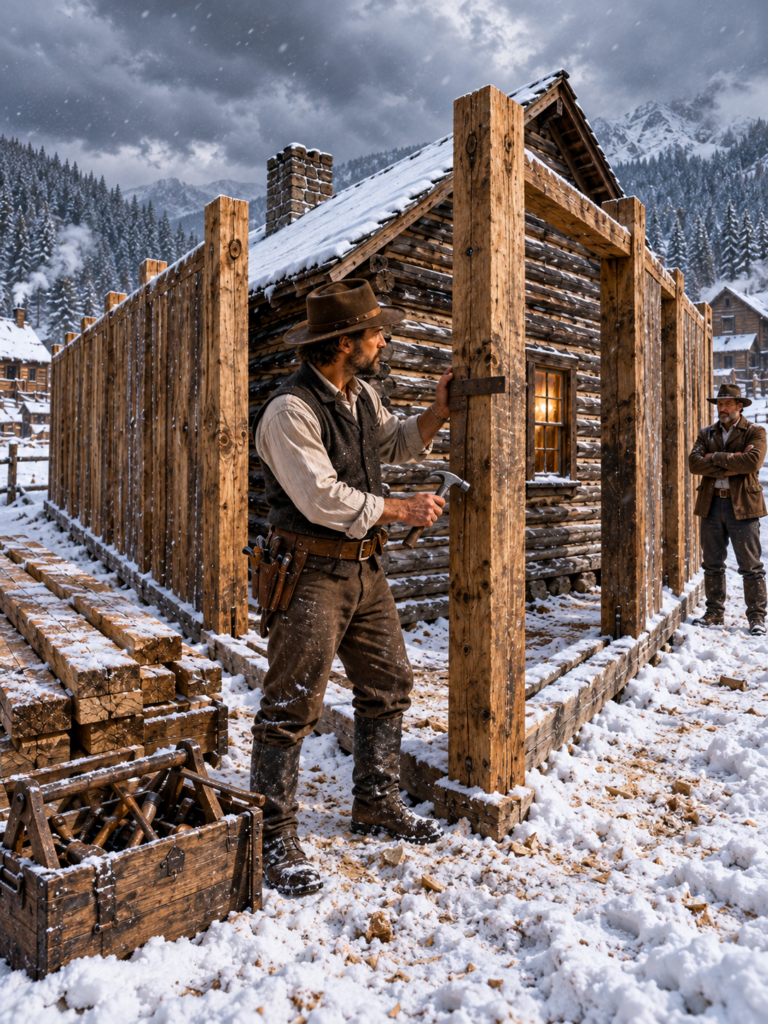
He measured a space roughly sixteen to eighteen inches beyond the cabin’s outer walls and began raising an entirely separate wooden frame.
Harlan Voss, the settlement’s master sawyer, happened to be passing when the first cedar planks came off the wagon.
He stopped.
For a while, he watched without speaking.
Then he approached Leander, who was kneeling beside a newly positioned timber sill with a carpenter’s square in his hand.
“Building yourself a shed?”
Leander checked the alignment of the timber.
“No.”
“A porch, then?”
“Wall.”
Harlan looked toward the finished cabin, then at the posts standing beyond it.
“You already have four of those.”
Leander shifted his square and made another pencil mark.
“I know.”
Harlan waited for an explanation.
None came.
He stepped closer and examined the distance between the new frame and the cabin.
“You’re leaving a foot and a half of empty space.”
“About that.”
“What’s supposed to go in there?”
“Nothing.”
Harlan straightened.
For thirty years, he had worked around sawmills and timber yards. He knew the price of good cedar, the labor required to haul it, and the number of practical uses those planks could serve.
Leander’s new construction seemed to offer none of them.
It carried no roof load. It enclosed no usable room. It would provide no storage worth speaking of.
As far as Harlan could tell, Leander was spending valuable materials to build a wall whose only purpose was to stand in front of another wall.
“You planning to explain this before winter?” Harlan asked.
Leander drove a wooden brace into position.
“Probably not.”
By afternoon, word had reached the general store.
Nell Barker, who operated the store and knew nearly every family in Ironwood Hollow, listened to the description with the amused interest of someone who had just been handed a story too good to keep.
“Sounds like Vale’s putting an overcoat on his house,” she said.
Someone near the stove laughed.
Nell smiled.
“That’s what I’ll call it. Vale’s Wooden Overcoat.”
The name took hold immediately.
By the next morning, men at the mill were using it. A passing teamster repeated it on the settlement road. Before another week had passed, Leander heard it from people who had not even visited his property.
He ignored them.
Every morning, he stepped outside with his tools, checked the frame, and continued working.
Every evening, he returned to a house where his wife, Mara, was keeping a different kind of record.
On a small wooden board, she marked the family’s supply of firewood.
Their nine-year-old son, Caleb, usually spent the early evening working arithmetic at a chair near the iron stove. Bracken, the family’s brindled dog, liked to stretch out beside the hearthstones, where the stored warmth remained long after the fire settled.
One evening, a northwest breeze began pressing against the cabin.
Caleb was halfway through a column of figures when he stopped writing.
He shifted in his chair, rubbed his hands together, then dragged the chair several feet closer to the stove.
Leander noticed.
He said nothing.
Mara, standing near the wood box, saw her husband watching the boy.
“He’s not cold enough to stop his lessons,” she said quietly.
“I know.”
But Leander continued looking toward the chair.
To anyone else, Caleb’s movement was ordinary. Children liked warmth. A stove was the natural center of a cabin.
To Leander, the sound of those chair legs scraping across the floor carried the memory of another winter.
And that winter was the reason he had decided to build something no one in Ironwood Hollow understood.
The previous year, the Vales had lived in a smaller cabin near the edge of a logging tract.
There had been no great catastrophe. Their roof had not collapsed. They had not been driven from their home. They had enough food, and the stove never stopped working.
But winter had gradually exhausted them.
On clear mornings, the washbasin beside the north wall sometimes held a thin skin of ice. The bedding near that same wall felt cold and slightly damp. Whenever a northwest wind rose, Caleb abandoned his place at the table and moved toward the stove.
Mara fed split wood into the fire from early morning until bedtime.
She became accustomed to the sound of the stove door opening, the sudden flare of orange light, and the repeated journey to the dwindling pile of wood.
Leander spent much of that winter trying to improve the cabin.
He examined the log joints, found small gaps, and pressed fresh chinking into them. For a while, the room would feel better.
Then the wind would return.
A cold current would find another seam and move across the floor.
One night, Leander woke and saw Mara standing beside Caleb’s bed.
The boy was asleep.
Mara spread another blanket over him, tucked it beneath his shoulder, and stood there for a moment to make certain he was covered.
Then she returned to bed without speaking.
Leander lay awake.
He knew Mara was tired. He knew the woodpile was shrinking faster than he had expected. More than anything, he disliked knowing that he had built and repaired shelters for other men while his own family continued to endure a room that the wind seemed able to enter whenever it pleased.
The following morning, he walked outside and counted the remaining firewood.
He returned to the cabin, found a pencil, and wrote down the amount.
It was a small act.
But it changed the way he thought about the problem.
He had spent years treating cold as an enemy that could be driven away with a bigger fire.
Now he began asking whether he could prevent so much of the warmth from escaping in the first place.
An old memory helped him consider the question differently.
Years before, Leander had known Emmett Roe, an icehouse keeper who had once worked alongside Leander’s father.
Emmett understood cold in a way most builders did not. His livelihood depended on keeping stored ice from melting through the warm months, and he had learned that thick construction alone was not enough.
A poorly fitted joint could allow moving air to undo the benefit of a surprising amount of material.
Leander remembered something Emmett had told him.
“Air only helps when the wind can’t put it to work.”
At the time, Leander had understood the remark as useful advice about icehouses.
After the winter of 1887, he began hearing another meaning in it.
During the following spring and summer, his repair work gave him opportunities to watch how weather behaved around buildings.
At one barn, frost damage appeared first on the most exposed wall.
Behind a granary, he noticed that snow remained loose and deep where the building sheltered it, while the windward ground had been scoured nearly bare.
Inside narrow enclosed porches, the air sometimes felt less punishing than it did outside, even when no stove was present.
None of these observations offered proof that a second wall would keep a cabin warmer.
Leander understood that.
But they suggested that the wind itself deserved more attention.
Instead of making the main cabin wall endlessly thicker, what if he put something in front of it?
What if the first surface the wind encountered was not the wall that separated his family from the cold?
By early summer, he had chosen a clearing in Ironwood Hollow and begun constructing the family’s new home.
He built the inner cabin carefully, never allowing himself to depend on the proposed outer shell.
If the experiment failed, the house still needed to stand on its own.
He squared the tamarack logs for the lower courses, selected white pine for the upper walls, fitted the joints, and filled the seams.
Mara helped where she could. She carried smaller tools from the wagon, kept nails sorted in a wooden box, and made certain the work materials did not become scattered across the clearing.
Caleb was proud to be included.
Whenever his father needed a wedge, a peg, or the measuring line, the boy hurried to fetch it.
Bracken spent the hottest afternoons beneath the wagon, occasionally lifting his head when an axe struck timber.
By the time the roof was complete, even Harlan Voss had little to criticize.
He visited one afternoon and inspected the corners and chinking.
“Tight enough for any sane man,” he told Leander.
Coming from Harlan, it was considerable praise.
Leander accepted it with a nod.
Then he began measuring outside the completed house.
He laid out a second rectangle, adjusting the distance where the ground sloped or the doorway needed more clearance.
The outer frame rose independently of the cabin.
Lighter posts and rails supported rough-sawn cedar planks. Most of the shell stood sixteen to eighteen inches beyond the inner logs.
The northwest-facing sections received particular attention.
Leander knew which direction the hardest winds usually came from. He wanted those winds to strike the cedar before reaching the family’s living walls.
Harlan understood the intention once Leander finally explained it.
Understanding did not make him agree.
“Good cedar could put siding on another house,” he remarked.
“It could.”
“Could repair a barn roof.”
“Yes.”
“Could be cut into shingles.”
Leander fitted another plank.
Harlan folded his arms.
“And you’re spending it on a space nobody can use.”
Leander did not answer immediately.
A nearby visitor, Elias Thorne, a logging teamster who lived in the settlement with his wife Adeline and their children, had been listening to the exchange.
Elias was less certain than Harlan that the idea was foolish.
Still, he had his doubts.
“If cold is what troubles you,” Elias asked, “why not cut the cedar into firewood and burn it?”
Leander held the plank against its frame until the edges lined up properly.
“Because I only burn wood once.”
Elias looked toward the cabin.
Then toward the woodpile.
He considered the answer longer than Leander expected.
Harlan shook his head.
“You’re counting on that empty space to do something it might not do.”
“That’s possible.”
“And if you’re wrong?”
“Then I’ll have to find out why.”
Harlan had no ready answer to that.
But the exchange revealed the difference between the two men’s thinking.
Harlan believed warmth depended on reliable walls and sufficient fuel. Leander agreed, but he wanted to reduce the amount of heat the weather could steal.
He wasn’t trying to make a fire burn hotter.
He was trying to make the same fire do more good.
By the middle of October, however, Leander’s strange construction had attracted attention more serious than the settlement’s laughter.
Otis Mercer, the county assessor and building examiner, arrived to inspect the property.
Otis was a practical man whose work had brought him into contact with structures that looked sound from a distance and concealed expensive trouble beneath their surfaces.
He had seen moisture trapped behind boards until timber rotted.
He had examined buildings damaged by chimney fires and sheds crushed beneath wet snow.
Hidden spaces worried him.
Leander’s new shell contained a great deal of hidden space.
Otis walked slowly around the cabin, examining the cedar, the roof junctions, and the narrow passage between the walls.
“How are you going to inspect the original logs when all this is closed?” he asked.
Leander led him toward an unfinished section.
“Through here.”
Otis leaned forward and examined the opening.
“Not much room.”
“It’s enough to get inside.”
“Maybe in a light shirt. What about winter clothing?”
Leander did not answer.
Otis moved toward the chimney side.
“And here? If soot gathers, or heat causes trouble, how do you reach it?”
“I’ve left an opening.”
Otis inspected it.
“Leave enough room to see what you’re doing, not just put your face through a hole.”
He continued around the north side.
His eyes moved toward the roof edge, where the cedar shell approached the cabin’s eaves.
“Driven snow can collect here. Then it melts. Then it freezes. If you can’t see what it’s doing, you won’t know there’s trouble until you have damage.”
Mara stood in the doorway, listening.
Leander followed Otis along the wall.
“I can make changes.”
“You should.”
Otis closed his notebook.
He did not order the construction removed.
But he refused to record it as an approved improvement until Leander could demonstrate that the cavity would remain inspectable and maintainable.
Before leaving, Otis looked once more into the narrow space.
“What’s this emptiness supposed to accomplish?”
“Keep the weather from reaching the house first.”
Otis studied him.
“Weather always finds what a man forgot.”
After the examiner departed, Leander stood near the northwest corner and considered the junction between the cedar and the roof.
Otis’s objections were inconvenient.
That did not make them wrong.
Leander returned to his tools.
Within days, the weather provided the first serious test of the design.
A strong northwest wind swept across Ironwood Hollow during the night.
The cedar boards groaned beneath the pressure, and loose leaves skittered through the clearing.
The next morning, Mara noticed that one portion of the cabin still felt colder than it should.
Bracken had abandoned his usual sleeping place and curled tightly beside the stove again.
Leander moved along the inner north wall, pressing his palm against the logs.
Most felt evenly cool.
Near the upper northwest corner, however, one narrow strip was markedly colder.
He examined the chinking.
No obvious seam had opened.
Then he entered the unfinished access passage carrying a candle.
The flame trembled.
Leander raised it higher.
It leaned toward the roof junction and remained there.
He lowered the candle.
The flame straightened somewhat.
He raised it again.
It leaned.
He repeated the movement several times, watching carefully.
Then he understood what he had built.
The cavity was not holding relatively still air.
Wind entering below was traveling upward through the passage. The opening near the roof was helping draw it along.
Instead of merely protecting the cabin, part of the second wall had become a channel for moving cold air.
Harlan arrived while Leander was still examining the problem.
The sawyer stepped into the accessible section and watched the candle flame.
For several seconds, neither man spoke.
Finally, Harlan pointed toward the roof.
“That’s what I meant.”
Leander nodded.
Harlan looked almost disappointed that his warning had proved correct.
“You’ve built yourself a chimney without smoke.”
Leander regarded the flame.
“Looks that way.”
“You going to take it all down?”
“No.”
“What, then?”
“That part.”
Leander set the candle aside and fetched his pry bar.
He began removing the upper planks.
One came free.
Then another.
By midday, nearly two days of careful work lay stacked on the ground.
Harlan watched for a while.
“You worked hard putting those up.”
“I did.”
“And now you’re pulling them off.”
“Can’t leave them doing that.”
Leander did not defend his original arrangement.
He took measurements.
He examined the lower openings, the upper junction, and the places where wind could enter the cavity and maintain a steady upward current.
He considered where the air needed to remain sheltered and where its movement had to be interrupted.
Then he rebuilt the exposed section.
Short cedar blocks interrupted the uninterrupted vertical path. The roof-edge arrangement was altered so the northwest wind could no longer pump freely through the space. On the chimney side, Leander preserved an opening large enough to examine the inner wall.
It was slower work the second time.
He knew precisely how much labor his first mistake had cost him.
Yet he also knew that closing the gap without understanding it would only hide the problem.
One morning, a small bundle of useful cedar offcuts appeared beside the frame.
They were suitable for the blocking he had been making.
Leander examined them.
Harlan had been working at the mill the previous day, but nobody offered an explanation about the scraps.
Mara noticed the wood when she stepped outside.
She glanced toward the mill road, then returned to preparing breakfast.
Two nights later, another northwest wind struck the settlement.
Leander carried his candle into the cavity.
This time the flame quivered when gusts hit the outer cedar.
But it did not lean steadily toward the roof.
He tested several locations.
The result remained much the same.
The following morning, the freezing strip along the northwest corner was noticeably smaller.
Inside the cabin, Bracken rose from his customary place near the hearth.
The brindled dog stretched, crossed the room, and circled once beside Caleb’s bed.
Then he settled on the floor near the boy’s feet.
Leander watched him.
The room had not suddenly become warm without a stove.
Winter had not yet arrived in force.
But something important had changed.
The wall had failed its first test, and Leander had found a way to correct it.
He looked toward the northwest corner, where the outer shell now stood between his family and the rising wind.
Then he returned to his bench, picked up another piece of cedar, and began shaping it to fit.
For the first time since he had started building his wooden overcoat, he had evidence that the idea might work.
But autumn winds were not the same as a Minnesota winter.
And the true test was still coming.
Part 2
November arrived with gray skies, shorter afternoons, and a cold that settled into the ground a little more deeply each morning.
Across Ironwood Hollow, families continued their familiar preparations.
The sound of splitting wood carried through the settlement. Smoke rose from chimneys at dawn. Outside the general store, men spoke about early frost, the condition of the roads, and the length of winter they believed lay ahead.
Leander listened when he happened to be among them.
He rarely joined the arguments.
At home, he and Mara had begun keeping a simple record of the cabin’s performance.
The board that once served only to count firewood now carried several observations.
Each morning, Mara marked the lowest temperature when they had a reliable reading. She noted how many armloads of firewood the stove had consumed during the previous day, and whether ice had formed on the washbasin near the cooler side of the room.
Leander added his own brief notes about the north wall.
Some mornings, he found faint traces of frost.
Others, he found none.
He checked the accessible portions of the outer shell, examined the blocking installed after the October failure, and watched the roof edge for signs of trapped moisture.
He never assumed the improved candle test meant the construction was finished proving itself.
Mara understood his caution.
She had spent the previous winter carrying wood to a stove that seemed hungry every hour of the day.
A few mild autumn mornings were not enough to convince her that the problem had been solved.
Still, she noticed changes.
On afternoons when the wind rose, Caleb no longer immediately abandoned the table.
He sometimes rubbed his hands, but he could finish a page of arithmetic without moving his chair across the room.
Mara began leaving certain things farther from the stove than she would have dared the year before.
The room was not always warmer in the ordinary sense.
It felt more even.
That difference mattered.
A stove could make the air around it fiercely hot while the far walls remained painfully cold. The Vales had lived with that contrast long enough to recognize its absence.
One evening, Elias Thorne stopped at the cabin after finishing his work.
He removed his coat and stood near the door, looking around.
“Your stove running low?”
Leander glanced toward it.
“No.”
Elias approached the hearth.
The fire was burning steadily, but not with the fierce draft he usually needed in his own house.
“Doesn’t feel like you’re using much wood.”
“Enough for the weather.”
Elias looked toward the far wall.
“Funny thing. At my place, you nearly cook yourself standing by the stove, and then you turn around and feel cold coming off the logs.”
Leander nodded.
“I know the feeling.”
“Doesn’t seem to do that here.”
“Not as much.”
Elias remained for a while, talking about work and the approaching winter.
When he finally left, he examined the cedar shell with renewed interest.
At the general store, Harlan was less impressed.
“November isn’t January,” he reminded Leander.
“No,” Leander replied.
“A mild spell can make a poor building look better than it is.”
“That’s true.”
Harlan studied him.
“You agree with everything I say about that wall?”
“Not everything.”
“Could fool a man listening to you.”
Leander gave a small smile.
The conversation ended there.
He had no desire to win an argument before he had evidence strong enough to support his position.
Through November, the board continued filling with small marks.
Some days required more fuel. Some required less.
Leander compared the entries with the weather and tried not to read too much into any single result.
By late December, the settlement began noticing signs that something unusual was approaching.
Smoke that ordinarily rose above the cabin roofs flattened and drifted close to the ground.
The snow hardened until every step produced a sharp crunch.
Horses stood with their hindquarters turned toward the northwest.
One afternoon, Bracken approached the Vales’ open doorway, stopped, lifted his nose, and withdrew into the cabin.
Leander had seen the dog refuse rain and strong wind before.
This was different.
Bracken did not linger to investigate.
He simply went inside.
Emmett Roe, now an old man with years of winter experience behind him, watched the pale northwest horizon from the settlement road.
“This cold has distance behind it,” he remarked.
At the general store, Nell Barker repeated reports brought by a freight team arriving from farther south.
Temperatures were falling across a wide region.
Whatever was coming toward Ironwood Hollow was not an ordinary local cold spell.
Families brought additional wood closer to their doors.
Elias began feeding his stove harder before the worst weather arrived, hoping to build up warmth in the cabin.
Harlan checked his own property and reminded people to examine their chimneys and rooflines.
Leander made another inspection of his wooden shell.
He checked the northwest seams.
He examined the blocking.
He opened the access panel, studied the inner wall, and inspected the clearance around the chimney side.
He looked for snow that might collect where the shell approached the eaves.
Mara joined him when he counted their remaining fuel.
The reserve was adequate, provided the house performed reasonably well.
That was the condition Leander could not ignore.
A mistake in ordinary November weather might mean an uncomfortable morning.
A mistake during the cold now approaching could endanger his family.
By late afternoon, the sky had become a flat, metallic gray.
Leander checked the access panel once more and secured it.
Mara met him at the doorway.
“Anything need fixing?”
“Not that I can find.”
She looked past him toward the cedar.
“Then you’ve done what you can.”
Leander stepped inside.
For the first time in weeks, he put his tools aside without a piece of unfinished work waiting on the bench.
The storm arrived during the night.
At first, it was the wind.
It came hard out of the northwest, crossing the open clearing and striking the cedar shell with enough force to make the boards shift and complain against their fastenings.
Caleb woke and listened.
“Is that the wall?”
Leander lay still for a moment.
“Yes.”
“Is it supposed to make that noise?”
“Wood moves when the wind pushes it.”
Caleb listened again.
“Does that mean it’s breaking?”
“Not necessarily.”
Leander rose, checked the stove, and moved to the north wall.
He placed a palm against the logs.
They felt cool, as expected.
But the familiar stream of cold air along the lower floor was absent.
He returned to bed.
Outside, the cedar continued taking the pressure of the wind.
The first two days were difficult throughout Ironwood Hollow.
Gusts drove snow across yards and against doorways.
Every journey between a cabin and a woodpile became unpleasant.
People kept fires burning and limited their time outdoors.
At the Thorne cabin, Elias noticed that the stove needed more attention than usual.
The fire was strong, yet the cold continued creeping across the floor.
He added wood, adjusted the draft, and checked the seams around the walls.
Nothing appeared dramatically wrong.
But the room lost heat faster than he could comfortably replace it.
Adeline moved the children’s bedding closer to the stove.
By the third day, a thin layer of ice appeared on their wash water.
Elias stood over the basin, looking down at it.
He knew what that meant.
The stove was still burning, but parts of the cabin had become cold enough for exposed water to freeze.
He returned to the woodshed and began taking split logs from the stack he had reserved for late January.
He had not planned to touch that wood so early.
Inside the Vale cabin, conditions were different.
The wind continued striking the outer cedar, and the temperature kept falling.
Leander did not pretend the house was unaffected.
He added more wood to the stove, and Mara marked the increase on the board.
The family wore warm clothing. They kept the door closed and worked around the demands of a severe northern winter.
But the room did not develop the same sharp division between a fiercely hot hearth and freezing outer walls.
On the fourth afternoon, Mara prepared bread dough.
During the previous winter, she would have placed it close to the stove, carefully choosing a position where it could rise without becoming too hot.
This time, she left it near the center table.
She checked it later.
The dough had risen normally.
She looked toward the north wall, then back at the bowl.
It was one of those small household facts that meant more than a grand declaration.
Caleb could work at his desk without drawing his chair close to the fire.
Bracken spent stretches of the day away from the hearth.
The washbasin remained unfrozen.
At night, Leander opened the inspection access and entered the sheltered cavity with his candle.
The outer cedar shuddered beneath the gusts.
Yet the flame in his hand barely flickered.
He raised it toward the section he had rebuilt in October.
It did not lean steadily upward.
He checked the inner wall.
The narrow freezing strip that had exposed the original mistake had not returned.
Leander remained there for several minutes, examining the wood by candlelight.
The shell was doing what he had hoped.
The wind was striking the outside structure rather than driving freely against the cabin itself.
The protected inner logs were still cold, but their temperature was more uniform.
Back inside, Mara looked up from the fuel board.
“Well?”
“It’s holding.”
She studied his face.
“You’re certain?”
“Certain about tonight.”
Mara accepted the answer.
She understood that he was not being evasive.
He simply refused to claim more than the evidence allowed.
On the fifth day, the temperature fell again.
That morning, Leander discovered a fresh rim of frost beside the inspection access near the chimney side.
He crouched and examined it.
A small irregular gap beside the opening had admitted wind-driven snow.
The snow had packed there, hardened, and frozen around the edge.
Leander tested the panel.
It still opened, but not freely.
He pushed it again.
The resistance was unmistakable.
Otis Mercer’s warning returned to him.
A hidden space could conceal a problem until the owner no longer had an easy way to reach it.
If Leander ignored the ice, the opening might freeze shut.
Then he would lose the access needed to inspect the chimney-side clearance and the inner wall.
He looked outside.
The wind was fierce, lifting sheets of loose snow across the clearing.
He had no desire to work in it unnecessarily.
For a while, he watched the weather and waited for visibility to improve.
When he could see the access area clearly enough, he put on his outer clothing and secured a rope line to a sturdy post near the entrance.
Mara watched him prepare.
“How long?”
“Only what it takes to clear that opening.”
“Nothing else?”
“Nothing else.”
He took his tools and stepped into the wind.
Cold struck his exposed face immediately.
He kept close to the cabin, followed the rope line, and reached the panel.
Snow had hardened along its edge.
He worked quickly, clearing the packed material and examining the irregular gap.
He checked the opening, inspected the nearby clearance, and tested the panel until it moved freely again.
A gust drove fresh snow against his coat.
Leander turned away from it, completed his final check, and returned inside.
He had been outside only as long as the necessary work required.
Nevertheless, snow clung to his clothing.
His mittens were damp along the palms.
Mara met him beside the stove.
Without making a speech about what he had done, she helped him remove the wet mittens and hung them on the drying peg.
Leander warmed his hands.
Then he checked the access from inside one more time.
It opened freely.
He sat down near the stove and looked toward the north wall.
His experiment had survived another problem, but the incident reminded him how easily one neglected detail could undermine an otherwise sound design.
The sixth day brought a different kind of trouble.
The wind shifted direction.
At the Thorne cabin, gusts began striking the roof at an unfamiliar angle.
Smoke from the stove flue was pushed back into the room.
Elias adjusted the draft and checked the fire, but the air inside remained smoky.
Adeline drew the children away from the stove.
Elias knew they could not remain in the room while he worked out what was wrong.
Harlan Voss had already come to help.
Together, they decided the safest immediate course was to move Adeline and the children somewhere with clear air while the men corrected the flue problem.
The Vale cabin was nearby.
Harlan accompanied the family through the bitter cold.
When Mara opened the door, Adeline entered with the children bundled in their winter clothing.
Harlan followed.
The contrast was immediate.
The Vale cabin was not unbearably hot.
There was no roaring fire intended to overwhelm the cold.
The iron stove burned steadily.
The air was clear.
Caleb sat away from the hearth with his arithmetic book, while Bracken lay stretched on the floor.
Mara cleared space for the visitors.
“Come in. Get yourselves settled.”
Adeline helped the children remove their outer clothing.
One of them instinctively moved toward the stove, but soon stopped and sat with the others.
Harlan stood near the entrance, taking in the room.
For a long time, he had imagined that Leander’s shell might offer a modest improvement during ordinary cold weather.
But outside, Ironwood Hollow had been enduring some of the hardest conditions in years.
And here was a cabin whose occupants were not crowded around the stove.
There was no obvious trick.
No extraordinary fire.
Just a steady room, with a child sitting comfortably beyond the hearth.
Harlan removed his gloves.
He walked toward the north wall and placed his hand against the logs.
They were cold.
But not painfully so.
He looked back toward Leander.
“Show me the space.”
Leander brought a light and led him toward the accessible section of the outer shell.
The two men entered the narrow passage.
Outside, the northwest wind battered the cedar.
Harlan pressed his hand against the outer boards.
They were bitterly cold.
Then he turned and placed his palm against the inner logs.
The difference was unmistakable.
He moved farther along the passage and repeated the comparison.
Then he tried a third location.
Each time, the inner surface was noticeably milder than the cedar facing the weather.
Harlan raised his light and examined the blocking above.
“Where did you stop that draw?”
Leander pointed toward the section he had dismantled in October.
“Here. And along that roof edge.”
Harlan leaned forward to study the work.
He remembered the first candle test.
He remembered the steady upward flame, the loose boards lying on the ground, and his own warning that Leander had built a chimney without smoke.
Now he could see the correction.
More importantly, he could see the result.
For thirty years, Harlan had handled timber and judged its uses.
He knew that wood could serve a purpose without carrying weight.
He had simply doubted that this particular purpose justified the labor and expense.
Standing between the two walls in the middle of a severe winter, he had something more reliable than opinion.
He had evidence he could feel with his own hands.
“Outer boards are taking the wind,” he said.
Leander nodded.
“And that blocking keeps it from drawing straight through.”
“That’s the idea.”
Harlan examined the upper junction once more.
He offered no apology.
Leander did not expect one.
The sawyer had questioned a weakness that genuinely existed. Without that weakness being discovered and corrected, the system might have performed very differently.
Harlan moved back toward the access opening.
Before stepping inside the cabin, he looked once more toward the cedar shell.
He did not call it foolish.
He did not ask how much lumber Leander had wasted.
And for the first time since the project began, the man who had most strongly doubted the wooden overcoat had stopped looking for reasons it could not work.
He was beginning to understand why it did.
Part 3
Adeline and the children remained at the Vale cabin until Elias and Harlan corrected the trouble with the stove flue.
When the air in their own house was clear again, Elias returned to bring them home.
He thanked Mara for opening her door and Leander for providing a place where his family could escape the smoke.
Leander accepted the thanks quietly.
He had not built the wooden shell expecting to shelter his neighbors.
He had built it because he remembered his wife standing beside their son’s bed in the middle of a freezing night, adding another blanket because the cabin could not hold enough warmth.
Yet now the work had helped another family.
That meant something to him.
The cold, however, was far from finished.
On the seventh and eighth days, Ironwood Hollow remained under the same punishing pressure.
The wind sometimes weakened, only to return with another fierce gust. Snow hardened around building corners. Door latches grew stiff. Any exposed skin began hurting almost immediately.
Across the settlement, woodpiles continued shrinking.
Families tended their stoves and counted what remained.
Harlan returned to his usual work, but something about his behavior had changed.
When he crossed his own yard, he began paying closer attention to the north-facing wall of his house.
He watched where snow accumulated.
He noticed the places the wind scraped bare.
He studied the joints where the wall met the roof.
He did not suddenly announce that every building needed a second wooden shell.
That would have been unlike him.
He had spent too many years learning that different structures required different solutions.
But he had stopped believing that a wall needed to carry weight or enclose a room to justify its existence.
Meanwhile, the evidence inside the Vale cabin continued accumulating.
On the seventh morning, Mara checked the washbasin.
No ice.
She examined the bedding along the colder side of the room.
It remained dry.
Caleb dressed without hurrying toward the stove, then sat at his desk with his schoolwork.
Bracken followed him, circled beneath the bed, and settled near his feet.
Mara watched the dog for a moment.
She remembered the previous winter, when Bracken had spent so many nights curled tightly beside the hearth that she could scarcely remember seeing him sleep anywhere else.
Animals did not understand experimental construction.
But they understood discomfort.
And Bracken no longer seemed compelled to remain beside the fire.
That evening, Mara brought out the old fuel record from their previous cabin.
She placed it beside the board they had been using throughout the present winter.
Leander sat across from her.
The two of them examined the marks.
During the winter of 1887, the fuel record had filled rapidly. On comparable cold days, they had carried considerably more wood into the cabin.
The current winter was still demanding additional fuel, and they had no exact scientific comparison that accounted for every difference between the two houses.
But the pattern was plain enough to be useful.
Their reserve was lasting longer than it had the year before.
Mara ran a finger along the old row of marks.
“Remember how often I had to refill the box?”
Leander nodded.
“You were bringing in wood before breakfast, and again before I finished washing up.”
“And again after supper.”
“Sometimes twice.”
She glanced toward the stove.
It was burning steadily.
Then she looked at the new record.
“We’re not doing that now.”
“No.”
She leaned back slightly.
For a moment, neither spoke.
The difference between the two winters could be measured in firewood, but the figures represented something more personal.
They represented fewer journeys into the bitter cold.
Less time spent feeding the stove.
Fewer nights waking to check whether Caleb’s bedding was warm enough.
Less worry about whether their carefully prepared reserve would last until spring.
Caleb approached the table and studied the two boards.
“Why are there more marks on that one?”
“That’s from last winter,” Mara explained.
He compared the rows.
“We burned more wood?”
“During cold weather like this, yes.”
Caleb considered that.
Then he looked toward the walls.
“Because of what Pa built?”
Leander answered before Mara could.
“At least partly. The new cabin was built carefully, too. We’re learning what helps.”
Caleb nodded.
He accepted the explanation more easily than most adults would have.
To him, the evidence was simple.
The cabin was comfortable enough for him to sit away from the stove, and the woodpile was not disappearing as quickly.
He returned to his arithmetic.
Leander remained at the table for several minutes after Mara put the records aside.
He had been mocked for spending lumber on an empty space.
Now he could see how much that space might be saving.
Yet he was not ready to call the work complete.
The following morning, he opened the inspection access again.
He examined the blocking and looked for frost.
He checked the roof edge and searched for any place where wind-driven snow might be collecting.
The storm had already exposed one weakness near the access panel.
There might be others.
A sound design, Leander had learned, was not one that never encountered problems.
It was one whose problems could be discovered and corrected before they became disasters.
On the ninth night, the temperature fell lower than it had during the previous eight.
By then, reliable readings around Ironwood Hollow placed the cold between thirty-four and thirty-six degrees below zero Fahrenheit.
Before dawn, the wind weakened.
The sudden quiet seemed almost unnatural.
There was no constant groaning of cedar boards, no rushing sound around the roof, and no loose snow rattling against the outer shell.
Instead, a deep stillness settled over the clearing.
Leander woke before Mara.
The stove had burned low during the night.
The room was cooler than it had been when the family went to bed.
He pulled on his wool clothing and crossed the floor.
The wood beneath his feet was cool, but he did not feel the familiar stream of icy air that had troubled their previous cabin.
He stopped beside the washbasin.
For several seconds, he looked down at the water.
There was no ice.
He touched the surface with his fingers.
It moved freely.
Then he approached the north wall.
He pressed his palm against the logs, beginning near the lower courses and moving slowly upward.
They were cold.
He had expected that.
But there was no wet, freezing patch beneath his hand.
No narrow strip of bitter cold near the northwest corner.
He checked the bedding.
Dry.
He crossed to the window and looked toward the outer shell.
Beyond the glass, the cedar stood motionless in the strange stillness of the morning.
It had been battered by wind, covered with driven snow, and exposed to temperatures severe enough to test every joint and opening.
Yet the inner cabin remained usable.
Leander turned toward Mara’s fuel board.
He examined the marks, then considered the remaining supply.
There was enough.
Not enough to waste.
Not enough to become careless.
But enough to continue through the winter without the immediate fear that the woodpile would disappear before the cold released its hold.
Behind him, Caleb stirred.
The boy sat up, rubbed his eyes, and pulled on his wool shirt.
“Morning, Pa.”
“Morning.”
“Is it still cold?”
Leander glanced toward the window.
“Colder than yesterday.”
Caleb looked toward the stove.
The fire was low.
He climbed from bed, pulled on the rest of his clothing, and picked up his arithmetic book.
Then he carried it to the desk near the north wall.
He sat down.
Leander watched him.
The boy opened the book and searched for the place where he had stopped working.
He did not drag his chair toward the stove.
He did not ask for another blanket.
He did not complain about the cold.
He simply began his morning.
Leander opened the stove and added a modest armload of split wood.
The flames caught slowly.
Bracken stretched beneath Caleb’s bed, rose, and settled again near the boy’s feet.
Mara woke and began preparing breakfast.
She checked the water, then looked toward her husband.
Leander met her eyes.
“No ice,” he said.
Mara nodded.
Her gaze moved toward Caleb, who was already working at his desk.
Then she went about her morning.
Outside, Ironwood Hollow had reached its coldest temperature in years.
Inside the Vale cabin, nothing remarkable was happening.
Water remained water.
Bedding remained dry.
There was fuel left to burn.
A nine-year-old boy could sit near the north wall and finish his arithmetic without needing to move toward the stove.
For Leander, that ordinary scene meant more than anything Harlan could have said at the mill or Nell Barker could have said at her store.
It answered the question that had troubled him since the previous winter.
He had not found a way to make cold disappear.
He had found a way to make his family’s shelter resist it more effectively.
And after nine days of severe weather, the wooden overcoat had demonstrated its value.
When the cold finally began to loosen its grip on Ironwood Hollow, the settlement emerged to examine what the storm had done.
Roofs were checked.
Chimneys were inspected.
Families assessed their remaining fuel and repaired damage where they could.
Otis Mercer returned to the area as part of his work.
He visited structures that had suffered from the severe weather, examining roofs, sheds, and other vulnerable parts of the settlement’s buildings.
Eventually, he reached the Vale property.
Leander met him outside.
Otis looked toward the cedar shell.
“Well,” he said, “it’s still standing.”
“It is.”
“Any trouble?”
“Some snow packed near the chimney-side access. Cleared it before the panel could freeze shut.”
Otis looked toward the opening.
“Show me.”
Before they went outside, Mara brought out the fuel board.
Otis examined the records.
He studied the daily marks and listened as Leander explained what they had observed.
The assessor made no dramatic announcement.
He knew that one family’s record did not prove how every cabin in Minnesota should be built.
But it offered practical evidence about this particular structure.
The Vales had experienced a severe cold spell, and their cabin had remained usable without extraordinary fuel consumption.
Otis closed the board and followed Leander outside.
They opened the access.
He examined the cavity, checked the blocking, and looked carefully at the roof junction.
He inspected the chimney clearance.
Harlan happened to be visiting and joined them near the outer wall.
Otis looked toward him.
Harlan placed one hand against the cedar.
“It cuts the wind.”
Otis examined the sheltered inner logs.
“That much I can see.”
The assessor continued his inspection.
He did not ignore the fact that the shell had performed well.
But he also did not abandon the concerns that had brought him to the property in October.
When he reached the chimney-side access, he stopped.
He examined the opening, then imagined someone trying to enter it during winter wearing a heavy coat and thick gloves.
“Still too narrow.”
Leander looked at the panel.
“I was able to use it.”
“You were. But you had trouble with snow packing around it, and the opening needs to remain practical in bad weather.”
Otis pointed toward the frame.
“Widen it before next winter. A man shouldn’t have to fight his own inspection opening to see whether his house is safe.”
Leander examined the area.
He could already see how the modification might be made without undoing the rest of the shell.
“All right.”
Otis waited, perhaps expecting an argument.
None came.
The assessor took out his ledger.
He recorded the outer cedar shell as a functional improvement.
He added a note requiring the access modification before the next cold season.
Then he closed the book.
The decision was not a grand public ceremony.
There was no crowd gathered to witness it.
But Leander understood its meaning.
Only months earlier, that same county ledger had withheld recognition of the strange wooden wall because its concealed space presented concerns that had not been resolved.
Now the book contained a written acknowledgment that the structure had demonstrated a practical purpose.
The remaining access problem had not been excused.
It had been identified for correction.
And Leander was satisfied with that.
Otis had been right to insist that a hidden space be inspectable.
Harlan had been right to question the cavity’s first uncontrolled draft.
Neither man’s doubts had been entirely misplaced.
In fact, those doubts had helped Leander make the wall better.
When Otis left, Harlan remained beside the cabin.
He looked along the line of cedar planks.
“Wouldn’t have believed it worked that well.”
Leander followed his gaze.
“Didn’t know it would myself.”
Harlan turned toward him.
“You suspected.”
“I hoped.”
There was a difference, and both men understood it.
By spring 1889, the snow began withdrawing from Ironwood Hollow.
Roads softened under the returning sunlight.
Water dripped from roof edges during the warmer hours.
The enormous importance of a winter woodpile faded as spring work took its place.
At Nell Barker’s general store, conversation returned to ordinary subjects.
People discussed repairs, planting, logging work, and the condition of the roads.
But the story of Leander’s second wall had not disappeared.
One afternoon, Nell saw him enter and smiled.
“Here comes the man with the wooden overcoat.”
The old nickname crossed the room.
No one laughed.
Elias Thorne stood near the counter and turned toward Leander.
“I’ve been thinking about putting something on the northwest side of my place.”
Leander removed his cap.
“What sort of thing?”
“A wooden buffer. Not all the way around, necessarily. Just enough to cut that wind.”
He hesitated.
“Would I need to do it the way you did?”
Leander considered the question.
“Depends on your house.”
“How?”
“How the wind reaches it. The roof shape. The condition of the logs. How much room you have to inspect what you’re building around.”
Elias nodded slowly.
“So it might work with only one side covered?”
“Might. If that’s the side giving you trouble. But you’d need to watch how the air moves and what happens when snow gets into the spaces.”
Harlan, standing nearby, joined the conversation.
“Wouldn’t want to leave a straight draft running up behind it.”
Leander looked at him.
“No.”
Harlan nodded toward the counter.
“Learned that one, didn’t we?”
There was a faint smile in his voice.
The men continued talking, not about whether Leander had been foolish, but about where the principle might be useful.
Several weeks later, Harlan helped a widow living near the edge of the settlement construct a simpler wooden windbreak along the exposed side of her cabin.
It was not an exact copy of Leander’s shell.
Her property did not have the same dimensions or the same exposure.
There was no reason to reproduce every detail of a structure designed for another house.
Instead, Harlan adapted the idea to the conditions in front of him.
He considered where the wind struck hardest and made sure the arrangement could be examined and maintained.
The important lesson had survived without requiring anyone to copy Leander board for board.
Break the wind before it reaches the living wall.
Do not allow a protected cavity to become an uncontrolled draft channel.
Leave access to inspect the structure.
And when something fails, learn why before covering the mistake.
Leander never drew plans to sell.
He did not travel to distant towns to lecture people about construction.
No newspaper came north to make him famous.
Ironwood Hollow did not suddenly surround every cabin with cedar.
Life continued much as it had before.
Men went to work.
Families prepared meals.
Children carried out their chores.
Storms came and went.
But something small and lasting had changed.
The people of Ironwood Hollow had begun thinking differently about the buildings they lived in.
They understood that a stove and a pile of firewood were only part of the struggle to stay warm.
A house also needed to protect the heat its occupants worked so hard to produce.
Leander had not proved that thick walls were useless.
His own inner cabin was carefully built, tightly fitted, and properly chinked.
He had not proved that the carpenters before him were fools.
The techniques they had used for generations still mattered.
Nor had he discovered a miraculous method of heating a building without fuel.
The stove remained necessary.
Firewood still had to be cut, split, carried, and burned.
What Leander had demonstrated was something more modest and more useful.
When weather struck a building, the way it moved around and through the structure mattered.
An exposed wall faced the full force of the wind.
A properly designed protective shell could reduce that exposure.
But if its cavity was arranged badly, moving air could make the situation worse.
And if the space was impossible to inspect, small hidden problems could grow into serious ones.
The wooden overcoat worked because Leander had been willing to test it, admit when it failed, and correct what he discovered.
He had listened to objections without allowing them to end his experiment.
He had allowed the winter itself to judge the result.
In the autumn of 1889, as another cold season approached, the Vale family returned to their familiar preparations.
Firewood was stacked.
The stove was checked.
Mara brought out the board that had recorded so many mornings during the previous winter.
Leander examined the cedar shell and ensured that the access improvements were in place.
One evening, the season’s first hard northwest wind descended through Ironwood Hollow.
It crossed the clearing, lifted dry leaves from the ground, and struck the outer planks of the cabin.
The cedar moved faintly against its frame.
Inside, Caleb sat near the north wall with his arithmetic book.
He took a fresh pencil and marked the season’s first notch on the family’s fuel board.
Bracken settled beneath his desk.
Mara tended the evening meal.
Leander stood near the stove, listening to the wind beyond the walls.
He remembered Harlan’s puzzled expression when the first cedar wagon arrived.
He remembered the laughter at the general store.
He remembered the cold candle flame leaning toward the roof junction, and the sight of two days’ work lying dismantled on the ground.
He remembered Otis Mercer’s warnings.
He remembered the ninth morning of the great cold spell, when the water had not frozen and Caleb had gone about his work as though nothing unusual had happened.
Outside, the wind continued pressing against the wooden shell.
Inside, the family carried on with their evening.
There was no applause.
No public triumph.
No need for anyone to declare Leander Vale a genius.
There was only another Minnesota winter beginning, a stove burning steadily, and a carefully built house that had learned how to stand between its family and the cold.
And in Ironwood Hollow, no one laughed at the wooden overcoat anymore.


