
Part 1
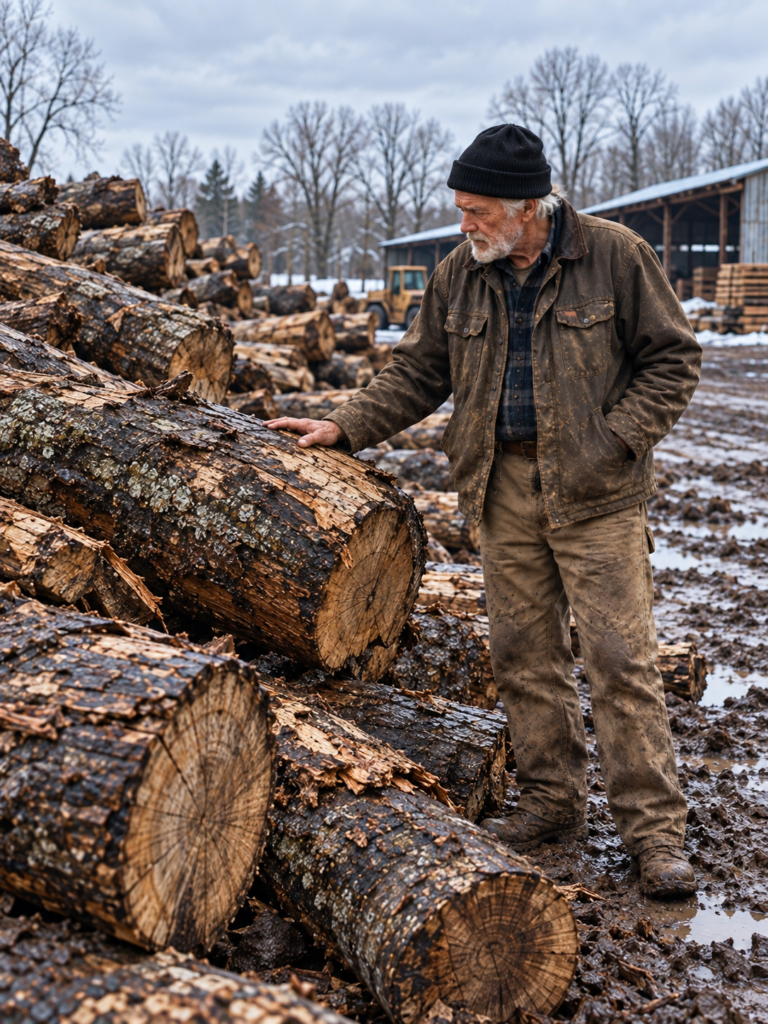
The first time I noticed those oak timbers, they were lying in a muddy heap behind the sawmill, looking like forty tons of trouble nobody wanted.
It had been raining off and on for days, the kind of cold late-winter rain that never seems to fall hard enough to call a storm but somehow manages to soak everything clear through. The gravel road along the mill yard was full of shallow brown puddles, and the low ground beyond the lumber stacks had turned into a mess of wet clay and wood chips.
That was where the mill had dumped the oak.
Some of the pieces were nearly straight, but most had bends and sweeps in them that made them look more like enormous wooden elbows than proper logs. A few curled sharply at one end. Others carried long, stubborn curves through their entire length. Dark water had gathered beneath them, and mud covered their surfaces so thoroughly that a man driving past would have had trouble telling one piece from another.
To most folks, it was nothing worth slowing down for.
The mill had its neat stacks of lumber, its machinery, and its trucks coming and going. Those were the things that made money. The twisted oak lying beyond the work yard was simply what remained after everything useful had been sorted out.
I understood that perfectly well.
I’d spent my life farming, and a farmer learns early that not everything growing out of the ground is worth what it costs to harvest. You can have the healthiest-looking field in the county, but if the crop won’t sell, that field can still put you in trouble.
A sawmill wasn’t so different.
The men working there needed straight timber they could turn into boards people wanted to buy. They couldn’t afford to spend half a day fighting crooked logs just because those logs happened to be good oak.
So when I first drove past that pile, I thought about it the same way everybody else probably did.
Firewood.
Good, heavy oak firewood, certainly. Enough to keep quite a few stoves burning through a winter. But firewood all the same.
I drove on.
Two days later, I passed the mill again.
The oak was still there.
Something about the shapes bothered me that second time. Not in a way I could have explained to anybody, at least not while I was driving. It was more like hearing an old song through a wall and recognizing it before you remembered the words.
I slowed down, looked toward the pile, and continued along the road.
By the third trip, I couldn’t leave it alone.
It was a bitter morning, and the cold had settled into my hands before I’d even finished the drive. I pulled my truck onto the gravel shoulder, shut off the engine, and sat looking through the windshield.
The sawmill was already working. Somewhere beyond the lumber stacks, a saw was whining through timber. The sound rose, held steady, and faded. A truck moved slowly across the yard, its tires grinding through wet gravel.
The discarded oak lay beyond it all, silent and forgotten.
I remember sitting there with both hands on the steering wheel, feeling a little foolish.
I was an old farmer with chores waiting at home. Nobody had asked me to inspect the mill’s refuse. Nobody needed my opinion about what belonged in a scrap pile.
Still, there were curves in that wood I hadn’t been able to forget.
Finally, I climbed out.
The mud caught at my boots the moment I stepped off the firm gravel. I walked carefully around the outside of the heap, studying the timbers from different angles.
Up close, they looked worse than they had from the road.
Water had settled in old cracks. Dirt clung to the rough grain. Several pieces were blackened with age, and the ends showed the effects of years of weather.
But beneath that ugly surface, I could see something else.
One enormous timber rose in a long natural sweep before turning into a tighter bend. Another had a broad shoulder and an arm extending from it at an angle no sawmill would consider convenient.
I stood looking at that second piece for a good while.
Then I reached out and laid my hand against the wood.
It was cold enough to make my fingers ache.
And suddenly I was a boy again, standing beside my father in his workshop.
My father had been a carpenter and a timberman, the kind of craftsman who could look at a piece of wood and tell you more about it than most men could tell you about their own neighbors.
He’d been gone more than forty years by then.
Even so, there were mornings when something as simple as the smell of freshly cut oak could bring him back so clearly that I almost expected to hear his boots crossing the floor behind me.
He had two rules that he repeated often enough to make them part of my bones.
The first was that you never took something that belonged to another man, no matter how little value you thought that man placed on it.
The second was that you never called a thing worthless until you understood what it was.
He wasn’t a man given to long speeches. Most of his lessons came while we were working, with a hammer in his hand or shavings collecting around his boots.
If I picked up a discarded piece of lumber and started carrying it away, he would ask whether I had permission.
If I tossed an odd-shaped offcut into the stove pile without examining it, he would tell me to bring it back.
There had been times, especially when I was young, when those habits seemed unnecessarily troublesome.
Why bother asking about something nobody wanted?
Why spend time looking at a piece of wood already rejected by a man who knew his business?
My father had a simple answer.
Because knowing what a thing is and knowing what it’s worth are not always the same.
Standing behind that sawmill all those years later, I could almost hear him saying it.
I looked again at the huge bent timber beneath my hand.
Its curve wasn’t a defect.
Not to a man who knew where such curves belonged.
There was a time when shipbuilders searched the forests for trees exactly like these. They wanted oak that had grown into strong natural bends, oak whose grain traveled around the curve instead of cutting across it.
They called it compass timber.
Certain curved pieces became ship’s knees, heavy wooden supports that helped join a vessel’s beams to its hull. A good one could withstand forces that would punish a weaker piece of timber.
Barn builders and timber framers understood the same principle.
When you needed to support a corner with a curved brace, you couldn’t always get the same strength by cutting a curved shape from a straight board. The grain might run out across the edge, leaving the finished piece weaker than its shape suggested.
And bending wood by steam or building up layers with glue was not the same as using a natural curve that had grown strong over decades.
My father had shown me that difference when I was little.
A boatbuilder down near the river had given him an old oak knee, and one afternoon Father set it across our workbench.
I can still remember its weight when he lifted it into my arms.
It looked plain enough to a boy who didn’t know better. A heavy crooked chunk of oak, polished in places by handling and rough in others.
Father traced the grain with one finger.
“Look here, Jack.”
I leaned closer.
“See how those lines follow the bend?”
I nodded.
“That’s because the tree grew that way. It didn’t start straight and have a man force a corner into it.”
He turned the timber slightly so the light caught the grain.
“That tree spent most of its life learning how to hold that shape. Don’t mistake what it learned for something being wrong with it.”
I never forgot that.
Nor did I forget the reverence with which he handled the old piece.
He could build fine things from straight lumber. He’d spent his life doing it. But that naturally curved oak seemed to stir something different in him, an appreciation for work that had begun long before any carpenter laid a tool against the wood.
Now, standing ankle-deep in mud, I was looking at a whole heap of timber that had grown into the very shapes my father had taught me to admire.
I walked around the pile again.
Forty tons, give or take.
That was an enormous amount of wood to a man working alone, and I had neither the equipment nor any immediate reason to haul it away. I wasn’t running a boatyard. I wasn’t building a barn.
But I knew somebody, somewhere, might need what was lying there.
And before I did another thing, there was my father’s first rule to settle.
I left the timber where it lay and went looking for the mill office.
The building was warm compared with the yard. The air carried the familiar mixture of damp coats, sawdust, and coffee. Papers sat in stacks near the desk, and through the window I could see a portion of the lumber yard.
The fellow inside looked up when I came through the door.
He was pleasant enough, though I imagine he wondered what an old man with muddy boots wanted at that hour.
“Morning,” he said.
“Morning. I’ve got a question about that oak you’ve got piled out back.”
He glanced toward the window.
“The crooked stuff?”
“That’s the one.”
“What about it?”
I took off my cap and held it between my hands.
“Who owns it?”
He gave me a curious look.
“The mill does.”
“You’re certain?”
He nodded.
“Bought it with a demolition load. Why? You looking for some firewood?”
“Not exactly.”
“Well, if you want some, we could work something out. We’d be glad to get part of that pile gone.”
I believed him.
The oak was taking up space and probably creating more work every time somebody needed to move around it. The mill had no use for timber that couldn’t be turned profitably into ordinary lumber.
And I wasn’t about to stand in that office and tell a man how to run his business.
Instead, I asked whether he’d mind telling me where the oak had come from.
He looked puzzled.
“From the demolition job, like I said.”
“What building?”
He thought a moment.
“I’d have to check.”
“I’d appreciate that.”
He hesitated, perhaps wondering why the answer mattered.
I understood his confusion. Most men interested in firewood wouldn’t care whether it came from an old barn, a warehouse, or a fallen tree.
But there was something I’d noticed while examining that pile, something that had been bothering me more than the natural bends.
Not all those pieces looked like freshly cut logs.
Some had flat faces that appeared to have been shaped by tools. Others bore marks that time and weather had softened but not erased.
And on one particularly large timber, partly buried beneath another, I’d found something my father would have recognized immediately.
A mortise.
A clean, squared pocket cut into the oak where another piece of timber had once fitted.
There was a round peg hole nearby.
I’d brushed mud from the opening with my fingers and found that the wood inside was still sound.
That changed the question entirely.
Those weren’t merely trees that had grown crooked and been rejected by a modern mill.
At least some of them had already served a purpose.
Someone had selected those curves, worked them by hand, cut joints into them, and fitted them into a structure that needed their strength.
Those pieces had once been part of something.
Something substantial enough to require oak beams and proper joinery.
I could imagine a carpenter leaning over that mortise with a chisel, working carefully because a bad joint might cause trouble long after he was gone.
I could imagine another man lifting the finished brace into place, checking the fit, and driving a wooden peg home.
They hadn’t shaped that timber for a fire.
They’d expected it to hold.
Now it was lying in the mud, awaiting a chipper.
The fellow at the desk pulled out a clipboard and began turning through the work orders.
I stood quietly while he searched.
A telephone rang somewhere behind him. Outside, machinery rattled against the steady noise of the mill. He went past one ticket, then another, checking dates and descriptions.
Every so often he would shake his head slightly and turn another page.
I don’t know why I remember that wait so clearly.
Nothing dramatic happened. Nobody came rushing through the door. The machinery outside kept running, and the man at the desk was simply trying to help an old farmer find an answer.
But I had the strangest feeling that something important was about to come out of those papers.
Perhaps it was because of the mortise I’d found.
Perhaps it was the old craftsman’s habits my father had left me.
Or perhaps I already understood, without yet knowing the particulars, that the timber lying outside had been part of a life the county had forgotten to honor.
The man finally stopped turning pages.
“Here it is,” he said.
He studied the work order a moment longer.
Then he read me the name of the building.
And for the first time that morning, the cold wasn’t what made me feel unsteady.
Part 2
The old Grange Hall.
For a moment I thought I’d misunderstood him.
I looked at the work order in his hand, then back at his face.
“The Grange Hall?” I asked.
“That’s what it says.”
“The one out at the crossroads?”
He checked the paper.
“Yes, sir. That’s where the demolition load came from.”
I didn’t say anything for a while.
The man continued explaining that the mill had purchased the timber as part of the demolition material. The old building had been taken down weeks earlier, and the heavier pieces had been hauled over for processing.
Most of the usable lumber had already been sorted.
The bent oak didn’t fit what the mill needed, so they’d set it aside.
It was a perfectly ordinary explanation.
But to me, there was nothing ordinary about what he’d just told me.
The Grange Hall had stood in our county since the 1880s.
It was one of those buildings that became part of the landscape so completely that people stopped thinking about the possibility of its disappearance.
You knew where it was the same way you knew where the river bent or where the old road met the highway.
For generations, folks had gathered there.
Farm families had come in from miles around for meetings and suppers. Children had played beneath its roof while their parents talked over crops, weather, and the ordinary troubles of making a living.
Young people had danced there.
Couples who’d spent their whole lives together had once stood there as newlyweds.
Families had come together for meals, celebrations, and the quiet, sorrowful business of saying goodbye to people they loved.
A building that has held that much human life becomes more than lumber and nails.
The Grange Hall had been raised by men who understood heavy timber.
They’d worked without the machines modern builders take for granted, using hand tools and methods passed from one generation to the next.
The great oak frame had stood through storms, harsh winters, summer heat, and the steady passage of time.
Its timbers had held for more than a century.
Then the roof began to fail.
There were repairs a building could survive and repairs that came too late. Eventually, the old hall had deteriorated badly enough that the county condemned it.
And once that decision was made, the rest followed.
The building came down.
Its old wooden frame was dismantled, and the pieces were carried away.
I knew all that.
The loss of the hall had been talked about around the county. I’d heard folks speak of it with the same helpless resignation people use when an old tree finally falls or a familiar place closes its doors for good.
But knowing a building was gone was one thing.
Standing in a sawmill office and discovering that its very bones lay discarded in the mud was another.
I thanked the man for his time.
He told me again that if I wanted some oak, the mill would be happy to sell it.
I said I’d think on it.
Then I put on my cap and walked back outside.
The wind had picked up.
I crossed the wet gravel, climbed into my truck, and shut the door.
For a long time, I didn’t start the engine.
I could see part of the pile from where I’d parked.
Those thick curved pieces, black with age and mud, had once been high above people’s heads, holding the roof and frame of the old hall together.
They had carried the weight of a place where generations of neighbors had gathered.
Now they were waiting to be ground into chips.
I leaned back against the seat and closed my eyes.
There is a particular kind of grief that comes with growing old.
You expect to lose people. That doesn’t make it easy, but you understand that every life has its appointed length.
What surprises you is how much of the world you remember begins disappearing along with them.
A farmhouse that once stood near a bend in the road becomes an empty patch of grass.
A store where your mother bought household goods becomes a vacant building.
An old bridge is replaced by a wider, stronger one, and although the new bridge does its job perfectly well, you still look toward the place where the old one used to stand.
After a while, a man can begin to feel that the landmarks of his life are quietly being erased.
The Grange Hall had been one of ours.
And now, looking at the timber outside, I felt that loss all over again.
I thought about my father.
He’d have walked around that pile with the same troubled expression I imagined I was wearing.
Not because he expected every old building to stand forever. He was practical enough to know better.
Wood rots. Roofs fail. Foundations settle. And sometimes the cost of saving a structure becomes more than the people responsible for it can reasonably bear.
No sensible carpenter denies those things.
But my father understood that the loss of a building didn’t necessarily mean every useful piece inside it had lost its purpose.
That thought stayed with me.
I looked out the windshield again.
And then I remembered Wendell.
Wendell was a good deal younger than I was, though he’d already spent years doing work most people considered old-fashioned.
He was a timber framer.
Not simply a carpenter who put up wooden buildings, but one of the few men left in the area who still practiced the older methods of fitting heavy timbers together with mortise-and-tenon joints and wooden pegs.
He understood why a natural curve mattered.
He understood what happened when a joint was cut against the grain.
More importantly, he respected what the old craftsmen had known, even when modern equipment offered easier ways of doing a job.
I’d known about his latest project because folks had been talking about it for nearly two years.
Wendell and a small group connected with the historical society had obtained a smaller old timber-frame pavilion.
They wanted to restore it and raise it again as a place the community could use.
It was a worthy idea.
The county had lost enough of its old gathering places, and this was a chance to bring one back.
The volunteers weren’t trying to rebuild the Grange Hall itself. That was gone.
They were working with a different, smaller structure, one that could still be saved.
They had the old frame.
They had people willing to give their time.
They had Wendell, who knew how the work needed to be done.
But they lacked a crucial part of the job.
Curved oak braces.
The old pavilion needed them to make its frame complete and sound.
And those particular pieces were proving nearly impossible to find.
I knew Wendell had searched farther than most people would have bothered.
He’d contacted sawmills in three states, asking about oak with suitable natural bends. He’d looked into what could be accomplished by steam bending and laminated construction.
He wasn’t opposed to modern methods merely because they were modern.
But he understood that substituting a manufactured curve would not necessarily give that old frame the strength, grain direction, and traditional joinery it required.
He wanted to restore it properly.
And for that, he needed oak that had grown into the right shapes.
That was the problem.
A straight board could be ordered.
A beam could be cut to length.
But a natural oak knee with a particular sweep wasn’t something a supplier could manufacture on demand.
A tree either had that curve or it didn’t.
Even when the right tree existed, somebody had to recognize it before it was cut into ordinary lumber or firewood.
The longer Wendell searched, the less hopeful the project became.
Two years had gone by.
And the old pavilion still hadn’t been raised.
I sat forward in the truck.
Forty feet away, more or less, was an enormous heap of old curved oak.
The very kind of timber Wendell had been looking for.
I couldn’t know yet how many pieces were sound, or whether their shapes would fit the restoration.
But I knew enough to understand that he needed to see them.
I reached for the telephone.
When Wendell answered, I told him where I was and what I’d found.
At first, I don’t think he quite understood.
“Crooked oak?” he asked.
“Not just crooked logs. Old worked timbers. Big curved braces, some with mortises and peg holes still in them.”
There was a pause.
“Where did you say?”
“The sawmill. Out beyond the main yard.”
“How much?”
“I couldn’t tell you exactly. They say there’s around forty tons in the pile.”
He let out a sound that was half disbelief and half something I hadn’t heard in a man for a while.
Hope.
“Jack,” he said, “are you telling me they’ve got old naturally curved oak lying around as scrap?”
“I’m telling you what I saw.”
“Is it sound?”
“Some of it is. I checked inside one of the old joints. You’ll have to look it over yourself before anybody promises anything.”
He went quiet again.
Then he asked the question that mattered.
“Whose is it?”
I almost smiled.
“The mill’s. I already asked.”
“Can we get it?”
“I haven’t asked that yet.”
Wendell understood.
We weren’t going to help ourselves to another man’s property, no matter how noble the intended use.
But now there was a reason to ask.
I told him where the oak had come from.
When I said the words old Grange Hall, the conversation changed.
Wendell knew that building.
More than that, he knew what it meant to the people trying to restore the pavilion.
Those timbers weren’t random scraps from some forgotten structure.
They were the remains of a place the community had lost, and they might be exactly what another old building needed to stand again.
It was the kind of possibility a man didn’t want to believe too quickly.
There was too much room for disappointment.
Still, neither of us could leave the matter alone.
After speaking with Wendell, I called Opal Rener.
Opal had been helping lead the historical society’s restoration effort, and she had a personal reason for caring about the Grange Hall.
Her great-grandfather had helped raise the original building back in the 1880s.
Imagine knowing that your own family had put its labor into a structure that served the community for more than a hundred years.
Imagine seeing that structure condemned and dismantled.
Opal had taken the loss hard.
I understood why.
When she answered, I explained what the mill office had told me.
There was silence on the line after I mentioned the Grange Hall.
Then she asked whether I was certain.
“As certain as I can be,” I said. “They checked the work order.”
“And the timbers are still there?”
“They were when I walked away from them.”
She wanted to know what condition they were in.
I told her the truth.
Dirty. Weathered. Muddy. A good many of them bent in ways no ordinary mill could use.
But some appeared sound, and the old joints were unmistakable.
I could hear her trying to make sense of the news.
For years she’d been carrying the grief of what had happened to the hall.
Now she was being told that pieces of its great oak frame might still have a purpose.
I didn’t promise her a miracle.
That wouldn’t have been fair.
I told her we had something worth examining, and that Wendell needed to see it before anybody knew what could be done.
But I think she understood what I was hoping.
The old hall couldn’t come back.
Its dances and suppers and meetings belonged to the past.
Yet perhaps part of what had held those gatherings together could be used to shelter new ones.
That seemed worth trying.
The next step was simple enough.
We went back to the mill and asked.
Not just Wendell and me acting as though enthusiasm gave us a right to anything. We approached the people responsible for the timber and explained what we had discovered.
The mill had obtained the oak lawfully.
It belonged to them.
They had bought it for business purposes, and the fact that they’d decided it wasn’t suitable for their saws didn’t change its ownership.
So we told them about the pavilion.
We explained that the old timber might be useful in a historic restoration, particularly because of its natural curves.
We explained that the material had come from the Grange Hall and that members of the historical society hoped to preserve a part of that history.
The people at the mill listened.
And then something happened that I have always appreciated.
They were glad to help.
There was no shouting, no dispute, and no ugly confrontation.
Nobody had to accuse the mill of disrespecting the county’s past.
The mill had simply been doing what a sawmill was meant to do. It wasn’t a museum, and it couldn’t be expected to preserve every odd-shaped timber that passed through its yard.
Once the people there understood the use we had in mind, they were happy to see the oak go toward something better than a chipper.
Any rightful claims were addressed, and everyone who needed to give permission did so openly.
That was important.
I would have been ashamed to take those timbers secretly, even if they ended up supporting a beautiful building.
My father had taught me that a good purpose didn’t make another man’s property yours.
We did things properly.
When the arrangements were settled, I walked outside and looked over that heap again.
It hadn’t changed.
The timbers were still blackened with age. The mud still clung to them. The pile was still awkward and enormous, with no easy way to separate one piece from another.
Anyone passing along the road would have seen the same discarded oak they’d seen the day before.
But I wasn’t looking at a pile of firewood anymore.
I was looking at work waiting to be done.
And for the first time since hearing that the Grange Hall had been torn down, I felt something other than sorrow when I thought about its old wooden frame.
I felt anticipation.
The trouble was, getting permission to save forty tons of timber was the easy part.
We still had to get those crooked old pieces out of the mud, determine which ones could be used, and somehow turn them into the bones of a building again.
That would take hands, patience, judgment, and more physical work than an old farmer like me could manage alone.
Fortunately, I wasn’t alone.
Part 3
The first day we started moving the oak, the ground was still wet enough to swallow a boot.
The mill yard looked much the same as it had on the morning I’d first stopped there. The low ground was slick with mud, and the old timbers lay tangled together in a heap that seemed to grow larger the closer a man got to it.
Only now, instead of one curious farmer walking around the outside, there were people who had come with a purpose.
Wendell was there, of course.
So was a crew of volunteers willing to spend their time rescuing pieces of wood that most folks wouldn’t have thought worth carrying home.
Some were younger than I was by several decades.
That pleased me more than I expected.
I’d worried, as older men sometimes do, that the kinds of things my father had cared about were disappearing from the world along with the men who knew how to make them.
But there they were, standing in the cold beside a muddy pile of oak, listening while Wendell explained what needed to be done.
We had to move carefully.
The timbers were heavy, awkward, and not arranged in any sensible order. Their curves locked against one another, making it difficult to separate them without first understanding how the pieces were resting.
Some of the old oak had been lying deep in mud for weeks.
Nobody could tell much about the condition of an entire timber until it had been pulled free and cleaned.
So we began slowly.
There was no grand speech, no dramatic moment when the work suddenly became easy.
We simply got on with it.
The first pieces came out covered in wet earth and old wood chips. As each one was freed, we moved it away from the heap, washed off the worst of the mud, and prepared it to be taken where it could be examined properly.
The work was tiring.
Cold water ran over our gloves and boots. Mud got onto coats, trousers, tools, and every other surface it could reach.
By the end of a day, a man could feel the effort in places he’d forgotten he had muscles.
I was old enough to know my limits.
I couldn’t match the younger volunteers when it came to lifting and hauling. My body had spent a lifetime working land, and it didn’t recover from hard labor the way it once had.
But there were things I could still contribute.
I could recognize old workmanship.
I could point out the direction of the grain.
And I could sometimes tell, from a shape or the position of a joint, what an unfamiliar piece of timber might have been intended to do.
Wendell valued those observations.
He knew the old methods himself, but he was also sensible enough to listen when somebody had learned them from a carpenter who’d practiced them before either of us was grown.
We spent the latter part of that winter and much of the spring working through the rescued oak.
The more we cleaned, the more the wood revealed.
There were mortises cut with remarkable care.
Peg holes passed cleanly through joints that had once held heavy sections of a frame together.
Some surfaces still carried the uneven but deliberate marks of hand tools.
Here and there, the old shaping had left subtle ridges that no modern machine would have produced in quite the same way.
The weathered outside of a timber might be gray or almost black, yet a newly exposed interior could still show strong, sound oak.
That was what interested Wendell most.
Age alone didn’t make a piece suitable for reuse. Nor did a beautiful curve.
The timber had to be sound enough for the work required of it, and the shape had to belong where it was going.
He examined each promising piece with the care of a man who knew that what looked good from a distance might reveal problems up close.
Sometimes he’d turn a timber and study the direction of the grain.
Sometimes he’d look into an old joint and run his fingers along the cut.
And sometimes he’d stand very still, staring at a curve as though he were trying to remember where he’d seen it before.
Those were my favorite moments.
Because every now and then, his expression would change.
He would call me over.
“Jack. Look at this.”
I’d make my way across the barn and stand beside him.
He would point to the curve.
“See how that sweeps through here?”
I would follow the line of the grain.
He’d explain where a brace like that might fit in the old pavilion frame.
The remarkable thing wasn’t merely that the oak was curved.
It was how closely some of those natural bends matched what the restoration needed.
Those timbers had been selected and worked more than a century earlier for a different building, by craftsmen who had understood the same principles Wendell was using now.
Their work hadn’t become obsolete simply because the building around it had been demolished.
The wood still possessed the qualities they’d valued.
There were moments when Wendell would hold up a sweeping oak knee, look toward the other salvaged members, and shake his head in quiet amazement.
For two years, he had searched for pieces like those.
He’d contacted mills across state lines. He’d considered alternatives. He’d wondered whether the restoration could ever be completed the way it deserved.
And now the material he needed was lying before him.
Not in a catalog.
Not in a warehouse full of new lumber.
But in pieces saved from the mud behind a local sawmill.
I remember one afternoon in particular.
We had been working in the barn, where the cleaned timbers were laid out for inspection.
The air smelled of damp oak, old wood, and the faint sweetness released wherever an aged surface had been cleaned enough to reveal the grain beneath.
Outside, the last cold weather of the season seemed determined not to leave.
Inside, Wendell was examining one of the larger curved braces.
He turned it carefully, studying the old joints and the way the grain flowed through the bend.
I stood nearby, watching.
It was strange to think of the men who had first worked that timber.
They’d been gone for generations.
They hadn’t known Wendell. They hadn’t known me.
They couldn’t have imagined the machines that would one day dismantle the building they’d helped raise, or the sawmill where its timbers would be discarded.
Yet here was a younger craftsman examining their work with the same concern for strength, proportion, and proper joinery.
For a few minutes, the distance between those generations seemed very small.
I thought of my father again.
He would have admired Wendell.
Not because Wendell refused to use modern tools, but because he understood the knowledge contained in old work.
A craftsman who respects the past doesn’t have to pretend that everything old is superior.
He simply knows that good judgment can survive its maker.
Standing there, watching Wendell measure the possibilities in that old curve, I felt as though my father was still teaching me something.
It was a feeling I hadn’t expected to have so late in life.
And it wasn’t the only surprise those months gave me.
The young volunteers kept coming back.
That’s worth mentioning, because it’s easy to admire an old building when somebody shows you a photograph of it.
It’s another matter to spend a cold afternoon washing mud from beams that weigh more than you do.
There was little glamour in the work.
The old timbers didn’t become pretty the moment we cleaned them. Some required close inspection. Others had to be sorted and handled again before anybody could decide how they might serve the restoration.
Yet the younger folks continued showing up.
They listened to Wendell explain the joints.
They learned to pay attention to grain direction.
They began recognizing the difference between a curve that merely looked interesting and one that could perform a useful structural job.
I watched them develop the same curiosity my father had encouraged in me.
And I found myself telling stories I hadn’t thought about in years.
I’d explain how my father studied a piece of timber before cutting it, or how he could spend longer choosing the right piece of wood than another man might spend shaping it.
Sometimes a volunteer would ask why an old joint had been made a particular way.
If I knew, I’d explain.
If Wendell knew better, I let him answer.
And there were times when neither of us could be completely certain what an old craftsman had intended.
We didn’t pretend otherwise.
We looked, reasoned, compared, and tried to understand.
That, to my mind, was as valuable as the work itself.
A piece of oak might hold a roof for a hundred years.
But the knowledge that tells a man how to use it can last much longer, provided somebody is willing to pass it along.
I had feared that nobody younger cared much about those things anymore.
Those weeks in the barn proved me wrong.
They cared enough to work.
And by the time spring settled over the county, I wasn’t thinking only about saving old timber.
I was thinking about how much of the old world could still find its way into the next generation if someone made room for it.
Eventually, the preparation began turning into construction.
The pavilion had waited a long time.
Its restoration had stalled because the necessary curved pieces simply couldn’t be found. Now Wendell had sound, naturally shaped oak that could be fitted into the old frame.
The project could move forward again.
I won’t pretend the construction was effortless.
Heavy timber framing is demanding work, even when the necessary pieces are available. Every member has its place. Every joint must fit properly.
An error that seems small while a timber lies on the ground can become a serious problem when that timber is raised into position.
Wendell knew this.
He approached the restoration with the same patient care he’d shown while examining the salvaged oak.
Those old curved braces had to become working parts of a sound structure, not merely souvenirs attached to a building for sentimental reasons.
That distinction mattered.
We hadn’t rescued the timber so people could stand around admiring its age.
We had rescued it because it still had a job to do.
And as the pavilion came together, the purpose of each piece became clearer.
The heavy oak frame began to take its familiar shape.
The braces fitted into their places, tying the timbers together in the manner the old craftsmen understood.
Each natural curve carried its grain along the bend, giving strength where the frame needed it.
Watching that happen was an experience I find difficult to put into words.
For months, I’d seen the oak lying on the ground.
First in a muddy heap.
Then in the barn, cleaned and carefully arranged.
Now I was looking at those same timbers as parts of a standing building.
Their curves no longer seemed awkward.
What had made them unsuitable for the sawmill was precisely what made them right for the pavilion.
One day, as I stood studying the frame, I thought back to the first morning I’d pulled my truck over.
I remembered looking at that pile and seeing firewood.
I’d come very close to driving away without another thought.
Most people had.
And I don’t fault them for it.
We all look at the world through the needs of our own lives.
The sawmill wanted straight boards.
A person heating a house might have wanted dry oak that would burn hot through the night.
A farmer might have thought about how much work it would take to move the pile.
But Wendell needed something else.
He needed the exact kind of strength those natural curves offered.
And the old oak had been waiting, without anybody realizing it, for a place where that strength mattered again.
When the pavilion was finally raised, it stood near the crossroads, not far from where the old Grange Hall had once been.
The original hall was still gone.
Nothing we had done could change that.
Its size, its long history, and the generations who’d gathered beneath its roof belonged to memory now.
But the smaller pavilion stood again.
And part of the old hall stood with it.
Opal Rener cut the ribbon at the dedication.
I watched her that day and thought about her great-grandfather, who had helped raise the Grange Hall all those years before.
He couldn’t have known what would become of his work.
He couldn’t have known that the building would serve four generations before its roof finally failed.
And he certainly couldn’t have known that some of the oak he’d helped put into place would one day be rescued from a sawmill and used to support another community gathering place.
Yet there was Opal, standing before the restored pavilion, with those old timbers overhead.
I wondered what she was feeling.
Pride, certainly.
Relief.
Perhaps some of the sorrow she’d carried since the hall came down.
There were tears in a good many eyes that day.
Mine among them.
I’ve attended enough county gatherings to know that people don’t always agree about much.
They can argue over roads, taxes, fences, and the proper way to handle almost any public matter.
But standing there beneath that old oak, I sensed that the people present understood what had been accomplished.
We hadn’t simply put up a shelter.
We’d given something back to the community.
Not the whole Grange Hall.
Not everything that had been lost.
But enough to prove that its story didn’t have to end in a pile of wood chips.
And the best part came afterward.
People began using the pavilion.
There was a wedding beneath it.
I wasn’t thinking about mortises and tenons when I heard about that occasion. I was thinking about two people beginning a life together under timbers that had already sheltered generations of ordinary human hopes.
There was a church supper.
Neighbors gathered, shared food, and talked beneath the wooden frame.
The sort of event that once would have seemed entirely at home in the old Grange Hall.
Then, on the Fourth of July, the county band played there.
I thought about that for a long while afterward.
The sound of music beneath those great curved braces.
The same oak that had lain in a muddy heap, waiting to be chipped, now standing above a gathering of people celebrating the county and the lives they shared within it.
That was worth more to me than any price somebody might have offered for the lumber.
People have asked what I made from the oak.
The answer is simple.
Not a dime.
I never intended to make money from it.
I had a farm to look after, and I knew very well that valuable things don’t always come with a price tag.
The mill had been willing to release the timber for a good purpose. Wendell and the historical society had given their knowledge and effort. Volunteers had spent weeks working in mud and cold water.
It would have felt wrong to treat the project as a chance for personal profit.
I didn’t need payment.
What I wanted was to see that old wood put to use before it was destroyed.
Still, I did keep one little piece.
A short offcut of the hand-hewn oak, too small for the restoration, with a single old peg hole passing through it.
It sits on my mantel now.
There isn’t anything especially impressive about it.
Its surface is rough in places. Its color has deepened with age. It doesn’t have the graceful sweep of the enormous braces Wendell fitted into the pavilion.
Most visitors probably wouldn’t give it a second glance.
But I know what it is.
I know that somebody more than a century ago held that piece of oak in his hands.
Somebody marked it, worked it, and bored a hole for a wooden peg.
Somebody trusted it to become part of a structure that would stand long after he was gone.
And for more than a hundred years, that old wood helped do exactly that.
When I sit by the fire in the evening, I sometimes look toward the mantel and think about everything that had to happen for that little offcut to end up in my house.
The tree had to grow with its particular shape.
A timberman had to recognize its usefulness.
A carpenter had to work it.
The Grange Hall had to stand through generations of county life.
Then the building had to come down.
The oak had to be carried to a mill that had no use for its curves.
And one cold morning, an old farmer had to stop his truck and ask a question.
There are times when that chain of events seems almost impossible.
But I don’t think there was anything miraculous about what happened.
The mill hadn’t done anything wrong.
The people who demolished the Grange Hall had been dealing with a building the county could no longer safely keep standing.
Wendell hadn’t failed because he lacked skill. He simply couldn’t find the unusual materials his work required.
Opal hadn’t been foolish to grieve for the old hall.
And I hadn’t been particularly clever when I stopped beside that pile.
We were ordinary people looking at the same problem from different directions.
What made the difference was that somebody finally connected one need with something another person no longer had a use for.
I’ve come to believe that happens more often than we realize.
A good tool can sit unused because its owner no longer has the work it was made for.
An old building can seem beyond hope until somebody understands which parts can still be saved.
A worker with years of knowledge can be overlooked because the world has changed the way it measures usefulness.
And an old man can begin to feel that his experience no longer has a place, only to discover that somebody younger is eager to learn what he knows.
I thought I was going to that sawmill to look at a pile of wood.
Instead, I found a way to put some of my father’s lessons to work again.
And perhaps that was the greatest gift the old oak gave me.
My father had been gone for more than forty years.
I couldn’t ask him what he thought of the pavilion.
I couldn’t bring him out to the crossroads and point up at those sweeping braces.
But I know what he would have looked at first.
He would have studied the joints.
He would have followed the grain around the curves.
He would have wanted to know whether the timbers were sound and whether the work had been done properly.
And once he was satisfied, I believe he’d have stood back and smiled.
Not a broad, showy smile.
Just the quiet expression he sometimes wore when something had been done the right way.
I can picture that almost as clearly as I can remember his hands.
These days, when I pass the crossroads and see the pavilion standing there, I sometimes slow my truck.
I look at the roof and the braces holding it.
I think about the people who gathered beneath the old Grange Hall, the men who raised it in the 1880s, and the generations who depended on its strength without giving much thought to the wood above their heads.
Then I think about the younger volunteers who came out in the mud to save those timbers.
And I realize the work connects more than buildings.
The craftsmen who shaped the original oak are gone.
My father is gone.
One day, Wendell and I will be gone, too.
But the lessons can remain.
They remain when somebody knows how to recognize a natural curve in an old timber.
They remain when people decide that a piece of their community’s history deserves the effort required to preserve it.
And they remain whenever a person stops long enough to ask whether something dismissed as useless might still have a purpose.
I don’t know how many more years that pavilion will stand.
I hope it stands a good long while.
I hope there are more weddings, more suppers, and more afternoons when neighbors come together under its roof.
I hope children who know nothing about the old Grange Hall will look up at those curved braces and wonder why the wood is shaped that way.
Perhaps someone will tell them.
Perhaps they’ll learn that the curves weren’t flaws at all.
That the trees grew that way, and that the grain followed the bends, making those pieces strong in ways straight lumber could not easily match.
Perhaps they’ll hear about a sawmill that had no need for the timber, and a group of people who recognized what it could become.
And maybe somebody will remember that the whole thing began with a question.
Not an accusation.
Not a demand.
Just a simple question asked before taking something that belonged to someone else.
Who owns it?
That was the first lesson my father taught me.
The second was to understand what a thing was before deciding it had no worth.
I was fortunate enough to see what happened when those two lessons came together.
Forty tons of crooked oak had been left in the mud because it couldn’t be made into the straight boards the sawmill needed.
There wasn’t anything wrong with those boards, or with the mill that produced them.
They served their purpose.
But the crooked pieces had a purpose, too.
They had helped hold up the Grange Hall for more than a century.
And when that building’s life came to an end, their strength was still there, waiting for somebody who knew how to use it.
The pavilion stands at the crossroads now, with its old oak braces fitted into place and its roof ready to shelter the next gathering.
Sometimes I think that says more about the worth of things than any words an old farmer could put together.
The timbers didn’t have to become straight to be useful.
They didn’t have to lose the shape they’d carried all their lives.
They only had to be seen for what they were.
And after everything they had been through, it was those crooked pieces, the ones everybody thought were good for nothing but the fire, that turned out to be strong enough to help hold the whole thing up.


