
Part 1
The first thing Jonah Callaway noticed was the little hand.
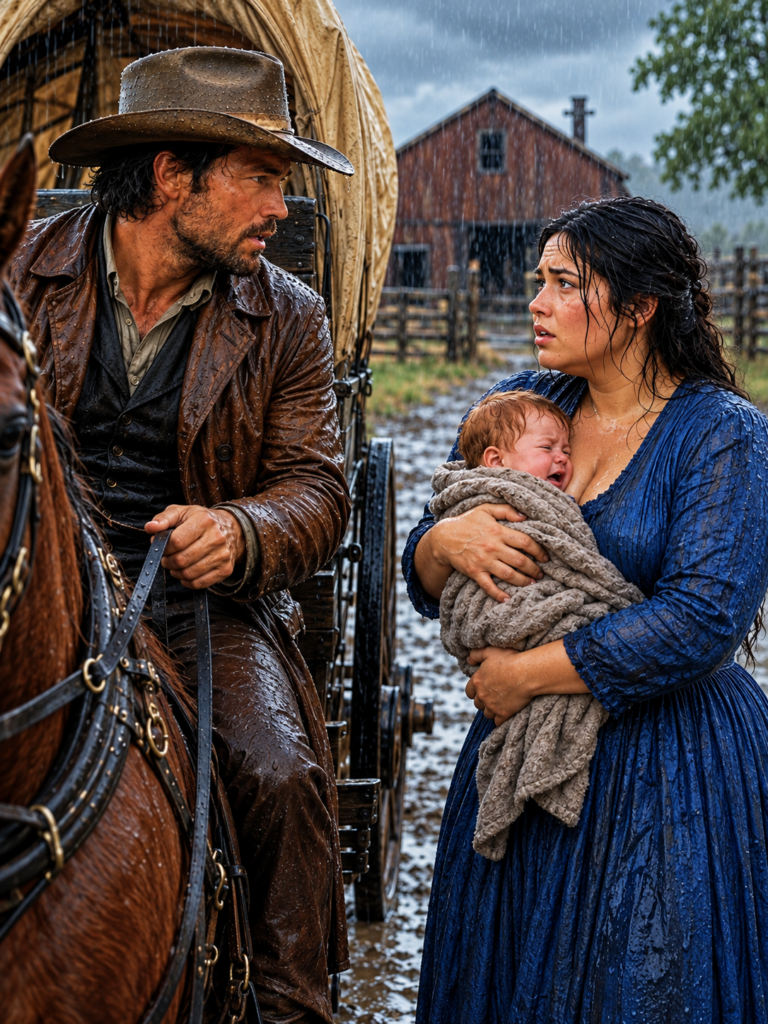
It appeared for an instant beneath the edge of a soaked wool blanket, no larger than a fallen maple leaf, before disappearing against the woman’s chest.
The second thing he noticed was that the woman had stopped walking.
She stood beside the muddy wagon road, with the October rain striking her shoulders and running down the front of her blue dress. Behind her stretched miles of empty Montana Territory, the mountains nearly swallowed by clouds.
There was no house in sight. No sheltered place to rest. No sensible reason for a young mother to be standing there as darkness gathered.
Jonah drew back on the reins.
His horse, August, snorted impatiently.
Jonah understood the sentiment.
He had spent the afternoon repairing a broken fence along the northern boundary of his ranch. His hands were stiff, his coat was wet, and the thought of a warm stove had occupied him for the better part of an hour.
He could have continued down the road.
He almost did.
Then the blanket shifted again.
“Ma’am?”
The woman turned.
She was younger than he had expected, perhaps twenty-seven or twenty-eight, with dark hair flattened against her cheeks and eyes that seemed to measure the distance between every possible danger.
“Are you hurt?” he asked.
“No.”
Her answer came too quickly.
“Where are you headed?”
“West.”
Jonah glanced toward the mountain road disappearing into the rain.
“West is a considerable distance.”
“I know.”
“You’ve got family waiting?”
Her lips tightened.
For a moment he thought she would refuse to answer. Then the baby made a small, unhappy sound beneath the blanket.
The woman lowered her face and murmured something Jonah could not hear.
He looked away, giving her a moment of privacy.
“My place is down in the valley,” he said. “A little over two miles. You can ride as far as the turnoff.”
She studied his wagon, then his face.
“What’s your name?”
“Jonah Callaway.”
“And you live there alone?”
The question was direct enough to surprise him.
“Yes, ma’am.”
“Have you a wife?”
“No.”
Something passed through his expression. He could feel it happening and disliked that he could not prevent it.
The woman noticed.
“I’m sorry,” she said.
He gave a brief nod.
Rain collected along the brim of his hat.
“How old is the baby?”
“Four months.”
Jonah looked at the blanket again.
Four months.
That changed things.
He climbed down from the wagon.
“You’re going to freeze standing here.”
She stepped backward.
He stopped immediately.
“All right,” he said. “I’ll stay where I am.”
For several seconds they watched one another through the rain.
Then she asked, so quietly he nearly missed it, “Do you have a barn?”
“I do.”
“Would there be somewhere dry in it? Just until morning. I can pay for the trouble.”
He looked at her muddy boots and the exhausted way she held the child.
“With what?”
She flushed.
Jonah regretted the question as soon as he heard it.
“I didn’t mean—”
“I have a little money.”
“Keep it.”
He reached toward the wagon, took up the spare horse blanket, and placed it over the bench.
“You and the baby can have the spare bedroom. There’s a stove in the house, and supper won’t take long.”
She stared at him.
“Why?”
It was not a question he knew how to answer in a way that would satisfy her.
“My father once found himself stranded in a blizzard,” he said. “A family he’d never met opened their door. I suppose I’ve remembered that.”
She looked down at the child.
“Her name is Clara.”
Jonah nodded.
“And yours?”
“Maeve Alder.”
She said the name carefully, almost as though offering it placed something precious at risk.
He held out his hand.
She hesitated before taking it.
Her fingers were colder than the rain.
As he helped her onto the wagon, he noticed an oilcloth packet tucked beneath the blanket, secured by a faded blue ribbon. She shifted it out of sight when she saw his glance.
Jonah pretended not to notice.
Some belongings were carried for warmth.
Others were carried because losing them would mean losing everything.
He had learned the difference long ago.
The Callaway ranch lay at the southern edge of a broad valley, where yellow grass rolled toward a distant line of dark pines.
The buildings were plain but sound.
A low house with a stone chimney stood near a weathered barn. Beyond it stretched a fenced pasture, a corral, and a narrow creek running between cottonwood trees.
Maeve counted three horses and several dozen cattle before Jonah had finished unhitching August.
She counted because counting steadied her.
She had counted coins on railway platforms, hours between stage departures, and the number of times Clara nursed each day.
She had counted until she understood exactly how little separated them from disaster.
The house surprised her.
It was clean, almost severely so. The firewood stood in a precise stack beside the stove. The dishes were arranged neatly, and a worn Bible rested on the mantel.
Nothing appeared neglected.
Yet something about the rooms felt unfinished.
There were two chairs near the fireplace, but one faced the wall.
A woman’s shawl hung from a peg beside the kitchen door, carefully folded over itself.
And beneath the front window stood a small wooden cradle.
Maeve looked at it only once.
Jonah saw.
“Spare room’s through there,” he said, pointing down a short passage. “There’s water in the pitcher. I’ll put more on the stove.”
He left her alone.
Maeve closed the bedroom door, laid Clara on the bed, and began removing her wet clothes with trembling hands.
Only after her daughter’s dry gown was fastened did she permit herself to sit.
She looked at Clara’s round face.
“Well,” she whispered, “we’ve managed another day.”
The baby studied her solemnly.
Maeve tried to smile.
For nearly three months, every morning had begun with one question.
How will I keep her safe today?
She had not allowed herself to ask anything beyond that.
Not where they would settle.
Not how she would earn a living.
And certainly not whether she would ever trust another person’s kindness.
Through the wall came the sound of Jonah moving pans.
Clara reached toward her mother’s face.
Maeve kissed her little fingers.
“Don’t become too fond of this place,” she whispered.
She was speaking to herself as much as the child.
Jonah made stew from beef, onions, potatoes, and the last carrots in his cellar.
He was cutting bread when Maeve appeared with Clara against her shoulder.
“May I do something?”
“No need.”
“I wasn’t asking whether there was a need.”
He turned.
She had changed into a plain gray dress. Her hair, still damp, was tied at her neck.
The exhaustion remained in her face, but she stood straighter now.
Jonah handed her the bread knife.
She accepted it without ceremony.
They worked in silence.
When supper was ready, Maeve sat across from him at the small kitchen table.
Clara lay awake in her arms.
“Where are you from?” Jonah asked.
“Kentucky.”
“Long journey.”
“Longer than I expected.”
He waited.
She offered nothing more.
He began eating.
A few minutes later she asked, “Do you hire help?”
“Sometimes. Branding season mostly.”
“Who keeps your accounts?”
“I do.”
She glanced toward a ledger on the shelf.
Jonah followed her eyes.
“Is that a criticism?”
“I haven’t seen the figures.”
“Then you’ll have to wait until morning.”
It was the first hint of amusement he had heard in her voice.
He found himself wanting to hear it again.
Clara began fussing.
Maeve rocked her gently, but the baby continued crying.
“She’s tired,” Maeve explained.
“Been a long day.”
“For both of us.”
Jonah stood and added another piece of wood to the stove.
As he turned, his eyes fell on the cradle.
He looked away.
Maeve noticed the movement.
She said nothing.
But later, when Clara had fallen asleep and the dishes were washed, she found Jonah standing at the window.
“Mr. Callaway?”
“Jonah will do.”
“Thank you for the room.”
“You’re welcome.”
“I’ll leave when the road is clear.”
His shoulders moved almost imperceptibly.
“The road will be ugly for a while.”
“Even so.”
He turned to face her.
“Nobody’s put a limit on your stay.”
Maeve lowered her eyes.
For reasons she could not explain, that frightened her more than a demand for payment would have.
Shortly after midnight, Clara began to cry.
At first Maeve thought she was hungry.
Then she touched her forehead.
Heat burned beneath the baby’s skin.
Maeve brought her closer to the lamp.
Her cheeks were flushed, and her breathing was quicker than usual.
A cold dread settled in Maeve’s stomach.
Not again.
She remembered Thomas lying beneath a quilt in the Kentucky summer, his skin burning while the doctor spoke in quiet tones at the foot of the bed.
She remembered the terrible speed with which a strong man had become a dying one.
“Clara?”
The baby cried harder.
Maeve opened the bedroom door.
Jonah was already standing in the passage.
“What’s wrong?”
“She’s feverish.”
He saw the fear in her face.
“How bad?”
“I don’t know.”
He looked at Clara.
Then he reached for his coat.
“Mrs. Fenner lives a mile east. She’s helped bring half the children in this valley into the world. I’ll fetch her.”
“The storm—”
“I know the road.”
He paused at the door.
“Would you rather I stayed?”
Maeve looked down at her daughter.
Every instinct told her not to depend on anyone.
But Clara’s skin was hot, and Maeve was far from everything familiar.
“Please bring her,” she whispered.
Jonah left without another word.
For the next hour, Maeve walked the bedroom floor, nursing Clara when she would feed, watching her breathing and speaking softly.
When she heard hoofbeats, she nearly fell reaching for the door.
Mrs. Fenner arrived wrapped in a heavy black coat, her silver hair escaping its pins.
She took one look at the baby and set down her bag.
“Light, dear. Bring the lamp closer.”
Jonah obeyed.
Mrs. Fenner examined Clara carefully, asking Maeve about her feeding, her breathing, and when the fever had begun.
After several minutes, she looked toward Jonah.
“Send for Doctor Mercer when there’s enough light to travel safely. I want him to examine her, too.”
Jonah nodded.
Maeve’s voice shook.
“Is she terribly ill?”
“She needs careful watching,” Mrs. Fenner answered. “We’ll do that together.”
Those last words almost undid Maeve.
Together.
She had forgotten how such a thing felt.
Jonah kept the stove burning and carried fresh water while Mrs. Fenner stayed beside the bed. At dawn he rode to fetch the doctor.
Clara’s fever eased as the morning brightened. Doctor Mercer examined her and, finding her breathing comfortable and her condition improved, left instructions for continued observation.
By afternoon, she was nursing well and sleeping peacefully.
Maeve remained beside her long after the doctor departed.
When Jonah came to the doorway, she looked up.
“Mrs. Fenner said you rode through the storm with your coat open.”
“The wind kept throwing it back.”
“You could have been hurt.”
“So could she.”
He looked at the sleeping baby.
For a moment, the tired lines around his eyes seemed deeper.
Then he said, “I’ll bring supper in here.”
Maeve reached out.
She caught his sleeve before he could turn away.
He looked down at her hand.
“Thank you,” she said.
He nodded.
Yet when he went into the kitchen, his expression was not that of a man who had done a good deed.
It was the expression of someone who had opened a locked room in his memory and found the grief still waiting inside.
By the fourth day, Maeve had discovered three things about Jonah Callaway.
He was a capable rancher, a poor bookkeeper, and a man who rarely asked for help even when he plainly needed it.
The first became obvious when she watched him calm a frightened horse with nothing but his voice.
The second emerged when she examined the ranch ledger.
The third revealed itself every time she offered to make his work easier.
“You’ve paid twice for the same shipment of grain,” she told him one afternoon.
Jonah looked up from repairing a harness.
“Impossible.”
She pointed to two entries.
“Same date, same quantity, same merchant.”
“Probably wrote it twice.”
“Then why did the money leave your cash box twice?”
He set down the harness.
Maeve showed him the corresponding receipts.
For a long moment he studied them.
Then he frowned.
“That miserable thief.”
“I wouldn’t call him that until we know whether it was deliberate.”
“What would you call him?”
“Someone who owes you twelve dollars.”
Jonah laughed.
It surprised them both.
He had forgotten how suddenly laughter could arrive.
From the floor, Clara made an approving noise.
Maeve smiled down at her.
Jonah found himself watching the smile.
He turned back to the harness before she noticed.
By the end of the week, Maeve had reorganized the accounts, repaired two torn shirts, and helped Mrs. Fenner preserve the final apples of the season.
She never behaved as though the ranch belonged to her.
But she moved through the house with growing certainty, and Jonah began noticing how often he looked for evidence of her presence.
A clean cloth on the kitchen counter.
A cup placed beside the coffee pot.
Clara’s little garments drying near the stove.
Ordinary things.
He had once believed ordinary things were the easiest to lose.
Now he began to suspect they were also the hardest to live without.
On the seventh evening, Jonah found Maeve standing beside the cradle.
She was running her fingertips over the carved wooden rail.
He stopped in the doorway.
She withdrew her hand.
“I’m sorry.”
“Nothing to apologize for.”
“It’s beautiful work.”
“My father made it.”
She looked toward him.
“For your child?”
Jonah felt the old familiar tightening beneath his ribs.
“Yes.”
Maeve’s face changed.
She understood enough not to ask more.
But Jonah surprised himself.
“His name would have been James.”
The room became very quiet.
“He never got to use it.”
Maeve lowered her head.
“I’m sorry.”
Jonah nodded.
Then he walked outside into the cold evening.
He stayed by the corral until the stars appeared.
When he returned, a lamp was burning in the kitchen, and Maeve had left a cup of coffee for him.
Beside it lay a folded piece of paper.
“Jonah,” she said, “there’s something I need to tell you.”
He sat.
She placed her hands on either side of the paper.
“My husband died in July.”
Jonah waited.
“His name was Thomas Alder. We had a little farm in Harlan County, Kentucky. Nothing grand, but it was ours.”
She spoke carefully, as though every sentence required courage.
“Thomas bought it after we married. He worked that land from dawn until dark. He wanted Clara to grow up where there was enough water for an orchard.”
Her fingers tightened.
“His older brother, Garrett, wanted the same property. There was a spring on it that could supply the mill Garrett had built farther down the valley.”
Jonah glanced at the document.
“What happened after your husband died?”
“Garrett offered to help.”
Maeve gave a small, bitter smile.
“He paid for Thomas’s burial. He arranged some of the business matters. I believed he was trying to spare me trouble.”
“And he wasn’t?”
“He began asking me to sign papers. At first he said they would settle Thomas’s debts. Then he said a widow with an infant couldn’t manage land properly.”
She pushed the document across the table.
Jonah unfolded it.
It was a copy of a petition addressed to a court in Kentucky.
His eyes moved down the page.
Then stopped.
The petition alleged that Maeve Alder was without adequate means to support her child and requested that Garrett Alder be appointed Clara’s guardian.
“Has a judge granted this?” Jonah asked.
“No. Not when I left.”
“He has only filed it?”
“Yes.”
Jonah continued reading.
Under the allegations, Garrett’s name appeared beside the names of two men Maeve did not recognize.
“He told me Clara would be better off under his protection,” she said. “He told me I could visit her.”
Her voice broke.
She looked away until she could speak again.
“Thomas wanted his daughter to inherit our land. Garrett intends to use Clara’s property as though it belongs to him.”
“Does your husband’s will say that?”
“Yes. The original is with the county records. I have a copy of the relevant pages.”
She touched the oilcloth packet that had traveled with her through the rain.
“I didn’t know whether it would be enough.”
Jonah folded the petition.
“Why Montana?”
“I bought a railway ticket as far as my money would take me. After that, I kept going because stopping frightened me.”
“Does Garrett know where you are?”
“I don’t think so.”
She studied Jonah’s face.
“I should have told you sooner.”
“Probably.”
“I understand if you want us gone.”
Jonah looked at the lamp, then at the sleeping child in the next room.
He thought about the cold road.
He thought about the money she no longer had.
And he thought about the way her hands had shaken when she told him another man wanted to take her daughter.
“Tomorrow,” he said, “we’ll speak to Edgar Cole.”
“Who is he?”
“Our local justice of the peace. He’ll tell us what can be done here, and what must be handled back in Kentucky.”
Maeve swallowed.
“You would help me?”
“I’d help anyone facing a man trying to take a child without the law behind him.”
She looked steadily at him.
“Anyone?”
He understood the question beneath the question.
“Yes,” he said. “But I’m glad you came here.”
For the first time since arriving, Maeve let herself believe she might remain in one place long enough to think about tomorrow.
Neither knew that, at that very moment, a stranger in a dark coat had arrived at the Coulter Creek Hotel.
He carried a Kentucky court petition inside his leather traveling case.
And he was asking whether anyone had seen a woman traveling alone with a red-haired baby.
Part 2
By the time Garrett Alder reached Coulter Creek, Maeve had already begun to fear the kindness of the house.
Not because Jonah expected something from her.
That would have been easier.
She understood bargains. She understood unpaid debts and the price people attached to assistance.
What she did not understand was a man who accepted her help without treating it as payment, who listened when she disagreed with him, and who carried Clara around the kitchen while Maeve worked without seeming to want credit for the act.
One evening she found him seated beside the stove, Clara resting against his chest.
He was studying the baby’s fingers.
“She keeps opening and closing them,” he said.
“She’s discovering that they’re hers.”
He considered that.
“Must be a peculiar thing, finding out you’ve been given hands.”
Maeve laughed.
Jonah looked up.
She was startled by the expression on his face.
Not surprise.
Something closer to wonder.
For a moment neither moved.
Then Clara seized a button on his shirt and tried to bring it to her mouth.
Jonah looked down.
“That won’t improve its flavor.”
Maeve laughed again.
Outside, the wind pressed against the windows.
Inside, the little house seemed almost unwilling to let the sound go.
Edgar Cole received Maeve in his office the following morning.
He was a broad-shouldered man with thinning gray hair and a habit of setting his spectacles down whenever a matter required particular attention.
Jonah remained beside the door while Maeve sat across from the desk.
She told Edgar about Thomas, about the farm, and about Garrett’s attempt to secure Clara’s guardianship.
Edgar examined the petition and the copies Maeve carried.
“This is not an order appointing anyone guardian,” he said at last.
“I know.”
“Has Mr. Alder made threats against you?”
“Not in words that would trouble a court.”
“What words did he use?”
Maeve held his gaze.
“He said a sensible mother would understand when she had lost the privilege of deciding for her child.”
Edgar’s expression hardened.
“That troubles me.”
He asked several more questions.
Then he explained what he could and could not do.
A Montana justice could not settle title to Kentucky land simply because the owner had traveled west. Nor could Edgar promise that proceedings filed elsewhere would disappear.
But Garrett’s petition did not itself authorize him to seize Clara, and no private citizen could turn accusations into lawful custody by carrying them across the country.
“If he comes here,” Edgar said, “he may present his documents. But you are entitled to be heard, Mrs. Alder. I advise you to have a lawyer in Kentucky examine what was filed.”
“I know someone who might help,” Maeve replied.
She told him about a former courthouse clerk named Mr. Whitcomb, who had witnessed Thomas’s will.
“I wrote to him before I left. I never gave him an address.”
Edgar pulled a sheet of paper from his drawer.
“Then let’s send him one.”
Maeve hesitated.
Garrett had spent months persuading her that any place she could be found was a place she could be harmed.
Jonah understood before she spoke.
“Use Edgar’s office,” he suggested. “If you prefer.”
Maeve looked at him.
He had offered her a choice rather than making one for her.
“Yes,” she said. “I’d prefer that.”
Edgar handed her the pen.
She wrote slowly, enclosing copies of the petition and the pages of Thomas’s will she had carried west.
When she finished, her hand trembled.
Jonah said nothing.
But he held the door open for her when they left, and Maeve found that even this small courtesy felt different now.
It was not the gesture of a man leading her.
It was the gesture of one who had decided not to let her face the cold alone.
Garrett found them three days later.
He came into Coulter Creek on a Friday afternoon with two hired men and a wagon bearing the marks of long travel.
His coat was expensive, his boots polished, and his face bore the strained confidence of a man who had spent too much money to permit failure.
He first visited the hotel.
Then the general store.
By the time Jonah learned he was in town, Garrett had already asked enough questions for half the settlement to know his business.
Mrs. Fenner brought the warning herself.
She drove her little buggy into the Callaway yard shortly before supper.
Maeve met her at the door.
“He’s here,” Mrs. Fenner said.
The words chilled Maeve more thoroughly than the rain ever had.
“Has he seen you?”
“No. And before you start imagining the worst, I want you to remember that this valley is not empty of decent people.”
Maeve looked toward the house.
“Garrett knows how to sound reasonable.”
“So do plenty of wicked men. It doesn’t make them right.”
Jonah came from the barn as Mrs. Fenner finished speaking.
She told him what she knew.
He stood silent for several moments.
Then he asked Maeve, “What do you want to do?”
She looked startled.
“Shouldn’t we decide what is safest?”
“Yes. But it ought to begin with what you want.”
Maeve looked toward the mountains.
For weeks she had imagined Garrett’s arrival as the moment when she would run again.
She had rehearsed it a hundred times.
She would take Clara.
She would hide her few belongings.
She would leave before dawn.
But now that he had finally found her, she was exhausted by the thought of surrendering every place she tried to make a home.
“I want to stop running,” she said.
Jonah nodded.
“Then we’ll begin there.”
Garrett came to the ranch the following morning.
Two men rode behind his wagon.
Jonah was mending a section of fence near the corral when he saw them approach.
He put down his tools and waited.
Garrett climbed from the wagon without removing his gloves.
“Callaway?”
“That’s right.”
“I’m looking for Maeve Alder.”
“I know.”
Garrett’s expression sharpened.
“Then you know she has my brother’s child.”
Jonah looked at him steadily.
“She has her own daughter.”
Garrett smiled thinly.
“I’m not here to argue the matter with a stranger.”
“Then you won’t mind speaking to her.”
Maeve appeared on the porch with Clara in her arms.
Garrett’s face altered when he saw her.
For a moment, something resembling relief crossed it.
Then anger took its place.
“Maeve.”
“Garrett.”
“You’ve caused a good deal of trouble.”
“I imagine I’ve caused you inconvenience.”
“Do you have any idea what it cost to follow you here?”
“No.”
“I sold equipment to raise the money.”
“That was your decision.”
One of the hired men looked away.
Garrett stepped closer.
Jonah moved slightly, but Maeve raised her hand.
He stopped.
“Come home,” Garrett said. “We can settle this without embarrassing the family any further.”
“Thomas is dead. Clara and I are the family he left.”
“That property cannot support you.”
“It supported Thomas and me.”
“Thomas had debts.”
“I know what he owed.”
“You don’t understand the mill business.”
“I understand why you want the spring.”
Garrett’s expression darkened.
“My mill employs eleven men. Their families depend upon it.”
“Then find a lawful way to secure the water you need.”
“Thomas would have wanted the family business protected.”
Maeve tightened her hold on Clara.
“Thomas loved his brother. That doesn’t mean he gave you his wife’s land.”
Garrett reached into his coat.
He produced the folded petition.
“I have sworn statements concerning your circumstances.”
“Then show them to Mr. Cole.”
“I’m prepared to offer you a fair arrangement.”
“What arrangement?”
“You can return with me. I’ll take responsibility for Clara’s property until she’s grown. You may live in the house and have an allowance.”
“And if I refuse?”
Garrett looked at Jonah.
“Then I shall ask the authorities why a recently widowed mother has taken an infant across the country to live with a man who is no relation to her.”
The words hung in the cold morning air.
Maeve went very still.
Garrett saw that he had struck something vulnerable.
He continued.
“People judge such matters, Maeve. You ought to consider the child’s future.”
Jonah felt anger rise through him.
Not the quick anger of a man offended.
The dangerous anger that comes when someone deliberately wounds a person already frightened.
He stepped forward.
Maeve touched his arm.
“Let me answer.”
Jonah stopped.
She looked at Garrett.
“Whatever strangers choose to think of me, they will not turn you into Clara’s father.”
Garrett’s mouth tightened.
“I will see you at the justice’s office.”
“Yes,” Maeve said. “You will.”
He climbed back into the wagon.
The two men followed.
As the wheels turned down the track, Maeve felt the strength leave her legs.
Jonah caught her elbow.
“Inside,” he said.
She looked toward the departing wagon.
“I thought I could face him without shaking.”
“You did face him.”
“He’s going to tell everyone.”
“He may.”
“That I am an unfit mother. That I’ve behaved shamefully.”
Jonah looked at Clara, who was tugging at her mother’s collar.
“People can repeat a lie a great many times,” he said. “It doesn’t improve the truth of it.”
Maeve pressed her lips together.
Then she began to cry.
It was the first time Jonah had seen her do so.
He did not embrace her immediately.
He waited until she leaned toward him.
Only then did he place an arm around her shoulders.
And for one brief moment she rested against him, the baby safe between them.
Garrett’s accusations traveled through Coulter Creek with the speed of gossip.
By Sunday, two women at the general store had stopped speaking when Maeve entered.
A ranch hand stared openly at Jonah when he bought oats.
The minister’s wife called upon Mrs. Fenner to inquire whether the arrangement at the Callaway ranch was “entirely proper.”
Mrs. Fenner told her that proper conduct would include minding her own household.
But Maeve heard enough to understand the danger.
Garrett did not need to prove she had harmed Clara.
He needed to persuade others that she was the sort of woman who might.
The distinction frightened her.
One afternoon, she found Jonah at the kitchen table with a sheet of paper.
He had drafted a letter to a lawyer in Helena asking about the Kentucky petition.
She read the first paragraph.
Then she looked up.
“You’ve written as though you represent me.”
Jonah frowned.
“I thought I’d find out what help is available.”
“I appreciate that. But it is my case.”
“I wasn’t trying to take it from you.”
“I know.”
She set the letter down.
“That’s what makes it difficult.”
He stared at her.
Maeve continued quietly.
“For months, Garrett made decisions in my name. He told everyone he was caring for me. He paid bills I hadn’t asked him to pay. He talked about what was best for Clara without once asking what I believed.”
Jonah’s expression changed.
“I am not Garrett.”
“No,” she said. “But I need you to understand why being helped without being consulted frightens me.”
He looked at the letter.
Then he tore it in half.
Maeve was startled.
“You didn’t need to destroy it.”
“I can write another.”
He drew a clean page toward her.
“Tell me what you want it to say.”
She sat down beside him.
Together they wrote the letter.
It took considerably longer.
But when it was finished, Maeve signed her own name beneath it.
And something important shifted between them.
That night, Jonah stood alone in the main room, looking at the cradle.
He had avoided touching it for years.
Its maple rails still carried the faint marks left by his father’s tools.
His father had been proud of making it.
Ruth had loved it before it was finished.
Jonah remembered her standing beside the window, one hand on her swollen belly, laughing because the cradle was so sturdily built that she claimed it might outlast the house.
He remembered carrying her to bed when the pains began.
He remembered the doctor arriving too late to change anything.
By morning, Ruth and their son were gone.
After the burial, Jonah had intended to move the cradle into the loft.
He had never managed to do it.
Now a baby slept beneath his roof, and sometimes he caught himself imagining Clara in it.
The thought filled him with tenderness.
And guilt.
He heard footsteps.
Maeve stood at the doorway.
“I couldn’t sleep.”
“Neither could I.”
She saw where he was looking.
“Would you tell me about Ruth?”
Jonah was silent.
Then he pulled a chair toward the fire.
Maeve sat opposite him.
He spoke slowly at first.
Ruth had been the daughter of a blacksmith. She had married him when the ranch consisted of a cabin, a broken wagon, and eleven cows.
She could ride better than he could, argued fiercely over livestock prices, and sang while she cooked, usually without knowing she was doing it.
“She sounds wonderful,” Maeve said.
“She was.”
His hands tightened.
“When James came too early, I thought if I could just get the doctor there, everything would be all right.”
He looked at the floor.
“I spent years wondering which thing I should have done differently.”
Maeve said nothing.
“Ruth was gone before sunrise. James had never opened his eyes.”
His voice lowered.
“Afterward, I couldn’t bear the sound of anyone talking about babies. When Luke and his wife had their youngest, I stayed away from their house for three months.”
“Grief makes cowards of us in unexpected ways,” Maeve said gently.
He looked up.
She understood because Thomas’s death had done the same to her.
She told Jonah how her husband had held Clara during the brief weeks he had known her. How he had imagined teaching her to plant beans and lead a pony.
And how, after he died, Maeve sometimes felt angry with him for leaving her.
“I knew he hadn’t chosen to,” she whispered. “But I was angry all the same.”
Jonah leaned back in his chair.
For a while they listened to the fire.
Then Maeve said, “Clara isn’t James.”
“I know.”
“And I cannot be Ruth.”
“I know that, too.”
She studied his face.
“Then why do you look frightened whenever we begin to feel at home here?”
Jonah closed his eyes.
Because happiness had once arrived at this house with terrible promises.
Because he knew what it cost to love someone who could disappear.
Because for the first time in three years, he had something to lose again.
He opened his eyes.
“Because I want you to stay,” he said.
Maeve’s breath caught.
Jonah looked at her.
“And I don’t know whether that is a fair thing to ask.”
She reached across the space between the chairs.
Her hand settled over his.
“For tonight,” she said, “you needn’t ask anything.”
He turned his hand beneath hers.
They remained that way until the fire burned low.
The following morning, Garrett appeared at Edgar Cole’s office with a second document.
Unlike the petition Maeve had seen, this one included a statement purporting to establish that she had abandoned the Kentucky property, had no settled residence, and was incapable of managing Clara’s inheritance.
More troubling still, Garrett claimed several Kentucky neighbors were prepared to support him.
Edgar examined the papers.
He did not promise Garrett the result he wanted.
Instead he notified Maeve that a meeting would be held the next morning to hear what Garrett was asking and whether any immediate action was warranted locally.
Maeve read the notice twice.
Jonah watched her.
“We can face it.”
She shook her head.
“You don’t understand.”
“Then tell me.”
“Those men Garrett named helped Thomas build our barn. They came to our wedding. One of their wives sat beside me when Thomas died.”
Her voice trembled.
“If they’ve truly agreed to testify against me, then Garrett has reached into every part of the life I thought I knew.”
She sank into the chair.
Clara slept in the next room.
The silence felt unbearable.
Then Maeve unfolded the document again.
Near the bottom was a name she recognized.
Not a neighbor.
Not a doctor.
A man who had once worked in the county records office.
The very clerk to whom she had written.
Mr. Whitcomb.
But his name appeared beside a statement that the court had been unable to locate Thomas Alder’s original will.
Maeve stared at the words.
“That’s not possible,” she whispered.
Jonah leaned closer.
“Why?”
“Because Mr. Whitcomb witnessed the will himself. He told Thomas where to have it recorded.”
She raised her eyes.
“If he’s saying it cannot be found, something has gone terribly wrong.”
For the first time, Jonah saw fear in her expression that was greater than her fear of Garrett.
Someone in Kentucky might have altered the story of her husband’s final wishes.
And tomorrow, in a town where she had lived less than two weeks, she would have to defend the one person who mattered more than her own life.
Her daughter.
Part 3
Maeve dressed Clara in her best little gown the next morning.
It was white cotton with blue stitching around the cuffs, sewn by Thomas’s mother before the baby was born.
Maeve had kept it folded in her traveling bag through every miserable mile from Kentucky.
She fastened the last button with steady fingers.
Then she knelt beside the bed.
“You’ll never remember any of this,” she whispered.
Clara reached toward her face.
“But one day, I’ll tell you what it took to keep us together.”
Outside, Jonah was waiting beside the wagon.
He wore his clean coat and carried no weapon beyond the small knife he used for ordinary ranch work.
When Maeve came out, he offered his hand.
She accepted it.
The journey into Coulter Creek took less than half an hour.
Neither spoke much.
But as they approached the town, Jonah glanced at her.
“Whatever happens in that office, you have somewhere to come back to.”
Maeve looked toward the road ahead.
She wanted to believe him.
But she had learned that people could promise safety while offering none.
She squeezed his hand once.
Then released it.
Edgar Cole’s office was crowded.
Garrett occupied a chair near the desk. His two companions stood against the wall.
Mrs. Fenner had arrived early and sat beside the window, her back unusually straight.
Doctor Mercer was there as well, summoned because Garrett’s allegations included questions about Clara’s health.
Jonah guided Maeve to an empty chair.
Garrett looked at them.
He did not smile.
Edgar began by making the purpose of the meeting plain.
He was not deciding ownership of Kentucky land. Nor was he conducting a full guardianship hearing under Kentucky law.
He was considering Garrett’s request for immediate local assistance in taking custody of Clara and determining whether the documents showed any lawful basis for such action.
Garrett spoke first.
He described his dead brother’s farm, his financial contributions, and the concerns he claimed to have about Maeve’s ability to raise a child alone.
His manner was controlled.
Almost sorrowful.
He spoke of duty, family, responsibility, and the uncertainty of life on the frontier.
Then he turned toward Maeve.
“My sister-in-law has suffered a terrible loss. I do not doubt her affection for the child. But grief has unsettled her judgment.”
Maeve remained still.
Garrett continued.
“She fled her home, crossed several territories without adequate support, and placed an infant in danger. She now resides with a gentleman unrelated to either her or my brother.”
A low murmur passed through the room.
Edgar raised his hand.
“That will be enough concerning her lodging arrangements.”
Garrett stiffened.
“I believe they are relevant.”
“Then establish how they make Mrs. Alder incapable of caring for her child.”
For the first time, Garrett struggled to answer.
He turned to the petition.
“The Kentucky court will address her fitness.”
“Perhaps,” Edgar said. “But you have brought me a request, not an order.”
Garrett laid the additional statement on the desk.
“These witnesses can confirm that my brother’s estate requires responsible administration.”
Edgar examined it.
Then he looked toward Maeve.
“Mrs. Alder, what do you wish to say?”
She stood.
For a moment, the room swayed.
She remembered Thomas’s funeral.
She remembered Garrett offering to pay for the coffin.
She remembered the first time he had spoken of taking Clara.
And she remembered a road in Montana where a stranger had reached down from a wagon without asking what she possessed.
Maeve drew a breath.
“My husband owned a farm in Harlan County,” she began. “It was small, but it had good water, and he was proud of it.”
She looked toward Garrett.
“His brother wanted the spring for his mill. Thomas refused to sell.”
Garrett moved in his chair.
Maeve continued.
“When Thomas died, Garrett paid for his burial. I was grateful. I still am. But he began treating that expense as though it gave him authority over everything Thomas left.”
Her voice steadied.
“He wanted me to sign papers placing the property under his control. When I refused, he questioned whether I should be permitted to raise my own child.”
She placed the copies of Thomas’s will on Edgar’s desk.
“These are the pages I carried from Kentucky. They show that Thomas intended his property to provide for Clara and me.”
Garrett interrupted.
“The original instrument has not been located.”
“I have asked the former clerk who witnessed it to confirm the record.”
“He may no longer remember the circumstances.”
Maeve turned toward him.
“Then why does your statement use his name?”
Garrett fell silent.
Edgar looked down at the document.
“Mr. Alder, is this a signed statement from Mr. Whitcomb?”
Garrett hesitated.
“It records information supplied concerning the estate.”
“That is not what I asked.”
“No. It was prepared from the information available to me.”
“Then you have not established that Mr. Whitcomb made this claim.”
Garrett’s expression hardened.
Edgar set the paper aside.
Maeve went on.
“I have not abandoned my daughter. I have not refused to work. I have not harmed her. I traveled because I feared what Garrett might attempt before I could secure proper legal help.”
She paused.
“I know that leaving Kentucky cannot settle a Kentucky court matter. I understand I may have to answer those claims there.”
She looked directly at Edgar.
“But I am here today. I am asking to be heard before anyone decides what should happen to my child.”
For several seconds, nobody spoke.
Then Doctor Mercer stood.
He testified that he had examined Clara shortly after her arrival and had found her appropriately cared for despite the illness that required attention.
Mrs. Fenner spoke next.
She told Edgar about the rainstorm, the fever, and Maeve’s constant concern for the baby.
Then she added something Maeve had not expected.
“I’ve known mothers with fine homes and cupboards full of food who paid less attention to their children than this woman does.”
Garrett shifted impatiently.
Mrs. Fenner faced him.
“Money is useful, sir. But it is not the same thing as character.”
Edgar listened.
When everyone had finished, he removed his spectacles.
“Mr. Alder, I have seen nothing here that authorizes you to take this child into your custody.”
Garrett opened his mouth.
Edgar raised a hand.
“If a court with proper jurisdiction issues an enforceable order, the matter can be addressed through lawful channels. Until then, your petition does not entitle you to remove Mrs. Alder’s daughter.”
Garrett’s face reddened.
“You mean to let her remain here?”
“I mean to prevent private accusations from being treated as a judgment.”
“Then I shall go to Helena.”
“That is your right.”
Garrett stood so abruptly his chair struck the wall.
He looked toward Maeve.
“You’ll regret making an enemy of me.”
Jonah began to rise.
Maeve touched his sleeve.
Then she answered.
“I never wanted an enemy, Garrett. I wanted the life Thomas left me.”
Garrett looked at the child in her arms.
For an instant his anger seemed to falter.
Then he gathered his papers and left.
His companions followed.
The door closed behind them.
Maeve remained standing.
Edgar looked at her with a gentler expression.
“This doesn’t finish the Kentucky matter,” he said. “You’ll still need proper representation there.”
“I understand.”
“But today you have given us good reason not to assist Mr. Alder in taking your daughter.”
Maeve nodded.
It was not a complete victory.
Yet it was the first time since Thomas’s death that she had stood before someone with authority and felt her own words carry weight.
They did not speak on the ride home.
The October afternoon had turned clear and cold.
Sunlight struck the hills, and a thin white line of early snow marked the highest mountains.
When they reached the ranch, Jonah helped Maeve down from the wagon.
She stood beside him while he loosened August’s harness.
At last she said, “You didn’t speak once.”
“You were doing well enough without me.”
She looked at him.
“That isn’t true.”
He turned.
“I was frightened the entire time.”
“I know.”
“I kept thinking Garrett would say something I couldn’t answer.”
“But you answered him.”
“Only because I knew you were there.”
Jonah looked down.
Maeve stepped closer.
“I want to ask you something.”
“Go ahead.”
“If Garrett had never followed me, would you still want Clara and me here?”
He met her eyes.
“Yes.”
“Even knowing how little money I have?”
“Yes.”
“Even knowing I may spend months sorting out Thomas’s estate?”
“Maeve.”
The sound of her name silenced her.
Jonah removed his hat.
“I wanted you to stay before I knew what was in those papers.”
Her eyes filled.
“Then why haven’t you asked?”
He looked toward the house.
“Because I’ve seen what happens when a frightened woman is made to believe she owes someone her future.”
She stared at him.
He continued.
“I don’t want gratitude mistaken for affection. I don’t want Clara needing a roof to become the reason you choose me.”
The words pierced something she had guarded fiercely since leaving Kentucky.
“Jonah,” she whispered, “I could leave tomorrow if I wished.”
He nodded.
“I know.”
“But I don’t wish to.”
The wind moved through the yellow grass.
Jonah stood very still.
Maeve reached for his hand.
“I want to stay because this is the first place since Thomas died where I don’t feel as though I must keep moving.”
She smiled through tears.
“And because of you.”
Jonah closed his hand around hers.
For the first time, he let himself imagine a future without immediately fearing its loss.
He did not kiss her then.
Clara was awake between them, tugging at the front of Maeve’s dress, and August was becoming impatient with the unfinished harness.
But Jonah took the baby into his arms while Maeve freed the horse.
And when they walked toward the house, they went together.
Winter came early that year.
By November, snow lay thick along the northern slopes, and the Callaway ranch settled into the demanding rhythm of cold weather.
There were animals to feed, water troughs to break free of ice, and endless repairs to make.
Maeve kept the ranch accounts with a precision Jonah had never managed.
She discovered another error in the feed merchant’s charges, persuaded Jonah to change a wasteful supply arrangement, and developed a new winter inventory that saved them several expensive trips into town.
Jonah began seeking her opinion before making purchases.
He still disagreed with her from time to time.
She still enjoyed proving him wrong.
But disagreement no longer frightened either of them.
One night they argued over whether to sell six young steers before spring.
Jonah believed the price was good.
Maeve thought the cattle would be worth considerably more after winter.
They discussed feed costs until the coffee grew cold.
At last Jonah leaned back.
“Do you ever intend to lose an argument?”
“Certainly.”
“When?”
“When I’m mistaken.”
He stared at her.
Then he laughed so hard that Clara woke in the next room.
Maeve threw a dish towel at him.
He caught it, still laughing.
Outside, snow struck the roof.
Inside, the little house no longer felt like a place built for people who had vanished.
It felt lived in.
The letter from Kentucky arrived in December.
It came in a thick envelope addressed to Maeve in care of Edgar Cole.
Jonah brought it home after riding into Coulter Creek for supplies.
Maeve recognized Mr. Whitcomb’s handwriting immediately.
She set Clara in a safe place beside the stove and opened the envelope.
Inside were several pages, including a certified copy of Thomas Alder’s recorded will and a signed explanation from the former clerk.
The original will had not vanished.
It remained in the county records where Thomas had arranged for it to be recorded.
Mr. Whitcomb confirmed that he had witnessed its execution and that the copy Maeve carried was consistent with the official record.
He also enclosed correspondence from a Kentucky attorney he had contacted on her behalf.
The attorney had reviewed Garrett’s petition.
It contained allegations but little reliable evidence that Maeve was incapable of caring for Clara.
Two neighbors who had been named as supporting Garrett had since denied agreeing to the claims attributed to them.
Garrett’s representations concerning the missing will had proved misleading.
The attorney was prepared to appear for Maeve if proceedings continued.
Maeve read everything twice.
Then she sat down.
Jonah watched her carefully.
“What does it say?”
She tried to answer.
Instead, she handed him the letter.
He read slowly.
When he finished, he placed the pages on the table.
“Thomas made certain you would have the land.”
Maeve nodded.
“He knew Garrett would want it.”
“Seems he did.”
She looked at the recorded will.
For months, Thomas’s memory had been bound to a grave in Kentucky and the fear of losing the last thing he had left her.
Now, for the first time, she could remember something else.
The way he had smiled when he brought home the deed.
The orchard he had wanted to plant.
The little room he had prepared for Clara before she was born.
She pressed the letter against her chest.
“He tried to keep us safe,” she whispered.
Jonah sat beside her.
“Yes.”
She looked up.
“And so did you.”
He shook his head.
“I gave you shelter. You’re the one who kept standing up.”
Maeve reached for his hand.
“Perhaps both things mattered.”
He could not argue with that.
By late January, word arrived that Garrett had withdrawn his effort to obtain Clara’s guardianship. His attorney had advised him that the evidence did not support the claim, and the dispute over property administration would not give him custody of the child.
Maeve’s Kentucky lawyer confirmed that Thomas’s will remained effective and that the land was protected under its terms.
It did not solve every practical problem involved in owning a farm so far away.
But the danger that had driven her across the country had finally loosened its hold.
When Jonah asked what she intended to do with the property, she considered the question carefully.
“I’ll keep it for Clara.”
“Even if she grows up here?”
“Especially then. Thomas wanted her to have a choice.”
Jonah nodded.
“That sounds right.”
Maeve looked across the table at him.
“Do you know what Thomas used to say?”
“What?”
“That the finest thing a father could leave a child was somewhere to return to.”
Jonah looked toward Clara, who was sitting on the floor with a wooden spoon and an extraordinary determination to strike everything within reach.
“Then she’ll have two places,” he said.
Maeve smiled.
“Yes. I suppose she will.”
It was in February that Maeve finally asked about the cradle.
She found Jonah polishing a piece of harness beside the fire.
“Would you mind if we moved it into Clara’s room?”
He stopped working.
For a moment he did not answer.
Maeve waited.
She had learned that Jonah’s silences were not refusals.
Sometimes they were simply the distance he needed to travel through memory before he could speak.
“My father made that cradle for James,” he said.
“I know.”
“Ruth chose the carving along the rail.”
“I know that, too.”
Jonah looked at the little bed.
“For three years, I thought moving it would mean I was ready to forget them.”
Maeve sat beside him.
“Do you believe that now?”
He considered the question.
“No.”
“Then what do you believe?”
He ran one finger along the worn wood.
“That Ruth would have hated seeing something made with so much love sitting unused forever.”
Maeve’s eyes warmed.
“She sounds sensible.”
“She was.”
He stood.
Together they carried the cradle into the room where Clara slept.
Jonah repaired a loose joint and made certain it stood firmly.
Then he stepped back.
Maeve watched him.
“Are you all right?”
He nodded.
For once, the answer was true.
When spring came, the hills greened almost overnight.
The valley filled with meltwater, meadowlarks returned to the fence posts, and the roads gradually emerged from beneath the winter mud.
By then, no one in Coulter Creek spoke of Maeve as the mysterious widow Jonah had taken in during a storm.
She was simply Maeve.
The woman who had corrected the general store’s account books.
The woman who helped Mrs. Fenner organize the church supper.
The woman whose daughter had begun attempting to stand by gripping the edge of every available chair.
And Jonah Callaway, who had once gone weeks without attending a social gathering, could now be seen carrying Clara through town while Maeve selected cloth or bought provisions.
Mrs. Fenner observed these developments with undisguised satisfaction.
One Sunday after church, she cornered Jonah beside the wagon.
“Have you asked her yet?”
Jonah frowned.
“Asked her what?”
Mrs. Fenner looked at him as though considering whether he possessed sufficient intelligence to continue ranching.
“To marry you, Jonah Callaway.”
He nearly dropped the parcel he was holding.
“Mrs. Fenner—”
“Don’t Mrs. Fenner me. I’ve watched you mope around that house for three years, and now you walk through town smiling at vegetables because a woman has put them on your shopping list.”
Jonah looked toward Maeve, who was speaking to the minister near the church steps.
“I intend to ask.”
“Then why haven’t you?”
“Because it’s something that belongs between us.”
Mrs. Fenner drew herself up.
“Well, of course it does.”
She paused.
“Though if you wait much longer, the rest of us may have to intervene.”
Jonah laughed despite himself.
That evening, he asked Maeve to walk with him.
Clara had fallen asleep after an afternoon of enthusiastic attempts to stand.
The air was mild, and the last sunlight lay along the distant mountains.
They walked to the cottonwood tree near the creek.
Jonah stopped beneath its branches.
Maeve turned toward him.
“Is something wrong?”
“No.”
He removed his hat.
She smiled.
“You always do that when something matters.”
“I suppose I do.”
He held the hat in both hands.
“Maeve, when you came here last October, I thought I was offering a room for a few nights.”
“I remember.”
“I didn’t expect you to show me how badly I’d been keeping my books.”
She laughed.
“That was an unfortunate discovery.”
“Or that Clara would decide my shirt buttons belonged to her.”
“She still believes that.”
He looked toward the house.
“And I didn’t expect to feel glad in the mornings again.”
Maeve’s smile softened.
Jonah drew a breath.
“I’ve loved Ruth every day since I buried her. I always will. But I’ve learned that loving someone who is gone doesn’t prevent me from loving someone who is here.”
Tears gathered in Maeve’s eyes.
He reached for her hand.
“I don’t want you to marry me because you need protection. You have proved you can look after yourself.”
He glanced toward the house.
“And I don’t expect you to forget Thomas.”
“I couldn’t.”
“Nor should you.”
He held her gaze.
“I want us to build something that belongs to both of us. Something chosen freely.”
Maeve’s lips trembled.
Jonah lowered himself onto one knee in the grass.
“Will you marry me?”
For a moment she could only look at him.
This quiet man.
This man who had stopped a wagon in the rain.
Who had learned when to speak and when to listen.
Who had protected her without requiring her obedience.
Who had loved her daughter before he knew whether he would ever be allowed to call her his own.
“Yes,” she whispered.
Jonah closed his eyes.
Then Maeve laughed through her tears.
“Yes, Jonah. Of course I will.”
He stood and took her into his arms.
Their first kiss came beneath the cottonwood tree, with the creek rushing past and the mountains bright in the last light.
Neither was young enough to imagine love could prevent sorrow.
But both had lived long enough to know that sorrow need not have the final word.
They married on a Saturday in April.
The little church in Coulter Creek was full.
Edgar Cole attended with his wife, wearing a coat too warm for the season because she insisted it looked dignified.
Mrs. Fenner arrived before anyone else and personally inspected the flowers.
Jonah wore the dark suit Ruth had once persuaded him to purchase for special occasions.
Maeve wore a blue dress she had sewn during the winter.
It was a different blue from the rain-soaked dress in which she had come to the ranch.
But she had chosen the color deliberately.
Some beginnings deserved to be remembered.
Clara, now ten months old, attended in Mrs. Fenner’s arms and interrupted the ceremony only twice.
The first time she attempted to seize the minister’s watch chain.
The second time she laughed loudly during a moment of solemn silence.
The congregation laughed with her.
When the minister pronounced Jonah and Maeve husband and wife, Jonah kissed his bride and heard applause rise around them.
Afterward, Edgar shook his hand.
“Your father would have been pleased.”
Jonah glanced toward Maeve and Clara.
“I think so.”
Edgar nodded.
“He was the sort of man who understood that a good decision sometimes begins with stopping when everyone else keeps going.”
Jonah said nothing.
But he remembered his father’s stories about strangers and winter roads.
He thought of the lessons he had once taken for granted.
And he silently thanked the man who had taught them.
Marriage did not turn the Callaway ranch into a place without difficulty.
There were cattle lost during a late spring storm.
There was a roof that leaked just above the pantry.
There were days when Jonah returned exhausted and Maeve was too tired to speak.
They disagreed about money.
They disagreed about the proper age to let Clara ride a pony.
They even disagreed about whether August was becoming too fat.
Jonah maintained that the horse was merely broad.
Maeve said broadness did not explain his reluctance to climb hills.
August offered no opinion.
But every night the lamps were lit in a house where three people belonged.
Clara took her first confident steps in the autumn.
She walked from the kitchen table to Jonah’s waiting arms, fell against his knees, and looked so astonished by her own accomplishment that Maeve began laughing.
Jonah lifted her high.
“Well done, little one.”
Clara shrieked happily.
Then she demanded to be put down so she could repeat the feat.
By November, she had developed a particular fascination with the barn.
She tried to follow Jonah whenever he went outside, carrying a small wooden horse he had carved for her during the summer.
Maeve watched them from the doorway.
There were moments when she remembered Kentucky so sharply that she could almost smell the orchard after rain.
She still missed Thomas.
She still spoke his name.
On Clara’s birthday, she told her daughter stories about the father who had loved her before she could remember being loved.
Jonah listened.
He never asked her to keep the stories private.
And when the letter arrived confirming that the Kentucky property was being properly cared for under the arrangements Maeve had made, they placed it with the family’s other important papers.
One day Clara would read them.
One day she would know where she had come from.
For now, she had horses to watch, grass to explore, and a world that seemed endlessly full of discovery.
On the second evening of November, a little more than a year after the storm, Jonah sat by the fire reading a cattle report.
Maeve was at the kitchen table finishing the monthly accounts.
Clara slept in the next room.
Outside, the mountains had disappeared beneath the first heavy snow clouds.
Inside, the stove was warm, and a pot of stew simmered gently.
Jonah turned a page.
Maeve looked up.
“Jonah?”
“Yes?”
She studied him for a moment.
Then she set down her pen.
“I went to see Doctor Mercer yesterday.”
Jonah lowered the report.
“Are you ill?”
“No.”
He waited.
Maeve placed one hand against her waist.
“I believe Clara is going to have a brother or sister.”
For a long moment, Jonah did not move.
His eyes went to the bedroom doorway.
Then to the cradle, still standing where they had placed it months earlier.
He looked back at his wife.
“Are you certain?”
“The doctor thinks so.”
Jonah set the report down.
Very carefully.
Maeve watched his face.
There was joy there.
But fear as well.
She knew its name.
She had seen it in him on the night Clara was ill.
She had heard it in his voice when he spoke of Ruth and the child he had lost.
She stood and crossed the room.
Jonah rose to meet her.
Neither spoke immediately.
At last he said, “I never expected another chance.”
Maeve rested her hands against his chest.
“This isn’t another chance to change what happened.”
“I know.”
“It’s something new.”
He nodded.
She looked at him.
“And if the baby is a boy, I’ve been thinking about a name.”
Jonah held his breath.
“James.”
His face changed.
For an instant he looked as though the past had reached through time and touched him.
Maeve went on softly.
“Not to replace your son. Nobody could.”
She took his hand.
“But because his name was loved here once. And perhaps it could be loved here again.”
Jonah closed his eyes.
When he opened them, there were tears on his cheeks.
“James,” he repeated.
Maeve nodded.
He put his arms around her.
They stood beside the fire for a long while.
There were no grand promises.
No declarations that sorrow was finished forever.
Only the warmth of the stove, the quiet breathing of a child in the next room, and the astonishing thought of another life coming into their keeping.
After a while, Jonah bent and kissed Maeve’s forehead.
Then he looked toward the window.
Rain had begun to fall.
Not the hard, bitter rain of the previous October, but a gentle November shower, tapping softly against the glass.
He remembered the muddy road.
A woman standing alone.
A blanket gathered tightly against her chest.
He remembered how close he had come to driving past.
And then he looked around the room.
At Maeve’s account book.
At Clara’s wooden horse beside the stove.
At the cradle his father had made.
At the woman who had entered his life asking for so little and had given him more than he had believed he could ever possess again.
He thought of Ruth and Thomas, of the lives that had ended too soon and the love that remained after them.
Nothing had been erased.
Nothing had been replaced.
The house had simply grown large enough to hold both memory and hope.
Maeve followed his gaze.
“What are you thinking about?”
Jonah smiled.
“The night I found you.”
She leaned against him.
“I thought you looked terribly stern.”
“I was cold.”
“And not especially pleased to have company.”
“I was surprised.”
She laughed softly.
“I almost refused your offer.”
“I know.”
“I was afraid.”
He put his hand over hers.
“So was I.”
She looked up.
“Of what?”
Jonah considered the question.
Then he looked toward the cradle.
“Of discovering there was still something in this world I couldn’t bear to lose.”
Maeve kissed him.
Outside, the rain continued.
Inside, the fire burned steadily.
And in the quiet Montana valley, beneath mountains that had witnessed countless winters, the Callaway house stood with light in its windows and room for those who belonged there.
Once, it had been a place where a man lived among reminders of everything he had lost.
Now a little girl slept beneath its roof.
A woman he loved stood beside him.
And a child not yet born was already making a place in their hearts.
Jonah tightened his arm around Maeve.
For three years, he had believed that surviving was all life could ask of him.
Then a storm had brought a stranger to his road.
He had stopped.
And because he stopped, three lives that had been moving through grief found somewhere to begin again.
The next morning there would be cattle to feed, breakfast to prepare, and ordinary work waiting in the cold.
But tonight, Jonah Callaway wanted nothing more.
The rain softened.
The fire settled.
And the house, at last, was home.

