
Part 1
By the time Evelyn Carter reached the farmhouse, her youngest son’s boots had begun to leave small, dark marks on the dusty road.
Blood.
She noticed it when James stumbled against the gatepost and tried to hide his foot behind the other.
“How long has that been happening?” she asked.
The eleven-year-old looked down.
“Since the creek, Mama.”
They had crossed the creek nearly two miles behind them.
Evelyn closed her eyes for one brief moment. She had spent the last four days counting every crust of bread, every swallow of water, every mile between her children and the next possible place to sleep. Somehow, she had failed to notice that her youngest boy was walking on a bleeding heel.
Thomas, her eldest, immediately stepped forward.
“I can carry him.”
“No, you can’t,” James protested.
“You’re limping.”
“I’m walking.”
“Not very well.”
“Enough,” Evelyn said quietly.
Both boys fell silent.
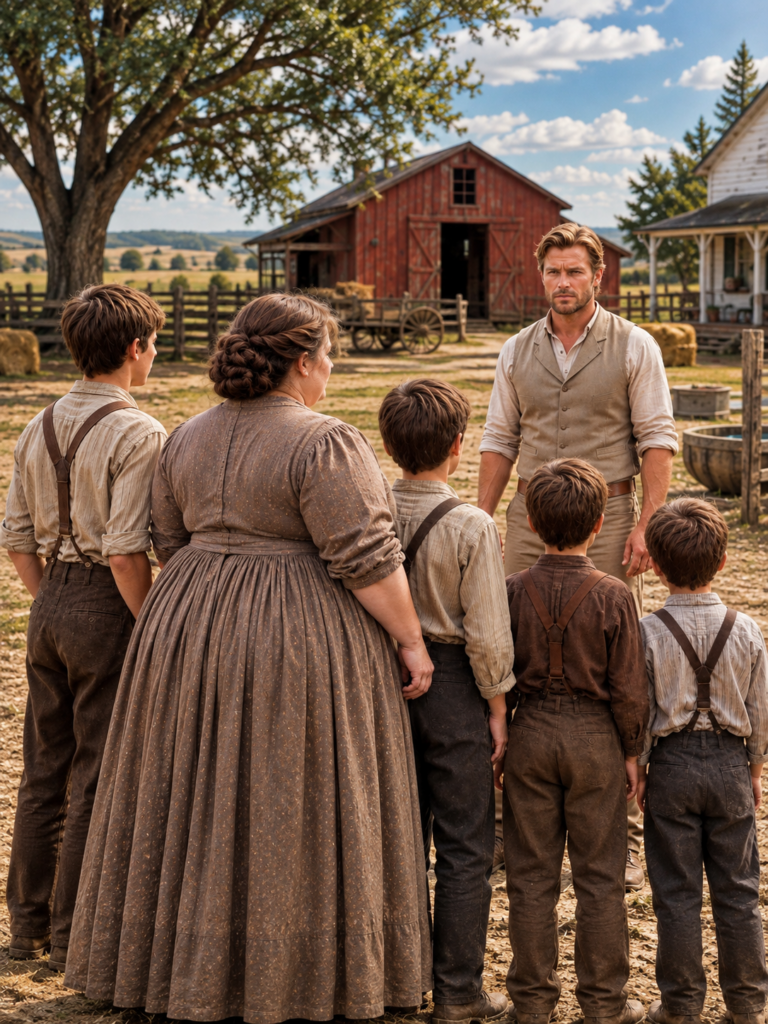
Beyond the gate stood a weather-beaten farmhouse with a broad porch, a red barn that badly needed painting, and a stretch of Nebraska farmland so wide that the last fence disappeared into the afternoon haze.
It was May of 1884.
The wind moved through the young grass with the dry, whispering sound Evelyn had come to associate with the prairie. Somewhere beyond the barn, a loose piece of metal knocked against wood.
She studied the house.
There were curtains in the front windows, but no flowers beneath them. A rocking chair stood on the porch with one broken runner. The vegetable patch beside the kitchen had been planted in straight, disciplined rows, though weeds were already beginning to claim the spaces between them.
It was not an abandoned place.
But it was a lonely one.
“Is this it?” Samuel asked.
Evelyn looked at the folded scrap of paper in her hand.
A man at the last trading post had written the directions for her. He had spoken of a farmer named Jonathan Reed who owned more land than he could manage and had been asking about hired hands.
The man had not promised that Jonathan would hire a widow.
He certainly had not promised that Jonathan would welcome four children.
“It’s the right place,” Evelyn answered.
Henry, who had spent the journey studying every field and boundary marker they passed, regarded the barn with interest.
“That west fence is leaning.”
“Henry,” Thomas warned.
“And there’s a gap in the lower pasture.”
“Henry.”
“I’m only saying he might need help.”
Evelyn almost smiled.
Then she looked at James’s injured foot, and the smile vanished.
“Stay here.”
She walked up the porch steps and knocked.
For several moments, nobody answered.
She knocked again.
Heavy footsteps sounded inside. A bolt slid back, and the door opened.
The man standing there was tall, broad through the shoulders, and perhaps forty-five. His dark hair had begun to gray at the temples, and his face carried the deep lines of someone accustomed to working outdoors in every season.
His shirt sleeves were rolled above his elbows. A smear of grease darkened one wrist.
He looked at Evelyn without speaking.
Then his gaze traveled beyond her to the four boys standing near the gate.
“Afternoon,” he said.
“Good afternoon. Are you Mr. Jonathan Reed?”
“I am.”
“My name is Evelyn Carter.”
He waited.
She had rehearsed what she would say throughout the final mile. She had intended to explain that she was hardworking, that Thomas knew cattle, that she could cook, sew, preserve food, and manage farm accounts. She had meant to sound capable rather than desperate.
But standing beneath that stranger’s steady gaze, with James bleeding by the gate, she found herself unable to deliver the speech.
“I have four sons,” she said, “and there isn’t a home left for us to return to.”
Jonathan’s expression did not change.
Evelyn forced herself to continue.
“I heard you might need help on your farm. We can work. All of us, according to our abilities. I’m not asking you to feed us for nothing.”
The farmer looked at the boys again.
Thomas stood straight, his jaw set with the fierce dignity of fifteen years. Samuel had put an arm around James. Henry was still studying the barn.
Jonathan noticed the blood on the road.
“That youngest one’s hurt.”
“It’s only a blister,” Evelyn said.
James immediately called, “I’m all right, sir.”
Jonathan regarded him for another moment.
Then he stepped aside.
“Bring them in.”
Evelyn did not move.
“Mr. Reed, I wouldn’t want you misunderstanding—”
“I understand you came looking for work.”
“Yes.”
“And I’ve got a farm that’s become too much for one man.”
His eyes met hers.
“Seems there’s a possibility we could both solve a problem.”
He turned toward the kitchen.
“There’s water by the stove. Bring the boy inside before that foot gets worse.”
For the first time in eight months, Evelyn felt something inside her loosen.
Not relief.
Not yet.
Only the faint possibility that tomorrow might look different from yesterday.
Jonathan Reed had lived alone for six years.
The house had not always been quiet.
There had once been laughter in the kitchen, music drifting through the open windows, and a woman who planted blue flowers beneath the porch because she insisted that every respectable home ought to have something beautiful growing outside it.
Her name had been Margaret.
She had died during a fever outbreak in the winter of 1878.
Their infant daughter, Rose, had followed her three days later.
Jonathan had buried them beside the small white church east of town, then returned to the farmhouse and continued working.
At first, the work had been a means of surviving grief.
Eventually, it became the whole of his existence.
He rose before sunrise, tended the livestock, repaired whatever machinery had broken during the previous day, and ate his supper alone at a table built for a family.
He had never remarried.
He had never considered selling the farm.
And he had never allowed himself to imagine that either decision might change.
Now, five strangers sat in his kitchen while he knelt in front of an eleven-year-old boy and carefully removed a damaged boot.
James winced.
Jonathan stopped immediately.
“That bad?”
“A little.”
“Then we’ll go slower.”
The boy watched him with cautious curiosity.
“Are you a doctor?”
“No.”
“You seem to know what you’re doing.”
“I’ve pulled enough thorns out of horses to learn something.”
Samuel laughed.
James looked mildly offended.
“I’m not a horse.”
“No,” Jonathan agreed. “A horse would’ve complained sooner.”
Even Thomas smiled at that.
Jonathan cleaned the injured heel with warm water, applied a little salve, and wrapped it in a clean strip of linen.
Evelyn watched from beside the stove.
The man’s movements were deliberate, almost awkwardly gentle. He spoke very little, but he never handled James roughly or made him feel foolish.
When he finished, he turned to her.
“There’s something we ought to settle.”
She straightened.
“Of course.”
“I can give you two rooms upstairs. There’s room enough for the boys if they don’t mind sharing. Meals come from the farm stores.”
“And the work?”
“I need help with the livestock, fencing, planting, and haying. Some of those jobs are fit for boys, some aren’t. I’ll decide what each one can safely do.”
Thomas looked disappointed.
Jonathan noticed.
“Don’t mistake me, son. There’s plenty of work that’ll test you.”
Thomas nodded.
“And your mother,” Jonathan continued, “can take charge of the kitchen and household if she’s willing. I’ve done a poor job of both.”
Evelyn glanced around the room.
Everything was clean, but the cleanliness had a strange, unused quality. The shelves were orderly. The copper pans were polished. Yet the bread tin was empty, and the stove looked as though it had been used mostly for heating water.
“I can manage a kitchen,” she said.
“I expect you can.”
Jonathan went to a cupboard and removed a leather-bound ledger.
He carried it to the table, opened it to a clean page, and dipped his pen into a small inkwell.
“One thing more. We’ll put it in writing.”
Evelyn blinked.
“In writing?”
“Yes, ma’am.”
He wrote her name at the top of the page.
Underneath it, he listed room, board, wages, and an agreed period of employment extending through the autumn harvest. He offered wages for her work and smaller amounts for the boys, adjusted according to their ages and responsibilities.
Nothing extravagant.
But fair.
“That way,” he said, “there won’t be any confusion about what I owe you.”
Evelyn sat down opposite him.
“Most men wouldn’t trouble themselves with a written agreement for a woman in my position.”
“Most men aren’t trying to run this particular farm.”
She studied him.
“And if you decide we aren’t suitable?”
“Then I’ll pay what you’ve earned and give you reasonable notice.”
“And if I decide we must leave?”
“Same terms.”
She looked down at the page.
There was something almost unbearable about seeing her name written beneath a promise that did not depend on pity.
She picked up the pen.
Her hand trembled slightly as she signed.
Jonathan pretended not to notice.
The upstairs rooms smelled of cedar, dust, and old linen.
One had a narrow bed and two small cots. The other contained a larger bed, a washstand, and a chest beside the window.
The boys immediately began debating where they would sleep.
Thomas wanted the cot closest to the door.
Samuel wanted the one beneath the window.
Henry insisted that the larger room received the best morning light and ought therefore to be used for reading.
James simply sat on the edge of a mattress and ran his hands over the blanket.
“It’s soft,” he whispered.
Evelyn turned away before anyone could see her expression.
For months, her children had slept in borrowed corners, beneath wagons, on barn floors, and once beneath an overturned boat that had offered more shelter from the rain than the nearby trees.
Now James was marveling at an ordinary blanket.
She walked into the hall.
At its far end stood another door, partly open.
Inside was a small room with pale wallpaper.
A wooden cradle rested against the wall.
On a shelf sat a child’s painted horse.
Evelyn knew instantly that the room had not belonged to a grown daughter.
She stepped backward.
Jonathan was standing at the head of the stairs.
“That room stays as it is,” he said.
His voice was not harsh.
But it was final.
“Of course,” Evelyn answered.
Neither spoke again.
By the end of the first week, the farmhouse had changed.
Not dramatically.
Not in any way that could be measured with a ruler or counted in a ledger.
But the change was unmistakable.
The kitchen smelled of fresh bread.
Clean shirts hung from a line behind the house.
The vegetable garden had been weeded, and Evelyn had discovered enough neglected jars and crocks in the cellar to begin planning a proper summer pantry.
At supper, conversation traveled around the table instead of ending when Jonathan put down his fork.
Samuel provided most of it.
He had a talent for turning ordinary inconveniences into elaborate tales, and on their sixth evening he delivered an account of a stubborn goat that had escaped through a broken gate and led him halfway across the pasture.
“I believe she thought I was chasing her,” he declared.
“You were chasing her,” Thomas said.
“I was negotiating.”
“The goat didn’t look convinced.”
“That’s because she’s unreasonable.”
Henry looked up from his plate.
“Actually, she found the gap in the fence because the lower rail was loose.”
Samuel sighed.
“Henry, a story doesn’t improve when you explain the engineering.”
Jonathan laughed.
The sound escaped him unexpectedly.
Everyone at the table looked up.
The farmer seemed startled by it himself.
Then James grinned, and Samuel continued talking as though nothing extraordinary had happened.
But Evelyn noticed.
It was the first time she had heard Jonathan Reed laugh.
The boys settled into the work more quickly than she had dared hope.
Thomas proved unusually gifted with cattle.
He could approach a nervous heifer without startling it, recognize the early signs of illness, and handle a frightened horse with patience beyond his years.
Jonathan began taking him along whenever difficult livestock needed attention.
Samuel worked best when given a challenge.
He could mend a fence for hours if somebody suggested he could not finish the job before supper.
Henry possessed a mind that collected details and refused to discard them. Within two weeks, he knew which fields drained poorly, which tools were missing parts, and why the eastern windmill had been turning unevenly.
Jonathan once found the boy drawing a careful diagram of the barn roof.
“What are you doing?”
“Working out where the rain gets through.”
“Why?”
“Because moving the hay every time it rains seems less sensible than repairing the roof.”
Jonathan studied the drawing.
Then he handed Henry a pencil.
“Show me where you’d put the new boards.”
James tried desperately to keep up with his brothers.
One afternoon, Evelyn found him struggling to carry a sack of feed nearly half his weight.
Jonathan reached him first.
“Put that down, son.”
“I can manage.”
“Perhaps. But I didn’t ask you to.”
James’s face reddened.
“Thomas says we have to earn our keep.”
Jonathan crouched beside him.
“There’s a difference between doing your share and hurting yourself to prove you belong here.”
James stared at him.
“How do you know the difference?”
“A good many years of making the wrong choice.”
He lifted the sack.
“Come along. I’ve got a job that requires a careful pair of hands.”
The job involved sorting harness buckles and cleaning the leather straps.
James worked beside him until dusk.
That evening, he told Evelyn it had been the most important task anyone had ever given him.
She did not correct him.
Near the end of May, Evelyn met the first neighbor.
Mrs. Beatrice Hale arrived with a basket of eggs and a keen, intelligent expression.
She was married to the local minister, knew nearly every family within fifteen miles, and possessed the direct manner of a woman who had spent much of her life solving problems other people preferred not to discuss.
She greeted Evelyn kindly.
Then, when they were alone in the pantry, she lowered her voice.
“I hope you’ll forgive my speaking plainly.”
Evelyn stiffened.
“I’ve been spoken to plainly often enough.”
Mrs. Hale gave a small, sympathetic smile.
“Then you’ll understand that people here have long memories and very little to occupy them when the crops are growing.”
“I see.”
“Mr. Reed has lived alone a long time. Some folks will wonder about a widow staying under his roof.”
Evelyn placed a jar carefully on the shelf.
“My sons and I work here. We receive wages.”
“I believe you.”
“Then I don’t see what concern it is of theirs.”
“It ought not to be.”
But the older woman’s expression told her what the answer really was.
In a small frontier community, a woman’s reputation could influence whether shopkeepers extended credit, whether neighbors offered assistance, and whether her children were welcomed into respectable households.
Evelyn knew it.
Mrs. Hale knew she knew it.
“I only wanted you prepared,” the minister’s wife said.
After she left, Evelyn stood in the kitchen for a long time.
She could endure hunger.
She could endure exhaustion.
She could even endure the memory of the bank official who had watched her husband’s farm sold at auction without once meeting her eyes.
But she was not certain she could endure becoming the subject of another town’s judgment.
That evening, Jonathan found her examining the employment agreement.
“Something wrong?” he asked.
She considered telling him about Mrs. Hale.
Instead, she asked, “Would you object if I took in sewing to earn a little more?”
“No.”
“Or sold eggs when there are enough to spare?”
“If they’re your work, you ought to have some return from them.”
She looked up.
“You won’t think me ungrateful?”
“For trying to earn money?”
“For wanting something that’s mine.”
Jonathan’s expression grew thoughtful.
“Mrs. Carter, I don’t believe a person should have to apologize for wanting to stand on her own feet.”
It was a simple answer.
But she carried it with her long after he left the room.
Three weeks after their arrival, Evelyn went into the study to record household expenses.
Jonathan had asked her to keep the accounts because she was better with figures than he was.
The leather ledger lay open on the desk.
She turned the pages, checking purchases of seed, harness repairs, flour, and lamp oil.
Near the back, she found the page containing their agreement.
She had expected to see her own name and perhaps Thomas’s.
Instead, Jonathan had created separate entries for every member of the family.
Thomas Carter.
Samuel Carter.
Henry Carter.
James Carter.
Beside each name was a careful record of work performed, money earned, and wages already paid.
For James, Jonathan had entered a few extra cents beneath the description Harness repairs — completed without supervision.
Evelyn smiled.
Then she noticed an entry near the bottom of the page.
Additional labor required to bring west pasture into production.
Below it, in smaller writing:
Reed farm would not manage another season without the Carter family.
Evelyn read the sentence twice.
Jonathan had not written it for her.
He had written it in the private book where he recorded things he considered true.
She closed the ledger gently.
Outside, the evening sun was sinking behind the wheat.
Her sons were coming toward the house, dusty and tired, laughing about something Samuel had said.
Behind them walked Jonathan Reed.
And for one dangerous moment, Evelyn allowed herself to imagine that they were not returning from a day’s work.
They were coming home.
The thought frightened her more than she expected.
Because she had once believed a place belonged to her.
She had once believed that hard work and devotion could protect a family from losing everything.
And she had learned how swiftly a home could vanish when the name on the deed belonged to someone whose death changed all their circumstances.
She pressed her hand against the closed ledger.
“I won’t let it happen again,” she whispered.
But outside, James was already calling Jonathan back to look at something he had found.
And the farmer turned toward the boy without hesitation.
Part 2
The first summer storm arrived on a Thursday in July.
It began with an unnatural stillness.
By late afternoon, the cattle had gathered near the southern fence, restless and unwilling to graze. The horses kept lifting their heads toward the western horizon.
Jonathan noticed the signs before the clouds had reached the property.
He was repairing a wagon wheel when Thomas came running from the lower pasture.
“Mr. Reed, the wind’s turned.”
Jonathan looked up.
A dark wall was rising beyond the fields.
“Get your brothers. Bring the animals toward the barn.”
Thomas ran.
Within minutes, the household was moving with the practiced urgency of people who understood that a prairie storm could undo months of labor.
Evelyn secured the kitchen shutters and carried buckets of water inside. Henry gathered loose tools from the yard. Samuel helped Thomas drive the younger cattle toward shelter.
James, his foot now fully healed, carried lanterns and coils of rope between the house and barn.
The first gust struck hard enough to tear the hat from Samuel’s head.
Then the rain came.
It fell in great, slanting sheets, driven by wind that seemed determined to strip the farm down to its foundations.
Jonathan was fastening the barn doors when a tremendous cracking sound came from the western pasture.
A section of fence had collapsed.
Beyond it, several frightened cattle were moving toward the open drainage ditch.
“Thomas!” Jonathan shouted.
The boy was already running.
Together, they fought through the rain toward the broken fence.
The ditch was normally shallow, but sudden storms could fill it with fast-moving water. A steer caught in the channel might break a leg or be carried downstream.
Jonathan caught one animal by its halter while Thomas turned another toward the barn.
Thunder shook the ground.
A loose fence rail whipped through the wind, striking the dirt near Thomas’s feet.
“Back to the barn!” Jonathan shouted.
“There’s still one loose!”
“I said go!”
But Thomas had seen a young heifer struggling near the ditch.
He ran toward it.
Jonathan swore under his breath and followed.
The bank had become slick mud. Thomas caught the animal’s halter just as it began to slide. He planted his heels and pulled, but the heifer was stronger, and the mud gave way beneath his boots.
Suddenly, the boy was falling.
Jonathan lunged forward.
He caught Thomas by the back of his coat with one hand and seized a fencepost with the other.
For several terrible seconds, all three struggled on the slippery bank.
Then Jonathan pulled Thomas against him, pushed him onto firmer ground, and released the terrified animal when it found its footing.
“Move!” he ordered.
They stumbled toward the barn.
By the time they reached shelter, both were soaked and shaking.
Thomas’s right hand was bleeding.
Jonathan caught the boy’s wrist.
“Can you move your fingers?”
Thomas flexed them.
“Yes, sir.”
“Anything broken?”
“I don’t think so.”
Jonathan examined the hand.
Then he looked directly into Thomas’s face.
“You could have been killed.”
The boy’s expression hardened.
“The heifer would’ve drowned.”
“And your mother would’ve buried her eldest son.”
Thomas went very still.
Jonathan’s voice dropped.
“I’ve buried enough people I love. I won’t stand by and watch you throw your life away for an animal.”
The words hung between them.
Thomas stared at him.
Jonathan seemed to realize what he had said.
He released the boy’s wrist and looked away.
“Get inside. Your mother needs to see that hand.”
Thomas did not move immediately.
Then he said, very quietly, “Yes, sir.”
The storm damaged two sections of fence, tore shingles from the barn roof, and flattened part of the kitchen garden.
But the farmhouse stood.
The livestock survived.
And all six people who had gone into the rain came safely out of it.
Near midnight, Evelyn found Jonathan sitting on the porch steps.
He had changed into dry clothes, though his hair was still damp.
A lantern burned beside him.
She carried two cups of coffee and lowered herself onto the step.
“Thomas told me what happened.”
Jonathan nodded.
“He shouldn’t have gone after that heifer.”
“No.”
“He doesn’t yet understand that there’s nothing a man can own that’s worth his life.”
Evelyn looked out across the dark fields.
“His father understood that. But Thomas has been trying to take William’s place since the funeral.”
Jonathan said nothing.
“He thinks if he’s strong enough, clever enough, useful enough, perhaps he can make certain we never lose anything again.”
“That’s a heavy burden for fifteen.”
“Yes.”
She wrapped both hands around her cup.
“I’ve tried to tell him he’s still allowed to be a boy.”
“Maybe he’ll believe it if we both tell him.”
Evelyn turned.
“We?”
Jonathan looked at her.
There was no embarrassment in his expression, only a grave sort of certainty.
“I intend to be here tomorrow, Mrs. Carter. And the day after. Seems reasonable that I should help where I can.”
She looked down at her coffee.
For a moment, neither spoke.
Then Evelyn said, “You frightened me tonight.”
Jonathan’s brow tightened.
“How?”
“When I saw you running toward that ditch. I’d already lost one man who made me believe the world was safe because he was in it.”
She stopped.
The words had come more freely than she intended.
Jonathan studied the darkness beyond the porch.
“Margaret used to say I could fix anything except my own stubbornness.”
Evelyn smiled faintly.
“She sounds sensible.”
“She was.”
He rubbed a hand across his jaw.
“Our little girl was named Rose. Margaret chose the name before she was born.”
Evelyn waited.
“She was six months old when the fever came. Margaret had it first. I sent for the doctor, but the roads were half buried under snow.”
His voice remained steady, though he stared so intently at the yard that Evelyn knew the effort it required.
“Rose became ill while Margaret was still alive. I kept telling myself one of them would recover. Then I kept telling myself the other would.”
Evelyn felt a deep ache move through her chest.
“I’m sorry.”
Jonathan nodded.
“For six years, I haven’t much liked talking about them. Makes it feel as though the whole thing happened yesterday.”
“Sometimes yesterday needs to be spoken of.”
He considered that.
“William,” he said after a while. “What was he like?”
Evelyn gave a small, surprised laugh.
“Terrible at arithmetic. Very good with horses. He used to sing when he was mending harness, although he couldn’t carry a tune.”
Jonathan smiled.
“Sounds like a decent man.”
“He was.”
She watched the rain dripping from the porch roof.
“He made mistakes. We both did. When the harvest failed two years running, he borrowed against the farm. We thought one good season would settle everything.”
She swallowed.
“Then the fever took him.”
Jonathan turned toward her.
“The bank didn’t give us much time. I argued. I begged them to let me keep the house until the next harvest. I brought them my accounts and showed them what the land could produce.”
Her fingers tightened around the cup.
“They sold it anyway.”
Jonathan listened without interrupting.
“Thirty days,” she whispered. “That’s what they gave me to get four children out of the only home they’d ever known.”
The lantern flickered.
“I promised myself that if I ever found another place to live, I would never make the mistake of believing a roof was safe simply because someone good stood beneath it.”
Jonathan absorbed the words.
He did not offer a hurried promise.
He did not tell her that he was different from William or the men at the bank.
Finally, he said, “A promise doesn’t carry much weight against a memory like that.”
“No.”
“Then I expect I’ll have to give you something more dependable than promises.”
She looked at him.
But he said nothing further.
They sat together until the lantern oil ran low.
During August, the farmhouse became a place Evelyn scarcely recognized.
The boys’ laughter echoed upstairs.
Samuel had begun leaving ridiculous sketches on scraps of paper for Jonathan to discover in his coat pockets.
One depicted their stubborn goat wearing a judge’s wig.
Another showed Henry standing on an enormous pile of books while the barn collapsed behind him.
Jonathan pretended to disapprove.
He kept every drawing.
Henry persuaded him to rebuild the western drainage channel using a shallower slope, explaining that the earlier storm had revealed exactly where the water collected.
The work took several afternoons, but the next heavy rain ran through the ditch without flooding the lower pasture.
Thomas’s injured hand healed, and Jonathan continued teaching him the finer points of managing cattle.
Their disagreements became less frequent.
When they did argue, it was usually about whether Thomas was old enough to do something dangerous.
Jonathan invariably won.
James developed a habit of following the farmer during the quiet hour before supper.
Sometimes he carried tools.
Sometimes he asked questions.
Sometimes he simply walked beside him.
One evening, Jonathan was repairing a saddle when James heard him whistle a low, wandering tune.
The boy stopped working.
“What’s that song?”
Jonathan glanced up.
“Don’t rightly know its name.”
“My pa used to whistle when he worked.”
“Did he?”
“Thomas remembers his songs better than I do.”
James looked down at the leather strap in his hands.
“I can’t remember his voice very clearly anymore.”
Jonathan placed his needle on the bench.
He understood that confession better than the boy could know.
“Memories change,” he said. “Doesn’t mean the people in them mattered any less.”
James was silent for a while.
Then he asked, “Could you teach me to whistle?”
Jonathan shifted over on the bench.
“Come here.”
The lesson was not an immediate success.
James produced a series of breathy squeaks that made Samuel laugh from the barn doorway.
The younger boy nearly gave up.
But Jonathan showed him again, adjusting the shape of his lips and telling him not to force the air.
On the thirteenth attempt, James managed one clear note.
His eyes widened.
“I did it!”
“You surely did.”
The boy grinned.
Then, without thinking, he leaned against Jonathan’s shoulder.
The farmer went still.
James remained there, happily trying to repeat his success.
Jonathan looked down at the child’s dark head.
Six years earlier, he had believed that fatherhood had been taken from him forever.
Now a boy who was not his son had trusted him with something terribly small and terribly important.
Jonathan picked up the saddle again.
“Try it once more,” he said gently.
Not every change was easy.
One Sunday in September, Evelyn took the boys to church in the Reed wagon.
Jonathan usually attended only on Christmas and Easter, but that morning he surprised them by appearing at the stable wearing his good black coat.
Samuel stared.
“Are you coming with us?”
“Unless you’ve objections.”
“No, sir. I just didn’t know you owned a coat without patches.”
“Mind yourself, Samuel.”
The boy grinned.
The service passed pleasantly enough.
Afterward, however, Evelyn overheard two women speaking near the church steps.
“She’s made herself comfortable at Reed’s place.”
“Four boys, too. Clever arrangement.”
“Perhaps he’ll marry her before people begin asking questions.”
Evelyn froze.
One of the women noticed her and turned away.
She felt heat rise into her cheeks.
Then she heard Thomas behind her.
“Say that again.”
His voice was dangerously quiet.
The women looked at him.
“Thomas,” Evelyn warned.
He stepped forward.
“My mother works harder than either of you could manage in a month.”
“Thomas.”
“She hasn’t asked him for anything she hasn’t earned.”
Jonathan appeared beside them.
“That’s enough, son.”
Thomas turned furiously.
“But they were—”
“I heard.”
Jonathan faced the women.
“Mrs. Carter manages my household and keeps my accounts. Her sons work my fields. Every one of them has done more for this farm than I could have accomplished alone.”
The women were silent.
“If there are questions about how I conduct my business, you’re welcome to ask me directly.”
He held their gaze.
“Otherwise, I’d thank you to speak of the Carters with the respect they’ve earned.”
He offered Evelyn his arm.
“Ready to go home?”
She hesitated.
Then she took it.
Thomas followed them to the wagon, still burning with anger.
For the rest of the ride, nobody mentioned what had happened.
But Evelyn could not forget those women.
Nor could she forget the ease with which Jonathan had said the word home.
That night, Thomas knocked on her bedroom door.
“Come in.”
He stood in the doorway, tall and awkward, his father’s seriousness settling more heavily over his features every month.
“Mama, I’ve been thinking.”
“That usually means trouble.”
He did not smile.
“We should save more money.”
“We are saving.”
“Enough to buy land?”
Evelyn laid aside her sewing.
“Not yet.”
“Maybe a small place. Nothing like our old farm. Just enough for a garden and some chickens.”
She studied him.
“Why?”
Thomas stared at the floor.
“Because I don’t like hearing people say we’re living off Mr. Reed.”
“He’s been very fair to us.”
“I know.”
“Then what is it?”
The boy’s mouth tightened.
“I like him.”
Evelyn waited.
“I like being here. James talks about him all the time. Henry acts as though the fields belong to him. Even Samuel doesn’t complain about getting up before daylight.”
“And you?”
Thomas looked at her.
“I was beginning to think we might stay.”
Evelyn felt the words like a hand closing around her heart.
“Thomas—”
“But the farm belongs to Mr. Reed. Not us. If something happens to him, somebody else could tell us to leave.”
He looked suddenly younger.
“I don’t think I could get James through that again.”
Evelyn rose and embraced him.
For once, he did not resist.
Neither of them knew Jonathan was standing in the hallway.
He had come upstairs to ask whether Thomas had remembered to latch the western gate.
He heard enough to understand.
Quietly, he turned and went back downstairs.
Autumn brought the harvest.
The days began before dawn and ended long after sunset.
The wheat had already been cut earlier in the season, but the remaining corn and feed crops demanded every available hand, and repairing the storm damage had left the family behind schedule.
Thomas worked beside Jonathan in the fields.
Samuel and Henry hauled bundles, tended livestock, and helped gather what the older workers brought in.
James carried water, sorted usable ears, ran messages, and assisted with lighter tasks.
Evelyn kept the kitchen operating like a well-managed military camp.
She baked before sunrise, prepared meals for the fields, mended torn shirts, handled accounts, and still found time to preserve the final vegetables from the garden.
By the first week of October, the work had begun to tell on everyone.
Samuel fell asleep at supper with a spoon in his hand.
Henry insisted he could calculate the yield of the south field more accurately than Jonathan’s estimate and promptly confused bushels with sacks.
Even Thomas became too tired to argue when Jonathan ordered him to bed.
But the harvest was good.
Better than good.
The improved drainage had saved a portion of the lower field. The repaired fences had kept livestock out of the remaining crops. Work that Jonathan had once put off until winter had been finished in time.
When the final wagons returned to the barn, Jonathan stood among the stacked grain and looked around in disbelief.
The place had not held so much produce in years.
That evening, he opened the farm ledger.
He totaled expenses, expected sales, wages, and provisions for winter.
Evelyn sat across from him, checking his arithmetic.
At last, he laid down the pen.
“We’ve done it.”
She looked up.
“Done what?”
“Made this place profitable again.”
He turned the ledger toward her.
The figures were plain.
After six years of declining yields and delayed repairs, the farm had finally produced enough to pay its expenses, keep adequate winter supplies, meet its obligations, and leave money for improvements.
Evelyn stared at the numbers.
Jonathan tapped the page.
“Those aren’t my earnings alone.”
“They’re the farm’s.”
“Then perhaps we ought to reconsider what that means.”
She closed the book.
“Jonathan, there’s something I need to tell you.”
Something in her expression made him still.
“Mrs. Hale has offered to help me find work at a boardinghouse in Kearney. The owner needs someone to manage the kitchen. There are rooms for the boys nearby.”
Jonathan looked at her.
“When?”
“After the harvest accounts are settled.”
“The harvest is settled.”
“I know.”
He waited.
Evelyn folded her hands tightly.
“I think it may be time for us to find a place of our own.”
Outside, a wagon creaked in the yard.
Jonathan did not speak.
She pressed onward.
“I’ve been grateful for everything you’ve done. More grateful than I could ever explain. But the boys have started believing this is their home.”
“Isn’t it?”
The question was so quiet that she almost missed it.
She looked at him.
“I don’t know how to answer that.”
“Why not?”
“Because I’ve already taught them to love one home that we couldn’t keep.”
Jonathan’s jaw tightened.
“Do you believe I’d turn them out?”
“No.”
“Then—”
“You might die.”
The words struck him silent.
Evelyn’s eyes filled.
“William was a good man. He loved us. He worked until he could barely stand. None of that prevented what happened after he was gone.”
Jonathan looked down.
“I’ve spent months trying not to depend upon you too much,” she continued. “And somehow I’ve done exactly that.”
“Do you want to leave?”
She looked toward the darkened staircase.
Upstairs, James would already be asleep. Samuel and Henry were probably whispering despite being told not to. Thomas would be lying awake, worrying about the future.
“No,” she admitted.
The answer came out barely above a whisper.
“That’s what frightens me.”
Jonathan sat very still.
Then he reached for the ledger.
He opened it to the pages containing the Carter family’s wages and work records.
For several moments, he studied the figures.
“Evelyn,” he said at last, “when you came here, I thought I was offering you a roof in exchange for work.”
“You were.”
“I was wrong about how much work it would take to bring this farm back. And about how much I needed something besides hired hands.”
She looked up.
He continued, “I’ve treated this place as though owning the land meant I was the only person responsible for it. But half the improvements made this year were your doing. The boys have put more life into these fields than they’ve seen in six winters.”
“Jonathan—”
“I’m not asking you to stay because you owe me anything.”
He turned the ledger toward her.
“I’m asking you to look at what you’ve earned.”
She studied the entries.
Then she shook her head.
“These are wages. They won’t buy a farm.”
“No,” Jonathan said. “But wages aren’t the only way to measure what someone contributes.”
He closed the book.
“I have to go to town tomorrow. There’s a matter I need to discuss with the county clerk.”
Evelyn stared at him.
“What matter?”
For the first time that evening, Jonathan seemed uncertain.
Then he said, “How to put something on paper that a storm, a bad harvest, or my own death can’t take away from you.”
She felt her breath catch.
“Jonathan, what are you suggesting?”
He looked directly at her.
“That perhaps the greatest mistake I’ve made these six years was believing this farm could belong to only one person’s future.”
He stood, gathered his coat, and went outside.
Evelyn remained at the table.
The ledger lay open beneath her hands.
For months, she had feared that loving the farm would make her helpless.
Now Jonathan was offering something she had scarcely dared imagine.
Not another promise.
A share in the land itself.
And that frightened her too.
Because accepting it would mean admitting that she wanted to stay.
Not until spring.
Not until another opportunity appeared.
But for the rest of her life.
Part 3
Jonathan returned from town the following afternoon with a folded document in his coat pocket and a troubled expression on his face.
Evelyn saw him crossing the yard as she was taking bread from the oven.
She knew at once that he had not gone merely to purchase supplies.
He entered through the kitchen door, removed his hat, and stood beside the table.
“May I speak with you?”
She set the bread down.
“Of course.”
He drew the paper from his pocket.
“I spoke with Mr. Finch at the county clerk’s office. He says what I have in mind can be done, provided we’re both willing to agree to it.”
Evelyn looked at the document.
“What is it?”
“A proposed deed.”
She stared at him.
Jonathan unfolded the paper.
“An undivided one-third interest in the Reed farm. Transferred into your name. The clerk explained the procedure, and he’ll prepare the final instrument if you agree to the terms.”
For a long moment, Evelyn could not speak.
“One-third?”
“Yes.”
“Of the land?”
“The land and the improvements on it.”
She stepped away from the table.
“Jonathan, you can’t simply give me a third of your farm.”
“I’m not proposing to give it away.”
“Then what do you call this?”
“Recognizing what you’ve helped build.”
She shook her head.
“I’ve worked here for five months. You’ve owned this place for years.”
“And for the past six of those years, I’ve been watching it decline.”
“That doesn’t make it mine.”
Jonathan laid the document on the table.
“Look at the figures, Evelyn.”
“I have looked at them.”
“Then you know how much the farm earned this season compared with the last three.”
“Yes.”
“You know the western pasture was nearly useless before Henry helped me fix the drainage. You know Thomas has taken more responsibility with the cattle than any hired man I could’ve afforded. And you know the household has operated more efficiently under your management than it ever did under mine.”
She opened her mouth, but he continued.
“You’ve kept the books, saved money on supplies, sold eggs and butter, organized the work, and made it possible for me to spend my days where I was needed.”
“That’s what you paid us to do.”
“I paid you wages. I didn’t pay you for turning this into a working family farm again.”
Evelyn looked down at the document.
“What if I refuse?”
“Then it stays my farm on paper, and we’ll settle your wages as agreed.”
“And if I accept?”
“Then it’s your farm too.”
She raised her eyes.
“What if I decide to leave?”
Jonathan’s answer came without hesitation.
“Your interest remains yours. You can live elsewhere if that’s what you choose.”
Her voice tightened.
“Even if you change your mind about us?”
“Even then.”
“Even if we quarrel?”
“Even if we quarrel.”
“Even if you marry someone else?”
Jonathan gave her a long, bewildered look.
“Evelyn, I can’t imagine why you think that’s likely.”
She almost laughed.
But then her face grew serious again.
“I don’t want another man’s charity.”
Jonathan stepped closer.
“Neither do I want to be the sort of man who takes the labor of a woman and four boys, calls it a kindness to feed them, and keeps every benefit for himself.”
He tapped the document.
“This isn’t charity. It’s a partnership.”
Evelyn read the proposed terms.
She knew enough about farming to understand the significance.
An ownership interest would mean a voice in decisions about the property. It would give her a share of the land’s value, and that share would not disappear merely because Jonathan became ill or died.
There would also be obligations.
Taxes.
Repairs.
Losses in poor seasons.
The uncertainty that belonged to every farm on the Nebraska plains.
She traced the edge of the paper with one finger.
“If we’re partners,” she said slowly, “then I must bear my part of those things too.”
Jonathan nodded.
“Naturally.”
“And I want the boys’ wages kept separate from the land arrangement. They should have money of their own.”
“Agreed.”
“And we must decide together before selling any part of the farm.”
“Agreed.”
She looked up.
“You seem very willing to agree with me.”
“I’ve discovered it makes for a peaceful household.”
She laughed.
A real laugh, full of the warmth she had been holding back for months.
Then she looked at the paper again.
Tears blurred the writing.
“Jonathan, do you know what this means?”
He watched her quietly.
“It means,” she whispered, “that my children may have somewhere to belong without having to depend entirely on whether a man lives long enough to protect them.”
Jonathan’s expression softened.
“That’s what I hoped it would mean.”
Evelyn pressed the paper against her chest.
For eight months, she had carried the memory of an auction hammer falling on her family’s possessions.
She remembered strangers walking through her kitchen, discussing the value of cupboards while her children stood silently upstairs.
She remembered the bank clerk telling her there was nothing more to be done.
Now, standing in a kitchen that smelled of fresh bread, she was being offered a legal interest in the very land her family had helped restore.
She wiped her eyes.
“I want to speak to the clerk myself.”
Jonathan smiled.
“I thought you might.”
Three days later, Evelyn traveled into town with Jonathan.
She wore her best brown dress, carefully mended at the cuffs, and carried the leather ledger beneath her arm.
The county office occupied two rooms in a plain brick building near the courthouse.
Mr. Finch was a thin, precise man with silver spectacles and a desk crowded with papers.
He reviewed the agreement, explained the deed, and answered Evelyn’s questions without impatience.
She asked about taxes.
She asked what would happen if the farm suffered another failed harvest.
She asked whether Jonathan could sell the property without her knowledge.
Most importantly, she asked whether her ownership interest would remain hers if she never married again.
Mr. Finch explained the distinction between ownership and marriage and confirmed that the proposed transfer, once properly executed and recorded, would give her an independent interest in the property.
Jonathan said very little.
He let Evelyn question the clerk until she was satisfied.
Then the papers were prepared and signed before the proper witnesses.
The clerk entered the instrument for recording.
Evelyn stared at her signature.
It looked ordinary.
The same letters she had written on dozens of receipts, letters, and church registers.
But this time, those letters represented something she had not possessed since William’s death.
A legal claim to a home.
She touched the ink gently, careful not to smear it.
Jonathan stood beside her.
“Well, Mrs. Carter,” he said, “I believe we’re partners.”
She looked up.
“Yes, Mr. Reed.”
Then she smiled.
“I believe we are.”
On the journey home, they stopped beside a shallow creek to water the horses.
The October air had turned cool. Dry leaves drifted across the road, and the grass along the creek banks had taken on the pale gold of approaching winter.
Jonathan stood near the wagon while Evelyn watched the water moving over the stones.
For a time, neither spoke.
Then Jonathan said, “There’s something else I ought to tell you.”
She turned.
He appeared more nervous than she had ever seen him.
That surprised her.
She had watched him face an angry bull, a collapsing fence, and a violent prairie storm with scarcely a change in expression.
Now he could hardly meet her eyes.
“I wanted the deed settled first,” he said.
“Why?”
“Because I didn’t want what I’m about to ask to have anything to do with whether you and the boys had a home.”
Evelyn felt her heart begin to beat harder.
Jonathan removed his hat.
“Six years ago, I buried my wife and daughter. Afterward, I decided the rest of my life would be nothing but work.”
He looked toward the water.
“I told myself I was content with that. Truth is, I was afraid to want anything else.”
Evelyn remained motionless.
“Then one afternoon you came up my road with four boys who looked as though the wind might carry them away.”
She smiled through the sudden tears in her eyes.
“James was limping.”
“I remember.”
“You nearly frightened Thomas to death.”
“He nearly frightened me.”
They shared a quiet laugh.
Then Jonathan grew serious.
“Somewhere along the way, those boys became dearer to me than I thought anyone could be again.”
His voice roughened.
“And you, Evelyn, have become the person I look for whenever I come through the door.”
She looked down.
“I know we’ve both lost people we loved. I wouldn’t ask you to forget William, any more than I could forget Margaret.”
He paused.
“But I find myself wanting to spend whatever years I have left beside you.”
Evelyn’s eyes filled.
Jonathan took a breath.
“Would you consider marrying me?”
For a moment, the only sound was the creek.
She had imagined this possibility.
In the quiet evenings when they sat on the porch.
At supper, when he watched the boys with unmistakable affection.
During the storm, when she had discovered that the thought of losing him frightened her.
But imagining something was different from hearing it spoken aloud.
“Jonathan,” she whispered, “I don’t know if I can survive losing another husband.”
He nodded slowly.
“I can’t promise you won’t.”
She looked up sharply.
He continued, “I can’t promise I won’t fall ill, or that a bad year won’t come, or that nothing will ever happen to this farm.”
His eyes held hers.
“But I can promise not to waste the years we’re given by pretending we don’t care for one another.”
Evelyn began to cry.
Not loudly.
Not helplessly.
Only the quiet tears of a woman who had spent too long being strong because there had been no other choice.
Jonathan waited.
He did not touch her.
At last, she stepped closer and placed her hand in his.
“I loved William.”
“I know.”
“And I believe I’ll always miss him.”
“You ought to be allowed to.”
She swallowed.
“I won’t be the same woman I was when I married him.”
Jonathan gently closed his fingers around hers.
“I wouldn’t want you to be anyone but the woman you are.”
She looked at him for a long time.
Then she said, “I would like to marry you.”
Jonathan stood perfectly still.
“Are you certain?”
Evelyn gave him a watery smile.
“Mr. Reed, I have negotiated an ownership interest in your farm, managed your household, and raised four stubborn sons. I believe I know my own mind.”
He laughed.
Then he drew her gently into his arms.
For a moment, Evelyn rested her forehead against his shoulder.
She had not realized how much she missed being held without having to ask for anything.
The creek continued moving beneath the autumn sky.
And for the first time since William died, she allowed herself to believe that loving someone again did not mean betraying the person she had lost.
The boys received the news that evening.
Evelyn had insisted they all sit down before she told them.
Samuel immediately grew suspicious.
“Has someone done something wrong?”
Henry frowned.
“Why would you assume that?”
“Because Mama only uses that voice when something’s happened.”
Thomas looked from his mother to Jonathan.
He seemed to understand before anyone spoke.
Evelyn folded her hands.
“Mr. Reed has asked me to marry him.”
Silence.
James blinked.
Samuel’s mouth fell open.
Henry sat perfectly still.
Thomas looked at Jonathan.
Then James asked, “Does that mean we can stay here?”
Evelyn felt her chest tighten.
“Oh, darling. You can stay whether I marry him or not. We have a secure place here now.”
The boy considered this.
“But if you marry him, does that mean he’s our pa?”
Nobody moved.
Jonathan lowered himself into a chair so that he was level with James.
“Your father was William Carter,” he said gently. “He’ll always be your father.”
James nodded.
“But if your mother chooses to marry me, I’d be honored to help raise you boys.”
The child’s eyes brightened.
“All four of us?”
“All four.”
“Even Samuel?”
Jonathan glanced at the fourteen-year-old.
“That might require some patience.”
Samuel pretended to be wounded.
Henry immediately began asking practical questions.
Would they continue using the Carter name at school?
Would Jonathan expect them to call him Father?
Would the marriage change who made decisions about the crops?
Evelyn answered what she could.
Jonathan assured them that nobody would be required to call him anything different.
He also assured Henry that marriage would not exempt him from cleaning the chicken house.
Samuel laughed.
But Thomas had not spoken.
Later, after the younger boys went upstairs, Jonathan found him in the barn.
The boy was oiling a saddle buckle.
“You’ve been quiet,” Jonathan said.
Thomas kept working.
“Yes, sir.”
“Something troubling you?”
Thomas set down the buckle.
“I need to ask you something.”
“Ask.”
“If you marry Mama, are you going to expect us to forget Pa?”
Jonathan felt the question settle heavily between them.
“No.”
Thomas watched him.
“People sometimes act as if there’s only room for one father in a house.”
Jonathan leaned against the workbench.
“Your father brought you into this world. He raised you for fifteen years. I wouldn’t insult his memory by pretending those years didn’t matter.”
Thomas swallowed.
Jonathan continued.
“I don’t want to replace him. I’d like the chance to be somebody you can depend on.”
The boy looked down at his hands.
“My pa was a good man.”
“I believe that.”
“He tried to save our farm.”
“I know.”
Thomas’s voice began to tremble.
“He would’ve hated seeing Mama and the boys on the road.”
Jonathan stepped closer.
“Then perhaps he’d be glad they aren’t there now.”
For several seconds, Thomas said nothing.
Then he extended his hand.
Jonathan took it.
The handshake was firm, solemn, and awkwardly formal.
But when Thomas released him, his eyes were wet.
“Thank you for looking after them,” the boy whispered.
Jonathan placed a hand on his shoulder.
“Thank you for helping me learn how.”
The wedding took place in December, after the first hard snow.
There was no grand celebration.
Evelyn had no money to waste on lace or a new dress, and Jonathan would have been miserable beneath the attention of half the county.
Instead, they were married in the farmhouse parlor.
Mrs. Hale brought flowers made from dried autumn blossoms and evergreen branches.
Her husband performed the ceremony.
Several neighbors arrived carrying preserves, bread, pies, and enough food to feed a small army.
The same community that had watched Jonathan live alone for six years now crowded into a house that had once seemed too large for one man.
Evelyn wore her brown Sunday dress.
Jonathan wore the black coat Samuel had mocked months earlier.
Thomas stood beside his mother, handsome and grave.
Samuel and Henry spent much of the morning teasing James, who had polished his shoes so thoroughly that he nearly slipped on the kitchen floor.
When the minister asked whether Jonathan accepted Evelyn as his wife, the farmer answered with a certainty that made several people smile.
“I do.”
When Evelyn spoke the same words, she felt an unexpected peace.
There were no trumpets.
No grand declarations.
No promise that sorrow would never come again.
Only two people standing before a few witnesses, choosing to face whatever remained of life together.
After the ceremony, James cried.
Samuel noticed immediately.
“What’s wrong with your eyes?”
“Nothing.”
“You’re crying.”
“Something got in them.”
“Both of them?”
“Be quiet, Samuel.”
Jonathan knelt beside James.
“You all right, son?”
James nodded fiercely.
Then he threw his arms around Jonathan’s neck.
“I just didn’t want us to have to go away.”
Jonathan held him close.
“You’re home, James.”
The boy clung to him a moment longer.
Then Jonathan added, “And if anything ever worries you, you tell me. We don’t carry those troubles alone anymore.”
The winter that followed was bitterly cold.
Snow piled against the barn doors, and the north wind drove through every small crack in the outbuildings.
But the Reed farm endured.
There was enough grain stored to see the livestock through the worst weather.
The pantry remained full.
The roof no longer leaked.
The western fence stood straight.
During long evenings, the boys gathered near the stove while Evelyn sewed or read aloud and Jonathan repaired harness.
Thomas began studying the farm accounts, learning that running a successful property required more than strength and long hours.
Henry kept detailed notes on crop rotation and rainfall, convinced that careful planning could improve the following year’s yield.
Samuel continued finding ways to make everyone laugh.
James practiced whistling.
He was still not particularly good at it.
But Jonathan insisted he was improving.
One evening, Evelyn discovered him standing in the little room at the end of the upstairs hallway.
The room that had once belonged to Rose.
Jonathan had left the door open.
He stood beside the cradle, holding a small quilt.
Margaret had begun sewing it shortly before their daughter was born. The fabric had faded, but the tiny embroidered flowers were still visible.
Evelyn remained at the threshold.
“May I come in?”
Jonathan looked up.
“Of course.”
She stepped inside.
For the first time, she noticed that he had dusted the shelves and cleaned the window.
The little wooden horse stood where it always had.
But the room no longer seemed sealed away from the rest of the house.
Jonathan looked at the quilt.
“One corner’s coming loose.”
Evelyn approached.
“Would you like me to mend it?”
He hesitated.
Then he handed it to her.
“If you wouldn’t mind.”
She turned the fabric carefully.
Margaret’s stitches were fine and even. Evelyn could see where the original thread had begun to weaken.
“She was a good seamstress.”
“Better than I realized at the time.”
Evelyn smiled gently.
“I think we often notice the work someone did after they can no longer do it.”
Jonathan watched her.
“Would it trouble you if I kept this room?”
“No,” she answered. “This was Rose’s room. She was your daughter. Nothing about our marriage should require you to forget her.”
He swallowed.
“And William?”
Evelyn looked toward the window.
“I still have his pocket watch. It stopped the week he died.”
“We could have it repaired.”
“Perhaps someday.”
She glanced at the quilt again.
“I think there’s room in this house for the people we lost, Jonathan. We don’t have to shut them out to make space for the people who are here.”
He reached for her hand.
And in the little room where sorrow had rested untouched for six years, they stood together without needing to say anything more.
Spring came slowly to Nebraska in 1885.
The snow retreated from the fields.
The creek rose with meltwater.
Green shoots appeared beside the farmhouse porch.
One morning, Evelyn carried a small packet of seeds outside.
Jonathan was repairing the porch railing when he noticed her kneeling near the steps.
“What are you planting?”
“Flowers.”
“What kind?”
“Blue larkspur.”
Jonathan stopped working.
For a moment, he said nothing.
Then he set down his hammer.
“Margaret used to grow blue flowers here.”
Evelyn looked up.
“I know. Mrs. Hale told me.”
He stared at the packet.
“I haven’t planted any since she died.”
Evelyn pressed another seed into the soil.
“Then perhaps it’s time they grew again.”
Jonathan lowered himself beside her.
For a few minutes, they worked together in the morning sunlight.
Afterward, he helped her to her feet.
From the barn came a loud argument.
Samuel was accusing Henry of misplacing a hammer.
Henry was explaining that the hammer had been left in a perfectly logical location.
Thomas was demanding that both of them stop talking and get back to work.
James was whistling.
Very badly.
Jonathan looked toward the noise.
Then he turned to Evelyn.
“Do you remember what you said when you first came to my door?”
She smiled.
“I remember thinking I’d never find the courage to knock.”
“I thought you were going to ask for directions.”
“And I thought you were going to send us away.”
He shook his head.
“Instead, you told me you had four boys and nowhere left to take them.”
“And you told me you had more farm than one man could manage.”
Jonathan looked across the fields.
The fences were repaired.
The barn doors stood square.
The crops were being planned for another year.
Then he looked back at the house.
A home that had been almost silent for six years was now filled with boots by the door, coats on the hooks, children’s arguments, warm bread, and the sound of Evelyn’s voice.
“I reckon we were both telling the same story,” he said.
“How do you mean?”
“We were both describing everything we couldn’t manage alone.”
Evelyn slipped her hand into his.
“And we found each other.”
He nodded.
“We did.”
That evening, the family gathered around the supper table.
There were six chairs.
Six plates.
Six voices offering thanks for the meal.
Thomas described a difficult young horse he was training.
Henry announced his plans for the vegetable garden.
Samuel offered a ridiculous suggestion for teaching their goat to pull a cart.
James laughed so hard he nearly spilled his milk.
Evelyn looked around at the faces she loved.
Then her gaze settled on Jonathan.
He was smiling.
Not the cautious smile of a lonely man surprised by a moment of amusement.
But the easy, unguarded smile of someone who no longer expected silence to be waiting at the end of every day.
Across the room, the old farm ledger rested on a shelf.
The latest pages contained the new season’s plans, with the household and farm accounts carefully maintained.
At the top of the new year’s opening page, Jonathan had written a heading in his deliberate hand.
Reed and Carter Farm — 1885.
Below it were the names of the people who worked the land.
Jonathan.
Evelyn.
Thomas.
Samuel.
Henry.
James.
Six names.
Six lives that had once seemed broken beyond repair.
Evelyn remembered the road that had brought them there.
The torn boots.
The hunger.
The fear.
The humiliation of losing everything she and William had spent years building.
And the final three miles she had walked with four exhausted boys, believing she had nothing left to offer anyone.
She had been wrong.
She had brought more than four children to Jonathan Reed’s doorstep.
She had brought courage.
Work.
Loyalty.
A mother’s determination to keep her family together.
And the possibility of a future that neither of them had believed could exist.
Jonathan had offered more than shelter in return.
He had offered respect.
Patience.
A willingness to share responsibility.
And eventually, the security of a home they could build together without fear that kindness might be withdrawn.
Neither had rescued the other by some grand gesture.
They had done it through ordinary days.
Through mended fences, warm meals, frightened cattle, difficult conversations, and the slow, patient work of learning to trust again.
Outside, the last light of evening moved across the Nebraska prairie.
Inside, James finished his supper and began whistling the little tune Jonathan had taught him.
This time, every note came out perfectly clear.
Jonathan looked up in surprise.
“Well, now. Listen to that.”
James beamed.
Thomas laughed.
Samuel began whistling along, deliberately out of tune.
Henry protested that neither of them was keeping proper time.
And Evelyn, sitting beside her husband at a table that had once held only one lonely place setting, closed her eyes for a brief moment and listened.
She had once feared there would never be a safe place for her children again.
Now there was laughter enough to fill every room.
And as Jonathan reached beneath the table to take her hand, she understood something that the long road had nearly made her forget.
A family could lose its first home without losing its future.
A grieving heart could honor yesterday and still welcome tomorrow.
And sometimes, the life people believed was finished was only waiting for someone brave enough to knock on the door.
That night, all six chairs were filled.
And no one at the Reed and Carter farm had to face the coming morning alone.

