
Part 1
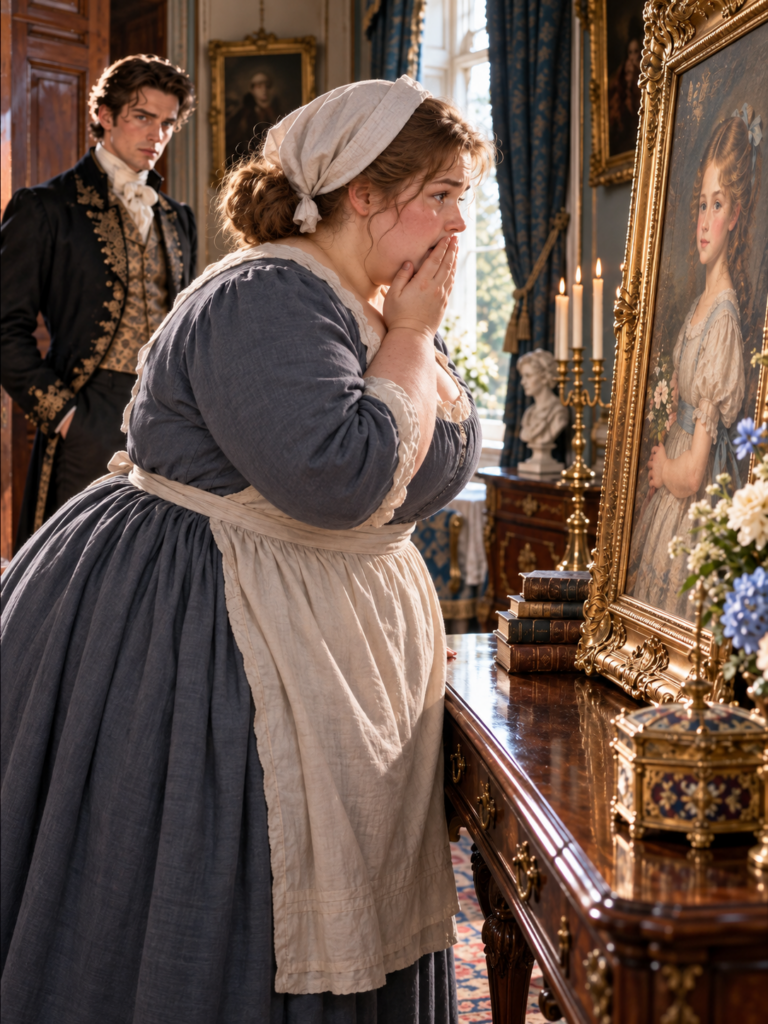
The first thing Clara Bell noticed was the blood.
Not fresh blood. Not the dark, sticky stain of a recent injury. This was an old brown mark, scarcely larger than a fingertip, on the back of a gilt picture frame hidden behind the bookcase in the Duke of Ravensmere’s private study.
The second thing she noticed was the child in the painting.
And that was when she stopped breathing.
The little girl wore a pale blue dress trimmed with ivory lace. Her dark hair fell in unruly curls around a solemn face, and one hand rested upon a wooden horse with a broken ear.
Clara knew that horse.
She had held it in her own hands as a child. She had wept when its ear broke. Her father had repaired it with a sliver of walnut wood, telling her that even broken things deserved a second chance.
The horse still stood on the mantelpiece of her mother’s cottage.
But that was not what frightened her most.
The painted child possessed Clara’s amber eyes, the small white scar beside her temple, and the faint downward turn of her mouth that her mother always said made her appear older than her years.
It was not a resemblance.
It was her.
Clara lowered the feather duster.
Outside the study windows, rain swept over the gray hills of Northumberland. The enormous house creaked beneath the October wind. Somewhere below, a clock struck ten.
She had been employed at Ravensmere Hall for almost a year. In that time, she had learned every rule governing the servants’ lives, particularly the rules concerning His Grace, the Duke.
Never enter his study without permission.
Never touch his correspondence.
Never disturb the concealed cabinet beside the north bookcase.
That final instruction had always seemed peculiar.
Now she understood why.
The cabinet had been left slightly open that morning, its narrow brass catch gleaming between the shelves.
She should have closed it.
Instead, she had looked inside.
And now she was staring at a portrait that should not exist.
With trembling fingers, Clara lifted the frame from its velvet-lined compartment.
There was writing on the reverse.
The ink had faded, but the letters remained beautifully formed.
For my little Eleanor. May the world be kinder to you than it has been to us.
Beneath the inscription stood a date.
18 June 1796.
Clara felt the room move beneath her feet.
She had been born in June 1796.
Her mother had told her so. The date appeared in their family Bible, written carefully by the man she had always known as her father.
But her name was Clara.
Clara Bell.
Not Eleanor.
Never Eleanor.
A sound came from the corridor.
She returned the picture to its compartment, closed the cabinet, and snatched up her duster just as the study door opened.
The Duke of Ravensmere stood on the threshold.
At thirty-seven, Edmund Vale possessed the kind of stern appearance that caused servants to straighten before he spoke. He was tall, dark-haired, and habitually dressed in black. A thin silver line crossed one eyebrow, the legacy of some long-ago riding accident.
His pale gray eyes moved from Clara to the cabinet.
Then back to Clara.
For the first time since she had entered his household, the Duke appeared genuinely afraid.
“What have you seen?” he asked.
Clara’s mouth went dry.
“Nothing, Your Grace.”
He looked at her duster, then at the slight gap beneath the cabinet door.
“Miss Bell.”
It startled her to hear him say her name.
He had never addressed her directly.
“Do not insult us both with a lie.”
Clara swallowed.
“I saw a painting.”
The Duke closed the study door.
The quiet click of the latch sounded terribly final.
“Did you read the inscription?”
“Yes, Your Grace.”
His face lost its color.
For several moments, he said nothing. Rain struck the windows. A log shifted in the fireplace.
At last, he crossed the room and opened the cabinet.
He removed the little portrait and carried it to his desk.
“Tell me what you recognize.”
Clara stared at him.
“The child has my face.”
“Anything else?”
“The horse.”
His fingers tightened upon the frame.
“What horse?”
“A wooden horse with one broken ear. My father made it for me when I was little.”
The Duke turned away.
It was a small movement, but she saw the effort behind it.
“Your father,” he repeated.
“Yes, Your Grace. Daniel Bell. He was a carpenter.”
“Was?”
“He died four winters ago.”
Something changed in the Duke’s expression. Not surprise, exactly. More like the confirmation of something he had dreaded.
He set the painting down.
“You must leave this room.”
Clara felt anger rise beneath her fear.
“Your Grace, I only wish to know why—”
“Not today.”
“But the child—”
“I said not today.”
His voice never rose.
That made the dismissal worse.
Clara curtsied because eighteen years of poverty had taught her that obedience was sometimes the only protection available to a person without power.
She reached the door before he spoke again.
“Miss Bell.”
She stopped.
“Did your mother ever tell you where your wooden horse came from?”
“My father carved it.”
“Are you certain?”
Clara turned.
“Why would she tell me otherwise?”
The Duke stared at her for a long time.
“Go home when your duties are finished,” he said. “Speak to your mother. Ask her about the summer of 1796.”
“Will she tell me the truth?”
His expression tightened.
“That depends upon what she fears losing.”
He dismissed her with a gesture.
But Clara did not forget those words.
Not when she returned to the servants’ quarters. Not while she scrubbed the silver candlesticks in the breakfast room. Not while Mrs. Finch, the housekeeper, reprimanded her for polishing the same spoon three times.
And certainly not when she walked the three miles to her mother’s cottage beneath a sky the color of slate.
Her mother was sitting beside the fire when Clara arrived.
Margaret Bell had once been a strong woman with broad shoulders and hands made rough by years of washing linen. Illness had reduced her to a fragile figure beneath a woolen shawl, but her eyes remained sharp.
“You have come early,” Margaret said.
“I need to ask you something.”
“Then take off that wet cloak before you catch your death.”
Clara did not move.
“Who is Eleanor?”
The cup slipped from Margaret’s fingers.
It shattered against the hearth.
Neither woman spoke.
Then Margaret closed her eyes.
“Oh, Clara.”
That was all she said.
And Clara knew.
The portrait was real.
The inscription mattered.
Her mother had been keeping something from her for eighteen years.
“Who is Eleanor?” Clara asked again.
Margaret bent to gather the broken porcelain, but her hands shook too violently.
Clara knelt beside her.
“Mama, please.”
Her mother looked at her with an expression Clara had never seen before.
Not guilt alone.
Not shame.
Terror.
“You must promise me something,” Margaret whispered.
“What?”
“Whatever you have discovered at Ravensmere, you must not let Lord Ashcombe know.”
Clara stared.
“Lord Ashcombe?”
“The Duke’s cousin.”
“Why?”
Margaret seized her wrist.
“Because that man has spent twenty years waiting for someone in the Vale family to die, and if he learns who you are, he will not care whether another person must die to get what he wants.”
A gust struck the cottage, rattling the shutters.
Clara heard the rain dripping from her cloak onto the floor.
“Mama,” she said quietly, “who am I?”
Margaret looked toward the wooden horse on the mantelpiece.
Then she began to weep.
Two days later, the Duke found a sealed envelope beneath the door of his study.
Inside was a single sheet of paper.
There were only eleven words.
The girl has seen the portrait. Your father’s bargain is finished.
The letter bore no signature.
But someone had drawn a tiny black crown beneath the message.
Edmund recognized it immediately.
His cousin Julian Ashcombe had used that same mark in their childhood whenever he considered a game won.
The Duke stood by his desk for a long time.
Then he rang for the housekeeper.
“Mrs. Finch, where is Miss Bell?”
“In the laundry, Your Grace.”
“Send her to me.”
The woman hesitated.
“May I ask whether she has done something wrong?”
Edmund looked at the letter.
“No,” he said.
“Then what is the matter?”
He folded the paper.
“Someone has decided that she is worth more dead than alive.”
Part 2
Clara entered the Duke’s study with her shoulders squared and her hands clasped so tightly that her knuckles had turned white.
She had spent the previous two nights listening to her mother tell a story in fragments.
A storm.
A carriage arriving after midnight.
A woman wrapped in a mourning cloak.
A newborn child whose cries had filled their little cottage.
And a promise made beside a dying candle.
Margaret had been willing to reveal that Clara was not her daughter by birth.
But she refused to name the child’s parents.
“You were given to us to keep safe,” she had said. “That was enough then, and it ought to be enough now.”
It was not enough.
Not anymore.
The Duke rose when Clara entered.
He dismissed Mrs. Finch and waited until they were alone.
“There is something I should have told you months ago.”
Clara lifted her chin.
“Then perhaps you might begin now.”
He accepted the rebuke without argument.
“Your name at birth was Eleanor Margaret Vale.”
The words seemed strangely weightless.
Clara had expected the truth to arrive like thunder.
Instead, it came in the Duke’s low, measured voice, surrounded by the familiar smell of leather and woodsmoke.
“Vale,” she repeated.
“Yes.”
“As in your family?”
“As in ours.”
The room fell silent.
Edmund stepped toward the portrait.
“My mother died in childbirth when I was nineteen. My father had always been a severe man, but after her death, he became something far worse. He could not bear to see the infant who had survived her.”
Clara looked at the little face in the painting.
“Me?”
“Yes.”
“Then you are—”
“Your brother.”
Clara stepped backward.
The edge of a chair struck her knees.
“No.”
Edmund did not approach her.
He seemed to understand that even kindness could become a form of force when offered by a powerful stranger.
“My father ordered that you be raised outside the family. Your existence was concealed from society. A private arrangement was made with Daniel and Margaret Bell.”
“My parents.”
“Yes,” Edmund said. “Your parents.”
Clara looked at him sharply.
He continued.
“They loved you. Nothing I tell you changes that.”
She sat because her legs would no longer support her.
“Did you know where I was?”
“For a time, no. The arrangement was handled by my father’s steward. I knew you had been sent away, but not where.”
“And afterward?”
“I searched.”
“For eighteen years?”
“Whenever I could. My father forbade inquiry while he lived. After his death, many of his papers were missing. I traced the steward to York, then the family that had first sheltered you, then a carpenter named Bell.”
Clara felt her eyes fill.
“You found me.”
“Yes.”
“When?”
Edmund looked down.
“Nine months ago.”
The answer struck harder than anything he had said.
“Nine months?”
“Yes.”
“You have known for nine months that I am your sister?”
He nodded.
“And you allowed me to carry coal into your study? To kneel on your floors? To stand at the servants’ table while you dined beneath portraits of our ancestors?”
A muscle moved in his jaw.
“I did.”
Clara stood.
“Why?”
“Because I was afraid.”
“Of what?”
“That you would despise me.”
She stared at him.
It was such a small, human answer that for a moment she could not fit it to the man before her.
Edmund continued, his composure breaking.
“I had spent years imagining what I would say. I thought I would arrive with the truth and offer you a home. Then I saw you in the morning room, carrying a basket of logs. You looked up at me, and you had my mother’s eyes.”
He swallowed.
“I knew at once. But I also saw that you had a life. You loved your mother. You were working to pay for her treatment. If I told you, I would overturn everything you believed about yourself.”
“So you did nothing.”
“I instructed the physician to visit your mother without charge. I arranged better wages. I asked Mrs. Finch to give you lighter duties.”
“And you never thought to ask what I wanted?”
“No.”
His answer was immediate.
“It was cowardice. I know that now.”
Clara turned away.
The portrait stood on the desk between them.
She remembered the tiny wooden horse, the broken ear, her father’s patient hands.
“Who painted it?”
“I arranged for an artist to visit your village when you were five. He told the Bells that a charitable patron wished to commission portraits of local children.”
“Why?”
“Because I could not bring you home.”
His voice became rough.
“And I wanted to know what you looked like.”
The silence afterward was different.
Clara felt the anger inside her, but beneath it was something more difficult.
A young man of nineteen had lost his mother and his infant sister on the same day.
Her brother had spent the next eighteen years searching for a child he had held only once.
She could not forgive his silence.
Not yet.
But she could begin to understand the shape of it.
“Why was the portrait hidden?” she asked.
Edmund looked toward the cabinet.
“Because my cousin knew there had been a child.”
Clara remembered her mother’s warning.
“Lord Ashcombe.”
The Duke nodded.
“Julian is my father’s nephew. Under the settlement governing Ravensmere, he is next in line to the title if I die without a son. But the estate itself is governed by an older trust.”
“What kind of trust?”
“One that gives a surviving legitimate daughter of my father a claim to property that Julian believed would eventually come under his control.”
Clara looked at him.
“You mean me.”
“Yes.”
“And he knows?”
“He suspects.”
Edmund handed her the anonymous letter.
She read it twice.
The little black crown seemed almost childish.
But the message was not.
“What does he mean by your father’s bargain?”
“That is what we must discover.”
Lord Julian Ashcombe arrived at Ravensmere Hall the following afternoon.
He came in a polished carriage with two footmen, a London solicitor, and enough luggage for a prolonged visit.
Clara watched from the upper gallery as he stepped into the entrance hall.
He was a handsome man in his early forties, with reddish hair, a pleasant smile, and eyes that never remained still.
He greeted the servants by name.
He praised the hall.
He kissed Mrs. Finch’s hand.
And when he saw Clara standing beside the staircase, his smile widened.
“Miss Bell, I believe?”
Clara curtsied.
“My lord.”
“What a charming young woman.”
He examined her face with an interest he made no effort to conceal.
“Have we met?”
“No, my lord.”
“Curious. You remind me of someone.”
He did not say whom.
But Clara knew.
That evening, while the Duke entertained his cousin at dinner, she went to the servants’ hall.
Mrs. Finch was sorting keys beside the fireplace.
“Did you know about me?” Clara asked.
The housekeeper looked up sharply.
“I beg your pardon?”
“About Eleanor.”
Mrs. Finch closed her eyes.
For a moment, the iron certainty with which she governed Ravensmere Hall seemed to desert her.
“Yes.”
Clara felt the answer like a small physical blow.
“How many people knew?”
“Only a handful.”
“And none of you told me.”
“We were forbidden.”
“By the old Duke?”
Mrs. Finch looked toward the corridor.
“By fear.”
She rose and closed the door.
“I was a young chambermaid when your mother died. Lady Ravensmere was a kind woman. She had a way of making every servant feel that their work mattered. She used to read to the kitchen children on Sundays.”
Clara listened.
“After her death, His Grace became a stranger. He dismissed servants who spoke of her. He removed her portrait from the gallery. And when the baby was sent away, he made us swear that no child had survived.”
“Why?”
“Because he believed the infant had taken his wife from him.”
Mrs. Finch shook her head.
“Grief can make fools of people. In his case, it made a cruel one.”
Clara moved closer.
“Did Lord Ashcombe know?”
“He discovered something years later. He questioned me after the old Duke’s death. I denied everything.”
“What did he ask?”
“Whether the child had been christened.”
Clara frowned.
“Why would that matter?”
“Because a christening meant records. Records meant proof.”
Mrs. Finch paused.
“There is something else.”
She withdrew a small iron key from her pocket.
“Before Lady Ravensmere died, she entrusted a box to the old Duke’s solicitor. I was told it contained instructions concerning her children. After the old Duke died, the box vanished.”
“Did Lord Ashcombe take it?”
“I cannot prove that.”
“Then why give me the key?”
“Because yesterday I found it in the belongings of Mr. Harrow, the old steward.”
Clara stared at the key.
“Mr. Harrow died years ago.”
“Yes. His effects were returned to Ravensmere after his widow passed away last month.”
“And the box?”
“Not among them.”
Mrs. Finch placed the key in Clara’s palm.
“Whatever was in it, someone has been trying very hard to keep it hidden.”
Three nights later, the Duke’s carriage overturned on the north road.
The accident happened just beyond the stone bridge, where the road narrowed above a steep ravine.
Edmund survived because the horses broke free before the carriage fell.
His coachman was less fortunate.
The older man suffered a broken arm and a deep wound above his eye.
When Clara arrived at the stables, Edmund stood beneath a lantern while the physician examined a cut along his shoulder.
His face was pale with pain.
“Was it an accident?” she asked.
The Duke looked at her.
“The wheel came loose.”
“Wheels do not simply come loose.”
“Sometimes they do.”
“Not when a carriage was inspected that morning.”
He said nothing.
Clara turned to the head groom.
“Who prepared the carriage?”
“Thomas, miss.”
“Where is he?”
“Gone.”
“Gone where?”
The groom hesitated.
“Left the estate before noon. Said his sister was ill.”
Clara met Edmund’s eyes.
Neither spoke.
But the meaning was unmistakable.
Someone had tried to kill him.
And that someone might try again.
Clara went to her mother’s cottage the next morning.
Margaret was weaker than before. Her breathing had become shallow, and a fever had settled into her bones.
Still, when Clara explained the carriage accident, the older woman pulled herself upright.
“Then there is no more time.”
She pointed beneath the bed.
“Bring me the old sewing chest.”
Clara obeyed.
Inside were needles, colored thread, two yellowed ribbons, and a small folded piece of cloth.
Margaret lifted the false bottom from the chest.
Beneath it lay a narrow leather packet.
“I promised never to open this,” she whispered.
“Who gave it to you?”
“Your father.”
“Daniel?”
Margaret shook her head.
“The Duke.”
Clara stared.
“The old Duke?”
“Yes. He brought you to us himself.”
For a moment, the cottage seemed to become very quiet.
Margaret continued.
“He came in the middle of the night, carrying you beneath his cloak. You were crying. He looked as though he had not slept in a week.”
She swallowed.
“Daniel said we could not take another mouth to feed. But then your father placed you in my arms.”
“Why did he choose you?”
“Because I had once worked as a nursemaid for Lady Ravensmere. She trusted me.”
Margaret touched Clara’s cheek.
“He said you must never return to the hall. He gave us money and promised more each year.”
Clara looked at the packet.
“What is this?”
“Something he told me to destroy.”
“Why did you keep it?”
“Because he frightened me.”
Margaret’s eyes filled.
“But I was more frightened of what might happen if you ever needed the truth and I had destroyed the only proof of it.”
Clara untied the cord.
Inside were three documents.
The first was an acknowledgment of her birth, signed by the old Duke.
The second was a receipt recording a substantial payment to Daniel Bell.
The third was a letter in Lady Ravensmere’s handwriting.
Clara unfolded it carefully.
The paper smelled faintly of lavender.
The letter was addressed to Edmund.
My dearest boy,
If your father ever allows grief to separate you from the child I am carrying, remember that you were loved before you could speak, and so shall she be. Should I not live to raise her, do not let my death become the burden of her life.
Clara stopped reading.
Her vision blurred.
There were several more lines, full of ordinary maternal hopes: that Edmund would show his sister the lake in summer, that he would teach her to ride, that the two children might one day laugh beneath the old cedar tree where their mother had spent her happiest afternoons.
At the bottom stood a final request.
Let no child of mine believe that she was unwanted.
Clara pressed the page against her chest.
The woman who had given birth to her had never held her.
Yet she had loved her before she was born.
Margaret watched her quietly.
“Your father could not bring himself to read that letter. He put it away with the others. I took it because I thought that one day you might need to know.”
Clara wiped her eyes.
“You saved everything.”
“I saved what I could.”
A cough seized Margaret.
Clara helped her back against the pillows.
When it passed, her mother caught her hand.
“There is another thing, Clara.”
“What?”
“The old Duke came back.”
“When?”
“Six months after he left you with us.”
Clara felt a chill.
“What happened?”
“He was not alone. A gentleman waited beside the carriage. Young, reddish-haired, finely dressed.”
“Julian.”
Margaret nodded.
“The Duke asked whether we had told anyone about you. I said no. Then the gentleman asked to see the child.”
Clara held her breath.
“Did he?”
“No. Daniel would not let him inside.”
Margaret’s hand trembled.
“As they were leaving, I heard the gentleman say something. I have never forgotten it.”
“What did he say?”
Margaret looked directly into Clara’s eyes.
“He said, ‘Then put her death in the register and be finished with it.’”
The discovery changed everything.
Clara returned to Ravensmere with the packet hidden inside her clothing.
She found Edmund in the library, his injured shoulder bound beneath his coat.
He listened without interruption.
But when she read their mother’s letter aloud, his expression collapsed.
He sat down heavily.
Clara had never seen him look so young.
“She wrote that?” he asked.
Clara handed him the page.
He recognized the handwriting immediately.
His fingers traced the signature.
For several minutes, he could not speak.
Then he whispered, “I thought Father had burned every letter she left.”
“He did not.”
Edmund read the letter again.
A tear fell upon the paper.
He brushed it away quickly, but Clara had seen it.
She sat beside him.
For the first time, she placed her hand over his.
He did not move.
Then he turned his palm upward and held her fingers.
It was not forgiveness.
It was something quieter.
A beginning.
“We must show these papers to Mr. Ellery,” he said at last.
“Your solicitor?”
“Yes. He is arriving from London tomorrow.”
Clara looked at him.
“And Julian?”
“He leaves nothing to chance. If he suspects we have proof, he will move against us.”
“Then we must act first.”
Edmund studied her.
There was surprise in his expression, followed by something like pride.
“You are very much our mother’s daughter.”
Clara gave a faint smile.
“I am also Margaret Bell’s daughter. And she taught me never to leave a dirty corner merely because no one else could see it.”
Edmund almost laughed.
But the sound died when the library door opened.
Lord Ashcombe stood there.
His pleasant smile had vanished.
In his hand was the missing iron-bound box.
“I believe,” he said softly, “that we have reached the point where family secrets must be discussed honestly.”
He set the box on the table.
Behind him stood two armed men.
And Clara understood that the danger had finally entered the room.
Part 3
“Step away from my sister,” Edmund said.
His voice was quiet.
Julian Ashcombe looked almost amused.
“Your sister. How touching. You have finally learned to say it aloud.”
The two men behind him remained beside the door.
They wore dark traveling coats and carried pistols beneath them.
Clara could see the outlines of the weapons.
Edmund rose slowly.
“What do you want?”
Julian placed one hand upon the iron box.
“What I should have inherited years ago. A little security. A little recognition. And an end to the absurd notion that a kitchen maid should control property worth more than half the county.”
Clara stood.
“I have made no claim against you.”
“Not yet.”
“You have nothing to fear from me if your claim is lawful.”
His expression hardened.
“Do not lecture me about law, child.”
“Then perhaps you should not threaten people in their own homes.”
Julian stared at her.
For one brief moment, she saw something of the old Duke in his expression: the astonishment of a powerful man discovering that obedience could not always be purchased.
He turned back to Edmund.
“You will sign a declaration that the girl is illegitimate. She will sign an acknowledgment accepting an annual allowance in exchange for surrendering any claim to Ravensmere property.”
“And if we refuse?”
“Then the county may shortly find itself mourning an unfortunate accident.”
Clara felt the cold spread through her.
“You arranged the carriage?”
Julian smiled.
“I had hoped the matter could be settled without unpleasantness.”
Edmund moved a step toward him.
One of the armed men drew his pistol.
“Careful, Your Grace.”
Edmund stopped.
Clara looked toward the windows.
The gardens beyond lay gray beneath a low mist.
No one outside would hear them.
But Mrs. Finch had taught her that every grand house had ways of listening.
And Clara knew Ravensmere better than Julian ever could.
She had carried coal through its passages. Scrubbed its floors. Polished its doors. She knew which boards creaked, which cupboards were connected by service hatches, which rooms opened into forgotten corridors.
She also knew that the bell rope beside the library fireplace connected to the servants’ hall.
Julian had stationed his men at the door.
He had not thought to guard the fireplace.
“Very well,” Clara said.
Both men turned toward her.
“Clara,” Edmund warned.
She ignored him.
“If you want my signature, I wish to know precisely what I am surrendering.”
Julian narrowed his eyes.
“An intelligent question.”
“Then open the box.”
For the first time, uncertainty crossed his face.
“What?”
“You brought it here to frighten us. I assume it contains something worth seeing.”
He hesitated.
Clara continued.
“Or perhaps you are as ignorant of its contents as I am.”
Julian’s pride did the rest.
He took a key from his waistcoat, unlocked the iron box, and lifted its lid.
Inside lay a bundle of documents tied with green ribbon.
The topmost sheet bore the seal of the Ravensmere estate.
Clara recognized the handwriting from the records she had seen in the library.
It was a supplementary trust settlement, written decades earlier by their grandfather.
Julian held it up.
“This,” he said, “is the trouble your mother caused.”
Edmund went very still.
“My mother?”
“Your grandfather altered the settlement shortly before his death. Your mother persuaded him to make provision for any daughter born to the family. Until then, everyone expected the estate to remain entirely in the male line.”
Clara stared at him.
“You mean she protected me before I existed.”
Julian laughed without humor.
“She protected a possibility. And that possibility has become very expensive.”
He spread the papers across the table.
“As long as Edmund lives, he may hold the estate under the existing trust. When he dies without legitimate issue, a surviving daughter of the late Duke may claim the settled property. If no such daughter exists, the residue passes under other provisions, from which I stand to benefit.”
Edmund looked sharply at him.
“Then you have been searching for Eleanor not to prove her existence, but to erase it.”
Julian’s eyes flashed.
“I have spent years watching a fortune slip beyond my reach because of a child who was supposed to disappear.”
Clara felt the truth settle over her.
The forged death record.
The vanished box.
The old Duke’s secrecy.
The failed carriage.
Julian had spent a lifetime attempting to bend one family’s history to his advantage.
And now he had brought the proof into the very room where that family could hear him.
Clara moved toward the fireplace.
“I have one more question,” she said.
Julian sighed.
“What now?”
“Why did you tell Margaret Bell to put my death in the register?”
His face changed.
Only slightly.
But enough.
“Your mother has a lively imagination.”
“She remembers you.”
“Old women remember many things incorrectly.”
“Then deny it.”
He looked at her.
“I deny nothing that I do not need to deny.”
“Did you attempt to have me declared dead?”
Julian’s patience broke.
“Yes!”
The word rang through the library.
“Yes, I tried. Because your father was too weak to finish what he started, and your brother too sentimental to accept that one inconvenient child might ruin the inheritance of generations.”
Clara’s hand closed around the bell rope.
She pulled.
Once.
Twice.
Three times.
Julian whirled.
“What have you done?”
“Asked for assistance.”
The door opened almost immediately.
But it was not Mrs. Finch who appeared.
It was Mr. Harding, the butler, accompanied by four men from the estate.
Behind them stood a county magistrate.
Julian stared.
Edmund exhaled slowly.
Clara had not known the magistrate was in the house.
But the Duke clearly had.
“You were expected, Julian,” Edmund said.
Julian stepped backward.
“This is absurd.”
“The magistrate arrived this morning to examine evidence concerning the attempted sabotage of my carriage. I intended to send for you after luncheon.”
“And you arranged this little performance?”
“No,” Edmund said. “You arranged it yourself.”
The magistrate stepped forward.
“Lord Ashcombe, I believe you have made several statements requiring further explanation.”
Julian looked toward his armed men.
Neither moved.
The estate servants had already surrounded them.
For a moment, Clara thought he might attempt something desperate.
Instead, he laughed.
It was an ugly sound.
“You cannot prove anything.”
“Perhaps not everything,” the magistrate replied. “But we can begin with the groom who admitted receiving your payment, and the coachmaker who identified the tampering.”
Julian’s smile vanished.
Edmund moved beside Clara.
“Are you hurt?”
She shook her head.
He looked at the bell rope, then at her.
“You knew they would come?”
“I hoped the servants would.”
“You risked your life.”
“So did you when you confronted him.”
He looked as though he wanted to argue.
Then, unexpectedly, he smiled.
A real smile, brief and astonished.
“You are impossible.”
Clara glanced at the portrait on his desk.
“Perhaps. But apparently that runs in the family.”
The legal proceedings began in November.
There was no grand courtroom spectacle, no single thunderous declaration that repaired eighteen years of injury.
Instead, there were affidavits, parish records, letters, witnesses, and days of tedious argument.
Mr. Ellery, the Duke’s solicitor, proved to be a thoughtful man who spoke softly and prepared meticulously.
He explained to Clara that the title and the settled property were separate matters. She could not inherit the dukedom under its male-only limitation, nor could she immediately displace Edmund from his lawful position.
But her identity gave her substantial rights under the family settlement.
Most importantly, those rights did not depend upon Julian’s goodwill.
The surviving acknowledgment of her birth, the original baptismal register, Margaret Bell’s testimony, and the old trust documents together established a compelling record of her parentage.
The supposed death entry in another parish register was shown to have been inserted years after the date it claimed to record.
Julian’s solicitor eventually withdrew from the matter.
Julian himself faced criminal proceedings concerning the attempted carriage sabotage and the intimidation at Ravensmere Hall.
The full outcome would take longer to determine.
But he no longer possessed the power to threaten Clara in secret.
And the county finally learned the truth.
The Duke of Ravensmere had a sister.
She had been raised in a carpenter’s cottage.
For nearly a year, she had worked as a maid in her own ancestral home.
News spread through drawing rooms and kitchens, across market squares and parish tables.
Some called it scandalous.
Others called it miraculous.
Clara called it exhausting.
She still rose before dawn from habit.
She still preferred plain tea to the elaborate chocolate Lady Charlotte, Edmund’s younger half-sister, sent from London.
And when Mrs. Finch suggested that she should abandon all household work immediately, Clara replied that she would stop working as a servant but saw no reason to forget how to mend a shirt.
The housekeeper looked scandalized.
Edmund looked delighted.
For the first time, Ravensmere Hall began to feel less like a monument to inherited silence and more like a place where ordinary people might speak freely.
But Clara refused to move permanently into the family wing until one matter had been settled.
Her mother.
Margaret Bell was dying.
No title could change that.
No legal victory could return the strength to her tired body.
Edmund sent the best physician available. He arranged medicines, warm blankets, good food, and a nurse who visited each morning.
Yet Clara understood what the physicians could not say aloud.
There were limits to what money could repair.
As winter approached, she spent most evenings beside her mother’s bed.
Sometimes they spoke about the past.
Sometimes they sat in silence.
Once, Margaret asked whether she regretted learning the truth.
Clara considered the question carefully.
“I regret the years we spent afraid of it.”
Margaret looked away.
“I thought you might hate me.”
“Why?”
“For letting you believe a lie.”
Clara took her hand.
“You let me believe that I was loved.”
“You were.”
“Then you told me the most important truth every day.”
Margaret’s eyes filled.
Clara leaned closer.
“I wish you had trusted me sooner. But I know why you were frightened.”
Her mother closed her eyes.
“Your father would have been proud.”
“Daniel?”
“Who else?”
Clara laughed through her tears.
Margaret smiled.
“He always said you had a stubborn streak.”
“I wonder where I learned it.”
“Certainly not from me.”
They both laughed then, and for a few precious moments the cottage was exactly as Clara remembered it from childhood.
Warm.
Small.
Safe.
With the wooden horse upon the mantelpiece and her mother within reach.
Margaret Bell died early in December, before the first heavy snowfall.
Clara was holding her hand.
Her final words were not about dukes, estates, or noble families.
She whispered, “Promise me you will be happy.”
Clara promised.
But happiness seemed very far away during the days that followed.
The funeral was held in the little village church.
Edmund attended without announcement.
He stood beside Clara beneath the bare yew trees while the church bell sounded across the valley.
When the mourners departed, she remained beside the grave.
Edmund did not hurry her.
At length, Clara spoke.
“She was afraid I would stop loving her when I discovered who I was.”
“She loved you very much.”
“She did.”
Clara looked down at the earth.
“I had two mothers. One gave me life. One taught me how to live it. And I lost them both before I truly understood what either had done for me.”
Edmund was silent.
Then he said, “I cannot tell you that the pain will disappear.”
“I know.”
“But it changes.”
She looked at him.
“How?”
He studied the winter hills.
“For years, when I thought of our mother, I remembered only the day she died. I could scarcely recall her laughter. I forgot the sound of her singing.”
He paused.
“Then you found the portrait. You began asking questions. Mrs. Finch told me stories I had never heard. I read the letter you brought me. And suddenly I remembered our mother sitting beneath the cedar tree, arguing with Father about whether a girl ought to learn Greek.”
Clara smiled faintly.
“Did she win?”
“Of course.”
“Good.”
He looked at her.
“Now when I think of her, I remember more than losing her.”
Clara wiped her cheek.
“I would like that.”
“You will have it.”
He offered his arm.
She took it.
Together they walked home through the cold afternoon.
The first Christmas Clara spent at Ravensmere as a member of the family was a quiet affair.
Lady Charlotte arrived from London with three trunks, two lapdogs, and an almost reckless determination to make up for eighteen years of missing sisterhood.
She embraced Clara before the footman had finished announcing her.
“I cannot believe Edmund kept you hidden,” she declared.
“He did not exactly keep me hidden,” Clara said.
“Nonsense. He keeps everything hidden. Letters, feelings, perfectly good furniture. I once found a set of beautiful blue curtains locked in a cupboard because he considered them too cheerful.”
Edmund, standing in the doorway, raised an eyebrow.
“They were entirely unsuitable.”
“They were curtains, Edmund, not a political rebellion.”
Clara laughed.
Charlotte looked triumphant.
“There. I knew she would have better sense than you.”
The two women became friends with surprising speed.
Charlotte helped Clara learn the complicated rituals of county society, although she privately confessed that most of those rituals deserved to be abandoned.
Clara taught Charlotte how to make bread.
The first loaf was a disaster.
The second was worse.
Mrs. Finch eventually banned them from the kitchen unless properly supervised.
And through it all, Edmund watched his sisters with the cautious amazement of a man discovering that happiness could be noisy.
In January, the portrait was moved from the hidden cabinet to the main gallery.
Clara had insisted.
Edmund resisted.
“Visitors will ask questions.”
“Then answer them.”
“They will speculate.”
“They have already speculated.”
“It is a private painting.”
“It is a picture of your sister.”
He stared at her.
She folded her arms.
“Are you ashamed of it?”
His expression changed immediately.
“No.”
“Then why hide it?”
He looked toward the little gold frame.
After a long silence, he said, “Because for years it was all I had of you.”
Clara’s anger softened.
“You need not lose it by sharing it.”
He looked at her.
Then, slowly, he nodded.
The painting was hung between two larger portraits: their mother on one side, their father on the other.
Clara studied the arrangement.
Then she shook her head.
“No.”
Edmund frowned.
“What now?”
“The portrait should hang beside Mother’s.”
“It does.”
“And Father should be moved.”
Charlotte, who had entered unnoticed, gave an approving laugh.
“Oh, I do like her.”
Edmund looked from one sister to the other.
“I see that I am outnumbered.”
“Completely,” Charlotte said.
Their father’s portrait was moved to the far wall.
And for the first time in nearly two decades, the mother and daughter were together.
Three years later, on a bright September morning, Clara stood in the gallery beneath the portrait of the little girl with the wooden horse.
She was twenty-one now.
She wore a simple blue riding habit and had tied her dark hair back with a ribbon.
A second portrait had been commissioned and hung beside the first.
It showed her as she was: no longer a frightened servant, nor a bewildered young woman struggling to understand her place in the world, but someone who had learned to belong to more than one history.
Beneath the paintings was a small brass inscription.
Eleanor Clara Vale, called Clara Bell. Beloved sister, daughter, and keeper of two families’ love.
She had chosen the wording herself.
She had also established a small charitable fund in Margaret and Daniel Bell’s names to provide medicine and schooling for children in the surrounding villages.
Edmund had offered to finance the entire undertaking.
Clara had accepted his help on the condition that she manage it herself.
He agreed.
Although he still insisted upon reviewing the accounts.
And she still insisted upon pointing out his arithmetic errors.
That morning, Edmund found her standing before the childhood portrait.
“The horses are ready,” he said.
Clara turned.
“You are early.”
“I am punctual.”
“You are unpleasantly proud of it.”
“A necessary quality in a man burdened with two sisters.”
She smiled.
“Charlotte says you would be unbearable without us.”
“Charlotte says many things.”
“Most of them true.”
He made a thoughtful sound.
Then his gaze settled upon the portrait.
“You know,” he said, “I once believed keeping that picture hidden was the only way to protect what remained of our family.”
“And now?”
He looked at her.
“Now I believe it was simply another way of being afraid.”
Clara considered him.
The sternness had not entirely left his face. He still preferred quiet rooms and early mornings. He still struggled to speak of sorrow without retreating behind formality.
But he laughed more often.
He allowed the curtains to remain open.
And he no longer treated love as something that must be guarded from the world.
Clara stepped beside him.
“I used to wonder why the little wooden horse was in the painting,” she said.
Edmund smiled faintly.
“Because you refused to sit without it.”
“You were there?”
“Of course. I stood behind the artist for the entire sitting.”
She looked at him in surprise.
“You never told me that.”
“You were five. You complained that your shoes pinched. Then you declared the painter was taking too long and threatened to go home.”
Clara laughed.
“That sounds like me.”
“It was entirely you.”
He grew quiet.
“Before you left, you handed me the horse and asked whether I would mend its ear.”
Clara turned toward him.
“You?”
“Yes.”
“But Papa told me he repaired it.”
“Daniel repaired it. I could not. I had no knowledge of carpentry.”
She looked back at the painted horse.
Edmund continued.
“I remember being ashamed of that. I had a title, an estate, a household full of servants, and all the advantages a man could be given. Yet the one thing my little sister asked of me was something I could not do.”
Clara’s eyes softened.
“So you sent it to Daniel.”
“Yes.”
“And he fixed it.”
“He did.”
She smiled through the tears gathering in her eyes.
“Then perhaps that was how our family began.”
Edmund regarded her.
“With a broken wooden horse?”
“With one brother who cared enough to try and one father who knew how to make it whole.”
For a long moment, Edmund said nothing.
Then he held out his hand.
Clara took it.
Outside, the September sun stretched across the green grounds of Ravensmere. The lake shone beyond the cedar trees, and two horses waited at the foot of the steps.
They walked through the entrance hall together.
Past the gallery where their mother’s portrait caught the morning light.
Past the staircase Clara had once scrubbed on her knees.
Past the servants who no longer lowered their voices whenever the Duke approached.
At the front door, Edmund stopped.
“Clara.”
“Yes?”
“I never properly thanked you.”
“For what?”
“For finding the portrait.”
She smiled.
“You mean for disobeying your household rules?”
“Yes,” he replied. “For that especially.”
She laughed.
And he laughed with her.
A moment later, they stepped into the sunshine.
Clara mounted her horse with far more confidence than she had possessed three years earlier. Edmund swung into his saddle beside her, and together they rode toward the lake.
Behind them, Ravensmere Hall rose against the bright morning sky.
Once, that house had contained a secret so carefully guarded that an innocent child had grown to womanhood without knowing her own name.
Now its windows stood open.
Its family portraits told the truth.
And the little girl who had once existed only behind a locked cabinet had become a woman who could choose her own future.
Clara glanced toward her brother.
“Edmund?”
“Yes?”
“Do you suppose Mother would be pleased?”
He followed her gaze toward the cedar trees.
For a moment, his eyes shone.
“I think,” he said, “she would be very pleased indeed.”
They rode on together.
And behind them, in the gallery filled with morning light, the painted child sat forever upon her velvet cushion, holding the small wooden horse that had passed between two families.
She was no longer hidden.
She was no longer forgotten.
And the name written on the back of her portrait was no longer a secret.
It belonged to a woman who had discovered that being loved by one family did not mean she had to surrender the love of another.
For a home was never merely the house in which a person was born, nor the name entered upon a certificate, nor the lands that might one day be inherited.
It was the place where someone remembered you.
The place where someone waited.
The place where, after years of silence, the truth could finally be spoken without fear.
And for Clara Bell, who was also Eleanor Vale, that place was no longer a mystery.
It was home.


