
Part 1
The Duke of Ravensmere was on his knees beneath a broken chandelier when the woman he was expected to marry walked into his ballroom carrying a basket of flowers.
He did not recognize her.
He had never seen her face, and her appearance offered him no reason to suspect that the young woman standing in the doorway possessed an income larger than that of several titled families combined.
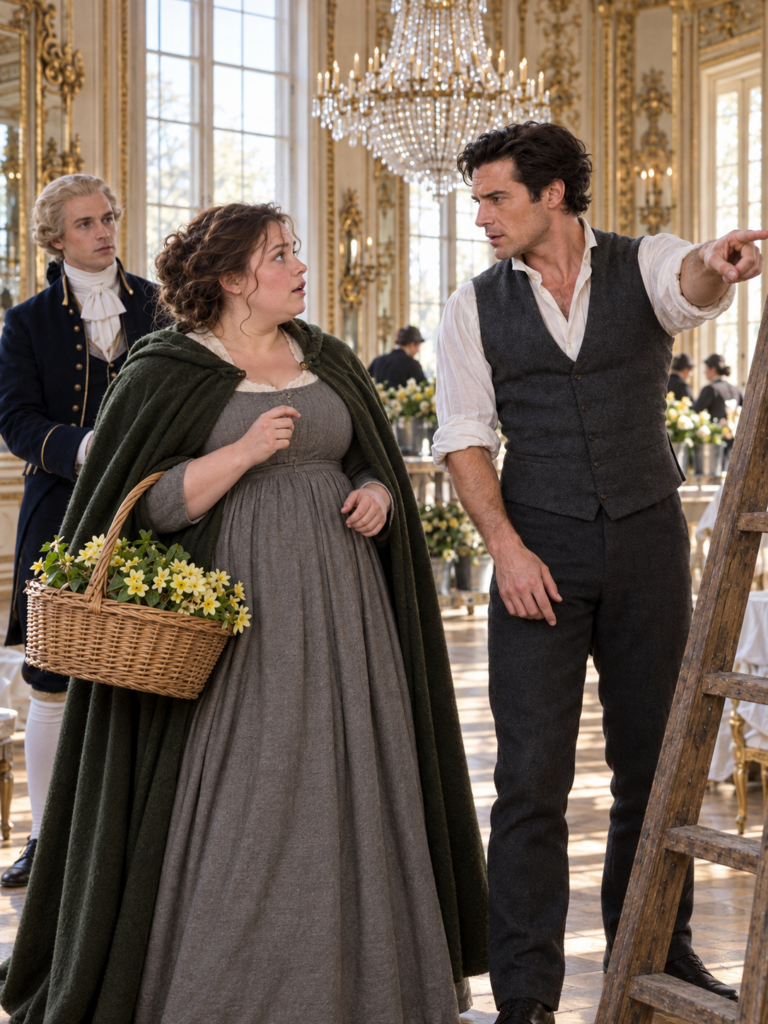
Her dress was plain brown wool. Her boots were stained with London mud. A faded green cloak hung from her shoulders, and the March wind had pulled loose several strands of dark hair from beneath her bonnet.
She looked like a servant who had come from the market.
And because the Duke was exhausted, irritated, and surrounded by preparations for an evening he had not wanted in the first place, he made the mistake of treating her as one.
“Are those all the flowers you’ve brought?”
The young woman stopped.
“I beg your pardon?”
“The flowers.” He nodded toward her basket. “Are those the replacements?”
She looked down at the pale yellow primroses resting against her arm.
“No, Your Grace. These belong to me.”
The Duke rose slowly.
“Then I suggest you take them somewhere they are wanted.”
It was not his finest moment.
He knew that almost immediately.
But before he could correct himself, another gust of wind entered through the shattered conservatory doors, lifted a dust sheet from a row of chairs, and sent a shower of glass fragments skittering across the polished floor.
The young woman looked past him.
Her expression changed.
“What happened here?”
“A small disaster,” he answered. “One that has apparently decided to become a large one.”
She moved farther into the room without waiting for permission.
The Duke watched her inspect the overturned flower stands, the cracked urns, the scattered greenery, and the great arrangements of roses that had been ruined when an iron support slipped from the chandelier frame.
A dozen servants had spent the morning attempting to restore order.
None had succeeded.
Yet this young woman stood among the wreckage with an expression that was neither frightened nor impressed.
She was studying it.
Finally, she turned toward him.
“Whoever ordered these arrangements chose entirely the wrong flowers.”
The Duke stared.
“Did they?”
“Yes.”
“How fortunate that you have arrived to inform me.”
She glanced at him, and something sharpened in her gray eyes.
“Your Grace, you may have a ballroom full of expensive roses, or you may have a beautiful ballroom tonight. At present, you cannot have both.”
For the first time that miserable afternoon, Nathaniel Wycliffe, Duke of Ravensmere, felt the unexpected temptation to smile.
“And what would you suggest?”
She placed her basket on the nearest table.
“First, I should like someone to open those curtains. Then I shall need branches of flowering blackthorn, fresh ivy, and every primrose that can be found within a reasonable distance of London.”
The Duke folded his arms.
“Blackthorn?”
“Yes.”
“In a ducal ballroom?”
“Particularly in a ducal ballroom.”
“How extraordinary.”
“Not nearly so extraordinary as charging guests into a room that resembles a funeral.”
The nearest footman made a strange noise and turned toward the wall.
Nathaniel looked at the woman.
Then at the broken arrangements.
Then at the bare windows, beyond which the gray London sky was beginning to darken.
“Very well,” he said.
He turned to the footman.
“Do as she asks.”
The young woman blinked.
She had evidently expected an argument.
Nathaniel reached for his coat.
“And you, madam?”
“Yes, Your Grace?”
“Since you appear to possess opinions about everything in this room, I trust you also possess the ability to make them useful.”
Her lips moved.
This time he saw it clearly.
She was trying not to laugh.
“I believe I do.”
“Then you have the afternoon.”
He extended his hand.
“Nathaniel Wycliffe.”
She hesitated.
Only for a moment.
Then she placed her hand in his.
“Clara,” she said.
She offered no surname.
He did not ask for one.
That was his second mistake.
Three hours earlier, Clara Ellery had been sitting opposite her aunt in a drawing room on Brook Street, listening to the announcement of her own approaching marriage as though she were hearing the terms of an estate auction.
“The Duke intends to lead you in the opening dance,” Lady Margaret declared. “My dear, you cannot possibly understand what a distinction that is.”
Clara understood it perfectly.
It meant that every fashionable family in London would regard her engagement as settled before she had even exchanged a private word with the man.
“It seems rather premature,” she replied.
“Premature? Your fathers arranged the understanding twenty-three years ago.”
“Our fathers are dead.”
“Clara!”
“It is nevertheless true.”
Lady Margaret lowered the invitation she had been admiring.
She was a gentle woman, but she belonged to a generation that considered family promises nearly sacred.
“Your father wished this marriage.”
Clara looked toward the window.
Outside, rain was streaking the glass.
Her father had wished many things.
He had wished the lead mine at Carrick Vale to remain profitable. He had wished the orchard behind their Cornish house to bear fruit again. He had wished his daughter to learn French, mathematics, and the management of accounts.
Above all, he had wished her to be happy.
She knew because he had told her so on the last evening of his life.
And she possessed proof that the marriage promise was not what London believed it to be.
The letter lay inside her writing case upstairs.
Twenty years earlier, her father, a young engineer without either title or fortune, had rescued the previous Duke of Ravensmere from a flooded mine tunnel after a collapse in Cornwall.
The rescue had nearly cost him his life.
The two men became friends.
Years later, after both had married and become fathers, they made an agreement that their children might one day marry.
The promise had been written down.
And for reasons Clara had never understood, the old Duke had treated it as a binding debt.
But her father had changed his mind.
She had discovered his letter after his funeral.
My dear Ravensmere,
You owe me nothing for what happened beneath the earth. A life saved is not a debt to be collected from one’s children. If our families are joined someday, let it be because the young people wish it, not because two foolish men believed they could arrange their happiness before they were born.
The letter had never been posted.
Clara had brought it to London for one purpose.
She intended to give it to the new Duke and release them both.
There was only one complication.
She had spent the previous fourteen months falling in love with a man whose face she had never seen.
His letters were signed simply N. Vale.
The acquaintance had begun with a drawing.
Clara had always loved the wildflowers growing on the Cornish cliffs. During her father’s illness, she had filled sketchbooks with sea thrift, campion, harebells, and tiny plants whose roots clung stubbornly to the rocks.
A bookseller in Truro had shown several drawings to a gentleman preparing an illustrated botanical volume in London.
The gentleman offered to purchase them.
Clara accepted, using the professional name C. Rowan.
At first, the correspondence concerned pigments, plant structures, and the difficulty of reproducing the translucent petals of sea campion.
Then came a question about Cornwall.
Then a remark about London.
Then a letter about his mother, who had loved natural history and died before completing the book.
Clara wrote about her father.
She described his illness, his cheerful stubbornness, and the way he insisted that the last apples of autumn be brought to his room even when he could no longer eat them.
N. Vale did not offer meaningless assurances.
Instead, he wrote:
There are griefs that cannot be repaired by words. If you cannot bear the silence one evening, write to me. You need not make the letter cheerful.
She had kept that letter beside her bed.
When her father died, she wrote to the unknown gentleman before she informed several relatives.
His reply arrived eleven days later.
It contained no poetry, no declarations, and no attempt to make death sound beautiful.
Only this:
I wish I had known him. From the way you speak of him, I think he understood that kindness requires courage.
Clara had cried when she read it.
She had been lonely enough afterward to wonder whether one could love a person known only through ink.
Now she had come to London to marry a duke.
And somewhere in the same city lived N. Vale.
That morning, as her aunt continued discussing the ball, Clara made her decision.
She would visit Ravensmere House privately.
She would deliver her father’s letter.
She would make it clear that no marriage was required.
And she would return home to Cornwall before society had a chance to turn the matter into a spectacle.
She had not expected a broken chandelier.
She had certainly not expected to spend the afternoon arranging flowers beside the very man she intended to refuse.
By four o’clock, the ballroom had begun to change.
The damaged roses had been stripped of their bruised outer petals and placed in shallow silver dishes. Ivy climbed the pillars in loose green spirals. Flowering blackthorn rose from tall porcelain urns, its white blossoms appearing almost luminous against the walls.
The primroses formed low banks beneath the windows.
They were humble flowers.
Common flowers.
The sort that appeared along country lanes without invitation.
Yet against the magnificent architecture of Ravensmere House, their simplicity created something unexpectedly beautiful.
Nathaniel stood in the center of the room, looking around.
“Good heavens.”
Clara glanced up from a bowl of water.
“Is something wrong?”
“No.”
He shook his head.
“Nothing at all.”
He moved toward one of the arrangements and examined a branch.
“My mother used to bring these into the house.”
“Blackthorn?”
“Anything she found growing in the hedgerows. My father disliked it. He said wildflowers belonged outside.”
“Your mother must have disagreed.”
“She disagreed with him about a great many things.”
The Duke’s expression altered.
It was a small change, but Clara noticed it.
“She died when I was twenty,” he said.
“I am sorry.”
He looked down.
“That was a long time ago.”
“Grief does not consult a calendar, Your Grace.”
He raised his eyes.
For an instant, the distance between them seemed to disappear.
Then he looked away.
“No,” he said quietly. “I suppose it does not.”
They returned to work.
As the servants carried in additional branches, Clara discovered something remarkable about the Duke.
He did not merely issue commands.
He worked.
When a heavy urn had to be moved, he lifted it himself. When ivy tangled around a railing, he climbed a ladder to straighten it.
At one point, he knelt to repair the wooden base of a damaged flower stand.
Clara watched him with unexpected tenderness.
He was still a duke.
He could not set aside his title any more than he could set aside his height or the dark hair falling over his forehead.
But here, without the ceremonial coat and polished manners, he seemed less a great nobleman than a tired, earnest man trying desperately to make something right.
“Your Grace?”
He glanced up.
“Yes?”
“Why are you doing all this yourself?”
“Because everyone else has been working since dawn, and I have two hands.”
“Most gentlemen of your position would not consider that an answer.”
“Most gentlemen of my position have never had to repair a ballroom with eight hours’ notice.”
She laughed.
He stopped working.
The sound appeared to surprise him.
Then his expression softened.
“There,” he said.
“What?”
“I had begun to suspect you were incapable of laughing.”
“I had begun to suspect the same of you.”
He returned to the flower stand.
“Perhaps we have both been mistaken.”
As evening approached, the servants lit the chandeliers.
The room brightened slowly.
Candlelight touched the blackthorn blossoms, glimmered across the silver bowls, and threw long delicate shadows against the ceiling.
Nathaniel stood beside Clara.
Neither spoke for some time.
At last he said, “There is something you ought to know.”
She turned.
“I am expected to marry.”
Her heart gave an unpleasant little movement.
“So I have heard, Your Grace.”
“Then you probably know more than I do.”
“Do you not know the lady?”
“Only by reputation.”
“And what is her reputation?”
“She is wealthy. Independent. Uncommonly intelligent, according to her aunt. Apparently she has spent more time examining rocks than attending assemblies.”
Clara lowered her eyes.
“How dreadful.”
“Quite.”
“Perhaps she is unbearable.”
“Perhaps.”
“Perhaps she is ugly.”
“I doubt that would trouble me.”
“Then what troubles you?”
He considered the question.
“My father arranged this marriage before either of us was old enough to understand what marriage meant.”
“Do you intend to honor it?”
“Yes.”
“Even if you cannot love her?”
His jaw tightened.
“I have not said I cannot love her.”
“But you do not know her.”
“No.”
“Then how can you promise her a lifetime?”
He looked across the ballroom.
For a moment, Clara thought he would dismiss the question.
Instead, he answered.
“My father died believing I had disappointed him in nearly everything that mattered. This marriage was his final request. I have told myself that honoring it might put something right.”
Clara’s chest tightened.
“And what of the lady?”
“She shall have my protection, my name, and whatever freedom I can give her.”
“But not your heart?”
He looked at her.
“That is not a thing a gentleman may honestly promise before he knows whether he possesses it to give.”
She had no answer.
He was silent for a moment.
Then he added, almost reluctantly, “There is someone else I must disappoint.”
Clara went still.
“Someone you love?”
“I do not know.”
The confession seemed to cost him something.
“Someone I have written to for more than a year. A person who understands parts of me I have never managed to explain to anyone.”
Clara’s fingers closed against her skirts.
“Have you met?”
“No.”
“Then perhaps you love an idea.”
“Perhaps.”
He looked toward the flowers.
“But ideas do not usually make a man feel less alone.”
A servant appeared at the doorway.
“Your Grace, the steward requires your attention.”
Nathaniel sighed.
He turned to Clara.
“Remain here, if you please. I have not yet thanked you properly, and I should like to know where I may send payment.”
Clara opened her mouth.
Now.
She must tell him now.
But the Duke was already being summoned into the corridor.
She watched him leave.
Then she looked at the basket resting beneath the window.
Her father’s letter was still tucked beneath the lining.
She could retrieve it, wait for Nathaniel, and end the matter exactly as she had planned.
Instead, her eyes filled with tears.
She had come to free herself from a stranger.
And somehow, in one afternoon, the stranger had become a man she could not bear to hurt.
Clara snatched up her cloak and basket.
She hurried through the servants’ passage, crossed the kitchen courtyard, and escaped into the cold London evening.
Only when she reached Brook Street did she discover that the letter was missing.
She emptied the basket twice.
Nothing.
She searched her cloak, her pockets, and the folds of her dress.
Still nothing.
The letter had slipped from the basket somewhere in the ballroom.
Clara stood in her bedroom, staring at the empty wickerwork.
Then came her aunt’s voice from the doorway.
“My dear, where have you been? The carriage leaves in forty minutes!”
Clara turned.
Lady Margaret stared at her clothes.
At the leaves caught in her hair.
At the muddy marks on her sleeves.
“Good heavens. You look as though you have been employed in somebody’s garden.”
Clara laughed once.
It was a strange, helpless sound.
“Something very like that, Aunt.”
An hour later, the Duke of Ravensmere stood beneath the chandeliers wearing immaculate evening clothes.
His dark hair had been brushed into order. A silver star rested against his coat. His expression was composed.
He looked every inch the great gentleman.
But he kept glancing toward the servants’ entrance.
The mysterious florist had vanished.
He had asked the housekeeper about her.
No one knew her surname.
No one knew where she lived.
All anyone could tell him was that she had arrived with a basket of primroses, transformed his ruined ballroom, and disappeared before receiving a penny.
He found her absence curiously disappointing.
Then the butler announced the next guests.
“Miss Clara Ellery, of Carrick Vale, and Lady Margaret Fenwick.”
Nathaniel turned.
A young woman stood at the ballroom entrance in a gown of ivory silk.
Her dark hair had been arranged beneath a delicate diamond ornament. Pearls glowed against her throat.
She carried herself with quiet dignity, although her cheeks were pale.
Nathaniel recognized her eyes first.
Then her mouth.
Then the small scratch on the back of her hand where a thorn had caught her that afternoon.
The room seemed to grow silent.
The woman he had ordered to repair his ballroom was the heiress his father had chosen for him.
And she was looking directly at him.
For one astonishing moment, neither moved.
Then Nathaniel crossed the floor.
He bowed.
“Miss Ellery.”
Clara curtsied.
“Your Grace.”
His voice dropped.
“I believe I owe you an apology.”
“Several, perhaps.”
He almost smiled.
“May I begin with one?”
“You may try.”
He glanced toward the flowers.
“I have spent the last hour wondering where you went.”
Clara looked up sharply.
“And I have spent it wondering whether you would recognize me.”
“How could I not?”
He offered his hand.
“Will you honor me with the first dance?”
She looked around.
Hundreds of guests were watching.
One refusal would make the whole evening memorable for the wrong reasons.
But that was not why she accepted.
She accepted because she suddenly wanted to discover what Nathaniel Wycliffe might be when he was no longer obeying his father’s wishes.
She placed her hand in his.
“Yes, Your Grace.”
He leaned closer.
“One condition.”
She stiffened.
“What condition?”
“Whenever we are alone, you must stop calling me Your Grace.”
Her heart fluttered.
“And what shall I call you?”
“Nathaniel.”
She met his eyes.
“Then you must call me Clara.”
He smiled.
And the first dance began.
But far behind them, beneath the moss surrounding the ballroom’s primroses, a damp envelope remained hidden.
It bore the handwriting of Clara’s dead father.
And the words inside it would soon threaten everything that had begun between them.
Part 2
By the following morning, half of fashionable London had heard that Miss Clara Ellery, heiress to the Carrick Vale fortune, had entered Ravensmere House through the servants’ door.
By the end of the week, the story had acquired embellishments.
Some claimed she had been carrying buckets.
Others insisted the Duke had ordered her to scrub the floor.
One particularly imaginative gentleman declared that she had spent the afternoon on her hands and knees polishing the ballroom steps.
The fact that every guest at the ball had admired the decorations did nothing to soften the gossip.
It merely made the story more entertaining.
Clara discovered this at a breakfast gathering hosted by Lady Winthrop.
A young woman in rose-colored satin leaned toward her and asked sweetly, “Tell me, Miss Ellery, do you intend to arrange all the flowers at Ravensmere after your marriage? Or will His Grace permit you to employ a gardener?”
Several ladies laughed.
Clara placed her teacup down.
“I cannot say what the Duke will permit. But I hope to employ a gardener clever enough to recognize when a plant requires water.”
The young woman’s smile faltered.
“Why, naturally.”
“Then I should consider him more useful than half the company I have met this morning.”
An elderly countess choked on her tea.
The conversation moved elsewhere.
But Clara understood something important.
London would accept her fortune.
It would accept her father’s wealth, her education, and even her provincial manners.
What it could not easily accept was that she possessed skills considered beneath her station and felt no shame in using them.
Her father had taught her to value useful work.
He had begun his career in muddy boots, carrying engineering tools into mine shafts. He had built his fortune through judgment, perseverance, and labor.
She would not pretend otherwise merely to please women who had inherited their opinions along with their silver.
Yet one person’s opinion mattered to her more than she wished to admit.
Nathaniel’s.
The Duke called three days later.
He arrived with a bouquet of white roses.
Clara looked at them.
Then at him.
“Are you certain you trust me with those?”
His mouth curved.
“I was advised that ladies appreciate roses.”
“Some do.”
“And you?”
“I appreciate flowers that look as though they have been permitted to grow.”
He lowered the bouquet.
“I see I have made another error.”
“Not entirely.”
She accepted the roses.
“They are very fine specimens.”
Lady Margaret, who had been watching with increasing delight, announced that she had urgent correspondence to attend to.
She left them in the drawing room with the door open.
Nathaniel waited until her footsteps had faded.
“I have been told that people are speaking unkindly of you.”
“People often speak unkindly of anyone who gives them an opportunity.”
“I can put a stop to it.”
“Can you?”
“I can make it clear that your assistance was invaluable.”
“That would be kind.”
He frowned.
“You do not sound convinced.”
Clara looked at him.
“Would it make any difference to what you think of me if I really were a florist?”
The question struck him with unexpected force.
“Of course not.”
“Then why must you defend me by reminding people that I am an heiress?”
Nathaniel said nothing.
She continued gently.
“I should rather they believed I did something useful than that I possessed fifty thousand pounds a year and had never lifted a finger.”
He looked toward the roses.
“You are right.”
Clara’s expression softened.
“I did not expect you to agree so quickly.”
“I have discovered it is usually less painful to admit when you are correct.”
She laughed.
He looked relieved.
Then he grew serious.
“Clara, I must ask you something.”
“Yes?”
“Why did you come to my house that afternoon?”
Her heart faltered.
“I wanted to speak with you.”
“Privately?”
“Yes.”
“About our fathers?”
She lowered her eyes.
“Yes.”
He waited.
But the missing letter was somewhere in his ballroom, and she could not bring herself to describe its contents without first recovering the proof.
“I was uncertain about the marriage,” she said.
Nathaniel nodded slowly.
“As was I.”
“And now?”
He glanced toward the open doorway.
Then back at her.
“Now I should very much dislike having you return to Cornwall before I know whether you could ever be happy at Ravensmere.”
She looked at him.
He continued.
“Our fathers made a promise, but I have no wish to make a prisoner of you. Give me a month, Clara. We shall know one another properly. At the end of it, you may tell me whether you wish to marry.”
“And if I refuse?”
“I shall announce that the decision was mutual.”
“You would protect me from scandal?”
“I would protect you from being punished for exercising a freedom that ought always to have been yours.”
Clara felt something warm and painful rise in her chest.
“Very well,” she whispered.
“One month.”
That afternoon, Clara visited the bookshop on Piccadilly where her correspondence with N. Vale was collected.
The elderly proprietor greeted her with a familiar smile.
“Something for you today, Miss Rowan.”
He gave her a folded letter.
She opened it outside, beneath the green-painted sign.
Her correspondent’s handwriting was unusually hurried.
My dear friend,
I have discovered that I am capable of being both foolish and fortunate in the same afternoon.
I misjudged a young lady rather badly. Yet she displayed more kindness than I had any right to expect. She possesses an extraordinary talent for turning disorder into beauty, and I find that I cannot remember when I last enjoyed another person’s company so thoroughly.
Clara stopped reading.
A familiar little ache moved through her.
N. Vale had met someone.
Someone whose company mattered to him.
She continued.
The difficulty is that obligations made long ago have begun to change their meaning. I had thought I was doing my duty. Now I suspect I am being offered something far more dangerous.
Hope.
Clara folded the paper.
A gentleman hurried past, lifting his hat against the wind.
She stared after him without seeing him.
It was absurd to feel jealous.
She had no claim on N. Vale.
She was expected to marry Nathaniel, and she had already begun to care for him.
Yet the unknown gentleman’s letters had sustained her through the loneliest year of her life.
She had imagined meeting him someday.
Perhaps only once.
Perhaps over a cup of tea in this very shop.
Now he was becoming attached to another woman.
Clara walked home carrying the letter as if it were a small, private bereavement.
That evening, she wrote her reply.
My dear Mr. Vale,
I believe the greatest danger in caring for another person is that we cannot remain entirely in command of ourselves.
I have also met someone whose presence has altered my plans. He is not what I expected. I had thought him proud, distant, and governed by obligation. Instead I find him capable of considerable kindness.
And yet I am afraid of the future.
Perhaps we are both discovering that a heart is much more troublesome than a botanical specimen.
She hesitated.
Then added:
I hope the lady you describe knows how fortunate she is.
She sealed the letter before she could change her mind.
Over the next two weeks, Nathaniel showed Clara a London different from the one she had encountered in drawing rooms.
He took her to a garden where rare plants were grown beneath glass.
He introduced her to an elderly physician who cultivated medicinal herbs in an unlikely little courtyard.
He accompanied her and Lady Margaret to a lecture on natural history, where he listened with unconcealed amusement as Clara quietly corrected several mistakes in the speaker’s description of coastal plants.
But he also let her see the less comfortable parts of his life.
The estate accounts.
The tenants’ petitions.
The correspondence from distant relatives who wanted money.
The petitions from former servants of his father.
One afternoon, she found him seated behind a mountain of papers in his library.
“You look defeated,” she said.
“I have received fourteen requests for assistance and possess funds sufficient to satisfy perhaps six.”
“Then you must decide which six.”
“That is rather the difficulty.”
She examined the papers.
One letter concerned a widow whose cottage roof had collapsed during the winter storms.
Another concerned a tenant who wanted permission to convert an unused barn into a workshop.
A third requested money for a cousin’s gambling debts.
Clara placed that one aside.
Nathaniel looked at her.
“How ruthless.”
“How practical.”
She began arranging the remaining letters.
Within an hour, she had suggested a method of funding the cottage repairs through the estate’s timber sales and permitting the barn conversion in return for a modest rental.
Nathaniel watched her work.
“You know a great deal about such things.”
“My father made me learn.”
“Most fathers would not have troubled themselves.”
“Mine intended that I should never be helpless merely because I was a woman.”
Nathaniel was silent.
Then he said, “He sounds remarkable.”
Clara looked at the handwriting on the papers.
“He was.”
She did not notice that Nathaniel was watching her.
He had known beautiful women.
Clever women.
Charming women.
But he had never before known one who could turn from discussing wildflowers to examining estate revenue with equal enthusiasm.
She made him feel less burdened.
Not because she offered to carry his responsibilities for him, but because she understood their weight.
And that, he was beginning to realize, was a much more dangerous form of companionship than beauty.
The truth about his mother came one rainy evening.
Nathaniel had invited Clara and Lady Margaret to dine at Ravensmere House.
After dinner, Lady Margaret settled near the drawing-room fire.
Nathaniel asked Clara whether she wished to see something in the library.
He led her to a cabinet beneath the windows.
Inside lay a collection of botanical drawings.
Some were delicate pencil studies.
Others were painted in faded watercolor.
Clara leaned closer.
They were beautiful.
Sea thrift in flower.
Wild orchids.
Rock samphire.
A tiny white campion bending beneath an unseen wind.
“These were my mother’s,” Nathaniel said.
Clara touched the edge of one sheet.
“The artist understood the plants.”
“She spent years drawing them.”
He lifted a second bundle.
“These are newer.”
Clara’s breath caught.
She recognized the first drawing immediately.
She had made it herself on a windy morning near Carrick Vale.
It showed a cluster of sea campion growing beside a limestone outcrop.
In the lower corner were her professional initials.
C. R.
Nathaniel did not notice her shock.
“There is an artist in Cornwall who has been helping me complete the collection. I hope to publish it as a book.”
Clara stared at the drawings.
Nathaniel continued.
“My mother began the work before she died. My father considered it unbecoming for a duchess. He believed there were more important things for her to do.”
His voice hardened slightly.
“After her funeral, he ordered some of the drawings destroyed.”
Clara looked at him.
Nathaniel lifted a page with a darkened corner.
“I managed to save these.”
The paper had been scorched by fire.
“Good heavens,” Clara whispered.
“I was too late to save the rest.”
He stood beside the cabinet, holding the damaged sheet.
“My father and I quarreled that night. I left England soon afterward.”
“Did you ever reconcile?”
Nathaniel shook his head.
“He died before I returned.”
The silence between them deepened.
“He left the marriage agreement among his papers,” Nathaniel said at last. “He had written a note asking me to honor it.”
Clara understood then that the promise was not merely an obligation.
It was the last bridge between Nathaniel and the father whose approval he had never won.
She looked at the drawings again.
“And the Cornish artist?”
Nathaniel’s expression softened.
“A remarkable woman, I think. Her letters have been a great comfort to me.”
“Do you know her name?”
“Only the name she uses professionally.”
“Have you ever tried to meet her?”
“No.”
“Why not?”
He was quiet.
Then he said, “Perhaps because I was afraid that meeting her would make something fragile too ordinary.”
Clara lowered her eyes to the drawings.
She knew his mother’s flowers.
She knew the correspondent who was finishing the book.
She knew his grief.
And yet the possibility did not fully arrange itself in her mind.
Not until he spoke again.
“She writes to me as though I were an ordinary man. Not a duke. Not an heir. Just a man who loves plants and misses his mother.”
His mouth curved slightly.
“In truth, I have become rather dependent upon her judgment.”
Clara gripped the cabinet.
The candlelight seemed suddenly too bright.
“Does she sign her letters C. Rowan?”
Nathaniel looked at her.
“Yes.”
“And you?”
He smiled faintly.
“I use the name Vale. My mother’s family name.”
Clara’s heart struck against her ribs.
N. Vale.
Nathaniel Vale Wycliffe.
The Duke of Ravensmere.
The man whose letters had comforted her after her father’s death was standing beside her, holding her drawings.
The man she believed she loved in secret was the very man she was expected to marry.
For a moment, the revelation was almost too wonderful to endure.
She wanted to laugh.
She wanted to embrace him.
She wanted to tell him everything.
But as Nathaniel carefully returned the damaged drawing to the cabinet, a terrible fear followed the joy.
If she told him now, would he believe that affection had brought them together?
Or would he see their double acquaintance as proof that his father had been right all along?
Would the marriage become another duty, neatly justified by coincidence?
She wanted him to choose her freely.
Not because of his father.
Not because of a promise.
Not because fate had appeared to arrange their lives.
Because he knew her.
Because he loved her.
So when Nathaniel turned toward her, she said only, “Your artist must be very proud to contribute to such a beautiful book.”
He smiled.
“I hope she shall be.”
And Clara, for the first time in her life, deliberately concealed a truth from someone she loved.
Two mornings later, a shallow wooden box arrived at Brook Street.
Inside were primroses.
The very plants Clara had arranged beneath the ballroom windows.
They were planted in fresh soil, with their roots carefully preserved.
A note accompanied them.
You told me that flowers should be allowed to grow. I have taken the liberty of returning these to the lady who saved them.
— N.
Clara smiled through tears.
She already knew his handwriting now.
She had recognized it in the library.
But seeing the familiar loops and careful strokes upon a note signed with his Christian initial made the truth feel more intimate.
She carried the box upstairs.
Then she took every letter from N. Vale out of her writing case.
She arranged them across her bed.
One by one, she read them again.
The letter about his mother.
The account of the fog.
The quiet sympathy after her father’s death.
The descriptions of lonely evenings spent with the botanical drawings.
All the fragments of the unknown man’s life now belonged to Nathaniel.
She had fallen in love with him twice.
Once through letters.
Once in person.
And he did not know.
Clara pressed the final letter against her heart.
“I shall tell him,” she whispered.
But she did not.
Not that day.
Not the next.
She persuaded herself that she needed the right moment.
A quiet moment.
A moment when their future could be decided without the weight of old obligations.
Meanwhile, Nathaniel made a decision of his own.
He wrote to C. Rowan.
My dear friend,
I owe you an honesty that has become difficult to give.
I have grown deeply attached to a lady whom I had expected to marry only because of an obligation to my father. I find now that the obligation has ceased to be the reason I wish to remain.
I cannot continue writing to you as though nothing has changed. You have become too dear to me for that.
You have known me in ways no one else has. But I have discovered that my future belongs with someone I can stand beside in daylight.
Forgive me if this causes pain.
I shall never forget the kindness you have shown me.
Clara read the letter in the bookshop doorway.
Then she sat on the stone step beside the entrance and began to cry.
The bookseller’s wife came outside.
“My dear, what has happened?”
Clara looked at the letter.
Then she laughed helplessly.
“He has chosen me.”
The old woman frowned.
“Who has?”
“The gentleman who wrote this.”
“Then why are you crying?”
“Because he thinks he has given me up.”
The bookseller’s wife regarded her for a long moment.
Then she said, “Young people are the most complicated creatures God ever made.”
Clara could hardly disagree.
The lost letter appeared four days later.
It was discovered by the gardener while removing the remaining primroses from the ballroom.
The envelope had slipped beneath a thick cushion of moss.
The paper was damp.
Its seal had softened.
But the handwriting remained legible.
It was addressed to the late Duke of Ravensmere.
Nathaniel recognized Clara’s father’s name immediately.
He read the letter twice.
Then he ordered his carriage.
When he arrived at Brook Street, Clara was alone.
He entered the drawing room carrying the damp envelope.
She knew what it was before he spoke.
“You came to give me this.”
She closed her eyes.
“Yes.”
“And when I took you for a servant, you chose not to tell me who you were.”
“Yes.”
“Because you wished to discover what sort of man I was?”
Clara opened her eyes.
“At first.”
He looked down at the letter.
“My father was released from the promise years ago.”
“He was.”
“And you knew.”
“Yes.”
Nathaniel turned toward the window.
For several moments, he said nothing.
Then he laughed without amusement.
“All these years I believed there was one thing my father expected of me that I might still accomplish.”
Clara stepped toward him.
“Nathaniel—”
He raised a hand.
“Please.”
His voice was not angry.
That made it worse.
“Do you know what is remarkable? I am not angry because the promise was released.”
He turned.
“I am angry because I have spent my life mistaking duty for the only form of love my father understood.”
Clara’s eyes filled.
“Your father may never have understood you,” she said. “But you need not continue living as though he is still waiting to judge you.”
Nathaniel looked at her for a long time.
Then he folded the letter.
“You are free, Clara.”
She shook her head.
“I know.”
“You always were.”
“I know.”
“And I shall not ask you to marry me because of something two men decided before we were born.”
He stepped closer.
“But there is something else I must tell you.”
Her heart tightened.
“I have corresponded with a woman for more than a year. She was a friend to me during a difficult time. I grew attached to her.”
Clara could hardly breathe.
“I know that you deserve the truth,” he continued. “I wrote to her recently and ended the correspondence because of my feelings for you.”
She opened her mouth.
The words were there.
I am the woman.
But Nathaniel’s face was so earnest, so exposed, that her courage deserted her.
She could not bear to see his expression change.
Not now.
Not while the wound left by his father was still so raw.
“I understand,” she whispered.
Nathaniel gave a small, weary nod.
“Then perhaps you understand more than I do.”
He bowed.
And left her standing beside the window.
For the next week, Nathaniel did not call.
London reached its own conclusions.
The engagement had been broken.
The Duke had discovered something humiliating.
The Cornish heiress had somehow disgraced herself.
One newspaper suggested that Ravensmere had grown tired of a bride who preferred gardening to jewels.
Clara endured it.
She answered invitations.
She accompanied her aunt on visits.
She refused to defend herself to people who had no right to demand explanations.
But at night she opened Nathaniel’s letters and read them until the candle burned low.
Her aunt finally confronted her.
“Clara, are you in love with him?”
“Yes.”
“Then why have you not told him?”
Clara looked up.
“Because I was afraid he would think he had no choice.”
Lady Margaret sat beside her.
“My dear, it seems to me that you have been so determined to preserve his freedom that you have forgotten he is entitled to the truth.”
Clara stared at her.
“And if he is angry?”
“Then he shall be angry.”
“If he cannot forgive me?”
“Then you must bear it.”
Her aunt took her hand.
“But do not decide for him what he can forgive.”
That night, Clara tied the letters with a blue ribbon.
She placed them inside her reticule.
The following afternoon, Nathaniel came to Brook Street unexpectedly.
Clara was upstairs when he arrived.
She hurried to make herself presentable, hearing her aunt’s delighted voice in the drawing room below.
Then came silence.
A silence that made her stop halfway down the stairs.
She entered the room.
Nathaniel stood beside the window.
In his hand was a sketchbook.
Her sketchbook.
Lady Margaret had apparently brought it out to demonstrate her niece’s accomplishments.
Nathaniel was studying a drawing of a sea campion growing beside a Cornish cliff.
In the corner were two small initials.
C. R.
He turned the page.
Another drawing appeared.
A man in shirtsleeves kneeling beneath a ballroom chandelier, carefully repairing the foot of a flower stand.
Nathaniel looked up.
His face had gone pale.
“Clara.”
She stopped.
“How long have you known?”
Her fingers tightened around the reticule.
“Since you showed me your mother’s drawings.”
He looked at the sketchbook.
Then at her.
“Then C. Rowan—”
“Yes.”
“And the letters?”
“Mine.”
He closed his eyes.
When he opened them again, there was pain in his expression that Clara had never seen before.
“You knew.”
She nodded.
“You knew when I told you about her?”
“Yes.”
“When I said I was ending the correspondence?”
“Yes.”
Nathaniel set the sketchbook down.
“Then you let me believe I was breaking one woman’s heart to protect another.”
Clara reached for him.
“Nathaniel—”
He stepped back.
“No.”
His voice was low.
“I trusted you.”
“I know.”
“You let me show you the only part of my mother’s life I have managed to preserve. You let me speak of things I had never told another soul. And all the while, you knew.”
Tears filled her eyes.
“I was afraid.”
“Of what?”
“That you would marry me because everything seemed arranged. Because our fathers had wanted it. Because the woman you wrote to and the woman you were meant to marry were the same.”
He stared.
Then he said the words that wounded her most.
“Clara, I had already chosen you.”
She began to cry.
“I know that now.”
“I chose you without knowing who you were. I chose you even though it meant losing the friend who had understood me better than anyone.”
His voice shook.
“And you let me suffer that loss.”
The room was silent.
Clara could hear her aunt moving somewhere beyond the door.
She opened her reticule and drew out the letters tied with blue ribbon.
“I brought these to give you.”
Nathaniel looked at them.
“I meant to tell you everything.”
“Then why did you not?”
“Because every day I waited made the next day harder.”
He turned away.
For a moment, Clara believed he would leave without another word.
Then he said, “I cannot answer you now.”
She nodded.
“I understand.”
He picked up his hat.
“I need to decide whether I can trust what we have become.”
He walked to the door.
There he paused.
“The second ball is tomorrow evening. You are still invited.”
Clara looked at him through tears.
“You need not be generous.”
“I am not being generous.”
He glanced back.
“I am trying to be the man you believed I was.”
And then he was gone.
Part 3
Clara did not sleep that night.
She sat at her writing desk while the rest of Brook Street sank into silence.
Outside, a cart passed through the wet darkness.
Somewhere in the house, a clock struck two.
Her father’s letter lay beside Nathaniel’s.
One had been written to release a promise.
The others had created a love neither of them had expected.
And Clara had nearly destroyed both truths by trying to control when they would be known.
At last, she took a clean sheet of paper.
She wrote Nathaniel’s name.
Then she began.
She told him why she had gone to Ravensmere House.
She told him how she had looked at him standing beneath the broken chandelier and decided to discover who he was before she told him who she was.
She described the moment she had recognized her own drawing in his library.
The joy.
The terror.
The ridiculous hope that he might somehow choose her without ever learning that he had loved her already.
Then she wrote:
I believed that if I could arrange the truth carefully enough, neither of us would be hurt.
Instead, I hurt the person whose trust I most wanted to deserve.
You were brave enough to tell me the truth about your correspondent, even though you feared losing me. I should have shown you the same courage.
She paused.
Her hand trembled.
At last, she continued.
I love you, Nathaniel.
I loved the man who wrote about his mother’s flowers. I loved the man who carried a broken urn rather than order a tired servant to lift it. I loved the gentleman who offered me freedom even when he believed he might lose me.
I do not ask you to forgive me because our fathers made a promise.
I ask you to believe that everything I felt was real, even when my courage failed.
She signed her name.
Clara Ellery.
Then, beneath it, she added:
C. Rowan.
She folded the letter.
But she did not send it.
She would deliver it herself.
Nathaniel spent that same night in the library at Ravensmere House.
The botanical drawings lay across the table.
His mother’s delicate pages rested beside Clara’s more recent studies.
For years he had believed the book belonged to the past.
It was something he could finish for his mother, a final act of devotion to a woman who had taught him to see beauty in things his father dismissed.
But Clara had made the work something else.
She had filled its empty places.
She had brought the coast of Cornwall into his lonely London rooms.
And all along, she had been the woman standing beside him beneath the blackthorn.
Nathaniel took out the letters he had received from C. Rowan.
He reread the first one.
Then the last.
At dawn, he understood what troubled him most.
It was not that Clara had possessed two names.
He himself had written under his mother’s name for years.
Nor was it that their meeting had been unusual.
He could forgive unusual circumstances.
What hurt was knowing that while he had been honest enough to risk losing her, she had chosen silence.
And yet, as the pale morning light crept across his desk, he remembered something else.
Clara had come to his house intending to end their marriage agreement.
She had not arrived seeking a title.
She had not attempted to impress him.
She had repaired his ballroom for no reward and left without giving her name.
She had looked at him as a man long before she knew she could love him as one.
He was angry.
But anger could not erase the truth of what they had shared.
He reached for a sheet of paper.
Then stopped.
Words would not be enough.
Not this time.
The second ball at Ravensmere House was smaller than the first, though no less fashionable.
Clara arrived shortly after nine.
She wore a pale blue gown with a simple pearl necklace.
There were no diamonds in her hair.
No elaborate ornaments.
She had chosen to appear as nearly herself as society allowed.
Her aunt walked beside her.
“Are you certain you wish to do this?”
“Yes.”
“Even if he refuses to speak with you?”
Clara swallowed.
“Then I shall give him the letter and go home.”
Lady Margaret squeezed her arm.
“Your father would be proud of you.”
Clara looked down.
“I hope so.”
The ballroom doors stood open.
She entered.
The room was no longer decorated with blackthorn.
Instead, the arrangements consisted of white roses, lilies, and great branches of flowering fruit trees.
They were magnificent.
But Clara’s heart sank.
Their flowers were gone.
She had known they must eventually be replaced, yet seeing the transformation made the distance between herself and Nathaniel feel terribly real.
Across the ballroom, she spotted him speaking with an elderly gentleman.
He saw her.
For an instant, his face changed.
Then he bowed.
He did not approach.
Clara felt her courage waver.
She had prepared herself for anger.
Not for courtesy.
Courtesy was worse.
It made strangers of people who had once spoken honestly.
She spent half an hour answering questions she barely heard.
Then a familiar voice spoke behind her.
“Miss Ellery.”
She turned.
It was Lady Beatrice Harcourt, a handsome widow with an elegant manner and an appetite for gossip.
“I confess I had not expected you tonight.”
Clara smiled politely.
“Then I hope my arrival has not disappointed you.”
“Not at all. I only wondered whether the recent misunderstanding had been settled.”
“That is a private matter.”
“Of course.”
Lady Beatrice glanced toward the Duke.
“Though I suppose it is difficult for a gentleman of his rank to overlook certain irregularities.”
Clara looked at her.
“What irregularities?”
“Why, the business of your entering the house as a servant. The unfortunate rumors. And now the suggestion that you have been conducting correspondence under another name.”
Clara went still.
Someone had learned about the letters.
Perhaps a servant had overheard part of the quarrel.
Perhaps the bookseller had spoken incautiously.
It scarcely mattered.
Lady Beatrice smiled.
“One must be careful with appearances.”
Clara thought of her father’s hands, scarred by years of engineering work.
She thought of the fishermen along the Cornish coast.
The women who gathered flowers for market.
The gardeners who rose before dawn to keep great houses beautiful.
Then she looked directly at Lady Beatrice.
“Yes,” she said. “One must.”
The older woman appeared satisfied.
But Clara continued.
“Appearances have caused a remarkable amount of confusion in this house.”
A few people nearby turned toward them.
“His Grace took me for a servant because I wore a plain dress. Others believed me unsuitable because I arranged flowers. Now I am apparently questionable because I used a professional name to sell drawings.”
Lady Beatrice stiffened.
“Miss Ellery, I hardly think—”
“I have found,” Clara said quietly, “that people are very willing to admire beautiful things, provided they need never acknowledge the hands that made them.”
The conversation around them faded.
Clara felt suddenly calm.
“My father earned his fortune working beneath the ground. I earn a little money drawing plants. I am proud of both facts.”
Lady Beatrice stared.
“And if those things make me unsuitable to marry a duke, then I should rather remain unsuitable.”
A long silence followed.
Then a voice spoke from behind the gathering.
“That would be a considerable loss to the duke.”
Nathaniel stood a few steps away.
He was looking only at Clara.
The crowd parted.
He walked toward her.
“Miss Ellery.”
She curtsied.
“Your Grace.”
His mouth moved slightly.
“I had hoped we were beyond that.”
Her breath caught.
“Perhaps we are.”
Nathaniel offered his arm.
“Would you walk with me?”
She glanced toward Lady Margaret.
Her aunt nodded.
Clara placed her hand on his sleeve.
Together they left the ballroom.
He led her through a quiet corridor and into the winter garden.
Beyond the glass, the city lay beneath a dark spring sky.
The room smelled faintly of damp earth and orange blossoms.
Nathaniel stopped beside a stone bench.
For a moment, neither spoke.
Then Clara took the letter from her reticule.
“I wrote this last night.”
He looked at it.
“I see.”
“I wanted to explain everything.”
He accepted the paper.
“May I read it?”
“Yes.”
He unfolded it beneath the lamplight.
Clara turned away.
She could not bear to watch his face.
The silence seemed endless.
At last, she heard the paper move.
Nathaniel spoke.
“You believe I have been waiting for my father to give me permission to be happy.”
Clara turned.
“Yes.”
He looked down at the letter.
“Perhaps I have.”
She stepped closer.
“I did not mean to deceive you cruelly.”
“I know.”
“But I deceived you.”
“Yes.”
She nodded.
“I will not make excuses.”
Nathaniel folded the letter carefully.
“When I wrote to C. Rowan and ended our correspondence, I believed I was sacrificing something precious.”
Clara’s eyes filled.
“I know.”
“I grieved for that friendship.”
“I am sorry.”
He looked at her.
“And when I discovered that you had known the truth, I felt foolish. More than foolish. I felt as though the most private part of my life had been placed in another person’s hands without my consent.”
Clara lowered her head.
“That was wrong of me.”
“Yes.”
She waited.
Then he continued.
“But I have spent the last day asking myself what I would choose if there had never been a promise.”
Clara looked up.
Nathaniel stepped toward her.
“If my father had never known yours, if no agreement had ever been written, if you had entered my house as a florist and departed without another word, I would have spent the next month trying to find you.”
Tears slipped down her cheeks.
“And if I had met C. Rowan in a bookshop without knowing her face, I think I would have loved her too.”
He smiled sadly.
“It seems I have been remarkably determined to find the same woman.”
Clara let out a trembling laugh.
Nathaniel took her hand.
“But there is something I must ask you.”
“Anything.”
“No more arrangements.”
She frowned through her tears.
“Arrangements?”
“No more deciding what I should know or when I should know it because you fear how I might respond.”
She nodded.
“No more.”
“And if you are frightened, you must tell me.”
“I will.”
“And if I am foolish, you must tell me that too.”
Clara almost smiled.
“I believe I have already demonstrated some ability in that direction.”
“Considerable ability.”
He touched her cheek.
“Clara, I cannot promise that we shall never hurt one another. We have already proved otherwise.”
“I know.”
“But I can promise that I shall not require you to become someone else in order to stand beside me.”
Her breath caught.
“And I can promise that I shall try to be worthy of your trust.”
He looked at her for a long moment.
Then he said, “Will you marry me?”
Clara closed her eyes.
For one heartbeat, she thought of the mine tunnel where two men had made a friendship.
The promise written beside a fire.
Her father’s final letter.
The flowers.
The books.
The unexpected tenderness of a stranger.
Then she opened her eyes.
“Are you asking because of your father’s promise?”
“No.”
“Because you feel obliged?”
“No.”
“Because I have a fortune?”
Nathaniel smiled.
“I confess the fortune may prove useful for purchasing botanical paper.”
She laughed through her tears.
Then he became serious again.
“I am asking because I love you.”
Clara placed her hand against his chest.
“Then yes.”
Nathaniel drew her into his arms.
And for the first time, there was no one else deciding what their future ought to be.
Their wedding took place in Cornwall six weeks later.
It was not the grand London ceremony that society had expected.
Clara insisted on the little stone church overlooking the sea, where her parents were buried and where she had attended services since childhood.
Nathaniel agreed without hesitation.
Lady Margaret wept throughout the ceremony.
The village turned out in its finest clothes.
Miners stood beside fishermen.
Tenant farmers stood beside titled guests.
Women carried baskets of spring flowers gathered from the hedgerows.
Nathaniel had ordered nothing from a fashionable florist.
Instead, the church was filled with primroses, campion, and white flowering branches.
They were arranged by Clara’s own hands.
And this time, no one mistook her for a servant.
After the ceremony, an elderly miner approached the Duke.
He removed his cap.
“Your Grace, I knew Miss Clara’s father when he was a young man.”
Nathaniel shook his hand.
“Then you knew a better man than I ever shall.”
The miner looked at him thoughtfully.
“He was a good man. But he had his faults, like the rest of us.”
Nathaniel smiled.
“So I have been told.”
The old man glanced toward Clara, who was laughing with several village children.
“One thing he always said about that girl.”
“What was that?”
“That she ought to be free to choose the road she walked.”
Nathaniel looked at his wife.
“She has.”
The miner replaced his cap.
“Aye. And so have you, I reckon.”
The botanical book was published the following spring.
Its title was Wildflowers of the Western Coast.
The first pages contained a dedication to Nathaniel’s mother.
Beneath it appeared another:
To Clara, who taught me that the most beautiful things cannot be commanded to grow.
The illustrations were credited to the Duchess of Ravensmere, formerly C. Rowan.
This caused a certain amount of consternation in London.
A duchess selling drawings!
A duchess whose name appeared on a scholarly publication!
A duchess who continued to walk the cliffs carrying a sketchbook!
Clara found the entire business amusing.
Nathaniel found it a source of considerable pride.
And when a gentleman suggested at dinner that botanical illustration was an unusual occupation for a woman of her position, Nathaniel merely replied, “My wife has never allowed her position to interfere with her usefulness.”
Clara loved him rather more for that answer than for all the jewels he had ever given her.
Five years later, the ballroom at Ravensmere House was filled with children.
There were only three of them, but they possessed the energy of thirty.
Their eldest daughter, Eleanor, had discovered that the polished floor was excellent for sliding.
Their younger son, James, had found a way to climb onto a chair without assistance.
And the smallest, a solemn little boy named Thomas, was sitting beneath the window attempting to remove the petals from a primrose.
Clara found him there.
“Thomas, darling, the flower requires its petals.”
The boy looked up.
“Why?”
“Because that is how it becomes beautiful.”
He considered this.
“Like Mama?”
Clara laughed.
“Who taught you to say such things?”
“Papa.”
Across the room, Nathaniel was pretending to study a book.
Clara approached him.
“Your Grace.”
He glanced up.
“That sounds ominous.”
“Have you been instructing our son in flattery?”
“Only the fundamentals.”
She sat beside him.
Outside, the March wind moved through the trees.
It was the same season in which they had first met.
The same pale light.
The same smell of damp earth and new flowers.
Nathaniel closed his book.
“Do you remember the first time you entered this room?”
“Vividly.”
“I was extraordinarily rude.”
“You were.”
“I accused you of bringing insufficient flowers.”
“You did.”
“And you informed me that my ballroom looked like a funeral.”
“It did.”
He laughed.
Then he took her hand.
“I have often wondered what would have happened if you had told me your name immediately.”
Clara leaned against his shoulder.
“You would have bowed.”
“Certainly.”
“And I would have curtsied.”
“Naturally.”
“And neither of us would have told the other a single honest thing.”
Nathaniel looked around the room.
At the children.
At the light falling across the floor.
At the woman who had entered his life wearing a plain dress and carrying a basket of primroses.
“Then I am very glad you did not.”
Clara smiled.
“Even after all the trouble?”
“Especially after all the trouble.”
He reached into his coat and produced a folded letter.
Clara raised an eyebrow.
“Another one?”
“I believe I owe you a lifetime of them.”
She opened it.
There were only three lines.
My dearest Clara,
I was asked once whether duty or love should govern a man’s life.
I know the answer now.
She looked up.
Nathaniel kissed her forehead.
Beyond the windows, the first blackthorn blossoms had begun to appear along the garden wall.
Years earlier, two fathers had made a promise they believed would determine their children’s lives.
One had tried to honor it.
The other had tried to release it.
But the promise itself had never possessed the power either man imagined.
That power belonged to two people who met by accident, misunderstood one another, wounded one another, and discovered that love required something greater than obedience.
It required truth.
And the courage to choose.
Clara folded the letter and placed it beside her heart.
Then she rose to rescue the primrose from her youngest son’s determined fingers.
Nathaniel watched her cross the room.
She was still the woman who had arrived at his door with wind-tangled hair and muddy boots.
Still the woman who had taught him the difference between possessing something beautiful and allowing it to flourish.
And although all London called her Duchess of Ravensmere, he knew the title was the least remarkable thing about her.
For she had never needed a duke to make her worthy.
She had only needed a man brave enough to recognize what stood before him.
The End.


