
Part 1
At 9:47 on Christmas Eve, Mason Reed walked into the Golden Lantern Diner because he could not bear to go home.
The explanation he would have given anyone else was simpler. He needed coffee. The snow was getting worse. He had been driving too long.
The truth was that his house in Lincoln Park was glowing with professionally installed Christmas lights, his seven-year-old son was waiting there with his grandmother, and every room still contained some small reminder that Sarah Reed was dead.
Three years had passed.
The scarf around Mason’s neck had been hers.
He slid into a cracked vinyl booth by the window and ordered coffee from a waitress named Doris. Outside, Chicago disappeared beneath heavy snow.
His phone buzzed twice.
Catherine, probably. Or his assistant, Liam Chen.
Mason turned it facedown.
Then the diner door opened again.
A woman stepped inside holding the hand of a little girl.
Mason noticed the child first.
She could not have been more than six. Blonde curls escaped beneath a pink knit hat with a broken pompom, and her coat looked too thin for a Chicago winter. Her lips had the faint bluish color that made something in Mason’s chest tighten.
Her mother looked even colder.
Late twenties, perhaps. Dark hair pulled into a collapsing ponytail. Exhaustion had settled into her posture so completely that Mason suspected she had forgotten how it felt not to carry it.
One boot was held together with duct tape.
“Come on, baby,” the woman murmured. “We’ll warm up for a minute.”
They took a booth near the back.
Mason tried not to watch.
He failed.
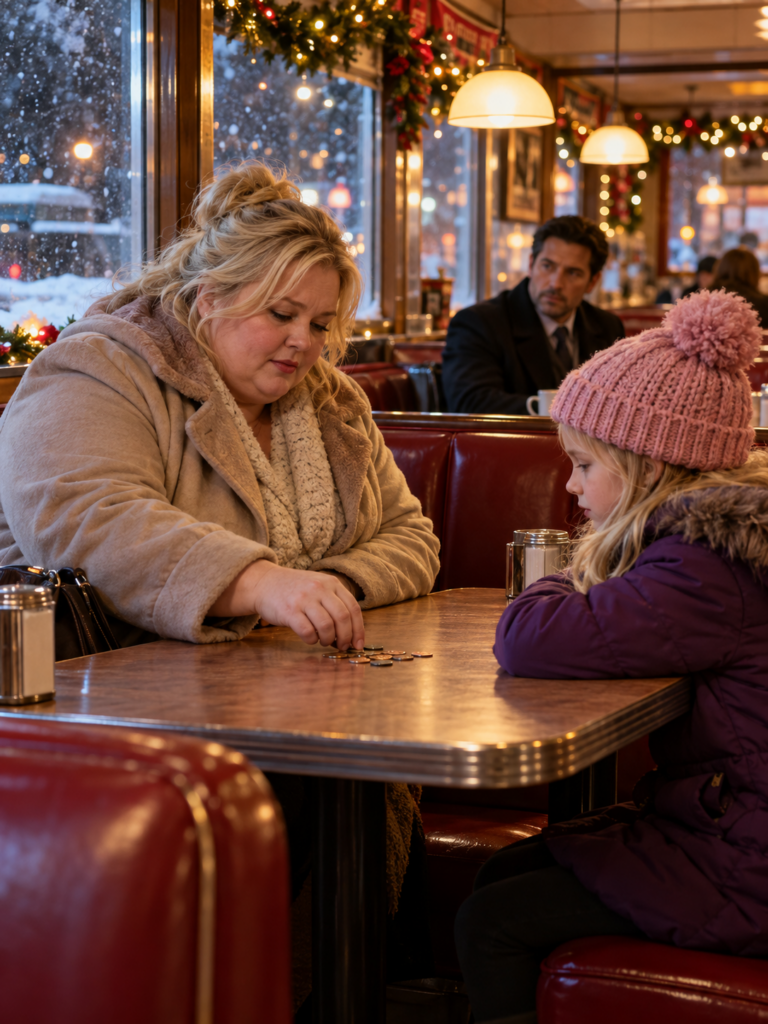
The woman studied the menu, then opened a cheap canvas purse and began counting coins on the table.
Quarters.
Dimes.
Nickels.
She counted twice.
“Mommy,” the girl whispered. “Can I have pancakes?”
Her mother smiled immediately.
“Of course.”
“What are you having?”
“I ate earlier.”
The lie came too smoothly.
Mason looked down at his coffee.
He knew something about lying to children because you wanted the world to seem safer than it was.
He had spent three years telling his son that Dad was fine.
Doris returned to the table.
“One chocolate chip pancake order,” the woman said. “And water, please.”
Nothing for herself.
When Doris came to refill Mason’s coffee, he spoke quietly.
“What’s their bill?”
Her eyes narrowed.
“Why?”
“Just tell me.”
“Six-fifty.”
Mason slipped two twenties onto her tray.
“Cover theirs and mine. Keep the rest.”
Doris studied him.
“Don’t tell her,” he added.
“You’re going to make me cry into the meatloaf.”
“It’s forty dollars.”
“To you.”
That stopped him.
Doris walked away.
The pancakes arrived. The child—Sophie, Mason learned when her mother said her name—ate with complete concentration.
Her mother watched every bite.
Not greedily.
Relieved.
That expression stayed with Mason.
When Doris eventually brought the check, the woman frowned.
“There’s a mistake.”
“No mistake, hon. Somebody took care of it.”
“I can’t accept—”
“Yes, you can.”
“Who?”
“Someone who wanted to stay anonymous.”
The woman pressed a hand over her mouth.
Her shoulders shook once.
Sophie looked alarmed.
“Mommy?”
“Happy tears,” she whispered. “Just happy tears.”
Mason stood before the woman could look around and identify him.
Outside, the cold struck hard enough to hurt.
He made it ten steps.
Then stopped.
Not your problem.
The voice sounded disturbingly like his father.
You cannot save everyone.
Mason had built an entire philosophy around that idea since Sarah died. Work hard. Provide for Liam. Write checks to charities. Attend the galas when necessary. Keep actual human suffering at a safe enough distance that it could not demand anything personal from him.
The diner door opened behind him.
The woman and Sophie emerged.
They turned north.
Into the storm.
Mason watched them go perhaps twenty feet.
Then he swore under his breath and followed.
“Hey.”
The woman spun, dragging Sophie instinctively behind her.
Mason stopped several yards away.
“Sorry. I didn’t mean to scare you.”
“We’re fine.”
“I was in the diner.”
“I know.”
Her expression told him she also knew exactly who had paid.
“My name’s Mason.”
“We don’t need anything else.”
“It’s below zero with the windchill.”
“We’re fine.”
Sophie peeked from behind her mother.
“Are you the man who bought our dinner?”
The woman stiffened.
“Sophie.”
“I heard you say her name,” Mason explained quickly. “That’s all.”
Her fear embarrassed him, though he knew it should not. A stranger following a mother and child through Chicago at night had no right to expect trust merely because he had purchased pancakes.
“Where are you staying?” he asked.
“That’s none of your business.”
“You’re right.”
“Then—”
“But that little girl is freezing.”
Anger flashed across her face.
Then exhaustion swallowed it.
“We have a shelter.”
“Which one?”
“Franklin Street.”
Mason felt his stomach sink.
“It closed last month.”
Her expression changed.
“What?”
“I donate to the organization. They sent notices.”
“No.” She shook her head. “The website— We just came back from Milwaukee. I thought—”
She stopped.
Snow settled in Sophie’s curls.
Mason asked carefully, “Do you have a car?”
“No.”
“Family?”
The woman looked away.
“Friends?”
Nothing.
Mason took out his phone.
“I’m getting you a room at the Whitmore.”
“No.”
“One night.”
“I don’t take charity.”
“Then don’t call it charity.”
“What would you call it?”
“Christmas.”
Despite everything, she nearly laughed.
Instead her chin trembled.
“Why?”
Mason looked at Sophie.
His own son was seven.
Warm.
Safe.
Probably asleep by now beneath blankets in a house with twelve rooms.
“Because someone should care,” he said.
The answer silenced both of them.
Three minutes later, a black sedan arrived.
The woman finally said, “Elena Hart.”
“Mason Reed.”
Recognition flickered across her face.
Of course it did. Reed Technologies occupied fifty-three floors of glass and steel in the Loop, and Mason’s name appeared on buildings, foundations, newspapers, and enough business magazines to embarrass him.
He opened the car door.
Before Elena could climb inside, he pressed five hundred dollars into her hand.
She immediately tried to return it.
“Food,” he said. “Clothes. Anything Sophie needs.”
“I can’t—”
“You can.”
“I don’t know you.”
“That’s probably the strongest argument you’ve made all night.”
That earned him the faintest exhausted smile.
“Merry Christmas, Elena.”
He shut the door before she could give the money back.
By the time Mason reached his Mercedes, he had already called Liam Chen.
His assistant answered with the weary suspicion of a man accustomed to unusual requests.
“Boss?”
“I need a favor.”
“It’s Christmas Eve.”
“Triple time.”
A sigh. “What?”
“There’s a woman named Elena Hart staying at the Whitmore with her daughter. Extend their room a week. Send clothes, toiletries, food. Tomorrow morning.”
“Mason—”
“And find out her employment history.”
“For what?”
“A job.”
“You cannot hire people because you found them in diners.”
“I own the company. I can interview whoever I want.”
“That sentence is why boards exist.”
“Something stable. Benefits. She has a child.”
Liam was silent.
Then typing began.
“You’re going soft.”
“Don’t make me regret calling.”
Mason hesitated.
“One more thing.”
“Of course.”
“A Christmas tree. Small one. And presents for a six-year-old girl.”
Liam groaned.
But Mason could hear the smile underneath it.
When Mason finally reached home, Catherine was waiting.
His mother-in-law had silver hair, an unbreakable spine, and the unnerving ability to see through him faster than anyone since Sarah.
“Liam waited for you,” she said.
“I know.”
“He finally fell asleep.”
Mason removed Sarah’s old scarf.
Catherine noticed his expression.
“What happened?”
“I met someone who needed help.”
“A woman?”
“And her daughter.”
Catherine’s gaze softened.
“Sarah would have stopped too.”
The name still found the tender places.
Mason looked toward the stairs.
“I know.”
Upstairs, he tucked the blankets around his sleeping son.
Young Liam had Sarah’s mouth.
Sometimes that resemblance felt like a gift.
Sometimes it was a wound.
Mason kissed his forehead and went to bed thinking not about Sarah for once, but about a stranger counting coins beneath fluorescent diner lights.
Across the city, Elena watched Sophie sleep in white hotel sheets.
There was hot water.
Heat.
Food.
A locked door.
Safety.
All of it provided by a man she had known for less than an hour.
Elena should have been relieved.
Instead, fear sat beneath her ribs.
Kindness had become difficult to trust.
Since Marcus died two years earlier in a construction accident, nearly every institution Elena had turned to had required proof, paperwork, waiting lists, explanations, humiliation, or money she did not have.
Her husband’s death had taken more than Marcus.
No life insurance.
No meaningful savings.
Hospital bills.
Lost apartment.
Lost car.
Then Marcus’s mother telling Elena that if she had been a better wife, perhaps Marcus would have been more careful. Later came threats about Sophie, accusations that Elena was unstable and incapable of providing.
So Elena had learned not to owe people anything.
But Sophie was warm.
That mattered more.
“One night,” Elena whispered into the quiet room.
Tomorrow she would return whatever remained of Mason’s money.
Tomorrow she would leave.
At eight the next morning, someone knocked.
Elena checked the peephole before opening.
A young Asian man in an expensive suit held up an identification badge.
“Liam Chen. Mr. Reed’s assistant.”
Beside him stood a hotel cart buried beneath bags and boxes.
Elena stared.
“No.”
Liam blinked.
“Good morning to you too.”
“This is too much.”
“Mr. Reed anticipated you might say that.”
“I bet he did.”
Liam began unloading clothing, toiletries, children’s things, breakfast, hot chocolate, and several wrapped packages.
Sophie emerged from the bedroom area.
Her eyes widened.
One gift contained a stuffed polar bear.
Another held art supplies.
The moment Sophie saw the crayons, something inside Elena gave way.
She had left Sophie’s old ones behind when they were evicted from a motel.
Her daughter had cried harder over those abandoned crayons than over almost anything else.
Now Sophie sat cross-legged on a hotel carpet, coloring with complete concentration.
“Mr. Reed will stop by around ten,” Liam said.
Elena crossed her arms.
“What does he want?”
“Nothing.”
“Nobody wants nothing.”
Liam’s expression became serious.
“I’ve worked for Mason three years. Believe me or don’t, but he’s one of the good ones.”
At ten precisely, another knock came.
Mason stood outside holding a three-foot Christmas tree.
Beside him was a boy carrying presents.
“This is my son, Liam.”
Elena stared from Mason to the child.
“You named your son and your assistant the same thing?”
“No. My son existed first. Hiring Liam Chen was poor planning.”
She laughed before she could stop herself.
Young Liam stepped inside.
Within minutes, he and Sophie were building towers from wooden blocks.
Mason set the little tree on the dresser.
“You can’t keep doing this,” Elena said.
“Doing what?”
“Giving us things.”
“Why?”
“Because I can’t pay you back.”
His answer came without hesitation.
“I don’t want you to.”
That frightened her more than any demand would have.
They sat near the window while the children played.
Mason told her about the opening in Reed Technologies’ corporate hospitality division. Elena had worked hotel front desks, managed guest services, and coordinated events before Marcus died.
“I looked into your background,” he admitted.
“You investigated me?”
“Liam did.”
“That does not improve it.”
“No.”
At least he looked appropriately ashamed.
Mason folded his hands.
“The interview is real. The job is real. You’d still have to earn it.”
“What if I’m terrible?”
“Then you don’t get hired.”
Elena stared.
He smiled slightly.
“I thought honesty might help.”
It did.
More than another promise would have.
“Why me?”
Mason glanced toward the children.
“Because last night I watched you buy your daughter dinner with coins and pretend you weren’t hungry. You were terrified and exhausted and still thinking about her first.”
“That doesn’t make me qualified.”
“No. Your resume does.”
A beat passed.
“The rest tells me something about you.”
Elena studied him.
For the first time, she noticed not his money or reputation but the tiredness in his eyes.
“Your wife,” she said carefully. “Liam mentioned…”
“Sarah. Cancer.”
“I’m sorry.”
“Eight months from diagnosis to funeral.”
He looked at his son.
“For a long time after, I did what was required. Nothing more. Liam needed a father, so I got up. The company needed me, so I worked. But I wasn’t really…”
“Living?”
His gaze returned to hers.
“Exactly.”
Something passed between them then.
Not attraction.
Recognition.
Two people who knew grief as a daily practical thing rather than a dramatic one.
The missing toothbrush.
The extra place at a table.
The instinct to send a text before remembering there was no one left to receive it.
Elena looked at Sophie laughing with young Liam.
“I’ll take the interview.”
Mason nodded.
“And the hotel?”
“For now.”
“And Catherine wants to talk to you about a program she runs.”
“You told your mother-in-law about me?”
“I may have made several decisions without permission.”
“You’re unbelievably pushy.”
“Persistent.”
“That is not better.”
But Elena was smiling.
And Mason realized he wanted to see her do it again.
Part 2
Christmas dinner at Catherine’s house should have felt awkward.
Instead, it felt dangerous for an entirely different reason.
It felt normal.
Catherine welcomed Sophie as though she had been expected for years. Young Liam dragged her away to show her his toys. Mason carried dishes to the table. Elena found herself standing beside Catherine at the sink after dinner, drying plates while tomato sauce simmered somewhere nearby and children laughed in another room.
Normal.
Domestic.
Warm.
Elena distrusted it immediately.
“I need to do this myself,” she told Catherine when the older woman described her professional development program for women rebuilding their lives.
Catherine kept washing a plate.
“Why?”
“Because I’m Sophie’s mother.”
“That doesn’t answer the question.”
“I need to prove I can take care of her.”
“Taking help and taking care of your child are not opposites.”
Elena looked down.
Catherine dried her hands.
“I spent thirty years in social work. The people who recover are rarely the ones who refuse every hand offered to them. They’re the ones who learn which hands are safe.”
Elena thought of Mason standing in a blizzard.
“Okay,” she said.
Two days later, she walked into Reed Technologies wearing borrowed confidence and a navy blazer Catherine had provided.
Mason met her in the lobby.
He looked different at work.
Still Mason.
But straighter somehow.
People watched when he moved.
Not because he was loud. Because he did not need to be.
Elena noticed.
And disliked that she noticed.
“I’m not interviewing you,” he said.
“Good.”
“Jennifer Torres and Marcus Bell will.”
“Better.”
“If you bomb, I’ll pretend we never met.”
She laughed.
The panel interview was harder than she expected.
Good.
Jennifer asked about difficult clients. Marcus tested her knowledge of event logistics, vendors, travel, and emergency planning.
Elena answered from experience.
Not perfectly.
Honestly.
She admitted where her skills had gone stale.
She described a hotel conference she had salvaged after a catering failure and a wedding she had reorganized in ninety minutes after a flooded ballroom forced two hundred guests into another space.
When Jennifer asked why she had been out of the workforce, Elena told the truth.
“My husband died.”
The words still hurt.
But they no longer knocked the air from her lungs.
Afterward, Mason asked her to lunch.
“That wasn’t part of the interview,” Elena said.
“It’s food.”
“With my potential employer.”
“I’m not making the hiring decision.”
“You own the company.”
“Technicality.”
At lunch, she surprised herself by talking about Marcus.
Not the sanitized version.
She told Mason about his terrible jokes and worse financial habits. How he could repair nearly anything but never remembered where he left his keys. How his mother blamed Elena after the accident.
“She said if I’d been a better wife, he wouldn’t have taken that job.”
Mason’s expression changed.
Elena held up a hand.
“Don’t.”
“Don’t what?”
“Get angry on my behalf.”
“I’m already angry.”
“I don’t need you to fix it.”
“I know.”
That stopped her.
Mason leaned back.
“You’re allowed to tell me something without me solving it.”
“You don’t look like you believe that.”
“I’m learning.”
She smiled despite herself.
Later, Catherine collected them and the children for apartment hunting.
Elena resisted until the hotel began to feel too temporary to ignore.
The apartment Catherine found was small.
Two bedrooms.
Old kitchen.
Reliable heat.
Secure windows.
A landlord who happened to know Catherine and agreed to defer part of the deposit.
Elena knew help when she saw it.
But this help left room for dignity.
She could pay the rent herself once employed.
“I’ll look at it,” she said.
Her phone chimed before they left.
Jennifer Torres.
The job offer.
Elena read it three times.
Then sat on the stairwell because her knees had gone weak.
Mason found her there.
“I got it.”
His face softened.
“Of course you did.”
“No.” Elena stood. “Don’t do that. Don’t make it sound inevitable.”
He blinked.
“I earned this.”
“Yes.”
“I need you to say it.”
“You earned it.”
The relief on her face taught him something important.
For Elena, generosity could become another form of power if he was careless.
So when she moved into the apartment, Mason brought boxes but did not pay her rent.
When she insisted on buying her own groceries, he did not argue.
When Catherine furnished half the living room from neighbors and storage, Elena wrote an IOU on a napkin.
Catherine accepted it solemnly.
Mason teased neither woman.
On Elena’s first Monday at Reed Technologies, she arrived before anyone expected her.
By the end of the afternoon, she had solved a scheduling disaster involving a double-booked venue.
By the end of the month, Jennifer trusted her with clients.
By the end of three months, Mason had learned something uncomfortable.
His first attraction to Elena had been tangled with protectiveness.
That had changed.
Now he admired how she worked.
How she anticipated problems before they became emergencies.
How she treated hotel staff, drivers, assistants, and executives with the same direct courtesy.
How she refused to flatter people merely because they were powerful.
How she could calm a furious vendor without surrendering an inch.
Competence made her more dangerous to him than beauty ever could.
She was building a life that did not depend on him.
And the more independent she became, the more Mason wanted her.
That frightened him.
Their families kept pulling them together.
Friday dinners at Catherine’s became routine.
Sophie began calling Catherine “Grandma Catherine” without anyone planning it.
Young Liam and Sophie fought over games, traded snacks, built blanket forts, and made up five minutes later.
One icy Friday night, the children fell asleep before anyone could drive home safely.
Catherine insisted Elena stay.
Later, long after the house quieted, Elena found Mason in the living room.
He was staring at a framed photograph of Sarah.
“She was beautiful,” Elena said.
“She was.”
Mason did not hide the photograph.
Elena liked that.
“Marcus hated having his picture taken.”
“He sounds sensible.”
“He was not.”
Mason laughed softly.
Elena sat beside him.
For several minutes neither spoke.
Then Mason said, “You got quiet tonight.”
“I’m tired.”
“Liar.”
She gave him a look.
“What?”
Elena pulled her knees closer.
“I keep waiting for all of this to disappear.”
“The job?”
“The job. Apartment. Catherine. You.”
Mason’s expression sharpened at the final word.
“Me?”
She regretted saying it.
“You know what I mean.”
“No, I don’t.”
“People leave.”
“Sometimes.”
“Marcus did.”
“He died.”
“So did Sarah.”
There it was.
The ugly arithmetic of grief.
Mason looked toward the hallway where their children slept.
“I can’t promise nothing bad will ever happen.”
“At least you’re not stupid enough to try.”
“But I can promise I’m not planning to disappear.”
Elena’s hands loosened.
Mason placed his palm on the couch between them, not touching her.
After a moment, she moved her hand into his.
No kiss.
No confession.
Just fingers closing.
The intimacy of it frightened them both enough that when Sophie stirred, they separated automatically.
Three months passed.
Their lives became full.
Work.
School pickups.
Friday dinners.
Catherine’s program.
Birthday invitations.
Forgotten lunch boxes.
The ordinary machinery of people beginning to belong to one another.
Mason and Elena did nothing about the moment on Catherine’s couch.
Which meant they thought about it constantly.
Jennifer finally caught Elena staring at her phone.
“He does that too,” she said.
“Who?”
Jennifer gave her a flat look.
Elena sighed.
“It’s complicated.”
“Of course it is.”
“He owns the company.”
“You report to Marcus, not Mason.”
“We both lost spouses.”
“Yes.”
“The children are attached.”
“Very.”
“If this goes wrong—”
“Then it hurts.”
Elena looked up.
Jennifer’s voice softened.
“But avoiding something because it might hurt is not the same as protecting yourself.”
That Friday, Catherine apparently reached the same conclusion.
After dinner, she placed down her wineglass and looked between Mason and Elena.
“Are you two planning to suffer in silence forever?”
Mason nearly choked.
“Catherine.”
“Don’t Catherine me. I am seventy-three. I don’t have enough years left to watch you stare at each other across my table.”
Elena laughed helplessly.
Catherine stood.
“I’m checking on the children. Speak to each other like adults.”
Then she left.
Mason rubbed both hands over his face.
“I’m sorry.”
“She’s right.”
He looked up.
Elena’s smile disappeared.
“She’s right,” she repeated.
Mason took a long breath.
“I don’t know how to do this.”
“Neither do I.”
“Sarah was it for me. I thought that part of my life was over.”
“And now?”
His eyes held hers.
“Now I want you.”
Elena’s pulse jumped.
Mason continued before courage deserted him.
“And I don’t know how much of that is real and how much is loneliness. I don’t know whether you feel something for me or whether what I did for you got tangled up with gratitude.”
“It did,” Elena admitted.
His face changed slightly.
“At first.”
She leaned forward.
“I was grateful. You helped Sophie when I couldn’t. For a while, I looked at you and saw the man who rescued us.”
Mason’s jaw—
No.
Elena almost laughed at herself. She had spent too much time reading fear into his expressions.
She simply watched him wait.
“But that isn’t who I see anymore.”
“Who do you see?”
“A man who worries about his son. A man who doesn’t know how to load Catherine’s dishwasher correctly.”
“No one knows how to load Catherine’s dishwasher correctly.”
“A man who went to therapy even though he hated it.”
“She told you that?”
“You told me.”
“Oh.”
“And someone who sometimes listens when I tell him not to fix things.”
“Sometimes.”
Elena’s voice softened.
“I see Mason.”
He went very still.
“And that terrifies me,” she added.
“Why?”
“Because if I lose you, I don’t only lose you. Sophie loses Liam. We lose Catherine. We lose Friday dinners and Christmas and this whole strange family we stumbled into.”
Mason leaned closer.
“And if it works?”
“I don’t know how to think that far.”
“Then don’t.”
He placed his hand between them, palm up.
“Tomorrow. Next week. Dinner. One day at a time.”
Elena looked at the offered hand.
“What are you asking?”
“A chance.”
She put her hand in his.
“One day at a time.”
Mason’s smile came slowly.
“Ground rules,” she said.
“Of course.”
“No grand gestures.”
His smile vanished.
“That feels discriminatory.”
“No expensive gifts.”
“Cruel.”
“We do this as equals.”
That sobered him.
“Agreed.”
“We don’t tell the kids anything until we understand what we’re doing.”
“Agreed.”
“And if it ends, we act like adults because they shouldn’t lose each other because we couldn’t make something work.”
Mason squeezed her fingers.
“Agreed.”
Later, beside Elena’s car, Mason stepped closer.
“I’d like to kiss you.”
Elena’s breath caught.
“That was unexpectedly polite.”
“I’m terrified.”
“Good.”
He laughed quietly.
Then kissed her.
Softly.
No demand.
No urgency.
A question more than a claim.
It was nothing like kissing Marcus.
That truth hurt for half a second.
Then Elena understood that it should be different.
Mason was not Marcus.
She did not want him to be.
When they separated, uncertainty crossed his face.
“Okay?”
Elena smiled.
“More than okay.”
The next evening was their first real date.
A small Italian restaurant in Wicker Park.
Tiramisu shared across the table.
A cold walk afterward.
They spoke about Sarah and Marcus without treating either name as an intrusion.
“Do you think they’d approve?” Elena asked.
“Sarah would tell me I’d wasted three years overthinking everything.”
“Marcus would make a joke about me dating a billionaire.”
“He would hate me.”
“No. He’d make fun of you, then like you.”
Mason reached across the table.
Elena let him take her hand.
When he brought her home, he kissed her again.
Longer this time.
Still careful.
But no longer uncertain.
For the first time since Marcus died, Elena allowed herself to imagine that wanting something did not automatically mean she would lose it.
Part 3
Dating did not magically make them whole.
It made their unfinished parts easier to see.
The first morning Sophie found Mason making breakfast in Elena’s kitchen, she burst into tears.
“You’re not Daddy.”
Mason went still.
Elena’s stomach dropped.
But Mason crouched several feet away.
“You’re right.”
Sophie cried harder.
He did not touch her until she moved toward him.
“I’m never going to be your daddy unless someday you want me to be something like that,” he said. “And even then, I wouldn’t replace him.”
Elena had to turn away.
That night, she told Mason he had handled it perfectly.
“I wanted to fix it.”
“I know.”
“I’m beginning to understand why you find me exhausting.”
“Beginning?”
There were other difficult moments.
Elena canceled dates when Sophie was sick and then resented Mason for being understanding because his patience sometimes reminded her of charity.
Mason shut down on Sarah’s birthday.
Elena had a panic attack in his car after an otherwise perfect evening because perfection made loss feel imminent.
They talked.
Sometimes badly.
Then apologized.
Sometimes Catherine ordered them to talk.
They learned.
Six months after Elena started work, Marcus Bell called her into his office.
She assumed she had made some invisible mistake.
Instead, he offered her a promotion to senior coordinator.
“You’ve earned it,” he said when she tried to question him.
Not Mason.
Not charity.
Her.
That evening they celebrated with both children.
Young Liam spilled juice.
Sophie gave a twenty-minute explanation of playground politics.
Mason listened as if the fate of civilization depended upon understanding which child had stolen whose swing.
Elena watched him.
And knew.
She loved him.
The realization did not arrive like lightning.
It arrived like recognition.
Of course she did.
She loved the man who had paid for pancakes anonymously because he had not needed her gratitude.
The man who now knew when to help and when to stand back.
The man who loved his dead wife without making Elena compete with a ghost.
The man who treated Sophie’s trust as something sacred.
Later, after Catherine took the children for a sleepover, Mason and Elena sat in his car outside her apartment.
“You got quiet at dinner,” he said.
Elena stared ahead.
“I love you.”
Mason did not move.
She laughed nervously.
“Well, that was graceful.”
“Elena—”
“I know it’s complicated. And fast. And maybe terrifyingly stupid. But I do.”
His expression softened.
“It isn’t too soon.”
“No?”
“I’ve loved you for weeks.”
She looked at him.
“You could have said something.”
“So could you.”
“We’re idiots.”
“Clearly.”
He kissed her.
Then, when they broke apart, he said, “Move in with me.”
Elena pulled back.
“What?”
“I know.”
“Mason.”
“I know.”
“You just agreed we’re idiots.”
“Still true.”
She stared.
His house was huge.
Her apartment was small.
They were together most nights anyway. The children behaved like siblings already.
But those practical truths were not why her breath caught.
“I want mornings,” Mason said quietly. “Homework. Dishes. Arguments about groceries. I don’t want to date around the edges of our lives forever.”
Elena thought of the terror she once felt standing in his hotel room accepting clothes she had not purchased.
He was not asking to rescue her now.
He was asking to build something with her.
“If Sophie hesitates,” Elena said, “we slow down.”
“Absolutely.”
“If young Liam isn’t okay—”
“We stop.”
She nodded.
“Okay.”
His eyes widened.
“Okay?”
“Yes.”
The children reacted by immediately discussing bedrooms, the backyard swing set, and whether combining households increased their chances of being allowed a dog.
Moving in was harder.
Sophie had nightmares.
Mason discovered Elena reorganized cabinets when anxious.
Elena discovered Mason left coffee cups in rooms like breadcrumbs.
They argued about bedtime routines and discipline.
Elena sometimes felt swallowed by the size of his house.
Mason sometimes felt guilty changing rooms Sarah had decorated.
Neither pretended those feelings meant the relationship was wrong.
At Catherine’s insistence, they attended couples therapy.
Three months later, on a quiet Sunday morning, Mason sat beside Elena.
“I want to tell you something without you panicking.”
“Excellent opening.”
“I want to marry you.”
Elena froze.
“I’m not proposing.”
She exhaled.
“Yet.”
“Mason.”
“I know we need more time. Sophie needs time. Liam needs time. We need time. I’m telling you where I’m going.”
His voice steadied.
“You and Sophie are my family. Eventually, I want to make that official.”
Elena’s eyes filled.
“Eventually,” she agreed.
One year after the night they met, Mason took everyone back to the Golden Lantern Diner.
Doris was still there.
The neon sign still flickered.
Sophie and young Liam could barely contain themselves.
Elena suspected nothing until Mason slid from the booth.
Then she saw the ring.
“Oh, God.”
Mason smiled up at her.
“You changed my life here exactly one year ago.”
“That feels unfair. I was ordering pancakes.”
“You were refusing to let the world make you stop fighting.”
His voice roughened.
“You reminded me I was still alive.”
Elena covered her mouth.
Mason looked at Sophie before returning his gaze to Elena.
“Let me spend the rest of my life building this family with you. Let me love Sophie. Let me keep choosing you.”
He opened the ring box.
“Marry me.”
Elena could not speak.
So she nodded.
Sophie shrieked.
Young Liam threw both arms around his father.
Elena joined them, and suddenly four people were tangled together beside the same booth where a frightened mother had once counted coins.
Doris brought out a cake.
“You knew?” Elena accused through tears.
“Honey, everybody knew.”
They married in spring in Catherine’s backyard.
Jennifer stood beside Elena as maid of honor.
Young Liam served as best man with solemn pride.
Sophie wore purple as flower girl because no argument on earth could persuade her otherwise.
Before Mason kissed his bride, he knelt in front of Sophie.
The girl went very still.
“Sophie Marie Hart,” he said, “I’m not asking you to forget your dad. I would never want that.”
Elena began crying before he finished.
“But if you want me to, I’d like to be your dad too. Another person who gets to love you and protect you and help you grow up.”
Sophie threw herself against him.
“Yes.”
Mason closed his eyes.
Young Liam wiped his face and vehemently denied crying when Catherine noticed.
Later, after the food and music and laughter, Mason and Elena sat alone on Catherine’s porch swing.
Fireflies moved through the dark yard.
Inside, both children slept.
Tomorrow Mason and Elena would leave for their honeymoon.
Tonight neither wanted to move.
“A year and a half ago,” Mason said, “I was sitting alone in that diner feeling sorry for myself.”
“A year and a half ago, I had six dollars and fifty cents.”
“You had more than that.”
“Fine. Seven dollars.”
Mason laughed.
Elena rested her head on his shoulder.
Sarah’s wedding band still hung on the chain he sometimes wore around his neck.
Her photograph remained in his office.
Marcus’s old toolbox sat in their garage now because Sophie had asked Elena not to give it away.
They had learned that moving forward required no betrayal of the people behind them.
There was room.
For grief.
For memory.
For new love.
“I was terrified of you,” Elena said.
“I know.”
“You kept sending things.”
“I was very bad at boundaries.”
“You were.”
“I improved.”
“Eventually.”
He kissed the top of her head.
Elena watched the fireflies.
“Thank you for not giving up when I kept trying to refuse everything.”
“Thank you for refusing enough that I learned how to help without taking over.”
“That’s growth.”
“I’ve been told.”
She smiled.
“I love you.”
“I love you too.”
Two years later, they would have a daughter together.
Every Christmas Eve, they would return to the Golden Lantern with Sophie and young Liam and, eventually, their little sister.
They would take the same booth whenever it was available.
Mason would order coffee.
Elena would order pancakes whether she wanted them or not.
They would leave Doris an absurd tip and ignore her complaints.
As the children grew older, Mason and Elena told more of the truth about that first night.
The cold.
The fear.
The shelter that had closed.
The six-dollar-and-fifty-cent dinner.
The stranger who paid anonymously and then ruined the anonymity by following them outside.
“I was making sure you were safe,” Mason would protest.
“You were being creepy.”
“It was a blizzard.”
“You were still creepy.”
The children always sided with Elena.
But underneath the jokes lived something neither Mason nor Elena ever forgot.
Their family existed because of small choices.
Mason chose not to walk away.
Elena chose to enter the car.
She chose to attend the interview.
He chose to respect her independence.
She chose to trust him beyond gratitude.
He chose patience.
She chose risk.
Again and again, long after the dramatic part of their story was over, they kept choosing.
That was the thing Mason had not understood while sitting alone in the diner years earlier.
Love after loss was not a replacement for what had vanished.
It was not a reward for suffering.
And it was not one grand rescue.
It was smaller than that.
Harder, too.
It was showing up.
Listening.
Remembering.
Making room.
Knowing when to help and when to let someone stand on her own.
Knowing that a dead spouse could still be loved without threatening a living marriage.
Knowing children could carry one parent in memory and another by the hand.
It was pancakes and school pickups.
Work emergencies and Friday dinners.
Therapy appointments.
Arguments over dishwashers.
Nightmares.
Promotions.
Christmas trees.
Quiet apologies made in kitchens after midnight.
Mason had given Elena safety on one frozen Christmas Eve.
Elena had given him something he had not known he needed.
A reason to participate in his own life again.
And somewhere between those two gifts, neither owed the other anything.
They simply became a family.
Not because money solved grief.
Not because kindness erased what had happened.
But because, on the night when both of them had nearly stopped believing that life could still surprise them, one stranger noticed another.
And chose not to look away.

