
Part 1
The first thing I remembered after the crash was a woman saying my name as if she’d been carrying it around for fifteen years.
“Evan Brooks?”
Not sir. Not can you hear me? Not one of those calm emergency-room commands designed to keep injured people from wandering off into the light.
My full name.
I opened my eyes to white ceiling panels, fluorescent glare, and pain arriving from several directions at once.
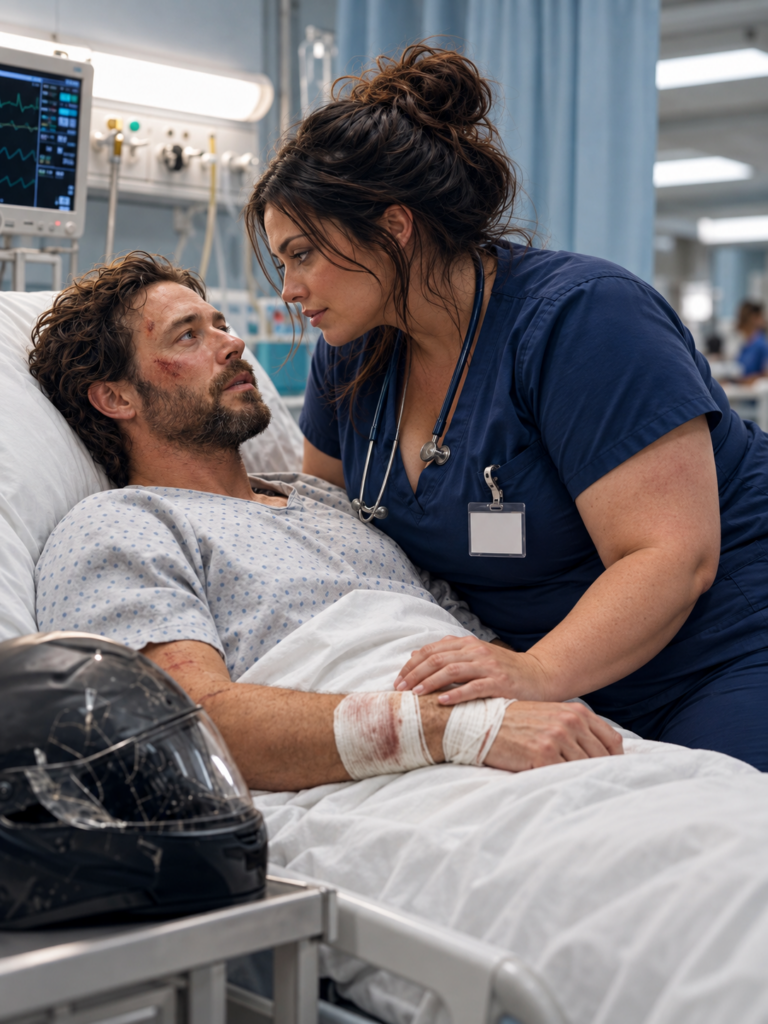
My left arm felt flayed. My ribs objected every time I breathed. Something around my wrist held it still, and my motorcycle helmet lay cracked on a chair beside the bed like evidence from a life I had apparently failed to manage responsibly.
Then she leaned over me.
Dark hair pinned back. Navy scrubs. Green eyes I hadn’t seen since I was eighteen.
There was still a faint crescent-shaped scar near her chin.
I knew because, once upon a time, I had known everything about Mia Caldwell that could be learned from three desks away without actually having the courage to speak to her.
“Mia?”
Her professional expression changed.
Only for a second.
Then she smiled.
“I guess you do remember me.”
The heart monitor beside me gave one sharp, enthusiastic beep.
I stared accusingly at it.
At thirty-three, I should have been immune to this.
I had been married. Divorced. Promoted. Responsible for gates, staffing problems, delayed aircraft, furious travelers, missing wheelchairs, weather diversions, and occasionally explaining to a grown man that no, I personally had not caused a thunderstorm over Denver.
I worked gate operations at Portland International.
I was good in emergencies.
My own life was another matter.
My divorce had been final eleven months earlier. There had been no affair, no screaming match, no villain. Just two people who had become excellent roommates and poor spouses, until eventually one of us had admitted what both already knew.
After that, I moved into an apartment with a balcony and bought one chair for it.
Buying two had felt optimistic.
Now Mia Caldwell had two fingers against my wrist.
“Evan, stay with me.”
“I’m here.”
“Do you know where you are?”
“Hospital.”
“Which one?”
I looked around as if there might be a helpful logo on the ceiling.
“Somewhere with terrible lighting.”
Her mouth twitched.
“Caldwell Medical.”
Of course it was.
“You know what day it is?”
I told her.
“Do you remember the accident?”
A pickup running a red light.
My motorcycle leaning beneath me as I tried to avoid it.
Wet pavement.
Gravel.
Then the road coming up much faster than roads ought to.
“Yes.”
“Good. Follow my finger.”
She raised one finger.
My eyes tracked it.
“I used to,” I murmured.
Her eyebrow rose.
“Excuse me?”
Apparently whatever part of the brain stopped a man from humiliating himself had been left somewhere on 82nd Avenue.
“In high school,” I said. “You walked fast.”
She stared at me.
“You remember how I walked?”
“I remember a lot of useless things.”
Something quiet passed across her face.
“They might not be useless tonight.”
Behind the curtain, the ER moved at full speed. Wheels rattled over tile. A monitor alarmed somewhere down the hall. Someone coughed. Someone else cried. Rain tapped against distant windows.
Mia kept working.
That was the first thing about the adult version of her that replaced the girl in my memory.
Competence.
She checked my pupils. Examined the abrasion along my jaw. Tested the movement in my fingers. Asked where it hurt and seemed unimpressed when I answered, “Mostly where I have a body.”
“You always did that,” she said.
“Did what?”
“Make jokes when something hurts.”
I looked at her.
She was studying my shoulder, not my face.
“You remember that?”
Her hand stopped briefly.
Then she resumed.
“You scared me when they brought you in.”
The words were so soft I almost thought I’d imagined them.
“You knew it was me?”
“The second I saw your license.”
Her eyes met mine.
“You still make the same face when you’re trying not to admit you’re in pain.”
For the first time, I really looked at her.
The years were there, but not in any way that diminished her.
There were faint lines beside her eyes. A tiny crease appeared between her brows when she concentrated. She looked tired in the way people looked when others depended on them.
At seventeen, Mia had seemed unreachable.
Popular. Beautiful. From the kind of family whose house had gates.
I had loved her from a safe distance because distance required nothing from me except imagination.
At thirty-three, she was real.
That was considerably more dangerous.
“Are you my nurse?” I asked.
“Nurse practitioner.”
“Right.”
“And only until imaging clears you.”
She adjusted the blanket across my ribs.
“After that, if you intend to flirt with the medical staff, I’ll recommend someone less emotionally compromised.”
The monitor beeped again.
She looked at it.
I closed my eyes.
“That machine is defective.”
“Obviously.”
The curtain opened.
A man stepped inside wearing a dark suit with rain on the shoulders and a watch expensive enough to make me reconsider every financial decision I’d ever made.
He looked at Mia first.
Then at me.
Whatever he saw, he disliked it immediately.
“Mia. I heard you were down here.”
Her hand had been resting near my wrist.
She removed it.
Not quickly.
Carefully.
That interested me more than it should have.
His hospital badge identified him as Daniel Voss, board director, Caldwell Medical Group.
“Mia?”
She straightened.
“Daniel.”
“Your mother called twice. She wants to make sure you’re still coming Sunday.”
“I’m working a double.”
“She said you’d say that.”
“She knows me well.”
A pause opened between them.
Not comfortable.
Not new.
Daniel glanced at me.
“You two know each other?”
“High school,” Mia said.
Just that.
High school.
It shouldn’t have bothered me.
It did.
“Small world,” Daniel said.
“Smaller when you’re horizontal.”
Mia coughed into her fist.
Daniel didn’t smile.
He moved closer to her.
“Mia, can we not do this here?”
Something changed in her shoulders.
The same woman who had handled my injuries without hesitation suddenly became very still.
I recognized the posture even before I understood why.
I had seen it once, fifteen years earlier.
A girl standing beneath an awning after graduation while her parents explained something to her she didn’t want to hear.
Mia picked up my chart.
“Mr. Brooks needs a CT.”
“We’ll talk later.”
Daniel looked at me.
“Feel better, Evan.”
The way he said my name made me wonder whether we had met before.
He walked out.
The curtain closed.
I waited two seconds.
“Ex?”
Mia gave me a look.
“Subtle.”
“I’m on pain medication. My subtlety is probably in trauma bay three.”
She stared at the chart.
“Fiancé.”
That word found an uninjured place and hit it.
“Oh.”
“Former fiancé.”
I tried not to feel relieved.
Failed.
She clipped the chart to the end of my bed.
“We should focus on your possible concussion.”
“I’d love to. Unfortunately, you just asked whether I remember high school, and then your former fiancé walked in looking like he’s about to foreclose on my organs.”
That earned a reluctant smile.
Then it disappeared.
“Evan.”
“Yeah?”
Her voice lowered.
“Do you remember what happened after graduation?”
I searched my memory.
Cheap folding chairs on the football field.
My mother crying.
My father not attending.
Mia crossing the stage beneath a storm of applause.
Me leaving early because I had a closing shift.
Then—
Rain.
A parking lot.
Mia crying.
I frowned.
Pain sharpened behind my eyes.
Her hand settled on my forearm.
“Don’t force it.”
“I saw you outside the gym.”
Her fingers tightened.
“You were upset.”
She looked down.
“You gave me your jacket.”
The memory returned.
Blue denim.
Frayed cuff.
My favorite jacket because I couldn’t afford another.
Mia standing beneath the awning while rain poured beyond the concrete.
Mascara under her eyes.
Her parents arguing beside a black car.
“You said you couldn’t go home.”
“I didn’t.”
Then I remembered driving.
My Civic had smelled like fast-food wrappers and engine oil. Mia had sat beside me in my oversized jacket, her knees drawn up, staring through a rain-streaked windshield.
We drove to the overlook above the river.
She told me her parents had chosen everything.
College.
Major.
Career.
People she should know.
People she shouldn’t.
Her whole future had been arranged with the efficient confidence of a dinner reservation.
“I feel like I’m disappearing,” she’d said.
I had been eighteen, broke, tired, and certain the future was something that happened to other people.
She asked where I was going to school.
I admitted I hadn’t applied anywhere.
Then she asked what I wanted.
No one had ever asked me that.
I remembered staring through the windshield.
“I don’t know.”
“You have to want something.”
“Why?”
“Because otherwise everyone else gets to decide.”
I had laughed.
“You’re giving me that advice?”
She laughed too.
And for a while we were just two frightened teenagers hiding from futures we hadn’t chosen.
Then I remembered what I’d told her.
“If you know what you don’t want, leave before you become somebody you hate.”
Mia’s eyes filled.
“That was what you said.”
And then the last memory came back.
Her hand against my cheek.
Rain beating softly on the roof.
Her mouth touching mine.
Not one of the countless imaginary kisses I’d invented afterward.
Real.
Brief.
Trembling.
I stared at her.
“You kissed me.”
A sad smile appeared.
“You kissed me back.”
The monitor beeped.
I ignored it.
“But the next morning you were gone.”
“My father sent me to Boston.”
“You didn’t say goodbye.”
“I wasn’t allowed to.”
Her voice was almost flat now, as if she had told herself that fact too many times to still sound angry.
“No phone. No chance to see anyone.”
She hesitated.
“I wrote to you.”
I thought I’d misunderstood.
“You what?”
“Three letters.”
“I never got them.”
She looked at me for several seconds.
Then an orderly appeared.
“CT’s ready.”
Mia stepped away.
The bed began to move.
I kept looking at her.
She walked beside me for two steps, then leaned close.
“Then somebody made sure you didn’t.”
As they rolled me down the corridor, I looked back.
Daniel stood beside the nurses’ station.
Watching us.
And for the first time that night, the crash stopped being the thing I couldn’t understand.
Part 2
The CT scanner sounded like an appliance attempting communication with another planet.
I lay perfectly still while it worked around my head and tried not to think about three letters that had apparently existed for fifteen years without me.
It didn’t work.
Mia had written.
I had waited for her.
For months after graduation, I had invented reasonable explanations for her silence.
Boston was busy.
She was adjusting.
Maybe the kiss embarrassed her.
Maybe I’d misunderstood it.
Eventually reasonable explanations became humiliating ones.
She regretted me.
I had been a strange little detour before her real life began.
I had been the broke kid with a battered Civic who confused one vulnerable night with love.
So I stopped waiting.
Or told myself I had.
I worked baggage handling at the airport. Then ramp operations. Then passenger service. Then supervision.
I built a life through schedules and overtime.
Years later, I married a woman who deserved someone more available than I knew how to be. When that ended, I blamed adulthood, incompatibility, exhaustion.
I never blamed a rainy night at eighteen.
That would have been pathetic.
Until Mia told me she wrote.
When I returned to the ER, she was near my bay.
Daniel stood a few feet from her.
They were speaking quietly.
I couldn’t hear the words, but I recognized Mia’s expression now.
Cornered.
The orderly pushed me into place.
“Results should be back soon.”
Mia nodded.
Then she faced Daniel.
“I’m working.”
“This isn’t appropriate.”
“What isn’t?”
“You treating him.”
“He’s a patient.”
“He’s Evan Brooks.”
The room seemed to sharpen.
Mia looked at him.
“How do you know his full name?”
Daniel paused.
Barely.
But once I noticed it, I couldn’t unnotice it.
“You said it earlier.”
“No.”
Her voice changed.
“I didn’t.”
He adjusted one cuff.
“Mia—”
“How do you know Evan?”
“I don’t.”
“Then why do you know his name?”
He glanced at me.
I wasn’t seventeen anymore.
Neither was he.
But something in his expression suddenly made us boys again, divided by an old boundary I had never known existed.
“Your family talked about him,” he said.
“When?”
“Years ago.”
He gave a dismissive laugh.
“Some airport kid who thought one pathetic night meant something.”
Airport kid.
I felt the old humiliation before I could stop it.
Reflective vest.
Minimum wage.
Sweat soaking through my shirt while I hauled bags belonging to people headed somewhere more interesting than my life.
Mia went completely pale.
“What did you do?”
Daniel’s confidence faltered.
“I was eighteen.”
“That isn’t an answer.”
“Your father asked me to help clean up a situation.”
“What situation?”
“You were leaving for Boston. He didn’t want distractions.”
The word came out of me before I planned it.
“The letters.”
Daniel looked at me.
Mia barely breathed.
“You took them?”
He didn’t answer.
He didn’t have to.
Something inside my chest hurt differently now.
“I delivered mail to the front desk that summer,” Daniel said. “Our families knew each other. Your father told me if anything came from you, it wasn’t to reach him.”
Mia stared.
“And if anything came from Evan?”
Daniel looked away.
A memory returned.
July.
Me at the Caldwell gate holding an envelope, feeling ridiculous.
Mrs. Caldwell refusing to see me.
Their housekeeper finally taking it because I wouldn’t leave.
“I wrote too,” I said.
Mia turned toward me.
“What?”
“One letter. Maybe two.”
I closed my eyes, trying to remember.
“I gave one to your housekeeper. Your mother wouldn’t let me through the gate.”
Daniel still said nothing.
Mia’s face changed as she understood.
“You knew.”
“I knew what your father knew.”
“And what was that?”
“That you were seventeen and dramatic.”
“We were eighteen.”
“You were confused.”
“No.”
Her answer was immediate.
Daniel exhaled impatiently.
“Mia.”
“I wasn’t confused.”
Her voice shook.
“I was in love.”
The words reached me strangely.
Not like a declaration.
Like a fact recovered from somewhere no one had been able to destroy.
She looked at me.
And I saw the eighteen-year-old girl under the woman in scrubs.
“I was,” she said again. “And I thought you never wrote back.”
I swallowed.
“I thought the same.”
For fifteen years I had carried a rejection that never happened.
So had she.
Daniel shook his head.
“This is absurd. You’re romanticizing a teenage mistake.”
Mia stepped away from him.
“No. The mistake was trusting you.”
“Careful.”
One word.
Low.
Controlled.
It made my entire body tense.
I tried to sit up.
Pain tore through my ribs.
The monitor objected violently.
Mia was beside me at once.
“Evan. Don’t.”
Her hand braced my shoulder, steady and competent even though her face was shaken.
“I’m fine.”
“You are demonstrably not fine.”
Daniel reached toward her arm.
“Mia—”
She turned so fast he stopped.
“Do not touch me.”
A nurse at the station glanced over.
Daniel raised his hands.
“You’re emotional.”
“I’m clear for the first time in years.”
Before he could answer, a doctor pulled back the curtain.
“Good news. CT is clean. No bleed.”
He scanned the tablet.
“Two cracked ribs, sprained wrist, significant abrasions. Nothing surgical. We’ll observe you for a few hours.”
“Great,” I said. “I was worried tonight might get complicated.”
The doctor looked at me, then at Mia and Daniel.
Apparently he decided medicine was the safer subject.
“I’ll have discharge instructions prepared.”
When he left, Daniel adjusted his jacket.
“We’ll discuss this when you’re off shift.”
“No.”
Mia didn’t raise her voice.
“We won’t.”
He moved closer.
“Your father won’t like that.”
For a moment, I expected her to fold.
Not because she was weak.
Because I was beginning to understand how many years she’d spent being trained to make peace with people who mistook control for love.
Instead, she lifted her chin.
“Then he can hate it.”
Daniel left.
Mia remained beside my bed.
Her hands trembled once before she shoved them into the pockets of her scrubs.
“You okay?” I asked.
She laughed quietly.
“You’re asking me?”
“You’re the one who just detonated a fifteen-year family conspiracy during your shift.”
“When you say it like that, it sounds unhealthy.”
“Most healthy things don’t involve hospital security.”
She looked toward the curtain.
Then back at me.
“I’m sorry.”
“For what?”
“All of it.”
“Mia, you didn’t take the letters.”
“I believed them.”
“So did I.”
“I should have tried harder.”
“You were eighteen.”
“So were you.”
“Exactly.”
That stopped her.
We had both spent years assigning adult responsibility to two teenagers who had been separated by adults with more power than either of us possessed.
I looked at her.
“What did the letters say?”
Her eyes went suspiciously bright.
“You don’t get to ask that while concussed.”
“CT’s clean.”
“You’ve got pain medication in your bloodstream.”
“So they’re embarrassing.”
“Deeply.”
“Love poetry?”
“No.”
“Song lyrics?”
“I will discharge you into traffic.”
I smiled.
She did too.
And for several seconds, that was all it was.
Not eighteen.
Not fifteen stolen years.
Just us.
Then she pulled a piece of paper from her pocket.
She wrote something.
Folded it.
Pressed it into my palm.
Her number.
“This time,” she said, “no one gets between us unless you ask them to.”
I curled my fingers around the paper.
From the hall, Daniel’s voice carried clearly.
“That patient is harassing staff.”
Mia closed her eyes.
“Oh, he did not.”
Two security guards appeared.
The taller one cleared his throat.
“Mr. Brooks?”
I raised my good hand.
“Currently harassing this bed.”
Mia stepped forward.
“This patient hasn’t harassed anyone.”
“We received a report.”
“From Daniel Voss?”
Neither guard answered quickly enough.
Mia folded her arms.
“Then document that the report is false.”
“Mia,” the taller guard said, “we need statements.”
“Good. My statement is that Daniel Voss interfered with patient care, attempted to intimidate me during my shift, grabbed my arm after being told to stop, and retaliated by making a false report about an injured patient.”
The guards looked at each other.
“My statement,” I offered, “is that I’m medicated and somehow still the least confused man involved.”
Mia gave me a warning look.
Her mouth almost smiled.
Then Daniel returned with a silver-haired physician.
The physician looked at Mia.
“My office. Now.”
“Dr. Harlow, my patient will need to be reassigned.”
Something inside me sank.
Daniel’s expression eased.
Mia looked at me, and for the first time since I’d opened my eyes that evening, she seemed afraid.
Not afraid of him.
Afraid of leaving me alone while other people decided what the truth should be.
I lifted the paper with her number on it.
“I’ve got it.”
Her shoulders loosened.
“Security stays outside his bay until discharge,” she told Dr. Harlow.
The older woman studied her.
“Agreed.”
Mia left.
Daniel followed.
A different nurse took over.
She was efficient and kind and asked no questions about why an apparently ordinary motorcycle accident required hallway security.
Two hours crawled by.
My ribs throbbed. My wrist ached. The pain medication made time soft at the edges.
Eventually someone returned my belongings in a clear bag.
Wallet.
Keys.
Phone.
The remains of my jacket.
Seven missed calls from my sister.
I called before Lena mobilized the National Guard.
“You idiot.”
She was crying.
“Nice to hear your voice too.”
“You crashed your motorcycle?”
“Technically the truck contributed.”
“I’m coming.”
“You have three children.”
“I know how many children I have.”
“Don’t bring them to the ER at midnight.”
“Are you alone?”
I looked through the curtain toward the security guard.
“No.”
A pause.
“Evan.”
“What?”
“That voice.”
“What voice?”
“You have your airport voice, your Mom voice, and the voice you use when there’s a woman.”
“I have cracked ribs. I don’t have specialized voices.”
“Is she pretty?”
I thought about Mia saying I was in love.
“That isn’t the problem.”
Lena became quieter.
“Don’t let lonely make choices for you.”
I rubbed my forehead.
She knew me too well.
“Go to bed.”
“Text me when you’re discharged.”
“I will.”
“And Evan?”
“Yeah?”
“Be careful.”
After we hung up, the curtain shifted.
An older woman stood there in a camel-colored coat, pearl earrings, and an expression so controlled it felt more hostile than shouting.
I recognized her.
Mia’s mother.
The security guard stepped forward.
“Ma’am—”
“It’s fine,” I said.
It wasn’t.
Mrs. Caldwell entered.
“Evan Brooks.”
“Mrs. Caldwell.”
“You need to leave my daughter alone.”
Fifteen years disappeared.
“You told me she’d moved on.”
“She did.”
“No.”
The pain in my ribs no longer mattered.
“You moved her.”
Her expression tightened.
“Mia had opportunities.”
“And?”
“You had a denim jacket and minimum wage.”
At eighteen, that sentence would have destroyed me.
At thirty-three, it did something else.
It made me understand.
“You were right,” I said.
She seemed surprised.
“That was all I had.”
I glanced at my wrapped wrist.
“And somehow you still thought I was dangerous.”
Her eyes hardened.
“Because she was willing to throw away her future for you.”
“No.”
I heard Mia’s eighteen-year-old voice.
I feel like I’m disappearing.
“She wanted to choose her future herself.”
For the first time, Mrs. Caldwell didn’t answer immediately.
Then she lowered her voice.
“Daniel can protect her.”
“From what?”
“Mistakes.”
I laughed once, regretted it instantly, and pressed a hand to my ribs.
She looked toward the corridor.
“You don’t understand our family.”
“I understand enough.”
“No. You don’t understand that Mia’s father is ill. The board is unstable. Caldwell Medical is vulnerable.”
She drew a breath.
“Daniel’s family is one of the only reasons it hasn’t been sold piece by piece.”
There it was.
A relationship described as corporate infrastructure.
I stared at her.
Then a voice came from behind her.
“So that’s why.”
Mia stood in the doorway.
Her face had gone white.
Her mother turned.
“Mia.”
“You pushed me toward him because of the hospital.”
“It isn’t that simple.”
“No?”
“We have responsibilities.”
“You didn’t want me safe.”
Mia’s voice shook.
“You wanted me useful.”
Her mother looked as if she had been struck.
Mia walked past her.
She came directly to my bed.
Then she took my hand.
Not secretly.
Not beneath a blanket.
Not with the hesitation of someone waiting for permission from a room full of people.
In front of her mother.
In front of security.
In front of anyone who cared to watch.
“Evan.”
“Yeah?”
“When you’re discharged, will you let me drive you home?”
Her hand was warm around mine.
Fifteen years earlier, we’d been teenagers in a car trying to imagine what it would feel like to make one choice entirely for ourselves.
“Yes,” I said.
Mia nodded.
Beyond her shoulder, Daniel stood near the nurses’ station with his phone pressed to his ear.
Mrs. Caldwell saw him.
So did I.
And from the way her face changed, I knew exactly who he was calling.
Part 3
Daniel approached with the phone still against his ear.
“Yes, sir,” he said. “She’s with him now.”
Mia turned.
“Hang up.”
He held the phone toward her.
“Your father wants to speak to you.”
“No.”
“Mia.”
“No.”
The second answer carried farther.
A few nurses looked over.
Daniel lowered the phone.
“This hospital is already under enough pressure without staff creating scenes.”
Dr. Harlow appeared behind him.
This time, she didn’t look angry with Mia.
She looked exhausted.
“Then stop creating them, Daniel.”
He turned.
She held a tablet at her side.
“Security reviewed the hallway footage.”
Daniel said nothing.
“You entered a patient-care area without authorization. You interfered with treatment. You grabbed Nurse Practitioner Caldwell’s arm. Then you filed a harassment report against an injured patient after she refused to speak with you privately.”
“My family sits on the board.”
“For now.”
Mrs. Caldwell inhaled.
Dr. Harlow continued.
“And since you’ve chosen to involve the board in what happened in my emergency department tonight, I’ll be filing an ethics report before sunrise.”
Daniel’s confidence disappeared.
Not all at once.
First his posture changed.
Then his eyes.
It wasn’t guilt.
It wasn’t even regret.
It was the expression of a man realizing consequences had finally become possible.
He looked at Mia.
“You’re throwing away everything.”
Mia still held my hand.
She looked down at our fingers.
Then up at him.
“No.”
Her voice was tired but steady.
“I’m finally finding out what was mine.”
Daniel left.
Mrs. Caldwell followed him after a long look at her daughter.
Neither appeared as large on the way out.
For several seconds, Mia didn’t move.
Then her breath left her in a sound halfway between laughter and tears.
She leaned one hand against the bed rail.
I squeezed her fingers.
“For the record,” I said, “this has been a very strange hospital visit.”
She wiped beneath one eye.
“Your discharge paperwork is going to be legendary.”
The crisis faded after that in the unceremonious way crises often do.
People returned to work.
Phones rang.
A child somewhere down the hall demanded crackers.
A nurse handed me instructions on rib fractures and told me, with alarming sincerity, not to operate heavy machinery while taking prescription pain medication.
Eventually, the hospital released me.
Mia appeared with a wheelchair.
“No.”
“Yes.”
“I can walk.”
“You have two cracked ribs, one sprained wrist, and enough road rash to qualify as a public service announcement.”
“I have dignity.”
“Not in my emergency department.”
“You’re not technically treating me anymore.”
“Correct.”
She pointed to the chair.
“Which means I can tell you to sit down without documenting your refusal.”
I sat.
She wheeled me through the automatic doors.
The rain had stopped.
The parking lot reflected white and yellow lights across black pavement. The air smelled washed clean.
At her car, she locked the wheelchair brake but didn’t open the passenger door.
Instead, she stood in front of me.
“I need to say something.”
I waited.
“Before this becomes another beautiful misunderstanding.”
There was no smile this time.
“I’m not seventeen anymore, Evan.”
“I noticed.”
“I’m serious.”
“So am I.”
She looked across the parking lot.
“I’m tired. I’m complicated. My family is a disaster. I work too much. I spent years engaged to someone because every time I tried to leave, someone gave me another reason staying was responsible.”
She looked back at me.
“And tonight feels enormous because we found out something was stolen from us. But that doesn’t mean we know each other now.”
There it was.
The thing I needed her to say.
Not a promise.
A boundary.
A truth.
I nodded.
“I’m divorced.”
“I know.”
“My apartment has one balcony chair.”
That surprised a laugh out of her.
“One?”
“Buying two seemed presumptuous.”
“That’s incredibly depressing.”
“I eat cereal over the sink.”
“Worse.”
“I sometimes leave laundry in the dryer until I need clothes.”
“You’re destroying whatever romantic image survived high school.”
“Good.”
She went quiet.
I looked at her.
“I don’t want the girl from graduation night.”
A flicker of hurt crossed her face before I finished.
“I don’t know her anymore.”
Mia studied me.
“I want to know you.”
The woman who had treated a bleeding stranger before she had time to process that he wasn’t a stranger.
The woman who stood up to Daniel even while her hands shook.
The woman who had carried an old hurt for fifteen years and still managed not to make it my responsibility to repair her.
“If you want that too,” I said, “we can start there.”
Her eyes filled.
“You make that sound simple.”
“It won’t be.”
“No.”
“But this time we have each other’s numbers.”
She laughed.
Really laughed.
Then she helped me into the passenger seat.
The first few weeks were remarkably unromantic.
Mostly because cracked ribs make romance impractical.
Mia texted the next morning.
Alive?
I replied.
Debatable.
She sent:
Use the incentive spirometer.
I stared at the plastic breathing device the hospital had given me.
Are you remotely monitoring me?
Yes.
HIPAA violation.
Not your provider anymore.
She checked on me without hovering.
That distinction mattered.
She didn’t show up uninvited with groceries and declare herself necessary.
She asked.
Sometimes I said yes.
Sometimes I told her I needed to sleep.
She respected both answers.
Three days after the crash, she came by with takeout.
She stood in my apartment and immediately noticed the balcony.
“You weren’t joking.”
“About?”
“One chair.”
“I rarely joke about furniture.”
She walked outside, put both hands on the chair back, and looked at the city.
I watched from the doorway.
“You can have it.”
She glanced over her shoulder.
“Where will you sit?”
“Floor.”
“Ribs.”
“Right.”
So we sat inside at the small kitchen table instead.
She ate noodles.
I spent ten minutes trying to open a sauce packet with one hand before she silently took it from me.
“I could’ve gotten that.”
“I watched you attempt negotiations.”
“I was making progress.”
“You threatened the packet.”
“It knew what it did.”
She laughed.
That was how it began.
Not with declarations.
With ordinary things.
She learned where I kept the coffee.
I learned she hated hazelnut creamer.
She found out I couldn’t stand peas.
I discovered she had a habit of reading every menu completely and then ordering the same thing she already wanted.
We talked about our marriages and almost-marriages carefully.
Not as confessions designed to win sympathy.
As history.
I told her about my divorce.
“She was good,” I said one evening.
Mia and I were sitting on the balcony floor because the chair problem remained unresolved.
“My ex. Good person.”
“What happened?”
“We stopped reaching for each other.”
Mia rested her arms on her knees.
“For how long?”
“Long enough that when we finally admitted it, neither of us was surprised.”
“That must have hurt.”
“It did.”
I thought about it.
“But it was also a relief.”
She nodded as if she understood too well.
“What about Daniel?”
She looked out over the railing.
“He was easy to choose.”
That wasn’t the answer I’d expected.
“How?”
“Our families approved. He understood the hospital. He knew everyone I knew.”
She picked at the paper label on her water bottle.
“And whenever I had doubts, I was told doubt was immaturity. Fear was selfishness. Leaving would hurt my father. Hurt the hospital. Hurt employees.”
“So you stayed.”
“For too long.”
I waited.
She glanced at me.
“Why aren’t you telling me he didn’t deserve me?”
“Would that help?”
“No.”
“Then I won’t.”
Something shifted in her expression.
Small.
Important.
“Thank you.”
A week later, I finally bought another chair.
I sent her a photo.
Major commitment.
She responded immediately.
Don’t panic. You can return it within thirty days.
The ethics investigation into Daniel widened.
Mia told me only what she could.
There had been other complaints.
Other instances of board influence crossing lines it should not have crossed.
Daniel resigned before the investigation concluded.
When she told me, I expected relief.
Instead, she looked tired.
“I thought this would feel better.”
“Consequences aren’t the same thing as healing.”
She gave me a long look.
“When did airport operations make you wise?”
“Gate C12. Delayed flight to Phoenix. Christmas Eve.”
“That bad?”
“A grown man threw a neck pillow at me.”
She laughed despite herself.
Her relationship with her parents grew worse before it improved.
Her father called.
Her mother called.
Daniel stopped after Mia blocked him.
Then came the decision about Caldwell Medical.
Dr. Harlow helped Mia arrange a transfer to a community clinic across town.
Mia resisted at first.
Leaving felt like surrender.
Then one night she arrived at my apartment carrying a cardboard box.
Inside were framed certificates, a coffee mug, spare shoes, and the small collection of objects that accumulate when a person spends too much of life at work.
“You did it.”
“I did.”
“How do you feel?”
She stared at the box.
“Unemployed for forty-eight hours.”
“You have another job.”
“Technically.”
“Mia.”
She looked at me.
“Terrified.”
That I understood.
So I didn’t tell her everything would be fine.
I took the box.
Set it beside the wall.
“Want dinner?”
Her face crumpled unexpectedly.
I stopped.
“What?”
“Nothing.”
“Mia.”
“I spent all day waiting for somebody to tell me what this means.”
“What what means?”
“Leaving. Whether it means I’m selfish. Whether I’ve ruined something. Whether my father will forgive me.”
She pressed both palms to her eyes.
“And you asked if I wanted dinner.”
“I can give you a speech if you prefer.”
“No.”
Her laugh broke.
“Please don’t.”
She slept on my couch that night.
Almost twelve hours.
Nothing happened.
That mattered too.
I woke before her and made coffee quietly. When she finally appeared, hair tangled and one side of her face creased from the pillow, she looked around as though she had forgotten where she was.
“Morning.”
She blinked at me.
“What time is it?”
“Almost noon.”
Her eyes widened.
“I slept twelve hours?”
“Impressive work.”
“I never sleep twelve hours.”
“Apparently you do now.”
She sat at the table.
I placed coffee in front of her.
She wrapped both hands around it.
No makeup.
No scrubs.
No Caldwell badge.
No Daniel.
No family watching.
For a moment she looked almost confused by the absence of pressure.
“This is weird.”
“What is?”
“Nobody needs anything from me.”
I leaned against the counter.
“I need you not to criticize the coffee until you’ve had at least three sips.”
She tried it.
“It’s terrible.”
“Two more.”
Six months after the accident, my apartment no longer looked arranged for a man expecting nobody to stay.
One balcony chair became two.
Eventually four.
Not because Mia moved in immediately.
She didn’t.
We refused to let fifteen lost years convince us we needed to race through the years ahead.
We dated.
Slowly.
Deliberately.
Some nights we went to restaurants.
Some nights she fell asleep halfway through a movie.
I learned she sang badly in the shower and confidently in the car.
She learned I loved thunderstorms.
I found out she cried at videos about old dogs.
She discovered I still sometimes woke from dreams with the feeling that something important had vanished while I wasn’t paying attention.
The first time that happened while she was there, I woke reaching toward the empty side of the bed.
Mia was getting a glass of water.
She returned and stopped in the doorway.
“You okay?”
“Yeah.”
She didn’t ask me to explain.
She climbed back into bed.
Lay beside me.
After a while, I told her anyway.
“I keep expecting good things to disappear.”
She was quiet.
“So do I.”
Her hand rested between us.
Not grabbing.
Not demanding.
Available.
I took it.
Several weeks later, she brought over a shoebox.
She carried it as carefully as if it contained something breakable.
We sat outside beneath a blanket.
“What is that?”
“You asked what the letters said.”
My stomach tightened.
“Mia.”
“I almost threw them away a dozen times.”
She opened the lid.
Yellowed envelopes.
Three.
My name written across each in eighteen-year-old Mia’s handwriting.
She had kept them.
Not copies.
The original letters Daniel had intercepted before they ever reached me.
At some point they’d come back into her possession through family belongings, but she’d never been able to destroy them.
I picked up the first envelope.
“Do you want me to read it?”
She drew the blanket closer.
“I think that’s why I brought them.”
So I did.
Slowly.
Some parts made us laugh.
Some embarrassed her so badly she tried to steal the pages back.
Some hurt.
Not because the language was beautiful.
Because it wasn’t.
It was eighteen-year-old language.
Hopeful.
Awkward.
Certain in the way only someone young enough not to understand loss can be certain.
She wrote about Boston.
About missing Portland rain.
About wondering whether I had applied to school.
About replaying our kiss until she worried she’d imagined it.
In the last letter she wrote that if I didn’t answer, she would understand.
She didn’t want to become another person deciding what I should do.
That line stopped me.
Mia watched my face.
“I hated you for a while.”
“I know.”
“No. You don’t.”
Her voice was gentle.
“I hated you because I needed to. If you had forgotten me, then I could be angry instead of heartbroken.”
I folded the letter carefully.
“I did the same.”
She looked at me.
“I told myself you’d gone to Boston and realized I was a mistake.”
“I never thought that.”
“We were very efficient at being wrong.”
“World-class.”
She smiled.
Then she touched the envelope between us.
“We lost so much time.”
There was grief in the sentence.
Real grief.
For the first time, I didn’t try to make it smaller.
“Yeah.”
Tears slipped down her face.
“Fifteen years.”
“I know.”
“I keep thinking about who we would’ve been.”
I took her hand.
“We don’t know.”
“What if—”
“We don’t know.”
She breathed shakily.
“And maybe that’s the part we have to stop letting them take.”
She looked at me.
“Our imaginary life?”
“Our actual one.”
Months later, spring rain began falling over Portland.
By then my motorcycle was gone.
Not because Mia demanded it.
Mostly.
She had looked at me once while I was browsing replacement bikes online and said, “I spent our reunion scraping gravel out of your arm.”
I bought a used Subaru.
Practical.
Safe.
Deeply unromantic.
Mia adored it.
One rainy evening, I drove us to the river overlook.
The same place.
We had not returned since graduation.
When I parked, neither of us spoke.
Rain tapped the windshield.
The city below us had changed.
So had we.
I looked toward the passenger seat.
Mia was watching the glass.
“I remember sitting here,” she said.
“So do I.”
“I was terrified.”
“You hid it well.”
“I cried for three hours.”
“Very discreetly.”
She smiled.
Then grew serious.
“My father called me last week.”
I waited.
“We talked.”
“How’d it go?”
“Badly.”
“Sorry.”
“Then better.”
She looked down at her hands.
“He didn’t apologize the way I wanted.”
“They rarely do.”
“But he admitted he thought controlling my choices was the same thing as protecting me.”
“That couldn’t have been easy.”
“No.”
She turned toward me.
“I told him loving someone doesn’t give you the right to choose their life.”
I thought of the frightened girl who had sat beside me here fifteen years earlier.
The woman beside me no longer looked frightened.
Sad, maybe.
But not trapped.
She reached across the console.
Her fingers closed around mine.
“Do you remember now?”
The first time she’d asked me, I had been injured beneath hospital lights with half my past still missing.
Now I understood the question differently.
Did I remember the kiss?
Yes.
The jacket?
Yes.
The letters?
Now I knew them too.
But that wasn’t what mattered most anymore.
I remembered the woman who asked permission before helping me.
The one who left a powerful family system instead of asking me to rescue her from it.
The one who stayed on my couch and slept twelve hours because for once nobody needed anything.
I remembered every ordinary dinner.
Every stupid text.
Every time she’d respected a boundary when fear told both of us to hold tighter.
Every moment when either of us could have turned fifteen stolen years into an excuse to rush—and chose instead to build something that belonged to the adults we had become.
I lifted her hand.
“Everything.”
She leaned toward me.
This kiss wasn’t the kiss from graduation.
It didn’t need to be.
That one had belonged to two frightened teenagers who didn’t know somebody else had already decided what came next.
This one belonged to us.
No urgency.
No audience.
No permission required.
When we pulled apart, rain continued tapping steadily above us.
Mia rested her forehead against mine.
“We really bought four chairs.”
“Don’t panic.”
“Why would I panic?”
“I still have the receipt.”
She laughed.
And I thought about the boy I’d been, convinced that wanting something made losing it more dangerous.
Maybe it did.
But there were worse ways to live.
There was letting fear choose first.
There was mistaking control for protection.
There was spending fifteen years believing silence meant someone had stopped caring.
I couldn’t change any of that.
Neither could Mia.
What we could do was refuse to build the rest of our lives around what had been taken from us.
Outside, the rain softened.
Inside the car, her hand remained in mine.
And this time, nobody else got to decide how the story ended.

