
Part 1
“Those rotten old things?”
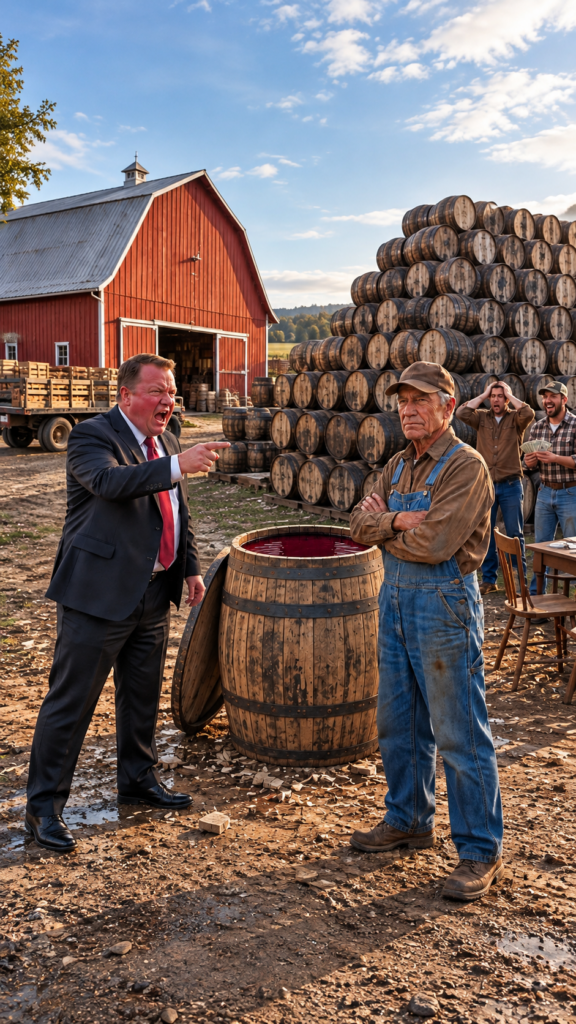
The bank manager’s laughter carried across the storage yard, loud enough to make two employees turn their heads.
“What in the world are you going to do with them? Catch rainwater?”
He stood with his hands resting against his broad waist, a black suit stretched across his shoulders and a red tie hanging over his stomach. Behind him, row after row of old whiskey barrels filled a yard that the bank was desperate to empty.
There were 1,140 of them.
Some leaned against one another. Others stood in uneven rows, their iron hoops spotted with rust and their oak staves weathered gray by years of use. The inside of each barrel was darkened by fire and stained by the whiskey it had once held.
To the manager, the entire collection was an expensive nuisance.
To the thin old farmer standing beside him, it was something else entirely.
The farmer was sixty-seven years old. His back had developed a permanent bend after decades of planting, harvesting, repairing machinery, and lifting things that seemed to grow heavier every year. His hair had thinned to wisps of gray. He wore a faded brown work coat, dark trousers, and boots whose leather had been stitched and patched so many times that little of the original stitching remained.
He looked like a man who had spent his life working hard and had very little money to show for it.
The manager knew him. More importantly, he knew the mortgage still hanging over the old man’s farm.
That knowledge made the situation even more amusing.
Here was a farmer who owed the bank $41,600 on 148 acres of land, standing in a yard full of discarded whiskey barrels and considering spending money he could scarcely afford.
The manager shook his head.
“You ought to be thinking about your loan, not buying somebody else’s junk.”
The farmer did not answer.
Instead, he crouched beside one of the barrels and ran his thumb across a rough oak stave. A little gray dust came loose beneath his fingers. He leaned closer, examining where the iron hoop had pressed into the wood.
Then he reached inside and scraped away a small patch of black char.
Underneath the burned surface, the wood showed a deep reddish-brown color. In another place, the grain carried a warmer amber shade, almost golden where the light caught it.
He brought his fingers close to his nose.
Even after years of service, the oak still held the unmistakable smell of whiskey.
The manager watched him with open impatience.
“Well?”
The farmer straightened slowly, brushing the black dust from his fingertips.
“How much for the whole lot?”
The manager blinked.
“The whole lot?”
“Every barrel.”
For a moment, the manager seemed uncertain whether he had heard correctly. Then he laughed again.
The bank had recently taken possession of the barrels after foreclosing on a failed barrel-making operation and liquor distribution warehouse. The business had left behind equipment, machinery, and materials that could be sold to recover some of the bank’s losses.
The barrels were different.
They occupied valuable space on a property the bank wanted to liquidate. Moving them would require trucks, workers, loading equipment, and a disposal arrangement.
A hauling company had already quoted more than $5,000 to clear the yard.
Every day the barrels remained there was another day the bank could not finish dealing with the property.
The manager had been looking for a cheap solution.
Now, apparently, a solution had walked into his yard wearing patched boots.
“Seven hundred and fifty dollars,” he said. “Every last one. But you haul them yourself. We’re not spending another dime on them.”
The farmer looked back over the rows.
One thousand one hundred and forty barrels.
He took a moment before answering.
“Put it in writing.”
The manager raised his eyebrows.
“You want a receipt for all this garbage?”
“I want the receipt to say what I’m buying.”
There was nothing argumentative in his voice. He spoke the way he might have asked a neighbor to confirm the price of a used implement before shaking hands.
The manager shrugged.
“Fine by me.”
They went inside.
On the bill of sale, the bank identified the entire lot of 1,140 used whiskey barrels. The total purchase price was $750. All transportation would be the buyer’s responsibility, and full ownership would transfer as soon as payment was made.
The farmer read it carefully.
Then he paid.
The manager signed the document and pushed it across the desk.
“Take them all,” he said. “Just don’t come back complaining after you realize you’ve paid us to haul away our trash.”
The employees laughed.
The old man folded the receipt along its creases and slipped it deep into the inside pocket of his brown coat.
He offered no clever reply.
He did not explain why he wanted the barrels.
And he gave the manager no reason to believe the deal was anything other than a foolish mistake.
Years later, that small piece of signed paper would become one of the most important documents the farmer owned.
But on that cold November day in 1980, he still had 1,140 barrels to move and a farm nearly forty miles away.
And moving them was going to be only the beginning.
The countryside outside Chillicothe, Ohio, was familiar to him in a way no map could explain.
He knew which fields held water after heavy rain, where the ground dried first in spring, and how certain stretches of fence tended to give way after a hard winter.
The 148 acres had belonged to his family for three generations.
His father had worked the soil before him. Before that, another generation had endured the same uncertain seasons, measuring their lives in planting dates, summer storms, harvests, and winters that sometimes seemed unwilling to end.
The farm had never made anyone wealthy.
It supported corn and soybeans, along with a small herd of cattle. In a favorable year, there was enough income to pay the bills, maintain the machinery, purchase seed, and prepare for another season.
But favorable years could never be counted on.
A wet spring could delay planting. A dry summer could weaken a corn crop. Market prices might fall between the day seed went into the ground and the day the harvest was sold.
And no matter what happened in the fields, the bank expected its payments.
The farmer owed $41,600.
That figure was not merely a number on a statement. It represented the possibility that everything his family had maintained for generations could one day belong to someone else.
At sixty-seven, starting over would have been difficult enough.
Losing the land itself was something he could scarcely bear to imagine.
Yet he had never been a man who responded to worry by sitting still.
He repaired machinery rather than replacing it whenever a repair made sense. He saved useful boards from collapsing outbuildings. Old gears, chains, brackets, and scraps of lumber accumulated in his barn because he had learned that an object could outlive the purpose for which it had originally been made.
His father had once told him something that had stayed with him all his life.
“A thing only has value when you put it in the right place.”
As a younger man, he had understood that lesson mostly in practical terms. A bent chain could still serve as a weight. A weathered board might become a shelf. A discarded machine part could save a trip to town when another piece of equipment broke.
But the older he grew, the more he recognized that the lesson concerned judgment as much as thrift.
People often declared something worthless simply because they no longer needed it.
He had learned to look a little longer before agreeing.
That was why the whiskey barrels interested him.
He knew enough about timber to recognize white oak when he saw it. He knew it was strong, dense, and valuable when properly used. But these barrels offered qualities that ordinary boards from a lumberyard could not provide.
The wood had been bent into curved staves, seasoned, exposed to fire on the inside, and soaked with whiskey for years.
Each piece carried evidence of that history.
Its colors were not painted on. Its dark lines were not decorative marks added by a craftsman. The wood had changed because of what it had been used for.
The bank manager had seen old containers.
The farmer had seen an unusual kind of lumber.
He did not yet know exactly what he would make from it.
He knew even less about who might want to buy it.
But he had seen enough to believe the question was worth investigating.
And now he had paid $750 for the chance to find out.
The first load went slowly.
His pickup was old, and the trailer he had borrowed from a neighbor was not designed to make the work easy. Every barrel had to be handled, positioned, secured, and hauled over the distance between the warehouse and his farm.
There were no hired crews waiting to help him.
He worked around the demands of the farm, making trips when the weather and his chores permitted.
At the warehouse, he loaded the barrels. At home, he unloaded them, arranged them behind the barn, and returned for another load whenever he could.
The work was harder than he had anticipated.
Even an empty whiskey barrel could be awkward to handle, particularly for a man whose joints had endured decades of farm labor. Iron hoops caught against other barrels. Rotten-looking wood left gray dust on his clothes. The cold stiffened his fingers, and the trailer had to be balanced carefully before every journey.
On one trip, a trailer wheel failed along the road.
He found himself crouched beside it, tools spread near his boots, with more barrels waiting behind him and daylight gradually slipping away.
He could have taken the breakdown as a warning.
Perhaps some of his neighbors would have.
Instead, he repaired the wheel and continued.
Fuel, rope, tie-downs, and the wheel repair added another $310 to the undertaking.
By the time the last barrel reached the farm, his total outlay had climbed to $1,060.
He had not sold a single piece of wood.
And now he owned more barrels than he could possibly use for storing anything.
They stood behind the barn in a great wall of weathered oak and rusty metal, a sight impossible to overlook from certain stretches of the road.
Word traveled quickly.
Neighbors slowed their trucks as they passed. Some looked twice, as though the old man might be building something they could not yet understand.
Others had no difficulty reaching a conclusion.
He had finally lost his sense.
A man in debt had spent more than a thousand dollars turning the back of his farm into a junkyard.
That was the general opinion.
It reached the bank manager soon enough.
He enjoyed repeating the story to customers. He had made $750 on something that would otherwise have cost the bank more than $5,000 to dispose of. From his perspective, the deal had improved the bank’s position by nearly $6,000 compared with paying for removal.
He considered it one of his better decisions.
What he did not consider was that the farmer might have made a good decision, too.
Behind the barn, the old man began studying his purchase.
He examined how the iron hoops held each barrel together. He watched how the curved oak staves separated when the hoops were removed. He learned to tell which pieces were sound and which carried damage that made them less useful.
At night, after the cattle were settled and the day’s farm work was finished, he returned to the oak.
Sometimes the air in the barn was cold enough that his breath lingered above the workbench.
He worked carefully, using old tools and the patience he had developed through a lifetime of repairing what he owned.
When the first barrel came apart, the whiskey smell rose sharply from the wood.
He paused with a stave in his hands.
Its inside face was almost black.
But the edge revealed a different story: layers of color that shifted from char to dark brown, then through reddish tones toward amber.
He scraped a small area and watched the grain emerge.
No lumberyard could sell him new oak that had spent years acquiring those exact marks.
For the first time since handing over the $750, he felt the beginnings of an answer.
He selected eight of the finest staves and decided to make a small table.
He had no modern woodworking shop.
His equipment consisted of an aging table saw, a hand plane, homemade clamps, wood glue, and the collection of tools he had accumulated over the years.
He made the best of them.
The curved staves were difficult to work into a flat surface. Their edges required careful attention. The grain did not behave like fresh, straight lumber, and the old wood sometimes resisted the shape he wanted it to take.
He worked on the table over several days.
When he finally stood it upright, he felt a satisfaction he had not expected.
The top was unlike anything he had seen in a furniture store.
Dark char lines ran beside stretches of reddish-brown oak. Amber-colored grain caught the light. The surface seemed to hold traces of fire and years of whiskey aging.
It was not a grand piece of furniture.
But it was handsome.
More importantly, it proved that the old barrels could become something other than barrels.
For a little while, that seemed enough.
Then the tabletop began to change.
At first, the movement was so slight he wondered whether he was imagining it. One edge lifted. The surface that had been flat began to develop a shallow curve.
He examined the joints.
The wood was pulling against itself.
Over the following days, the problem grew worse.
Before a month had passed, one glued joint opened by nearly half an inch.
The farmer stood over the table, running a rough fingertip along the gap.
He had spent days building it.
Now it was coming apart.
The neighbors had called the purchase foolish. The manager had mocked him for taking the barrels. He had spent money he could ill afford and months hauling a mountain of old wood onto his property.
And his first real attempt to turn that wood into something useful had failed.
For a time, he simply stood there.
Then he reached for his tools.
He took the table apart.
Rather than throwing the damaged pieces into the stove or abandoning the project, he marked the wood and began examining the failure.
The trouble was not obvious at first.
The joints had been made carefully. The glue had been applied. The surface had looked sound when assembled.
But something inside the material was changing.
He began to suspect moisture.
The barrels had spent years holding liquid. Even after being emptied, the oak retained moisture unevenly. Moving the wood from cold, damp conditions into a warm, dry room caused different pieces to shrink at different rates.
The wood itself was not necessarily poor.
He had simply tried to make it perform a new job before it was ready.
That realization changed the direction of his work.
Instead of building another table immediately, he went to the county library.
He searched the shelves for books on woodworking, oak, moisture, shrinkage, and joinery. He read carefully, copying useful information into a small notebook with a carpenter’s pencil.
At home, he tested what he had learned.
He studied the direction of the grain. He watched how individual pieces changed as they dried. He compared staves from different barrels and began understanding why apparently similar pieces behaved differently.
It took weeks of reading and experimentation to arrive at a rule simple enough to write near the front of his notebook.
Take the barrels apart carefully.
Sort the wood.
Dry it slowly.
Do not build until it is stable.
He had spent his life trying to make the most of things other people discarded. Now he was discovering that recognizing value was only the first step.
Knowing how to preserve that value was another matter entirely.
He converted part of an old grain shed into a drying area.
The oak staves were stacked in layers, separated by thin strips of wood so air could circulate around them. Old iron hoops became weights laid across the stacks to help reduce twisting.
The shed kept rain off the lumber while allowing fresh air to pass through.
The arrangement was modest, but it was deliberate.
Every barrel had to be opened. Every stave had to be examined. Every stack had to be allowed enough time to dry without being damaged by haste.
When the work was finished, the farmer stepped back and looked at the rows of oak.
There was nothing more he could do to hurry the process without risking another failure.
The wood would need months.
And months were something he could not easily afford.
Outside the shed, corn prices were weakening. Interest rates were rising. His adjustable mortgage was becoming more burdensome, even when he did everything within his power to keep the farm productive.
The bank manager had begun speaking more seriously about the possibility of selling the property if payments became impossible to maintain.
Every visit to the bank carried the same reminders.
The next payment was coming.
The balance remained.
The land was security for the loan.
The farmer listened, answered what was necessary, and returned to his work.
He did not mention the wood drying in his shed.
He did not tell the manager about the ruined table or the notebook filled with observations.
There was no reason to discuss an idea that had yet to earn a dollar.
That winter, he tended his cattle, watched the farm accounts, and checked the oak whenever he had the opportunity.
Sometimes he picked up a stave and examined the grain.
Sometimes he shifted a weight or checked a stack for signs of movement.
Mostly, he waited.
On one side of his life stood a bank that could take the farm if the debt became unmanageable.
On the other stood hundreds of old whiskey barrels, slowly becoming something he still did not know how to sell.
And between those two realities was a sixty-seven-year-old farmer who had learned that the hardest part of saving something might be refusing to hurry.
Part 2
Nearly a year after the barrels arrived at the farm, the old man selected several staves from the stacks that had been drying the longest.
He handled them with a different kind of confidence now.
The first time, he had been excited by the wood’s appearance. He had imagined what it might become and had hurried to see whether his idea was possible.
This time, he understood that appearance meant little if the material could not hold its shape.
He inspected each piece before carrying it to the workbench. The grain was carefully examined, the edges prepared, and the joints fitted with far more attention to the stresses the wood might develop.
He was no longer simply making a table.
He was testing almost a year’s worth of mistakes, reading, and patience.
He wanted the new tabletop to preserve the very qualities that had caught his attention in the bank’s storage yard. He left a dark line of char running through the center and arranged the surrounding pieces so their amber and reddish-brown tones could be seen.
He sanded the surface until it was smooth beneath his palm.
Then he strengthened the joinery and applied a protective finish.
When he finished, he placed the table in his kitchen.
He did not congratulate himself.
He remembered the first one.
That table had looked beautiful, too.
Instead, he decided to use the second table as ordinary furniture and see what happened.
Through winter, it endured the dry warmth inside the house while cold weather settled over the farm.
He checked the joints.
Nothing opened.
When spring arrived, the air grew damp. Rain moved through the countryside, softening the fields and making the barnyard muddy.
He watched for movement in the wood.
The surface remained flat.
Then came summer, with its heat and changing humidity.
The farmer continued examining the table, sometimes leaning close enough to see the finest line between two joined pieces.
There were no cracks.
No separation.
No twisting.
By the time the summer heat had settled over the farm, he finally permitted himself to believe that he had solved the problem.
The knowledge he had gained from failure was working.
But success in his kitchen was not success in business.
A table that remained sound was useful. Whether anybody would pay for the wood was another question.
He knew the difference.
He had watched farmers make costly decisions based on what they hoped markets would do. He had seen machinery purchased on the assumption that next year’s harvest would be better, or expenses taken on because prices appeared likely to rise.
Hope had its place.
It could not make a loan payment.
He needed a buyer.
And he still had no idea where one might come from.
The answer arrived on an ordinary day, when a cabinetmaker from Columbus came to the farm to look at an old tractor.
The visitor was a man accustomed to working with wood. He understood cabinets, joinery, and the differences between lumber that would remain stable and lumber that might betray a craftsman months after a piece was finished.
He had not come looking for whiskey barrels.
He had come about farm equipment.
But when he stepped into the kitchen, his attention moved almost immediately to the table.
He stopped walking.
For several seconds, he studied the top without saying anything.
Then he moved closer and placed his hand on the smooth surface.
His fingers followed one of the dark char lines.
He tilted his head to examine the reddish-brown grain.
Finally, he looked at the farmer.
“Where did you get this oak?”
The question caught the old man by surprise.
He had expected a visitor might ask whether he had made the table himself. He might even have expected a compliment.
But the cabinetmaker was asking about the material.
Not the design.
Not the price.
The wood.
The farmer pulled out a chair.
“Used to be whiskey barrels,” he answered.
The visitor looked down again.
“Whiskey barrels?”
“White oak. They’ve been holding whiskey for years.”
The cabinetmaker examined the top more carefully. He could see the contrast between the scorched inner faces of the staves and the aged wood beneath them.
The markings were unusual, but not artificial.
They belonged to the wood.
“How much of this have you got?” he asked.
The farmer hesitated.
Then he nodded toward the back of the property.
“Come on. I’ll show you.”
They walked behind the barn.
The cabinetmaker stopped when he saw the remaining barrels.
There were hundreds of them, along with rows of oak staves stacked beneath cover.
The farmer explained how he had bought the entire lot from the bank. He showed the drying area and described how the first table had warped because he had worked the wood too soon.
He did not try to make his operation sound more sophisticated than it was.
He talked about moisture, the importance of slow drying, and the care required when taking the barrels apart.
The cabinetmaker listened.
He picked up a stave, examined the grain, and studied the dark marks left by years of whiskey aging.
He understood what a furniture maker might do with material like this.
A new piece of white oak could be cut, shaped, stained, and finished. But reproducing this exact combination of natural aging, fire-darkened grain, and deep amber color would not be simple.
The old farmer had acquired something unusual.
And unlike the neighbors who had driven past the barn shaking their heads, the cabinetmaker could imagine customers wanting it.
“Would you sell some?” he asked.
“Depends how many.”
“Twelve barrels. Ninety-five dollars apiece.”
The farmer kept his expression steady.
Twelve barrels at $95 each would bring $1,140.
He had paid only $750 for the entire original collection.
Even after including the $310 he had spent moving them, the offer for twelve barrels would have exceeded his initial cash outlay.
For an instant, he considered the strange turn of events.
The bank manager had laughed while signing the sale.
Now a knowledgeable craftsman was offering more for twelve barrels than the bank had charged for all 1,140.
But the farmer did not immediately accept.
He had already learned the price of moving too fast.
“I’ll let you have six,” he said.
The cabinetmaker studied him.
“Only six?”
“Try them first. See what happens.”
There was still too much the farmer did not know.
One excited buyer could be mistaken. A beautiful table might attract attention without producing reliable sales. He had no reason to empty his inventory before discovering whether the market existed beyond this one visitor.
The cabinetmaker agreed.
Six barrels changed hands at the offered price.
It was the first money the old man had earned from the oak.
And it was the first proof that someone else saw value in what the bank had dismissed.
The farmer returned to his ordinary routines.
The corn still needed attention. The cattle still needed feeding. Equipment still broke down, and the mortgage still demanded payment.
He kept working with the oak, but he did not assume a thriving business had begun simply because six barrels had sold.
He continued improving the drying process.
He sorted pieces by condition and appearance. He noted which staves held the richest colors, which had suffered damage, and which needed longer drying before he would trust them in another person’s hands.
When he wrote in his notebook, he recorded observations rather than grand plans.
Then, several months later, the cabinetmaker returned.
This time, he did not spend long discussing the tractor or the weather.
The furniture made from the first six barrels had sold.
Tables and cabinets using the whiskey-aged oak had attracted buyers, and the cabinetmaker wanted more.
“Thirty barrels,” he told the farmer.
The old man looked at him.
“Thirty?”
“I can use them.”
“What are you paying?”
“A hundred and twenty-five each.”
The farmer did the calculation.
Thirty barrels at $125 would bring $3,750.
This was no longer one man’s curiosity.
Customers had purchased finished furniture made from the wood. A professional cabinetmaker had returned with a larger order and a higher price.
The old man thought about all the months he had spent waiting for the oak to dry.
The ruined table.
The library books.
The cold hours in the shed.
The road journeys with the overloaded trailer.
For the first time, those efforts were beginning to form something he could measure.
He agreed to the sale.
But he kept one condition firmly in place.
The cabinetmaker would receive only material that had been properly prepared.
No shortcuts.
No damp staves rushed out of storage simply because somebody was willing to pay.
The farmer understood what one shipment of unstable wood could do.
A cabinet that twisted after delivery, or a table that cracked inside a customer’s home, would not merely disappoint one buyer. It could persuade other craftsmen that the whiskey oak was unreliable.
He had worked too long to let that happen.
His first failed table had taught him the cost of impatience.
Now that lesson was protecting the business.
By the third year, the yard behind the barn had become known to woodworkers well beyond the immediate community.
The business had grown without newspaper advertisements or expensive sales campaigns.
The Columbus cabinetmaker told other craftsmen about the material. Those craftsmen told people they knew. Word traveled through woodworking shops, among cabinetmakers, and between people who understood the value of distinctive, well-prepared lumber.
Buyers began arriving from different parts of Ohio.
Then from Indiana, Kentucky, and Pennsylvania.
Some were interested in the richest amber shades. Others wanted staves with dramatic char patterns. Some sought complete barrels with iron hoops intact, while others were looking for prepared wood suitable for furniture making.
The farmer learned to distinguish between the requests.
He also learned that not every barrel held the same commercial value.
Some were damaged. Some needed far more preparation than others. Some yielded wood with exceptional color, while others were useful but less distinctive.
He did not pretend they were all equal.
He inspected and graded them, paying careful attention to the condition of the oak.
His notebook gradually changed.
Pages once devoted almost entirely to moisture levels and drying observations began to fill with names, orders, quantities, and promises.
There were craftsmen waiting for material.
People he had never met before were willing to travel considerable distances to buy something his neighbors had considered junk.
Yet the farm itself remained difficult to operate.
The agricultural crisis spreading through the Midwest was no longer something farmers discussed as a distant possibility.
It could be seen along the roads.
Auction signs appeared on properties where families had spent their lives working. Fields changed hands. Machinery was sold. Farms that had supported generations were broken apart as debt, falling land values, and borrowing costs overwhelmed their owners.
The old man passed some of those signs while driving between town and his property.
He understood what they meant.
An auction did not necessarily announce that a farmer had been careless or lazy. Sometimes it meant that prices had fallen, expenses had risen, and years of difficult work had not produced enough cash to satisfy a lender.
He knew how narrow the distance could be between a difficult season and a disaster.
His own corn and soybean income was increasingly uncertain.
Some years, after paying for seed, fuel, repairs, and the other costs of production, the crops left almost nothing.
The cattle helped, but they could not guarantee a healthy balance at the bank.
And the adjustable mortgage remained a burden.
The manager had once expected that the farmer would eventually miss payments and leave the bank no choice but to seize or sell the land.
But something unexpected kept happening.
The old man paid.
Even after a disappointing harvest, he arrived with the amount due.
Sometimes he carried a check across the bank counter on a day when the manager had been expecting a difficult conversation.
The manager began watching his account more closely.
The farm’s ordinary income did not seem strong enough to explain what was happening.
A crop might have brought disappointing returns. Expenses might have risen. Neighboring properties might have been headed toward auction.
Yet the farmer continued meeting his obligations.
It made little sense.
At least, it made little sense to someone who still believed that the barrels behind the barn were worthless.
One day, after another timely payment, the manager finally asked.
“Where are you getting this money?”
The farmer had heard enough questions from the man over the years to know when he was being asked for a serious explanation.
He did not smile.
He did not remind him of the laughter in the storage yard.
He simply answered.
“From the seven hundred and fifty dollars you sold me.”
The manager frowned.
“What?”
“The barrels.”
The manager stared at him.
He remembered the transaction.
He remembered the old whiskey barrels, the disposal quotation, and the peculiar farmer who had insisted on buying the entire lot.
But he could not connect that event with a stream of mortgage payments.
The farmer offered no elaborate explanation.
He had work waiting at home.
And the manager was left with a question he had never expected to ask.
Had he misunderstood the value of those barrels from the beginning?
The answer reached the bank in the form of a local newspaper article.
An employee brought it to the manager’s desk.
The article described a growing interest in furniture made from old whiskey oak. Craftsmen were seeking used barrels because the wood carried distinctive colors and char patterns that could not readily be duplicated with new lumber.
The manager read the account carefully.
One figure held his attention.
Properly dried and selected barrels could now command around $210 each.
He sat back in his chair.
Then he reached for a pen.
For years, he had remembered the original transaction as a triumph in saving disposal expenses.
Now he wrote down the number of barrels.
1,140.
Then the current approximate value of a prepared barrel.
$210.
He multiplied them.
The result was $239,400.
He stared at the figures.
That was a potential market value for an entire lot at that price, not cash the farmer had necessarily earned. The original barrels had required hauling, storage, processing, knowledge, and years of careful work. Some were already sold, others varied in condition, and not every barrel would qualify for the same price.
But even allowing for those realities, the difference was astonishing.
The bank had sold the whole collection for $750.
He had congratulated himself for avoiding more than $5,000 in hauling expenses.
He had told the story repeatedly, laughing at the foolish farmer who had paid to remove the bank’s unwanted property.
Now, for the first time, he considered what the old man might have understood on that morning in the yard.
He remembered the farmer bending down and examining the wood.
The way he had scraped away a little char.
The insistence on a written receipt.
The manager searched for the old bill of sale.
There it was.
The quantity was unmistakable.
The purchase price was clear.
Transportation had been the buyer’s responsibility, and ownership had passed completely to him upon payment.
The manager’s own signature appeared at the bottom.
There was no uncertainty about who owned the barrels.
No legal reason to expect them returned.
The bank had sold them.
The farmer had bought them.
Whatever they were worth now, the original transaction was finished.
The manager put down the document.
For years, he had regarded that signature as evidence of an especially profitable decision.
Now it reminded him that he had never bothered to ask what the buyer intended to do with the property.
Not long afterward, he drove to the farm.
It was the first time he had seen what had become of the old barrels since the farmer had hauled them away.
The scene behind the barn was not what he expected.
There were still barrels on the property, but they were no longer simply piled wherever space was available.
The usable ones were organized. Oak staves rested in orderly drying stacks. Material was being sorted and inspected, and the old grain shed had become an important part of the operation.
The manager had expected a junkyard.
Instead, he was looking at a modest but functioning business.
The farmer came to meet him wearing familiar work clothes.
“Afternoon,” he said.
The manager glanced around the yard.
“You’ve done quite a bit with these.”
The old man nodded.
“Been working at it.”
The manager explained why he had come.
The bank wanted to purchase the remaining barrels.
It would offer considerably more than the farmer had originally paid for the entire lot.
The farmer listened without interrupting.
Years earlier, the same man had warned him not to return complaining about his worthless purchase.
Now the manager was proposing to buy that purchase back at a much higher price.
The reversal was plain.
But the farmer did not take pleasure in embarrassing him.
He had customers waiting.
His notebook contained names of craftsmen who had been promised material, and those promises mattered to him.
He was not prepared to abandon them simply because the bank had finally recognized the market.
“No,” he answered.
The manager looked surprised.
“We’re willing to pay good money.”
“I know.”
“More than you paid for all of them.”
“I know that, too.”
“Then why not sell?”
The farmer glanced toward the drying shed.
“Because I’ve already given my word to people.”
The manager studied him.
There was no anger in the answer.
No attempt to punish the bank for what had happened.
The old man was simply unwilling to betray the trust that had helped create his business.
He had spent years proving that his wood was reliable.
He was not about to prove that his promises were not.
The manager returned to town without the barrels.
The farmer went back to work.
And the business continued growing.
The manager had finally learned that the barrels were valuable.
He had not yet learned what made them valuable in the farmer’s hands.
That lesson would be considerably more expensive.
Part 3
The years that followed brought more orders, more work, and a gradual change in the old farmer’s circumstances.
Demand for whiskey-aged oak continued to increase as furniture made from the reclaimed wood appeared in craft stores and showrooms in larger cities.
The material developed a reputation of its own.
Craftsmen came looking for the deep amber colors, the blackened lines, and the character that decades of ordinary lumber production could not reproduce.
The prices reflected that growing interest.
Barrels that had once brought approximately $210 climbed toward $280. Later, selected and properly prepared barrels could sell for around $340, with especially desirable examples bringing more.
A barrel with particularly rich coloring, intact iron hoops, and a clear history could be worth considerably more to the right buyer than one with damaged staves or poor-quality wood.
The farmer understood that difference.
He also understood that a rising price was not a reason to abandon the careful methods that had created the opportunity.
He never forgot the first table.
Whenever someone urged him to prepare the wood faster, he remembered the joint that had opened nearly half an inch.
Whenever demand grew so strong that he was tempted to promise more than he could reasonably deliver, he looked at the orders already written in his notebook.
His original collection of 1,140 barrels was limited.
He could not replace it simply by wishing for more.
And he had no intention of damaging his reputation by sending poorly prepared material into the hands of craftsmen who trusted him.
The money arriving at the farm changed his life, but not in the ways some neighbors expected.
He did not purchase a luxurious house or replace his old pickup merely because he could finally afford something better.
His priorities were much simpler.
The $41,600 mortgage had shadowed the family for years.
He wanted it gone.
Each time the oak business produced a worthwhile surplus, he considered what could be put toward the debt and what the operation needed to remain sound.
He paid down the mortgage.
He improved the drying shed.
He acquired safer equipment and made the work area more efficient.
He spent money where it strengthened the business or protected the property.
The farm still grew corn and soybeans. The cattle still required daily attention. But the old man now had something he had lacked when the bank manager first warned him about foreclosure.
He had income that did not depend entirely on the next harvest.
And that income had been developed without taking out a new loan to finance an unproven idea.
It began with $750, another $310 in hauling expenses, and years of work that few people had been willing to understand.
Eventually, the business became more than one elderly farmer could manage alone.
There were barrels to unload and examine, iron hoops to remove, staves to stack, and wood to prepare for buyers.
The notebooks filled faster than his hands could complete the work.
He needed help.
Around that time, two local farmers had lost their own land at bank auctions.
They knew what it meant to work from morning until evening and still find themselves unable to satisfy the figures written in a lender’s account.
Their farms were gone.
But they still knew how to work.
The old man hired them.
He did not offer them an easy occupation. Handling weathered oak required strength, care, and attention. The staves could be awkward, the iron hoops difficult, and the drying process unforgiving when rushed.
But it was steady, honest work.
He began teaching them what he had learned.
He showed them how to remove a hoop without damaging the wood beneath it, how to distinguish a sound stave from one that needed to be rejected, and how to read the direction of the grain.
He explained why some pieces had to remain in the drying stacks long after others were ready.
He showed them how the fire-darkened interior could become a valuable feature rather than something to be planed away thoughtlessly.
There were no shortcuts in his instruction.
He had learned through ruined furniture, library books, and long months of trial and error. He wanted the men working beside him to understand the reasons behind every step.
Gradually, the operation behind the barn became a small workshop where several men could earn a living.
The contrast with the countryside around them was painful.
Farm auctions continued.
Families struggled with debt.
Land changed hands, sometimes ending generations of ownership.
Yet at this one farm, wood that a bank had nearly paid to destroy was providing wages to men who had lost their own fields.
The old farmer noticed that change.
He was proud that his mortgage payments were becoming easier to manage.
But there was something deeply satisfying about watching men who had suffered the loss of their farms find useful work again.
The operation was no longer protecting only his own land.
It was helping other families endure a difficult time.
And then, in the eighth year after his purchase, the bank encountered a situation that must have felt painfully familiar.
Another business connected to the liquor industry, one the bank had financed, was left with thousands of used whiskey barrels.
Once again, there were large quantities of aging oak that needed to be handled.
Only this time, the manager did not look at them and see worthless rubbish.
He remembered the farmer.
He remembered the newspaper article, the prices, and the remarkable business that had developed behind an ordinary Ohio barn.
He had learned one lesson.
Old whiskey barrels could be worth money.
But he drew another conclusion from that discovery.
If a farmer in his late sixties had managed to turn discarded barrels into valuable material, surely a bank with capital, employees, and commercial connections could accomplish the same thing.
The bank had access to more resources than the farmer had possessed at the beginning.
It could arrange transportation. It could hire workers. It already had material available.
On paper, the plan looked straightforward.
Keep the barrels.
Prepare them.
Sell them to craftsmen for a profit.
The manager believed the bank could finally benefit from the opportunity it had once overlooked.
But the reality proved more difficult.
The barrels were stored improperly.
Some remained outdoors where rainwater collected inside them. Others rested against damp ground long enough for the lower wood to begin deteriorating.
Iron hoops loosened.
Barrels shifted out of shape.
Some staves were removed before the workers understood how they needed to be handled.
When the wood began drying unevenly, it twisted and cracked.
The bank had workers, but it lacked the experience to recognize problems before the damage occurred.
It had material, but no reliable method for turning that material into something furniture makers would trust.
It had money, but no established customer network like the one the farmer had built through years of careful service.
And it did not have the most important thing.
Knowledge earned through repeated observation.
The old farmer had spent months understanding why his first table had failed.
The bank had assumed that failure could be skipped.
It could not.
The manager watched the difficulties accumulate.
Every damaged barrel reduced the potential return. Every improperly dried stave represented time and labor wasted. The bank could not simply attach a premium price to poor material and expect experienced cabinetmakers to buy it.
The more the manager examined the problem, the more clearly he understood the difference between owning something valuable and knowing how to make it valuable.
Eventually, he recognized what had to be done.
The bank needed the old farmer.
Not because the farmer possessed a secret formula.
Not because he had stumbled across hidden wealth.
Because he had taken the time to learn a difficult process and had earned the confidence of people willing to purchase the results.
The manager would have to return to the same farm where his earlier offer to buy back the barrels had been refused.
And this time, he would have to approach the old man as someone whose experience the bank needed.
Nearly eleven years had passed since the original $750 transaction.
The farmer was older now. His hair had grown thinner, his movements slower, and the years of physical labor were more visible than ever in his hands and shoulders.
But the business he had created was stronger.
The drying areas were better organized. The equipment was safer. The men working alongside him knew their responsibilities.
The old whiskey barrels were no longer a strange collection stacked behind a barn.
They were the foundation of an established trade.
By then, properly prepared and selected barrels could command prices around $460 each.
The figure would have seemed absurd to anyone standing in the storage yard back in November 1980.
The manager arrived at the farm carrying a business proposal.
He was not there to collect an overdue payment.
He was not there to warn the farmer about the mortgage.
He needed an agreement.
The bank wanted to send its barrels to the farmer’s operation for processing, drying, grading, and distribution to buyers.
The manager explained the situation.
There was material available, but the bank had struggled to handle it correctly. The farmer already possessed the facilities, the experience, and the relationships necessary to do the work.
If they reached an agreement, the bank could recover value from its barrels while the farmer’s operation gained additional business.
The old man listened.
He understood the irony.
The manager who had laughed at him for taking possession of 1,140 old whiskey barrels was now asking him to manage another collection of those same barrels.
The man who had once seen only a disposal expense was now seeking the knowledge required to turn that expense into income.
The farmer had every opportunity to make the moment humiliating.
He could have reminded the manager of the laughter.
He could have brought up the repeated warnings about losing his land.
He could have used the bank’s difficulty to demand punishing terms.
After everything that had happened, the manager might even have expected such a response.
Instead, the farmer studied the proposed contract.
He read it with the same care he had shown the original bill of sale.
Then he picked up a pencil.
“I need three things changed.”
The manager leaned forward.
“Which three?”
“Transportation.”
The farmer marked the relevant section.
“The bank pays all of it. Every load coming here.”
The manager considered the change.
The farmer continued.
“Damaged barrels get taken out before we settle the price. I’m not charging for good material that isn’t there, and I’m not accepting a lot of ruined wood as though it’s sound.”
He made another mark.
Then he turned to the final condition.
“And the people working for me have steady work for the full length of this contract.”
The manager looked up.
“Your workers?”
“Yes.”
The old man placed the pencil beside the papers.
“They’ve got families. If we’re taking on this much work, I want to know the work will be there for them.”
The manager studied the three changes.
None was designed to punish the bank.
Transportation costs belonged with the party supplying the barrels. Damaged material needed to be identified before the deal could be priced fairly. And the employees who would perform the labor deserved a measure of security.
The agreement would protect the farmer’s operation without stripping the bank of a reasonable chance to earn money.
After a moment, the manager asked the question that had been troubling him.
“Why aren’t you asking for more?”
The old man waited.
The manager glanced at the contract.
“After the way I treated you back then. You could make this a lot harder on us.”
The farmer looked toward the workshop.
There was still work going on outside.
Barrels waited to be inspected. Oak staves lay in drying stacks. Men who had once faced the loss of their livelihoods were earning wages from material most people had overlooked.
Finally, he answered.
“I never started this to make the bank lose money.”
The manager said nothing.
“I wanted to keep my farm. I found something that was being wasted, and I thought maybe I could put it to use.”
The farmer looked back at the contract.
“If this works for both of us and keeps these men employed, that’s good enough.”
The manager lowered his eyes to the papers.
For years, he had assumed that the farmer’s success came from having bought the barrels cheaply.
He had believed the advantage was ownership.
But the bank’s own failure had shown him otherwise.
The barrels alone were not enough.
It was the process the farmer had developed, the patience he had practiced, and the trust he had earned.
The bank had possessed thousands of barrels and still struggled to turn them into a reliable product.
The farmer had begun with old tools, borrowed transportation, and a notebook.
Yet he had built what the bank could not easily reproduce.
At last, the manager understood.
He agreed to the changes.
The bank signed the contract.
Truckloads of used whiskey barrels began arriving at the farm.
This time, the material entered an organized operation.
Damaged barrels were identified and separated before pricing. Sound barrels were inspected, disassembled, and sorted according to the condition and potential use of the wood.
Staves that needed drying were stacked carefully with room for air to circulate.
Those already prepared were examined and graded before being offered to customers.
Nothing was hurried simply because more barrels had arrived.
The farmer knew the consequences of moving too fast.
As the volume increased, he hired additional workers, giving preference where possible to people from struggling farming families.
The business grew, but the principles remained unchanged.
The bank received value from material that might otherwise have become an expensive disposal problem.
The farmer earned income through the work of preparing and distributing it.
And local men found employment at a time when dependable work was desperately needed.
No one standing in the storage yard eleven years earlier could have imagined such an arrangement.
Back then, the manager had believed the farmer was accepting an unnecessary burden.
Now the bank was paying for the expertise that made that burden valuable.
The farm continued operating through the years that followed.
The old man still cared about the soil, the crops, and the cattle. He never stopped thinking of himself as a farmer simply because the oak business had become successful.
But the threat that had once followed him into every growing season was slowly disappearing.
The mortgage balance declined.
Payment by payment, the debt that had placed 148 acres of family land in jeopardy grew smaller.
After more than a decade, the final payment was ready.
The old farmer walked into the bank wearing his worn brown coat.
It was the same coat he had worn years before, when he stood among 1,140 discarded whiskey barrels and agreed to pay $750 for the entire lot.
The fabric had grown more faded.
His shoulders had grown more rounded.
But he carried himself with the quiet steadiness of a man who knew exactly why he was there.
Inside his coat pocket was the final mortgage check.
He approached the desk.
The manager looked up.
The farmer placed the check in front of him.
“That should finish it.”
The manager examined the payment and the remaining balance.
It did.
The original $41,600 mortgage, after years of payments and additional amounts applied whenever possible, was finally settled.
The paperwork was completed.
The loan was marked paid in full.
For a moment, neither man spoke.
The farmer looked at the documents.
There had been years when the mortgage seemed almost impossible to escape.
Years of uncertain harvests, rising interest costs, and quiet anxiety over whether his family would be able to keep the land.
He had passed auction signs belonging to neighbors who were not as fortunate.
He knew what the loss of a farm could mean.
Now the papers on the desk confirmed that the 148 acres were no longer threatened by that loan.
The land his family had maintained for three generations remained theirs.
The manager stood.
He reached across the desk and offered his hand.
The farmer accepted it.
The manager held the handshake a moment longer than usual.
“I still remember when you bought those barrels,” he said.
The old man nodded.
“So do I.”
“I thought I’d just made seven hundred and fifty dollars and saved the bank another five thousand or more.”
He gave a faint, uncomfortable smile.
“I thought you were paying me to haul away my trash.”
The farmer listened.
The manager looked down briefly, then met his eyes.
“I had no idea what you were seeing.”
The old man considered the words.
He had spent years thinking about the difference between the two views of those barrels.
On that first morning, they had stood in the same yard.
They had looked at the same weathered oak, the same rusty iron, and the same blackened interiors.
Nothing about the barrels had been hidden.
The difference was what each man believed could be done with them.
“You saw the job they’d already finished,” the farmer said. “I saw the job they might still do.”
The manager was quiet.
Then he apologized.
Not for making a bad financial decision. Not merely for overlooking an opportunity.
He apologized for the way he had looked down on the old man.
For assuming that debt and worn clothing meant a person had little judgment.
For laughing before he understood.
The farmer accepted the apology.
He had no desire to prolong the conversation or make the manager suffer for the embarrassment of being wrong.
The signed receipt from 1980 had once protected his ownership of the barrels.
Now the mortgage documents confirmed something even more important.
His ownership of the land was secure.
He did not need a speech.
He did not need an audience.
He had come to settle an obligation, and he had settled it.
The old man put the completed paperwork into his coat pocket.
Then he left the bank and returned to the farm.
Years later, when the farmer was already in his eighties, the workshop had become an established part of life on the property.
The methods he had developed were still being used.
Barrels arrived, were examined, and were sorted. Usable oak was prepared carefully, and craftsmen continued buying material for furniture and other work.
But every woodworking operation produced scraps.
Short pieces that were unsuitable for furniture accumulated near the work area. There were bits of char, sawdust, and small sections of oak that could no longer serve the purposes for which the larger staves had been prepared.
The old farmer had begun thinking of those leftovers as waste.
They were too short for tabletops.
Too small for cabinets.
Too irregular to be sold alongside the better material.
One day, his grandson stood beside a pile of those scraps and looked at them with interest.
The young man had been paying attention to what people were buying.
He told his grandfather that some restaurants were using whiskey-aged oak to smoke food, seeking the character and aroma the wood could provide.
Smaller sound pieces could also be turned into coasters, trays, and other handmade goods.
The farmer glanced at the pile.
He had spent years teaching people not to waste good oak.
Yet here he was, preparing to discard material because it no longer suited the products his workshop usually made.
His grandson picked up one of the smaller pieces.
“This could still be worth something.”
The old man did not answer immediately.
He examined the wood.
A piece too short for a table might still be useful for a coaster. A sound offcut that could not become furniture might have another market.
He recognized the idea.
In fact, he recognized it so clearly that for a moment he was carried back to the storage yard in November 1980.
He remembered the manager laughing at the old barrels.
He remembered scraping away the black char and smelling whiskey buried in the oak.
He remembered a man who had been certain the material was worthless because its original purpose had ended.
Now, standing beside the workshop, the farmer realized he had nearly made the same mistake.
The pieces were not useful for the work he had been doing.
That did not mean they were useless.
He looked at his grandson.
Then he handed him the old notebook.
Its pages held years of measurements, observations, orders, and lessons learned.
“Run the numbers,” he said.
The young man looked down at the notebook.
“See if there’s a market. Don’t just assume there is.”
The old man glanced toward the stacks of oak.
“And don’t borrow money chasing something you haven’t proved.”
His grandson listened.
“Try it small first,” the farmer continued. “See what people will actually pay. Learn what works. Then, if the demand is real, you can do more.”
It was the same method that had carried him from his first failed table to a business capable of saving his farm.
The same method that had persuaded him to sell only six barrels when the Columbus cabinetmaker originally wanted twelve.
And the same method the bank had ignored when it tried to turn thousands of used barrels into valuable lumber without understanding how to handle them.
The grandson turned one of the little pieces over in his hand.
The old man watched him.
There was something satisfying about seeing another generation discover a possibility that had been sitting in plain sight.
His father had taught him to consider an object’s usefulness before judging its worth.
Now he was passing that lesson forward.
Not as a promise of easy money.
Not as a guarantee that every discarded thing concealed a fortune.
But as a way of thinking.
Value had to be recognized.
Then tested.
Then developed with enough care that it could survive beyond the excitement of the first idea.
The old man looked past the workshop toward the fields.
The 148 acres were still there.
The soil had been worked by his grandfather’s generation, his father’s generation, and his own.
The mortgage was gone.
The workshop was providing work.
And the oak that the bank had once wanted hauled away had become part of the farm’s future.
He thought about the first barrel he had opened and the table that had cracked.
He thought about the winter months spent waiting for wood to dry while the bank warned him about losing the land.
He thought about the cabinetmaker who had entered his kitchen looking for a tractor and discovered something unexpected.
None of those moments had offered him instant success.
He had made mistakes.
He had endured doubt.
He had waited when waiting seemed dangerous, and worked when there was no assurance that his efforts would ever pay.
The manager had sold him 1,140 barrels for $750 because the bank believed they were finished.
Eleven years later, the bank had needed the very knowledge the farmer developed by refusing to accept that judgment.
But the greatest result was not the price the barrels eventually commanded.
It was not even the business agreement that reversed the positions of the two men.
It was the land.
The farm had remained in the family.
And men who had lost their own farms had found a way to keep working.
As the grandson began considering what might be done with the smallest pieces of oak, the old man remembered his father’s words.
He had heard them long before anyone offered him a yard full of used whiskey barrels.
He had tested them through years of labor, failure, and uncertainty.
Now he understood them better than ever.
“A thing only has value when you put it in the right place.”
And on those 148 acres outside Chillicothe, an old farmer had spent the better part of a decade proving just how much that could mean.

