
Part 1
On the fourth morning after Rachel Morgan bought the old feed store, a farmer she had never met walked through the front door, crossed three aisles of empty shelving, and placed a brass key on the counter.
He didn’t ask whether the store was open.
He didn’t ask for feed, fencing supplies, or anything else a person might reasonably expect to find in a building that had once served half the farms in northern Missouri.
He simply put the key beside the dusty cash register and turned to leave.
Rachel was kneeling behind the counter with a cardboard box balanced against one knee. She had been sorting old receipts, broken pencils, and things the previous owner had apparently decided were too unimportant to take with him.
She looked up just as the man’s boots reached the doorway.
“Sir?”
He stopped.
“I think you forgot something.”
The farmer glanced over his shoulder. He was elderly, with a weathered face and the slightly stooped posture of a man who had spent most of his life working outdoors. His faded jacket hung loosely over his shoulders.
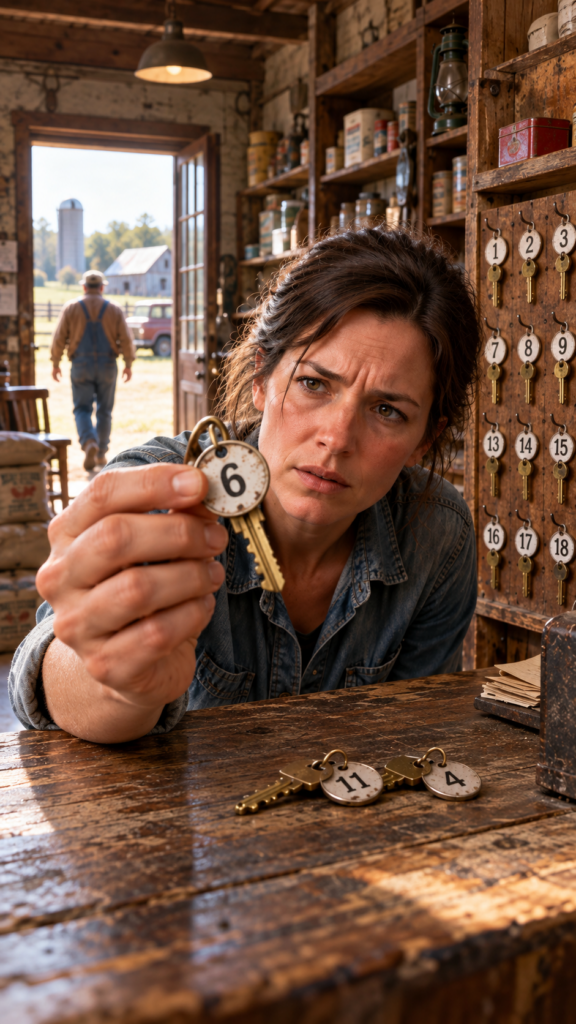
Rachel picked up the key.
A thin aluminum tag dangled from its ring. One number had been stamped into the metal.
6.
“Your key,” she said.
The farmer looked at it, then at her.
For a moment, she thought he hadn’t heard.
Finally, he nodded toward the counter.
“That’s where it stays.”
Then he opened the door and walked outside.
Rachel remained standing behind the counter, the brass key resting against her palm.
She listened to his truck start, idle roughly, and pull away.
“Well,” she murmured, “that explains absolutely nothing.”
She had been in the building four days. Already she had discovered two dead mice, a shelf that leaned dangerously to the left, a nest of old invoices beneath the register, and a storeroom door that refused to close properly.
Apparently, she could add mysterious keys to the list.
She tried the key in the front door.
It didn’t fit.
She tried the little office beside the counter, then the rear storeroom. Neither lock accepted it.
At the back of the building was another door with an old padlock on the hasp. The lock was so rusty that Rachel doubted anything had opened it recently, but she tried anyway.
Nothing.
She returned to the counter, pulled open the cash register drawer, and dropped the key inside.
There were more important things to worry about.
Rachel Morgan was thirty-nine years old, recently divorced, and trying to build something that belonged entirely to her.
For years, she had operated a machinery repair business from a cramped shed behind her house. The shed had never been designed for the amount of work she eventually brought into it.
During planting season, engines crowded the workbench. During harvest, broken pumps, chains, blades, and machine parts accumulated faster than she could repair them.
There were days when she had to roll one unfinished job into the yard just to make room for another.
Her father had taught her how to repair machinery when she was young.
He believed that understanding why something failed mattered more than knowing how to replace it. If a machine stopped working, he expected her to take the time to find the cause.
Rachel had carried that lesson into adulthood.
She sharpened mower blades, rebuilt pumps, repaired small engines, welded broken hitches, and worked on machines that local dealers no longer wanted to touch.
By the time she turned thirty, farmers throughout the county knew her name.
Some called because she was cheaper than a dealer. Others called because she would work on equipment that a dealer considered hopelessly outdated.
A few called simply because they knew Rachel would tell them the truth.
If a machine could be repaired, she would explain what it needed.
If it wasn’t worth repairing, she would say so.
But knowing how to repair old machinery was not the same as knowing how to expand a business.
For years, she had saved what she could, kept expenses low, and imagined having a proper shop with enough room to work without moving everything twice.
The divorce had made her more determined to stop postponing that plan.
She didn’t want to spend another decade squeezing between equipment in a backyard shed.
When the old feed store became available, she saw an opportunity.
The building had stood near the center of the farming community for decades. It had a solid concrete floor, a loading dock, two substantial storerooms, and enough space behind it for machinery awaiting repair.
It also had a long wooden equipment shed at the rear of the property.
The place was worn and dusty, but Rachel understood worn machinery and neglected buildings. She was not frightened by either.
For almost fourteen months, the store had been closed.
Its former owner, Walter Price, had spent decades selling feed and agricultural supplies to the surrounding farms.
Then a regional farm supply chain opened beside the highway, eighteen miles away.
The new business could stock more inventory, negotiate lower prices, and offer services Walter’s little store could no longer compete with.
Customers began making the longer drive.
At first, business declined gradually.
Then the quieter mornings became quieter weeks.
Walter kept the store operating for as long as he could. Finally, at seventy-four, he locked the doors and retired.
When Rachel bought the building, she had no intention of reopening the feed business.
The old shelves would come down.
The faded advertisements would disappear.
The loading dock would become a place to receive broken equipment.
The storerooms would hold tools, parts, and work awaiting completion.
She considered keeping the long wooden counter, mainly because it looked too heavy to move without more trouble than it was worth.
She wasn’t interested in turning the building into a museum.
She needed a working shop.
And she intended to make one.
Two mornings after the first key appeared, another farmer walked through the door.
Rachel was removing a rusted bracket from an old shelving unit when she heard boots on the wooden floor.
She turned to find a man in his late fifties approaching the counter.
His boots were coated with mud. His jacket smelled faintly of diesel fuel and damp soil, and his face had the tired look of someone who had started working several hours before sunrise.
He did not introduce himself.
He placed a small brass key beside the register.
Rachel stared at it.
Another aluminum tag.
Another stamped number.
11.
The man began turning toward the door.
“Hold on.”
He stopped.
Rachel put down her wrench.
“All right. I’ve got to ask you something.”
He waited.
“What does eleven open?”
The farmer glanced at the key, then back at Rachel.
A small smile appeared beneath his mustache.
“Depends whether four is back yet.”
Rachel blinked.
“Four?”
But he was already walking away.
“Wait. What does that mean?”
The bell above the door gave a weak metallic rattle as he left.
Rachel stood alone in the store, looking at the key.
She pulled open the register drawer and placed number eleven beside number six.
Two keys.
Two farmers.
Neither man interested in buying anything.
And both apparently convinced that leaving a numbered key on the counter was the most ordinary thing in the world.
She closed the drawer slowly.
Something about the building was beginning to irritate her.
Not because she believed anything sinister was happening. Rachel was a practical woman, and she had no patience for turning ordinary mysteries into ghost stories.
But she disliked not understanding something that was happening directly in front of her.
Especially in a building she now owned.
That afternoon, she began searching more carefully.
She inspected the office cabinets, checked beneath the counter, and sorted through a box of old equipment manuals.
She looked for numbered lockers, storage bins, or cabinets that might correspond to the keys.
There was nothing.
The following morning, she carried a stack of empty mineral tubs out of the rear storeroom.
Behind them, leaning against the wall, was a wooden pegboard.
It was roughly made, with eighteen hooks arranged in neat rows.
Each hook had a number painted above it in black.
1 through 18.
Some hooks were empty.
Others held small aluminum tags.
Rachel set the tubs aside.
For several seconds, she looked at the board without moving.
Then she returned to the register drawer.
She took out the two brass keys, brought them back to the storeroom, and hung them on the corresponding hooks.
Six on six.
Eleven on eleven.
The tags matched the others exactly.
Rachel folded her arms.
“So that’s where you belong.”
It was the first useful answer she had found.
Unfortunately, it created a more interesting question.
Why were farmers still returning keys to a feed store that had been closed for over a year?
She studied the board.
Eighteen numbers meant eighteen things to unlock, or perhaps eighteen people who had once been assigned keys.
Yet there were no numbered compartments in the building.
And why would a farmer return a key to a store that no longer conducted business?
Unless the store’s closure hadn’t ended whatever arrangement the keys belonged to.
Rachel left the board hanging in the storeroom.
She had intended to remove it with the other abandoned fixtures, but now she wanted to know more.
A few days later, while pulling an old shelf away from a wall, she discovered a chalkboard.
Someone had pushed the shelf against it, hiding almost the entire surface.
The chalk had faded, and dust covered much of the writing.
Rachel wiped a corner with a rag.
Several names gradually emerged.
Dawson — 4.
Keller — 11.
Puit — 6.
Martin — 2.
Beside the names were days of the week.
Monday.
Wednesday.
Thursday.
Across the top, in larger letters, someone had written:
RETURNED BY SUNSET.
Rachel read the words twice.
That didn’t sound like a record of feed purchases.
It sounded like instructions.
She checked the pegboard again.
The numbers matched.
Whatever the keys opened, they appeared to have been assigned to different farmers on different days.
She wondered whether Walter had rented storage space.
Perhaps farmers had kept grain or tools somewhere behind the building.
Maybe the numbers corresponded to locked bins.
But she had already looked through the storerooms. There was no sign of eighteen separate storage spaces.
She asked two neighboring farmers if they remembered the numbered keys.
Neither could give her an explanation.
One remembered that Walter had always kept the counter organized. The other vaguely recalled farmers visiting the rear of the property years earlier, but couldn’t say what the keys were for.
Rachel thanked them and returned to work.
Still, every time she passed the storeroom, she found herself glancing toward the pegboard.
She began leaving the old register drawer slightly open.
If another farmer came through the door, she wanted to be able to show him what she had found.
On Friday afternoon, she finally got her chance.
A pickup pulled into the gravel lot, and an older man climbed out.
Rachel recognized him immediately.
Earl Dawson.
He farmed approximately fifty acres northwest of town and had been part of the community for as long as she could remember.
She had sharpened blades and repaired equipment for men who spoke of Earl as someone who understood the land better than most people understood their own houses.
He entered the store without any particular ceremony.
“Afternoon, Rachel.”
“Afternoon, Earl.”
He looked around.
“Making progress.”
“Depends what you call progress.”
Earl smiled slightly.
“Looks better than the last time I was in here.”
Rachel glanced at the empty shelving and the tools scattered across the counter.
“Then I’d hate to have seen it.”
Earl’s eyes moved toward the storeroom.
He noticed the numbered pegboard hanging where Rachel had placed it.
His expression changed.
“Four back yet?”
Rachel put down the screwdriver in her hand.
For a moment, she simply looked at him.
Then she gave a short laugh.
“You’re the third person who’s said something like that to me.”
Earl frowned.
“Nobody told you?”
“Told me what?”
“About the keys.”
“No, Earl. Nobody told me about the keys. I’ve got two of them in the back, a chalkboard full of names, and a man who seems to think number eleven depends on number four.”
Earl stared at her.
Then he shook his head.
“Well, I’ll be.”
Rachel waited.
He looked toward the rear door.
“Come on.”
“Where?”
“Out back.”
She followed him through the storeroom and into the afternoon sunlight.
Behind the building stood the long wooden equipment shed.
Rachel had looked inside it shortly after buying the property, but she hadn’t done much more than inspect the roof and take stock of what was stored there.
Most of the machinery looked like scrap.
An old fertilizer spreader sat near one wall, its tires aging and its metal surfaces dulled by rust.
Beside it stood a portable grain auger.
Farther inside were a post-hole driver, a seed drill, a manure spreader, a brush mower, and a grain cleaner.
Other pieces were crowded around them, some hidden under years of dust.
Several machines appeared unlikely ever to work again.
Rachel had already considered selling them for parts.
She had been waiting until she had enough time to sort the usable metal from the equipment that might be worth repairing.
Earl walked past the spreader.
He passed the auger.
He stopped in front of the old seed drill.
A chain had been wrapped around its drawbar and secured with a padlock.
Earl pointed to it.
“Four.”
Rachel looked at the chain.
Then she looked at Earl.
“Four?”
“Number four.”
“The key?”
“That’s right.”
She stared at the padlock.
For the first time, the numbered keys began to make a kind of sense.
“So this belongs to one of the farmers?”
Earl gave her an odd look.
“Not exactly.”
Rachel went back into the storeroom and removed the aluminum tag from hook number four.
There was no key attached.
She held it up when she returned.
“There’s a tag for it. But no key.”
Earl nodded.
“That’s because Hank Miller still has it.”
Rachel frowned.
“Has what?”
“The drill.”
She glanced toward the machine standing in front of them.
Earl saw her confusion.
“He still has it checked out. The drill’s here, but the key hasn’t come back.”
Rachel looked from the chained machine to the tag.
She had spent days trying to imagine which door these keys might open.
She had never seriously considered that the answer was sitting in the equipment shed.
Earl rested a hand against the seed drill’s frame.
“Years ago, Hank and a few others put money together for this one. Couldn’t justify everybody buying a drill of their own.”
Rachel slowly lowered the tag.
“Together?”
“Sure.”
Earl gestured around the shed.
“Most of this equipment was bought that way.”
Rachel looked at the fertilizer spreader.
The portable auger.
The post driver.
Machines she had thought were abandoned property, forgotten because nobody cared enough to remove them.
“You’re telling me these belonged to a group of farmers?”
“That’s exactly what I’m telling you.”
“And Walter kept them here?”
“He managed the arrangement.”
Earl pointed toward the feed store.
“That counter wasn’t just for buying feed. It was where people picked up the keys and brought them back.”
Rachel thought of the first elderly farmer, quietly placing number six beside the register.
The second man, leaving number eleven without explanation.
The chalkboard.
The instructions about sunset.
The empty hooks.
She looked at Earl.
“So when someone returns a key…”
“Everyone knows the equipment’s available.”
There had been no computer system.
For much of the arrangement’s history, no proper telephone system to coordinate who needed what.
The pegboard had been enough.
A key on its hook meant a machine was available.
An empty hook meant someone had it checked out.
And a key placed on the counter meant the person who had finished using that machine was returning it for someone else.
Rachel turned toward the shed again.
She saw the old machinery differently now.
Until that afternoon, the equipment had been a collection of worn-out parts she could possibly sell.
Now each machine represented farmers who had once needed something they couldn’t afford alone.
The keys were not souvenirs.
They were part of an agreement that had continued long after the business responsible for managing it had disappeared.
Earl watched her for a moment.
“Bet you were planning to get rid of most of this.”
Rachel didn’t answer immediately.
Finally, she nodded.
“I was.”
“Some of it probably ought to go,” he said. “Not everything lasts forever.”
He looked at the fertilizer spreader.
“But some of us still need a few of these things.”
Rachel stood in the open doorway of the shed, listening to the wind moving through the weeds beside the building.
She had bought the feed store because she needed room to repair machinery.
She hadn’t expected to inherit responsibility for a system of equipment sharing that nobody had bothered to explain.
And she certainly hadn’t expected a handful of brass keys to make her question what should stay and what should go.
But that afternoon, she understood one thing.
The machines in the shed had not been completely forgotten.
Somewhere beyond the gravel lot, across the fields and narrow county roads, farmers were still working according to an arrangement that had begun long before she owned the building.
And they were still expecting someone to keep the keys.
Part 2
For the next several days, Rachel found herself thinking about the equipment shed more often than she wanted to admit.
She had bought the property with a straightforward plan.
Clear the old merchandise, establish her workshop, and begin taking in larger repair jobs.
The less time she spent sorting through the previous owner’s belongings, the sooner she could begin earning back what she had invested.
But the pegboard complicated that plan.
Now, whenever she looked at the machinery behind the store, she remembered Earl’s explanation.
Those old machines hadn’t simply been left there because nobody wanted them.
At one time, they had been the difference between a farmer being able to complete a job and having to go without.
Rachel understood that distinction.
She had spent years repairing equipment for small farms where every dollar mattered. She knew the conversations farmers had with themselves before deciding whether to replace something.
Could it last another season?
Could the broken part be repaired?
Could the expense wait until harvest?
Buying a machine that might be used only two or three days a year was difficult to justify, even when that machine was essential for those few days.
A portable grain auger might be needed urgently during harvest, then sit unused for months.
A post driver could save days of labor when fences needed replacing, but there was no reason for every farmer in the county to own one.
A grain cleaner might be valuable at the right moment and unnecessary for the rest of the year.
The old arrangement had been built around a simple calculation.
If several farms shared the cost of one machine, none had to carry the entire expense.
Earl explained more of the system when he came by again.
In the early years, he told her, farmers who wanted a piece of equipment contributed money toward buying it. Walter kept track of the machines, their keys, and which farmer was using them.
Not every farmer belonged to every arrangement.
Some machines were shared by larger groups. Others belonged to a smaller number of people who had agreed to divide the cost.
The feed store had served as the central meeting point because everyone already came there.
A farmer could collect feed, speak to Walter, check the board, and discover whether a machine was available.
When he finished using it, he brought the equipment back and returned the numbered key.
The rules were familiar enough that no one needed to explain them every time.
“Most people knew what they were supposed to do,” Earl said.
“And when they didn’t?”
“Walter reminded them.”
Rachel smiled.
“I can imagine.”
Earl looked around the half-empty store.
“He was particular about a few things.”
“Like returning keys by sunset?”
“Like making sure the next fellow wasn’t left standing around waiting for something that should’ve been back.”
That part Rachel understood immediately.
One farmer’s delay could become another farmer’s lost working day.
In agriculture, a lost day could matter far more than it did in most businesses.
Planting, spreading fertilizer, harvesting, and repairing fences all depended on conditions that didn’t necessarily cooperate with anyone’s schedule.
If the equipment was somewhere else when the weather finally turned favorable, an otherwise manageable job could become a serious problem.
Rachel asked why the arrangement had faded.
Earl considered the question.
“Things changed.”
Over the years, farms had grown larger. More dealers offered financing. Equipment rental became easier to find, and custom operators could be hired for jobs that once required owning or sharing a machine.
Some of the smaller farms disappeared.
Younger farmers often preferred equipment they could keep on their own property and use whenever they wanted.
The old system had become less necessary.
But not entirely.
Three or four machines still circulated occasionally among the remaining smaller farms.
The arrangement had diminished so gradually that nobody seemed to have made a formal decision to end it.
Walter closed the business.
The farmers kept returning the keys.
And somehow, the system continued.
Rachel wondered why Walter hadn’t mentioned any of this when she bought the property.
Then she considered the way Earl had reacted when he discovered she didn’t know.
Perhaps everyone had assumed someone else had already told her.
In a small farming community, shared knowledge could become invisible simply because people had relied on it for so long.
That spring, northern Missouri stayed wet for weeks.
Rain crossed the county in repeated stretches, soaking fields and filling low places where water drained slowly.
Gravel roads remained muddy.
Farmers watched the sky and listened to forecasts, trying to judge when they could finally move equipment across their land without cutting deep ruts.
Rachel saw the effects every day.
Men came into her shop with machinery that had been sitting unused through the rain.
Some wanted repairs finished before the ground dried.
Others needed a pump running, a blade sharpened, or a broken fitting welded so they would be ready when conditions improved.
They spoke about the weather almost constantly.
The trouble was not simply the amount of rain.
It was the timing.
Too much water could keep a tractor out of a field for days.
When the weather finally cleared, everyone needed to make use of the same narrow opportunity.
After weeks of waiting, the forecast began showing three dry days.
Farmers who had been unable to work their fields started preparing.
On Saturday morning, Earl Dawson arrived at the store.
Rachel was standing near the counter, studying a list of repairs.
Earl barely glanced at the workbench.
He looked toward the pegboard.
“Six available?”
Rachel followed his gaze.
Number six was hanging on its hook.
“The fertilizer spreader?”
“That’s the one.”
She hesitated.
“You still use that thing?”
Earl shrugged.
“If it works.”
Rachel put down her pencil.
“That’s a fairly important condition.”
“I figured you might have an opinion about it.”
She looked toward the rear door.
The spreader had been sitting in the shed for so long that she hadn’t seriously considered putting it back to work.
She knew how old machinery behaved after being neglected.
Rubber hardened.
Grease dried out.
Seals deteriorated.
Bearings that seemed acceptable when turned by hand could fail once a machine began operating under load.
She wasn’t about to let Earl tow something dangerous into a field simply because it had once been shared among farmers.
“Let me look at it first.”
Earl nodded.
“Fair enough.”
Rachel spent the afternoon inspecting the spreader.
The tires were cracked, though they still held air. A bearing made a low, rough growling sound when she turned the assembly. The drive chain had too much slack, and oil had been leaking from the gearbox.
She stood back and studied it.
Under normal circumstances, this was the sort of job she might have advised a customer not to bother with.
The machine was old.
Several components needed work.
And there was no guarantee that something else wouldn’t fail once it returned to service.
She could have said no.
She could have told Earl the spreader was finished and that the farmers should find a rental unit elsewhere.
Instead, she rolled out her tools.
Perhaps it was professional stubbornness.
Perhaps she was curious whether the machine could still perform the job it had been built to do.
Or perhaps she had begun to understand why the numbered keys mattered enough that farmers kept returning them.
Whatever the reason, she went to work.
She removed the failing bearing and fitted a replacement.
She adjusted the chain.
She dealt with the leaking gearbox seal, checked the drive mechanism, and packed the grease fittings.
The work took longer than she expected.
A stubborn fastener consumed time she could have spent on other repairs. Old metal resisted being moved after years in the same position.
By early evening, the shop was quiet.
Rachel continued working.
She cleaned her tools, checked the adjustments again, and turned the moving parts by hand to listen for anything she might have missed.
The spreader was far from new, but it was functioning.
She stayed until nearly midnight.
When she finally switched off the lights, she was tired enough to feel every hour of the day in her shoulders.
Still, she had the satisfaction of knowing she had brought an old machine back to working condition.
Earl collected it shortly after sunrise.
Rachel watched him connect the spreader and prepare to leave.
“Take it easy,” she warned.
“I always do.”
She raised an eyebrow.
Earl smiled.
“Most of the time.”
He drove away with number six checked out.
For the first time since she bought the store, Rachel felt that she had done more than repair a machine.
She had helped put a forgotten arrangement back into motion.
The feeling lasted until the following day.
Around noon, she heard an engine pulling into the gravel lot.
She stepped outside.
Earl was returning the spreader.
Smoke was rising from one side of the machine.
Rachel stared at it.
“Oh, you’ve got to be kidding me.”
Earl shut off his tractor.
“Something’s wrong.”
“I can see that.”
She fetched her tools and crouched beside the spreader.
The bearing she had replaced was fine.
The bearing on the opposite side had seized.
Heat and friction had damaged it badly enough that the machine could no longer be used.
Rachel sat back on her heels.
For several seconds, she examined the failed assembly without speaking.
She had inspected the machine.
She had known it was old.
She had known there was a risk.
And now, after spending half the previous day making it operational, she was looking at another repair.
She stood and wiped her hands.
“This,” she said, “is exactly why people stopped sharing equipment.”
Earl studied her.
“No.”
Rachel frowned.
“No?”
“This is why we used to charge maintenance.”
She looked at him.
“What maintenance?”
Earl didn’t answer immediately.
Instead, he walked into the feed store.
Rachel followed.
He approached the old wooden counter and bent slightly.
Then he reached beneath it and pulled open a shallow drawer.
Rachel stopped.
She had cleaned almost every visible inch of the counter.
She had removed old receipts, nails, scraps of paper, and a remarkable quantity of dust.
Yet somehow, she had never noticed that drawer.
Inside were dozens of index cards.
Earl began looking through them.
Each card had a number written across the top.
He found number six and handed it to Rachel.
She read:
Grease every 40 acres.
Inspect wheel bearings after 80.
Check chain tension each return.
Maintenance contribution: $4.
Rachel read the instructions a second time.
Then she looked at the drawer.
There were cards for other machines.
Some contained detailed reminders about lubrication and inspection. Others listed basic operating requirements and maintenance contributions.
The system had been more organized than she realized.
Farmers had not simply borrowed machinery whenever they wanted.
They had shared responsibility for maintaining it.
Each person who used a machine contributed a small amount toward the work required to keep it operating.
The rules were recorded so users knew what needed checking.
Wear was expected.
Repair bills were expected.
And the people who benefited from the equipment helped pay for both.
Rachel turned the card over in her hand.
“I didn’t know any of this.”
Earl shrugged.
“Nobody told you.”
There was no accusation in his voice.
That somehow made it worse.
Rachel had approached the spreader as though it were simply an old machine that somebody wanted repaired.
She had focused on the mechanical problem in front of her.
But there had been another problem she hadn’t seen.
A shared machine needed shared responsibility.
If one farmer used it carelessly and someone else had to pay for the damage, the arrangement would not last.
If nobody contributed toward maintenance, eventually the equipment would become unusable.
And if the people managing the system failed to keep track of its condition, the next farmer might discover a problem only after losing valuable time.
The old index card wasn’t complicated.
It didn’t need to be.
It was a reminder that borrowing something was not the same as having no responsibility for it.
Rachel placed the card carefully on the counter.
“So everybody paid a little each time?”
“That was the idea.”
“And when something broke?”
“We fixed it.”
“Who paid?”
Earl gave her a patient look.
“The people using it.”
Rachel considered the smoking spreader outside.
She thought about the hours she had spent working on it the night before.
She had nearly convinced herself that repairing it had been a mistake.
Now she understood that the repair itself wasn’t the mistake.
The mistake had been trying to revive the machine without understanding the arrangement that once kept it working.
She looked at the drawer again.
“Well,” she said, “I suppose we’d better figure out what it needs.”
Earl smiled.
“That’s what I came back for.”
Over the following days, Rachel examined the equipment more systematically.
She didn’t attempt to restore the entire collection.
Too much had changed since the old feed store’s busiest years.
Some machines were badly worn.
Others needed replacement parts that had not been manufactured in years.
A few were simply too dangerous to return to service.
Rachel had no intention of sending unreliable machinery into the fields merely to preserve a tradition.
She made practical decisions.
Of the machines that farmers still asked about, three appeared worth maintaining.
The fertilizer spreader.
The portable grain auger.
And the post driver.
Those were the pieces she chose to keep in the working arrangement.
Everything else would have to be considered separately.
She checked their condition, reviewed the old cards, and began thinking about how their maintenance should be handled.
She had no desire to become the unpaid caretaker of every broken machine in the county.
Her own business still had expenses.
Tools cost money.
Replacement parts cost money.
And her time had value.
But the old maintenance system provided a reasonable starting point.
The farmers who used the machines could contribute to their upkeep.
Rachel could perform the repairs.
The machines could remain available without requiring anyone to bear the entire burden alone.
It was not an elaborate business model.
That was precisely why it might work.
Then another problem emerged.
Scheduling.
As soon as the weather began improving, three different farms wanted the fertilizer spreader.
Each had waited through the rain.
Each needed to finish work while the ground was suitable.
And each considered his need urgent.
Rachel did what seemed natural.
She took out a piece of paper and began writing requests in the order they arrived.
The first farmer would use the machine first.
The second would receive it when the first returned it.
The third would wait for the second.
She considered the arrangement fair.
When Earl saw the list, he laughed.
Rachel looked up.
“What’s funny?”
“That’s not how Walter did it.”
She folded the paper.
“All right. How did Walter do it?”
“By the ground.”
“By the ground?”
Earl pulled up a chair.
He explained that fields didn’t all dry at the same rate.
Land on a ridge could become workable while lower ground remained too soft.
A farmer with higher, drier fields might be ready to spread fertilizer immediately.
Another farmer whose land lay in a low area might not be able to use the machine for another day or two.
If the second farmer received it first simply because he had asked first, the spreader might sit unused while the first farmer lost his opportunity.
Rachel considered that.
“So the ridge farm goes first?”
“If it’s ready.”
“And the bottomland waits until it can actually use it.”
“That’s the idea.”
She looked down at her list.
It was such a simple adjustment that she wondered why it hadn’t occurred to her.
She knew machinery.
Earl knew farming conditions.
Walter, apparently, had understood how to bring those two kinds of knowledge together.
Rachel crossed out the order she had written.
Then she rearranged the schedule.
The farmer whose land dried first would take the spreader.
When he finished, he would return it promptly.
The next farmer would use it when his fields were ready.
The last would have the machine when the lowest ground became workable.
That way, one piece of equipment could serve several farms during the same brief stretch of favorable weather.
Over the next four days, number six traveled from one farmer to another.
The first farm covered thirty-six acres.
The second finished twenty-eight.
The third managed forty-one.
More than one hundred acres were fertilized using a single old spreader Rachel had almost sold for scrap.
The machine wasn’t flawless.
It still required attention.
Between uses, Rachel made sure the chain was checked, the moving parts were inspected, and the lubrication schedule was followed.
The farmers paid for their own fuel.
Each made a small contribution toward maintenance.
When Rachel replaced the second failed bearing, nobody argued about dividing the expense.
That surprised her more than the repairs themselves.
She was accustomed to customers who asked difficult questions about every dollar on a bill.
These farmers were not wealthy men.
They had every reason to watch their expenses.
Yet they understood that the maintenance contributions served a purpose.
A few dollars spent today could prevent a much larger expense tomorrow.
By the end of the fourth day, Rachel had watched the system accomplish exactly what Earl said it was designed to do.
Three farms had completed necessary work.
None had purchased a machine that would spend most of the year unused.
Nobody had been forced to wait for a rental spreader to arrive from thirty miles away.
The old machine had done its job.
And the responsibility for keeping it operational had been shared.
Late that afternoon, Rachel stood behind the counter and reviewed the card for number six.
The spreader needed care, just as any aging machine did.
There would be more repairs.
There would probably be more inconvenient breakdowns.
But for the first time, she could see why the arrangement had survived so long.
It had never depended on the machinery being perfect.
It depended on people understanding that they were responsible for more than their own turn.
Rachel returned the card to its drawer.
Across the room, the pegboard hung against the wall.
Some of its numbered hooks would probably never hold keys again.
Others might remain useful for years.
She thought about Walter Price.
He had been managing this system for decades, yet he had never described it to her.
She wondered whether he realized that farmers were still using it.
And she wondered why, when the old feed store finally closed, he had left the equipment behind.
A month later, she decided to ask him.
Part 3
Walter Price lived outside town in a white farmhouse surrounded by walnut trees.
Rachel drove out one afternoon, about a month after the fertilizer spreader had returned to regular use.
The weather had improved considerably since the long stretch of spring rain. Fields that had seemed permanently soaked were finally being worked, and farmers had begun settling into the demanding rhythm of the growing season.
Rachel had plenty to do herself.
Her repair business was taking shape inside the old feed store. More equipment arrived each week, and there were days when she barely had time to eat lunch before another customer appeared.
But the question about the machinery had been bothering her.
She wanted to hear Walter explain the arrangement in his own words.
When she pulled into the driveway, the farmhouse looked quiet and well kept.
Walter was seventy-four, retired, and apparently content to spend his days away from the counter where he had worked for most of his adult life.
He greeted Rachel without much surprise.
“How’s the old place treating you?”
“Keeping me busy.”
Walter smiled.
“That’s what it always did to me.”
They sat together, with the afternoon light coming through the windows and the walnut trees moving gently outside.
At first, they spoke about the building.
Rachel told him which shelves she had removed, how she was arranging her tools, and where she planned to keep larger equipment awaiting repairs.
Walter listened with interest.
He didn’t seem offended that she was changing the store.
It had served its purpose as a feed business.
Now it needed to serve hers.
Eventually, Rachel brought up the keys.
“There’s something I’ve been meaning to ask you.”
Walter looked at her.
“What’s that?”
“Why didn’t you tell me about all those machines behind the store?”
He leaned back slightly.
“The old equipment?”
“Yes. The numbered keys. Earl Dawson. The whole arrangement.”
Walter’s expression softened with recognition.
“Oh, that.”
Rachel laughed.
“That? Walter, I spent days trying to find doors those keys would open.”
He chuckled.
“Didn’t think to look in the shed?”
“Not until Earl showed me.”
Walter shook his head with amusement.
Rachel described what had happened.
The elderly farmer leaving number six.
The second man returning number eleven.
The pegboard behind the mineral tubs.
The old chalkboard and its instructions.
Then she told him about the spreader.
How Earl had asked for it.
How she had repaired it.
How it had broken down again.
And how Earl had finally shown her the maintenance cards hidden beneath the counter.
Walter listened carefully.
When she explained that three farms had used the spreader during the brief window of dry weather, he nodded.
“Good.”
Rachel studied him.
“You don’t sound surprised.”
“Why would I be?”
“Because the store’s been closed for over a year. I thought the machinery was abandoned.”
Walter looked toward the window.
“Some of it probably should’ve been scrapped a long time ago.”
“That’s what I thought.”
“But not all of it.”
“No,” Rachel admitted. “Not all of it.”
She rested her hands together.
“Why didn’t you sell everything when you shut the store?”
Walter considered the question.
For a while, he said nothing.
Then he looked at her.
“Because small farms always need one more machine than they can afford.”
Rachel smiled.
It sounded exactly like something Earl might have said.
“So you were helping everybody out?”
Walter laughed.
“Helping?”
He shook his head.
“We weren’t saints.”
Rachel waited.
Walter leaned back in his chair.
“We were trying not to go broke.”
The answer surprised her.
She had expected a story about neighbors helping neighbors.
Perhaps Walter would tell her that the farmers had always looked after one another, or that running the equipment pool had been his way of giving something back to the community.
Instead, he spoke about expenses.
A farmer might need a machine badly enough to justify using it, Walter explained, without needing it often enough to justify buying it.
If he purchased that machine alone, he carried the entire cost.
He had to find somewhere to store it.
He had to maintain it.
And whether he used it once or twenty times, the money was already gone.
The equipment pool worked because several farmers could divide that burden.
Walter gave Rachel a simple example.
A machine worth two thousand dollars might spend nearly the entire year sitting behind one farmer’s barn.
That farmer would have the convenience of owning it, but he would also bear the full expense.
The same machine could be purchased by eight farmers who each needed it for only a short period.
Now the cost was shared.
The equipment could move between farms as needed.
And instead of sitting unused for most of its working life, it could perform useful work for several families.
“It wasn’t free,” Walter said. “Nothing about it was free.”
Rachel nodded.
“The maintenance cards made that pretty clear.”
“Had to have those.”
“Because people would forget?”
“Because machinery wears out whether people remember it or not.”
Rachel laughed softly.
Walter continued.
If a bearing failed, someone had to replace it.
If a chain stretched, someone had to adjust it.
If a gearbox leaked, the problem had to be addressed before it ruined something more expensive.
A machine shared by several farmers did not become cheaper to maintain simply because several people used it.
Sometimes it required more attention.
But dividing the costs made the arrangement manageable.
Small contributions collected over time could cover ordinary repairs.
And when larger repairs became necessary, farmers who depended on the equipment had a reason to help pay.
The system wasn’t perfect.
People sometimes returned machines late.
Equipment sometimes broke.
Farmers sometimes disagreed about who needed something first.
Those problems weren’t new.
They were simply the practical difficulties of coordinating work among people whose needs changed with the weather.
Walter had spent years handling those difficulties.
He knew which farms tended to dry first.
He knew who needed equipment during planting and who needed it closer to harvest.
He knew which farmers were likely to return a machine early and which needed a reminder.
The numbered keys provided a simple way to organize the arrangement.
The maintenance cards provided a record of what each machine required.
And the feed store gave everyone a central place to come.
Rachel thought about her first scheduling attempt.
“I tried doing it first come, first served.”
Walter raised his eyebrows.
“How’d that work?”
“Earl laughed at me.”
Walter laughed too.
“Sounds like Earl.”
“He told me to schedule by the ground.”
“Well, he was right.”
“I figured that out.”
Walter smiled.
Rachel looked down at her hands.
She had always considered herself a practical person.
She could take apart a pump, identify a damaged component, and work out whether repairing it made financial sense.
She understood the difference between machinery that was genuinely useful and machinery that was too expensive to keep running.
Yet the old arrangement had shown her another form of practical thinking.
Sometimes the smartest solution was not to buy more equipment.
Sometimes it was to organize the equipment people already had.
She thought about the years when Walter’s store had been busy.
Farmers came to buy feed or supplies, but those visits had also allowed them to exchange information.
They could find out whether a machine was available.
They could ask about repairs.
They could arrange who needed something next.
The store had been more than a place where money changed hands.
It had helped coordinate work that would otherwise have been harder and more expensive.
When Walter closed, the business disappeared.
But the need for that coordination hadn’t vanished with it.
A few farmers had continued doing what they had always done because it still solved a problem.
Rachel looked at Walter.
“Did you know they were still bringing keys back after you closed?”
He considered her question.
“I knew some of them were still using the equipment.”
“And you were fine with that?”
“Wasn’t much reason to stop them.”
Rachel thought about the unused machines in the shed.
“Some of those things aren’t safe anymore.”
“No,” Walter agreed. “And you shouldn’t try to save them all.”
That answer relieved her.
She had worried that he might expect her to preserve every piece of equipment simply because it had once belonged to the arrangement.
But Walter understood what years of wear could do.
He had watched the old machinery age.
He knew the difference between equipment worth repairing and something that had finally reached the end of its useful life.
Rachel told him she had chosen three machines to maintain.
The fertilizer spreader.
The portable grain auger.
The post driver.
Walter nodded.
“Those are the ones they still need.”
“That’s what Earl said.”
“Then you’ve got a good place to start.”
For a moment, neither spoke.
Rachel thought about how close she had come to selling the spreader.
She had looked at it and seen rusty metal, worn tires, and an inconvenient repair bill.
She hadn’t seen the three farms waiting for a chance to work their fields.
That difference mattered.
Not because the machine suddenly became valuable in a way it hadn’t been before.
But because its value depended on what people could accomplish with it.
A spreader sitting behind a locked shed was nearly useless.
A spreader traveling between farms at the right time could help several farmers complete work they couldn’t afford to delay.
Walter seemed to understand what she was thinking.
“Don’t make it more complicated than it needs to be,” he said.
Rachel looked up.
“What do you mean?”
“Keep the machines working. Keep track of who has them. Make sure people help pay for repairs.”
He shrugged.
“That’s most of it.”
Rachel smiled.
When she finally left the farmhouse, the afternoon sun was beginning to lower behind the trees.
She drove back toward town along the familiar county roads, passing fields and farm buildings she had seen all her life.
Nothing about the landscape had changed.
There were still tractors in the fields.
There were still fences needing attention and machinery that would eventually break.
Farmers would still have to make difficult decisions about money, time, and equipment.
But Rachel understood something she hadn’t understood when she first bought the store.
The old machinery pool had not survived for decades because everyone involved was unusually generous.
It had survived because the arrangement made economic sense.
People didn’t have to own every machine they needed.
They only needed reliable access when the work had to be done.
And keeping that access reliable required everyone to carry a reasonable share of the responsibility.
By autumn, Rachel’s repair business was fully operating from the old feed store.
The transformation was substantial.
Most of the old shelving had been removed.
The faded advertisements were gone.
The loading dock, once used for sacks of feed and farming supplies, now held engines and machinery waiting for repair.
Tools hung within easy reach.
Parts were organized in the storerooms.
Larger equipment could be brought inside without forcing Rachel to move three other jobs out of the way.
For the first time in years, she had enough space to work properly.
Customers continued coming.
Some brought small engines.
Others needed pumps rebuilt or mower blades sharpened.
Farmers who had once delivered equipment to the cramped shed behind Rachel’s house now brought their repairs to the former feed store.
She was still doing the work she knew best.
But now she could do it in a place designed to accommodate the business she had built.
Not everything from the old store disappeared.
The heavy wooden counter remained.
Its surface was worn smooth in places by decades of hands, receipts, tools, and purchases.
Rachel had considered removing it several times.
Each time, she decided there was something else more important to do.
Eventually, she stopped thinking about moving it.
The shallow drawer beneath the counter also remained.
Inside, the numbered maintenance cards were kept where she could find them.
Some were rarely used.
Others had become part of her regular work.
The pegboard stayed on the wall.
Eighteen numbered hooks.
Most were empty much of the time.
A few held the brass keys that still mattered.
Rachel no longer expected the system to return to what it had once been.
There were no longer eighteen machines circulating among dozens of farms.
The old arrangement had belonged to a different period, when smaller farms were more numerous and sharing specialized machinery was one of the practical ways they survived.
That world had changed.
Rachel couldn’t bring it back simply by repairing a few machines.
Nor did she want to.
She had a business of her own to run.
Her goal wasn’t to preserve the entire past.
It was to keep the useful parts of the old arrangement alive for as long as they continued to serve a purpose.
Three machines remained active.
Perhaps six farmers still depended on them.
That was enough.
When the portable auger was needed, its key could be collected.
When the post driver was checked out, the board showed that it wasn’t available.
When the fertilizer spreader came back, number six returned to its hook.
The farmers understood that maintenance wasn’t somebody else’s problem.
They contributed to repairs.
Rachel checked the equipment and kept it in working condition.
Nobody earned much money from the arrangement itself.
But that had never been its purpose.
For the farmers, the benefit was avoiding expenses they couldn’t easily justify.
For Rachel, it was a manageable addition to the repair work she already performed, so long as the costs and responsibilities were handled properly.
The arrangement was smaller now.
It was imperfect.
But it still worked.
One evening, Rachel was sweeping the floor around the old wooden counter.
The day had been long.
A dismantled engine occupied part of her workbench, and several pieces of equipment were waiting for attention.
The light coming through the front windows had begun to soften as the sun moved toward the horizon.
Rachel pushed a small pile of dust toward the doorway.
Then she heard footsteps.
She looked up.
A young farmer had entered the store.
He couldn’t have been more than thirty.
He wore work clothes and boots that had clearly spent the day in the fields.
Rachel recognized him as one of the younger men who still used the shared equipment.
He approached the counter.
Without asking for anything, he reached into his pocket.
A small brass key appeared in his hand.
He placed it beside the old register.
The metal tag settled against the wood.
6.
Rachel stopped sweeping.
For a moment, she simply looked at the key.
She remembered the first morning.
The elderly farmer who had walked through the empty store, crossed three aisles of shelving, and placed a brass key in exactly the same spot.
She remembered calling after him because she thought he had forgotten it.
And she remembered his answer.
“That’s where it stays.”
Back then, the words had made no sense.
She had tried the key in every lock she could find.
The front door.
The office.
The storeroom.
The old padlock.
She had held it in her hand and wondered what sort of person left a key in a store that had been closed for fourteen months.
Then another farmer had brought number eleven.
Another had asked about number four.
And a seemingly ordinary building had gradually revealed a system of cooperation that had operated quietly for decades.
Rachel remembered Earl showing her the machinery in the shed.
The seed drill with its chained drawbar.
The missing key.
The revelation that farmers had pooled their money to buy equipment they couldn’t afford individually.
She remembered working late into the night to repair the fertilizer spreader.
The disappointment when it came back smoking.
The maintenance card that explained what she had been missing.
She remembered rearranging the schedule so the farmers with the driest fields could work first.
And she remembered Walter’s words.
We weren’t saints. We were trying not to go broke.
The young farmer waited for a moment.
Rachel set her broom against the counter.
She picked up the brass key.
“All finished?”
He nodded.
“All finished.”
Rachel glanced at the tag.
Number six.
The same machine that had traveled between farms during the spring.
The same machine she had almost dismissed as worthless.
She walked toward the pegboard.
The young farmer headed for the door.
There was no special ceremony.
No speech about community.
No discussion of how things used to be.
Just a farmer returning a key after using a machine.
Rachel reached the board and found the sixth hook.
She hung the key in its place.
The brass settled against the wood with a faint metallic sound.
She stood there for a moment, looking at it.
The action had become familiar to her now.
A machine went out.
A farmer used it.
He contributed toward keeping it operational.
When he finished, the key came back so the next person would know the machine was available.
It was a modest system.
It didn’t require expensive technology, complicated contracts, or a business large enough to own every piece of equipment in the county.
It required people to remember that the machines were useful only when they remained accessible and in working condition.
Rachel returned to the counter.
Outside, the young farmer’s pickup pulled away.
For a while, she listened to the engine fading down the road.
Then she picked up her broom again.
There was still work to finish before she could close for the evening.
Tomorrow, another farmer might arrive with a broken pump.
Someone might need a chain repaired or a mower blade sharpened.
Another old machine might require a part that was difficult to find.
The work would continue because machinery always wore out, and farmers would always need help keeping it running.
Rachel had never imagined that buying the old feed store would teach her anything new about that.
She had purchased the building for its concrete floor, loading dock, storerooms, and workshop space.
She had seen an opportunity to expand her business and build a more secure future for herself.
Everything else had seemed like clutter left behind by the previous owner.
The shelves could go.
The advertisements could go.
The unused equipment could be sold.
Even the old pegboard had nearly ended up in the discard pile.
But the numbered keys had interrupted her plans just long enough for her to understand what the building had once made possible.
The old feed store had not merely sold things farmers needed.
For decades, it had provided a place where farmers could share access to things none of them needed to own alone.
And although the business had closed, that practical agreement had survived among the few people who still relied on it.
Rachel didn’t preserve the system because she believed the past was always better.
She knew too much about worn machinery, unpaid bills, and struggling farms to believe that.
She preserved what remained because it still worked.
Because three useful machines were better than three piles of scrap.
Because a few dollars contributed toward maintenance could prevent a much larger expense.
Because a farmer who needed a spreader for two days shouldn’t necessarily have to buy one for a lifetime.
And because some agreements were worth keeping, even when the people who created them had long since moved on.
When Rachel finished sweeping, she turned off the lights at the back of the shop.
Before leaving, she glanced once more toward the pegboard.
The brass key marked six hung quietly in its place.
No mystery remained about what it opened.
It had never been meant to unlock a door in the feed store.
It belonged to something less visible and far more useful: a shared arrangement built on trust, necessity, and the understanding that every farmer had a responsibility to the next.
The building had changed.
The business had changed.
The number of farmers had changed.
But the simple practice of returning a key when the work was finished had endured.
And as long as that practice still made sense, Rachel intended to leave a place for it on the wall.
Because the farmers had never needed every machine to belong to them.
They had only needed access to the right machine at the right time.
And long after the feed store had closed, they kept leaving the keys on the counter.

