
Part 1
The truck stopped beside the old maple tree, its tires settling into the shallow ruts that twenty winters had carved into my driveway.
I knew the man behind the windshield before he opened the door.
A father knows.
Even when a boy leaves home at eighteen with a cheap suitcase and returns at twenty-five with broader shoulders, a stronger jaw, and a few lines beside his eyes, something about him stays the same.
My son had always looked straight at me when he had something important to say.
He was looking straight at me now.
“Well,” my sister Evelyn said, standing beside the porch railing, “look what the wind finally blew home.”
Our neighbor, Mrs. Dalton, gave an uncomfortable little laugh.
I’d heard that laugh before. It was the sound people made when they knew something cruel had been said but weren’t prepared to challenge the person who said it.
My son climbed out.
He wore faded work jeans, brown boots, and a dark jacket with a small embroidered company name on the chest. His hair was shorter than the last time I’d seen him. There was a pale scar beneath his chin I didn’t remember.
But when he smiled at me, I saw the seven-year-old who used to run across my cornfield holding frogs in his pockets.
“Hey, Dad.”
Two words.
That was all it took.
I put my coffee down on the railing because I didn’t trust my hands.
“Daniel?”
He nodded.
“Yeah.”
I started toward the steps, but my right knee gave its familiar warning. Daniel saw it immediately.
He crossed the yard before I reached the first board.
For a moment we stood looking at each other.
Then he hugged me.
Not the quick, awkward hug men sometimes give when they haven’t seen each other in a long time. He wrapped both arms around me and held on as if he had traveled a thousand miles just to make sure I was still solid.
I put one hand against the back of his head.
“You’re home,” I whispered.
“Yes, sir.”
Behind us, Evelyn cleared her throat.
“Daniel, you certainly know how to make an entrance.”
He loosened his arms but kept one hand on my shoulder.
“Hello, Aunt Evelyn.”
She looked him over.
“I suppose life has treated you well.”
“Better than I deserve.”
“Well, some people have all the luck.”
Daniel’s expression changed slightly.
Not anger.
Recognition.
He had heard that tone all his life.
Then he glanced toward the truck.
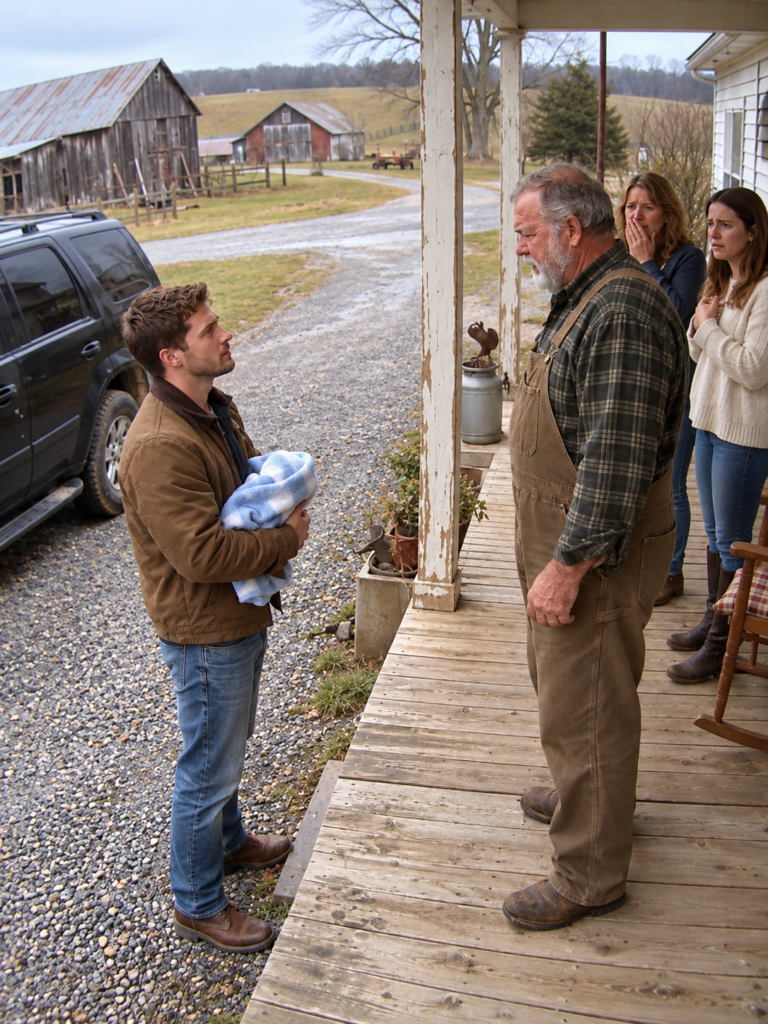
“Dad, I brought something.”
He walked to the passenger side and opened the door.
I expected a suitcase.
Maybe a gift.
Instead, he lifted out an old blue blanket.
The fabric was thin and faded, its corners curled from years of washing. Near one edge was a crooked line of white stitching.
I knew that stitching.
I’d made it myself one winter with a sewing needle so small I could barely thread it.
My breath caught.
“Daniel, where did you get that?”
He didn’t answer immediately.
He held the blanket against his chest.
And behind me, Evelyn made a sound I’d never heard from her before.
It was small.
Almost a gasp.
I turned.
Her eyes were fixed on the blanket.
“Evelyn?”
She shook her head.
“Nothing.”
But she had gone pale.
Daniel climbed the porch steps.
“Do you remember this, Dad?”
“Of course I remember.”
I reached toward the cloth, touching the white stitching with one finger.
“I thought it was lost.”
“No.”
His voice softened.
“It wasn’t lost.”
Evelyn stepped forward.
“Where exactly has that been?”
Daniel looked at her.
“With me.”
“All these years?”
“Every one of them.”
She swallowed.
Then she asked a strange question.
“Did you ever look inside the hem?”
The porch fell quiet.
Daniel’s eyes narrowed.
“What?”
Evelyn seemed to realize she’d said too much.
“I only meant old blankets sometimes have things sewn into them. Money, names, little keepsakes. Your grandmother used to do that.”
I stared at my sister.
Our mother had never sewn anything into a blanket in her life.
She could barely attach a button.
Daniel folded the blue cloth carefully.
“Funny you should mention that.”
He reached into his jacket and removed a flat brown envelope.
“I think we need to talk.”
Mrs. Dalton glanced toward the road.
“Maybe we ought to leave you folks alone.”
“No,” Daniel said.
He wasn’t rude.
He simply spoke with a firmness I hadn’t heard before.
“Please stay. You’ve heard what people have said about my father for years. I’d like you to hear what actually happened.”
Evelyn’s jaw tightened.
“What is that supposed to mean?”
Daniel didn’t answer.
Instead, he placed the envelope on the porch table, beside my coffee.
I looked from him to the blanket.
Then to my sister.
And suddenly I remembered the night twenty-five years earlier when that piece of blue cloth had first entered my life.
I remembered the rain.
I remembered the crying.
And I remembered that Evelyn had known more about the baby than she’d ever admitted.
My name is Thomas Bennett.
For most of my life, I worked a sixty-acre farm outside Ash Grove, Missouri.
It was not a pretty farm.
Not the kind that appears on calendars, with white fences and neat red barns beneath golden sunsets.
My barn leaned toward the east. My fencing was patched with wire collected from three different properties. The tractor was older than most of the men who worked on the neighboring farms.
And the land was not mine.
I rented it from Walter Price, a retired cattle dealer who lived forty miles away and raised the rent whenever he believed I had finally managed to save something.
I was thirty-eight when I found Daniel.
I’d been married once.
My wife, Helen, died from complications after a winter illness when we were both twenty-nine. We had tried for children, but none came.
After the funeral, I stopped speaking about marriage.
People said I was grieving.
They were right.
But they didn’t understand the other part.
I’d grown comfortable with having nothing to lose.
Then, on a Thursday evening in August, I heard a baby crying from the ditch behind the southern pasture.
At first I thought it was an injured animal.
The rain had been coming down hard for nearly an hour, and the old drainage ditch was filling.
I followed the sound through weeds taller than my knees.
There, beneath the low branches of a wild plum tree, lay a cardboard box.
Inside was a newborn boy.
He was wrapped in blue.
His face was red from crying, and one tiny foot had worked free of the blanket.
For a few seconds, I couldn’t move.
The box was getting wet.
The ditch was rising.
The child couldn’t have been more than a day or two old.
Then he opened his mouth and cried again.
I took off my jacket, lifted him into my arms, and ran.
My truck refused to start on the first turn.
Or the second.
I remember hitting the steering wheel with my fist and saying words I later apologized for in church.
On the third try, the engine caught.
I drove to the county hospital with the child tucked against my chest, praying at every stop sign that he would keep breathing.
A nurse named Patricia Ellis met me at the emergency entrance.
She took one look at the baby and shouted for help.
“What happened?”
“Found him in a ditch.”
“How long was he out there?”
“I don’t know.”
“Do you know his mother?”
“No.”
She reached for him.
And I held on for one ridiculous second.
It wasn’t because I didn’t trust her.
It was because the child had finally stopped crying.
He was warm against me.
His fingers were closed around the edge of my shirt.
I had never felt so necessary in my life.
Patricia touched my arm.
“We’ll take good care of him.”
I let her carry him through the double doors.
Then I sat down and discovered that my boots were full of water.
A sheriff’s deputy arrived.
He asked questions.
I answered them.
An investigator from child protective services came the next morning.
More questions.
More answers.
By then I had returned home long enough to feed the chickens, change my clothes, and stare at an empty kitchen that suddenly seemed much too quiet.
Nobody knew whose baby he was.
There had been no missing-child report.
No note in the box.
No identifying information.
Only the blue blanket.
When I returned to the hospital, Patricia was working again.
“How is he?” I asked.
She smiled.
“Healthy, considering everything.”
“Good.”
I stood there awkwardly.
Then I asked, “What’s going to happen to him?”
“He’ll enter protective custody while they investigate.”
“And after that?”
“Possibly foster care.”
I nodded.
There was nothing wrong with foster care. I knew good people who had opened their homes to children.
But I couldn’t stop picturing that box in the rain.
“Can I apply?”
Patricia studied me.
“To foster him?”
“Yes, ma’am.”
“Mr. Bennett, that’s a serious commitment.”
“I know.”
“You’re single?”
“Yes.”
“Do you have family nearby?”
“My sister.”
“Steady employment?”
I glanced down at my cracked fingernails.
“I farm.”
She didn’t smile this time.
She pulled a chair toward me.
“Then let’s find somebody who can explain the process.”
That was how it began.
Not with a miracle.
With paperwork.
Inspections.
Interviews.
A home study.
A background check.
Questions about income, childcare, safety, and what I would do if the baby’s biological family came forward.
For a while, I was told not to expect anything.
Then an emergency foster placement became possible after the required approvals and help from a local support organization.
The arrangement was temporary.
Nobody promised I would get to keep him.
But one afternoon, Patricia called and told me to come to the county office.
I arrived wearing the only clean button-down shirt I owned.
She handed me a list of supplies.
Formula.
Diapers.
Infant clothing.
A safe crib.
Bottles.
A car seat.
I looked at the list.
Then at my wallet.
I had eighty-three dollars.
I went to the bank and withdrew nearly everything left in my savings.
An elderly church member gave me a crib her grandchildren had outgrown, which I checked and cleaned before the placement worker approved it.
Mrs. Dalton brought diapers.
Patricia found a local charity that helped with the car seat.
And on a cool September morning, I carried that baby through my front door.
The house had never seemed so alive.
I named him Daniel.
Helen and I had chosen that name years earlier, back when we believed we’d fill the house with children.
I hadn’t spoken it aloud since she died.
The first time I whispered it over the crib, I cried.
I hadn’t expected to.
It simply happened.
Evelyn came to visit three days later.
She was forty-one, married to a salesman named Richard, and lived in a comfortable brick house near the center of town.
My sister liked order.
She liked polished furniture, pressed clothes, properly arranged holidays, and knowing what the neighbors thought before they thought it.
She entered my kitchen carrying a bag of groceries.
Then she looked at Daniel asleep in his crib.
“Thomas, what have you done?”
I took the groceries.
“What do you mean?”
“You know exactly what I mean.”
She lowered her voice.
“You’re nearly forty. You have no wife, no savings, and barely enough money to keep this place.”
“I manage.”
“Manage?”
She pointed toward the sink, where bottles were drying beside an old coffee mug.
“That baby needs more than a man who manages.”
“He has everything the placement worker required.”
“That’s not the point.”
“Then what is?”
She looked at Daniel.
For a moment, something strange passed across her face.
Not the usual irritation.
Something closer to fear.
Then she said, “You have no idea where that child came from.”
“No.”
I looked toward the crib.
“But I know where he is now.”
Evelyn turned away.
“One day you’ll understand how foolish this is.”
She stayed less than fifteen minutes.
Afterward, I found a fifty-dollar bill beneath the grocery bag.
I called to thank her.
She said Richard must have left it by accident.
I knew that was a lie.
It was the first kindness she’d shown Daniel.
For twenty-five years, it was also the only one she never tried to make me repay.
The first year nearly broke me.
Daniel had colic.
The tractor needed repairs.
A late frost damaged the early planting.
I learned to warm bottles with one hand while balancing a checkbook with the other.
I learned to sleep in pieces.
I learned that a baby’s fever could make a grown man feel smaller than he’d ever felt.
There were nights I sat beside the crib listening to every breath.
And there were mornings I stood in the barn at four-thirty, exhausted, with Daniel safely settled with Mrs. Dalton while I finished chores I couldn’t postpone.
Mrs. Dalton became our lifeline.
She was a widow with silver hair, strong opinions, and three grown daughters who lived out of state.
She lived two houses down and didn’t believe in asking permission to help somebody who obviously needed it.
One morning she appeared with a casserole.
Another day with clean laundry.
When I thanked her too many times, she said, “Thomas, raising a child isn’t a debt you settle with the neighbors. Just raise him right.”
I tried.
By the time Daniel was two, he followed me everywhere.
At three, he called every piece of farm equipment a tractor.
At four, he asked why I didn’t have a mother living in the house.
I showed him Helen’s photograph.
“She was my wife,” I told him.
“Did she love babies?”
“More than anything.”
He studied the photograph.
Then he asked, “Would she have loved me?”
I sat down because my knees suddenly felt weak.
“Yes, buddy.”
He smiled.
“Good.”
He went back to playing.
Children can settle questions that adults carry for years.
When Daniel turned five, the legal process that had begun with his emergency placement finally ended in adoption.
The authorities had completed their efforts to establish his identity and locate family members. The court approved the adoption after the required proceedings.
I remember standing in the courthouse, wearing a borrowed tie.
Daniel wore a navy sweater and kept trying to pull the sleeves over his hands.
The judge asked whether I understood that adoption meant accepting every responsibility of a parent.
I said yes.
He asked whether I was prepared to provide a permanent home.
I said yes again.
Then the judge smiled at Daniel.
“And what do you think about all this, young man?”
Daniel looked at him.
“I already live with my dad.”
The courtroom laughed.
I didn’t.
I couldn’t get enough air to speak.
Afterward, I bought him a chocolate milkshake.
He spilled half of it down the front of his sweater.
It remains one of the happiest days of my life.
But the courthouse wasn’t the place where I first became his father.
That happened when I lifted him out of the rain.
As Daniel grew, so did Evelyn’s objections.
She stopped questioning whether I could raise him and started questioning whether he belonged.
At Thanksgiving, she’d introduce him as “Thomas’s adopted boy.”
At church picnics, she’d tell people, “We don’t know anything about his actual family.”
When he won a school award, she’d say, “Amazing how well children can turn out, even under difficult circumstances.”
Daniel heard more than she realized.
At eight, he asked me what actual family meant.
We were sitting at the kitchen table.
I’d been fixing a broken radio.
He was coloring a picture of a red barn.
“Aunt Evelyn says I’m not actual family.”
I put down the screwdriver.
“Come here.”
He climbed onto the chair beside me.
“Do you know what family means?”
He shrugged.
“People who live together?”
“Sometimes.”
“People with the same last name?”
“Not always.”
He thought for a moment.
“Then what?”
I looked at his small hands, stained with red crayon.
“Family means people who keep showing up for you. When you’re sick. When you’re scared. When you make mistakes. When life gets hard.”
He looked toward the kitchen window.
“Like you and me?”
“Exactly like you and me.”
He nodded.
Then he asked, “Does Aunt Evelyn know that?”
I laughed before I could stop myself.
“I suppose she has a little more learning to do.”
He returned to his picture.
But I could tell the question stayed with him.
And I was beginning to understand that my sister’s words weren’t harmless.
They were teaching my son to feel like a guest in his own family.
The first time I confronted her, Daniel was eleven.
She’d told him at a family dinner that he should be grateful someone had taken him in.
I asked her to step outside.
“Evelyn, you will not speak to him that way again.”
She crossed her arms.
“I was teaching him appreciation.”
“He’s a child.”
“He’s old enough to understand the truth.”
“He knows he’s adopted.”
“That’s not the same.”
“What isn’t?”
She looked toward the house.
Then back at me.
“You’re making him believe things are simpler than they are.”
I stared at her.
“What things?”
Her mouth tightened.
“Forget it.”
“No. Tell me.”
“Thomas, I’m trying to protect you.”
“From what?”
She didn’t answer.
Instead, she got into her car and drove away.
For years, I remembered that exchange as another example of Evelyn’s prejudice.
Standing on my porch twenty-five years after finding Daniel, watching my sister stare at the blue blanket, I finally understood there might have been another reason for her fear.
Daniel touched the brown envelope.
“Dad,” he said quietly, “there’s something I need you to know.”
Evelyn moved toward him.
“Daniel, don’t.”
He looked at her.
“Why not?”
“Because some things should stay buried.”
The neighbors went silent.
Daniel’s hand remained on the envelope.
“I used to think that too,” he said.
“Then I learned what keeping them buried cost my father.”
He opened the envelope.
And the first thing he placed on the table was a photograph of a young woman holding a newborn baby.
I had never seen her before.
But Evelyn had.
She reached for the porch railing.
And whispered a name.
“Rebecca.”
Part 2
I looked at the photograph.
The young woman couldn’t have been more than twenty.
She had long dark hair, tired eyes, and a small, uncertain smile.
The infant in her arms was wrapped in blue.
My blue blanket.
The one I’d pulled from a muddy cardboard box all those years ago.
“Who is she?” I asked.
Daniel didn’t answer at once.
He watched Evelyn.
My sister lowered herself into a porch chair.
“Where did you find that picture?”
Daniel kept his voice steady.
“That’s what we’re going to discuss.”
He turned back toward me.
“Dad, her name was Rebecca Mercer.”
I studied the young woman’s face.
Something about her expression unsettled me.
She looked exhausted.
But not indifferent.
She was holding the baby close, her cheek resting against the top of his head.
That wasn’t the face I’d imagined all those years when I wondered what kind of mother could leave a newborn in a ditch.
“I found her family last year,” Daniel said.
I looked up.
“You found your mother?”
He nodded.
“Her sister, actually. Rebecca died eleven years ago.”
The words settled heavily between us.
“I’m sorry, son.”
“Thank you.”
Daniel pressed his lips together.
“I wanted to tell you sooner. But there were things I didn’t understand.”
Evelyn suddenly stood.
“This is ridiculous. Twenty-five years have passed. Digging up old trouble won’t change anything.”
Daniel turned toward her.
“Did you know Rebecca Mercer?”
“No.”
He waited.
Evelyn looked away.
Then said, “Not well.”
Mrs. Dalton shifted in her chair.
“Evelyn, those are two different answers.”
My sister glared at her.
But Daniel wasn’t finished.
He reached into the envelope again.
This time he removed a photocopy of a handwritten letter.
“Dad, before I explain this, I need you to understand something.”
He looked directly at me.
“Nothing I found changes who you are to me.”
I tried to smile.
“Son, I never worried about that.”
But the truth was more complicated.
Not because I doubted Daniel loved me.
Because I had spent twenty-five years believing I’d rescued a child whose mother had simply left him.
Now the photograph suggested a different story.
And I could see from Daniel’s face that whatever came next would hurt.
Daniel had left home at eighteen on a September morning.
He had won a scholarship to a technical college near Kansas City, where he planned to study construction management.
He had always been good with his hands.
At twelve, he’d repaired the back gate without being asked.
At fifteen, he’d built Mrs. Dalton a wheelchair ramp when her visiting brother needed one.
At seventeen, he’d helped a contractor repair our church basement after spring flooding.
He understood buildings.
He liked knowing why things stood.
And he noticed every weakness in our farmhouse.
The sagging porch.
The roof that leaked above the pantry.
The foundation that shifted slightly each winter.
Before he left, he promised he’d come back and repair everything.
I told him I wanted him to build his own life first.
We argued about it at the bus station.
Not an angry argument.
The kind two people have when each is trying to give the other more than he can afford.
I pressed sixty dollars into his palm.
He tried to refuse.
“Dad, you need this.”
“I’ve got enough.”
“You said that when the freezer broke.”
“That freezer was older than you.”
“And it still doesn’t work.”
I smiled.
He didn’t.
He looked at my coat, at the frayed cuff I’d sewn three times.
Then he hugged me.
“I’m going to make things better for us.”
I pulled away enough to see his face.
“Listen to me. You don’t owe me a better life.”
He swallowed.
“You raised me.”
“And I’d do it all again.”
He looked down.
I put my hand behind his neck.
“The only thing you owe me is to become a man you can respect.”
He nodded.
Then he boarded the bus.
For the first few years, he called constantly.
He told me about classes, cheap apartments, difficult supervisors, and the woman he’d dated for three months before they realized they wanted different things.
He found work with a regional building company.
He became a site supervisor.
Then a project manager.
Eventually, he helped start a business specializing in restoring old houses and commercial properties.
I knew the outline.
I didn’t know how successful he’d become.
He was the kind of man who described a large achievement as “things are going pretty good.”
Some winters, he came home.
Others, he couldn’t.
I always said I understood.
I did understand.
But after each call ended, I’d sit at the kitchen table looking at his school photographs and wish the house made more noise.
Evelyn noticed.
Of course she did.
One Christmas, after Daniel canceled a visit because of a job-site emergency, she stood in my kitchen and said, “I tried to warn you.”
I was washing dishes.
“About what?”
“Raising someone else’s child. Eventually they go looking for their own people.”
I turned off the faucet.
“Daniel is working.”
“That’s what he tells you.”
“Evelyn.”
“Thomas, you don’t know what he’s doing.”
“Neither do you.”
She took a long breath.
“Maybe he has questions about where he came from.”
“Then I hope he finds answers.”
Her face changed.
Just slightly.
“You really mean that?”
“Of course.”
“What if those answers hurt you?”
I set down the dish towel.
“I’d rather he know the truth than spend his life wondering.”
Evelyn stared at me.
For a moment I thought she might say something important.
Instead, she picked up her handbag.
“You’re too trusting. You always have been.”
I watched her drive away.
I had no idea that she was frightened of precisely the truth I’d encouraged Daniel to seek.
Daniel’s search began after his twenty-fourth birthday.
He told me later that it wasn’t because he felt incomplete.
He’d never doubted he belonged with me.
But becoming older had made him curious about the woman in the rain.
Had she been afraid?
Had she been sick?
Had she wanted him?
And if she had, why hadn’t she kept him?
He requested the adoption information he was legally entitled to obtain and learned what additional records might be available through the proper channels.
Some records were sealed or limited.
Others provided clues.
There was the hospital intake summary.
A partial description of the blanket.
An approximate location.
The name of the sheriff’s deputy who’d first interviewed me.
Daniel tracked down that deputy, now retired and living in Arkansas.
His name was Harold Kline.
Kline remembered the case.
“Hard to forget a newborn found during a storm,” he told Daniel over the phone.
But what the retired deputy remembered most was a young woman who’d visited the sheriff’s office several days before the baby was found.
She had asked about emergency housing and whether a mother could surrender an infant safely.
Kline couldn’t remember her name.
He did remember that she seemed frightened of someone.
“Kept looking toward the parking lot,” he said.
Daniel asked if the woman had been identified during the investigation.
Kline wasn’t sure.
The original files were incomplete.
Some notes had been archived.
Some details were obscured in the copies Daniel was permitted to review.
But one thing bothered the retired deputy.
He remembered a report that someone had seen a cream-colored sedan near the farm road that evening.
And he remembered that the lead had never gone anywhere.
Daniel knew a cream-colored sedan once belonged to my sister.
He’d seen it in old family photographs.
At first, he dismissed the thought.
There must have been hundreds of similar cars.
And Evelyn, for all her faults, couldn’t have been involved in leaving a newborn beside a flooded ditch.
That seemed impossible.
Then he found the photograph.
The picture came from a woman named Laura Mercer, Rebecca’s younger sister.
Laura lived in Topeka, Kansas.
She’d spent years wondering what had happened to her nephew.
When Daniel contacted her, she initially thought it was a mistake.
Then he explained the approximate date and location of his discovery.
Laura asked about the blanket.
When he described it, she began to cry.
Rebecca had sewn it herself.
She had chosen the blue fabric because she didn’t know whether she was having a boy or girl, and she liked the color.
Near one edge she’d embroidered a small white star.
The star had almost disappeared after years of washing.
But Daniel remembered it.
He’d spent countless childhood nights rubbing that tiny patch of stitching with his thumb.
Laura sent the photograph.
Daniel stared at it for a long time.
Then he drove to Topeka.
Laura was fifty-one, a retired school employee who lived in a small yellow house with flowerpots along the steps.
She welcomed him into her kitchen.
She showed him photographs of Rebecca as a child.
School portraits.
Birthday parties.
A graduation picture.
And finally, a hospital photograph of Rebecca holding a newborn.
Daniel was that baby.
Laura told him Rebecca had been frightened during her pregnancy.
The baby’s father had left before the birth.
Rebecca was living with a relative who disapproved of her situation and believed unmarried motherhood would disgrace the family.
She had little money.
No car.
And no stable place to go.
“She called me two days after you were born,” Laura said.
Daniel leaned forward.
“What did she say?”
“That she needed help. That someone had promised to take you somewhere safe, but she wasn’t certain she could trust them.”
“Who?”
Laura hesitated.
“A woman from Ash Grove.”
Daniel felt something cold move through his stomach.
“What woman?”
“Rebecca never gave me the name over the phone.”
Laura opened a small wooden box.
Inside were birthday cards, old receipts, and a thin collection of letters.
“After Rebecca died, I kept everything. I couldn’t bear to throw it away.”
She handed Daniel a folded page.
The handwriting was cramped and hurried.
It was dated three days before he was found.
Rebecca wrote that a woman named Evelyn had offered to help her find a safe home for the baby.
The woman knew someone with experience caring for children, Rebecca believed.
She had promised to arrange everything discreetly.
But Rebecca feared the arrangement was being rushed.
In the final lines, she wrote that she wanted proof her baby would be safe.
Daniel read the letter twice.
Then a third time.
“Evelyn?”
Laura nodded.
“Do you know her?”
He could barely answer.
“She’s my aunt.”
When Daniel told me that part of the story, I turned toward my sister.
“Evelyn?”
She was sitting motionless.
The breeze lifted a corner of the photocopy.
Mrs. Dalton reached out and pressed it flat.
I could hear birds calling from the maple tree.
Someone’s lawn mower started two houses away.
Ordinary sounds.
It seemed impossible that ordinary life could continue while my understanding of twenty-five years came apart.
“You knew Rebecca?” I asked.
Evelyn kept her eyes on the table.
“She worked briefly at the church thrift shop.”
“And?”
“She was having trouble.”
“What kind of trouble?”
My sister looked up.
“You know how people were back then.”
“No, Evelyn. Tell me how you were.”
Her face tightened.
Daniel placed another document beside the photograph.
It was a copy of a church assistance request from that summer.
Rebecca Mercer had asked for temporary housing and help with childcare.
The request had been referred to a volunteer committee.
Evelyn’s name appeared beside it.
I felt sick.
“You were helping her?”
“I tried.”
“What happened?”
Evelyn shook her head.
“You don’t understand.”
“Then explain it.”
She looked toward the neighbors.
“Not here.”
Daniel spoke quietly.
“That’s what everyone told my mother. Not here. Not in front of people. Not where someone might talk.”
Evelyn flinched.
But I wasn’t listening to the argument anymore.
I was remembering the day after I found Daniel.
Evelyn had appeared at the hospital.
I’d been standing near the nursery window.
She came beside me and asked whether anyone had identified the mother.
I told her no.
She’d looked relieved.
At the time, I’d mistaken that relief for reassurance that nobody would arrive to take the baby away from me.
Now I realized it might have meant something entirely different.
“Evelyn,” I said, “did you know he was Rebecca’s baby when I found him?”
My sister covered her mouth.
That was answer enough.
I took a step backward.
Daniel reached for my arm.
“Dad.”
I shook my head.
“Just give me a minute.”
I sat in my porch chair.
For the first time in twenty-five years, I allowed myself to imagine Rebecca not as a faceless woman who’d abandoned her child, but as a frightened young mother asking for help.
And I wondered what she’d believed was happening to her baby while I was carrying him into the hospital.
Evelyn finally began talking.
Not because Daniel shouted.
Not because I threatened her.
Because there was no room left for her old version of events.
She had met Rebecca through the church’s charitable work.
Rebecca was staying with an older cousin near Ash Grove after losing her job.
She had given birth at a hospital in a neighboring county.
When she returned with the baby, the cousin threatened to throw her out.
Rebecca approached the church for help.
Evelyn was one of the volunteers.
She admitted that Rebecca had asked her to arrange temporary care while she found housing.
“I told her I knew someone,” Evelyn said.
“Who?” Daniel asked.
She looked at me.
“Thomas.”
I stared.
“You told her about me?”
“Not by name.”
“Why?”
“Because you were always talking about wanting a family.”
I leaned forward.
“You knew I’d help.”
She nodded weakly.
“Yes.”
“Then why didn’t you bring her to my house?”
Evelyn’s eyes filled.
“Because Richard found out.”
Her husband had been involved in church leadership.
He was proud of the family’s reputation.
He didn’t want Evelyn becoming involved in what he called “someone else’s scandal.”
He believed the safest thing was to persuade Rebecca to place the baby with a licensed agency and end the matter.
Evelyn was torn between her husband’s demands and her promise to Rebecca.
At least, that was how she described it.
But Daniel had found evidence that the decision went further than refusing help.
Rebecca had written a second letter.
And this one had never reached its intended destination.
Daniel unfolded a copy.
It was addressed to me.
Thomas Bennett.
Not a stranger.
Me.
I stared at my name, written in the careful hand of someone I’d never met.
Daniel’s voice shook as he read the opening lines.
Rebecca had been told that I was a widower who wished to adopt.
She asked whether I would consider helping her and her child until she could find a safe place to live.
She did not ask me to take her baby forever.
She asked whether I could help them both.
The letter was dated the morning before the storm.
I looked at Evelyn.
“She wrote to me?”
My sister nodded.
“You never gave it to me.”
“No.”
“Why?”
She began crying.
“I was afraid.”
“Of what?”
“Of Richard finding out. Of people saying I was bringing scandal into the family. Of getting involved in something we couldn’t fix.”
I looked at the letter again.
“You let me believe nobody wanted that child.”
Evelyn whispered, “I didn’t know what would happen.”
But Daniel wasn’t finished.
He looked at her with an expression that made me think of him as a boy, standing in the principal’s office after someone called him a ditch baby.
The same hurt.
Only older.
And much more difficult to comfort.
“Aunt Evelyn, there’s another question.”
She said nothing.
“How did I end up in that ditch?”
The silence that followed seemed to stretch across the entire yard.
Evelyn pressed both hands against her knees.
“I never meant for him to be left there.”
Daniel stood very still.
“Then tell us what you meant.”
She finally looked at me.
And I saw a woman who’d spent twenty-five years building a wall around one terrible evening.
“I was supposed to take the baby to the county hospital,” she whispered.
I could barely breathe.
“Rebecca gave him to you?”
Evelyn nodded.
“She was staying in a motel. She couldn’t keep him there. Richard said we couldn’t bring him home. I told her I’d make sure he was safe.”
“Then why was he on my farm?”
Her voice cracked.
“Richard wouldn’t let me drive to the hospital.”
She wiped her face.
“He said if I wanted to help so badly, I should take the baby to you. He said you’d call the authorities.”
I stared at her.
“So you left him beside my field?”
“I thought you’d hear him.”
Rain began to tap lightly against the porch roof.
As if the weather itself remembered.
I rose from my chair.
“That ditch was filling with water.”
“I know.”
“He could have died.”
Evelyn began sobbing.
“I know.”
I looked at my sister.
For twenty-five years, she had criticized me for raising a child she herself had placed in danger.
For twenty-five years, she’d told me I’d ruined my life.
And for twenty-five years, she had known that the woman whose baby I found had once asked me for help.
I gripped the railing.
Then Daniel said something that brought a different kind of silence.
“That isn’t everything, Aunt Evelyn.”
She looked up.
He removed one final page from the envelope.
“A few weeks after I was found, Rebecca tried to locate me.”
Evelyn went completely still.
Daniel laid the document on the table.
It was a copy of a letter Rebecca had written to Laura after the investigation began.
She said Evelyn had told her the baby was safely placed with a family and that contacting him might threaten the arrangement.
Rebecca had asked for an address.
Evelyn refused.
She had told Rebecca that the child would be better off if she disappeared.
I looked at my sister.
“Did you tell her that?”
Evelyn didn’t answer.
Daniel asked again.
“Did you?”
Her whisper was barely audible.
“Yes.”
Daniel closed his eyes.
For the first time since he’d arrived, his composure broke.
“My mother spent years believing I didn’t want to see her.”
Evelyn began shaking her head.
“No. She couldn’t have known that.”
“She wrote about it.”
He tapped the letter.
“She tried to find me again when I was seven. And when I was twelve. She didn’t know my name had changed.”
Mrs. Dalton began crying quietly.
I stood there, watching my son’s face, understanding that the pain he’d brought home wasn’t just the loss of a mother.
It was the discovery that a person he’d been taught to call family had helped create that loss.
Daniel looked toward the road.
“I spent months wondering whether to tell you any of this.”
“Son,” I said, “you should never have had to carry it alone.”
He nodded without looking at me.
Then he reached into the envelope again.
And what he said next surprised even Evelyn.
“Dad, I wasn’t sure you’d forgive me.”
I stared at him.
“For what?”
He swallowed.
“For what I did after I found out.”
Part 3
I had imagined plenty of things on the day Daniel finally came home.
I imagined him bringing a wife.
Maybe a grandchild.
Maybe news of a promotion or a new house.
I never imagined him standing on my porch with tears in his eyes, asking forgiveness for something he hadn’t yet explained.
“What did you do?” I asked.
He looked at the envelope.
“I went looking for proof.”
“Of what?”
“Of everything. What happened to my mother. Why nobody found her. What Aunt Evelyn knew.”
He took a breath.
“And while I was doing that, I learned how much trouble you’re in with the farm.”
My chest tightened.
“Daniel.”
He held up a hand.
“Please, Dad. Let me finish.”
I sat down.
He pulled another folder from the truck.
Inside were copies of bank records, property records, and correspondence with a local law office.
I recognized the name on the first page.
Walter Price.
The man who owned the land.
Daniel explained that Walter had died the previous spring.
His heirs planned to sell the rented farm, including the house I’d occupied for nearly thirty years.
They intended to give me the notice required by the lease and applicable law.
I had known they might sell.
I’d received letters.
I’d ignored them longer than I should have.
At seventy-three, I’d grown tired of solving problems I couldn’t afford to fix.
The farmhouse needed major repairs.
My savings were small.
My farming income had declined.
And the thought of leaving the place where I’d raised Daniel was almost more than I could bear.
So I hadn’t told him.
“I didn’t want you worrying,” I said.
Daniel smiled sadly.
“That’s what you always say.”
I looked down.
He continued.
“When I came home last winter, I saw the notices on the kitchen counter.”
I remembered that visit.
He’d only stayed two days.
We’d eaten meatloaf at Mrs. Dalton’s house, gone through old photographs, and spent a morning fixing the barn door.
I had thought he hadn’t noticed the papers.
Apparently he’d noticed everything.
“After that,” Daniel said, “I called the attorney handling the estate. I asked whether the property was going on the market.”
“And?”
“It was.”
He looked at me.
“I made an offer.”
The world seemed to tilt.
“You what?”
“I offered to buy it.”
“Daniel, that land is worth—”
“I know what it’s worth.”
“You can’t just—”
“I can.”
He said it quietly.
Not arrogantly.
Like a man explaining he’d already measured the distance and knew he could cross it.
I looked toward his truck.
The dark paint.
The company name on his jacket.
The steady confidence I barely recognized.
“How much money do you have, son?”
He gave a small laugh.
“Enough to be careful with it.”
I shook my head.
“No.”
“Dad.”
“No, Daniel. You’re not spending your future fixing my mistakes.”
He knelt beside my chair.
Just as he’d done when he was little and wanted me to listen.
“Do you remember what you gave me when I left for college?”
“Sixty dollars.”
“Do you remember what you said?”
I swallowed.
“That a father ought to send his boy away with something.”
He nodded.
“I carried that money for two years.”
I looked at him.
“You didn’t spend it?”
“No.”
“Daniel, I told you to use it.”
“I know.”
He smiled.
“But I wanted to keep something you gave me when you barely had enough for yourself.”
He reached into his wallet and removed an old, folded twenty-dollar bill.
It was creased almost white along the edges.
“One of the original three,” he said.
I stared at the bill.
Then at my son.
He placed it carefully in my hand.
“That money reminded me what somebody can do when they love you more than they’re afraid of being poor.”
I couldn’t speak.
He put his hand over mine.
“You gave me a home when you couldn’t afford one.”
His voice broke.
“Let me make sure you keep yours.”
I shook my head, tears clouding my eyes.
“You’re not responsible for me.”
“I know.”
“Then why?”
“Because I want to.”
And that answer was so much like something I’d said twenty-five years earlier that I began to cry.
Daniel had purchased the farm through his company after completing the required sale.
He showed me the recorded deed and explained the ownership arrangements he’d made with an attorney.
The house and surrounding property were secure.
He’d also arranged a plan for essential repairs.
But he hadn’t secretly transferred the property into my name.
He knew better than to make decisions about my home without consulting me.
Instead, he wanted me to meet with his lawyer and discuss the best way to protect my right to live there permanently, whether through a life estate, an appropriate trust, or another legal arrangement.
For the first time in years, I could imagine growing old without wondering where I would go if the rent rose again.
But the property wasn’t what made me cry hardest.
It was the folder Daniel handed me afterward.
Inside were photographs of the original farmhouse.
The cracked window.
The sagging porch.
The place where Helen’s rosebush still grew beside the steps.
Alongside them were drawings of proposed repairs.
A sound foundation.
A new roof.
A safer bathroom.
A small workshop.
And one additional room overlooking the west field.
“What is this?” I asked.
Daniel glanced at me.
“A room for when the grandkids visit.”
I looked up so quickly he laughed.
“Grandkids?”
He nodded.
“I’m engaged.”
For a moment I forgot everything else.
“Engaged?”
“Her name is Rachel. She’s a school counselor. We’ve been together three years.”
I stared at him.
“Three years?”
He looked sheepish.
“I wanted to tell you properly.”
I stood and pulled him into another hug.
“You stubborn boy.”
He laughed against my shoulder.
“You taught me.”
I held him for a long time.
Then I stepped back.
“Are there already grandkids I don’t know about?”
“No, sir.”
He grinned.
“Not yet.”
It was the first easy laugh we’d shared that afternoon.
And for a few seconds, the porch felt like it had when he was young.
But Evelyn was still sitting nearby.
And the truth about Rebecca hadn’t gone away.
Daniel turned toward her.
“I didn’t come here to hurt you, Aunt Evelyn.”
She looked exhausted.
Her neat hair had come loose.
Mascara marked the skin beneath her eyes.
“Then why did you do this in front of everyone?”
He looked at Mrs. Dalton and our other neighbor, Mr. Harris.
“Because for years you made my father’s sacrifice everybody’s business.”
Evelyn lowered her eyes.
“You told people he was foolish. You told them I wasn’t really his son. You told me I should remember I came from nothing.”
He paused.
“You knew where I came from.”
She covered her face.
“And you knew my mother hadn’t simply decided I wasn’t worth keeping.”
Nobody spoke.
Daniel continued.
“I can’t change what happened. I can’t give Rebecca back the years she lost. And I can’t make you into the aunt I needed.”
Evelyn looked at him through her fingers.
“But I can stop pretending this was all just family gossip.”
He placed the documents back in the envelope.
“I’ve spoken with a lawyer about what happened. Some things may be too old to address legally, and some records are incomplete. I’m not promising a courtroom will fix it.”
Evelyn nodded faintly.
“But I’m going to preserve everything we found. And I want you to give a full, truthful account of what you know.”
“Why?”
“Because there’s still a family who spent years wondering what happened to a baby.”
His voice softened.
“Rebecca’s family deserves answers.”
Evelyn began crying again.
This time Daniel didn’t comfort her.
Neither did I.
I had spent much of my life making excuses for my sister.
She’d had a difficult marriage.
She worried too much about appearances.
She could be thoughtless.
She hadn’t meant to hurt anyone.
I’d told myself those things because believing otherwise would mean accepting that someone I loved could knowingly cause harm.
But standing there, I couldn’t excuse what she’d done.
“You told me I wasted my life,” I said.
She looked up.
“Thomas—”
“Every year. Every holiday. Every time that boy did something good, you found a way to remind us he wasn’t born into this family.”
She shook her head.
“I was ashamed.”
I stared at her.
“Of Daniel?”
“Of myself.”
Her answer surprised me.
She looked toward the yard.
“Every time I saw him, I remembered that night. The rain. That road. What I did.”
Her voice trembled.
“When you decided to raise him, I thought the truth would eventually come out. Then it didn’t.”
She wiped her cheeks.
“And after a while, it felt easier to convince myself you’d been foolish than admit you’d done what I should have done.”
The rain grew heavier.
I watched water run down the porch steps.
“You could have told us,” I said.
“I know.”
“You could have told Rebecca he was safe.”
“I know.”
“You could have stopped treating him like a mistake.”
She covered her mouth.
“I know.”
I wanted to shout.
For one moment, I wanted her to feel every cold night I’d spent worrying over bills, every schoolyard insult Daniel had carried home, every lonely Christmas she’d used to remind me my son might never return.
But shouting wouldn’t give us back those years.
So I said the only thing I could say.
“I don’t know how to forgive you.”
Evelyn nodded, crying.
“I understand.”
“And I’m not going to pretend I do.”
She looked down.
Then I added, “But I hope you’ll finally tell the truth without making somebody drag it out of you.”
For the first time that afternoon, she didn’t argue.
The days that followed were difficult.
News traveled quickly through Ash Grove.
Mrs. Dalton told people only what Daniel and I gave her permission to share.
That was enough to correct the worst rumors.
But stories develop their own lives in small towns.
People wanted explanations.
Some wanted to defend Evelyn.
Others wanted to condemn her.
I wanted neither.
I wanted to understand what had happened to Rebecca.
Daniel and I traveled to Topeka two weeks later.
I drove.
He offered three times.
I refused three times.
Some habits survive even when your son can buy a farm.
Laura Mercer met us at the door.
She was shorter than I’d imagined.
Her hair was silver, and she wore glasses on a cord around her neck.
When she saw Daniel, she embraced him.
Then she turned to me.
For a moment we simply looked at each other.
Finally she said, “You’re Thomas.”
“Yes, ma’am.”
She took my hand.
“My sister would have wanted to meet you.”
That nearly brought me to my knees.
We sat in her kitchen for most of the afternoon.
Laura showed me Rebecca’s photographs.
She told me about her childhood.
How Rebecca loved horses.
How she sang while washing dishes.
How she once rescued a stray kitten and hid it in the garage for three weeks before her father discovered it.
Ordinary things.
The details that make a person real.
I learned Rebecca had been twenty-one when Daniel was born.
She had struggled for years afterward.
She married later, but never had another child.
She worked at a grocery store and volunteered at a community garden.
She died after a long illness, still uncertain whether the baby she’d entrusted to someone else had survived.
Laura showed us an old notebook.
Rebecca had written in it on the birthdays of the child she couldn’t find.
The entries were short.
Sometimes only a few sentences.
On his fifth birthday, she wondered whether he liked school.
On his tenth, she wondered whether he played baseball.
On his sixteenth, she hoped someone was teaching him how to drive.
And in the final entry, written not long before her death, she expressed the hope that he had grown up in a home where he felt wanted.
Daniel sat beside me reading those pages.
I heard him struggling to breathe evenly.
I put my arm around his shoulders.
He leaned against me.
Just for a moment, he was the little boy who used to crawl onto my lap after a nightmare.
Laura watched us.
Then she said, “I think she would have been grateful.”
Daniel looked up.
“For what?”
“For him.”
She nodded toward me.
“For the life he gave you.”
I shook my head.
“I wish I’d known about her.”
Laura reached across the table.
“So do I.”
I looked at Rebecca’s photograph.
“I’m sorry she had to wonder.”
Laura nodded.
“Me too.”
Then Daniel asked if we could visit the cemetery.
Rebecca was buried beneath a maple tree in a small cemetery outside Topeka.
The afternoon was clear.
The grass had recently been cut.
Her stone was simple.
Her name.
Her dates.
And beneath them, a small engraved flower.
Daniel stood in front of it for a long time.
I stayed a few steps behind.
He placed a blue ribbon beside the headstone.
Not the blanket.
He’d decided to keep that.
Then he said softly, “I wish we’d met.”
I looked away.
Some moments don’t belong to anyone except the person living them.
After a while, he turned toward me.
“Dad?”
“Yes, son?”
“Do you think she loved me?”
I looked at Rebecca’s name.
I thought about the letters.
The requests for help.
The years she spent trying to find him.
Then I looked at the grown man beside me.
“Yes,” I said.
“I believe she did.”
His eyes filled.
“Even though she gave me away?”
I shook my head.
“She asked somebody to help you. What happened after that wasn’t the choice she thought she was making.”
He nodded slowly.
Then he looked at me.
“And you?”
“What about me?”
“Did you ever wish you’d let someone else take me?”
I almost laughed.
Not because the question was funny.
Because after twenty-five years, he still didn’t understand how completely he’d changed my life.
I put a hand on his shoulder.
“Daniel, before you came along, I used to get up every morning because the cows needed feeding.”
He smiled faintly.
“That’s a pretty good reason.”
“It is. But it’s not enough to make a man feel like his life matters.”
I looked toward the cemetery road.
“After your mother Helen died, I thought I’d already had my chance at a family.”
My voice trembled.
“Then I heard you crying.”
Daniel lowered his head.
“I never once wished I’d walked past that ditch,” I said.
“Not when money was tight. Not when you got suspended for fighting. Not when you broke the barn window. Not when you left home.”
He laughed through tears.
“I still say that window was an accident.”
“It was a baseball.”
“An accident with a baseball.”
I smiled.
Then I pulled him close.
“If I had to live it all again, knowing every hard day that was coming, I’d still pick you up.”
He held on to me.
And for the first time, I understood that he’d needed to hear that as much as I’d needed to say it.
The legal and practical matters took time.
Evelyn eventually provided a signed account of her involvement.
Daniel’s attorney reviewed it alongside the surviving records and explained the limits of what could be established so many years later.
There was no dramatic trial.
No sudden confession that solved every missing detail.
Some questions remained unanswered.
We never learned exactly what Richard had said or done that evening beyond Evelyn’s account. He’d died seven years before Daniel began his search.
We couldn’t know whether Rebecca would have been able to raise Daniel if she’d received the support she’d requested.
And no document could give her back the years she lost.
But the truth was no longer buried beneath Evelyn’s pride.
Laura received copies of the relevant materials.
Daniel kept Rebecca’s letters.
And I finally stopped describing my son as a baby who’d simply been abandoned.
He’d been endangered.
He’d been separated from a mother who sought help.
And then he’d been loved.
All three things were true.
Daniel deserved to know every one of them.
By November, work had begun on the farmhouse.
The foundation crew arrived first.
Then the roofers.
Then the electricians.
For weeks, the house was full of men carrying tools, calling measurements, and complaining about the age of the wiring.
I loved every minute.
Daniel supervised when he could, though I repeatedly told him he ought to be running his business.
He said this was business.
“Family business.”
Rachel came with him one weekend.
She was warm, practical, and had a laugh that made the house feel younger.
She brought a homemade peach pie.
She asked about Helen.
And when I showed her Daniel’s childhood photographs, she insisted on hearing the story behind every single one.
By supper, I knew why my son loved her.
She looked at him the way Helen used to look at me when I’d said something foolish but meant well.
Two people who understood that affection wasn’t always polished.
That evening, after Rachel went to help Mrs. Dalton in the kitchen, Daniel and I sat on the newly repaired porch.
The yard smelled of fresh-cut lumber.
The new railing was smooth beneath my palm.
For the first time in years, the porch didn’t creak when I shifted my weight.
Daniel handed me a cup of coffee.
“How’s it feel?”
I looked out across the fields.
“Different.”
“Good different?”
I nodded.
“Safe.”
He didn’t say anything.
He didn’t need to.
A few minutes later, headlights appeared on the road.
A small sedan slowed near the driveway.
It was Evelyn.
She hadn’t visited since the day Daniel returned.
She’d written two letters.
I’d read them.
I hadn’t answered.
Now she sat in her car for a while.
Finally, she climbed out and walked toward the porch.
She looked older.
Not simply because time had passed.
Because she no longer seemed to be holding herself above everyone else.
“Thomas,” she said.
I nodded.
“Evelyn.”
She looked at Daniel.
“Hello.”
“Hello, Aunt Evelyn.”
She clasped her hands.
“I won’t stay.”
She handed me a small paper bag.
Inside was an old photograph.
Helen and me on our wedding day.
I hadn’t seen that particular picture in years.
“I found it while clearing out some things,” Evelyn said.
“I thought you should have it.”
“Thank you.”
She glanced at the renovated house.
“It’s looking nice.”
“Daniel’s been helping.”
She nodded.
“I can see that.”
For a moment, silence settled between us.
Then she looked at my son.
“I don’t expect you to forgive me.”
Daniel didn’t answer.
She continued.
“But I wanted to say I’m sorry without explaining myself again. I did something terrible. And afterward I let you and your father carry the consequences.”
Her voice trembled.
“I can’t make that right.”
Daniel studied her.
“No,” he said.
“You can’t.”
She nodded.
Tears filled her eyes.
Then he added, “But you can stop lying about it.”
“I have.”
“Keep doing that.”
She looked toward me.
I didn’t invite her inside.
Not that evening.
Forgiveness, if it ever came, would have to grow slowly.
It couldn’t be demanded because someone finally admitted what was obvious.
But I stood and walked her to the bottom of the steps.
“Take care of yourself, Evelyn.”
She nodded.
“You too, Thomas.”
Then she went home.
I watched her taillights disappear down the road.
Daniel stood beside me.
“Are you okay?”
I considered the question.
Then I said, “I think I’m getting there.”
The following spring, Daniel and Rachel were married in a small ceremony beneath the trees behind the farmhouse.
Mrs. Dalton sat in the front row.
Laura Mercer came from Topeka.
Patricia Ellis, the nurse who’d helped us twenty-five years earlier, attended with her husband.
Evelyn wasn’t invited.
Daniel had made that decision, and I respected it.
There were no lavish decorations.
Just white flowers, folding chairs, and strings of lights hung between the trees.
The same fields I’d worked for decades stretched behind us.
The ceremony was simple.
The weather was warm.
And for the first time, the farmhouse felt like a place where the future might be as full as the past.
During the reception, Laura came to stand beside me.
She held a small framed photograph.
Rebecca.
Young.
Smiling.
Holding Daniel.
“I thought you might want this,” Laura said.
I took it carefully.
“Thank you.”
She watched the bride and groom laughing near the cake table.
“She would have loved seeing him happy.”
I nodded.
“I believe she would.”
Laura smiled sadly.
“Thomas, I spent so many years angry about what happened.”
“I understand.”
“And part of me still is.”
I looked at her.
“So am I.”
She touched the frame.
“But seeing him here…”
Her voice caught.
“Seeing the kind of man he became…”
She didn’t finish.
She didn’t need to.
We stood together watching Daniel put his arm around Rachel.
And I thought about the strange, painful way a family can be made.
Not always by one perfect decision.
Sometimes by several broken circumstances followed by one person refusing to walk away.
A year later, Daniel and Rachel had a daughter.
They named her Grace.
The first time I held her, she was three weeks old.
She had her father’s dark eyes.
Her mother’s little chin.
And a fierce grip that made me smile.
Daniel stood beside my chair watching me rock her.
“Careful,” he said.
“She’s got quite a temper.”
“Gets that from her father.”
He laughed.
“Pretty sure she gets it from Rachel.”
Grace yawned.
I looked down at her tiny face.
The world seemed to grow very quiet.
I thought about the night I found Daniel.
The wet fields.
The failing truck.
The hospital lights.
The way his little hand had held my shirt.
Then I thought about everything that followed.
The school mornings.
The lost teeth.
The basketball games.
The arguments over homework.
The years I worked until my knees hurt.
The birthday cakes Mrs. Dalton made when I couldn’t afford one from the store.
The Christmas mornings when Daniel ran down the hallway shouting that Santa had somehow found our little house.
The afternoons when he came home from school and told me about his day.
The day he left.
The day he returned.
And the terrible truth he’d carried back with him.
All of it had led to this child sleeping in my arms.
Daniel sat down beside me.
“What’s on your mind, Dad?”
I smiled.
“Just thinking.”
“About what?”
I looked around the living room.
The roof no longer leaked.
The windows closed properly.
Helen’s photograph sat above the fireplace.
Beside it was Rebecca’s picture.
Not hidden.
Not treated as a threat.
Just another person whose love had mattered to our family.
And across the room, folded inside a wooden keepsake box Daniel had made, lay the old blue blanket.
He’d given it to me on my seventy-fourth birthday.
Along with a short handwritten note.
You carried me when I couldn’t stand. Keep this until the day I carry it for you.
I looked at my granddaughter.
Then at my son.
“Do you remember when you were little and asked how I knew you belonged to me?”
Daniel smiled.
“Yeah.”
“I told you family was people who kept showing up.”
“I remember.”
I adjusted the blanket around Grace.
“Well, I think I left something out.”
He leaned closer.
“What’s that?”
I looked at him.
“Sometimes family is also knowing when to let somebody else show up for you.”
His eyes grew bright.
I smiled.
“You’ve done that, son.”
He reached over and rested his hand on mine.
We sat together in the warm afternoon light.
Three generations.
One old farmhouse.
And a little girl who would grow up knowing she was wanted.
Later, when Grace fell asleep in her crib, Daniel walked outside to fix a loose hinge on the garden gate.
I followed with two cups of coffee.
He was standing beside the fence when I reached him, screwdriver in hand.
“That ought to do it,” he said.
I pushed the gate.
It swung smoothly and settled into place.
“Looks good.”
He smiled.
“Think it’ll hold?”
I looked toward the house.
At the repaired porch.
At the windows glowing in the afternoon sunlight.
At the home where my wife had once dreamed of children, where a frightened little boy had grown into a good man, and where that man’s daughter would someday learn to walk.
Then I looked at Daniel.
“Yes, son,” I said.
“I think it will.”
And for once, there was nothing left in my life that I needed to prove.


