
Part 1
The phone was still plugged into the wall when I said it.
My daughter Emma stared at me from across the kitchen island, one hand curled around the charging cable as if the small black device might disappear again if she let go.
“Mom, it’s almost five.”
“I know.”
“The marina office might be closed.”
“Then we’ll find out who has the keys.”
She didn’t argue after that.
Emma was twenty-four by then, old enough to recognize the tone I used when fear had burned itself down into something harder.
Six years earlier, I had used that same tone while calling hospitals.
Then sheriff’s offices.
Then the county emergency line.
Then every number anyone handed me.
I had spent the first night of the disappearance refusing to cry because crying felt too much like admitting something had happened.
By sunrise, I had stopped refusing.
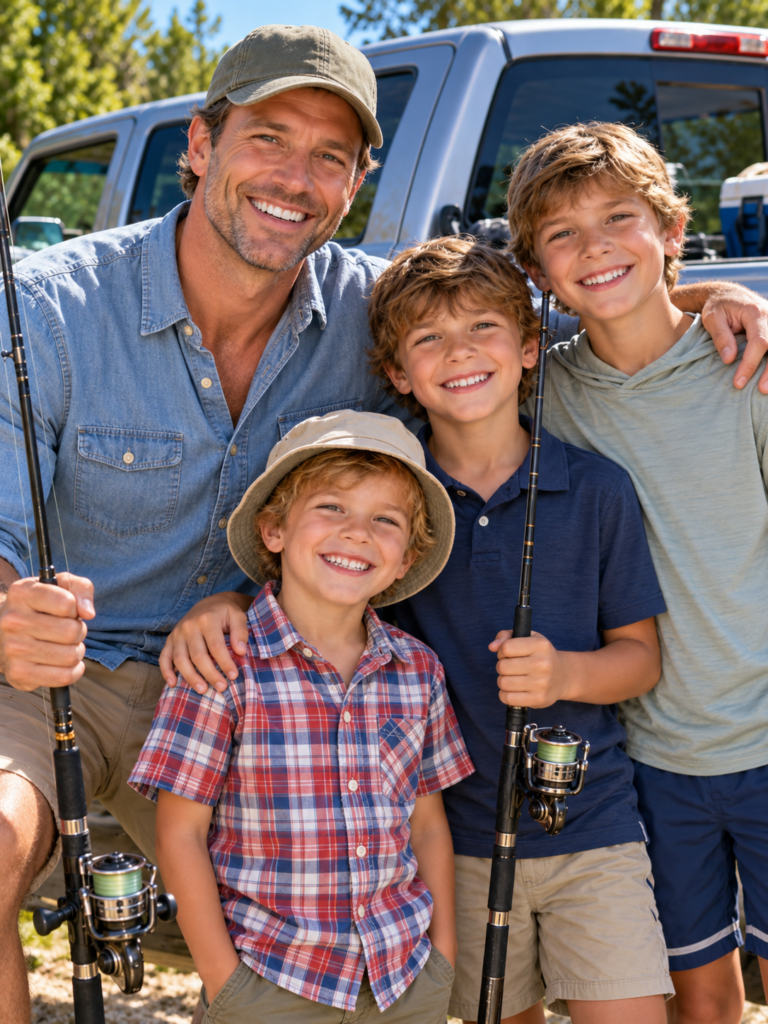
My husband, Daniel Mercer, had taken our sons Noah, Caleb, and Ben to Cedar Ridge Lake on a Saturday morning in late October.
They were supposed to come home Sunday afternoon.
Daniel had been taking the boys fishing since Noah was ten.
By the time they disappeared, Noah was sixteen, Caleb fourteen, and Ben eleven.
They had routines.
Rules.
Lists.
Daniel treated water the way some people treated fire. He loved it, respected it, and never assumed experience made him invincible.
That was one of the reasons I could never make peace with the official explanation.
The authorities had called it a boating accident.
A fast-moving cold front.
Sudden winds.
Poor visibility.
The boat had been found damaged against a rocky bank more than three miles from where Daniel’s truck and trailer were parked.
The engine cover had been cracked.
One side rail was bent.
Two tackle boxes and a broken seat cushion were recovered nearby.
No bodies were ever found.
No life jackets either.
The search lasted nineteen days before it was reduced.
Then three more months of periodic recovery efforts followed.
After that came phrases I learned to hate.
Presumed drowned.
Unrecoverable remains.
Probable accidental deaths.
I signed papers because there were bills to settle and insurance forms to complete and three daughters still living under my roof.
But I never packed away the boys’ rooms.
I never donated Daniel’s work boots.
I never removed his shaving cream from the cabinet beneath our bathroom sink.
Grief made no sense, so I stopped trying to make sense of it.
That afternoon, Emma had finally persuaded me to start with one harmless closet.
“Not their bedrooms,” she had promised.
“Just the hallway closet. Half that stuff hasn’t been touched since I was in high school.”
Her younger sisters, Lily and Grace, had both moved out by then. Lily was finishing graduate school in Tennessee, and Grace had recently gotten engaged.
Emma still lived close enough to visit without calling first.
She had inherited Daniel’s refusal to leave any organizational disaster alone.
Three hours after she arrived, she had made separate piles for cables, old routers, dead batteries, obsolete remotes, and devices no one remembered owning.
Then she walked into the kitchen holding Daniel’s missing phone.
I recognized the case before I saw the screen.
Dark green rubber, worn smooth on one corner.
My knees nearly gave out.
“That can’t be.”
Emma turned it over.
“Dad’s initials are scratched here.”
D.M.
I had scratched them myself with the tip of a kitchen knife after Daniel complained that everyone at his construction office owned the same model.
He had lost that phone almost a year before the fishing trip.
We had searched everywhere.
Daniel had accused Ben of hiding it as a joke.
Ben had been deeply offended.
“I hide your keys,” he’d said. “Phones are expensive.”
The memory had come back so clearly that I had to sit down.
Emma charged it.
The phone booted slowly.
Most of the local storage had been wiped by age or corruption, but it remained connected to Daniel’s old cloud account through credentials stored on the device.
Emma started opening folders.
Photos appeared.
Daniel asleep in an airport chair.
Ben with chocolate icing across his nose.
A blurry picture of our dog chasing a sprinkler.
Caleb holding a bass with the serious expression of a surgeon displaying a successful transplant.
Then came the video.
It was time-stamped Friday, October 21, one day before the trip.
Daniel had apparently propped the phone on a shelf in the garage while testing whether its camera still worked.
The image tilted slightly downward.
His workbench filled most of the frame.
Behind him stood his younger brother, Ryan.
I had not known Ryan had been at our house that day.
For six years, that would have meant nothing.
Now it meant everything.
We played the recording twice.
Then three times.
Daniel was sorting equipment when Ryan said, “I told you I’m not going.”
“You told me that Tuesday.”
“I’m telling you again Friday.”
“You need to get out of that apartment.”
“I need people to stop deciding what I need.”
Daniel looked up.
Ryan had just gone through a brutal separation. His wife had moved to Arizona and taken most of the furniture. He had spent months alternating between anger and silence.
In the video, Daniel held up a yellow adult flotation vest.
“If you change your mind, I bought one for you.”
Ryan scoffed.
“I’m thirty-seven, Dan. I own a life jacket.”
“You own one from 1998 with a broken buckle.”
“It still floats.”
“So does a refrigerator door. I’m not putting you in one.”
Ryan almost smiled.
Then Daniel tossed the vest onto the workbench.
“Come tomorrow or don’t. But if you do, meet us at the west launch. Boys want to try the north cove before the rain.”
I froze the video.
“The west launch?”
Emma looked at me.
“What?”
“Your father’s truck was found at Harbor Point.”
She frowned.
“Is that different?”
“It’s on the other side of the lake.”
My pulse started climbing.
For six years I had pictured their final morning according to the investigation maps.
Daniel parked at Harbor Point.
Daniel launched there.
Daniel headed east.
Daniel encountered the storm.
Daniel lost control.
That was the story.
But according to his own voice the day before, he intended to use the west launch.
Emma replayed the sentence.
Meet us at the west launch.
“Maybe they changed plans.”
“Maybe.”
But Daniel did not casually change launch sites.
Harbor Point was larger and busier.
The west launch was a narrow county ramp surrounded by woods and used mostly by locals.
Daniel preferred it because the northern coves were closer.
“Why would he drive all the way around to Harbor Point?”
Emma asked.
I had no answer.
Then she discovered the location history.
Daniel’s account had synced a handful of data points from the newer phone he had used after replacing the lost one.
Most were ordinary.
Home.
Gas station.
Grocery store.
But Sunday morning contained a stop at Miller’s Outdoor Supply, almost twelve miles west of the route to Harbor Point.
Emma enlarged the map.
“The store’s near the west launch.”
I felt cold despite the warm kitchen.
Ten minutes later we were driving.
The first place we went was not the lake.
It was Ryan’s house.
He opened his door wearing slippers and an old university sweatshirt.
At fifty, Ryan’s hair had gone mostly gray around the temples.
He smiled when he saw Emma.
Then he noticed my face.
“What happened?”
I held up the phone.
The color drained from his cheeks.
For one second, that reaction frightened me more than anything I had seen in six years.
“Where did you get that?”
“You recognize it.”
“Of course I recognize it.”
“Were you at our house the Friday before they disappeared?”
His eyes dropped.
“Yes.”
“You never told me.”
“I didn’t think it mattered.”
“You were invited on the trip.”
Ryan said nothing.
Emma stood behind me on the porch.
I heard her whisper, “Uncle Ryan?”
He stepped back.
“Come inside.”
“No.”
“Laura—”
“Did you plan to meet them at the west launch?”
His face changed again.
Not guilt exactly.
Pain.
“I almost did.”
Those three words made my hands shake.
Ryan sat on the porch step.
“I changed my mind Sunday morning.”
“You were going?”
“I was going to surprise them.”
“Why Sunday?”
“Daniel texted me Saturday night. Said they’d camped and the boys were already talking trash about how many fish I wouldn’t catch.”
“You never mentioned a text.”
“I deleted his messages after the funeral.”
“There was no funeral.”
The words left me before I could soften them.
Ryan closed his eyes.
After six years, we still used the wrong language because there had been no bodies.
No coffins.
Only four enlarged photographs at a memorial service.
“I deleted them after the service,” he corrected quietly.
“Why didn’t you tell the police you were supposed to meet them?”
“Because I never reached the lake.”
“That wasn’t the question.”
He rubbed both hands over his face.
“When I got near Cedar Ridge, emergency vehicles started passing me. Two ambulances. A sheriff’s truck. Then another rescue unit. I heard on the radio that boats were in distress.”
“Boats?”
“Plural. At first.”
I stared at him.
“The report said Daniel’s was the only major incident.”
“Major incident, yes.”
“What does that mean?”
“I don’t know. I turned around before I reached the ramp.”
“You turned around?”
His eyes filled.
“I panicked.”
I had imagined many things about Ryan over the years.
That he knew Daniel had been tired.
That he knew the boat had mechanical problems.
That the brothers had argued.
Never this.
“You knew they were out there and you drove home?”
“I knew emergency crews were heading toward the lake. I did not know it was them.”
“You could have called.”
“I did.”
“Daniel’s phone records showed no call from you.”
“Not Daniel. I called dispatch.”
He looked at me.
“They told me multiple units were responding and asked me not to come because the roads around the launches were getting congested.”
Emma sat down beside him.
“So why keep it secret?”
Ryan swallowed.
“Because when I found out it was Daniel and the boys, all I could think was that I was supposed to be there.”
His voice cracked.
“And if I had gone Saturday morning like he asked, maybe there would have been two adults on that boat instead of one.”
For six years, Ryan had told me to stop searching backward.
I had thought it was impatience.
Now I understood it as shame.
I should have felt sympathy.
Instead, I felt furious.
“You made that decision for me.”
“What?”
“You decided your guilt was too painful, so you hid part of the last weekend I had with my family.”
“I was trying not to add to your grief.”
“You added to it every time you told me there was nothing left to know.”
Ryan lowered his head.
Emma touched my arm.
I pulled away.
Then I remembered the yellow vest.
“Daniel bought you a new life jacket.”
Ryan looked up.
“What?”
“It’s on the video.”
He stared at me.
“He bought one?”
“Yes.”
“I never knew.”
“The recovered-property inventory listed Daniel’s red vest and the boys’ blue ones as missing.”
Ryan nodded slowly.
“The yellow one wasn’t found either.”
“No.”
Something moved behind his expression.
Fear.
“Laura.”
“What?”
“If I never got on that boat…”
He stood.
“…then who wore the extra vest?”
That question stayed in my head all the way to Miller’s Outdoor Supply.
The store had changed owners but not much else.
A hand-painted wooden fish still hung over the door.
The floor smelled like rubber boots, cedar chips, and bait.
A woman in her forties stood behind the register.
I showed her Daniel’s photograph and explained why we were there.
She listened carefully.
“My father owned the store back then.”
“Is he still alive?”
“He is.”
“Can we speak to him?”
She hesitated.
“He lives behind the shop.”
Five minutes later, Walter Miller walked in carrying a coffee mug.
He was eighty-one and moved with a cane, but his mind sharpened the moment he saw the picture.
“The Mercer boys.”
I grabbed the counter.
“You remember them?”
“Those three? Certainly.”
He laughed faintly.
“They nearly started a civil war over whistles.”
Emma looked at me.
“Whistles?”
“Emergency whistles. Your husband bought four.”
“Four?”
“One for each boy and an extra.”
“For himself?”
Walter frowned.
“No. He had one clipped to his vest already.”
I slid Daniel’s photograph closer.
“Did he buy anything else?”
Walter looked toward the ceiling as he remembered.
“Hand warmers. New battery lantern. A box of hooks. Couple rain ponchos.”
He paused.
“Oh. And another adult vest.”
“Yellow?”
“Yes.”
My breath stopped.
“What did he say it was for?”
“His brother.”
Emma and I exchanged a look.
“Did the brother come into the store?”
“No.”
“Did anyone else?”
Walter studied me.
“You mean with them?”
“Yes.”
He shook his head.
“Not while they were here.”
I took out my phone and photographed the old handwritten ledger he had saved.
Daniel Mercer.
Four emergency whistles.
Adult PFD, yellow.
Three youth ponchos.
Batteries.
Fishing line.
The receipt was dated Sunday at 8:17 a.m.
Something else caught my eye.
“Why Sunday?”
Walter blinked.
“That’s when he came in.”
“But they left our house Saturday morning.”
His eyebrows lifted.
“Then they came back through.”
I turned to Emma.
The official timeline said Daniel and the boys had camped Saturday night at Cedar Ridge.
Walter had just destroyed that timeline with one faded receipt.
I called Ryan from the parking lot.
“Did Daniel tell you where they were staying Saturday night?”
“At the campground.”
“Which one?”
“North Point, I thought.”
“Did you ever speak to him Saturday?”
“Text only.”
“What time?”
“Late. Maybe ten.”
“What did he say?”
Ryan went quiet.
“Ryan?”
“He said, ‘Change of plans. Sunday will be better.’”
My heart began beating so hard I could hear it.
“Better for what?”
“He didn’t say.”
I looked toward the road leading to the lake.
For six years, I had believed the mystery began with a storm.
Standing outside that store, I realized it had begun before they ever put the boat in the water.
Part 2
The sheriff’s department did not welcome us back with enthusiasm.
Deputy Chief Hollis had been a patrol sergeant during the original search. He remembered me immediately.
That did not mean he was pleased to see me.
“Mrs. Mercer, we reviewed the case extensively.”
“You reviewed the wrong timeline.”
I placed copies of Walter Miller’s ledger on his desk.
Emma sat beside me.
Ryan had come too, though he stayed near the door as if he had not decided whether he deserved a chair.
Hollis read the page.
Then he read it again.
“You’re saying this transaction occurred Sunday morning.”
“The store owner remembers Daniel.”
“Six years is a long time.”
“He remembers my sons fighting over whistle colors.”
“He may.”
“You think I coached an eighty-one-year-old stranger into remembering my children?”
“No.”
Hollis rubbed his jaw.
“I’m saying memory is complicated.”
“So are official reports. That doesn’t make them sacred.”
Emma shifted beside me, surprised.
Six years earlier, I had sat in this same building saying yes sir, thank you sir, of course sir.
Grief had made me polite because I depended on everyone.
Now I wanted answers more than approval.
Hollis reopened the digital file.
“The original assumption was that your family stayed overnight at North Point Campground.”
“Assumption?”
“They had camping gear.”
“Was the campground reservation confirmed?”
His fingers paused over the keyboard.
“No reservation was located.”
“So why did everyone say they stayed there?”
“The boys talked about camping. Gear was missing from your home. North Point allowed walk-ins at that time.”
“Did anyone actually see them there?”
Hollis scrolled.
“No witness statement confirms it.”
Emma leaned forward.
“Then where were they Saturday night?”
“That I cannot tell you.”
Ryan spoke from behind us.
“There was another accident Sunday.”
Hollis looked at him.
“What?”
“You told the public there were several distressed boats when the weather shifted.”
“That happens during storms.”
“Was anyone rescued before Daniel disappeared?”
Hollis became still.
That was enough for me.
“You know something.”
“I know there were multiple calls.”
“Who?”
“I’d have to review the archives.”
“You just had the file open.”
“The Mercer file.”
“Then open the incident log.”
He stared at me for several seconds.
Finally, he stood.
“I’ll have Records pull the lake calls for that weekend.”
“When?”
“Mrs. Mercer—”
“When?”
“Today.”
I left without thanking him.
Ryan caught up with us in the hallway.
“You’ve changed.”
I turned.
“No, Ryan. I finally got tired of apologizing for wanting to know how my children died.”
His face fell.
I regretted the cruelty as soon as I saw it.
But I did not take the sentence back.
That evening, the three of us returned to my house.
The phone stayed on the dining table between us like a witness.
Emma searched folders while Ryan went through everything he remembered from Daniel’s final messages.
At 9:42 Saturday night, Daniel had texted him:
Sunday will be better. West side, around nine. Kids are exhausted.
At 9:44:
Bring coffee.
At 9:51:
And don’t bring that ridiculous vest of yours. Got you a real one.
Ryan stared at the screenshot.
“I forgot that last message.”
“Convenient.”
Emma looked sharply at me.
“Mom.”
“I’m allowed to be angry.”
“Yes, but he’s helping.”
Ryan put the phone down.
“She’s allowed.”
That only made me angrier.
I went into the kitchen.
For several minutes I pretended to rinse clean dishes.
Then Ryan appeared beside me.
“Daniel called me the week before.”
I kept my back to him.
“About what?”
“My divorce.”
“That doesn’t surprise me.”
“He said something else.”
I waited.
“He said Noah had been asking questions about me.”
I turned.
“What kind of questions?”
“Whether I regretted not having kids.”
Daniel and I had known Ryan’s divorce involved more than infidelity or money, though he rarely discussed it.
His former wife had wanted children.
Ryan had always said later.
Then later became no.
Then the marriage ended.
“Why was Noah asking about that?”
“He had a school project. Family tree or something.”
Emma looked up from the dining room.
“I remember that.”
“What?”
“Noah interviewed everybody.”
I stared at her.
“He never interviewed me.”
“Yes, he did. You were making lasagna. He asked about Grandma’s maiden name and where Dad proposed.”
“That was the project?”
Emma nodded.
She looked at Ryan.
“He asked Uncle Ryan too.”
Ryan’s face tightened.
“Daniel said Noah had found an old picture.”
“What picture?”
“He didn’t tell me.”
Now the mystery had acquired a second branch.
Not only where Daniel and the boys had been Saturday night, but what Noah had been investigating before they left.
Emma went upstairs.
She came down carrying the battered blue binder we had used for family documents.
Birth certificates.
Old school records.
Obituaries.
Marriage licenses.
Things a teenager might use for a genealogy assignment.
One plastic sleeve was empty.
A label in my handwriting read:
MERCER FAMILY – GRANDPA THOMAS.
“What was here?” Emma asked.
“A photograph.”
“Of Grandpa?”
“Daniel and Ryan’s father with some men from the fire department.”
Ryan frowned.
“Dad was never in the fire department.”
“Yes, he was. Volunteer unit before you were born.”
“No.”
I stared at him.
“Daniel told me he was.”
Ryan shook his head.
“Our father hated boats, firefighters, hospitals, uniforms, anything that reminded him of emergency work. He repaired transmissions.”
The room went silent.
I had been married to Daniel for twenty-two years.
His father had died before our wedding.
I suddenly realized almost everything I knew about Thomas Mercer had come from Daniel.
“Why would Daniel lie?”
Ryan walked toward the binder.
“Maybe he didn’t.”
He flipped through old papers.
“Our dad’s brother, Frank, was a volunteer firefighter.”
“Daniel had an uncle Frank?”
“You met him.”
“No, I didn’t.”
“At our wedding.”
“No.”
Ryan stopped.
“He was the older man who left early. Gray suit.”
I remembered dozens of faces.
Nothing more.
“Frank died the next year.”
Emma began searching the phone again.
“What if Dad took the missing photograph?”
“What does that have to do with the fishing trip?”
“Maybe nothing.”
Two hours later, she found a photograph in Daniel’s cloud archive.
Not the missing family picture.
A picture of an old wooden cabin.
On the back, photographed separately, Daniel had written:
Dad’s place. Ask Ryan if he remembers.
Ryan stared.
“I know that cabin.”
“Where is it?”
“Near Cedar Ridge.”
My skin prickled.
“How near?”
“Ten minutes from the west launch.”
The property had belonged to their father.
Daniel and Ryan had spent childhood weekends there.
After Thomas died, the land passed to a cousin.
Ryan had not visited in almost thirty years.
Daniel apparently had.
The next morning, we drove there.
The cabin no longer belonged to the Mercer family.
A retired teacher named Margaret Lane had bought it four years earlier and renovated most of the interior.
She listened to our story on the porch.
Then she said something that made Emma grip my hand.
“There were names carved inside the shed.”
“What names?”
“I painted over them.”
She thought for a moment.
“One was Noah.”
My son’s name.
“Are you sure?”
“Quite.”
“Could it have been another Noah?”
“Possibly.”
“Was there a date?”
“Yes.”
She led us behind the cabin.
The shed had been converted into a small workshop.
Fresh paneling covered the interior walls.
Margaret pointed.
“It was there.”
“When did you paint?”
“Summer after I moved in.”
“So the carving was already there.”
“Yes.”
“Did you photograph it?”
She laughed.
“I photograph everything before I renovate.”
Ten minutes later she was scrolling through her tablet.
Then she found it.
Four names had been carved into the wood.
DANIEL.
NOAH.
CALEB.
BEN.
Underneath them:
10-22.
The Saturday they disappeared.
My sons had spent at least part of that day at Daniel’s childhood cabin.
Not North Point Campground.
Not the lake.
The cabin.
Ryan sat down hard on an old stool.
“Why would he bring them here?”
Margaret enlarged the photograph.
“There’s something else.”
Beside the names was a sentence scratched faintly into the wood.
WE FOUND IT.
I felt the room tilt.
“Found what?”
No one knew.
We searched the shed with Margaret’s permission.
Nothing.
The original floorboards remained, though everything else had been changed.
Near the back wall, Ryan noticed one plank with newer screws.
He crouched.
“Daniel used to hide things under floors.”
“Why?”
“Our father drank.”
That was the first time Ryan had ever said it plainly.
“He wasn’t violent every day. That almost made it worse. You never knew which father was coming home.”
Daniel had told me his childhood was strict.
He had never called it frightening.
Ryan removed the screws.
Underneath the plank sat a rusted metal box.
Margaret whispered, “Oh my God.”
My hands went numb.
The box was empty except for a water-stained envelope and a brass key.
The envelope bore one word.
DANIEL.
Inside was a note written by Thomas Mercer decades earlier.
Daniel—
If you ever come looking, I was wrong to make you promise silence.
Frank didn’t cause what happened.
I did.
He tried to save that boy.
I was ashamed.
You were twelve and I put my shame on you.
I’m sorry.
Dad
Ryan read it twice.
Then he walked outside.
Emma looked at me.
“What does it mean?”
“I don’t know.”
But Ryan did.
He stood behind the shed staring into the trees.
“My father killed someone.”
“What?”
“No. Not exactly.”
He wiped his mouth.
“When Daniel was twelve, there was an accident here.”
“At the cabin?”
“On the lake.”
Ryan’s eyes stayed fixed on the trees.
“Our father took Daniel fishing with Uncle Frank. A boy from another boat fell into the water.”
“What happened?”
“Dad froze.”
He swallowed.
“He didn’t jump in. Frank did.”
“And?”
“The boy drowned.”
I felt cold all over.
“Daniel saw it?”
“Yes.”
“Why didn’t you know?”
“I was six. Our father told everyone Frank had ignored safety rules and made things worse.”
“But this letter says Frank tried to save him.”
Ryan nodded.
“My father blamed his brother because he couldn’t live with the fact that he had done nothing.”
A terrible understanding began taking shape.
Daniel’s obsession with life jackets.
Whistles.
Weather.
Equipment.
His refusal to launch without checking everything twice.
It had not been simple caution.
He had spent his whole life trying not to become his father.
Emma whispered, “That’s what Dad brought the boys here to find.”
The hidden letter.
The truth about their grandfather.
Daniel had taken our sons to the cabin before the fishing trip.
He had shown them something painful about the Mercer family.
Then he had taken them onto the same lake where, decades earlier, he had watched a child drown while the adults around him failed.
At noon, Deputy Chief Hollis called.
He had found the old incident log.
At 11:36 Sunday morning, a vessel carrying a grandfather and his nine-year-old grandson capsized in the northern section of Cedar Ridge.
Both survived.
The first people to reach them were identified only as four occupants of a fishing boat.
One adult.
Three juveniles.
My family.
My knees buckled.
Emma caught me.
“What happened after that?”
Hollis hesitated.
“The survivor statement says the fishing boat remained nearby until a rescue craft arrived.”
“And then?”
“They headed south.”
“Toward Harbor Point?”
“Possibly.”
“Why?”
“The weather was deteriorating. Harbor Point was the nearest protected marina from that section.”
That explained the truck problem.
Or part of it.
Daniel had launched from the west side.
But if his truck had been found at Harbor Point, someone had moved it.
“Who moved Daniel’s truck?”
Silence.
“Hollis.”
“We assumed he did.”
“How could he move his truck from one side of the lake while his boat was on the water?”
Another silence.
“We need to revisit that.”
My fear changed shape.
For the first time, I wondered whether the boat accident itself had ever been understood correctly.
Part 3
The truck was the mistake that reopened everything.
Not the phone.
Not the vest.
Not the receipt.
The truck.
Once Deputy Chief Hollis stopped treating its location as an unquestioned fact, the old investigation began unraveling in small, embarrassing ways.
A marina employee had reported seeing Daniel’s truck at Harbor Point Sunday afternoon.
The search team therefore assumed Daniel launched there.
But no one had photographed the vehicle until nearly midnight.
No one had checked whether the trailer wheels were wet.
No one had searched traffic cameras because the storm had knocked out power to two intersections.
Most importantly, no one had interviewed the towing contractor whose name appeared on a handwritten notation buried in a supplementary report.
Hollis found him.
His name was Curtis Bell.
He still operated a repair shop forty minutes away.
When we arrived, he was standing under a lifted pickup truck with grease on his sleeves.
Hollis showed him the old file.
Curtis read it slowly.
Then he shook his head.
“That’s wrong.”
My stomach tightened.
“What’s wrong?”
“I didn’t tow that truck after the search started.”
“When did you tow it?”
“Sunday morning.”
“From where?”
“The west ramp.”
No one spoke.
Curtis wiped his hands.
“Guy came out of the woods waving me down. Said his truck wouldn’t start.”
“What guy?”
“Your husband.”
The world narrowed to his face.
“You met Daniel?”
Curtis looked at the photograph.
“Yeah. That’s him.”
“What time?”
“Maybe ten-thirty.”
“Were the boys there?”
“Yes.”
Alive.
Sunday morning.
Alive.
My knees weakened again, but this time I stayed standing.
“What happened?”
“The battery was dead.”
Daniel had left the truck’s interior light on overnight while unloading gear at the cabin.
Curtis jump-started it.
Then Daniel asked for a favor.
Storm warnings had begun coming across the radio.
Daniel planned to fish north briefly, then return through the marina on the east side because it offered better shelter if the wind increased.
Instead of driving back to retrieve the truck later, he paid Curtis to move it to Harbor Point.
Curtis had a second driver follow him.
They transported the truck and trailer there before noon.
“Why wasn’t that explained during the search?”
Curtis shrugged.
“I told a deputy.”
“Which one?”
He named a man who had retired years earlier.
Hollis closed his eyes.
The information had been written down.
It had simply never been connected to the timeline.
There was no sinister stranger.
No secret fifth passenger.
No crime behind the moved truck.
Just a practical decision made before the weather worsened.
For some reason, learning that made me cry harder than any frightening theory would have.
Because it sounded exactly like Daniel.
Plan ahead.
Move the truck.
Avoid the dangerous road later.
Be prepared.
He had done everything right.
Almost.
We still needed to know what happened after the rescue.
The capsized boat belonged to seventy-three-year-old Samuel Pike.
His grandson, Ethan, was fifteen then.
Hollis located them in North Carolina.
They agreed to speak to us.
Two days later, they returned to Cedar Ridge.
Samuel was eighty now.
He brought something wrapped in a towel.
Before he opened it, he looked at me.
“I tried to find your family.”
“You knew who they were?”
“Not then.”
He unwrapped the towel.
Inside was a faded yellow flotation vest.
My breath left my body.
Ryan made a sound beside me.
Samuel touched the fabric.
“Your husband threw this to me.”
The vest Daniel had bought for Ryan.
Samuel had been clinging to his overturned boat.
Ethan had been separated from him by several yards.
Daniel’s fishing boat reached them before the rescue crews.
“Noah drove,” Samuel said.
I stared at him.
“My oldest son?”
“The tall one.”
A laugh escaped me through tears.
“That was Noah.”
Samuel nodded.
“Your husband pulled my grandson in. One of the younger boys threw me this vest.”
“Caleb or Ben?”
“I couldn’t tell you.”
Ethan spoke for the first time.
“The youngest one kept yelling at me.”
My heart stopped.
“What did he say?”
“‘Hook your arm through! Don’t let go!’ Over and over.”
Ben.
That was Ben.
When he was nervous, he repeated instructions until everyone obeyed him.
He did it with seat belts.
Bike helmets.
The dog’s leash.
“Did they seem frightened?”
Ethan shook his head.
“Focused.”
Samuel smiled sadly.
“Your husband was.”
“What did he do after you were safe?”
“He stayed until the rescue boat took us.”
“And then?”
Samuel looked toward the lake.
“That’s the part I’ve replayed for years.”
The wind was already rising.
Visibility had dropped.
Daniel wanted to return to Harbor Point.
But the rescue crew warned him against crossing open water.
They suggested he shelter in one of the northern coves until the front passed.
“He agreed?”
“At first.”
Then Daniel heard something.
A whistle.
Faint.
Coming from farther north.
Samuel believed another person was in the water.
The rescue crew could not hear it over their engine.
Daniel could.
“He turned his boat.”
I closed my eyes.
Of course he did.
Samuel’s voice softened.
“I yelled at him not to go.”
“What did he say?”
Samuel hesitated.
Then smiled.
“He said, ‘If that’s somebody’s kid, I’m not pretending I didn’t hear it.’”
Ryan covered his face.
The sentence broke something open inside me.
Thomas Mercer had once frozen while a child drowned.
Daniel had carried that shame from the age of twelve.
Now, decades later, he had heard what he believed was a person calling for help.
He had three sons with him.
A storm coming.
Every reason to turn toward safety.
And one unbearable memory telling him what it meant to do nothing.
“Was there another person?”
I asked.
Hollis answered.
“Yes.”
A kayaker.
Twenty-two-year-old college student named Melissa Ward.
She had been separated from her kayak near the mouth of a narrow inlet.
Search crews rescued her at 12:18.
“How?”
Hollis looked down.
“They followed whistle blasts.”
I stared at Samuel’s table.
“Whistle blasts.”
“One of Daniel’s boys apparently reached her first.”
My sons.
Again.
Hollis had tracked down Melissa too.
She joined us by video call that afternoon.
The moment her face appeared on the laptop, she began crying.
“I’m sorry.”
I moved closer.
“For what?”
“For not finding you.”
“You were the one drowning.”
“I should have remembered more.”
“You survived a storm.”
She wiped her face.
“A boy came to me.”
“Which boy?”
“I don’t know.”
“How old?”
“Maybe thirteen or fourteen.”
Caleb.
She described his dark hair.
His blue jacket.
The small scar beneath his chin from falling off his bicycle at nine.
Caleb.
“He jumped into the shallow water near the inlet,” Melissa said. “It wasn’t deep where I was, but the current kept dragging me toward the mouth.”
“Was Daniel with him?”
“The man stayed in the boat. The other boys were holding onto a rope.”
She closed her eyes.
“Your son clipped something to my life jacket.”
“What?”
“A whistle.”
Emma gasped.
One of the four orange whistles.
Three had been bought for my boys.
One extra.
One had never been recovered.
Melissa still had it.
She held it up to the camera.
Orange plastic.
Faded cord.
The cheapest thing Daniel bought that morning.
And somehow, six years later, it had become proof of my son’s final act of kindness.
“What happened after that?”
“They pulled me onto their boat.”
For several minutes the five of them sheltered near the inlet.
Then the wind shifted violently.
A large branch fell into the water.
Daniel decided they could no longer remain there.
He headed south.
Melissa begged him to drop her at a private dock less than half a mile away.
He did.
She reached the house nearby and called emergency services.
“Why didn’t anyone connect you to Daniel?”
“I never got their names.”
“You didn’t?”
“The man said, ‘Tell them five are safe at Miller Cove.’”
Five.
Daniel.
Three boys.
Melissa.
Then they left.
“You were the last person to see them alive.”
Melissa nodded.
“I think so.”
“What condition was the boat in?”
“Fine.”
That answer stunned everyone.
“The hull wasn’t damaged?”
“No.”
“The motor?”
“Running.”
“Were they panicking?”
“No.”
Daniel had saved Samuel and Ethan.
Then Caleb had helped rescue Melissa.
And after all that, the boat was still operational.
So what caused the wreck?
The final clue came from the weather reconstruction.
Hollis brought in a retired lake patrol officer named George Talley, who had worked Cedar Ridge for thirty-one years.
He studied the old photographs of the damaged boat.
Then he asked where it had been recovered.
When Hollis told him, George frowned.
“That boat didn’t capsize where you found it.”
“How can you tell?”
“Damage.”
The starboard side had struck something hard above the waterline.
Not a rock underwater.
Not a submerged stump.
Something elevated.
George took us to an old service bridge near the southern channel.
The bridge had been replaced three years after Daniel disappeared.
Before that, one concrete support had contained a rusted maintenance ladder extending several feet outward.
During flooding, debris often collected around it.
George stood on the new bank and pointed.
“The old navigation light failed during that storm.”
Hollis checked archived maintenance records.
It had.
Daniel was trying to reach Harbor Point in near-zero visibility.
A floating tree trunk likely struck the boat or forced him toward the bridge support.
The collision tore equipment loose and damaged the rail.
The boat continued downstream after everyone entered the water.
No bodies were found because the channel opened into a deep spillway system farther south.
Divers had searched it.
But after six years, no one could promise remains would ever be recovered.
There was no villain.
No conspiracy.
No hidden survivor.
For weeks after the phone appeared, some small, irrational part of me had hoped every inconsistency meant Daniel had somehow planned an escape.
That the boys were alive.
That there was a house somewhere.
A secret.
A reason.
Even anger would have been easier than death.
But the truth was quieter.
They had gone to Daniel’s childhood cabin.
He had shown his sons the letter his father left behind.
He had told them about the boy his uncle tried to save.
About the shame their grandfather carried.
About why Daniel checked every buckle twice and watched weather reports like scripture.
Then Sunday morning they went fishing.
Daniel bought whistles.
He bought Ryan a life jacket because he still hoped his little brother would come.
Ryan never arrived.
Daniel and the boys launched without him.
When Samuel and Ethan capsized, they stopped.
When Melissa blew a whistle, they turned back.
By the time they finally headed toward safety, they had given away one of their adult flotation vests and at least one whistle.
They had lost precious minutes.
And the storm had become worse than anyone predicted.
Months after the case was formally amended, Ryan asked if I wanted to visit the cabin again.
I almost said no.
Then Emma volunteered.
So did Lily and Grace.
For the first time since the disappearance, all four of us drove to Cedar Ridge together.
Margaret Lane met us at the cabin.
She had done something I did not expect.
When she renovated the shed, she had saved the original wall panel containing the carved names.
Daniel.
Noah.
Caleb.
Ben.
10-22.
WE FOUND IT.
She had stored it behind a workbench because she could not bring herself to throw away children’s names.
Now she handed it to me.
“You should have this.”
I traced Ben’s crooked B.
“He always made them backwards when he was tired.”
Emma laughed.
“He was eleven.”
“He was lazy.”
Grace started crying.
Then we all did.
Later, we went to Harbor Point.
Samuel came with Ethan, who was now twenty-one.
Melissa flew in from Ohio.
Hollis attended out of uniform.
Ryan brought the yellow flotation vest.
For years I had pictured that lake as the place that swallowed my family.
I hated it.
I hated the sunlight on the water.
I hated fishermen laughing near the docks.
I hated parents fastening life jackets onto children as if safety were something you could guarantee if you just pulled the straps tight enough.
But that afternoon, the lake looked different.
Not kinder.
Just fuller.
It held the worst thing that ever happened to me.
It also held the last proof of who my husband and sons had chosen to be.
Ethan carried Noah’s old fishing rod.
I had given it to him that morning.
“You sure?” he asked.
“Noah would haunt me if I let a good rod collect dust.”
He laughed awkwardly.
“That sounds like him.”
“You knew him fifteen minutes.”
“That was enough.”
Melissa stood beside me holding the orange whistle.
“I can give it back.”
“No.”
“But it belongs to your son.”
I looked at it.
“No. He gave it to you.”
She pressed her lips together.
“Then I’ll keep it.”
“Use it.”
She nodded.
Ryan came to stand beside me.
He had spent six years believing absence was his great failure.
I had spent six years believing uncertainty was mine.
Both of us had been wrong.
“I should have gone,” he said.
I looked across the water.
“Maybe.”
He flinched.
I took his hand.
“But Daniel didn’t buy that vest because he needed you to save him.”
Ryan looked at me.
“He bought it because he wanted his brother with him.”
His face crumpled.
I squeezed his fingers.
“You’ve punished yourself long enough.”
Emma called from several yards away.
“Mom.”
She had her phone raised.
That word still did something to me.
A camera.
A family gathered near a lake.
For one terrible second, I was back in our driveway.
Daniel checking trailer straps.
Noah pretending not to smile.
Caleb rolling his eyes.
Ben complaining that his father was squeezing him too hard.
I had taken their picture because I assumed there would always be another one.
For six years, photographs felt like traps.
Proof that happiness could exist five seconds before disaster.
Now Emma waved impatiently.
“Come on. Everybody closer.”
Samuel stood beside Ethan.
Melissa joined Grace and Lily.
Hollis stayed near the edge until Emma ordered him into the frame.
Ryan slipped an arm around my shoulder.
The yellow vest rested on the dock.
The orange whistle hung around Melissa’s neck.
Noah’s fishing rod leaned against Ethan’s leg.
And in my hands, I held the piece of old cabin wall carved with four names.
I looked at those names one last time.
We found it.
For years I had thought finding the truth would mean discovering the single mistake that killed them.
A bad decision.
A broken engine.
A hidden argument.
Someone to blame.
Instead, the truth was larger and harder.
Daniel had taken our sons to face an old family shame.
Then, when their own test came, they chose differently.
They stopped.
They helped.
They turned toward people in danger.
It cost them time they did not have.
Perhaps it cost them everything.
I would never call that fair.
I would never call it fate.
And I would never pretend losing them had become beautiful simply because I finally understood their final hours.
Loss was still loss.
My sons were still dead.
My husband was still gone.
There were still mornings when grief returned before I even opened my eyes.
But I no longer imagined them disappearing into chaos.
I could see them now.
Noah steady at the wheel.
Caleb climbing toward a frightened stranger.
Ben shouting instructions because he believed everyone should follow safety rules.
Daniel watching all three of them become the men he had tried to raise.
Emma counted down.
“Three.”
Ryan stepped closer.
“Two.”
Wind moved across the lake.
“One.”
The shutter clicked.
This time I did not wonder who might be missing from the next photograph.
I looked at the people who were there.
And for the first time in six years, that was enough.


