Part 1
The man who would become Anna Parker’s husband was standing in her father’s dining room with two armed guards and a document worth eight hundred and forty thousand dollars.
Outside, November rain battered the windows of the old Boston townhouse. Inside, nobody seemed willing to breathe.
Anna had come directly from work, still wearing the gray sweater and black trousers she had put on that morning. Her brother Daniel had called three times in less than ten minutes, insisting that their father was in trouble.
She had assumed another unpaid bill. Another business mistake. Another emergency Daniel had somehow managed to create and everyone else would be expected to solve.
She had not expected Gabriel Duca.
At thirty-nine, Gabriel controlled an empire whose legitimate businesses stretched across shipping, real estate, restaurants, and private investments. The less legitimate parts were discussed only behind locked doors.
In Boston, his name carried the kind of authority that made wealthy men reconsider their words and dangerous men reconsider their loyalties.
Now he stood beneath her mother’s old crystal chandelier, holding the document that could take everything her father owned.
“Eight hundred and forty thousand dollars,” Gabriel said.
He spoke quietly, almost conversationally.
That made it worse.
Anna looked at Daniel.
“Tell me there’s an explanation.”
Her younger brother sat at the dining table, his hands clenched together so tightly that the knuckles had gone white.
He couldn’t meet her eyes.
Gabriel placed the document on the polished wood.
“Your brother borrowed money through a company under my control. When his business began losing money, he concealed those losses with false invoices. The debt grew. He continued borrowing.”
Anna turned toward her father.
“How does that involve the house?”
Her father’s expression answered before anyone spoke.
Gabriel slid another page toward her.
“The property was pledged as collateral.”
Anna stared at the signature.
Her father’s name appeared at the bottom, but the handwriting was wrong.
Daniel had done it.
He had placed the family home at risk without even asking permission.
Her mother had died in that house. Her father had spent thirty years paying for it. Every birthday photograph, every Christmas morning, every ordinary memory that made a building something more than brick and timber belonged to those rooms.
And Daniel had gambled all of it away.
“Anna,” her brother whispered, “please don’t make this worse.”
She looked at him.
“Worse than what? Losing Dad’s home because you forged your way into another loan?”
Her father tried to intervene.
“Your brother made mistakes. We have to think about what happens next.”
Anna turned back toward Gabriel.
“Then tell us what happens next.”
He studied her with unsettling attention.
“Your brother cannot repay the debt. The collateral can be collected.”
“So Daniel creates the problem, and everybody else loses something.”
“That is how guarantees work.”
“That doesn’t make it right.”
For the first time, something shifted behind Gabriel’s carefully neutral expression.
Not anger.
Interest.
Daniel reached beneath the table and caught Anna’s wrist.
“Stop arguing with him.”
She pulled her hand away.
Gabriel noticed.
His eyes moved briefly toward Daniel before returning to her.
“There is an alternative.”
Anna felt her father’s hope rise almost visibly.
She did not share it.
Powerful men rarely offered alternatives without expecting something more valuable in return.
“What alternative?” she asked.
Gabriel folded his hands.
“Marriage.”
The word seemed to settle over the room without meaning.
Daniel gave a startled laugh.
Anna stared at Gabriel.
“Whose marriage?”
“Yours. To me.”
Her father’s chair creaked.
One of the armed guards looked away.
Anna remained standing.
“Why?”
Gabriel answered with the same composed precision he had used to explain the debt.
“The Duca family council expects stability from its leader. A wife would settle certain questions about my position. Your family needs this financial obligation removed.”
“So you need a respectable woman beside you, and you have found one whose family can’t afford to refuse.”
His eyes narrowed slightly.
“That is one interpretation.”
“It’s the accurate one.”
Gabriel accepted the remark without argument.
“Twelve months. After that, the marriage ends. Your family’s debt disappears permanently, and you receive five million dollars.”
Daniel pushed back his chair.
“Anna, you have to understand what he’s offering.”
She did.
Perfectly.
He was offering to purchase one year of her life.
Not because he loved her.
Not even because he wanted her.
Because a powerful family required the appearance of stability, and a desperate family provided a convenient solution.
Anna looked toward her father.
He appeared older than he had that morning.
She thought of him opening another letter from a creditor. Of Daniel begging for another chance. Of the house disappearing because nobody had stopped her brother when it mattered.
Then she faced Gabriel again.
“I’ll agree to the marriage if you extinguish the debt.”
Daniel exhaled.
Gabriel watched her.
“And the five million?”
“I don’t want it.”
That finally unsettled him.
“You’re declining five million dollars?”
“Yes.”
“May I ask why?”
“Because I won’t spend the rest of my life wondering whether you bought me or married me. My brother made a debt. I’m agreeing to settle it. I won’t create another one with you.”
For several moments, only the rain spoke.
Gabriel studied her as if some important calculation had produced a result he had not anticipated.
Then he picked up the papers.
“The wedding will take place Friday.”
Four days later, Anna walked into Saint Cecilia’s Church wearing an ivory gown she had not chosen for herself.
Gabriel’s staff had originally brought her three elaborate designer dresses. She had rejected all three after learning how much they cost.
The fourth was simple, elegant, and comfortable enough that she did not feel like a stranger inside it.
Gabriel stood at the altar in a tailored black suit.
He looked less like a bridegroom than a man preparing to sign an international treaty.
Two hundred guests occupied the pews.
Businessmen. Relatives. Women wearing diamonds that could have paid Daniel’s entire debt twice over. Men whose eyes followed Gabriel with a mixture of respect and caution.
Everyone seemed to understand that the wedding served a purpose.
Everyone pretended otherwise.
When Anna reached the altar, Gabriel offered his hand.
His fingers were warm.
That surprised her.
“You can still turn around,” he murmured, too quietly for the guests to hear.
Anna looked at him.
“And let you foreclose on my father?”
A faint shadow crossed his face.
“No.”
“Then don’t offer me choices that aren’t real.”
He lowered his eyes for an instant.
“Fair enough.”
They exchanged vows without smiling.
Gabriel placed a wedding ring on her finger.
Anna did the same for him.
By the time the priest pronounced them husband and wife, she understood that she had entered a world where appearances could be as valuable as money and far more dangerous.
The reception passed in a blur of champagne, congratulations, and carefully measured conversations.
Gabriel remained beside her whenever someone approached, quietly introducing people whose names she struggled to remember.
He never pulled her closer than necessary.
He never pretended affection where none existed.
For that, at least, she was grateful.
That night, the black SUV carrying them entered Beacon Hill and stopped before a mansion whose stone exterior seemed designed to endure centuries.
The interior was elegant, quiet, and intimidatingly immaculate.
A housekeeper greeted them. Security remained discreetly positioned throughout the property.
Gabriel personally led Anna upstairs.
At the end of the eastern corridor, he opened a bedroom door.
“This is yours.”
The room was larger than Anna’s entire apartment.
Cream-colored walls. Tall windows. An antique writing desk. Fresh flowers beside a bed that looked as though nobody had ever slept in it.
She glanced down the hallway.
“Where will you be?”
“West wing.”
She nodded.
“Good.”
Gabriel appeared almost amused.
He started to leave.
“Gabriel?”
He stopped.
Anna hesitated, uncertain how to ask the question that had been troubling her since the wedding.
“We haven’t discussed children.”
His expression changed immediately.
“There won’t be any.”
She had expected him to mention contraception or the temporary nature of their arrangement.
Instead, he stood motionless beside the door.
“Eight years ago, I was caught in an explosion,” he said. “The injuries were extensive. Three specialists evaluated me afterward.”
Anna watched the guardedness settle over his face.
“They told me the damage was permanent. I cannot father children.”
“I’m sorry.”
“I didn’t tell you for sympathy.”
“I know.”
“You should have been informed before agreeing to marry me.”
Anna looked at the ring on her hand.
“We’re married for one year, Gabriel. Having a family together was never part of the arrangement.”
His expression hardened.
“Exactly.”
He left before she could say anything more.
But Anna remained standing in the enormous bedroom, thinking about the way his voice had changed.
It had not sounded like a man relieved of an obligation.
It had sounded like a man who had buried something he once desperately wanted.
Life inside the Duca mansion operated according to rules nobody had bothered to explain.
Breakfast appeared at seven every morning.
Cars waited before Anna requested transportation.
Security personnel followed her through the city, maintaining enough distance to appear polite while making it impossible to forget their presence.
Gabriel rarely raised his voice.
He did not need to.
One morning, Anna discovered six expensive garment bags hanging in her dressing room.
She inspected the clothing, checked the designer labels, and carried the bags downstairs.
Gabriel sat near the dining room windows, reviewing financial reports while drinking black coffee.
She placed the clothes beside his chair.
“These need to go back.”
He glanced up.
“Is something wrong with them?”
“I already own clothes.”
“My staff believed you’d appreciate having more appropriate options.”
“Appropriate for whom?”
He set down his coffee.
“Anna.”
“Gabriel.”
A man standing near the doorway suddenly became fascinated by the curtains.
Gabriel looked at the garment bags.
Then at her.
“You are representing my household.”
“And I can do that without wearing a month’s salary on my back.”
His mouth twitched.
It was so brief she might have imagined it.
Finally, he called for the housekeeper.
“Please arrange the returns.”
Anna picked up her coffee and left before he could reconsider.
She considered it their first successful negotiation.
The second began with numbers.
Before the wedding, Anna had worked as an internal auditor for a regional logistics company. She understood corporate records, transaction histories, and the small inconsistencies people overlooked when they trusted a company’s reputation more than its books.
One evening, she sat alone at the mansion’s library table examining publicly available reports from Duca Maritime.
A series of consulting expenses had caught her attention.
The amounts were substantial.
The recipient companies had minimal operating histories.
Several payments followed patterns she had seen before in businesses trying to disguise the movement of money.
She was comparing dates when Gabriel entered.
He stopped behind her chair.
“Are those my companies’ financial statements?”
“Public filings.”
“Why are you studying them?”
“Because the numbers are strange.”
His expression became wary.
“Explain.”
She turned the laptop toward him.
“Duca Maritime is paying significant consulting fees to companies that don’t appear to provide meaningful services. Some share registration details. Others show unusual payment intervals.”
Gabriel looked at the screen.
“Who asked you to investigate this?”
“Nobody.”
“Then leave it alone.”
Anna closed the laptop.
“All right.”
She gathered the papers and stood.
Gabriel reached for her wrist.
His grip was light, but the unexpected contact stopped them both.
For a moment, she could hear the clock ticking near the fireplace.
Gabriel looked at his hand.
He released her immediately.
Then he pulled out the chair opposite hers.
“Show me what you found.”
Anna sat down again.
That evening became three evenings.
Then ten.
They followed payment histories through corporate subsidiaries and obscure consulting arrangements until one name appeared too frequently to dismiss.
Nico Duca.
Gabriel’s cousin.
His presumed successor.
Nico was everything Gabriel was not on the surface.
He smiled easily, remembered personal details, and moved through wealthy society as though affection were an endless resource.
But Anna had learned something about numbers.
They were often most interesting when someone worked very hard to make them look ordinary.
And Nico’s numbers were anything but ordinary.
At a Duca charity dinner, he raised his glass toward her.
“I hear Gabriel has found himself a bride who prefers balance sheets to diamonds.”
Several guests laughed.
Anna smiled politely.
“Diamonds usually come with certificates. Financial transactions should come with explanations.”
The laughter changed.
Nico’s smile grew thinner.
Across the table, Gabriel continued eating without comment.
Later, inside the car, he turned toward Anna.
“You embarrassed my cousin.”
“He embarrassed himself.”
“We haven’t established wrongdoing.”
“Then why are we still investigating?”
Gabriel watched the city pass beyond the rain-streaked windows.
“You understand he may eventually inherit responsibility for everything I’ve built.”
“That’s an excellent reason to find out whether he’s stealing from it.”
He said nothing.
Anna looked at his reflection in the glass.
“You dislike being challenged.”
“I’m not accustomed to it.”
“That’s not necessarily a good thing.”
He turned toward her.
“Do you ever feel afraid?”
“Of course.”
“Of me?”
She could have told him no.
It might have pleased him.
But she had not entered this marriage to become another person who lied to Gabriel Duca.
“Yes,” she said.
His expression became unreadable.
“Then why do you argue with me?”
“Because being frightened doesn’t automatically make you wrong, and being powerful doesn’t automatically make you right.”
Gabriel remained quiet for the rest of the journey.
That night, Anna woke shortly after two and went downstairs for water.
A light burned in the sitting room.
Gabriel sat alone beside the fireplace, his suit jacket discarded, a glass of whiskey untouched on the table.
There were no guards within sight.
No papers.
Only an old photograph.
Anna recognized Gabriel as a young boy standing beside an older man.
When Gabriel noticed her, he turned the picture facedown.
“My father,” he said.
Anna remained near the doorway.
“You resemble him.”
“People used to tell me that.”
Something about his voice made her stay.
Gabriel looked toward the fireplace.
“He cared about succession. About the family name continuing after him.”
“Did he want grandchildren?”
“Very much.”
Anna considered the photograph.
“And what did you want?”
Gabriel’s face closed.
“It doesn’t matter.”
“That isn’t an answer.”
“No. It isn’t.”
She could tell he wanted the conversation finished.
For once, she decided not to press.
“Good night, Gabriel.”
She had nearly reached the hallway when he spoke again.
“A daughter.”
Anna turned.
Gabriel kept his gaze on the fireplace.
“I always pictured having a little girl.”
The words seemed to cost him more than any financial admission she had heard him make.
“Just one?” she asked softly.
“One would have been enough.”
He gave a humorless smile.
“Ridiculous, considering the life I lead.”
Anna shook her head.
“No. Not ridiculous.”
He looked up.
For several seconds, the powerful man who had entered her father’s dining room with armed guards seemed painfully ordinary.
A man who had wanted something.
A man who had lost it.
Anna left without trying to comfort him.
Some confessions deserved silence more than sympathy.
Three months into the marriage, someone tried to kill her.
She was traveling through downtown Boston when a gunshot shattered the SUV’s rear window.
Glass exploded across the back seat.
The driver shouted for her to get down.
Anna barely understood what was happening before he forced her below the window line and accelerated into traffic.
Another sharp sound came from behind them.
She tasted blood where she had bitten her lip.
The city blurred through fractured glass.
She remembered clutching the edge of the seat, thinking absurdly that she had forgotten her bag at the mansion.
Then the driver was speaking urgently into a radio.
Within twenty minutes, Anna was inside the Duca Medical Clinic.
She had minor scratches but no serious injuries.
A nurse was cleaning glass fragments from her sleeve when the clinic doors opened.
Gabriel entered so quickly that two security officers struggled to keep pace.
He went directly to Anna.
His hands came up to her face.
“Are you injured?”
“I’m all right.”
He checked her forehead, her shoulders, her arms.
His expression held a fear she had never seen in him.
“Gabriel, look at me. I’m fine.”
Only then did he seem to register that she was speaking.
His hands dropped.
He turned toward his consigliere.
“Who did it?”
“We’re working to identify them.”
Gabriel’s face became terribly composed.
Anna recognized that expression.
It was the one he wore when something had already been decided.
She caught his sleeve.
“Don’t do something you won’t be able to undo.”
His eyes returned to hers.
“They fired at your car.”
“I know.”
“They could have killed you.”
“And you’re frightening me more right now than the shooting did.”
That reached him.
Not enough to extinguish his anger.
Enough to make him stop and look at her.
For a moment, neither spoke.
Then Gabriel covered her hand with his.
“They tried to take my wife away from me.”
Anna felt a strange tightening beneath her ribs.
He said my wife as though it meant something beyond the contract.
That night, six men vanished from Boston.
Anna never learned exactly what happened to them.
She knew only that Gabriel came home after midnight, carrying the cold exhaustion of a man who had crossed a line he refused to discuss.
The following morning, her bedroom was moved from the eastern corridor to the West Wing, directly across from his.
“For security,” Gabriel said.
Anna watched him supervising the transfer of her belongings.
“Of course.”
He glanced at her.
“What does that mean?”
“Nothing.”
His expression suggested he didn’t believe her.
She let him wonder.
For the first time since entering his house, Anna understood that Gabriel Duca was not merely protecting an arrangement.
Somewhere between the arguments, the financial reports, and a photograph of a little boy beside his father, the distance between them had begun to disappear.
And neither of them knew what to do about it.
Part 2
After the shooting, Gabriel began appearing in places where Anna had never expected to find him.
He brought financial documents home instead of asking her to visit his office.
He delayed dinner when she worked late.
When meetings ran beyond their scheduled time, he asked the housekeeper whether Anna had eaten, then acted irritated when anyone mentioned the question.
He never explained these changes.
Anna didn’t ask him to.
One evening, she returned to the mansion with a fever.
She blamed exhaustion. The doctor recommended rest.
Gabriel canceled a meeting involving representatives of three powerful families.
Anna discovered this only when she woke shortly before midnight and opened her bedroom door.
He was sitting in a chair across the hallway.
His suit jacket hung over the armrest.
The corridor was quiet.
“Gabriel?”
He looked up immediately.
“Do you need something?”
“What are you doing out here?”
“Working.”
Anna looked at his empty hands.
“Without papers?”
He followed her gaze.
“I was thinking.”
“For six hours?”
His eyes narrowed.
“How would you know?”
“The housekeeper told me you canceled your meeting at six.”
“She talks too much.”
Anna leaned against the doorframe.
“You realize a fever can’t pass through a closed door and attack you.”
“I’m aware.”
“So why are you sitting outside?”
He considered her for a moment.
“Go back to bed.”
“That’s not an answer.”
“It’s the one you’re getting.”
She smiled.
Something shifted in his expression.
It was almost a smile in return.
Almost.
Anna closed the door with an unexpected warmth moving through her chest.
She was beginning to recognize Gabriel’s silences.
Some concealed anger.
Some concealed fear.
And a few, she was discovering, concealed tenderness he could not yet bring himself to admit.
A week later, snow began falling across Boston.
Anna found Gabriel standing on the mansion rooftop, looking over the city.
The skyline glimmered beneath a pale winter sky. Snow gathered along the stone railing, softening the hard edges of the buildings below.
He turned when he heard her approach.
“You shouldn’t be up here without a coat.”
“I thought I’d only stay a minute.”
“Your definitions of sensible behavior continue to surprise me.”
She joined him at the railing.
“Coming from a man whose security team travels in armored vehicles, that sounds almost affectionate.”
Gabriel removed his coat and placed it over her shoulders.
The fabric carried his warmth and the faint scent of his cologne.
Anna caught the lapels.
“Thank you.”
He stood close enough that their sleeves touched.
Below them, traffic crawled along the wet streets.
Neither spoke for some time.
Then Gabriel said, “When the year ends, you’ll leave.”
It was not phrased as a question.
Anna looked toward him.
“That’s what we agreed.”
His gaze remained on the city.
“Nine months.”
“Gabriel—”
“I know how many months remain.”
She studied his profile.
The man who once seemed impossible to read now looked like someone struggling not to ask for something.
“What are you trying to tell me?”
He turned.
His eyes lowered briefly to her mouth.
Anna felt her breath change.
Gabriel lifted a hand toward her cheek, hesitated, and let it fall.
“You should go inside.”
She didn’t move.
“Do you want me to?”
He looked directly at her.
“No.”
It was the simplest honest answer he had ever given her.
Anna stepped closer.
For one suspended moment, the contract, the guards, the family council, and the enormous house below them seemed very far away.
Their first kiss was careful.
Gabriel barely touched her, as though he expected her to step back.
Instead, Anna rested her hand against his chest.
He kissed her again.
The restraint vanished slowly, replaced by something neither had planned and both had been denying.
When they finally separated, Gabriel rested his forehead against hers.
“This makes our situation more complicated.”
Anna laughed softly.
“You made our situation complicated the day you walked into my father’s dining room.”
His hand settled gently at the back of her neck.
“I’ve spent most of my life avoiding complications.”
“Then you’ve had very little practice with marriage.”
He almost laughed.
She kissed him before he could answer.
After that evening, the rooms in the West Wing no longer represented separate lives.
Their relationship changed without either of them announcing it.
Anna began finding Gabriel waiting for her at breakfast even when he had already finished eating.
He learned that she disliked overly sweet coffee and remembered which books she left unfinished on her bedside table.
She discovered that he sometimes woke before dawn and stood at the window, watching the mansion gates as though danger might announce itself if he stared hard enough.
When nightmares interrupted his sleep, he rarely described them.
But he stopped asking her to leave when she sat beside him.
He never tried to replace those moments with gifts.
She never treated his trust as something she had earned the right to demand.
They were learning one another through ordinary acts that felt extraordinary because of how little either had expected from the arrangement.
Yet outside their rooms, the Duca empire remained dangerous.
And Nico Duca was becoming desperate.
By spring, Anna’s review of the corporate transfers had raised serious concerns.
The questionable consulting payments were not isolated.
They formed a pattern.
Money had moved through companies tied to Nico, disappearing into arrangements that were difficult to explain as legitimate business expenses.
Gabriel’s advisers were discreetly examining the records.
But the family council’s succession ceremony was approaching.
In May, Gabriel was expected to formally designate Nico as the man who would inherit his position if he died.
Anna could not understand why he was willing to proceed.
One morning, she watched Gabriel fasten his watch beside the bedroom window.
“You can’t possibly intend to name him.”
Gabriel looked up.
“We’ve discussed this.”
“And we haven’t resolved it.”
“The council expects a successor.”
“Then give them someone you trust.”
“Trust is not the only consideration.”
“It should be when you’re handing someone the future of your family.”
Gabriel turned toward her.
“If I refuse to designate anyone, the council will divide. Rival claims will begin immediately. People will prepare for a conflict that could become violent the moment I’m gone.”
“You’re thirty-nine.”
“In this family, being thirty-nine doesn’t guarantee another thirty years.”
Anna’s frustration deepened.
“Then investigate Nico properly before the ceremony.”
“We are investigating him.”
“Not openly. Not enough to stop him.”
Gabriel’s expression cooled.
“You see documents, Anna. You don’t see everything those documents affect.”
“I see enough to know money is disappearing.”
“You don’t understand every room this matter reaches.”
She stared at him.
“Every room?”
He recognized the mistake immediately.
“That wasn’t what I intended to say.”
“Then what did you intend?”
His silence hurt more than the words.
Anna folded her arms.
“I thought we were working together.”
“We are.”
“Until I disagree with you?”
Gabriel took a step toward her.
“Anna.”
“No. Tell me something. Am I your wife when you need someone you can trust, but an outsider when you want me to stop asking questions?”
“That isn’t fair.”
“Neither is expecting me to protect your interests while pretending I have no right to challenge your decisions.”
He looked exhausted.
“You’re dealing with a world that can destroy people without warning.”
“And you’re using that as a reason to shut me out.”
For a moment, she thought he would apologize.
Instead, he looked away.
Anna nodded slowly.
“Now I understand.”
She left the room.
Gabriel did not follow.
For three days, they remained painfully polite.
They ate meals together when necessary.
They discussed practical matters.
They slept apart.
The distance between them felt larger than the mansion itself.
On the fourth night, Gabriel returned after midnight and found Anna placing clothing into a suitcase.
He stopped in the doorway.
“Where are you going?”
“New York.”
His face changed.
“Why?”
“Nico invited me to accompany the council wives.”
“No.”
Anna looked up.
“Excuse me?”
“You’re not going.”
She folded the dress she was holding.
“You do realize this is not how a conversation works?”
“Then consider it a warning.”
“About what?”
Gabriel entered the room and closed the door.
“We have information suggesting Nico’s associates may be connected to the attack on your vehicle.”
Anna became very still.
“You knew this?”
“I suspected it. We haven’t confirmed everything.”
“And you continued allowing me to sit across from him at family dinners?”
“You had security around you.”
“That wasn’t my question.”
Gabriel rubbed a hand over his face.
“I was trying to keep you safe.”
“By deciding what I was allowed to know?”
“By preventing you from becoming involved in something dangerous.”
Anna stepped away from the suitcase.
“I was already involved when someone shot at my car.”
His expression tightened.
“Don’t remind me.”
“Then don’t pretend the solution is to keep me ignorant.”
Gabriel turned toward the window.
For several seconds, neither spoke.
When he finally answered, his voice was strained.
“I trust you more than anyone else in this house.”
Anna’s anger faltered.
“Then why won’t you treat me that way?”
He looked back at her.
“Because I don’t know how.”
The admission seemed to surprise him.
He stood beside the bed, looking more weary than commanding.
“When this began, you were supposed to spend twelve months here. We would fulfill the agreement. Your family would be free of the debt. Then you would go back to your life.”
Anna waited.
“I knew exactly what that arrangement would cost me.”
“And now?”
He crossed the room slowly.
“Now I listen for your car when you’re late. I sit through meetings thinking about what you’ll say when I tell you what happened. I walk into a room and notice when you’re not there.”
Her eyes burned.
Gabriel stopped in front of her.
“And every time I imagine someone hurting you, I understand that everything I’ve built could become worthless in a single second.”
Anna touched his face.
He closed his eyes briefly.
“I’m not asking you to stop being afraid,” she whispered. “I’m asking you not to let fear make every decision for us.”
He covered her hand with his.
“I don’t know if I can promise that.”
“Then promise you’ll try.”
He opened his eyes.
After a long moment, he nodded.
Anna leaned against him.
His arms closed around her.
She did not go to New York.
But this time, it was because she understood the danger and chose not to go.
That distinction mattered.
Two weeks later, Anna discovered the document that would change the future of the Duca family.
She was working in the library, reviewing archived records connected to subsidiaries involved in the suspicious payments.
One transfer led to another.
A disbursement appeared under the name of an old family trust.
It was dated eight years earlier.
Anna almost overlooked it.
Then she noticed the recipient.
Dr. Leonard Walsh.
The name seemed familiar.
She searched the family records Gabriel had previously allowed her to examine.
Walsh had been one of the specialists involved in evaluating Gabriel after the explosion.
Anna sat motionless.
She opened the payment details.
The money had originated from a trust controlled by Gabriel’s late uncle.
Nico’s father.
She searched again.
Another payment appeared.
Then a third.
Different dates.
The same doctor.
The same financial connection.
Her heart began beating faster.
The transfers did not explain everything, but they raised a question too serious to ignore.
Why had the father of Gabriel’s presumed successor been paying the physician responsible for Gabriel’s infertility diagnosis?
Anna was still examining the records when Gabriel entered.
He stopped beside the table.
“What have you found?”
She turned the screen toward him.
“Look at these payments.”
Gabriel bent over the laptop.
His expression changed as he read.
He checked the names.
Then the dates.
Finally, he straightened.
“Where did this come from?”
“An archived subsidiary connected to the family trust. Gabriel, I think your uncle was paying Dr. Walsh.”
Gabriel stared at the screen.
“Walsh retired years ago.”
“The payments began after your accident. I can’t explain why they’re here.”
Gabriel took out his phone.
When his consigliere answered, he gave a single instruction.
“Find Leonard Walsh.”
By sunrise, his people had located the retired physician in Connecticut.
By noon, Walsh sat inside a Duca conference room.
Anna remained beside Gabriel.
The doctor appeared elderly and uncomfortable. He repeatedly adjusted his glasses and avoided looking directly at either of them.
Gabriel placed copies of the financial records on the table.
“Tell me why my uncle was paying you.”
Walsh glanced at the papers.
“I don’t know what you’re suggesting.”
“Then explain the transactions.”
“They were professional fees.”
“For what services?”
Walsh said nothing.
Gabriel leaned forward.
“Eight years ago, you examined me after an explosion. You told me the damage had made me permanently infertile. Is that correct?”
“That was the medical conclusion.”
“Was it?”
The physician looked toward Anna.
She kept her gaze steady.
Gabriel pushed the payment records closer.
“My uncle sent you money over several years. You were paid after the original diagnosis. And again after subsequent records were prepared.”
Walsh’s hands began to tremble.
“I didn’t fabricate your original injuries.”
Gabriel went completely still.
“Original injuries?”
“The damage was severe. There was no question of that.”
“That isn’t what I asked.”
Walsh swallowed.
“The initial findings indicated extremely limited fertility. Your prognosis was poor.”
Gabriel’s voice became dangerously quiet.
“Was I incapable of fathering a child?”
The doctor looked down.
“Not necessarily.”
Anna felt the air leave her lungs.
Gabriel did not move.
Walsh began speaking quickly.
“At the time, there was significant damage. The expectation was that recovery would be unlikely. But the prognosis should not have been described as an absolute certainty.”
“Yet you told me it was permanent.”
“Your uncle insisted.”
The room seemed to shrink.
Walsh gripped the edge of the table.
“He wanted his son positioned as the natural successor. He believed uncertainty about your ability to have children might create complications for the family.”
Gabriel stared at him.
“And you agreed.”
The doctor lowered his head.
“There were later findings. Some recovery was documented.”
“Did you inform me?”
“No.”
“Did you arrange for an independent evaluation?”
“No.”
“Did you tell anyone that I might still be capable of becoming a father?”
Walsh could not answer.
Gabriel rose from his chair.
The doctor recoiled.
Anna stood immediately and caught Gabriel’s hand.
He looked at her.
“Not here,” she said softly.
For several seconds, he seemed unable to hear her.
Then he looked down at their joined hands.
His shoulders lowered.
He walked out.
Anna followed him into the corridor.
Gabriel stopped beside the wall, his breathing uneven.
She had seen him furious.
She had seen him frightened.
She had never seen him lost.
“Eight years,” he said.
Anna approached carefully.
“I know.”
“He knew I wanted children.”
His voice was barely audible.
“My uncle knew. Walsh knew. They let me believe there was nothing left to hope for.”
Anna touched his arm.
“We still need independent tests. Nothing is certain yet.”
Gabriel looked at her.
“They stole the possibility, Anna. Even if the answer turns out to be no, they stole eight years in which I could have known the truth.”
Her heart broke at the quiet devastation in his voice.
She stepped forward and wrapped her arms around him.
For a moment, he stood rigidly.
Then he held her so tightly she could feel the tremor running through his body.
There was nothing she could say that would return those years.
So she simply stayed.
That evening, Gabriel arranged independent medical testing.
The results would not arrive before the succession ceremony.
Anna wanted him to postpone the event.
He refused.
“Nico still believes he controls the situation,” Gabriel explained.
“Which makes him dangerous.”
“Yes.”
“Then why give him another opportunity?”
Gabriel’s gaze moved toward the financial documents spread across the desk.
“Because I need to know how far this goes. And he won’t reveal anything while he thinks I’m watching every move.”
Anna considered his words.
“Promise me you won’t underestimate him.”
Gabriel looked up.
“I won’t.”
The succession ceremony took place at the Duca ancestral estate north of Boston.
Three hundred candles illuminated the stone hall.
Portraits of long-dead Duca patriarchs hung above a black oak table where council members sat in formal silence.
Nico stood near the front, smiling confidently.
He greeted relatives and advisers as though the evening were already a celebration of his future authority.
Anna watched him from beside Gabriel.
The sight made her uneasy.
So did the room.
It was unusually warm.
The scent of candle wax seemed stronger than normal.
She had eaten very little that morning, and an uncomfortable wave of nausea rolled through her stomach.
Gabriel leaned toward her.
“You’re pale.”
“It’s just the heat.”
“Do you want to leave?”
“No. This is important.”
He examined her face.
“We can step outside.”
She shook her head.
Across the room, Nico glanced toward them.
His expression was almost cheerful.
The council elder rose.
He began speaking about the future of the Duca family, the need for continuity, and the importance of an undisputed succession.
Anna tried to concentrate.
The words became indistinct.
She reached for Gabriel’s hand.
He turned immediately.
“Anna?”
The candles stretched into bright, wavering lines.
Her hearing faded.
She felt herself falling.
Gabriel caught her before she struck the floor.
Chairs scraped backward.
Someone shouted for a physician.
Gabriel lifted Anna into his arms.
The council elder tried to continue speaking.
“Mr. Duca, the ceremony—”
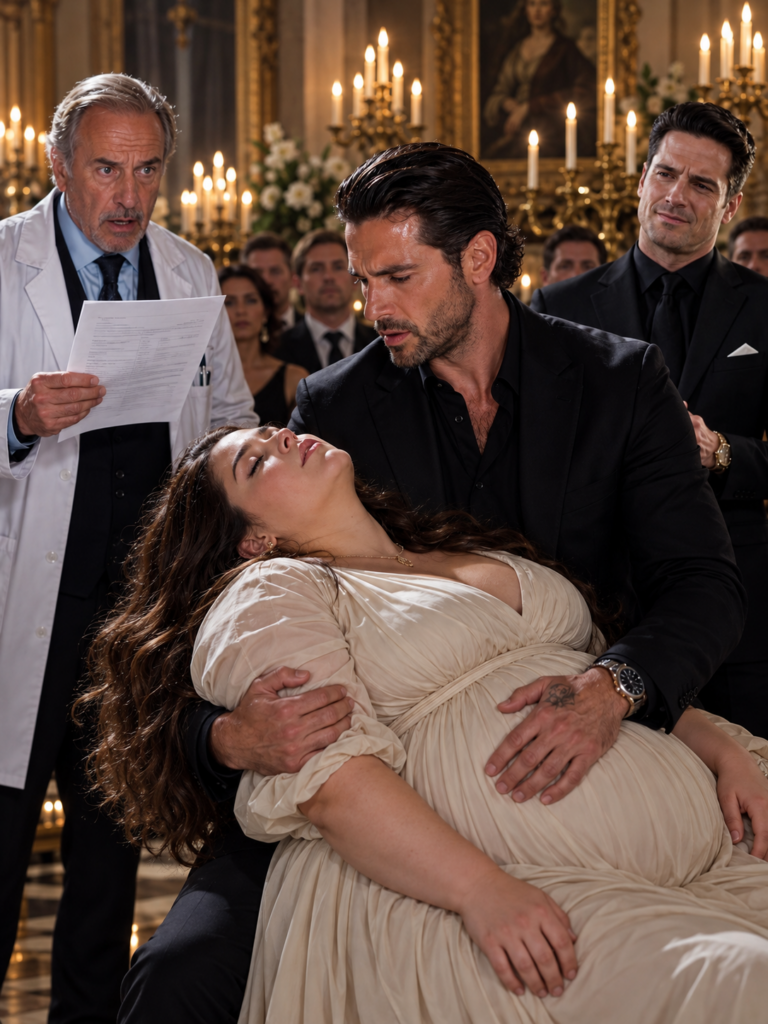
Gabriel turned toward him.
“Not another word.”
Nobody challenged him.
He carried Anna into a private bedroom while the physician was summoned.
When she regained full awareness, Gabriel was sitting beside her.
His expression was grim.
“You fainted.”
“I gathered that.”
“You frightened me.”
“I’m sorry.”
He looked at her sharply.
“Don’t apologize for being unwell.”
The doctor entered and began examining her.
After asking several questions, he requested blood work.
Gabriel reluctantly stepped into the corridor.
Anna remained on the bed, trying to understand why her body felt so strangely exhausted.
Twenty minutes later, the physician emerged.
Gabriel approached immediately.
“Tell me what’s wrong.”
The doctor looked nervous.
“Mr. Duca, I repeated the preliminary test because the result was unexpected.”
Gabriel’s face hardened.
“What result?”
The physician swallowed.
“Your wife is pregnant.”
For one impossible second, Gabriel heard nothing beyond the beating of his own heart.
“That’s not possible.”
“The result was confirmed.”
Gabriel took a step backward.
“How far along?”
“Approximately eight weeks.”
His mind returned to the explosion.
The hospitals.
The specialists.
The eight years he had spent believing he would never become a father.
Then he remembered Walsh.
The suppressed reports.
The possibility Anna had uncovered.
Before he could speak, a familiar voice sounded behind him.
“Well, this is an interesting development.”
Nico stood at the entrance to the corridor.
His expression was pleasant.
Too pleasant.
“Congratulations, cousin.”
Gabriel slowly turned.
Nico glanced toward the physician.
“Although I suppose we should be careful about whom we’re congratulating.”
Several council members had gathered nearby.
The corridor became unnaturally quiet.
Nico continued.
“Every person in this family knows you’ve been unable to have children for years. So naturally, people are going to wonder how your wife managed to become pregnant.”
Anna had reached the bedroom doorway.
She heard every word.
The accusation struck harder than she expected.
Not because Nico’s opinion mattered.
Because she knew how easily a suspicion could become a scandal in the Duca family.
She looked toward Gabriel.
For one terrible moment, he was staring at her without speaking.
“Gabriel?”
His eyes met hers.
“Do you believe what he’s suggesting?”
Nico gave a low laugh.
“Surely you can see why there would be questions.”
Gabriel crossed the corridor.
He seized Nico by the collar and slammed him against the wall.
The sound echoed through the estate.
Several men moved instinctively, then stopped.
Gabriel’s voice remained quiet.
“You will not accuse my wife of betraying me.”
Nico’s smile disappeared.
“You’re making a mistake.”
Gabriel leaned closer.
“Then let it be mine to make.”
He released him.
Nico stumbled backward, straightening his jacket with shaking hands.
Gabriel turned away from him and walked directly toward Anna.
She stood with one hand against the doorway.
“Eight weeks?” he asked gently.
She nodded.
“I didn’t know.”
“I know you didn’t.”
Her eyes filled.
“You’re not wondering if—”
“No.”
He touched her cheek.
“Not for a moment.”
Anna stared at him.
“You don’t even have the test results yet.”
“I don’t need a medical report to know who you are.”
Her tears spilled over.
Around them, members of the Duca council stood watching the most feared man in Boston defend a woman whose pregnancy had just threatened the certainty of his family’s succession.
Gabriel did not look at any of them.
His attention remained on Anna.
For the first time, she understood that the truth about his feelings had been there long before either of them found the courage to speak it.
He had chosen to believe her.
Not because she had provided evidence.
Not because she had convinced him.
Because he knew her.
And she knew, with sudden devastating clarity, that she loved him.
Part 3
By nightfall, the news had spread beyond the Duca estate.
Gabriel’s wife was pregnant.
The man everyone believed incapable of fathering children was about to become a father.
And Nico Duca had publicly questioned whether the child belonged to him.
In another family, the accusation might have produced a private argument.
In the Duca family, it threatened the foundation of an empire.
Rival organizations heard the rumors.
Council members began questioning Gabriel’s judgment.
Men who had never dared challenge his authority were suddenly discussing his marriage behind closed doors.
Nico had created exactly the kind of uncertainty that could turn an argument over succession into a struggle for control.
But he had underestimated one thing.
Gabriel was no longer willing to sacrifice Anna’s dignity to preserve appearances.
When the independent medical results finally arrived, Gabriel opened the report in his study with Anna sitting beside him.
He read the first page without moving.
Then the second.
Anna watched his expression, afraid to interrupt.
At last, he placed the report on the desk.
“The original diagnosis was wrong.”
She leaned forward.
“What does it say?”
Gabriel turned the pages toward her.
The specialists confirmed that his injuries had severely compromised his fertility.
The damage was genuine.
The likelihood of fathering a child remained exceptionally low.
But it had never been zero.
His condition had shown signs of limited recovery years earlier.
The records suppressed by Dr. Walsh had concealed that possibility.
Anna read the conclusion twice.
Then she looked at Gabriel.
“It’s possible.”
He nodded slowly.
“It’s possible.”
Their child’s conception was medically extraordinary.
But there was no contradiction between Anna’s pregnancy and Gabriel’s condition.
The central claim that had governed eight years of his life had been false.
Gabriel stared at the medical report.
For several moments, he said nothing.
Then a short, disbelieving laugh escaped him.
Anna had heard him sound angry.
Cold.
Amused.
Tender.
She had never heard that particular sound.
It belonged to a man who had spent nearly a decade refusing to hope because hope had been presented as foolish.
Anna covered her mouth as tears filled her eyes.
Gabriel stood.
He crossed the small distance between them, lowered himself to his knees, and looked at her stomach.
His hand hovered above it.
“May I?”
Anna nodded.
He laid his palm gently against her abdomen.
There was no visible movement yet.
Nothing he could feel.
Still, the gesture changed something in his face.
His eyes closed.
Anna rested a hand in his dark hair.
For a long time, neither spoke.
Then Gabriel looked up.
“What if something happens?”
She understood immediately.
He was not asking about the medical report.
He was thinking about the car shooting.
The men who wanted him dead.
The family council.
The endless violence that had followed him since he was young.
He had barely accepted the possibility of becoming a father, and already he was imagining losing everything.
“We’ll take care of each other,” Anna said.
His expression remained troubled.
“I’ve spent my entire life preparing for the worst.”
“I know.”
“I don’t know how to be a father.”
She smiled through her tears.
“I don’t know how to be a mother.”
“You’re going to be better at it than I am.”
“Probably.”
That finally earned a faint smile.
She cupped his face.
“But we’re allowed to learn.”
Gabriel lowered his forehead against her stomach.
Anna watched the tension gradually leave his shoulders.
For those quiet minutes, he was not thinking about succession or inheritance.
He was simply a man kneeling in front of the woman he loved, trying to imagine the small life growing inside her.
Their peace lasted eleven minutes.
Then gunfire shattered the mansion windows.
Gabriel reacted before Anna fully understood the sound.
He grabbed her and pulled her behind the marble kitchen island as glass exploded across the floor.
Security personnel rushed through the corridor.
Someone shouted that armed vehicles had breached the outer perimeter.
A second burst of gunfire struck the house.
Gabriel covered Anna with his body.
“Stay below the counter.”
She clutched his sleeve.
“What’s happening?”
He listened to the urgent voices coming through his security radio.
The answer arrived almost immediately.
Nico.
With the possibility of a biological heir confirmed, his claim to succession was no longer secure.
The financial investigation threatened his wealth.
The medical records threatened to expose his father’s betrayal.
And Anna’s pregnancy threatened the position he had spent years preparing to inherit.
Nico had chosen violence rather than accountability.
Another impact shook the courtyard.
A vehicle exploded beyond the gates.
Smoke drifted past the broken windows.
Gabriel looked toward the service corridor.
“We’re leaving through the private passage.”
He helped Anna to her feet, keeping himself between her and the sound of gunfire.
His security team moved ahead.
They descended a narrow passage concealed within the house, making their way toward an armored SUV waiting beyond the main residence.
Anna tried to control her breathing.
Her hand remained locked around Gabriel’s.
Halfway through the corridor, a man appeared near the service entrance.
He raised a weapon.
Gabriel fired once.
The man fell.
Anna recoiled at the sound.
Gabriel turned immediately.
“Anna. Look at me.”
She stared at him, trembling.
“Keep your eyes on me. We’re almost there.”
She nodded.
He took her hand again.
They reached the armored SUV while gunfire continued across the property.
Gabriel opened the passenger door and helped her inside.
Then he stepped away.
Anna caught his jacket.
“Where are you going?”
He looked toward the mansion.
“This has to end.”
“No.”
“Anna—”
“No. You don’t get to decide that you can protect us by throwing yourself back into a gunfight.”
His expression hardened with determination.
“If Nico gets away, he’ll keep coming for you.”
“And what happens if you don’t come back?”
Gabriel looked at her.
She could barely breathe.
For months, she had been careful with the feelings she was beginning to understand.
She had measured every word.
Waited for him to speak first.
Pretended the approaching end of their contract did not terrify her.
Now, surrounded by smoke and violence, the truth came out.
“I love you, Gabriel.”
He went motionless.
Anna’s tears slipped down her cheeks.
“I love you, and I won’t stand here pretending you don’t matter to me. Not anymore.”
Gabriel stared at her.
For one moment, the entire world seemed to recede.
Then he stepped closer and pressed his forehead against hers.
“I’ve loved you longer than you think.”
She made a small, broken sound.
“Since when?”
His mouth softened.
“Since the day you turned down five million dollars because you refused to let me buy your life.”
Despite everything happening around them, Anna nearly laughed.
“That’s your romantic confession?”
“It’s the best one I can manage with people shooting at my house.”
She touched his face.
“Then come back and give me a better one.”
Gabriel kissed her forehead.
“I intend to.”
He closed the armored door.
Anna watched him turn toward the mansion.
For the first time, she understood why loving a man like Gabriel could be more frightening than fearing him.
Fear had once allowed her to keep her distance.
Love gave her something she could not bear to lose.
Nico was captured before dawn.
Alive.
Gabriel made certain of that.
He wanted explanations, not another death that would bury the truth.
And the answers were worse than even Anna’s investigation had suggested.
Nico’s father had bribed Dr. Walsh eight years earlier to describe Gabriel’s infertility as permanent.
The original injury had been real, but the prognosis had been deliberately distorted.
When later medical records showed signs of recovery, they had been suppressed.
After his father’s death, Nico had continued making payments through intermediaries to keep those records hidden.
He had used Duca-controlled businesses to divert money into companies connected to him, building a financial reserve for the moment he could claim power.
When Anna discovered the suspicious transfers, Nico had ordered the attack on her car.
And when Gabriel’s medical report confirmed that Anna’s pregnancy was possible, Nico had authorized the assault on the mansion.
Every thread led back to the same ambition.
Nico wanted an empire he had never earned.
He had tried to make Gabriel believe he would never have a child so that Nico could present himself as the only possible future.
The deception had survived because it was built around Gabriel’s deepest private wound.
The following day, Gabriel convened an emergency meeting of the Duca council.
The atmosphere inside the chamber had changed.
There were no celebratory speeches.
No discussions of continuity.
No smiling congratulations for Nico.
Instead, financial statements, trust records, intercepted communications, and medical documents covered the long black oak table.
Gabriel stood at its head.
Anna waited near the doorway.
She had insisted on being present.
This was not merely a matter of business.
Her work had helped uncover the fraud.
Her life had been threatened.
And her unborn child had become a target because of decisions made by men who believed they could control the future by manipulating the truth.
Gabriel began with the payment records.
He explained the transfers.
He documented the manipulation of the medical findings.
He identified the companies through which Nico had diverted funds.
Finally, he placed the independent medical report on the table.
“My wife is carrying my child,” he said.
Nobody interrupted.
“The doctor who informed me I could never become a father was paid to conceal medical evidence. Those payments were arranged to influence who would inherit this family’s leadership.”
Gabriel turned toward Nico.
His cousin sat under guard, looking exhausted and furious.
“For eight years, you benefited from a lie. And when the truth threatened your position, you tried to kill my wife.”
Nico stared at him.
“You think having a child makes you untouchable?”
Gabriel shook his head.
“No.”
“Then what makes you think you’ve won?”
Gabriel glanced toward Anna.
“Because I finally understand what matters more than this chair.”
Nico followed his gaze.
His expression twisted.
“That child won’t make you stronger.”
Gabriel looked back at him.
“You’re right. My wife has already made me stronger by refusing to let me mistake fear for judgment.”
He faced the council.
“Nico will hold no position in any Duca enterprise again.”
There was no negotiation.
The evidence of Nico’s financial crimes would be delivered to the appropriate authorities through the family’s legitimate attorneys.
The people who had helped conceal the fraud would also face investigation.
Gabriel would not allow his cousin to escape accountability simply because they shared a name.
Nico began protesting.
Gabriel listened without expression.
Then he closed the final folder.
“For years, you mistook inheritance for entitlement. That ends today.”
The council accepted the decision.
But Gabriel’s choices did not stop with Nico.
The attack had shown him how readily the criminal parts of his empire could reach the people he loved.
He could no longer pretend that the danger remained separate from his home.
Gradually, he began dismantling the operations and relationships that made violence an ordinary instrument of Duca power.
He strengthened the legitimate businesses.
He changed who was permitted to exercise authority.
He began removing the arrangements that had allowed his cousin to hide money and purchase loyalty.
The criminal empire he had inherited would not vanish in a single season.
Gabriel understood that.
There were obligations, enemies, and consequences he could not escape simply because he wanted a different life.
But for the first time, he was making decisions with a future in mind rather than merely defending the past.
And Anna remained beside him.
Not as a decorative wife.
Not as a purchased symbol of stability.
As the woman who had challenged his decisions, investigated the books others were afraid to question, uncovered the secret that had altered his life, and refused to allow fear to decide what their marriage would become.
Eleven months after Anna signed the original marriage agreement, Gabriel found her standing on the rooftop where they had first kissed.
Boston glittered beneath a veil of spring rain.
Anna wore a soft dress that followed the unmistakable curve of her pregnancy.
Her hair moved in the cool breeze.
She rested one hand on the stone railing and the other against her stomach.
Gabriel stopped a few steps behind her.
For a moment, he simply watched.
He remembered their first night in the mansion.
The distant bedrooms.
The careful conversations.
The stubborn young woman who returned expensive dresses without asking permission.
The auditor who had looked him in the eye and told him his financial records were wrong.
The wife who had refused five million dollars.
He had entered the marriage convinced he understood exactly what it would cost.
He had been wrong about everything that mattered.
Anna turned when she heard him.
“You’re late.”
“I had something to finish.”
She noticed the folder in his hand.
Her eyebrows rose.
“Please tell me that isn’t another contract.”
Gabriel approached.
“In a manner of speaking.”
She groaned.
“Gabriel.”
He handed her the folder.
Inside was their original marriage agreement.
Anna recognized the pages immediately.
The debt settlement.
The twelve-month term.
The termination clause that would end their marriage after one year.
But someone had drawn a line through the provision establishing the end date.
She looked up.
“You know you can’t change a contract just because you’ve decided you don’t like it.”
“I know.”
“Both parties have to agree.”
“I know that too.”
“Then what is this?”
Gabriel took a small lighter from his pocket.
Anna stared at him.
“You’re not serious.”
He removed the agreement from the folder.
Then he placed it inside a metal bowl resting on the rooftop table.
He lit the corner.
Anna watched the paper catch fire.
The edges darkened.
The signatures curled.
The words that had defined their marriage slowly turned to ash.
When the flame died, Gabriel set the lighter down.
Anna folded her arms.
“That was unnecessarily dramatic.”
“I’ve been informed that I’m not particularly skilled at expressing myself.”
“Who told you that?”
“My wife.”
She smiled.
“She sounds intelligent.”
“Exceptionally.”
Gabriel reached into his pocket again.
This time, he withdrew a small ring.
It was simple and beautiful.
Nothing ostentatious.
Nothing designed to impress the family council or advertise his wealth.
Exactly the kind of ring Anna would have chosen for herself.
Her smile faded.
“Gabriel…”
He took her hand.
“The first time I married you, I asked for twelve months.”
Rain gathered in his hair.
His expression was open in a way she would once have thought impossible.
“I needed a wife because my family wanted one. I believed marriage was another problem that could be solved with an agreement.”
Anna’s eyes filled.
Gabriel looked down at her wedding ring.
“I told myself you would leave when the contract ended, and that it wouldn’t matter.”
He paused.
“Then you walked into my life and made it impossible to imagine without you.”
Anna pressed her lips together.
He continued.
“I can’t promise you a life without danger. I can’t erase the things I’ve done or pretend the world I inherited has already changed.”
His thumb moved gently over her hand.
“But I can promise that I won’t stop trying to build something better for you and our child.”
A tear slipped down Anna’s cheek.
“You’re supposed to ask me a question.”
Gabriel’s mouth curved slightly.
“Would you marry me again, Anna Duca? Not for a year. Not because of a debt. Because you want the same future I do.”
She laughed through her tears.
“Yes.”
He slipped the ring onto her finger.
Anna stepped into his arms.
Gabriel kissed her slowly while rain whispered against the rooftop stones.
Then something moved beneath her hand.
She pulled back.
“Gabriel.”
His expression changed.
“What’s wrong?”
“Nothing. Give me your hand.”
She placed his palm against her stomach.
For a moment, he felt only warmth.
Then a small, unmistakable movement pressed against his hand.
Gabriel froze.
Anna smiled.
“Did you feel that?”
He nodded without speaking.
The baby moved again.
Wonder spread across his face.
Anna watched him with tears in her eyes.
“There’s something else I haven’t told you.”
Gabriel looked up.
“What?”
“The doctor confirmed it this morning.”
She covered his hand with hers.
“We’re having a girl.”
Gabriel stared at her.
“A daughter?”
Anna nodded.
His expression transformed.
Eight years earlier, he had been told that the child he imagined would never exist.
He had accepted the diagnosis as an unchangeable fact.
He had learned to speak of children with indifference because wanting them hurt too much.
Now his daughter was moving beneath his hand.
Real.
Alive.
Waiting to meet him.
Gabriel slowly lowered himself in front of Anna.
For once, the man who commanded armed guards and controlled fortunes did not care who might see him kneeling.
He pressed his forehead gently against her stomach.
Anna ran her fingers through his hair.
His voice was thick with emotion.
“I thought I’d never get to meet you.”
The baby moved again.
Gabriel closed his eyes.
“I’m going to do everything I can to deserve you.”
Anna bent toward him.
“You already love her.”
He nodded.
“More than I know how to say.”
She smiled.
“Then you can show her.”
Gabriel rose and gathered Anna carefully into his arms.
Below them, black vehicles moved through the rain-darkened streets of Boston.
The Duca name still carried fear.
There were still rivals who watched Gabriel’s businesses and enemies who remembered old debts.
The future would demand difficult choices.
But the man who had once believed love was a weakness now understood that loneliness had never made him strong.
It had simply made him easier to control.
Anna rested her head against his chest.
“One year,” she murmured.
Gabriel glanced toward the ashes of their agreement.
“That was never going to be enough.”
She looked up.
“Then how long do you want?”
He placed his hand over hers, where their daughter had moved only moments earlier.
He thought of the old photograph of his father.
Of the years he had lost.
Of the woman who had brought him the truth when everyone else had protected the lie.
Then he looked into Anna’s eyes.
“All of it,” he said.
She smiled.
And Gabriel kissed her beneath the Boston rain, knowing that for the first time in his life, forever was not a promise he feared making.
It was the future he intended to protect.