
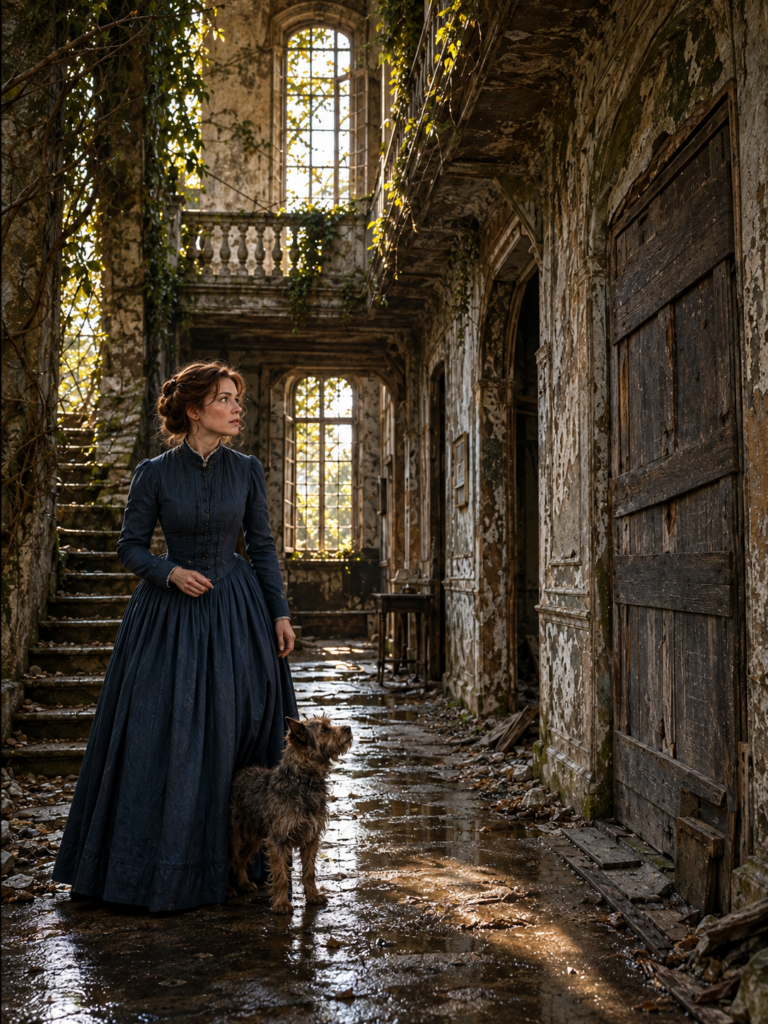
Part 1
At twenty-one, Clara Reed Harcourt learned exactly what her place in the world was worth.
Fifty pounds.
Samuel Bell did not say it so cruelly. The solicitor was too decent a man for that. He sat behind his dark wooden desk with his gray hair neatly combed and his full beard trimmed close, turning Lady Eleanor Vale’s papers beneath the pale light from the office window.
The room smelled of dry paper, old leather, sealing wax, and the stale trace of pipe smoke.
“Your uncle’s estate passed according to his will,” Samuel said. “Lady Eleanor inherits Blackwood Manor in full.”
Clara sat with her gloved hands folded in her lap.
“And I inherit nothing.”
Samuel hesitated.
The hesitation was the answer.
Sir Alister Harcourt had taken Clara into Blackwood Manor when she was four years old, after both her parents died. For seventeen years, the manor had been the only home she remembered clearly.
Yet she had never truly belonged to it.
She had grown up neither servant nor daughter, niece by blood but dependent by circumstance. She had eaten in respectable rooms when her uncle remembered to invite her and spent most of her happier hours in the kitchens, gardens, scullery, stillroom, and linen cupboards with Mrs. Gable, the housekeeper.
Then Sir Alister had died suddenly of heart trouble.
Within days, the balance of Blackwood shifted.
His widow, Lady Eleanor Vale, had been his wife for only two years. She had never been openly vicious to Clara. Open cruelty would have required more interest than she possessed.
Lady Eleanor simply did not consider her family.
Clara had seen it in the inventories, in the reassignment of rooms, in the whispered conversations that stopped when she entered. Before anyone formally told her she must leave, she understood.
Samuel pushed a document toward her.
“Lady Eleanor is prepared to offer you fifty pounds as a final settlement, provided you sign a release confirming that you will make no future claim against the estate.”
Clara looked down at the paper.
Fifty sovereigns.
Enough to live carefully for a while.
Not enough to purchase a place in respectable society, secure a permanent income, or guarantee that she would never be dependent again.
The money was not generosity.
It was the price of removing her neatly.
Samuel’s fingers rested on the edge of the desk.
“You should read every line.”
“I intend to.”
Something softened briefly in his expression.
Clara read.
She had learned early that helplessness was dangerous, but appearing helpless was worse.
Mrs. Gable had taught her that.
Never let people hurry you when a signature is involved.
Never accept another person’s arithmetic without checking it.
Never confuse expensive things with useful ones.
And when someone wishes to humiliate you, do not assist them.
Clara reached the final line.
“Do I have any legal claim Lady Eleanor is asking me to surrender?”
Samuel answered carefully. “Nothing substantial that I can identify.”
“Then refusing would leave me with nothing instead of fifty pounds.”
He met her eyes.
“Yes.”
Clara picked up the pen.
Her hand did not shake.
She signed Clara Reed Harcourt in a clear, deliberate script.
Samuel counted out the sovereigns.
The small gold coins made remarkably little noise for something upon which an entire future might depend.
The following morning, Clara left Blackwood Manor.
She owned one carpet bag, two changes of clothing, a few practical personal things, and a thin silver locket that had belonged to her mother. Inside the locket rested a tiny faded lock of brown hair.
Clara remembered almost nothing of the woman who had worn it. Sometimes she believed she remembered a voice. At other times she suspected she had created the memory because she needed one.
The locket nevertheless meant that once, before she became an obligation passed into her uncle’s household, someone had held her as a daughter.
Mrs. Gable met her near the servants’ entrance.
The housekeeper’s wiry frame looked even smaller beneath the gray morning sky. She had spent most of Clara’s childhood with her sleeves rolled and her hands occupied—sorting linen, tying herbs, kneading dough, pruning, salting, bottling, mending, counting.
Now those hands held a parcel and an old leather-bound book.
“Bread and cheese for the road,” Mrs. Gable said, giving her the parcel.
“You have already given me too much.”
“Nonsense.”
She placed the book in Clara’s hands.
Its leather cover was worn smooth at the corners.
Clara recognized it immediately.
“Your remedy book?”
“Mine long enough. Yours now.”
“I can’t take this.”
“You can, and you will.”
Clara opened the cover. The pages were filled with Mrs. Gable’s handwriting, older entries from women before her, notes about drying herbs, household mixtures, poultices, preserves, salves, and dozens of ordinary remedies.
“This is worth more than you think,” Clara whispered.
Mrs. Gable gave her a sharp look.
“That is precisely why I’m giving it to you instead of letting it sit on a shelf here.”
For a moment neither woman spoke.
Then Mrs. Gable adjusted Clara’s collar as she had when Clara was a child.
“Coin disappears,” she said. “Knowledge behaves better, provided you use it.”
Clara swallowed.
“I’ll write.”
“You’d better.”
Lady Eleanor did not come to say goodbye.
Clara did not look back when she walked down the drive.
A coach carried her away from the clipped hedges and broad fields surrounding Blackwood. The farther she traveled, the rougher the countryside became. Managed estates gave way to smaller farms. Roads narrowed. Hedgerows thickened.
All the while Clara could feel the weight of the sovereigns hidden beneath her clothing.
Fifty pounds.
She refused a private room on the road and paid for a place in a common chamber. She bought cheap food when bread and cheese would do. Each small economy seemed trivial until she counted her money again.
At Oak Haven, a market town far enough from Blackwood that nobody appeared to recognize her name, Clara stopped outside a property office.
Several notices were displayed.
Rooms to rent.
Cottages to rent.
A small house at a price that made her stomach tighten.
Rent was the trouble.
She could spend Lady Eleanor’s fifty pounds purchasing temporary safety until, one month at a time, the money belonged to somebody else.
Ownership was different.
Clara studied the cheapest notices.
One caught her attention because the price seemed impossible.
GREYWOOD COTTAGE — FERN HOLLOW — FREEHOLD — £20
She went inside.
The clerk looked her over with the particular expression men sometimes wore when a young woman entered an office alone and expected to discuss money seriously.
“I want to ask about Greywood Cottage.”
That changed his expression.
“Greywood?”
“Yes.”
“You’ve seen the price?”
“Twenty pounds.”
“You know why?”
“No. That is what I intend to discover.”
He leaned back.
“It’s been abandoned forty years.”
“Why?”
“Because no one wants it.”
“That isn’t an answer.”
The clerk’s eyebrows lifted.
Clara continued.
“Is the freehold clear?”
“Yes.”
“Boundary dispute?”
“None recorded.”
“Water?”
“A well with a hand pump, assuming it still works.”
“Drainage?”
“Poor, I imagine.”
“Structural walls?”
“Still standing.”
“Roof?”
“Half of it, more or less.”
Only after asking about access, title, water, boundaries, and the surrounding land did Clara finally say, “And now you may tell me why no one wants it.”
The clerk almost smiled.
“People in Fern Hollow say it’s haunted.”
Clara waited.
“That’s all?”
“Some consider it sufficient.”
He produced a small photograph from a file.
Greywood Cottage stood beneath a dark mass of trees. Ivy crawled over heavy stone walls. The roof sagged badly on one side.
But Clara was not looking at the ivy.
She was looking at the thickness of the walls and the deep window openings.
Whatever else Greywood was, it had not been cheaply built.
“Can I buy it for twenty pounds?”
“If you truly want it.”
She did.
By the time Clara reached Fern Hollow, rain had dampened her shawl and turned the lane beneath her boots to mud.
Ancient oaks crowded the road. Moss covered their lower trunks. The air smelled of pine resin, wet bark, and black soil.
Fern Hollow was little more than a cluster of stone cottages gathered around a squat church tower and a public house called The Green Man.
News traveled faster than Clara.
By the time she completed the final paperwork in the small property office above the bakery, at least three villagers seemed to know that the young stranger had purchased Greywood.
The clerk there gave her a yellowed deed and an oversized iron key.
“You understand,” he said, “that the place is scarcely habitable.”
“So I’ve been told.”
“Roof’s bad.”
“I know.”
“Garden’s gone wild.”
“I know.”
“And there are stories.”
“So I’ve also been told.”
He lowered his voice.
“Twenty pounds is still twenty pounds.”
Clara put the deed safely away.
“Yes. That’s why I asked so many questions before spending it.”
She walked out with thirty pounds remaining.
Thirty pounds, Mrs. Gable’s remedy book, her mother’s locket, a deed, and an iron key.
People watched her go.
Clara recognized their expressions.
They thought they were watching a desperate young woman make a disastrous decision.
Greywood Cottage stood where the village lane narrowed into a forest track.
For several seconds Clara simply looked at it.
The photograph had been charitable.
Brambles crowded the garden. Ivy swallowed one wall and climbed toward the roof. Moss streaked the gray stone. A ground-floor window had been boarded. Part of the roof had collapsed, exposing dark timber.
Only one neglected apple tree rose clearly above the wilderness.
Yet the cottage did not frighten her.
Neglect was honest.
Blackwood Manor had been polished, warm, orderly—and could still cast her out.
Greywood made no promises.
Its failures were visible.
Clara pushed through the brambles, fitted the iron key into the swollen oak door, and leaned hard against it until the wood gave way.
Dust moved in the dim air.
The main room contained uneven flagstones, a broad soot-blackened hearth, a rickety table, two damaged chairs, and enough cobwebs to make the corners appear curtained.
Clara stepped carefully.
Rotten boards could break a leg more efficiently than any ghost.
She used the handle of an old broom to test uncertain flooring before trusting her weight to it.
Upstairs were two small bedrooms. One could be made usable quickly. The other lay beneath the damaged roof.
The scullery contained a stoneware sink and a rusted hand pump.
Clara worked the handle.
It answered with a metallic cough and nothing more.
“Charming,” she murmured.
The pantry shelves, however, were sound.
Behind another door she discovered old hooks where herbs had once been hung to dry.
That interested her.
Outside, beneath the nettles, she found the faint line of a stone path. Against the southern wall were narrow garden beds almost completely swallowed by weeds.
Those were not accidental.
Someone had once arranged this place carefully.
Clara looked toward the forest.
Greywood did not feel abandoned so much as interrupted.
She began work before sunset.
The first night, she slept in her clothes beneath every blanket she owned, listening to rain strike the surviving roof.
The house creaked.
Branches dragged across stone.
Something small moved inside a wall.
If Greywood possessed a ghost, Clara decided, it was less troublesome than mice.
Morning brought the smell of wet ash and damp plaster.
Clara made a list.
Roof.
Water.
One secure bedroom.
Chimney.
Garden later.
Cellar, when she had the courage to discover how much worse the damp became underground.
She lasted until afternoon before curiosity won.
The cellar trapdoor was in the scullery.
When she lifted it, cold air rose from below.
Clara lit a candle and descended narrow stone steps.
The underground room smelled of mildew and earth. Broken barrels leaned in one corner. Mold furred old shelves.
The far wall was wettest.
Clara raised the candle.
Then she frowned.
Three cellar walls were made from large, rough blocks of the same local gray stone used throughout the cottage.
The fourth was not.
Its stones were smaller and flatter.
The mortar was different too.
She moved closer.
Mrs. Gable had taught her to distrust inconsistency in practical things. A different stitch in linen meant a repair. A patch of altered soil meant someone had planted or dug there. A changed smell in a preserve meant something had begun to spoil.
A changed wall meant somebody had changed it.
Clara knocked against the stone with her knuckles.
Solid.
She tried another place.
Solid.
Then lower down—
A strange, faint echo answered.
Clara froze.
She struck it again.
Not the dense thud of stone backed by earth.
Hollow.
She brought a small hammer and crowbar down from the tools she had purchased in Oak Haven.
Removing the mortar was slow work.
Dust coated her hands.
Twice she stopped, wondering whether she was damaging the only house she owned based on nothing more than a sound.
Then the first stone loosened.
Clara pulled.
It came free.
She expected packed earth.
Instead, there was darkness.
Dry darkness.
A thread of cool air touched her face, carrying none of the cellar’s mildew.
Clara stared into the opening.
Then she removed another stone.
And another.
Behind the false wall was a narrow brick-lined alcove.
Someone had deliberately built an air gap between the hiding place and the wet hillside.
On a shelf inside sat two objects.
A tin-plated deed box.
And a small leather journal.
Clara lifted the candle higher.
For the first time since Lady Eleanor’s solicitor had placed fifty sovereigns before her, Clara felt her hands begin to shake.
Part 2
Clara did not touch the box first.
That surprised even her.
The box was heavy-looking, plainly made, and obviously intended to protect something valuable. Yet it was the journal beside it that drew her hand.
Its brown leather was cracked at the corners but remarkably well preserved.
Clara carried both objects upstairs.
She locked the cottage door, although there was hardly anyone nearby to see her, then set the journal on the rickety table.
The first pages were dense with handwriting.
Dates.
Weather observations.
Sketches of leaves.
Notes about soil.
Flowering times.
Plants Clara recognized and several she did not.
Whoever had written the book possessed the disciplined curiosity of a person who could spend an hour noticing what another person walked past.
Near the front was a name.
Beatrice Vance.
Clara read on.
Beatrice had lived at Greywood for twenty-two years.
She had been a botanist.
Her final entry was dated 1815.
There were no dramatic confessions in the opening pages. No ghost stories. No breathless account of danger.
There was instead a life built from observation.
Which plants survived under the oaks.
How rainfall changed the lower garden.
When to gather particular leaves.
Where mushrooms appeared after prolonged wet weather.
A recipe for limewash.
Instructions for polishing old wood.
Then, deeper in the journal, the tone changed.
Beatrice wrote about a nephew.
He was charming, especially in company, but careless with money. His debts had grown. He had begun asking questions about her savings, Greywood, and what property she intended to leave behind.
Beatrice understood him perfectly.
She had no intention of watching a lifetime of discipline disappear into someone else’s debts.
So she hid what she possessed.
Not beneath a loose floorboard.
Not in the bedroom.
Not in the garden.
She chose the cellar.
More precisely, she chose the damp wall.
Clara read the passage twice.
Beatrice had deliberately placed her savings behind the part of Greywood most likely to be investigated by someone determined to preserve the house.
A thief searching quickly might never discover it.
A careless owner could live above it for years.
But a person who noticed the moisture, studied the masonry, and tried to repair the foundation would eventually find the false wall.
One sentence had been written with darker pressure than the lines around it.
Look to the foundation of things.
Clara sat back.
She could almost hear Mrs. Gable answering from Blackwood.
Quite right.
Only then did Clara turn toward the deed box.
Its tin plating had dulled but barely rusted.
The lock was simple.
She tried the key she had been given for Greywood, though she knew it would not fit.
It did not.
At last she used the crowbar.
The lock broke.
Inside lay yellowed linen.
Clara folded it aside.
Gold caught the weak afternoon light.
For several seconds she did not understand what she was seeing.
Stacks of sovereigns.
Not a handful.
Stacks.
Beside them lay jewelry wrapped carefully in cloth: a pearl necklace, sapphire earrings, and a heavy gold brooch.
Clara lowered herself slowly into the chair.
Thirty pounds remained from Lady Eleanor’s settlement.
Thirty pounds had seemed to her, that morning, like the thin line between independence and ruin.
Now a fortune sat on her table.
She touched none of it.
Instead she returned to Beatrice’s journal.
The older woman’s intentions were clear.
The money represented savings preserved from her grasping nephew. Beatrice wished whoever eventually found it to use it to build a good life within the walls she had loved.
The money was not separate from Greywood.
Neither was the journal.
Beatrice had left capital and knowledge together.
Clara looked toward Mrs. Gable’s worn remedy book lying near her carpet bag.
Two books.
Two women.
One she had known nearly all her life.
One had died long before Clara was born.
Both seemed to be telling her the same thing.
Money without skill could disappear.
Skill without opportunity could remain trapped in someone else’s household.
Together, they could create independence.
Clara did not carry the treasure into Fern Hollow.
That would have been foolish.
She returned most of it to the dry alcove and replaced enough loose stone to conceal the opening from a casual glance.
She took only several sovereigns.
The roof came first.
A fortune in a box would be meaningless if rain destroyed the house above it.
In the village she was directed to Silas Croft, an elderly slater with thick hands, a weathered face, and the suspicious expression of a man who had spent decades watching people underestimate roofs.
He came to Greywood the following morning.
Silas stood in the lane, tipped his head backward, and stared upward.
After a long silence he said, “That isn’t a repair.”
Clara waited.
“That’s a resurrection.”
“Can you resurrect it?”
Silas looked at her.
“Maybe.”
“How much?”
He named the materials he would need before discussing a final figure.
Clara asked what could be reused.
That earned the first sign of approval.
“A fair amount of slate, if it comes down without breaking.”
“And the timber?”
“Some sound. Some rotten.”
“How will you know?”
“I’ve been doing this forty years.”
Clara nodded.
“Then I expect you will.”
She placed three sovereigns on his workbench when they returned to the village.
Silas stared at the gold.
Then at Clara.
“Where’d a young woman living in a ruined cottage come by three sovereigns?”
“I had savings.”
The answer was true enough.
Silas grunted.
“Don’t pay a man everything before the work’s done.”
“I wasn’t planning to.”
That nearly became a smile.
He brought a young apprentice named Thomas Baird.
Thomas arrived carrying tools and the poorly concealed expectation that Clara would prove to be either foolish or delicate.
She disappointed him on both counts.
Silas stripped the damaged roof back to sound timber, showing Thomas which slates could be saved.
Clara worked below, hauling debris away from the house.
Once, Thomas climbed down and found her tapping two pieces of slate together.
“What are you doing?”
“Listening.”
“For what?”
“The good ones ring more cleanly.”
Thomas looked toward the roof.
“Silas tell you that?”
“I heard him telling you.”
Thomas laughed.
By the fourth day, Silas called down, “Miss Harcourt!”
Clara stepped outside.
“Measure those rows from the ground for me.”
Thomas glanced at her, perhaps expecting confusion.
Clara fetched the measuring line.
Rain stopped the roofing work twice during the first week. Instead of wasting the day, Clara and Thomas cleared the loft and laid temporary boards beneath the worst gaps.
They worked mostly without ceremony.
Thomas learned that Clara could carry her share.
Clara learned that Thomas knew how to repair more than roofs.
“You’ve got a wall collapsing behind the garden,” he told her.
“I’m aware.”
“And the pump sounds terrible.”
“I am painfully aware.”
“And one chair is held together by optimism.”
“That one is on my list.”
“You have a list?”
“Several.”
He shook his head.
Silas, passing behind them, said, “Never mock a person with a list, boy. They’ll own the roof over your head while you’re still deciding where you left your hammer.”
Two weeks after the work began, Greywood looked different from the lane.
Not restored.
Not grand.
But awake.
The roofline was straight.
Rain struck slate and ran where it ought to run instead of entering Clara’s bedroom.
Silas accepted his remaining payment.
Before leaving, he looked once more toward the roof.
“It’ll hold.”
Coming from him, it sounded like a blessing.
Clara turned next to the interior.
She scrubbed flagstones with lye and sand.
She repaired the broken chair with glue and clamps.
Using Beatrice’s notes, she mixed limewash and covered the dark interior walls.
The transformation startled her.
The walls became soft white surfaces that gathered daylight and returned it to the room. What had once seemed like a hole in the forest began to feel inhabitable.
The pump resisted longer.
Clara dismantled what she understood, cleaned what she could, worked the handle, cursed it privately, worked again, and watched rusty water finally spit into the stoneware sink.
She kept pumping.
Brown became cloudy.
Cloudy became clear.
At last a stream of cold water filled her bucket.
Clara laughed aloud.
Nobody was present to hear except the cottage.
The garden demanded harder labor.
She cut nettles.
Dragged bramble.
Found the old path.
Pruned dead branches from the apple tree.
As she cleared the southern beds, she discovered signs that confirmed what Beatrice’s journal had suggested. The garden had once been arranged for usefulness.
Medicinal plants had grown here.
The first villager to cross Greywood’s gate voluntarily was Mrs. Hemlock.
She was a formidable older woman whose authority appeared to come from no official position whatsoever.
Clara had seen her several times in the village.
Mrs. Hemlock entered the garden without invitation, inspected the new roof, inspected Clara’s mud-stained skirt, and inspected the cleared path.
“You’ve been busy.”
“Yes.”
Mrs. Hemlock looked toward the house.
“Silas did that roof?”
“He did.”
“Then at least it won’t fall on you.”
A pause.
“I’m relieved.”
Mrs. Hemlock left.
The next morning she returned carrying a basket containing bread, butter, and tomato seedlings.
“No sense having a garden full of nettles.”
Clara looked at the basket.
“Thank you.”
“Don’t make an event of it.”
“I wouldn’t dare.”
That was how Greywood began entering the life of Fern Hollow.
Mr. Evans, a neighboring farmer, arrived one Saturday with his two sons and tools for clearing fallen branches.
Clara attempted to pay him.
He refused.
She tried again.
He gave her a look.
“Miss Harcourt, if you insist on turning neighborliness into bookkeeping, we’ll never get anything done.”
So Clara gave the men cold water from the repaired pump and later sent them away with what little preserved food she could spare.
By late summer, the cottage smelled not of mildew but of limewash, wood smoke, drying plants, and bread.
Clara used part of Beatrice’s money for second-hand furniture and a proper iron cooking stove.
She did not spend extravagantly.
The existence of the hidden sovereigns made her more cautious, not less.
It was too easy to imagine Lady Eleanor’s prediction coming true in a different form—to receive money, mistake it for permanent security, and watch it disappear.
Instead Clara treated the treasure as a foundation.
The books became equally important.
Mrs. Gable’s remedy book contained methods Clara already understood.
Beatrice’s journal expanded the landscape around her.
The forest stopped being merely a wall of trees.
It became specific.
Bilberries here.
Plantain near the track.
Yarrow in open ground.
Useful roots where the soil stayed damp.
Safe mushrooms identified by careful notes—and others to be avoided entirely.
Clara refused to pretend knowledge where she had none.
That principle mattered the first time a village woman came asking for help with a child’s cough.
Clara made thyme and honey.
“For comfort,” she said. “And if the child worsens, you send for the doctor.”
For a minor burn, she prepared calendula salve.
When someone presented an illness she did not understand, Clara said so.
Word spread anyway.
Perhaps it spread because she refused to promise miracles.
People began leaving eggs, milk, cured meat, beeswax, useful boards, jars, cloth, or labor in exchange for ordinary remedies and practical help.
Clara never called herself an apothecary.
Her kitchen nevertheless began to resemble a small workshop.
Bundles of plants hung from the rafters.
Jars filled the shelves.
She marked them carefully and kept anything uncertain well apart from ordinary household supplies.
Thomas Baird had finished the roof weeks earlier.
He continued to appear.
Once with spare boards.
Once because, according to him, he happened to notice the garden wall needed attention.
Another time because he had built a drying rack from offcuts that “would only have gone to waste.”
Clara did not point out that the rack fit the space beneath Greywood’s eaves perfectly.
Their conversations remained practical.
“Your wall leans.”
“I know.”
“That branch needs taking off the apple tree.”
“I know.”
“The gate sticks.”
“I know.”
Thomas looked at her.
“Do you know everything wrong with this cottage?”
“No. Every week it introduces me to something new.”
He smiled.
“Fair enough.”
Affection entered slowly, disguised as usefulness.
Meanwhile, Fern Hollow changed the way it spoke about her.
She was no longer the young woman who had thrown away twenty pounds on a haunted ruin.
She became Miss Harcourt of Greywood.
The woman who had restored the pump.
The woman who knew how to prune an apple tree.
The woman with the herb shelves.
The woman who would tell you plainly when something was beyond her knowledge.
Respect came without announcement.
It accumulated through evidence.
One afternoon Clara saw a familiar figure coming up the lane.
Samuel Bell.
For one irrational second she feared he had come on Lady Eleanor’s behalf.
Then she reminded herself that Greywood was hers.
She opened the gate.
Samuel removed his hat.
“Miss Harcourt.”
“Mr. Bell.”
His gaze traveled from the repaired roof to the cleared garden and the white curtains at the cottage window.
“I heard you had purchased property.”
“News does travel.”
“Apparently farther than one would expect.”
Inside, Clara placed the yellow deed on the table.
Samuel had come to confirm that the purchase had been properly recorded.
He examined the document carefully.
Clara watched his face.
“Well?”
“It appears entirely in order.”
Only then did she realize how tightly she had been holding herself.
Samuel looked around the room.
The limewashed walls.
The stove.
Shelves.
Drying herbs.
A repaired chair.
The remedy book.
Evidence of work everywhere.
“Lady Eleanor,” he said slowly, “believed the fifty pounds would be consumed by lodging and necessities within a relatively short period.”
Clara’s mouth curved faintly.
“I suspected as much.”
“You spent twenty of it on land.”
“On a house.”
Samuel glanced at the ceiling.
“I believe ‘house’ was initially a generous description.”
“It has improved.”
“So I see.”
She offered tea.
He accepted.
Clara did not mention the hidden sovereigns.
She did not show him Beatrice’s jewelry.
The legal fact that mattered was straightforward.
She had purchased Greywood legitimately.
The deed named her.
The treasure remained concealed behind the false cellar wall, and Beatrice’s journal remained a private bridge between two women separated by generations.
Still, after Samuel left, one question stayed with Clara.
Was Greywood truly beyond Lady Eleanor’s reach?
She had learned too recently how quickly a home could cease to be hers.
Until the title and boundaries were beyond doubt, some part of her would continue listening for footsteps on the road.
Part 3
By early autumn, Greywood had become almost unrecognizable from the ruin Clara first entered.
Rows of kale, beans, and late vegetables occupied the reclaimed garden.
Tomatoes from Mrs. Hemlock’s seedlings had ripened against the southern wall.
The old apple tree, freed from dead growth, bent beneath its fruit.
A repaired rain barrel stood under the rear eaves.
Smoke rose from the chimney in a thin blue column on cold mornings.
Clara had also restored a narrow path toward the forest, guided partly by Beatrice Vance’s descriptions.
The work changed her sense of wealth.
When she first left Blackwood Manor, security had meant counting sovereigns.
How many nights of lodging?
How many meals?
How many weeks until necessity made the next decision for her?
Now she measured security differently.
A roof that did not leak.
A functioning pump.
A garden producing food.
Dry firewood.
Skills.
Neighbors.
Knowledge.
And, hidden below, Beatrice’s savings.
Clara still visited the alcove carefully.
She kept the jewelry wrapped.
She accounted for every sovereign she removed.
Beatrice had spent a lifetime preserving those resources from a reckless relative. Clara refused to become reckless merely because the money had reached her hands.
The journal itself grew more valuable each week.
One rainy evening, she opened it beside Mrs. Gable’s remedy book and compared two descriptions of drying chamomile.
The handwriting differed.
The decades between the women differed.
The underlying discipline did not.
Observe.
Do not waste.
Know what you are handling.
Do not pretend certainty where you have none.
Make useful things last.
A knock came at the door.
Clara closed the journal.
Samuel Bell stood outside.
Rain shone on his coat shoulders.
Her heart gave one hard beat.
“You’ve come a long way for tea.”
“I hope you have some.”
“I can probably manage.”
His expression reassured her before his words did.
Inside, he removed a packet of documents.
“I have confirmation regarding Greywood.”
Clara remained standing.
“The boundaries have been checked against the records. The title is secure. Your purchase was validly recorded. Greywood belongs to you outright.”
She was quiet.
Samuel continued.
“Lady Eleanor has no claim upon this property.”
The sentence entered Clara slowly.
“No claim?”
“None.”
“And she cannot interfere with my ownership?”
“No.”
Clara looked around her kitchen.
The table she had repaired.
The shelves Thomas had built.
The drying herbs.
The stove.
Her mother’s silver locket lying beside the closed journal.
Mine.
The word felt almost unfamiliar.
Blackwood Manor had contained hundreds of things finer than anything at Greywood.
She had owned none of them.
Here even the cracked flagstone beneath her boot belonged to her.
Samuel watched her.
“I thought you would want certainty.”
“Yes.”
Her voice was softer than she intended.
“Yes, I did.”
She made tea.
Samuel did not ask how she had paid for the repairs.
Perhaps the question occurred to him. If so, he kept it to himself.
He had known Clara only in the coldest moment of her life, sitting opposite his desk while another woman assigned fifty pounds as the price of removing her from a household.
Now he saw what she had done with the opportunity.
“You proved Lady Eleanor mistaken,” he said at last.
Clara shook her head.
“I stopped needing her to be right or wrong.”
Samuel considered that.
Then he smiled.
“That may be a greater achievement.”
When he prepared to leave, Clara gave him a packet of dried thyme.
He accepted it solemnly.
“Your fee,” she said.
“I have charged larger ones.”
“Have they been as fragrant?”
“Rarely.”
After he left, Clara walked to the gate.
The rain had stopped.
Water shone on the leaves. The forest smelled dark and clean.
Farther down the lane she could see the first lamps appearing in Fern Hollow.
Once, she had arrived under those trees as a stranger carrying nearly everything she owned in one carpet bag.
The village had watched her pass with pity.
She understood why.
Twenty pounds for Greywood had looked like desperation.
In one sense, perhaps it had been.
But desperation and courage could sometimes occupy the same decision.
The following weeks settled into a rhythm.
Mrs. Hemlock brought beeswax and left with cuttings for her own garden.
Mr. Evans’s wife exchanged milk for preserved fruit.
Children arrived carrying baskets from their parents and lingered to stare at leaves and forest specimens spread on Clara’s table.
Thomas appeared often enough that eventually neither of them bothered inventing reasons.
One afternoon he repaired the garden wall while Clara sorted apples.
“You know,” he said, “most people hire someone when they have this much work.”
“I hired Silas.”
“For the roof.”
“He was more qualified than I was.”
“And the rest?”
“I am becoming more qualified.”
Thomas laughed.
“You’re impossible.”
“So I’ve been told.”
“By whom?”
Clara thought briefly of Lady Eleanor.
Then she shook her head.
“People whose opinions no longer matter.”
Thomas returned to the stones.
The silence between them was comfortable.
Their affection did not require declarations.
It grew in shared work, in a cup of tea left near a half-repaired wall, in tools returned clean, in Thomas remembering where Clara preferred a shelf placed, in Clara keeping bread warm when she knew he would be working late.
Greywood taught her that some relationships did not have to be purchased through obedience or gratitude.
People could stay because they wished to.
That realization took longer to trust than the roof.
One evening, after the last apples had been brought inside, Clara descended into the cellar.
The damp wall still needed eventual repair, but the hidden alcove remained dry.
She moved the loose stones and reached inside.
The deed box sat where she had left it.
Beside it was Beatrice’s journal.
Clara carried the journal upstairs but left the gold.
The fortune no longer produced the sharp disbelief it once had.
That surprised her.
Money had seemed enormous when she possessed only thirty pounds.
Now she understood something Beatrice probably had as well.
A hidden box could provide choices.
It could not create judgment.
It could not repair a roof by itself.
It could not make a neighbor trust you.
It could not teach you which plants were safe.
It could not make Thomas appear at the gate carrying boards he claimed not to need.
It could not turn Greywood into a home without hands willing to work.
Clara opened the journal at the kitchen table.
A pressed wild orchid lay between two pages.
She had discovered it there some weeks earlier and always handled it carefully.
The flower had lost most of its original color, but its shape remained delicate and precise.
Clara touched the silver locket at her throat.
There were several kinds of inheritance on the table before her.
Her mother had left almost nothing Clara could remember except the locket and the knowledge that she had once been loved as someone’s child.
Mrs. Gable had given her skills.
Beatrice had left knowledge and material means.
Even Lady Eleanor, unintentionally, had contributed.
Her fifty pounds had severed Clara’s last dependence on Blackwood.
Lady Eleanor had meant the money as an ending.
Clara had used twenty pounds of it as a beginning.
She thought of the day she first saw Greywood.
The collapsed roof.
Boarded window.
Nettles.
Brambles.
A pump that coughed rust.
Villagers who believed the cottage haunted.
A cellar wall darker with moisture than all the others.
What had saved Clara was not that she possessed some extraordinary instinct for treasure.
She had noticed a poor repair.
That was all.
Different stones.
Different mortar.
A hollow sound.
Someone else might have covered the damp with furniture.
Someone might have cursed the cellar and shut the trapdoor.
Clara had looked closer because she intended to live there.
Beatrice had understood exactly what sort of person would eventually find the hiding place.
Not necessarily the cleverest.
Not the richest.
Not even the most fortunate.
The person willing to care enough about the house to investigate what was wrong with it.
Look to the foundation of things.
Clara finally understood why those words had struck her so deeply.
They applied to more than walls.
At Blackwood Manor, appearances had always carried great weight.
Polished furniture.
Silver.
Good linen.
Formal dinners.
Titles.
Inheritance.
Lady Eleanor possessed all of them.
Yet Clara’s place beneath that polished surface had never been secure.
Greywood offered none of Blackwood’s grandeur.
Its worth existed in less impressive things.
Stone.
Timber.
Water.
Soil.
Food.
Work.
Trust.
Things that had to be maintained rather than displayed.
By winter, nobody in Fern Hollow described Clara primarily as the woman who had purchased the ruined cottage.
Greywood had simply become Greywood again.
Children knew which path led to the kitchen door.
Mrs. Hemlock entered the garden as though she partly owned the right to criticize it.
Mr. Evans occasionally left timber near the gate without announcing himself.
Thomas’s drying rack beneath the eaves stayed full.
Clara sometimes wondered what Lady Eleanor would think if she saw the cottage.
Then she realized the question had lost its power.
She did not need Lady Eleanor to regret dismissing her.
She did not need Blackwood Manor returned.
She did not need to appear at its gates dressed in expensive clothes or riding in a fine carriage.
Revenge would still have tied her future to the judgment of the people who had excluded her.
Freedom was quieter.
One cold evening, Clara stood outside Greywood while smoke curled from the chimney.
The forest had gone nearly silent.
Behind her, the windows glowed with lamplight.
She could smell bread from the stove and the faint sweetness of apples stored inside.
Thomas had repaired the gate that afternoon.
Mrs. Hemlock had promised to bring beeswax the following day.
A jar of milk from the Evans family sat cooling in the pantry.
The hidden gold remained beneath the house.
Clara knew it was there.
That mattered.
But it did not feel like the center of her security anymore.
If someone had asked her what made Greywood valuable, she would not have begun with Beatrice’s sovereigns.
She would have pointed to the roof she now understood well enough to notice when a slate shifted.
The pump she had helped bring back to life.
The southern beds.
The apple tree.
The shelves of herbs.
The stone path beneath the nettles.
The relationships that had formed because people exchanged usefulness instead of condescension.
At twenty-one, Clara had been given fifty pounds and told, without anyone saying the words plainly, that the rest of her life was now her own problem.
She had spent twenty pounds on a place everyone else considered worthless.
It was the best money she ever spent.
Not because Greywood happened to contain treasure.
The treasure alone could have disappeared.
What the purchase gave Clara was somewhere for her abilities to belong to her.
At Blackwood, the skills Mrs. Gable taught her had made Clara useful inside another person’s household.
At Greywood, those same skills became independence.
Beatrice’s journal expanded them.
The hidden savings gave them room to grow.
Fern Hollow gave them purpose beyond Clara herself.
That was the inheritance no solicitor could have calculated.
Years later, when people repeated the story, they naturally preferred the dramatic part.
They spoke of the abandoned forest cottage.
The haunted reputation.
The strange wall.
The hollow knock beneath Clara’s hand.
The hidden alcove.
The deed box filled with sovereigns.
The pearls, sapphires, and gold brooch.
Those details made a satisfying tale.
Clara never corrected anyone.
But she knew where the true story lay.
It was in Mrs. Gable pressing a worn remedy book into her hands at the gate.
It was in Beatrice Vance constructing an air gap behind damp stone because she understood both moisture and human greed.
It was in Silas Croft teaching Thomas to listen for the clean ring of sound slate.
It was in Mrs. Hemlock bringing tomato seedlings while pretending not to be kind.
It was in Mr. Evans refusing payment.
It was in Thomas finding one more unnecessary reason to walk up the lane.
It was in Clara refusing to promise remedies she did not understand.
It was in repaired things.
Shared things.
Learned things.
The hidden fortune had given her capital.
But labor, knowledge, judgment, and community had given the capital meaning.
Late one evening Clara closed Beatrice’s journal and placed her mother’s locket beside it.
The fire settled softly in the stove.
Outside, wind moved through the forest.
Once, those sounds might have made Greywood seem haunted.
Now they were simply the sounds of home.
Clara carried the journal back to its shelf and extinguished the lamp.
There would be work tomorrow.
There was always work.
For the first time in her life, that thought did not feel like servitude.
It felt like freedom.


