
Part 1
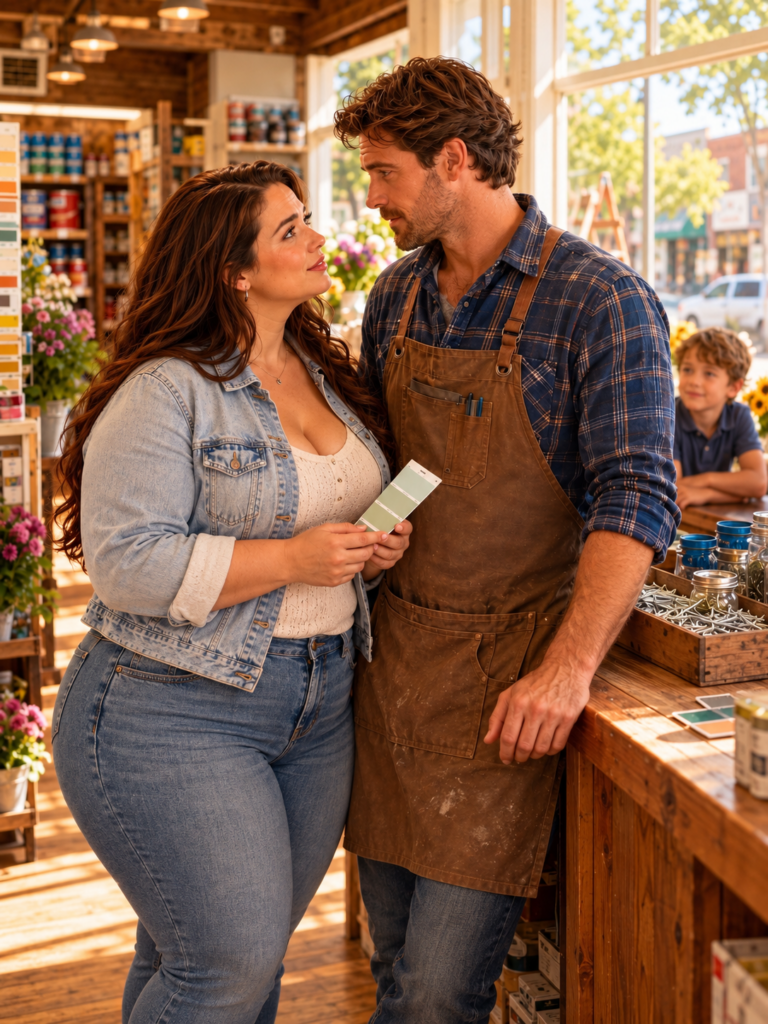
Clare Bennett asked me in the paint aisle on a Wednesday afternoon.
She was holding a blue-gray color swatch she wasn’t looking at. Her fingers had bent one corner nearly in half.
“Dean,” she said, “can you be the father of my baby for one day?”
I set down the box of cabinet hinges I was carrying.
I’d known Clare four months.
Long enough to know she took her coffee black with one sugar. Long enough to recognize the sound of her laugh from the front of the store when I was in the stockroom. Long enough to know that when she was worried, she tucked loose strands of dark hair behind her ear even though they fell right back out again.
Not long enough for that question.
“Only if you tell me why.”
Three years before, a doctor had sat across from me in a room that smelled like disinfectant and told me I wasn’t going to become a father the ordinary way.
Eleven months after that, my wife left.
Now Clare stood in my paint aisle asking me to become one for a morning.
What I didn’t know yet was that she would give me three answers over the next year.
Each would be more true than the last.
And the truest answer wouldn’t come from her.
It would come from a little boy sitting on my father’s old stool behind the register.
My name is Dean Whitaker. I was thirty-four then, owner of Whitaker Hardware on Main Street in a central Ohio town with four thousand people and enough interest in high school football to put Friday-night scores on the bank marquee before they put up the interest rates.
My father opened the store in 1986.
I grew up in it.
I learned fractions from socket sizes and multiplication by counting boxes of nails. I knew which floorboard squeaked near plumbing and which customers would stand at the register telling you about their knees for twenty minutes before remembering why they’d come in.
Dad died when I was twenty-six.
He left me the building, the business, and thirty years’ worth of habits I used to think were mostly stubbornness.
He wasn’t affectionate. He wasn’t much of a conversationalist either. Forty words from him on a weekday meant something unusual had happened.
But he had one sermon.
When I was about fifteen, a kid came into the store pushing a bicycle with the chain hanging loose. Dad stopped stocking shelves and went outside.
I watched him spend twenty minutes kneeling on hot concrete, getting grease on his hands, fixing a bike for somebody who wasn’t buying anything.
When he came back in, I told him we had paying customers.
Dad looked at me like he was deciding whether I was worth explaining something to.
“Anybody can sell a man a hammer, Dean.”
He pointed toward the door.
“The job is being here. Same place, same hours, every day. Then when somebody needs somebody, they know where to find one.”
He picked up his box again.
“Showing up is the whole trade, son. Everything else is inventory.”
At fifteen, I thought that was the kind of thing a man said when he didn’t want to admit he’d wasted twenty minutes fixing a bicycle for free.
At thirty-four, I had become him without noticing.
I opened at seven.
Closed at six.
Same place. Same hours.
That routine became especially useful after Rachel left.
Rachel and I married when I was twenty-eight. We wanted children almost immediately.
For two years, wanting them was easy.
Then wanting became calendars and appointments and private disappointments. Eventually we sat in a doctor’s office and found out why nothing had happened.
It was me.
We tried other roads. None led anywhere.
I remember one night near the end sitting across from Rachel at our kitchen table. She looked at me with an expression I had prepared myself to resent.
But there wasn’t anger in it.
There was grief.
That was worse.
She was grieving children who had never existed, and whatever I told myself afterward, some part of me believed I was the reason.
She left eleven months later.
Within two years, she had remarried a man in Columbus.
Last I heard, they had three children.
I never hated her.
She wanted motherhood more than she wanted the marriage we had left. There wasn’t anything pretty about knowing that, but there was something honest in it.
Afterward, I stopped dating.
It wasn’t dramatic. I didn’t swear off women or drink myself stupid or become the bitter guy at the end of the bar.
I simply stopped making openings.
I had Whitaker Hardware.
I had an empty house five blocks away.
I had people who needed furnace filters, washers, extension cords, snow shovels, plumbing tape, and advice about why their bathroom sink was making that noise.
I called that a life.
Then Charlie Bennett walked in.
He was six.
School ended at 3:15. His mother worked at Franklin Insurance two doors down until five. Clare had arranged a complicated rotation of favors until September, when one favor disappeared and another became unreliable.
So one afternoon, Charlie stood inside my front door with his backpack on.
He was small for six, with a cowlick that apparently answered to no human authority and sneakers splitting at one toe.
“You lost?” I asked.
“My mom said wait here.”
“All right.”
That was our entire first conversation.
He remained by the door twenty minutes, like moving farther into the store might violate some law nobody had explained to him.
He didn’t touch anything.
Didn’t ask for anything.
Didn’t sit.
The next afternoon, I brought out my father’s stool from the stockroom.
Dad had sat on it behind the register for thirty years. The wooden seat was rubbed smooth and one rung had been repaired so many times it was more glue than wood.
I placed it behind the counter.
“That’s yours.”
Charlie stared at it.
“Mine?”
“From 3:15 until five.”
He climbed onto it carefully.
That was the beginning.
The following week, somebody dumped a coffee can of mixed screws on my counter. I put three empty jars beside Charlie.
“Wood screws. Sheet metal. Drywall.”
He examined the pile.
“I don’t know which is which.”
“Neither did I once.”
I showed him.
For the next two hours he sorted screws with his tongue sticking slightly out one side of his mouth, displaying the concentration of a surgeon working without anesthesia.
A week later, I made him a name badge.
We had an engraving machine in the back for employee tags.
I punched out:
CHARLIE
ASSISTANT MANAGER
I clipped it to his shirt.
The kid looked down at that piece of plastic as if somebody had pinned a medal on him.
Clare told me later that he wore it to school.
Then every day after that.
Once, apparently, he fell asleep with it still attached to his pajamas.
By October, we had a routine.
The bus stopped.
Charlie came in.
His backpack went under the register.
His backside went on the stool.
He told me about school while I handed him harmless jobs invented largely for the purpose of giving him something to do.
Count washers.
Straighten paint cards.
Check whether the price stickers on the batteries matched the sheet.
Absolutely do not touch the box cutter.
That last rule required frequent reinforcement.
At five, Clare came through the door.
And every day she apologized.
“Dean, I’m sorry. He has to be in your way.”
“He’s not.”
“I’m going to figure something else out.”
“Why?”
“Because you run a business.”
“Exactly. He’s the only employee I have who doesn’t steal.”
That got the first real laugh I ever heard from her.
It surprised both of us.
Clare covered her mouth.
I looked down at the receipt tape I was changing and pretended something about it required my full attention.
That night I remembered the laugh while eating leftover chili alone in my kitchen.
That irritated me.
Not because there was anything wrong with Clare.
That was the problem.
There wasn’t.
She was thirty-two. Dark hair usually twisted into a clip. Practical shoes. Fast walk. Always carrying too many things.
There was something about her I started noticing before I gave myself permission to call it noticing.
The way she checked Charlie’s coat zipper without interrupting whatever conversation she was having.
The way she always asked if I wanted coffee when she bought one for herself.
The way she smiled at customers she clearly didn’t have time for because she seemed constitutionally incapable of making another person feel like a burden when she knew exactly what it felt like to be one.
She had raised Charlie alone since he was two.
I never asked about his father.
Dad taught me another rule without ever saying it: if a person wants you to know their business, they will tell you.
Four months passed.
Then came the Wednesday in the paint aisle.
Charlie was already on his stool when Clare arrived early.
Instead of going to him, she found me in aisle four.
She picked up the color swatch.
Then she asked me to be her son’s father for one day.
“Only if you tell me why,” I said.
She breathed out.
“His school has something Friday morning. Donuts with Dad.”
I knew exactly what that was.
When I was a kid, my school held it too.
My father opened the hardware store at seven. Donuts with Dad started at seven-thirty.
Both years, he locked the front door again, taped a handwritten BACK AT NINE sign to the glass, and came to school.
He sat in a plastic chair built for somebody half his size and ate a powdered donut while I talked about nothing.
At the time, I barely understood the sacrifice.
Dad never mentioned the money he lost that morning.
He just came.
Clare was watching me.
“He’s the only one,” she said.
“What?”
“There are twenty-two kids in his class. Every one of them has somebody coming. Dad. Grandpa. Uncle. Stepdad. Somebody.”
Her voice weakened.
“Charlie doesn’t.”
She pressed the paint sample against her mouth.
“I don’t have a father anymore. No brothers. Nobody. And I can’t go because…”
“Because it’s Donuts with Dad.”
She nodded.
“There’s no man in his life except—”
She stopped.
“Except me,” I said.
Her eyes lifted to mine.
She nodded again.
That was answer number one.
I said yes.
There wasn’t even a decision.
And what I felt afterward surprised me.
Not awkwardness.
Not pity.
Gratitude.
A doctor had once told me I would never be a father. I had carried that sentence for three years as if it described not just biology but the boundaries of my entire future.
Then a woman with trembling hands walked into my paint aisle and asked me to borrow the title for one morning.
It felt like somebody handing water to a man who hadn’t understood how thirsty he was.
“I’ll close the store,” I said.
Her head snapped up. “Dean, you can’t close the store.”
“My dad did.”
“What?”
“For mine.”
Her face changed.
Something softened there.
Not romance.
Not yet.
Something smaller and more dangerous.
Trust.
Friday morning, I taped a sign to the hardware-store door.
OPEN AT NINE.
Then I drove to Charlie’s school in a clean shirt.
At seven-thirty, I folded myself into a first-grade chair with my knees somewhere near my shoulders.
Charlie sat beside me wearing his assistant-manager badge.
A chocolate donut rested on my paper napkin.
I had been there four minutes when I realized something was wrong.
The other kids knew who I was.
Not personally.
They knew about me.
A boy beside us leaned over.
“Are you Charlie’s dad from the hardware store?”
I glanced at Charlie.
“I’m Dean.”
“Charlie says you have a machine that makes name tags.”
“We do.”
Another boy turned around.
“He says you let him use the box cutter.”
“No.”
Charlie studied his donut.
“Absolutely not,” I added.
A girl across the table frowned at the boys.
“Charlie said his dad was coming. Everybody said he was lying.”
I stopped moving.
Charlie didn’t.
He took another bite.
His back was perfectly straight.
Badge clipped to his shirt.
Face shining.
Proud.
And suddenly I understood.
He had been talking about me.
For months.
The store.
The stool.
The screw jars.
The engraving machine.
Every detail was true.
The only thing different was the word he used for the man in the story.
I made it through the breakfast.
I don’t remember how.
At 8:15, I sat in my truck with both hands gripping the steering wheel.
Then I cried harder than I had at my father’s funeral.
A knock sounded against the passenger window.
Clare stood outside.
One look at my face and she knew.
I opened the door.
“You knew.”
Her eyes filled immediately.
“Yes.”
That was when she gave me the second answer.
Part 2
We stood in an elementary-school parking lot while parents drove around us and children carried paper napkins full of leftover donuts toward minivans.
Clare wiped at her face with her sleeve.
“His teacher called me in October.”
I waited.
“She was worried because Charlie kept talking about his dad. She knew there wasn’t one around, so she thought maybe he was inventing somebody. Coping somehow.”
Clare gave an embarrassed little shake of her head.
“I sat him down that night. I asked him to tell me about his dad.”
My throat tightened.
“And?”
“It was you.”
She looked at me.
“Every word, Dean. The hardware store. Sorting screws. Your stool. The badge. You telling him he couldn’t touch the box cutter. You buying him hot chocolate when the bus was late that one afternoon.”
I looked away.
“I’ve known since October,” she whispered. “I should’ve told you.”
“Why didn’t you?”
“Because I didn’t know how.”
A tear slipped down her cheek.
“And because he was happy.”
She laughed once, miserably.
“I kept thinking I’d correct him tomorrow. Then tomorrow came, and he’d run into the store like it was the best part of his day, and you’d already have some ridiculous job ready for him.”
“They’re essential operations.”
That made her laugh through the tears.
Only for a second.
Then she shook her head.
“I was ashamed. I thought you’d feel used.”
I didn’t.
I felt something far more frightening.
Chosen.
Clare hadn’t asked me to breakfast because I happened to be the nearest available man.
She had asked because her six-year-old son had already assigned me the part.
I had spent years believing fatherhood was a locked room.
Charlie had apparently walked in, sat on a stool, and decided the door had never been locked at all.
By Sunday, half the town had heard about Donuts with Dad.
By Monday, the story had reached Trent Bennett.
Charlie’s biological father lived two towns over.
Thirty-five minutes away.
That distance became important to me.
Thirty-five minutes.
He had left when Charlie was two.
He had remarried. Had another baby.
In four years, he had not once driven those thirty-five minutes to see his son.
On Monday afternoon, he did.
He entered my store around four.
Big man. Heavy work jacket. Sunglasses pushed onto his head despite the fact that we were indoors in February.
Charlie was sitting behind the register.
When he saw Trent, his entire body changed.
That was what I noticed first.
He became smaller.
Not physically.
A child knows how to disappear without moving.
His shoulders curled. His eyes dropped.
Six years old, and he already understood that sometimes safety meant taking up less space.
“Charlie,” I said, “go count the paint stirrers in back.”
He looked at me.
“All of them?”
“Every last one.”
There were maybe eight hundred.
He nodded seriously and disappeared.
Trent watched him go.
Then he looked at me.
“So you’re the guy.”
“I’m Dean.”
“You’re playing house with my son.”
I leaned one hand on the counter.
“No.”
He smiled without humor.
“You know what this looks like?”
He raised his voice.
There were two customers nearby. That was intentional.
“Thirty-four-year-old man. No wife. No kids of his own. Can’t have kids of his own.”
My fingers went cold.
“Everybody around here knows it. And suddenly this kid’s hanging around your store every afternoon. You give him a badge, give him little jobs. Now you’re showing up at his school pretending to be his father.”
His smile disappeared.
“He’s mine. You don’t get to take somebody else’s kid because you couldn’t make one.”
Every sentence contained enough truth to hurt.
That was what made it effective.
I couldn’t have children.
Charlie did spend afternoons in my store.
I had made him a badge.
I had gone to his school.
But facts become lies when you remove everything that gives them meaning.
His mother worked two doors down.
School ended at 3:15.
Her office closed at five.
A boy needed a safe place to wait.
Nobody else had been there.
Especially not Trent.
My hands were shaking.
I laid them flat on the counter.
“Where do you live?”
His expression changed.
“What?”
“How far from here?”
“That’s none of your—”
“Thirty-five minutes.”
He went still.
“I looked it up Saturday.”
Nobody in the store moved.
“You’ve had four years and thirty-five minutes of road.”
His jaw worked.
“You didn’t drive it for his birthdays. You didn’t drive it when he had pneumonia last winter and Clare slept three nights in a hospital chair.”
“That’s between me and—”
“You drove it today.”
I kept my voice low.
“Twelve hours after somebody told you a hardware-store owner ate a donut with your son.”
Trent stared at me.
“You’re not here because you miss Charlie.”
I let the words settle.
“You’re here because somebody else showed up, and now you have to look at what that says about you.”
His face reddened.
“You don’t want your son. You want not to be the man who left him.”
I nodded toward the windows.
“I can’t fix that. Nobody in this store can. Only thirty-five minutes of road can, and it’s been there the whole time.”
He threatened lawyers.
Custody.
Police.
Things angry men threaten when they discover noise isn’t the same as authority.
Then he left.
He never returned.
I took no satisfaction from that.
People sometimes want villains to be punished because punishment feels like an ending.
Trent disappearing again wasn’t justice.
It was another abandonment Charlie would eventually have to understand.
And before Trent left town, he did damage to someone else.
Clare came to my house that night.
It was after eleven.
When I opened the door, she stood on my porch wearing jeans, an old sweatshirt, and no coat despite the cold.
“He’s right,” she said.
“Come inside.”
“No.”
“Clare.”
“If I come inside, you’ll make coffee or find me a blanket or do something decent, and then I won’t say this.”
So I stepped outside instead.
She folded her arms around herself.
“People are talking.”
“They always are.”
“I let my son build a father out of a man who was being kind to him.”
I said nothing.
“What happens when this ends?”
The question landed harder than anything Trent had said.
“What ends?”
“This.”
She waved vaguely between us, toward Main Street, toward the store, toward all the afternoons behind the register.
“You meet somebody. Or you get tired of having us around. Or you realize Charlie isn’t yours and none of this is actually your responsibility.”
Her voice cracked.
“He’s six, Dean. He cannot lose a father twice.”
There it was.
Not distrust of me.
Fear with history behind it.
“I did this,” she said. “I let him call you that because correcting him hurt too much. I chose the easy thing. And now if you leave—”
I sat on the porch step.
After a moment, she sat beside me.
“My dad ran that store thirty years.”
She glanced over.
“He was not an easy man,” I said. “He wasn’t affectionate. If you told him you loved him, he’d probably ask whether your car needed oil.”
A reluctant smile touched her face.
“But every morning at seven, that door opened.”
I looked toward the dark street.
“Every kid in town knew it. If your bicycle chain came off, he was there. If your mother locked herself out, he was there. If you needed a tool you couldn’t afford, somehow there’d be a used one under the counter.”
I rubbed my hands together.
“He always told me showing up was the whole job.”
“I thought that sounded like a low bar when I was young.”
Clare watched me.
“It isn’t.”
I looked at her.
“It’s the only bar.”
Neither of us spoke for several seconds.
“Trent is his biological father,” I said. “He has thirty-five minutes of road.”
I nodded toward town.
“I’m nobody. I’ve got a stool.”
“You’re not nobody.”
“I’m not promising you forever tonight.”
That hurt her. I saw it.
So I kept going.
“Because promises are cheap. And I suspect people have made you plenty.”
Her eyes dropped.
“I’m telling you I’ll open the store tomorrow at seven.”
I paused.
“And I’ll open it the day after that.”
She stared at me.
“You’ve been opening it at seven for four months.”
“Yeah.”
Something moved between us then.
Not a kiss.
Not a declaration.
I think it was the first moment Clare believed that my quietness wasn’t distance.
It was simply how I stayed.
After that, things changed so gradually I couldn’t have told you when friendship became something more.
We were careful.
Painfully careful.
Charlie was never going to become the excuse for two lonely adults to confuse gratitude with love.
So nothing happened for weeks.
Coffee happened.
Mostly coffee.
Clare started coming five minutes early to pick Charlie up.
Sometimes ten.
She stood at the counter drinking coffee while I counted the register.
I learned that she hated bananas, liked thunderstorms, and always read the ending of a mystery novel early if the suspense got too bad.
She learned that I kept my father’s old coat hanging in the stockroom because I couldn’t bring myself to throw it away.
Then dinner happened.
Charlie stayed with Clare’s sister.
Clare and I ate at a restaurant twenty miles away because neither of us wanted the town watching.
She caught me checking the entrance.
“You think somebody followed us?”
“I think Mrs. Hanley would if she knew.”
Clare laughed.
I realized I had begun arranging my days around hearing that sound.
Then we went to a movie.
An actual theater.
When our hands touched reaching for popcorn, both of us jerked away like teenagers.
Neither mentioned it.
Those were not dramatic months.
That was the point.
Trust grew in ordinary places.
She started calling when the insurance office copier jammed because she knew I could usually fix things.
I started keeping an extra black coffee with one sugar on the counter around five.
She noticed the first time.
“Is that mine?”
“No. I’ve recently developed terrible taste.”
She took it anyway.
In February, my furnace quit.
Clare showed up carrying two grocery bags while I was elbow-deep in the basement unit.
“What’s that?”
“Food.”
“I have food.”
“You have mustard, eggs, and something in Tupperware old enough to vote.”
She filled my refrigerator while lecturing me.
I should have resented it.
Instead I found myself standing in the basement listening to her open cabinets upstairs and thinking that my house had not sounded occupied in years.
That frightened me enough that I barely spoke the rest of the evening.
Clare noticed.
She didn’t demand an explanation.
That made it worse.
Because restraint was one of the things I was beginning to love about her.
I wasn’t ready to use that word.
Then March came.
Charlie got strep.
Clare missed two days of work and slept almost none.
At ten one night, my phone rang.
She didn’t ask me for anything.
That was important.
She just said, “Are you awake?”
“Yes.”
“I’m sorry.”
“For what?”
“I don’t know. Calling.”
I could hear Charlie coughing in the background.
“I’ve got to go,” she said.
The line went dead.
Twenty-five minutes later, I stood on her porch with chicken soup from the diner and a bag of orange popsicles.
Charlie’s favorite.
Clare opened the door.
She looked exhausted.
Hair loose. Same sweatshirt I’d seen the day before. Dark circles under her eyes.
“You didn’t have to do that.”
“I know.”
Her face crumpled.
No warning.
No graceful single tear.
She broke.
Right there in the doorway.
I set the food down and waited.
I didn’t tell her everything would be fine.
Charlie had strep, not a terminal disease, but that wasn’t why she was crying anyway.
She was crying because for four years she had been the only adult awake when her son was sick.
The only one remembering medicine times.
The only one calculating missed wages.
The only one worrying whether a fever was ordinary or whether she should drive to the emergency room.
Eventually she wiped her face.
“God. Sorry.”
“For what?”
“I’m a lot.”
“You’re not.”
“Dean, I’m a single mother with a sick kid, no money to spare, and an ex who occasionally appears like a natural disaster.”
She laughed weakly.
“I am objectively a lot.”
I leaned against the counter.
“Clare, I own a hardware store in a town of four thousand people. I’ve been alone three years. A doctor told me I’d never have the family I wanted, and I responded by working six hundred hours a week and pretending shelving caulk was emotional fulfillment.”
She stared.
“You think you’re a lot?”
I pushed the soup toward her.
“I’m not a little. I’m just quiet about it.”
Her mouth trembled.
“I’m not here because you’re easy,” I said. “I’m here because it’s ten o’clock and you called.”
That was the first time I kissed her.
No music.
No candles.
A sick child coughed down the hall.
Snow tapped lightly against the kitchen window.
Both of us were exhausted.
I touched her face.
Paused.
She had time to step away.
She didn’t.
The kiss lasted maybe thirty seconds.
It changed everything.
When she pulled back, she rested her forehead against my chest.
“I’m scared of this.”
“Me too.”
“Don’t be somebody who leaves.”
I almost gave her a promise.
Instead I gave her the truest thing I had.
“Clare, I’ve never left anywhere in my life.”
She looked up.
“That’s basically my entire personality. It may be a documented flaw.”
She laughed against my shirt.
Wet.
Tired.
Beautiful.
And somewhere between that kitchen and the months that followed, I stopped being the man from the hardware store.
I became the person Clare called first.
Part 3
About a year after Donuts with Dad, the three of us were in my kitchen.
Charlie was seven.
He sat at the table doing math homework with the expression of a man personally betrayed by subtraction.
Clare and I were at the sink.
We weren’t touching.
We had gotten very good at standing almost close enough.
Charlie erased something violently.
Then, without looking up, he said, “Mom, when are you going to marry Dean?”
Clare dropped a plate into the sink.
It didn’t break.
Barely.
I turned around.
Charlie kept writing.
Clare stared at him.
Then at me.
Then back at him.
“Charlie.”
“What?”
“Put your pencil down.”
That got his attention.
He looked suspicious.
Clare dried her hands and sat across from him.
I knew instantly what she was doing.
It was the conversation she had postponed for a year and a half.
“Honey, we need to talk about something.”
Charlie looked at me.
“Am I in trouble?”
“No.”
“Did Dean tell you about the socket wrench?”
“What socket wrench?” I asked.
“Nothing.”
“Charlie.”
“Later,” Clare said.
He sighed.
She reached across the table.
“Dean is very important to us.”
I turned toward the sink because suddenly I felt as though I was trespassing on something private.
“He’s my friend,” Clare continued. “And we care about him very much.”
Charlie looked bored.
“But Dean isn’t your dad.”
The room changed.
Clare’s voice remained steady through sheer force.
“Your father is Trent.”
Charlie blinked.
“I know.”
Clare stopped.
“What?”
“I know Trent’s my dad.”
He frowned.
“I’m not a baby.”
I turned around.
Clare stared at him as though the boy had started speaking French.
“Then why did you tell everybody at school Dean was your dad?”
Charlie’s expression became pure seven-year-old frustration at adult stupidity.
“Because he is.”
“Charlie, you just said—”
“I know Trent’s my dad.”
She rubbed both hands over her face.
“Honey, you can’t have it both ways.”
“Why?”
“Because you can’t just pick a dad.”
Charlie looked directly at me.
Then he said the sentence that reorganized my life.
“Why not? He picked me first.”
I left the room.
I had to.
I stood in the hallway with one hand over my mouth.
For years I had measured fatherhood according to what my body could not do.
A medical result.
A failed treatment.
A marriage that hadn’t survived the grief.
I thought biology had issued a ruling.
Charlie had never understood the ruling.
He had simply walked into a hardware store one September afternoon because his mother needed him somewhere safe.
There was a stool.
A man behind a counter.
A jar of screws.
A badge.
Someone who noticed when his bus was late.
Someone who knew which popsicles he liked.
Someone who was there at 3:15 the next day.
And the next.
And the next.
Children understand consistency differently than adults do.
Adults listen to promises.
Children count appearances.
Charlie had counted mine.
When I returned to the kitchen, Clare was crying.
Charlie looked alarmed.
“I didn’t mean to make everybody sad.”
“You didn’t,” I said.
He pointed at us.
“You’re both crying.”
“Adults do that.”
“Why?”
“No idea.”
That seemed to satisfy him.
He picked up his pencil.
“Can you help me with number twelve?”
I sat beside him.
“What is it?”
“Fractions.”
Finally.
Something I understood.
Clare watched us from across the table.
Later, after Charlie was asleep, she found me on the back steps.
Cold air moved through the yard.
She sat beside me.
For a while neither of us spoke.
Then she said, “He picked you first.”
I laughed quietly.
“Apparently.”
“No.”
She turned toward me.
“I mean it.”
I looked at her.
“I think I did too.”
That scared me more than Charlie’s sentence had.
Clare looked down at her hands.
“I didn’t know it then. In the paint aisle.”
“You needed somebody for breakfast.”
“I told myself that.”
She smiled faintly.
“But there were other people I could have asked.”
I said nothing.
“I could have asked a coworker. A neighbor. One of the dads from school. Somebody’s husband.”
“Would’ve been awkward.”
“It was already awkward.”
“Fair.”
She bumped her shoulder lightly against mine.
“I asked you because Charlie trusted you.”
She paused.
“And because I did.”
There it was.
The third answer, or maybe the beginning of it.
Not romance first.
Trust first.
That mattered to both of us.
We got married the following fall.
Backyard ceremony.
Forty people.
Clare’s sister cried from the moment the chairs were put out until somebody packed them away.
Charlie was my best man.
Eight years old.
Clip-on tie.
Dead serious.
He carried the rings in his jacket pocket and checked for them so often I thought he might wear a hole through the fabric.
Five minutes before the ceremony, he appeared in the room where I was getting ready.
“Dean.”
“What?”
“I made you something.”
He held out a name badge.
Same kind I had made him years before.
The letters were slightly crooked.
It said:
DEAN
DAD
I couldn’t speak.
Charlie frowned.
“You don’t like it?”
I crouched in front of him.
“You made this?”
“By myself.”
“You’re not supposed to use that machine without me.”
His eyes widened.
“Are you going to fire me?”
“Possibly.”
He grinned.
I clipped the badge to my shirt beneath the boutonniere.
“Looks good,” he said.
“Yeah.”
My voice failed.
“Looks perfect.”
The adoption went through the following spring.
Trent signed the papers.
He didn’t fight.
He didn’t attend the hearing.
I wish I could say I felt nothing toward him.
That would be simpler.
I mostly feel sadness.
Because he possessed, without effort, the one thing I once believed I would give almost anything to have.
A son.
And he never understood the value of what he had been given.
I used to think that made him powerful.
Later I understood it made him poor.
Charlie is twelve now.
He works Saturdays at Whitaker Hardware.
Actual employee.
Actual paycheck.
Technically assistant manager, although his record on screw sorting has declined dramatically and I threaten termination at least twice a month.
My father’s stool is still behind the register.
So is the engraving machine.
And the badge Charlie made me is still pinned to my work shirt.
Customers ask about it.
I tell them my assistant manager made it.
Sometimes people hear this story and think it’s about fate.
Maybe.
But I don’t think fate explains most of it.
Nothing grand happened at the beginning.
A single mother’s workday ended an hour and forty-five minutes after her child’s school day.
That was the problem.
A boy needed somewhere to wait.
I had a store.
He needed something to do.
I had screws.
He wanted to belong somewhere.
I had an old stool and a cheap plastic badge.
And because none of those things looked important at the time, I almost missed what they were becoming.
Clare came down the paint aisle and asked me to be a father for one day.
I told her she had to tell me why.
The first answer was simple.
Her son had a school breakfast.
Twenty-one other children had somebody coming.
Charlie didn’t.
So she asked me.
True.
But not the whole truth.
The second answer came in a school parking lot.
She had known for months that Charlie was telling people about his father.
He described the hardware store.
The stool.
The screws.
The name badge.
Me.
Clare hadn’t chosen me because there was no other man available.
She had chosen me because Charlie already had.
Truer.
Still not everything.
The final answer came from a seven-year-old holding a pencil at my kitchen table.
You can pick.
His mother told him you couldn’t.
He looked at me.
Why not?
He picked me first.
For most of my life, I misunderstood something my father had been trying to teach me.
He spent thirty years in the same building.
Same place.
Same hours.
I used to think his life was small.
Then I became him.
After Rachel left, I believed mine was small too.
A man alone in a building full of objects other people needed.
I thought staying in one place meant I had failed to go somewhere larger.
But a fixed point has value.
Sailors navigate by things that stay where they are.
Children do too.
Trent could make a son.
He had.
Biology had given him something biology would never give me.
For years I thought that settled the matter.
It didn’t.
Because making a child and being where that child can find you are two different things.
One afternoon, a six-year-old came through my door.
I didn’t rescue him.
I didn’t change his life in some spectacular moment.
I gave him a place to sit.
Then I was there the next afternoon.
And the afternoon after that.
That was all.
At 3:15, the door was open.
The stool was behind the register.
I was where I had been yesterday.
Eventually, apparently, that became enough for a boy to build a father out of.
A doctor once told me I would never have children.
Within the limits of what he knew, he was right.
What neither of us understood was that fatherhood could arrive through the front door carrying a backpack, with a hole in one sneaker and an unauthorized interest in box cutters.
Clare asked me to be Charlie’s father for one day.
The funny part is, by then the decision had already been made.
Charlie had made it months earlier.
I was simply the last person to find out.
And my father, gone all those years, had given me the only instructions I ever needed.
Be there.
Same place.
Same hours.
Because sooner or later, somebody may need somebody.
And when they do, they should know exactly where to find you.
Showing up is the whole trade.
Everything else is inventory.


