
Part 1
The little girl had been staring at the red shoes for almost ten minutes.
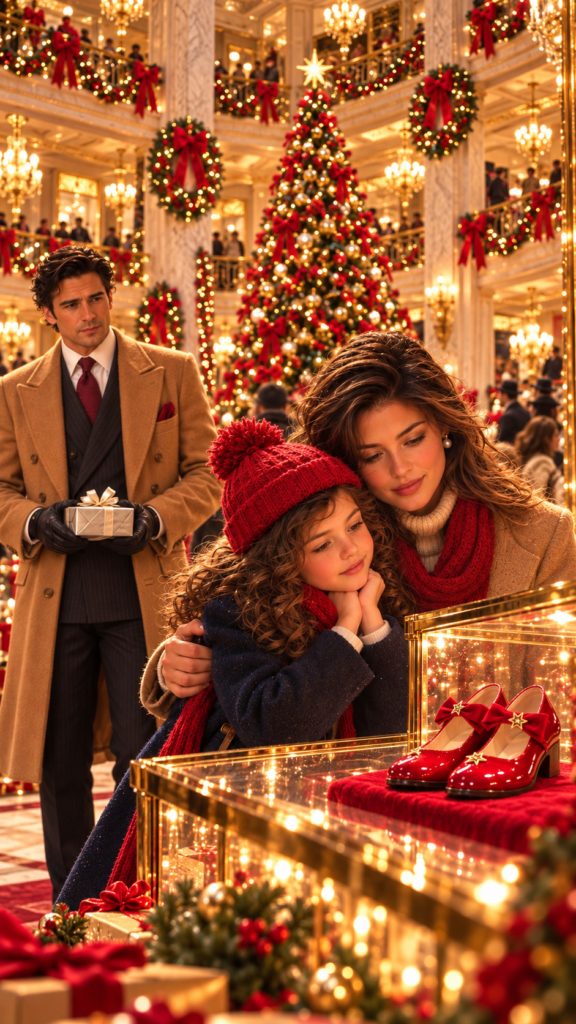
Behind the enormous glass display at Bergman’s department store on Fifth Avenue, beneath a Christmas tree that nearly touched the ceiling, sat a pair of children’s patent-leather shoes. Their bright red surfaces reflected the chandelier light. Tiny satin bows decorated the toes, and silver star-shaped buckles glittered against the velvet cushion.
The girl pressed her forehead against the glass.
“Mommy,” she whispered, “aren’t they beautiful?”
Her mother knelt beside her, gently pulling the girl’s knitted red hat over her ears.
“They certainly are, sweetheart.”
“Do you think someone will wear them for Christmas?”
“I’m sure someone will.”
The child glanced at the little price card.
Her mother saw the number, too.
Thirty-eight dollars.
For a woman who earned forty-two dollars a week, those shoes might as well have been diamonds.
She slipped an arm around her daughter’s shoulders.
“Not today, sweetheart,” she whispered.
The little girl didn’t complain.
She didn’t stomp her feet or ask why other children could have beautiful things while she couldn’t.
Instead, she reached into her coat pocket, pulled out a stub of a bus ticket and a short pencil, and began drawing the shoes.
A few feet behind them stood a tall man in an expensive camel-hair overcoat.
He had entered the store intending to buy another luxurious gift for someone who already had everything.
But watching a little girl carefully sketch something she knew she couldn’t own, Edward Hale suddenly forgot what he had come to purchase.
And for the first time in four years, the wealthy Manhattan developer felt something stir inside the part of his heart he had believed was permanently closed.
To understand why, the story must return to five o’clock that same morning.
It was December 1984, and New York City was settling into one of its coldest stretches of the Christmas season.
The streets were still dark when twenty-eight-year-old Anna Kowalski pushed open the back door of Novak’s Bakery on Ninth Avenue.
Inside, the ovens were already burning.
The familiar smell of rye bread, yeast, sugar, and warm flour greeted her before she could remove her scarf.
“Morning, Anna,” Mr. Novak called from beside the ovens.
“Morning. Are the rye loaves ready?”
“Almost. You can start the poppy-seed rolls.”
Anna hung her worn coat on its usual hook, tied her apron around her waist, and went to work.
She had worked at Novak’s for six years.
Her hands knew the motions better than her mind did: fold, press, turn, shape. She could braid dough while calculating expenses, decorate pastries while remembering a grocery list, and recognize when a loaf was ready simply by listening to the sound it made when tapped.
At seven, the first customers arrived.
Bus drivers finishing their night routes. Nurses whose shifts had ended at dawn. Elderly neighbors who bought one roll, settled beside the counter, and took their time reading the newspaper.
Anna knew most of them by name.
They knew her as the young widow-like woman who always had flour on her sleeves and a smile waiting, even when she looked exhausted.
She wasn’t actually a widow.
Sometimes she thought that might have been easier to explain.
Her husband had walked out four years earlier, when their daughter was two.
He had kissed little Rosie on the forehead, told Anna that Chicago offered better work, and promised to write as soon as he found a place to stay.
No letter ever came.
For several months, Anna had watched the mailbox with a kind of hope that embarrassed her now.
Then one morning, while dressing Rosie for the day, she realized she had been waiting for a man who had already made his choice.
She stopped waiting.
Instead, she made a promise to herself.
Rosie would never grow up believing she was only half of a family.
Anna might not be able to give her everything, but she would give her a childhood filled with love, security, and the certainty that someone would always come home.
Keeping that promise required nearly every dollar she earned.
Forty-two dollars a week covered the rent on their small third-floor apartment on West Forty-Seventh Street, a few necessities, and installments on Rosie’s winter coat.
Mr. Novak allowed Anna to take home bread and milk without paying. She had resisted at first, but he insisted it was better than throwing away perfectly good food.
Anna accepted because she worked hard for him.
She refused to think of it as charity.
On this particular Saturday, she finished at eleven.
And Rosie was waiting.
The six-year-old stood by the bakery counter wearing her favorite red knitted hat, her dark curls escaping in every direction. Serious brown eyes watched Anna count her final change.
“Is it time?”
Anna smiled.
“Time for what?”
Rosie looked scandalized.
“Mommy!”
“Oh, that’s right.” Anna pretended to remember. “Our very important appointment.”
Rosie nodded solemnly.
“With the Christmas tree.”
Every December, mother and daughter had a tradition.
They took the bus to Fifth Avenue, walked past the decorated shop windows, and visited the enormous Christmas tree inside Bergman’s department store.
They never bought anything.
They didn’t need to.
For half an hour, beneath the chandeliers and among the marble floors and glittering ornaments, Rosie could imagine herself in a magical world where dresses shimmered, dolls lived inside little houses, and Christmas seemed capable of making anything happen.
Anna loved those afternoons almost as much as Rosie did.
They cost only the bus fare.
And when money was scarce, free happiness mattered.
Rosie carried a pencil everywhere.
She drew on paper bags from the bakery, the backs of old newspapers, and occasionally on surfaces Anna would rather she hadn’t.
Once, Anna discovered an elaborate evening gown sketched directly onto the wallpaper beside Rosie’s bed.
“Rosie!”
Her daughter had looked at the drawing, then at her mother.
“But Mommy, the wall was so empty.”
Anna had tried very hard not to laugh.
Rosie loved drawing dresses.
Long dresses with bows, short dresses with buttons, wedding dresses with sweeping trains. Dresses for princesses, teachers, shopkeepers, and the elderly woman who lived downstairs.
Every design had a purpose in her imagination.
She didn’t merely want beautiful clothes.
She wanted to make beautiful clothes for people.
Across Central Park, in a spacious Park Avenue apartment, Edward Hale was preparing for an entirely different morning.
At thirty-eight, Edward had built one of Manhattan’s most successful property development companies.
His name appeared on contracts involving apartment buildings worth millions. Architects listened carefully when he spoke. Bankers returned his calls. City officials recognized him before he introduced himself.
Yet his home was so quiet that he often left the radio playing in rooms he wasn’t using.
Four years earlier, his wife, Helen, had died after an illness doctors had failed to identify in time.
Edward had spent months revisiting every appointment, every conversation, every unexplained symptom.
There was nothing he could do to change the outcome.
So he had returned to work.
Twelve hours a day.
Sometimes fourteen.
He attended meetings, reviewed building plans, negotiated financing, and returned to an apartment where nobody asked whether he had eaten dinner.
His housekeeper occasionally left fresh flowers in the sitting room.
Edward rarely noticed them.
That morning, standing before his closet, he remembered something he should have remembered weeks ago.
His mother’s birthday was Sunday.
Margaret Hale would be sixty-six.
She belonged to an old New York family that considered good manners an obligation and emotional declarations an unnecessary indulgence.
Margaret wore pearls to breakfast and had an extraordinary ability to make disapproval sound like a polite observation.
Every year, Edward bought her an expensive gift.
A bracelet. A silk scarf. A crystal vase.
Every year, she thanked him graciously, placed the gift in a cabinet, and seldom touched it again.
He knew the routine.
So did she.
Nevertheless, he called for his driver and asked to be taken to Bergman’s.
At precisely noon, Edward approached the revolving doors of the department store.
At the same moment, Anna arrived with Rosie.
The three nearly collided.
“Oh!” Anna stepped back quickly. “I’m sorry. Please, go ahead.”
Edward moved aside.
“No, please. After you.”
Anna hesitated.
He gave a small, exaggerated bow, one hand extended toward the door.
“Madam.”
Rosie’s eyes widened.
Then, gathering the sides of her little coat like a ballroom skirt, she returned his bow with all the seriousness of a princess greeting a royal guest.
Edward laughed.
It was a full, surprised laugh that escaped before he could control it.
Anna smiled.
She had a warm, slightly tired smile, the sort that suggested a person who had endured much more than she ever discussed.
For a moment, Edward forgot the noise of Fifth Avenue.
Then Anna took Rosie’s hand and went inside.
Edward watched them disappear into the crowd.
Upstairs, in the gift department, a saleswoman presented him with several possibilities.
Fine leather gloves.
Decorative pins.
An enamel music box.
Edward examined everything with practiced politeness.
None of it seemed right.
Eventually, he chose a silver brooch shaped like a bird.
It was elegant, costly, and perfectly suited to his mother’s taste.
He also knew exactly where it would end up.
The cabinet.
With the bracelet and the scarf.
He was descending the marble staircase with the wrapped box beneath his arm when he noticed the red hat again.
The little girl from the revolving doors stood near the great Christmas tree, her nose almost touching the children’s shoe display.
Her mother was beside her.
Edward slowed.
He saw the shoes.
He saw the price.
Then he heard Anna speak.
“Not today, sweetheart.”
There was no sharpness in her voice.
Only quiet regret.
Rosie nodded.
“I know, Mommy.”
She took out her pencil.
“I’m just drawing them so I don’t forget.”
Edward remained where he was.
He could have walked on.
He had passed hundreds of expensive displays without a second thought. He had purchased jewelry that cost more than the monthly rent of entire apartment buildings. Thirty-eight dollars was an amount he might spend without remembering it.
But something about the child stopped him.
She wasn’t begging.
She wasn’t crying.
She was preserving the memory of something she loved, as though a drawing could be enough.
Edward approached slowly.
“Excuse me.”
Anna turned, immediately recognizing him.
“The gentleman from the doors.”
“Edward Hale,” he said.
“Anna Kowalski. And this is Rosie.”
Rosie lifted her bus ticket.
“Would you like to see?”
Edward crouched until he was level with her.
The drawing was surprisingly detailed.
Rosie had captured the shape of the satin bows, the tiny star buckles, even the bright curve of reflected light across the patent leather.
Edward studied it with the same attention he gave architectural plans.
“Miss Rosie,” he said at last, “I think you’ve improved on the original.”
Rosie blinked.
“Really?”
“Look at this bow. Yours has more personality.”
She beamed.
Edward stood and turned toward Anna.
He could see that her coat was old, that her gloves had been carefully repaired, and that the red scarf around her neck had probably survived several winters.
But he also saw how firmly she held herself.
He chose his words carefully.
“Mrs. Kowalski, I’ve spent this morning shopping for a birthday present for my mother.”
Anna waited.
“I buy her something expensive every year. She thanks me, and then the gift disappears into a cabinet. It’s become a rather unfortunate tradition.”
A faint smile touched Anna’s mouth.
“My daughter has been looking at those shoes as though they’re the most wonderful things in New York. I don’t believe I’ve ever seen anyone appreciate a pair of shoes quite so much.”
Anna glanced at the display.
Edward continued.
“I’d like to buy them for her.”
Her expression changed immediately.
“Oh, no. That’s very generous, but we couldn’t possibly—”
“I understand.”
He didn’t interrupt again.
He simply waited.
Then he said, more softly, “I’ve bought a great many things in my life, Mrs. Kowalski. But I don’t think I’ve ever given anyone something that felt like a small miracle.”
Anna’s throat tightened.
“I don’t want her to think strangers are supposed to buy her things.”
“Neither do I.”
“Or that she should expect—”
“She doesn’t appear to expect anything,” Edward said gently. “That’s part of why I’m asking.”
Anna looked toward Rosie.
Her daughter was standing perfectly still, clutching the bus ticket with both hands.
Edward had not gone around Anna.
He had not ordered the saleswoman to bring the shoes.
He had asked.
And he seemed prepared to accept whatever answer she gave.
Finally, Anna nodded.
“All right.”
Rosie’s breath caught.
“But,” Anna added, turning back to Edward, “I would like to give you something in return.”
Edward looked surprised.
“I work at Novak’s Bakery on Ninth Avenue. I can make your mother a birthday cake. A Polish honey cake, from my grandmother’s recipe.”
“A cake?”
“Seven layers. Honey and cream. Walnuts on top.” Her smile grew. “I promise it’s better than anything you’ll find upstairs.”
Edward looked at her for a moment.
Then he smiled.
“I have a feeling that will be the first birthday present my mother doesn’t put in her cabinet.”
The saleswoman brought the shoes in a white box lined with tissue paper.
Rosie sat on a velvet bench beneath the Christmas tree.
Edward knelt on the polished marble floor, his expensive camel-hair coat gathering around his knees, and carefully removed her worn brown shoes.
He slipped the bright red shoes onto her feet.
Fastened the little star buckles.
Made certain the straps sat comfortably.
Then he stood.
Rosie took three tentative steps.
The shoes flashed beneath the chandeliers.
She looked down.
Turned slightly.
Looked again.
She didn’t speak.
Her face held such astonished happiness that Anna knew she would remember it for the rest of her life.
And Edward, watching the child, felt something he had not experienced since Helen’s death.
The uncomplicated pleasure of having made another person happy.
That evening, Rosie refused to put the shoes away.
Anna suggested keeping them safe in their box.
Rosie shook her head.
“Then I can’t see them.”
“Beside your bed?”
“What if it’s dark?”
Eventually, they found a place on the bedroom windowsill, between a small cactus and the glass.
The streetlamp outside cast a soft glow across the red leather.
Rosie fell asleep looking at them.
Anna remained awake long afterward, sitting in the kitchen with a cup of tea.
She kept remembering Edward kneeling on the department store floor, carefully fastening her daughter’s shoes.
She remembered his voice.
The way he had asked permission.
The way he had looked directly into her eyes instead of letting his attention settle on her worn clothes.
It was a kind act, she told herself.
Nothing more.
By Christmas, he would probably have forgotten their names.
At four the next morning, Anna returned to Novak’s Bakery.
She worked slowly and carefully, preparing seven delicate layers of cake, spreading honey and cream between them, and decorating the top with walnuts.
Her grandmother had taught her the recipe years ago in Krakow.
Anna remembered watching those older hands move over the dough, patient and precise.
This time, she made every layer as perfect as she could.
She couldn’t afford a silver brooch.
But she knew how to create something worth giving.
At eleven, a black car stopped outside Novak’s.
Edward stepped out wearing the same camel-hair coat.
The bakery was crowded.
Bus drivers, elderly women, a policeman, and two nurses were waiting at the counter.
Mr. Novak nearly dropped a tray when he recognized the visitor.
But Edward did not push ahead.
He joined the line.
When his turn finally came, Anna brought out the cake in a white box tied with string.
Edward lifted the lid.
For several seconds, he said nothing.
“It’s almost too beautiful to cut.”
Anna laughed.
“That’s what people always say. Then they finish it in ten minutes.”
Edward laughed with her.
Before leaving, he turned to Mr. Novak.
“I’d like to pay for hot rolls for everyone here. Coffee, too, if you have it.”
The old women applauded.
The policeman shook his hand.
And Anna watched the happiness spread through the bakery.
Edward wasn’t looking at her to see whether she was impressed.
He was simply enjoying the fact that people who had been standing in the cold now had something warm in their hands.
Somehow, that touched her more deeply than the shoes.
At the door, he stopped.
“Anna?”
“Yes?”
“May I see you again?”
She looked up.
“To thank you for the cake?” she asked.
“No.” He hesitated. “Just to see you.”
Anna felt warmth rise into her cheeks.
She wiped her hands on her apron.
“I finish at three on Wednesdays.”
Edward waited.
“And Rosie has never been ice-skating.”
His smile was immediate.
“Then perhaps Wednesday would be a good day to change that.”
That evening, Margaret Hale celebrated her sixty-sixth birthday in her Fifth Avenue dining room.
Twenty guests sat beneath crystal chandeliers while a string quartet played softly in the corner.
Silver candlesticks gleamed on the long table.
Edward presented his mother with the silver bird brooch.
“Oh, Edward. How lovely.”
She kissed his cheek.
He noticed that her eyes were already drifting toward the cabinet.
Then dessert arrived.
The seven-layer honey cake looked almost modest beside the family’s silver serving dishes.
Margaret took a small bite.
Then another.
She stopped talking.
Across the table, an elderly banker requested a second serving.
A judge’s wife wanted to know where the cake had been purchased.
Margaret, who had not finished an entire slice of birthday cake in twenty years, cleaned her plate.
“Edward,” she said, “where did you find this?”
“I didn’t buy it.”
Margaret looked up.
“A friend made it.”
There was something in his voice.
A softness she hadn’t heard in years.
Margaret knew her son too well to miss it.
She said nothing.
But she remembered.
On Wednesday afternoon, sunlight shimmered over the ice at Rockefeller Center.
Rosie stood near the railing in rented skates, gripping the barrier with both hands.
“I can’t do it!”
Edward glided toward her.
He looked rather distinguished in his dark suit and long coat, although Anna had already warned him that elegance might not impress a six-year-old learning to skate.
“Of course you can,” he told Rosie.
“My feet won’t listen.”
“Then perhaps they need a little encouragement.”
He held out both hands.
Rosie considered them suspiciously.
“What if I fall?”
“Then I’ll help you stand up.”
She took his hands.
Edward began skating backward, drawing her gently forward.
“Don’t stare at your feet. Look at me.”
She managed one step.
Then another.
On the third, she lost her balance and landed on the ice.
For one terrible second, Anna started forward.
Then Rosie burst out laughing.
Edward helped her up.
She fell again.
He helped her up again.
By the fifth attempt, she crossed several feet without falling.
“Mommy!”
Anna looked up from her hot chocolate.
“Mommy, look! I’m skating!”
Her voice echoed across the rink.
Edward was smiling as though he had just witnessed the greatest achievement of his life.
Anna stood at the railing watching them circle beneath the Christmas tree.
A tall, successful man.
A little girl with dark curls.
Two people laughing together as though they had always belonged in the same family.
She realized she was smiling at a man in a way she hadn’t smiled for four years.
When the skating ended, Rosie insisted on keeping her red shoes in her lap while Edward helped loosen her skates.
She wouldn’t put them on the bench.
Someone might take them.
Edward glanced at the shoes.
“Miss Rosie, what will you do with those when your feet grow too big?”
Rosie considered the question.
“I’ll keep them forever.”
“A sensible decision.”
“And when I’m grown up, I’m going to make shoes like these.”
Edward nodded.
“Are you?”
“Yes. And dresses to go with them. For all the little girls who stand outside store windows.”
Edward stopped untying the skate.
He studied her face.
There was no childish exaggeration in her voice.
She meant it.
“That sounds like a serious plan.”
Rosie nodded.
“Very serious.”
“Then you’re going to need proper equipment.”
He reached into his coat pocket and produced a small hardbound sketchbook.
From beside him, he lifted a box containing forty-eight colored pencils.
Rosie’s mouth opened.
She looked from the pencils to Edward, then back again.
“For me?”
“For your designs.”
She hugged the box to her chest.
Edward didn’t tell her she would become famous.
He didn’t promise her a future he couldn’t guarantee.
He simply treated her dream as something worth taking seriously.
And standing nearby, Anna realized that the most extraordinary thing about this wealthy stranger wasn’t how much money he had.
It was how carefully he listened.
For the first time, she allowed herself to wonder whether the afternoon at Bergman’s had been something more than a passing act of kindness.
Perhaps it had been the beginning of something neither of them had expected.
Something beautiful.
And something that would soon demand far more courage than either of them understood.
Part 2
In the weeks that followed, Anna discovered that Edward Hale was a man who understood the value of small gestures.
He didn’t arrive at the bakery every morning in his expensive car.
He didn’t send elaborate gifts or make grand declarations.
Instead, he began writing letters.
There was no telephone in Anna’s apartment, so he left cream-colored envelopes with Mr. Novak, who took his new responsibility with an air of exaggerated annoyance.
“Another letter for you,” he would grumble, handing Anna an envelope while pretending not to smile.
Sometimes Edward wrote about a building he had visited that morning.
Sometimes he described something ridiculous he had overheard on the street.
Once, he mentioned a song on the radio that had made him think of her.
Anna answered on pages torn from the little notebook she used for bakery orders.
Her handwriting was neat and practical.
She told him about customers, Rosie’s latest drawings, and the ordinary challenges of life in their neighborhood.
She was surprised by how much she enjoyed telling him about things that had never seemed interesting enough to mention before.
Edward, meanwhile, began looking forward to those letters more than he looked forward to signing another development agreement.
He read them at his desk, between meetings, sometimes smiling at remarks that nobody else in his office would have understood.
Anna didn’t flatter him.
She never asked about his fortune or seemed particularly interested in the buildings bearing his company’s name.
She wanted to know whether he had eaten lunch.
Whether he ever took an afternoon off.
Whether the man who spent his life designing places for people to live remembered how to enjoy living himself.
Those questions followed him long after he folded her letters away.
While their friendship deepened, Rosie found someone who would change the direction of her childhood.
Her name was Dolores Rivera.
Dolores was seventy years old and lived on the second floor of Anna’s building, directly beneath their apartment.
She had come to New York from Puerto Rico forty years earlier. For thirty of those years, she had worked in a Seventh Avenue dressmaking workshop, sewing wedding gowns and evening dresses for women whose names sometimes appeared in newspapers.
Now arthritis had twisted her fingers and made the simplest tasks painful.
But in the corner of her living room stood a black Singer sewing machine with gold lettering, polished and maintained like an old friend.
Rosie had heard the machine humming through the floorboards for as long as she could remember.
One afternoon, carrying her new sketchbook beneath one arm and wearing her beloved red shoes, she knocked on Dolores’s door.
“Mrs. Dolores?”
The elderly woman opened it.
“Rosie, sweetheart. What’s happened?”
“Nothing.”
“Then why do you look so serious?”
Rosie held up her sketchbook.
“I need to make a dress.”
Dolores raised an eyebrow.
“A dress?”
“To match my shoes.”
She opened the book to a drawing of a gown with a wide skirt and an oversized satin bow.
Dolores studied the page.
Then she studied Rosie.
“Who taught you to draw like this?”
“Nobody.”
“Nobody?”
Rosie shrugged.
“I just look at things for a long time.”
Dolores turned another page.
There were drawings of collars, sleeves, buttons, and complicated folds of fabric.
The proportions were imperfect, but the ideas were remarkably clear.
For several moments, Dolores said nothing.
Then she pulled a little chair beside the Singer machine.
“Come here, niña.”
Rosie hurried inside.
“Are you going to teach me to make a dress?”
“Eventually.”
Dolores picked up a needle.
“First, I’m going to teach you how to sew a button.”
Rosie looked disappointed.
“A button?”
“If you can’t sew a button, you have no business making a dress.”
She placed a scrap of red fabric in front of the child.
“And after the button, we’ll learn a straight seam. After that, we’ll see what kind of dressmaker you might become.”
Rosie spent the next hour working on one crooked button.
When Anna came looking for her, she found her daughter seated beside Dolores, tongue caught between her teeth, concentrating so fiercely that she barely noticed the door opening.
The button was far from perfect.
Rosie looked delighted.
“Mommy! I made it stay!”
Anna examined the fabric.
“So you did.”
Dolores looked over Rosie’s head and caught Anna’s eye.
There was affection in the older woman’s expression, but also something more serious.
She had recognized a spark in the little girl.
A talent that deserved patience.
Anna understood.
That evening, another cream-colored envelope waited at Novak’s Bakery.
Inside were three short lines.
Edward wrote that a concert and dancing were taking place at the Rainbow Room on Friday evening, high above Manhattan.
He would like to take her.
More than anything, he wrote, he would like the chance to dance with her.
Anna read the invitation three times.
Then she went home and opened her closet.
Two dresses hung inside.
Both were old.
Both had been repaired so many times that Anna knew every seam.
Neither seemed remotely appropriate for the Rainbow Room.
She sat on the edge of her bed with Edward’s letter in her hands.
It was a strange feeling, wanting to go somewhere badly enough that she felt almost foolish.
She had spent four years thinking about Rosie’s needs before her own.
Now a man was asking her to do something simply because it might make her happy.
Rosie found her sitting there.
“Mommy, what’s wrong?”
“Nothing, darling.”
Rosie looked at the open closet.
Then at the letter.
“Is it Edward?”
Anna smiled reluctantly.
“He’s invited me dancing.”
Rosie’s face brightened.
“That’s wonderful!”
“At the Rainbow Room.”
“Is that a nice place?”
“A very nice place.”
“Then why are you sad?”
Anna glanced toward her dresses.
“I don’t have anything suitable to wear.”
Rosie considered the problem for approximately five seconds.
Then she marched out of the apartment.
“Rosie?”
“I know what to do!”
She went straight downstairs.
Dolores was drinking coffee when Rosie arrived.
“My mommy has to dance on Friday,” Rosie announced.
Dolores set down her cup.
“Does she?”
“At the Rainbow Room. She doesn’t have a dress.”
Dolores watched the child’s anxious expression.
Then, very slowly, she stood.
“Come with me.”
From the back of a tall wardrobe, she removed a garment bag that had not been opened in decades.
Inside was an emerald-green silk dress.
Its waist was beautifully fitted, and the long skirt moved like flowing water when Dolores lifted it from the hanger.
Rosie gasped.
“It’s a princess dress.”
Dolores smiled.
“I wore it to my wedding in 1952.”
She ran her fingers across the silk.
“My husband told me I looked like a queen.”
For a moment, her eyes went somewhere far away.
Then she looked back at Rosie.
“It needs a few alterations. And these old hands can’t manage them alone anymore.”
Rosie stepped closer.
“I can help.”
Dolores smiled.
“Then you will be my hands, niña.”
For the next three evenings, the lights in Dolores’s apartment remained on until nearly midnight.
Anna stood on a chair while Dolores measured and adjusted the hem.
Rosie threaded needles, passed pins, pressed seams with an old heavy iron, and listened carefully as Dolores explained why fabric should fall a particular way.
When her fingers trembled, Dolores guided Rosie’s small hands.
When Rosie made a mistake, she showed her how to undo it without damaging the silk.
The little girl learned more in those three evenings than she had imagined it possible to learn about clothing.
And Anna, watching her daughter work with such concentration, felt an enormous quiet pride.
On the third night, Rosie suddenly disappeared upstairs.
She returned carrying a small piece of red satin from the lining of an old coat.
Dolores examined it.
“What are you planning?”
Rosie spread the fabric on the table.
“A bow.”
“A bow?”
“For Mommy’s dress.”
With Dolores’s guidance, Rosie folded and stitched the red satin into a small bow.
They fastened it at the waist of the emerald gown.
Rosie stepped back.
“Now it matches my shoes.”
She smiled with satisfaction.
“Now it’s a family dress.”
On Friday evening, a black car stopped outside the building on West Forty-Seventh Street.
Half the neighbors appeared at their windows.
Edward stood beside the car in a black dinner jacket, adjusting a cuff that didn’t need adjusting.
Then the front door opened.
Anna descended the steps wearing the emerald silk dress.
The little red bow rested at her waist.
Her hair was arranged simply, and she wore no expensive jewelry.
Edward forgot the greeting he had rehearsed.
For several seconds, he just looked at her.
“Anna…”
She stopped on the last step.
“Is something wrong?”
“No.”
He shook his head.
“Nothing at all.”
Then he smiled.
“You look magnificent.”
Anna blushed.
“Dolores made the dress. Rosie made the bow.”
“Then I owe them both a great deal.”
Anna looked at him uncertainly.
“Do you really think it’s appropriate?”
Edward offered his arm.
“I think the Rainbow Room has been waiting for you.”
The famous restaurant and ballroom occupied the sixty-fifth floor of Rockefeller Center.
When the elevator doors opened, Anna saw Manhattan stretched beneath the windows.
Millions of lights shimmered toward the rivers.
Crystal sparkled on every table.
An orchestra played near the rotating dance floor.
Anna had seen photographs of places like this.
She had never imagined entering one.
But as Edward escorted her inside, she lifted her head.
She wasn’t ashamed of her dress.
She wasn’t ashamed of the neighborhood she came from or the bakery where she worked.
She had earned her living with her hands, raised a daughter without help from the man who had abandoned them, and walked through years that would have defeated someone less determined.
There was nothing about her life that required apology.
Edward noticed the way she carried herself.
He had attended countless expensive dinners where people spent entire evenings trying to impress one another.
Anna didn’t try.
She was simply herself.
They ate a little and talked a great deal.
Eventually, Edward told her about Helen.
About the illness nobody had understood soon enough.
About how helpless he had felt watching his wife grow weaker while doctors searched for answers.
And about the terrible quiet that had followed her death.
“I thought if I kept working,” he admitted, “eventually I wouldn’t notice how empty everything was.”
“Did it help?”
“For a while.”
“And now?”
Edward looked at her across the table.
“Now I notice what I was missing.”
Anna lowered her eyes.
Then, after a moment, she told him about her husband.
The promise of work in Chicago.
The letters that never came.
The months she had wasted waiting for him.
“I finally decided Rosie and I would be enough,” she said. “I couldn’t spend the rest of my life hoping somebody else would come back and make our family whole.”
Edward listened.
“You were enough,” he said.
Anna looked up.
“You and Rosie. You still are.”
She tried to smile.
“That sounds very noble.”
“I’m not being noble.”
His voice softened.
“I’m telling you what I see.”
Something trembled beneath Anna’s composure.
“And what do you see?”
“A woman who has built a good life out of very little. A mother who has taught her daughter kindness without teaching her to expect pity.”
He paused.
“And someone I would very much like to know better.”
Anna drew a slow breath.
“That frightens me.”
“Why?”
“Because I’ve learned how to survive without depending on anyone.”
Edward reached across the table, stopping just short of her hand.
“I’m not asking you to depend on me.”
“Then what are you asking?”
“Whether there might be room in your life for me.”
Before she could answer, the orchestra began a slow melody.
Edward stood and extended his hand.
“May I have this dance?”
Anna looked at his hand.
Then she placed hers in it.
On the revolving dance floor, high above the glittering city, Edward drew her gently into his arms.
They moved slowly.
Anna had not danced since her wedding.
At first, she concentrated on her steps.
Then the music settled around them, and she rested her head against Edward’s shoulder.
For a few minutes, neither spoke.
The city revolved beyond the windows.
Anna closed her eyes.
She had forgotten that happiness could feel this quiet.
After that evening, a single white rose appeared outside her apartment door every Saturday morning.
Not a dozen.
Not an extravagant arrangement delivered by a florist.
One white rose.
Rosie insisted it was Edward’s way of reminding Anna about the revolving doors where they had first met.
Anna placed each rose in a glass on the windowsill.
Beside the red shoes.
The little apartment gradually filled with traces of a man who had asked for nothing except permission to be there.
And Rosie began to expect him.
Not because of presents.
Because he kept appearing when it mattered.
On the final Thursday before Christmas, Rosie’s school performed its annual holiday play.
Rosie had been chosen to play a snowflake.
Her costume was made of white tulle and silver thread, stitched by Rosie and Dolores down to the final sequin.
Anna had been proud of it from the moment Rosie first tried it on.
Edward had promised to attend.
But he also had an important meeting scheduled with the city planning board.
Anna told him she would understand if work kept him away.
Edward canceled the meeting.
That afternoon, he sat in the front row of the school auditorium, surrounded by parents on small wooden chairs designed for children.
His long legs were folded awkwardly, his knees nearly touching his chin.
Several people recognized him.
He paid no attention.
When Rosie appeared onstage, she immediately searched the audience for her mother.
Then she saw Edward.
Her entire face changed.
She danced her snowflake dance with extraordinary enthusiasm.
And at the end, forgetting every instruction her teacher had given her, she waved directly at him.
Snowflakes were not supposed to wave.
Edward waved back.
That evening, the three took a taxi home.
Rosie fell asleep against Edward’s shoulder, still wearing her white costume, her red shoes resting securely in her lap.
Anna watched his hand settle protectively around the child’s shoulders.
The taxi turned onto West Forty-Seventh Street.
Rosie stirred.
Then, in the soft, uncertain voice of someone speaking through a dream, she whispered one word.
“Daddy.”
Anna stopped breathing.
Edward looked down.
Rosie remained asleep.
Neither adult spoke.
Outside, snow floated past the taxi windows.
Edward stared into the darkness for the rest of the ride.
Later, alone in his Park Avenue apartment, he sat for a long time without turning on the lights.
He had believed he would never again have a family of his own.
Now a little girl had called him Daddy.
And the word had reached something in him that years of wealth, work, and solitude had failed to touch.
But elsewhere in Manhattan, someone was becoming increasingly concerned about the changes in his life.
Margaret Hale.
Her driver had told her about the bakery on Ninth Avenue.
The apartment on West Forty-Seventh Street.
The little girl.
The evening at the Rainbow Room.
And the fact that Edward had canceled a meeting with the city planning board to attend a school performance.
Margaret loved her son.
She believed she understood the world he inhabited, the obligations of his family name, and the social expectations that accompanied his fortune.
In her mind, Edward’s relationship with Anna was becoming dangerous.
Not because Anna had done anything dishonest.
But because she belonged to a world Margaret did not know how to welcome into her own.
On Saturday morning, Margaret sent her car to Novak’s Bakery.
The driver carried a card requesting the pleasure of Mrs. Kowalski’s company for afternoon tea.
Anna read it twice.
She knew what it meant.
Nevertheless, she accepted.
Margaret’s Fifth Avenue apartment was filled with dark wood, old paintings, silver ornaments, and portraits of ancestors whose wealth had survived for generations.
Anna followed the butler into a formal drawing room.
Margaret sat perfectly straight in an upholstered chair, a string of pearls resting against her blouse.
“Mrs. Kowalski.”
“Mrs. Hale.”
“Please, sit.”
Margaret poured the tea herself.
For several minutes, they discussed harmless things.
The weather.
Christmas.
The extraordinary honey cake Anna had made.
“My guests are still talking about it,” Margaret admitted.
“I’m glad you enjoyed it.”
“Oh, I did.”
Margaret set down her cup.
Then her expression changed.
“Mrs. Kowalski, I’m going to be direct. At my age, I see little value in disguising an uncomfortable truth.”
Anna placed her cup in its saucer.
“I’m listening.”
“You seem like a respectable young woman. You’re clearly talented, and I don’t doubt that you work very hard.”
Anna waited.
“But my son is Edward Hale.”
“I know who your son is.”
“His wife will be expected to entertain senators in this room. She will represent a family whose position carries certain responsibilities.”
Margaret glanced briefly at Anna’s modest coat.
“You work in a bakery. You have a child from a husband who abandoned you. Whatever your personal virtues, you must understand that people will talk.”
Anna’s fingers tightened around the edge of her saucer.
Margaret continued.
“They will talk about you. And they will talk about Edward.”
Anna spoke quietly.
“Do you believe your son doesn’t know where I work?”
“Of course he knows.”
“Or that I have a daughter?”
“That isn’t the issue.”
“Then what is?”
Margaret’s face remained composed.
“The issue is whether affection is enough to bridge two lives that were never meant to intersect.”
She opened a small leather folder on the table beside her.
Inside was a check.
Already signed.
Margaret slid it across the polished surface.
Anna looked at the amount.
For a moment, she could hardly comprehend the number.
It was more money than she would earn at Novak’s Bakery in ten years.
With that money, she could pay their rent without fear.
Buy Rosie a proper winter coat.
Replace the apartment’s aging furniture.
Perhaps even provide opportunities for her daughter that Anna could scarcely imagine.
Margaret watched her.
“You would never have to worry about small expenses again.”
Anna did not touch the check immediately.
“All you would have to do,” Margaret continued, “is step away from Edward’s life.”
Anna looked up.
“Does Edward know you’re doing this?”
“No.”
“Would you tell him?”
“I would prefer there was no need.”
Anna stared at the check.
She thought about the red shoes.
About Edward kneeling on the marble floor.
About the fact that he had asked permission before giving her daughter a gift.
Then she remembered their conversation at the Rainbow Room.
He hadn’t asked her to surrender her independence.
He had asked whether there was room for him in her life.
She picked up the check.
Margaret’s shoulders relaxed.
But Anna wasn’t putting it into her handbag.
She folded it carefully.
Then tore it in half.
Margaret went still.
Anna folded the pieces again and tore them once more.
Four pieces of paper fell onto the polished table beside the silver teapot.
“I didn’t enter your son’s life for money, Mrs. Hale.”
Her voice was steady.
“And I won’t leave it for money, either.”
Margaret stared at the pieces.
Anna rose.
“Thank you for the tea.”
She turned toward the door.
Margaret did not stop her.
Anna walked out of the apartment with her head held high.
She maintained that composure all the way to the street.
Then she stepped into the falling snow.
And for the first time that afternoon, her shoulders sagged.
Because Margaret had said something Anna could not dismiss.
People would talk.
Perhaps Edward could ignore the gossip for a while.
But what about years later?
What would happen when he brought her into a room filled with powerful men and elegantly dressed women who knew every detail of her past?
Would he still look at her as he had in the Rainbow Room?
Would he always be proud to stand beside a baker with rough hands and a daughter from another marriage?
Or would there come a day when he silently regretted choosing her?
Anna had survived one man leaving her.
She knew what it had cost Rosie.
She could not bear the thought of watching another man slowly discover that their little family was a burden.
That evening, Edward arrived at the bakery carrying a white rose.
Anna met him at the door.
She was still wearing her apron.
“Anna.”
His smile faded when he saw her expression.
“What’s wrong?”
She gripped the edge of the doorway.
“Edward, I can’t do this.”
He looked at her.
“Can’t do what?”
“Us.”
For a moment, the traffic outside seemed unbearably loud.
“Anna, what happened?”
She swallowed.
“Your mother came to see me.”
Edward’s face changed.
“What did she say?”
“Enough.”
“Anna—”
“I don’t want you forced to choose between me and your mother.”
He stepped closer.
“Please, let me explain.”
She shook her head.
“I don’t want you to regret me one day.”
“Look at me.”
She couldn’t.
“Anna, please.”
Tears gathered in her eyes.
“It’s not because I don’t love you.”
Edward went still.
The words had escaped before she could stop them.
Anna pressed a hand against her mouth.
Then she looked at him.
“It’s because I do.”
He reached toward her.
She stepped back.
“Please go home.”
“Anna—”
“Please.”
She closed the door.
Through the glass, Edward saw her turn away and cover her face with both hands.
In the bakery’s back room, Rosie sat on a sack of flour.
She had heard everything through the curtain.
The child opened her bag and took out her red shoes.
She held them against her chest.
Then she began crying as quietly as she could, afraid that if her mother heard, Anna would become even sadder.
Outside, Edward stood in the snow for a long time.
He didn’t pound on the door.
He didn’t demand another chance to speak.
Anna had asked him to leave.
So he respected her choice.
Finally, he returned to the black car.
The driver opened the door.
“Home, Mr. Hale?”
Edward looked toward the bakery window one last time.
Then he shook his head.
“No.”
He climbed inside.
“Fifth Avenue. My mother’s apartment.”
There were some things wealth couldn’t repair.
But Edward knew there were also things silence should never be allowed to destroy.
And that night, for the first time in his adult life, he intended to tell his mother exactly what her idea of protecting him had cost.
Part 3
Margaret Hale was sitting alone in her drawing room when her son arrived.
Snow clung to the shoulders of his camel-hair coat.
He didn’t ask the butler to announce him.
He walked directly into the room.
On the small table beside the silver teapot lay four pieces of a torn check.
Margaret hadn’t hidden them.
Perhaps she had wanted him to see.
Edward stopped beside the table.
“She tore it up.”
It wasn’t a question.
Margaret set down her book.
“Right in front of me,” she replied. “I confess I didn’t expect that.”
Edward looked at the pieces.
Then at his mother.
“Why did you offer it to her?”
“Because I believed it was necessary.”
“Necessary for whom?”
“For you, Edward.”
He said nothing.
Margaret straightened.
“I know you think I’ve been cruel. But I have watched you suffer. I watched you bury Helen. I watched you disappear into your work for four years. Now you’re allowing yourself to become deeply involved with a woman whose life is completely different from yours.”
Edward removed his coat.
“Yes,” he said. “I am.”
“People will use that difference against you.”
“People have talked about our family for generations.”
“This is different.”
“How?”
Margaret hesitated.
Edward pulled out the chair opposite her.
He sat.
He had never shouted at his mother, and he wasn’t going to begin now.
But there was a firmness in his expression that Margaret hadn’t seen since he was a young man determined to build his first apartment building.
“Mother, do you remember the silver bird I gave you on Sunday?”
“Of course.”
“Where is it?”
Margaret’s eyes moved toward the tall cabinet in the corner.
Edward followed her gaze.
“There,” he said.
He nodded toward the cabinet.
“With last year’s bracelet. And the scarf from the year before. The vase. The gloves. All the expensive things I’ve given you for years.”
Margaret’s face tightened.
“They were lovely gifts.”
“They were.”
He paused.
“But when was the last time you opened that cabinet because you actually wanted to look at one of them?”
She didn’t answer.
Edward leaned forward.
“I bought those presents because I believed I was supposed to. You accepted them because you believed you were supposed to. We’ve spent years being polite to each other while pretending that was enough.”
Margaret looked down at her hands.
“Your father would never have—”
“Father isn’t here, Mother.”
The words were gentle, but they stopped her.
Edward took a breath.
“Neither is Helen.”
For a moment, his voice grew unsteady.
“I spent four years believing that if I worked hard enough, earned enough, built enough, the emptiness would eventually become manageable.”
He looked toward the dark windows.
“It didn’t.”
Margaret watched him.
“Then two weeks ago, I saw a little girl standing in front of a shop window.”
He told her about Rosie.
About the red patent-leather shoes.
The bus ticket.
The child who drew what she couldn’t afford rather than asking her mother for something impossible.
“Anna barely had enough money to pay for necessities,” he continued. “And when I offered to buy Rosie those shoes, she wouldn’t accept until she could give me something in return.”
Margaret remained silent.
“She woke before dawn and baked you a cake.”
Edward pointed toward the dining room.
“That cake was the first birthday gift in years that you actually enjoyed.”
Margaret’s expression softened.
“You told me a friend had made it.”
“She is my friend.”
His voice deepened.
“And I love her.”
Margaret closed her eyes briefly.
“I love her daughter, too.”
Edward looked at his mother for a long moment.
“Rosie is six years old. She doesn’t care who owns buildings or which family has the oldest name. She cares whether someone listens when she talks about her drawings. She cares whether someone comes to her school play.”
He hesitated.
“On Thursday night, she fell asleep against my shoulder and called me Daddy.”
Margaret lifted her head.
Edward swallowed.
“Do you understand what that means to me?”
For once, Margaret had nothing to say.
“I thought that part of my life was over,” he continued. “I thought I would spend the rest of my years alone, convincing myself that work was enough.”
He stood.
“Anna and Rosie have given me something I didn’t believe I could have again.”
Margaret looked toward the torn check.
“I wanted to protect you.”
“I know.”
“People can be unkind.”
“I know that, too.”
Edward reached for his coat.
“But Anna has never asked me to be less than I am. And I won’t ask her to become someone else to make other people comfortable.”
He paused at the doorway.
“I’m not asking your permission to love her, Mother.”
Margaret slowly raised her eyes.
“I’m telling you because I want you to understand what you stand to lose if you cannot welcome them.”
He left.
For a long time, Margaret sat without moving.
The apartment was silent.
The grandfather clock in the hall marked the passing minutes.
Finally, she looked toward the cabinet.
She rose and opened its doors.
Inside were the gifts Edward had described.
Silver.
Silk.
Crystal.
Objects chosen with impeccable taste, arranged with great care, and almost entirely untouched.
The silver bird brooch rested in its velvet box.
Margaret picked it up.
She remembered the smile on Edward’s face when he had given it to her.
The smile of a dutiful son who no longer expected much from birthdays.
Then she remembered the honey cake.
Seven thin layers.
Walnuts.
The unmistakable care of someone who had risen before dawn to make a gift for a stranger.
Margaret sat down holding the brooch.
Her husband had been gone for years.
She had surrounded herself with familiar rituals, old portraits, and the certainty that her family name could protect her from everything she feared.
But the cabinet told a different story.
She had accumulated beautiful things while gradually forgetting how to receive love.
And now she had nearly driven away two people who had given her son a reason to smile again.
Across the city, Rosie was making a decision of her own.
She sat beside Dolores’s Singer sewing machine, her red shoes tucked carefully beneath her chair.
“Mrs. Dolores?”
“Yes, niña?”
“I need to make something.”
Dolores looked up from her sewing.
“What are we making this time?”
“A present.”
“For your mother?”
Rosie shook her head.
“For Edward’s mother.”
Dolores studied the little girl’s expression.
“Why?”
“Because Mommy is sad.”
Rosie twisted her fingers together.
“And Edward is sad. And I think his mommy is sad, too.”
Dolores lowered her needle.
“That’s a lot of sadness for one little girl to worry about.”
Rosie nodded.
“That’s why it needs to be a good present.”
She brought out the white ribbon she had saved from the Bergman’s shoe box.
Then she found a piece of red satin left over from the alterations to Anna’s emerald dress.
“I want to make her something like my shoes.”
Dolores smiled.
“A bow?”
“Yes.”
“Then we’ll make one.”
For two evenings, Rosie worked beside the elderly seamstress.
Her stitches were uneven.
The satin slipped between her fingers.
Twice, she had to begin again.
Dolores could have finished the entire thing in minutes.
But she didn’t.
She guided Rosie’s hands and let the child do the work.
Finally, Dolores attached a small pin to the back.
The finished bow was slightly crooked.
One side was larger than the other.
Rosie held it up.
“It’s not perfect.”
Dolores examined it.
“No,” she said. “It isn’t.”
Rosie’s face fell.
Then Dolores gently touched the child’s chin.
“But your hands made it. And your heart decided who it was for. That’s what makes it a gift.”
Rosie studied the bow again.
Then she smiled.
On Christmas Eve, Anna was preparing their modest holiday supper when Rosie appeared in the doorway wearing her red knitted hat and polished red shoes.
She held a small wrapped package.
“Mommy, I need to go somewhere.”
Anna looked up.
“Where?”
“To see Edward’s mother.”
Anna stopped.
“Rosie…”
“I made her a present.”
“Sweetheart, I don’t think that’s a good idea.”
Rosie straightened.
“You can come with me.”
Anna stared at her.
“Or,” Rosie continued firmly, “I can take the bus. I know the way.”
Anna opened her mouth.
Then closed it.
There were moments when her daughter looked so much like her that arguing seemed pointless.
And there was something else in Rosie’s expression.
She wasn’t trying to disobey.
She simply believed that someone who was unhappy ought to be given a chance to feel better.
Anna slowly removed her apron.
“Get your coat.”
The butler at Margaret Hale’s Fifth Avenue apartment had no idea what to do when he opened the door.
Before him stood a young woman in a worn winter coat and a small girl wearing bright red shoes.
“May I help you?”
Rosie stepped forward.
“We’ve come to see Mrs. Hale.”
“I’m afraid—”
Margaret heard the voices from the drawing room.
She came into the hallway herself.
The moment Anna saw her, she stiffened.
“Mrs. Hale. I’m sorry to arrive without an invitation. My daughter insisted—”
“Mrs. Hale!”
Rosie interrupted before anyone could stop her.
She held out the package.
“This is for you.”
Margaret looked at it.
“For me?”
Rosie nodded.
“I made it myself. Mrs. Dolores helped with the difficult parts.”
Margaret accepted the parcel.
It was wrapped in ordinary white paper and tied with a saved piece of ribbon.
She opened it carefully.
Inside, resting against tissue paper, lay a little red satin bow.
It was slightly crooked.
One loop was larger than the other.
Margaret lifted it with her gloved fingers.
Rosie raised one foot.
“See? It’s like the bows on my shoes.”
Margaret looked down at the bright red leather.
“Edward bought them for me,” Rosie explained. “When I thought I couldn’t have anything like that.”
Her voice grew softer.
“Mommy says sometimes people are angry because they’re sad.”
Anna felt her cheeks warm.
“Rosie—”
But the child continued.
“I thought maybe you needed something nice, too.”
The hallway became very quiet.
Margaret looked at the bow.
Then at Rosie.
Then at Anna.
Something changed in her face.
For twenty years, she had received gifts from jewelers, fashionable shops, and people who knew exactly how much a present should cost.
She had admired them.
Thanked the giver.
Put them away.
But no one had sat at a sewing machine and worked for two evenings simply because they wanted to make her happy.
Not since her husband had been alive.
Margaret slowly removed her gloves.
She placed them on the small hallway table.
Then she took the red bow and pinned it to her gray silk dress, directly over her heart.
Above it, her pearls gleamed.
Her chin trembled.
“Forty years,” she whispered.
Rosie looked puzzled.
“What?”
Margaret touched the little bow.
“People have given me beautiful things for forty years. But nobody has made something for me with their own hands since my husband died.”
Her eyes filled.
Rosie stepped closer.
“Do you like it?”
Margaret nodded.
“Very much, sweetheart.”
Then she looked at Anna.
The young woman stood beside her daughter, wary but dignified, just as she had stood in the drawing room two days earlier.
Margaret drew a shaky breath.
“Mrs. Kowalski, I owe you an apology.”
Anna said nothing.
“I was wrong about you.”
Margaret glanced down at Rosie.
“And I was very wrong about who belongs in this home.”
Her voice broke slightly.
“I thought I was protecting my son. I was protecting my own prejudices.”
Anna watched her carefully.
Margaret extended her bare hand.
“I would be very happy if you and Rosie stayed for Christmas Eve dinner.”
Anna looked at the offered hand.
She remembered the check.
The humiliation.
The fear she had carried home through the snow.
None of it vanished instantly.
But she also saw an older woman standing before her, wearing a crooked bow made by a six-year-old girl, trying to repair something she had damaged.
Anna reached out.
And took her hand.
“Thank you, Mrs. Hale.”
“Margaret,” the older woman said.
Anna smiled faintly.
“Thank you, Margaret.”
From the entrance to the drawing room, Edward watched.
He had been standing there silently for nearly a minute.
He saw his mother wearing Rosie’s handmade bow.
He saw her bare hand holding Anna’s.
And he saw Rosie looking enormously pleased with herself.
Edward turned his face toward the Christmas tree.
For a moment, he needed the distraction.
He had spent years believing that certain parts of his life could never fit together.
His family.
His grief.
His love for Anna.
His unexpected affection for Rosie.
Now, standing in his mother’s home on Christmas Eve, he watched the people he loved begin to find a place beside one another.
And he understood that the greatest changes in his life had not come from contracts, buildings, or fortune.
They had come from a little girl who refused to stop believing that a handmade gift could soften a lonely heart.
The next day, Christmas morning sunlight fell across Rockefeller Center.
The skating rink was crowded with families.
Rosie moved across the ice with growing confidence, wearing a small red coat Dolores had helped her sew the night before.
She no longer needed to hold the railing.
Edward and Anna skated slowly behind her, holding hands.
The great Christmas tree shimmered overhead.
At its base, Edward stopped.
Anna turned.
“Something wrong?”
“No.”
He smiled.
“There’s something I’d like to ask you.”
He reached into his coat pocket.
Anna watched as he removed a small box.
Inside was a ring.
Tied above it with a thin white ribbon was another tiny red satin bow.
Anna looked at it.
Edward laughed softly.
“Rosie made that one, too.”
Anna covered her mouth.
“She insisted the ring needed to match everything.”
For a moment, Anna couldn’t speak.
She looked at the ring.
At the handmade bow.
At the man standing before her.
There had been a time when she believed she would never trust anyone enough to share her life again.
There had been a time when Edward believed that loving someone meant risking another unbearable loss.
Now neither had a guarantee about the future.
But they had something more important.
They had chosen each other with open eyes.
Edward took her hand.
“Anna Kowalski,” he said, “will you marry me?”
Tears slipped down her cheeks.
She laughed through them.
“Yes.”
Edward stared at her.
“Yes?”
“Yes, Edward.”
She threw her arms around his neck.
He held her tightly as the Christmas music floated across the rink.
A moment later, Rosie came skating toward them.
She stopped with an awkward wobble, cheeks bright red from the cold.
She looked at Anna.
Then at Edward.
“Did she say yes?”
Edward laughed.
“She did.”
Rosie grinned.
Then her expression grew very serious.
“Edward?”
“Yes, Miss Rosie?”
She drew a breath.
“Can I call you Daddy now?”
Anna felt her heart stop.
Rosie glanced down at her skates.
“I mean when I’m awake. Not just when I’m sleeping.”
Edward’s eyes filled.
He bent down and lifted her into his arms, skates and all.
“Rosie,” he whispered, holding her close, “I’ve been waiting all month for you to ask me that.”
She wrapped her little arms around his neck.
“Daddy.”
He closed his eyes.
And this time, he answered without hesitation.
“I’m right here, sweetheart.”
Twenty-two years later, in December 2006, the windows of Bergman’s department store on Fifth Avenue were filled with an extraordinary collection of children’s clothing.
There were dresses with full skirts.
Delicate buttons shaped like stars.
Silk ribbons.
Satin bows.
Designs inspired by childhood dreams and made with the precision of a gifted professional.
The collection belonged to a young designer named Rose Hill.
At twenty-eight, Rosie had become one of New York’s most exciting new fashion talents.
Newspapers praised her creativity.
Fashion editors admired her attention to detail.
And young girls pressed their faces against the store windows to admire the beautiful dresses.
But the centerpiece of the largest display was not a gown.
Beneath a glass dome, resting on a red velvet cushion, stood a small pair of worn patent-leather shoes.
Bright red.
With satin bows.
And tiny star-shaped buckles.
Beside them lay a little handmade red bow.
One loop was still slightly larger than the other.
A small card beneath the display read:
HERE IS WHERE THE STORY BEGAN.
1984.
Outside, snow drifted gently onto Fifth Avenue.
An older couple stood on the sidewalk, holding hands.
The man was tall, his hair now gray, his familiar camel-hair coat buttoned against the cold.
Beside him stood a woman wearing a knitted red scarf.
Edward and Anna had come to see their daughter’s first collection displayed in the very store where their lives had changed.
They didn’t go inside immediately.
Instead, they stood together looking through the glass.
Edward studied the little shoes.
“I remember fastening those buckles,” he said quietly.
Anna smiled.
“And I remember thinking you were the strangest man I’d ever met.”
He chuckled.
“A fair assessment.”
They looked at the display for a while longer.
Anna’s eyes moved to the little bow.
The stitching was still uneven.
The satin had faded slightly with age.
But there it was, carefully preserved beside the shoes that had inspired it.
Anna remembered a six-year-old girl standing at this very window, trying so hard not to ask for something she knew her mother couldn’t afford.
She remembered whispering words that had broken her own heart.
Not today, sweetheart.
Edward gently squeezed her hand.
Anna looked at him.
Then she turned toward the window again.
She bent slightly, as though Rosie were still standing beside her in a little red hat.
And with tears shining in her eyes, she whispered the words she had waited twenty-two years to say.
“Today, sweetheart.”
She smiled.
“Today.”
Because sometimes a miracle doesn’t arrive as something grand or impossible.
Sometimes it begins with a pair of red shoes given with respect.
A door held open.
A question asked instead of a decision imposed.
A cake baked before sunrise.
Or a crooked little bow made by a child who believes that kindness can change a heart.
And sometimes, a little girl remembers that kindness for the rest of her life.
Then grows up determined to create beautiful things for every other little girl who has ever stood outside a shop window, dreaming of something she couldn’t yet reach.


