
Part 1
The helicopter’s rotors were still turning when my oldest son reached for my hand.
“Mom,” Caleb said, raising his voice above the noise, “is that really where Dad grew up?”
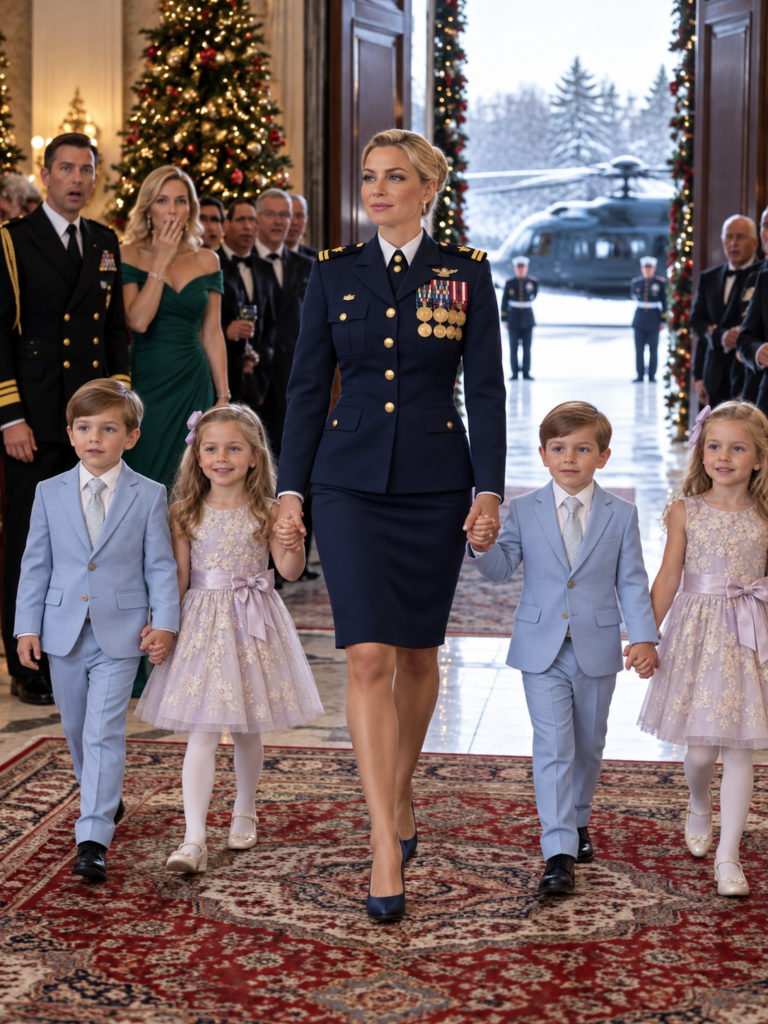
Beyond the landing field, a three-story stone mansion stood against the snowy Colorado foothills. Warm light glowed through tall windows. Wreaths decorated the iron gates, and an enormous Christmas tree was visible through the front entrance.
“Yes,” I said. “That’s where he grew up.”
Caleb studied the house.
“Looks like a museum.”
His brother, Miles, adjusted his scarf. “Technically, museums are supposed to preserve historically significant objects. Rich people just preserve their own stuff.”
I almost laughed.
At eight years old, Miles could turn almost anything into a lecture.
Behind them, my daughters, Grace and Lily, were trying to keep their matching red coats from blowing open in the wind.
Four children.
Born within seven minutes of one another.
Four lives that my former husband had spent eight years pretending did not exist.
My name is Rebecca Hale. I was thirty-five years old that Christmas, a commander in the United States Navy and the mother of quadruplets who had learned very early that love and responsibility were not always found in the same person.
The helicopter had been chartered privately after winter weather made the mountain roads unreliable. I had hesitated over the expense, but a former colleague had helped arrange the aircraft, and I wanted the children to see their father’s family without risking an overnight drive through the storm.
I was wearing my formal Navy uniform because I had attended a military recognition ceremony earlier that afternoon.
My children had insisted I keep it on.
“You look important,” Lily had told me.
I had answered that uniforms only showed what someone had been trusted to do.
They didn’t tell you whether that person was good.
Now, standing beside the helicopter, I wondered whether I should have explained that lesson more carefully.
Because inside the mansion was a man who had worn his own uniform like proof that he could never be wrong.
His name was Andrew Whitmore.
And once, I had loved him enough to believe almost anything he told me.
“Everybody remember what we discussed?” I asked.
Grace nodded. “We don’t have to hug anybody.”
“Correct.”
“We can leave whenever we want,” Miles added.
“Yes.”
Caleb looked toward the mansion.
“And if Dad says we aren’t his?”
My throat tightened.
“Then he will be the one who has to live with that answer.”
The helicopter crew helped us gather our bags. At the edge of the landing field, a groundskeeper stood beside a black utility vehicle, staring at us with an expression that suggested unexpected guests were not common at the Whitmore estate.
“Commander Hale?”
“Yes.”
“Mrs. Whitmore said someone might be arriving, but she didn’t mention…”
His eyes moved across the children.
I spared him the explanation.
“We’re expected.”
He drove us toward the main house.
As we approached, I could hear music coming from inside. The long driveway was lined with expensive cars, and the mansion’s stone columns had been wrapped in evergreen garlands.
Andrew had grown up here.
His childhood had been filled with private schools, exclusive summer programs, and the unquestioned belief that the Whitmore name opened doors.
My childhood had been different.
My father was a county deputy in Ohio. My mother worked nights as a hospital respiratory therapist. We didn’t have much money, but we had Sunday dinners, birthday cakes made from boxed mixes, and parents who showed up even when they were exhausted.
I had believed that was what family meant.
Andrew believed family meant reputation.
I learned the difference too late.
The front doors opened before we reached the steps.
An elderly housekeeper appeared.
She looked at me, and her face changed.
“Rebecca?”
“Hello, Mrs. Foster.”
Her hand flew to her chest.
“Oh, sweetheart.”
She had worked for the Whitmores since Andrew was a boy. During my marriage, she had been one of the few people in that house who treated me like more than a temporary addition to the family.
Then she saw the children.
Her eyes filled with tears.
I gave her a small nod.
“May we come in?”
She stepped aside without another word.
The entrance hall was filled with guests.
Military officers, retired executives, family friends, and neighbors stood beneath crystal chandeliers holding drinks.
A string quartet played near the staircase.
The smell of roasted turkey and cinnamon drifted from the dining room.
I had taken only three steps across the marble floor when someone recognized me.
“Rebecca Hale?”
A woman near the fireplace lowered her wineglass.
Another turned.
Then another.
Conversation began to fade.
At the far end of the room, Andrew Whitmore stood beside a tall blonde woman wearing a dark green silk dress.
She was beautiful.
Elegant.
Younger than me by perhaps six or seven years.
Her left hand rested lightly on his arm, displaying a large diamond engagement ring.
Andrew was laughing at something an older officer had said.
Then he looked up.
I saw the exact moment he recognized me.
His smile vanished.
For several seconds, he simply stared.
Then his eyes moved to the children.
Caleb stood at my right. Miles stood at my left. Grace and Lily were just behind me.
All four had Andrew’s dark brown eyes.
Caleb had his jawline.
Miles had the same narrow nose.
Grace and Lily had inherited the small dimple in his left cheek.
I had seen those similarities every day for eight years.
Watching Andrew discover them was something else entirely.
“Rebecca?”
His voice sounded unfamiliar.
I stopped a few feet away.
“Merry Christmas, Andrew.”
He looked from one child to the next.
“What is this?”
I glanced toward the woman beside him.
“Perhaps you should introduce us.”
She stepped forward politely, although confusion was beginning to show on her face.
“I’m Natalie Brooks.”
“Rebecca Hale.”
Natalie’s expression shifted.
“Oh.”
Clearly, she knew my name.
Andrew must have talked about me.
I wondered which version of our marriage he had given her.
The ambitious officer who wanted too much?
The unstable wife who wouldn’t accept a divorce?
The woman who supposedly invented a pregnancy to keep him?
Natalie looked at my children.
“And these are…?”
“Caleb, Miles, Grace, and Lily.”
Andrew made a sound that was almost a laugh.
“Rebecca, don’t do this.”
I turned toward him.
“Do what?”
He looked around the room.
People were openly watching now.
“Not here.”
“You invited me here.”
“That was supposed to be a private conversation.”
I thought of the invitation he had sent three weeks earlier.
It might be healthy for everyone to see you’ve moved on. Natalie knows about our difficult history, and I believe meeting you would help put the past behind us.
At the bottom, he had added:
Please don’t make things uncomfortable.
I had read those words several times.
Eight years of silence.
Eight years of raising four children.
And Andrew was still more concerned about his comfort than the truth.
Caleb stepped forward.
“Are you Andrew Whitmore?”
Andrew looked at him.
“Yes.”
Caleb swallowed.
“Are you our father?”
The silence in the room became almost physical.
Andrew’s eyes widened.
Natalie turned toward him.
“Andrew?”
He didn’t answer.
Caleb tried again.
“Mom says you are. But she also said you told people we weren’t real.”
Andrew’s face drained of color.
“Rebecca,” he whispered.
I rested a hand on Caleb’s shoulder.
“He asked you a question.”
Andrew looked helplessly toward the guests.
“Can we discuss this somewhere else?”
A voice came from the staircase.
“Andrew, what is going on?”
His mother, Eleanor Whitmore, was descending slowly.
She wore a burgundy dress and a pearl necklace. Her silver hair was arranged perfectly, and she carried herself with the practiced composure of a woman who had spent decades hosting military families.
When she saw me, she stopped.
“Rebecca?”
I hadn’t seen Eleanor in nearly nine years.
She had once criticized the way I set a table, the way I spoke at formal dinners, and the fact that my parents had never belonged to a country club.
I had not expected warmth.
“Hello, Eleanor.”
She looked at the children.
Her hand tightened around the stair railing.
“Who are they?”
“My children.”
Her gaze returned to me.
“How old?”
“Eight.”
She closed her eyes.
“No.”
The word came out quietly.
Andrew moved toward her.
“Mother, please don’t listen to—”
“Eight?” she repeated.
“Yes,” I said.
She looked at the four small faces standing beside me.
Then she looked at her son.
“Andrew, you told me the pregnancy wasn’t real.”
He said nothing.
“You told me she had admitted it.”
I felt something cold settle in my stomach.
I had never admitted any such thing.
I opened the leather document case I was carrying.
Inside was a folder I had prepared carefully, with copies of the children’s birth certificates, medical records, and proof of my previous attempts to contact the family.
I placed it on the marble console table.
“The pregnancy was real. The births were real. And the letters I sent you were real.”
Eleanor stared at the folder.
Andrew reached for it.
I moved my hand over the papers.
“No.”
His eyes flashed.
“You can’t come into my mother’s home and humiliate me.”
For the first time that evening, I felt my hands begin to shake.
Not from fear.
From remembering.
I remembered standing outside a courthouse in Virginia, five months pregnant, while Andrew walked away from me.
I remembered the way my knees hurt from swelling.
I remembered the ultrasound photograph folded in my purse.
And I remembered Andrew’s last words that day.
You’ll find someone else to manipulate, Rebecca. I’m finished.
I looked him directly in the eyes.
“You humiliated yourself eight years ago. I’m only telling the truth.”
Natalie slowly stepped away from him.
“You said you didn’t have any children.”
Andrew’s jaw tightened.
“I don’t.”
Grace made a small noise.
It wasn’t a word.
It was worse.
She had heard him.
I felt her fingers grip the back of my uniform jacket.
Eleanor turned sharply.
“Andrew!”
He immediately corrected himself.
“I meant I didn’t know about them.”
I looked down at Grace.
Her eyes were filling with tears.
That was when something inside me changed.
I had come prepared to confront Andrew.
I had come prepared to answer questions.
I had even come prepared to be insulted.
But I had not come prepared to let my children stand in a room full of strangers while their father denied them to their faces.
I closed the folder.
“Children, we’re leaving.”
Caleb looked surprised.
“But Mom—”
“We’re leaving.”
Andrew let out a breath.
“Good.”
Eleanor turned on him.
“Be quiet.”
Her voice was so sharp that several guests flinched.
Then she approached me.
“Rebecca, please.”
I shook my head.
“Not tonight.”
She looked at the children again.
Something in her expression broke.
“Can I at least say hello?”
I hesitated.
Then I looked at the four people whose feelings mattered most.
Lily nodded slightly.
Eleanor knelt, ignoring the expensive dress gathering around her knees.
“Hello,” she said softly. “I’m Eleanor.”
Lily studied her.
“Are you our grandmother?”
A tear slipped down Eleanor’s cheek.
“I think I am.”
Caleb frowned.
“Then why didn’t you come to our birthdays?”
Eleanor covered her mouth.
She looked up at me.
“I never knew.”
I believed that she believed it.
But belief was not proof.
And there were still things I needed to know.
I reached into my case and removed one final envelope.
It had been mailed to me anonymously six weeks earlier.
Inside were photocopies of old correspondence, account records, and a memorandum carrying the signature of Andrew’s late father, Lieutenant General Charles Whitmore.
At the top of the memorandum were five words:
Regarding the Hale Pregnancy Matter.
I had been carrying that envelope since the day I received it.
Now I placed it in Eleanor’s hands.
“Before you decide who lied to you,” I said, “you should read this.”
Andrew recognized the document immediately.
I knew because his expression changed from anger to genuine fear.
“Where did you get that?”
I didn’t answer.
Eleanor looked down at the signature.
Her lips parted.
“Charles?”
Andrew stepped toward her.
“Mother, give me that.”
She pulled it away.
“Why?”
“Because you don’t understand what you’re looking at.”
Her voice trembled.
“Then explain it.”
He couldn’t.
And that was the moment I knew the truth about my children was only part of what his family had hidden.
Part 2
Eight years earlier, I had believed my marriage was worth saving.
That belief lasted until the afternoon Andrew told me I had become an inconvenience.
We were living in a rented townhouse near Norfolk, Virginia. I was twenty-six and newly pregnant. Andrew had been selected for a prestigious assignment, and he had begun speaking about his future as though I were someone standing outside it.
One evening, while I was preparing dinner, he came home carrying a bottle of champagne.
“I got it,” he announced.
I smiled.
“The assignment?”
He nodded.
I hugged him.
I was genuinely happy.
Then I told him I had something to celebrate too.
I handed him a small white envelope containing a photograph from my first ultrasound.
Andrew stared at it.
Then at me.
“You’re pregnant?”
“Yes.”
His smile disappeared.
He placed the photograph on the kitchen counter.
“This is terrible timing.”
I remember laughing nervously because I thought he was joking.
He wasn’t.
Over the following weeks, Andrew became distant.
He worked late.
He stopped discussing our plans.
When I suggested looking for a larger apartment, he accused me of assuming his career would have to accommodate my decisions.
Then came the second ultrasound.
Four heartbeats.
Four babies.
I cried when the doctor told me.
I was frightened, but beneath the fear was something extraordinary.
Four tiny lives were growing inside me.
I brought the pictures home in a blue folder.
Andrew barely looked at them.
“Four?” he said.
I nodded.
He shook his head.
“That’s impossible.”
“It’s rare, not impossible.”
He stared at me.
“Rebecca, you’re taking this too far.”
I didn’t understand.
“Taking what too far?”
“This whole thing.”
He believed I was lying.
Or perhaps he wanted to believe it.
That distinction haunted me for years.
Three months later, Andrew filed for divorce.
His attorney described our marriage as irretrievably broken.
Andrew accused me of trying to interfere with his career.
I had medical records, but he refused to discuss them.
Our divorce was finalized before the babies were born.
I sent him letters afterward.
I sent his mother letters too.
When the quadruplets arrived prematurely, I wrote again.
I told Andrew the babies had been born at twenty-nine weeks.
I told him Caleb was struggling to breathe.
I told him Grace weighed barely two pounds.
I told him I was frightened every time a monitor sounded in the neonatal intensive care unit.
I sent photographs.
I left voicemails.
I asked only that he acknowledge their existence.
Nothing came back.
My mother flew to Virginia and slept on a folding chair beside my hospital bed.
My father took unpaid leave to help.
Two nurses organized donations of baby clothes.
A retired chief petty officer from my unit brought frozen dinners every Sunday for almost three months.
Those people became my family when the one I had married into disappeared.
I returned to work after maternity leave with four infants at home, a carefully organized childcare schedule, and more fear than I ever admitted.
There were nights when all four children cried at once.
There were weeks when my paycheck seemed to vanish into diapers, formula, childcare, and medical bills.
I remember standing in a grocery store once, staring at a package of coffee and wondering whether I could afford it.
I put it back.
Then I went home, kissed four sleeping babies, and reminded myself that I had not failed.
We were surviving.
As the children grew, I stopped writing to Andrew.
Not because he had earned my silence.
Because I had decided our lives would not revolve around his refusal to answer.
Eventually, I earned another promotion.
We moved to Maryland.
I bought a modest house with a fenced backyard.
Caleb learned to ride a bicycle before his siblings.
Miles became fascinated with science.
Grace loved books and animals.
Lily painted everything she could reach, including one unfortunate bathroom wall.
Our house was loud and imperfect.
It was also happy.
And I had believed the Whitmore family had become nothing more than a painful chapter in my past.
Until the anonymous envelope arrived.
It came on a rainy Tuesday in November.
There was no return address.
Inside were photocopies of three letters I had written during my pregnancy.
Each had been stamped Received by the Whitmore estate office.
Another page contained instructions directing staff not to forward correspondence from me to Eleanor.
The instructions were signed by General Charles Whitmore.
Andrew’s father.
The final documents were more troubling.
They referenced financial accounts associated with a veterans’ charitable organization Andrew had helped establish, and they included the name of a retired administrator I remembered from the general’s office.
Martin Keene.
I had met Martin only twice.
He had been quiet, precise, and almost invisible beside the powerful general.
At the bottom of the envelope, someone had written:
Ask Martin what happened to the hospital photographs.
I read that sentence over and over.
Hospital photographs.
The words made my chest ache.
I had sent photographs of the children during their first weeks in intensive care.
Andrew had never acknowledged receiving them.
The next morning, I contacted an attorney.
Her name was Patricia Monroe.
She was in her early sixties, with short gray hair and the steady manner of someone who had spent decades listening to people explain why the truth was inconvenient.
When I laid the documents on her desk, she studied them carefully.
“Rebecca,” she said, “where did these come from?”
“I don’t know.”
“Has anyone threatened you?”
“No.”
She turned over one of the pages.
“Are you willing to discover something you might wish you hadn’t?”
I thought of my four children eating breakfast at home.
“Yes.”
Patricia helped me make contact with Martin Keene.
He was living in a retirement community outside Denver.
At first, he refused to speak with me.
Then he learned the children were eight years old.
He agreed to a meeting.
I flew to Colorado alone.
Martin was smaller than I remembered, his shoulders rounded, his hands trembling around a ceramic coffee mug.
We met in a quiet sitting room overlooking a courtyard.
For nearly ten minutes, he spoke about the weather.
Finally, I placed one photograph on the table.
It showed Caleb in the hospital, no bigger than the length of my forearm.
Martin’s eyes filled with tears.
“Good Lord,” he whispered.
“That’s my son.”
He nodded.
“I know.”
I felt the room tilt.
“What do you mean?”
He looked at me.
“I remember the photographs.”
I gripped the edge of my chair.
“You saw them?”
“Yes.”
“Who else?”
He stared down at the table.
“General Whitmore.”
“And Andrew?”
Martin said nothing.
I waited.
Finally, he whispered, “I need to show you something.”
From his coat pocket, he removed a small notebook.
Inside were dates, names, and brief handwritten notes.
He explained that General Whitmore had instructed him to screen all correspondence from me during the divorce.
The general believed a public dispute over children would damage Andrew’s future.
He had told staff that I was unstable and attempting to trap his son.
Martin had followed those orders.
He admitted that he had destroyed some letters.
Others he had kept because he feared the instructions might eventually become part of a legal dispute.
“Why are you telling me now?” I asked.
He looked toward the window.
“Because I’ve spent eight years knowing what we did.”
His voice broke.
“And because those babies didn’t deserve it.”
I wanted to hate him.
Part of me did.
But there was more.
“Did Andrew see the photographs?”
Martin closed his eyes.
“I can’t answer that yet.”
“Why not?”
“Because there were other documents in that office. Financial documents. Things the general was using to protect your husband.”
I stared at him.
“What things?”
Martin looked frightened.
“Things that could send people to prison.”
He explained that several accounts connected to the Whitmore Veterans Recovery Fund had been used for expenses that appeared unrelated to charitable work.
Andrew had been involved in the fund.
His father had influenced its board.
Martin suspected that money had been redirected through consulting arrangements and businesses connected to family associates.
He had retained copies of certain records, but he did not know the full extent of the transactions.
“Have you told anyone?” I asked.
He nodded.
“An investigator contacted me last spring.”
That was when I realized the anonymous documents might be connected to an ongoing investigation.
Martin told me that a former financial officer had raised concerns.
Records were being reviewed.
He had recently decided to cooperate.
I asked again about the photographs.
He looked at the notebook.
“Please let me speak with the investigators first.”
I wanted answers immediately.
But I understood enough about investigations to know that forcing him into a careless conversation could create problems.
Before leaving, I asked one question.
“Did Eleanor know?”
Martin shook his head.
“No. The general made certain she didn’t.”
I returned home with more questions than answers.
And then Andrew’s Christmas invitation arrived.
I sat at my kitchen table reading it while Caleb practiced spelling words beside me.
Andrew wanted me to attend a holiday dinner.
He wanted to introduce me to his fiancée.
He wanted to demonstrate that the past no longer mattered.
I could almost hear his voice.
Be reasonable, Rebecca.
For several hours, I considered deleting the message.
Then Caleb looked up from his notebook.
“Mom?”
“Yes?”
“Do we have grandparents on Dad’s side?”
I froze.
He had asked about his father before.
All four children had.
I had always answered honestly, explaining that their father had chosen not to be involved.
But I had avoided speaking much about the larger family because I couldn’t explain what had happened.
Now Caleb was asking a different question.
“We do,” I said.
“Are they alive?”
“Your grandfather died a few years ago. Your grandmother is alive.”
“Does she know about us?”
I opened my mouth.
Then closed it.
“I don’t know.”
Caleb looked confused.
“How can someone not know they have four grandchildren?”
I didn’t have an answer.
That night, after the children went to sleep, I contacted Patricia.
Andrew’s invitation wasn’t a legal summons, she reminded me.
I had no obligation to attend.
But the children had a right to understand their family history.
If I chose to go, she advised me to protect them from confrontation and avoid discussing the unrelated financial inquiry.
“Don’t turn them into witnesses in an adult argument,” she said.
I promised I wouldn’t.
I nearly kept that promise.
Until Andrew denied them in front of everyone.
The Christmas Eve confrontation had ended with Eleanor clutching the old memorandum and Andrew demanding to know where it came from.
I took the children toward the front door.
Outside, the snow was falling harder.
The pilot had already warned that the weather could prevent another flight that evening.
Mrs. Foster hurried after us.
“Rebecca, the roads are closing.”
I stopped.
Through the glass doors, I could see snow gathering on the steps.
The children were exhausted.
Grace had begun to shiver.
Eleanor appeared behind us.
“Please,” she said. “Let them stay tonight.”
Andrew stood several feet away, glaring.
I looked at him.
“If we stay, you will not approach my children without my permission.”
His face reddened.
“This is my family’s house.”
Eleanor turned toward him.
“It is my house now.”
That silenced him.
I agreed to stay in the guest wing.
The children ate sandwiches in a small sitting room while Mrs. Foster brought hot chocolate.
Eleanor asked about their birthdays, favorite subjects, and hobbies.
She listened with the concentration of someone trying to recover eight lost years in a single evening.
Lily showed her a drawing.
Grace talked about her favorite horse at a nearby riding stable.
Miles explained the difference between astronomy and astrology.
Caleb asked whether the estate had sleds.
Eleanor smiled for the first time.
“An entire shed full.”
I watched her carefully.
She did not act like a woman pretending to be surprised.
She acted like a woman whose life had split into before and after.
Later, when the children were asleep, Eleanor found me in the library.
She was holding the memorandum.
“I thought your marriage ended because you couldn’t accept Andrew’s career,” she said.
I sat beside the fireplace.
“That’s what he told you?”
She nodded.
“He said you became obsessed with having a baby and then started making accusations.”
I looked into the fire.
“I was pregnant with four babies.”
“I know that now.”
Her voice was barely audible.
She sat opposite me.
“I wasn’t kind to you when you were married.”
“No.”
“I thought you weren’t suitable for Andrew.”
“I know.”
Her eyes filled with tears.
“I believed my husband when he told me not to interfere.”
I looked at her.
“You could have called me.”
She nodded.
“Yes.”
For a while, neither of us spoke.
Then Eleanor placed the memorandum on the table.
“Charles intercepted your letters.”
“Apparently.”
“But why would Andrew continue lying after his father died?”
I didn’t answer.
Because I was beginning to suspect the answer was worse than either of us wanted to believe.
The next morning, Christmas breakfast was awkward.
Andrew had stayed somewhere else overnight.
Natalie remained in the guest suite.
When she came downstairs, her engagement ring was gone.
She approached me near the kitchen.
“May I speak with you?”
I nodded.
She looked tired.
“I need to apologize.”
“You didn’t know.”
“That’s not entirely true.”
I felt my stomach tighten.
Natalie looked away.
“Andrew told me you had claimed to be pregnant when you separated. He said it was medically impossible.”
I stared at her.
“He said that?”
“Yes.”
I shook my head.
“I have four living examples to the contrary.”
Her eyes filled with tears.
“I should have questioned him.”
I could hear the children laughing in the next room.
Natalie followed the sound.
“He told me he’d always wanted a family.”
I looked at her.
“Andrew wants a family that doesn’t inconvenience him.”
She closed her eyes.
“I think I’m beginning to understand.”
She left the estate that afternoon.
Andrew did not try to stop her.
Two weeks later, Patricia called me with news.
The financial investigation involving the veterans’ fund had intensified.
Several people had provided statements.
Martin Keene had submitted records.
And one particular document had become important.
An internal memorandum dated shortly after the quadruplets’ births showed that Andrew had personally authorized a payment to an outside consulting firm connected to the fund.
The memo referenced a meeting at his father’s office.
On the same date, Martin’s notebook contained another entry.
Andrew reviewed photographs and medical packet.
Patricia paused.
“Rebecca, I need you to prepare yourself.”
I sat down.
“What are you telling me?”
“That Andrew may have known about the children years before Christmas.”
I had imagined this possibility.
I had feared it.
But hearing another person say it aloud was different.
I could barely speak.
“How long?”
“The records suggest he saw the photographs shortly after they were born.”
My hands went numb.
“Why would he keep lying?”
Patricia was silent.
Then she said, “I don’t know.”
That evening, I sat in my children’s bedroom after they had fallen asleep.
Caleb had left a flashlight beside his pillow.
Miles had fallen asleep clutching a book about space.
Grace’s stuffed rabbit was tucked beneath her arm.
Lily had managed to get blue paint on her pajama sleeve.
I looked at their faces.
Eight years earlier, they had been fighting to survive in hospital incubators.
I had watched the monitors.
I had celebrated every ounce they gained.
I had cried when a nurse told me I could finally hold Caleb against my chest.
And somewhere during those same weeks, Andrew might have been looking at their photographs.
Knowing.
Choosing.
Leaving.
I put my hand over my mouth to stop myself from making a sound.
For the first time in years, I wished I had never opened the anonymous envelope.
Because I understood that the truth could wound my children all over again.
Then my phone rang.
It was Eleanor.
“Rebecca,” she whispered, “Andrew is here.”
I sat upright.
“What happened?”
“He found out Martin has been speaking with investigators.”
A long silence followed.
Then she said something I will never forget.
“He’s telling me his father made him do everything.”
Part 3
I flew to Colorado the following week.
This time, I went alone.
The children stayed with my parents, who had come to Maryland to help.
I did not tell them about the new evidence.
Not yet.
Patricia met me at the airport and drove us to her Denver office, where an investigator had arranged to interview me about financial documents from my marriage.
I had signed several forms during those years without fully understanding how Andrew’s family handled its financial affairs.
Some had involved joint accounts.
Others concerned charitable contributions and transfers.
I was careful to tell the investigator only what I knew.
I could identify signatures.
I could describe conversations.
I could explain when Andrew had controlled access to our records.
I could not claim to know where money had gone after the divorce.
The investigator listened without interrupting.
At the end, she asked whether I had ever been pressured to sign anything.
I thought about one evening in particular.
Andrew had brought home a stack of papers.
He had been irritable.
His father had called twice.
When I asked what the papers were, Andrew said they were routine administrative forms.
I had been exhausted from pregnancy-related nausea.
I signed where he pointed.
I told the investigator.
She wrote something down.
Then she asked whether I remembered the date.
I did.
Because the following morning, I had gone to the doctor and heard four heartbeats for the first time.
After the interview, Patricia drove me to Eleanor’s estate.
Andrew was waiting in the library.
He looked older.
His hair was thinner.
There were dark circles beneath his eyes.
For years, I had imagined what it would feel like to confront him again.
Now, standing in front of him, I felt strangely calm.
He rose when I entered.
“Rebecca.”
I stayed near the door.
“Why am I here?”
He looked toward Eleanor.
She sat beside the fireplace, her hands folded tightly in her lap.
“I asked him to tell you the truth,” she said.
Andrew swallowed.
“My father made some decisions that hurt people.”
I didn’t respond.
“He controlled everything,” Andrew continued. “My career, my assignments, our finances. He didn’t want a scandal.”
I folded my arms.
“What scandal?”
“The divorce. The pregnancy.”
“The children,” I corrected.
He looked down.
“Yes.”
I stepped closer.
“Did you see their photographs?”
Andrew closed his eyes.
There it was.
The answer before the words.
“Andrew.”
He nodded once.
I felt something break inside me.
“All four?”
“Yes.”
“When?”
He looked at the carpet.
“A few weeks after they were born.”
I could hear the grandfather clock ticking.
Eleanor covered her mouth.
I forced myself to ask the next question.
“Did you know they were premature?”
“Yes.”
“Did you know Caleb was having trouble breathing?”
He nodded.
“Did you know Grace needed a blood transfusion?”
His eyes filled with tears.
“Yes.”
I felt suddenly cold.
For years, I had imagined Andrew simply refusing to believe me.
I had believed he had built a wall of denial so high that the truth never reached him.
But it had reached him.
He had seen four tiny babies.
He had known they were his.
And he had chosen to leave them.
“Why?” I whispered.
Andrew lowered himself into a chair.
“My father said if I acknowledged them, there would be questions. About the divorce. About my declarations. About why I hadn’t provided support.”
“So you did nothing?”
“I thought I could fix it later.”
I stared at him.
“Later?”
His shoulders shook.
“I was afraid.”
I felt anger rise so quickly that I had to take a breath.
“Andrew, I was afraid too.”
He looked up.
“I was twenty-seven years old, sitting in a hospital with four premature babies. I was afraid every time a doctor entered the room. I was afraid I wouldn’t be able to pay for everything they needed. I was afraid one of them would die.”
Tears ran down my face.
“But I stayed.”
He began crying.
I didn’t stop.
“You knew they were alive. And you let me believe you had never seen them.”
“My father told me—”
“No.”
My voice echoed through the library.
“You do not get to hide behind a dead man.”
Eleanor stood.
“Rebecca is right.”
Andrew looked at her.
“Mother—”
“Your father was controlling. He was proud. He cared too much about what people thought.”
Her voice trembled.
“I know that better than anyone.”
She took a step toward him.
“But you were a grown man.”
Andrew stared at her.
“You could have called. You could have visited. You could have sent money. You could have written one honest letter.”
He lowered his head.
Eleanor was crying now.
“And instead, you let me lose eight years with my grandchildren.”
For several minutes, no one spoke.
Finally, Andrew looked at me.
“What do you want me to do?”
The question was so familiar.
During our marriage, he had asked it whenever he wanted an argument to end.
As though my pain were a problem I had created.
But this time, I knew my answer.
“I want you to stop lying.”
He wiped his face.
“And then?”
“I want you to take responsibility for whatever the investigation finds. I want you to provide the support your children are legally entitled to. And I want you to understand that you don’t get to decide when they forgive you.”
He nodded.
I watched him carefully.
“Do you understand?”
“Yes.”
I picked up my coat.
“Then start there.”
I left without hugging him.
And I did not look back.
The following months were difficult.
The financial investigation expanded.
The Whitmore Veterans Recovery Fund was subjected to a detailed review.
Several contracts were found to involve businesses connected to people who had served alongside General Whitmore.
Investigators questioned whether charitable funds had been used for private expenses.
Andrew stepped away from his command responsibilities while the military reviewed his involvement.
His family name no longer guaranteed that difficult questions would disappear.
The inquiry also uncovered inconsistencies in documents Andrew had submitted during and after our divorce.
He had repeatedly declared that he had no children.
That falsehood became impossible to maintain.
Patricia helped me pursue appropriate financial support.
I did not ask for money to punish Andrew.
I wanted the children to receive what they should have received from the beginning.
Their needs had never stopped existing simply because he ignored them.
Meanwhile, Eleanor began calling every Sunday.
At first, I listened to the conversations on speakerphone.
She asked the children about school.
She remembered their favorite subjects.
She sent birthday cards and small gifts.
She didn’t overwhelm them with money.
She sent things that showed she was paying attention.
Caleb received a model helicopter kit.
Miles received a book about planetary exploration.
Grace received a beautifully illustrated collection of animal stories.
Lily received watercolor paints and thick paper.
One afternoon, Eleanor called simply to ask whether Caleb’s science presentation had gone well.
He talked for fifteen minutes.
When the call ended, he looked at me.
“Grandma remembers stuff.”
I smiled.
“Yes, she does.”
He considered that.
“That’s nice.”
I knew exactly what he meant.
Being remembered had become something precious to my children.
Andrew’s contact was different.
With help from a child psychologist, I explained the truth to the quadruplets in language they could understand.
I did not tell them every painful detail.
But I told them that their father had seen photographs of them when they were babies and had chosen not to visit.
Caleb cried first.
Then Grace.
Lily climbed into my lap.
Miles sat very still.
Finally, he asked, “Did he know we were sick?”
I nodded.
“Yes.”
He stared at the carpet.
“Then he knew you needed help.”
I put my arm around him.
“Yes.”
Miles was quiet for a long time.
Then he said, “That’s worse.”
He was right.
The children decided they did not want to see Andrew immediately.
I supported that decision.
Andrew wrote letters.
At first, the letters were full of explanations.
He talked about pressure.
He talked about his father.
He talked about making mistakes.
The psychologist advised against giving those letters to the children.
They were apologies that still tried to make Andrew the victim.
Eventually, his writing changed.
He stopped describing the reasons he had left.
He began acknowledging what leaving had done.
One letter contained only a few paragraphs.
He admitted that he had known they were alive.
He admitted that he had been selfish.
He admitted that nothing they had done caused him to leave.
And he told them they did not owe him forgiveness.
Caleb read the letter twice.
Then he put it in his desk drawer.
“I don’t want to answer yet.”
“You don’t have to,” I told him.
For the first time, I felt that our future might not be controlled by the decisions Andrew had made.
We were finally allowed to move forward.
That spring, I met someone.
His name was Thomas Bennett.
He was a pediatric surgeon at a hospital near Washington, D.C.
We met at a charity event supporting families whose children had experienced long hospital stays.
I had been invited to speak about raising premature quadruplets.
Thomas approached me afterward.
“You made a comment about how frightening the first night home can be,” he said.
I laughed softly.
“That’s an understatement.”
He smiled.
“I work with families who spend months waiting for that night. Sometimes I think we forget how terrifying it can be once they finally get there.”
We talked for almost an hour.
He didn’t ask about Andrew.
He didn’t seem impressed by my rank.
He asked about my children.
Not whether raising four had been difficult.
But who they were.
I told him about Caleb’s fascination with aircraft.
Miles’s endless questions.
Grace’s love of books.
Lily’s artwork.
Thomas listened.
Then he asked whether I would like to have coffee sometime.
I almost said no.
It had been years since I had considered letting someone into my life.
But something about his patience made me hesitate.
“I’d like that,” I said.
Our relationship developed slowly.
He never pushed.
He never acted as though my children were an obstacle.
When he eventually met them, they behaved exactly as I expected.
Miles questioned him about medical school.
Grace asked whether he liked dogs.
Lily demanded that he draw a horse.
Caleb stared at him for several minutes.
Then he asked, “Are you going to leave?”
Thomas set down his fork.
I felt myself tense.
But he didn’t seem offended.
“I don’t know everything that will happen in life,” he said. “But I don’t make promises lightly.”
Caleb frowned.
“What does that mean?”
“It means if I say I’ll be somewhere, I’ll do my best to be there. And if something changes, I’ll tell you the truth.”
Caleb considered the answer.
Then he nodded.
“Okay.”
Later, he made a chart.
Every time Thomas kept a promise, Caleb added a check mark.
At first, Thomas didn’t know about it.
Then one afternoon, he noticed the chart taped beside Caleb’s bedroom door.
“What’s that?”
Caleb shrugged.
“Evidence.”
Thomas smiled.
“Evidence of what?”
“That you come back.”
Thomas became very quiet.
Then he said, “I hope you run out of room.”
Months passed.
The chart filled.
Thomas attended school events.
He helped Miles build a model solar system.
He listened patiently while Grace read him chapters from her favorite books.
He let Lily paint one of his fingernails blue.
And when Caleb broke his arm falling from a bicycle, Thomas sat beside him in the emergency department, answering questions and making him laugh.
He never asked the children to call him Dad.
He never spoke badly about Andrew.
He simply showed up.
That was how he earned their trust.
Not through grand gestures.
Through ordinary Tuesday afternoons.
Through school pickups.
Through remembering appointments.
Through keeping promises when nobody was watching.
A year after the Christmas confrontation, Eleanor invited us back to the estate.
I discussed the visit with the children.
They wanted to go.
Andrew would be there for a short, supervised family gathering, but the children would not be required to spend time alone with him.
The estate looked different when we arrived.
The giant portrait of General Whitmore had been removed from the staircase.
In its place was a photograph of Eleanor sitting in the garden with her four grandchildren.
I stared at it for a long time.
Eleanor came to stand beside me.
“I kept Charles’s medals and photographs in the study,” she said. “But I realized I didn’t want the entire house to be a monument to him.”
I looked at her.
She smiled sadly.
“I want it to be a place where people can live.”
That afternoon, the children played in the snow.
Andrew came outside wearing a simple winter jacket.
He looked uncertain.
Caleb stood beside the sledding hill, watching him.
Then he picked up a snowball.
“Hey!”
Andrew turned.
Caleb threw it.
The snowball struck Andrew in the chest.
Andrew staggered dramatically.
“Oh, no.”
Caleb narrowed his eyes.
“You’re supposed to fall.”
Andrew dropped into the snow.
The children laughed.
For a moment, everything seemed almost ordinary.
But ordinary moments could not erase what had happened.
Later, Andrew approached me on the porch.
“Thank you for letting me see them.”
I looked toward the children.
“They agreed to it.”
He nodded.
“I know.”
He hesitated.
“I’ve been attending counseling.”
“That’s good.”
“I’ve been thinking about what you said.”
I waited.
“I spent my whole life believing being respected was the same as being a good man.”
I looked at him.
“And?”
He watched Caleb helping Lily onto a sled.
“I think I was wrong.”
I didn’t offer comfort.
I didn’t tell him I forgave him.
Instead, I said, “Then keep learning.”
He nodded.
That was enough.
A few months later, the investigation reached a significant turning point.
The fund’s former financial administrator agreed to cooperate fully, and investigators obtained additional records documenting payments that had been misrepresented.
Andrew’s responsibility was examined alongside that of other individuals involved.
He eventually left military service while facing the consequences of his involvement in the financial misconduct.
I was not present for every hearing.
I did not want to be.
My life no longer revolved around watching him fall.
The justice that mattered most had already begun.
The truth had been documented.
My children had been acknowledged.
And Andrew could no longer pretend they had never existed.
Then something unexpected arrived in the mail.
It was a small wooden box from Eleanor.
Inside were four silver identification bracelets.
Hospital bracelets.
Each engraved with one of my children’s names.
I recognized them immediately.
I had believed they were lost.
There was a letter beneath them.
Eleanor explained that Martin Keene had kept several items from the correspondence General Whitmore ordered removed.
He had returned them during the investigation.
The bracelets had been among the hospital keepsakes I mailed with photographs in an attempt to convince Andrew’s family the babies were real.
For eight years, they had been sitting in a locked office.
I held the bracelets in my hands and cried.
Lily came into the kitchen.
“Mom?”
I showed her.
“These belonged to you when you were born.”
She picked up the smallest one.
“Mine?”
“Yes.”
She stared at it.
“I was really tiny.”
“You were.”
The others gathered around.
Miles examined the lettering.
Grace touched hers carefully.
Caleb held his bracelet against his wrist.
It barely circled two of his fingers.
He looked at me.
“Did Dad see these too?”
I paused.
“Yes.”
Caleb nodded slowly.
Then he placed the bracelet beside our family photograph on the mantel.
“I’m keeping it there.”
“Why?”
He looked at me.
“So nobody forgets we were here.”
I couldn’t speak.
I pulled him into my arms.
Three years after that first Christmas dinner, we returned to the Whitmore estate for another holiday celebration.
This time, there was no helicopter.
No dramatic entrance.
No room full of strangers waiting to judge us.
We arrived in our family SUV with presents piled in the back and the children arguing over whose turn it was to choose the music.
Thomas drove.
I sat beside him.
The children were eleven now.
Caleb was taller.
Miles had developed an obsession with building complicated machines.
Grace dreamed of becoming a veterinarian.
Lily wanted to paint murals.
Eleanor stood outside waiting for us.
When the car stopped, all four children rushed toward her.
“Grandma!”
She laughed as they surrounded her.
I watched from the driveway.
Three years earlier, she hadn’t known their names.
Now she knew their favorite foods, their friends, their fears, and the small things that made them happy.
She had missed their earliest years.
But she had not wasted the years that followed.
Inside, photographs of the children lined the walls.
The library held their favorite books.
In the kitchen, a row of cookie jars bore their names.
Andrew attended the dinner with everyone’s agreement.
He had continued counseling and had established a more consistent, though still carefully bounded, relationship with the children.
He had learned not to demand affection.
Not to make excuses.
Not to treat every visit as an opportunity to prove he was forgiven.
That evening, he helped Miles assemble a model airplane.
Grace discussed a book with him.
Lily showed him photographs of a painting she had completed.
Caleb invited him outside for a snowball fight.
I watched from the kitchen window.
Thomas was already in the yard.
The children attacked him with snowballs, and he pretended to surrender.
Andrew joined them.
For a moment, the two men stood beside each other, laughing as four determined children buried them in snow.
I felt no jealousy.
No bitterness.
Only a quiet recognition that life had become larger than the pain that once defined it.
Eleanor came beside me.
“You look happy,” she said.
“I am.”
She squeezed my hand.
“You deserved that.”
I looked at her.
“So did the children.”
She nodded.
“Yes. They did.”
After dinner, Thomas asked me to walk outside with him.
The snow had stopped falling.
The trees along the driveway glowed with white Christmas lights.
We stood near a stone bench overlooking the valley.
Thomas seemed unusually nervous.
I smiled.
“What’s wrong?”
He laughed.
“Am I that obvious?”
“A little.”
He reached into his coat pocket.
Then he stopped.
Behind us, someone shouted.
“Wait!”
Caleb was running down the steps, followed by the other three children.
Thomas closed his eyes.
“Oh, no.”
I laughed.
“What?”
Caleb stopped in front of us, breathing hard.
“You can’t do it without us.”
I looked from him to Thomas.
My heart began to race.
“Do what?”
Miles folded his arms.
“We’ve known for weeks.”
Grace was practically bouncing.
Lily had tears in her eyes.
Thomas shook his head.
“I thought we agreed not to tell your mother.”
Caleb shrugged.
“We didn’t.”
Then Thomas turned toward me.
He took my hands.
“Rebecca, when I met you, you already had a life full of love. You didn’t need someone to complete it.”
My eyes filled with tears.
“You had built something extraordinary with these children. All I wanted was the chance to be part of it.”
He lowered himself onto one knee.
“I love you. I love them. And I want to spend the rest of my life showing up for all of you.”
He opened a small box.
Inside was a simple, beautiful ring.
“Will you marry me?”
I looked at my children.
Caleb nodded firmly.
“He passed.”
I laughed through my tears.
“Passed what?”
“The chart.”
Miles nodded.
“Statistically, his record is excellent.”
Grace wiped her eyes.
“Mom, please say yes.”
Lily threw her arms around my waist.
“Please!”
I looked at Thomas.
“Yes.”
He stood, and I kissed him while the children cheered.
From the porch, Eleanor clapped.
Andrew stood beside her.
He didn’t turn away.
He didn’t interrupt.
He didn’t make the moment about himself.
He simply watched.
Later that evening, after the children had gone upstairs, I walked through the mansion’s main hall.
The Christmas tree stood beside the staircase.
The same staircase where Andrew had once stared at four children he refused to acknowledge.
But something had changed.
On the mantel was a glass display case.
Inside were four tiny silver hospital bracelets.
Beneath them, Eleanor had placed a small engraved plaque.
It read:
THEY WERE ALWAYS HERE.
I stood in front of it for a long time.
I thought about the frightened young woman I had once been.
The one who begged Andrew to believe her.
The one who sat beside four incubators, praying her children would survive.
The one who waited for letters that never came.
I wanted to tell her that she would be all right.
Not because life would suddenly become easy.
Not because the people who hurt her would eventually apologize.
But because she would discover she was stronger than she knew.
She would build a home.
She would raise four remarkable children.
She would find friends who became family.
She would learn that being abandoned did not make her unworthy of love.
And one day, she would stand in the very house that had once denied her children and watch those same children race through its rooms as though they had always belonged there.
Footsteps sounded behind me.
Thomas appeared at the entrance to the hall.
“There you are.”
I turned.
He smiled.
“Everybody’s asking for you.”
“What’s happening?”
“Apparently, Caleb has organized a family photograph.”
I laughed.
“Of course he has.”
Thomas held out his hand.
I took it.
As we walked toward the staircase, I heard my children’s voices upstairs.
Miles was correcting someone’s position.
Grace was asking Eleanor to sit in the middle.
Lily was insisting everyone hold hands.
And Caleb was explaining that a family photograph only worked if every person in it actually wanted to be there.
I stopped for a moment.
Thomas looked at me.
“You okay?”
I nodded.
“Yes.”
And I meant it.
For years, Andrew’s rejection had been the first thing people learned about my story.
He left.
He denied the pregnancy.
He abandoned his children.
But that was no longer the most important part.
The most important part was what happened afterward.
Four babies survived.
A mother kept going.
A grandmother found the courage to question the family history she had been taught.
A man learned that being a father required more than sharing a name.
And another man proved, one ordinary day at a time, that love was something you did.
Not something you simply promised.
Upstairs, Caleb called again.
“Mom! We’re waiting!”
I squeezed Thomas’s hand.
“Coming!”
Then I walked toward the voices of the people who had made my life whole.
Not because someone powerful had finally allowed us into the family.
But because we had created a family of our own.
And this time, nobody had to beg to belong.


