
Part 1
The little boy couldn’t have been much older than two. He had bare feet, a yellow T-shirt with a faded dinosaur on the front, and a stubborn lock of dark hair that refused to lie flat.
He was clutching the airplane by its broken wing.
I knew that airplane.
I had watched my son, Noah, make it at our kitchen table when he was seventeen, using scraps of pine from a broken bookshelf and a pocketknife his grandfather had given him.
He had painted the wings red because, according to him, ordinary airplanes were boring.
One wing had always been a little crooked.
Now that same crooked wing was hanging from the small boy’s fist.
“Where did you get that?” I asked.
The young woman standing in the doorway went very still.
“Mrs. Carter?”
Her voice pulled my eyes away from the toy.
“Tessa?”
She nodded, but there was no happiness in her face.
The last time I had seen Tessa Pike, she was a frightened nineteen-year-old standing near the back of the church at Noah’s funeral. She had left before the service ended, and I had been too buried in my own grief to go after her.
Now she was standing in front of me, three and a half years later, looking as though she expected me to say something terrible.
The scruffy brown dog that had brought me there squeezed between her legs and disappeared into the house.
“Blue,” she murmured.
I blinked.
“That’s his name?”
She looked down the hallway, then back at me.
“Yes.”
“He’s been coming to the cemetery.”
“I know.”
That answer surprised me more than it should have.
“You know?”
Tessa glanced toward the little boy.
“Could we talk inside?”
I stepped onto the porch without answering.
The house was small, with peeling white paint around the windows and a porch light that had been repaired with electrical tape. A plastic tricycle sat beneath the railing. There were two flowerpots beside the door, one full of marigolds and the other holding nothing but dry soil.
Everything looked worn, but cared for.
The little boy took a step behind Tessa.
“Mommy, who is she?”
Mommy.
The word landed somewhere deep inside me.
Tessa crouched and touched his shoulder.
“This is Evelyn.”
He studied me.
“Like Miss Evelyn at the library?”
“Different Evelyn, sweetheart.”
I had spent twenty-eight years working in a public library. I had answered thousands of questions from children, helped them find books, tied shoelaces, wiped runny noses, and listened to them explain things only children could find important.
Yet I couldn’t think of a single thing to say to this one.
Because he had Noah’s eyes.
Not merely the same color.
He had the same slightly heavy eyelids, the same narrow crease near the outside corner, and the same habit of lifting his chin when he was uncertain.
I felt my knees weaken.
“Tessa,” I said quietly. “Whose little boy is this?”
She closed her eyes.
For several seconds, neither of us spoke.
Then she looked at him.
“Miles, would you take Blue into the kitchen? I left some apple slices on your plate.”
Miles considered this.
“Can Blue have one?”
“Just a little piece.”
He hurried away.
The dog followed him, nails clicking against the worn floorboards.
When they were gone, Tessa opened the door wider.
“Please come in.”
I walked into the living room and felt the strange sensation of stepping into a life that had somehow continued without me.
There were children’s drawings taped to the refrigerator. A pile of folded laundry sat on an armchair. A small television rested on a secondhand cabinet, and beside it stood a framed photograph of Tessa holding a newborn.
I looked at the photograph.
Then I looked toward the kitchen.
“Tessa.”
She pressed her lips together.
“Miles is Noah’s son.”
The room seemed to lose its air.
I reached for the back of the couch.
“No.”
“He was born eight months after the accident.”
I looked at her, unable to make the numbers fit inside my head.
Eight months.
Noah had died in March.
A child born the following November would be almost three now.
The little boy in the kitchen was almost three.
I sat down because I no longer trusted my legs.
For three years and seven months, I had believed I knew the full shape of my loss.
My only child was dead.
I would never watch him graduate from college, find a career he loved, marry, or become a father.
I had learned to live around that absence.
Now a young woman I barely recognized was telling me that one of those vanished futures had been living less than four miles from my house.
“Does Noah know?” I asked.
The question escaped before I could stop it.
Tessa’s face crumpled.
“No. I found out after he died.”
I pressed my fingers against my forehead.
“Why didn’t you tell me?”
She sat on the edge of the armchair.
“I wanted to.”
“But you didn’t.”
“No.”
“Why?”
She looked toward the kitchen.
“Because I thought you didn’t want us.”
I stared at her.
“Why would you think that?”
Tessa swallowed.
“Because of the letter.”
Something cold moved through me.
“What letter?”
She didn’t answer immediately.
Instead, she stood, walked to a cabinet beside the television, and opened a drawer.
While she searched, I heard Miles talking to Blue in the kitchen.
“You sit. No, Blue. Sit.”
The dog gave a short bark.
Miles laughed.
It was such an ordinary sound.
A child laughing in a kitchen.
I hadn’t heard it inside my own home since Noah was small.
Tessa returned with a thin envelope.
But before she handed it to me, she stopped.
“Mrs. Carter, I need you to understand something. I was nineteen. My dad had just lost his job, my mom was furious with me, and I didn’t even know whether I could finish school. I wasn’t trying to punish anybody.”
I looked at her.
“Then why have I never met my grandson?”
The word grandson made both of us flinch.
Tessa lowered her eyes.
“I thought I was doing what you wanted.”
She placed the envelope on the coffee table.
I reached for it, but my hand was trembling so badly that I couldn’t open it.
And while I sat there, staring at my own name written across the front, I remembered how Blue had brought me to that house.
I remembered the first Sunday I had seen him.
It had been early April, when the ground at Willow Creek Cemetery was still damp from spring rain.
The cemetery sat on the edge of our town in western Pennsylvania, surrounded by old maples and a low stone wall that had begun to crumble in places.
I went every Sunday after church hours, though I had stopped attending church myself after Noah died.
I wasn’t angry with God exactly.
I was angry with everyone who kept telling me there was a reason for what happened.
A car had lost traction on an icy bridge. Noah had been coming home from a late shift at the hardware store. A truck driver had tried to avoid him and couldn’t.
That was the reason.
I didn’t need anyone turning it into a lesson.
On the first Sunday Blue appeared, he was lying directly beside Noah’s grave.
His fur was the color of muddy leaves, with a patch of white beneath his chin. His left ear stood upright, while his right ear drooped. He had one cloudy blue eye and one warm brown eye.
I thought he belonged to another visitor.
“Hello, sweetheart,” I said.
He raised his head.
I placed a small bunch of daffodils beside Noah’s stone.
The dog moved closer, sniffed the flowers, and settled down again.
“Did someone leave you here?”
He looked at me.
I sat on the grass, ignoring the dampness soaking through my skirt.
“I don’t suppose you’re going to answer.”
His tail moved once.
I smiled.
It startled me.
Smiling had become something I did for other people: grocery clerks, neighbors, former coworkers who stopped me in the pharmacy and asked how I was managing.
But that small smile was different.
It belonged to me.
The following Sunday, he was there again.
Then the next.
Sometimes he was curled beside the headstone. Sometimes he sat upright, watching the path as though waiting for a familiar person to arrive.
He never wandered far from Noah’s grave.
I began bringing biscuits.
He accepted them politely, never grabbing or begging.
Once, I stayed an extra half hour simply to watch him sleep.
Eventually, I asked the cemetery caretaker about him.
His name was Walter, and he had known Noah since my son was old enough to ride his bicycle through the cemetery on his way to school.
Walter scratched his gray beard when I described the dog.
“He’s been coming around for months,” he said. “I figured he belonged to someone who visits.”
“Does he have a collar?”
“Not that I’ve seen.”
“Where does he go?”
Walter shrugged.
“Never followed him.”
I considered reporting him to animal control, but Blue looked healthy enough, and something about his patient vigil made me hesitate.
I told myself I was being ridiculous.
Dogs didn’t understand headstones.
They didn’t know which bodies lay beneath the grass.
Still, every Sunday, there he was.
And every Sunday, I found myself asking the same question.
Why Noah?
I finally followed him on a warm morning in September.
I had brought Noah’s favorite yellow chrysanthemums and spent nearly an hour telling him about ordinary things.
The neighbor’s fence had fallen during a storm.
My car needed new tires.
His old friend Marcus was engaged.
I didn’t tell him how badly the engagement announcement had hurt.
Not because I begrudged Marcus his happiness, but because every wedding invitation reminded me of another day I would never experience.
Blue sat quietly beside me.
When I stood to leave, he stood too.
He walked toward the cemetery gates.
Instead of going to my car, I followed.
I expected him to stop at a nearby house.
He didn’t.
He crossed two residential streets, cut through a small park, and continued along the sidewalk past an abandoned gas station.
I stayed well behind him.
At one intersection, I nearly lost sight of him behind a parked delivery truck.
Then I saw his crooked ear appear on the other side.
“Where on earth are you taking me?” I whispered.
He kept walking.
Almost twenty minutes later, he turned onto a narrow dead-end street and trotted up the steps of Tessa’s house.
He scratched at the door twice.
And Tessa opened it.
Now I was sitting inside that house, with an envelope in my lap and the knowledge that my son had a child.
I carefully unfolded the paper.
It was a short letter written in dark blue ink.
I have suffered enough because of what happened between our children. I cannot be involved in raising this baby, and I do not wish to be contacted again. Please respect my decision.
It was signed:
Evelyn Carter.
I read it twice.
Then a third time.
My name was there.
But the handwriting wasn’t mine.
I looked up.
“Tessa, I didn’t write this.”
Her expression changed, though not in the way I’d hoped.
She looked exhausted.
“Please don’t.”
“I’m telling you the truth.”
“I’ve spent almost three years trying to accept it.”
“Tessa, look at me.”
She did.
“I never received a letter from you. Nobody told me you were pregnant. I didn’t even know Miles existed until five minutes ago.”
She gripped the edge of the armchair.
“My mother said—”
She stopped.
I waited.
“My mother said she spoke to you after I told her about the pregnancy. She said you were still grieving, and that I shouldn’t make things worse.”
My throat tightened.
“And this letter?”
“She gave it to me.”
“When?”
“A few weeks before Miles was born.”
I looked down at the paper.
I had never seen it before.
But there was something else troubling me.
The envelope had my name on the front, yet no address, no stamp, and no postmark.
It hadn’t traveled through the mail.
Someone had handed it directly to Tessa.
“Did you see me give this to your mother?”
She shook her head.
“Did you speak to me yourself?”
“No.”
“Then how do you know it came from me?”
Tessa’s mouth opened, then closed.
I could see the answer forming in her eyes.
She didn’t know.
She had simply believed the person she trusted.
Before either of us could say another word, Miles appeared in the doorway.
“Mommy, the plane broke again.”
He held out the wooden airplane.
The loose wing dangled from a tiny brass screw.
I reached toward it.
“May I see?”
He hesitated, then walked closer.
I turned the little plane over in my hands.
Noah had carved his initials beneath the tail.
N.C.
The letters were still there, rough and uneven.
My vision blurred.
“My son made this,” I whispered.
Miles leaned against the coffee table.
“Your son?”
“Yes.”
“Was he a builder?”
I smiled through my tears.
“He liked to think so.”
Miles considered that.
“Can you fix it?”
I looked at Tessa.
She was watching us with an expression I couldn’t read.
“I think I can,” I told him.
Miles nodded solemnly.
“It’s my special one.”
He reached out to take it back.
Our fingers touched.
His hand was warm and sticky from apple juice.
I had imagined becoming a grandmother so many times when Noah was alive.
I had imagined a hospital room, a photograph, a tiny blanket, a child placed carefully into my arms.
I had never imagined meeting my grandson in a strange living room while holding a letter somebody had written to keep us apart.
“Tessa,” I said, keeping my voice steady, “I don’t expect you to trust me because I walked through your door today.”
She wiped her eyes.
“I don’t know what to think.”
“Neither do I.”
I put the letter carefully back into its envelope.
“But I would like the chance to know him. And I’d like the chance to understand what happened.”
She looked at Miles.
He had climbed onto the couch and was showing Blue how the airplane was supposed to fly.
For a long moment, she said nothing.
Then she spoke so quietly that I almost missed it.
“My mother can’t know about this yet.”
“Why?”
Her eyes filled again.
“Because she’s the reason I thought you hated us.”
Before I could ask what she meant, a car door slammed outside.
Tessa went pale.
She hurried to the window, moved the curtain an inch, and stepped backward.
“Oh, no.”
“Who is it?”
She turned toward me.
“My mother.”
And from the way her hands began to shake, I understood that the hardest part of discovering my grandson had only just begun.
Part 2
Gloria Pike entered the house carrying two grocery bags and wearing the same expression I remembered from every church committee meeting I had attended with her.
Her gray-blond hair was neatly arranged. Her coat was pressed. A little gold cross rested against the collar of her blouse.
She looked like the kind of woman who remembered birthdays, delivered casseroles to sick neighbors, and never failed to send a thank-you note.
For years, I had considered her respectable.
Now I watched her eyes move from Tessa’s frightened face to mine.
The grocery bags stopped swinging.
“Evelyn.”
“Gloria.”
She glanced toward Miles, who had climbed onto the couch with Blue.
“What are you doing here?”
“I followed the dog.”
Her face tightened.
Then she looked at Tessa.
“You’ve told her?”
Tessa nodded.
Gloria set the bags on the kitchen counter.
“I see.”
No surprise.
No confusion.
Just two words spoken with the weary irritation of someone discovering that a carefully locked door had been left open.
I stood.
“There’s a letter I need to ask you about.”
Gloria removed her gloves slowly.
“Not in front of the child.”
That was a reasonable request, and I hated how much I resented hearing it from her.
Tessa took Miles into the kitchen and turned on a cartoon.
The three of us remained near the living room window.
I held out the envelope.
“Did you give this to your daughter?”
Gloria looked at it.
“Yes.”
“Where did you get it?”
“From you.”
“No, you didn’t.”
She met my eyes.
“Evelyn, you were in a terrible state after Noah died. I don’t think anyone would blame you for not remembering everything you said or did.”
I felt something hot rise through my chest.
“I remember what I did not do.”
“You barely answered your telephone for months.”
“That doesn’t mean I wrote a letter rejecting my grandchild.”
Gloria’s mouth tightened.
“Don’t use that word as though it gives you rights over Tessa’s life.”
I paused.
She had struck something important.
And she knew it.
“You’re right,” I said.
Both women looked surprised.
“I don’t have the right to walk into this house and make decisions for Tessa or Miles. But I do have the right to know why a letter bearing my name was given to her when I never wrote it.”
Gloria folded her arms.
“Perhaps you should have come to us sooner.”
I stared at her.
“I didn’t know there was anyone to come to.”
For the first time, she looked away.
Tessa returned from the kitchen.
“Mom, please.”
Gloria turned to her daughter.
“You have enough problems without opening old wounds.”
“She’s not a problem,” Tessa said.
The words were quiet.
But I saw Gloria’s expression change.
“I’m trying to protect you.”
“I know.”
“Then perhaps you’ll trust me to continue doing that.”
The silence that followed told me more about their relationship than an hour of conversation could have.
Tessa lowered her gaze.
I understood that I had reached the limit of what she could manage that afternoon.
So I picked up my purse.
“Thank you for letting me meet Miles,” I told her.
She looked relieved and ashamed at the same time.
“I’m sorry about this.”
“Don’t apologize.”
I turned to Gloria.
“We will talk again.”
Her smile was thin.
“I don’t believe that’s necessary.”
“It is to me.”
I walked to the door.
Miles spotted me from the kitchen.
“Bye, airplane lady!”
I turned.
He stood beside Blue, holding the broken plane above his head.
I managed a smile.
“Goodbye, Miles.”
“Don’t forget you said you could fix it.”
“I won’t.”
As I drove home, I kept hearing those words.
Don’t forget.
I had spent years trying to remember everything about Noah.
The exact shape of his laugh.
The way he drummed his fingers against the steering wheel.
How he ate cereal from a mixing bowl because he claimed ordinary bowls were too small.
I was terrified that time would take those details away.
And now a little boy was depending on me to remember a promise about a toy airplane.
It was such a small responsibility.
It felt enormous.
That evening, I went into Noah’s bedroom.
For three years, the room had remained almost unchanged.
His books stood on the shelves. His old work boots waited beneath a chair. There was still a dent in the drywall where he had accidentally struck it while carrying a ladder upstairs.
I sat on the edge of his bed.
“You had a son,” I whispered.
The words sounded impossible in the quiet room.
I thought of all the times I had stood beside his grave, wondering what kind of father he might have been.
Patient, probably.
Imperfect, certainly.
He would have taught his child to take things apart just to understand how they worked.
He would have burned pancakes and insisted they were supposed to be that color.
And he would have loved that little boy so fiercely that it frightened me to imagine.
I covered my face.
“I wish you’d told me about Blue.”
That had been another surprise.
I hadn’t known the dog belonged to Noah.
But as soon as Tessa had told me his name, an old memory returned.
Two summers before the accident, Noah had started coming home smelling faintly of wet dog.
Once, I found a bag of kibble in his trunk.
He claimed it belonged to a friend.
I hadn’t questioned him.
Our homeowners’ association had strict rules about pets, and I had refused to consider a dog after my husband left years earlier.
Apparently, my son had found a way to love one anyway.
The next morning, I called Tessa.
I waited through four rings.
“Hello?”
“It’s Evelyn.”
There was a pause.
“Hi.”
“I wanted to make sure you and Miles were all right.”
“We’re okay.”
“I also wanted to apologize if my visit caused trouble.”
She sighed.
“My mom was upset.”
“I gathered that.”
“She thinks you’re going to try to take Miles away.”
“Tessa, I have no intention of taking your child.”
Her breath caught.
“I just don’t know why she thinks that.”
“Then perhaps that’s something she needs to explain.”
We were quiet for a moment.
Then I asked, “Would you feel comfortable meeting me somewhere outside your house? You could choose the place.”
She hesitated.
“Maybe the library?”
I looked toward the hallway.
The library.
Of all the places she could have chosen.
“Of course,” I said. “Saturday morning?”
“Ten?”
“I’ll be there.”
Saturday arrived with cold rain and gray skies.
I reached the library half an hour early, carrying a small paper bag containing the wooden airplane’s replacement screw, a tiny screwdriver, and a few old photographs of Noah.
I had asked Tessa’s permission before bringing them.
She arrived just after ten, holding Miles’s hand.
Blue wasn’t with them.
Miles wore a green raincoat and bright orange boots.
He recognized me immediately.
“Airplane lady!”
Several people in the children’s section turned.
I laughed.
“That’s me.”
Tessa smiled for the first time since I had found her house.
We settled at a small table near the picture books.
Miles carefully placed the plane in front of me.
I examined the wing.
“This will require very serious repairs.”
He leaned forward.
“Can you do it?”
“I used to help your daddy fix things.”
He blinked.
“My daddy?”
Tessa became still.
I looked at her.
She gave a tiny nod.
“Yes,” I said. “Your daddy’s name was Noah.”
Miles smiled.
“Mommy says he liked pancakes.”
I laughed.
“He liked them even when they were burned.”
Miles looked astonished.
“Burned pancakes?”
“He said they were extra crispy.”
Miles giggled.
While I worked on the wing, Tessa watched quietly.
After a while, she reached into her bag and took out a photograph.
It showed Noah sitting on the back steps of her parents’ house, holding a much younger Blue.
Noah’s hair was a mess.
He was grinning at the camera.
I hadn’t seen that photograph before.
“He found Blue near the railroad tracks,” Tessa explained. “The dog was scared and skinny. Noah brought him to our house because your neighborhood didn’t allow pets.”
I touched the edge of the photograph.
“He never told me.”
“He wanted to. He was afraid you’d make him take Blue to the shelter.”
I smiled sadly.
“He was probably right.”
Tessa looked down.
“Blue loved him more than anything. After the accident, I kept taking him to the cemetery. I thought it might help me, somehow. When Miles was born, I didn’t go as often. But Blue remembered the way.”
“He goes on Sundays.”
“I know. There’s a loose board beneath our back fence. He slips through it sometimes. I’ve tried fixing it.”
“He always comes back?”
“Eventually.”
I thought of the long streets Blue had crossed.
“He’s going to get hurt one of these days.”
“I worry about that too.”
We worked on the airplane in silence for a while.
Then I asked about her life.
She told me that she worked mornings at a bakery and attended evening classes for a medical assistant certificate.
She wanted a position at the local clinic.
Something steady.
Something with health insurance.
Her father had moved to Ohio after her parents separated, and Gloria helped with rent and watched Miles when Tessa worked late.
It wasn’t a comfortable arrangement.
But it was one that kept the lights on.
“My mother isn’t all bad,” Tessa said.
“I didn’t say she was.”
“She was there when Miles was born. She stayed up with him when he had colic. She helped me find this house.”
“I’m glad you had someone.”
Tessa stared at her hands.
“Sometimes I think I owe her everything.”
I adjusted the tiny screw.
“Being grateful doesn’t mean you have to agree with every decision she’s made.”
Tessa didn’t answer.
A few minutes later, I set the airplane on the table.
The red wing held firmly.
Miles picked it up.
He ran it through the air with a loud buzzing noise, making a wide circle around our table.
“It’s fixed!”
I smiled.
“Yes, it is.”
He threw his arms around my waist.
The hug lasted barely two seconds.
Then he ran toward the children’s rug to show a stuffed bear his airplane.
But I stayed perfectly still.
For the first time in more than three years, something about my future felt different.
Not certain.
Not easy.
Just possible.
Over the next two weeks, Tessa allowed me to see Miles three more times.
We went to the park once.
Another afternoon, I brought soup to her house and stayed while she finished an assignment.
At first, I was careful not to overstep.
I didn’t buy expensive toys.
I didn’t ask to take Miles anywhere alone.
I didn’t call myself his grandmother unless Tessa introduced me that way.
Trust, I was beginning to understand, wasn’t something I could claim simply because we shared blood.
It had to be built.
One afternoon, while Miles napped, Tessa and I sat at her kitchen table drinking tea.
She asked about Noah.
Not the bright, polished version people offered at funerals.
The real version.
“Was he ever afraid of anything?” she asked.
I smiled.
“Plenty.”
“Like what?”
“He was terrified of failing people.”
Tessa looked up.
“He always acted like nothing bothered him.”
“That was the act.”
I told her about the time he had ruined a neighbor’s lawn mower while trying to repair it, then spent two entire weekends working at the hardware store to pay for a replacement.
She laughed.
“That sounds like him.”
“And once, when he was ten, he cried because he forgot my birthday.”
Tessa’s smile faded.
“He used to say you were the strongest person he knew.”
I looked into my teacup.
“I wasn’t always a good listener.”
She didn’t contradict me.
That made me like her more.
“When you two broke up,” I said, “he wouldn’t tell me why.”
Tessa looked toward the window.
“He said he needed some space. My mom told me he didn’t think we had a future.”
“Did he say that to you?”
“No. Not exactly.”
She picked at the edge of her napkin.
“I was supposed to start college. He was working at the hardware store and talking about an electrician apprenticeship. My mom thought I was throwing my future away.”
“Were you?”
“No.”
She said it with surprising firmness.
“I wanted to finish school. I also loved him. I didn’t understand why those things had to be enemies.”
I thought of Gloria and her perfectly arranged house, her church committees, her devotion to making things appear respectable.
I could imagine her being frightened for her daughter.
I could even understand that fear.
What I couldn’t understand was the letter.
I still had a photograph of it on my phone.
I had compared it with birthday cards, old grocery lists, and notes I had written in the weeks after Noah died.
It wasn’t my handwriting.
It wasn’t close.
I knew Gloria had written it, or at least arranged for it to be written.
But suspicion wasn’t enough.
I wanted Tessa to have something stronger than my word against her mother’s.
A few days later, I went back into Noah’s room.
I was searching for photographs when I found a battered metal toolbox beneath his desk.
It was heavier than I expected.
Inside were loose screws, old electrical tape, a tape measure, two pencils, and a folded sheet of paper tucked inside a plastic sleeve.
On the front, in Noah’s handwriting, was one word.
Tess.
I stared at it.
My heart began beating faster.
I sat down on the floor and held the paper for several minutes.
A part of me wanted to open it immediately.
Another part knew it wasn’t addressed to me.
Eventually, I slipped it back into the sleeve.
I called Tessa.
“I found something of Noah’s that I think belongs to you.”
She came to my house the following afternoon.
It was her first visit.
She stood for a long moment in the hallway, looking at the photographs on the wall.
There was Noah at seven, missing both front teeth.
Noah at twelve, holding a fishing pole much too large for him.
Noah in his high school graduation gown, trying unsuccessfully to look serious.
Tessa touched that last photograph.
“I remember this day.”
“He wouldn’t wear the tie I bought him.”
“He told me it made him look like a used-car salesman.”
I laughed.
“He told me exactly the same thing.”
We sat at the kitchen table.
I handed her the folded paper.
She recognized his handwriting immediately.
Her fingers trembled as she unfolded it.
I watched her read.
Her lips moved silently.
Then she covered her mouth.
“What is it?” I asked.
She handed it to me.
This time, I read it.
Noah had written that he was sorry for letting other people speak for him.
He didn’t want Tessa to feel that loving him meant abandoning her plans.
He wanted her to finish school.
He wanted to begin his apprenticeship.
And he wanted them to decide together what happened next.
Near the bottom, he had written:
I don’t want your mom to think I’m trying to take you away from your family. I just want us to have the chance to become our own people.
Then one final sentence.
If you still want to talk, meet me at the footbridge Saturday. I’ll bring Blue.
The letter was dated the Thursday before the accident.
Noah had died early Saturday morning.
Tessa read it again.
“I thought he didn’t want me anymore.”
I looked at her.
“Why?”
“My mom said she’d spoken to him. She told me he was tired of fighting about our future.”
I felt a chill.
“Did Noah tell you that himself?”
She shook her head.
“He said he needed to think. Then he stopped answering for a couple of days.”
I remembered that week.
Noah had been quieter than usual.
He had eaten dinner with me on Thursday night and asked whether people could love each other and still be wrong about each other.
I had given him some ordinary motherly answer about being young and having plenty of time.
Plenty of time.
Those words felt cruel now.
Tessa held the letter against her chest.
“He was coming back.”
Her voice broke.
“He was going to try again.”
I reached across the table and took her hand.
Neither of us spoke for a long time.
That afternoon, I understood something I hadn’t understood before.
Gloria hadn’t simply kept me away from Miles.
She had been standing between people long before he was born.
And perhaps Noah had spent his final weeks trying to find a way around her.
The following Sunday, I saw Gloria outside the church.
I had gone to meet an old friend for coffee after the service, but when I saw Gloria walking toward her car, I knew I couldn’t leave without speaking to her.
“Gloria.”
She stopped.
“Evelyn.”
“I found a letter Noah wrote to Tessa before he died.”
Her expression tightened.
“That’s nice.”
“He wanted to make things right between them.”
“They were children.”
“They were young adults.”
“She had a future.”
“So did Noah.”
Gloria looked away.
I stepped closer.
“I want to ask you one question. Did you tell Tessa that Noah didn’t want her anymore?”
She stared at me.
Then she said, “I told my daughter what I believed she needed to hear.”
I felt the words settle between us.
“That isn’t an answer.”
“Sometimes mothers have to make difficult decisions.”
“For their children,” I said, “not instead of them.”
Her eyes flashed.
“You have no idea what I went through. Tessa was pregnant and frightened. Her father was gone. She had no money and no plan. I was the one sitting beside her at the doctor. I was the one holding that baby while she cried because she didn’t know how to feed him.”
“I am grateful Miles had your help.”
“You should be.”
“But that doesn’t explain why you told her I wanted nothing to do with him.”
Gloria’s face hardened.
“You were barely functioning after the funeral. I didn’t think you were capable of helping anybody.”
“Then you could have asked me when I was.”
She looked toward the church doors.
“I won’t discuss this here.”
“Where will you discuss it?”
She didn’t answer.
Instead, she got into her car and drove away.
I stood in the parking lot, shaking.
That evening, Tessa called.
“Mom knows we’ve been spending time together.”
“I spoke with her.”
“I know.”
She sounded frightened.
“She says she’s not going to watch Miles anymore if I keep seeing you.”
I closed my eyes.
“Oh, Tessa.”
“She also says she’s done helping with the rent.”
“Can you manage without her?”
“Not yet. I’m trying. I thought I could finish the certificate first, but now I don’t know.”
I considered offering to write a check.
It would have been easy to make the offer.
I had savings.
My house was paid for.
But I also understood how frightening another person’s financial power could become when love and obedience were treated as the same thing.
So I asked something else.
“What would help you most this week?”
She was quiet.
“Honestly?”
“Yes.”
“Someone to watch Miles on Thursday evening. I have a practical exam, and if I miss it, I’ll have to wait until next semester.”
“I can do that.”
“Mom says you’ll start demanding things.”
“I won’t.”
“She says people always do.”
I took a breath.
“Tessa, you can say no to me. You can disagree with me. You can tell me when I’ve crossed a line. Helping you with Miles doesn’t buy me a vote in how you raise him.”
She began crying.
“I don’t know why that makes me feel worse.”
“Because you’ve had too many reasons to worry.”
On Thursday evening, I went to Tessa’s house.
Miles was delighted to see me.
He wanted to read the same dinosaur book four times, and then he insisted that Blue needed a bedtime story too.
I sat on the floor beside his bed, reading while the dog rested his chin on my knee.
When Tessa returned from her exam, she looked tired but hopeful.
“I think I passed.”
I hugged her.
“I’m proud of you.”
She clung to me for a moment longer than I expected.
Then headlights swept across the front window.
A car pulled into the driveway.
Tessa stiffened.
“Mom.”
Gloria knocked once and let herself in with her key.
She stopped when she saw me.
Then she noticed the textbooks on the table, Miles’s pajamas, and the empty teacups in the kitchen.
Her expression told me she understood exactly what had happened.
“So this is how it’s going to be.”
Tessa stood.
“Mom, please don’t start.”
“I said I wouldn’t be taken advantage of.”
“Nobody is taking advantage of anybody.”
Gloria looked at me.
“You’re trying to replace your son with this child.”
The words struck harder than I expected.
I could have defended myself.
I could have told her about the nights I still cried into Noah’s old sweatshirt.
I could have explained that no child could replace another, especially not a child who had died.
But I saw Miles standing in the hallway behind his mother.
He had heard the raised voices.
So I kept mine low.
“Not here, Gloria.”
She followed my gaze.
For a moment, something like shame crossed her face.
Then she looked at Tessa.
“If Evelyn is going to take over, perhaps she should take over everything. The rent. The daycare bills. Your car insurance. All those little things that somehow never seem to end.”
Tessa went white.
“I’ve never asked you to pay forever.”
“No. You just keep needing help.”
“I’m trying to finish school.”
“And I am trying to keep you from making another mistake.”
Miles began to cry.
“Mommy?”
Tessa hurried to him.
He reached for her.
“Am I the mistake?”
The room went silent.
Gloria’s mouth opened.
Nothing came out.
Tessa dropped to her knees.
“No, baby. Never.”
Miles clung to her neck.
“I don’t wanna make Nana mad.”
I watched Tessa’s face change.
Not suddenly.
Not dramatically.
Something simply gave way.
She looked at her mother.
“Go home.”
Gloria stared at her.
“Tessa—”
“Please. Go home.”
“I am your mother.”
“I know.”
“I’ve done everything for you.”
Tessa held her son closer.
“And I will always be grateful. But you cannot say things like that in front of Miles.”
Gloria looked at me with naked anger.
“You see what you’ve done?”
I shook my head.
“This isn’t about me.”
She turned and walked out.
A moment later, her car pulled away.
Tessa carried Miles to his bedroom.
I stayed in the kitchen, staring at the unopened schoolbooks and the little plastic dinosaur sitting beside them.
When she came back, her eyes were swollen.
“I don’t know what I’m going to do.”
“We can figure out the practical things.”
She shook her head.
“You don’t understand. My mom’s name is on the daycare payment account. She has been covering the part of the rent I can’t afford. My car needs tires. I’m behind on my electric bill.”
“I can help with Miles.”
“That’s not all of it.”
“I know.”
She walked to the sink.
For a long time, she stared out the dark window.
Then she said something that broke my heart.
“Every time I think I’m finally standing on my own feet, somebody reminds me what I owe them.”
I wanted to tell her she owed me nothing.
I wanted to promise that everything would be easier now.
But I couldn’t honestly promise either of us a simple future.
So I said, “You don’t have to decide anything tonight.”
She turned toward me.
“Could you go home, Evelyn?”
Her voice was barely audible.
I nodded.
“Of course.”
“I just need to think.”
“I understand.”
At the door, she caught my arm.
“I don’t regret telling you about Miles.”
My throat tightened.
“Neither do I.”
“But I’m scared.”
“I know.”
She looked toward his bedroom.
“I cannot let him become something everyone fights over.”
I touched her hand.
“Then we won’t.”
I drove home through the rain.
My house was dark and quiet when I entered.
I hung up my coat, put my purse on the kitchen chair, and stood staring at the second chair on the opposite side of the table.
It had been Noah’s favorite place to sit.
I had imagined Miles there.
I had imagined birthday cakes and messy breakfasts and tiny shoes beside the door.
For a few precious weeks, I had allowed myself to imagine a family again.
Now I understood how quickly that hope could become another burden for Tessa.
Near midnight, my phone lit up.
It was a message from her.
I’m sorry. Please don’t come over for a while. I need to figure out how to keep my home and take care of Miles without hurting anyone else.
I read it several times.
Then I typed a reply.
You don’t owe me an apology. I care about both of you. That won’t change because you need space.
I sent it.
And for the first time since following Blue, I had no idea whether I would ever see my grandson again.
Part 3
I didn’t go to Tessa’s house.
I didn’t call the next morning or drive past her street to see whether Gloria’s car was there.
I had promised her space, and I intended to keep that promise.
But keeping my distance didn’t mean doing nothing.
On Monday, I visited the library where I had worked for nearly three decades.
My old colleague, Marlene, was still behind the circulation desk.
She looked up when I approached.
“Evelyn Carter. You’re a sight for sore eyes.”
I smiled.
“Do you have a minute?”
“Of course.”
I told her a little about Tessa.
Not the whole story.
That belonged to Tessa, and I was beginning to understand how important it was for her to own it.
I simply explained that a young mother I knew was struggling to finish school while paying for childcare and rent.
Marlene took me to the community resources desk.
She showed me information about subsidized childcare, a local family assistance program, and a nonprofit that helped working parents complete vocational training.
I took the brochures.
Then I put them in my purse and went home.
I didn’t send them to Tessa.
Not yet.
I had spent the previous weeks wanting so badly to make up for lost time that I sometimes forgot she had spent almost three years building a life without me.
She deserved to decide when I entered it.
That Thursday, I visited Noah’s grave.
Blue was already there.
He lay in the grass with his chin resting between his paws.
When he saw me, his tail began beating against the ground.
“Well,” I said softly. “It’s you and me again.”
I sat beside the headstone.
The weather had turned cooler.
Red and gold leaves collected along the base of the stone, and the chrysanthemums I had brought the previous Sunday were beginning to wilt.
Blue leaned against my leg.
I scratched behind his crooked ear.
“You know, I spent months wondering why you kept coming here.”
He closed his eyes.
“I thought you were a stray.”
The wind moved through the branches overhead.
I looked at Noah’s name.
“Your boy has a little boy,” I whispered.
I had told Noah that before.
But saying it again made my throat close.
“He’s beautiful. He’s stubborn. He likes dinosaurs and wooden airplanes, and he thinks burned pancakes are funny.”
I brushed a leaf from the stone.
“I don’t know what happens now.”
Blue shifted closer.
“I don’t want to lose him before I even get to know him.”
For a while, I sat quietly.
Then I remembered something Noah had said when he was fourteen.
He had wanted to rebuild an old bicycle we found at a yard sale. The chain was rusted, the brakes barely worked, and I told him it would be easier to buy another.
He looked at me and said, “Mom, not everything that’s broken needs replacing.”
I hadn’t thought much about it then.
Now I wondered whether he had understood something I was only beginning to learn.
Some things could be repaired.
But only if the people involved were willing to do the work.
A week after Tessa’s message, my phone rang.
Her name appeared on the screen.
I answered immediately.
“Hello?”
“Evelyn?”
“I’m here.”
She was quiet for a moment.
“I’ve been thinking.”
I waited.
“I made a budget.”
That wasn’t what I’d expected.
She gave a nervous laugh.
“I know that sounds strange.”
“Not at all.”
“I called the childcare assistance office. I talked to my instructor about extra clinic hours after I finish. And my manager said I can pick up another shift at the bakery.”
“That’s good.”
“I still have a problem with Thursday evenings.”
I sat down.
“Tessa, if you’re asking whether I still want to help with Miles, the answer is yes.”
She exhaled.
“I am asking.”
“Then we’ll make a schedule that works for both of us.”
There was a long pause.
Then she said, “I also need to talk to my mother.”
I looked out the window.
“All right.”
“I don’t want to go alone.”
“Would you like me there?”
“Yes.”
I could hear how difficult that answer had been.
“Then I’ll be there.”
We met Gloria the following Sunday afternoon.
Tessa chose the small meeting room at the church rather than her own home.
She told me she didn’t want Miles listening through a bedroom door again.
A friend from her training program was watching him for the afternoon.
When we arrived, Gloria was arranging pamphlets on a table.
She looked surprised to see me.
“Tessa, I thought we were going to talk privately.”
“We are,” Tessa said. “But Evelyn is part of what we need to discuss.”
Gloria set down the pamphlets.
“I see.”
For once, Tessa didn’t lower her eyes.
She pulled out a chair and sat.
I took the one beside her.
Gloria remained standing.
“Mom,” Tessa began, “I need you to tell me the truth about the letter.”
Gloria looked at me.
I said nothing.
Tessa continued.
“You told me Evelyn didn’t want to know about my pregnancy. You gave me a letter with her name on it. She’s telling me she never wrote it.”
Her mother folded her hands.
“It was a difficult time.”
“That isn’t what I asked.”
Gloria looked startled.
I think it was the first time I had heard Tessa interrupt her.
“Did Evelyn write that letter?”
Silence.
The clock on the wall ticked loudly.
Finally, Gloria sat down.
“No.”
I felt my chest tighten.
Tessa stared at her.
“No?”
Gloria’s eyes filled with tears.
“I wrote it.”
For a moment, nobody moved.
I had suspected it.
I had been almost certain.
But hearing her admit it made something inside me go cold.
Tessa spoke first.
“Why?”
Gloria looked at her daughter.
“Because you were nineteen years old, pregnant, and terrified. You had no money. Your father was leaving. Noah was gone, and Evelyn could barely get through the funeral.”
“You didn’t know what I could get through,” I said.
Gloria turned toward me.
“I saw you that day. You could hardly stand.”
I remembered the funeral.
I remembered people holding my elbows because my legs wouldn’t stop shaking.
I remembered staring at Noah’s closed casket and trying to understand why the world was still making ordinary sounds.
“Yes,” I said. “I was devastated.”
Gloria nodded as though that proved her point.
I continued.
“But being devastated didn’t mean I had stopped being capable of love.”
She looked away.
Tessa pressed her palms flat against the table.
“Did you ever actually tell Evelyn I was pregnant?”
Gloria shook her head.
“No.”
“Did you try?”
“No.”
“Then why did you tell me she’d refused to help?”
Gloria began crying.
“I was afraid she’d try to take over. I was afraid she’d blame you for Noah’s death, or decide you weren’t good enough to raise his child.”
Tessa’s face changed.
“You thought she’d take Miles away?”
“I didn’t know what would happen.”
“So you made the decision for everybody.”
Gloria wiped her cheeks.
“I was trying to protect you.”
“You made me believe my son’s grandmother didn’t want him.”
Her voice cracked.
“You let me sit in that hospital, holding him, thinking half his family had already rejected him.”
Gloria looked down.
I felt tears moving down my own face.
For nearly three years, Tessa had believed she was protecting her son from a woman who didn’t want him.
And I had spent that same time believing there was nobody left to know.
All because Gloria had decided fear was enough reason to speak for both of us.
“There’s something else,” Tessa said.
She took Noah’s letter from her bag.
Gloria stared at it.
“What’s that?”
“A letter Noah wrote before he died.”
Tessa unfolded it.
“He wanted to meet me at the footbridge. He wanted us to talk about our future.”
Gloria’s expression changed.
“You were going to college.”
“Yes.”
“He would have held you back.”
“You don’t know that.”
“He barely had a plan for his own life.”
I felt myself straighten.
“Noah had been accepted into an electrician apprenticeship,” I said. “He had a job. He was saving money. He was twenty-one years old, Gloria. He wasn’t a failure because his life didn’t look the way you imagined it should.”
She looked at me.
I went on.
“He wasn’t perfect. I worried about him too. I sometimes pushed him harder than I should have. But he was trying.”
Tessa turned toward her mother.
“Did you tell Noah I didn’t want to see him anymore?”
Gloria closed her eyes.
“I told him you needed a clean break.”
“And did you tell me he didn’t want a future with me?”
“I thought it would help you move on.”
Tessa sat back.
The truth had arrived without shouting.
That somehow made it worse.
Two young people had been trying to decide whether they still belonged together.
An older woman had decided for them.
Then one of them had died before either could discover the truth.
Gloria looked at Tessa.
“I thought you would thank me someday.”
Tessa shook her head.
“I might have been angry with Noah. I might have decided not to go back to him. But that should have been our decision.”
Her mother covered her face.
For a while, the room was quiet.
Then I asked, “Gloria, did Tessa ever try to contact me after Miles was born?”
Gloria hesitated.
My stomach tightened.
“Tessa?”
Tessa looked confused.
“I wrote a letter when he was six months old,” she said. “I gave it to Mom to mail.”
I turned back to Gloria.
“Did you mail it?”
She shook her head.
Tessa made a small sound.
“Mom.”
“I couldn’t bear to reopen everything.”
“Where is it?” Tessa asked.
“At home.”
“Do you still have it?”
“Yes.”
Tessa looked down at the paper in her hands.
I could see her fighting to keep her voice steady.
“Then I want it back.”
Gloria nodded.
“I’ll bring it.”
“And I want my house key back.”
Her mother looked up.
“Tessa—”
“Please.”
Gloria slowly reached into her purse.
She placed the key on the table.
Tessa picked it up.
There was no triumphant speech.
No dramatic demand for punishment.
Just a young mother reclaiming the right to make decisions about her home and her child.
“I love you, Mom,” she said. “But you can’t keep using everything you’ve done for us as a reason to control us.”
Gloria began crying again.
“I don’t know how to stop worrying.”
“Then worry,” Tessa said gently. “But don’t lie.”
I looked at Gloria across the table.
For years, I had thought of her as a reliable woman who always knew what needed to be done.
Now I saw someone whose fear of losing control had caused terrible harm.
I didn’t hate her.
But I wasn’t ready to forgive her either.
And I knew that whatever happened between us in the future would depend on what she did next, not merely what she said that afternoon.
Tessa stood.
“I need some time.”
Gloria nodded.
“Can I still see Miles?”
Tessa looked at her mother for a long moment.
“Not right now. He loves you, and I won’t use him to punish you. But I need to know you can respect my decisions before we talk about visits.”
Gloria lowered her head.
“All right.”
It was the first time I had ever heard her accept an answer she didn’t like.
Outside, the air smelled of wet leaves.
Tessa and I walked toward our cars.
Halfway across the parking lot, she stopped.
“Evelyn?”
“Yes?”
“I should have come to you.”
I shook my head.
“No.”
“I should have asked you myself.”
“You were young and frightened, and someone you trusted told you something that wasn’t true.”
She wiped her face.
“But we lost so much time.”
“I know.”
I touched her shoulder.
“We can’t get that time back. But we don’t have to lose any more.”
She stepped forward and hugged me.
I held her close.
We stood there between two parked cars, two women who had loved the same young man and spent years grieving him in separate houses.
For the first time, the separation began to feel unnecessary.
Not erased.
Just something we might finally cross.
Over the following months, our lives changed gradually.
Tessa finished her certificate and accepted a job at a medical clinic with steadier hours and benefits. Until then, we worked out a childcare schedule that allowed her to keep her bakery shifts and attend classes.
I watched Miles twice a week.
Sometimes more, when Tessa asked.
She applied for childcare assistance and began putting a little money aside each paycheck.
She still worried about bills.
She still had long days when she came home exhausted.
But she stopped apologizing every time she needed help.
And I learned not to interpret every independent decision she made as a rejection of me.
When she told me she wanted to keep living in her small house rather than move into mine, I accepted it.
When she said Miles needed an earlier bedtime, I followed her rules.
When he had a tantrum over a cookie, I let her handle it rather than rushing in to make everything better.
I was his grandmother.
Not his mother.
That distinction mattered.
We also fixed the loose board beneath the back fence.
It took two trips to the hardware store, several crooked screws, and an entire afternoon of Tessa and me arguing good-naturedly over instructions.
Blue sat nearby, watching our work with obvious disapproval.
“Sorry, old boy,” I told him. “No more wandering across town.”
He sneezed.
Miles laughed so hard that he fell backward into the grass.
By December, Gloria had begun taking small steps toward repairing her relationship with Tessa.
She gave Tessa the unsent letter, still sealed in its original envelope.
She apologized without adding excuses.
And when Tessa told her she could visit Miles for an hour one Saturday afternoon, Gloria arrived on time and left when asked.
I didn’t suddenly become her friend.
Some damage needed longer than a few months to heal.
But I could see that she was trying.
That was something.
One evening, shortly before Christmas, Tessa brought Miles to my house for dinner.
He had grown comfortable enough with me to run through the front door without hesitation.
“Grandma Evie!”
The first time he called me that, I cried.
Now I still felt my heart jump every time.
He came into the kitchen carrying the wooden airplane.
Its red wing was slightly scratched from months of rough landings.
“Can I show Daddy’s plane to Blue?”
“You certainly can.”
He ran into the living room.
Tessa set a bag of groceries on the counter.
“He asked to come here all morning.”
I smiled.
“He must like my cooking.”
She laughed.
“He likes that you let him put cheese on everything.”
I began chopping vegetables.
Tessa stood beside me, washing potatoes.
For a while, we worked in the comfortable silence of people who no longer needed to fill every moment with explanations.
Then she said, “I used to be afraid you’d hate me forever.”
I put down the knife.
“For what?”
“For not telling you sooner.”
I looked at her.
There were still moments when I thought about those missing years.
Miles’s first laugh.
His first steps.
The first time he said a word.
Photographs I’d never been given the chance to take.
I wouldn’t pretend those losses meant nothing.
But I had come to understand that loving him couldn’t begin with making his mother pay for what we’d missed.
“I was angry,” I admitted.
“I know.”
“Sometimes I still feel sad about the time we lost.”
She nodded.
“So do I.”
I reached for her hand.
“But I’m not angry at you for being scared. And I don’t want the rest of our lives to be built around that fear.”
Her eyes filled.
“Neither do I.”
From the living room came a crash.
Then Miles’s voice.
“I’m okay!”
Tessa and I looked at each other.
We burst out laughing.
Noah had said those exact words every time he knocked something over.
I wiped my eyes.
“He is definitely your son,” Tessa whispered toward the empty space between us.
I smiled.
“And definitely Noah’s.”
After dinner, Miles climbed onto my lap with a picture book.
Tessa sat nearby.
Blue stretched out beneath the table, his repaired collar resting against the floor.
I opened the book.
But before I could begin, Miles touched a photograph on the side table.
It showed Noah at seventeen, sitting on our porch with the wooden airplane balanced on one knee.
“That’s Daddy.”
“Yes, sweetheart.”
He looked at me.
“Was Daddy your little boy?”
I swallowed.
“He was.”
“Did you hold him like this?”
I wrapped my arms a little tighter around Miles.
“I did.”
He thought for a moment.
“Do you miss him?”
I looked at Noah’s smiling face.
“Every single day.”
Miles leaned against me.
“Mommy says he’s in our hearts.”
I smiled.
“She’s right.”
He placed his small hand over my chest.
“In there?”
“Right there.”
He was quiet for a moment.
Then he put his other hand over his own heart.
“And in mine.”
I couldn’t answer.
I simply held him.
Later that evening, after Tessa had put him into his coat, we stepped onto the porch.
A light snow was falling.
Blue waited beside the door, his tail moving lazily.
Miles turned toward me.
“Grandma Evie?”
“Yes?”
“Can we visit Daddy on Sunday?”
My throat tightened.
I looked at Tessa.
She smiled.
“I told him we’d take flowers.”
Miles nodded.
“And Blue can come too.”
I crouched in front of him.
“I think that’s a wonderful idea.”
The following Sunday, we went to the cemetery together.
The trees were bare, and a thin layer of snow covered the grass.
Tessa held the flowers.
I carried a little wreath.
Miles walked between us, his mittened hand holding mine.
Blue trotted ahead on his leash.
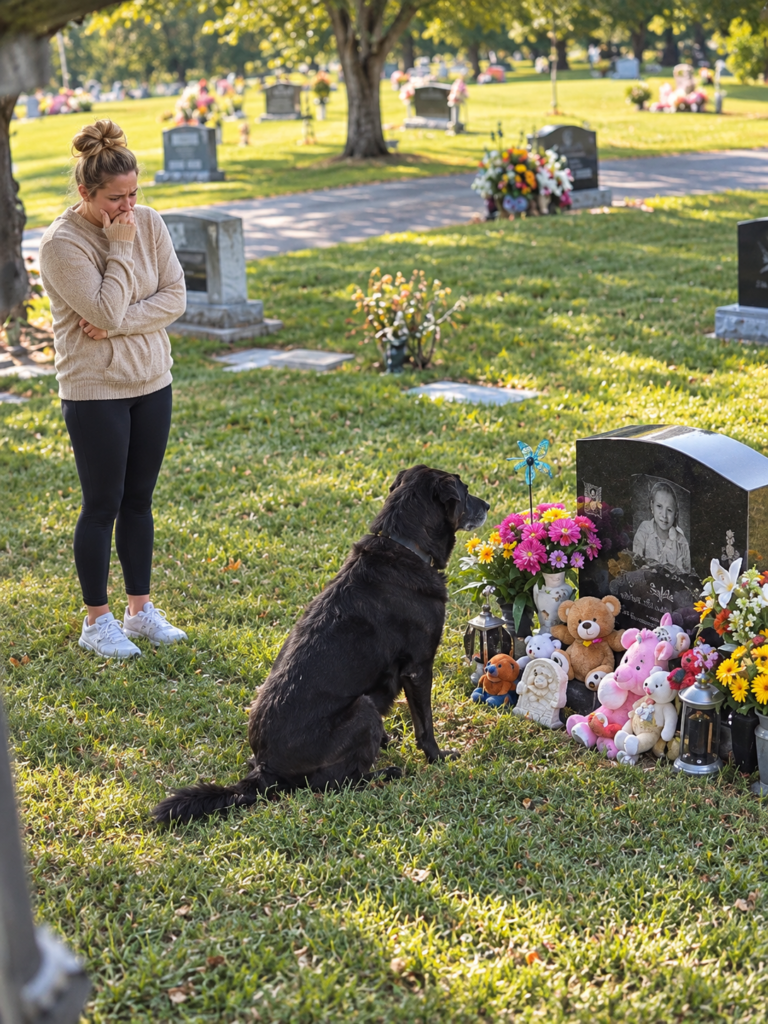
When we reached Noah’s grave, the dog went straight to his familiar place beside the stone.
He lowered himself into the grass and rested his chin on his paws.
Miles stood very still.
“Hi, Daddy,” he said.
I felt Tessa’s hand find mine.
We stayed there for a while.
We told Noah about Miles’s new winter boots, Tessa’s clinic job, and the fence Blue could no longer escape through.
Miles placed a small red toy airplane beside the flowers.
“For Daddy,” he explained.
Tessa knelt beside him.
“He would have loved that.”
I touched Noah’s name.
For years, I had come to that place carrying everything I had lost.
I had believed my life would always be divided into two parts.
Before Noah died.
And after.
But standing there beside his son, I understood that the second part of my life wasn’t finished being written.
There would still be grief.
There would still be birthdays that hurt and holidays when I would reach for the telephone before remembering why I couldn’t call him.
Nothing could change that.
But grief no longer had to be the only thing waiting for me when I woke each morning.
Miles tugged at my coat.
“Grandma?”
I looked down.
“Can we make pancakes when we get home?”
I smiled.
“Of course.”
“Crispy ones?”
Tessa laughed.
I looked at the headstone one more time.
“Yes, sweetheart,” I whispered. “The crispiest ones.”
Then we turned toward the cemetery gates.
Blue walked ahead.
Tessa stayed beside me.
And Miles skipped between us, talking excitedly about how many pancakes he thought a dinosaur could eat.
That afternoon, my kitchen smelled of butter and slightly burned batter.
Miles sat in Noah’s old chair with a paper napkin tucked into his collar.
Tessa was laughing because I’d dropped a pancake onto the floor, and Blue was waiting hopefully beneath the table.
The repaired wooden airplane rested on the windowsill, its red wings catching the pale winter sunlight.
One wing was still a little crooked.
I had decided to leave it that way.
Not every scar needed to disappear for something to be whole again.
And as I looked around my kitchen—at the young mother who had finally found the courage to tell the truth, at the loyal dog who had somehow found his way back to us, and at the little boy laughing in his father’s chair—I realized that the house was no longer quiet.
It was full of life again.
Not the life I had imagined.
Not the life I would have chosen if I could have kept Noah here.
But a life with love still growing inside it.
For the first time in years, I stopped wishing every Sunday would bring me one step closer to the past.
I had a grandson asking for another pancake.
And I had every reason to look forward to tomorrow.

