
PART 2
The Woman in the Photograph
For several seconds, nobody spoke.
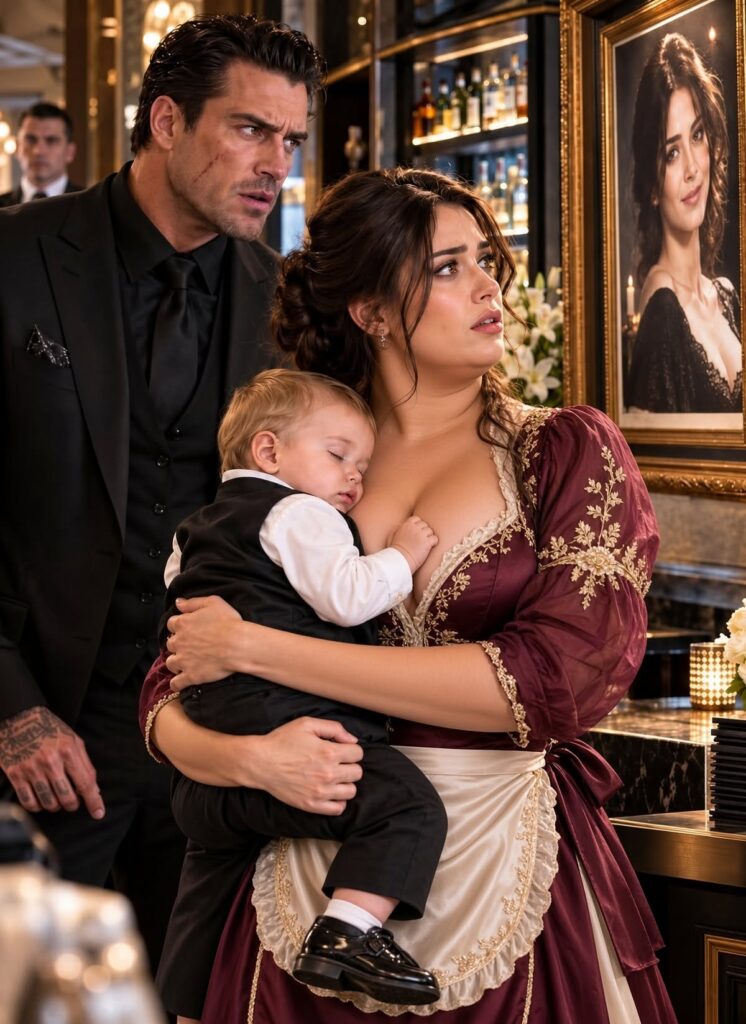
The baby was sleeping against my chest, one tiny fist curled around the fabric of my apron.
His breathing was soft and steady, completely undisturbed by the strange silence that had settled over the restaurant.
His father, meanwhile, looked as though the ground had disappeared beneath his feet.
“Who is she?”
I finally asked.
The man didn’t answer.
His gaze moved from the photograph to my face, then back again.
Something flickered in his dark eyes.
Recognition, certainly.
But beneath it was something much harder to understand.
Grief.
“Where did you get that photograph?” he asked.
I glanced toward the bar.
“It’s been there since before I started working here.”
“Who owns this restaurant?”
“My manager’s uncle.
Why?”
He carefully pulled out the chair beside him.
“Please sit down.”
I almost laughed.
A few minutes earlier, he’d ordered me to hold his baby as though I were another employee on his payroll.
Now he was asking me to sit with the politeness of a man afraid I might disappear.
“I’m working,” I said.
“I understand.”
He looked toward my manager, who was hovering nervously near the kitchen.
“Mr.
Orelio, would you mind giving Miss Valdez a few minutes?”
My manager blinked.
“Of course, Mr.
Moretti.”
Moretti.
Of course.
I’d heard that name before.
Everyone in our neighborhood had.
Adrian Moretti owned half the waterfront properties, several expensive hotels, and a collection of businesses whose exact purpose nobody seemed particularly eager to discuss.
People said his family had controlled the city’s criminal underworld for three generations.
But standing in front of me, Adrian Moretti didn’t look like a man thinking about his empire.
He looked like a father who had forgotten how to breathe.
I sat down.
“What’s your son’s name?”
The question seemed to surprise him.
“Leo.”
I looked at the sleeping baby.
“Hello, Leo.”
His tiny fingers tightened around my apron.
For the first time that evening, Adrian smiled.
It was brief, almost reluctant, but it changed his entire face.
“He likes you.”
“I noticed.”
“He hasn’t slept this peacefully in weeks.”
Something in his voice made me look up.
“Is he sick?”
“No.
He’s healthy.
The doctors have examined him more times than I can count.”
“Then what’s wrong?”
Adrian rested his hands on the table.
“His mother died when he was three months old.”
My heart softened immediately.
“I’m sorry.”
He nodded, accepting the words without seeming to know what to do with them.
“Since then, he’s had trouble settling.
He’ll fall asleep with me sometimes, but most nights are difficult.
My sister helps whenever she can.
We’ve tried different caregivers, different routines.
Nothing seems to work for long.”
I glanced down at Leo.
He was perfectly content, his cheek warm against my collarbone.
“Maybe he just likes the sound of my voice.”
“Perhaps.”
But Adrian wasn’t looking at the baby.
He was looking at me.
“What’s your full name?”
“Elina Valdez.”
“How old are you?”
“Twenty-six.”
“Where were you born?”
I frowned.
“Why does that matter?”
He looked embarrassed.
“You’re right.
Forgive me.”
That answer surprised me more than any threat could have.
I studied him for a moment.
Then I asked the question that had been waiting between us since I’d noticed the photograph.
“Who is that woman?”
Adrian turned toward the bar.
“Her name was Sofia.”
He swallowed.
“Sofia Bellini Moretti.
My wife.”
I looked at the photograph again.
His wife.
Leo’s mother.
The woman who looked almost exactly like me.
“That’s impossible,” I whispered.
Adrian said nothing.
I searched Sofia’s face, trying to find differences.
There were some.
Her hair was slightly longer than mine.
Her eyebrows were shaped differently, and she wore a confidence in the photograph that I had never quite managed to acquire.
But the resemblance was extraordinary.
The same heart-shaped face.
The same slightly crooked smile.
Even the small dimple in our left cheeks.
“Did she have a sister?”
I asked.
Adrian’s expression changed.
“Not that I know of.”
“Are you sure?”
“I knew her for six years.
We were married for three.”
“That doesn’t answer my question.”
He studied me for a long moment.
“No,” he admitted.
“It doesn’t.”
I looked down at Leo, who had begun making the tiny movements babies make when they’re dreaming.
“Why is her photograph hanging in this restaurant?”
“Because she loved this place.”
His answer came immediately.
“She used to come here before we were married.
Sometimes she’d bring a book and sit at the table by the window for hours.
She said it was the only place in the city where nobody expected her to be anything except herself.”
I knew the table.
Number seven.
The one with the uneven leg and the little scratch shaped like a crescent moon.
It was my favorite place to sit during my breaks.
A strange sensation passed through me.
“She knew Mr.
Orelio?”
“Very well.”
I looked toward the kitchen.
My manager, Marco Orelio, had disappeared behind the swinging doors.
For the first time since I’d started working at the restaurant, I wondered how much he knew about the photograph hanging behind his own bar.
Adrian’s sister arrived twenty minutes later.
Her name was Isabella Moretti, and she entered the restaurant carrying an enormous handbag and wearing the exhausted expression of someone who had spent the day solving other people’s problems.
“Adrian, what happened?
You said Leo was—”
She stopped when she saw me.
Her handbag slipped from her shoulder.
“Oh.”
Adrian stood.
“Isabella.”
But she barely seemed to hear him.
Her eyes filled with tears.
“Sofia?”
The name was barely a whisper.
I felt my stomach tighten.
“No,” Adrian said gently.
“This is Elina.”
Isabella pressed a hand against her mouth.
She looked from me to the baby, then back again.
“Oh, my goodness.”
I shifted uncomfortably.
“Would someone please explain what’s happening?”
Isabella immediately looked ashamed.
“I’m so sorry.
It’s just…”
She pulled out a chair.
“You look so much like my sister-in-law.”
“I’ve gathered that.”
“No.
You don’t understand.”
She leaned forward, studying my face.
“Even your expressions are similar.”
I wasn’t sure whether that was supposed to comfort me.
Adrian placed a hand on his sister’s shoulder.
“She’s holding Leo.”
Isabella finally noticed the sleeping child.
Her face softened.
“He’s asleep?”
“He has been for almost half an hour.”
She stared.
Then she laughed quietly, although tears were still shining in her eyes.
“That little rascal.
I’ve been singing the same three lullabies for six months, and all I get is a fist in the face.”
I couldn’t help smiling.
“He seems very sweet.”
“Oh, he is.
Particularly when he’s asleep.”
Isabella reached across the table and gently touched Leo’s foot.
He stirred but didn’t wake.
“Well,” she whispered, “I suppose we’ve found his favorite person.”
I glanced at Adrian.
He wasn’t smiling anymore.
He was studying me with the same troubling intensity.
By ten o’clock, the restaurant was almost empty.
Marco approached our table carrying three cups of coffee and a small plate of almond biscuits.
“On the house,” he said.
His eyes lingered on me.
Then on Leo.
Then on Adrian.
Something about his expression bothered me.
“Marco,” I said, “did you know the woman in that photograph?”
His hand tightened around the coffee tray.
“Of course.
Mrs.
Moretti was a wonderful customer.”
“Did she have any sisters?”
He went still.
It was such a small change that I might have missed it if I hadn’t been watching him.
“Why would you ask that?”
“Because she looks like me.”
He glanced toward Adrian.
“I can see the resemblance.”
“Marco.”
He looked back at me.
“Did she?”
He set down the tray.
“I think that’s a question for your mother.”
The restaurant seemed to grow very quiet.
“My mother?”
Marco’s expression immediately became guarded.
“I shouldn’t have said anything.”
“What does my mother have to do with this?”
He glanced toward the kitchen.
“Elina, perhaps you should speak with her.”
I stared at him.
“My mother has never even been here.”
“Are you certain?”
The question struck me strangely.
Of course I was certain.
Wasn’t I?
My mother lived two hours outside the city in a small house surrounded by lavender bushes.
She hated crowded places, never visited me at work, and rarely came into town.
But there had been one exception.
Three months earlier, she’d arrived unexpectedly at the restaurant just before closing.
She’d seemed nervous.
I’d assumed she was worried about my rent.
Now I remembered something else.
She had spent several minutes standing beside the bar.
Looking at the photograph.
I left work shortly after eleven.
Adrian insisted on having his driver take me home, but I declined.
He didn’t argue.
Instead, he handed me a simple white business card.
“If you ever want to talk about Sofia, call me.”
I looked at the card.
“And if I don’t?”
“Then I won’t bother you.”
It was the first thing he’d said all evening that made me feel entirely comfortable around him.
Isabella gently lifted Leo from my arms.
The baby immediately frowned.
“Oh, here we go,” she murmured.
His lower lip trembled.
Then he began to cry.
I reached out instinctively and touched his cheek.
“It’s all right, sweetheart.”
He quieted.
Adrian watched with an expression I couldn’t read.
“Would you…”
He hesitated.
“Would you mind visiting him again sometime?”
I looked at the baby.
Then at the man who had lost his wife.
“I don’t know.”
“Of course.”
He stepped aside, allowing me to leave.
But just as I reached the door, he spoke again.
“Elina?”
I turned.
“Sofia used to hum when she held him.”
I waited.
“A particular melody.
I don’t know where she learned it.”
My skin prickled.
“Why are you telling me this?”
“Because when you were holding Leo earlier, you were humming the same tune.”
I barely remembered the journey home.
The melody kept circling through my mind.
Four soft notes.
A pause.
Then three more.
I’d hummed it for as long as I could remember.
My mother used to sing it when I was little, especially during thunderstorms.
She claimed her own mother had taught it to her.
I’d never thought much about it.
Until tonight.
My apartment was small, with peeling paint around the windows and a radiator that made a strange knocking sound whenever the temperature dropped.
Usually, I found it comforting.
Tonight, it felt unfamiliar.
I placed my handbag on the kitchen counter and called my mother.
She answered on the fourth ring.
“Elina?
Darling, it’s nearly midnight.”
“Mom, I need to ask you something.”
“Are you all right?”
“Yes.
I’m fine.”
I hesitated.
“Do you know a woman named Sofia Bellini?”
Silence.
Not the ordinary silence of someone searching their memory.
The terrible, unmistakable silence of someone who has been waiting years for a particular question.
“Mom?”
“Where did you hear that name?”
My fingers tightened around the phone.
“At work.”
Another pause.
“Did you meet someone?”
“Yes.”
“Who?”
“Her husband.”
I heard a chair scrape against the floor.
“Oh, Elina.”
My stomach sank.
“You know her.”
My mother began to cry.
I had heard my mother cry only twice in my life.
Once when my grandfather died.
And once when I was seventeen and told her I had been accepted into culinary school but couldn’t afford the tuition.
That second time, she’d cried in the kitchen while pretending to chop onions.
Tonight, she made no attempt to hide it.
“Mom, please tell me what’s going on.”
“I wanted to tell you.”
“Tell me what?”
“I just never knew how.”
I closed my eyes.
“Are you my mother?”
The question escaped before I could stop it.
She made a small, wounded sound.
“Elina, sweetheart, I raised you.”
“That’s not what I asked.”
“No,” she whispered.
“It isn’t.”
I sank onto the edge of my bed.
Outside, rain began tapping against the window.
“Mom?”
“I am your mother in every way that has mattered to me,” she said.
“But I didn’t give birth to you.”
The words settled over me slowly.
I had always known I was different from my mother.
She had fair hair and pale blue eyes.
I had dark hair, brown eyes, and olive skin.
But families didn’t always look alike.
And she’d never given me any reason to question our relationship.
“Why didn’t you tell me?”
“Because I was afraid.”
“Of what?”
“Of losing you.”
I pressed my palm against my forehead.
“Mom, I’m twenty-six.”
“I know.”
“You could have told me.”
“I know.”
Her voice broke.
And despite everything, I wanted to comfort her.
That was the most confusing part.
I was angry.
I was frightened.
But she was still the woman who had taught me how to ride a bicycle, stayed awake through every childhood fever, and worked extra shifts to buy me the red winter coat I’d wanted when I was twelve.
She was still my mother.
I just didn’t know who else I might be.
“Where did I come from?”
I asked.
She took a shaky breath.
“Come home tomorrow.”
“Mom—”
“Please.
There are things I need to show you.
Things I should have shown you years ago.”
I looked at the rain sliding down the glass.
“Was Sofia my sister?”
My mother didn’t answer immediately.
Then she whispered, “I think she was.”
I didn’t sleep much.
By morning, I’d gone through every photograph in my apartment.
Birthday parties.
School concerts.
Summer picnics.
Christmas mornings.
In every picture, my mother stood beside me, smiling with the familiar tenderness I’d never questioned.
But now I noticed something.
There were no photographs of me as a newborn.
The earliest picture showed me at approximately eighteen months old, sitting on a yellow blanket in our old backyard.
I’d always assumed the baby photographs had been lost during one of our moves.
Now I wondered whether they had ever existed.
At seven-thirty, my phone rang.
Adrian.
I almost ignored it.
Then I remembered Leo.
“Hello?”
“Good morning, Elina.
I’m sorry to call so early.”
“It’s fine.”
“I wanted to apologize for last night.”
“Which part?”
He paused.
“All of it, perhaps.”
Despite myself, I smiled.
“That’s a fairly ambitious apology.”
“I’ve been told I have a talent for making situations uncomfortable.”
“Who told you that?”
“My sister.
Repeatedly.”
I sat at the kitchen table.
“Adrian, I spoke to my mother.”
His silence told me he understood the significance.
“She knew Sofia.”
“Did she tell you how?”
“Not yet.”
I looked at the old photograph spread across my table.
“She told me I’m adopted.”
He exhaled slowly.
“I’m sorry you had to discover it this way.”
“Me too.”
There was a brief pause.
Then he said something unexpected.
“If you’d prefer that I stay out of this, I will.”
I looked toward the window.
“Would you?”
“Yes.”
“Even if Sofia was my sister?”
His voice softened.
“Especially then.
You deserve to learn about your family without feeling that you owe mine anything.”
For the first time since the previous evening, I felt the tightness in my chest ease.
“Thank you.”
“There’s one more thing.”
“What?”
“Leo has been looking toward the door all morning.”
I laughed before I could stop myself.
“He’s nine months old.”
“I know.”
“He doesn’t know where I live.”
“I’m aware.”
“Then perhaps he’s looking for breakfast.”
Adrian chuckled.
“That’s what Isabella said.”
I smiled.
And for one brief moment, the world felt almost normal.
My mother was waiting on the porch when I arrived.
Her name was Rosa Valdez, and she’d always seemed to me like the strongest woman alive.
She could repair a leaking faucet, stretch one chicken into three dinners, and persuade a stubborn landlord to fix a broken heater without raising her voice.
But that morning, she looked smaller than I remembered.
She wore her favorite blue cardigan and held a handkerchief between her fingers.
I stepped out of the car.
For a moment, we simply looked at each other.
Then she opened her arms.
I walked straight into them.
She smelled of lavender soap and fresh bread.
The smell of home.
“I’m sorry,” she whispered.
I held her tightly.
“I know.”
We stood like that for a long time.
Eventually, she led me inside.
The kitchen looked exactly as it always had.
Yellow curtains.
A chipped ceramic fruit bowl.
The old clock that ran seven minutes fast because my mother believed being early was a sign of respect.
But on the table sat something I’d never seen before.
A wooden box.
Dark walnut, with a small brass clasp.
My mother sat opposite me.
“I promised someone I would keep these safe.”
“Who?”
She looked down.
“Your grandmother.”
Her name was Lucia Bellini.
My biological grandmother.
My mother opened the box and removed a faded photograph.
Three women stood in a garden.
One was my mother, much younger, with her hair falling loosely over her shoulders.
Beside her stood a woman with silver-streaked dark hair and kind brown eyes.
And between them stood two little girls.
Identical little girls.
Both wearing yellow dresses.
Both smiling at the camera.
One held a small white rabbit.
The other held a wooden spoon.
I stared at the picture.
“That’s…”
“Yes.”
My mother touched the photograph.
“That’s you and Sofia.”
I could barely breathe.
“Twins?”
She nodded.
“Identical twins.”
The room seemed to tilt.
I looked at the girls again.
Two little faces.
Two matching smiles.
One life I remembered.
One life I’d never known existed.
“Why were we separated?”
My mother folded her hands.
“Because your grandmother made a decision she believed would protect both of you.
And because I agreed to something I should have questioned much sooner.”
I looked up.
“Protect us from what?”
She hesitated.
“Not what, sweetheart.”
She looked at the photograph.
“From losing the only home she thought she could give you.”
My mother told me the story slowly.
Lucia Bellini had been a gifted seamstress who raised her daughter, Camilla, alone.
When Camilla became pregnant with twins at twenty-two, she wasn’t prepared for motherhood.
She loved her babies, Rosa insisted, but she was young, struggling financially, and overwhelmed by responsibilities she hadn’t expected.
Their father, a traveling musician named Daniel Varela, had returned to his home country before he knew Camilla was pregnant.
After the twins were born, Camilla tried to build a stable life.
For almost two years, she managed.
Then Lucia became seriously ill.
Medical bills mounted.
Camilla lost her job.
The little family moved repeatedly, staying with relatives and friends.
Rosa had been Lucia’s closest friend since childhood.
She and her husband, Mateo Valdez, had been trying unsuccessfully to have children for years.
When Lucia asked whether they would consider caring for one of the girls temporarily, they agreed.
That girl was me.
“Temporarily?”
I repeated.
My mother nodded.
“At first, we thought it would be six months.
Perhaps a year.”
“What happened?”
“Your grandmother’s health deteriorated.
Camilla moved abroad to find work.
Sofia stayed with Lucia’s older sister, Teresa.”
“And I stayed with you.”
“Yes.”
“Why didn’t anyone bring us back together?”
My mother looked at her hands.
“Because every year, the situation became more complicated.
You were happy with us.
Sofia was happy with Teresa.
Your grandmother worried that changing everything again would hurt you both.”
I stared at her.
“So everyone simply decided we were better off apart?”
She closed her eyes.
“That’s what we told ourselves.”
There was no defensiveness in her voice.
Only regret.
“Did you legally adopt me?”
“Yes.
When you were four.”
“Did Sofia know about me?”
My mother hesitated.
“I don’t know what Teresa told her.”
I looked at the photograph again.
Two little girls in yellow dresses.
Two sisters who had once shared everything.
And somehow, somewhere along the way, the adults in their lives had allowed them to become strangers.
I spent the afternoon asking questions.
Some my mother could answer.
Others she couldn’t.
Camilla had died in a car accident when I was six.
Lucia had passed away three years later.
Teresa had moved to Italy with Sofia when Sofia was four, and the two branches of the family had gradually lost contact.
My mother had sent letters.
Some were returned.
Others went unanswered.
Eventually, she’d stopped writing.
“I thought Teresa wanted a clean beginning,” she admitted.
“And you?”
“I wanted you to have one too.”
I looked at her.
“Did you ever think about telling me?”
“Every birthday.”
Her answer was immediate.
“Every time you asked why you didn’t look like me.
Every time you wanted to know why there weren’t any photographs of you as a newborn.”
Tears slipped down her cheeks.
“I kept waiting for the right moment.
And then I was afraid there was no right moment left.”
I reached across the table and took her hand.
“I wish you’d trusted me.”
She nodded.
“So do I.”
For a long time, neither of us spoke.
Then I asked the question that had been growing inside me all day.
“Did Sofia ever try to find me?”
My mother opened the wooden box again.
This time, she removed a cream-colored envelope.
My name was written across the front.
Elina.
The handwriting was elegant and unfamiliar.
My mother held it out.
“This arrived six years ago.”
I stared at her.
“Six years?”
“I didn’t know what to do with it.”
“Who sent it?”
She swallowed.
“Your sister.”
I took the envelope with trembling hands.
It had been opened.
I noticed that immediately.
My mother noticed me noticing.
“I read it,” she admitted.
“Why didn’t you give it to me?”
“Because I was frightened that you would leave.”
Her voice was barely audible.
“And because I convinced myself that waiting a little longer wouldn’t matter.”
I looked at her.
For the first time in my life, I didn’t know what to say to my mother.
She had loved me.
I had never doubted that.
But love had not prevented her from making a choice that belonged to me.
I carefully unfolded the letter.
The paper was soft at the creases.
I began to read.
Dear Elina,
I don’t know whether you remember me.
Sometimes I think I remember you.
Not clearly.
Just little things.
A yellow dress.
A garden.
Someone laughing beside me.
When I was sixteen, Aunt Teresa told me I had a twin sister.
She said our family had been separated when we were very young, and that you had grown up with people who loved you.
I spent years wondering whether you were happy.
Whether you liked music.
Whether you had my terrible habit of losing your keys.
Whether you ever looked in the mirror and felt that something was missing.
I stopped reading.
My mother was crying quietly.
I continued.
I found your name through an old family friend.
I hope you don’t mind that I’m writing.
I’m not asking you to change your life.
I just want you to know that somewhere in the world, there’s someone who shares your birthday and probably your stubbornness.
And if you ever want to meet me, I’ll be here.
Love,
Sofia.
Beneath her signature was a telephone number.
And an address.
I pressed the letter against my chest.
Six years.
My sister had written to me six years ago.
She had reached across the distance between us.
And I’d never known.
I stayed with my mother until evening.
We didn’t resolve everything.
I didn’t forgive her immediately.
She didn’t ask me to.
Instead, we made dinner together, just as we had when I was younger.
She chopped vegetables.
I prepared the sauce.
Occasionally, one of us asked a question.
Sometimes the other answered.
Sometimes we simply stood quietly, trying to understand how an ordinary kitchen could contain so much history.
Before I left, my mother handed me the wooden box.
“It belongs to you.”
I shook my head.
“Some of it belongs to you too.”
She smiled sadly.
“Then perhaps we can share it.”
I looked at the photograph of the two little girls.
“Mom?”
“Yes?”
“Would you have told me if I hadn’t seen Sofia’s picture?”
She took a long time to answer.
“I hope so.”
It wasn’t the answer I’d wanted.
But it was the first answer she’d given me that felt completely honest.
I hugged her before leaving.
And although something between us had changed, I knew I would come back.
Adrian answered my call that night.
“Elina?”
“I found something.”
He was silent.
“Can we talk?”
“Of course.”
I looked at the letter lying on my kitchen table.
“Your wife was my sister.”
There was a long pause.
Then he whispered, “I thought she might be.”
“I have a photograph of us together when we were little.”
“Twins?”
“Yes.”
He exhaled.
I heard a small noise in the background.
Then Isabella’s voice.
“Is that her?”
Adrian murmured something I couldn’t hear.
When he returned to the phone, his voice had changed.
“Elina, there’s something you should know.”
My heart began beating faster.
“What?”
“Sofia spent years looking for you.”
I closed my eyes.
“I know.
I found her letter.”
“She wrote more than one.”
I sat down.
“What do you mean?”
“She had an entire folder.
Letters, photographs, old addresses.
She never stopped hoping she’d find you.”
I looked at the envelope on my table.
“Why didn’t she?”
Adrian hesitated.
“Because six years ago, she received a letter telling her that you didn’t want contact.”
I went completely still.
“What?”
“She was devastated.
But she respected what she believed was your decision.”
I stared at the wall.
“I never wrote that letter.”
“I know.”
“Then who did?”
“I don’t know.”
He paused.
“But I think we should find out.”
The following afternoon, I returned to Restorante Orelio.
Marco was arranging clean glasses behind the bar.
When he saw me, he stopped.
“Elina.”
“I need to ask you something.”
He looked tired.
“I thought you might.”
I placed Sofia’s letter on the counter.
“Did you know she was looking for me?”
Marco looked at the envelope.
Then he nodded.
“Yes.”
My chest tightened.
“And you never told me?”
“I didn’t know you were the same Elina until your mother brought you here three months ago.”
I frowned.
“What?”
He leaned against the counter.
“She came to see my uncle.
They were old friends of Lucia’s.
She asked about Sofia.”
I remembered my mother’s unexpected visit.
The photograph.
Her nervous expression.
“Why?”
“She’d heard that Sofia had died.”
I looked down.
“Did she know Sofia was married?”
“Yes.”
“And that she had a baby?”
Marco nodded.
“She wanted to know whether you should meet them.”
My throat tightened.
“Why didn’t she tell me?”
“She said she needed time.”
I closed my eyes.
There it was again.
Time.
Everyone had needed more time.
And while they waited, my sister had lived an entire life without me.
Marco looked genuinely sorry.
“I should have said something.”
“Yes,” I whispered.
“You should have.”
He accepted that.
Then he reached beneath the counter.
“There’s something else.”
He brought out a small leather-bound notebook.
“Sofia left this here about a year before she died.
She used to write while she sat at table seven.
My uncle kept it in the office after she forgot it one evening.”
I stared at the notebook.
“Why didn’t anyone return it?”
“We tried.
She said she’d collect it the next time she came in.
Then life got busy, and eventually…”
He didn’t finish.
I understood.
I opened the notebook.
Most of the pages contained recipes.
Handwritten measurements.
Little drawings of cakes.
Notes about ingredients.
Then, near the back, I found a page titled:
For Elina, if I ever find her.
My hands began to shake.
Beneath the title was a recipe for orange-and-almond cake.
My favorite.
The cake my mother made every year on my birthday.
At the bottom of the page, Sofia had written:
Grandma Lucia always said this was our birthday cake.
I wonder if Elina still remembers the taste.
I sat down on the nearest chair.
For a moment, I couldn’t speak.
Then I turned the page.
And found a name.
Teresa Bellini.
An address in Florence.
And a note written beneath it.
Ask Aunt Teresa about the second letter.
Something about her explanation doesn’t make sense.
I looked up at Marco.
“Is Teresa still alive?”
He nodded slowly.
“As far as I know.”
I stared at the notebook.
My sister had known something was wrong.
She had been trying to understand why our reunion had never happened.
And the woman who had raised her might have known the answer.
That evening, I met Adrian at his home.
It was nothing like I’d expected.
I’d imagined marble floors, enormous chandeliers, and cold rooms filled with expensive furniture.
Instead, the house was warm and surprisingly lived-in.
Children’s toys lay scattered across the sitting-room carpet.
A half-finished puzzle occupied the coffee table.
Someone had left a pair of tiny socks on the arm of a sofa.
Isabella opened the door.
“Elina!”
Before I could respond, she hugged me.
Then she stepped back, looking embarrassed.
“Sorry.
We’re a hugging family.”
I smiled.
“So am I.”
Leo was sitting on a soft blanket in the living room, surrounded by colorful wooden blocks.
When he saw me, his entire face lit up.
He lifted both arms.
I laughed.
“Hello, little gentleman.”
Adrian appeared in the doorway.
“He’s been practicing that all afternoon.”
“Reaching?”
“Demanding attention.”
I knelt beside Leo.
He immediately crawled into my lap.
Isabella shook her head.
“Unbelievable.”
For the first time in two days, I felt something other than confusion.
Joy.
Simple, unexpected joy.
Adrian showed me Sofia’s study after dinner.
He had left it almost exactly as she’d arranged it.
Books lined the shelves.
A vase of dried flowers stood beside the window.
Photographs covered the desk.
There were pictures of Sofia with Adrian.
Sofia holding Leo.
Sofia laughing beside Isabella.
And one photograph that made me stop.
Sofia stood in the garden, heavily pregnant, holding a tiny yellow dress.
I looked at Adrian.
“What’s this?”
He smiled sadly.
“She found it in an old trunk.
She said she and her sister had worn matching dresses when they were little.”
I touched the photograph.
“She kept it?”
“She kept everything that reminded her of you.”
He opened a drawer.
Inside lay a blue folder.
My name was written across the front.
Elina.
He placed it on the desk.
“I think you should have this.”
I opened it carefully.
There were copies of old letters.
Addresses.
Photographs.
Notes.
And finally, a letter dated six years earlier.
The letter Sofia had received.
The one supposedly written by me.
I read the first line.
Dear Sofia,
Thank you for reaching out, but I don’t wish to reopen the past.
My hands went cold.
I read the rest.
It was polite.
Carefully worded.
And completely unfamiliar.
At the bottom was a signature.
Elina Valdez.
Except it wasn’t my handwriting.
I looked at Adrian.
“This isn’t mine.”
He nodded.
“I believe you.”
Then I noticed something else.
The return address.
It wasn’t my mother’s house.
It wasn’t anywhere I’d ever lived.
It was an address in Florence.
Italy.
The same city where Teresa Bellini lived.
I looked at Sofia’s notebook, which I’d brought with me.
Then at the letter.
Then back at Adrian.
“Someone wrote this from Italy.”
He leaned closer.
And for the first time, I saw genuine surprise cross his face.
Because beneath the false signature, almost invisible in the faded ink, was a small handwritten notation.
Two letters.
T.B.
Teresa Bellini.
My sister’s adoptive mother.
The woman who had raised her.
The woman who had apparently decided we should never meet.
And somewhere in Florence, she was still alive.
Still carrying the truth.
I looked toward the living room, where Leo was laughing at something Isabella had done.
Then I looked at the folder containing six years of my sister’s unanswered love.
“I need to speak to Teresa,” I whispered.
Adrian nodded.
“Then we’ll find a way.”
But before either of us could say another word, Isabella appeared in the doorway holding a small silver locket.
“Adrian, I found this in Sofia’s jewelry box.”
She looked at me.
“I think it belongs to you.”
I took it carefully.
Inside were two tiny photographs.
Two little girls in yellow dresses.
And engraved beneath them were four words.
Together, wherever we are.
For the first time since discovering the truth, I began to cry.
Not because I’d lost my sister.
But because I finally understood how much she had wanted to find me.
And now, I had to decide what to do with the life she’d left behind.
PART 3
I held the silver locket in my palm long after Isabella had left the room.
The two little girls inside were smiling at each other, completely unaware that the world would soon separate them.
I wondered which one was me.
Then I realized something that made my chest ache.
I didn’t know.
I had spent twenty-six years looking at photographs of myself, but I couldn’t recognize my own face beside my sister’s.
“She wore that almost every day,” Adrian said quietly.
I looked up.
“Sofia?”
He nodded.
“She used to say it reminded her that somewhere in the world, someone understood what it was like to be her.”
I ran my thumb over the engraving.
“Did she ever tell you why she stopped looking for me?”
Adrian pulled out the chair beside me.
“She never stopped wanting to find you.
But she believed you had asked her to leave you alone.”
I glanced at the forged letter on the desk.
“She must have been hurt.”
“She was.
But she was also very protective of you, even though she didn’t know you.”
He smiled faintly.
“She used to say that if you were happy, she could live with never meeting you.
She just wanted to know you were loved.”
I closed the locket.
“And she was loved?”
Adrian looked toward the photograph of his wife.
“Very much.”
For the first time that evening, I saw something beyond the powerful man everyone feared.
I saw a husband who had lost his favorite person.
A father who was learning to raise a child alone.
And a man who had been given an unexpected opportunity to return a small piece of his wife’s love to the person she’d spent years searching for.
“Tell me about her,” I said.
He looked surprised.
“What would you like to know?”
“Everything.”
We stayed in Sofia’s study until nearly midnight.
Adrian told me how they’d met at a charity dinner neither of them had wanted to attend.
Sofia had accidentally spilled sparkling water on his jacket.
Instead of apologizing immediately, she’d looked at the expensive fabric and said, “Well, at least now you have an excuse to stop looking so serious.”
He’d fallen in love with her that evening.
Or so he claimed.
“That quickly?”
I asked.
“She was very persuasive.”
“What happened next?”
“She refused to give me her telephone number.”
I laughed.
“That sounds reasonable.”
“She told me that if I genuinely wanted to see her again, I’d have to visit the little restaurant where she spent her Thursday afternoons.”
“Restorante Orelio?”
He nodded.
“I went there every Thursday for three weeks.”
“And?”
“She was never there.”
I burst out laughing.
Adrian smiled.
“Eventually, I discovered she went on Wednesdays.”
“She tricked you.”
“She wanted to know whether I could laugh at myself.”
“Could you?”
“Not particularly well at the time.”
He looked toward her photograph.
“She helped me learn.”
The more he spoke, the more I recognized little pieces of myself in his descriptions.
Sofia loved cooking but hated washing dishes.
She collected old recipe books.
She talked to herself when she was nervous.
And whenever she was worried about someone, she made them something to eat.
I looked down at my hands.
“That’s exactly what I do.”
Adrian smiled.
“She would have liked knowing that.”
When I finally left the study, Isabella was asleep on the living-room sofa.
Leo lay peacefully in his crib nearby, watched over by the family’s longtime housekeeper, Mrs.
Conti.
I approached him quietly.
His tiny eyelashes rested against his cheeks.
One hand was curled beside his face, and his lips moved slightly as he dreamed.
I had known him for barely two days.
Yet somehow, I already felt protective of him.
Adrian stood beside me.
“He has her eyes,” he whispered.
I looked more closely.
They were my eyes too.
That realization brought a strange warmth to my chest.
“May I visit him again?”
Adrian turned toward me.
“Of course.”
“I don’t want him to get too attached if I’m not going to be around regularly.”
He considered that.
“Then we’ll take things slowly.
There’s no need to make promises before we know what works.”
I appreciated the answer.
So much of my life had suddenly been rearranged by decisions other people had made without consulting me.
It felt good to be offered a choice.
I looked down at Leo.
“Goodnight, little one.”
His fingers opened and closed in his sleep.
And for the first time, I allowed myself to imagine that perhaps this strange new family might eventually become part of my ordinary life.
Three days later, I received an unexpected telephone call.
It was from a woman named Francesca Bellini.
She introduced herself as Teresa’s daughter.
My cousin.
I had never known I had one.
“I hope you don’t mind me calling,” she said.
“Adrian gave me your number after you agreed he could contact our family.”
I sat down at my kitchen table.
“Not at all.”
There was a brief silence.
Then she said, “I remember you.”
My heart skipped.
“You do?”
“Only a little.
I was seven when you and Sofia were separated.
I remember two little girls running around my grandmother’s garden.”
I closed my eyes.
“What were we like?”
She laughed softly.
“Inseparable.
And extraordinarily mischievous.”
“Really?”
“Oh, yes.
Once, you convinced Sofia to help you hide every wooden spoon in the kitchen because you didn’t want Grandma Lucia to make vegetable soup.”
I laughed.
“That sounds like something I’d do.”
“Apparently, you preferred cake.”
“Some things never change.”
Her laughter faded.
“Elina, I’m calling because I heard about the letter.”
I looked toward the blue folder on my table.
“Do you know anything about it?”
“I know my mother wrote to Sofia several years ago.
I don’t know exactly what she said.”
I waited.
Francesca took a breath.
“She’s been asking about you.”
“Teresa?”
“Yes.”
I didn’t know how to respond.
For days, I’d imagined Teresa as the woman who had kept my sister away from me.
But now I was speaking to her daughter, who sounded nervous and deeply concerned.
“Does she know I found the letter?”
“Yes.”
“And?”
“She wants to explain.”
I looked out of the window.
The morning sunlight was falling across the kitchen counter, illuminating the little collection of photographs I’d arranged there.
Two girls in yellow dresses.
My mother holding me.
Sofia smiling beside Adrian.
A family scattered across decades and continents.
“Then I think it’s time we spoke,” I said.
Teresa Bellini appeared on my laptop screen the following afternoon.
She was seventy-three, with silver hair arranged in a neat bun and a pair of reading glasses hanging from a chain around her neck.
Francesca sat beside her.
Adrian had offered to be present during the call, but I’d declined.
I wanted to hear Teresa’s story without feeling that anyone expected a particular response from me.
“Elina,” she said.
Her eyes filled with tears.
“You look so much like your sister.”
I nodded.
“So everyone keeps telling me.”
She smiled sadly.
“I suppose they do.”
For a moment, neither of us spoke.
Then I held up the letter.
“Did you write this?”
Teresa looked at it.
Her face changed.
“Yes.”
The answer was so immediate that it startled me.
“Why?”
She folded her hands in her lap.
“Because I believed I was protecting Sofia.”
I took a breath.
“From me?”
“No, darling.
Never from you.”
“Then from what?”
She looked toward Francesca, who gently squeezed her hand.
“From another disappointment.”
I waited.
Teresa began to explain.
When Sofia turned sixteen, Teresa had finally told her about me.
Until then, she’d believed her sister had died as a toddler.
That revelation stopped me.
“She thought I was dead?”
Teresa nodded.
“When Lucia became ill, she worried that Sofia would spend her childhood longing for a sister she couldn’t see.
She told Sofia that you’d passed away when you were very young.”
I stared at the screen.
“Why would she do that?”
“I think she believed a loss Sofia could mourn would be easier than a separation she couldn’t understand.”
Teresa’s voice trembled.
“I disagreed with her, but I didn’t challenge her strongly enough.
I was afraid of upsetting the family when everyone was already struggling.”
I thought about my mother.
About the letters she’d hidden.
About the way adults sometimes convinced themselves that avoiding difficult conversations was an act of kindness.
“What happened when Sofia found out?”
“She was furious with me.
She asked why nobody had trusted her with the truth.”
I almost smiled.
That sounded familiar.
“She wanted to find you immediately,” Teresa continued.
“We contacted your mother through an old family friend.”
My heart tightened.
“Rosa?”
“Yes.”
“What did she say?”
“That you were happy, but she wasn’t certain you were ready to learn about your adoption.”
I closed my eyes.
“She never asked me.”
“I know.”
Teresa lowered her gaze.
“Eventually, Sofia found your address and wrote to you herself.”
“The letter I received six years later.”
“Yes.”
I held it up.
“And this one?”
Teresa looked at the forged reply.
“That was my mistake.”
She explained that after Sofia sent her first letter, Rosa had telephoned Teresa.
She’d been frightened.
I’d recently left home, started working in the city, and was struggling to establish myself.
Rosa worried that discovering an entirely new family would overwhelm me.
“She asked us to wait,” Teresa said.
“For how long?”
“She didn’t know.”
I felt the familiar frustration rising.
“And you decided to write a letter pretending to be me?”
Teresa shook her head.
“Not exactly.
I wrote a letter to Sofia explaining that your mother believed you needed time.”
I frowned.
“Then why does this one have my name on it?”
She looked genuinely confused.
“May I see it more closely?”
I held the page toward the camera.
She adjusted her glasses.
Then her expression changed.
“Oh, dear.”
“What?”
“That’s my handwriting.
But those aren’t the words I sent.”
I stared at her.
“What do you mean?”
Teresa looked at Francesca.
“I wrote a draft.
I never intended Sofia to see it.”
She pressed her fingers against her forehead.
“I was trying to decide how to explain the situation without revealing that Rosa had asked us to wait.
I wrote several versions.”
“Where did you keep them?”
“In my desk.”
Francesca suddenly sat straighter.
“Mom, didn’t you give Sofia the folder when she came to Florence?”
Teresa nodded slowly.
“Yes.”
Francesca looked at me.
“She came to visit us shortly after her wedding.
She wanted to look through the family documents again.”
I glanced at the forged letter.
“Then she found the draft?”
Teresa covered her mouth.
“I think she did.”
The room went quiet.
I looked at the letter again.
The careful handwriting.
The words that sounded nothing like me.
The signature Teresa had written while imagining what I might say.
Sofia had found it among the family papers.
And she’d believed it was real.
I ended the call an hour later.
Teresa had answered every question I could think of.
She hadn’t defended her decision to write the draft.
She hadn’t asked me to understand it.
She simply acknowledged that her fear of upsetting Sofia had contributed to years of confusion.
Before we said goodbye, she asked whether I would consider visiting Florence someday.
“I still have some of your grandmother’s things,” she said.
“And photographs of you and Sofia.”
I hesitated.
“I’d like to see them.”
She smiled.
“Then they’ll be waiting whenever you’re ready.”
After the call, I sat quietly for a long time.
The mystery of the letter had finally been explained.
But understanding how it had happened didn’t make the lost years disappear.
I had missed my sister’s wedding.
She had missed my graduation.
I’d never held her hand when she was pregnant.
She’d never tasted the first cake I sold at the restaurant.
We had been living parallel lives, connected by an invisible thread neither of us had been able to follow.
And now, there was no way to recover the time we’d lost.
Or so I thought.
That evening, my mother arrived at my apartment carrying a basket of homemade bread.
She stood in the doorway looking uncertain.
“I wasn’t sure whether you’d want to see me.”
I stepped aside.
“Come in, Mom.”
She placed the basket on the kitchen counter.
For several minutes, we talked about ordinary things.
The weather.
Her garden.
My rent.
Then I told her about Teresa.
She listened without interrupting.
When I finished, she sat down.
“I should have told you the truth when you were old enough to understand.”
“Yes.”
She nodded.
“I know.”
I looked at her.
“Why were you so afraid I’d leave?”
She twisted her wedding ring.
“Because your father and I had wanted a child for so long.
When you came to us, it felt like a miracle.”
I softened at the mention of Mateo.
My adoptive father had died when I was fourteen.
He’d been a quiet, affectionate man who taught me to bake bread and insisted that every family dinner needed a ridiculous story.
“He would have told me,” I said.
My mother smiled sadly.
“Probably.”
She looked toward the window.
“He wanted to tell you when you turned eighteen.
We argued about it.”
I stared at her.
“He knew?”
“Of course.”
“And he wanted me to know?”
“Yes.”
I felt tears gathering.
“Why didn’t he tell me himself?”
“He became ill before we could agree on how to do it.
After he died, I couldn’t bear the thought of losing you too.”
I reached across the table.
“Mom, knowing I had another family wouldn’t have meant I stopped loving you.”
She began to cry.
“I understand that now.”
I squeezed her hand.
“I can’t promise I’ll stop being upset tomorrow.”
“I wouldn’t expect you to.”
“But I don’t want us to spend another six years avoiding things we’re afraid to say.”
She nodded.
“Neither do I.”
We sat together until the bread had gone cold.
And for the first time in years, my mother told me stories about my early childhood that I’d never heard before.
Stories about Sofia.
About our grandmother.
About two little girls who insisted on sleeping in the same bed because neither wanted to be alone.
My visits to the Moretti house became a regular part of my week.
At first, I came only on Sunday afternoons.
Then Isabella began inviting me to family dinners.
Eventually, Adrian asked whether I’d be willing to help Leo adjust to a more predictable bedtime routine.
I agreed, provided we took things slowly and followed his pediatrician’s advice.
The change wasn’t immediate.
Leo still had difficult evenings.
He still preferred Adrian when he was tired, and there were nights when nothing seemed to satisfy him except being carried around the living room while his father sang badly.
But he grew comfortable with me.
And I grew comfortable with him.
One Sunday afternoon, I sat on the carpet building a tower of wooden blocks while Leo enthusiastically knocked it down.
Isabella watched from the sofa.
“You know, he doesn’t usually share those.”
I looked at the blocks.
“Perhaps he knows I’m an excellent architect.”
She laughed.
“You’re an excellent something.
He certainly thinks so.”
Leo picked up a yellow block and offered it to me.
“Thank you, sir.”
He squealed.
I placed it on top of the tower.
He immediately knocked everything over.
Adrian appeared in the doorway carrying two cups of tea.
“I see he’s supervising construction again.”
“Very strictly,” I said.
He handed me a cup.
Our fingers brushed.
It was nothing.
A perfectly ordinary moment.
Yet I became unexpectedly aware of how easily we’d begun to speak to each other.
How comfortable the house felt.
How naturally I looked forward to seeing him.
I glanced at Sofia’s photograph on the mantelpiece.
And immediately felt confused.
That evening, I asked Isabella to walk with me in the garden.
The air smelled of roses and freshly cut grass.
She linked her arm through mine.
“What’s troubling you?”
I looked at her.
“Am I that obvious?”
“Only to someone who’s spent years observing my brother.”
I smiled.
Then I hesitated.
“Do you ever feel strange having me here?”
She stopped walking.
“Why would I?”
“Because I look like Sofia.”
Her expression softened.
“Oh, Elina.”
“I don’t want anyone to feel as though I’m trying to replace her.”
Isabella took my hands.
“Nobody thinks that.”
I looked away.
“Sometimes Adrian looks at me and gets this expression…”
“I know.”
She sighed.
“He misses her.”
“I know that too.”
“But he also enjoys your company.
Those are two different things.”
I looked toward the house.
“How do you know?”
“Because Sofia was my closest friend.
And you are becoming one too.”
Her answer surprised me.
Isabella smiled.
“You have the same face, sweetheart.
But you’re very different people.”
“How?”
“Sofia was impulsive.
She’d make a decision before anyone else had finished asking the question.
You’re more thoughtful.
You watch people.
You listen.”
I laughed softly.
“She sounds more interesting.”
“She was exhausting.”
We both laughed.
Then Isabella squeezed my hand.
“You don’t have to become Sofia to belong here.”
The words stayed with me long after I went home.
Two weeks later, Adrian invited me to dinner.
Not a family dinner.
Just dinner.
At a small restaurant near the waterfront.
I stared at his message for several minutes before replying.
Is this about Leo?
His response arrived almost immediately.
No.
Then another message.
Although I’m certain he’d insist on coming if he knew.
I laughed.
Then I typed:
I’d like that.
The restaurant was quiet and warmly lit, with candles on the tables and a pianist playing near the windows.
Adrian was already waiting when I arrived.
He stood as I approached.
“You look lovely.”
I glanced down at my simple blue dress.
“Thank you.”
He pulled out my chair.
For the first few minutes, we talked about ordinary things.
My work.
His business.
Isabella’s latest attempt to reorganize the entire Moretti household.
Then I asked a question I’d been carrying for weeks.
“Adrian, why did you become involved in your family’s business?”
He considered his answer.
“Because I inherited responsibilities before I was old enough to understand them.”
“Do you enjoy it?”
“Some parts.
Others, not at all.”
He looked toward the water.
“My family built its reputation in a very different time.
I’ve spent years trying to change the way we operate.”
I studied him.
“Is that possible?”
“Not quickly.”
He smiled faintly.
“Sofia used to ask me the same question.”
“What did you tell her?”
“That I wanted Leo to inherit something better than a name people feared.”
I looked at him.
“And do you?”
“More than ever.”
There was no grand declaration in his voice.
Only the quiet seriousness of a father thinking about the future.
After dinner, we walked along the waterfront.
The city lights shimmered across the dark water.
Adrian kept his hands in his coat pockets.
I appreciated that he wasn’t trying to rush anything.
Eventually, he stopped beside a bench.
“Elina, there’s something I want to say.”
I looked at him.
“All right.”
“When you first walked into the restaurant that night, I thought I was seeing Sofia again.”
My chest tightened.
“I know.”
“But the more time I spend with you, the more I realize how different you are.”
I waited.
“You’re patient in ways she wasn’t.
You question things she would have accepted without hesitation.
And you have a talent for making people feel comfortable without even realizing you’re doing it.”
I looked down.
“Adrian…”
“I’m not asking you for anything.”
He smiled gently.
“I just wanted you to know that when I look at you now, I see you.”
For a long moment, I couldn’t speak.
Then I said, “I think I needed to hear that.”
We continued walking.
And when he offered me his arm, I took it.
The following month, I traveled to Florence.
My mother came with me.
It had been my suggestion.
She’d initially refused, insisting that the journey belonged to me.
But I wanted her there.
Not because everything between us had been repaired.
Because I wanted us to begin making new memories without hiding the old ones.
Teresa met us at the airport with Francesca.
She embraced my mother first.
They stood holding each other for several moments, two women who had spent decades carrying different versions of the same regret.
Then Teresa turned to me.
“Elina.”
She reached for my hands.
I stepped forward and hugged her.
It wasn’t forgiveness for everything.
It was simply the beginning of something new.
Florence was beautiful.
We spent our first afternoon walking through narrow streets, stopping for coffee and looking at shop windows.
Francesca showed me the little bakery where Sofia used to buy pastries.
Then she took me to the apartment where my sister had lived during university.
“She used to sit on that balcony and read,” Francesca said.
I looked up.
A small balcony overlooked a courtyard filled with potted plants.
I imagined Sofia sitting there with a book.
Perhaps thinking about me.
Perhaps wondering whether I was sitting somewhere equally ordinary, reading something entirely different.
That evening, Teresa brought out several old photograph albums.
We sat around her dining-room table.
There were photographs of birthday parties.
Christmas mornings.
Summer holidays.
And dozens of pictures of Sofia growing up.
I studied each one carefully.
At eight, she had missing front teeth and an enormous smile.
At twelve, she wore glasses and looked deeply unimpressed with her school uniform.
At sixteen, she had cut her hair short and dyed the ends purple.
I laughed.
“She actually did that?”
Francesca grinned.
“Teresa nearly fainted.”
“I did not,” Teresa protested.
“You sat down very suddenly.”
We all laughed.
Then Teresa turned a page.
And there we were.
Two little girls sitting beneath an olive tree.
One holding a wooden spoon.
The other holding a small white rabbit.
My mother leaned closer.
“Oh, Elina.”
I touched the photograph.
“Which one am I?”
Teresa smiled.
“The one with the spoon.”
I stared.
“How do you know?”
“Because you refused to go anywhere without it.
You said you were going to become a chef.”
My mother began laughing through her tears.
“You’ve been stealing my wooden spoons since you were old enough to walk.”
For the first time, the past felt less like a mystery and more like something I could finally belong to.
On our final morning in Florence, Teresa gave me a small wooden recipe box.
It had belonged to Lucia.
Inside were dozens of handwritten recipes, some in Italian and others in Spanish.
At the very back was a folded piece of paper.
Teresa handed it to me.
“Your grandmother wrote this shortly before she died.”
I unfolded it.
The handwriting was shaky but still legible.
My darling girls,
If you ever find each other again, I hope you will understand that families sometimes make mistakes even when they believe they are acting out of love.
I wish I had been braver.
I wish I had trusted that two little girls who loved each other so much would find a way to grow up knowing they belonged together.
Wherever life takes you, remember that you were loved from the very beginning.
Grandma Lucia.
I read the letter twice.
Then I folded it carefully and placed it back inside the box.
I couldn’t change my grandmother’s decisions.
I couldn’t ask Sofia all the questions I’d carried to Italy.
But I could choose what happened next.
And I knew exactly where I wanted to begin.
When I returned home, I handed Marco my resignation.
He looked genuinely shocked.
“You’re leaving?”
I nodded.
“Not immediately.
I’ll work my notice.”
“Have you found another restaurant?”
“Not exactly.”
He leaned against the counter.
“Elina, you’re one of the best employees I’ve ever had.”
I smiled.
“Then perhaps you should have paid me more.”
He laughed.
“Fair point.”
Then his expression softened.
“What’s the plan?”
I placed Lucia’s recipe box on the counter.
“I’m opening a bakery.”
Marco stared at me.
“Really?”
“Really.”
He looked toward Sofia’s photograph.
Then back at me.
“She would have loved that.”
I smiled.
“I think so too.”
Opening a bakery was considerably harder than announcing that I wanted to open one.
There were permits.
Renovations.
Equipment.
Insurance.
And a truly astonishing number of forms.
I spent evenings researching suppliers and mornings visiting potential locations.
Adrian offered to help with the financing.
I declined.
Not because I doubted his intentions.
Because I needed this particular dream to belong to me.
He understood.
Instead, he introduced me to a small-business adviser and helped me compare the terms of several commercial leases.
My mother offered to contribute her savings.
I refused those too.
She pretended to be offended.
Then she arrived the following weekend carrying six enormous bags of flour.
“Consider it an investment,” she said.
“Mom, that’s enough flour for a small army.”
“Then you’d better start baking.”
We laughed.
And just like that, something between us felt easier.
Three months later, I signed the lease on a small storefront two streets away from Restorante Orelio.
It had large windows, a bright kitchen, and a little courtyard where I hoped to place tables during the summer.
The walls needed painting.
The floors needed repairing.
And the old oven looked as though it had survived several generations of questionable cooking decisions.
But I loved it immediately.
Isabella helped me choose the curtains.
Francesca designed the logo.
Marco recommended reliable suppliers.
And Adrian spent an entire Saturday assembling shelves, despite repeatedly insisting that he was perfectly capable of reading the instructions.
He was not.
At one point, I found him staring at a collection of screws with deep suspicion.
“Problem?”
He looked up.
“I believe the manufacturer has made a mistake.”
I picked up the instruction booklet.
“Adrian, you’re holding it upside down.”
He stared at me.
Then we both started laughing.
It was the first time I’d seen him laugh without any trace of sadness.
The evening before the bakery opened, I stood alone in the finished shop.
The walls were painted a soft cream.
Fresh flowers stood on the counter.
The shelves were filled with bread, pastries, and little jars of homemade preserves.
Above the entrance hung a simple wooden sign.
THE TWO SISTERS BAKERY
Beneath it, in smaller letters:
Made with love, shared with family.
I looked around the room.
Then I placed Sofia’s photograph on a shelf beside Lucia’s recipe box.
For a moment, I simply stood there.
“Well,” I whispered, “we did it.”
The bell above the door rang.
Adrian stepped inside carrying Leo.
“Are we too early?”
I smiled.
“You’re exactly on time.”
Leo immediately reached toward me.
I laughed and took him.
He was growing quickly now, with a cheerful personality and a determined interest in anything he wasn’t supposed to touch.
He pointed toward the pastry display.
“Ba!”
“Absolutely not,” Adrian said.
“You’ve already had dinner.”
Leo looked deeply offended.
I kissed the top of his head.
“Your father is very unreasonable.”
Adrian raised an eyebrow.
“You’re encouraging him.”
“Someone has to.”
He smiled.
Then he looked around the bakery.
“It’s beautiful, Elina.”
I felt my cheeks warm.
“Thank you.”
He stepped closer.
“Sofia would have been proud of you.”
I glanced toward her photograph.
“I hope so.”
Then I looked back at him.
“But I think she’d also have told me the curtains were crooked.”
Adrian laughed.
“She absolutely would have.”
The bakery opened on a Saturday morning.
By nine o’clock, there was a line outside.
Marco arrived with several employees from the restaurant.
Francesca had flown in from Italy.
Teresa sent an enormous arrangement of flowers.
My mother stood behind the counter wearing an apron she’d embroidered herself.
And Isabella arrived with enough balloons to decorate an entire wedding reception.
“Isn’t this a little excessive?”
I asked.
She looked offended.
“Elina, this is a family celebration.”
Adrian appeared behind her.
“She said the same thing when Leo learned to crawl.”
“That was a very important milestone,” Isabella replied.
Leo, sitting comfortably in his stroller, clapped his hands.
Everyone laughed.
For the first time in my life, I looked around a room and saw people from every part of my history standing together.
My adoptive mother.
My biological relatives.
My friends.
My new family.
All of them celebrating something I’d built with my own hands.
I felt an unexpected rush of emotion.
My mother noticed immediately.
She came around the counter and hugged me.
“Your father would have been so proud.”
I closed my eyes.
“I know.”
That afternoon, after the last customers had left, Adrian helped me clean the kitchen.
We worked quietly together.
He washed the mixing bowls.
I wiped down the counters.
Eventually, he said, “Elina, may I ask you something?”
“Of course.”
“Are you happy?”
I looked around.
At the flour-covered worktops.
The empty pastry trays.
The flowers beginning to droop slightly in the afternoon warmth.
Then I looked at him.
“Yes.”
He smiled.
“Good.”
I hesitated.
“Are you?”
His expression became thoughtful.
“More than I expected to be.”
I put down my cloth.
“Adrian…”
He turned toward me.
“I know this hasn’t been simple.”
“No.”
“And I know Sofia will always be part of our lives.”
“Of course.”
He stepped closer.
“But I don’t want the past to prevent us from discovering what the future might hold.”
I looked at him for a long moment.
Then I smiled.
“Neither do I.”
He reached for my hand.
And this time, I didn’t hesitate.
We didn’t rush.
There were still difficult conversations.
About Sofia.
About Leo.
About the responsibilities Adrian carried and the life I wanted to build.
We agreed that Leo’s happiness and stability would always come first.
We also agreed that I wasn’t there to replace his mother.
I was his aunt.
And whatever else the future brought, that relationship was already precious enough.
Adrian continued working to separate his family’s legitimate businesses from the criminal associations that had followed the Moretti name for generations.
It wasn’t a simple process.
But for the first time, he spoke openly about wanting a different future.
Not just for Leo.
For himself.
And perhaps, eventually, for us.
A year after the night Adrian walked into Restorante Orelio, we gathered at the bakery for Leo’s second birthday.
The courtyard was decorated with yellow ribbons.
My mother had baked an enormous orange-and-almond cake.
Isabella had organized the games.
Francesca had brought gifts from Italy.
And Teresa had traveled all the way from Florence.
I stood beside the birthday table, watching Leo enthusiastically attempt to blow out his candles.
He succeeded only after Adrian helped him.
Everyone cheered.
Leo looked delighted.
Then he reached for me.
“Auntie!”
I froze.
It wasn’t the first time he’d attempted the word.
But it was the first time he’d said it so clearly.
I looked at Adrian.
His eyes were shining.
“Well,” he said, “I think he’s made his decision.”
I lifted Leo into my arms.
“Hello, sweetheart.”
He wrapped his arms around my neck.
And for a brief moment, I remembered the frightened little baby who had reached for me in a crowded restaurant.
The child who had somehow brought me into a family I hadn’t known existed.
Later that evening, after the guests had gone home, I sat in the bakery courtyard with Adrian.
Leo was asleep upstairs in the little guest room we’d prepared for family visits.
The city was quiet.
A warm breeze stirred the yellow ribbons.
Adrian reached into his coat pocket.
“I have something for you.”
I looked at him suspiciously.
“If it’s another set of expensive baking equipment, I’m sending it back.”
He laughed.
“No.
Nothing like that.”
He handed me a small envelope.
Inside was a photograph.
It showed Sofia standing in the garden, holding a newborn Leo.
She was smiling down at him.
And around her neck hung the silver locket.
I stared at the picture.
“Where did you find this?”
“In an old album Isabella was organizing.”
I touched Sofia’s face.
She looked happy.
Peaceful.
Completely absorbed in her little boy.
On the back of the photograph, she’d written something.
For my beautiful Leo.
May you always find people who make you feel loved, safe, and completely at home.
I read the words aloud.
Then I looked at Adrian.
He was watching me with a gentle smile.
“She got her wish,” he said.
I looked toward the upstairs window.
Then at the bakery we’d built.
At the photograph of my sister.
At the man sitting beside me.
And finally, at the silver locket resting against my heart.
For twenty-six years, I’d believed that family was something you were simply given.
Now I understood that it was also something you could discover.
Something you could rebuild.
Something you could choose to nurture, even after years of separation and misunderstanding.
I leaned my head against Adrian’s shoulder.
And for the first time, I no longer felt that the missing pieces of my past defined me.
They had led me here.
To a little bakery filled with laughter.
To a mother who was learning to trust me with the truth.
To relatives who were becoming friends.
To a little boy who called me Auntie.
And to a man who had learned to look at me and see someone entirely her own.
The next morning, I arrived at the bakery before sunrise.
The streets were still quiet.
I unlocked the door, switched on the lights, and began preparing the first batch of bread.
As the oven warmed, I took Sofia’s photograph from the shelf and placed it beside Lucia’s recipe box.
Then I opened the box and found the recipe for our birthday cake.
Orange and almond.
The same cake our grandmother had made for two little girls in yellow dresses.
I smiled.
“Good morning, Sofia.”
Outside, the first customers were beginning to arrive.
And somewhere upstairs, I heard Leo laughing.
I put on my apron.
Opened the bakery door.
And welcomed the new day.

