
Part 1
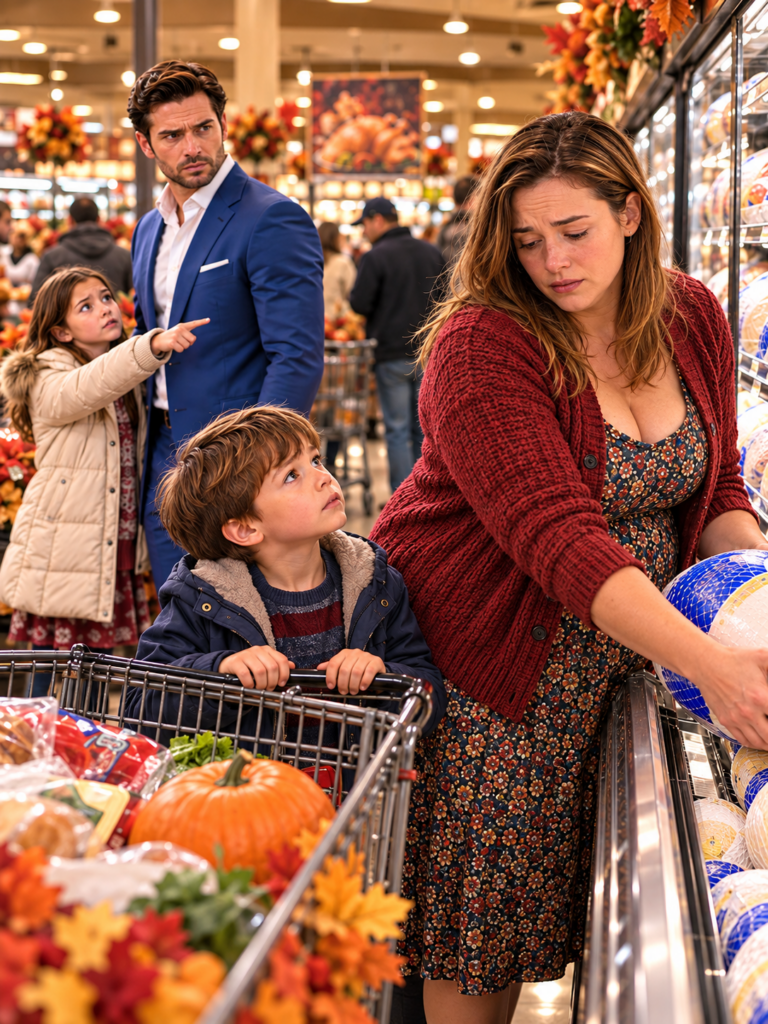
Two days before Thanksgiving, Lindall’s Market smelled of cinnamon, damp wool, and the cold air that rushed through the automatic doors every time someone entered from the South Dakota drizzle.
Eric Thorson was still dressed for work.
Dark overcoat. White shirt. Phone in one hand.
His daughter, Elsie, had control of the cart.
At eight years old, Elsie pushed it with the seriousness of someone who had already reviewed the shopping list and considered alternate routes.
She stopped abruptly in front of the canned cranberry sauce.
“This one.”
Eric glanced away from his phone.
“There are three kinds.”
“The kind with the ridges.”
He picked up a glass jar filled with whole cranberries.
“This looks better.”
Elsie gave him the disappointed look reserved for fathers who had somehow reached adulthood without understanding important things.
“That’s the fancy kind.”
“And?”
“The ridges are the point.”
Eric looked at the can in her hand, then at the jar in his.
He put the jar back.
“Ridges it is.”
Elsie nodded, satisfied.
He let her win more often than he admitted.
For three years, it had been the two of them most of the time. They had developed systems. Fast grocery trips. Weeknight dinners at the kitchen island. Saturday pancakes. Quiet holidays.
Eric had a phrase for it.
Just us.
He used to say it lightly, as though two people were enough because they had chosen to be.
Lately, Elsie had stopped answering when he said it.
His phone buzzed.
He checked the screen.
Operations.
A shipment of glass bound for one of Thorson Window Company’s manufacturing lines had been delayed in Omaha.
Eric answered automatically.
His entire voice changed.
“Tell them I don’t care whose truck broke down. We have installation crews waiting Monday morning.”
The warmth left his tone. His words became clipped and precise.
It was the voice employees knew.
The voice that moved people, contracts, inventory, and money.
Elsie rolled the cart a few feet away and waited.
That was when she noticed Milo Lowry.
He was a first grader at Hawthorne Elementary. Elsie knew him mostly because his hair never stayed down in the back.
Milo stood beside his mother’s cart while she stared at the calculator on her phone.
Potatoes.
Stuffing mix.
Canned green beans.
Dinner rolls.
A small pumpkin pie.
A frozen turkey.
His mother typed something into the phone.
Stopped.
Deleted it.
Added again.
Her lips moved as she counted.
Elsie watched without meaning to.
The woman’s coat looked too thin for late November.
After a moment, she set down her phone and lifted the turkey from the cart.
She didn’t leave it on a random shelf.
She carried it back to the refrigerated case.
Placed it exactly where she had found it.
Then she straightened the turkey beside it so the row looked neat.
For some reason, that small gesture bothered Elsie more than if the woman had simply abandoned it.
“Mom?”
Milo had followed her.
“Did we forget the turkey?”
His mother crouched until they were eye to eye.
“We didn’t forget anything.”
He looked toward the cooler.
“But Thanksgiving—”
“We’ve got potatoes. Stuffing. Green beans. Rolls. And pie.”
She smiled.
The smile almost worked.
“We’re going to make it special.”
Milo’s expression remained uncertain.
His mother stood quickly and turned toward the boxed macaroni.
“Okay. Important decision.”
Milo looked up.
“Shells or regular?”
“What?”
“Thanksgiving rules. One vote only.”
He thought seriously about it.
“Shells.”
“Shells it is.”
The woman put a box into the cart.
She did not look back at the turkey.
Not once.
Elsie found her father just as he ended his call.
She caught the sleeve of his overcoat.
“Dad.”
“Hmm?”
She tugged until he bent closer.
Her voice dropped to a whisper.
“She can’t afford a Thanksgiving turkey for her child.”
Eric followed her gaze.
He saw the boy first.
Then the woman.
His hand moved toward his wallet almost before he thought about it.
That was how Eric’s life worked.
Problems had costs.
He paid them.
Problems disappeared.
It was one of the privileges of having built a successful company, and one of the habits wealth had quietly taught him.
But then he noticed the woman’s posture.
Shoulders square.
Chin lifted.
Every movement controlled.
There was something familiar in it.
Eric had stood that way himself during the year his marriage collapsed—when lawyers asked questions, employees watched his face, and Elsie was young enough to notice everything without understanding any of it.
The posture of someone holding themselves together because one more sympathetic look might undo the work.
He took his hand away from his wallet.
“Stay here,” he told Elsie.
He approached alone.
The woman was comparing two boxes of macaroni.
“Excuse me.”
She turned.
Eric kept his voice low enough that Milo, several feet away, would not hear.
“I don’t mean to intrude. If it would help at all—”
Her face changed before he finished.
Not anger.
Humiliation.
Then control.
“Thank you.”
She placed one macaroni box into the cart.
“But no.”
Eric hesitated.
She understood the hesitation.
“He’s had enough people feeling sorry for him this year.”
Her tone remained polite.
Firm.
“We’re fine.”
Eric could have insisted.
He could have said it meant nothing to him.
He could have offered a gift card or told a cashier to cover her entire order.
All of those options arrived in his mind within seconds.
He chose none of them.
“All right.”
She gave him a small nod.
He returned to Elsie.
She studied his face.
“She said no?”
“She said no.”
“But they don’t have a turkey.”
“I know.”
“You have money.”
Eric almost smiled.
“Also true.”
“Then why—”
“Because sometimes helping somebody the way you want isn’t the same as helping them the way they want.”
Elsie frowned at this deeply unsatisfying adult logic.
Eric’s phone buzzed again.
He glanced at the screen.
“I have to take this.”
He stepped toward the end of the aisle.
He turned his back for less than a minute.
That was enough.
Elsie looked at the turkey cooler.
Then at Milo.
Then at her father.
She had twenty-three dollars in a white envelope inside her coat.
Birthday money.
She had been saving it because adults always said that birthday money should be saved for something important.
Elsie decided that this qualified.
She walked to the cooler, lifted the exact turkey Milo’s mother had returned, and carried it with both arms toward the express register.
The price was $19.84.
Elsie opened the envelope.
One twenty-dollar bill.
Three crumpled ones.
The teenage cashier looked at her.
“Your parents know you’re buying a turkey?”
Elsie glanced toward Eric, still on the phone.
“My dad knows about turkeys.”
It was technically true.
She slid the money over.
The cashier rang it up.
A few dollars in change went back into the envelope.
Elsie pointed toward the neighboring checkout lane, where Milo was helping his mother unload groceries.
“Can you put it in his bag?”
The cashier looked from Elsie to Milo.
“Your brother?”
“No.”
“Friend?”
“Sort of.”
Elsie lowered her voice.
“Please don’t tell them.”
The cashier shrugged the shrug of a teenager who had already learned that grocery stores contained stranger stories than anyone expected.
“Okay.”
Outside, the drizzle had hardened into cold, stinging rain.
Eric loaded groceries into the back of his SUV.
Elsie climbed into the rear seat without saying much.
Across the parking lot, Greta Lowry buckled Milo into an aging Corolla.
She opened the trunk.
Potatoes.
Green beans.
Macaroni.
Rolls.
Pie.
Then she saw the turkey.
She stopped moving.
Rain struck the metal around her.
For several seconds she simply stared.
Then she looked across the parking lot.
The man from the store stood by his SUV.
His daughter watched through the rear window.
Greta understood immediately.
Or believed she did.
“Milo, stay in the car.”
She shut the trunk and crossed the parking lot.
Elsie pressed one hand against the window.
The woman did not look thankful.
She looked furious.
Greta stopped beside Eric’s SUV.
“I told you no.”
Eric, holding two grocery bags, straightened.
“I’m sorry?”
“In the store.”
Her voice trembled once.
Then steadied.
“I said no.”
Eric set the bags down.
“I heard you.”
“And then you went around me.”
“I didn’t.”
Greta gave a short, disbelieving laugh.
“There’s a turkey in my trunk.”
Eric looked genuinely confused.
“What?”
“What kind of man uses his own little girl so a woman can’t refuse him?”
The rear door opened.
Elsie climbed out into the rain.
“Dad didn’t do it.”
Both adults turned.
She held up the white envelope.
It was almost empty.
“It was me.”
Eric stared at her.
“Elsie.”
“I used my birthday money.”
Greta looked at the envelope.
Then at the child.
The anger left her face so quickly that what remained looked like exhaustion.
For a moment, nobody said anything.
Rain ticked against the SUV roof.
Two adults who had spent years learning how to conceal things from children had just been exposed by an eight-year-old who had noticed everything.
Greta crouched.
“That was a very kind thing.”
Elsie swallowed.
“Are you mad?”
“No.”
Greta glanced toward the Corolla, where Milo was trying to see through the fogged window.
“I’m keeping it because of him.”
“Good.”
“But I don’t take things I can’t repay.”
“I don’t want money.”
Greta considered that.
“Then I’ll think of something better.”
She stood.
Her eyes met Eric’s for one brief second.
She did not thank him.
She did not owe him thanks.
Then she walked back through the rain.
That night, Greta sat alone at her kitchen table after Milo went to sleep.
Their apartment on the west side was small and clean.
A paper-plate turkey Milo had made at school hung crookedly on the refrigerator.
Under another magnet was a pink notice from the landlord.
PAST DUE.
The fold was soft from being opened too many times.
Greta worked the numbers again.
Rent.
Electricity.
Gas.
Groceries.
There was no different answer waiting inside the calculator.
Two years earlier, money had not been easy, but there had been Luke.
Luke Lowry had been a lineman—the kind of man who went thirty feet into the air in weather everyone else was warned to stay inside.
After his death, his crew had taken up a collection.
For Milo.
That was what everyone had said.
Mitch Kessle, Luke’s best friend since high school, had handled it.
Mitch had handled many things after the funeral.
He had even given Greta a job running the office at his heating and cooling company.
Then business slowed in August.
The job disappeared.
Greta looked at the top shelf above the stove.
Luke’s mother’s speckled blue roaster sat there beneath two years of dust.
She had not touched it since the funeral.
Across town, the Thorson house was large, warm, and silent.
On Thanksgiving morning, Eric received a text from Scottsdale.
Courtney.
Sorry. Flights are a mess. Tell Els I’ll call.
Second holiday in a row.
Eric stared at the message for several seconds before setting the phone facedown.
“Change of plans,” he told Elsie brightly. “Takeout.”
Elsie sat at the kitchen island.
“It’ll be fun,” he added.
“Okay.”
“Chinese? Italian?”
“Whatever.”
Eric watched her leave the room.
The house had twelve dining chairs.
That evening, only two were pulled from the table.
Greta, meanwhile, had taken down the blue roaster.
She scrubbed away the dust.
Butter.
Sage.
Too much pepper, the way Luke’s mother had taught her.
As the turkey cooked, the apartment filled with a smell Greta had not allowed inside it for two years.
Milo sat near the oven like he was watching television.
At six, Greta covered a plate in foil.
Turkey.
Stuffing.
Pie.
Her mother’s rule returned to her without invitation.
Never go to someone’s table empty-handed.
She found the Thorson address in the school family directory.
When Eric opened his front door, Greta could see past him into the dining room.
A long table.
Two chairs.
Two half-eaten takeout cartons.
She held out the foil-covered plate.
“This is for Elsie.”
Eric blinked.
“She bought the turkey.”
Greta lifted the plate slightly.
“She should get to taste it.”
Elsie appeared behind him.
Greta handed it to her.
Elsie held the plate carefully.
“Thank you.”
“No.”
Greta smiled faintly.
“Thank you.”
Eric looked at Greta.
“Do you want to come in?”
“No. Milo’s waiting.”
Elsie tilted her head.
“Does Milo have anybody besides you?”
Greta froze.
“He has me.”
“That’s a lot.”
The answer should have comforted her.
Instead, as she drove home with Milo drowsy in the back seat and the heater rattling beneath the dashboard, Greta kept hearing her own words.
He has me.
It was true.
It should have been enough.
So why had it sounded so lonely?
Her phone buzzed at a red light.
Her landlord.
The remaining balance was due December 15.
No more extensions.
Greta sat motionless even after the light changed.
A horn sounded behind her.
That night, she did something she had avoided for almost two years.
She called Mitch.
He answered warmly.
“Greta. Happy Thanksgiving. How’s my buddy?”
“He’s good.”
“Tell him Uncle Mitch says hello.”
“Mitch, I need to ask you about something.”
“Sure.”
“The collection.”
Silence.
“The money Luke’s crew raised for Milo.”
Another pause.
Then Mitch sounded puzzled.
“What money, Greta?”
Her fingers tightened around the phone.
“The union hall collection.”
“Oh.”
His tone softened.
“That.”
“Yes. That.”
“Greta, most of that went toward the funeral.”
She stared at the paper turkey on the refrigerator.
“What?”
“The casket. Headstone. Luncheon. You remember. You told me to handle everything.”
“The life insurance paid for the funeral.”
“Some of it.”
“Mitch.”
“Honey, you were in pieces.”
The gentleness in his voice made her feel worse.
“Nobody expects you to remember every bill from that week.”
“There was almost fourteen thousand dollars.”
“Was there?”
He sounded sincerely uncertain.
“I don’t remember it being that much.”
Greta’s skin went cold.
“Mitch—”
“Get some sleep.”
His voice remained warm.
“Grief does strange things to memory.”
The call ended.
Greta sat at the table until 2:14 in the morning.
She tried to reconstruct the funeral week.
Casseroles.
Low voices.
Flowers.
Documents.
People taking things from her hands because everyone agreed she should not have to think.
Had she signed something?
Had Mitch explained something?
Had she forgotten?
The worst thing about his story was that grief had been bad enough for it to be possible.
Almost sure began to feel dangerously close to crazy.
Part 2
On Monday morning, Hawthorne Elementary filled its halls with paper pilgrims, construction-paper corn, and the aftermath of Thanksgiving.
The first graders had built Mayflowers from shoeboxes.
Milo’s had a cardboard mast that leaned slightly to the left.
During reading-buddy time, third graders joined them.
Elsie sat beside Milo.
His elbow caught the ship.
It fell.
The mast snapped.
Milo stared down at it.
His chin began to tremble.
Elsie reached for tape.
She did not repair it for him.
Instead, she held the mast upright while Milo taped it himself.
The first strip went on crooked.
She held it again.
The second held.
“There.”
Elsie leaned back.
“Now it’s been through a storm.”
Milo studied the ship.
“Real ships do that?”
“Probably.”
At lunch, he saved her a seat by spreading one arm across the bench and refusing to move until she arrived.
Greta heard all of this at pickup.
“Milo fixed his ship,” he announced.
Then corrected himself.
“I fixed it. Elsie held it.”
The line of parents moved slowly beneath a bitter wind.
Greta checked her phone.
Two messages to Mitch.
No response.
“Hey.”
She looked up.
Eric stood a few feet away, collar turned against the cold.
“I hear our kids are shipbuilders now.”
Greta almost smiled.
Then her phone buzzed.
Her expression changed.
Only the pharmacy.
Eric noticed anyway.
“Everything okay?”
Greta hesitated.
“Someone owes my son something.”
Eric said nothing.
“And now he says it never existed.”
Eric glanced toward Milo and Elsie.
“My company has an attorney.”
“No.”
“I was just going to say—”
“I know what you were going to say.”
Eric stopped.
Greta put her phone away.
“I don’t want Mitch talking to a lawyer.”
“Why?”
“I want him talking to me.”
Her voice hardened.
“To my face.”
Eric studied her.
She expected another offer.
Another solution.
Instead, he nodded.
“All right.”
Something about that mattered.
He had put a solution down after she rejected it.
Men accustomed to authority did not always know how to do that.
That night, Greta lay awake again.
But she stopped asking whether grief had erased the truth.
She started asking who else might remember it.
The union hall.
The week after Luke died.
Heavy jackets.
Red eyes.
A hard hat passed down a row of men.
Cash folded into it.
Someone counting at a folding table.
Someone writing.
Gary.
Gary Bjornstad had been Luke’s foreman for eleven years.
He had retired the following spring.
Saturday morning, while Milo attended a classmate’s birthday party, Greta drove across town.
Gary still lived in the same split-level house he had owned for decades.
He answered the door in flannel and reading glasses.
For several seconds he simply looked at her.
Then his expression softened.
“Luke’s Greta.”
She had not heard anyone call her that in a long time.
“Come inside.”
Gary’s kitchen smelled like coffee and old wood.
Greta told him everything.
Mitch’s version.
The funeral expenses.
The missing collection.
Gary listened without interrupting.
When she finished, he removed his glasses.
“Wait here.”
He crossed to a drawer and returned with a worn green ledger, its corners covered in cloth.
He opened it.
Pages filled with names and figures.
Then he turned it toward her.
“Fourteen thousand six hundred dollars.”
Greta stopped breathing for a second.
Gary tapped the page.
“I counted it into Mitch Kessle’s hands myself.”
She stared at the entries.
“You’re sure?”
Gary looked offended.
“I spent thirty years recording crew hours, outages, materials, injuries, weather calls, and every fool who borrowed equipment without returning it.”
He pushed the book closer.
“I’m sure.”
Greta reached for it.
Gary’s hand covered the ledger.
“It stays here.”
She looked at him.
“I trust you.”
“That’s not the point.”
His expression turned grim.
“Records stay where they belong.”
Then he handed her a legal pad.
“But you can copy anything you want.”
Greta spent more than an hour at Gary’s table.
Sixty-three names.
Amounts beside each.
Twenty dollars.
Fifty.
Two hundred.
One man had given four hundred.
Greta knew him.
Three children.
Truck payment.
Probably no spare four hundred dollars.
Yet he had given it because Luke had died and Milo had lost his father.
She drove home with a handwritten list in a manila folder.
Then she began making calls.
Every evening after Milo slept.
She never accused Mitch.
She never told people what to say.
She asked one question.
“I’m trying to account for the collection the crew raised for Milo. Do you remember what you contributed?”
Most did.
Exactly.
A hundred.
Fifty.
Two hundred.
Some apologized that it had not been more.
One widow talked for forty minutes about her own husband’s death before realizing she had drifted away from the subject.
“I’m sorry,” the woman said.
“Don’t be.”
Greta meant it.
A lineman named Tony Reyes asked for her number.
The next morning, a photograph arrived.
Luke at twenty-two.
Sunburned.
Grinning from the top of a utility pole.
Thumb raised.
Tony had written:
For the little guy. So he knows.
Greta stood at the counter with the photograph in her hand for a long time.
Every call went into the folder.
Name.
Date.
Amount.
What they remembered.
She had run an office for two years.
Documentation was something she understood.
Around the fortieth call, another pattern appeared.
Mitch’s business had been failing.
Late payroll.
Repossessed trucks.
Unpaid suppliers.
Loans.
“He’s been borrowing from anybody who’ll answer the phone,” one former employee told her.
Greta wrote that down too.
She did not yet write the accusation forming inside her.
The second Thursday of December was Hawthorne Elementary’s canned-food night.
Eric arrived forty minutes late, still in his work coat.
He had missed the opening announcements.
He stayed anyway.
Long after parents began leaving, he carried boxes to the loading dock.
No photographer.
No ceremonial donation.
No mention of Thorson Window Company.
Greta noticed.
Eric noticed her too.
She somehow controlled three volunteer tables at once.
Vegetables.
Soup.
Peanut butter.
Cereal.
People brought her problems and she solved them without turning them into emergencies.
When a carton of glass jars broke, Greta had children moved away, volunteers redirected, and the mess contained before the principal finished saying, “Oh no.”
Eric handed her tape.
“You’ve done this before.”
“I’ve run an office.”
She pulled the tape hard against a box.
“Same thing. More peanut butter.”
Eric laughed.
Greta looked up.
For some reason, the sound surprised both of them.
Later they walked into the parking lot together.
Elsie and Milo ran ahead under the lights, sliding across thin patches of ice.
“Can I tell you something?” Greta asked.
“Sure.”
“After Luke died, everybody made Milo promises.”
Eric remained quiet.
“Always.”
She watched the children.
“Always here. Always around. Always family.”
Milo nearly slipped.
Elsie grabbed his coat.
Greta continued.
“Within a year, most of them were gone.”
“Because they didn’t care?”
“No.”
That was almost harder.
“They got busy. Their lives went back to normal.”
Eric nodded.
“The biggest promise came from Mitch.”
Greta shoved her hands into her pockets.
“He sat on our couch holding Milo and told me he’d always take care of us.”
Eric could have said he understood abandonment.
Could have described his divorce.
Could have compared her loss to his own.
He did none of it.
He listened.
Greta finished the story without being interrupted.
It occurred to her afterward that nobody had let her do that in years.
Two nights later, Greta called the last few people on the list.
One woman said, “Funny you’re calling.”
“Why?”
“Mitch called me yesterday.”
Greta’s pen stopped.
“What did he want?”
“He asked what you’d been saying.”
“Anything else?”
“He asked about some man in a picture.”
Greta felt a chill.
“What picture?”
“The school Facebook page. Food drive.”
The woman chuckled.
“You were taping boxes with some tall guy. Somebody in the comments said he owns Thorson Window.”
The next morning, Eric was halfway through a production meeting when his assistant appeared at the conference-room door.
“There’s a man downstairs.”
Eric glanced at the clock.
“Appointment?”
“No.”
“Name?”
“Mitch Kessle.”
That got his attention.
“He says he’s a friend of Greta Lowry.”
Eric went down.
Mitch stood in the lobby near the windows.
Early fifties.
Heavy winter coat.
Easy smile.
The kind of expression that suggested they had already agreed about something.
“Mitch Kessle.”
He extended a hand.
Eric shook it.
“Eric Thorson.”
“I’ll keep this short.”
Eric brought him upstairs because whatever was coming did not belong in a public lobby.
Mitch entered Eric’s office and looked around.
Windows.
Furniture.
View over the river.
His eyes lingered half a beat too long on everything expensive.
He sat without being invited.
“I figured somebody should tell you what you’re getting involved in.”
Eric remained standing.
“Go ahead.”
“Greta’s a good woman.”
Mitch smiled sadly.
“One of the best.”
Eric said nothing.
“But she hasn’t been right since Luke died.”
“Meaning?”
“Fixated.”
Mitch leaned forward.
“She’s calling people. Digging through old memories. Upsetting men who loved Luke.”
“About money.”
“Money that’s gone.”
“Where?”
Mitch sighed.
“Funeral expenses. Life. You know how things happen when somebody dies.”
“She seems pretty clear about what she remembers.”
“That’s how it looks.”
Mitch’s tone became confidential.
“Look. I didn’t come here to fight.”
“Then why are you here?”
“To solve it.”
Mitch spread his hands.
“You can afford fourteen grand.”
Eric’s expression did not change.
Mitch continued.
“Write her a check. Call it a gift. She gets what she thinks she’s owed. I get some peace. Everybody moves on.”
Eric stared at him.
Mitch smiled as though the logic should have been obvious.
Finally Eric said, “That’s why you came.”
“I just told you—”
“You didn’t come to warn me about Greta.”
Eric’s voice took on the flatness employees recognized.
“You came to ask me to pay your bill.”
Mitch’s smile remained.
But something behind it hardened.
He stood.
Buttoned his coat.
At the door, he paused.
“She ever tell you how Luke died?”
Eric said nothing.
Mitch looked almost kind.
“Ask her sometime.”
Then he left.
Eric stood alone in his office.
Fourteen thousand six hundred dollars was not a meaningful amount of money to him.
He could transfer it before lunch.
No missed rent.
No collection calls.
No panic.
No confrontation.
It was exactly the kind of problem money was good at solving.
His hand reached for the phone.
Then he remembered Greta in the grocery store.
He’s had enough people feeling sorry for him this year.
He remembered her at school.
I want him talking to me.
Eric withdrew his hand.
He took his coat instead.
Greta opened her apartment door wearing a sweatshirt with a dish towel over one shoulder.
From the living room came cartoon voices.
“Eric?”
She stepped into the hall and pulled the door mostly closed.
“Is Elsie okay?”
“She’s fine.”
“Then what happened?”
“I need to tell you something.”
He told her everything.
Mitch at the office.
The concern.
The accusation that grief had made her unstable.
The offer.
Fourteen thousand is nothing to a guy like you.
Greta’s face went pale.
Then hard.
“He went to you.”
“Yes.”
“A man he has never met.”
“Yes.”
“And asked you to pay me.”
“Yes.”
Over her shoulder, Eric saw the refrigerator.
The paper turkey.
And the pink notice.
He could read the handwritten date.
December 15.
Tomorrow.
Eric said nothing about it.
Greta followed his eyes.
She saw what he had seen.
More importantly, she recognized what he was choosing not to do.
“Thank you for telling me.”
“Of course.”
“I need you to promise me something.”
Eric waited.
“Don’t pay him.”
“I won’t.”
“Don’t pay me.”
“All right.”
“Don’t pay anybody.”
Her voice stayed low.
“If you pay this away, Mitch never has to look my son in the eye.”
Eric looked at her.
“That’s what you want?”
“That’s the one thing I won’t sell.”
He nodded.
“Then I won’t.”
For a strange second, something inside him shifted.
He possessed the money.
Greta possessed the decision.
And that felt more correct than anything he could have bought.
“There’s something else,” Eric said.
“What?”
“Before Mitch left, he asked whether you’d told me how Luke died.”
Greta stopped moving.
“He said I should ask you.”
Silence filled the narrow hallway.
Something passed across her face.
Old.
Heavy.
Eric did not ask.
“Good night, Greta.”
Her eyes lifted to his.
“Good night.”
After Milo went to sleep, Greta started laundry.
She emptied his backpack onto the table while looking for a permission slip.
A packet of crackers fell out.
Then another.
A fruit cup.
Granola bar.
Two small milk cartons.
Greta stared.
She walked into Milo’s room and sat on the edge of his bed.
“Bud?”
His eyes opened.
“Why do you have food in your backpack?”
Milo was quiet.
“School food?”
“Why are you saving it?”
He pulled the blanket closer.
Then whispered:
“Because groceries cost too much.”
Greta could not answer.
All those smiles.
All the jokes in grocery aisles.
All her careful arithmetic behind closed doors.
She had thought she was protecting him from fear.
Instead, she had taught him to carry it silently.
The next morning she placed the crackers between them on the kitchen table.
“Money is tight.”
Milo stared at the table.
“That’s true.”
She took his hand.
“But worrying about that is my job.”
“What if we run out?”
“We will have dinner.”
“Always?”
Greta had avoided that word for two years.
She said it anyway.
“Yes.”
Milo touched one cracker packet.
“Can I keep one?”
Greta almost cried.
“One.”
The rent was due the fifteenth.
On the fourteenth, Greta carried a canvas bag into a pawn shop on Minnesota Avenue.
Inside were Luke’s climbing hooks.
His worn leather belt.
Tools he had oiled at the kitchen table every Sunday while football played on the radio.
The man behind the counter gave her a number.
Enough.
Barely.
Greta signed the receipt.
She paid the rent.
The pink notice came off the refrigerator.
The empty hooks in the closet stayed empty.
Part 3
That Saturday, Elsie asked whether Milo could come over.
Greta said yes.
Eric’s kitchen was enormous compared with Greta’s.
The children ate grilled cheese at the island.
Greta rinsed her coffee mug at the sink while Eric wiped crumbs from the counter.
She heard Milo speaking behind her.
“I still save one.”
Elsie asked, “One what?”
“Snack.”
“Why?”
Milo looked embarrassed.
Before he could answer, Eric crouched beside him.
“Hey, buddy.”
His voice was warm.
“You never have to save food here.”
Milo looked up.
“You can always eat at our house.”
Eric smiled and ruffled his hair.
“Always.”
Greta set the mug down.
Her hand remained on it.
The children were delighted.
They ran upstairs a few minutes later.
When their footsteps disappeared, Greta turned.
“Don’t promise him always.”
Eric frowned.
“What?”
“You don’t get to say that.”
“I only meant—”
“I know what you meant.”
Greta’s voice remained controlled.
“That’s the problem.”
“Greta.”
“Not until you’ve been here long enough to know you can keep it.”
Eric looked genuinely stung.
“I wasn’t trying to—”
“They never are.”
She gathered Milo’s coat.
Called upstairs.
Thanked Elsie for lunch.
And left.
Afterward, the two families stopped spending time together.
The children remained friends at school.
The adults stayed apart.
Eric did not call Greta.
He did not arrive at her door.
Two days later, a plain envelope appeared in her mailbox.
Inside was one sentence written by hand.
I promised your son something that wasn’t mine to promise. I’m sorry. E.
Greta read it twice.
Then put it in the kitchen drawer.
The apology affected her more than an argument would have.
She understood what it had cost him.
The winter concert at Hawthorne Elementary took place the final Thursday before Christmas break.
Greta volunteered at the cookie table.
The first graders performed “Jingle Bells” with enthusiasm far exceeding musical accuracy.
Milo waved to her through most of the second verse.
Afterward, children scattered toward parents.
Greta was finishing at the cookie table when she saw someone sit beside Milo on the bottom bleacher.
Heavy jacket.
Familiar smile.
Mitch.
He held a white lineman’s hard hat.
Scuffed brim.
One name stenciled across the side.
LOWRY.
Greta’s hands went cold.
Mitch placed it on Milo’s head.
“Present from your dad’s best friend.”
Milo touched the brim.
“Was this Dad’s?”
Mitch smiled.
“Sure was.”
Milo lit up.
Across the gym, Greta understood the message underneath the gesture.
I can reach him whenever I want.
Then she saw Eric.
He had been several rows back with Elsie.
He stood.
Walked down the bleachers.
Sat on Milo’s other side.
He did not confront Mitch.
Did not touch him.
Did not create a scene.
He simply stayed.
One arm rested along the bleacher behind Milo while the final group sang.
Mitch left before the lights came fully on.
Christmas passed.
Then New Year’s.
During the second week of January, Greta’s phone rang at seven in the morning.
Gary.
His breathing sounded uneven.
“Mitch came by Tuesday.”
Greta sat upright.
“For what?”
“Said he wanted to check on me.”
Gary paused.
“Stayed for coffee.”
Another silence.
“The ledger’s gone.”
By afternoon, Greta had learned more.
Mitch had sold the heating and cooling company.
He planned to leave town Saturday.
Friday night brought the coldest temperatures of the winter.
Eleven below zero.
That afternoon Greta drove past the old shop.
Mitch’s truck stood backed to the loading door.
One work light glowed inside.
She held her phone for a long time.
Then called Eric.
He answered immediately.
“I need to ask you for something.”
“Okay.”
“It isn’t money.”
Another pause.
“Okay.”
“Can Milo stay with you for a few hours tonight?”
“Yes.”
She shut her eyes.
No questions.
No conditions.
The simplicity almost broke her.
Before leaving home, Greta took down the speckled blue roaster.
She made pot roast.
Carrots.
Too much black pepper.
She covered a plate in foil.
Luke had done that when crews worked holidays.
If somebody got stuck at a substation on Christmas Eve, Luke arrived with food.
Nobody should eat alone on a pole, he used to say.
Greta dropped Milo at Eric’s.
Then she drove toward the industrial park with the warm plate on the passenger seat.
Kessle Heating and Cooling was nearly dark.
One work light inside.
She knocked.
Mitch opened the door wearing a heavy coat.
His breath fogged between them.
For one instant, he looked frightened.
“Greta.”
“I brought supper.”
He stared at the foil-covered plate.
“It’s late.”
“I know.”
She stepped past him.
Boxes covered the floor.
Invoices.
Old files.
Equipment waiting to be moved.
An open carton sat near the workbench.
On top was a green ledger with cloth corners.
Greta stopped.
“That belongs to Gary.”
Mitch followed her eyes.
His shoulders dropped.
“It doesn’t matter now.”
“It matters to Gary.”
“It’s a book.”
Greta placed the plate on the workbench.
Then opened her coat.
She removed the manila folder.
“I copied every name.”
Mitch’s face changed.
“I called them too.”
“Greta—”
She opened the folder.
“Ron Astramm. One hundred dollars.”
Mitch looked away.
“Tony Reyes. Two hundred.”
“Stop.”
“Linda Sorum. Twenty-five dollars in Pete’s name.”
“Greta.”
“Carl Mowen. Four hundred.”
She lifted her eyes.
“He had three kids and a truck payment.”
Mitch stared at the floor.
She continued.
One name.
Then another.
Each amount became heavier than money.
These were people.
Friends.
Widows.
Crew members.
Men who had known what it cost to climb poles in freezing rain.
Around the thirtieth name, Mitch’s voice cracked.
“Stop.”
Greta closed the folder.
Silence filled the shop.
Then Mitch said, “You don’t understand.”
“I understand enough.”
“No.”
He looked at her.
His face had changed completely.
“You don’t know what happened that night.”
Greta stood still.
Then she took out her phone.
“I do.”
She found a message she had kept for two years.
Luke’s final text.
11:52 p.m.
Covering for Mitch. Home by 2.
Mitch’s face collapsed.
“He climbed that pole for you.”
Greta’s voice remained quiet.
“I’ve always known.”
He sat down hard on a box.
“I was supposed to be up there.”
“I know.”
“Me.”
His hands covered his face.
“Not him.”
Greta waited.
“I couldn’t fix that.”
His shoulders shook.
“So I tried to fix everything else.”
He looked around the nearly empty shop.
“This place was supposed to be ours.”
“What?”
“Luke and me.”
Mitch wiped his face.
“We talked about it for ten years. Starting a business. Getting off the lines before our bodies gave out.”
He laughed once without humor.
“When he died, I thought if the shop failed too, then what was any of it for?”
Greta’s eyes went to the ledger.
“So you used Milo’s money.”
“At first I borrowed it.”
“You stole it.”
“I was going to put it back.”
“But you didn’t.”
“Payroll came due. Then a truck broke down. Then suppliers—”
“Mitch.”
He stopped.
“The money was for Luke’s son.”
“I told you I’d take care of you.”
“That wasn’t taking care of us.”
Mitch’s breathing shook.
Greta looked at him for a long time.
“That was guilt wearing a kind face.”
He flinched.
Then bent toward the box.
He lifted the green ledger and held it out.
Greta took it.
Mitch pulled an old invoice from a pad.
Turned it over.
Wrote slowly.
I owe Milo Lowry $14,600. I will repay every dollar.
He signed.
Dated it.
Then handed it over.
“I’ll tell Milo.”
Greta read the paper.
“Not tonight.”
“When I can do it right.”
She folded it and placed it inside her folder.
At the door, she looked back.
The foil-covered plate remained on the workbench.
“Eat before it gets cold.”
When Greta reached the Thorson house, every light seemed to be on.
Inside the unused dining room, the children had built a blanket fort across the long table.
Milo crawled out carrying a board game.
“Mom.”
“Shoes.”
He looked down.
“Oh.”
He found them.
Then held up the game.
“Can I leave this here?”
“Why?”
“So we can finish next time.”
Greta looked at him.
Next time.
He said it naturally.
Not as a promise extracted from an adult.
Just an expectation built from experience.
Greta nodded.
“Okay.”
Milo placed the box carefully on a shelf.
In the kitchen, Eric poured coffee.
He did not ask how the meeting went.
Greta sat.
For a while, neither spoke.
Then Eric said, “After my divorce, I told Elsie we’d be fine.”
Greta looked at him.
“Just us.”
He leaned against the counter.
“I built our entire life around not needing anybody.”
From the dining room came laughter inside the fort.
“I thought that made her feel safe.”
Greta wrapped both hands around the coffee.
“And?”
“I think I taught her to hide what she needs.”
Their eyes met.
Eric exhaled.
“Stay for dinner.”
Greta’s body tensed automatically.
He noticed.
“I’m not asking because you need dinner.”
She waited.
“I’m asking because I do.”
That changed everything.
Greta stayed.
Later, the children fell asleep inside the fort.
Milo still wore Luke’s hard hat.
Eric and Greta sat at opposite ends of a table designed for twelve people.
For the first time since they met, there was nothing immediate to fix.
No turkey.
No rent notice.
No missing money.
No frightened child.
No villain requiring confrontation.
Nothing remained except a more difficult question.
If nobody needed rescuing, did they still want each other?
The answer took time.
The following year was not dramatic.
That was what made it matter.
In March, Greta was hired as office manager at a dental laboratory.
Two interviews.
Typing test.
Reference from Gary.
Nobody there knew Eric Thorson.
Greta made certain of it.
She wanted the job because she had earned it.
Money remained tight.
She still clipped coupons.
Still checked grocery totals twice.
But when her water heater failed in April, she hired a plumber and paid the bill.
When Milo’s class scheduled a zoo trip, she signed the permission slip without calculating the cost first.
Mitch began sending payments.
Late sometimes.
A hundred dollars.
Two hundred.
Never enough to erase what he had done.
Enough to prove he had not disappeared.
Every dollar went into an account under Milo’s name.
In May, Mitch returned to Sioux Falls.
He sat with Milo on Gary’s front steps for almost an hour.
Greta watched through the kitchen window.
She heard none of the conversation.
When Milo came inside, he carried the hard hat beneath one arm.
“Uncle Mitch said Dad was the bravest guy on the crew.”
Greta crouched.
“He said Dad went up because Mitch couldn’t.”
She pulled Milo close.
“That sounds like your dad.”
That summer, Gary taught Milo and Elsie cribbage.
Elsie won constantly.
Milo complained.
Gary told him learning to lose without sulking was among the most important skills a man could possess.
The rest happened slowly.
Cheap hamburgers after school functions.
Soccer games from folding chairs.
Grocery trips where both children announced starvation simultaneously.
Eric cooking badly but enthusiastically.
Greta helping Milo practice spelling words at the kitchen counter.
They still fought.
Sometimes Greta described a problem from work and Eric immediately began solving it.
One evening she was halfway through explaining a pricing mistake when he reached for his phone.
She covered his hand.
“Stop.”
Eric looked at her.
“I don’t need you to fix it.”
“What do you need?”
“Listen.”
He put the phone down.
“I can do that.”
And increasingly, he did.
Sometimes Greta withdrew.
A canceled dinner.
Shorter messages.
A week when dependence felt too comfortable and therefore dangerous.
Eric learned not to chase her.
Not to appear with solutions.
Not to force reassurance.
He waited.
She returned because she chose to.
Courtney’s calls with Elsie became more regular.
Once a week.
Then twice.
Greta never criticized her.
Not privately to Eric.
Certainly not in front of Elsie.
Eric noticed.
It told him more about Greta’s character than praise ever could.
One September night, they sat on Gary’s porch after the children went inside.
Eric spoke without ceremony.
“I’m not here because you couldn’t afford a turkey.”
Greta looked sideways at him.
“Good.”
“Good?”
“I would never stay with a man because I once needed help.”
Eric smiled.
“I know.”
By then, that was the point.
There was no debt between them.
Nothing owed.
So they kept choosing each other anyway.
The next Thanksgiving, Greta bought the turkey.
With her own money.
At a different grocery store.
Milo selected his favorite rolls.
Greta picked up cranberry sauce with ridges because Elsie would reject anything else.
At checkout, an elderly man ahead of them counted coins.
He was short.
Milo watched.
Then quietly took two dollars from his allowance and placed the bills near the register.
He did not announce it.
Did not wait for praise.
Only Greta saw.
She said nothing.
She held his hand slightly tighter on the walk to the car.
At the Thorson house, the extra leaf came up from the basement.
For the first time since Eric’s divorce, the dining table extended to its full length.
Every chair was occupied.
Gary sat at one end wearing a pressed flannel shirt.
The board game Milo had left months earlier remained on the living-room shelf.
From the kitchen came arguing.
“I have the heavy side.”
“There is no heavy side.”
Elsie and Milo appeared carrying Luke’s mother’s speckled blue roaster between them.
Nobody gave a speech.
There was no proposal.
No grand declaration.
No one promised always.
Eric looked around the room.
His house had once stayed quiet because quiet felt safe.
Now chairs scraped.
Children argued.
Gary complained about someone’s cribbage strategy.
Greta laughed from the kitchen.
The house was no longer protected from other people.
It was filled with them.
Greta watched Milo set down the roaster.
Her son no longer examined every act of kindness for the hidden cost.
Elsie stepped back and inspected the table.
Then she looked at her father.
“Dad.”
Eric turned.
“The turkey is getting cold.”
He smiled.
Then quietly walked around the table and pulled out Greta’s chair.
Their first Thanksgiving had begun because Greta could not afford a turkey.
This one mattered for a different reason.
Everyone had arrived carrying something.
Food.
History.
Regret.
Trust.
A board game.
A battered hard hat.
A blue roaster.
No one at the table needed to be rescued.
They had simply made room for one another.
And kept coming back.

