
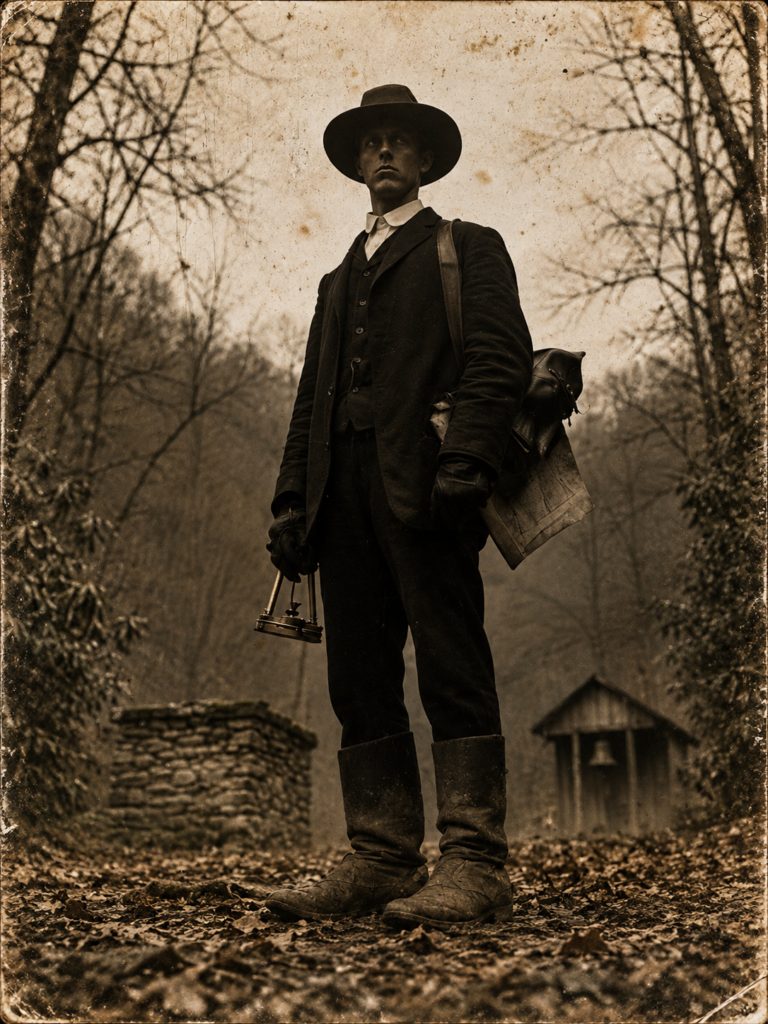
Part 1
There was a kind of quiet the old people of the Appalachian mountains knew how to distinguish from every other kind.
It was not the quiet before sunrise, when the birds had not yet begun and smoke hung straight above the chimneys. It was not the quiet after snow, when every familiar road seemed softened and the whole world appeared to have drawn a blanket over itself.
Those were honest silences.
The other kind was different.
It seemed to arrive from the side.
A man walking alone through timber would become aware that something had disappeared from the world without knowing exactly what. He might slow his steps. He might listen. Then he would realize he could hear his own boots too clearly.
No birds.
No insects.
No water.
No wind below the treetops.
Only himself.
The mountains contained places where that silence lingered.
One of them was called Wolf’s Neck Hollow.
In the autumn of 1907, Emmett Hirsch was sent there by the Cumberland Timber and Coal Company.
He was 38 years old.
On paper, his occupation was land agent.
That title suggested desks, deeds, courthouse records, signatures, and negotiations. In practice, it meant that Emmett spent much of each year outdoors. He measured tracts. He checked corners. He estimated timber. He settled boundary questions between company maps and farmers who sometimes had nothing but a stone, an oak tree, and the memory of a dead grandfather to prove where their property ended.
He worked from the 3rd floor of a brick building on Market Street in Louisville, Kentucky, but the office was largely where he returned between journeys.
Most of his real work was done in a saddle.
Emmett had been born in Ohio in 1869. His family moved south after the Panic of 1873, and he entered the mountain trade early. By adulthood he knew survey chains, field books, boundary calls, county maps, timber estimates, and the strange mathematics by which a piece of land could belong to one family in memory, another family by deed, and a company in some distant city by court order.
He was 6 feet 1 inch tall and lean.
His hair had begun going gray at the temples, though he was not yet 40. Years of bad weather had put lines into his face that made him look older.
People who knew him remembered 2 things.
He wrote with his left hand.
And he rarely trusted anything after seeing it only once.
Emmett checked compass bearings twice, sometimes 3 times. He reread contracts. He compared maps against fence lines. When a man gave him directions, Emmett often asked him to repeat them.
He was not imaginative by temperament.
That fact became important later.
He had never married.
According to his sister, there had once been a schoolteacher in Frankfort. Emmett had been engaged to her briefly in 1898. The engagement ended without scandal. His sister later described the separation only as decent.
Afterward, Emmett seemed to resume his life normally.
He kept the woman’s photograph in his field kit for several years.
He never married anyone else.
On September 17, 1907, Cumberland assigned him to parcel 14.
The company had purchased the tract at auction without sending anyone to inspect it first.
That was not unusual.
Timber and coal companies bought mountain acreage by the thousands. Maps were studied. Old deeds were gathered. Mineral rights passed through offices hundreds of miles from the ridges themselves.
Parcel 14 lay in Letcher County near the Virginia line.
On company paper it was nothing more than acreage.
Among the local people it had another name.
Wolf’s Neck.
The hollow extended roughly 4 miles between 2 ridges that leaned inward as they rose. On a topographic map, the shape narrowed near its entrance before widening farther back.
That was supposedly how it had earned its name.
The company wanted timber estimates and boundary marks.
There was one complication.
People already lived there.
Cumberland knew this.
A surviving note from an August company meeting mentioned prior tenancy on the tract. A junior clerk had apparently asked what should be done about occupants whose families might have lived there before the present deeds existed.
A supervisor answered in the margin.
Handle.
Nothing more was written.
Emmett was assigned a guide.
His name was Isham Vardy.
He was about 50, small and wiry, with a dark beard streaked with iron gray. He had the appearance of a man built from mountain hardwood: narrow, strong, weathered, and difficult to bend.
He lived east of Whitesburg and knew the surrounding ridges better than nearly anyone.
Isham had been near Wolf’s Neck before.
When he was younger, he told Emmett, he had hunted bear near the entrance.
He had never gone all the way into the hollow.
Emmett asked why.
Isham did not answer.
Emmett arrived in Whitesburg on September 18.
The final 12 miles from the depot at Jenkins were made on a hired horse, though the animal became so difficult near the end that Emmett walked beside it for the final 2 miles.
He spent that night in a boarding house run by a widow named Mrs. Ridenour.
She served white beans, fatback, cornbread, and coffee.
After supper, when the dishes had been removed, she remained sitting across from him.
For several minutes she said nothing.
Then she asked, “They told me you’re going to Wolf’s Neck.”
“Yes, ma’am.”
“My father trapped the Kingdom Come country.”
Emmett waited.
“He wouldn’t run a trap line on the Wolf’s Neck side.”
“All right.”
Mrs. Ridenour folded her hands on the table.
“That’s all.”
Emmett recorded the conversation in his field book before bed.
He and Isham left at first light.
They carried a survey chain, field equipment, food for a week, coffee, hardtack, salt pork, and a Wesson revolver that Emmett put into his saddlebag.
Later, he would write that he nearly forgot to load it.
For part of the first day, they followed Rockhouse Creek.
Then the trail left the water and climbed into thinner, colder country.
Autumn had begun.
Leaves were turning.
The air smelled of wet stone.
On the first day they passed 2 homesteads.
At each, people came to their doors and watched.
They looked at Isham.
Then they looked at Emmett.
Nobody asked where the men were going.
Nobody waved.
By the second day, even the houses disappeared.
They passed a chimney standing alone where the rest of the building had collapsed and rotted away years before.
Later, they came upon a graveyard cut into a steep hillside.
There were perhaps 12 stones.
Emmett stopped long enough to examine them.
No full names had been carved.
Only initials.
Several of those initials had been deliberately chiseled away.
He mentioned this to Isham.
The guide looked at the stones and said nothing.
That afternoon the trail divided.
The left fork descended toward Cranks Creek.
The right fork climbed sharply into pine and mountain laurel.
Wolf’s Neck lay to the right.
Isham stopped his mule.
Emmett continued another few yards before noticing the other man had not followed.
He turned.
Isham sat motionless at the fork.
“You coming?”
“I’ll camp here.”
Emmett looked toward the right-hand trail.
“You said you were guiding me.”
“I guided you.”
“To the hollow?”
“To here.”
Emmett waited.
Isham stared into the trees where the trail disappeared.
Then he said, “You’ll be all right if you remember a few things.”
The wording bothered Emmett.
Not learn.
Remember.
As though the rules were things a man should already know.
Isham looked at him directly.
“Don’t walk after the bell rings.”
Emmett almost smiled.
Isham continued before he could speak.
“Don’t cross the creek at dusk.”
“What bell?”
“If somebody calls your name from outside the door after dark, don’t answer.”
“Isham.”
“No matter whose voice it is.”
Emmett’s expression changed slightly.
“Keep a candle burning all night.”
The guide leaned forward in his saddle.
“Whatever they give you to eat, eat it. Whatever they give you to drink, drink it. Don’t refuse them.”
“Who?”
“The people up there.”
“So there are people.”
“Most likely.”
Emmett stared at him.
Isham went on.
“Whatever room they put you in, there’ll be a mirror.”
“A mirror.”
“There’ll be a cover over it. Leave the cover where it is.”
Emmett took his field book from his coat.
Isham watched him write.
“Anything else?”
“Yes.”
The guide nodded toward the hidden trail.
“At the back of the settlement there’s a little building. Looks something like a chapel.”
“All right.”
“It isn’t.”
“What is it?”
“I don’t know.”
“You’ve never been in the hollow.”
“No.”
“Then how do you know there’s a chapel?”
“I said it looks like one.”
Emmett closed the field book.
Isham’s face remained expressionless.
“Don’t go past it. Don’t touch the door. Don’t stand in front of the windows.”
Emmett exhaled.
“This is a survey.”
“I know.”
“I am measuring company land.”
“I know.”
“I am not staying with witches.”
“I didn’t say you were.”
“Then what are you saying?”
Isham looked back toward the right fork.
“There are people up there.”
“Yes.”
“Most likely.”
Emmett gave a single short laugh.
Isham did not.
“If you aren’t back by Friday sundown,” the guide said, “I’ll come to the mouth of the hollow.”
“And then?”
“I’ll wait.”
“You’ll come get me.”
“No.”
Emmett frowned.
“I’ll come to the mouth.”
“That’s not much use to me if I need help.”
“It’s what I’m offering.”
For several seconds neither man spoke.
Then Isham asked, “Do you understand?”
Emmett did not.
But he said yes.
He turned his mule toward Wolf’s Neck.
The trail narrowed almost immediately.
For the first mile it followed a creek bed. Then it rose onto higher ground beneath old hemlocks.
Emmett stopped beneath one of the largest trees and looked upward.
The timber was extraordinary.
Some of the hemlocks appeared untouched for more than a century. Cumberland had purchased a valuable tract, whatever else might be wrong with it.
He took rough measurements.
The silence distracted him.
There were no birds.
He stood listening for them.
Nothing.
Wind moved in the tops of the trees, but lower branches barely stirred.
Behind him, the sound of the creek diminished rapidly. Within half a mile it was gone completely.
Emmett looked back.
The water should still have been audible.
It was not.
His mule had also changed.
The climb had been steep enough that the animal should have been sweating heavily.
Its coat was dry.
It did not resist the trail.
It did not behave as if frightened.
Instead it walked with the dull obedience of an animal being led somewhere unfamiliar but inevitable.
An hour later, the path rounded a shoulder of rock.
Wolf’s Neck Hollow opened beneath him.
Emmett stopped.
There were 7 cabins.
They stood in a rough ring around a broad clearing that might once have been common pasture.
At the center was a low stone wellhouse.
On the north side stood a long building Emmett initially took for a barn.
Then he noticed it had no doors along the long wall.
Instead there were 2 small doors close together on one end.
Beneath the eaves hung a bell.
Behind that building, deeper among the trees, stood a low stone structure with part of its roof collapsed.
Beyond it, only partly visible, was a pale building small enough to be a chapel.
It had no steeple.
Emmett remembered Isham.
Do not go past it.
He rode down.
Smoke rose from 3 chimneys.
He counted 5 people outside.
Nobody approached.
As he crossed the clearing, Emmett became convinced there were more people inside the cabins.
He saw no faces in the windows.
No curtains moved.
Still, he felt observed.
At the central wellhouse he dismounted.
He stood with the mule’s reins in his hand for nearly 4 minutes.
Then the door of the nearest cabin opened.
A woman came out.
She appeared to be in her 60s.
She was thin, with hair pulled tightly back from a long severe face. Her dress was black. Her sleeves were rolled to the elbows, exposing forearms that looked unusually strong for a woman her age.
She stopped several feet from Emmett.
“Land man.”
Not a question.
“Yes, ma’am.”
“We knew someone would come.”
Emmett looked at the surrounding cabins.
“My name is Malvina Coles,” she said. “I speak for the hollow.”
He repeated the name as he wrote it down.
“We made you a room.”
Emmett paused.
“You expected me?”
“We expected someone.”
“How?”
“When the papers changed hands.”
He looked at her.
The courthouse was several ridges and nearly 30 miles away.
“How did you know the papers changed hands?”
Malvina watched him for a moment.
Then she turned and walked toward the cabin.
That was the only answer he received.
Inside, the house was clean and dim.
There was a table, a cast-iron stove, a rocking chair, and a narrow shelf holding 4 books.
One was a Bible worn nearly black with use.
Above the stove hung a framed sampler.
Its faded red thread formed 3 words.
KEEP THE DOOR.
Emmett’s room was behind a curtain.
It contained a narrow bed, a washbasin, a box that served as a bedside table, and a window facing the wellhouse.
On the opposite wall hung a mirror about half the height of a man.
It was covered by heavy dark cloth.
Emmett stepped closer.
The cloth had not been draped over the mirror.
It had not been nailed or pinned.
Someone had sewn it directly around the frame.
Removing it would require a knife.
“We cover them,” Malvina said from behind him.
Emmett turned.
“All of them?”
“In every house.”
“Why?”
“Because.”
He waited.
Malvina waited longer.
Emmett left it alone.
That afternoon he met several other residents.
Alrich Fetterman was an old man with a white beard and dark gray eyes. Emmett could not determine whether he was nearly 80 or simply a younger man who had lived hard.
Otis Grua was roughly the same age. He never spoke in Emmett’s presence. His hands shook constantly.
The 3rd was a woman of about 45 named Perpetua Lyall.
She wore her hair in a long braid.
She watched Emmett too carefully.
Whenever he noticed, she looked away.
Over the rest of the day, Emmett counted or heard evidence of 11 inhabitants.
That night he wrote in his notebook:
11 souls.
He later noticed the word.
Not people.
Souls.
Supper was cornbread, beans, a little salt beef, and bitter coffee served from tin cups.
Malvina and Alrich ate at the table with Emmett.
Otis sat near the stove but did not touch food.
Emmett asked about the strange buildings at the rear of the settlement.
“What is the chapel?”
Alrich stopped eating.
Malvina lowered her eyes.
“That is not a chapel,” Alrich said.
“Then what is it?”
“An old thing.”
“How old?”
“It was there when our great-grandparents came.”
Emmett leaned back.
“What is it used for?”
“We don’t go past it.”
“Does anyone?”
Alrich looked at him.
“The ones who go past don’t come back to ask that question.”
Nobody spoke for several seconds.
Emmett changed the subject.
“What about the well?”
Malvina looked toward the center of the clearing.
“We don’t draw water from it.”
“Then why keep a wellhouse over it?”
“It’s for the well.”
Emmett waited.
She did not elaborate.
After supper, he went to his room.
He lit a candle.
He read a chapter from the old Bible because his mother had required him to do so as a child and he had never entirely abandoned the habit.
Then he lay down without removing his boots.
He slept badly.
Sometime after midnight, the bell rang.
Emmett’s eyes opened.
The sound came from the strange long building across the clearing.
One slow strike.
Then another.
He counted.
The bell stopped.
Emmett remained still.
The silence afterward seemed deeper than anything he had experienced on the trail.
He could hear the tiny wet hiss of wax running down the candle.
He remembered Isham.
Do not walk after the bell rings.
Emmett stayed in bed.
Much later, near the edge of sleep, he thought he heard another bell.
It came from farther away.
Past the settlement.
Past the building at the rear.
Soft.
Almost an answer.
He never became certain whether he had dreamed it.
Before dawn, Emmett woke again.
The candle was nearly gone.
He moved to the window.
Moonlight covered the clearing.
The wellhouse stood at the center.
The long building with the bell was dark.
The cabins were still.
Nothing moved.
Yet Emmett had an immediate and unreasonable certainty that something had been moving only seconds before he reached the window.
Something that had stopped because he was watching.
He remained there.
Eventually he wrote down what the impression had been.
Something had been walking in a slow half circle around the well.
Not floating.
Not crawling.
Walking.
The way a farmer might circle a patch of ground while deciding where to build a fence.
Emmett stayed at the window for almost an hour.
Whatever had been moving did not begin again.
Part 2
Morning made Wolf’s Neck ordinary again.
That was part of what troubled Emmett.
Sunlight filtered through the trees.
Smoke rose from chimneys.
Malvina served oat mush.
Someone split wood behind one of the cabins.
Nothing about the clearing suggested that a bell had counted through the darkness or that something had walked around the wellhouse while everyone slept.
After breakfast, Emmett asked to see the parcel boundaries.
Alrich said he would accompany him.
They climbed toward the western ridge.
Emmett carried his transit, compass, chain, and notebook.
Alrich carried nothing.
Despite his age, the old man moved efficiently. He never appeared hurried. He simply wasted no step.
After 2 hours they reached the corner indicated by the company deed.
Emmett unpacked his instruments.
The compass needle would not settle.
It drifted slowly across approximately 10 degrees.
He tapped the case.
Waited.
The needle moved back.
He tried again.
Same result.
Emmett took a second compass from the kit.
The second needle behaved exactly like the first.
Alrich stood nearby.
His expression was almost patient.
“Has anyone tried a compass here before?” Emmett asked.
“Yes.”
“And?”
“It never works.”
“You knew that?”
“Yes.”
“You might have told me.”
Alrich shrugged slightly.
Emmett turned back to the instrument.
The old man had spoken as casually as if he had said a bridge was washed out.
Emmett entered a note.
Compass unreliable in hollow.
He tried to establish the boundary by landmarks and visual bearings.
That created another problem.
From the ridge, the settlement appeared differently arranged.
The cabins were where he expected.
Or nearly.
The central wellhouse seemed shifted.
The long building with the bell appeared farther north.
The low stone structure seemed too close to the small chapel-like building.
He checked his earlier sketch.
The arrangements did not match.
He looked down again.
Then at the page.
Then down.
He took a bearing.
He repeated it.
The second measurement differed from the first.
A 3rd differed from both.
Emmett wrote:
This parcel cannot be surveyed.
He stared at the sentence.
Then crossed it out.
Beneath it he wrote:
This parcel does not wish to be surveyed.
He crossed that out as well.
The words remained legible beneath the pencil marks.
On their return to the settlement, they passed the half-ruined stone structure behind the cabins.
From a distance Emmett had taken it for some kind of storage house.
Up close it looked more like another wellhouse.
There was no door.
Only a rectangular opening.
The interior was too dark to see.
Emmett stopped.
Cold air came from it.
Not wind.
Air.
It smelled faintly of stone and old water.
Not stagnant water exactly.
Something deeper.
Water that had never been touched by sunlight.
Emmett took one step toward the opening.
Alrich placed a hand on his shoulder.
The touch was gentle.
“Please don’t.”
Emmett looked at him.
The old man did not appear frightened.
That somehow made the warning stronger.
Emmett stepped away.
Later, in Malvina’s front room, he attempted to make a detailed plan of the settlement.
He drew the 7 cabins.
The central wellhouse.
The building with the bell.
The second stone structure.
Finally, he drew the small pale building at the back.
He stopped.
He could not remember whether it had windows.
That annoyed him.
Emmett opened the cabin door and stepped outside.
From the clearing he could see the building through the trees.
There were 3 windows on the visible wall.
He returned to the table.
He drew the wall.
Then 2 windows.
He stared at the page.
“Three.”
He drew another.
He looked down.
There were 2.
Emmett frowned.
He counted the marks.
He went outside again.
3 windows.
Back inside.
He began another drawing.
2 appeared.
He said the number aloud.
“Three.”
He placed the pencil carefully against the page.
One.
Two.
Three.
When he lifted his hand, he had drawn 2.
Emmett put the pencil down.
For some time he sat without moving.
Then he wrote:
Cannot fix the number of windows in my memory. Cannot fix them on the page.
It was the sort of observation a professional surveyor did not want to make.
His entire career depended on translating physical reality into numbers and lines that another person could verify.
Distance.
Elevation.
Angle.
Count.
If he saw 3 windows, he should be able to draw 3 windows.
That afternoon, perhaps because he wanted something simpler to measure, Emmett asked about the graveyard.
Malvina pointed toward a path rising west of the clearing.
“There is one.”
“Can I see it?”
“You can go if you want.”
She looked at him.
“Don’t touch the stones.”
The cemetery lay about a quarter mile uphill.
There were 22 markers.
Emmett counted twice.
The stones were rough limestone.
No names.
No dates.
Some carried a single carved letter.
K.
R.
Sometimes K again.
Sometimes combinations.
Several had a small crescent-shaped notch at the top.
Others did not.
The graveyard had no fence.
No defined plots.
After walking among the markers, Emmett stepped back.
Only then did he understand the arrangement.
The stones formed rings.
An outer circle.
Another inside it.
At the center stood a single taller stone without any letter.
Emmett approached it.
He remembered Malvina’s warning and kept his hands at his sides.
The ground around the center marker was slightly depressed.
Something beneath it appeared to have settled.
Then he noticed another detail.
The west face of the stone was warm.
October air on the ridge was cold enough that Emmett could see his breath.
He did not touch the marker.
He held his hand close enough to feel heat coming from the rock.
A light rain began.
Emmett opened his field book.
No names, no dates. Only K and R.
Below that he wrote:
I do not want to know what the letters mean.
After several minutes he added:
I think I do know.
He did not explain.
On the 3rd day, Malvina took him to the smallest cabin.
“No one lives here?” Emmett asked.
“Not now.”
The inside smelled of old paper.
There was no bed.
No fire.
Only a table under the window.
On that table lay a ledger.
It was large, bound in dark green cloth, the size of a company register.
Emmett recognized the manufacturer’s stamp.
Cumberland Timber and Coal Company.
He looked at Malvina.
“This belongs to us.”
“It belonged to the ones who came.”
“What ones?”
She nodded toward the ledger.
“This is what they left.”
“You read it?”
“We don’t touch it.”
“But I can?”
“You may want to.”
Malvina went out.
The door closed.
Emmett opened the book.
Entries covered approximately 32 years.
Different hands.
Different inks.
Some had been written in pencil and faded almost beyond recognition.
Most began with a name and date.
Anel Kirkpatrick, June 1875.
Willard Kerson, October 1893.
Cyrus Voy, April 1896.
Reuben Potit, September 1899.
Harmon Cleary, August 1902.
Josiah Enfield, May 1905.
Some names had a K beside them.
Some had R.
A few had both.
Others had neither.
Emmett read.
Much of the ledger resembled his own work.
Survey notes.
Timber estimates.
Distances.
Boundary measurements.
But several entries ended strangely.
Anel Kirkpatrick had written:
The country will not permit an accurate reading.
Cyrus Voy:
My chain is a foot shorter than it was on Tuesday, and I do not know why.
Emmett checked the previous pages.
Voy had repeatedly measured the chain.
No explanation followed.
Then Emmett found Willard Kerson.
His final entry ended:
If anyone reads this, I have chosen to remain in the hollow, and my choice was freely made.
Beside Kerson’s name was the letter K.
Emmett stared at it.
Kept.
He turned backward.
Returned.
K and R.
The interpretation formed slowly.
Some men had been kept.
Others returned.
Some somehow belonged to both categories.
Emmett did not yet understand what either word meant.
He turned to the last written page.
His breathing stopped.
At the top, in unmistakable handwriting, was:
Emmett Hirsch — September 1907.
The letters sloped exactly as his did.
The H carried the same uneven upper stroke.
At the end were his initials, joined with the little looping motion he had used since boyhood.
There was no K.
No R.
Only an empty space beside the name.
Emmett sat at the table for a long time.
He had no memory of writing in the ledger.
He had never seen it before that morning.
He closed the book.
Then he walked directly to Malvina’s cabin.
“What does K mean?”
She was kneading dough.
“Kept.”
“And R?”
“Returned.”
“Kept means what?”
“Stayed.”
“Returned means went home?”
“Yes.”
Emmett watched her face.
“What about the names with both?”
Malvina stopped kneading.
For the first time since his arrival, she seemed reluctant to speak.
Finally she said, “Not everyone who goes home is the one who left.”
Emmett felt cold.
“I understand those words.”
Malvina resumed working.
“I don’t understand what they mean.”
“I know.”
That night Emmett kept the candle lit.
He read from the Bible.
He bolted the door.
Sometime after midnight, the bell rang.
This time it did not strike 7 times.
It rang once.
A minute passed.
Then once again.
Emmett sat upright.
Silence returned.
Then a voice spoke outside the cabin.
“Emmett.”
He froze.
The voice sounded familiar.
“Emmett.”
He realized why.
It was his own.
Isham’s warning returned immediately.
If you hear your name called from outside the door, do not answer, no matter whose voice it sounds like.
Emmett remained motionless.
“Emmett.”
The voice was close.
Perhaps on the front step.
“Emmett.”
He watched the candle.
No footsteps followed.
The voice stopped.
Minutes passed.
Then, from behind him:
“Emmett.”
It came from inside the room.
From the corner near the covered mirror.
Emmett did not turn.
Every muscle in his back tightened.
The mirror was behind him.
Its cloth cover remained sewn in place.
He stared at the candle flame.
Nothing else spoke.
He remained that way until the window began turning gray.
By morning, a new conviction had entered his notes.
The room felt larger.
Not much.
An inch, perhaps.
Maybe less.
The wall on which the mirror hung seemed farther from the bed than it had the night before.
Emmett could not prove this.
He had never measured the room.
That failure angered him.
He wrote:
This is not a rational observation. I record it because I do not trust myself to remember it accurately in the morning.
Then he made a decision.
He was leaving.
Cumberland could declare him incompetent.
The parcel could remain unmeasured.
Someone else could come.
He would not spend another night in Wolf’s Neck Hollow.
Emmett packed.
He went behind Malvina’s cabin to the small paddock where his mule had been kept.
The animal was gone.
Emmett checked the fence.
Closed.
No broken rails.
No tracks he could identify.
He asked Perpetua.
She had not seen it.
Otis shook his head.
Another man appeared whom Emmett had not previously met.
He was stooped, narrow-chested, dressed in a black coat, and introduced himself as Ephraim Vandergrift.
“No mule,” Ephraim said.
Nobody seemed surprised.
Emmett stopped asking.
He would walk.
He took the shoulder trail.
It climbed through trees.
Turned.
Climbed again.
After perhaps 30 minutes, the woods opened.
Emmett stepped into sunlight.
For one hopeful second he thought he had reached the saddle.
Then he saw the wellhouse.
He was back in the clearing.
He stood looking at the cabins.
The trail had returned him from the same direction he had left.
Emmett tried again.
Same path.
Same climb.
Same turns.
Same clearing.
Then he tried the creek trail.
The result did not change.
At midday, he sat on the stone lip of the wellhouse.
His hands shook.
Alrich came and sat beside him.
Neither man spoke at first.
Finally the old man said, “They need you.”
Emmett looked at him.
“We need you.”
“For what?”
Alrich stared across the clearing.
“There used to be 9 families here.”
Emmett waited.
“Now there are 3.”
“What happened to the others?”
“They went away. They died. Some couldn’t keep doing it.”
“Doing what?”
“Keeping it.”
Emmett closed his eyes briefly.
“Keeping what?”
Alrich nodded toward the back of the settlement.
“The thing we watch.”
Emmett looked toward the small pale building.
“The chapel.”
“It isn’t a chapel.”
“What is behind it?”
“I don’t know.”
“You expect me to believe that?”
“Yes.”
Alrich’s answer was simple.
He continued.
“It was set at 9.”
“What was?”
“The keeping.”
Emmett said nothing.
“Nine families. Nine places. Nine at dawn, nine at dusk. We have 3 now.”
“And?”
“And it doesn’t care about arithmetic.”
Emmett turned toward him.
“What doesn’t?”
Alrich did not answer directly.
“We’ve been holding it with 3 longer than we should.”
“Holding it where?”
“Here.”
“What happens if you stop?”
The old man looked beyond the ridges.
“It starts looking downhill.”
“At what?”
“Whitesburg first.”
Alrich’s voice remained calm.
“Then farther.”
Emmett watched him.
“It’s hungry?”
“That is the closest word.”
The clearing felt suddenly smaller.
“If I stay?”
Alrich nodded.
“If you stay, you take a name.”
“What name?”
“One of ours. One of the old ones. It doesn’t matter which.”
“And then?”
“You sit at the bell.”
“For how long?”
“As long as you have.”
Emmett gave a short disbelieving laugh.
“My life.”
“Yes.”
“And this saves Whitesburg?”
“It keeps the counting where it belongs.”
Emmett’s jaw tightened.
“And if I say no?”
Alrich was quiet.
Then he said, “We let you leave.”
Emmett stared at him.
“You just watched me walk that trail twice.”
“I know.”
“It brings me back here.”
“It does now.”
“What changes?”
“Your choice.”
Emmett stood.
“That is nonsense.”
“It may be.”
“My mule?”
“It will be at the mouth of the hollow.”
“So you did take it.”
“No.”
“Then how does it get there?”
“I don’t know.”
Emmett looked down at the old man.
Alrich’s face contained no deception he could recognize.
“If I leave,” Emmett said, “what happens?”
Alrich looked up.
“Something goes with you.”
Emmett felt his anger disappear.
“What?”
“Not a bad thing.”
“That isn’t reassuring.”
“Not a good thing either.”
“Then what?”
“A thing.”
Alrich’s hands rested on his knees.
“Not all of you comes down.”
Emmett did not move.
“And some of what is here goes with what does.”
“That isn’t a choice.”
“No.”
Alrich lowered his head.
“No, it isn’t.”
He looked suddenly very old.
“I sat where you’re sitting in 1871.”
Emmett stared at him.
“You came here like I did?”
“Yes.”
“For a company?”
“No.”
“What did you choose?”
Alrich looked around the clearing.
“You know.”
“How long have you regretted it?”
“Every day.”
Emmett sat again.
“Tell me plainly.”
The old man gave a faint, humorless smile.
“Plain isn’t something this hollow allows.”
He waited.
Then he spoke.
Whatever existed behind the small building had been in Wolf’s Neck before the first white settlers crossed the ridge.
It had been there before them.
The people who lived in the mountains earlier had known about it.
They had taught the first settler families how to contain it.
Then they left.
Nine families remained.
Generation after generation, they kept the arrangement.
What they kept was never named.
Perhaps it could not be.
Perhaps naming it was part of what they feared.
Now only 3 families remained.
Alrich said no more.
For the rest of the afternoon, Emmett thought about Louisville.
The office on Market Street.
His desk.
His sister.
The woman whose letters he had stopped answering.
The Wesson revolver in his saddlebag.
He wondered whether dying in the hollow might be easier than carrying anything from it home.
Then he realized the revolver was gone with the mule.
Perhaps that decided nothing.
Perhaps it decided everything.
Near evening he found Alrich.
“I’m going down.”
The old man nodded.
No anger.
No judgment.
“All right.”
“When?”
“Sundown.”
“What do I do?”
“When the bell rings, walk to the trail.”
Alrich stood.
“Don’t look back.”
Emmett listened.
“If you hear your name, don’t answer.”
“Yes.”
“If you hear the bell somewhere it shouldn’t be, keep walking.”
Emmett nodded.
“Don’t stop.”
“All right.”
Alrich hesitated.
“One more thing.”
“What?”
“When you get home, don’t stand in front of mirrors.”
Emmett felt his stomach tighten.
“Why?”
“Cover them if you can.”
“And if I can’t?”
“Look straight at yourself. Then look away.”
“What am I supposed not to see?”
“Don’t look for a face that isn’t yours.”
Emmett said nothing.
Alrich’s voice softened.
“You’ll see it anyway.”
Part 3
At sundown, the bell rang once.
Long.
Emmett stood from Malvina’s front step.
His field kit was over one shoulder.
No one came to say farewell.
Malvina remained inside.
Perpetua stood at another cabin door.
Otis was nowhere visible.
Alrich had disappeared shortly before dusk.
Emmett crossed the clearing.
He did not look at the central well.
He did not look at the half-ruined stone house.
Most of all, he did not look toward the small pale building at the back.
He entered the trail.
Trees closed around him.
The bell’s vibration followed for several seconds.
Then silence.
Emmett climbed.
Halfway up the slope he heard his name.
“Emmett.”
It came from behind.
He kept walking.
“Emmett.”
Closer.
He did not turn.
Then a bell rang somewhere to his left.
Emmett stopped himself from looking.
The bell should have been behind him in the hollow.
Instead it seemed to move among the trees parallel to the trail.
One slow note.
Then another farther ahead.
Walking.
Isham had warned him.
Do not walk after the bell rings.
Alrich had told him the opposite.
When it rings, walk.
Emmett suddenly understood that the rules had never been universal.
Rules belonged to circumstances.
To times.
To choices.
He kept moving.
At the top of the shoulder, the path curved.
Emmett prepared himself for another sight of the clearing.
Instead, the trees opened onto the narrow throat of the hollow.
His mule stood beside the trail.
Saddled.
The reins were wrapped around a branch.
The Wesson remained inside the saddlebag.
Emmett later wrote that he did not remember climbing onto the animal.
He remembered almost nothing of the first part of the descent.
His next clear memory was lantern light.
Isham Vardy stood at the saddle where they had separated.
He held the lantern high.
The guide looked at Emmett’s face for a long time.
He did not ask what had happened.
He took the mule’s reins and led it down the mountain.
They rode toward Whitesburg in silence.
Sometime during the night, Isham stopped.
Emmett looked up.
The guide had turned in his saddle.
Lantern light moved across Emmett’s face.
Isham stared.
For perhaps 20 seconds he said nothing.
Then he turned around again.
Years later, Emmett would say he believed Isham had been trying to decide whether the same number of travelers were on the trail as before.
At Whitesburg, Isham put Emmett into a room at Mrs. Ridenour’s boarding house.
He took the room across the hall.
Emmett slept for 18 hours.
When he woke, he ate.
Then he opened his field book and wrote for 4 hours without stopping.
When he finished, he closed it.
He did not open it again for a long time.
Isham accompanied him to the depot the next morning.
Before the train departed, the guide shook his hand.
“If you ever write me,” Isham said, “don’t put my name on the envelope.”
Emmett frowned.
“Just the address.”
“I don’t intend to write.”
“That’s better.”
The train pulled out.
Emmett watched Isham become smaller beside the tracks.
He never contacted him.
Back in Louisville, Emmett prepared an official report.
Parcel 14, he wrote, should not be worked.
He avoided supernatural language.
He did not mention bells.
He did not mention the ledger.
He did not say that his own name had appeared in a book before he remembered writing it.
Instead, he concentrated on legal and practical concerns.
Residents occupied the land.
Their claims predated Cumberland’s ownership.
Perhaps they predated the recorded ownership itself.
The terrain could not be surveyed reliably.
Access was poor.
Boundary measurements could not be trusted.
His recommendation was simple.
Abandon the tract.
He signed the report.
Then he carried it to his supervisor.
The man read it.
He laughed once.
Quietly.
2 weeks later, Cumberland sent a crew.
There were 13 men.
They reached the entrance to Wolf’s Neck.
The trail was gone.
A rockslide covered the shoulder where Emmett and Isham had entered.
The crew searched for another route.
For 3 days they walked the perimeter.
They found nothing.
No trail.
No opening.
No path that allowed them into the hollow.
They returned to Whitesburg.
Cumberland’s supervisor filed his own report.
Parcel 14 was inaccessible due to terrain.
Emmett Hirsch, he added, had probably suffered an episode of nervous exhaustion common among men who spent too long alone in remote mountain country.
That explanation entered the company record.
But not all 13 men were satisfied.
2 refused to work for Cumberland again.
One was a chain carrier named Josephus Boyd.
When he returned home, he told his wife that on the 2nd day near Wolf’s Neck, the crew heard a bell.
Not ahead of them.
Not inside the hollow.
Behind.
Boyd said it moved through the trees along the same trail they had just walked.
His wife wrote the account in her diary.
Emmett stayed with Cumberland another year.
He refused field assignments.
He worked from the Louisville office.
Coworkers noticed he had grown quieter.
They also noticed something else.
Emmett avoided mirrors.
The mirror in his boarding room was taken down.
He paid the landlady an additional dollar each month to store it in the cellar.
When he passed shop windows, he kept his eyes forward.
He did not shave before a mirror.
He learned to do it by touch.
In 1909, he moved to a small rented room on Fifth Street because the house had no mirror in the parlor and none in the shared bathroom.
His new landlady had known his mother.
She noticed that Emmett never looked at windows after dark.
He always closed the curtains before approaching the glass.
Letters accumulated.
He stopped answering his mother regularly.
He ignored the woman he had once intended to write again.
His life became smaller.
Work.
Meals.
His room.
Candles.
Curtains.
In the autumn of 1912, his sister traveled from Ohio.
Emmett greeted her politely.
He made tea.
They sat at the kitchen table for nearly 2 hours.
He asked about her husband.
Her house.
Mutual acquaintances.
His behavior was courteous.
Almost normal.
Except that he never looked directly at her face.
Not once.
He looked at her hands.
The table.
The doorway.
The window with its curtain closed.
When she finally rose to leave, Emmett said, “Forgive me.”
His sister asked, “For what?”
He did not answer.
During that same visit, Emmett stopped in the middle of a sentence.
His head turned slightly toward the wall.
He went still.
His sister waited.
A full minute passed.
Then another.
Emmett seemed to be listening.
Eventually he blinked.
Then he continued the sentence from exactly where he had stopped.
His sister asked what he had heard.
“The house settling.”
She wrote later that the house had been perfectly silent.
When she left for the station, she looked back.
Emmett stood at the kitchen window watching her.
He was very close to the glass.
She could see his body clearly.
But there was no reflection.
Not of Emmett.
Not of the kitchen.
The pane appeared dark except for the figure of her brother standing behind it.
On the train home, she attempted to reason it away.
Angle.
Light.
Old glass.
Fatigue.
She was unable to convince herself.
She did not visit again.
Emmett continued carrying a field book.
After his death, his sister gave it to a physician named Norbert Kratic, who was studying what he called Appalachian dissociative episodes.
Kratic did not dismiss Emmett.
His later monograph treated the case as a psychological phenomenon for which he lacked a satisfactory diagnosis.
Emmett spoke repeatedly of Wolf’s Neck.
Not about what he had seen there.
About what had failed to return.
He told Kratic that part of him was still in the hollow.
At night he sometimes felt that part being counted.
Kratic underlined that word in his notes.
Counted.
During one interview, Emmett stopped speaking.
He turned toward a corner of the room.
He remained motionless for 11 minutes.
Kratic watched the clock.
Emmett did not blink normally.
Did not speak.
Did not react when addressed.
Then, suddenly, he resumed.
He began with the exact word that should have followed his unfinished sentence.
Kratic asked what had happened.
Emmett appeared confused.
11 minutes, the doctor told him.
Emmett insisted no time had passed.
By early 1915, he was 46.
On March 3, his landlady found him dead in his room.
The official cause was heart failure.
There was no sign of violence.
He lay on his bed with his hands folded over his chest.
A candle still burned beside him.
His field book was open.
The final entry had been written the previous night.
March 2.
Only 5 words.
They are counting me now.
In the parlor, a mirror had been covered.
A thick cloth had been placed over it and secured to the frame with 6 iron nails.
The landlady swore she had not done it.
No one else had a key.
The death certificate remained unchanged.
Heart failure.
If the story ended there, it could be interpreted as the long psychological collapse of one exhausted man.
It did not end there.
Cumberland retained parcel 14.
Between 1910 and 1954, the company sent 4 additional agents toward Wolf’s Neck.
The first was Reuben Potit II.
He was related to the Reuben Potit whose name Emmett had seen in the ledger.
The others were Silas Balance, Corwin Hedgepath, and August Fenomore.
All 4 returned.
All 4 advised Cumberland not to work the tract.
And all 4 died of heart failure between the ages of 44 and 47.
Reuben Potit II died in 1922.
He was 45.
During the final month of his life, according to his widow, he asked the same question each morning at breakfast.
“Can you hear a bell?”
“No,” she would answer.
Reuben would nod.
Then he would go to work.
The question repeated every morning.
He never explained it.
Silas Balance died in 1931.
He was traveling by train.
A porter saw him reading a newspaper.
Silas lowered it.
Folded it carefully.
Placed it on the seat beside him.
Then he closed his eyes.
He never opened them again.
The porter later mentioned one odd detail.
At the end of the railway car was a mirror.
Sometime during the final hour of the trip, someone had covered it with black cloth.
No passenger admitted doing it.
Corwin Hedgepath died in 1947.
He rented a room in Lexington from a woman whose aunt had once known Emmett.
The woman kept a diary.
On the evening before Hedgepath died, he asked her during supper whether she could hear a bell.
She said no.
He nodded.
“All right.”
He went upstairs.
For much of the night, she heard no movement.
Only breathing through the floorboards.
In the morning, he was dead.
Heart failure.
Again.
August Fenomore made the final known journey.
It was 1954.
By then nearly half a century had passed since Emmett Hirsch entered Wolf’s Neck.
Fenomore later wrote an account.
He went alone.
When he reached the settlement, only 2 people remained.
A woman named Malvina Coles.
An old man named Alrich Fetterman.
Fenomore knew Emmett’s report.
He knew the date.
47 years earlier.
He also knew Emmett’s descriptions.
Malvina had been an elderly woman then.
Alrich had already appeared old.
Yet Fenomore wrote that neither looked older.
Not noticeably.
The same thin woman.
The same white-haired man.
The same faces described in a field book written before Fenomore was born.
According to his account, they did not pretend surprise at his arrival.
Malvina looked at him and said, “We need one more.”
Fenomore refused.
He did not describe a long conversation.
Perhaps he had already read enough.
Perhaps by 1954 there was no one left in the hollow with the energy to explain.
Malvina walked him toward the trail.
At the place where the settlement disappeared behind the trees, she stopped.
“You’ll be the last one the company sends.”
Fenomore asked how she knew.
She did not answer.
“We will hold it as long as we can,” she said.
Then:
“We’re sorry for what happens when we can’t.”
Fenomore left.
He returned home.
Cumberland never sent another known agent to Wolf’s Neck.
His written account ended with the ride down.
Somewhere behind him and slightly to the left, among trees he could not see through clearly, a bell began to ring.
The sound followed for some distance.
Not directly behind him.
Never approaching.
Never falling away.
Simply walking.
There is no satisfactory explanation for the story preserved around parcel 14.
Perhaps Cumberland employees passed rumors among themselves.
Perhaps Emmett’s experience became company folklore, and later men unconsciously reproduced its details.
Perhaps Wolf’s Neck contained magnetic deposits sufficient to disturb compasses.
Perhaps isolation, exhaustion, poor food, anxiety, and suggestion caused perceptual disturbances.
Perhaps Emmett suffered a psychological episode and spent the rest of his life interpreting ordinary experiences through it.
Any individual detail can be challenged.
The impossible measurements.
The missing mule.
The looping trail.
The bell.
The covered mirrors.
The windows he could not count.
The ledger.
His own handwriting.
The heart failures.
The ages.
Malvina and Alrich apparently unchanged after 47 years.
Each can be disputed.
Together they are harder to dismiss.
Most disturbing of all is the choice offered in the hollow.
Stay, and become part of the keeping.
Return, and leave something behind while carrying something else away.
Alrich never called either option good.
He did not pretend Emmett had freedom.
When Emmett said, “That is not a choice,” the old man agreed.
Perhaps that was the truth of Wolf’s Neck.
It did not need to trap every traveler.
It only needed them to choose between 2 forms of captivity.
Willard Kerson had apparently stayed.
His ledger entry insisted that his decision was freely made.
Beside his name was K.
Kept.
Emmett chose the other path.
Returned.
Yet Malvina’s warning remained.
Not everyone who goes home is the one who left.
For the remaining years of his life, Emmett behaved like a man who believed a portion of himself remained somewhere in the mountains.
He avoided his own reflection.
He heard sounds others did not.
He lost sections of time.
On the final night of his life, he believed he was being counted.
Maybe he was only sick.
Maybe he carried trauma out of the hollow and gave supernatural language to symptoms he could not understand.
That is possible.
It is also possible that Isham Vardy understood the danger better than anyone.
He had gone to the door.
He had never stepped through.
When he saw Emmett return, he did not celebrate.
He did not ask what happened.
He looked into Emmett’s face by lantern light as though checking whether the correct man had come down.
Years afterward, the old question remains.
What was being kept in Wolf’s Neck?
Alrich claimed it was older than white settlement.
Older than the families assigned to guard it.
The previous inhabitants had known how to contain it.
Then they left.
9 families remained.
Eventually there were 3.
By 1954, only 2 people were visible in the hollow.
Malvina told Fenomore they would hold it as long as possible.
She also apologized in advance for the day they could not.
No reliable account says what happened afterward.
No official record identifies Wolf’s Neck as the site of anything unusual.
Company paperwork eventually became scattered.
Boundaries changed.
Timber companies merged, sold assets, and disappeared.
Roads improved across eastern Kentucky.
Old settlements vanished.
Hollows once considered remote became reachable by automobiles.
But some mountain country remains difficult to explain from a map.
A road can exist on paper and fail to exist on the ground.
A hollow can appear 4 miles long and contain more distance than a traveler expects.
And sometimes people who have lived near such places for generations preserve rules long after they have forgotten, or refused to say, what the rules were created to prevent.
Do not walk after the bell rings.
Do not cross the creek at dusk.
Do not answer when your name is called outside the door.
Keep a candle lit.
Accept what you are given.
Do not uncover the mirror.
Do not go beyond the small building at the back.
Rules like these sound absurd in daylight.
Most old warnings do.
They become different after midnight when a voice outside the door speaks your name in your own voice.
Different again when the same voice answers from behind you.
Emmett Hirsch survived Wolf’s Neck.
That is what the company record would imply.
He rode back to Whitesburg.
He returned to Louisville.
He continued working.
He lived almost 8 more years.
But survival may not have been the correct word.
The ledger used another.
Returned.
And if Malvina told the truth, returned did not necessarily mean whole.
Somewhere in the last years of Emmett Hirsch’s life, whatever distinction existed between the man who came down the mountain and the man who remained there became impossible even for him to describe.
He could only say that part of him was still being counted.
Perhaps that is why he covered the mirrors.
Perhaps he feared seeing the portion that had come home.
Or perhaps he feared seeing the portion that had not.
The last known men connected to parcel 14 are dead.
Cumberland Timber and Coal Company has long since ceased to matter.
The old ledger, if it survives, is not in any ordinary company archive known from the surviving accounts.
There is no reliable modern record of Malvina Coles.
No grave anyone can point to with certainty.
No death certificate tied to Wolf’s Neck.
The same is true of Alrich Fetterman.
If August Fenomore’s account was accurate, they remained in the hollow long beyond an ordinary human span.
If it was not accurate, then a different mystery remains: why several practical land agents across half a century kept writing variations of the same story.
A bell.
A choice.
A mirror.
A place that would not stay fixed on paper.
And the sense that something in the mountain was counting.
The easiest answer is that none of it happened as written.
That explanation may be right.
But there are easier answers that were also written down in company records.
Nervous exhaustion.
Heart failure.
Inaccessible terrain.
Words can close a file without explaining it.
That happened often in mountain country.
A clerk needed something to place in a blank.
A supervisor needed a reason a tract could not be worked.
A doctor needed a cause of death.
A company needed an employee’s fear to become illness instead of evidence.
So the words were supplied.
The parcel remained.
The reports were filed.
Men died.
And somewhere beneath those records there remained another account, less tidy.
That account begins with an experienced land agent riding toward a hollow in September 1907.
It ends, as far as anyone can say, with another man riding away in 1954 while a bell moved through the trees beside him.
Between those 2 rides lies nearly half a century.
Across it, the warning never changed.
Something was being kept.
Something needed a number.
And the number was no longer complete.
If Wolf’s Neck Hollow still exists under that name, it may look ordinary now.
Most places eventually do.
Cabins collapse.
Stone walls disappear beneath moss.
Trails move.
Wells fill with leaves.
Wooden buildings rot until no one remembers what they were for.
A bell can fall from its beam and vanish under soil.
A chapel that was never a chapel can become nothing more than foundation stones under mountain laurel.
That does not necessarily mean the purpose of the place has ended.
Old arrangements do not always depend on old buildings.
And if there was ever any truth in what Alrich told Emmett, the buildings were never the important part.
The people were.
9 families.
Then 3.
Then 2.
Then perhaps one.
Perhaps none.
Malvina had told Fenomore they would hold it as long as they could.
She did not tell him what would happen when the last watcher disappeared.
Only that she was sorry.
Maybe nothing happened.
Maybe the whole arrangement died with the last person who believed in it.
Maybe Wolf’s Neck became an ordinary tract of eastern Kentucky woodland where compasses work, trails lead where they should, and no bell rings after sundown.
That is possible.
It is the explanation a reasonable person should prefer.
Still, there is something worth remembering about Isham Vardy.
He knew the ridges.
He knew the stories.
He knew enough to lead Emmett to the entrance.
Then he stopped.
He could have entered.
He did not.
He waited outside.
And when Emmett finally came back, Isham raised a lantern and examined his face without saying a word.
Of all the people connected to Wolf’s Neck, Isham may have made the simplest choice.
He went as far as the door.
And no farther.

