
Part 1
I was seventy-one years old the morning I bought the swamp, and judging by the faces around me, every man at the county auction figured age had finally finished what hard times had started.
It was a Tuesday in late March of 1998, cold enough that Harlan Voss’s breath showed white every time he called another parcel. The county had set up the auction outside, and the wind came across the bare Iowa fields with nothing to slow it down. Along County Road 14, the mud had frozen into ridges hard enough to jar your teeth if you hit them wrong.
There were maybe thirty people there—farmers, seed dealers, a couple of men who bought distressed land, and the usual handful who attended county auctions because there wasn’t much else happening on a Tuesday morning.
Then Harlan reached the parcel nobody wanted.
“Ten acres,” he announced. “Wapello County. Two miles south of Ottumwa.”
Everybody knew the place.
Ten acres of standing water, cattails, willow scrub, and black mud. No proper road into it, only a washed-out gravel track that disappeared every spring beneath ruts and water. No drainage worth mentioning. No building site. No good corn ground. No pasture anybody could use without sinking a tractor.
The county had taken it after three years of unpaid taxes.
Harlan opened the bidding at five dollars.
Nobody moved.
He looked over the crowd.
“Come on now. Ten acres. Somebody give me five.”
A few men smiled into their coat collars.
Nothing.
“Three?”
Still nothing.
I raised my hand.
“Ten dollars.”
For a second Harlan just stared at me.
Somebody behind me laughed.
Harlan lowered his paper.
“Ten dollars?”
“That’s what I said.”
He gave the crowd another chance.
“Going once.”
Nobody challenged me.
“Going twice.”
A seed dealer named Pritchard turned around and looked at me with the kind of smile people reserve for an old dog that has wandered into traffic and somehow doesn’t know it.
“Sold,” Harlan said. “To Howard Hope for ten dollars.”
That was it.
I reached into my wallet, took out one ten-dollar bill, and paid for ten acres nobody else would take for three.
I signed the deed on the hood of my 1979 Ford F-250. The truck had more than 240,000 miles on it by then, but the hood still made a decent desk if you didn’t mind the rust.
Pritchard passed me on his way to his Suburban.
“Howard,” he said, “what in God’s name are you going to do with a swamp?”
The two men walking with him slowed down to hear my answer.
I folded the deed and slipped it into my jacket.
“Guess I’ll find out.”
They laughed all the way to their truck.
I drove to the property that afternoon.
The access track was worse than I remembered. Water had eaten channels through the clay. Brush grew down the center. Twice I thought about trying the Ford anyway, and twice I pictured myself paying somebody more than ten dollars to pull it back out.
So I parked beside the road and walked.
Twenty minutes later I stood near the middle of what I had bought.
The mud was almost black beneath a thin skin of ice. Dead cattail stalks rose everywhere, brown and gray against the flat March sky. Willow branches leaned low over pockets of standing water. Each step pushed my boots an inch deeper into the ground.
The place smelled of wet earth, old vegetation, and rot.
But underneath that was another smell I remembered.
I had not thought about it in years.
My father had died in 1964. Thirty-four years had gone by, yet standing in that swamp I could hear his voice clearer than I could remember what I had eaten for breakfast.
I had been twelve when he first told me about marsh roots.
He had grown up in the Depression, and his father—my grandfather—understood what it meant to feed a family from ground other people considered useless.
In the winter of 1936, Granddad took a job helping drain a marsh outside Ottumwa. A man wanted to turn the wet ground into pasture. The pay was fifty cents a day.
Granddad worked there three weeks.
On the last day, instead of coming home empty-handed, he brought a burlap sack full of roots.
My father described them as thick, jointed things, yellow-white beneath the mud, some almost as long as a man’s forearm.
Grandma boiled them.
The family ate them with salt pork.
Dad said they tasted something like turnips, only sweeter. More important, they filled a stomach. In a winter when there wasn’t much else, those roots helped carry the family until spring and the garden.
The plant was cattail.
Typha latifolia, I later learned.
Most people I knew looked at cattails and saw weeds. Something growing where useful land had failed.
My father saw food.
The roots could be eaten. Pollen could be mixed into flour. Young shoots could be cooked. The plant had been useful to Native people and settlers long before supermarkets gave people the luxury of forgetting where food came from.
Dad made sure I remembered.
So there I was, seventy-one years old, standing on ten acres of mud while men back at the auction were probably still laughing.
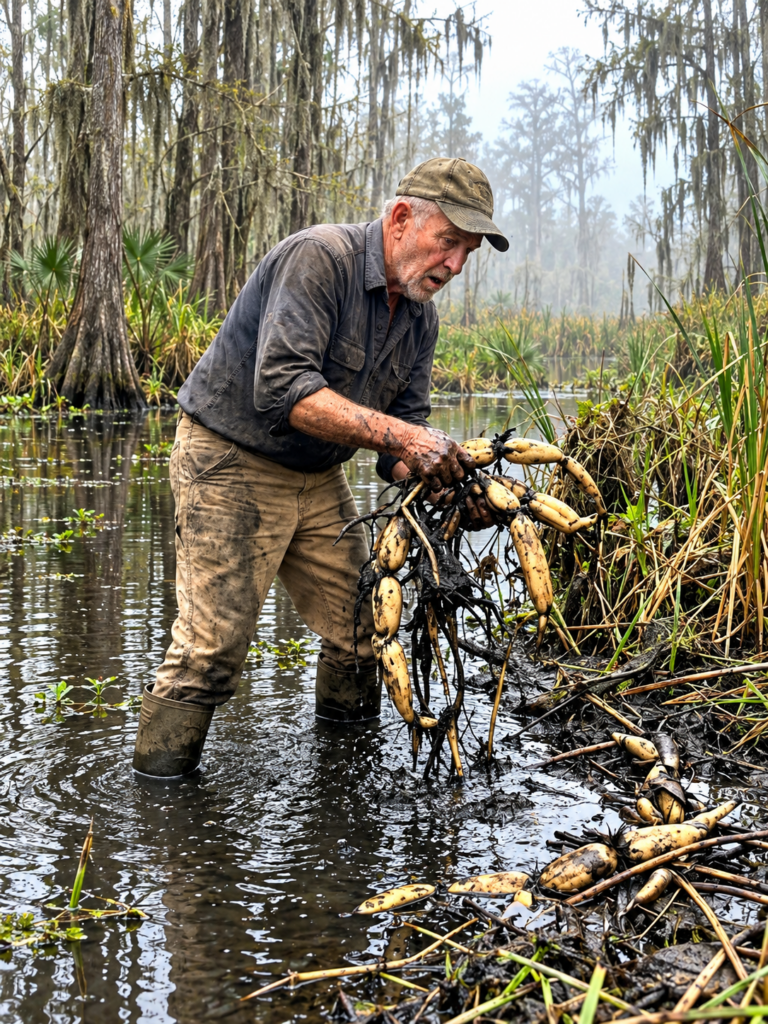
I bent down and grabbed the base of a cattail.
The first pull did nothing.
I shifted my weight, dug my fingers lower into the wet ground, and pulled again.
Something gave beneath the mud.
A thick root came up trailing black slime.
I wiped it on my jacket.
Pale flesh showed underneath.
I stared at it for a long moment.
Then I pulled another.
And another.
Within fifteen minutes, a dozen lay on the frozen ground.
I cut into one and tasted it.
Starchy.
Fibrous.
Faintly sweet.
Exactly the way Dad had described.
On the walk back to the Ford, I carried the roots in an old feed sack.
By the time I reached home, I wasn’t thinking about Pritchard laughing anymore.
I sat at my kitchen table that night with a pencil and a sheet of paper.
Ten acres.
Dense cattails.
Maybe eight thousand plants per acre in the heaviest stands.
Two to four usable roots per plant in a year.
My arithmetic was rough, but even using conservative numbers, the potential ran into hundreds of thousands of roots.
The question wasn’t whether something useful grew there.
The question was whether anybody still cared.
For the next three days, I lived at the library.
I went through old agricultural bulletins, government pamphlets, extension papers, anything mentioning marsh plants or subsistence crops.
Most told me only pieces of what Dad had known.
Then I found a publication from 1936, issued by the Iowa State Agricultural College, dealing with marsh plants of economic value.
There it was.
Cattails.
Roots that could be dried and ground.
Young shoots eaten like asparagus.
Pollen used as a food supplement.
And the seed-head fluff—the soft down that scattered on the wind—had been used for stuffing and insulation. The stuff had even been used in flotation material during wartime.
That changed the question.
Food markets were one possibility.
Fiber was another.
I wrote notes on whatever paper I had, including the back of a deposit slip.
Then I drove to an extension office and asked for somebody who understood wetlands.
The man I spoke with was named Harlan Voss. He was around forty, wore wire-rimmed glasses, and had the careful manner of somebody who had listened to plenty of farmers arrive with ideas they believed would make them rich by Christmas.
I told him about the swamp.
I told him about the cattails.
I told him what I had found.
He listened.
When I finished, he leaned back.
“You’re not wrong,” he said. “The plant’s underused. Trouble is, there’s no real market system for it. No processors set up around here. No distribution. You’d be starting from nothing.”
“What if I didn’t sell it as food?”
He looked at me.
“What if I sold the fluff?”
That made him stop.
He turned, pulled down a binder, and started going through pages.
“There’s a company in Michigan,” he finally said. “Small operation. They’ve been testing biodegradable packing material. Natural fibers. Milkweed. Cattail down. Things like that.”
He wrote something on a piece of paper.
“No promises. But if you can supply clean material in quantity, they might be interested.”
I tucked the name into my shirt pocket.
On the drive home, I thought about my father.
About Granddad.
About how strange it was that a memory from a hungry winter before I was born might still be worth something more than sixty years later.
I called Michigan the next morning.
A woman named Linda Marsh answered.
I told her I could supply cattail fluff. Clean. Dry. Potentially in volume.
“How much volume?” she asked.
“I don’t know yet.”
There was a pause.
I told her I had dense marsh growth and was willing to find out.
She wanted samples.
Moisture content.
Weight per cubic foot.
Contamination notes.
I wrote everything down.
For the next three days I worked the swamp.
I cut mature heads, carried them home, stripped the fiber and dried it on wire racks in the barn beneath heat lamps I normally used for seedlings. I weighed it. Checked it under bright light. Picked out stem pieces. Dried it again.
When I was satisfied, I packed two pounds into a box.
At the post office, Marge Holloway looked at the destination.
“Michigan?”
“Yes.”
“What’s in it?”
“Cattail fluff.”
She blinked.
Then she stamped the box.
I spent the next two weeks harvesting even though I had no idea whether Michigan would call.
Eight burlap sacks accumulated in the barn.
My fingers turned raw. Fine fibers got into my nose and shirt. My back complained.
But I liked the work.
There was something honest about taking value out of ground that required no seed salesman, no chemical bill, and no banker.
Then one Tuesday in late September, the telephone rang.
Linda Marsh.
“We tested your samples.”
I held the receiver tighter.
“And?”
“They’re good.”
I said nothing.
“Better than good, actually. Consistent fiber length. Moisture is right. Very little contamination.”
Then came the words that changed the swamp from an experiment into work.
“We’d like two hundred pounds as a trial. Delivered within sixty days. Four dollars a pound.”
Eight hundred dollars.
For fluff.
From plants growing on land nobody would bid three dollars for.
“I can do it.”
“If the trial goes well,” she said, “we can discuss a contract.”
After I hung up, I stood at the kitchen window looking toward the swamp.
The cattails were brown now, their heads heavy and beginning to split.
Two hundred pounds.
Sixty days.
A man can feel proud for about thirty seconds before arithmetic ruins the celebration.
I needed more than three pounds a day, every day, with no allowance for bad weather, broken equipment, or a seventy-one-year-old back.
So I went back to the swamp.
And this time, I wasn’t wandering around wondering whether I had bought something useful.
I was working an order.
Part 2
I marked the northwest corner with orange baling twine and started before sunrise the next morning.
The air was still at that hour. Water lay dark beneath the cattails. During warmer weather, getting out early also meant finishing part of the work before the mosquitoes found me.
I carried a machete that had belonged to my father.
Wood handle.
Twelve-inch blade.
He had used it clearing fence line in 1967. I kept the edge with a bastard file every few days.
I cut the stalks low and tied them into bundles of twenty with jute twine.
Six bundles.
Seven.
Whatever I could carry back to dry ground.
Then the Ford hauled them to the barn, where I hung them from rafters and left them several days before processing.
Cutting was simple.
Processing was not.
At first I pulled the down by hand.
Too slow.
Too much stem came with it.
Then one afternoon I looked across the barn and noticed an old corn sheller my grandfather had bolted to a bench in 1954.
It had not done meaningful work in decades.
I pulled it loose, cleaned out mouse nests and dust, oiled the moving points, adjusted the hopper, and fed in a dried cattail.
The gears grabbed.
The fluff separated.
The core dropped.
I stared at the machine.
Then I fed another stalk through.
It worked again.
Granddad’s corn sheller could process cattails.
I laughed out loud in an empty barn.
With a steady rhythm I could run thirty stalks an hour.
For the first time, two hundred pounds seemed possible.
By the second week of October, sixty-three pounds were bagged and labeled.
Then the weather turned.
Frost arrived early. On October ninth the edges of the marsh blackened overnight.
I knew what that meant.
My window was closing.
So I worked longer.
The water numbed my feet through the boots. My hands split at the knuckles. Some nights I wrapped cracked skin in electrical tape.
I made a crude sled out of two-by-fours and an old truck tailgate so I could drag bundles from the wetter sections instead of carrying them.
By October twenty-third I had 112 pounds processed and stored against the north wall of the barn.
That week a man named Gerald Pitts from the county extension office drove up in a white Dodge pickup.
Word had apparently traveled through the co-op.
Gerald stepped into the barn and looked at my sacks.
He opened one.
Ran his fingers through the fluff.
Held it toward the light.
“You know the bulk price for kapok substitute?” he asked.
“No.”
“Four to six dollars a pound, depending on purity and moisture.”
He told me some textile buyers wanted natural fiber that met tight specifications—low stem contamination, properly dried.
He took a sample to have tested.
When the result came back, it was six percent contamination and nine percent moisture.
Gerald sounded almost impressed when he called.
“That’s cleaner than a lot of imported material we’ve seen.”
He gave me a buyer.
Riverside Fiber Company in Marietta.
I called.
A man asked how much material I had.
“One hundred twelve pounds. Maybe more.”
“Bring it.”
“What are you paying?”
“Five-twenty a pound if it matches the sample.”
That gave me another market.
I loaded six canvas feed sacks into the Ford and made the drive.
The Riverside building was old brick near the railroad siding. The loading dock smelled of machine oil, burlap, and warehouse dust.
A man named Vernon Coss met me at the scale.
He wore a green work shirt and had ink marks on his fingers.
He weighed each sack separately.
Then he pulled samples from three, rubbed the fluff between his fingers, and disappeared inside.
I stood beside the truck and waited.
Ten minutes later he came back with a check.
Six hundred four dollars.
The total weight was 116 pounds.
“You have more in spring?” he asked.
“I expect to.”
“We’ll buy it. Same quality, same terms.”
I folded the check and put it in my shirt pocket.
The sacks rode home empty.
That was the first time I truly understood what had happened.
The men at the auction had been right about one thing.
The swamp was useless for what they wanted.
Corn.
Beans.
Buildings.
Pasture.
But they had mistaken “useless to me” for “worthless.”
Those are not the same thing.
Winter came.
I kept visiting the marsh.
Cattails dry while standing, and if the heads survive wind and snow, there is still material to harvest.
By Christmas I had cut another sixty pounds and stored it in the loft where air could circulate.
Then, in February, I started studying the rest of the parcel.
The dense swamp itself occupied only part of the ten acres. Beyond it were stretches of willow scrub, softer ground, and patches near the inlet where wild rice grew.
Stony Creek fed water in from the north.
I walked the land on a Saturday when frost had hardened the surface enough to support me.
Muskrat runs marked the bank.
At the back corner I found old beaver-chewed stumps.
The signs confirmed what I already suspected.
The water table stayed high.
Good for cattails.
Good for plants that didn’t need dry feet.
By March, I had a plan.
Clear some willow along the east side.
Let in sunlight.
Let the cattails spread naturally.
No seed bill.
No planting cost.
Mostly chainsaw fuel and labor.
I spent two weeks cutting.
The willow wasn’t worth much even as firewood—too crooked, too thin—so I piled it on high ground.
I left the stumps low.
Cattails wouldn’t care.
Then April thawed everything.
The water rose quickly and covered the low sections like a shallow lake.
For days I could do nothing but stand at the edge.
Then, in early May, I noticed pale green spears breaking the surface where the willow had been.
New cattails.
More each day.
The old roots beneath the mud had been waiting for light.
By June the new growth stood waist high.
The stand was expanding.
That was when I began keeping serious records.
Dad had kept ledgers for hog weights and corn moisture. I found one of his old marbled notebooks and started doing the same.
Date.
Weight harvested.
Condition.
Weather.
June ninth: 140 pounds. Firm. No rot. Overcast.
June eleventh: 162 pounds. Some soft ends. Hot.
Writing the numbers down made the work feel less like an old man experimenting in the mud and more like an operation.
By mid-June I was pulling around 170 pounds of roots per week.
A Hmong buyer began coming regularly.
Then every Saturday.
The van would back toward the barn. The roots were weighed on a hanging scale. Cash was counted out in twenties and tens.
The older man’s name was Khao.
He told me restaurants in the cities wanted more.
My roots, he said, were cleaner and larger than some of the supply he had been getting elsewhere.
That surprised me.
Until then I hadn’t even known there were other suppliers.
The first Saturday in July he handed me $340.
I stood inside the barn holding the money while the smells of mud and drying fiber mixed around me.
I started thinking about the land cost.
About how quickly the swamp was paying its way.
Khao said his nephew was opening another restaurant in St. Paul and wanted a standing order.
“I’ll pull until frost,” I told him.
Demand kept growing.
I cleared another quarter acre along the north side.
Reed canary grass had crowded part of it, so I spent mornings ripping grass from the wet soil, making room for cattails.
Some days the work was so repetitive my mind went completely quiet.
The only company might be a heron standing motionless in the shallows.
By September, the water had dropped several inches.
Mud cracks appeared along the margins.
I pulled roots four days a week, sometimes five.
My hands had changed.
The skin that once split under wet work had hardened into calluses thick enough that I stopped bothering with gloves.
I could work the mud in the morning, load the truck by noon, make a delivery, then return in time to check water and mark the next section.
The swamp had become a routine.
Then Harlan called.
His nephew wanted to see the property.
He brought a woman who worked as a buyer for a distributor in Minneapolis.
Her rubber boots looked new enough to still have store shine on them.
The nephew asked about yield.
Production.
Whether I could scale.
“I’m one man with a spade and ten acres of swamp,” I told him.
The woman walked the perimeter with a clipboard and took photographs.
“Do you own all this outright?” she asked.
“Yes.”
“Ever thought about leasing it to a commercial operator?”
“No.”
She studied me for a second.
Then she let the subject go.
They stayed around forty minutes.
That evening Harlan called again.
“They liked what they saw.”
“How much do they want?”
“Two hundred pounds a week through October. Maybe November if weather cooperates.”
“At what price?”
“Sixty cents a pound, delivered.”
It wasn’t spectacular money by the pound, but standing orders mattered.
Predictability mattered.
I agreed.
After that I started at five-thirty every morning.
I pulled while the mud was cool.
Rinsed roots in the creek.
Spread them across plywood sheets—the same sheets I had once used for drying tobacco.
I bought a hanging scale from the co-op and mounted it to a beam in the barn.
Harlan dropped waxed cardboard boxes on Tuesdays.
I packed the product.
He picked it up Thursdays.
First week: 187 pounds.
Second: 212.
Third: over 220.
The checks arrived every two weeks.
Two hundred forty dollars.
Then 270.
I left the money in the bank.
By the middle of September, more than a thousand dollars sat in the account that had not been there earlier that summer.
When my tractor payment came due in October, I wrote the check without using what I had saved from corn.
For the first time in eleven years, I made that payment and still had money left over.
That mattered more to me than the laughter at the auction.
A man can tolerate being called a fool.
What wears him down is lying awake wondering whether next month’s payment will finally be the one he cannot make.
For years I had known that feeling.
Now a swamp was easing it.
Then Harlan came by late one Saturday in September.
This time he brought an older man from the distributor.
Maybe seventy.
Canvas jacket.
Work boots scarred by enough mud that I knew immediately he wasn’t there for photographs.
He walked slowly through the marsh with me.
Watched how I worked.
Asked how deep the roots ran.
“How do you know where they are?” he asked.
“I feel for them.”
He nodded.
He squatted at the edge of one bed and examined what I had pulled.
Then he said something that made me stop.
“Forty-two years in this business, I’ve never seen ginseng growing this thick in bottomland.”
I looked at him.
He turned the root in his hand.
“Most comes out of mountain country. North Carolina. Tennessee. Better drainage.”
I didn’t answer.
He looked around the marsh.
“You plant this?”
“No.”
Another pause.
Then he said, “Maybe your grandfather did.”
Those words followed me all the way back to the house.
Part 3
That night I pulled out the old family ledger.
Not my new marbled notebook.
The older one.
Granddad’s.
I had read parts of it many times over the years.
Most entries were ordinary enough to put a man to sleep.
Prices.
Weather.
Feed.
Repairs.
Work done.
Money owed.
A farm life reduced to short lines written by somebody too tired at night to waste ink.
I sat at the table turning pages slowly.
Nothing.
More figures.
More notes.
Then, three pages from the back, I saw a line I had passed before without understanding.
Plant it root stock. North quarter bottom land. September 1947. Let it go wild.
I read it again.
And again.
Seven plain words and a date.
No explanation.
No drawing.
No grand statement about leaving something for the future.
Just an instruction.
Plant it.
Let it go wild.
I sat there with my hand resting on the page.
All those years I had thought the swamp was something nobody wanted.
Maybe Granddad had seen it differently.
He had worked marsh ground in 1936.
He had brought roots home to feed his family.
He had lived through years when usefulness was not measured by what a banker could value or what a seed catalog could promise.
Then in 1947 he had planted root stock in bottomland and deliberately left it alone.
If the distributor’s man was right, at least some of what I had been finding had a history far older than my purchase at the county auction.
The land flooded.
The land dried.
Farmers changed.
Roads changed.
Owners forgot.
People stopped talking about old food plants and old roots.
But whatever Granddad had put there kept going.
Not in neat rows.
Not behind a fence.
Not with a sign.
It simply waited.
That realization changed something in me.
For most of my life I had believed patience meant enduring.
Hold on until rain.
Hold on until harvest.
Hold on until cattle prices improve.
Hold on until the bank gives you another season.
But Granddad had practiced another kind.
He planted something knowing he might never be the man who benefited from it.
That was more than patience.
That was faith without an audience.
I kept harvesting through November.
The mornings became harder.
Water skinned over with ice.
Mud stiffened.
My breath showed white.
Eventually, near Thanksgiving, the ground froze hard enough that I had to stop.
By then the year’s work had produced a return I never would have believed while standing beside the auctioneer in March.
The final dried lot brought in about $4,100.
I put half in the bank.
With the rest, I fixed the barn roof and bought what I needed for spring.
I didn’t suddenly become rich.
The Ford was still old.
The barn was still patched.
My back still hurt after a long day in the mud.
The swamp had not turned me into some county legend with money spilling from every pocket.
What it gave me was smaller than that and, to me, more important.
Breathing room.
A tractor payment I could make.
A roof I could repair.
Seed I could buy without wondering which other bill would suffer.
The dignity of earning value from something everyone else had dismissed.
People around town began hearing pieces of the story.
Small towns are like that.
You can keep your mouth shut and still discover that somebody at the feed counter knows what you hauled three counties away the week before.
A few people who had laughed became curious.
Some asked what I was really pulling.
Some wanted to know what buyers were paying.
Some wanted to know whether I planned to expand.
And more than one asked the question Pritchard had never imagined needing to ask:
Would I sell the swamp?
The answer was no.
That confused people almost as much as buying it had.
Land was land, they figured.
If something rose in value, you sold it.
If somebody offered enough money, you took the profit and moved on.
But I no longer saw those ten acres as the county had described them on the auction sheet.
I didn’t even see them as a crop.
I saw my grandfather writing a note in September of 1947.
I saw my father telling a twelve-year-old boy that cattail roots had once kept people fed.
I saw the old McCormick sheller turning after decades of silence and stripping fiber clean as if Granddad had left that behind for me, too.
I saw the marks in the mud where muskrats moved.
Willow stumps.
Young cattails appearing where sunlight finally reached water.
I saw a piece of family memory nobody had thought important enough to call an inheritance.
The swamp remained wet.
It still smelled of decay in summer.
Mosquitoes still rose in clouds.
A tractor could still disappear to its axle in the wrong spot.
There was still no miracle road into it.
A developer still couldn’t build houses there.
Pritchard still couldn’t plant corn on it.
None of that had changed.
What had changed was the measure.
One afternoon I ran into a man who remembered the auction.
He smiled.
“Still got that mud hole?”
“I do.”
“You ever figure out what it’s good for?”
I looked at him.
There were a dozen ways I could have answered.
I could have told him what the fiber brought per pound.
I could have told him about the restaurants.
The distributor.
The standing orders.
The old ledger.
The ginseng.
The roots.
The marsh expanding into cleared ground.
I could have produced numbers until he stopped smiling.
Instead I said, “Enough.”
Because by then I understood something that numbers couldn’t quite explain.
For years, farming had taught me to fight the land.
Drain it.
Plow it.
Straighten it.
Dry it.
Clear it.
Plant what the market wanted.
Spray what threatened the crop.
Push yield.
Push acreage.
Push machinery.
Push yourself.
But the swamp worked differently.
The more closely I watched it, the more obvious that became.
The first profitable thing I had done was not changing the land.
It was paying attention to what was already there.
Even when I cleared willow, I wasn’t forcing a new crop into the ground. I was giving the old one enough light to return.
The plants spread without asking me to buy seed.
Roots multiplied beneath water where conventional farm equipment was useless.
The ground everybody called bad was excellent ground for something else.
That was the lesson.
Not that every swamp hides money.
Not that every forgotten root will save a farm.
The lesson was that people become dangerous to themselves when they decide value has only one shape.
My father’s generation knew things mine had gradually stopped needing to know.
His father’s generation knew more.
They knew which plants survived poor soil.
What could be eaten after frost.
What could be dried.
What could be stored.
What animals meant water was nearby.
What trees meant the soil stayed wet.
What a family could use when cash disappeared.
Modern farming gave us machines bigger than anything Granddad had imagined.
Better seed.
Better fertilizers.
Better roads.
Better markets.
But every improvement made it easier to forget something older.
Then trouble came, and sometimes the forgotten things were the ones still standing.
I kept the deed.
The original paper I had signed on the hood of the Ford.
Every now and then I took it out and looked at the figure.
Ten dollars.
It was almost embarrassing.
Not because I had paid too much.
Because everybody else had been so certain it wasn’t worth even that.
I remembered Harlan trying to get five.
Then three.
Thirty men standing around with their hands in their pockets.
Men who knew land.
Men who could judge corn ground from the highway.
Men who could estimate a harvest from the color of a field in July.
They looked at standing water and cattails and saw failure.
I looked at it and almost saw the same thing.
Almost.
The only difference was that a dead man’s voice interrupted me.
My father had given me a memory.
My grandfather had left something deeper in the ground.
Neither man had known exactly what I would do with it.
That may have been the best part.
An inheritance does not always arrive through a lawyer.
Sometimes it is a sentence remembered sixty years later.
Sometimes it is a machine rusting in a barn.
Sometimes it is seven words in an old ledger.
Sometimes it is a root planted where everybody else sees mud.
The next fall I went back.
By then I knew the ground better.
I knew which areas stayed firm longest.
Which channels held deeper water.
Where new shoots came strongest.
I knew when to harvest and when to leave a section alone.
I knew where the cattails had moved into cleared ground.
I knew which part of the marsh would swallow a boot if I stepped carelessly.
The place no longer looked like a mess.
It had a pattern.
Not rows.
Not fences.
Not the geometry of cornfields.
But a pattern.
The marsh had its own order, and the older I got, the less I felt the need to force it into mine.
The money continued to matter, of course.
A man who says money does not matter has usually had enough of it.
I had bills.
Equipment.
Repairs.
Taxes.
Fuel.
Food.
The swamp’s income bought real things.
It relieved real pressure.
But the most important change was harder to enter into a ledger.
Before I bought those ten acres, I had spent years feeling like the world had moved past the kind of farmer I knew how to be.
Operations were getting bigger.
Margins thinner.
Equipment more expensive.
Debt easier to acquire and harder to escape.
Every season seemed to demand more acres, more machinery, more yield, more risk.
A seventy-one-year-old man with an old Ford and a patched barn could feel small in that world.
Then the swamp gave me work my age did not disqualify me from understanding.
Slow work.
Observant work.
Work where an old memory had value.
Where knowing what my father had said could matter more than owning a newer tractor.
Where Granddad’s ledger could tell me something no bank officer knew.
I began to understand why he had written, Let it go wild.
He had not abandoned the planting.
He had trusted it.
There is a difference.
By the time people started asking why I hadn’t sold, I had my answer.
You don’t measure every piece of land by what it can do this season.
Some ground carries memory.
Some things need years before anybody understands why they were saved.
Some need decades.
That swamp outlived the men who first knew what grew there.
It outlived bad prices, wet years, dry years, auctions, unpaid taxes, changing owners, and generations that stopped recognizing what was beneath their boots.
Yet the roots remained.
The cattails remained.
The old machinery remained.
The ledger remained.
And somehow I remained long enough to bring those things together.
Maybe one day I’ll be too old to work the mud.
That is not a sad thought.
I was already seventy-one when I started.
Every year after that was extra.
When my legs no longer trust the soft ground and my hands can’t grip the tools, the swamp will not care.
The cattails will still rise.
Roots will still travel beneath the mud.
Water will still come through Stony Creek.
Herons will stand in the shallows.
Muskrats will cut their runs through the banks.
Willow will try to reclaim whatever sunlight I opened.
That is what wild ground does.
It carries on without needing applause.
Maybe somebody younger will understand what is there.
Maybe they won’t.
Maybe the place will be forgotten again.
But I know now that forgetting does not always destroy a thing.
Sometimes it protects it.
Had everybody remembered what the land held, perhaps somebody would have bought it long before me.
Had it looked valuable, the county would never have offered it for nearly nothing.
Had the road been good and the ground dry, somebody might have bulldozed the whole place.
Its apparent worthlessness may have been the reason it survived.
That thought makes me smile whenever I remember Pritchard.
“What in God’s name are you going to do with a swamp?”
At the time I told him I guessed I would find out.
That was more truthful than I knew.
I found out that my father’s old stories were worth remembering.
I found out Granddad had planted for a future he would not live to see.
I found out a machine built for one job could perform another forty years later.
I found out buyers existed for materials most farmers walked past every day.
I found out mud could pay a tractor bill.
I found out old men are not necessarily finished because younger men have stopped asking what they know.
Most of all, I found out land can remember what people forget.
That is why I never sold.
To somebody driving past, it was still ten acres of weeds and water.
To me it was a conversation stretching across three generations.
Granddad started it with a root in 1947.
Dad carried it with a story.
I answered it with a ten-dollar bill at a county auction.
And the swamp answered back.
Not all at once.
Not with treasure.
Not with a miracle.
It answered in pounds.
In wet boots.
In cracked hands.
In sacks stacked against a barn wall.
In checks folded into a shirt pocket.
In a ledger line finally understood after half a century.
That was enough.
More than enough.
People like Pritchard thought I bought ten acres no one wanted.
Maybe they were right.
But standing there years later, with the cattails moving in the wind and black water shining between the stalks, I came to believe I had bought something else.
A reminder.
What looks useless may simply be useful in a way you have forgotten.
What looks empty may be holding something out of sight.
And what looks like an old man’s foolish purchase may be the last link in work begun long before he arrived.
The deed said I owned the swamp.
I never quite believed that.
I was only the man holding it for a while.
Granddad had understood that better than I did.
Plant it.
Let it go wild.
So I did.


