
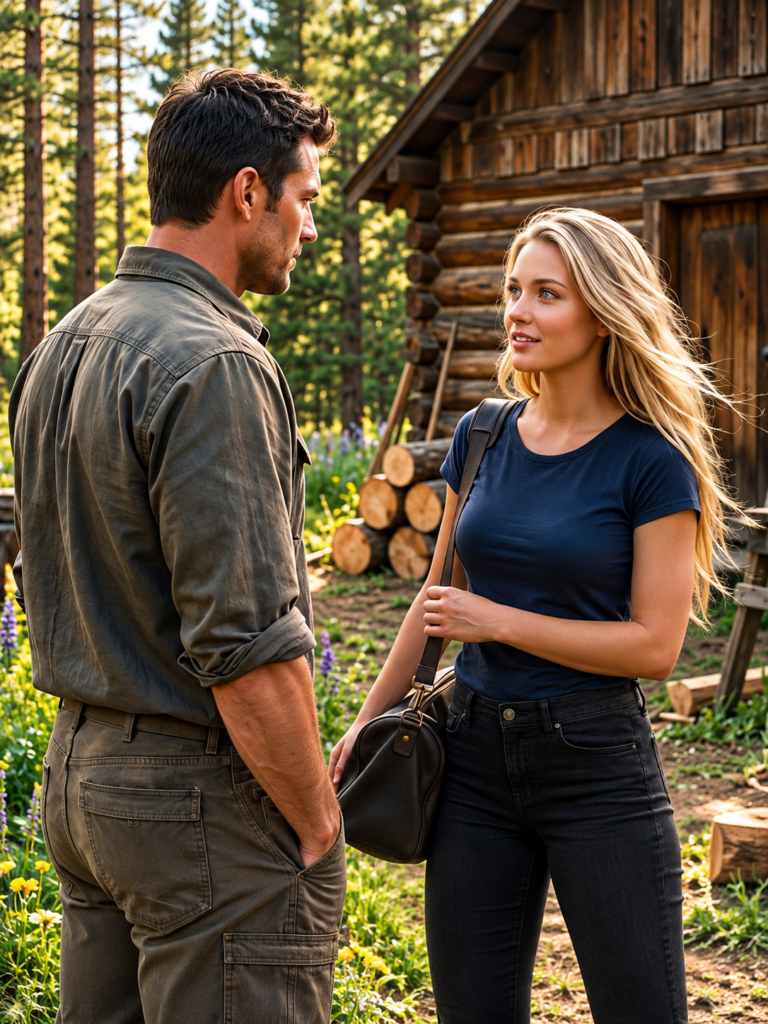
“Didn’t think a woman could look this good covered in sawdust, did you?” she said, pulling the work gloves off one finger at a time, eyes locked on mine.
I looked her over once.
“Slow.”
“No,” I said. “I really didn’t.”
She set the gloves on the sawhorse and picked the sander back up without looking away.
“Then quit staring and hand me the mask.”
I handed it over.
Slow.
I’m Tanner Ree.
I fix things nobody else wants to touch anymore.
Old barns leaning half a foot off plumb. Forgotten cabins with rot in the sills. Bridges that were never framed right the first time around.
I’m 40 years old, grew up in the foothills of the Bighorns in northern Wyoming, and I learned this trade from a grandfather who figured if a thing was worth building, it was worth building until your hands bled a little getting there.
First warm Monday in May.
I was alone on a mountainside with a half-collapsed homestead cabin, a thermos of black coffee gone lukewarm, and absolutely no plan to be interrupted by anything.
That, naturally, is exactly when she showed up.
I heard the engine before I saw it.
A clean white SUV working its way up the switchback with all the hesitation of somebody who’d never driven a road like that in her life.
The snowmelt had turned the lane into a paste that grabbed its tires and let go with a sound like something alive.
I was up on the east wall of the cabin, chipping out rotted chinking between the old logs, when the SUV came around the last bend and stopped in the drive like it expected a valet to come take the keys.
She stepped out, and I’ll say it plain.
She wasn’t what I’d have pictured.
Not that I’d been picturing anyone.
The Ashkcom family trust had hired me through a property management firm out of Boston 6 weeks back.
A billing address and nothing else.
No contact name on the paperwork.
I’d been up on that mountain alone 11 days straight.
So when this woman climbed down in city flats, clean leather, the kind that’d be ruined inside of 40 feet, with a heavy duffel over one shoulder and hair the color of wheat catching the morning light, I just stood there with my chisel in hand and watched.
She took in the scaffolding, the tarp over the bad section of roof, the green logs stacked and drying in the yard.
Her face did something complicated.
Then she looked at me.
“You must be the contractor,” she said.
“And you must be lost,” I said.
She almost smiled.
“Vivien Ashkcom. My family owns this property.”
Behind her, the passenger door opened and a man in a suit stepped out, phone already up in one hand, picking his way around a puddle like the ground had personally wronged him.
Foster Lang, family attorney.
He launched straight into something about documentation and scope of work.
“Drive back down,” I told him. “Road softens by mid-morning. You’ve got maybe 40 minutes before you’re calling a tow instead of a meeting.”
He looked at Vivien.
She looked at me.
That unreadable look I’d get used to over the weeks that followed.
The look of somebody deciding in real time whether they were furious or curious.
Then she told Foster to go.
He didn’t care for it.
Made a small production of leaving, pressed a card into her hand, gave me a look meant to land like a warning.
The white SUV disappeared behind the treeline a few minutes later.
When I turned back around, Vivien was standing alone in the mud with her duffel and her ruined shoes and the expression of somebody who’d just sent away the last thing tethering her to civilization.
“Pump’s out,” I said. “No running water till I fix it. Stove needs calibrating before you use it. Bunk room in back is sound. Everything else, assume it’s mid-repair.”
“Okay,” she said.
Just that.
No negotiating, no complaint about the mud or the shoes.
I turned and walked toward the cabin and heard her footsteps behind me, slow and careful, picking through the muck on nothing but sheer determination.
I didn’t offer to carry the duffel.
She didn’t ask.
That’s how it started.
I didn’t know yet what she was running from, or what her father had sent her up that mountain to learn, or what was gathering in the valley below like weather.
All I knew was the pump was broken, the log work needed finishing before the next rain came through, and there was suddenly a woman in city clothes standing in the middle of my job site, looking up at the mountain like she was deciding whether or not to be afraid of it.
She wasn’t.
That turned out to be both her best quality and her most dangerous one.
The first three days she watched.
Not uselessly.
She wasn’t the type to stand in a doorway with her arms crossed doing nothing.
She watched the way somebody does when they’re cataloging information, filing it away, deciding what to do with it later.
I’d look up from a joint I was cutting or a section of subfloor I was pulling out, and she’d be nearby, quiet, taking it all in.
When she asked questions, they were good ones.
Not, “What’s that for?”
But, “Why that angle? Why that wood? Why now and not after the weather clears?”
I gave her straight answers because they were straight questions.
On the fourth day, she asked if she could help.
I handed her a dust mask and pointed her at the interior log wall.
Three courses of old pine gone gray with age, soft in a few spots, needing to come back to bare wood before I could seal it.
Slow work.
Loud work.
The kind that fills your lungs and your hair with fine pale dust whether you like it or not.
She put the mask on without a word of complaint and started at the near end of the wall with the block sander.
She didn’t quit.
That surprised me more than anything else about her.
By noon, her arms were shaking slightly, and I could see the beginnings of blisters at the base of her fingers through the work gloves.
But her head stayed down, and she kept moving.
I brought her water and set it on the sawhorse without saying anything.
She drank it without breaking her rhythm.
Her phone rang that afternoon.
She glanced at the screen, something shutting behind her eyes, and let it ring itself out to voicemail.
It rang again 20 minutes later.
Same result.
I didn’t ask.
Wasn’t my business.
But I noticed.
Gus Proo showed up on day five in his old Chevy.
Two-tone rust and primer, rattling up the lane like it was held together purely by stubbornness.
Gus had worked with me on and off for six years, a weathered, unhurried man who said even less than I did, which was saying something.
He climbed down out of the cab, took one long look at Vivien standing in the yard with sawdust on her jacket and her hair tucked up under a wool cap, and muttered just loud enough to carry, “That one’s trailing money and trouble in equal parts, I’d guess.”
She heard every word of it.
I saw it land in the set of her jaw.
She didn’t turn around, didn’t so much as flinch.
Just kept stacking scrap lumber.
Gus caught my eye.
I gave him nothing back.
He had the good sense to get to work after that.
Later, she tried to buy her way out of the discomfort.
Not crudely.
She wasn’t crude about anything she did.
She’d found a number for a water-hauling outfit and a plumber two counties over, and she laid the information on the workbench beside me with the quiet efficiency of somebody used to problems dissolving the second money touched them.
“I can cover both,” she said. “It’d be faster.”
I looked at the paper, then at her.
“I’ll have the pump running by tonight.”
“It doesn’t have to be your problem to solve.”
“It’s my job, and I’m not letting you pay me twice for it.”
I folded the paper and handed it back.
She held on to it a second, then set it aside without arguing.
But something crossed her face.
Not anger exactly.
More like a person quietly recalibrating to a world that wasn’t behaving the way worlds usually behaved for her.
The night that actually changed everything between us started with something as small as a headache.
The pump ate up most of the afternoon.
I had it running by 5, washed up in a cold trickle off the newly fixed line, and came inside to find Vivien at the small table in the corner, laptop open, working with a kind of stillness that means somebody’s deep in something that actually matters.
She wasn’t answering emails.
The screen was full of columns, legal language, something structured and deliberate.
She closed the lid when she heard me.
Not fast.
Just unhurried, like a person with nothing to hide who simply preferred her privacy.
That night, the mountain went cold fast, the way it does in early May once the sun drops and the snowfields above the treeline remember exactly what they are.
I lit the stove and we ate in near silence.
Canned soup.
Bread.
The radio turned low.
Outside, the spring dark settled in thick over the pines.
Neither one of us knew yet what was coming.
The stove ticked away quietly.
The flue, I’d realized far too late, had a problem I hadn’t found on inspection, and the night was about to get considerably worse before it got better.
I woke around midnight with a headache sitting behind my eyes like somebody had a thumbscrew pressed to my skull.
That alone should have told me something.
I’m not a man who wakes up with headaches.
I lay still a second, cataloging the low tick of the stove, the deep mountain quiet outside, and something underneath it.
A thickness in the air.
Subtle.
The way real danger usually is right before it turns obvious.
I was on my feet and at Vivien’s door in under 10 seconds.
She was alive but wrong, breathing shallow, slow to respond when I shook her shoulder.
I got her up by the arm, half carried her through the cabin and out onto the porch, where the cold May air hit us both like a wall of clean water.
She doubled over with her hands on her knees, pulling in long, ragged breaths.
I stood next to her doing the same.
The night huge and starry above the treeline, the mountain entirely indifferent to the whole business.
“Don’t go back in,” she managed once she had enough air to say it.
I went back in anyway.
The flue had a partial blockage, a collapsed section of old clay liner sitting just above the first elbow, one I hadn’t gotten to yet on inspection.
Starved of proper draw, the stove had been backdrafting for hours, pushing carbon monoxide quietly into the cabin while we both slept through it.
I worked in short bursts, ducking back to the doorway every minute or so for air, breaking the blockage loose with a length of rebar and a long-handled brush until I felt the draft finally pull clean again.
Then I hauled the generator around to the far side of the woodshed.
It had been sitting too close to the cabin wall, and I reset the exhaust line away from the window gap I’d been meaning to seal all week and hadn’t gotten to.
My knuckles were split open from the rebar work.
My nose had caught the edge of a low beam somewhere in the dark and was bleeding freely by the time I came back out onto the porch.
Vivien was sitting on the top step, wrapped in the wool blanket from her bunk, hair loose around her shoulders, face pale in the starlight.
She looked at me.
The blood.
The split knuckles.
The general state of things.
And didn’t say anything for a long moment.
“I told you not to go back in,” she said finally.
“Flue’s clear. Generator’s moved. It won’t happen again.”
She was quiet.
Then, “Sit down, Tanner.”
First time she’d used my name.
I sat down beside her on the step.
She tore a clean strip off the hem of an old undershirt she’d grabbed on the way out.
Practical.
No ceremony to it.
And handed it to me for my nose without a word.
I took it.
We sat there in the cold dark a while, the pines breathing around us, the adrenaline slowly stepping down out of my blood.
“My father sent me up here,” she said eventually.
Not a confession exactly.
More like something she decided I’d earned the right to hear.
“He thinks this place will humble me. Teach me I can’t manage everything from three states away with a laptop and a good lawyer.”
I didn’t say anything.
I’d already figured most of it.
“He’s controlled every major decision in my life since I was 19,” she said. “The company, the trust, my apartment, all of it set up so nothing moves without his signature.”
“He thinks that’s protection.”
She paused.
“It isn’t.”
The mountain held its silence around that for a moment.
“What’s in the blue folder?” I asked.
I’d seen it on the table three times by then, always closed and moved before I got close enough to read a word of it.
She looked at me sideways.
Something shifted in her expression.
Not surprise exactly.
More like somebody deciding how much of the hand to show.
“Something I’ve been building,” she said. “For a while now.”
She didn’t say more.
I didn’t push.
But I thought about the columns of numbers on that laptop screen.
The legal language.
The calls she wouldn’t take.
I thought about the way she’d handled Foster Lang on day one.
Not with anger, but with quiet, decisive authority.
Like somebody who’d been planning something patient and thorough for a very long time.
We went back inside once the air tested clean, left the door cracked an inch against the cold.
I checked the stove twice before I trusted it to run.
She went back to her bunk without another word, but something had shifted between us out there in the dark.
Some last layer of distance had burned off along with whatever had been sitting in that flue.
Here’s the thing about a near disaster.
It has a way of stripping the performance out of two people faster than months of ordinary time ever could.
I didn’t expect that to apply to her.
I was wrong.
After that night, something settled between us that wasn’t quite comfort and wasn’t quite ease either.
More like a mutual, unspoken agreement.
The kind that works best precisely because nobody says it out loud.
We were finished performing for each other.
She stopped moving the blue folder when I came near the table.
I stopped pretending I hadn’t clocked it.
The work carried on.
The cabin came together in the slow, honest way real restoration always does.
Not fast.
Not dramatic.
Just measurable in increments at the end of each day.
A wall sealed here.
A doorway reframed there.
The north roof finally watertight after a full day up on the scaffolding in a cold drizzle neither of us mentioned.
Gus came and went, watchful, doing his work without editorializing.
He’d stopped making comments about money.
I took that as progress.
Vivien worked alongside us most mornings by then.
Not performing anymore.
Not trying to prove a single thing.
Just present, useful, willing.
She developed a particular focus on the interior finish work, the kind of patient detail that some people have in them and some don’t.
She had it.
Her hands had toughened up.
The blisters from that first week had hardened into calluses.
She examined them one evening with something that looked a lot like quiet satisfaction.
One afternoon, I came in from the yard and found her sitting on the floor of the pump closet, back against the wall, knees drawn up.
Not on the laptop.
Not working.
Just sitting.
Her eyes were dry when she looked up at me.
But the room had a particular stillness to it that told me she’d been crying not long before and was finished with it now.
“Bad news from the valley?” I asked.
She considered the question seriously, the way she considered everything.
“Depends how you look at it,” she said. “I filed the last covenant trigger this morning. My father will know by end of day.”
A pause.
“He’s going to be furious.”
“Covenant trigger?” I said.
“A clause buried in the original trust document. If certain conditions get met simultaneously, the controlling trustee has to give up discretionary authority.”
She said it the way I’d explain a load calculation.
Plain.
No drama in it.
“I’ve been working toward meeting those conditions for 14 months. This morning was the last one.”
I leaned against the doorframe.
Outside, the May afternoon was running gold through the pines, the kind of light that makes a mountain look like it was arranged on purpose.
“That’s what’s in the blue folder,” I said.
Not a question.
“Part of it,” she said.
She held my eyes a beat.
“The rest is something I’ve been thinking about since about day three up here. Maybe earlier.”
I waited.
She didn’t say more.
But she held my gaze a little longer than she needed to, and I felt the particular weight of something already decided but not yet said out loud.
Her father called that evening.
She took it outside, standing at the edge of the yard where the ground dropped off toward the valley, the last light behind her, her hair moving in the cold updraft off the slope below.
I couldn’t make out words.
Just the shape of the conversation.
His voice loud through the phone, even at a distance.
Hers low and level, never once climbing.
When she came back in, she set the phone face down on the table and stood there a moment, palms flat against the wood.
“He’s signing the property over,” she said. “The cabin, the land, all of it. His lawyers will have the deed ready by end of week.”
She looked up.
“He didn’t have a choice left. I made sure of that.”
There wasn’t any triumph in her voice.
Just the quiet weight of something long and hard finally finished.
I understood that particular exhaustion.
The kind that comes not from losing, but from winning something that should never have needed fighting for at all.
“You did all that from up here,” I said. “Between sanding sessions.”
Something loosened in her face.
Then the first real, unguarded smile I’d seen off her, brief and genuine, and gone almost as fast as it landed.
“And one cry in the pump closet,” she said. “Don’t leave that part out.”
I didn’t say anything back.
But I think she already knew I wouldn’t.
That night, I stayed up late at the work table, going over the licensing paperwork I’d been hauling around in my bag for 2 weeks.
Ridgeback Restoration.
The name I’d picked out a couple years back for a business I hadn’t quite let myself believe was actually coming.
The cabin sat quiet around me.
The stove drawing clean now.
The mountain dark and steady outside.
Somewhere in the back room, Vivien was at her laptop again, the blue folder open beside her.
Neither of us knew the envelopes were already in the mail.
They showed up on a Thursday morning.
Two of them, side by side on the cabin’s front step, left by the county mail carrier, who’d learned by then not to bother knocking.
The air smelled like fresh grass and pine sap and something faintly sweet drifting down off the slope above.
The small white wildflowers that had been pushing up along the drive all week had finally opened all the way.
I got to both envelopes before Vivien was even out of her bunk.
I set hers on the table and carried mine to the window.
Ridgeback Restoration.
Officially licensed.
State of Wyoming.
Contractor classification.
Two years of paperwork.
Three rejections.
One resubmission that had cost me a lawyer I couldn’t quite afford, and a month of sleep I never got back.
I read it twice.
Then I folded it carefully, set it down beside her envelope, and went to put coffee on because I didn’t know what else to do with my hands right then.
Vivien came out of the back room in her work clothes, hair loose, and stopped when she saw the two envelopes sitting there.
She picked hers up, read it standing at the table, and went quiet for a long moment.
Then she set it down flat, smoothed it once with her palm, and looked out the window at the mountain.
“It’s done,” she said.
Not really to me.
More to herself, or to the mountain, or to the 19-year-old version of herself who’d first understood exactly what her father’s control had actually cost her.
I let it sit.
Didn’t interrupt it.
Then she reached under the table and brought up the blue folder, set it between us with the same quiet deliberateness she brought to everything.
No preamble.
No performance.
I opened it.
Inside was a partnership agreement, clean and complete, drafted with a kind of precision that told me she’d spent real time on it.
The business name at the top read Ridgeback Restoration.
My name on one line.
Hers on the other.
Even split.
Kept simple.
She’d handle the money, the contracts, the Foster Lang-shaped problems that showed up in good suits and needed managing before they turned expensive.
I’d handle the work, the crews, the calls at 3:00 in the morning when something broke or buckled or came apart in the dark.
At the bottom, one line in her sharp, angled handwriting:
“The cabin is the office and home, if you want it to be.”
I read it through twice.
Careful.
The same way I’d read the license.
Taking in every clause the way I’d take in the load-bearing details of a structure I was about to trust with my weight.
It was good work.
Honest.
Built to last, not to impress.
I picked up the pen she’d set beside the folder and signed where my name was printed.
Set the pen down.
She picked it back up without hesitating and signed underneath me, her name sharp and clean as a ridgeline against the white page.
Then she capped the pen, set it aside, and came around the table.
“You’re not just my contractor anymore,” she said.
She kissed me slow and certain.
Nothing rushed about it.
No crisis behind it this time.
Just spring air coming through the open window.
Pine on the breeze.
And two people who’d spent three weeks building something real out of old wood and bad paperwork and one very dangerous night, and had arrived without quite meaning to plan it right here.
I put my hand against her jaw and kissed her back the same way.
Like something that had been decided a long time ago and was only now getting said out loud.
The door opened.
Gus stood in the frame with his thermos and his truck keys and the look of a man who’d walked into a room and understood the whole situation inside of two seconds.
He looked at the envelopes on the table.
Looked at us.
Looked at the cabin.
The sealed walls.
The true floor.
The clean-drawing stove.
The windows letting in the full bright length of a May morning.
He shook his head slowly, and the corner of his mouth pulled into the closest thing to a grin I’d seen out of him in six years of working together.
“Always figured this place was worth saving,” he said.
He poured himself coffee off the stove, carried his thermos out to the porch, and left us to it.
Outside, the mountain sat green and gold and entirely unbothered.
The wildflowers were open the whole length of the drive.
And somewhere down in a valley, a man in a very good suit was learning, a little too late, that the thing he’d sent his daughter up that mountain to break had gone and made her unbreakable instead.
I looked at Vivien.
She looked at me.
The license and the deed and the partnership agreement sat on the table between us like the foundation of something only just started.
We got to work.


